Slashdot Mirror
Domain: sciencemag.org
Stories and comments across the archive that link to sciencemag.org.
Comments · 1,625
-
Desensationalised
I admit not having read the clickbait (this is
-
Mouse studies
I found the quote:
http://www.sciencemag.org/cont...
Science 18 July 2014:
Vol. 345 no. 6194 pp. 252-257
DOI: 10.1126/science.345.6194.252
The elusive heart fix
Jennifer Couzin-Frankel“In mouse studies there's always dramatic improvement,” says Joseph Wu, a cardiologist studying stem cells at Stanford University in Palo Alto, California. “Once you go to a large animal study, it's moderate improvement, once you go to a phase I trial, it's decent improvement, and once you go to phase II, phase III, there's no improvement. This happens again and again and again. It's the entire field of biological research.”
-
Roundup of Ebola drugs and vaccines in Science
Science magazine had a good article about the drugs being developed for Ebola. One drug, TKM-Ebola, is in Phase I trials, but the FDA put them on hold because they wanted to change the protocol to protect participants' safety.
One researcher, Erica Ollmann Saphire, said that, because of the high case fatality rate, if she were exposed to Ebola, "I'd run for the freezer and ask for forgiveness instead of permission." But in cases like this, they usually can get FDA permission, under compassionate use. One German researcher got a needlestick, and they rushed the VSV-vaccine to her. But those were individual cases, in western hospitals, and they can't give an untested drug to a population in Africa (although some American pharmaceutical companies have tried that, and it didn't go too well).
http://www.sciencemag.org/cont...
Science 25 July 2014:
Vol. 345 no. 6195 pp. 364-365
DOI: 10.1126/science.345.6195.364
Infectious Diseases
Ebola drugs still stuck in lab
Martin EnserinkFor you suckers who are stuck behind the paywall, it had a good table that summed it all up:
VACCINES
VSV-based vaccines. Profectus BioSciences; Public Health Agency of Canada
Adenovirus-based vaccines. At least three different labs/companies
DRUGS
TKM-Ebola (RNAi-based). Tekmira Pharmaceuticals Corp. In phase I trials, but the FDA put a hold
Nucleoside analog. U.S.Army Medical Research Institute of Infectious Diseases
Monoclonal antibodies. Many labs/companies
AVI-7537 (antisense-based). Sarepta Therapeutics.
Everybody who does clinical research knows that most of the drugs that work great in mice, work reasonably well in monkeys, passably well in Phase I trials, poorly in Phase II trials, and not at all in Phase III trials.
There were a few articles in the New England Journal of Medicine on the FDA's fast track approvals. They found that when the FDA started speeding up drug approvals, they started approving more drugs with life-threatening side effects that had to be withdrawn from the market.
Of course, if you're dying of a disease now, the calculus is different.
-
Re:The problem is...
We have had the ability for quite some time to synthesize viruses from scratch (the first report in the scientific literature came from the laboratory of poliovirus from scratch, published in 2002). So, there is no reason to keep smallpox stocks around because we can just synthesize the virus if we need it. While this technology means that anyone with sufficient resources could download the (publically available smallpox genome, and synthesize it, the same technology also enables scientists to more rapidly generate vaccines without having to start with a physical sample of the virus.
-
Re:The problem is...
We have had the ability for quite some time to synthesize viruses from scratch (the first report in the scientific literature came from the laboratory of poliovirus from scratch, published in 2002). So, there is no reason to keep smallpox stocks around because we can just synthesize the virus if we need it. While this technology means that anyone with sufficient resources could download the (publically available smallpox genome, and synthesize it, the same technology also enables scientists to more rapidly generate vaccines without having to start with a physical sample of the virus.
-
Re:Just an opinion...
Given how relatively time-consuming research is(and how negative results, however valid, tend to have difficulty moving papers), it would be...surprising... to hear that one percent of the scientists are co-authoring 41 percent of the papers on sheer productivity.
Actually, not so surprising, depending on how the analysis is done. And it also depends a lot on how you want to measure "sheer productivity". A supervisor who helps design the experiment, interpret the data, write the paper, and communicate with journal editors probably spends fewer hours than the trainee (grad student or postdoc) who actually does all the bench work--but that doesn't mean that the supervisor hasn't earned an authorship credit.
If Alice, Bob, Carol, Dave, and Elsa are all graduate students in Dr. Frink's lab, and each of those students publishes two papers over the course of their PhD programs, then all of those students are going to be authors on 2 papers each, and Frink will be an author on 10 papers. Dr. Frink is 1 out of 6 scientists - a bit less than 17% - but is on 100% of the papers. If you have a big lab in a relatively hot (or well-funded) field, then your name is going to be on a lot of papers.
And papers these days - especially the high-impact, widely-read, highly-cited papers - tend to have a longer list of authors. If you look at the table of contents for the most recent issue of Science, the two Research Articles have 26 and 12 authors. Out of the dozen or so Reports, one has 4 authors, two have 5, all the rest have more. Speaking personally and anecdotally, my last three manuscripts (in the biomedical sciences) had 8, 3, and 7 authors.
Going back to "1% of scientists are on 45% of papers"--well, if those are all six-author papers, then that top 1% is only responsible for a 7.5% share (45 divided by 6) of the "output". Given that there is a very long tail of authors who only have 1, 2, or 3 authorships in their lifetime (the majority of PhD graduates never end up conducting research as university faculty; there just aren't enough jobs), I am willing to believe that there is a small fraction of productive, top scientists whose names are on a disproportionately large share of papers.
-
Jane is Lonny Eachus is a pathological liar
You can argue if you like that a ~ 27.3% increase is large but I disagree, since climate sensitivity to CO2... [Jane Q. Public, 2014-07-07]
Ocean acidification is independent of climate sensitivity, and it's another reason to be concerned about the unprecedented rapidity of our CO2 emissions.
I would also like to point out again that even if acidification is happening, the RESULTS of that acidification are probably less than alarmists have claimed. Example (2010 article): http://www.rationaloptimist.co... [Jane Q. Public, 2014-06-10]
Lonny Eachus also linked to that misinformation from Matt Ridley, a journalist with a long history of distorting climate science.
In contrast, I quoted from Honisch et al. 2012 (PDF), Knoll et al. 2007 (PDF), and Ken Caldeira’s 2012 AGU lecture. That last link was from my videos section which also includes:
- Andrew Dickson gave a technical 2009 presentation called “Acidic Oceans: Why Should We Care?”
- A series of panels at the 2011 AGU discussed declining reef health and tipping points.
I'm not a chemist or a marine biologist/ecologist, so I read peer-reviewed papers and go to conferences like the AGU to watch lectures by scientists who do specialize and publish in those fields. For instance, consider that 2011 AGU panel on declining reef health. Nina Keul observed one species of foramanifera Glas et al. 2012 (PDF) growing faster as carbonate ion concentration decreases (which happens when CO2 increases). She provided context by noting that this is one species from one experiment, noting that this is like looking at one puzzle piece of a big puzzle.
Then Adina Paytan provides further context by noting that most species aren't like this. She shows Fig. 2 from Crook et al. 2012 (PDF) which shows that only ~3 out of 9 species of coral are present in locations with naturally low pH and notes that "Because these three species are rarely major contributors to Caribbean reef framework, these data may indicate that today’s more complex frame-building species may be replaced by smaller, possibly patchy, colonies of only a few species along the Mesoamerican Barrier Reef."
Finally, Robert Ridin
-
Re:
Apparently admitting what I don't know is a fault in your book. Yes, I am not well read on the land ice mass issue. But thank you for providing more information. It weakens what some AGW proponents are saying, and helps balance my understanding. There appear to be conflicting reports. Someone should tell the guys at skeptical science to get their shit together.
Re: CMIP5, I suppose that's why it's called "An Initial" assessment of the models they were using? I double checked elsewhere before posting to satisfy myself that the CMIP5 models did in fact predict less sea ice, and were in fact wrong. The whole point was to dispute your statement: "Go right ahead and point me to where a decline in Antarctic ice was a forecast of AGW", which is plainly wrong if we were talking about Antarctic sea ice extent. I see now that you misinterpreted A.Michael's post.
Do you agree that Antarctic sea ice was falsely predicted to decline? -
Re:Not surprising.
The "small percentage" I mentioned was in reference to this. You can argue if you like that a ~ 27.3% increase is large but I disagree, since climate sensitivity to CO2 is widely acknowledged to be based on a geometric progression.
As I've said, we've increased CO2 by ~40% but your link refers to the CO2 rise between 1900 (290 ppm) to 2000 (369 ppm) which is an increase of ~27.24%. But we're actually living in 2014, and CO2 in real life is now at ~400 ppm because we're increasing it so rapidly that even NOAA websites rapidly go out of date. That's a ~37.93% increase even if you take "1900" to be the start of the the Industrial Revolution.
Also, climate sensitivity is logarithmic, not geometric. But it's hard to remember that our CO2 emissions are probably more rapid than any events in the last 300 million years. Even logarithmic climate sensitivity allows for accelerating warming if the CO2 concentration rises faster than exponentially. Since 1960, atmospheric CO2 concentration has risen faster than exponentially. Tamino showed this by taking the logarithm of the Mauna Loa measurements and noting a statistically significant acceleration.
We also need to keep in mind, though, what percentage that is of the overall atmosphere: (CO2 % of all atmosphere [wikimedia.org]. Which is a very small percentage indeed, even though Wikipedia puts it higher than NCDC does in the above page.
Why do we need to keep that in mind, any more than we need to keep in mind the very small percentage of alcohol or LSD in the bloodstream? The same percentage increase of ~40% also occurs when we notice that before 1850 there were ~4 kg of CO2 over each square meter of Earth's surface. Now there are ~6. We did that.
-
Skewed SamplingWas surprised to find their methodology not paywalled:
http://www.sciencemag.org/cont...Study 10: Shock Study Participants.Participants were 55 undergraduate students (31 female, 24 male) who participated for course credit or pay
I'm not speaking negatively against the study. There's actually some interesting findings above/beyond what the news media outlets are picking up on. I believe followup studies may provide insights into additional variables and how strongly they factor into the results (read: ANOVA analysis). However, take into context who the participants and the rewards they were given for the study before drawing larger conclusions.
-
Re:Democrats getting a pass here?
Who else is on the subcommittee? Turns out it's 7 republicans and 4 democrats. While I can believe that the Rs may have dominated the vote, it's about as valid as assuming both sides agreed on the cut, since the quote from Senator Lamar Alexander specifies "We've withdrawn..." meaning it wasn't just his decision.
Really, though, you expect one single person is the only one ever asked to decide anything? Well, you might, but I don't think you should admit to it, if you do. But in case you do, perhaps you should examine this:
"Instead, appropriators will zero out ITER spending until DOE comes up with reliable numbers, said Senator Dianne Feinstein (D-CA), chair of the Subcommittee on Energy and Water Development of the Senate Committee on Appropriations, at a hearing today. "We provide no funding for ITER until the department provides this committee with a baseline cost, schedule, and scope," she said.
Don't ask me why I decided to go to google for this stuff, but I didn't really need to. Even the first link in the submission specifies that it was a Democrat who chairs the subcommittee and who warned almost 3 months ago that the funding was in jeapordy.
-
Rocks
Plastic clumps together with other minerals and forms rocks.
-
The missing link?
-
not a link but...
Hypothetical stuff causes hypothetical problems. Wow, I would have never thunk it! Let the paranoia.. er fun begin!
Before you claim troll show me where in the non-existent TFA (yes, I read this one) they come up with: 1) Their estimated "millions of tons". 2) How many "millions" are they claiming. 3) Why the only possible explanation is that fish are eating it (so now it's in your food). Nope, I'm not going to wait. They use a 1970 study that showed
I agree that "The Great Pacific Garbage Dump" is a huge problem, and know that the same problems exist in every ocean. Fantastic theories (or fantasy depending on your perspective) requires evidence, and there is none to back TFA. None of this addresses the real problems causing dumping (like greed and a lack of enforced regulation, or wars).
The last paragraph of TFA says it all. "We really don’t know what this plastic is doing.” So the point of the article telling people fish are eating the plastic is what exactly?
-
Re:Where's the article?
-
Article Link Here.
Here's the "Science" magazine page:
http://news.sciencemag.org/env...
and here's the referenced paper:
-
Re:Still cooler than the MWP
Do you have a citation saying that the MWP was warmer world wide?
Yep. There's one right here. And here is another one you won't like.
-
People in glass houses...
Maybe you could site a reference, other than your body's exit point for your food. When one is immunized, one can handle the real thing quickly. That means the sickness cannot take hold, or not for long.
Unfortunately - that's not entirely true, immunization against whooping cough is only partially effective. Worse yet, the effectiveness also fades over time. Even worse.... there's a possibility that the vaccine may not stop an uninfected person from being a carrier.
There is a group of dumb ass American parents that believe that immunizing their children is a bad thing.
If you're talking about the post-Jenny McCarthy era, you can't blame the current rise in whooping cough cases on her. Pertussis cases began rising in the 1980's, and the current spike takes off in 2003 - four years before she started her campaign.
-
Re:MIT sure has fallen far
Do you have inside information?
I have public information.
Although that goal is at least 20 years away, ITER is already burning through money at a prodigious pace. The United States is only a minor partner in the project, which began construction in 2008. But the U.S. contribution to ITER will total $3.9 billionâ"roughly four times as much as originally estimatedâ"according to a new cost estimate released yesterday. That is about $1.4 billion higher than a 2011 cost estimate, and the numbers are likely to intensify doubts among some members of Congress about continuing the U.S. involvement in the project.
That paragraph in a nutshell shows both the mismanagement and the connection between that mismanagement and a continued US contribution to ITER.
-
Re:Mass extinction waits for no-one
I see no real argument for saying that the PETM had significant ocean acidification yet this isn't the first it's been trotted out as an example of the dire effects of ocean acidification. [khallow]
Rapid Acidification of the Ocean During the Paleocene-Eocene Thermal Maximum
Rapid and sustained surface ocean acidification during the Paleocene-Eocene Thermal Maximum
-
Re:Faster than the global average?
And the amount it has actually risen in the Marshalls is roughly about 3". Even then, attributing this to "Climate Change" is a bit of a leap. Even though water has risen there "more than the global average", that's really not saying much since the global average is something like 1/4" over the last century. (Roughly... I don't remember the exact figure.) [Jane Q. Public]
Quoting 3" for the Marshalls makes it clear that Jane is talking about the total sea level rise, not the annual rise. Total global average sea level rise over the last century (1914-2014) is more like ~6 inches (see fig. 5 of Church and White 2011. Jane obviously doesn't remember the exact figure, because the rise Jane's memory provides is ~24x smaller than the actual observed rise.
Anyway, sea level rise can vary regionally due to factors like the gravity of thinning ice sheets.
-
Re:Mass extinction waits for no-one
"Ocean Acidification” is an up-and-coming buzz phrase used by global warming alarmists. They say it will harm sea life like coral. [Lonny Eachus]
Caused by CO2, of course. The problem with that theory is that coral evolved when CO2 concentration was *70 TIMES* what it is now. [Lonny Eachus]
"Warmists" like to scare over things like death of coral due to ocean acidification from CO2. Coral evolved at a time of 70x today’s CO2. [Lonny Eachus]
The degree of "doomedness" is highly questionable. I don't dispute that human activities have harmed coral in many cases. But coral evolved when it was both warmer than it is now, AND the concentration of CO2 was many times what it is today.
If atmospheric CO2 increases slowly, ocean pH doesn't change significantly because it's buffered by carbonates and land weathering on long time scales. See Fig. 2 in Honisch et al. 2012 (PDF):
"When CO2 dissolves in seawater, it reacts with water to form carbonic acid, which then dissociates to bicarbonate, carbonate, and hydrogen ions. The higher concentration of hydrogen ions makes seawater acidic, but this process is buffered on long time scales by the interplay of seawater, seafloor carbonate sediments, and weathering on land."
It's incredibly ironic that Jane Q. Public and Lonny Eachus both point to paleoclimate evidence to support their dismissal of ocean acidification. Honisch et al. 2012 also discusses the observed consequences of releasing CO2 more quickly, such as during the end-Permian and PETM.
Paleoclimate evidence shows that ocean acidification depends on the rate of CO2 emissions, not the amount in the atmosphere.
Further, it has been shown that DAILY VARIATION of ocean pH at a given location is greater than any change attributable to CO2. [Lonny Eachus]
Also, studies have shown that the pH in a given location of the ocean typically varies every day far more than any amount that can be attributed to CO2. [Jane Q. Public]
Daily variations can be ~10C or more, but during the end-Permian a ~10C rise in the long term global average temperature coincidentally happened when ~90% of all species went extinct. Furthermore, the marine extinction pattern has ocean acidification's fingerprints on it. Knoll et al. 2007 (PDF) showed that during the end-Permian extinction, ~85% of genuses like coral with aragonite (CaCO3) skeletons went extinct, but only ~5% of genuses like fish with other skeletons went extinct. The rapid CO2 increase during the PETM also led to a similar albeit less severe marine extinction pattern. Again by coincidence?
Corals evolved during the Cambrian Era with CO2 7-20X higher than today. "Ocean acidificiation" is just another scam. pic.twitter.com/AufWkV57hR ["Steve Goddard" retweeted by Lonny Eachus]
No Lonny, it's not a scam. Extremely ra
-
Re:Go outside. San Francisco underwater by 2010?
> On balance, scientists aren't entirely sure what effect clouds will have on global warming. Most climate models predict that clouds will amplify global warming slightly.
That sentence lumps professional alarmists in with actual scientists. Never been outside on a cloudy day? Those "scientists" (alarmists) who say clouds make it hot are the same ones who you said San Francisco would be underwater by the year 2010. Don't let their silly pseudo-science make you doubt the obvious facts of your experience. You know that when it's cloudy, it's cooler.
What you may not know not know is that islands near San Francisco have recently re-appeared after having been underwater for the last 60 years, the exact opposite of what the alarmists claimed. There is some important science around climate change. Earth HAS warmed a bit more in the last 100 years than the other planets have. There's also a metric ton of snake oil being sold by alarmists whose pseudoscience is nothing more than patter for their act. Confusing one with the other ends up getting you confused and making you look silly. You end up believing things like "it gets hot when it's cloudy", which is of course ridiculous.
Well, at risk of repeating myself, here's some of those actual scientists who find no negative feedback, and/or some positive feedback from clouds:
http://www.sciencemag.org/cont...
http://rain.atmos.colostate.ed...
http://journals.ametsoc.org/do...
http://journals.ametsoc.org/do...
ftp://eos.atmos.washington.edu...
http://journals.ametsoc.org/do...
http://journals.ametsoc.org/do...
Never been outside on a cloudy night? It's warmer when the heat is reflected back than when it is radiated out into space. Don't let your interests in the islands off San Francisco make you doubt the obvious facts of your experience. You know that when it's cloudy, it's warmer. The thing is, that AGW is primarily an effect of warming the cooler temps; at night, in winter, in higher latitudes, with less change in the tropics, in the day, when it's hot. So, whatever effects might occur from cooling the tropic days (which is apparently none, or close to it, but giving the credit of infinitesimal doubt) is irrelevant because those temps changed the least; the biggest warming, and therefore the most increase in clouds, will be in the winter nights in the high latitudes, where the clouds will be positive feedback.
-
Re:shocked to learn nature is full of balancing me
This is just another one of the many, many balancing mechanisms in nature. Another obvious one is that more heat causes more evaporation, which causes more clouds, which causes less heat. Mother nature I has thousands of such negative feedback cycles that tend to buffer against changes.
That's Lindzen's "iris hypothesis", basically (in case you didn't know). Unfortunately, there isn't any evidence for it, http://www.sciencemag.org/cont... http://rain.atmos.colostate.ed... http://journals.ametsoc.org/do... http://journals.ametsoc.org/do... ftp://eos.atmos.washington.edu... http://journals.ametsoc.org/do... http://journals.ametsoc.org/do...
-
Re:Sensationalism at it's finest...
You think biodiversity and climate haven't changed radically in the last 4.5 billion years? You think the earth is static state? Have sea levels fallen and risen before?
No, I think that the current warming is primarily caused by human activity, and that this is putting extinction pressure on great swathes of a wide range of ecosystems, is responsible for the observed acceleration in sea level rise.
Forbes is using NOAAs data.
They're not understanding that the increase in CO2 is responded to my a warming over the following decades though. Scientific sources are better, and Forbes' opinion pieces are appallingly unscientific when it comes to climate change.
The economist reported the 25% number
So they did. A well researched and intellectual publication. Not scientific as such, but educated. It gets a pass.
Yet, still no warming during that time
Not quite true. There has been warming.
That is because the CO2 greenhouse effect is weak and marginal compared to natural causes of global temperature changes.
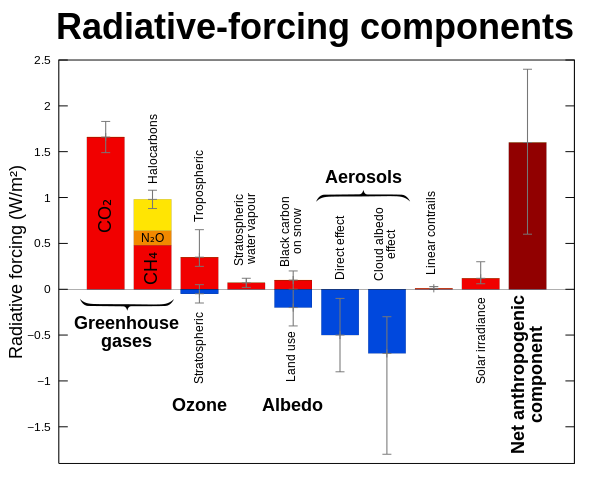
Not even close to correct. Completely wrong. Every time you decompose global warming into the response to natural and anthropogenic forcing it looks something like this. Most or all of the observed warming is anthropogenic. Every time you look at what is applying radiative forcing it looks like this. Anthropogenic forcing dominates, and of the anthropogenic forcings, CO2 forcing is the largest part.
There is no question in the scientific literature that most of the current warming is likely anthropogenic. About 0% of scientific organisations and 0% of scholarly papers refute this fact. We know it better than we know an asteroid impact killed the dinosaurs. -
Re:Maybe RTFA?
And if it was created in 2012, then gets released, then a little bit freezes in the ice next year...it doesn't sound like this is even a story!
It does sound like it is accumulating year over year, otherwise how do you explain the "abundances of hundreds of particles per cubic meter. That’s three orders of magnitude larger than some counts of plastic particles in the Great Pacific Garbage Patch." - http://news.sciencemag.org/ear...
-
Re:0.43 mm per year, eh?
Results indicate that most recession occurred during the middle to late Holocene in the absence of substantial sea level or climate forcing. Current grounding-line retreat may reflect ongoing ice recession that has been under way since the early Holocene. If so, the WAIS could continue to retreat even in the absence of further external forcing
Past and Future Grounding-Line Retreat of the West Antarctic Ice Sheet H. Conway1, B. L. Hall2,3, G. H. Denton2, A. M. Gades1, E. D. Waddington1
Science 8 October 1999: 280-283. [DOI:10.1126/science.286.5438.280]So this chunk of ice has beem falling into the sea for the past 20,000 years, we've known about it for 15 years, but now it's a revelation of thermagedon!
-
Re:Facts are there
Since that is what was provided (where do you think the charts come from)
There are many hundreds of thousands of scholarly papers on climate change now. There is no reason to go to resort to counterscientific blogs. For over 20 years about 0% of scholarly papers counter the basic finding that human activity is probably responsible for most of the current climate change.
But Watts has never once reported on any of these papers.
The site is extremely biased.Go peddle your lies elsewhere.
Sorry?
I said that we should use science-based sources. Your position is that that is a lie?
Kid, the entire advantage that humans have is encompassed by science. It's not your enemy. -
CORRECT ABSTRACT LINK
Nitrogen-based thermoset polymers have many industrial applications (for example, in composites), but are difficult to recycle or rework. We report a simple one-pot, low-temperature polycondensation between paraformaldehyde and 4,4-oxydianiline (ODA) that forms hemiaminal dynamic covalent networks (HDCNs), which can further cyclize at high temperatures, producing poly(hexahydrotriazine)s (PHTs). Both materials are strong thermosetting polymers, and the PHTs exhibited very high Young’s moduli (up to ~14.0 gigapascals and up to 20 gigapascals when reinforced with surface-treated carbon nanotubes), excellent solvent resistance, and resistance to environmental stress cracking. However, both HDCNs and PHTs could be digested at low pH (
-
Re:this is news???
Wow, that's coming across as arrogant even for slashdot, yes Harvard isn't in Europe, but that dosn't mean the rest of us abstain from scientific research into the effects of neonicotinoids on bees.
The topic HAS indeed been "buzzing" around the news for a while over here (in the UK), it's not new, hell the EU has a two year ban on Neonicotinoids that began in December 2013 BECAUSE of the link between them and CCD, here's a couple of links for you to read to bring you up to speed with the rest of the world.
The ban from the EU... http://www.epa.gov/pesticides/...
Scientists from the University of Stirling in the UK submitted papers for publication in October 2011 in this regard http://www.sciencemag.org/cont...
as did French scientists from the French national institute for agricultural research in http://www.sciencemag.org/cont...
-
Re:this is news???
Wow, that's coming across as arrogant even for slashdot, yes Harvard isn't in Europe, but that dosn't mean the rest of us abstain from scientific research into the effects of neonicotinoids on bees.
The topic HAS indeed been "buzzing" around the news for a while over here (in the UK), it's not new, hell the EU has a two year ban on Neonicotinoids that began in December 2013 BECAUSE of the link between them and CCD, here's a couple of links for you to read to bring you up to speed with the rest of the world.
The ban from the EU... http://www.epa.gov/pesticides/...
Scientists from the University of Stirling in the UK submitted papers for publication in October 2011 in this regard http://www.sciencemag.org/cont...
as did French scientists from the French national institute for agricultural research in http://www.sciencemag.org/cont...
-
Re:Time to move into the Century of the fruit bat.
Secondly, what about the estimated 4% of people on death row who are innocent.
Sitting "on death row" is no different than going to prison. You seem to be implying 4.1% of the executed are innocent, but that's not what the number means at all!
That 4.1% figure comes from the percentage of those on death row, who are exonerated in the NORMAL appeals process. In other words, they are not executed. It's a reassuringly-low false-conviction rate to begin with, and an example of the system WORKING AS DESIGNED, as they are all released.
They sometimes sit in jail for decades trying to get cleared.
Eliminating the death penalty will NOT help this at all.
In fact, it will make matters worse, as the same study determined that "resentenced defendants are eight times less likely to be exonerated than those on death row."
Sometimes they do (having lost years/decades of their life), sometimes they don't (cleared after they die in jail or are executed).
The same study you cited says you're wrong:
"once someone is executed, dies of natural causes, or commits suicide, the chance of being exonerated drops to nearly zero."
In other words, no, it essentially doesn't happen.
Furthermore, last time I checked, not a single condemned person in the US has been exonerated after execution, ever since the death penalty was suspended/reinstated (in 1976). Unless there's been recent news on that front, you can't cite a single one.
Better to keep a guilty person alive and in jail than to execute an innocent.
I don't agree. Leaving an innocent person to rot in a cell for decades is every bit as inhumane as execution, if not more-so. Removing the threat of the death penalty would allow our judicial system to get far more sloppy, and would remove the last reason for someone with a life sentence not to murder guards or other inmates, with no real consequences.
-
read article first
1. http://news.sciencemag.org/che...
2. NOT HEAT ENGINE. THERMOELECTRICS! -
Re:What if we overcorrect?
So you're saying in effect that if the buffalo herds had grown to ~30% larger that it would have had a significant effect on global warming? That's quite a leap.
I don't think I did anything to suggest significance. All I did was show that the loss of the bison herds of North America wasn't accompanied by a drop in Methane production by the bovine gut. We could calculate the significance if you like.
This whole CO2 and climate-change alarmism is not any of that.
Ah. A climate science conspiracy theorist.
Hi.
Did you know that there are about zero scholarly papers and about zero scientific organizations that support climate change denial?
[1] As of 2007, when the American Association of Petroleum Geologists released a revised statement,[11] no scientific body of national or international standing rejected the findings of human-induced effects on climate change.
[2] Remarkably, none of the papers disagreed with the consensus position.The Earth is in a warming cycle that will continue until it peaks and reverses back towards another ice age, no matter what we puny humans do.
You don't believe in the greenhouse effect?
Rather than attempt to put chains on the growth of civilization and the freedom of men, why not trust that humans will do what they've always done? Adapt, survive, overcome, and prosper.
What you have there starts with a straw man. No one is suggesting putting chains on the growth of civilization nor freedoms.
As to humans adapting, surviving, overcoming and prospering, the way we have always done that is to use science. Not ignore it.With the growth of civilization also comes a growth in our ability to adapt, overcome, and mitigate.
With the growth of technology, perhaps. The magnitude of civilization by a lot of measures merely increases our vulnerability.
Once humans start moving such activities off-planet, there will be a chance for Earth's natural processes to abate and recover from the damage we may have done on our way to maturity.
This is very pie-in-the-sky. Ignoring issues that are killing about 150,000 people annually right now, and set to grow, because one day we might be able to move industry and food production off planet, when we have zero capacity to move anything living off planet without ferrying all their biological needs up from earth, and also exposing them to considerable risk, is certainly visionary. But reducing greenhouse emissions is something we can do today. And should have done 30 years ago.
You can't have humans totally proscribed from causing any potential damage to the environment or climate.
No. We've already done a lot of damage to the environment and climate. The point is that reducing emissions is the economically most cost effective path. So we should do that. Adaptation is much more costly when you do the economic analysis.
-
Like 1999 KW4
-
Like 1999 KW4
-
The Science article
I didn't notice any links to the article in Science that was mentioned. Here it is, although it is paywalled. If you search for the title ("A Combined Mitigation/Geoengineering Approach to Climate Stabilization") you might find some non-paywalled copies or preprints.
-
And you do??????
http://news.sciencemag.org/hea...
http://www.bloomberg.com/news/...
http://thebulletin.org/threate...
http://armscontrolcenter.org/E...
http://thebulletin.org/unaccep...
http://www.ncbi.nlm.nih.gov/pm...
http://www.pathobiologics.org/...
http://www.biomedcentral.com/1...
http://news.sciencemag.org/sit...
http://www.usatoday.com/news/n... -
And you do??????
http://news.sciencemag.org/hea...
http://www.bloomberg.com/news/...
http://thebulletin.org/threate...
http://armscontrolcenter.org/E...
http://thebulletin.org/unaccep...
http://www.ncbi.nlm.nih.gov/pm...
http://www.pathobiologics.org/...
http://www.biomedcentral.com/1...
http://news.sciencemag.org/sit...
http://www.usatoday.com/news/n... -
Time for serious reading, children.....
http://www.bloomberg.com/news/...
http://thebulletin.org/threate...
http://armscontrolcenter.org/E...
http://thebulletin.org/unaccep...
http://www.ncbi.nlm.nih.gov/pm...
http://www.pathobiologics.org/...
http://www.biomedcentral.com/1...
http://news.sciencemag.org/sit...
http://www.usatoday.com/news/n...
http://news.sciencemag.org/hea... -
Time for serious reading, children.....
http://www.bloomberg.com/news/...
http://thebulletin.org/threate...
http://armscontrolcenter.org/E...
http://thebulletin.org/unaccep...
http://www.ncbi.nlm.nih.gov/pm...
http://www.pathobiologics.org/...
http://www.biomedcentral.com/1...
http://news.sciencemag.org/sit...
http://www.usatoday.com/news/n...
http://news.sciencemag.org/hea... -
Read and learn
-
There ARE differences between corporate pseudo-...
...science and Real Science:
http://news.sciencemag.org/hea... -
Original article...
Here's the original article (paywalled, Science magazine): https://www.sciencemag.org/con...
-
2 years old
Please Google prior to posting: http://news.sciencemag.org/201...
-
Re:When do we reach ...
Emerging research is increasingly supporting a global rather than regional MWP such as
Observed increases in ocean heat content (OHC) and temperature are robust indicators of global warming during the past several decades. We used high-resolution proxy records from sediment cores to extend these observations in the Pacific 10,000 years beyond the instrumental record. We show that water masses linked to North Pacific and Antarctic intermediate waters were warmer by 2.1 ± 0.4C and 1.5 ± 0.4C, respectively, during the middle Holocene Thermal Maximum than over the past century. Both water masses were ~0.9C warmer during the Medieval Warm period than during the Little Ice Age and ~0.65 warmer than in recent decades. Although documented changes in global surface temperatures during the Holocene and Common era are relatively small, the concomitant changes in OHC are large. Pacific Ocean Heat Content During the Past 10,000 Years
-
Saturn's Rings!
-
Saturn's Rings!
-
Re:Dec 2013 Research
Possible source: http://www.pnas.org/content/ea.... Unfortunately paywalled.
It's definitely from there, see http://www.sciencemag.org/content/342/6165/1418.3.full
-
Studies, studies, studies and Marcia Angell
The kind of studies you ask for in humans would generally be considered unethical. Even if ethical, they are expensive, and such results don't profit drug companies, so they are rare. So, in humans, we are left with small "gold standard" double-blind controlled studies and larger observational epidemiological studies. A lot of infectious disease were already greatly reduced through improved sanitation, handwashing, quarantine, and better nutrition and lifestyle/behavioral choices (such as not drinking from a common cup and bucket of water on a train as once was common) as well as some curative medicines (antibiotics, phage therapy, etc.) before vaccines came along.
However, I challenge you to supply the same sorts of studies you request for all the specific current formulations of vaccines currently in use today. If you look for such studies in animals, you may find at least some popular vaccines do not work as well as you might think. For example, consider:
http://news.sciencemag.org/hea...
"The current vaccine for whooping cough, or pertussis, may keep you or your baby healthy, but it may not stop either of you from spreading the disease, a new animal study suggests. Baboons can harbor and spread the disease even after receiving the vaccine, researchers have found.Note that the baboons that actually had the disease did not pass it on, unlike those who had been vaccinated. Vaccine-based immunity fades fairly quickly for pertussis. It is possible that when people get whooping cough as older children or adults (when it is more manageable) and nursing mothers pass that immunity on to their infants, there may be less mortality among infants from the disease. One problem with many vaccines is that since they fade quickly, you need life-long booster shots, which for dozens of disease could add up potentially to thousands of shots over a lifetime -- each one with a risk of being a mis-manufactured "hot lot" or being mis-injected or being worthless because the disease evolved. Even if each shot may seem to make sense, the total cost for the individual and society of getting on the treadmill of artificial immunity may be quite high. For example, consider the lifetime burden of aluminum from 100 or so annual flu shots.
Of the related research easy to find on exercise and nutrition and disease transmission, here are a few of them:
http://www.ucdenver.edu/academ...
"Children with poor nutrition are at increased risk of pneumonia. In many tropical settings seasonal pneumonia epidemics occur during the rainy season, which is often a period of poor nutrition. We have investigated whether seasonal hunger may be a driver of seasonal pneumonia epidemics in children in the tropical setting of the Philippines. In individual level cohort analysis, infant size and growth were both associated with increased pneumonia admissions, consistent with findings from previous studies. A low weight for age z-score in early infancy was associated with an increased risk of pneumonia admission