Slashdot Mirror
Domain: slashdot.org
Stories and comments across the archive that link to slashdot.org.
Stories · 37,380
-
The Joker Behind the Signetics 25120 Write-Only Memory Chip Hoax
New submitter st1lett0 writes: Now and in years past, electronic engineers and hobbyists alike have enjoyed the classic 1972 April Fool's joke by Signetics of the Signetics 25120 Write-Only Memory chip. Now it seems that the previously anonymous practical joker has identified himself and stepped forward with new information to correct and complete the story. -
Sony Demands Press Destroy Leaked Documents
SydShamino writes In an effort that may run afoul of the first amendment, Sony, through their lawyer David Boies (of SCO infamy), has sent a letter to major news organizations demanding that they refrain from downloading any leaked documents, and destroy those already possessed. Sony threatens legal action to news organizations that do not comply, saying that "Sony Pictures Entertainment will have no choice but to hold you responsible for any damage or loss arising from such use or dissemination by you." -
Interviews: Ask Jonty Hurwitz About Art and Engineering
samzenpus (5) writes "Jonty Hurwitz is an artist with a degree in engineering who says each one of his pieces is "a study on the physics of how we perceive space and is the stroke of over 1 billion calculations and algorithms." Recently, his nano sculpture project drew a lot of attention. With help from the Weizmann Institute of Science and using a 3D printing technique by the Institute of Microstructure Technology at the Karlsruhe Institute of Technology, Hurwitz created a number of sculptures that were so small they could fit in the eye of a needle, or on a human hair. Jonty has agreed to answer any questions you have big or very small. As usual, ask as many as you'd like, but please, one per post." -
Interviews: Ask Jonty Hurwitz About Art and Engineering
samzenpus (5) writes "Jonty Hurwitz is an artist with a degree in engineering who says each one of his pieces is "a study on the physics of how we perceive space and is the stroke of over 1 billion calculations and algorithms." Recently, his nano sculpture project drew a lot of attention. With help from the Weizmann Institute of Science and using a 3D printing technique by the Institute of Microstructure Technology at the Karlsruhe Institute of Technology, Hurwitz created a number of sculptures that were so small they could fit in the eye of a needle, or on a human hair. Jonty has agreed to answer any questions you have big or very small. As usual, ask as many as you'd like, but please, one per post." -
Job Postings Offer Clues to Future of Google Fiber
New submitter Admiral Jimbob McGif writes Even as a massive firestorm burns uncontrollably threatening to scorch the very foundations of the internet with AT&T indefinitely halting future GigaPower FTTH rollouts due to uncertainty over the future of net neutrality and the Obama administration proposing to regulate the internet under Title 2, highly suggestive jobs were recently added to Google Careers.
These Google Fiber related positions include: "City Manager", "Community Impact Manager" and "Plant Manager" in all potential Google Fiber cities. Perplexing inconsistences abound, such as Portland, Phoenix, San Jose and Atlanta positions being listed as local. Whereas San Antonio, Raleigh, Charlotte, and Nashville are listed as telecommute positions.
One is inclined to speculate as to what these job postings mean despite Google's disclaimer: "Not all cities where we're exploring hiring a team will necessarily become Google Fiber cities." Would Google post jobs as an act of posturing much like AT&T's supposed "Gigabit smoke screen" bluff? Or, should we expect to see these so called Fiber Huts springing up like so many mushrooms after a heavy rain in an additional 9 metro areas?
At the rate Google is going, is it too soon to speculate over Fiber Dojos popping up in Japan? -
Job Postings Offer Clues to Future of Google Fiber
New submitter Admiral Jimbob McGif writes Even as a massive firestorm burns uncontrollably threatening to scorch the very foundations of the internet with AT&T indefinitely halting future GigaPower FTTH rollouts due to uncertainty over the future of net neutrality and the Obama administration proposing to regulate the internet under Title 2, highly suggestive jobs were recently added to Google Careers.
These Google Fiber related positions include: "City Manager", "Community Impact Manager" and "Plant Manager" in all potential Google Fiber cities. Perplexing inconsistences abound, such as Portland, Phoenix, San Jose and Atlanta positions being listed as local. Whereas San Antonio, Raleigh, Charlotte, and Nashville are listed as telecommute positions.
One is inclined to speculate as to what these job postings mean despite Google's disclaimer: "Not all cities where we're exploring hiring a team will necessarily become Google Fiber cities." Would Google post jobs as an act of posturing much like AT&T's supposed "Gigabit smoke screen" bluff? Or, should we expect to see these so called Fiber Huts springing up like so many mushrooms after a heavy rain in an additional 9 metro areas?
At the rate Google is going, is it too soon to speculate over Fiber Dojos popping up in Japan? -
Job Postings Offer Clues to Future of Google Fiber
New submitter Admiral Jimbob McGif writes Even as a massive firestorm burns uncontrollably threatening to scorch the very foundations of the internet with AT&T indefinitely halting future GigaPower FTTH rollouts due to uncertainty over the future of net neutrality and the Obama administration proposing to regulate the internet under Title 2, highly suggestive jobs were recently added to Google Careers.
These Google Fiber related positions include: "City Manager", "Community Impact Manager" and "Plant Manager" in all potential Google Fiber cities. Perplexing inconsistences abound, such as Portland, Phoenix, San Jose and Atlanta positions being listed as local. Whereas San Antonio, Raleigh, Charlotte, and Nashville are listed as telecommute positions.
One is inclined to speculate as to what these job postings mean despite Google's disclaimer: "Not all cities where we're exploring hiring a team will necessarily become Google Fiber cities." Would Google post jobs as an act of posturing much like AT&T's supposed "Gigabit smoke screen" bluff? Or, should we expect to see these so called Fiber Huts springing up like so many mushrooms after a heavy rain in an additional 9 metro areas?
At the rate Google is going, is it too soon to speculate over Fiber Dojos popping up in Japan? -
Job Postings Offer Clues to Future of Google Fiber
New submitter Admiral Jimbob McGif writes Even as a massive firestorm burns uncontrollably threatening to scorch the very foundations of the internet with AT&T indefinitely halting future GigaPower FTTH rollouts due to uncertainty over the future of net neutrality and the Obama administration proposing to regulate the internet under Title 2, highly suggestive jobs were recently added to Google Careers.
These Google Fiber related positions include: "City Manager", "Community Impact Manager" and "Plant Manager" in all potential Google Fiber cities. Perplexing inconsistences abound, such as Portland, Phoenix, San Jose and Atlanta positions being listed as local. Whereas San Antonio, Raleigh, Charlotte, and Nashville are listed as telecommute positions.
One is inclined to speculate as to what these job postings mean despite Google's disclaimer: "Not all cities where we're exploring hiring a team will necessarily become Google Fiber cities." Would Google post jobs as an act of posturing much like AT&T's supposed "Gigabit smoke screen" bluff? Or, should we expect to see these so called Fiber Huts springing up like so many mushrooms after a heavy rain in an additional 9 metro areas?
At the rate Google is going, is it too soon to speculate over Fiber Dojos popping up in Japan? -
OpenMotics Offers Open Source (and Open Hardware) Home Automation
Home automation is a recurring topic around here; we've had stories about X-10-based home-brewed systems, a protocol designed for automation, and more than a few Ask Slashdots. Now, an anonymous reader writes OpenMotics is an open source home automation hardware and software system that offers features like switching lights and outputs, multi-zone heating and cooling, power measurements, and automated actions. The system encompasses both open source software and hardware. For interoperability with other systems, the OpenMotics Gateway provides an API through which various actions can be executed. The project was open sourced 2 years ago and was started about 10 years. The choice to open source the project was very conscious: we want to offer a system where users are in full control over their home automation system. -
OpenMotics Offers Open Source (and Open Hardware) Home Automation
Home automation is a recurring topic around here; we've had stories about X-10-based home-brewed systems, a protocol designed for automation, and more than a few Ask Slashdots. Now, an anonymous reader writes OpenMotics is an open source home automation hardware and software system that offers features like switching lights and outputs, multi-zone heating and cooling, power measurements, and automated actions. The system encompasses both open source software and hardware. For interoperability with other systems, the OpenMotics Gateway provides an API through which various actions can be executed. The project was open sourced 2 years ago and was started about 10 years. The choice to open source the project was very conscious: we want to offer a system where users are in full control over their home automation system. -
OpenMotics Offers Open Source (and Open Hardware) Home Automation
Home automation is a recurring topic around here; we've had stories about X-10-based home-brewed systems, a protocol designed for automation, and more than a few Ask Slashdots. Now, an anonymous reader writes OpenMotics is an open source home automation hardware and software system that offers features like switching lights and outputs, multi-zone heating and cooling, power measurements, and automated actions. The system encompasses both open source software and hardware. For interoperability with other systems, the OpenMotics Gateway provides an API through which various actions can be executed. The project was open sourced 2 years ago and was started about 10 years. The choice to open source the project was very conscious: we want to offer a system where users are in full control over their home automation system. -
OpenMotics Offers Open Source (and Open Hardware) Home Automation
Home automation is a recurring topic around here; we've had stories about X-10-based home-brewed systems, a protocol designed for automation, and more than a few Ask Slashdots. Now, an anonymous reader writes OpenMotics is an open source home automation hardware and software system that offers features like switching lights and outputs, multi-zone heating and cooling, power measurements, and automated actions. The system encompasses both open source software and hardware. For interoperability with other systems, the OpenMotics Gateway provides an API through which various actions can be executed. The project was open sourced 2 years ago and was started about 10 years. The choice to open source the project was very conscious: we want to offer a system where users are in full control over their home automation system. -
Google Earth API Will Be Retired On December 12, 2015
An anonymous reader writes Google [on Friday] announced it plans to retire the Google Earth API on December 12, 2015. The reason is simple: Both Chrome and Firefox are removing support for Netscape Plugin Application Programming Interface (NPAPI) plugins due to security reasons, so the API's death was inevitable. The timing makes sense. Last month, Google updated its plan for killing off NPAPI support in Chrome, saying that it would block all plugins by default in January and drop support completely in September. The company also revealed that the Google Earth plugin had dropped in usage from 9.1 percent of Chrome users in October 2013 to 0.1 percent in October 2014. Add dwindling cross-platform support (particularly on mobile devices), and we're frankly surprised the announcement didn't come sooner. -
Deflating Claims That ESA Craft Has Spotted Dark Matter
Yesterday, we posted news that data from the European Space Agency's XMM-Newton spacecraft had been interpreted as a possible sign of dark matter; researchers noted that a spike in X-ray emissions from two different celestial objects, the Andromeda galaxy and the Perseus galaxy cluster, matched just what they "were expecting with dark matter — that is, concentrated and intense in the center of objects and weaker and diffuse on the edges." StartsWithABang writes with a skeptical rejoinder: There seems to be a formula for this very specific extraordinary claim: point your high-energy telescope at the center of a galaxy or cluster of galaxies, discover an X-ray or gamma ray signal that you can't account for through conventional, known astrophysics, and claim you've detected dark matter! Only, these results never pan out; they've turned out either to be due to conventional sources or simply non-detections every time. There's a claim going around the news based on this paper recently that we've really done it this time, and yet that's not even physically possible, as our astrophysical constraints already rule out a particle with this property as being the dark matter! -
Tour the Vintage Radio and Communications Museum - Part Two (Video)
Earlier this week we ran two videos about the Vintage Radio and Communications Museum of Connecticut. Their site says, "Our volunteers are happy to give personal tours," and that's what today's videos (and the two we already ran) are: personal tours of the museum conducted by volunteer Bernie Michaels, known in ham radio circles as W2LFV. And for extra fun, after we ran out of video time we added some bonus transcript material for those who remember things like Sams Photofacts. (Alternate Video Link 1 - Alternate Video Link 2) -
Tour the Vintage Radio and Communications Museum - Part Two (Video)
Earlier this week we ran two videos about the Vintage Radio and Communications Museum of Connecticut. Their site says, "Our volunteers are happy to give personal tours," and that's what today's videos (and the two we already ran) are: personal tours of the museum conducted by volunteer Bernie Michaels, known in ham radio circles as W2LFV. And for extra fun, after we ran out of video time we added some bonus transcript material for those who remember things like Sams Photofacts. (Alternate Video Link 1 - Alternate Video Link 2) -
Tour the Vintage Radio and Communications Museum - Part Two (Video)
Earlier this week we ran two videos about the Vintage Radio and Communications Museum of Connecticut. Their site says, "Our volunteers are happy to give personal tours," and that's what today's videos (and the two we already ran) are: personal tours of the museum conducted by volunteer Bernie Michaels, known in ham radio circles as W2LFV. And for extra fun, after we ran out of video time we added some bonus transcript material for those who remember things like Sams Photofacts. (Alternate Video Link 1 - Alternate Video Link 2) -
Hollywood's Secret War With Google
cpt kangarooski writes: Information has come to light (thanks to the recent Sony hack) that the MPAA and six major studios are pondering the legal actions available to them to compel an entity referred to as 'Goliath,' most likely Google, into taking aggressive anti-piracy action on behalf of the entertainment industry. The MPAA and member studios Universal, Sony, Fox, Paramount, Warner Bros., and Disney have had lengthy email discussions concerning how to block pirate sites at the ISP level, and how to take action at the state level to work around the failure of SOPA in 2012. Emails also indicate that they are working with Comcast (which owns Universal) on some form of traffic inspection to find copyright infringements as they happen. -
IsoHunt Unofficially Resurrects the Pirate Bay
An anonymous reader writes: Torrent site isoHunt appears to have unofficially resurrected The Pirate Bay at oldpiratebay.org. At first glance, The Old Pirate Bay seems to be just a commemorative site for The Pirate Bay, which went down this week after police raided its data center in Sweden. Upon further inspection, however, it turns out the site is serving new content. This is much more than just a working archive of The Pirate Bay; it has a functioning search engine, all the old listings, and working magnet links. -
2014 Geek Gift Guide
With the holidays coming up, Bennett Haselton has updated his geek-oriented gift guide for 2014. He says: Some of my favorite gifts to give are still the ones that were listed in several different previously written posts, while a few new cool gift ideas emerged in 2014. Here are all my current best recommendations, listed in one place. Read on for the list, or to share any suggestions of your own.Most annual gift guides would only list new items. It would be considered a mortal sin of click-baiting to tell the reader, "Well, the coolest stuff we could tell you about, was stuff that we mentioned this time last year, so first and foremost we're just going to direct you to that."
Well, my job in writing a gift guide is not to dazzle people with "all new hottest gift item" recommendations, my job is to recommend the things that I think you would most enjoy giving and the recipient would most enjoy receiving, and the fact of the matter is that most of the gifts I would most highly recommend, were listed in different previously written articles. I'll provide that list in a second (with links back to the older articles describing them in more detail), but first some criteria for how I make the recommendations.
First, I'm assuming you want to go inexpensive. If you have unlimited cash, you don't need my help finding cool presents -- although for the record, the online store of New York's Museum of Modern Art has the best collection of things that incorporate "visual puns" that I really like, but which are usually overpriced for what the item does. (Check out this image of a set of nesting tables, for example -- which isn't even that much of a "neat idea", by their standards -- and try to guess how much they cost, before looking at the answer on the product page.) If you don't mind spending the money, they also sell a dandelion encased in acrylic ($375), a lamp in the shape of an open book ($190), a necklace of small rectangular mirrors creating an interesting 3D effect ($190), a porcelain vase that kind of looks like a crinkled paper bag ($120), a pair of candleholders that interlock without touching ($170), a serving tray that looks like the splash from a drop of water ($130), a clock that evokes an M.C. Escher "infinite staircase" optical illusion ($80), and a vase that exists in the shape of an outline ($65, which at this point sounds cheap). At the end of this gift guide I list some MoMA items that are somewhat more reasonably priced.
Second, I'm assuming you don't need help finding branded merchandise. I'm sure literally every combination of [Star Wars / LOTR / Game of Thrones / Star Trek / Hunger Games] and [coffee mug / beach towel / earrings / Christmas tree ornaments / shot glass / cufflinks] is available somewhere. It's not that these are bad gifts for the hardcore fan, it's that all you need to find them is to Google "Game of Thrones Christmas tree ornaments" and you'll find something. And occasionally you'll will find something in this "branded" category that jumps out as a pretty cool idea, like the TARDIS Tea Infuser or the Game of Thrones Dragonclaw Goblet or the light-up lightsaber chopsticks.
Third, I look mostly for novelty or decorative items that confound your senses or demonstrate some interesting scientific principle (or both), but that can still fit in to a semi-elegant environment without garishly calling attention to themselves. These color changing beads are kind of neat, but it would look weird having them lying around on top of a living room dresser along with a UV flashlight to demonstrate what they do. On the other hand, a Galileo thermometer can blend in pretty well the decorations on a mantlepiece.
The following are my current most-recommended gift ideas:
Custom Photomosaic
In this December 2013 post I described how to create a photomosaic (a patchwork of smaller pictures that, when viewed from a distance, take on the appearance of a larger picture) using two free (donation-supported) programs, one to download and save pictures en masse from a friend's Facebook profile, and the other to create the photomosaic using those photos. I still think they make amazing gifts, and the only cost is the cost of printing and framing it. You can even give the digital-only version as a gift that costs nothing at all, making a photomosaic from a friend's photos and sending it to them on the other side of the world, where they can print it themselves or use it as a desktop background. Everyone that I've given one of these to, has loved it.
Strandbeest kit
With this $35 kit, which I recommended as a Christmas gift last year, you can assemble a tabletop version of the legendary full-size Strandbeests, the eerily lifelike creatures created by Dutch artist Theo Jansen which walk across the beaches of Holland powered only by the wind. Assembly of the creature takes about 90 minutes, less if you make a family activity out of it and share the labor.
In the last year, a second model has been released, dubbed the "Rhinoceros Mini-Beest (technically, it was available a year ago, but the assembly instructions were only printed in Japanese; now it's available with English directions). I haven't assembled one of these myself yet, but it looks fine in the video.
There is also now a pre-assembled, motorized, remote-control version of the Strandbeest, although honestly, where's the fun in that? Part of the effect of the Strandbeest assembly kit is the feeling that you've breathed life into an inanimate object by putting it together from static parts. A remote-control toy that moves forwards and backwards on the ground is a little underwhelming when you can get an RC helicopter for the same price.
Levitron Revolution and Levitron Cherrywood
The Levitron Revolution ($70) consists of a circular magnetic disc that levitates about half an inch above an electrically powered square base, and can support up to a pound of weight on top of it while maintaining levitation. The Levitron Cherrywood ($35) consists of a top that has to be spun by hand, which levitates almost a full two inches above the cherrywood base containing an embedded magnet. As described in the first gift guide, the Levitron Cherrywood is more visually impressive because of the extra height of levitation, but the top almost always falls if you touch the top or move the base while the top is spinning. The Levitron Revolution only levitates the disc by half an inch, but you can embellish the appearance by placing other objects on top of it, like the pyrite crystal levitating in this video. (Also, the Levitron Revolution will continue levitating as long as power is supplied to it, making it a good decorative item; the Levitron Cherrywood has to be spun by hand and levitates for only about two minutes before air friction slows it down, so it works better as a toy or party activity.) Both of them take some practice to operate (the Levitron Cherrywood takes considerably more), but they're worth it.
Spare batteries for your friend's phone
I mentioned this in January 2013 as a life hack for smartphones and got pilloried for promoting what people called an "obvious" idea. But two years later, almost nobody that I know is carrying around fully charged extra batteries for their phones. It's easy, it works, and the spare batteries in my jacket pockets have gotten me out of a jam multiple times. If you know what type of phone your gift recipient uses, get them some extra batteries. (T-Mobile sent me extra batteries for my LG Optimus for free.)
The iPhone is the only phone I'm aware of that does not support this, because the battery is not meant to be removed or replaced by the user.
And yes, I know about the portable external battery products that can be used to charge a phone. These aren't as big or expensive as they used to be, but you still have to leave them plugged in to your phone while they're charging it, which is awkward if you're using your phone or carrying it in your pocket (compared to the 10 seconds it takes to swap out the battery).
Heat Wave car heater
This $40 device from Canadian company "Heat & Clean" sits on your dashboard and turns itself on at a pre-determined time, blowing hot air into the interior of the car for 20 minutes, all without starting the car. If all goes well, this means your car will be warm (or at least not as cold as it would have been) when you first get into it in the morning, and you don't have to wait several minutes for the air ventilation system to heat up. The Heat Wave is powered by the car's 12V charger, although Heat & Clean states that "has built-in circuitry to ensure that the health of the vehicle's battery is never compromised."
I can't vouch for the device's respect for your battery (the device unfortunately isn't sold on Amazon, which is usually where I go to find out if something does what it's supposed to), but I ordered one and verified that it works, then gave it to my aunt for her birthday. (If it kills her car, I will promptly make it up to her by taking it out of the gift guide.) Even though I tested the functionality, I didn't get the chance to see if the device actually helps much, because it's not cold enough yet here in Seattle to really feel the bite of the cold when you get into your car in the morning. (The other reason I personally won't get much benefit from this, is that I work from home and leave the house at a different time every day, so I never know in advance what time I'll be getting into my car the next morning.)
Most cars can be modified so they can be started remotely, so that they're warmed up by the time you go outside and get into them, but that modification usually costs a few hundred dollars. You might as well try the Heat Wave first to see if it does the job almost as well.
(To me, the obvious question is: Why not make a version of the Heat Wave that can be turned remotely, as well? For people like me who usually don't know the night before what time they'll be getting into their car the next day, but who often do know at least 20 minutes in advance, so they can turn it on remotely and start heating the car. The company does make a very different-looking product called the Heat Stick which can be activated remotely -- but at $300, that's more than it costs to add remote start to the actual car.)
It's Nuts 3D puzzle
Distributed by Grand Illusions in the UK, the It's Nuts 3D puzzle consists of a bolt and a pair of nuts threaded onto the bolt. As you can see in the video, when you rotate one nut, it moves in the direction that you'd expect, following the threading on the bolt -- but when you rotate the other nut the same way, it moves in the opposite direction. There are no hidden moving parts to make the illusion work, and you can unscrew both nuts right off of the bolt and examine them.
Having acquired one, I can say that the secret is a little bit easier to figure out when you're holding it in your hand and looking at it closely, than when you're watching the video. But it still makes a nice novelty conversation piece.
As a brain-tickler, this feels a bit overpriced at $40 - costing more than the aforementioned Levitron Cherrywood, which actually levitates. I bought It's Nuts mainly to fill out my collection off oddities since I already owned most of the other items in this list. Of course, unlike the Levitron, this takes no skill to operate (only a little bit of smarts to figure out the secret). I wouldn't foist the Levitron on my grandfather, but he would probably enjoy this one.
(Note that if you buy from the Grand Illusions website to ship to the United States, you'll pay the non-VAT rate -- but then you'll have to add about $14 in air mail shipping to the U.S. So you might want to combine this order with some other items from Grand Illusions -- search this article for "Grand Illusions" for the other recommended items, or browse their site and pick your own.)
Inverter Magnet
The Inverter Magnet, from Grand Illusions (also available from Amazon at a slightly higher price), consists of one disc magnet encased in rubber, which holds a second disc magnet in a permanent "force field" a few millimeters away when the two are slid across a table.
At $40, this might be more of a "collection filler-outer", since especially as a magnetic toy it compares unfavorably with the Levitron Cherrywood, which, to repeat, can actually fly. But again, the Inverter Magnet also takes no skill to operate.
Magna Nails
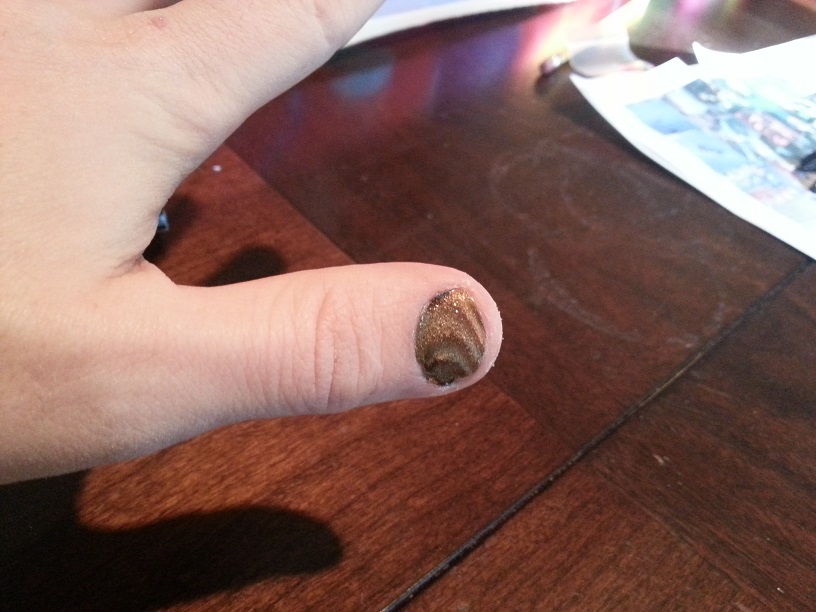
This nail polish (about $7 used on Amazon) forms a stripe pattern when you hold a magnet near your fingernail while the polish is trying. (There are many similar products on the market, searchable under "magnetic nail polish.") The appeal to young science geeks is that the iron filings in the nail polish align themselves along magnetic field lines in the vicinity of the magnet, forming the stripes.
I don't wear glittery nail polish (at least not as "Bennett Haselton"...), but I took one for the team to see if this works. It does. That's my thumb. (Apparently it looks better if you apply a "top coat" after the nail polish dries, but I didn't have any.) If you plan on testing it out before giving it as a gift, remember to pick up some nail polish remover to get it off.
A few things from MoMA that we can actually afford
- An appetizer serving dish complete with toothpick holder that looks like a porcupine ($28). This item probably has the highest price-to-cool-factor ratio of anything on this list, just barely within the limit of what I'd recommend, but it's elegant in addition to being funny, and the recipient would probably use it.
- A faux-wood cube clock ($38). This is interesting mostly for looking like a visual impossibility -- how can the digital numbers appear on the side of a block of wood, even fake wood? Unfortunately I think the photo is doctored, because this youtube video shows an undoctored shot of the cube clock, and you can easily see the un-illuminated LEDs on the side, which don't quite blend in with the wood. But it still makes for an elegant optical illusion.
Miscellaneous "Visual Puns"
- The ambiguous vase ($33) from Grand Illusions -- a real-life version of the Rubin vase optical illusion, where a vase suddenly takes on the appearance of two faces in profile.
- The glass water faucet ($50)
- The sliced grandfather clock ($36)
- Ulexite "television stones" ($10) - a rock that, when placed on a flat surface, will cause the markings on that surface to re-appear on the top face of the rock, due to the naturally occurring fiber optics in ulexite.
Of course, if you're now craving one of these items for yourself, order one and try it out before re-gifting, or set up an Amazon wish list in the last two weeks before Christmas. And remember to be good!
-
2014 Geek Gift Guide
With the holidays coming up, Bennett Haselton has updated his geek-oriented gift guide for 2014. He says: Some of my favorite gifts to give are still the ones that were listed in several different previously written posts, while a few new cool gift ideas emerged in 2014. Here are all my current best recommendations, listed in one place. Read on for the list, or to share any suggestions of your own.Most annual gift guides would only list new items. It would be considered a mortal sin of click-baiting to tell the reader, "Well, the coolest stuff we could tell you about, was stuff that we mentioned this time last year, so first and foremost we're just going to direct you to that."
Well, my job in writing a gift guide is not to dazzle people with "all new hottest gift item" recommendations, my job is to recommend the things that I think you would most enjoy giving and the recipient would most enjoy receiving, and the fact of the matter is that most of the gifts I would most highly recommend, were listed in different previously written articles. I'll provide that list in a second (with links back to the older articles describing them in more detail), but first some criteria for how I make the recommendations.
First, I'm assuming you want to go inexpensive. If you have unlimited cash, you don't need my help finding cool presents -- although for the record, the online store of New York's Museum of Modern Art has the best collection of things that incorporate "visual puns" that I really like, but which are usually overpriced for what the item does. (Check out this image of a set of nesting tables, for example -- which isn't even that much of a "neat idea", by their standards -- and try to guess how much they cost, before looking at the answer on the product page.) If you don't mind spending the money, they also sell a dandelion encased in acrylic ($375), a lamp in the shape of an open book ($190), a necklace of small rectangular mirrors creating an interesting 3D effect ($190), a porcelain vase that kind of looks like a crinkled paper bag ($120), a pair of candleholders that interlock without touching ($170), a serving tray that looks like the splash from a drop of water ($130), a clock that evokes an M.C. Escher "infinite staircase" optical illusion ($80), and a vase that exists in the shape of an outline ($65, which at this point sounds cheap). At the end of this gift guide I list some MoMA items that are somewhat more reasonably priced.
Second, I'm assuming you don't need help finding branded merchandise. I'm sure literally every combination of [Star Wars / LOTR / Game of Thrones / Star Trek / Hunger Games] and [coffee mug / beach towel / earrings / Christmas tree ornaments / shot glass / cufflinks] is available somewhere. It's not that these are bad gifts for the hardcore fan, it's that all you need to find them is to Google "Game of Thrones Christmas tree ornaments" and you'll find something. And occasionally you'll will find something in this "branded" category that jumps out as a pretty cool idea, like the TARDIS Tea Infuser or the Game of Thrones Dragonclaw Goblet or the light-up lightsaber chopsticks.
Third, I look mostly for novelty or decorative items that confound your senses or demonstrate some interesting scientific principle (or both), but that can still fit in to a semi-elegant environment without garishly calling attention to themselves. These color changing beads are kind of neat, but it would look weird having them lying around on top of a living room dresser along with a UV flashlight to demonstrate what they do. On the other hand, a Galileo thermometer can blend in pretty well the decorations on a mantlepiece.
The following are my current most-recommended gift ideas:
Custom Photomosaic
In this December 2013 post I described how to create a photomosaic (a patchwork of smaller pictures that, when viewed from a distance, take on the appearance of a larger picture) using two free (donation-supported) programs, one to download and save pictures en masse from a friend's Facebook profile, and the other to create the photomosaic using those photos. I still think they make amazing gifts, and the only cost is the cost of printing and framing it. You can even give the digital-only version as a gift that costs nothing at all, making a photomosaic from a friend's photos and sending it to them on the other side of the world, where they can print it themselves or use it as a desktop background. Everyone that I've given one of these to, has loved it.
Strandbeest kit
With this $35 kit, which I recommended as a Christmas gift last year, you can assemble a tabletop version of the legendary full-size Strandbeests, the eerily lifelike creatures created by Dutch artist Theo Jansen which walk across the beaches of Holland powered only by the wind. Assembly of the creature takes about 90 minutes, less if you make a family activity out of it and share the labor.
In the last year, a second model has been released, dubbed the "Rhinoceros Mini-Beest (technically, it was available a year ago, but the assembly instructions were only printed in Japanese; now it's available with English directions). I haven't assembled one of these myself yet, but it looks fine in the video.
There is also now a pre-assembled, motorized, remote-control version of the Strandbeest, although honestly, where's the fun in that? Part of the effect of the Strandbeest assembly kit is the feeling that you've breathed life into an inanimate object by putting it together from static parts. A remote-control toy that moves forwards and backwards on the ground is a little underwhelming when you can get an RC helicopter for the same price.
Levitron Revolution and Levitron Cherrywood
The Levitron Revolution ($70) consists of a circular magnetic disc that levitates about half an inch above an electrically powered square base, and can support up to a pound of weight on top of it while maintaining levitation. The Levitron Cherrywood ($35) consists of a top that has to be spun by hand, which levitates almost a full two inches above the cherrywood base containing an embedded magnet. As described in the first gift guide, the Levitron Cherrywood is more visually impressive because of the extra height of levitation, but the top almost always falls if you touch the top or move the base while the top is spinning. The Levitron Revolution only levitates the disc by half an inch, but you can embellish the appearance by placing other objects on top of it, like the pyrite crystal levitating in this video. (Also, the Levitron Revolution will continue levitating as long as power is supplied to it, making it a good decorative item; the Levitron Cherrywood has to be spun by hand and levitates for only about two minutes before air friction slows it down, so it works better as a toy or party activity.) Both of them take some practice to operate (the Levitron Cherrywood takes considerably more), but they're worth it.
Spare batteries for your friend's phone
I mentioned this in January 2013 as a life hack for smartphones and got pilloried for promoting what people called an "obvious" idea. But two years later, almost nobody that I know is carrying around fully charged extra batteries for their phones. It's easy, it works, and the spare batteries in my jacket pockets have gotten me out of a jam multiple times. If you know what type of phone your gift recipient uses, get them some extra batteries. (T-Mobile sent me extra batteries for my LG Optimus for free.)
The iPhone is the only phone I'm aware of that does not support this, because the battery is not meant to be removed or replaced by the user.
And yes, I know about the portable external battery products that can be used to charge a phone. These aren't as big or expensive as they used to be, but you still have to leave them plugged in to your phone while they're charging it, which is awkward if you're using your phone or carrying it in your pocket (compared to the 10 seconds it takes to swap out the battery).
Heat Wave car heater
This $40 device from Canadian company "Heat & Clean" sits on your dashboard and turns itself on at a pre-determined time, blowing hot air into the interior of the car for 20 minutes, all without starting the car. If all goes well, this means your car will be warm (or at least not as cold as it would have been) when you first get into it in the morning, and you don't have to wait several minutes for the air ventilation system to heat up. The Heat Wave is powered by the car's 12V charger, although Heat & Clean states that "has built-in circuitry to ensure that the health of the vehicle's battery is never compromised."
I can't vouch for the device's respect for your battery (the device unfortunately isn't sold on Amazon, which is usually where I go to find out if something does what it's supposed to), but I ordered one and verified that it works, then gave it to my aunt for her birthday. (If it kills her car, I will promptly make it up to her by taking it out of the gift guide.) Even though I tested the functionality, I didn't get the chance to see if the device actually helps much, because it's not cold enough yet here in Seattle to really feel the bite of the cold when you get into your car in the morning. (The other reason I personally won't get much benefit from this, is that I work from home and leave the house at a different time every day, so I never know in advance what time I'll be getting into my car the next morning.)
Most cars can be modified so they can be started remotely, so that they're warmed up by the time you go outside and get into them, but that modification usually costs a few hundred dollars. You might as well try the Heat Wave first to see if it does the job almost as well.
(To me, the obvious question is: Why not make a version of the Heat Wave that can be turned remotely, as well? For people like me who usually don't know the night before what time they'll be getting into their car the next day, but who often do know at least 20 minutes in advance, so they can turn it on remotely and start heating the car. The company does make a very different-looking product called the Heat Stick which can be activated remotely -- but at $300, that's more than it costs to add remote start to the actual car.)
It's Nuts 3D puzzle
Distributed by Grand Illusions in the UK, the It's Nuts 3D puzzle consists of a bolt and a pair of nuts threaded onto the bolt. As you can see in the video, when you rotate one nut, it moves in the direction that you'd expect, following the threading on the bolt -- but when you rotate the other nut the same way, it moves in the opposite direction. There are no hidden moving parts to make the illusion work, and you can unscrew both nuts right off of the bolt and examine them.
Having acquired one, I can say that the secret is a little bit easier to figure out when you're holding it in your hand and looking at it closely, than when you're watching the video. But it still makes a nice novelty conversation piece.
As a brain-tickler, this feels a bit overpriced at $40 - costing more than the aforementioned Levitron Cherrywood, which actually levitates. I bought It's Nuts mainly to fill out my collection off oddities since I already owned most of the other items in this list. Of course, unlike the Levitron, this takes no skill to operate (only a little bit of smarts to figure out the secret). I wouldn't foist the Levitron on my grandfather, but he would probably enjoy this one.
(Note that if you buy from the Grand Illusions website to ship to the United States, you'll pay the non-VAT rate -- but then you'll have to add about $14 in air mail shipping to the U.S. So you might want to combine this order with some other items from Grand Illusions -- search this article for "Grand Illusions" for the other recommended items, or browse their site and pick your own.)
Inverter Magnet
The Inverter Magnet, from Grand Illusions (also available from Amazon at a slightly higher price), consists of one disc magnet encased in rubber, which holds a second disc magnet in a permanent "force field" a few millimeters away when the two are slid across a table.
At $40, this might be more of a "collection filler-outer", since especially as a magnetic toy it compares unfavorably with the Levitron Cherrywood, which, to repeat, can actually fly. But again, the Inverter Magnet also takes no skill to operate.
Magna Nails
This nail polish (about $7 used on Amazon) forms a stripe pattern when you hold a magnet near your fingernail while the polish is trying. (There are many similar products on the market, searchable under "magnetic nail polish.") The appeal to young science geeks is that the iron filings in the nail polish align themselves along magnetic field lines in the vicinity of the magnet, forming the stripes.
I don't wear glittery nail polish (at least not as "Bennett Haselton"...), but I took one for the team to see if this works. It does. That's my thumb. (Apparently it looks better if you apply a "top coat" after the nail polish dries, but I didn't have any.) If you plan on testing it out before giving it as a gift, remember to pick up some nail polish remover to get it off.
A few things from MoMA that we can actually afford
- An appetizer serving dish complete with toothpick holder that looks like a porcupine ($28). This item probably has the highest price-to-cool-factor ratio of anything on this list, just barely within the limit of what I'd recommend, but it's elegant in addition to being funny, and the recipient would probably use it.
- A faux-wood cube clock ($38). This is interesting mostly for looking like a visual impossibility -- how can the digital numbers appear on the side of a block of wood, even fake wood? Unfortunately I think the photo is doctored, because this youtube video shows an undoctored shot of the cube clock, and you can easily see the un-illuminated LEDs on the side, which don't quite blend in with the wood. But it still makes for an elegant optical illusion.
Miscellaneous "Visual Puns"
- The ambiguous vase ($33) from Grand Illusions -- a real-life version of the Rubin vase optical illusion, where a vase suddenly takes on the appearance of two faces in profile.
- The glass water faucet ($50)
- The sliced grandfather clock ($36)
- Ulexite "television stones" ($10) - a rock that, when placed on a flat surface, will cause the markings on that surface to re-appear on the top face of the rock, due to the naturally occurring fiber optics in ulexite.
Of course, if you're now craving one of these items for yourself, order one and try it out before re-gifting, or set up an Amazon wish list in the last two weeks before Christmas. And remember to be good!
-
2014 Geek Gift Guide
With the holidays coming up, Bennett Haselton has updated his geek-oriented gift guide for 2014. He says: Some of my favorite gifts to give are still the ones that were listed in several different previously written posts, while a few new cool gift ideas emerged in 2014. Here are all my current best recommendations, listed in one place. Read on for the list, or to share any suggestions of your own.Most annual gift guides would only list new items. It would be considered a mortal sin of click-baiting to tell the reader, "Well, the coolest stuff we could tell you about, was stuff that we mentioned this time last year, so first and foremost we're just going to direct you to that."
Well, my job in writing a gift guide is not to dazzle people with "all new hottest gift item" recommendations, my job is to recommend the things that I think you would most enjoy giving and the recipient would most enjoy receiving, and the fact of the matter is that most of the gifts I would most highly recommend, were listed in different previously written articles. I'll provide that list in a second (with links back to the older articles describing them in more detail), but first some criteria for how I make the recommendations.
First, I'm assuming you want to go inexpensive. If you have unlimited cash, you don't need my help finding cool presents -- although for the record, the online store of New York's Museum of Modern Art has the best collection of things that incorporate "visual puns" that I really like, but which are usually overpriced for what the item does. (Check out this image of a set of nesting tables, for example -- which isn't even that much of a "neat idea", by their standards -- and try to guess how much they cost, before looking at the answer on the product page.) If you don't mind spending the money, they also sell a dandelion encased in acrylic ($375), a lamp in the shape of an open book ($190), a necklace of small rectangular mirrors creating an interesting 3D effect ($190), a porcelain vase that kind of looks like a crinkled paper bag ($120), a pair of candleholders that interlock without touching ($170), a serving tray that looks like the splash from a drop of water ($130), a clock that evokes an M.C. Escher "infinite staircase" optical illusion ($80), and a vase that exists in the shape of an outline ($65, which at this point sounds cheap). At the end of this gift guide I list some MoMA items that are somewhat more reasonably priced.
Second, I'm assuming you don't need help finding branded merchandise. I'm sure literally every combination of [Star Wars / LOTR / Game of Thrones / Star Trek / Hunger Games] and [coffee mug / beach towel / earrings / Christmas tree ornaments / shot glass / cufflinks] is available somewhere. It's not that these are bad gifts for the hardcore fan, it's that all you need to find them is to Google "Game of Thrones Christmas tree ornaments" and you'll find something. And occasionally you'll will find something in this "branded" category that jumps out as a pretty cool idea, like the TARDIS Tea Infuser or the Game of Thrones Dragonclaw Goblet or the light-up lightsaber chopsticks.
Third, I look mostly for novelty or decorative items that confound your senses or demonstrate some interesting scientific principle (or both), but that can still fit in to a semi-elegant environment without garishly calling attention to themselves. These color changing beads are kind of neat, but it would look weird having them lying around on top of a living room dresser along with a UV flashlight to demonstrate what they do. On the other hand, a Galileo thermometer can blend in pretty well the decorations on a mantlepiece.
The following are my current most-recommended gift ideas:
Custom Photomosaic
In this December 2013 post I described how to create a photomosaic (a patchwork of smaller pictures that, when viewed from a distance, take on the appearance of a larger picture) using two free (donation-supported) programs, one to download and save pictures en masse from a friend's Facebook profile, and the other to create the photomosaic using those photos. I still think they make amazing gifts, and the only cost is the cost of printing and framing it. You can even give the digital-only version as a gift that costs nothing at all, making a photomosaic from a friend's photos and sending it to them on the other side of the world, where they can print it themselves or use it as a desktop background. Everyone that I've given one of these to, has loved it.
Strandbeest kit
With this $35 kit, which I recommended as a Christmas gift last year, you can assemble a tabletop version of the legendary full-size Strandbeests, the eerily lifelike creatures created by Dutch artist Theo Jansen which walk across the beaches of Holland powered only by the wind. Assembly of the creature takes about 90 minutes, less if you make a family activity out of it and share the labor.
In the last year, a second model has been released, dubbed the "Rhinoceros Mini-Beest (technically, it was available a year ago, but the assembly instructions were only printed in Japanese; now it's available with English directions). I haven't assembled one of these myself yet, but it looks fine in the video.
There is also now a pre-assembled, motorized, remote-control version of the Strandbeest, although honestly, where's the fun in that? Part of the effect of the Strandbeest assembly kit is the feeling that you've breathed life into an inanimate object by putting it together from static parts. A remote-control toy that moves forwards and backwards on the ground is a little underwhelming when you can get an RC helicopter for the same price.
Levitron Revolution and Levitron Cherrywood
The Levitron Revolution ($70) consists of a circular magnetic disc that levitates about half an inch above an electrically powered square base, and can support up to a pound of weight on top of it while maintaining levitation. The Levitron Cherrywood ($35) consists of a top that has to be spun by hand, which levitates almost a full two inches above the cherrywood base containing an embedded magnet. As described in the first gift guide, the Levitron Cherrywood is more visually impressive because of the extra height of levitation, but the top almost always falls if you touch the top or move the base while the top is spinning. The Levitron Revolution only levitates the disc by half an inch, but you can embellish the appearance by placing other objects on top of it, like the pyrite crystal levitating in this video. (Also, the Levitron Revolution will continue levitating as long as power is supplied to it, making it a good decorative item; the Levitron Cherrywood has to be spun by hand and levitates for only about two minutes before air friction slows it down, so it works better as a toy or party activity.) Both of them take some practice to operate (the Levitron Cherrywood takes considerably more), but they're worth it.
Spare batteries for your friend's phone
I mentioned this in January 2013 as a life hack for smartphones and got pilloried for promoting what people called an "obvious" idea. But two years later, almost nobody that I know is carrying around fully charged extra batteries for their phones. It's easy, it works, and the spare batteries in my jacket pockets have gotten me out of a jam multiple times. If you know what type of phone your gift recipient uses, get them some extra batteries. (T-Mobile sent me extra batteries for my LG Optimus for free.)
The iPhone is the only phone I'm aware of that does not support this, because the battery is not meant to be removed or replaced by the user.
And yes, I know about the portable external battery products that can be used to charge a phone. These aren't as big or expensive as they used to be, but you still have to leave them plugged in to your phone while they're charging it, which is awkward if you're using your phone or carrying it in your pocket (compared to the 10 seconds it takes to swap out the battery).
Heat Wave car heater
This $40 device from Canadian company "Heat & Clean" sits on your dashboard and turns itself on at a pre-determined time, blowing hot air into the interior of the car for 20 minutes, all without starting the car. If all goes well, this means your car will be warm (or at least not as cold as it would have been) when you first get into it in the morning, and you don't have to wait several minutes for the air ventilation system to heat up. The Heat Wave is powered by the car's 12V charger, although Heat & Clean states that "has built-in circuitry to ensure that the health of the vehicle's battery is never compromised."
I can't vouch for the device's respect for your battery (the device unfortunately isn't sold on Amazon, which is usually where I go to find out if something does what it's supposed to), but I ordered one and verified that it works, then gave it to my aunt for her birthday. (If it kills her car, I will promptly make it up to her by taking it out of the gift guide.) Even though I tested the functionality, I didn't get the chance to see if the device actually helps much, because it's not cold enough yet here in Seattle to really feel the bite of the cold when you get into your car in the morning. (The other reason I personally won't get much benefit from this, is that I work from home and leave the house at a different time every day, so I never know in advance what time I'll be getting into my car the next morning.)
Most cars can be modified so they can be started remotely, so that they're warmed up by the time you go outside and get into them, but that modification usually costs a few hundred dollars. You might as well try the Heat Wave first to see if it does the job almost as well.
(To me, the obvious question is: Why not make a version of the Heat Wave that can be turned remotely, as well? For people like me who usually don't know the night before what time they'll be getting into their car the next day, but who often do know at least 20 minutes in advance, so they can turn it on remotely and start heating the car. The company does make a very different-looking product called the Heat Stick which can be activated remotely -- but at $300, that's more than it costs to add remote start to the actual car.)
It's Nuts 3D puzzle
Distributed by Grand Illusions in the UK, the It's Nuts 3D puzzle consists of a bolt and a pair of nuts threaded onto the bolt. As you can see in the video, when you rotate one nut, it moves in the direction that you'd expect, following the threading on the bolt -- but when you rotate the other nut the same way, it moves in the opposite direction. There are no hidden moving parts to make the illusion work, and you can unscrew both nuts right off of the bolt and examine them.
Having acquired one, I can say that the secret is a little bit easier to figure out when you're holding it in your hand and looking at it closely, than when you're watching the video. But it still makes a nice novelty conversation piece.
As a brain-tickler, this feels a bit overpriced at $40 - costing more than the aforementioned Levitron Cherrywood, which actually levitates. I bought It's Nuts mainly to fill out my collection off oddities since I already owned most of the other items in this list. Of course, unlike the Levitron, this takes no skill to operate (only a little bit of smarts to figure out the secret). I wouldn't foist the Levitron on my grandfather, but he would probably enjoy this one.
(Note that if you buy from the Grand Illusions website to ship to the United States, you'll pay the non-VAT rate -- but then you'll have to add about $14 in air mail shipping to the U.S. So you might want to combine this order with some other items from Grand Illusions -- search this article for "Grand Illusions" for the other recommended items, or browse their site and pick your own.)
Inverter Magnet
The Inverter Magnet, from Grand Illusions (also available from Amazon at a slightly higher price), consists of one disc magnet encased in rubber, which holds a second disc magnet in a permanent "force field" a few millimeters away when the two are slid across a table.
At $40, this might be more of a "collection filler-outer", since especially as a magnetic toy it compares unfavorably with the Levitron Cherrywood, which, to repeat, can actually fly. But again, the Inverter Magnet also takes no skill to operate.
Magna Nails
This nail polish (about $7 used on Amazon) forms a stripe pattern when you hold a magnet near your fingernail while the polish is trying. (There are many similar products on the market, searchable under "magnetic nail polish.") The appeal to young science geeks is that the iron filings in the nail polish align themselves along magnetic field lines in the vicinity of the magnet, forming the stripes.
I don't wear glittery nail polish (at least not as "Bennett Haselton"...), but I took one for the team to see if this works. It does. That's my thumb. (Apparently it looks better if you apply a "top coat" after the nail polish dries, but I didn't have any.) If you plan on testing it out before giving it as a gift, remember to pick up some nail polish remover to get it off.
A few things from MoMA that we can actually afford
- An appetizer serving dish complete with toothpick holder that looks like a porcupine ($28). This item probably has the highest price-to-cool-factor ratio of anything on this list, just barely within the limit of what I'd recommend, but it's elegant in addition to being funny, and the recipient would probably use it.
- A faux-wood cube clock ($38). This is interesting mostly for looking like a visual impossibility -- how can the digital numbers appear on the side of a block of wood, even fake wood? Unfortunately I think the photo is doctored, because this youtube video shows an undoctored shot of the cube clock, and you can easily see the un-illuminated LEDs on the side, which don't quite blend in with the wood. But it still makes for an elegant optical illusion.
Miscellaneous "Visual Puns"
- The ambiguous vase ($33) from Grand Illusions -- a real-life version of the Rubin vase optical illusion, where a vase suddenly takes on the appearance of two faces in profile.
- The glass water faucet ($50)
- The sliced grandfather clock ($36)
- Ulexite "television stones" ($10) - a rock that, when placed on a flat surface, will cause the markings on that surface to re-appear on the top face of the rock, due to the naturally occurring fiber optics in ulexite.
Of course, if you're now craving one of these items for yourself, order one and try it out before re-gifting, or set up an Amazon wish list in the last two weeks before Christmas. And remember to be good!
-
2014 Geek Gift Guide
With the holidays coming up, Bennett Haselton has updated his geek-oriented gift guide for 2014. He says: Some of my favorite gifts to give are still the ones that were listed in several different previously written posts, while a few new cool gift ideas emerged in 2014. Here are all my current best recommendations, listed in one place. Read on for the list, or to share any suggestions of your own.Most annual gift guides would only list new items. It would be considered a mortal sin of click-baiting to tell the reader, "Well, the coolest stuff we could tell you about, was stuff that we mentioned this time last year, so first and foremost we're just going to direct you to that."
Well, my job in writing a gift guide is not to dazzle people with "all new hottest gift item" recommendations, my job is to recommend the things that I think you would most enjoy giving and the recipient would most enjoy receiving, and the fact of the matter is that most of the gifts I would most highly recommend, were listed in different previously written articles. I'll provide that list in a second (with links back to the older articles describing them in more detail), but first some criteria for how I make the recommendations.
First, I'm assuming you want to go inexpensive. If you have unlimited cash, you don't need my help finding cool presents -- although for the record, the online store of New York's Museum of Modern Art has the best collection of things that incorporate "visual puns" that I really like, but which are usually overpriced for what the item does. (Check out this image of a set of nesting tables, for example -- which isn't even that much of a "neat idea", by their standards -- and try to guess how much they cost, before looking at the answer on the product page.) If you don't mind spending the money, they also sell a dandelion encased in acrylic ($375), a lamp in the shape of an open book ($190), a necklace of small rectangular mirrors creating an interesting 3D effect ($190), a porcelain vase that kind of looks like a crinkled paper bag ($120), a pair of candleholders that interlock without touching ($170), a serving tray that looks like the splash from a drop of water ($130), a clock that evokes an M.C. Escher "infinite staircase" optical illusion ($80), and a vase that exists in the shape of an outline ($65, which at this point sounds cheap). At the end of this gift guide I list some MoMA items that are somewhat more reasonably priced.
Second, I'm assuming you don't need help finding branded merchandise. I'm sure literally every combination of [Star Wars / LOTR / Game of Thrones / Star Trek / Hunger Games] and [coffee mug / beach towel / earrings / Christmas tree ornaments / shot glass / cufflinks] is available somewhere. It's not that these are bad gifts for the hardcore fan, it's that all you need to find them is to Google "Game of Thrones Christmas tree ornaments" and you'll find something. And occasionally you'll will find something in this "branded" category that jumps out as a pretty cool idea, like the TARDIS Tea Infuser or the Game of Thrones Dragonclaw Goblet or the light-up lightsaber chopsticks.
Third, I look mostly for novelty or decorative items that confound your senses or demonstrate some interesting scientific principle (or both), but that can still fit in to a semi-elegant environment without garishly calling attention to themselves. These color changing beads are kind of neat, but it would look weird having them lying around on top of a living room dresser along with a UV flashlight to demonstrate what they do. On the other hand, a Galileo thermometer can blend in pretty well the decorations on a mantlepiece.
The following are my current most-recommended gift ideas:
Custom Photomosaic
In this December 2013 post I described how to create a photomosaic (a patchwork of smaller pictures that, when viewed from a distance, take on the appearance of a larger picture) using two free (donation-supported) programs, one to download and save pictures en masse from a friend's Facebook profile, and the other to create the photomosaic using those photos. I still think they make amazing gifts, and the only cost is the cost of printing and framing it. You can even give the digital-only version as a gift that costs nothing at all, making a photomosaic from a friend's photos and sending it to them on the other side of the world, where they can print it themselves or use it as a desktop background. Everyone that I've given one of these to, has loved it.
Strandbeest kit
With this $35 kit, which I recommended as a Christmas gift last year, you can assemble a tabletop version of the legendary full-size Strandbeests, the eerily lifelike creatures created by Dutch artist Theo Jansen which walk across the beaches of Holland powered only by the wind. Assembly of the creature takes about 90 minutes, less if you make a family activity out of it and share the labor.
In the last year, a second model has been released, dubbed the "Rhinoceros Mini-Beest (technically, it was available a year ago, but the assembly instructions were only printed in Japanese; now it's available with English directions). I haven't assembled one of these myself yet, but it looks fine in the video.
There is also now a pre-assembled, motorized, remote-control version of the Strandbeest, although honestly, where's the fun in that? Part of the effect of the Strandbeest assembly kit is the feeling that you've breathed life into an inanimate object by putting it together from static parts. A remote-control toy that moves forwards and backwards on the ground is a little underwhelming when you can get an RC helicopter for the same price.
Levitron Revolution and Levitron Cherrywood
The Levitron Revolution ($70) consists of a circular magnetic disc that levitates about half an inch above an electrically powered square base, and can support up to a pound of weight on top of it while maintaining levitation. The Levitron Cherrywood ($35) consists of a top that has to be spun by hand, which levitates almost a full two inches above the cherrywood base containing an embedded magnet. As described in the first gift guide, the Levitron Cherrywood is more visually impressive because of the extra height of levitation, but the top almost always falls if you touch the top or move the base while the top is spinning. The Levitron Revolution only levitates the disc by half an inch, but you can embellish the appearance by placing other objects on top of it, like the pyrite crystal levitating in this video. (Also, the Levitron Revolution will continue levitating as long as power is supplied to it, making it a good decorative item; the Levitron Cherrywood has to be spun by hand and levitates for only about two minutes before air friction slows it down, so it works better as a toy or party activity.) Both of them take some practice to operate (the Levitron Cherrywood takes considerably more), but they're worth it.
Spare batteries for your friend's phone
I mentioned this in January 2013 as a life hack for smartphones and got pilloried for promoting what people called an "obvious" idea. But two years later, almost nobody that I know is carrying around fully charged extra batteries for their phones. It's easy, it works, and the spare batteries in my jacket pockets have gotten me out of a jam multiple times. If you know what type of phone your gift recipient uses, get them some extra batteries. (T-Mobile sent me extra batteries for my LG Optimus for free.)
The iPhone is the only phone I'm aware of that does not support this, because the battery is not meant to be removed or replaced by the user.
And yes, I know about the portable external battery products that can be used to charge a phone. These aren't as big or expensive as they used to be, but you still have to leave them plugged in to your phone while they're charging it, which is awkward if you're using your phone or carrying it in your pocket (compared to the 10 seconds it takes to swap out the battery).
Heat Wave car heater
This $40 device from Canadian company "Heat & Clean" sits on your dashboard and turns itself on at a pre-determined time, blowing hot air into the interior of the car for 20 minutes, all without starting the car. If all goes well, this means your car will be warm (or at least not as cold as it would have been) when you first get into it in the morning, and you don't have to wait several minutes for the air ventilation system to heat up. The Heat Wave is powered by the car's 12V charger, although Heat & Clean states that "has built-in circuitry to ensure that the health of the vehicle's battery is never compromised."
I can't vouch for the device's respect for your battery (the device unfortunately isn't sold on Amazon, which is usually where I go to find out if something does what it's supposed to), but I ordered one and verified that it works, then gave it to my aunt for her birthday. (If it kills her car, I will promptly make it up to her by taking it out of the gift guide.) Even though I tested the functionality, I didn't get the chance to see if the device actually helps much, because it's not cold enough yet here in Seattle to really feel the bite of the cold when you get into your car in the morning. (The other reason I personally won't get much benefit from this, is that I work from home and leave the house at a different time every day, so I never know in advance what time I'll be getting into my car the next morning.)
Most cars can be modified so they can be started remotely, so that they're warmed up by the time you go outside and get into them, but that modification usually costs a few hundred dollars. You might as well try the Heat Wave first to see if it does the job almost as well.
(To me, the obvious question is: Why not make a version of the Heat Wave that can be turned remotely, as well? For people like me who usually don't know the night before what time they'll be getting into their car the next day, but who often do know at least 20 minutes in advance, so they can turn it on remotely and start heating the car. The company does make a very different-looking product called the Heat Stick which can be activated remotely -- but at $300, that's more than it costs to add remote start to the actual car.)
It's Nuts 3D puzzle
Distributed by Grand Illusions in the UK, the It's Nuts 3D puzzle consists of a bolt and a pair of nuts threaded onto the bolt. As you can see in the video, when you rotate one nut, it moves in the direction that you'd expect, following the threading on the bolt -- but when you rotate the other nut the same way, it moves in the opposite direction. There are no hidden moving parts to make the illusion work, and you can unscrew both nuts right off of the bolt and examine them.
Having acquired one, I can say that the secret is a little bit easier to figure out when you're holding it in your hand and looking at it closely, than when you're watching the video. But it still makes a nice novelty conversation piece.
As a brain-tickler, this feels a bit overpriced at $40 - costing more than the aforementioned Levitron Cherrywood, which actually levitates. I bought It's Nuts mainly to fill out my collection off oddities since I already owned most of the other items in this list. Of course, unlike the Levitron, this takes no skill to operate (only a little bit of smarts to figure out the secret). I wouldn't foist the Levitron on my grandfather, but he would probably enjoy this one.
(Note that if you buy from the Grand Illusions website to ship to the United States, you'll pay the non-VAT rate -- but then you'll have to add about $14 in air mail shipping to the U.S. So you might want to combine this order with some other items from Grand Illusions -- search this article for "Grand Illusions" for the other recommended items, or browse their site and pick your own.)
Inverter Magnet
The Inverter Magnet, from Grand Illusions (also available from Amazon at a slightly higher price), consists of one disc magnet encased in rubber, which holds a second disc magnet in a permanent "force field" a few millimeters away when the two are slid across a table.
At $40, this might be more of a "collection filler-outer", since especially as a magnetic toy it compares unfavorably with the Levitron Cherrywood, which, to repeat, can actually fly. But again, the Inverter Magnet also takes no skill to operate.
Magna Nails
This nail polish (about $7 used on Amazon) forms a stripe pattern when you hold a magnet near your fingernail while the polish is trying. (There are many similar products on the market, searchable under "magnetic nail polish.") The appeal to young science geeks is that the iron filings in the nail polish align themselves along magnetic field lines in the vicinity of the magnet, forming the stripes.
I don't wear glittery nail polish (at least not as "Bennett Haselton"...), but I took one for the team to see if this works. It does. That's my thumb. (Apparently it looks better if you apply a "top coat" after the nail polish dries, but I didn't have any.) If you plan on testing it out before giving it as a gift, remember to pick up some nail polish remover to get it off.
A few things from MoMA that we can actually afford
- An appetizer serving dish complete with toothpick holder that looks like a porcupine ($28). This item probably has the highest price-to-cool-factor ratio of anything on this list, just barely within the limit of what I'd recommend, but it's elegant in addition to being funny, and the recipient would probably use it.
- A faux-wood cube clock ($38). This is interesting mostly for looking like a visual impossibility -- how can the digital numbers appear on the side of a block of wood, even fake wood? Unfortunately I think the photo is doctored, because this youtube video shows an undoctored shot of the cube clock, and you can easily see the un-illuminated LEDs on the side, which don't quite blend in with the wood. But it still makes for an elegant optical illusion.
Miscellaneous "Visual Puns"
- The ambiguous vase ($33) from Grand Illusions -- a real-life version of the Rubin vase optical illusion, where a vase suddenly takes on the appearance of two faces in profile.
- The glass water faucet ($50)
- The sliced grandfather clock ($36)
- Ulexite "television stones" ($10) - a rock that, when placed on a flat surface, will cause the markings on that surface to re-appear on the top face of the rock, due to the naturally occurring fiber optics in ulexite.
Of course, if you're now craving one of these items for yourself, order one and try it out before re-gifting, or set up an Amazon wish list in the last two weeks before Christmas. And remember to be good!
-
2014 Geek Gift Guide
With the holidays coming up, Bennett Haselton has updated his geek-oriented gift guide for 2014. He says: Some of my favorite gifts to give are still the ones that were listed in several different previously written posts, while a few new cool gift ideas emerged in 2014. Here are all my current best recommendations, listed in one place. Read on for the list, or to share any suggestions of your own.Most annual gift guides would only list new items. It would be considered a mortal sin of click-baiting to tell the reader, "Well, the coolest stuff we could tell you about, was stuff that we mentioned this time last year, so first and foremost we're just going to direct you to that."
Well, my job in writing a gift guide is not to dazzle people with "all new hottest gift item" recommendations, my job is to recommend the things that I think you would most enjoy giving and the recipient would most enjoy receiving, and the fact of the matter is that most of the gifts I would most highly recommend, were listed in different previously written articles. I'll provide that list in a second (with links back to the older articles describing them in more detail), but first some criteria for how I make the recommendations.
First, I'm assuming you want to go inexpensive. If you have unlimited cash, you don't need my help finding cool presents -- although for the record, the online store of New York's Museum of Modern Art has the best collection of things that incorporate "visual puns" that I really like, but which are usually overpriced for what the item does. (Check out this image of a set of nesting tables, for example -- which isn't even that much of a "neat idea", by their standards -- and try to guess how much they cost, before looking at the answer on the product page.) If you don't mind spending the money, they also sell a dandelion encased in acrylic ($375), a lamp in the shape of an open book ($190), a necklace of small rectangular mirrors creating an interesting 3D effect ($190), a porcelain vase that kind of looks like a crinkled paper bag ($120), a pair of candleholders that interlock without touching ($170), a serving tray that looks like the splash from a drop of water ($130), a clock that evokes an M.C. Escher "infinite staircase" optical illusion ($80), and a vase that exists in the shape of an outline ($65, which at this point sounds cheap). At the end of this gift guide I list some MoMA items that are somewhat more reasonably priced.
Second, I'm assuming you don't need help finding branded merchandise. I'm sure literally every combination of [Star Wars / LOTR / Game of Thrones / Star Trek / Hunger Games] and [coffee mug / beach towel / earrings / Christmas tree ornaments / shot glass / cufflinks] is available somewhere. It's not that these are bad gifts for the hardcore fan, it's that all you need to find them is to Google "Game of Thrones Christmas tree ornaments" and you'll find something. And occasionally you'll will find something in this "branded" category that jumps out as a pretty cool idea, like the TARDIS Tea Infuser or the Game of Thrones Dragonclaw Goblet or the light-up lightsaber chopsticks.
Third, I look mostly for novelty or decorative items that confound your senses or demonstrate some interesting scientific principle (or both), but that can still fit in to a semi-elegant environment without garishly calling attention to themselves. These color changing beads are kind of neat, but it would look weird having them lying around on top of a living room dresser along with a UV flashlight to demonstrate what they do. On the other hand, a Galileo thermometer can blend in pretty well the decorations on a mantlepiece.
The following are my current most-recommended gift ideas:
Custom Photomosaic
In this December 2013 post I described how to create a photomosaic (a patchwork of smaller pictures that, when viewed from a distance, take on the appearance of a larger picture) using two free (donation-supported) programs, one to download and save pictures en masse from a friend's Facebook profile, and the other to create the photomosaic using those photos. I still think they make amazing gifts, and the only cost is the cost of printing and framing it. You can even give the digital-only version as a gift that costs nothing at all, making a photomosaic from a friend's photos and sending it to them on the other side of the world, where they can print it themselves or use it as a desktop background. Everyone that I've given one of these to, has loved it.
Strandbeest kit
With this $35 kit, which I recommended as a Christmas gift last year, you can assemble a tabletop version of the legendary full-size Strandbeests, the eerily lifelike creatures created by Dutch artist Theo Jansen which walk across the beaches of Holland powered only by the wind. Assembly of the creature takes about 90 minutes, less if you make a family activity out of it and share the labor.
In the last year, a second model has been released, dubbed the "Rhinoceros Mini-Beest (technically, it was available a year ago, but the assembly instructions were only printed in Japanese; now it's available with English directions). I haven't assembled one of these myself yet, but it looks fine in the video.
There is also now a pre-assembled, motorized, remote-control version of the Strandbeest, although honestly, where's the fun in that? Part of the effect of the Strandbeest assembly kit is the feeling that you've breathed life into an inanimate object by putting it together from static parts. A remote-control toy that moves forwards and backwards on the ground is a little underwhelming when you can get an RC helicopter for the same price.
Levitron Revolution and Levitron Cherrywood
The Levitron Revolution ($70) consists of a circular magnetic disc that levitates about half an inch above an electrically powered square base, and can support up to a pound of weight on top of it while maintaining levitation. The Levitron Cherrywood ($35) consists of a top that has to be spun by hand, which levitates almost a full two inches above the cherrywood base containing an embedded magnet. As described in the first gift guide, the Levitron Cherrywood is more visually impressive because of the extra height of levitation, but the top almost always falls if you touch the top or move the base while the top is spinning. The Levitron Revolution only levitates the disc by half an inch, but you can embellish the appearance by placing other objects on top of it, like the pyrite crystal levitating in this video. (Also, the Levitron Revolution will continue levitating as long as power is supplied to it, making it a good decorative item; the Levitron Cherrywood has to be spun by hand and levitates for only about two minutes before air friction slows it down, so it works better as a toy or party activity.) Both of them take some practice to operate (the Levitron Cherrywood takes considerably more), but they're worth it.
Spare batteries for your friend's phone
I mentioned this in January 2013 as a life hack for smartphones and got pilloried for promoting what people called an "obvious" idea. But two years later, almost nobody that I know is carrying around fully charged extra batteries for their phones. It's easy, it works, and the spare batteries in my jacket pockets have gotten me out of a jam multiple times. If you know what type of phone your gift recipient uses, get them some extra batteries. (T-Mobile sent me extra batteries for my LG Optimus for free.)
The iPhone is the only phone I'm aware of that does not support this, because the battery is not meant to be removed or replaced by the user.
And yes, I know about the portable external battery products that can be used to charge a phone. These aren't as big or expensive as they used to be, but you still have to leave them plugged in to your phone while they're charging it, which is awkward if you're using your phone or carrying it in your pocket (compared to the 10 seconds it takes to swap out the battery).
Heat Wave car heater
This $40 device from Canadian company "Heat & Clean" sits on your dashboard and turns itself on at a pre-determined time, blowing hot air into the interior of the car for 20 minutes, all without starting the car. If all goes well, this means your car will be warm (or at least not as cold as it would have been) when you first get into it in the morning, and you don't have to wait several minutes for the air ventilation system to heat up. The Heat Wave is powered by the car's 12V charger, although Heat & Clean states that "has built-in circuitry to ensure that the health of the vehicle's battery is never compromised."
I can't vouch for the device's respect for your battery (the device unfortunately isn't sold on Amazon, which is usually where I go to find out if something does what it's supposed to), but I ordered one and verified that it works, then gave it to my aunt for her birthday. (If it kills her car, I will promptly make it up to her by taking it out of the gift guide.) Even though I tested the functionality, I didn't get the chance to see if the device actually helps much, because it's not cold enough yet here in Seattle to really feel the bite of the cold when you get into your car in the morning. (The other reason I personally won't get much benefit from this, is that I work from home and leave the house at a different time every day, so I never know in advance what time I'll be getting into my car the next morning.)
Most cars can be modified so they can be started remotely, so that they're warmed up by the time you go outside and get into them, but that modification usually costs a few hundred dollars. You might as well try the Heat Wave first to see if it does the job almost as well.
(To me, the obvious question is: Why not make a version of the Heat Wave that can be turned remotely, as well? For people like me who usually don't know the night before what time they'll be getting into their car the next day, but who often do know at least 20 minutes in advance, so they can turn it on remotely and start heating the car. The company does make a very different-looking product called the Heat Stick which can be activated remotely -- but at $300, that's more than it costs to add remote start to the actual car.)
It's Nuts 3D puzzle
Distributed by Grand Illusions in the UK, the It's Nuts 3D puzzle consists of a bolt and a pair of nuts threaded onto the bolt. As you can see in the video, when you rotate one nut, it moves in the direction that you'd expect, following the threading on the bolt -- but when you rotate the other nut the same way, it moves in the opposite direction. There are no hidden moving parts to make the illusion work, and you can unscrew both nuts right off of the bolt and examine them.
Having acquired one, I can say that the secret is a little bit easier to figure out when you're holding it in your hand and looking at it closely, than when you're watching the video. But it still makes a nice novelty conversation piece.
As a brain-tickler, this feels a bit overpriced at $40 - costing more than the aforementioned Levitron Cherrywood, which actually levitates. I bought It's Nuts mainly to fill out my collection off oddities since I already owned most of the other items in this list. Of course, unlike the Levitron, this takes no skill to operate (only a little bit of smarts to figure out the secret). I wouldn't foist the Levitron on my grandfather, but he would probably enjoy this one.
(Note that if you buy from the Grand Illusions website to ship to the United States, you'll pay the non-VAT rate -- but then you'll have to add about $14 in air mail shipping to the U.S. So you might want to combine this order with some other items from Grand Illusions -- search this article for "Grand Illusions" for the other recommended items, or browse their site and pick your own.)
Inverter Magnet
The Inverter Magnet, from Grand Illusions (also available from Amazon at a slightly higher price), consists of one disc magnet encased in rubber, which holds a second disc magnet in a permanent "force field" a few millimeters away when the two are slid across a table.
At $40, this might be more of a "collection filler-outer", since especially as a magnetic toy it compares unfavorably with the Levitron Cherrywood, which, to repeat, can actually fly. But again, the Inverter Magnet also takes no skill to operate.
Magna Nails
This nail polish (about $7 used on Amazon) forms a stripe pattern when you hold a magnet near your fingernail while the polish is trying. (There are many similar products on the market, searchable under "magnetic nail polish.") The appeal to young science geeks is that the iron filings in the nail polish align themselves along magnetic field lines in the vicinity of the magnet, forming the stripes.
I don't wear glittery nail polish (at least not as "Bennett Haselton"...), but I took one for the team to see if this works. It does. That's my thumb. (Apparently it looks better if you apply a "top coat" after the nail polish dries, but I didn't have any.) If you plan on testing it out before giving it as a gift, remember to pick up some nail polish remover to get it off.
A few things from MoMA that we can actually afford
- An appetizer serving dish complete with toothpick holder that looks like a porcupine ($28). This item probably has the highest price-to-cool-factor ratio of anything on this list, just barely within the limit of what I'd recommend, but it's elegant in addition to being funny, and the recipient would probably use it.
- A faux-wood cube clock ($38). This is interesting mostly for looking like a visual impossibility -- how can the digital numbers appear on the side of a block of wood, even fake wood? Unfortunately I think the photo is doctored, because this youtube video shows an undoctored shot of the cube clock, and you can easily see the un-illuminated LEDs on the side, which don't quite blend in with the wood. But it still makes for an elegant optical illusion.
Miscellaneous "Visual Puns"
- The ambiguous vase ($33) from Grand Illusions -- a real-life version of the Rubin vase optical illusion, where a vase suddenly takes on the appearance of two faces in profile.
- The glass water faucet ($50)
- The sliced grandfather clock ($36)
- Ulexite "television stones" ($10) - a rock that, when placed on a flat surface, will cause the markings on that surface to re-appear on the top face of the rock, due to the naturally occurring fiber optics in ulexite.
Of course, if you're now craving one of these items for yourself, order one and try it out before re-gifting, or set up an Amazon wish list in the last two weeks before Christmas. And remember to be good!
-
Once Again, Baltimore Police Arrest a Person For Recording Them
MobyDisk writes: A lawsuit was filed yesterday over a case in which a woman was arrested for recording the police from her car while stopped in traffic. Ars Technica writes, "Police erased the 135-second recording from the woman's phone, but it was recovered from her cloud account according to the Circuit Court for Baltimore City lawsuit, which seeks $7 million."
Baltimore police lost a similar case against Anthony Graber in 2010 and another against Christopher Sharp in 2014. The is happening so often in Baltimore that in 2012, the U.S. Department of Justice sent a letter to the police reminding them that they cannot stop recordings, and most certainly cannot delete them.
Local awareness of this issue is high since the the Mayor and the City Council support requiring police body cameras. The city council just passed a bill requiring them, but the mayor is delaying implementation until a task force determines how best to go about it. The country is also focused on police behavior in light of the recent cases in Ferguson and New York, the latter of which involved a citizen recording.
So the mayor, city council, police department policies, courts, and federal government are all telling police officers to stop doing this. Yet it continues to happen, and in a rather violent matter. What can people do to curb this problem? -
Once Again, Baltimore Police Arrest a Person For Recording Them
MobyDisk writes: A lawsuit was filed yesterday over a case in which a woman was arrested for recording the police from her car while stopped in traffic. Ars Technica writes, "Police erased the 135-second recording from the woman's phone, but it was recovered from her cloud account according to the Circuit Court for Baltimore City lawsuit, which seeks $7 million."
Baltimore police lost a similar case against Anthony Graber in 2010 and another against Christopher Sharp in 2014. The is happening so often in Baltimore that in 2012, the U.S. Department of Justice sent a letter to the police reminding them that they cannot stop recordings, and most certainly cannot delete them.
Local awareness of this issue is high since the the Mayor and the City Council support requiring police body cameras. The city council just passed a bill requiring them, but the mayor is delaying implementation until a task force determines how best to go about it. The country is also focused on police behavior in light of the recent cases in Ferguson and New York, the latter of which involved a citizen recording.
So the mayor, city council, police department policies, courts, and federal government are all telling police officers to stop doing this. Yet it continues to happen, and in a rather violent matter. What can people do to curb this problem? -
Lenovo Recalls LS-15 Power Cords
jones_supa writes US Consumer Product Safety Commission reports that Lenovo is recalling a batch of laptop AC power cords due to fire hazard. The power cords have been bundled with IdeaPad brand B-, G-, S-, U-, V- and Z-series laptop computers and Lenovo brand B-, G- and V-series laptop computers. The recalled power cords are black in color and have the "LS-15" molded mark on the base of the IEC 60320 connector. The company seems to have been bitten by the exact same problem that HP faced this summer. Lenovo has set up an info page for affected customers. -
Army Building an Airport Just For Drones
schwit1 writes The Army's ever-growing use of unmanned aerial systems has gotten to the point where two of the most commonly used UAS are getting their own airport. The service's Corps of Engineers at Fort Worth, Texas, has awarded a $33 million contract to SGS to build a 150-acre unmanned aircraft launch and recovery complex at Fort Bliss for Grey Eagle and Shadow UAS. In related news, the FAA has just cleared 4 companies (Trimble Navigation Limited, VDOS Global, Clayco Inc. and Woolpert Inc.) to use drones commercially, for purposes such as site inspection and aerial surveys. (A lot of drones are already in use, of course, but the FAA doesn't like it.) -
Australia Pushes Ahead With Website Blocking In Piracy Fight
angry tapir writes As part of its crackdown on unauthorized downloading of copyright material, the Australian government will push ahead with the introduction of a scheme that will allow rights holders to apply for court orders to force ISPs to block websites. (Previously Slashdot noted that the Australian government had raised such a scheme as a possibility). -
Liquid Cooling On the Rise As Data Centers Crunch Bigger Data
1sockchuck writes The use of liquid cooling will accelerate in the next five years, according to experts in high performance computing, who cite the data-crunching requirements of scientific research, cloud computing, bitcoin and "big data" analytics. "In the HPC world, everything will move to liquid cooling," said Paul Arts, technical director of Eurotech. But there's still plenty of resistance from data center operators wary of bringing liquid near servers, and cost is also an issue. Liquid cooling can offer significant savings over the life of a project, but the up-front installation cost can be higher than those for air-cooled systems. Immersion cooling has gotten a surprise boost from the rise of bitcoin, including a large bitcoin mine inside a Hong Kong high-rise. -
James Watson's Nobel Prize Medal Will Be Returned To Him
First time accepted submitter Dave Knott writes Following the recent auction of James Watson's Nobel Prize medal, the winning bidder will return the medal to Watson. The $4.7 million winning bid was made by Alisher Usmanov, Russia's wealthiest man, a metal and telecommunications tycoon worth $15.8 billion US. In remarks carried by Russian television Tuesday, Usmanov hailed Watson one of the greatest biologists in the history of mankind, and stated that when he learned that Watson was selling the medal for charity, he decided to purchase it and immediately give it back to him. -
An Algorithm To Prevent Twitter Hashtag Degeneration
Bennett Haselton writes The corruption of the #Ferguson and #Gamergate hashtags demonstrates how vulnerable the hashtag system is to being swamped by an "angry mob". An alternative algorithm could be created that would allow users to post tweets and browse the ones that had been rated "thoughtful" by other users participating in the same discussion. This would still allow anyone to contribute, even average users lacking a large follower base, while keeping the most stupid and offensive tweets out of most people's feeds. Keep reading to see what Bennett has to say.As demonstrations and looting took place in Ferguson, some friends of mine and many public commentators expressed disgust with some of the most prejudiced comments tweeted with the #ferguson hashtag. A few high-profile cases led to incidents such as security concerns at one high school and a teacher being fired from another, but most of my friends paying attention said it was more about the steady drumbeat of subtly racist, ignorant, or epically point-missing tweets limping past, often larded with passive-aggressive sarcasm. (Typical example that I just pulled from #ferguson, courtesy of "Wayne Dupree Show": "Liberal Logic 101: Blacks don't commit crimes, Police are just racist. It's sad but that's the narrative being pushed #ferguson #ericgarner". But on the other side, hashtag names like "#BlackLivesMatter" are pretty passive-aggressive too.)
It reminded me of the corruption of the original #GamerGate tag, which today is infamously known for crude sexist trolling, but in its original incarnation (as coined by actor Alec Baldwin), the hashtag apparently referred to some somewhat reasonable questions being raised about ethics in gaming journalism and the statements of one (female) indie game developer. Regardless of what you think of the original arguments or the people making them -- even if you accept, for the sake of argument, that everything they were saying was wrong -- they didn't deserve for the hashtag to be associated with sexist piggishness that became synonymous with #GamerGate, to the exclusion of any discussion of the original points.
Whether a hashtag is corrupted by opponents (#ferguson) or by Neanderthals who nominally claim to be supporting you (#GamerGate), in either case it's possible for a sufficiently large mob to effectively ruin the discussion for many of the participants. In the case of #GamerGate, the point of the original discussion was drowned out completely; in the case of #ferguson, a high proportion of tweets are still aligned with the original point, but a reader is still going to quit reading if each victim-blaming tweet depresses them so much that the next 10 decent tweets won't make up for it.
So, what can you do? You could follow only the people you trust to say something thoughtful (or, at least, not proudly ignorant), and filter their posts for the #ferguson hashtag, but then you'd miss the overwhelming majority of other people's tweets on the subject, even the good ones. You can follow all posts with the hashtag and block the most egregious repeat "offenders", but that won't help much when the problematic messages come from so many different accounts.
What Twitter could do, on the other hand, would be to set up a system for browsing tweets under a given hashtag that would reward the tweets that are given the highest rating by other users following the same hashtag. That would not replace the current Twitter default of strict reverse chronological order for tweets, which hardcore Twitter fans consider sacrosanct. But it could be an alternative model for browsing the tweets grouped under a given hashtag.
Similar to the system I suggested for Twitter to adjudicate abuse reports, a tweet under a given hashtag could initially be shown to a random subset of, say, 100 users who are following that hashtag, and rated as to whether the tweet is funny, informative, interesting, etc. (sound familiar)? Then if the average rating is high enough, the tweet would be shown to users who are browsing the "highest rated" tweets on a given topic.
(The simpler and more obvious solution would be to display tweets as "highest rated" if they had been favorited or retweeted by lots of people. However, this is problematic because it allows a person to game the system by having all of their friends -- or sockpuppet accounts -- "like" a tweet in order to drive it to the top of the pile. By having the ratings come from a random subset of users, this resists attempts to game the system, because there's no way for a user to ensure that their friends will be among the random subset that is selected to rate the tweet.)
This is, essentially, the same algorithm that I've recommended for many other similar problems, even including, say, ways to identify the best new songs in a given genre (so that trance fans can rate the best new trance songs, country fans can rate the best new country songs, and in both cases, the new songs with the highest average rating get the widest promotion to all self-declared fans of that genre). However, there's a signficant twist in the case of rating tweets under a political hashtag. Fans of trance music can be reasonably sure that country music fans are not going to sign up to rate trance songs and given upvotes to the stupidest trance music. But on the other hand, if you create the #ferguson hashtag to discuss reforms to the justice system, there's a good chance that plenty of trolls will sign up to follow the #ferguson hashtag if it gives them the opportunity to upvote racist and victim-blaming tweets that defeat the purpose of the original discussion. Even if you assume that the racists and victim-blamers constitute a minority of users following the hashtag, it might also be the case that they will have a higher response rate whenever they happen to part of a random sample which is asked to "rate" a given tweet to determine whether that tweet is promoted to a wider audience. The trolls might end up constituting a majority of votes cast, which would defeat the purpose.
So perhaps a modified version of the algorithm could work better. As before, new tweets under a given hashtag would be rated by a random subset of users following that hashtag. However, for some random subset of those tweets, the tweets would also be rated by a random subset of all Twitter users. (How to solicit ratings from the general population of Twitter users is a good question. If you simply displayed those tweets to random Twitter users in a sidebar and asked, "Please rate this tweet, even though it's for a hashtag that you're not following," the response rate would likely be very low. But whatever the low rate was, if you display the tweet and the rating request to enough users, eventually you will get a sample of ratings that is statistically significant.) If the system determines that, in many cases, the rating of the tweet's quality from average Twitter users is significantly far apart from the rating from users following that hashtag, then that hashtag can be considered "compromised" (i.e., the majority of people following tweets on that hashtag are probably trolls, or at the least, voting far differently from how average Twitter users vote). And then, perhaps, the highest-rated tweets under that hashtag could be displayed with a disclaimer saying that the ratings have probably been manipulated and are not reliable (but here are the highest-rated tweets anyway, in case you want to read them).
This does raise a philosophical question: What if some subset of Twitter users -- whether skinheads, or communists, or Beliebers -- want to engage in a discussion where posts are rated according to their appeal to members of that in-group, without regard for those posts' appeal to the rest of the user base? Isn't that a perfectly valid form of discussion? My sympathies lie against that point of view. Apart from the fact that the group obviously has the legal right to engage in whatever in-group discussion they want to have, I don't think it's healthy to engage only with like-minded people whose mindset is radically different from almost everyone else's. (In any case, the system could still display the highest-rated tweets, just with the ever-present reminder that those ratings are wildly different from the average ratings given by users who are not following the hashtag. Unfortunately that might just embolden members of the in-group who take pride in the fact that their philosophy sets them apart from most of the rest of the world.)
Unfortunately a "deference to the majority" also means that the protocol wouldn't do much good in cases where the majority really is wrong. If Twitter had existed 60 years ago and had implemented something like what I'm describing, then Twitter discussions of homosexuality or interracial marriage might never have gotten off the ground, because the majority probably would have downvoted anything advocating or even tolerating those lifestyle options. (What year would you guess was the first year in which surveys showed that a majority of Americans supported interracial marriage? 1997.) Peer review, even in the random-sample, non-gameable fashion that I'm talking about, doesn't do much good to advance the discussion when we are the trolls, oblivious to the things we're bigoted and ignorant about that we'll look back and shake our heads at in another fifty years.
-
An Algorithm To Prevent Twitter Hashtag Degeneration
Bennett Haselton writes The corruption of the #Ferguson and #Gamergate hashtags demonstrates how vulnerable the hashtag system is to being swamped by an "angry mob". An alternative algorithm could be created that would allow users to post tweets and browse the ones that had been rated "thoughtful" by other users participating in the same discussion. This would still allow anyone to contribute, even average users lacking a large follower base, while keeping the most stupid and offensive tweets out of most people's feeds. Keep reading to see what Bennett has to say.As demonstrations and looting took place in Ferguson, some friends of mine and many public commentators expressed disgust with some of the most prejudiced comments tweeted with the #ferguson hashtag. A few high-profile cases led to incidents such as security concerns at one high school and a teacher being fired from another, but most of my friends paying attention said it was more about the steady drumbeat of subtly racist, ignorant, or epically point-missing tweets limping past, often larded with passive-aggressive sarcasm. (Typical example that I just pulled from #ferguson, courtesy of "Wayne Dupree Show": "Liberal Logic 101: Blacks don't commit crimes, Police are just racist. It's sad but that's the narrative being pushed #ferguson #ericgarner". But on the other side, hashtag names like "#BlackLivesMatter" are pretty passive-aggressive too.)
It reminded me of the corruption of the original #GamerGate tag, which today is infamously known for crude sexist trolling, but in its original incarnation (as coined by actor Alec Baldwin), the hashtag apparently referred to some somewhat reasonable questions being raised about ethics in gaming journalism and the statements of one (female) indie game developer. Regardless of what you think of the original arguments or the people making them -- even if you accept, for the sake of argument, that everything they were saying was wrong -- they didn't deserve for the hashtag to be associated with sexist piggishness that became synonymous with #GamerGate, to the exclusion of any discussion of the original points.
Whether a hashtag is corrupted by opponents (#ferguson) or by Neanderthals who nominally claim to be supporting you (#GamerGate), in either case it's possible for a sufficiently large mob to effectively ruin the discussion for many of the participants. In the case of #GamerGate, the point of the original discussion was drowned out completely; in the case of #ferguson, a high proportion of tweets are still aligned with the original point, but a reader is still going to quit reading if each victim-blaming tweet depresses them so much that the next 10 decent tweets won't make up for it.
So, what can you do? You could follow only the people you trust to say something thoughtful (or, at least, not proudly ignorant), and filter their posts for the #ferguson hashtag, but then you'd miss the overwhelming majority of other people's tweets on the subject, even the good ones. You can follow all posts with the hashtag and block the most egregious repeat "offenders", but that won't help much when the problematic messages come from so many different accounts.
What Twitter could do, on the other hand, would be to set up a system for browsing tweets under a given hashtag that would reward the tweets that are given the highest rating by other users following the same hashtag. That would not replace the current Twitter default of strict reverse chronological order for tweets, which hardcore Twitter fans consider sacrosanct. But it could be an alternative model for browsing the tweets grouped under a given hashtag.
Similar to the system I suggested for Twitter to adjudicate abuse reports, a tweet under a given hashtag could initially be shown to a random subset of, say, 100 users who are following that hashtag, and rated as to whether the tweet is funny, informative, interesting, etc. (sound familiar)? Then if the average rating is high enough, the tweet would be shown to users who are browsing the "highest rated" tweets on a given topic.
(The simpler and more obvious solution would be to display tweets as "highest rated" if they had been favorited or retweeted by lots of people. However, this is problematic because it allows a person to game the system by having all of their friends -- or sockpuppet accounts -- "like" a tweet in order to drive it to the top of the pile. By having the ratings come from a random subset of users, this resists attempts to game the system, because there's no way for a user to ensure that their friends will be among the random subset that is selected to rate the tweet.)
This is, essentially, the same algorithm that I've recommended for many other similar problems, even including, say, ways to identify the best new songs in a given genre (so that trance fans can rate the best new trance songs, country fans can rate the best new country songs, and in both cases, the new songs with the highest average rating get the widest promotion to all self-declared fans of that genre). However, there's a signficant twist in the case of rating tweets under a political hashtag. Fans of trance music can be reasonably sure that country music fans are not going to sign up to rate trance songs and given upvotes to the stupidest trance music. But on the other hand, if you create the #ferguson hashtag to discuss reforms to the justice system, there's a good chance that plenty of trolls will sign up to follow the #ferguson hashtag if it gives them the opportunity to upvote racist and victim-blaming tweets that defeat the purpose of the original discussion. Even if you assume that the racists and victim-blamers constitute a minority of users following the hashtag, it might also be the case that they will have a higher response rate whenever they happen to part of a random sample which is asked to "rate" a given tweet to determine whether that tweet is promoted to a wider audience. The trolls might end up constituting a majority of votes cast, which would defeat the purpose.
So perhaps a modified version of the algorithm could work better. As before, new tweets under a given hashtag would be rated by a random subset of users following that hashtag. However, for some random subset of those tweets, the tweets would also be rated by a random subset of all Twitter users. (How to solicit ratings from the general population of Twitter users is a good question. If you simply displayed those tweets to random Twitter users in a sidebar and asked, "Please rate this tweet, even though it's for a hashtag that you're not following," the response rate would likely be very low. But whatever the low rate was, if you display the tweet and the rating request to enough users, eventually you will get a sample of ratings that is statistically significant.) If the system determines that, in many cases, the rating of the tweet's quality from average Twitter users is significantly far apart from the rating from users following that hashtag, then that hashtag can be considered "compromised" (i.e., the majority of people following tweets on that hashtag are probably trolls, or at the least, voting far differently from how average Twitter users vote). And then, perhaps, the highest-rated tweets under that hashtag could be displayed with a disclaimer saying that the ratings have probably been manipulated and are not reliable (but here are the highest-rated tweets anyway, in case you want to read them).
This does raise a philosophical question: What if some subset of Twitter users -- whether skinheads, or communists, or Beliebers -- want to engage in a discussion where posts are rated according to their appeal to members of that in-group, without regard for those posts' appeal to the rest of the user base? Isn't that a perfectly valid form of discussion? My sympathies lie against that point of view. Apart from the fact that the group obviously has the legal right to engage in whatever in-group discussion they want to have, I don't think it's healthy to engage only with like-minded people whose mindset is radically different from almost everyone else's. (In any case, the system could still display the highest-rated tweets, just with the ever-present reminder that those ratings are wildly different from the average ratings given by users who are not following the hashtag. Unfortunately that might just embolden members of the in-group who take pride in the fact that their philosophy sets them apart from most of the rest of the world.)
Unfortunately a "deference to the majority" also means that the protocol wouldn't do much good in cases where the majority really is wrong. If Twitter had existed 60 years ago and had implemented something like what I'm describing, then Twitter discussions of homosexuality or interracial marriage might never have gotten off the ground, because the majority probably would have downvoted anything advocating or even tolerating those lifestyle options. (What year would you guess was the first year in which surveys showed that a majority of Americans supported interracial marriage? 1997.) Peer review, even in the random-sample, non-gameable fashion that I'm talking about, doesn't do much good to advance the discussion when we are the trolls, oblivious to the things we're bigoted and ignorant about that we'll look back and shake our heads at in another fifty years.
-
An Algorithm To Prevent Twitter Hashtag Degeneration
Bennett Haselton writes The corruption of the #Ferguson and #Gamergate hashtags demonstrates how vulnerable the hashtag system is to being swamped by an "angry mob". An alternative algorithm could be created that would allow users to post tweets and browse the ones that had been rated "thoughtful" by other users participating in the same discussion. This would still allow anyone to contribute, even average users lacking a large follower base, while keeping the most stupid and offensive tweets out of most people's feeds. Keep reading to see what Bennett has to say.As demonstrations and looting took place in Ferguson, some friends of mine and many public commentators expressed disgust with some of the most prejudiced comments tweeted with the #ferguson hashtag. A few high-profile cases led to incidents such as security concerns at one high school and a teacher being fired from another, but most of my friends paying attention said it was more about the steady drumbeat of subtly racist, ignorant, or epically point-missing tweets limping past, often larded with passive-aggressive sarcasm. (Typical example that I just pulled from #ferguson, courtesy of "Wayne Dupree Show": "Liberal Logic 101: Blacks don't commit crimes, Police are just racist. It's sad but that's the narrative being pushed #ferguson #ericgarner". But on the other side, hashtag names like "#BlackLivesMatter" are pretty passive-aggressive too.)
It reminded me of the corruption of the original #GamerGate tag, which today is infamously known for crude sexist trolling, but in its original incarnation (as coined by actor Alec Baldwin), the hashtag apparently referred to some somewhat reasonable questions being raised about ethics in gaming journalism and the statements of one (female) indie game developer. Regardless of what you think of the original arguments or the people making them -- even if you accept, for the sake of argument, that everything they were saying was wrong -- they didn't deserve for the hashtag to be associated with sexist piggishness that became synonymous with #GamerGate, to the exclusion of any discussion of the original points.
Whether a hashtag is corrupted by opponents (#ferguson) or by Neanderthals who nominally claim to be supporting you (#GamerGate), in either case it's possible for a sufficiently large mob to effectively ruin the discussion for many of the participants. In the case of #GamerGate, the point of the original discussion was drowned out completely; in the case of #ferguson, a high proportion of tweets are still aligned with the original point, but a reader is still going to quit reading if each victim-blaming tweet depresses them so much that the next 10 decent tweets won't make up for it.
So, what can you do? You could follow only the people you trust to say something thoughtful (or, at least, not proudly ignorant), and filter their posts for the #ferguson hashtag, but then you'd miss the overwhelming majority of other people's tweets on the subject, even the good ones. You can follow all posts with the hashtag and block the most egregious repeat "offenders", but that won't help much when the problematic messages come from so many different accounts.
What Twitter could do, on the other hand, would be to set up a system for browsing tweets under a given hashtag that would reward the tweets that are given the highest rating by other users following the same hashtag. That would not replace the current Twitter default of strict reverse chronological order for tweets, which hardcore Twitter fans consider sacrosanct. But it could be an alternative model for browsing the tweets grouped under a given hashtag.
Similar to the system I suggested for Twitter to adjudicate abuse reports, a tweet under a given hashtag could initially be shown to a random subset of, say, 100 users who are following that hashtag, and rated as to whether the tweet is funny, informative, interesting, etc. (sound familiar)? Then if the average rating is high enough, the tweet would be shown to users who are browsing the "highest rated" tweets on a given topic.
(The simpler and more obvious solution would be to display tweets as "highest rated" if they had been favorited or retweeted by lots of people. However, this is problematic because it allows a person to game the system by having all of their friends -- or sockpuppet accounts -- "like" a tweet in order to drive it to the top of the pile. By having the ratings come from a random subset of users, this resists attempts to game the system, because there's no way for a user to ensure that their friends will be among the random subset that is selected to rate the tweet.)
This is, essentially, the same algorithm that I've recommended for many other similar problems, even including, say, ways to identify the best new songs in a given genre (so that trance fans can rate the best new trance songs, country fans can rate the best new country songs, and in both cases, the new songs with the highest average rating get the widest promotion to all self-declared fans of that genre). However, there's a signficant twist in the case of rating tweets under a political hashtag. Fans of trance music can be reasonably sure that country music fans are not going to sign up to rate trance songs and given upvotes to the stupidest trance music. But on the other hand, if you create the #ferguson hashtag to discuss reforms to the justice system, there's a good chance that plenty of trolls will sign up to follow the #ferguson hashtag if it gives them the opportunity to upvote racist and victim-blaming tweets that defeat the purpose of the original discussion. Even if you assume that the racists and victim-blamers constitute a minority of users following the hashtag, it might also be the case that they will have a higher response rate whenever they happen to part of a random sample which is asked to "rate" a given tweet to determine whether that tweet is promoted to a wider audience. The trolls might end up constituting a majority of votes cast, which would defeat the purpose.
So perhaps a modified version of the algorithm could work better. As before, new tweets under a given hashtag would be rated by a random subset of users following that hashtag. However, for some random subset of those tweets, the tweets would also be rated by a random subset of all Twitter users. (How to solicit ratings from the general population of Twitter users is a good question. If you simply displayed those tweets to random Twitter users in a sidebar and asked, "Please rate this tweet, even though it's for a hashtag that you're not following," the response rate would likely be very low. But whatever the low rate was, if you display the tweet and the rating request to enough users, eventually you will get a sample of ratings that is statistically significant.) If the system determines that, in many cases, the rating of the tweet's quality from average Twitter users is significantly far apart from the rating from users following that hashtag, then that hashtag can be considered "compromised" (i.e., the majority of people following tweets on that hashtag are probably trolls, or at the least, voting far differently from how average Twitter users vote). And then, perhaps, the highest-rated tweets under that hashtag could be displayed with a disclaimer saying that the ratings have probably been manipulated and are not reliable (but here are the highest-rated tweets anyway, in case you want to read them).
This does raise a philosophical question: What if some subset of Twitter users -- whether skinheads, or communists, or Beliebers -- want to engage in a discussion where posts are rated according to their appeal to members of that in-group, without regard for those posts' appeal to the rest of the user base? Isn't that a perfectly valid form of discussion? My sympathies lie against that point of view. Apart from the fact that the group obviously has the legal right to engage in whatever in-group discussion they want to have, I don't think it's healthy to engage only with like-minded people whose mindset is radically different from almost everyone else's. (In any case, the system could still display the highest-rated tweets, just with the ever-present reminder that those ratings are wildly different from the average ratings given by users who are not following the hashtag. Unfortunately that might just embolden members of the in-group who take pride in the fact that their philosophy sets them apart from most of the rest of the world.)
Unfortunately a "deference to the majority" also means that the protocol wouldn't do much good in cases where the majority really is wrong. If Twitter had existed 60 years ago and had implemented something like what I'm describing, then Twitter discussions of homosexuality or interracial marriage might never have gotten off the ground, because the majority probably would have downvoted anything advocating or even tolerating those lifestyle options. (What year would you guess was the first year in which surveys showed that a majority of Americans supported interracial marriage? 1997.) Peer review, even in the random-sample, non-gameable fashion that I'm talking about, doesn't do much good to advance the discussion when we are the trolls, oblivious to the things we're bigoted and ignorant about that we'll look back and shake our heads at in another fifty years.
-
AI Expert: AI Won't Exterminate Us -- It Will Empower Us
An anonymous reader writes: Oren Etzioni has been an artificial intelligence researcher for over 20 years, and he's currently CEO of the Allen Institute for AI. When he heard the dire warnings recently from both Elon Musk and Stephen Hawking, he decided it's time to have an intelligent discussion about AI. He says, "The popular dystopian vision of AI is wrong for one simple reason: it equates intelligence with autonomy. That is, it assumes a smart computer will create its own goals, and have its own will, and will use its faster processing abilities and deep databases to beat humans at their own game. ... To say that AI will start doing what it wants for its own purposes is like saying a calculator will start making its own calculations." Etzioni adds, "If unjustified fears lead us to constrain AI, we could lose out on advances that could greatly benefit humanity — and even save lives. Allowing fear to guide us is not intelligent." -
AI Expert: AI Won't Exterminate Us -- It Will Empower Us
An anonymous reader writes: Oren Etzioni has been an artificial intelligence researcher for over 20 years, and he's currently CEO of the Allen Institute for AI. When he heard the dire warnings recently from both Elon Musk and Stephen Hawking, he decided it's time to have an intelligent discussion about AI. He says, "The popular dystopian vision of AI is wrong for one simple reason: it equates intelligence with autonomy. That is, it assumes a smart computer will create its own goals, and have its own will, and will use its faster processing abilities and deep databases to beat humans at their own game. ... To say that AI will start doing what it wants for its own purposes is like saying a calculator will start making its own calculations." Etzioni adds, "If unjustified fears lead us to constrain AI, we could lose out on advances that could greatly benefit humanity — and even save lives. Allowing fear to guide us is not intelligent." -
Apple DRM Lawsuit Loses Last Plaintiff, but Judge Rules Against Dismissal
UnknowingFool writes: In the Apple DRM lawsuit, the last plaintiff in the case has been disqualified. However, due to the number of potential consumers affected, the judge has denied Apple's motion to dismiss. The plaintiffs' lawyers will have to find a qualified plaintiff. To recap, the suit lost both plaintiffs in the last week when Apple reported to the judge that their iPods were not eligible (iPods must be purchased between Sept 2006 and May 2009). The first plaintiff withdrew when all her iPods were found to be outside the time period. The second plaintiff produced one iPod that was not eligible but two others that were eligible; however, Apple challenged the two eligible ones as the plaintiff could not prove she purchased them. They were purchased by her ex-husband's law firm. Since one of the suit's main claims was that the price of the iPod was raised due to Apple's actions, it was important to establish that she purchased them.
At the heart of the case is that Apple's use of DRM harmed customers by raising the price of the iPod and that Apple removed other competitor's music from the iPod — namely RealPlayer's Harmony music files. Apple does not dispute that it removed RealPlayer's files, but contends it was done for security reasons as RealPlayer was able to get the music files onto the iPod by posing as Apple FairPlay files. In testimony, Steve Jobs called RealPlayer's move "a hack" and there was considerable discussion at the time." -
Peter Sunde: the Pirate Bay Should Stay Down
An anonymous reader writes: We are on the second day since The Pirate Bay was raided by Swedish police. While it's still unclear how hard the site was hit, not everyone is mourning its troubles. Peter Sunde, one of the well-known founders of TPB, wrote, "The Pirate Bay has been raided, again. That happened over 8 years ago last time. That time, a lot of people went out to protest and rally in the streets. Today few seem to care. And I'm one of them." He paints a rather crusty picture: "The site was ugly, full of bugs, old code and old designs. It never changed except for one thing – the ads. More and more ads were filling the site, and somehow when it felt unimaginable to make these ads more distasteful, they somehow ended up even worse." Adding to that, the plan had always been to pull the plug after 10 years, so others could take over. However, when that day came last year, the site remained online. The big question that remains right now is whether The Pirate Bay will make another comeback, or if this is indeed the end. Peter seems to believe that the latter may be the case, but that others will fill the gap. -
$35 Quad-core Hacker SBC Offers Raspberry Pi-like Size and I/O
DeviceGuru writes: Hardkernel has again set its sights on the Raspberry Pi with a new $35 Odroid-C1 hacker board that matches the RPI's board size and offers a mostly similar 40-pin expansion connector. Unlike the previous $30 Odroid-W that used the same Broadcom BCM2835 SoC as the Pi and was soon cancelled due to lack of BCM2835 SoC availability, the Odroid-C1 is based on a quad-core 1.5GHz Cortex-A5 based Amlogic S805 SoC, which integrates the Mali-400 GPU found on Allwinner's popular SoCs. Touted advantages over the similarly priced Raspberry Pi Model B+ include a substantially more powerful processor, double the RAM, an extra USB2.0 port that adds Device/OTG, and GbE rather than 10/100 Ethernet. -
Comcast Sued For Turning Home Wi-Fi Routers Into Public Hotspots
HughPickens.com writes: Benny Evangelista reports at the San Francisco Chronicle that a class-action suit has been filed in District Court in San Francisco on behalf of Toyer Grear and daughter Joycelyn Harris, claiming that Comcast is "exploiting them for profit" by using their home router as part of a nationwide network of public hotspots. Comcast is trying to compete with major cell phone carriers by creating a public Xfinity WiFi Hotspot network in 19 of the country's largest cities by activating a second high-speed Internet channel broadcast from newer-model wireless gateway modems that residential customers lease from the company.
Although Comcast has said its subscribers have the right to disable the secondary signal, the suit claims the company turns the service on without permission. It also places "the costs of its national Wi-Fi network onto its customers" and quotes a test conducted by Philadelphia networking technology company Speedify that concluded the secondary Internet channel will eventually push "tens of millions of dollars per month of the electricity bills needed to run their nationwide public Wi-Fi network onto consumers." The suit also says "the data and information on a Comcast customer's network is at greater risk" because the hotspot network "allows strangers to connect to the Internet through the same wireless router used by Comcast customers." -
Comcast Sued For Turning Home Wi-Fi Routers Into Public Hotspots
HughPickens.com writes: Benny Evangelista reports at the San Francisco Chronicle that a class-action suit has been filed in District Court in San Francisco on behalf of Toyer Grear and daughter Joycelyn Harris, claiming that Comcast is "exploiting them for profit" by using their home router as part of a nationwide network of public hotspots. Comcast is trying to compete with major cell phone carriers by creating a public Xfinity WiFi Hotspot network in 19 of the country's largest cities by activating a second high-speed Internet channel broadcast from newer-model wireless gateway modems that residential customers lease from the company.
Although Comcast has said its subscribers have the right to disable the secondary signal, the suit claims the company turns the service on without permission. It also places "the costs of its national Wi-Fi network onto its customers" and quotes a test conducted by Philadelphia networking technology company Speedify that concluded the secondary Internet channel will eventually push "tens of millions of dollars per month of the electricity bills needed to run their nationwide public Wi-Fi network onto consumers." The suit also says "the data and information on a Comcast customer's network is at greater risk" because the hotspot network "allows strangers to connect to the Internet through the same wireless router used by Comcast customers." -
Tour the Vintage Radio and Communications Museum (Video)
"Welcome to the Vintage Radio and Communications Museum of Connecticut," is the headline on the museum's website. The site also says, "Our volunteers are happy to give personal tours," and that's what today's two videos (and two more we'll run tomorrow or later in the week) are: personal tours of the museum conducted by volunteer Bernie Michaels, known in ham radio circles as W2LFV. (Alternate Video Link 1) (Alternate Video Link 2) -
Tour the Vintage Radio and Communications Museum (Video)
"Welcome to the Vintage Radio and Communications Museum of Connecticut," is the headline on the museum's website. The site also says, "Our volunteers are happy to give personal tours," and that's what today's two videos (and two more we'll run tomorrow or later in the week) are: personal tours of the museum conducted by volunteer Bernie Michaels, known in ham radio circles as W2LFV. (Alternate Video Link 1) (Alternate Video Link 2) -
AdNauseam Browser Extension Quietly Clicks On Blocked Ads
New submitter stephenpeters writes The AdNauseam browser extension claims to click on each ad you have blocked with AdBlock in an attempt to obfuscate your browsing data. Officially launched mid November at the Digital Labour conference in New York, the authors hope this extension will register with advertisers as a protest against their pervasive monitoring of users online activities. It will be interesting to see how automated ad click browser extensions will affect the online ad arms race. Especially as French publishers are currently planning to sue Eyeo GmbH, the publishers of Adblock. This might obfuscate the meaning of the clicks, but what if it just encourages the ad sellers to claim even higher click-through rates as a selling point? -
POODLE Flaw Returns, This Time Hitting TLS Protocol
angry tapir writes: If you patched your sites against a serious SSL flaw discovered in October you will have to check them again. Researchers have discovered that the POODLE vulnerability also affects implementations of the newer TLS protocol. The POODLE (Padding Oracle On Downgraded Legacy Encryption) vulnerability allows attackers who manage to intercept traffic between a user's browser and an HTTPS website to decrypt sensitive information, like the user's authentication cookies. -
Linux 3.18 Released, Lockup Bug Still Present
jones_supa writes As anticipated, Linus Torvalds officially released Linux 3.18. The new version is now out there, though that nasty lockup issue has still yet to be resolved. Dave Jones is nearing the end of dissecting the issue, but since it also affects Linux 3.17 and not too many people seem to get hit by the lockups, Linus Torvalds decided to go ahead and do the 3.18 release on schedule. Linus was also concerned that dragging out the 3.18 release would then complicate the Linux 3.19 merge window due to the holidays later this month. Now the Linux 3.19 kernel merge window is open for two weeks of exciting changes. -
Book Review: Spam Nation
benrothke writes There are really two stories within Spam Nation: The Inside Story of Organized Cybercrime-from Global Epidemic to Your Front Door. The first is how Brian Krebs uncovered the Russian cybergangs that sent trillions of spam emails for years. As interesting and compelling as that part of the story is; the second storyline is much more surprising and fascinating. Brian Krebs is one of the premier cybersecurity journalists. From 1995 to 2009, he was a reporter for The Washington Post, where he covered Internet security, technology policy, cybercrime and privacy issues. When Krebs presented the Post with his story about the Russian spammers, rather than run with it, the Post lawyers got in the way and were terrified of being sued for libel by the Russians. Many of the stories Krebs ran took months to get approval and many were rejected. It was the extreme reticence by the Post to deal with the issue that ultimately led Krebs to leave the paper. Before Krebs wrote this interesting book and did his groundbreaking research, it was clear that there were bad guys abroad spamming American's with countless emails for pharmaceuticals which led to a global spam problem. Read below for the rest of Ben's review. Spam Nation: The Inside Story of Organized Cybercrime-from Global Epidemic to Your Front Door author Brian Krebs pages 256 publisher Sourcebooks rating 10/10 reviewer Ben Rothke ISBN 978-1402295614 summary Excellent expose on why cybercrime pays and what you can do about it Much of the story details the doings of two of the major Russian pharmacy spammer factions, Rx-Promotion and GlavMed. In uncovering the story, Krebs had the good fortune that there was significant animosity between Rx-Promotion and GlavMed, which lead to an internal employee leaking a huge amount of emails and documents. Krebs obtained this treasure trove which he used to get a deep look at every significant aspect of these spam organizations. Hackers loyal to the heads of Rx-Promotion and GlavMed leaked this information to law enforcement officials and Krebs in an attempt to sabotage each other.
Krebs writes that the databases offered an unvarnished look at the hidden but burgeoning demand for cheap prescription drugs; a demand that appears driven in large part by Americans seeking more affordable and discreetly available medications.
Like many, I had thought that much of the pharmaceutical spam it was simply an issue of clueless end-users clicking on spam and getting scammed. This is where the second storyline comes in. Krebs notes that the argument goes that if people simply stopped buying from sites advertised via the spam that floods our inboxes, the problem would for the most part go away. It's not that the spam is a technology issue; it's that the products fill an economic need and void.
Krebs shows that most people who buy from the spammers are not idiots, clueless or crazy. The majority of them are performing rational, if not potentially risky choices based on a number of legitimate motivations. Krebs lists 4 primary motivations as: price and affordability, confidentiality, convenience & recreation or dependence.
Most of the purchasers from the Russian spammers are based in the US, which has the highest prescription drug prices in the world. The price and affordability that the spammers offer is a tremendous lure to these US consumers, many of whom are uninsured or underinsured.
Krebs then addresses the obvious question that this begs: if the spammers are selling huge amounts of bogus pharmaceuticals to unsuspecting Americans, why doesn't the extremely powerful and well-to-do pharmaceutical industry do something about it. Krebs writes that the pharmaceutical industry is in fact keenly aware of the issue but scared to do anything about it. Should the reality be that the unauthorized pharmaceuticals are effective, then the pharmaceutical industry would be placed in a quandary. They have therefore decided to take a passive approach and do nothing.
The book quotes John Horton, founder and president of LegitScript, a verification and monitoring service for online pharmacies. Horton observed that only 1% of online pharmacies are legitimate. But worse than that, he believes that the single biggest reason neither the FDA nor the pharmaceutical industry has put much effort into testing, is that they are worried that such tests may show that the drugs being sold by many so-called rogue pharmacies are by and large chemically indistinguishable from those sold by approved pharmacies.
So while the Russian spammers may be annoying for many, they have found an economic incentive that is driving many people to become repeat customers.
As to the efficacy of these pharmaceuticals being shipped from India, Turkey and other countries, it would seem pretty straightforward to perform laboratory tests. Yet the university labs that could perform these tests have found their hands-tied. In order to test the pharmaceuticals, they would have to order them, which is likely an illegal act. Also, the vast amount of factories making these pharmaceuticals makes it difficult to get a consistent set of findings.
As to getting paid for the products, Krebs writes how the thing the spammers relied on most was the ability to process credit card payments. What they feared the most were chargebacks; which is when the merchant has to forcibly refund the customer. If the chargeback rate goes over a certain threshold, then the vendor is forced to pay higher fees to the credit card company or many find their merchant agreement cancelled. The spammers were therefore extremely receptive to customer complaints and would do anything to make a basic refund than a chargeback. This was yet another economic incentive that motivated the spammers.
As to the main storyline, the book does a great job of detailing how the spam operations worked and how powerful they became. The spammers became so powerful, that even with all the work firms like Blue Security Inc. did, and organizations such as Spamhaus tried to do, they were almost impossible to stop.
Krebs writes how spammers now have moved into new areas such as scareware and ransomware. The victims are told to pay the ransom by purchasing a prepaid debit card and then to send the attackers the card number to they can redeem it for cash.
The book concludes with Krebs's 3 Rules for Online Safety namely: if you didn't go looking for it, don't install it; if you installed it, update it and if you no longer need it, remove it.
The scammers and online attackers are inherent forces in the world of e-commerce and it's foolhardy to think any technology or regulation can make them go away. Spam Nation does a great job of telling an important aspect of the story, and what small things you can do to make a large difference, such that you won't fall victim to these scammers. At just under 250 pages, Spam Nation is a quick read and an important one at that.
Reviewed by Ben Rothke.
You can purchase Spam Nation: The Inside Story of Organized Cybercrime-from Global Epidemic to Your Front Door from amazon.com. Slashdot welcomes readers' book reviews (sci-fi included) -- to see your own review here, read the book review guidelines, then visit the submission page. If you'd like to see what books we have available from our review library please let us know. -
Book Review: Spam Nation
benrothke writes There are really two stories within Spam Nation: The Inside Story of Organized Cybercrime-from Global Epidemic to Your Front Door. The first is how Brian Krebs uncovered the Russian cybergangs that sent trillions of spam emails for years. As interesting and compelling as that part of the story is; the second storyline is much more surprising and fascinating. Brian Krebs is one of the premier cybersecurity journalists. From 1995 to 2009, he was a reporter for The Washington Post, where he covered Internet security, technology policy, cybercrime and privacy issues. When Krebs presented the Post with his story about the Russian spammers, rather than run with it, the Post lawyers got in the way and were terrified of being sued for libel by the Russians. Many of the stories Krebs ran took months to get approval and many were rejected. It was the extreme reticence by the Post to deal with the issue that ultimately led Krebs to leave the paper. Before Krebs wrote this interesting book and did his groundbreaking research, it was clear that there were bad guys abroad spamming American's with countless emails for pharmaceuticals which led to a global spam problem. Read below for the rest of Ben's review. Spam Nation: The Inside Story of Organized Cybercrime-from Global Epidemic to Your Front Door author Brian Krebs pages 256 publisher Sourcebooks rating 10/10 reviewer Ben Rothke ISBN 978-1402295614 summary Excellent expose on why cybercrime pays and what you can do about it Much of the story details the doings of two of the major Russian pharmacy spammer factions, Rx-Promotion and GlavMed. In uncovering the story, Krebs had the good fortune that there was significant animosity between Rx-Promotion and GlavMed, which lead to an internal employee leaking a huge amount of emails and documents. Krebs obtained this treasure trove which he used to get a deep look at every significant aspect of these spam organizations. Hackers loyal to the heads of Rx-Promotion and GlavMed leaked this information to law enforcement officials and Krebs in an attempt to sabotage each other.
Krebs writes that the databases offered an unvarnished look at the hidden but burgeoning demand for cheap prescription drugs; a demand that appears driven in large part by Americans seeking more affordable and discreetly available medications.
Like many, I had thought that much of the pharmaceutical spam it was simply an issue of clueless end-users clicking on spam and getting scammed. This is where the second storyline comes in. Krebs notes that the argument goes that if people simply stopped buying from sites advertised via the spam that floods our inboxes, the problem would for the most part go away. It's not that the spam is a technology issue; it's that the products fill an economic need and void.
Krebs shows that most people who buy from the spammers are not idiots, clueless or crazy. The majority of them are performing rational, if not potentially risky choices based on a number of legitimate motivations. Krebs lists 4 primary motivations as: price and affordability, confidentiality, convenience & recreation or dependence.
Most of the purchasers from the Russian spammers are based in the US, which has the highest prescription drug prices in the world. The price and affordability that the spammers offer is a tremendous lure to these US consumers, many of whom are uninsured or underinsured.
Krebs then addresses the obvious question that this begs: if the spammers are selling huge amounts of bogus pharmaceuticals to unsuspecting Americans, why doesn't the extremely powerful and well-to-do pharmaceutical industry do something about it. Krebs writes that the pharmaceutical industry is in fact keenly aware of the issue but scared to do anything about it. Should the reality be that the unauthorized pharmaceuticals are effective, then the pharmaceutical industry would be placed in a quandary. They have therefore decided to take a passive approach and do nothing.
The book quotes John Horton, founder and president of LegitScript, a verification and monitoring service for online pharmacies. Horton observed that only 1% of online pharmacies are legitimate. But worse than that, he believes that the single biggest reason neither the FDA nor the pharmaceutical industry has put much effort into testing, is that they are worried that such tests may show that the drugs being sold by many so-called rogue pharmacies are by and large chemically indistinguishable from those sold by approved pharmacies.
So while the Russian spammers may be annoying for many, they have found an economic incentive that is driving many people to become repeat customers.
As to the efficacy of these pharmaceuticals being shipped from India, Turkey and other countries, it would seem pretty straightforward to perform laboratory tests. Yet the university labs that could perform these tests have found their hands-tied. In order to test the pharmaceuticals, they would have to order them, which is likely an illegal act. Also, the vast amount of factories making these pharmaceuticals makes it difficult to get a consistent set of findings.
As to getting paid for the products, Krebs writes how the thing the spammers relied on most was the ability to process credit card payments. What they feared the most were chargebacks; which is when the merchant has to forcibly refund the customer. If the chargeback rate goes over a certain threshold, then the vendor is forced to pay higher fees to the credit card company or many find their merchant agreement cancelled. The spammers were therefore extremely receptive to customer complaints and would do anything to make a basic refund than a chargeback. This was yet another economic incentive that motivated the spammers.
As to the main storyline, the book does a great job of detailing how the spam operations worked and how powerful they became. The spammers became so powerful, that even with all the work firms like Blue Security Inc. did, and organizations such as Spamhaus tried to do, they were almost impossible to stop.
Krebs writes how spammers now have moved into new areas such as scareware and ransomware. The victims are told to pay the ransom by purchasing a prepaid debit card and then to send the attackers the card number to they can redeem it for cash.
The book concludes with Krebs's 3 Rules for Online Safety namely: if you didn't go looking for it, don't install it; if you installed it, update it and if you no longer need it, remove it.
The scammers and online attackers are inherent forces in the world of e-commerce and it's foolhardy to think any technology or regulation can make them go away. Spam Nation does a great job of telling an important aspect of the story, and what small things you can do to make a large difference, such that you won't fall victim to these scammers. At just under 250 pages, Spam Nation is a quick read and an important one at that.
Reviewed by Ben Rothke.
You can purchase Spam Nation: The Inside Story of Organized Cybercrime-from Global Epidemic to Your Front Door from amazon.com. Slashdot welcomes readers' book reviews (sci-fi included) -- to see your own review here, read the book review guidelines, then visit the submission page. If you'd like to see what books we have available from our review library please let us know. -
Interviews: Rachel Sussman Answers Your Questions
Back in November you had a chance to ask Rachel Sussman about photography and her work. Her most famous project may be the Oldest Living Things in the World, a collection of organisms that are 2,000 years old and older from around the world. Below you'll find her answers to your questions. Nature
by omfglearntoplay
Awesome work. Great images of nature just seem to hit somewhere very primal and deep. The age of these things just makes it that much more incredible.
Question: When did you decide to undertake this project and did the journey take as long as you thought it would?
Rachel: Thank you very much. It was certainly my intention to add layers of complexity to what we often gloss over in images of the natural world. Not all the organisms – or images – are beautiful, but I see natural beauty as a democratic entry point into the work. However, once you are in, I hope to invite the viewer deeper into the context and layers of content, and leave them with something to process. These elements were something I was thinking about for a long time before getting the idea itself: I wanted to make an art and science project of substance, and it took a lot of literal and figurative searching until it clicked in my mind. The idea in part was sparked by a visit to a supposedly 7,000-year-old tree in Japan, living on a remote island. I invite you to read the whole story in the introduction of my book.
In terms of the amount of time it has taken – at this point 10 years – I had no idea what I was getting into when I started it, or how long it would take. I just knew it was worth it.
Unwanted attention
by Anonymous Coward
Are you concerned that by photographing these rare organisms you may be drawing undesirable attention to them? That is, that someone might use your photos to locate them and steal or destroy them. Was there anything you did to mitigate such a risk?
Rachel: This is a great question, and something I have given a lot of thought to. It is difficult to find the right balance between sharing information – which I believe belong to us all – and overprotecting information, even with good intentions. In regard to the organisms in my project, some of them are common, public knowledge, and some are so closely guarded that I do not share anything more than the state in which they reside. In one instance, I found and photographed a type if eucalyptus that is so rare, there are only as few as four individuals left in the world. Because the name information would make it too easy to deduce its location, I had to redact both the species and common names before sharing it.
We have lost two of my 30 subjects in the past 5 years alone. One, the 3,500-year-old Senator Tree in Florida, was burnt to the ground by some kids doing meth inside the hollow of the tree, despite it being fenced off and inside a park. Another, an underground forest in Pretoria, South Africa, was bulldozed over in order to make way for a new traffic pattern.
For me, the imperative to responsibly share the wonder of these ancient organisms speaks to two primary considerations. One is that they symbolically transcend the things that divide us on a global level: there are organisms that have surpassed the 2,000-year mark on every continent; something I find to be both marvelous and hopeful. The second is that the threat of climate change threatens every single one of them, and every single one of us. My hope is that by relating to the collective tenacity, improbability, and remarkable perseverance of these organisms, they can help spark more awareness of the climate as a whole, and action to slow down the damage that we, as a species, continue to wreak.
Are there any precautions you must take?
by uslurper
Are there any precautions you must take to ensure you do not harm the organisms?
Photography is often thought of as a non-destructive process. But as a nature photographer myself, I know that equipment like tripods, lighting units, and sometimes just being there can be harmful to wildlife.
Rachel: It is of utmost importance to me that I do not cause harm to my subjects, or the environments they live in. (I try not to cause harm wherever I am, for that matter.) In some instances, specific precautions are required, but often just using common sense is enough. I travel with a minimum amount of equipment and never shoot with lights. I do not consider myself a wildlife photographer.
Anything else in common?
by g01d4
Aside from being able to reach a very old age do these species have anything else in common? For example, are their population pyramids correlated?
Rachel: As I worked on compiling a list of subjects, certain characteristics did begin to emerge. One thing I noticed early on is that a large percentage of the organisms live in fairly extreme conditions including high altitude, extreme hot or cold temperatures, low moisture, and low nutrient availability. Many are uniquely adapted to environments that are far too challenging for other organisms to survive in, let alone thrive. The other consideration is growth rate: many of the oldest organisms are incredibly slow growing. There are of course exceptions to all of these, but I do wonder, with more study, what other links can be found. There is an infographic in my book illustrating this Growth Strategy Analysis in general terms.
Published vs Personal Best Photos
by tsuliga
I am curious if your own best photos are different than your best published photos. I would think published photos would need to appeal to a larger audience while personal best photos only need to appeal to you. Have you ever had an editor say no to a photo that you thought was brilliant or amazing?
Rachel: While I haven’t experienced that, it is an interesting question. In the case of editing the photographs for my book, I was very fortunate to work with a photo editor, Christina Louise Costello, whom I selected because of her great eye and our productive and our comfortable working relationship. It was not easy to pare down thousands of images to the 125 that appear in the book, but everything in there is something we agreed both forwarded my messages yet was strong enough to stand on its own in aesthetic terms. Another consideration was that each image work at that size. For instance, in my exhibition of the Oldest Living Things, which is currently traveling, I included a couple of images that are not in the book, including one 44x54” print that is fantastic large, but would not have functioned as successfully had it appeared at a small size in the book.
How does it make you feel?
by uslurper
How do you feel being around things that were living when our culture was just at it infancy? Or knowing that the aspens may have been a shelter for early humans (just guessing) Do you feel a spiritual connection or more of a scientific respect?
Rachel: Connecting to a deeper timeframe is one of the most important tenants of the work. I selected 2,000 years as my minimum age precisely to call attention to how shallow – and how arbitrary – human timekeeping is. Considering the larger context of these long-lived organisms helps connect to those deep timescales, sometimes even to specific milestones in human development. For example, the earliest known musical instruments date back 43,000 years – almost the same age as the 43,600-year-old Tasmanian Lomatia, a self-propagating shrub that is the last of its species left on Earth, rendering it simultaneously critically endangered and theoretically immortal.
My personal appreciation for these ancient beings is layered. I can’t help but anthropomorphize their longevity, perseverance, and fortitude, and sometimes even their cleverness. My connection with them is philosophical, visceral, anchored in scientific fact, and rounded out by the stories of the scientists, my own experiences, and cultural contexts.
The really important question
by RDW
So, Nikon or Canon?
Rachel: Nope! I mostly shoot with my Mamiya 7 II, a medium format 6x7 rangefinder film camera.
Your Thoughts and Use of Post Processing?
by eldavojohn
So I'm not too knowledgeable on photography but one thing I'm aware of is that professional photographers do a lot of post processing. To the point of Adobe Lightroom or higher being so mandatory with DSLRs that they sometimes package it with lenses (especially the ones that distort like a wide angle lens). Do you post process your photos? To what extent? How do you feel about people who use advanced techniques like even adding color to their photos? For example, I came across this photo which was odd to me because I've been to that place and it's beautiful but not like in that photo -- it doesn't need fake pink clouds to be beautiful. It would seem to me a shame to have a tree live 2,000 years and then a human uses a fish eye lens on its knotted trunk to make it seem more old and gnarled and then later adjusts the darkness of the sky to give it a Halloween feel, etc. And then since that's the most artistic shot of it, that's how we remember it.
Rachel: Everybody is a photographer now, and there is no one right way to go about it. There are more – and easier – ways to enhance and manipulate images than there ever were before. What is important is the intent of the person making them. For me, I still shoot film, and I do not do anything beyond correcting my images in the traditional sense. I have nothing against digital photography, but given the large format prints I make, I still find medium format film to give me the best quality. I then scan my negatives, correct them in Photoshop, and make archival pigment prints. For the Oldest Living Things specifically, my aim was to illustrate the organisms as they are, to present their character and context in a way that felt true to the spirit of the project.
Thoughts on the future?
by Anonymous Coward
Having spent time with living things whose lifespans reach so far back into the past, what thoughts do you now have about the future? Have these encounters changed your approach to environmentalism, sustainability, future planning, or your everyday sense of time?
Rachel: My personal sense of time has expanded. I get caught up in the here and now like everyone else, but after ten years of pondering deep time, I find the depths more accessible than they used to be. Ancient lives that have borne witness to these vast expanses are a means to connect with these abstract timescales. They are hopeful. Or at least, we imbue our hopes on them. There are individuals over 2,000 years old on every continent, which serves as a reminder that we are all on this planet together and transcends the things that divide us. The Oldest Living Things are like living beacons of perseverance, surviving against increasingly mounting odds. Every single one of them (and every single one of us) is threatened by climate change. My hope is that they can help others engage in more environmentally aware and sustainable lives, and embrace long-term thinking. -
James Watson's Nobel Medal Sells For $4.1 Million
An anonymous reader writes Scientist James Watson, who has issues with women, Africans, and the scientific community, has became the only living Nobel laureate to sell his medal after it fetched over $4 million at auction. "Watson told Nature that his motivation for selling the medal is a chance for redemption. He plans to donate some of the proceeds to Cold Spring, where he still draws a $375,000 base salary as chancellor emeritus, and also to University College Cork in Ireland to help establish an institute dedicated to the mathematician George Boole. 'I'm 52% Irish,' Watson said by way of explanation."