Slashdot Mirror
Domain: slashdot.org
Stories and comments across the archive that link to slashdot.org.
Stories · 37,380
-
Steve Ballmer Authored the Windows 3.1 Ctrl-Alt-Del Screen
Nerval's Lobster writes According to Microsoft developer Raymond Chen, Steve Ballmer didn't like the original text that accompanied the Ctrl-Alt-Del screen in Windows 3.1, so he wrote up a new version. If you used Windows at any point in the past two decades, you can thank him for that infuriatingly passive 'This Windows application has stopped responding to the system' message, accompanied by the offer to hit Ctrl+Alt+Delete again to restart the PC (and lose all your unsaved data). Update: 09/09 15:30 GMT by S : Changed headline and summary to reflect that Ballmer authored the Ctrl-Alt-Del screen, not the BSoD, as originally stated. -
Ask David Saltzberg About Being The Big Bang Theory's Science Advisor
For seven seasons Dr. David Saltzberg has made sure the science on the CBS sitcom The Big Bang Theory is correct. As science consultant for the show he reviews scripts for technical errors, fixing any problems he finds. He also adds complex formulae to whiteboards on set. Before his life as a science advisor, Saltzberg received his Ph.D. in physics from the University of Chicago, performed post-graduate work at CERN, and currently is a Professor of Physics and Astronomy at UCLA. He writes The Big Blog Theory, where he explains the science behind each episode of the show. Dr. Saltzberg has agreed to answer any questions you have about the show or his previous scientific work. As usual, ask as many as you'd like, but please, one per post. -
Combating Recent, Ugly Incidents of Misogyny In Gamer Culture
ideonexus writes: 2490 gamers, developers and journalists have signed an open letter supporting inclusiveness in the gaming community after indie game developer Zoe Quinn received backlash and harassment when her ex-boyfriend posted false accusations that she traded sex for favorable reviews of her game and feminist critic Anita Sarkeesian was driven from her home after receiving death and rape threats for her videos illustrating the way some mainstream games encourage the commoditization of and violence against women. The harassment has prompted geek-dating advice columnist Harris O'Malley to declare the backlash the "Extinction Burst of Gaming Culture," the last reactionary gasp before the culture shifts to become more inclusive. -
Oregon Suing Oracle Over Obamacare Site, But Still Needs Oracle's Help
jfruh writes Oracle and the state of Oregon are in the midst of a particularly nasty set of lawsuits over the botched rollout of Oregon's health care exchange site, with Oregon claiming that Oracle promised an "out-of-the-box solution" and Oracle saying that Oregon foolishly attempted to act as its own systems integrator. But one aspect of the dispute helps illustrate an unpleasant reality of these kinds of disputes: even as Oregon tries to extract damages from Oracle, it still needs Oracle's help to salvage the site. -
Apple Denies Systems Breach In Photo Leak
Hamsterdan notes that Apple has posted an update to its investigation into the recently celebrity photo leak, which was attributed to a breach of iCloud. Apple says the leak was not due to any flaw in iCloud or Find My iPhone, but rather the result of "a targeted attack on user names, passwords and security questions." Despite this, Wired reports that hackers on an anonymous web board have been openly discussing a piece of software designed for use by law enforcement. Whether it was involved in the celebrity attacks or not, it's currently being used to impersonate a user's device in order to download iCloud backups.
"For Apple, the use of government forensic tools by criminal hackers raises questions about how cooperative it may be with Elcomsoft. The Russian company’s tool, as Zdziarski describes it, doesn't depend on any 'backdoor' agreement with Apple and instead required Elcomsoft to fully reverse engineer Apple’s protocol for communicating between iCloud and its iOS devices. But Zdziarski argues that Apple could still have done more to make that reverse engineering more difficult or impossible." Meanwhile, Nik Cubrilovic has waded into the data leak subculture that led to this incident and provides insight into the tech and the thinking behind it. -
Why Phone Stores Should Stockpile Replacements
Bennett Haselton writes: I would be in favor of a regulation requiring cell phone stores to have replacement phones on hand, for any phone model covered by a customer's insurance policy. Then customers who have insurance protection on their phones could get the damaged phones replaced instantly, and the replacement phones that are normally mailed out by overnight mail to customers under their protection plan, could instead be mailed to the stores to replace the one they just gave out to the customer. Read on for the rest of Bennett's thoughtsMy phone got wet. It wasn't a warranty issue, since it was my fault. (Well, it would be more accurate to say that it wasn't the manufacturer's fault. I was going through the Ballard Locks with some friends in a river raft that we were paddling. But taking my phone on the raft wasn't the stupid part; I had it sealed in a zippable plastic bag. But on the way back through the locks, some jerks in a rental yacht pulled up to the raft, started chatting, and then suddenly urged us to get on board and get our raft into the yacht very urgently, making me think it was an emergency and causing me to lose track of my phone. As I dug the soaked phone out of my pocket once we were all on board the yacht, we later determined that the "emergency" was that the jerks were trying to get the three women in bikinis on board their boat.)
So I gave the T-Mobile store rep an abbreviated version of this story the next day, and he said that after I paid the $90 deductible under the phone insurance policy, I could get a new phone mailed out to me by overnight mail. As much as the phone itself sucked, I really wanted a working one again, so since I could see the same model in boxes on the wall, I asked why I couldn't just take one of those, since the insurance policy entitled me to a replacement. He said it was because to save costs, their insurance provider sometimes sent out refurbished phones as replacements under the insurance policy, which are worth less because they can't be sold new.
Well, that's fair. Presumably it really does keep costs down to use refurbished phones as replacements, and while not every cost savings gets passed on to the consumer, it doesn't hurt. Then I asked if I could "borrow" one of the in-store models by buying it and using it until the replacement phone arrived the next day, then returning the borrowed phone to the store under their 14-day return policy? No, he said, at least not without paying the $50 re-stocking fee. (In hindsight I probably should have paid that for the ability to start using my phone again, but it's one of those fees that grates on you not because you can't afford it, but because you're disgusted at having to pay it.)
But, that's still fair. Restocking a phone costs money too. But -- but -- why don't they just keep a stockpile of phones in a cardboard box in the back -- the crummy "refurbished" ones that can't be sold new -- and use those to satisfy customers' insurance claims? Then customers who file a claim could walk out of the store with a replacement phone, the same model they'd always been used to, and the insurance company could mail the replacement phone to the store, to replace the one that was handed out to the customer.
They would only have to have one replacement model of each phone that had been sold recently enough to consumers to still be covered under a replacement insurance plan. That still probably wouldn't take up more space than what you could fit into a medium cardboard box. Perhaps more popular models of phones could have multiple stand-by replacement models in the store, since it would be more likely for two people to walk in on the same day looking for replacements for that phone model -- and once the replacement phones get mailed out by the insurance company, the store's supply of replacements gets replenished anyway. If the store is really unlucky, and four people walk in on the same day making warranty claims on a phone model, when the store's policy was to only carry three of that model in stock, there would be no reason to penalize the store, as long as they made a reasonable effort to have enough replacement phones in stock to handle the normal rate of insurance claims.
For that matter, you wouldn't even have to have the replacement phones all in stock at the same store. One store could serve as the "replacement supplier" for all of that carrier's retail stores in, say, a 20-minute driving radius. So when I make my warranty claim at the initial store, they can tell me to drive 20 minutes and pick up a new phone. That would have been much preferable to waiting another day.
Also, if the customer's replacement phone gets given to me instantly and then the replacement from the insurance provider gets mailed to the store to replenish the one they just gave out, there's no particular reason it would have to be sent out by overnight mail. That would bring down the cost of handling the claim, which might be passed on to the consumer in the form of a lower insurance deductible or lower overall fees (again with the optimism, but lowering costs means the savings will be passed on to somebody, even if only to the shareholders of the cell phone carrier). The more of that phone model they have in stock at the store, the more slowly and cheaply the replacement phone can be mailed out, since you only need to make sure that the store's supply of that model never hits zero. So the optimal solution would involve weighing the cost of storing two or three of a particular phone (versus just one) versus the cost savings of the slower mailing method.
This is a simple (and very first-world) problem and a modest fix, but the larger point is that there's no reason to think that the free market necessarily arrives at the most cost-effective solution in situations like this. Companies compete on cost-effectiveness in arenas that are highly visible to the consumer and likely to factor into their purchasing decisions -- the highest-megapixel camera for the lowest price, for example -- but few customers at purchase time are likely to ask about the insurance claim process (and probably very few people ask how quickly a phone gets replaced when a user files a claim). As such, we're lucky that the insurance provider sends out the replacement phone by overnight mail at all, when they could presumably mail it out by 3- or 4-day mail instead, and no free market forces or government truth-in-labeling enforcers would probably penalize them for that. But an in-store-replacement rule (or a replacement-from-some-store-within-a-20-minute-drive rule) would benefit customers more and, with the savings on the mailing speed for the replacements, possibly cost the carrier less. (Even if it did cost the carrier more to carry a small box of in-store replacements in the back room, and even if that cost did get passed on to customers, I'd consider myself ahead on the deal if it meant I'd never be without a replacement phone for more than a day.)
-
Why Phone Stores Should Stockpile Replacements
Bennett Haselton writes: I would be in favor of a regulation requiring cell phone stores to have replacement phones on hand, for any phone model covered by a customer's insurance policy. Then customers who have insurance protection on their phones could get the damaged phones replaced instantly, and the replacement phones that are normally mailed out by overnight mail to customers under their protection plan, could instead be mailed to the stores to replace the one they just gave out to the customer. Read on for the rest of Bennett's thoughtsMy phone got wet. It wasn't a warranty issue, since it was my fault. (Well, it would be more accurate to say that it wasn't the manufacturer's fault. I was going through the Ballard Locks with some friends in a river raft that we were paddling. But taking my phone on the raft wasn't the stupid part; I had it sealed in a zippable plastic bag. But on the way back through the locks, some jerks in a rental yacht pulled up to the raft, started chatting, and then suddenly urged us to get on board and get our raft into the yacht very urgently, making me think it was an emergency and causing me to lose track of my phone. As I dug the soaked phone out of my pocket once we were all on board the yacht, we later determined that the "emergency" was that the jerks were trying to get the three women in bikinis on board their boat.)
So I gave the T-Mobile store rep an abbreviated version of this story the next day, and he said that after I paid the $90 deductible under the phone insurance policy, I could get a new phone mailed out to me by overnight mail. As much as the phone itself sucked, I really wanted a working one again, so since I could see the same model in boxes on the wall, I asked why I couldn't just take one of those, since the insurance policy entitled me to a replacement. He said it was because to save costs, their insurance provider sometimes sent out refurbished phones as replacements under the insurance policy, which are worth less because they can't be sold new.
Well, that's fair. Presumably it really does keep costs down to use refurbished phones as replacements, and while not every cost savings gets passed on to the consumer, it doesn't hurt. Then I asked if I could "borrow" one of the in-store models by buying it and using it until the replacement phone arrived the next day, then returning the borrowed phone to the store under their 14-day return policy? No, he said, at least not without paying the $50 re-stocking fee. (In hindsight I probably should have paid that for the ability to start using my phone again, but it's one of those fees that grates on you not because you can't afford it, but because you're disgusted at having to pay it.)
But, that's still fair. Restocking a phone costs money too. But -- but -- why don't they just keep a stockpile of phones in a cardboard box in the back -- the crummy "refurbished" ones that can't be sold new -- and use those to satisfy customers' insurance claims? Then customers who file a claim could walk out of the store with a replacement phone, the same model they'd always been used to, and the insurance company could mail the replacement phone to the store, to replace the one that was handed out to the customer.
They would only have to have one replacement model of each phone that had been sold recently enough to consumers to still be covered under a replacement insurance plan. That still probably wouldn't take up more space than what you could fit into a medium cardboard box. Perhaps more popular models of phones could have multiple stand-by replacement models in the store, since it would be more likely for two people to walk in on the same day looking for replacements for that phone model -- and once the replacement phones get mailed out by the insurance company, the store's supply of replacements gets replenished anyway. If the store is really unlucky, and four people walk in on the same day making warranty claims on a phone model, when the store's policy was to only carry three of that model in stock, there would be no reason to penalize the store, as long as they made a reasonable effort to have enough replacement phones in stock to handle the normal rate of insurance claims.
For that matter, you wouldn't even have to have the replacement phones all in stock at the same store. One store could serve as the "replacement supplier" for all of that carrier's retail stores in, say, a 20-minute driving radius. So when I make my warranty claim at the initial store, they can tell me to drive 20 minutes and pick up a new phone. That would have been much preferable to waiting another day.
Also, if the customer's replacement phone gets given to me instantly and then the replacement from the insurance provider gets mailed to the store to replenish the one they just gave out, there's no particular reason it would have to be sent out by overnight mail. That would bring down the cost of handling the claim, which might be passed on to the consumer in the form of a lower insurance deductible or lower overall fees (again with the optimism, but lowering costs means the savings will be passed on to somebody, even if only to the shareholders of the cell phone carrier). The more of that phone model they have in stock at the store, the more slowly and cheaply the replacement phone can be mailed out, since you only need to make sure that the store's supply of that model never hits zero. So the optimal solution would involve weighing the cost of storing two or three of a particular phone (versus just one) versus the cost savings of the slower mailing method.
This is a simple (and very first-world) problem and a modest fix, but the larger point is that there's no reason to think that the free market necessarily arrives at the most cost-effective solution in situations like this. Companies compete on cost-effectiveness in arenas that are highly visible to the consumer and likely to factor into their purchasing decisions -- the highest-megapixel camera for the lowest price, for example -- but few customers at purchase time are likely to ask about the insurance claim process (and probably very few people ask how quickly a phone gets replaced when a user files a claim). As such, we're lucky that the insurance provider sends out the replacement phone by overnight mail at all, when they could presumably mail it out by 3- or 4-day mail instead, and no free market forces or government truth-in-labeling enforcers would probably penalize them for that. But an in-store-replacement rule (or a replacement-from-some-store-within-a-20-minute-drive rule) would benefit customers more and, with the savings on the mailing speed for the replacements, possibly cost the carrier less. (Even if it did cost the carrier more to carry a small box of in-store replacements in the back room, and even if that cost did get passed on to customers, I'd consider myself ahead on the deal if it meant I'd never be without a replacement phone for more than a day.)
-
Amazon's Plan To Storm the Cable Industry's Castle
Randy Davis sends analysis of Amazon's acquisition of Twitch.tv, a move that indicates higher ambitions than simply another avenue for putting products in front of consumers. The Daily Herald think this is a sign Amazon is bulking up for a fight with cable companies, strengthening is bargaining position for getting (and maintaining) access to subscribers. "There are very few places in the U.S. where these four giant carriers allow independent networks carrying traffic from the data centers run by Amazon (and future Twitch.tv successors) to put that data on the carriers' controlled networks."
A related article at the NY Times argues Amazon is "betting on content," not wanting to fall behind the surge of new media productions from companies like Netflix. "There is a huge land grab for nontraditional models of programming. DreamWorks Animation bought AwesomenessTV, a popular YouTube channel, last year, and in March, Disney snatched up Maker Studios, a video supplier for YouTube, while Peter Chernin, formerly president of News Corporation, has invested in Crunchyroll, a streaming hub of anime. All of these deals are about content, but they are also a hedge, a way of exploring other production protocols that don’t involve prominent stars, agents and expensive producers." A different piece at The Motley Fool takes the acquisition as confirmation Amazon is developing its own ad network. -
You Got Your Windows In My Linux
snydeq writes: Ultimately, the schism over systemd could lead to a separation of desktop and server distros, or Linux server admins moving to FreeBSD, writes Deep End's Paul Venezia. "Although there are those who think the systemd debate has been decided in favor of systemd, the exceedingly loud protests on message boards, forums, and the posts I wrote over the past two weeks would indicate otherwise. I've seen many declarations of victory for systemd, now that Red Hat has forced it into the enterprise with the release of RHEL 7. I don't think it's that easy. ... Go ahead, kids, spackle over all of that unsightly runlevel stuff. Paint over init and cron, pam and login. Put all of that into PID1 along with dbus. Make it all pretty and whisper sweet nothings about how it's all taken care of and you won't have to read a manual or learn any silly command-line stuff. Tune your distribution for desktop workloads. Go reinvent Windows." -
You Got Your Windows In My Linux
snydeq writes: Ultimately, the schism over systemd could lead to a separation of desktop and server distros, or Linux server admins moving to FreeBSD, writes Deep End's Paul Venezia. "Although there are those who think the systemd debate has been decided in favor of systemd, the exceedingly loud protests on message boards, forums, and the posts I wrote over the past two weeks would indicate otherwise. I've seen many declarations of victory for systemd, now that Red Hat has forced it into the enterprise with the release of RHEL 7. I don't think it's that easy. ... Go ahead, kids, spackle over all of that unsightly runlevel stuff. Paint over init and cron, pam and login. Put all of that into PID1 along with dbus. Make it all pretty and whisper sweet nothings about how it's all taken care of and you won't have to read a manual or learn any silly command-line stuff. Tune your distribution for desktop workloads. Go reinvent Windows." -
David Klann Talks About Using Open Source Software in Broadcast Radio (Video)
David Klann works with Driftless Radio, call letters WDRT, in Wisconsin. This is community radio, with no huge advertisers or morning shock jocks with names like Bobba the Fet Sponge. They use open source software for just about everything except accounting, and that includes processing their audio for both OTA (Over the Air) and online streaming. Their transmitter runs a "stripped down" version of Debian, and David is proud that they had 3 1/2 years of uptime -- that only ended when David did a kernel upgrade that forced a reboot. (Alternate Video Link) -
Ask Slashdot: the State of Free Video Editing Tools?
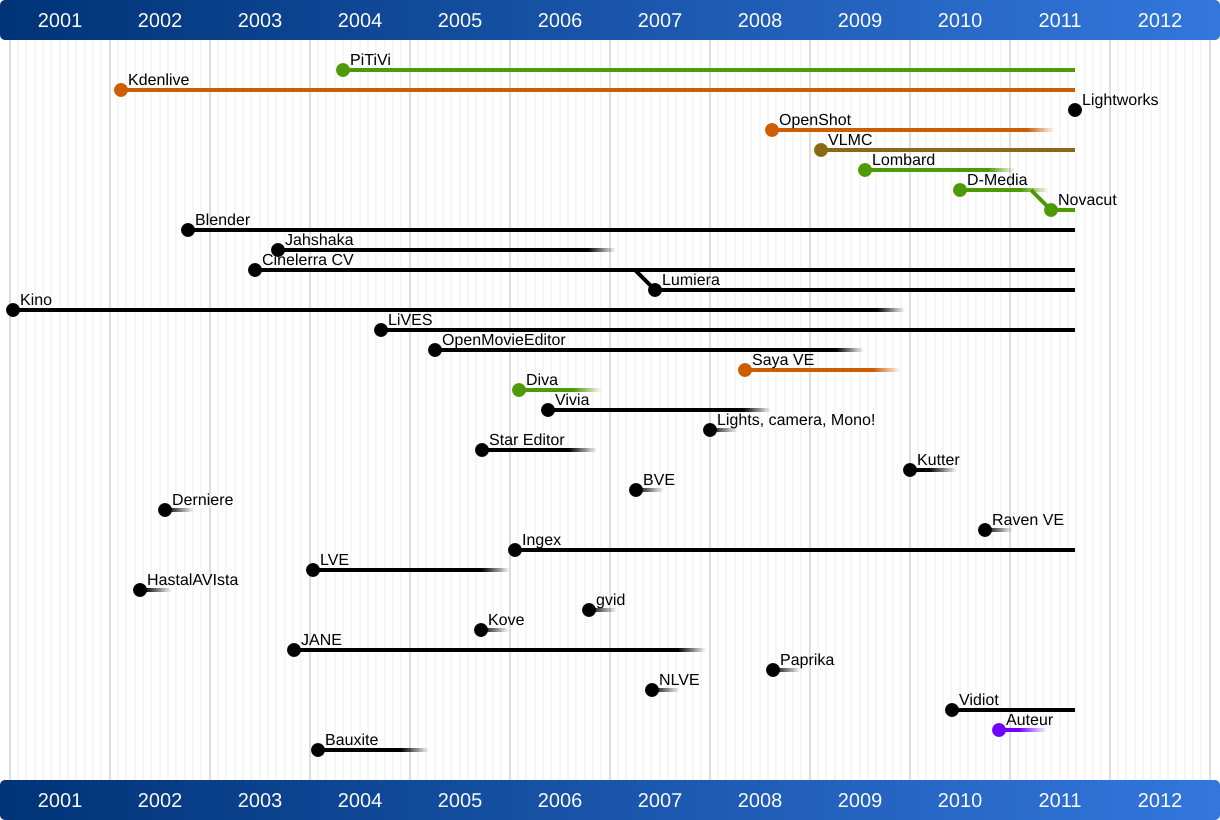
New submitter Shadow99_1 writes I used to do a lot of video editing (a few years ago, at an earlier job) and at that time I used Adobe Premiere. Now a few years later I'm looking to start doing some video editing for my own personal use, but I have a limited budget that pretty well excludes even thinking about buying a copy of Adobe Premiere. So I ask slashdot: What is the state of free (as in beer or as in open source) video editing tools? In my case... I support a windows environment at work and so it's primarily what I use at home. I am also using a camcorder that uses flash cards to record onto, so for me I need a platform that supports reading flash cards. So that is my focus but feel free to discuss video editing on all platforms. I've been looking forward to the Kickstarted upgrade to OpenShot; based on the project's latest update, early versions of an installer should start appearing soon. Video editing is a big endeavor, though, and ambitious announcements and slipped schedules both seem to be the norm: an open-source version of Lightworks was announced back in 2010. Some lighter open-source options include Pitivi (raising funds to get to version 1.0) and Kdenlive, also in active development (most recent release was in mid-May). Pitiviti's site links to a sobering illustration about many of the shorter- and longer-lived projects in this area. -
Interview: Ask Christopher "moot" Poole About 4chan and Social Media
Having started 4chan when he was 15, Christopher Poole, better known as "moot", is indirectly responsible for almost every meme you've ever seen. The group "Anonymous" originated on 4chan and has since engaged in a number of well-publicized publicity stunts and distributed denial-of-service attacks. Thanks to users gaming the system, moot was famously voted the world's most influential person of 2008 in an open internet poll conducted by Time magazine. He is an advocate of online anonymity and speaks on the importance of privacy online to foster creativity and open discussion. moot has agreed to answer your questions about 4chan, social media, and privacy. As usual, ask as many as you'd like, but please, one per post. -
Interview: Ask Christopher "moot" Poole About 4chan and Social Media
Having started 4chan when he was 15, Christopher Poole, better known as "moot", is indirectly responsible for almost every meme you've ever seen. The group "Anonymous" originated on 4chan and has since engaged in a number of well-publicized publicity stunts and distributed denial-of-service attacks. Thanks to users gaming the system, moot was famously voted the world's most influential person of 2008 in an open internet poll conducted by Time magazine. He is an advocate of online anonymity and speaks on the importance of privacy online to foster creativity and open discussion. moot has agreed to answer your questions about 4chan, social media, and privacy. As usual, ask as many as you'd like, but please, one per post. -
Code.org Discloses Top Donors
theodp (442580) writes "Under the leadership of Code.org, explained the ACM, it joined CSTA, NCWIT, NSF, Microsoft and Google in an effort "to reshape the U.S. education system," including passing a federal law making Computer Science a "core subject" in schools. If you're curious about whose money helped fuel the effort, Code.org's Donors page now lists those who gave $25,000+ to $3,000,000+ to the K-12 CS cause (the nonprofit plans to raise $20-30 million for 2015-16 operations). Microsoft is at the top of the list as a Platinum Supporter ($3,000,000+), while Bill Gates is Gold ($1,000,000+), and Steve Ballmer is Silver ($500,000+). Interestingly, six of Code.org's ten biggest donors are also Founders of Mark Zuckerberg's FWD.us tech immigration reform PAC." -
Code.org Discloses Top Donors
theodp (442580) writes "Under the leadership of Code.org, explained the ACM, it joined CSTA, NCWIT, NSF, Microsoft and Google in an effort "to reshape the U.S. education system," including passing a federal law making Computer Science a "core subject" in schools. If you're curious about whose money helped fuel the effort, Code.org's Donors page now lists those who gave $25,000+ to $3,000,000+ to the K-12 CS cause (the nonprofit plans to raise $20-30 million for 2015-16 operations). Microsoft is at the top of the list as a Platinum Supporter ($3,000,000+), while Bill Gates is Gold ($1,000,000+), and Steve Ballmer is Silver ($500,000+). Interestingly, six of Code.org's ten biggest donors are also Founders of Mark Zuckerberg's FWD.us tech immigration reform PAC." -
Ask Slashdot: Linux-Friendly Desktop x86 Motherboard Manufacturers?
storkus writes: The release of Haswell-E and a price drop on Devil's Canyon has made me itch for a PC upgrade. However, looking around I discovered a pair of horror stories on Phoronix about the difficulties of using Linux on a multitude of motherboards. My question: if MSI, Gigabyte, Asus (and by extension Asrock) are out, who's left and are they any good? I'd like to build a (probably dual-boot, but don't know for sure) gaming and 'other' high-end machine with one of the above chips, so we're talking Z97 or X99; however, these stories seem to point to the problems being Windows-isms in the BIOS/UEFI structures rather than actual hardware incompatibility, combined with a lousy attitude (despite the Steam Linux distro being under development). -
Ask Slashdot: Linux-Friendly Desktop x86 Motherboard Manufacturers?
storkus writes: The release of Haswell-E and a price drop on Devil's Canyon has made me itch for a PC upgrade. However, looking around I discovered a pair of horror stories on Phoronix about the difficulties of using Linux on a multitude of motherboards. My question: if MSI, Gigabyte, Asus (and by extension Asrock) are out, who's left and are they any good? I'd like to build a (probably dual-boot, but don't know for sure) gaming and 'other' high-end machine with one of the above chips, so we're talking Z97 or X99; however, these stories seem to point to the problems being Windows-isms in the BIOS/UEFI structures rather than actual hardware incompatibility, combined with a lousy attitude (despite the Steam Linux distro being under development). -
Hidden Obstacles For Delivery Drones
An anonymous reader writes: A few days ago we talked over some of the difficulties faced by makers of autonomous car software, like dealing with weather, construction, and parking garages. Today, the NY Times has a similar article about delivery drones, examining the safety and regulatory problems that must be solved in addition to getting the basic technology ready. "[R]researchers at NASA are working on ways to manage that menagerie of low-flying aircraft. At NASA's Moffett Field, about four miles from Google's headquarters in Mountain View, Calif., the agency has been developing a drone traffic management program that would in effect be a separate air traffic control system for things that fly low to the ground — around 400 to 500 feet for most drones. Much like the air traffic control system for conventional aircraft, the program would monitor the skies for weather and traffic. Wind is a particular hazard, because drones weigh so little compared with regular planes." Beyond that, the sheer scale of infrastructure necessary to get drone delivery up and running in cities across the U.S. is staggering. Commercial drones aren't going to have much range, particularly when carrying something heavy. They'll be noisy, and the products they're transporting will still need to be relatively close by. What other issues do Amazon, DHL, Google, and other need to solve? -
Hackers Behind Biggest-Ever Password Theft Begin Attacks
An anonymous reader writes Back in August, groups of Russian hackers assembled the biggest list of compromised login credentials ever seen: 1.2 billion accounts. Now, domain registrar Namecheap reports the hackers have begun using the list to try and access accounts. "Overnight, our intrusion detection systems alerted us to a much higher than normal load against our login systems. ... The group behind this is using the stored usernames and passwords to simulate a web browser login through fake browser software. This software simulates the actual login process a user would use if they are using Firefox/Safari/Chrome to access their Namecheap account. The hackers are going through their username/password list and trying each and every one to try and get into Namecheap user accounts." They report that most login attempts are failing, but some are succeeding. Now is a good time to check that none of your important accounts share passwords. -
Tox, a Skype Replacement Built On 'Privacy First'
An anonymous reader writes: Rumors of back door access to Skype have plagued the communication software for the better part of a decade. Even if it's not true, Skype is owned by Microsoft, which is beholden to data requests from law enforcement. Because of these issues, a group of developers started work on Tox, which aims to rebuild the functionality of Skype with an emphasis on privacy. "The main thing the Tox team is trying to do, besides provide encryption, is create a tool that requires no central servers whatsoever—not even ones that you would host yourself. It relies on the same technology that BitTorrent uses to provide direct connections between users, so there's no central hub to snoop on or take down." -
Tox, a Skype Replacement Built On 'Privacy First'
An anonymous reader writes: Rumors of back door access to Skype have plagued the communication software for the better part of a decade. Even if it's not true, Skype is owned by Microsoft, which is beholden to data requests from law enforcement. Because of these issues, a group of developers started work on Tox, which aims to rebuild the functionality of Skype with an emphasis on privacy. "The main thing the Tox team is trying to do, besides provide encryption, is create a tool that requires no central servers whatsoever—not even ones that you would host yourself. It relies on the same technology that BitTorrent uses to provide direct connections between users, so there's no central hub to snoop on or take down." -
Radioactive Wild Boars Still Roaming the Forests of Germany
An anonymous reader writes 28 years after the Chernobyl accident, tests have found that more than one in three Saxony boars give off such high levels of radiation that they are unfit for consumption. In 2009 almost €425,000 ($555,000) was paid out to hunters in compensation for wild boar meat that was too contaminated to be sold. "It doesn't cover the loss from game sales, but at least it covers the cost of disposal," says Steffen Richter, the head of the Saxon State Hunters Association. -
The Passenger Pigeon: A Century of Extinction
An anonymous reader writes On September 1, 1914, Martha, the last passenger pigeon was found dead in her aviary at the Cincinnati Zoo. When the first European settlers arrived in North America at least one of every four birds on the continent was a passenger pigeon, making them the most numerous birds in North America, and perhaps in the world. From the article: "But extinction apparently doesn't ring with the finality it used to. Researchers are working to 'de-extinct' the bird. They got their hands on some of the 1,500 or so known passenger pigeon specimens and are hoping to resurrect the species through some Jurassic Park-like genetic engineering. Instead of using frog DNA to fill out the missing parts of a dinosaur's genetic code as in Michael Crichton's story, the real-life 'bring-back-the-passenger pigeon' researchers are using the bird's closest relative, the band-tailed pigeon. -
XKCD Author's Unpublished Book Remains a Best-Seller For 5 Months
destinyland writes Tuesday is the official release date for the newest book from the geeky cartoonist behind XKCD — yet it's already become one of Amazon's best-selling books. Thanks to a hefty pre-order discount, one blogger notes that it's appeared on Amazon's list of hardcover best-sellers since the book was first announced in March, and this weekend it remains in the top 10. Randall Munroe recently announced personal appearances beginning this week throughout the U.S. (including Cambridge, New York, Seattle, and the San Francisco Bay Area) — as well as a Google Hangout on Friday, September 12. Just two weeks ago he was also awarded the Hugo Award for Best Graphic Story — and now many of his appearances are already sold out. -
Update: Raspberry Pi-Compatible Development Board Cancelled
An anonymous reader writes "Anyone who might have been interested in the miniature Raspberry Pi compatible board mentioned here a month ago should know the board has been cancelled due to problems sourcing the Broadcom SoC. Given the less than welcoming response from the rpi community to the board's release, there is speculation as to why Hardkernel is having trouble buying the chip. -
Feynman Lectures Released Free Online
Anna Merikin writes In 1964, Richard Feynman delivered a series of seven hour-long lectures at Cornell University which were recorded by the BBC, and in 2009 (with a little help from Bill Gates), were released to the public. The three-volume set may be the most popular collection of physics books ever written, and now the complete online edition has been made available in HTML 5 through a collaboration between Caltech (where Feyman first delivered these talks, in the early 1960s) and The Feynman Lectures Website. The online edition is "high quality up-to-date copy of Feynman's legendary lectures," and, thanks to the implementation of scalable vector graphics, "has been designed for ease of reading on devices of any size or shape; text, figures and equations can all be zoomed without degradation." Volume I deals mainly with mechanics, radiation and heat; Volume II with electromagnetism and matter; and Volume III with quantum mechanics. Last year we told you when Volume I was made available. It's great to see the rest added. -
Magnetic Stimulation Boosts Memory In Humans
sciencehabit writes: Our memories are annoyingly glitchy. Names, dates, birthdays, and the locations of car keys fall through the cracks, losses that accelerate at an alarming pace with age and in neurodegenerative diseases. Now, by applying electromagnetic pulses through the skull to carefully targeted brain regions, researchers have found a way to boost memory performance in healthy people. The new study (abstract) sheds light on the neural networks that support memories and may lead to therapies for people with memory deficits, researchers say. Similar studies have been performed using electric current. -
Magnetic Stimulation Boosts Memory In Humans
sciencehabit writes: Our memories are annoyingly glitchy. Names, dates, birthdays, and the locations of car keys fall through the cracks, losses that accelerate at an alarming pace with age and in neurodegenerative diseases. Now, by applying electromagnetic pulses through the skull to carefully targeted brain regions, researchers have found a way to boost memory performance in healthy people. The new study (abstract) sheds light on the neural networks that support memories and may lead to therapies for people with memory deficits, researchers say. Similar studies have been performed using electric current. -
Microsoft Releases Replacement Patch With Two Known Bugs
snydeq writes Microsoft has re-released its botched MS14-045/KB 2982791 'Blue Screen 0x50' patch, only to introduce more problems, InfoWorld's Woody Leonhard reports. "Even by Microsoft standards, this month's botched Black Tuesday Windows 7/8/8.1 MS14-045 patch hit a new low. The original patch (KB 2982791) is now officially 'expired' and a completely different patch (KB 2993651) offered in its stead; there are barely documented revelations of new problems with old patches; patches that have disappeared; a 'strong' recommendation to manually uninstall a patch that went out via Automatic Update for several days; and an infuriating official explanation that raises serious doubts about Microsoft's ability to support Windows 9's expected rapid update pace." -
No, a Stolen iPod Didn't Brick Ben Eberle's Prosthetic Hand
New submitter willoremus writes A wounded Army vet had his $75k prosthetic hand bricked when someone stole his iPod Touch? Yeah, not so much. I'm a tech reporter for Slate.com, and a Slashdot post earlier this week prompted me to look into this story and ultimately debunk some of the key info. Sorry for self-posting, but I thought folks here might be interested in the truth since the false story was one of the top posts earlier this week. -
State of the GitHub: Chris Kelly Does the Numbers
I talked with Chris Kelly of GitHub at last week's LinuxCon about GitHub. He's got interesting things to say about the demographics and language choices on what has become in short order (just six years) one of the largest repositories of code in the world, and one with an increasingly sophisticated front-end, and several million users. Not all of the code on GitHub is open source, but the majority is -- handy, when that means an account is free as in beer, too. (And if you're reading on the beta or otherwise can't view the video below, here's the alternative video link.) -
Microsoft Dumps 1,500 Apps From Its Windows Store
redletterdave writes: Microsoft announced on its Windows blog Wednesday that it's removed more than 1,500 apps from its Windows Store in a bid to clean up the store and restore trust with Windows 8 and Windows Phone users. Microsoft's new certification process, in particular, asks for clear and accurate names that "reflect the functionality of the app," more accurate categories, and differentiated icons to ensure apps aren't confused with one another. Microsoft reached out to developers with apps that violated its policies; some agreed to make changes to their software, while those who were "less receptive" saw their apps removed from the Windows Store. That might be just the beginning. -
Research Shows RISC vs. CISC Doesn't Matter
fsterman writes The power advantages brought by the RISC instruction sets used in Power and ARM chips is often pitted against the X86's efficiencies of scale. It's difficult to assess how much the difference between instruction sets matter because teasing out the theoretical efficiency of an ISA from the proficiency of a chip's design team, technical expertise of its manufacturer, and support for architecture-specific optimizations in compilers is nearly impossible . However, new research examining the performance of a variety of ARM, MIPS, and X86 processors gives weight to Intel's conclusion: the benefits of a given ISA to the power envelope of a chip are minute. -
Slashdot Talks WIth IBM Power Systems GM Doug Balog (Video)
Yesterday we had a story titled 'IBM Gearing Up Mega Power 8 Servers For October Launch.' In the intro Timothy wrote, '...watch for a video interview with Balog on how he's helping spend the billion dollars that IBM pledged last year on open source development.' This is that video, and in it Balog tells us how much IBM loves Linux and open source, and how they're partnering with multiple distros, recently including Ubuntu. So get ready for Power 8 servers in October. IBM is pushing them like mad -- especially in the Linux/FOSS realm. (Alternate Video Link) -
Slashdot Talks WIth IBM Power Systems GM Doug Balog (Video)
Yesterday we had a story titled 'IBM Gearing Up Mega Power 8 Servers For October Launch.' In the intro Timothy wrote, '...watch for a video interview with Balog on how he's helping spend the billion dollars that IBM pledged last year on open source development.' This is that video, and in it Balog tells us how much IBM loves Linux and open source, and how they're partnering with multiple distros, recently including Ubuntu. So get ready for Power 8 servers in October. IBM is pushing them like mad -- especially in the Linux/FOSS realm. (Alternate Video Link) -
Fermilab Begins Testing Holographic Universe Theory
Back in 2009, researchers theorized that space could be a hologram. Four years ago, Fermilab proposed testing the theory, and the experiment is finally going online. Jason Koebler writes Operating with cutting-edge technology out of a trailer in rural Illinois, government researchers started today on a set of experiments that they say will help them determine whether or not you and me and everything that exists are living in a two-dimensional holographic universe. In a paper explaining the theory, Craig Hogan, director of the Department of Energy's Fermilab Center for Particle Astrophysics writes that "some properties of space and time that seem fundamental, including localization [where things are], may actually emerge only as a macroscopic approximation from the flow of information in a quantum system." In other words, the location of places in space may constantly fluctuate ever so slightly, which would suggest we're living in a hologram. -
Fermilab Begins Testing Holographic Universe Theory
Back in 2009, researchers theorized that space could be a hologram. Four years ago, Fermilab proposed testing the theory, and the experiment is finally going online. Jason Koebler writes Operating with cutting-edge technology out of a trailer in rural Illinois, government researchers started today on a set of experiments that they say will help them determine whether or not you and me and everything that exists are living in a two-dimensional holographic universe. In a paper explaining the theory, Craig Hogan, director of the Department of Energy's Fermilab Center for Particle Astrophysics writes that "some properties of space and time that seem fundamental, including localization [where things are], may actually emerge only as a macroscopic approximation from the flow of information in a quantum system." In other words, the location of places in space may constantly fluctuate ever so slightly, which would suggest we're living in a hologram. -
Project Zero Exploits 'Unexploitable' Glibc Bug
NotInHere (3654617) writes with news that Google's Project Zero has been busy at work. A month ago they reported an off-by-one error in glibc that would overwrite a word on the heap with NUL and were met with skepticism at its ability to be used in an attack. Google's 'Project Zero' devised an exploit of the out-of-bounds NUL write in glibc to gain root access using the setuid binary pkexec in order to convince skeptical glibc developers. 44 days after being reported, the bug has been fixed. They even managed to defeat address space randomization on 32-bit platforms by tweaking ulimits. 64-bit systems should remain safe if they are using address space randomization. -
Exomoon Detection Technique Could Greatly Expand Potential Habitable Systems
Luminary Crush (109477) writes Most of the detected exoplanets thus far have been gas giants which aren't great candidates for life as we know it. However, many of those planets are in fact in the star's habitable zone and could have moons with conditions more favorable. Until now, methods to detect the moons of such gas giants have been elusive, but researchers at the University of Texas, Arlington have discovered a way to detect the interaction of a moon's ionosphere with the parent gas giant from studies of Jupiter's moon Io. The search for 'Pandora' has begun. -
The Grumpy Programmer has Advice for Young Computer Workers (Video)
Bob Pendleton calls his blog "The Grumpy Programmer" because he's both grumpy and a programmer. He's also over 60 years old and has been programming since he was in his teens. This pair of videos is a break from our recent spate of conference panels and corporate people. It's an old programmer sharing his career experiences with younger programmers so they (you?) can avoid making his mistakes and possibly avoid becoming as grumpy as he is -- which is kind of a joke, since Bob is not nearly as grumpy as he is light-hearted. (Transcript covers both videos. Alternate Video Link One; Alternate Video Link Two) -
The Grumpy Programmer has Advice for Young Computer Workers (Video)
Bob Pendleton calls his blog "The Grumpy Programmer" because he's both grumpy and a programmer. He's also over 60 years old and has been programming since he was in his teens. This pair of videos is a break from our recent spate of conference panels and corporate people. It's an old programmer sharing his career experiences with younger programmers so they (you?) can avoid making his mistakes and possibly avoid becoming as grumpy as he is -- which is kind of a joke, since Bob is not nearly as grumpy as he is light-hearted. (Transcript covers both videos. Alternate Video Link One; Alternate Video Link Two) -
IBM Gearing Up Mega Power 8 Servers For October Launch
darthcamaro (735685) writes "Now that IBM has sold off its x86 server business to Lenovo, it's full steam ahead for IBM's Power business. While Intel is ramping up its next generation of server silicon for a September launch, IBM has its next lineup of Power 8 servers set to be announced in October. "There is a larger than 4U, 2 socket system coming out," Doug Balog, General Manager of Power Systems within IBM's System and Technology Group said. Can IBM Power 8 actually take on x86? Or has that ship already sailed?" At last weekend's Linux Con in Chicago, IBM talked up the availability of the Power systems, and that they are working with several Linux vendors, including recently-added Ubuntu; watch for a video interview with Balog on how he's helping spend the billion dollars that IBM pledged last year on open source development. -
New Windows Coming In Late September -- But Which One?
snydeq (1272828) writes "Nobody seems to know for sure whether 'Threshold' and 'Windows 9' will be one and the same or separate operating systems, reports Woody Leonhard in his roundup of insights on Microsoft's forthcoming OS plans, expected September 30. 'Many people think the terms are synonymous, but longtime Chinese leaker Faikee continues to maintain that they are two separate products, possibly headed in different directions. Neowin Senior Editor and Columnist Brad Sams appears to have access to the most recent test builds, possibly on a daily basis. He doesn't talk about details, but the items he's let drop on the Neowin forum leave an interesting trail of crumbs.' Either way, the next iteration of Windows will have a lot to say about the kind of Microsoft to expect as Satya Nadella cements his leadership over the flagship OS." -
Amazon To Buy Twitch For $970 Million
Dave Knott (2917251) writes Amazon has agreed to acquire the live game-streaming service Twitch for approximately $970 million in cash, a move that could help Amazon bolster its position in the fast-growing business of online gaming and give it technology to compete with video-streaming rivals Netflix and YouTube. The acquisition, which has been approved by Twitch's shareholders, is expected to be completed by the end of the year. Google had for some time been reported to have interest in acquiring Twitch, but those talks cooled in recent weeks. Google was unable to close the deal, said sources familiar with the talks, because it was concerned about potential antitrust issues that could have come with the acquisition. -
Munich Council Say Talk of LiMux Demise Is Greatly Exaggerated
ndogg (158021) writes "The rumors of Munich's city government going back to Microsoft seem to have been greatly exaggerated. There was a review of the city's IT systems that was called for by the mayor, but it wasn't solely just to decide on whether to move back to Microsoft. And while there have been complaints about LiMux, they mostly seem to concern compatibility with OpenOffice.org, which may well be resolved by switching to LibreOffice." -
Dropbox Caught Between Warring Giants Amazon and Google
An anonymous reader writes: Google and Amazon are both aggressively pursuing the cloud storage market, constantly increasing available storage space and constantly dropping prices. On its face, this looks great for the consumer — competition is a wonderful thing. Unfortunately, many smaller companies like Box, Dropbox, and Hightail simply aren't able to run their services at a loss like the giants can. Dropbox's Aaron Levie said, "These guys will drive prices to zero. You do not want to wait for Google or Amazon to keep cutting prices on you. 'Free' is not a business model."
The result is that the smaller companies are pivoting to win market share, relying on specific submarkets or stronger feature sets rather than available space or price. "Box is trying to cater to special data storage needs, like digital versions of X-rays for health care companies and other tasks specific to different kinds of customers. Hightail is trying to do something similar for customers like law firms. And Dropbox? It is trying to make sure that its consumer-minded service stays easier to use than what the big guys provide." It's going to be tough for them to hold out, and even tougher for new storage startups to break in. But that might be the only thing keeping us from choosing between the Wal-Mart-A and Wal-Mart-B of online storage. -
Dropbox Caught Between Warring Giants Amazon and Google
An anonymous reader writes: Google and Amazon are both aggressively pursuing the cloud storage market, constantly increasing available storage space and constantly dropping prices. On its face, this looks great for the consumer — competition is a wonderful thing. Unfortunately, many smaller companies like Box, Dropbox, and Hightail simply aren't able to run their services at a loss like the giants can. Dropbox's Aaron Levie said, "These guys will drive prices to zero. You do not want to wait for Google or Amazon to keep cutting prices on you. 'Free' is not a business model."
The result is that the smaller companies are pivoting to win market share, relying on specific submarkets or stronger feature sets rather than available space or price. "Box is trying to cater to special data storage needs, like digital versions of X-rays for health care companies and other tasks specific to different kinds of customers. Hightail is trying to do something similar for customers like law firms. And Dropbox? It is trying to make sure that its consumer-minded service stays easier to use than what the big guys provide." It's going to be tough for them to hold out, and even tougher for new storage startups to break in. But that might be the only thing keeping us from choosing between the Wal-Mart-A and Wal-Mart-B of online storage. -
Iceland Stands Down On Travel Alert: From Orange To Red and Back Again
Iceland's tiered system of air travel alerts went to orange last week, then to red with a believed under-ice eruption of the volcano beneath the Dyngjujokull glacier, but has now been eased back to orange. "Observations show that a sub-glacial eruption did not occur yesterday. The intense low-frequency seismic signal observed yesterday has therefore other explanations," the Icelandic Met Office said. The office had therefore decided to move the aviation warning code from red to orange, it said, but since there was no sign the seismic activity was slowing down, an eruption could still not be excluded. The national police commissioner said separately that all restrictions on aviation had been cancelled. Airspace of 140 by 100 nautical miles above the volcano had been closed to aircraft on Saturday. -
Iceland Stands Down On Travel Alert: From Orange To Red and Back Again
Iceland's tiered system of air travel alerts went to orange last week, then to red with a believed under-ice eruption of the volcano beneath the Dyngjujokull glacier, but has now been eased back to orange. "Observations show that a sub-glacial eruption did not occur yesterday. The intense low-frequency seismic signal observed yesterday has therefore other explanations," the Icelandic Met Office said. The office had therefore decided to move the aviation warning code from red to orange, it said, but since there was no sign the seismic activity was slowing down, an eruption could still not be excluded. The national police commissioner said separately that all restrictions on aviation had been cancelled. Airspace of 140 by 100 nautical miles above the volcano had been closed to aircraft on Saturday.