 Slashdot Mirror
Domain: slashdot.org
Stories and comments across the archive that link to slashdot.org.
Stories · 37,380
-
Parents Mobilize Against States' Student Data Mining
theodp writes 'Politico reports that parents have mobilized into an unexpected political force to fight the data mining of their children, catapulting student privacy to prominence in statehouses. Having already torpedoed the $100 million, Bill Gates-funded inBloom database project, which could have made it easier for schools to share confidential student records with private companies, the amateur activists are now rallying against another perceived threat: huge state databases being built to track children for more than two decades, from as early as infancy through the start of their careers. "The Education Department," writes Stephanie Simon, "lists hundreds of questions that it urges states to answer about each child in the public school system: Did she make friends easily as a toddler? Was he disciplined for fighting as a teen? Did he take geometry? Does she suffer from mental illness? Did he go to college? Did he graduate? How much does he earn?" Leonie Haimson, a NY mother who is organizing a national Parent Coalition for Student Privacy says, "Every parent I've talked to has been horrified. We just don't want our kids tracked from cradle to grave." For their part, ed tech entrepreneurs and school reformers are both bewildered by and anxious about the backlash — and struggling to craft a response, having assumed parents would support their vision: to mine vast quantities of data for insights into what's working, and what's not, for individual students and for the education system as a whole. "People took for granted that parents would understand [the benefits], that it was self-evident," said Michael Horn, a co-founder an education think tank." -
The Ethics Cloud Over Ballmer's $2 Billion B-Ball Buy
theodp (442580) writes '"It is hard to imagine any more heinous way of earning money than by benefiting from racism," writes Rick Cohen, who argues that Donald Sterling and the NBA owners are being unjustly enriched by Sterling's racism, which led to the $2 billion sale of the L.A. Clippers to ex-Microsoft CEO Steve Ballmer, a record-high sum for an NBA team. "Indeed, the only losers in the Sterling affair are the players," adds the NY Times. "What held promise as a possible D-Day in the N.B.A., a day when N.B.A. owners stood up to be counted and voted Donald Sterling out of the league, instead turned into a great day for the status quo." Forbes contributor Robert Wood speculates that if he plays his cards right, Sterling's windfall could be tax-free.' -
Google Unveils Project Tango 3D Tablet DevKit Powered By NVIDIA's Tegra K1
MojoKid (1002251) writes 'Google's Project Tango tablet is a 3D mapping and spatially-aware device that, with number of cameras and sensors on it, can detect its surroundings and your movements in three dimensions. As such, you can utilize the device to develop applications and uses that integrate the physical world around you in a virtual representation on screen. From augmented reality, to gaming and terrain mapping, the things you could conceivably do with a device like this are rather fascinating. Until today, we haven't gotten a lot of detail regarding exactly what makes Project Tango tick but the folks at NVIDIA have helped, along with Google, to let the cat out of the proverbial bag. It appears that the just announced Project Tango development kit is based on a 7-inch Android tablet with 4GB of RAM, 128GB of storage and it's powered by NVIDIA's new Tegra K1 integrated processor and SoC (System On a Chip). Interestingly, previous versions of Project Tango have been torn down, revealing a Qualcomm Snapdragon 801 under the hood. However, it appears Google needed a bit more juice and is also going with NVIDIA's new low power mobile beast. Word is Google's Project Tango Developer's Kit will be available "later this year" and will cost exactly $1024. Wouldn't you know it, that price fits neatly into a 1KB memory space. Think they meant to do that?' -
ISS-Above Tells You When the International Space Station is Overhead (Video)
It's a device, and quite a small one, based on the Raspberry Pi. It tells you when the ISS is visible from your part of the world and when it will soon be visible so you can grab the kids and dogs and run outside to wave at the astronauts. Or just to watch the closest thing humanity has to a space colony orbit the Earth. Liam Kennedy, ISS-Above's creator, points out that the ISS passes over most of the inhabited parts of the Earth five or six times a day, which is more than most people know. And about ISS-Above and Kickstarter: It's too late to climb on that wagon, and it already was when this interview was recorded in mid-May. But don't despair. Liam managed to raise $17,731 -- which was far more than his $5000 goal. Can you buy one of these things in its various manifestations? Yes. But you need to look long and hard at the ISS-Above website to spot the all-caps word HERE that takes you to the order page. Liam also points out that you can get all kinds of smartphone apps that will tell you where the ISS is at any given moment, but the ISS-Above has an advantage or two over those apps that will be revealed only to those who watch the video or read the transcript. (Alternate Video Link) -
ISS-Above Tells You When the International Space Station is Overhead (Video)
It's a device, and quite a small one, based on the Raspberry Pi. It tells you when the ISS is visible from your part of the world and when it will soon be visible so you can grab the kids and dogs and run outside to wave at the astronauts. Or just to watch the closest thing humanity has to a space colony orbit the Earth. Liam Kennedy, ISS-Above's creator, points out that the ISS passes over most of the inhabited parts of the Earth five or six times a day, which is more than most people know. And about ISS-Above and Kickstarter: It's too late to climb on that wagon, and it already was when this interview was recorded in mid-May. But don't despair. Liam managed to raise $17,731 -- which was far more than his $5000 goal. Can you buy one of these things in its various manifestations? Yes. But you need to look long and hard at the ISS-Above website to spot the all-caps word HERE that takes you to the order page. Liam also points out that you can get all kinds of smartphone apps that will tell you where the ISS is at any given moment, but the ISS-Above has an advantage or two over those apps that will be revealed only to those who watch the video or read the transcript. (Alternate Video Link) -
A Year After Snowden's Disclosures, EFF, FSF Want You To Fight Surveillance
Today, as the EFF notes, marks one year from Edward Snowden's first document leaks, and the group is using that as a good spur to install free software intended to make it harder for anyone (the NSA is certainly not the first, and arguably far from the worst) to spy on your electronic communications. Nowadays, that means nearly everything besides face-to-face communication, or paper shipped through the world's postal systems. Reader gnujoshua (540710) highlights one of the options: 'The FSF has published a (rather beautiful) infographic and guide to encrypting your email using GnuPG. In their blog post announcing the guide they write: "One year ago today, an NSA contractor named Edward Snowden went public with his history-changing revelations about the NSA's massive system of indiscriminate surveillance. Today the FSF is releasing Email Self-Defense, a guide to personal email encryption to help everyone, including beginners, make the NSA's job a little harder.'" Serendipitous timing: a year and a day ago, we mentioned a UN report that made explicit the seemingly obvious truth that undue government surveillance, besides being an affront in itself, chills free speech. (Edward Snowden agrees.) -
SpaceX Landing Video Cleanup Making Progress
Maddog Batty (112434) writes 'The fine people at the NASA Space Flight Forum are making good progress on restoring the corrupted landing video reported earlier. It worth looking at the original video to see how bad it was and then at the latest restored video. It is now possible to see the legs being deployed, the sea coming closer and a big flame ball as the rocket plume hits the water. An impressive improvement so far and it is still being actively worked on so further refinements are likely.' Like Maddog Batty, I'd suggest watching the restored version first (note: the video is lower on the page), to see just what a big improvement's been made so far. -
Group Demonstrates 3,000 Km Electric Car Battery
Jabrwock (985861) writes 'One of the biggest limitations on lithium battery-powered electric cars has been their range. Last year Israeli-based Phinergy introduced an "aluminum-air" battery. Today, partnering with Alcoa Canada, they announced a demo of the battery, which is charged up at Alcoa's aluminum smelter in Quebec. The plant uses hydro-electric power to charge up the battery, which would then need a tap-water refill every few months, and a swap (ideally at a local dealership) every 3,000km, since it cannot be recharged as simply as Lithium. The battery is meant to boost the range of standard electric cars, which would still use the Lithium batteries for short-range trips. The battery would add about 100 kg to an existing Tesla car's battery weight.' -
Google Has Received Over 41,000 Requests To "Forget" Personal Information
itwbennett (1594911) writes 'In the three weeks since a key ruling by the European Court of Justice about the so-called right to be forgotten, Google has already received around 41,000 requests to delete links to personal information from its search results (within 24 hours of putting the form online, Google had reportedly received 12,000 deletion requests). It should be noted, though, that there is no absolute right to have information deleted, and Google will have to weigh a number of criteria in responding to the requests to delete links, including relevance of the information, and the time passed since the facts related.' -
MIT Working On Robotic Limbs That Attach To Shoulders, Waist
Nerval's Lobster writes: 'Following up on news that ActiveLink is building heavy-duty exoskeletons for work in nuclear plants, IEEE Spectrum reports that MIT researchers are experimenting with Supernumerary Robotic Limbs (SRLs) that attach to either the shoulder or waist. The SRLs are capable of lifting objects and bracing against solid surfaces. From the article: "The SRL watches what you're doing with your arms to decide how to move. It does that by monitoring two inertial measurement units (IMUs) that the user wears on the wrists. A third IMU sits at the base of the robot's shoulder mount, to track the overall orientation and motion of the SRL." In the future, we will all have the ability to become Doctor Octopus (minus two robo-limbs, of course).' -
Fuel 3-D Claims to be a High-Res, Point and Shoot 3-D Scanner (Video)
The Fuel 3-D website has a blurb that says, "The world’s first handheld point-and-shoot, full color 3D scanner. Our planned list price is $1500 but by placing your advanced order now you pay only $1,250. Fire up your creativity!" We've thought about getting a 3-D scanner ever since we first messed with a 3-D printer, but we've thought more about something in the sub-$300 price range than in $1000+ territory. But that's just us. There is no doubt a healthy market for 3-D scanners to use in commercial applications where $1250 (or even $1500) is hardly worth noticing. Ah, well. Maybe we need to look at the The DAVID website which describes their device as an "Incredibly Low-Cost 3D Scanner for Everyone!" Their 3-D starter kit is only $529 from a randomly-selected U.S. reseller, which isn't too bad compared to the alternatives. But waiting for prices in this market niche to come down is another possibility, and it's one a whole lot of individuals -- including us -- and smaller companies will probably choose. (Alternate Video Link) -
Key Researcher Agrees To Retract Disputed Stem Cell Papers
sciencehabit (1205606) writes "After several months of fiercely defending her discovery of a new, simple way to create pluripotent stem cells, Haruko Obokata of the RIKEN Center for Developmental Biology in Kobe, Japan, has agreed to retract the two Nature papers that reported her work. Satoru Kagaya, head of public relations for RIKEN, headquartered in Wako near Tokyo, confirmed press reports today that Obokata had finally agreed to retract both papers. He said the institute would be notifying Nature and that the decision to formally retract the papers would be up to the journal." -
Netflix Ditches Silverlight For HTML5 On Macs
An anonymous reader writes "Netflix yesterday furthered its plans to ditch Silverlight for HTML5 on Macs, having already done so last year in IE11 on Windows 8.1. HTML5 video is now supported by Netflix in Safari on OS X Yosemite, meaning you can stream your favorite movies and TV shows without having to install any plugins." Courtesy of encrypted media extensions. -
AMD, NVIDIA, and Developers Weigh In On GameWorks Controversy
Dputiger writes: "Since NVIDIA debuted its GameWorks libraries there's been allegations that they unfairly disadvantaged AMD users or prevented developers from optimizing code. We've taken these questions to developers themselves and asked them to weigh in on how games get optimized, why NVIDIA built this program, and whether its an attempt to harm AMD customers. 'The first thing to understand about [developer/GPU manufacturer] relations is that the process of game optimization is nuanced and complex. The reason AMD and NVIDIA are taking different positions on this topic isn't because one of them is lying, it’s because AMD genuinely tends to focus more on helping developers optimize their own engines, while NVIDIA puts more effort into performing tasks in-driver. This is a difference of degree — AMD absolutely can perform its own driver-side optimization and NVIDIA's Tony Tamasi acknowledged on the phone that there are some bugs that can only be fixed by looking at the source. ... Some of this difference in approach is cultural but much of it is driven by necessity. In 2012 (the last year before AMD's graphics revenue was rolled into the console business), AMD made about $1.4 billion off the Radeon division. For the same period, NVIDIA made more than $4.2 billion. Some of that was Tegra-related and it's a testament to AMD's hardware engineering that it competes effectively with Nvidia with a much smaller revenue share, but it also means that Team Green has far more money to spend on optimizing every aspect of the driver stack.'" -
Intel Wants To Computerize Your Car
cartechboy writes: 'Google just unveiled its cute self-driving car prototype, and now Intel is the next tech company looking to get in on the rapid digital change coming in cars — a potentially lucrative area for expansion. Intel is releasing what it's calling an "in-vehicle solutions platform" — processors, an operating system and developer kits Intel is hoping automakers and others would use to build in-vehicle infotainment systems. From the developer perspective, there is a chance the Intel release makes building easier and cheaper. But is it good for automakers to be building these systems instead of Google and Apple? So far, no automaker has done so well on software, and some have seriously damaged their reputation (ex: MyFord Touch and Sync, Cadillac CUE).' -
This 360-Degree, 4K Video Camera isn't Getting Kickstarted (Video)
This is something that caught Tim Lord's eye as he cruised the 2014 Bay Area Maker Faire: A 360 4K-resolution video camera. It's not out yet for retail sale, but if you look at the Centrcam website you can see a number of videos their cameras have shot, including some high-motion ones that they say, truthfully, are excellent to watch full-screen. The people who came up with this aren't college students who have never done any professional design work. Rather, they're "the same team that engineered and built the Apple iPhone cameras." So it's no wonder they have made something pretty cool that has already been used to make videos for Fox Sports, National Geographic, and the U.S. Army, among others. Their Kickstarter blurb is pretty cool, too. It is one of the most detailed ones we've ever seen. It's sad that they only got $607,628 of their $900,000 funding goal, considering all the work they've put into their product, along with the great presentation. They didn't know this would happen at the time this video was shot at the Maker Faire; their Kickstarter time window didn't close until four days ago. But there are other ways to fund a startup, and we hope they manage find one -- because we would eventually like to get our hands on one of their cameras and test it for ourselves, possibly with a little help from some of the Bradenton Riverwalk Skatepark regulars. (Alternate Video Link) -
Bill Blunden's Rejected DEF CON Presentation Posted Online
Nicola Hahn (1482985) writes "Though the Review Board at DEF CON squelched Bill Blunden's presentation on Chinese cyber-espionage, and the U.S. government has considered imposing visa restrictions to keep out Chinese nationals, Bill has decided to post both the presentation's slide deck and its transcript online. The talk focuses on Mike Rogers, in all his glory, a former FBI agent who delivers a veritable litany of hyperbolic misstatements (likely to be repeated endlessly on AM radio). Rather than allow the DEFCON Review Board to pass judgement as supposed .gov 'experts,' why not allow people to peruse the material and decide for themselves who is credible and who is not?" "Squelched" seems a little harsh (only so many talks can fit, and there's no accounting for taste), but it's certainly good to see any non-accepted DEF CON presentations made public. -
Interviews: Jennifer Granick Answers Your Questions
samzenpus (5) writes "Recently you had a chance to ask Jennifer Granick, the Director of Civil Liberties for the Center for Internet and Society at Stanford Law School, about surveillance, data protection, copyright, and number of other internet privacy issues. Below you'll find her answers to those questions." What can be done to fix the DMCA?
by Anonymous Coward
As pretty much anyone who has ever used YouTube (or any similar service) knows, the DMCA has a lot of issues. For one, there's the fact that individuals or companies who file false DMCA claims, which are supposedly punishable under the law, are never punished. Another would be the unfair application of the DMCA - partners and other monetized channels on YouTube will (almost) never have their videos taken down from a single DMCA claim, even if a video made under the same circumstances and containing similar content would be taken down on a non-partner channel if a DMCA notice was ever filed. Is the EFF planning to do anything lobbying-wise to fix the DMCA? If so, what in your opinion would be the way to go about fixing it?
Granick: I don’t work for EFF anymore, so I can’t speak for their plans or thoughts.
The DMCA has two main parts, the notice and take down provisions, and the anti-circumvention provisions. By and large I think the notice and take down provisions are livable. the burden for specifically identifying infringing content is and should remain on rights holders. In making those identifications, there is the problem of unpunished abuse, and even just plain mistakes. Sometimes, legitimate content is improperly taken down and not restored. But overall, that system is allowing non-infringing content to flourish, and even enabling alternative business models for licensing and monetizing.
The anti-circumvention provisions, also called section 1201, are fundamentally broken. They interfere with people’s freedom to explore and modify software and devices that they themselves own. I support currently stalled efforts to reform section 1201 by protecting cell phone unlocking. If want to just address phone unlocking, there’s a right and a wrong way to do it. https://cyberlaw.stanford.edu/blog/2013/03/heres-how-legalize-phone-unlocking Still, these efforts fall short. Section 1201 could be and should be modified to regulate tools designed for infringement and leave mere access and tools that enable access alone.
Role of DMCA and free markets
by JohnnyComeLately
Do you see free market innovation thriving with DMCA despite the apparent lack of innovation? Articulation of my question: When I buy a car, I can modify it. If people like my modification they can view it at my leisure and tinker themselves. GM doesn't sue me, and if I open a business to work on other GM cars to do similar GM vehicle modifications, then I have little legal exposure. However, with DMCA, GM can shut down a video if it's "suspected" I've infringed on a digital asset, and I can't legally sell modifications of their digital asset. This is why we see every new technology for digital streaming of data run a gauntlet of legal hurdles, which in turn stifles new innovation in the area of digital property.
Granick: The anti-circumvention provisions of the DMCA haven’t totally killed innovation even as they hamper it in a number of ways. The EFF has been documenting those ways.
Re:European "right to be forgotten"
by AmiMoJo
Could you explain the "right to be forgotten" concisely and effectively so that people don't assume it grants "freedom not to be talked about"? Every story on Slashdot and every other news site with comments gets hundreds of angry responses from people who have completely the wrong idea about it.
Granick: The new case from the European Court of Justice says that people can compel search engines to remove certain reputation-harming search results that are generated by searching on the individual’s name. The ruling does not establish a “freedom not to be talked about” generally. But it is too broad. It interferes with the sanctity of search, which should be about getting people the most relevant results. Instead, it allows individuals to try to hide information about themselves, even if true. And the standard to be applied is horribly vague — search results are to be excluded if they are “inadequate, irrelevant or no longer relevant”. Companies will likely err on the side of caution and remove links upon request, regardless of the public interest in the information.
ECJ Google Spain v AEPD: privacy vs expression?
by xavdeman
You must deal with the clash between freedom of information (and expression), like in the Schwartz-case, and the right to privacy (and to be forgotten, even by agencies such as the NSA), every day.
What is your opinion on the Court of Justice of the European Union's Grand Chamber judgement in C-131/12 (Google Spain v AEPD and Mario Costeja Gonzalez)? The court ruled that the fundamental rights to privacy and data protection should, ‘as a rule’ override ‘not only the economic interest of the operator but also the interest of the general public in finding that information’. However, in certain circumstances, there may be a preponderant interest of the general public (for instance, if the individual concerned was a public figure) [97].[...], this is an assessment which must be made by the national court [98]. One commentator (Guy Vassall-Adams) noted that: "It appears that the court never asked itself if these large corporations can be relied on to protect the public interest in freedom of expression, taking a principled stance in response to unmeritorious complaints, as opposed to simply following the easy (and cheap) course of erasing information on request. Across the Atlantic and around the world other countries will look on us with bemusement as they read information which we are denied. This judgment is profoundly harmful to the operation of the internet and a betrayal of Europe’s great legacy in protecting freedom of expression."
Do you think the Court struck a good balance between the rights to privacy and freedom of expression? Can we expect a similar ruling by the US Supreme Court?...
Granick: For the reasons above, I think the ruling is a big mistake. I don’t believe this rule would be possible in the United States, as it almost certainly violates the First Amendment.
...What is your opinion on the Streisand effect of such cases (everybody knows that Mario Costeja Gonzalez was at one time involved in bankruptcy proceedings, because this is in ECJ case).
Granick: This individual will go down in history for both bankruptcy proceedings and for engendering one of the more confounding privacy rulings of the decade.
How to fight harder and win
by globaljustin
Ms. Granick, thanks so much for taking the time, your expertise on this issue is very valuable! I was an intern on Capitol Hill and was able to sneak into the Senate Judiciary Committee hearing on updates to the DCMA where Metallica and Shaun Fanning testified. My question: On issues of digital technology and freedom how can we, the people of the US, fight harder & win?
What represents a "win" against the RIAA/MPAA or a "win" for net neutrality? If all we need is Congress to pass Common Carriage why is it so difficult to get done? Ever since I attend that Senate Judiciary hearing, and I learned the issues, I realized it's always the same groups opposing digital freedom. What do we have to do to fix these issues forever so we can move on to better problems?
Granick: I’ve become even more disillusioned with Congress than I already was. I think money in politics is a huge problem. Its polarizing the politicians such that they do not do what the public wants even when there is a general consensus. Lawmakers can’t agree so they propose laws that do nothing and please no one, and then those bills do not pass. I remain optimistic, but we need to get all the pieces of democracy healthy again—free press, level playing field, educated populace—before Congress is going to be a fruitful avenue for the public interest to win. This is why I support the Rootstrikers and Larry Lessig’s MayDayPAC.
Re:Can Privacy ever actually be Maintained?
by Noah Haders
a follow on to this that is more personal. Without a doubt EFF has been owned 20 times over by NSA, not to mention anybody who works as a director of internet civil civil liberties. Personal stuff too. emails, bank records. Email accounts of your family, friends, and friends of friends (3 hops)! And unlike most NSA snooping which seems to be captured for the glee of capturing, your stuff is probably pretty closely monitored.
Do you think about this or worry about this? does it change your online behavior, or relationships with friends and family?
Granick: This has changed my behavior. I use encryption now far more than I did, for emails, texts and for phone calls. The people I communicate with are not that tech savvy though, and so that limits my ability to encrypt all the time. I use cookie blockers now, when I didn’t before. I don’t want Facebook tracking what I read. If I had more privacy friendly options, I’d use them. People often preface things they say to me with, “If the NSA is listening, they may not understand this, but” I find that terrifying, that people are afraid to be honest with their friends, and eventually maybe with themselves, for fear of government overreaction.
But I haven’t given up and you shouldn’t either. The idea isn’t complete secrecy, but to make opportunistic mass surveillance and bulk data collection impossible, and to make investigating people expensive again. That is one way we can ensure that such investigations happen for good reason, i.e. when they are worth the trouble. A great essay on the inevitability of privacy is by @neilmrichards: Privacy is Not Dead—Its Inevitable There’s also a great essay by Eben Moglen on why privacy is not hopeless. He says Snowden distinguished “between those forms of network communication that are hopelessly corrupted and no longer usable, those that are endangered by a continuing assault on the part of an agency gone rogue, and those that, even with their vast power, all their wealth, and all their misplaced ambition, conscientiousness and effort, they still cannot break.”
Where is personal privacy going?
by Spyder
Ms Granick, I'd really appreciate your perspective of where you think the personal privacy equilibrium will be. What personal privacy protections do you believe will survive the next 20 years in the US?
Do you believe that there will be individual control of personal information that will have suffice force of law to be functional meaningful in the US? Do you believe those protections will be useful if the information is stored outside the US?
Granick: I believe the Fourth Amendment is going to evolve in constructive ways such that it will still be relevant to privacy in 20 years. I think we’re going to reform statutes to provide location privacy. There’s a lot of support for that. And I think we’re going to have a single rule for law enforcement access to communications content from public providers. Beyond that, I think we’ve got work to do.
My opinion is that the location of data is not going to be a major factor in whether our government accesses it, except to the extent that it can do more mass surveillance of unencrypted data overseas at this point in time. I think that’s going to (slowly) change for technological and political reasons.
Campaign Finance Reform
by RR
It seems that no matter which party we vote for, we get either corporate-funded stooges or patronizing paternalists, like Dianne Feinstein of California. The media are complicit in this miscarriage of justice with their anointed "serious" candidates and "wasted" votes, for various reasons probably including the high amounts of money that they receive during campaigns.
So, what do you think about Larry Lessig and his change of focus from free culture to Congressional corruption?
Granick: I admire Larry immensely for the work he’s doing now on money in politics and for his innovation and commitment to the cause. I support the MayOne PAC wholeheartedly, and hope you will too.
Reconcile wisdom vs. technological savviness
by OSULugan
Slashdot has had a lot of discussion recently with regard to the (perception of the) Supreme Court justices (apparent) lack of technological savviness due to their age. This is pervasive throughout all of our government, from federal to local and throughout all three branches. Classically, this was desirable for the wisdom that comes with age, the prevention of coercion for the independent Supreme Court and/or the perks that could come from having a representative with seniority.
How do you see evolution of our government in a future where technological advances come at an ever increasing pace?
I.e., how does our government reconcile the need for wisdom in governance with the need for an understanding of the technology in the modern world, and the application of laws against it?
Granick: There are lots of informal ways to address this. For example, Supreme Court clerks are from a different generation, and understand cell phones. There are tech trainings for judges. I’ve attended them. Overall, I think the older judges are getting the point that technology matters, and they are trying to do better. The recent Fourth Circuit opinion in Lavabit got the tech, for example. Of course, you start with awareness that there’s a problem, and solving it is another matter. But its solvable.
Re:ECJ Google Spain v AEPD: privacy vs expression?
by xavdeman
Hey Jennifer, I just thought of another question. What is your opinion on cyber bullying and litigation?
E.g. a bully posts sensitive personal data about someone, and he or she wants that data to be "forgotten" by search engines, web hosts etc. (data processors). To obtain this result, he or she would have to go to a court, and because of the fact that most court proceedings are public and published (in the EU, at least, and let's assume this is concerning an adult, because in most countries, court cases involving minors are closed), this information would be even more widely broadcast, through the public records of the courts.
Is this a legal catch 22, do you see any solutions for these kinds of victims?
Granick: Courts deal with confidential information all the time, like in trade secret cases. And I think those tools can be used to hide sensitive personal data like addresses, credit card numbers and the like during litigation. But there is a bigger problem you are touching on here which includes “revenge porn”, upskirt photos, pictures of college kids passed out from drinking too much, and the like. Our society hasn’t developed a good way of dealing with these privacy violations yet. I do not think the law should change to make Internet search engines or platforms legally responsible for policing this content. Such changes may threaten public access to embarrassing information about politicians, for example. But while we figure out how we should respond, some people are suffering. So far this is a Catch-22, and I look to markets, technology and norms to develop into the main drivers for mitigating this serious problem.
Thanks to everyone who submitted questions for me! -
Heartbleed Bug Exploited Over Extensible Authentication Protocol
wiredmikey (1824622) writes "While most organizations have patched the Heartbleed bug in their OpenSSL installations, a security expert has uncovered new vectors for exploiting the vulnerability, which can impact enterprise wireless networks, Android devices, and other connected devices. Dubbed 'Cupid,' the new attack method was recently presented by Portuguese security researcher Luis Grangeia, who debunked theories that Heartbleed could only be exploited over TCP connections, and after the TLS handshake. Unlike the initial Heartbleed attack, which took place on TLS connections over TCP, the Cupid attack happens on TLS connections over the Extensible Authentication Protocol (EAP), an authentication framework typically used in wireless networks and peer-to-peer connections.
The researcher has confirmed that default installations of wpa_supplicant, hostapd, and freeradius (RADIUS server implementation) can be exploited on Ubuntu if a vulnerable version of OpenSSL is utilized. Mobile devices running Android 4.1.0 and 4.1.1 also use wpa_supplicant to connect to wireless networks, so they're also affected. Everything that uses OpenSSL for EAP TLS is susceptible to Cupid attacks. While he hasn't been able to confirm it, the expert believes iPhones, iPads, OS X, other RADIUS servers besides freeradius, VoIP phones, printers, and various commercial managed wireless solutions could be affected." -
Patent Troll Ordered To Pay For the Costs of Fighting a Bad Patent
We mentioned last year that FindTheBest CEO Kevin O'Connor had taken an unusual step, when confronted with a demand by patent troll company Lumen View that the startup pay $50,000 for what struck O'Connor as a frivolous patent: He not only refused, but pledged to spend a million bucks, if necessary, to fight Lumen View in court. Now, as Ars Technica reports, O'Connor has succeeded on a grand scale. Before trouncing Lumen View in court, Ars reports, "FindTheBest had spent about $200,000 on its legal fight—not to mention the productivity lost in hundreds of work hours spent by top executives on the lawsuit, and three all-company meetings. Now the judge overseeing the case has ruled (PDF) that it's Lumen View, not FindTheBest, that should have to pay those expenses. In a first-of-its-kind implementation of new fee-shifting rules mandated by the Supreme Court, US District Judge Denise Cote found that the Lumen View lawsuit was a 'prototypical exceptional case.'" -
The Sudden Policy Change In Truecrypt Explained
X10 (186866) writes "I use Truecrypt, but recently someone pointed me to the SourceForge page of Truecrypt that says it's out of business. I found the message weird, but now there's an explanation: Truecrypt has received a letter from the NSA." Anyone with a firmer source (or who can debunk the claim), please chime in below; considering the fate of LavaBit, it sure sounds plausible. PCWorld lists some alternative software, for Windows users in particular, but do you believe that Microsoft's BitLocker is more secure? -
The Sudden Policy Change In Truecrypt Explained
X10 (186866) writes "I use Truecrypt, but recently someone pointed me to the SourceForge page of Truecrypt that says it's out of business. I found the message weird, but now there's an explanation: Truecrypt has received a letter from the NSA." Anyone with a firmer source (or who can debunk the claim), please chime in below; considering the fate of LavaBit, it sure sounds plausible. PCWorld lists some alternative software, for Windows users in particular, but do you believe that Microsoft's BitLocker is more secure? -
Is Google CEO's "Tiny Bubble Car" Yahoo CEO's "Little Bubble Car"?
theodp (442580) writes "Back in 2011, then-Google VP and now-Yahoo CEO Marissa Mayer brainstormed with BMW to sketch out an idea she had for self-driving 'little bubbles' that could ease office commutes. Here's Mayer's pitch from a BMW film short: 'All I really need is a little bubble that drives itself and when it runs into something, it doesn't hurt that much...and...you know, like it doesn't actually take up that much fuel because it's so lightweight and it's good for the environment for that reason.' So, with Google's newly-built, steering wheel-less self-driving car being described as a 'tiny bubble-car', one wonders if Google CEO Larry Page's "Tiny Bubble Car" has its roots in Mayer's 'Little Bubble Car,' especially considering the striking similarity of Mayer's concept car sketch and Google's built vehicle." Seems to me there's been plenty of concept art (as well as actual tiny bubble-like cars, even if they generallly have had steering wheels) for car designers to draw on. -
Grace Hopper Documentary Edges on Successful Crowdfunding
mikejuk (1801200) writes "Born With Curiosity is a proposed biopic about computer pioneer Grace Hopper. With a week to go before it closes on June 7, a crowdfunding campaign on Indigogo has so far raised 94% of its $45,000 target. Although there have been a couple of books devoted to Grace Hopper and she recently was the subject of a Google Doodle, her story hasn't made it to celluloid, which is something that Melissa Pierce finds anomalous, stating on the Born With Curiosity Indigogo page: 'Steve Jobs had 8 films made about him, with another in pre-production! Without Grace Hopper, Steve might have been a door to door calculator salesman! Even with that fact,there isn't one documentary about Grace and her legacy. It's time to change that.'" -
LAPD Gets Some Hand-Me-Down Drones From Seattle, Promises Discretion
After Seattleites objected to the local police department's plan to deploy unmanned aircraft, that plan was withdrawn. Now, it seems, Seattle has found a willing recipient for some of the drones that it no longer has use for: the Los Angeles Police Department. From the linked article: "The Draganflyer X6 aircraft, which resemble small helicopters, are each about 3 feet wide and equipped with a camera, video camera and infrared night-vision capabilities. In making the announcement, however, department officials were at pains to make it clear the LAPD doesn't intend to use the new hardware to keep watch from above over an unsuspecting public. If they're used at all, the remotely controlled aircraft will be called on only for "narrow and prescribed uses" that will be made clear to the public, the statement said." -
SpaceX Shows Off 7-Man Dragon V2 Capsule
As promised, SpaceX has unveiled its design for a 7-passenger space capsule, intended for carrying astronauts to the International Station or other missions. Writes the L.A. Times: "SpaceX's Dragon V2 spacecraft looks like a sleek, modern-day version of the Apollo capsules that astronauts used in trips to the moon in the 1960s. Those capsules splashed down in the ocean and couldn't be reused. SpaceX builds its Dragon capsules and Falcon 9 rockets in a vast complex in Hawthorne, where fuselage sections for Boeing's 747 jumbo jets once were built. The company is expanding its complex, near Los Angeles International Airport, and has more than 3,000 employees."
NBC News offers more pictures and description of what conditions aboard the Dragon would be like, while astronaut Chris Hadfield says that for all its good points, the Dragon won't eliminate the need for international cooperation in space: "The United States cannot fly to the Space Station without Russia, and Russia can't fly to the Space Station without the United States. It's a wonderful thing to have. If you look at the whole life of the Space Station, think of all the tumult, with the fall of the Soviet Union, and the devaluation of the Ruble in 1998, and other countries backing out of it, the Columbia accident, which would have left us completely helpless if we hadn't had the international commitment. It's easy to have a one-month attention span, but that's just not how you build spaceships, or how you explore the rest of the universe." -
HR Chief: Google Sexual, Racial Diversity "Not Where We Want to Be"
theodp (442580) writes "In 2007, Congress asked Google, "How many [Google employees] are African-American?" "I don't actually have that data at my fingertips," replied Google HR Chief Laszlo Bock. Seven years later, Google finally disclosed diversity data for the first time ever, revealing that 17% of its tech workforce is female, and only 1% is Black. "Put simply," wrote Google's Bock, "Google is not where we want to be when it comes to diversity." To put things in perspective, it looks like the 1947 Brooklyn Dodgers — commemorated in last year's Google Doodle of Jackie Robinson — put up better Black diversity numbers than Google was able to muster 67 years later. Things could have been worse, but the EEOC doesn't ask for and Google chose not to disclose anything about the age makeup of its workforce, aside from a mention of the existence of Greyglers, a group "for Googlers 'of a certain age.'"" -
Thousands of Europeans Petition For Their 'Right To Be Forgotten'
The EU's new rule (the result of a court case published May 13) requiring that online businesses remove on request information that is "inadequate, irrelevant or no longer relevant" has struck a chord with more than 12,000 individuals, a number that's rising fast. Other search engines, ISPs, and firms are sure to follow, but the most prominent reaction to the decision thus far, and one that will probably influence all the ones to come, is Google's implementation of an online form that users can submit to request that information related to them be deleted. The Daily Mail reports that the EU ruling "has already been criticised after early indications that around 12 per cent of applications were related to paedophilia. A further 30 per cent concern fraud and 20 per cent were about people's arrests or convictions"; we mentioned earlier this month one pedophile's request for anonymity. As the First Post story linked above puts it, the requirement that sites scrub their data on request puts nternet companies in the position of having to interpret the court’s broad criteria for information meeting the mandate's definition of "forgettable," "as well as developing criteria for distinguishing public figures from private individuals." Do you favor opt-out permissions for reporting facts linked to individuals? What data or opinions about themselves should people not be able to suppress? (Note: Google's form has this disclaimer: "We're working to finalize our implementation of removal requests under European data protection law as soon as possible. In the meantime, please fill out the form below and we will notify you when we start processing your request." That finalization may take some time, since there are 28 data-protection agencies across the EU to harmonize.) -
Thousands of Europeans Petition For Their 'Right To Be Forgotten'
The EU's new rule (the result of a court case published May 13) requiring that online businesses remove on request information that is "inadequate, irrelevant or no longer relevant" has struck a chord with more than 12,000 individuals, a number that's rising fast. Other search engines, ISPs, and firms are sure to follow, but the most prominent reaction to the decision thus far, and one that will probably influence all the ones to come, is Google's implementation of an online form that users can submit to request that information related to them be deleted. The Daily Mail reports that the EU ruling "has already been criticised after early indications that around 12 per cent of applications were related to paedophilia. A further 30 per cent concern fraud and 20 per cent were about people's arrests or convictions"; we mentioned earlier this month one pedophile's request for anonymity. As the First Post story linked above puts it, the requirement that sites scrub their data on request puts nternet companies in the position of having to interpret the court’s broad criteria for information meeting the mandate's definition of "forgettable," "as well as developing criteria for distinguishing public figures from private individuals." Do you favor opt-out permissions for reporting facts linked to individuals? What data or opinions about themselves should people not be able to suppress? (Note: Google's form has this disclaimer: "We're working to finalize our implementation of removal requests under European data protection law as soon as possible. In the meantime, please fill out the form below and we will notify you when we start processing your request." That finalization may take some time, since there are 28 data-protection agencies across the EU to harmonize.) -
Solar Roadways Project Beats $1M Goal, Should Enter Production
Lucas123 (935744) writes "It appears an Idaho-based company that created prototype panels for constructing roads that (among other features) gather solar power, will be going into production after it exceeded its crowdfunding goal of $1M. ... Solar Roadways' Indiegogo project has already exceeded $1.6 million. The hexagonal-shaped solar panels consist of four layers, including photovoltaic cells, LED lights, an electronic support structure (circuit board) and a base layer made of recyclable materials. The panels plug together to form circuits that can then use LED lights to create any number of traffic patterns, as well as issue lighted warnings for drivers. The panels also have the ability to melt snow and ice. Along with the crowdfunding money, Solar Roadways has received federal grant money for development." -
Popular Shuttered Torrent Site Demonoid Returns
First time accepted submitter AudioEfex (637163) writes "Demonoid has emailed all registered users that it is back online — at its original site — in a new "cloud based" back-end. There have been various attempts in the past (including one accused of simply being malware), but so far this appears to be the original site admins and a legitimate resurrection. User registrations are also open at this time, but as a semi-private tracker, it's unknown how long that will continue." -
Terran Computational Calendar Introduces Minimonths, Year Bases, and Datemods
First time accepted submitter TC+0 (3672227) writes "Inspired by comments regarding its first incarnation, the Terran Computational Calendar's recent redefinition now includes dynamic support for 'leap duration', 'year bases', and 'datemods'. Here's the new abstract from terrancalendar.com (wikia mirror) captured at 44.5.20,6.26.48 TC+7H:
Synchronized with the northern winter solstice, the terran computational calendar began roughly* 10 days before the UNIX Epoch. Each year is composed of 13 identical 28-day months, followed by a 'minimonth' that houses leap days (one most years and two every 4th but not 128th year) and leap seconds (issued by the IERS during that year). Each date is an unambiguous instant in time that exploits zero-based numbering and a handful of delimiters to represent the number of years and constant length months, days, hours, minutes, and seconds that have elapsed since 0TC (the calendar's starting point). An optional 'year base' may be applied to ignore erratic leap duration. Arithmetic date adjusting 'datemods' can be applied to define things like weeks, quarters, and regional times." -
A Bike Taillight that Goes Beyond Mere Taillighting (Video)
Meet David. Tim Lord ran into him at the 2014 Maker Faire Bay Area. He didn't have a display, and he wasn't obviously trying to sell anything or promote a Kickstarter campaign. He was just walking around with a panel full of LEDs that he wears as a backpack while riding his bike, which beats the heck out of regular bike taillights, even the blinky flashy ones a lot of us have these days. So good on you, David. This is your three minutes of Slashdot fame -- and please note, people, that you can now fast-forward through any preroll ads longer than 30 seconds, so you won't get bombed with multi-minute ads to watch a three minute Slashdot video. (Alternate video link) -
Perl 5.20 Released, and Mojolicious 5.0: the Very Modern Perl Web Framework
Kvorg writes: "Back in 2012 Slashdot noticed how at the time of Perl 5.16, the modern Perl projects, including Mojolicious, formed a new and expanding movement of a Perl Renaissance. With the release of Perl 5.20 and Mojolicious 5.0, the Modern Perl Renaissance is ever more striking. Faster, neater, sharper with its asynchronous APIs, Mojolicious is extremely flexible with its advanced request routing, plugin system, perl templating and hook API. Its adherence to the modern interfaces and standards and its implementation of advanced features in support tools, DOM and CSS selectors makes it easy to program with.
Mojolicious, with its philosophy of optimized code-generation (think metaprogramming), enabled-by-default support for encodings and UTF-8, zero dependency deployment with wide support for existing CPAN packages, zero downtime restarts and fully tested implementations, reminds us of how fun and flexible programming in scripting languages used to be. Of course, integrated documentation and a very supportive bundled development server don't hurt, either. The new Perl release with new postfix dereference syntax, subroutine signatures, new slice syntax and numerous optimizations makes it all even more fun." -
UPS Denies Helping the NSA 'Interdict' Packages
An anonymous reader writes "When Glenn Greenwald's book came out recently, one of the most startling revelations was that the NSA has been intercepting shipments of networking gear to add spyware. Cisco was one of the vendors whose gear was altered, and now their shipping provider has spoken up about it: 'UPS, which Cisco has used since 1997 to ship hardware to customers around the world, said on Thursday that it did not voluntarily allow government officials to inspect its packages unless it is required to do so by law. "UPS' long-standing policy is to require a legal court-ordered process, such as a subpoena, before responding to any third-party requests," UPS spokeswoman Kara Ross wrote in an e-mail to TheBlot Magazine. "UPS is not aware of any court orders from the NSA seeking to inspect technology-related shipments." In a follow-up e-mail, Ross said UPS had no knowledge of similar orders from the FBI, CIA or any other federal agency.' That sounds like carefully parsed language to me. 'Did not voluntarily,' 'unless it is required to do so by law.' Perhaps they're bound by a National Security Letter?" -
Scientists Find Method To Reliably Teleport Data
An anonymous reader writes "Scientists at the Kavli Institute of Nanoscience say they've managed to reliably teleport quantum information stored in one bit of diamond to another sitting three meters away (abstract, pre-print) . Now, their goal is to extend the range over a distance of a kilometer. '[R]eliability of quantum teleportation has been elusive. For example, in 2009, University of Maryland physicists demonstrated the transfer of quantum information, but only one of every 100 million attempts succeeded, meaning that transferring a single bit of quantum information required roughly 10 minutes. In contrast, the scientists at Delft have achieved the ability "deterministically," meaning they can now teleport the quantum state of two entangled electrons accurately 100 percent of the time. They did so by producing qubits using electrons trapped in diamonds at extremely low temperatures. According to Dr. Hanson, the diamonds effectively create 'miniprisons' in which the electrons were held. The researchers were able to establish a spin, or value, for electrons, and then read the value reliably.'" -
Former Microsoft CEO Steve Ballmer Buys the LA Clippers For $2 Billion
DroidJason1 (3589319) writes "Former Microsoft CEO Steve Ballmer has purchased the LA Clippers for a whopping $2 billion, also setting a new record price for an NBA team. This deal is apparently tentative until Donald Sterling gives his blessing. Twenty-nine other NBA owners need to offer their approval as well, but that shouldn't be a problem as long as Ballmer reaffirms his commitment of keeping the Clippers in Los Angeles. Interestingly, Donald Sterling had purchased the team back in June of 1981 for $12.5 million." We talked about this earlier in the week when rumors of the purchase started circulating. -
Not A Hoverboard, but Close (Video)
It's a one-wheeled, self-balancing electric skateboard called (appropriately) the Onewheel. You can't buy one right now. They've already shipped all of their first production runs and still have Kickstarter backers' orders to fulfill. After that, though, they might make one for you -- if you come up with a deposit of $500 against a total price of $1499. Plus shipping. This may seem like a lot of money to some people, but enough folks have found it reasonable that Onewheel has sold out not just its first production run but also the second one. Their Kickstarter success was nothing short of amazing, with $630,862 raised although their goal was only $100,000. Inventor Kyle Doerksen is the man behind Onewheel, but he's also one of the people behind Faraday Bicycles, whose flagship model costs $3500 -- and whose initial production run is also sold out -- which means there are people around who are willing to pay $3500 for an electric bicycle instead of putting a motor kit on a used Schwinn for a total cost of less than $500 (with a little careful shopping). Alternate video link. -
Not A Hoverboard, but Close (Video)
It's a one-wheeled, self-balancing electric skateboard called (appropriately) the Onewheel. You can't buy one right now. They've already shipped all of their first production runs and still have Kickstarter backers' orders to fulfill. After that, though, they might make one for you -- if you come up with a deposit of $500 against a total price of $1499. Plus shipping. This may seem like a lot of money to some people, but enough folks have found it reasonable that Onewheel has sold out not just its first production run but also the second one. Their Kickstarter success was nothing short of amazing, with $630,862 raised although their goal was only $100,000. Inventor Kyle Doerksen is the man behind Onewheel, but he's also one of the people behind Faraday Bicycles, whose flagship model costs $3500 -- and whose initial production run is also sold out -- which means there are people around who are willing to pay $3500 for an electric bicycle instead of putting a motor kit on a used Schwinn for a total cost of less than $500 (with a little careful shopping). Alternate video link. -
NYC Councilman (and Open Source Developer) Submits Bill Establishing Open Source
NewYorkCountryLawyer (912032) writes "New York City Council Member Ben Kallos (KallosEsq), who also happens to be a Free and Open Source Software (FOSS) developer, just introduced legislation to mandate a government preference for FOSS and creating a Civic Commons website to facilitate collaborative purchasing of software. He argues that NYC could save millions of dollars with the Free and Open Source Software Preferences Act 2014, pointing out that the city currently has a $67 million Microsoft ELA. Kallos said: 'It is time for government to modernize and start appreciating the same cost savings as everyone else.'" -
Amazon Confirms Hachette Spat Is To "Get a Better Deal"
tlhIngan (30335) writes "Last week we heard that Amazon was withdrawing Hachette books from its virtual shelves including allowing preorders of the new JK Rowling book. Amazon has responded to these allegations, and confirms that yes, they are purposefully preventing pre-orders and lowering stock in order to get a better deal from Hachette. Amazon recommends that in the meantime, customers either buy a used or new copy from their zShops or buy from a competitor. Amazon admits there is nothing wrong with Hachette's business dealings and that they are a generally good supplier." Here's Hachette's response to the Amazon statement. -
Bunnie Huang Shows Off His Open Source Laptop (Video)
Bunnie Huang is both a hardware and software hacker, but that's greatly understating the case: renaissance man is more like it. Bunnie doesn't just tinker with one-off system modifications or console mods (though he's done that, too) -- he creates and repurposes at scale. (He's also an author, respected researcher with interesting thoughts on a wide range of topics, like how to think of the H1N1 flu from the point of view of a security researcher.) Bunnie's latest long-term project has been mentioned a few times on Slashdot: It's an open-source laptop computer that goes much farther than some other open-source hardware projects, and as a bonus includes an FPGA as well as a conventional -- but unusual -- processor. (Bunnie grants that there are still bits that aren't quite open source, but points out that we also don't have the software that runs the fabs; there's a point of diminishing returns.) A crowd funding campaign (via CrowdSupply) was successful enough to also fund several stretch goals, including a general purpose breakout board. I talked with Bunnie at the recent Bay Area Maker Faire. (Expect more from that show in coming weeks.) He walked us through the state of the hardware, and talked about some of the design decisions that go into making a computer that is of, by, and for hackers. (Alternate video link) -
Bunnie Huang Shows Off His Open Source Laptop (Video)
Bunnie Huang is both a hardware and software hacker, but that's greatly understating the case: renaissance man is more like it. Bunnie doesn't just tinker with one-off system modifications or console mods (though he's done that, too) -- he creates and repurposes at scale. (He's also an author, respected researcher with interesting thoughts on a wide range of topics, like how to think of the H1N1 flu from the point of view of a security researcher.) Bunnie's latest long-term project has been mentioned a few times on Slashdot: It's an open-source laptop computer that goes much farther than some other open-source hardware projects, and as a bonus includes an FPGA as well as a conventional -- but unusual -- processor. (Bunnie grants that there are still bits that aren't quite open source, but points out that we also don't have the software that runs the fabs; there's a point of diminishing returns.) A crowd funding campaign (via CrowdSupply) was successful enough to also fund several stretch goals, including a general purpose breakout board. I talked with Bunnie at the recent Bay Area Maker Faire. (Expect more from that show in coming weeks.) He walked us through the state of the hardware, and talked about some of the design decisions that go into making a computer that is of, by, and for hackers. (Alternate video link) -
Bunnie Huang Shows Off His Open Source Laptop (Video)
Bunnie Huang is both a hardware and software hacker, but that's greatly understating the case: renaissance man is more like it. Bunnie doesn't just tinker with one-off system modifications or console mods (though he's done that, too) -- he creates and repurposes at scale. (He's also an author, respected researcher with interesting thoughts on a wide range of topics, like how to think of the H1N1 flu from the point of view of a security researcher.) Bunnie's latest long-term project has been mentioned a few times on Slashdot: It's an open-source laptop computer that goes much farther than some other open-source hardware projects, and as a bonus includes an FPGA as well as a conventional -- but unusual -- processor. (Bunnie grants that there are still bits that aren't quite open source, but points out that we also don't have the software that runs the fabs; there's a point of diminishing returns.) A crowd funding campaign (via CrowdSupply) was successful enough to also fund several stretch goals, including a general purpose breakout board. I talked with Bunnie at the recent Bay Area Maker Faire. (Expect more from that show in coming weeks.) He walked us through the state of the hardware, and talked about some of the design decisions that go into making a computer that is of, by, and for hackers. (Alternate video link) -
Bunnie Huang Shows Off His Open Source Laptop (Video)
Bunnie Huang is both a hardware and software hacker, but that's greatly understating the case: renaissance man is more like it. Bunnie doesn't just tinker with one-off system modifications or console mods (though he's done that, too) -- he creates and repurposes at scale. (He's also an author, respected researcher with interesting thoughts on a wide range of topics, like how to think of the H1N1 flu from the point of view of a security researcher.) Bunnie's latest long-term project has been mentioned a few times on Slashdot: It's an open-source laptop computer that goes much farther than some other open-source hardware projects, and as a bonus includes an FPGA as well as a conventional -- but unusual -- processor. (Bunnie grants that there are still bits that aren't quite open source, but points out that we also don't have the software that runs the fabs; there's a point of diminishing returns.) A crowd funding campaign (via CrowdSupply) was successful enough to also fund several stretch goals, including a general purpose breakout board. I talked with Bunnie at the recent Bay Area Maker Faire. (Expect more from that show in coming weeks.) He walked us through the state of the hardware, and talked about some of the design decisions that go into making a computer that is of, by, and for hackers. (Alternate video link) -
Bunnie Huang Shows Off His Open Source Laptop (Video)
Bunnie Huang is both a hardware and software hacker, but that's greatly understating the case: renaissance man is more like it. Bunnie doesn't just tinker with one-off system modifications or console mods (though he's done that, too) -- he creates and repurposes at scale. (He's also an author, respected researcher with interesting thoughts on a wide range of topics, like how to think of the H1N1 flu from the point of view of a security researcher.) Bunnie's latest long-term project has been mentioned a few times on Slashdot: It's an open-source laptop computer that goes much farther than some other open-source hardware projects, and as a bonus includes an FPGA as well as a conventional -- but unusual -- processor. (Bunnie grants that there are still bits that aren't quite open source, but points out that we also don't have the software that runs the fabs; there's a point of diminishing returns.) A crowd funding campaign (via CrowdSupply) was successful enough to also fund several stretch goals, including a general purpose breakout board. I talked with Bunnie at the recent Bay Area Maker Faire. (Expect more from that show in coming weeks.) He walked us through the state of the hardware, and talked about some of the design decisions that go into making a computer that is of, by, and for hackers. (Alternate video link) -
Virtual DVDs, Revisited
Bennett Haselton writes: "In March I asked why Netflix doesn't offer their rental DVD service in 'virtual DVD' form -- where you can 'check out' a fixed number of 'virtual DVDs' per month, just as you would with their physical DVDs by mail, but by accessing the 'virtual DVDs' in streaming format so that you could watch them on a phone or a tablet or a laptop without a DVD drive. My argument was that this is an interesting, non-trivial question, because it seems Netflix and (by proxy) the studios are leaving cash on the table by not offering this as an option to DVD-challenged users. I thought some commenters' responses raised questions that were worth delving into further." Read on for the rest of Bennett's thoughts.This isn't a silly wish-fulfillment question like "Why doesn't Papa John's give pizzas away for free?" or "Why doesn't Gmail come with more free storage space?" This is about why Netflix and the studios won't take our money for something they could legally provide -- the exact same service that they provide for regular DVDs, but in streaming virtual-DVD form. In other words, consider Bob who wants to pay Netflix $15 a month for their standard DVD-rental service, watching up to 10-20 movies per month for the flat monthly fee -- but he only wants to watch them on a phone or tablet. A profit-seeking company, with the rights to provide the movies in any format, would offer Bob that deal. But they don't offer that option, so Netflix and the studios get nothing, and Bob probably figures out how to pirate movies for free instead. Why would a profit-maximizing company turn down the opportunity to take Bob's money? If the free market never obstructs deals which are a win-win for everybody, why doesn't that happen here?
Some quick responses: A few users said that they wouldn't want to switch from DVDs to "virtual DVDs" even if they could, since they prefer regular DVDs because they have limited bandwidth or Internet access, or their main TV was hooked up to a DVD player but not an Internet streaming device, etc. So to clarify, what I was asking is why Netflix doesn't offer the option of checking out virtual DVDs instead of real ones. So of course anyone who preferred regular DVDs could still get those, but you would have the option of having streaming "virtual DVDs" instead of (or at the same time as) the regular DVDs mailed to your house.
A couple of people argued that the real difference is because of the first sale doctrine -- once Netflix has bought a copy of the DVD, it can do whatever it wants with the DVD, including renting it to customers an unlimited number of times, without re-negotiating the rights with the studio. On the other hand, if Netflix wants to stream a movie to its users, it has to obtain the studio's permission, which could come with any number of restrictions (Netflix streaming is geographically limited to U.S. users) and could be revoked at any time. Hence, no virtual DVDs.
Unfortunately, that explanation doesn't work because Netflix generally acquires DVDs from studios as part of a cooperative agreement, not because once Netflix has the DVDs "they can do anything they want and the studios can't stop them". And any time Netflix acquires a DVD from the studio as part of a cooperative agreement, it really doesn't matter what the pricing agreement is between them, you are still left with the non-trivial question: Why don't they just add in the potential customers of "virtual DVDs", and then they would have more money to divide up all around?
Suppose the studio sells the DVD to Netflix for a flat fee of $50. Netflix pays this much because they expect enough users to check out that DVD, that the DVD will be responsible for bringing in an average of $60 worth of users' membership fees. Now, Netflix knows that if they bought the rights to a "virtual DVD" -- which could only be "checked out" to one user at a time -- they would be able to make $66 over the lifetime of a that virtual DVD, since they'd be able to make slightly more by including the users who didn't want to deal with regular DVDs. So they offer the studio $55 to acquire a single "virtual DVD", which can only be "checked out" to one user at a time, but which they have the rights to "check out" to people forever. The studio makes $55 instead of $50, Netflix makes a net profit of $11 instead of $10, and a few additional users get to check out a movie that they otherwise wouldn't have. Everybody should be happy with this change -- which makes it an interesting question as to why it doesn't happen.
Or, suppose that the studio negotiates a different royalty-based deal with Netflix: the studio gives Netflix the DVD, and Netflix pays them 50 cents each time the DVD is mailed to a user and returned. Netflix likes that deal because if the user is paying $15/month to rent an average of 20 movies per month, that's still 75 cents for Netflix for each DVD mailing, leaving them with 25 cents left over after paying the studio's royalty. But Netflix figures that if they offered a virtual DVD plan -- 20 "virtual DVD" rentals per month, for the same $15 -- they could rope in a few new paying users that they didn't have before, taking $15 per month from each user, paying $10 to the studios (50 cents royalty each time a "virtual DVD" is "checked out"), and having $5 left over. Plus of course the studios get $10 from each user that they weren't getting before. Again, win-win for everyone, so a bit of a mystery why they don't do it.
The moral of these two examples is that as long as the DVDs are provided as a cooperative agreement between Netflix and the studios, there is no simple explanation for why they don't offer virtual DVDs as an option. It doesn't matter whether the DVDs are bought by Netflix for a one-time fee, or rented by the month, or paid for in royalties based on the number of times that they are rented out, or paid for in royalties based on the number of days each user keeps them before mailing it back -- in all cases, virtual DVDs would bring in some additional money, which could be divided between Netflix and the studios so that they both come out ahead.
In rare cases the DVDs are actually not acquired as part of a cooperative agreement -- in 2012, Disney refused to provide copies of John Carter to Netflix, so Netflix simply went out and bought copies at retail and mailed those copies to their subscribers. In that case, of course, it's trivially true that Netflix could not provide "virtual DVDs" of John Carter to their users, because it would have been illegal without Disney's permission. But in the vast majority of cases where Netflix is providing DVDs to users with the studio's knowledge and cooperation, that's where it's puzzling that virtual DVDs are not an option.
In the last article I ended up concluding that the reason was price discrimination -- whereby a company provides two different tiers of service, at about the same cost to themselves, but where the cheaper version of the service comes with some inconvenience that is deliberately put in place to steer less thrifty shoppers to the more expensive version. In other words, maybe DVDs are inconvenient on purpose, to steer users towards spending $2-$5 to download a digital copy of each movie they want to watch, instead of watching 20 movies per month for $15. You can get cheap movies, but you have to be willing to deal with clunky DVDs. (The irony, of course, being that DVDs originally became popular because they were so much more convenient than their VHS tape predecessors.)
I'm not sure if my non-obvious answer is right. However I think the "obvious answers" are wrong.
Well, I'll manage. In 2013 I wrote about low-tech tablet hacks including #2, using C-clamps to mount a shelf to another bookshelf, and then attach a tablet holder to hold a tablet above my head while watching movies in bed, which is still to this day the most comfortable way I've ever found to watch a movie. It turns out it works for a portable DVD player as well, but for all the people who moaned at the last pictures going "When did Slashdot turn into Pinterest?", I didn't bother taking a picture this time. Just picture something that's such a hacky solution it looks almost steampunk, but these days, so does a portable DVD player.
-
Virtual DVDs, Revisited
Bennett Haselton writes: "In March I asked why Netflix doesn't offer their rental DVD service in 'virtual DVD' form -- where you can 'check out' a fixed number of 'virtual DVDs' per month, just as you would with their physical DVDs by mail, but by accessing the 'virtual DVDs' in streaming format so that you could watch them on a phone or a tablet or a laptop without a DVD drive. My argument was that this is an interesting, non-trivial question, because it seems Netflix and (by proxy) the studios are leaving cash on the table by not offering this as an option to DVD-challenged users. I thought some commenters' responses raised questions that were worth delving into further." Read on for the rest of Bennett's thoughts.This isn't a silly wish-fulfillment question like "Why doesn't Papa John's give pizzas away for free?" or "Why doesn't Gmail come with more free storage space?" This is about why Netflix and the studios won't take our money for something they could legally provide -- the exact same service that they provide for regular DVDs, but in streaming virtual-DVD form. In other words, consider Bob who wants to pay Netflix $15 a month for their standard DVD-rental service, watching up to 10-20 movies per month for the flat monthly fee -- but he only wants to watch them on a phone or tablet. A profit-seeking company, with the rights to provide the movies in any format, would offer Bob that deal. But they don't offer that option, so Netflix and the studios get nothing, and Bob probably figures out how to pirate movies for free instead. Why would a profit-maximizing company turn down the opportunity to take Bob's money? If the free market never obstructs deals which are a win-win for everybody, why doesn't that happen here?
Some quick responses: A few users said that they wouldn't want to switch from DVDs to "virtual DVDs" even if they could, since they prefer regular DVDs because they have limited bandwidth or Internet access, or their main TV was hooked up to a DVD player but not an Internet streaming device, etc. So to clarify, what I was asking is why Netflix doesn't offer the option of checking out virtual DVDs instead of real ones. So of course anyone who preferred regular DVDs could still get those, but you would have the option of having streaming "virtual DVDs" instead of (or at the same time as) the regular DVDs mailed to your house.
A couple of people argued that the real difference is because of the first sale doctrine -- once Netflix has bought a copy of the DVD, it can do whatever it wants with the DVD, including renting it to customers an unlimited number of times, without re-negotiating the rights with the studio. On the other hand, if Netflix wants to stream a movie to its users, it has to obtain the studio's permission, which could come with any number of restrictions (Netflix streaming is geographically limited to U.S. users) and could be revoked at any time. Hence, no virtual DVDs.
Unfortunately, that explanation doesn't work because Netflix generally acquires DVDs from studios as part of a cooperative agreement, not because once Netflix has the DVDs "they can do anything they want and the studios can't stop them". And any time Netflix acquires a DVD from the studio as part of a cooperative agreement, it really doesn't matter what the pricing agreement is between them, you are still left with the non-trivial question: Why don't they just add in the potential customers of "virtual DVDs", and then they would have more money to divide up all around?
Suppose the studio sells the DVD to Netflix for a flat fee of $50. Netflix pays this much because they expect enough users to check out that DVD, that the DVD will be responsible for bringing in an average of $60 worth of users' membership fees. Now, Netflix knows that if they bought the rights to a "virtual DVD" -- which could only be "checked out" to one user at a time -- they would be able to make $66 over the lifetime of a that virtual DVD, since they'd be able to make slightly more by including the users who didn't want to deal with regular DVDs. So they offer the studio $55 to acquire a single "virtual DVD", which can only be "checked out" to one user at a time, but which they have the rights to "check out" to people forever. The studio makes $55 instead of $50, Netflix makes a net profit of $11 instead of $10, and a few additional users get to check out a movie that they otherwise wouldn't have. Everybody should be happy with this change -- which makes it an interesting question as to why it doesn't happen.
Or, suppose that the studio negotiates a different royalty-based deal with Netflix: the studio gives Netflix the DVD, and Netflix pays them 50 cents each time the DVD is mailed to a user and returned. Netflix likes that deal because if the user is paying $15/month to rent an average of 20 movies per month, that's still 75 cents for Netflix for each DVD mailing, leaving them with 25 cents left over after paying the studio's royalty. But Netflix figures that if they offered a virtual DVD plan -- 20 "virtual DVD" rentals per month, for the same $15 -- they could rope in a few new paying users that they didn't have before, taking $15 per month from each user, paying $10 to the studios (50 cents royalty each time a "virtual DVD" is "checked out"), and having $5 left over. Plus of course the studios get $10 from each user that they weren't getting before. Again, win-win for everyone, so a bit of a mystery why they don't do it.
The moral of these two examples is that as long as the DVDs are provided as a cooperative agreement between Netflix and the studios, there is no simple explanation for why they don't offer virtual DVDs as an option. It doesn't matter whether the DVDs are bought by Netflix for a one-time fee, or rented by the month, or paid for in royalties based on the number of times that they are rented out, or paid for in royalties based on the number of days each user keeps them before mailing it back -- in all cases, virtual DVDs would bring in some additional money, which could be divided between Netflix and the studios so that they both come out ahead.
In rare cases the DVDs are actually not acquired as part of a cooperative agreement -- in 2012, Disney refused to provide copies of John Carter to Netflix, so Netflix simply went out and bought copies at retail and mailed those copies to their subscribers. In that case, of course, it's trivially true that Netflix could not provide "virtual DVDs" of John Carter to their users, because it would have been illegal without Disney's permission. But in the vast majority of cases where Netflix is providing DVDs to users with the studio's knowledge and cooperation, that's where it's puzzling that virtual DVDs are not an option.
In the last article I ended up concluding that the reason was price discrimination -- whereby a company provides two different tiers of service, at about the same cost to themselves, but where the cheaper version of the service comes with some inconvenience that is deliberately put in place to steer less thrifty shoppers to the more expensive version. In other words, maybe DVDs are inconvenient on purpose, to steer users towards spending $2-$5 to download a digital copy of each movie they want to watch, instead of watching 20 movies per month for $15. You can get cheap movies, but you have to be willing to deal with clunky DVDs. (The irony, of course, being that DVDs originally became popular because they were so much more convenient than their VHS tape predecessors.)
I'm not sure if my non-obvious answer is right. However I think the "obvious answers" are wrong.
Well, I'll manage. In 2013 I wrote about low-tech tablet hacks including #2, using C-clamps to mount a shelf to another bookshelf, and then attach a tablet holder to hold a tablet above my head while watching movies in bed, which is still to this day the most comfortable way I've ever found to watch a movie. It turns out it works for a portable DVD player as well, but for all the people who moaned at the last pictures going "When did Slashdot turn into Pinterest?", I didn't bother taking a picture this time. Just picture something that's such a hacky solution it looks almost steampunk, but these days, so does a portable DVD player.
-
Virtual DVDs, Revisited
Bennett Haselton writes: "In March I asked why Netflix doesn't offer their rental DVD service in 'virtual DVD' form -- where you can 'check out' a fixed number of 'virtual DVDs' per month, just as you would with their physical DVDs by mail, but by accessing the 'virtual DVDs' in streaming format so that you could watch them on a phone or a tablet or a laptop without a DVD drive. My argument was that this is an interesting, non-trivial question, because it seems Netflix and (by proxy) the studios are leaving cash on the table by not offering this as an option to DVD-challenged users. I thought some commenters' responses raised questions that were worth delving into further." Read on for the rest of Bennett's thoughts.This isn't a silly wish-fulfillment question like "Why doesn't Papa John's give pizzas away for free?" or "Why doesn't Gmail come with more free storage space?" This is about why Netflix and the studios won't take our money for something they could legally provide -- the exact same service that they provide for regular DVDs, but in streaming virtual-DVD form. In other words, consider Bob who wants to pay Netflix $15 a month for their standard DVD-rental service, watching up to 10-20 movies per month for the flat monthly fee -- but he only wants to watch them on a phone or tablet. A profit-seeking company, with the rights to provide the movies in any format, would offer Bob that deal. But they don't offer that option, so Netflix and the studios get nothing, and Bob probably figures out how to pirate movies for free instead. Why would a profit-maximizing company turn down the opportunity to take Bob's money? If the free market never obstructs deals which are a win-win for everybody, why doesn't that happen here?
Some quick responses: A few users said that they wouldn't want to switch from DVDs to "virtual DVDs" even if they could, since they prefer regular DVDs because they have limited bandwidth or Internet access, or their main TV was hooked up to a DVD player but not an Internet streaming device, etc. So to clarify, what I was asking is why Netflix doesn't offer the option of checking out virtual DVDs instead of real ones. So of course anyone who preferred regular DVDs could still get those, but you would have the option of having streaming "virtual DVDs" instead of (or at the same time as) the regular DVDs mailed to your house.
A couple of people argued that the real difference is because of the first sale doctrine -- once Netflix has bought a copy of the DVD, it can do whatever it wants with the DVD, including renting it to customers an unlimited number of times, without re-negotiating the rights with the studio. On the other hand, if Netflix wants to stream a movie to its users, it has to obtain the studio's permission, which could come with any number of restrictions (Netflix streaming is geographically limited to U.S. users) and could be revoked at any time. Hence, no virtual DVDs.
Unfortunately, that explanation doesn't work because Netflix generally acquires DVDs from studios as part of a cooperative agreement, not because once Netflix has the DVDs "they can do anything they want and the studios can't stop them". And any time Netflix acquires a DVD from the studio as part of a cooperative agreement, it really doesn't matter what the pricing agreement is between them, you are still left with the non-trivial question: Why don't they just add in the potential customers of "virtual DVDs", and then they would have more money to divide up all around?
Suppose the studio sells the DVD to Netflix for a flat fee of $50. Netflix pays this much because they expect enough users to check out that DVD, that the DVD will be responsible for bringing in an average of $60 worth of users' membership fees. Now, Netflix knows that if they bought the rights to a "virtual DVD" -- which could only be "checked out" to one user at a time -- they would be able to make $66 over the lifetime of a that virtual DVD, since they'd be able to make slightly more by including the users who didn't want to deal with regular DVDs. So they offer the studio $55 to acquire a single "virtual DVD", which can only be "checked out" to one user at a time, but which they have the rights to "check out" to people forever. The studio makes $55 instead of $50, Netflix makes a net profit of $11 instead of $10, and a few additional users get to check out a movie that they otherwise wouldn't have. Everybody should be happy with this change -- which makes it an interesting question as to why it doesn't happen.
Or, suppose that the studio negotiates a different royalty-based deal with Netflix: the studio gives Netflix the DVD, and Netflix pays them 50 cents each time the DVD is mailed to a user and returned. Netflix likes that deal because if the user is paying $15/month to rent an average of 20 movies per month, that's still 75 cents for Netflix for each DVD mailing, leaving them with 25 cents left over after paying the studio's royalty. But Netflix figures that if they offered a virtual DVD plan -- 20 "virtual DVD" rentals per month, for the same $15 -- they could rope in a few new paying users that they didn't have before, taking $15 per month from each user, paying $10 to the studios (50 cents royalty each time a "virtual DVD" is "checked out"), and having $5 left over. Plus of course the studios get $10 from each user that they weren't getting before. Again, win-win for everyone, so a bit of a mystery why they don't do it.
The moral of these two examples is that as long as the DVDs are provided as a cooperative agreement between Netflix and the studios, there is no simple explanation for why they don't offer virtual DVDs as an option. It doesn't matter whether the DVDs are bought by Netflix for a one-time fee, or rented by the month, or paid for in royalties based on the number of times that they are rented out, or paid for in royalties based on the number of days each user keeps them before mailing it back -- in all cases, virtual DVDs would bring in some additional money, which could be divided between Netflix and the studios so that they both come out ahead.
In rare cases the DVDs are actually not acquired as part of a cooperative agreement -- in 2012, Disney refused to provide copies of John Carter to Netflix, so Netflix simply went out and bought copies at retail and mailed those copies to their subscribers. In that case, of course, it's trivially true that Netflix could not provide "virtual DVDs" of John Carter to their users, because it would have been illegal without Disney's permission. But in the vast majority of cases where Netflix is providing DVDs to users with the studio's knowledge and cooperation, that's where it's puzzling that virtual DVDs are not an option.
In the last article I ended up concluding that the reason was price discrimination -- whereby a company provides two different tiers of service, at about the same cost to themselves, but where the cheaper version of the service comes with some inconvenience that is deliberately put in place to steer less thrifty shoppers to the more expensive version. In other words, maybe DVDs are inconvenient on purpose, to steer users towards spending $2-$5 to download a digital copy of each movie they want to watch, instead of watching 20 movies per month for $15. You can get cheap movies, but you have to be willing to deal with clunky DVDs. (The irony, of course, being that DVDs originally became popular because they were so much more convenient than their VHS tape predecessors.)
I'm not sure if my non-obvious answer is right. However I think the "obvious answers" are wrong.
Well, I'll manage. In 2013 I wrote about low-tech tablet hacks including #2, using C-clamps to mount a shelf to another bookshelf, and then attach a tablet holder to hold a tablet above my head while watching movies in bed, which is still to this day the most comfortable way I've ever found to watch a movie. It turns out it works for a portable DVD player as well, but for all the people who moaned at the last pictures going "When did Slashdot turn into Pinterest?", I didn't bother taking a picture this time. Just picture something that's such a hacky solution it looks almost steampunk, but these days, so does a portable DVD player.
-
Data Center With a Brain: Google Using Machine Learning In Server Farms
1sockchuck (826398) writes "Google has begun using machine learning and artificial intelligence to analyze the oceans of data it collects about its server farms and recommend ways to improve them. Google data center executive Joe Kava said the use of neural networks will allow Google to reach new frontiers in efficiency in its server farms, moving beyond what its engineers can see and analyze. Google's data centers aren't yet ready to drive themselves. But the new tools have been able to predict Google's data center performance with 99.96 percent accuracy."
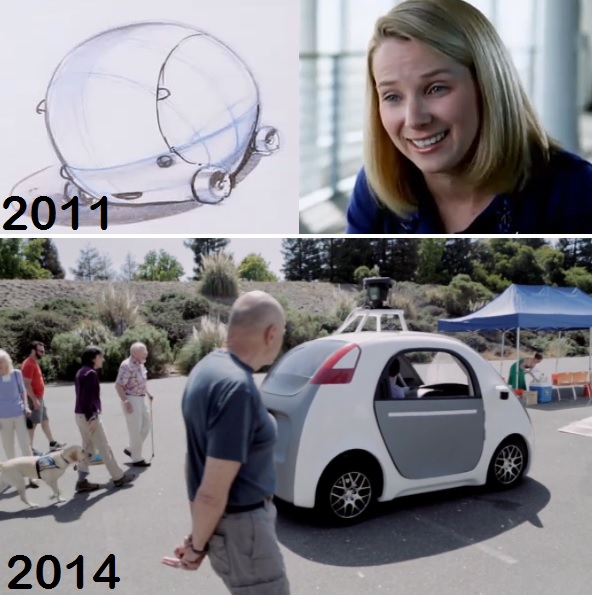
.jpg)