Slashdot Mirror
Domain: slashdot.org
Stories and comments across the archive that link to slashdot.org.
Stories · 37,380
-
Futuremark Delists Samsung and HTC Android Devices for Cheating 3DMark
MojoKid writes "Benchmarks are serious business. Buying decisions are often made based on how well a product scores, which is why the press and analysts spend so much time putting new gadgets through their paces. However, benchmarks are only meaningful when there's a level playing field, and when companies try to 'game' the business of benchmarking, it's not only a form of cheating, it also bamboozles potential buyers who (rightfully) assume the numbers are supposed mean something. 3D graphics benchmark software developer Futuremark just 'delisted' a bunch of devices from its 3DMark benchmark results database because it suspects foul play is at hand. Of the devices listed, it appears Samsung and HTC in particular are indirectly being accused of cheating 3DMark for mobile devices. Delisted devices are stripped of their rank and scores. Futuremark didn't elaborate on which specific rule(s) these devices broke, but a look at the company's benchmarking policies reveals that hardware makers aren't allowed to make optimizations specific to 3DMark, nor are platforms allowed to detect the launch of the benchmark executable unless it's needed to enable multi-GPU and/or there's a known conflict that would prevent it from running." -
Dual-Core Allwinner A20 Powered EOMA-68 Engineering Card Available
A year after the first schematics were completed and a few months after the first prototype board shipped, Make Play Live has released Improv, the first engineering card for EOMA-68 (EOMA-68 is a specification for modular systems that splits the cpu board from the rest of the system, allowing the end user to use the same core with several devices or upgrade e.g. a tablet without having to pay for a new screen shell). From Aaron Seigo's weblog post: "The hardware of Improv is extremely capable: a dual-core ARM® Cortex-A7 System on Chip (SoC) running at 1Ghz, 1 GB of RAM, 4 GB of on-board NAND flash and a powerful OpenGL ES GPU. To access all of this hardware goodness there are a variety of ports: 2 USB2 ports (one fullsize host, one micro OTG), SD card reader, HDMI, ethernet (10/100, though the feature card has a Gigabit connector; more on that below), SATA, i2c, VGA/TTL and 8 GPIO pins. The entire device weighs less than 100 grams, is passively cooled and fits in your hand. Improv comes pre-installed with Mer OS, sporting a recent Linux kernel, systemd, and a wide variety of software tools. By default it boots into console, so if you are making a headless device you needn't worry about extra overhead running that you don't need. If you are going to hook it up to a screen (or two), then you have an amazing starting point with choices such as X.org, Wayland, Qt4, Qt5 and a full complement of KDE libraries and Plasma Workspaces. Improv takes advantage of the open EOMA68 standard to deliver a unique design: the SoC, RAM and storage live on one card (the 'CPU card'), the feature ports are on a PCB it docks with (the 'feature board'). The two dock securely together with the CPU card sitting under the feature board nestled in a pair of rails; they are undocked from each other by pushing a mechanical ejector button." Check out the specs and pictures. The card is available now for $75. Improv is open hardware, with the schematics licensed under the GPL and available soon. -
Dual-Core Allwinner A20 Powered EOMA-68 Engineering Card Available
A year after the first schematics were completed and a few months after the first prototype board shipped, Make Play Live has released Improv, the first engineering card for EOMA-68 (EOMA-68 is a specification for modular systems that splits the cpu board from the rest of the system, allowing the end user to use the same core with several devices or upgrade e.g. a tablet without having to pay for a new screen shell). From Aaron Seigo's weblog post: "The hardware of Improv is extremely capable: a dual-core ARM® Cortex-A7 System on Chip (SoC) running at 1Ghz, 1 GB of RAM, 4 GB of on-board NAND flash and a powerful OpenGL ES GPU. To access all of this hardware goodness there are a variety of ports: 2 USB2 ports (one fullsize host, one micro OTG), SD card reader, HDMI, ethernet (10/100, though the feature card has a Gigabit connector; more on that below), SATA, i2c, VGA/TTL and 8 GPIO pins. The entire device weighs less than 100 grams, is passively cooled and fits in your hand. Improv comes pre-installed with Mer OS, sporting a recent Linux kernel, systemd, and a wide variety of software tools. By default it boots into console, so if you are making a headless device you needn't worry about extra overhead running that you don't need. If you are going to hook it up to a screen (or two), then you have an amazing starting point with choices such as X.org, Wayland, Qt4, Qt5 and a full complement of KDE libraries and Plasma Workspaces. Improv takes advantage of the open EOMA68 standard to deliver a unique design: the SoC, RAM and storage live on one card (the 'CPU card'), the feature ports are on a PCB it docks with (the 'feature board'). The two dock securely together with the CPU card sitting under the feature board nestled in a pair of rails; they are undocked from each other by pushing a mechanical ejector button." Check out the specs and pictures. The card is available now for $75. Improv is open hardware, with the schematics licensed under the GPL and available soon. -
Book Review: Digital Outcasts
benrothke writes "Many of us have experimented with what it means to be disabled, by sitting in a wheelchair for a few minutes or putting a blindfold over our eyes. In Digital Outcasts: Moving Technology Forward without Leaving People Behind, author Kel Smith details the innumerable obstacles disabled people have to deal with in their attempts to use computers and the Internet. The book observes that while 1 in 7 people in the world have some sort of disability, (including the fact that 1 in every 10 U.S. children has been diagnosed with ADHD), software and hardware product designers, content providers and the companies who support these teams often approach accessibility as an add-on, not as a core component. Adding accessibility functionality to support disabled people is often seen as a lowest common denominator feature. With the companies unaware of the universal benefit their solution could potentially bring to a wider audience. " Read below for the rest of Ben's review. Digital Outcasts: Moving Technology Forward without Leaving People Behind author Kel Smith pages 288 publisher Morgan Kaufmann rating 9/10 reviewer Ben Rothke ISBN 978-0124047051 summary Manifesto for technology accessibility for all One of the many examples of this which the book provides is how sidewalk ramps are often an easier access method to streets; not just for those in wheelchairs, but for those simply walking and desiring an easier method.
In the book, Smith details how digital outcasts often rely on technology for everyday things that we take for granted. The problem is that poorly designed products create an abyss for these outcasts, who number in the hundreds of millions.
So just what is this digital outcast? Smith notes that the term was first introduced by Gareth White of the University of Sussex to describe people who are left behind the innovation curve with respect to new advances in technology. The term is also relevant to today's Internet user who can't perform a simple function such as making an e-commerce purchase or checking their financial statement; due to inaccessibility of the content, platform or device. These outcasts represent large swaths of forgotten populations.
In the first chapter, Smith makes the chilling observation that all of us, at some point or another, will find that our capabilities have diminished. Today's disabled users are not outliers of the able-bodied population – they are a prototype of what our future looks like.
The book provides a detailed overview of how people with disabilities use technology. More importantly, it shows that creating effective user interfaces for those with disabilities is beneficial for all users.
It showcases numerous application and case studies, including how iPad apps have been used for cognitive therapy, video games to help many types of illnesses and more.
An important point the book makes is that there are no easy answers or silver-bullet solutions. There are no quick add-ons which a firm can use to quickly make their user interfaces outcast compliant. Rather it takes a concerted effort from senior management to make accessibility work.
A key point Smith makes many times is that students with disabilities are left behind. There are many students who fail in antiquated educational systems since the administration can't restructure their curricula around a child's individual talents or aptitudes. He writes that students with disabilities get stigmatized into special education programs, some of which are very good, but can be socially ostracizing.
Throughout the book, Smith quotes many studies and significant amounts of data that shows the power of how software can make significantly positive impacts on the lives of those with disabilities. In chapter 7, he writes that at the Center for Brain Health at The University of Texas, they used virtual worlds and avatars to help autistic children. That form of therapy has proven to be successful and that 4 or 5 sessions using that technology, is worth 2 or 3 years of real world training.
As detailed in many parts of the book, many doctors say the best high-tech treatments are in fact the ones you can download from an app store.
As the end of the book, Smith writes that for accessibility to work, it has to be an enterprise initiative. He provides 8 strategic steps to doing that, including creating an accessibility task force (and engaging them from the very beginning of the project), knowing the legal landscape (and not to be driven solely by law), to designing mobile applications to be run universally, and more.
Smith sadly writes at the end of the book that while Apple has been at the forefront of accessibility, in 2012, despite having no legal mandate, Apple removed the Speak for Yourself (SFY) application; which was an extremely popular and helpful augmentative and alternative communication app. It seems that SFY is now once again available in the App Store, but with legal maneuvering what it is, that could change at any moment.
While the accessibility of technology is getting better every year, there are still many challenges to ahead. Digital Outcasts: Moving Technology Forward without Leaving People Behind articulately and passionately details the groundwork, itemizes what needs to be done, and implores the reader to do something to ensure this trend continues.
This book is an important read for everyone. As there are two types of people, those that are currently digital outcasts, and those that will be sometime in the future.
The book closes with a most accurate observation: digital outcasts are not a biological model for a future we should fear, they are an inspiration for what we can all become.
Reviewed by Ben Rothke.
You can purchase Digital Outcasts: Moving Technology Forward without Leaving People Behind from amazon.com. Slashdot welcomes readers' book reviews (sci-fi included) -- to see your own review here, read the book review guidelines, then visit the submission page. -
Book Review: Digital Outcasts
benrothke writes "Many of us have experimented with what it means to be disabled, by sitting in a wheelchair for a few minutes or putting a blindfold over our eyes. In Digital Outcasts: Moving Technology Forward without Leaving People Behind, author Kel Smith details the innumerable obstacles disabled people have to deal with in their attempts to use computers and the Internet. The book observes that while 1 in 7 people in the world have some sort of disability, (including the fact that 1 in every 10 U.S. children has been diagnosed with ADHD), software and hardware product designers, content providers and the companies who support these teams often approach accessibility as an add-on, not as a core component. Adding accessibility functionality to support disabled people is often seen as a lowest common denominator feature. With the companies unaware of the universal benefit their solution could potentially bring to a wider audience. " Read below for the rest of Ben's review. Digital Outcasts: Moving Technology Forward without Leaving People Behind author Kel Smith pages 288 publisher Morgan Kaufmann rating 9/10 reviewer Ben Rothke ISBN 978-0124047051 summary Manifesto for technology accessibility for all One of the many examples of this which the book provides is how sidewalk ramps are often an easier access method to streets; not just for those in wheelchairs, but for those simply walking and desiring an easier method.
In the book, Smith details how digital outcasts often rely on technology for everyday things that we take for granted. The problem is that poorly designed products create an abyss for these outcasts, who number in the hundreds of millions.
So just what is this digital outcast? Smith notes that the term was first introduced by Gareth White of the University of Sussex to describe people who are left behind the innovation curve with respect to new advances in technology. The term is also relevant to today's Internet user who can't perform a simple function such as making an e-commerce purchase or checking their financial statement; due to inaccessibility of the content, platform or device. These outcasts represent large swaths of forgotten populations.
In the first chapter, Smith makes the chilling observation that all of us, at some point or another, will find that our capabilities have diminished. Today's disabled users are not outliers of the able-bodied population – they are a prototype of what our future looks like.
The book provides a detailed overview of how people with disabilities use technology. More importantly, it shows that creating effective user interfaces for those with disabilities is beneficial for all users.
It showcases numerous application and case studies, including how iPad apps have been used for cognitive therapy, video games to help many types of illnesses and more.
An important point the book makes is that there are no easy answers or silver-bullet solutions. There are no quick add-ons which a firm can use to quickly make their user interfaces outcast compliant. Rather it takes a concerted effort from senior management to make accessibility work.
A key point Smith makes many times is that students with disabilities are left behind. There are many students who fail in antiquated educational systems since the administration can't restructure their curricula around a child's individual talents or aptitudes. He writes that students with disabilities get stigmatized into special education programs, some of which are very good, but can be socially ostracizing.
Throughout the book, Smith quotes many studies and significant amounts of data that shows the power of how software can make significantly positive impacts on the lives of those with disabilities. In chapter 7, he writes that at the Center for Brain Health at The University of Texas, they used virtual worlds and avatars to help autistic children. That form of therapy has proven to be successful and that 4 or 5 sessions using that technology, is worth 2 or 3 years of real world training.
As detailed in many parts of the book, many doctors say the best high-tech treatments are in fact the ones you can download from an app store.
As the end of the book, Smith writes that for accessibility to work, it has to be an enterprise initiative. He provides 8 strategic steps to doing that, including creating an accessibility task force (and engaging them from the very beginning of the project), knowing the legal landscape (and not to be driven solely by law), to designing mobile applications to be run universally, and more.
Smith sadly writes at the end of the book that while Apple has been at the forefront of accessibility, in 2012, despite having no legal mandate, Apple removed the Speak for Yourself (SFY) application; which was an extremely popular and helpful augmentative and alternative communication app. It seems that SFY is now once again available in the App Store, but with legal maneuvering what it is, that could change at any moment.
While the accessibility of technology is getting better every year, there are still many challenges to ahead. Digital Outcasts: Moving Technology Forward without Leaving People Behind articulately and passionately details the groundwork, itemizes what needs to be done, and implores the reader to do something to ensure this trend continues.
This book is an important read for everyone. As there are two types of people, those that are currently digital outcasts, and those that will be sometime in the future.
The book closes with a most accurate observation: digital outcasts are not a biological model for a future we should fear, they are an inspiration for what we can all become.
Reviewed by Ben Rothke.
You can purchase Digital Outcasts: Moving Technology Forward without Leaving People Behind from amazon.com. Slashdot welcomes readers' book reviews (sci-fi included) -- to see your own review here, read the book review guidelines, then visit the submission page. -
Researchers Build Covert Acoustical Mesh Networks In Air
An anonymous reader writes "Researchers at Fraunhofer FKIE, Germany have presented a paper on covert acoustical communications between laptop computers. In their paper 'On Covert Acoustical Mesh Networks in Air', they describe how acoustical communication can be used to secretly bridge air gaps between computers and connect computers and networks that are thought to be completely isolated from each other. By using ad-hoc routing protocols, they are able to build up a complete mesh network of infected computers that leaks data over multiple hops. A multi-hop acoustical keylogger is also presented where keystrokes are forwarded to an attacker over multiple hops between different office rooms. The fundamental part of the communication system is a piece of software that has originally been developed for acoustic underwater communications. The researchers also provide different countermeasures against malicious participation in a covert acoustical network. The limitations of air gaps have been discussed recently in the context of a highly advanced malware, although reports on this so-called badBIOS malware could not yet be confirmed." -
Singapore & South Korea Help NSA Tap Undersea Cables
An anonymous reader writes "Singapore and South Korea are playing key roles helping the United States and Australia tap undersea telecommunications links across Asia, according to top secret documents leaked by Edward Snowden. Indonesia and Malaysia have been key targets for Australian and Singaporean intelligence collaboration since much of Indonesia's telecommunications and Internet traffic is routed through Singapore. The NSA has a stranglehold on trans-Pacific communications channels with interception facilities on the West coast of the United States and at Hawaii and Guam, tapping all cable traffic across the Pacific Ocean as well as links between Australia and Japan. Japan had refused to take part." -
Apple Officializes Purchase of Motion-Sensor Firm PrimeSense
The reports that Apple was to buy Israeli 3-D sensor maker PrimeSense have turned out to be correct; the BBC reports that Apple has confirmed the purchase, though it is mum both about the price it paid and about where 3D sensors are likely to show up first in the Apple lineup. Also at the Register and Apple Insider, among others. -
Twitter Implements Forward Secrecy For Connections
Fnord666 writes with this excerpt from Tech Crunch "Twitter has enabled Perfect Forward Secrecy across its mobile site, website and API feeds in order to protect against future cracking of the service's encryption. The PFS method ensures that, if the encryption key Twitter uses is cracked in the future, all of the past data transported through the network does not become an open book right away. 'If an adversary is currently recording all Twitter users' encrypted traffic, and they later crack or steal Twitter's private keys, they should not be able to use those keys to decrypt the recorded traffic,' says Twitter's Jacob Hoffman-Andrews. 'As the Electronic Frontier Foundation points out, this type of protection is increasingly important on today's Internet.'" Of course, they are also using Elliptic Curve ciphers. -
The Surprising Second Life of the PlayStation Vita
First time accepted submitter jonyami writes "It's been a slow start for Sony's latest handheld console, despite the console-like quality games that were shown off at launch, and its excellent screen and tactile controls you could take on the go, but you only have to look at the upcoming Christmas line-up to see where it's lagging behind. That said, a new article points out there's still life in the relatively-fresh handheld yet. With the arrival of the PlayStation 4 and a whole new wave of indie games and HD remakes heading to the handheld, it looks like Sony's plucky portable console is still going — but is that enough to save the Vita?" -
DARPA's Atlas Walking Over Randomness
mikejuk writes "Considering how long we have been trying to solve the problem, a robot walking is mostly amusing. Atlas is an impressive robot, evoking the deepest fears of sci fi. Watch as one of the DARPA challenge teams makes Atlas walk, unaided, on randomness. This video of Atlas was created by the Florida Institute For Human and Machine Cognition robotics team. It shows Atlas walking across a random collection of obstacles. Notice that even though it looks as if Atlas is supported by a tether, it isn't — as proved when it falls over at the end." -
Digital Taste Interface
Tutter writes with news that Smellovision is being joined in reality by Tasteovision. "Possible applications in healthcare and gaming — it works by using electrodes on your tongue to stimulate salty, sweet, bitter and sour. It can produce the taste of virtual foods or drinks, allowing you to enjoy the taste without the calories (or chewing...). They are also good reasons to do this, for example, a diabetic can now taste sweets without actually affecting their blood sugar levels. Quote: 'The team is also working on a spin-off called a digital lollipop that will give the effect of a continuous sugar hit – but without sugar. For taste messaging they have developed TOIP — Taste Over Internet Protocol. This is a data format that makes it easy to transmit information on how to recreate the different tastes via the electrode. ... It is early days. The four major taste components, plus the fifth, the savoury 'umami' tang, are only a part of what we call flavor. Smell and texture are important, too — and the team now wants to work on adding those effects.' A video on youtube shows what it can do." -
3D Systems and Motorola Team Up To Deliver Customizable 3D Printed Smartphones
MojoKid writes "Motorola is forging ahead with the concept of modular, customizable smartphones first put forth by designer Dave Hakkens with his Phonebloks concept. The company said recently that it was officially pursuing such an idea with Project Ara, and Motorola is already putting together important partnerships to make it happen. 3D Systems, a maker of 3D printers and other related products, has signed on to create a 'continuous high-speed 3D printing production platform and fulfillment system' for it. In other words, 3D Systems is going to print parts for the project, and what's more, the company has what appears to be an exclusive agreement to make all the enclosures and modules for Project Ara." -
FEC Will Not Allow Bitcoin Campaign Contributions
First time accepted submitter memnock writes "ABC new reports: 'Political organizations can't accept contributions in the form of bitcoins, at least for now, The Federal Election Commission said Thursday. The commission passed on a request by the Conservative Action Fund, a political action committee, to use the digital currency. That group had asked the FEC recently whether it could accept bitcoins, how it could spend them and how donors must report those contributions. It was not immediately clear whether the same ruling would apply to individual political candidates.' Slashdot reported earlier this week that other federal agencies have taken positions that may recognize or regulate the currency." -
IRS Left Taxpayer Data Vulnerable and Lied About It
Bruce66423 writes with news that the IRS hasn't made much progress improving its poor IT security. From the article: "The Treasury Inspector General for Tax Administration found that the IRS had only partially implemented 42 percent of the corrective plans it checked off as completed in recent years. ... The review (PDF) showed that the IRS failed to properly track its progress toward completing many of the fixes auditors had recommended in recent years. The agency closed most of the cases without adequate documentation and did not always upload the necessary information into a database that helps ensure compliance." -
IRS Left Taxpayer Data Vulnerable and Lied About It
Bruce66423 writes with news that the IRS hasn't made much progress improving its poor IT security. From the article: "The Treasury Inspector General for Tax Administration found that the IRS had only partially implemented 42 percent of the corrective plans it checked off as completed in recent years. ... The review (PDF) showed that the IRS failed to properly track its progress toward completing many of the fixes auditors had recommended in recent years. The agency closed most of the cases without adequate documentation and did not always upload the necessary information into a database that helps ensure compliance." -
IRS Left Taxpayer Data Vulnerable and Lied About It
Bruce66423 writes with news that the IRS hasn't made much progress improving its poor IT security. From the article: "The Treasury Inspector General for Tax Administration found that the IRS had only partially implemented 42 percent of the corrective plans it checked off as completed in recent years. ... The review (PDF) showed that the IRS failed to properly track its progress toward completing many of the fixes auditors had recommended in recent years. The agency closed most of the cases without adequate documentation and did not always upload the necessary information into a database that helps ensure compliance." -
Virgin Galactic Now Taking Bitcoin For Suborbital Flights
Nerval's Lobster writes "Bitcoin hype has reached orbit: you can now use the virtual currency to fly on Virgin Galactic, which will begin taking passengers on sub-orbital flights in 2014. 'One future astronaut, a female flight attendant from Hawaii, has already purchased her Virgin Galactic ticket using bitcoins,' Virgin CEO Richard Branson wrote in a blog posting on Virgin's Website, 'and we expect many more to follow in her footsteps. All of our future astronauts are pioneers in their own right, and this is one more way to be forward-thinking.' Branson is an investor in Bitcoin, which has seen its per-unit value skyrocket from $10 to $900 over the past two years (today, its value stands at $766, but that could rapidly change). 'The lack of transparency from Bitcoin's founders has attracted some criticism, but its open source nature means anyone can audit the code,' he added in his posting. 'It is a brilliantly conceived idea to allow users to power the peer-to-peer payment network themselves, providing control and freedom for consumers.' A flight aboard Virgin Galactic costs $250,000, or roughly 320 Bitcoin at today's price. However, Bitcoin is also a volatile currency, diving and spiking in response to a variety of factors—while it's certainly possible that its value could zoom above $1,000 in the near future, there's always the possibility it could crash down to a few hundred dollars, or even lower." -
Scientists Forced To Reexamine Theories In Light of Massive Gamma-Ray Burst
cold fjord writes "Earlier this year we discussed news of a shockingly powerful gamma-ray burst. Scientists have had time to study the phenomenon, but it's not offering up any easy answers. The Christian Science Monitor reports, 'An exploded star some 3.8 billion light-years away is forcing scientists to overhaul much of what they thought they knew about gamma-ray bursts – intense blasts of radiation triggered, in this case, by a star tens of times more massive than the sun that exhausted its nuclear fuel, exploded, then collapsed to form a black hole. Last April, gamma rays from the blast struck detectors in gamma-ray observatories orbiting Earth, triggering a frenzy of space- and ground-based observations. Many of them fly in the face of explanations researchers have developed during the past 30 years ... "Some of our theories are just going down the drain," said Charles Dermer, an astrophysicist at the Los Alamos National Laboratory in New Mexico ... while typical long-duration bursts last from a few seconds to a few minutes, GRB 130427A put on its display for 20 hours. ... [W]ith GRB 130427A, some of the highest energy photons, including the new record-holder, appeared hours after the blast. "This is hard to explain with our current models," Dermer said. In addition, gamma rays and emissions at visible wavelengths brightened and dimmed in tandem, quite unexpected because theory suggested they come from different regions of the expanding shells of material and thus should have peaked and dimmed at different times. Finally, theorists had posited different mechanisms for generating gamma rays and X-rays that are part of the light show a long-duration gamma-ray burst puts on. The result should have been a fadeout for the two forms of light punctuated by periods where emissions were interrupted. Instead, the two dimmed smoothly. The theoretical edifice GRB 130427A is eroding has been 46 years in the making.' — The 21 November 2013 Science Express has abstracts for four related papers (first, second, third, fourth). More at Sky & Telescope and NASA." -
Putting the Wolfram Language (and Mathematica) On Every Raspberry Pi
An anonymous reader writes "Working with the Raspberry Pi Foundation, effective immediately, there's a pilot release of the Wolfram Language — as well as Mathematica—that will soon be bundled as part of the standard system software for every Raspberry Pi computer. Quite soon the Wolfram Language is going to start showing up in lots of places, notably on the web and in the cloud." -
Putting the Wolfram Language (and Mathematica) On Every Raspberry Pi
An anonymous reader writes "Working with the Raspberry Pi Foundation, effective immediately, there's a pilot release of the Wolfram Language — as well as Mathematica—that will soon be bundled as part of the standard system software for every Raspberry Pi computer. Quite soon the Wolfram Language is going to start showing up in lots of places, notably on the web and in the cloud." -
Samsung Ordered To Pay Apple $290M In Patent Case
itwbennett writes "After 3 days of deliberations, a jury has ordered Samsung to pay $290 million to Apple for infringement of several of its patents in multiple Samsung smartphones and tablets. The verdict is the second victory for Apple in its multiyear patent fight against Samsung in the U.S. District Court for the Northern District of California. Last year a jury in the same San Jose courtroom ruled Samsung should pay just over $1 billion for infringement of five Apple patents in multiple Samsung phones and tablets. But afterward, Judge Lucy Koh ordered a new trial to reconsider $450 million of the damages after finding the previous jury had applied an 'impermissible legal theory' to its calculations. Thursday's verdict is the result of that new trial." -
NHTSA Tells Tesla To Stop Exaggerating Model S Safety Rating
cartechboy writes "There's always that kid in the class that ruins it for everyone when being graded on a curve. At the moment, that kid is Tesla and Elon Musk. Tesla's been proudly claiming the Model S is one of the safest cars in the word despite the recent fire controversy. And while it may be just that, claiming it earned 5.4 stars from NHTSA isn't pleasing the safety agency as there is no such thing as a rating higher than five. While NHTSA already released a statement indirectly to Tesla saying it doesn't release ratings higher than 5, Tesla continued to promote this fictitious rating. Now NHTSA has updated its guidelines explicitly stating safety ratings are whole numbers only and that 5 stars is the maximum advertisers can claim. If advertisers and automakers decide to disregard these rules NHTSA is threatening removal from the program or referral to state authorities for appropriate action. Basically, hey Tesla, stop making false claims." -
Building a (Virtual) Roman Emperor's Villa
Nerval's Lobster writes "Scientists have been using everything from supercomputing clusters to 3D printers to virtually recreate dinosaur bones. Now another expert is trying to do something similar with the ancient imperial villa built for Roman emperor Hadrian, who ruled from 117 A.D. to 138 A.D. Hadrian's Villa is already one of the best-preserved Roman imperial sites, but that wasn't quite good enough for Indiana University Professor of Informatics Bernie Frischer, who trained as a classical philologist and archaeologist before being seduced by computers into what evolved into the academic discipline of digital analysis and reproduction of archaeological and historical works. The five-year effort to recreate Hadrian's Villa is based on information from academic studies of the buildings and grounds, as well as analyses of how the buildings, grounds and artifacts were used; the team behind it decided to go with gaming platform Unity 3D as a key part of the simulation." -
Vint Cerf Thinks Privacy May Be an Anomaly
Nerval's Lobster writes "Vint Cerf, widely considered one of the 'founders of the Internet,' told an audience at the Federal Trade Commission's Internet of Things workshop that privacy could be considered 'an anomaly.' That workshop, held Nov. 19 in Washington, DC, explored (via speeches and panel discussions) how the proliferation of sensors on everything from cars to household devices is fundamentally changing how people live and work—while raising questions of how to best maintain privacy and security in an environment where more and more things are 'watchers.' 'The technology that we use today has far outraced our social intuition, our headlights,' he added. '[There's a] need to develop social conventions that are more respectful of people's privacy.' Current social behaviors, such as instantly posting images from smartphones to social networks, can result in a whole lot of embarrassment—and maybe even penalties, if data and media happens to catch someone in the act of doing something illegal. Cerf currently works at Google as chief Internet evangelist, which would make him uniquely positioned to comment on these sorts of issues even if he hadn't co-created the TCP/IP backbone that supports the modern Web. (Back in April, he told an audience that, if he had to do it all over again, he'd construct the Internet in the mold of Software-Defined Networking — but that's a whole different, tangled discussion.)" -
Vint Cerf Thinks Privacy May Be an Anomaly
Nerval's Lobster writes "Vint Cerf, widely considered one of the 'founders of the Internet,' told an audience at the Federal Trade Commission's Internet of Things workshop that privacy could be considered 'an anomaly.' That workshop, held Nov. 19 in Washington, DC, explored (via speeches and panel discussions) how the proliferation of sensors on everything from cars to household devices is fundamentally changing how people live and work—while raising questions of how to best maintain privacy and security in an environment where more and more things are 'watchers.' 'The technology that we use today has far outraced our social intuition, our headlights,' he added. '[There's a] need to develop social conventions that are more respectful of people's privacy.' Current social behaviors, such as instantly posting images from smartphones to social networks, can result in a whole lot of embarrassment—and maybe even penalties, if data and media happens to catch someone in the act of doing something illegal. Cerf currently works at Google as chief Internet evangelist, which would make him uniquely positioned to comment on these sorts of issues even if he hadn't co-created the TCP/IP backbone that supports the modern Web. (Back in April, he told an audience that, if he had to do it all over again, he'd construct the Internet in the mold of Software-Defined Networking — but that's a whole different, tangled discussion.)" -
Google Patents Fooling Friends With Snooping, Chatbots
theodp writes "Google takes Scroogling to new heights with its just-patented Automated Generation of Suggestions for Personalized Reactions in a Social Network, which not only data mines "e-mail systems, SMS/MMS systems, micro blogging systems, social networks or other systems" to get the buzz on your social circle, but also uses the data it collects to make like ELIZA and formulate appropriate responses for you to send as if they were your own (e.g., 'Happy Birthday, Mom!). Wouldn't Turing be so proud! From the patent: 'In a third example, a friend, David, sends Alice public or private message of a particular but regularly encountered message type (e.g., "how are you doing?" a common way to greet someone in the United States). The suggestion generation module suggest a good set of reactions to David, for example, based on the professional profile of David from the social network indicating that David has changed employers. The suggestion generation module generates a reply message such as "Hey David, I am fine, You were in ABC corp. for 3 years and you recently moved to XYZ corp., how do you feel about the difference, enjoying your new workplace?" The content of this suggestion are based on 1) prior conversations between Alice and David, 2) previous messages sent by Alice to other friends and 3) messages (sent by other connections in Alice's friend circle to David) which are either publicly or privately accessible to Alice, or some combination of these. Thus, the suggestion generation module generates messages that are personalized based upon both the sender and recipient using information that is accessible (public or private) to the sender.' Looks like Facebook may not be the only one strip-mining human society!" -
Wikimedia Sends Cease and Desist Letter To Firm Providing Paid Editing Services
Hugh Pickens DOT Com writes "For months, Wikipedia has been battling a company called 'Wiki-PR,' which purportedly sells paid editing services on Wikipedia and in October announced it had blocked or banned hundreds of Wiki-PR's sockpuppet accounts in response. Now Cyrus Farivar reports at Ars Technica that the Wikimedia Foundation (which runs Wikipedia) is escalating its game, issuing a cease and desist letter to Wiki-PR, demanding that the company immediately halt editing Wikipedia 'unless and until [Wiki-PR has] fully complied with the terms and conditions outlined by the Wikimedia Community.' The attorney representing the Wikimedia Foundation, Patrick Gunn, wrote that 'you admitted that Wiki-PR has continued to actively market paid advocacy editing services despite the ban — consistent with evidence that we have discovered independently. ... Should you fail to comply with the terms of this cease and desist letter, Wikimedia Foundation is prepared to take any necessary legal action to protect its rights.'" -
Mir Won't Ship Even In Ubuntu 14.04
jones_supa writes "As can be recalled, Mir didn't make it to the Ubuntu 13.10 release to replace X.org as the display server. Back then it suffered of problems in multi-monitor support, along with other issues. Now it turns out that Canonical's product will not make it even into the next LTS version (14.04) of the Ubuntu desktop. Mir itself would be ready for showtime in the schedule, but there are problems with XMir, which is the X11 compatibility layer that ensures Mir can work with applications built for X. The comments came at the Ubuntu Developer Summit: in an online event Mark Shuttleworth stressed that the 14.04 desktop has to be rock-solid for customers with large-scale deployments, such as educational institutions. In the meantime, you can already try out Mir in your Ubuntu system." -
Cupertino Approves New Apple Spaceship HQ
mrspoonsi writes with news that Apple's plan to raze the old HP headquarters and replace it with some kind of space ship is moving forward. From the article: "A little over two years since Steve Jobs presented his case for it and after the occasional setback, the Cupertino City Council has finally given Apple full approval to go ahead with its futuristic campus. In exchange, Apple has agreed to fork over more money to the city in the form of a reduced sales tax rebate — going forward, Cupertino will only give back 35 percent sales tax instead of the 50 percent it had previously. Indeed, as soon as Apple gets its final permits some time today, it can begin demolishing the former HP headquarters and start building its own." -
Google Maps, Lasers Reveal Vatican Catacombs
Nerval's Lobster writes "The Vatican, while notoriously secretive about things buried in its vaults and archives, is being as public as the digital age allows it to be about the nearly completed restoration of catacombs early Christians used as secret churches as well as burial sites. Contractors, archaeologists and art experts spent the past five years restoring the Priscilla catacombs under the Vatican using lasers, among other techniques, to restore frescoes painted on the walls of the burial chambers. The Vatican unveiled the work Nov. 19 with a press conference in the Basilica of San Silvestro outside the burial tunnels, accompanied by a virtual tour of the Priscilla catacombs provided by Google Maps. The basilica is divided into an area for religious services and another that acts as a deposit for sculptures and artifacts dug up during excavations of the catacombs and other areas underneath the Vatican." -
Musk Lashes Back Over Tesla Fire Controversy
Nerval's Lobster writes "A small handful of Tesla electric cars have caught fire, driving down the company's stock price, and finally prompting CEO Elon Musk to tackle the issue in a new blog posting. 'Since the Model S went into production last year, there have been more than a quarter million gasoline car fires in the United States alone, resulting in over 400 deaths and approximately 1,200 serious injuries (extrapolating 2012 NFPA data),' he wrote in that posting. 'However, the three Model S fires, which only occurred after very high-speed collisions and caused no serious injuries or deaths, received more national headlines than all 250,000+ gasoline fires combined.' Responsible journalism on the matter, he added, has been 'drowned out' by 'an onslaught of popular and financial media seeking to make a sensation out of something that a simple Google search would reveal to be false.' According to his own figures, Tesla suffers an average of one fire per 6,333 cars, versus a rate of one fire per 1,350 gasoline-powered cars. Every Tesla vehicle includes internal walls between the battery modules, in addition to a firewall between the battery pack and the passenger compartment — enough shielding, in the event of a fire, to prevent pens and papers in the glove compartment from combusting. 'Despite multiple high-speed accidents, there have been no deaths or serious injuries in a Model S of any kind ever,' Musk continued. 'Of course, at some point, the law of large numbers dictates that this, too, will change, but the record is long enough already for us to be extremely proud of this achievement.' Tesla is about to push an 'over-the-air update' to its vehicles' air suspension that will create more ground clearance at highway speeds. In theory, that could reduce the chances of impact damage to the underbody, should the vehicle roll over an object — and that, in turn, could lower the chances of fire." -
How Perl and R Reveal the United States' Isolation In the TPP Negotiations
langelgjm writes "As /. reported, last Thursday Wikileaks released a draft text of the intellectual property chapter in the Trans-Pacific Partnership Agreement. Since then, many commentators have raised alarm about its contents. But what happens when you mix the leaked text together with Perl regular expressions and R's network analysis packages? You get some neat visualizations showing just how isolated the United States is in pushing for extreme copyright and patent laws." -
How Snapchat Could March Startups Right Off the Cliff, Lemming-Style
Nerval's Lobster writes "Two investors are Tweeting that Instagram, had it stayed an independent company, could be worth between $5 billion and $15 billion today. That's led to talk of whether Snapchat was right to (reportedly) shoot down Facebook's bid of $3 billion for its business, considering its growth and sizable user base. Snapchat's founders evidently think they can score a better deal within the next few quarters. If they manage to sell their startup a year from now for twice as much, they'll be lauded as extraordinarily smart businessmen—perhaps smarter than the folks at Instagram who sold for a 'measly' $1 billion (and all this despite Snapchat making no revenue). But for other startups in the space, the Snapchat and Instragram stories won't do them much good. Propelled by dreams of ever-increasing millions (perhaps billions!) startup founders could end up turning down perfectly good acquisition offers in favor of continuing to bootstrap — and find their businesses eroding and imploding, as the market for their particular app or service either fades away or (more likely) ends up crowded out by competing software. The startup market is a shark-tank, and most of those who don't get out of the water as soon as possible are eaten, dreams of grandeur or no." -
Yahoo Encrypting Data In Wake of NSA Revelations
Nerval's Lobster writes "Following reports that the NSA aggressively targets Google and Yahoo servers for surveillance, Yahoo is working to encrypt much of the data flowing through its datacenters. 'As you know, there have been a number of reports over the last six months about the U.S. government secretly accessing user data without the knowledge of tech companies, including Yahoo,' Yahoo CEO Marissa Mayer wrote in a Nov. 18 blog posting. 'I want to reiterate what we have said in the past: Yahoo has never given access to our data centers to the NSA or to any other government agency.' In order to make Yahoo's systems more secure, she added, the company is introducing SSL (Secure Sockets Layer) encryption to Yahoo Mail with a 2048-bit key. That security measure will supposedly be in place by January 8, 2014. Beyond that, Yahoo plans on encrypting all information that moves between its datacenters by the end of the first quarter of 2014. Around that same time, the company will give users the option to encrypt all data flowing to and from Yahoo; it will also 'work closely with our international Mail partners to ensure that Yahoo co-branded Mail accounts are https-enabled,' Mayer wrote. (While it's not a crushing expense for massive companies such as Yahoo, introducing this sort of security does add to infrastructure and engineering costs, and takes time to actually put in place.)" -
Interview: Ask Limor Fried About Open-Source Hardware and Adafruit
With her signature pink hair, MIT engineer Limor Fried has become a force in the maker movement. Last year she was awarded Entrepreneur of the Year by Entrepreneur Magazine, and her company, Adafruit Industries, did $10 million in sales. Limor has agreed to take some time away from soldering and running a new company to answer your questions about hardware, electronics, and Adafruit. As usual, ask as many as you'd like, but please, one question per post. -
Interview: Ask Limor Fried About Open-Source Hardware and Adafruit
With her signature pink hair, MIT engineer Limor Fried has become a force in the maker movement. Last year she was awarded Entrepreneur of the Year by Entrepreneur Magazine, and her company, Adafruit Industries, did $10 million in sales. Limor has agreed to take some time away from soldering and running a new company to answer your questions about hardware, electronics, and Adafruit. As usual, ask as many as you'd like, but please, one question per post. -
Reports: Apple To Buy Israeli 3D Sensing Company PrimeSense
Several sources, including this report at Forbes, and this one at All Things Digital, say that Apple has bought (or is in the process of buying) Tel-Aviv based PrimeSense, the company behind the 3-D sensing technology in Microsoft's Kinect, for $345 million. The Forbes piece also gives a compact but interesting summary of the possibilities of ubiquitous 3-D hardware, and the sudden, recent drop in price of the components necessary for that to happen. Devices like the Lynx 3-D scanner that I saw at last year's SXSW (targeting the cheap and portable end of the 3-D scanning market) may have a lot of competition in the near future. -
Raspberry Pi Hits the 2 Million Mark
The Raspberry Pi project that we've been fans of for quite a while now has hit a new milestone: Today, they announced that as of the last week in October, the project has sold more than two million boards. Raspberry Pi is anything but alone in the tiny, hackable computer world (all kinds of other options, from Arduino to the x86-based Minnowboard, are out there, and all have their selling points), but the low price, open-source emphasis, and focus on education have all helped the Pi catch on. If yours is one of these 2 million, what are you using it for? (And if you favor some other small system for your own experiments, what factors matter?) -
Raspberry Pi Hits the 2 Million Mark
The Raspberry Pi project that we've been fans of for quite a while now has hit a new milestone: Today, they announced that as of the last week in October, the project has sold more than two million boards. Raspberry Pi is anything but alone in the tiny, hackable computer world (all kinds of other options, from Arduino to the x86-based Minnowboard, are out there, and all have their selling points), but the low price, open-source emphasis, and focus on education have all helped the Pi catch on. If yours is one of these 2 million, what are you using it for? (And if you favor some other small system for your own experiments, what factors matter?) -
Raspberry Pi Hits the 2 Million Mark
The Raspberry Pi project that we've been fans of for quite a while now has hit a new milestone: Today, they announced that as of the last week in October, the project has sold more than two million boards. Raspberry Pi is anything but alone in the tiny, hackable computer world (all kinds of other options, from Arduino to the x86-based Minnowboard, are out there, and all have their selling points), but the low price, open-source emphasis, and focus on education have all helped the Pi catch on. If yours is one of these 2 million, what are you using it for? (And if you favor some other small system for your own experiments, what factors matter?) -
Can the US Be Weaned Off Ethanol?
Hugh Pickens DOT Com writes "Matthew Wald reports in the NYT the the Environmental Protection Agency has proposed reducing the amount of ethanol that is required to be mixed with the gasoline supply, the first time it has taken steps to slow down the drive to replace fossil fuels with renewable forms of energy. The move drew bitter complaints from advocates of ethanol, including some environmentalists, who see the corn-based fuel blend as a weapon to fight climate change and was also unwelcome news to farmers, coming at a time when a record corn crop is expected, and the price of a bushel has fallen almost to the cost of production. "Boy, my goodness, are the oil companies going to benefit from this," says Bob Dinneen, president of the Renewable Fuels Association. "We're all just sort of scratching our heads here wondering why this administration is telling us to produce less of a clean-burning American fuel." But the EPA says that a big part of the problem was that automobile fuel systems and service stations were not set up to absorb more than about 10 percent ethanol. Most cars on the road are limited to the current mixture, called E10, and there has been little demand by consumers for more. Reasons for the turnaround are many: The boom in domestic oil drilling has dimmed the urgency to find other alternatives to Mideast petroleum. Demand for gasoline has slumped. And criticism of the environmental impacts of corn ethanol has dimmed its luster nationally. The chill on ethanol will certainly affect the industry's powerhouse, corn ethanol. But the risk is far greater for smaller sectors of the industry still struggling to get out of the gate — those aimed at producing next-generation biofuels like "cellulosic" ethanol, made from ingredients like switchgrass and corn stalks. "I don't know if the EPA is aiming for uncertainty, but they may inadvertently create it," says Jan Koninckx, the global business director of biorefineries for DuPont. "The impact could be that another country will lead this rather than the U.S."" -
Object Lessons: Evan Booth's Post-Checkpoint Airport Weapons
Jah-Wren Ryel writes "In early-2013, independent security researcher, Evan 'treefort' Booth, began working to answer one simple question: Can common items sold in airports after the security screening be used to build lethal weapons? As it turns out, even a marginally 'MacGyver-esque' attacker can breeze through terminal gift shops, restaurants, magazine stands and duty-free shops to find everything needed to wage war on an airplane." We mentioned Evan's work several months back; now his not-just-a-thought-experiment exploration of improvised weapons has been cleaned up and organized, so you don't have to watch his (fascinating) talks to experience the wonders of the Chucks of Liberty (video) or the Fragguccino (video). -
Prison Is For Dangerous Criminals, Not Hacktivists
In late 2011, defense contractor Stratfor suffered a cybersecurity breach that resulted in a leak of millions of internal emails. A few months later, the FBI arrested hacktivist Jeremy Hammond and several others for actions related to the breach. Hammond pleaded guilty to one count of violating the CFAA, and today his sentence was handed down: 10 years in prison followed by three years of supervised release. He said, [The prosecutors] have made it clear they are trying to send a message to others who come after me. A lot of it is because they got slapped around, they were embarrassed by Anonymous and they feel that they need to save face." Reader DavidGilbert99 adds, "Former LulzSec and Anonymous member Jake Davis argues that U.S. lawmakers need to take a leaf out of the U.K.'s legal system and not put Jeremy Hammond behind bars for his part in the hack of Stratfor. 'Jeremy Hammond has a lot to give society too. Prisons are for dangerous people that need to be segmented from the general population. Hackers are not dangerous, they are misunderstood, and while disciplinary action is of course necessary, there is nothing disciplined about locking the door on a young man's life for 10 years.'" -
Prison Is For Dangerous Criminals, Not Hacktivists
In late 2011, defense contractor Stratfor suffered a cybersecurity breach that resulted in a leak of millions of internal emails. A few months later, the FBI arrested hacktivist Jeremy Hammond and several others for actions related to the breach. Hammond pleaded guilty to one count of violating the CFAA, and today his sentence was handed down: 10 years in prison followed by three years of supervised release. He said, [The prosecutors] have made it clear they are trying to send a message to others who come after me. A lot of it is because they got slapped around, they were embarrassed by Anonymous and they feel that they need to save face." Reader DavidGilbert99 adds, "Former LulzSec and Anonymous member Jake Davis argues that U.S. lawmakers need to take a leaf out of the U.K.'s legal system and not put Jeremy Hammond behind bars for his part in the hack of Stratfor. 'Jeremy Hammond has a lot to give society too. Prisons are for dangerous people that need to be segmented from the general population. Hackers are not dangerous, they are misunderstood, and while disciplinary action is of course necessary, there is nothing disciplined about locking the door on a young man's life for 10 years.'" -
MenuetOS, an OS Written Entirely In Assembly Language, Inches Towards 1.0
angry tapir writes "MenuetOS is an open source, GUI-equipped, x86 operating system written entirely in assembly language that can fit on a floppy disk (if you can find one). I originally spoke to its developers in 2009. Recently I had a chance to catch up with them to chat about what's changed and what needs to be done before the OS hits version 1.0 after 13 years of work. The system's creator, Ville Turjanmaa, says, 'Timeframe is secondary. It's more important is to have a complete and working set of features and applications. Sometimes a specific time limit rushes application development to the point of delivering incomplete code, which we want to avoid. ... We support USB devices, such [as] storages, printers, webcams and digital TV tuners, and have basic network clients and servers. So before 1.0 we need to improve the existing code and make sure everything is working fine. ... The main thing for 1.0 is to have all application groups available'" -
Zuckerberg To Teach 10 Million Kids 0-Based Counting
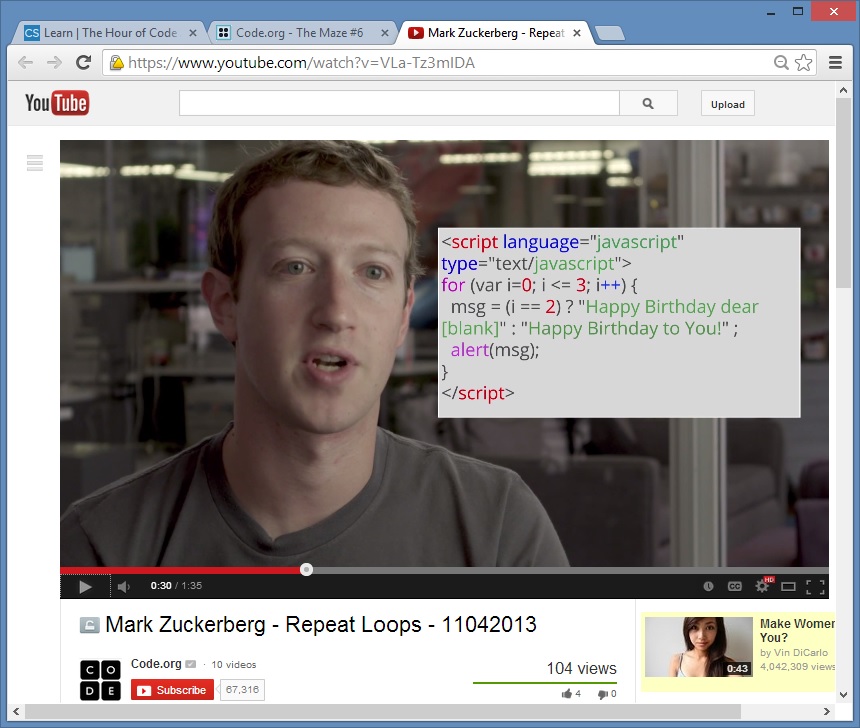
theodp writes "'Why do programmers start counting at zero?' wondered Mike Hoye, questioning the conventional programming wisdom. Code.org will soon introduce the practice to a hoped-for audience of 10 million schoolchildren as part of Computer Science Education Week's Hour of Code. In a tutorial created by engineers from Microsoft, Google, Twitter and Facebook that's intended to introduce programming to kids as young as six years old, an otherwise breezy lesson featuring look-ma-no-typing Blockly and characters out of Angry Birds and Plants vs. Zombies, a Mark Zuckerberg video introducing the concept of Repeat Loops includes an out-of-place JavaScript example that shows kids it's as easy as 0-1-2-3 to generate 4 lines of lyrics from Happy Birthday to You by using zero-based numbering with a For-loop and ternary If statement. Accompanying videos by Bill Gates on If Statements and basketball star Chris Bosh on Repeat Until Blocks show the Code.org tutorial is still a work-in-progress. That's no big deal, since CSEdWeek has pushed back the delivery date for final Hour of Code tutorials from its prior little-time-for-testing due date to Dec. 9th, the first day of a five-day period during which teachers are expected to deliver the lessons to 10 million students." -
Stephen Wolfram Developing New Programming Language
Nerval's Lobster writes "Stephen Wolfram, the chief designer of the Mathematica software platform and the Wolfram Alpha 'computation knowledge engine,' has another massive project in the works—although he's remaining somewhat vague about details for the time being. In simplest terms, the project is a new programming language—which he's dubbing the 'Wolfram Language'—which will allow developers and software engineers to program a wide variety of complex functions in a streamlined fashion, for pretty much every single type of hardware from PCs and smartphones all the way up to datacenters and embedded systems. The Language will leverage automation to cut out much of the nitpicking complexity that dominates current programming. 'The Wolfram Language does things automatically whenever you want it to,' he wrote in a recent blog posting. 'Whether it's selecting an optimal algorithm for something. Or picking the most aesthetic layout. Or parallelizing a computation efficiently. Or figuring out the semantic meaning of a piece of data. Or, for that matter, predicting what you might want to do next. Or understanding input you've given in natural language.' In other words, he's proposing a general-purpose programming language with a mind-boggling amount of functions built right in. At this year's SXSW, Wolfram alluded to his decades of work coming together in 'a very nice way,' and this is clearly what he meant. And while it's tempting to dismiss anyone who makes sweeping statements about radically changing the existing paradigm, he does have a record of launching very big projects (Wolfram Alpha contains more than 10 trillion pieces of data cultivated from primary sources, along with tens of thousands of algorithms and equations) that function reliably. At many points over the past few years, he's also expressed a belief that simple equations and programming can converge to create and support enormously complicated systems. Combine all those factors together, and it's clear that Wolfram's pronouncements—no matter how grandiose—can't simply be dismissed. But it remains to be seen how much of an impact he actually has on programming as an art and science." -
Sears To Convert Old Auto Centers Into National Chain of Data Centers
1sockchuck writes "Sears plans to convert dozens of Sears Auto Center stores into a national chain of server farms, saying it wants to be "the McDonald's or Starbucks of data centers." The strategy is an evolution of Sears Holdings' previously announced plan to turn old Sears and Kmart stores into IT centers. Instead, it will focus on the more than 700 Sears Auto Centers, which include many stand-alone cement buildings on mall perimeters. Ubiquity Critical Environments, the data center arm of Sears, will team with Schneider Electric to turn these sites into data centers. They'll use repeatable modular designs to add power and cooling infrastructure, targeting at least 23 smaller cities where there currently aren't many options for IT outsourcing." -
Tesla Planning an Electric Pickup Truck, Says Elon Musk
cartechboy writes "Tesla Motors CEO Elon Musk says the company will make an electric pickup truck to compete with America's best-selling Ford F-Series pickups. Musk made the comment yesterday at the end of an interview at a tech conference in New York. Surrounded by questioners, Musk was asked if Tesla would ever make commercial fleet trucks (like for UPS or Fed Ex) and he responded that a consumer truck would be the company's best answer, because America's pickup truck sales numbers don't lie — that's what buyers want, and if Tesla wants to replace the most gasoline miles possible, that's what they should build. Musk said it will be about five years before the company builds its pickup however, giving it time to focus on another hurdle: breaking into the pickup market. Texas is where trucks rule, and Texas, as we know, is the Bermuda Triangle for Tesla." That also gives me five years to save up for one, and (just maybe) five years for Ford, et al to jump in, too.