Slashdot Mirror
Domain: slashdot.org
Stories and comments across the archive that link to slashdot.org.
Stories · 37,380
-
CERN: Neutrinos Respect Cosmic Speed Limit
An anonymous reader writes with news of a presentation from CERN Research Director Sergio Bertolucci about follow-up experiments trying to repeat the faster-than-light neutrino results from last year. Quoting the press release: "The four [experiments], Borexino, ICARUS, LVD and OPERA all measure a neutrino time of flight consistent with the speed of light. This is at odds with a measurement that the OPERA collaboration put up for scrutiny last September, indicating that the original OPERA measurement can be attributed to a faulty element of the experiment's fibre optic timing system. 'Although this result isn't as exciting as some would have liked,' said Bertolucci, 'it is what we all expected deep down. The story captured the public imagination, and has given people the opportunity to see the scientific method in action – an unexpected result was put up for scrutiny, thoroughly investigated and resolved in part thanks to collaboration between normally competing experiments. That's how science moves forward.'" -
CERN: Neutrinos Respect Cosmic Speed Limit
An anonymous reader writes with news of a presentation from CERN Research Director Sergio Bertolucci about follow-up experiments trying to repeat the faster-than-light neutrino results from last year. Quoting the press release: "The four [experiments], Borexino, ICARUS, LVD and OPERA all measure a neutrino time of flight consistent with the speed of light. This is at odds with a measurement that the OPERA collaboration put up for scrutiny last September, indicating that the original OPERA measurement can be attributed to a faulty element of the experiment's fibre optic timing system. 'Although this result isn't as exciting as some would have liked,' said Bertolucci, 'it is what we all expected deep down. The story captured the public imagination, and has given people the opportunity to see the scientific method in action – an unexpected result was put up for scrutiny, thoroughly investigated and resolved in part thanks to collaboration between normally competing experiments. That's how science moves forward.'" -
OpenLogic Backs Linux On Windows Azure With SLA
MikeatWired writes "OpenLogic announced on Thursday that it will provide CentOS Linux — and service-level agreement (SLA) support — through Microsoft's new Windows Azure gallery. Yesterday, Microsoft announced support for Linux instances on its cloud service, among other cloud news, in what Wired Enterprise's Cade Metz dubbed an Amazonian facelift. OpenLogic's Steven Grandchamp writes in a blog post that for 'enterprise developers and IT folks who are multi-source and multi-platform, today's announcement is good news. The Windows and Linux worlds take one step towards each other.' However, Grandchamp notes that despite Microsoft 'maturing its views on open source' with 'significant work' with Node.js, Hadoop, and Samba, the open source community 'will meet [Linux on Azure] with overall wariness and skepticism.' 'Some will view this with hope and a positive step; others will continue to be cynical,' he writes. 'For me, it's part of a larger overall process that continues to signal open source coming of age. What major vendor doesn't have an open source story now? It's such an ingrained part of development, from legacy to mobile to cloud, that we can't live without and we are figuring out how to love living with it.'" -
OpenLogic Backs Linux On Windows Azure With SLA
MikeatWired writes "OpenLogic announced on Thursday that it will provide CentOS Linux — and service-level agreement (SLA) support — through Microsoft's new Windows Azure gallery. Yesterday, Microsoft announced support for Linux instances on its cloud service, among other cloud news, in what Wired Enterprise's Cade Metz dubbed an Amazonian facelift. OpenLogic's Steven Grandchamp writes in a blog post that for 'enterprise developers and IT folks who are multi-source and multi-platform, today's announcement is good news. The Windows and Linux worlds take one step towards each other.' However, Grandchamp notes that despite Microsoft 'maturing its views on open source' with 'significant work' with Node.js, Hadoop, and Samba, the open source community 'will meet [Linux on Azure] with overall wariness and skepticism.' 'Some will view this with hope and a positive step; others will continue to be cynical,' he writes. 'For me, it's part of a larger overall process that continues to signal open source coming of age. What major vendor doesn't have an open source story now? It's such an ingrained part of development, from legacy to mobile to cloud, that we can't live without and we are figuring out how to love living with it.'" -
MD5crypt Password Scrambler Is No Longer Considered Safe
As reported here recently, millions of LinkedIn password hashes have been leaked online. An anonymous reader writes "Now, Poul-Henning Kamp a developer known for work on various projects and the author of the md5crypt password scrambler asks everybody to migrate to a stronger password scrambler without undue delay. From the blog post: 'New research has shown that it can be run at a rate close to 1 million checks per second on COTS GPU hardware, which means that it is as prone to brute-force attacks as the DES based UNIX crypt was back in 1995: Any 8 character password can be found in a couple of days. The default algorithm for storing password hashes in /etc/shadow is MD5. RHEL / CentOS / FreeBSD user can migrate to SHA-512 hashing algorithms.'" Reader Curseyoukhan was one of several to also point out that dating site eHarmony got the same treatment as LinkedIn. Update: 06/07 20:13 GMT by T : An anonymous reader adds a snippet from Help Net Security, too: "Last.fm has piped up to warn about a leak of their own users' passwords. Users who have logged in to the site were greeted today by a warning asking them to change their password while the site investigates a security problem. Following the offered link to learn more, they landed on another page with another warning." -
Oracle's Ellison Vows "Most Comprehensive Cloud On Earth"
CWmike writes "Oracle CEO Larry Ellison declared the company is ready to offer 'the most comprehensive cloud on the planet Earth,' during a webcast event on Wednesday. 'It's been a long time coming,' Ellison said of the Oracle Public Cloud, which encompasses Oracle's suite of Fusion Applications delivered as both SaaS (software as a service) and PaaS (platform as a service) features, including the Java Cloud Service and Database Cloud Service. It's also the home of Oracle Social Network, the company's foray into Facebook-like collaboration tools for enterprises. Wednesday's event — and Twitter (where his first tweet is a gem) — also provided Ellison with an opportunity to tout what he called Oracle Public Cloud's many advantages over rivals such as SAP and Salesforce.com, as well as to engage in some of his traditional competitive trash talk." -
Online Courses and the $100 Graduate Degree
First time accepted submitter GCA10 writes "Forbes reports on the latest project of Google Fellow Sebastian Thrun (the proponent of self-driving cars.) He's moved on to education now, believing that conventional university teaching is way too costly, inefficient and ineffective to survive for long. So he started Udacity, which aims to deliver an online version of a master's degree for $100 per student. From the article: 'Udacity’s earliest course offerings have been free, and although Thrun eventually plans to charge something, he wants his tuition schedule to be shockingly low. Getting a master’s degree might cost just $100. After teaching his own artificial intelligence class at Stanford last year—and attracting 160,000 online signups—Thrun believes online formats can be far more effective than traditional classroom lectures. “So many people can be helped right now,” Thrun declares. “I see this as a mission.”'" -
Is Microsoft's Kinect a Gaming Failure?
MojoKid writes "E3 is well underway in Los Angeles, and Microsoft has already made a major splash with its 'SmartGlass' technology, game demos, and its announcement that a Kinect-powered version of Internet Explorer will debut on the Xbox 360. This is a marked change from last year, when Kinect was the unquestioned centerpiece of Microsoft's display and the company's demos focused on how Kinect-powered games used your full body as a controller. Kinect is in the interesting position of having sold extremely well while failing to move the bar forward in any of the ways Microsoft projected in the run up to its launch. Scroll through the ratings on Kinect-required titles, and the percentages are abysmal. Kinect's biggest problem is rooted in ergonomics. Gamepads with buttons may be crude approximations of real life, but they're simple and intuitive. They're also flexible — a great many games have conditional scenarios that allow the same button to perform different functions depending on what's going on within the game. Pure Kinect games don't have a simple mechanism to incorporate these features, and there's no easy way around them. The motion-controller's most enduring features may ultimately be its capabilities outside the gaming sphere." -
Is Microsoft's Kinect a Gaming Failure?
MojoKid writes "E3 is well underway in Los Angeles, and Microsoft has already made a major splash with its 'SmartGlass' technology, game demos, and its announcement that a Kinect-powered version of Internet Explorer will debut on the Xbox 360. This is a marked change from last year, when Kinect was the unquestioned centerpiece of Microsoft's display and the company's demos focused on how Kinect-powered games used your full body as a controller. Kinect is in the interesting position of having sold extremely well while failing to move the bar forward in any of the ways Microsoft projected in the run up to its launch. Scroll through the ratings on Kinect-required titles, and the percentages are abysmal. Kinect's biggest problem is rooted in ergonomics. Gamepads with buttons may be crude approximations of real life, but they're simple and intuitive. They're also flexible — a great many games have conditional scenarios that allow the same button to perform different functions depending on what's going on within the game. Pure Kinect games don't have a simple mechanism to incorporate these features, and there's no easy way around them. The motion-controller's most enduring features may ultimately be its capabilities outside the gaming sphere." -
Is Microsoft's Kinect a Gaming Failure?
MojoKid writes "E3 is well underway in Los Angeles, and Microsoft has already made a major splash with its 'SmartGlass' technology, game demos, and its announcement that a Kinect-powered version of Internet Explorer will debut on the Xbox 360. This is a marked change from last year, when Kinect was the unquestioned centerpiece of Microsoft's display and the company's demos focused on how Kinect-powered games used your full body as a controller. Kinect is in the interesting position of having sold extremely well while failing to move the bar forward in any of the ways Microsoft projected in the run up to its launch. Scroll through the ratings on Kinect-required titles, and the percentages are abysmal. Kinect's biggest problem is rooted in ergonomics. Gamepads with buttons may be crude approximations of real life, but they're simple and intuitive. They're also flexible — a great many games have conditional scenarios that allow the same button to perform different functions depending on what's going on within the game. Pure Kinect games don't have a simple mechanism to incorporate these features, and there's no easy way around them. The motion-controller's most enduring features may ultimately be its capabilities outside the gaming sphere." -
Book Review: How Google Tests Software
MassDosage writes "Having developed software for nearly fifteen years, I remember the dark days before testing was all the rage and the large number of bugs that had to be arduously found and fixed manually. The next step was nervously releasing the code without the safety net of a test bed and having no idea if one had introduced regressions or new bugs. When I first came across unit testing I ardently embraced it and am a huge fan of testing of various forms — from automated to smoke tests to performance and load tests to end user and exploratory testing. So it was with much enthusiasm that I picked up How Google Tests Software — written by some of the big names in testing at Google. I was hoping it would give me fresh insights into testing software at "Google Scale" as promised on the back cover, hopefully coupled with some innovative new techniques and tips. While partially succeeding on these fronts, the book as a whole didn't quite live up to my expectations and feels like a missed opportunity." Read below for the rest of MassDosage's review. How Google Tests Software author James Whittaker, Jason Arbon, Jeff Carollo pages 281 publisher Addison Wesley rating 6/10 reviewer Mass Dosage ISBN 978-0321803023 summary Testing at Google scale The book is written in an informal, easy to read manner and organized in such a way that readers can read chapters in any order or just choose to focus on the parts that interest them. One annoying layout choice is to highlight and repeat certain key sentences (as is often done in magazines) resulting in one reading the same thing twice, often only words away from the original sentence. Thankfully this is only the case in the first two chapters, but it highlights the variable quality of this book — possibly due to the authors having worked separately on different chapters. How Google Tests Software isn't a book for people new to testing or software development. The authors assume you know a fair amount about the software development lifecycle, where testing fits into this and what different forms testing can take. It is also largely technology neutral, using specific examples of testing software that Google uses only to illustrate concepts.
After a brief introduction as to how testing has evolved over time at Google the book devotes a chapter to each of the key testing-related roles in the company: the 'Software Engineer in Test' (SET), the 'Test Engineer' (TE) and the 'Test Engineering Manager' (TEM). SETs are coders who focus on writing tests or frameworks and infrastructure to support other coders in their testing. The TE has a broader, less well-defined role and is tasked with looking at the bigger picture of the product in question and its impact on users and how it fits into the broader software ecosystem. These two sections form the bulk of the book in terms of pages and interesting content. The TEM is essentially what the name says — someone who manages testers and testing and coordinates these activities at a higher level within Google.
The descriptions of each of these testing roles highlights the ways Google's thinking about testing has matured and also shows how some of these approaches differ from other companies. There are also explanations of the tools and processes that people in these roles use and follow and this for me was the most interesting part of the book. Topics covered include: specific bug tracking and test plan creation tools; risk analysis; test case management over time; and automated testing. Particularly of note are discussions on using bots to perform testing of web pages to detect differences between software releases, cutting down on the amount of human interaction required as well as the opposite approach — using more humans via "crowd sourced testing" among first internal and then select groups of external users. The tools that Google utilizes to simplify tester's jobs by recording steps to reproduce bugs and simplifying bug reporting and management sound very useful. Many of the tools described in the book are open source (or soon to be opened) and are probably worth following up on and investigating if this is what you do for a living.
In addition to the main body of text most chapters also include interviews with Google staff on various testing related topics. Some of these are genuinely interesting and give the reader a good idea of how testing is tackled at Google on a practical level. However some of the interviews fall into the "navel gazing" camp (especially when the authors interview one of themselves) and feel more like filler material. I enjoyed the interviews with Google hiring staff the most — their take on how they recruit people for testing roles and the types of questions they ask and qualities they look for make a lot of sense. The interview with the GMail TEM was also good and illustrated how the concepts described in the book are actually performed in practise. The interviews are clearly marked and can thus be easily skipped or skim read but one wonders what more useful text could have been included in their place.
The book wraps up with a chapter that attempts to describe how Google intends to improve their testing in the future. The most valuable point here is how testing as a separate function could "disappear" as it becomes part and parcel of the product being developed like any other feature, and thus the responsibility of all of the people working on the product as opposed to it being a separate thing. Another key point made throughout the book is how the state of testing at Google is constantly in flux which makes sense in such a fast moving and innovative company but leaves one questioning how much of this book will still be relevant in a few year's time.
How Google Tests Software isn't a bad book but neither is it a great one. It has some good parts and will be worth reading for those who are interested in "all things Google." For everyone else I'd recommend skimming through to the parts that grab your attention most and glossing over the rest.
You can purchase How Google Tests Software from amazon.com. Slashdot welcomes readers' book reviews -- to see your own review here, read the book review guidelines, then visit the submission page. -
Book Review: How Google Tests Software
MassDosage writes "Having developed software for nearly fifteen years, I remember the dark days before testing was all the rage and the large number of bugs that had to be arduously found and fixed manually. The next step was nervously releasing the code without the safety net of a test bed and having no idea if one had introduced regressions or new bugs. When I first came across unit testing I ardently embraced it and am a huge fan of testing of various forms — from automated to smoke tests to performance and load tests to end user and exploratory testing. So it was with much enthusiasm that I picked up How Google Tests Software — written by some of the big names in testing at Google. I was hoping it would give me fresh insights into testing software at "Google Scale" as promised on the back cover, hopefully coupled with some innovative new techniques and tips. While partially succeeding on these fronts, the book as a whole didn't quite live up to my expectations and feels like a missed opportunity." Read below for the rest of MassDosage's review. How Google Tests Software author James Whittaker, Jason Arbon, Jeff Carollo pages 281 publisher Addison Wesley rating 6/10 reviewer Mass Dosage ISBN 978-0321803023 summary Testing at Google scale The book is written in an informal, easy to read manner and organized in such a way that readers can read chapters in any order or just choose to focus on the parts that interest them. One annoying layout choice is to highlight and repeat certain key sentences (as is often done in magazines) resulting in one reading the same thing twice, often only words away from the original sentence. Thankfully this is only the case in the first two chapters, but it highlights the variable quality of this book — possibly due to the authors having worked separately on different chapters. How Google Tests Software isn't a book for people new to testing or software development. The authors assume you know a fair amount about the software development lifecycle, where testing fits into this and what different forms testing can take. It is also largely technology neutral, using specific examples of testing software that Google uses only to illustrate concepts.
After a brief introduction as to how testing has evolved over time at Google the book devotes a chapter to each of the key testing-related roles in the company: the 'Software Engineer in Test' (SET), the 'Test Engineer' (TE) and the 'Test Engineering Manager' (TEM). SETs are coders who focus on writing tests or frameworks and infrastructure to support other coders in their testing. The TE has a broader, less well-defined role and is tasked with looking at the bigger picture of the product in question and its impact on users and how it fits into the broader software ecosystem. These two sections form the bulk of the book in terms of pages and interesting content. The TEM is essentially what the name says — someone who manages testers and testing and coordinates these activities at a higher level within Google.
The descriptions of each of these testing roles highlights the ways Google's thinking about testing has matured and also shows how some of these approaches differ from other companies. There are also explanations of the tools and processes that people in these roles use and follow and this for me was the most interesting part of the book. Topics covered include: specific bug tracking and test plan creation tools; risk analysis; test case management over time; and automated testing. Particularly of note are discussions on using bots to perform testing of web pages to detect differences between software releases, cutting down on the amount of human interaction required as well as the opposite approach — using more humans via "crowd sourced testing" among first internal and then select groups of external users. The tools that Google utilizes to simplify tester's jobs by recording steps to reproduce bugs and simplifying bug reporting and management sound very useful. Many of the tools described in the book are open source (or soon to be opened) and are probably worth following up on and investigating if this is what you do for a living.
In addition to the main body of text most chapters also include interviews with Google staff on various testing related topics. Some of these are genuinely interesting and give the reader a good idea of how testing is tackled at Google on a practical level. However some of the interviews fall into the "navel gazing" camp (especially when the authors interview one of themselves) and feel more like filler material. I enjoyed the interviews with Google hiring staff the most — their take on how they recruit people for testing roles and the types of questions they ask and qualities they look for make a lot of sense. The interview with the GMail TEM was also good and illustrated how the concepts described in the book are actually performed in practise. The interviews are clearly marked and can thus be easily skipped or skim read but one wonders what more useful text could have been included in their place.
The book wraps up with a chapter that attempts to describe how Google intends to improve their testing in the future. The most valuable point here is how testing as a separate function could "disappear" as it becomes part and parcel of the product being developed like any other feature, and thus the responsibility of all of the people working on the product as opposed to it being a separate thing. Another key point made throughout the book is how the state of testing at Google is constantly in flux which makes sense in such a fast moving and innovative company but leaves one questioning how much of this book will still be relevant in a few year's time.
How Google Tests Software isn't a bad book but neither is it a great one. It has some good parts and will be worth reading for those who are interested in "all things Google." For everyone else I'd recommend skimming through to the parts that grab your attention most and glossing over the rest.
You can purchase How Google Tests Software from amazon.com. Slashdot welcomes readers' book reviews -- to see your own review here, read the book review guidelines, then visit the submission page. -
Committee Offers Scenarios for Japan's Energy Future
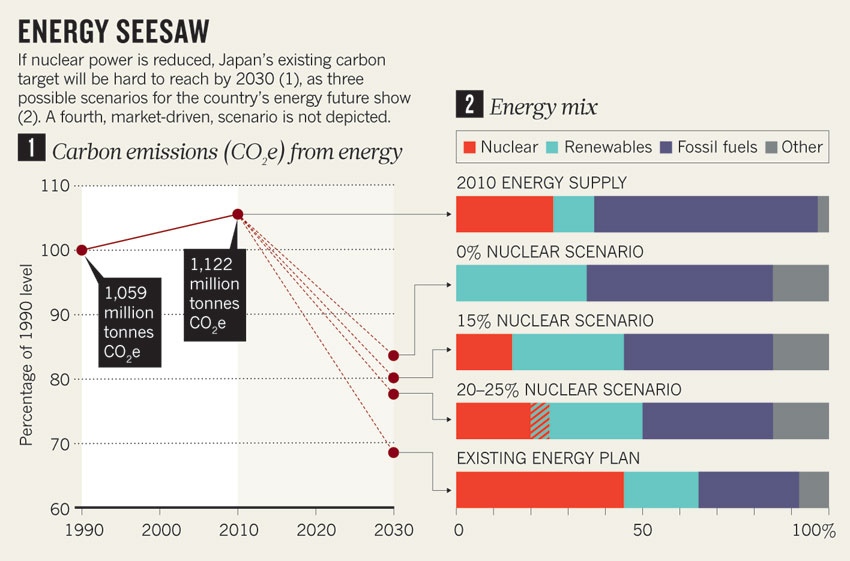
ananyo writes with a story about more concrete plans for a reduced or nuclear-free energy future for Japan. From the article: "It's official: nuclear power will have a much smaller role in Japan's energy future than was once thought. Since the meltdowns and gas explosions at the Fukushima Daiichi nuclear power station in March 2011, all of Japan's remaining reactors have been shut down for inspections and maintenance. The government offered a glimpse of their future, and that of the country's nuclear power in general, when it published an outline of four ways to satisfy Japan's future energy demands. One scenario recommends using a market mechanism to determine the nuclear contribution. Under the other three, nuclear power would supply at most one-quarter of Japan's energy by 2030 — and in one case, none at all. The scenarios come from a 25-person advisory committee to the industry ministry. The sharp reductions in the nuclear power part of the country's energy mix mean that Japan will struggle to reach the 31% reduction in carbon dioxide emissions that it had planned by 2030 (PDF)." -
Google Warning Gmail Users About State-Sponsored Attacks
Trailrunner7 writes "Google, whose users have been frequent targets of suspected attacks by foreign governments, is deploying a new warning system for users who may be victims of those kinds of attacks. The new system is in addition to existing warnings that Google will show Gmail users when their accounts may have been accessed by attackers. Gmail users have been on the receiving end of a number of known attacks, including the infamous Google Aurora attack that has been blamed on China. Part of that operation was aimed at a specific subset of Gmail users, including Chinese dissidents and journalists. Now, Google says it will warn users about exactly that kind of activity." -
Fourth European Committee Rejects ACTA
Dangerous_Minds writes "Last month, ACTA was rejected by three European committees (the industry committee, the civil liberties committee, and the legal affairs committee). Now, a fourth European committee, the Development Committee, has voted to reject ACTA as well, making it zero for four. ZeroPaid is offering a quick timeline of the series of blows to ACTA all last month as well. The next stop for ACTA will be the Trade Committee which is scheduled to hand down a decision later this month on June 21. From there, it'll head to the full House for a vote in July." -
Fighting Counterfeiters With Quantum Money
the_newsbeagle writes "This article discusses a proposal to create cash that can't be counterfeited by embedding quantum particles in banknotes. A counterfeiter trying to copy a real bill would have to precisely measure all the attributes of the embedded quantum particles — which is impossible under the tricky laws of quantum mechanics (PDF). MIT computer scientist Scott Aaronson, who famously offered a prize for anyone who could prove quantum computers are impossible, said, 'This is science fiction, but it’s science fiction that doesn’t violate any of the known laws of physics.'" -
Oracle Sues Lodsys For Patent Trolling
RWarrior(fobw) writes "PJ reports at Groklaw that Oracle has sued well-known patent troll Lodsys, asking for declaratory judgement in the Eastern District of Texas that Oracle and its customers don't need Lodsys licenses, and that Lodsys patents are invalid anyway. 'It seems that Lodsys has been going after Oracle customers, and they in turn have been asking Oracle to indemnify them. Lodsys, methinks, has made a mistake. One doesn't go after Oracle's money. No. No. Never a good plan. I suspect Oracle will go for damages, tripled, and all their expenses, legal fees, etc. when this is over.' PJ also points out that which companies are the good guys and which are the bad guys depends on which case you're looking at. " -
Flame Malware Hijacks Windows Update
wiredmikey writes "As more research unfolds about the recently discovered Flame malware, researchers have found three modules – named Snack, Gadget and Munch – that are used to launch what is essentially a man-in-the-middle attack against other computers on a network. As a result, Kaspersky researchers say when a machine attempts to connect to Microsoft's Windows Update, it redirects the connection through an infected machine and it sends a fake malicious Windows Update to the client. That is courtesy of a rogue Microsoft certificate that chains to the Microsoft Root Authority and improperly allows code signing. According to Symantec, the Snack module sniffs NetBIOS requests on the local network. NetBIOS name resolution allows computers to find each other on a local network via peer-to-peer, opening up an avenue for spoofing. The findings have prompted Microsoft to say that it plans to harden Windows Update against attacks in the future, though the company did not immediately reveal details as to how." And an anonymous reader adds a note that Flame's infrastructure is massive: "over 80 different C&C domains, pointed to over 18 IP addresses located in Switzerland, Germany, the Netherlands, Hong Kong, Poland, the UK, and other countries." -
Mozilla's Open Source Project Shumway To Translate SWF To HTML5
An anonymous reader writes "Mozilla currently has an experimental project on github called Shumway to try to interpret SWF (aka Flash files) using browser-standard technologies like HTML5 and JavaScript. All I can say is please and thank you! 'Shumway is an HTML5 technology experiment that explores building a faithful and efficient renderer for the SWF file format without native code assistance. Shumway is community-driven and supported by Mozilla. Our goal is to create a general-purpose, web standards-based platform for parsing and rendering SWFs. Integration with Firefox is a possibility if the experiment proves successful.'" It's not the first such attempt; here's a post from a few years back about one called Smokescreen, and another about QuickTime programmer Steve Perlman's subscription-based workaround for iDevices. -
Mozilla's Open Source Project Shumway To Translate SWF To HTML5
An anonymous reader writes "Mozilla currently has an experimental project on github called Shumway to try to interpret SWF (aka Flash files) using browser-standard technologies like HTML5 and JavaScript. All I can say is please and thank you! 'Shumway is an HTML5 technology experiment that explores building a faithful and efficient renderer for the SWF file format without native code assistance. Shumway is community-driven and supported by Mozilla. Our goal is to create a general-purpose, web standards-based platform for parsing and rendering SWFs. Integration with Firefox is a possibility if the experiment proves successful.'" It's not the first such attempt; here's a post from a few years back about one called Smokescreen, and another about QuickTime programmer Steve Perlman's subscription-based workaround for iDevices. -
Steam For Linux Will Launch In 2012
An anonymous reader writes "Gabe Newell has responded to an email asking if Steam for Linux will be released this year with the simple answer 'Yes.' That means at some point in the next 7 months anyone running Linux will be able to download Steam and start playing a number of games, including at least one Valve title (most likely Left 4 Dead 2). After that the emphasis will be on game developers to start porting their Steam games over to Linux. 2012 could be a great year for gaming on Linux. The news follows the revelation in April that Valve was indeed working on a Linux port of its digital games service. At the time though, and as with all Valve software, we had no idea when it would get released." -
DHS Best-and-Brightest STEM Program Under Fire
theodp writes "In mid-May, the Department of Homeland Security quietly expanded a program that allows foreign science, technology, engineering and math grads to work in the U.S. for 29 months without a work visa. 'Attracting the best and brightest international talent to our colleges and universities and enabling them to contribute to their professional growth is an important part of our nation's economic, scientific and technological competitiveness,' explained DHS Chief Janet Napolitano. But last week, Senator Chuck Grassley called on the GAO to 'fully investigate' the student visa program, citing reports of abuse and other concerns in his letter. Now, Computerworld reports that the DHS STEM Visa Extension Program continues to be dominated by Stratford University and the University of Bridgeport (as it was in 2010), prompting some tongues to wag. It is 'obvious to any reasonable person that the schools producing most of the OPT students are not prestigious research universities,' quipped policy analyst Daniel Costa, 'which means that many of the OPT students across the country are not in fact the "best and brightest."' While conceding that top students can come from lesser-known schools, 'those will be the exception to the rule,' argued Costa, who suggested the government should include performance metrics in the OPT program, such as grades and university rankings." -
Asus Announces x86 Transformer
MrSeb writes with the scoop on Asus's new Transformer tablet/laptop devices: "If you've ever looked at an Asus Transformer and wished that it was slightly bigger, had an x86 processor, and ran Windows, I have good news: At Computex in Taiwan, Asus has unveiled just that. Dubbed the Transformer Book, this isn't some wimpy Atom-powered thing either: This Transformer will ship with a range of Ivy Bridge Core i3/5/7 processors and discrete Nvidia graphics. Like its Android-powered predecessors, the Transformer Book is a touchscreen tablet computer that plugs into keyboard docking station, effectively becoming a laptop (or ultrabook, if you prefer). Rounding out the specs, the Transformer Book will come in a range of models (11.6, 13, and 14 inches), your choice of SSD or HDD, up to 4GB of RAM. All three models will have an IPS display capable of full HD (1920×1080). There's a webcam on the front of the tablet portion of the Transformer, and a 5-megapixel shooter on the back. There's no mention of wireless connectivity, but presumably there's Bluetooth and WiFi; on the wired side, there seems to be only a single micro-HDMI socket (on the tablet), and a USB socket (on the keyboard/dock). On the software side, the Transformer Book will of course run Windows 8. It all sounds great — but Asus kept one tiny tidbit out of its presentation: battery life." Aside from the Nvidia graphics (which, from the looks of it, can be disabled for the on-chip output), perhaps this could be the first "tablet" capable of running fully Free Software? (UEFI evil aside). -
KDE Announces 4.9 Beta1 and Testing Initiative
jrepin writes "KDE released the first beta for its version 4.9 of Workspaces, Applications, and Development Platform. With API, dependency and feature freezes in place, the KDE team's focus is now on fixing bugs and further polishing new and old functionality. Highlights of 4.9 include, but are not limited to: Qt Quick in Plasma Workspaces, many improvements in Dolphin file manager, deeper integration of Activities, and many performance improvements. The KDE Community is committed to improving quality substantially with a new program that starts with the 4.9 releases. The 4.9 beta releases are the first phase of a testing process that involves volunteers called 'Beta Testers.' They will receive training, test the two beta releases and report issues through KDE Bugzilla." I was recently forced into installing GNOME 3 (who knew printing required removing GNOME 2); after trying for a while to get Sawfish working again in the deprecated fallback mode, I gave up and tried KDE again. I have to say that I was surprised: KDE 4.5 was unpolished and painful to use whereas 4.7 is pretty slick. With the GNOME 3 developers catering to some seemingly mythical user, it's nice to see the other major desktop using user feedback to make design decisions. -
NoSQL Document Storage Benefits and Drawbacks
Nerval's Lobster writes "NoSQL databases sometimes feature a concept called document storage, a way of storing data that differs in radical ways from the means available to traditional relational SQL databases. But what does 'document storage' actually mean, and what are its implications for developers and other IT pros? This SlashBI article focuses on MongoDB; the techniques utilized here are similar in other document-based databases." -
Book Review: Elemental Design Patterns
jkauzlar writes "Believe it or not, it's been 18 years since Design Patterns by Gamma, et al, first began to hit the desks of programmers world-wide. This was a work of undeniable influence and usefulness, but there is criticism however that pattern-abuse has lead to over-architected software. This failure is perhaps due to wide-spread use of patterns as templates instead of understanding their underlying 'grammar' of this language such that it may be applied gracefully to the problem at hand. What's been missing until now is a sufficiently authoritative study of design patterns at this 'grammatical' level of abstraction. Jason McC. Smith, through a surprisingly captivating series of analytic twists and turns, has developed a theory of Elemental Design Patterns that may yet rejuvenate this aging topic." Keep reading for the rest of Joe's review. Elemental Design Patterns author Jason McC. Smith pages 368 publisher Addison-Wesley Professional rating 9/10 reviewer Joe Kauzlarich ISBN 978-0321711922 summary Software Design Much as developing a large taxonomy of star-types in astronomy lead to and enabled theories of star formation, or a classification of organic life lead to studies of genetics, it makes sense that the large volumes of collected object-oriented design patterns should somehow lead to a generic understanding of them. Smith actually approached this in an attempt to solve a very practical problem: given the variety of ways a particular pattern can be implemented, how can one be recognized programmatically with a degree of certainty?
What's most fascinating about Elemental Design Patterns is the analysis performed in working out a solution to the question of how a pattern may be defined in a way that's language-agnostic and flexible to differing implementations. This was a success: his resulting pattern recognition tool even found unintentional usages of well-known design patterns in a large legacy code base, which could then be refactored from the ugly 'accidental usage' to transform apparent chaos into maintainable order.
The basic idea is that every pattern is composed of elemental patterns. For example, the 'Factory Method' pattern may be decomposed into four EDPs (elemental design patterns): 'Create Object', 'Fulfill Method', 'Conglomeration' and 'Retrieve'. The 'Pattern Instance Notation', introduced in this book, and which serves as an extension to UML, helps visualize the relationships between the four sub-patterns and the larger pattern. No doubt readers will find the notation useful in their own work.
This premise's success or failure hinges on two questions: are the set of patterns really elemental? and can the set of patterns be complete? Oddly, the patterns listed in the book are NOT complete: "this book touches on only one-quarter, at best, of the possible EDPs that exist" (p. 107). The fact that this book (which defines 16 patterns in depth) is only the beginning of a project is not well-communicated. Those who might benefit from a complete listing of EDPs (i.e. analysis tool makers) might be puzzled at how to immediately put this book to use if it's not complete. After all, Smith insists in the Preface that "this book is meant to be used." To me, this implies it should serve as more than a basis for research or design-skills edification.
As for them being elemental, in the sense that all possible 'macro-patterns' may be built from them, Smith backs up this claim with the help of a mathematical formal system called rho-calculus, which is introduced in some depth in the appendix, but avoided in the body of the text for readability's sake. Readers wanting a full mathematical treatment are referred to Smith's Ph.D thesis.
What makes the book worth reading and re-reading is in the methods employed to analytically derive EDPs. As dull as I probably make it sound, Smith gives the entertaining first half of the book an almost 'novelistic', first-person quality in which the reader is engaged to experience Smith's insights first-hand. In a sense, the EDPs are 'unfolded' from simple concepts like the degrees of method or object similarity in a method-call relationship.
Understanding this point is important to understanding EDPs: a method call is not just a method call from a 'micro-patterns' perspective. Calling a very different method on the same object is semantically distinct from calling a very similar method on a very different object. The first is described by the EDP 'Conglomeration' (breaking larger tasks into subtasks); the second, by the EDP 'Redirection' (redirecting a process to another object). Of course, the terms 'similar' and 'different' are fuzzy qualifiers to programmers and there's bound to be some debate on how these terms are applied. Smith, in order to make this distinction, puts faith in the developer's ability to name classes and methods. But anyway, such 'semantic' relationships are the real building-blocks of the higher-level patterns. Once other object-oriented principles are considered, like inheritance, the EDP list grows.
The importance of Elemental Design Patterns from a designer's perspective should now be more clear. I kept stressing the word 'semantic' in the last paragraph because what this book strives to do is provide a *language* for describing object-oriented structure that, first of all, doesn't rely on the OO language itself (C++, Smalltalk, Java, Javascript, etc), and more notably, which takes into account the designer's purpose for employing simple devices like method calls and class extension. As I said earlier, a method call is not just a method call. There may be a dozen or so 'structural' reasons to call a method, and each reason is given it's own 'word' (i.e. EDP) in Smith's language. It stands to reason that a designer with a firmer grasp on his own intentions is a more effective designer.
You can purchase Elemental Design Patterns from amazon.com. Slashdot welcomes readers' book reviews -- to see your own review here, read the book review guidelines, then visit the submission page. -
Book Review: Elemental Design Patterns
jkauzlar writes "Believe it or not, it's been 18 years since Design Patterns by Gamma, et al, first began to hit the desks of programmers world-wide. This was a work of undeniable influence and usefulness, but there is criticism however that pattern-abuse has lead to over-architected software. This failure is perhaps due to wide-spread use of patterns as templates instead of understanding their underlying 'grammar' of this language such that it may be applied gracefully to the problem at hand. What's been missing until now is a sufficiently authoritative study of design patterns at this 'grammatical' level of abstraction. Jason McC. Smith, through a surprisingly captivating series of analytic twists and turns, has developed a theory of Elemental Design Patterns that may yet rejuvenate this aging topic." Keep reading for the rest of Joe's review. Elemental Design Patterns author Jason McC. Smith pages 368 publisher Addison-Wesley Professional rating 9/10 reviewer Joe Kauzlarich ISBN 978-0321711922 summary Software Design Much as developing a large taxonomy of star-types in astronomy lead to and enabled theories of star formation, or a classification of organic life lead to studies of genetics, it makes sense that the large volumes of collected object-oriented design patterns should somehow lead to a generic understanding of them. Smith actually approached this in an attempt to solve a very practical problem: given the variety of ways a particular pattern can be implemented, how can one be recognized programmatically with a degree of certainty?
What's most fascinating about Elemental Design Patterns is the analysis performed in working out a solution to the question of how a pattern may be defined in a way that's language-agnostic and flexible to differing implementations. This was a success: his resulting pattern recognition tool even found unintentional usages of well-known design patterns in a large legacy code base, which could then be refactored from the ugly 'accidental usage' to transform apparent chaos into maintainable order.
The basic idea is that every pattern is composed of elemental patterns. For example, the 'Factory Method' pattern may be decomposed into four EDPs (elemental design patterns): 'Create Object', 'Fulfill Method', 'Conglomeration' and 'Retrieve'. The 'Pattern Instance Notation', introduced in this book, and which serves as an extension to UML, helps visualize the relationships between the four sub-patterns and the larger pattern. No doubt readers will find the notation useful in their own work.
This premise's success or failure hinges on two questions: are the set of patterns really elemental? and can the set of patterns be complete? Oddly, the patterns listed in the book are NOT complete: "this book touches on only one-quarter, at best, of the possible EDPs that exist" (p. 107). The fact that this book (which defines 16 patterns in depth) is only the beginning of a project is not well-communicated. Those who might benefit from a complete listing of EDPs (i.e. analysis tool makers) might be puzzled at how to immediately put this book to use if it's not complete. After all, Smith insists in the Preface that "this book is meant to be used." To me, this implies it should serve as more than a basis for research or design-skills edification.
As for them being elemental, in the sense that all possible 'macro-patterns' may be built from them, Smith backs up this claim with the help of a mathematical formal system called rho-calculus, which is introduced in some depth in the appendix, but avoided in the body of the text for readability's sake. Readers wanting a full mathematical treatment are referred to Smith's Ph.D thesis.
What makes the book worth reading and re-reading is in the methods employed to analytically derive EDPs. As dull as I probably make it sound, Smith gives the entertaining first half of the book an almost 'novelistic', first-person quality in which the reader is engaged to experience Smith's insights first-hand. In a sense, the EDPs are 'unfolded' from simple concepts like the degrees of method or object similarity in a method-call relationship.
Understanding this point is important to understanding EDPs: a method call is not just a method call from a 'micro-patterns' perspective. Calling a very different method on the same object is semantically distinct from calling a very similar method on a very different object. The first is described by the EDP 'Conglomeration' (breaking larger tasks into subtasks); the second, by the EDP 'Redirection' (redirecting a process to another object). Of course, the terms 'similar' and 'different' are fuzzy qualifiers to programmers and there's bound to be some debate on how these terms are applied. Smith, in order to make this distinction, puts faith in the developer's ability to name classes and methods. But anyway, such 'semantic' relationships are the real building-blocks of the higher-level patterns. Once other object-oriented principles are considered, like inheritance, the EDP list grows.
The importance of Elemental Design Patterns from a designer's perspective should now be more clear. I kept stressing the word 'semantic' in the last paragraph because what this book strives to do is provide a *language* for describing object-oriented structure that, first of all, doesn't rely on the OO language itself (C++, Smalltalk, Java, Javascript, etc), and more notably, which takes into account the designer's purpose for employing simple devices like method calls and class extension. As I said earlier, a method call is not just a method call. There may be a dozen or so 'structural' reasons to call a method, and each reason is given it's own 'word' (i.e. EDP) in Smith's language. It stands to reason that a designer with a firmer grasp on his own intentions is a more effective designer.
You can purchase Elemental Design Patterns from amazon.com. Slashdot welcomes readers' book reviews -- to see your own review here, read the book review guidelines, then visit the submission page. -
Ask the Space Command Team About All Things Sci-Fi
Marc Zicree, Doug Drexler, David Raiklen, and Neil Johnson are the guys behind the fastest funded film project ever on Kickstarter, Space Command. The project will feature a number of Star Trek vets behind the camera and a number of Trek actors are also involved, including Armin Shimerman, George Takei, Ethan Phillips and Robert Picardo. The team has graciously agreed to take some time from trying to make a crowd-funded movie, building spaceships, and exploring alien worlds to answer your questions. Ask as many as you like but please confine your questions to one per post. -
Ask the Space Command Team About All Things Sci-Fi
Marc Zicree, Doug Drexler, David Raiklen, and Neil Johnson are the guys behind the fastest funded film project ever on Kickstarter, Space Command. The project will feature a number of Star Trek vets behind the camera and a number of Trek actors are also involved, including Armin Shimerman, George Takei, Ethan Phillips and Robert Picardo. The team has graciously agreed to take some time from trying to make a crowd-funded movie, building spaceships, and exploring alien worlds to answer your questions. Ask as many as you like but please confine your questions to one per post. -
Microsoft Certificate Was Used To Sign Flame Malware
wiredmikey writes "Microsoft disclosed that 'unauthorized digital certificates derived from a Microsoft Certificate Authority' were used to sign components of the recently discovered Flame malware. 'We have discovered through our analysis that some components of the malware have been signed by certificates that allow software to appear as if it was produced by Microsoft,' Microsoft Security Response Center's Jonathan Ness wrote in a blog post. Microsoft is also warning that the same techniques could be leveraged by less sophisticated attackers to conduct more widespread attacks. In response to the discovery, Microsoft released a security advisory detailing steps that organizations should take in order block software signed by the unauthorized certificates, and also released an update to automatically protect customers. Also as part of its response effort, Microsoft said its Terminal Server Licensing Service no longer issues certificates that allow code to be signed." -
Antivirus Firms Out of Their League With Stuxnet, Flame
Hugh Pickens writes "Mikko Hypponen, Chief Research Officer of software security company F-Secure, writes that when his company heard about Flame, they went digging through their archive for related samples of malware and were surprised to find that they already had samples of Flame, dating back to 2010 and 2011, that they were unaware they possessed. 'What this means is that all of us had missed detecting this malware for two years, or more. That's a spectacular failure for our company, and for the antivirus industry in general.' Why weren't Flame, Stuxnet, and Duqu detected earlier? The answer isn't encouraging for the future of cyberwar. All three were most likely developed by a Western intelligence agency as part of covert operations that weren't meant to be discovered and the fact that the malware evaded detection proves how well the attackers did their job. In the case of Stuxnet and DuQu, they used digitally signed components to make their malware appear to be trustworthy applications and instead of trying to protect their code with custom packers and obfuscation engines — which might have drawn suspicion to them — they hid in plain sight. In the case of Flame, the attackers used SQLite, SSH, SSL and LUA libraries that made the code look more like a business database system than a piece of malware. 'The truth is, consumer-grade antivirus products can't protect against targeted malware created by well-resourced nation-states with bulging budgets,' writes Hypponen, adding that it's highly likely there are other similar attacks already underway that we haven't detected yet because simply put, attacks like these work. 'Flame was a failure for the antivirus industry. We really should have been able to do better. But we didn't. We were out of our league, in our own game.'" -
Copyright Infringer Tries To Shut Down Reporting On Her Infringement
An anonymous reader writes "Further to the previous story on Slashdot where attorney Candice Schwager threw threats to sue a photographer who reported a DMCA violation against her for infringing use of his photography: Candice has now made a DMCA threat of her own against Petapixel, a photography site that reported on her infringement. The kicker? She's sent the DMCA notice an apparent six times not to Petapixel's registrar or their hosting service, but to Godaddy, her own registrar." -
Light Table IDE Finds Funding Success
omar.sahal writes "Chris Granger's Light Table IDE, covered here previously on Slashdot, has been successfully funded by a Kickstarter campaign. 7,317 backers brought in $316,720, obliging Chris to support the Python Programming language with his first release. Chris and his team have also been successful in being funded by Y Combinator. Here's some more background (video) on the concepts developed by Bret Victor found in Light Table. -
Speech Recognition Using the Raspberry Pi
aonsquared writes "In a previous Slashdot story, I demonstrated a voice-controlled robotic arm using the open-source speech decoder Julius. This time, I have managed to port the system to a Raspberry Pi to control the same robotic arm, and as usual, posted the tutorial and source code. Some negative reviews of the Raspberry Pi are starting to appear, and they're missing the educational point of this device — I'm hoping this will counter the naysayers, and help inspire a new generation of hackers, as well as also bring open-source speech recognition the same attention as proprietary solutions (i.e Siri) are getting!" -
Apple, Google: Battle of the Cloud Maps
Nerval's Lobster writes "Google has sent invitations for a June 6 event in which it will apparently unveil 'The Next Dimension of Google Maps.' Meanwhile, rumor suggests Apple is preparing its own mapping service for iOS devices. The escalating battle over maps demonstrates the importance of cloud apps to tech companies' larger strategies." I only wish my phone would hold by default the X-million data points that my outmoded (but cheap and functional) dedicated GPS device does, without quite so much cloud-centric bottlenecking, and leave all expensive data use for optional overlays and current conditions. -
Rights Holders See Little Point Creating Legal Content Sources
aesoteric writes "Six weeks after Hollywood lost a landmark internet piracy case in Australia, it appears the film studios have gone cold on the idea of helping develop legal avenues to access copyrighted content as a way to combat piracy. Instead, they've produced research to show people will continue pirating even if there are legitimate content sources available. The results appear to support the studios' policy position that legislation is a preferable way of dealing with the issue." The industry-controlled kill switch is a popular idea all over the world. -
Rights Holders See Little Point Creating Legal Content Sources
aesoteric writes "Six weeks after Hollywood lost a landmark internet piracy case in Australia, it appears the film studios have gone cold on the idea of helping develop legal avenues to access copyrighted content as a way to combat piracy. Instead, they've produced research to show people will continue pirating even if there are legitimate content sources available. The results appear to support the studios' policy position that legislation is a preferable way of dealing with the issue." The industry-controlled kill switch is a popular idea all over the world. -
IE10 Will Have 'Do Not Track' On By Default
An anonymous reader writes "As Microsoft released the preview of the next version of its Internet Explorer browser, news that in Windows 8 the browser will be sending a 'Do Not Track' signal to Web sites by default must have shaken online advertising giants. 'Consumers can change this default setting if they choose,' Microsoft noted, but added that this decision reflects their commitment to providing Windows customers an experience that is 'private by default' in an era when so much user data is collected online.' This step will make Internet Explorer 10 the first web browser with DNT on by default. And while the websites are not required to comply with the users' do-not-track request, the DNT initiative — started by the U.S. Federal Trade Commission — is making good progress." -
Five EU Countries Taken To Court For Failing To Implement Cookie Law
concertina226 writes "The European Commission announced on Thursday that it has asked the European Court of Justice to impose fines on Belgium, the Netherlands, Poland, Portugal and Slovenia for not transposing binding telecoms rules into their national laws. The official deadline for doing so was 25 May last year. These telecoms rules are aimed at protecting users' privacy online. They also require companies to notify users about any data breach without undue delay and to allow customers to switch fixed or mobile phone operators without changing their phone number, within one working day. But the main sticking point in the telecoms package appears to be the requirement for Web companies to obtain 'explicit consent' from Internet users before storing cookies." -
MusOpen Releases Open Source Classical Music As Pro Tools Files
VVrath writes "Following Tuesday's story about MuseScore releasing its open source recording of the Goldberg Variations, the Musopen project has released ProTools files from its open source recording project. The final edited recordings are still being worked on but it seems we're living in very interesting times regarding open source classical music." -
Sergey Brin Demos Google Glasses Prototype
MojoKid writes "Folks have been clamoring for more on Google's Project Glass and Sergey Brin — one of the co-founders of Google — is now burying himself in the R&D department associated with its development. Recently Brin appeared on 'The Gavin Newsom Show' with the prototype glasses perched on his face. The visit was actually a bit awkward as you can see in the video, as it's a lot of Brin and Newsom describing what they're seeing via the glasses with no visual for the audience. However, Brin dropped a bomb when he stated that he'd like to have the glasses out as early as next year." -
VA Governor Wants Military Drones For Police
New submitter Screen404-O writes "During a radio interview, Virginia governor Bob McDonnell suggested that using unmanned drones to assist police would be 'great' and 'the right thing to do.' 'Increased safety and reduced manpower are among the reasons the U.S. military and intelligence community use drones on the battlefield, which is why it should be considered in Virginia, he says. ... McDonnell added Tuesday it will prove important to ensure the state maintains Americans' civil liberties, such as privacy, if it adds drones to its law enforcement arsenal.' Is this the next step toward militarizing our law enforcement agencies? How exactly can they ensure our privacy, when even the Air Force can't?" -
Microsoft's Office 365 For Government Heralds New Google Fight
Nerval's Lobster writes "In a bid to expand the reach of its cloud services, Microsoft has introduced Office 365 for Government, which features the same cloud-based productivity tools as Office 365 but stores data in a segregated community cloud. Google and Microsoft have been locked in vicious battle over the past few years to score cloud contracts for government agencies. Microsoft hopes its support of standards such as ISO 27001, SAS70 Type II, HIPAA, FERPA, and FISMA will help to give it an edge in winning those contracts." -
Microsoft's Office 365 For Government Heralds New Google Fight
Nerval's Lobster writes "In a bid to expand the reach of its cloud services, Microsoft has introduced Office 365 for Government, which features the same cloud-based productivity tools as Office 365 but stores data in a segregated community cloud. Google and Microsoft have been locked in vicious battle over the past few years to score cloud contracts for government agencies. Microsoft hopes its support of standards such as ISO 27001, SAS70 Type II, HIPAA, FERPA, and FISMA will help to give it an edge in winning those contracts." -
Microsoft's Office 365 For Government Heralds New Google Fight
Nerval's Lobster writes "In a bid to expand the reach of its cloud services, Microsoft has introduced Office 365 for Government, which features the same cloud-based productivity tools as Office 365 but stores data in a segregated community cloud. Google and Microsoft have been locked in vicious battle over the past few years to score cloud contracts for government agencies. Microsoft hopes its support of standards such as ISO 27001, SAS70 Type II, HIPAA, FERPA, and FISMA will help to give it an edge in winning those contracts." -
Everything You Need To Know About the June 5/6 Venus Transit
The Bad Astronomer writes "Next week, on June 5/6, there will be the last Venus transit across the face of the Sun until the year 2117. There are dozens of sites issuing press releases about it — online resources, watching live, viewing advice — so I've collected them into a single blog post with tons of links and my own advice on how to observe this (most likely) last-in-a-lifetime event. This complements the previous article on Slashdot from a few weeks ago." -
Ask Candidate Jeremy Hansen About Direct Democracy in Vermont
We mentioned yesterday Jeremy Hansen's run for the Vermont Senate. There are a lot of political races currently active in the U.S.; what makes Hansen's interesting (besides his background in computer science) is his pledge to use modern communication technology to provide a taste of direct representation within a representative democracy. He makes a claim not many candidates (and probably even fewer elected officials) ever will: "A representative should be elected who would work strictly as an advisor and make all policy and voting decisions based on the will of his or her constituents, regardless of personal opinion." To that end, Hansen says that if he's elected, he'll employ "an accessible online voting platform to allow discussion and voting on bills" for his constituents. He's agreed to answer questions about how such a system could work, and the nature of democracy in today's ultra-connected world, in which distance and communication delays are much smaller than they were even 20 years ago, never mind 200. So ask Hansen whatever questions you'd like about his plans and philosophy; as always, ask as many questions as you please, but please separate them into separate posts, lest ye be modded down. -
Ask Candidate Jeremy Hansen About Direct Democracy in Vermont
We mentioned yesterday Jeremy Hansen's run for the Vermont Senate. There are a lot of political races currently active in the U.S.; what makes Hansen's interesting (besides his background in computer science) is his pledge to use modern communication technology to provide a taste of direct representation within a representative democracy. He makes a claim not many candidates (and probably even fewer elected officials) ever will: "A representative should be elected who would work strictly as an advisor and make all policy and voting decisions based on the will of his or her constituents, regardless of personal opinion." To that end, Hansen says that if he's elected, he'll employ "an accessible online voting platform to allow discussion and voting on bills" for his constituents. He's agreed to answer questions about how such a system could work, and the nature of democracy in today's ultra-connected world, in which distance and communication delays are much smaller than they were even 20 years ago, never mind 200. So ask Hansen whatever questions you'd like about his plans and philosophy; as always, ask as many questions as you please, but please separate them into separate posts, lest ye be modded down. -
Dot-Word Bidders In Last Minute Dash
benfrog writes "Dot-word bidders are in a last-minute dash for domain names as ICANN has revealed its timetable for the controversial new TLDs. The organization will close its TLD Application System (TAS) at a minute before midnight tonight (23.59 GMT, 19.59 ET, 16.59 Pacific). The TAS was originally supposed to close on April 12, but the deadline was extended twice because of a security bug. The winners for domains will be selected (initially) by a 'widely derided mechanism' of 'digital archery' in which every bidder will be assigned a date and time and then be asked to login to a secure website and hit a submit button as close to that time as possible." -
Dot-Word Bidders In Last Minute Dash
benfrog writes "Dot-word bidders are in a last-minute dash for domain names as ICANN has revealed its timetable for the controversial new TLDs. The organization will close its TLD Application System (TAS) at a minute before midnight tonight (23.59 GMT, 19.59 ET, 16.59 Pacific). The TAS was originally supposed to close on April 12, but the deadline was extended twice because of a security bug. The winners for domains will be selected (initially) by a 'widely derided mechanism' of 'digital archery' in which every bidder will be assigned a date and time and then be asked to login to a secure website and hit a submit button as close to that time as possible."