Slashdot Mirror
Domain: slashdot.org
Stories and comments across the archive that link to slashdot.org.
Stories · 37,380
-
All Five Smartphones Survive Pwn2Own Contest
CWmike writes "Although three of the four browsers that were targets in the PWN2OWN hacking contest quickly fell to a pair of researchers, none of the smartphones were successfully exploited. TippingPoint had offered $10,000 for each exploit on any of the phones, which included the iPhone and the BlackBerry, as well as phones running the Windows Mobile, Symbian and Android operating systems. 'With the mobile devices so limited on memory and processing power, a lot of [researchers'] main exploit techniques are not able to work,' said TippingPoint's Terri Forslof. 'Take, for example, [Charlie] Miller's Safari exploit,' referring to Miller's 10-second hack of a MacBook via an unpatched Safari vulnerability that he'd known about for more than a year. 'People wondered why wouldn't it work on the iPhone, why didn't he go for the $10,000?' she said. 'The vulnerability is absolutely there, but it's a lot tougher to exploit on the iPhone.'" Chrome was the only browser at the contest that was not successfully exploited. We previously discussed day one of the contest, and a summary of day two is available as well. -
All Five Smartphones Survive Pwn2Own Contest
CWmike writes "Although three of the four browsers that were targets in the PWN2OWN hacking contest quickly fell to a pair of researchers, none of the smartphones were successfully exploited. TippingPoint had offered $10,000 for each exploit on any of the phones, which included the iPhone and the BlackBerry, as well as phones running the Windows Mobile, Symbian and Android operating systems. 'With the mobile devices so limited on memory and processing power, a lot of [researchers'] main exploit techniques are not able to work,' said TippingPoint's Terri Forslof. 'Take, for example, [Charlie] Miller's Safari exploit,' referring to Miller's 10-second hack of a MacBook via an unpatched Safari vulnerability that he'd known about for more than a year. 'People wondered why wouldn't it work on the iPhone, why didn't he go for the $10,000?' she said. 'The vulnerability is absolutely there, but it's a lot tougher to exploit on the iPhone.'" Chrome was the only browser at the contest that was not successfully exploited. We previously discussed day one of the contest, and a summary of day two is available as well. -
AT&T Has Begun Issuing RIAA Takedown Notices
suraj.sun writes with this excerpt from CNet: "AT&T, one of the nation's largest Internet service providers, confirmed on Tuesday the company is working with the recording industry to combat illegal file sharing. At a digital music conference in Nashville, Jim Cicconi, a senior executive for AT&T told the audience that the ISP has begun issuing takedown notices to people accused of pirating music by the Recording Industry Association of America, according to one music industry insider who was present. In December, the RIAA, the lobbying group of the four largest recording companies, announced the group would no longer pursue an antipiracy strategy that focused on suing individuals, but rather would seek the help of broadband providers to stem the flow of pirated content. The RIAA said an undisclosed number of ISPs had agreed to cooperate but declined to name them. This is important because the RIAA has said that repeat offenders faced the possibility of losing service — at least temporarily — as part of the music industry's 'graduated response' plan." -
Kernel Hackers On Ext3/4 After 2.6.29 Release
microbee writes "Following the Linux kernel 2.6.29 release, several famous kernel hackers have raised complaints upon what seems to be a long-time performance problem related to ext3. Alan Cox, Ingo Molnar, Andrew Morton, Andi Keen, Theodore Ts'o, and of course Linus Torvalds have all participated. It may shed some light on the status of Linux filesystems. For example, Linus Torvalds commented on the corruption caused by writeback mode, calling it 'idiotic.'" -
Linux Kernel Benchmarks, 2.6.24-2.6.29
Ashmash writes "Phoronix has posted benchmarks of the Linux kernel from versions 2.6.24 to 2.6.29. They ran a number of desktop benchmarks from the Phoronix Test Suite on each of the six kernels on an Ubuntu host with an Intel Core 2 processor. The points they make with the new Linux 2.6.29 kernel are 1. there's a regression with 7-Zip compression 2. OpenSSL has improved significantly 3. a regression drastically impacting the SQLite performance has been fixed 4. the OpenMP GraphicsMagick performance is phenomenally better with this new kernel. In all of their other tests, the kernel performance was the roughly the same." -
Sun's CEO On FOSS and the Cloud
ruphus13 writes "Sun CEO Jonathan Schwartz continues to promote the use of Open Source, and says the downturn in the economy will only boost the momentum behind FOSS. From his post, 'Free and open source software is sweeping across the vast majority of the Fortune 500. When you see the world's most conservative companies starting to deploy open source, you know momentum is on your side. That's creating massive opportunity for those of us who have pioneered the market, to drive commercial opportunities... We announced just last week that we're building the Sun Cloud, atop open source platforms — from ZFS and Crossbow, to MySQL and Glassfish. By building on open source, we're able to avoid proprietary storage and networking products, alongside proprietary software.'" In related news, the Sun-IBM deal proposed last week has been called "anti-competitive" by a tech industry group, while others are speculating on how it could affect Linux and Java. -
Mississippi Passes Law To Ban Traffic Light Cameras
DaGoatSpanka writes with news that Mississippi Governer Haley Barbour signed a bill into law on Friday which instituted a ban on automated cameras that would snap pictures of motorists when they ran red lights. "The new law says the two cities that already have the cameras, Jackson and Columbus, must take them down by Oct. 1. Other cities and counties are banned from starting to use them." We've discussed situations in the past where cities looked at such cameras as "profit centers," and even tampered with their traffic light timing to catch more motorists. Now, in Mississippi, the contractors who installed the cameras are unhappy, since they received a cut of the ticket revenue generated by the cameras. However, lawmakers overwhelming voted to get rid of them (117-3 in the House, 42-9 in the Senate), because "the cameras were an invasion of privacy and their constituents thought they had been unfairly ticketed." -
Mississippi Passes Law To Ban Traffic Light Cameras
DaGoatSpanka writes with news that Mississippi Governer Haley Barbour signed a bill into law on Friday which instituted a ban on automated cameras that would snap pictures of motorists when they ran red lights. "The new law says the two cities that already have the cameras, Jackson and Columbus, must take them down by Oct. 1. Other cities and counties are banned from starting to use them." We've discussed situations in the past where cities looked at such cameras as "profit centers," and even tampered with their traffic light timing to catch more motorists. Now, in Mississippi, the contractors who installed the cameras are unhappy, since they received a cut of the ticket revenue generated by the cameras. However, lawmakers overwhelming voted to get rid of them (117-3 in the House, 42-9 in the Senate), because "the cameras were an invasion of privacy and their constituents thought they had been unfairly ticketed." -
Rights Groups Speak Out Against Phorm, UK Comm. Database
MJackson writes "The Open Rights Group (ORG) has issued a public letter to the Chief Privacy Officers (or the nearest equivalent) for seven of the world's largest website giants (including Microsoft and Google), asking them to boycott Phorm. The controversial Phorm system works with broadband ISPs to monitor what websites you visit for use in targeted advertising campaigns. Meanwhile, the Joseph Rowntree Reform Trust has issued a new report slamming the UK government's plans for a Communications Database. This would be designed to intercept and log every UK ISP user's e-mail headers, website accesses and telephone history. The report warns that the public are often, 'neither served nor protected by the increasingly complex and intrusive holdings of personal information invading every aspect of our lives.'" -
Colbert Wins Space Station Name Contest
As we speculated a couple of weeks back, it has come to pass. Reader mknewman writes to tell us that comedian Stephen Colbert has won the vote to have his name immortalized (or at least until it crashes) as the moniker on NASA's newest addition to the International Space Station. We can but wonder what NASA will do now. "NASA's mistake was allowing write-ins. Colbert urged viewers of his Comedy Central show, 'The Colbert Report' to write in his name. And they complied, with 230,539 votes. That clobbered Serenity, one of the NASA choices, by more than 40,000 votes. Nearly 1.2 million votes were cast by the time the contest ended Friday." -
The Age of Speed
enactd writes "I feel life is a constant juggle, for every task in hand you have another to react to or let drop. The Age of Speed helps you chart your tasks to keep the important goals in sight while recognizing and reacting to distractions. Being a geek on the cutting edge of technology gets one acquainted with speed quickly, but being able to handle it is another matter and streamlining is an ongoing effort. The goal of the book is to help you decide what is important in your life and extract as much pleasure from those things while minimizing the time spent on the mundane." Keep reading for the rest of Chris's review. The Age of Speed author Vince Poscente pages 215 publisher Bard Press rating 8.5 reviewer Chris Alan ISBN 978-1-885167-67-5 summary Tips on getting more done with the time you have. The beginning of the book deals with shedding the guilt most people associate with getting things done quickly. We are lead to believe at an early age that shortcuts diminish the reward or the experience of a task. While there are some tasks where this holds true, overall it is a common myth one needs to overcome in the age of speed.
My favorite anecdote was a fresh look at the Tortoise and the Hare. The common moral one associates with this fable is "Slow and steady wins the race." But the story isn't a condemnation on speed, rather against stupidity. The Hare lost simply because he was dumb enough to take a nap in the middle of the race, in no way did his speed work against him.
One of the major sections of the book splits personalities up into four categories, Zeppelins, Balloons, Bottle Rockets and Jets. The tech world mostly consists of Bottle Rockets and Jets, as long as you don't include managers. The Jets run smoothly and routinely hit their targets while the Bottle Rockets follow pets.com off the cliff.
Whenever I'm behind the wheel and someone asks if I know where I'm going I reply, "Nope, but I'm going to get there quickly." While I'm usually joking, it perfectly sums up the attitude of a Bottle Rocket. While a Jet has a single target and maintains focus until it's task is complete, a Bottle Rocket constantly changes it's target and never seems to be able to hit it before being distracted by a new goal, leaving a wake of unfinished debris. Obviously one should strive to be a Jet.
I finished this book two weeks ago. I started writing the review immediately after finishing the book, but I wanted to see how applying the principles helped me out. My favorite section was titled Aerodynamics and led to an immediate change in how I approach working.
Sometimes I find myself falling into a black hole of needless distractions, constantly switching between email, Twitter, Slashdot and any other diversion I reward myself with throughout the day. If I have too many distractions in a short amount of time I'll fall into a pseudo trance of cycling through them endlessly. Afterward I'm at square one with getting back on task. Directly after reading the chapter An Exercise in Consciousness I turned off my email auto checker. This simple change transformed my work environment from an interruptive process to one I'm in control of. By removing the interruption I don't have the temptation to succumb to distractions and I've felt much more productive.
The only time the author had me rolling my eyes was the shameless self promotion of referencing the Age of Speed throughout the book. If I were reviewing this book for a more general audience I would have rated it a point higher, but people in the technology sector don't have the same speed hang ups as most people, negating some of the insights of the book. However, there are plenty of pointers for even the most hardcore tech geek. Surviving in an always on World is easy, the key is learning how to prosper.
You can purchase The Age of Speed from amazon.com. Slashdot welcomes readers' book reviews -- to see your own review here, read the book review guidelines, then visit the submission page. -
The Age of Speed
enactd writes "I feel life is a constant juggle, for every task in hand you have another to react to or let drop. The Age of Speed helps you chart your tasks to keep the important goals in sight while recognizing and reacting to distractions. Being a geek on the cutting edge of technology gets one acquainted with speed quickly, but being able to handle it is another matter and streamlining is an ongoing effort. The goal of the book is to help you decide what is important in your life and extract as much pleasure from those things while minimizing the time spent on the mundane." Keep reading for the rest of Chris's review. The Age of Speed author Vince Poscente pages 215 publisher Bard Press rating 8.5 reviewer Chris Alan ISBN 978-1-885167-67-5 summary Tips on getting more done with the time you have. The beginning of the book deals with shedding the guilt most people associate with getting things done quickly. We are lead to believe at an early age that shortcuts diminish the reward or the experience of a task. While there are some tasks where this holds true, overall it is a common myth one needs to overcome in the age of speed.
My favorite anecdote was a fresh look at the Tortoise and the Hare. The common moral one associates with this fable is "Slow and steady wins the race." But the story isn't a condemnation on speed, rather against stupidity. The Hare lost simply because he was dumb enough to take a nap in the middle of the race, in no way did his speed work against him.
One of the major sections of the book splits personalities up into four categories, Zeppelins, Balloons, Bottle Rockets and Jets. The tech world mostly consists of Bottle Rockets and Jets, as long as you don't include managers. The Jets run smoothly and routinely hit their targets while the Bottle Rockets follow pets.com off the cliff.
Whenever I'm behind the wheel and someone asks if I know where I'm going I reply, "Nope, but I'm going to get there quickly." While I'm usually joking, it perfectly sums up the attitude of a Bottle Rocket. While a Jet has a single target and maintains focus until it's task is complete, a Bottle Rocket constantly changes it's target and never seems to be able to hit it before being distracted by a new goal, leaving a wake of unfinished debris. Obviously one should strive to be a Jet.
I finished this book two weeks ago. I started writing the review immediately after finishing the book, but I wanted to see how applying the principles helped me out. My favorite section was titled Aerodynamics and led to an immediate change in how I approach working.
Sometimes I find myself falling into a black hole of needless distractions, constantly switching between email, Twitter, Slashdot and any other diversion I reward myself with throughout the day. If I have too many distractions in a short amount of time I'll fall into a pseudo trance of cycling through them endlessly. Afterward I'm at square one with getting back on task. Directly after reading the chapter An Exercise in Consciousness I turned off my email auto checker. This simple change transformed my work environment from an interruptive process to one I'm in control of. By removing the interruption I don't have the temptation to succumb to distractions and I've felt much more productive.
The only time the author had me rolling my eyes was the shameless self promotion of referencing the Age of Speed throughout the book. If I were reviewing this book for a more general audience I would have rated it a point higher, but people in the technology sector don't have the same speed hang ups as most people, negating some of the insights of the book. However, there are plenty of pointers for even the most hardcore tech geek. Surviving in an always on World is easy, the key is learning how to prosper.
You can purchase The Age of Speed from amazon.com. Slashdot welcomes readers' book reviews -- to see your own review here, read the book review guidelines, then visit the submission page. -
New Zealand Halts Internet Copyright Law Changes
phobonetik writes "The New Zealand Prime Minister announced his Government will throw out the controversial Section 92A of the Copyright Amendment (New Technologies) Act and start again. The proposed law changes contained 'guilty upon accusation, without appeal' clauses and heavy compliance costs to ISPs and businesses. The changes were hours away from being signed but a series of online protests, a petition on Government grounds, as well as public rebuttal by a large ISP and by Google contributed to the Government changing course and respecting the wishes of the IT industry." -
New Zealand Halts Internet Copyright Law Changes
phobonetik writes "The New Zealand Prime Minister announced his Government will throw out the controversial Section 92A of the Copyright Amendment (New Technologies) Act and start again. The proposed law changes contained 'guilty upon accusation, without appeal' clauses and heavy compliance costs to ISPs and businesses. The changes were hours away from being signed but a series of online protests, a petition on Government grounds, as well as public rebuttal by a large ISP and by Google contributed to the Government changing course and respecting the wishes of the IT industry." -
Increase In Xbox 360 E74 Problems
Xbm360 writes "According to data collected by Joystiq as well as Google Trends, there's been a steady rise in reports and discussion of the so-called E74 error on Xbox 360 consoles since August of last year. The E74 error is related to video problems caused by either a faulty AV connector or, more often, a loosened ANA/HANA scaling chip. This is not the first time the Xbox 360 has experienced technical issues; in recent years many people have complained about scratched discs and over-heating consoles — the 'red ring of death.'" -
Increase In Xbox 360 E74 Problems
Xbm360 writes "According to data collected by Joystiq as well as Google Trends, there's been a steady rise in reports and discussion of the so-called E74 error on Xbox 360 consoles since August of last year. The E74 error is related to video problems caused by either a faulty AV connector or, more often, a loosened ANA/HANA scaling chip. This is not the first time the Xbox 360 has experienced technical issues; in recent years many people have complained about scratched discs and over-heating consoles — the 'red ring of death.'" -
Obama DOJ Sides With RIAA
NewYorkCountryLawyer writes "The Obama Administration's Department of Justice, with former RIAA lawyers occupying the 2nd and 3rd highest positions in the department, has shown its colors, intervening on behalf of the RIAA in the case against a Boston University graduate student, SONY BMG Music Entertainment v. Tenenbaum, accused of file sharing when he was 17 years old. Its oversized, 39-page brief (PDF) relies upon a United States Supreme Court decision from 1919 which upheld a statutory damages award, in a case involving overpriced railway tickets, equal to 116 times the actual damages sustained, and a 2007 Circuit Court decision which held that the 1919 decision — rather than the Supreme Court's more recent decisions involving punitive damages — was applicable to an award against a Karaoke CD distributor for 44 times the actual damages. Of course none of the cited cases dealt with the ratios sought by the RIAA: 2,100 to 425,000 times the actual damages for an MP3 file. Interestingly, the Government brief asked the Judge not to rule on the issue at this time, but to wait until after a trial. Also interestingly, although the brief sought to rebut, one by one, each argument that had been made by the defendant in his brief, it totally ignored all of the authorities and arguments that had been made by the Free Software Foundation in its brief. Commentators had been fearing that the Obama/Biden administration would be tools of the RIAA; does this filing confirm those fears?" -
Battlestar Galactica Comes To an End
On Friday evening, Battlestar Galactica ended its four-season run as one of the most popular science fiction shows in recent history. 2.4 million people tuned in for the finale, and reactions to the ending — positive, negative, and often a mix of both — are springing up all over the internet, as are tributes and retrospectives. Producers Ron Moore and David Eick held a Q&A session after the finale to discuss certain aspects of the story and spell out the final status of several plot lines. Fans of the show will have a chance to see the Cylon side of the story this fall in a two-hour TV movie titled "The Plan," and we've previously discussed the spin-off prequel series, Caprica, the pilot for which will come out on April 21st. Be warned: these links and the following discussion will contain spoilers. -
New Bill Could Shift Federal Cybersecurity Work From DHS To White House
CNet reports on legislation currently being drafted that would transfer federal cybersecurity responsibilities away from the Department of Homeland Security. Instead, they would fall under the authority of the Executive Office of the President, creating an Office of the National Cybersecurity Advisor. A tech commission recommended relieving the DHS of cybersecurity responsibilities late last year, saying it simply wasn't prepared to deal with organized online threats. More recently, the director of the DHS's National Cybersecurity Center resigned, citing interference from the NSA. The new legislation would "put the White House National Cybersecurity Advisor in charge of coordinating cyber efforts within the intelligence community and within civilian agencies, as well as coordinating the public sector's cooperation with the private sector. The advisor would have the authority to disconnect from the Internet any federal infrastructure networks — or other networks deemed to be 'critical' — if found to be at risk of a cyberattack. The private sector will certainly speak out if this provision is included in the final draft of the bill, a representative of the technology industry who spoke on condition of anonymity said." -
US Nuclear Sub Crashes Into US Navy Amphibious Vessel
Kugrian writes "Showing that it's not just the British and the French who have trouble seeing each other on the high seas, a US Nuclear submarine yesterday crashed into a US Navy heavy cruiser. The USS Hartford, a nuclear-powered attack submarine, was submerged as it crashed into the USS New Orleans in the strait of Hormuz, resulting in the spillage of 95,000 litres of diesel fuel. Both vessels were heading in the same direction when the collision occurred in the narrow strait and were subsequently heading to port for repairs. A spokesman for the 5th Fleet said that the USS Hartford suffered no damage to its nuclear propulsion system." According to the USS New Orleans' Wikipedia page, it's actually an amphibious transport dock. -
Researchers Ponder Conficker's April Fool's Activation Date
The Narrative Fallacy writes "John Markoff has a story at the NY Times speculating about what will happen on April 1 when the Conficker worm is scheduled to activate. Already on an estimated 12 million machines, conjectures about Conficker's purpose ranges from the benign — an April Fool's Day prank — to far darker notions. Some say the program will be used in the 'rent-a-computer-crook' business, something that has been tried previously by the computer underground. 'The most intriguing clue about the purpose of Conficker lies in the intricate design of the peer-to-peer logic of the latest version of the program, which security researchers are still trying to completely decode,' writes Markoff. According to a paper by researchers at SRI International, in the Conficker C version of the program, infected computers can act both as clients and servers and share files in both directions. With these capabilities, Conficker's authors could be planning to create a scheme like Freenet, the peer-to-peer system that was intended to make Internet censorship of documents impossible. On a darker note, Stefan Savage, a computer scientist at the University of California at San Diego, has suggested the possibility of a 'Dark Google.' 'What if Conficker is intended to give the computer underworld the ability to search for data on all the infected computers around the globe and then sell the answers,' writes Markoff. 'That would be a dragnet — and a genuine horror story.'" -
DC Fires Tech Contractors, Puts Employees On Leave
theodp writes "After Gov. Tim Kaine intervened on his behalf, Vivek Kundra was quietly reinstated to his Federal CIO post on Tuesday after a brief leave following an FBI raid on Kundra's former DC office (Kundra was not implicated). Now, the Washington Post reports that the City of DC plans to fire 23 Technology Office contractors and place 4 employees on leave in the aftermath of the arrests of a Security manager and contractor on bribery charges last week. Another government employee has since been arrested for his role in the scam, and the mayor has promised that the tech office will undergo a 'full and formal review.'" -
DC Fires Tech Contractors, Puts Employees On Leave
theodp writes "After Gov. Tim Kaine intervened on his behalf, Vivek Kundra was quietly reinstated to his Federal CIO post on Tuesday after a brief leave following an FBI raid on Kundra's former DC office (Kundra was not implicated). Now, the Washington Post reports that the City of DC plans to fire 23 Technology Office contractors and place 4 employees on leave in the aftermath of the arrests of a Security manager and contractor on bribery charges last week. Another government employee has since been arrested for his role in the scam, and the mayor has promised that the tech office will undergo a 'full and formal review.'" -
Sony Charges Publishers For DLC Bandwidth Usage
tlhIngan writes "Since October 1, 2008, Sony has been billing game publishers for DLC bandwidth usage. The game companies are forced to pay 16 cents per gigabyte downloaded by users (the 'Playstation Network Fee') regardless of whether the content is free or paid. The good news is that free content will only be billed during the initial 60 days it's up, but paid content will require fees forever. (No word on whether free content will mysteriously disappear after 60 days, though.) Given that some popular game demos run over a gigabyte by themselves, it could easily start costing publishers serious money (16 cents each for a few million downloads adds up). So far, it hasn't cut down the content available (or few publishers have started pulling content), but it's too soon to tell. It should be noted that Microsoft isn't charging publishers any money for content on Xbox Live, though some may argue that the 'gold premium content' is the same thing." Perhaps this is one of the reasons various publishers are pressuring Sony for a PS3 price cut. -
Report Links Russian Intelligence Agencies To Cyber Attacks
narramissic writes "A report released Friday by a group of cyber-security experts from greylogic finds it is very likely that the Foreign Military Intelligence agency (the GRU) and Federal Security Service (the FSB) directed cyber attacks on Georgian government servers in July and August of 2008. 'Following a complex web of connections, the report claims that an Internet service provider connected with the Stopgeorgia.ru web site, which coordinated the Georgian attacks, is located next door to a Russian Ministry of Defense Research Institute called the Center for Research of Military Strength of Foreign Countries, and a few doors down from GRU headquarters.' But Paul Ferguson, a researcher with Trend Micro who has reviewed the report, says it's a 'bit of a stretch' to conclude that the Georgia attacks were state-sponsored. 'You can connect dots to infer things, but inferring things does not make them so,' he said. One other interesting allegation in the report is that a member of the Whackerz Pakistan hacking group, which claimed responsibility for defacing the Indian Eastern Railway Web site on Dec. 24, 2008, is employed by a North American wireless communications company and presents an 'insider threat' for his employer." -
eBay Describes the Scale of Its Counterfeit Goods Problem
Ian Lamont writes "As the Tiffany vs. eBay lawsuit winds its way through a federal appeals court, eBay has trotted out some numbers that show how many sellers attempt to sell fake goods on the auction site. Millions of auctions were delisted last year, and tens of thousands of accounts were suspended after reports were made to eBay's Verified Rights Owner program, which lets trademark owners notify eBay of fake goods being sold on the site. eBay says 100% of reported listings were removed from the site last year, most within 12 hours, and the company uses sellers' background information to make sure that they don't create new accounts to sell delisted items. Tiffany brought the suit against eBay in 2004, alleging that eBay was turning a blind eye to counterfeit luxury goods and demanding that eBay police its listings for bogus goods. Tiffany lost the case last July and will shortly present its arguments to the US Court of Appeals for the Second Circuit in New York. A similar case in France cost eBay $61 million." -
eBay Describes the Scale of Its Counterfeit Goods Problem
Ian Lamont writes "As the Tiffany vs. eBay lawsuit winds its way through a federal appeals court, eBay has trotted out some numbers that show how many sellers attempt to sell fake goods on the auction site. Millions of auctions were delisted last year, and tens of thousands of accounts were suspended after reports were made to eBay's Verified Rights Owner program, which lets trademark owners notify eBay of fake goods being sold on the site. eBay says 100% of reported listings were removed from the site last year, most within 12 hours, and the company uses sellers' background information to make sure that they don't create new accounts to sell delisted items. Tiffany brought the suit against eBay in 2004, alleging that eBay was turning a blind eye to counterfeit luxury goods and demanding that eBay police its listings for bogus goods. Tiffany lost the case last July and will shortly present its arguments to the US Court of Appeals for the Second Circuit in New York. A similar case in France cost eBay $61 million." -
Oracle's Take On Red Hat Linux
darthcamaro writes "For nearly three years, Oracle has had its own version of Red Hat Enterprise Linux, claiming the two versions are essentially the same thing. But are they really? As it turns out, there are a few things on which Oracle and Red Hat do not see eye-to-eye, including file systems and virtualization. The article quotes Wim Coekaerts, Oracle's director of Linux engineering, saying, 'A lot of people think Oracle is doing Enterprise Linux as just basically a rip off of Red Hat but that's not what this is about. ... This is about a support program, and wanting to offer quality Linux OS support to customers that need it. The Linux distribution part is there just to make sure people can get a freely available Linux operating system that is fully supported.'" -
Fermilab Discovers Untheorized Particle
alevy writes to mention that scientists at Fermilab have detected a new, completely untheorized particle. Seems like Fermi has been a hotbed of activity lately with the discovery of a new single top quark and narrowing the gap twice on the Higgs Boson particle. "The Y(4140) particle is the newest member of a family of particles of similar unusual characteristics observed in the last several years by experimenters at Fermilab's Tevatron as well as at KEK and the SLAC lab, which operates at Stanford through a partnership with the U.S. Department of Energy. 'We congratulate CDF on the first evidence for a new unexpected Y state that decays to J/psi and phi,' said Japanese physicist Masanori Yamauchi, a KEK spokesperson. 'This state may be related to the Y(3940) state discovered by Belle and might be another example of an exotic hadron containing charm quarks. We will try to confirm this state in our own Belle data.'" -
Space Bat Tribute Will Make You Cry (youtube.com)
KILNA writes "The bat who latched himself to the space shuttle Discovery for its recent launch has a more complex story that it would appear. This is a tribute to his struggle." -
If We Have Free Will, Then So Do Electrons
snahgle writes "Mathematicians John Conway (inventor of the Game of Life) and Simon Kochen of Princeton University have proven that if human experimenters demonstrate 'free will' in choosing what measurements to take on a particle, then the axioms of quantum mechanics require that the free will property be available to the particles measured, or to the universe as a whole. Conway is giving a series of lectures on the 'Free Will Theorem' and its ramifications over the next month at Princeton. A followup article strengthening the theory (PDF) was published last month in Notices of the AMS." Update: 03/19 14:20 GMT by KD : jamie points out that we discussed this theorem last year, before the paper had been published. -
If We Have Free Will, Then So Do Electrons
snahgle writes "Mathematicians John Conway (inventor of the Game of Life) and Simon Kochen of Princeton University have proven that if human experimenters demonstrate 'free will' in choosing what measurements to take on a particle, then the axioms of quantum mechanics require that the free will property be available to the particles measured, or to the universe as a whole. Conway is giving a series of lectures on the 'Free Will Theorem' and its ramifications over the next month at Princeton. A followup article strengthening the theory (PDF) was published last month in Notices of the AMS." Update: 03/19 14:20 GMT by KD : jamie points out that we discussed this theorem last year, before the paper had been published. -
Breach Exposes 19,000 Active US, UK Credit Cards
pnorth writes "A defunct payment gateway has exposed as many as 19,000 credit card numbers of US and UK consumers in a major worldwide breach. The data, held in Google cache, includes credit card numbers, CVVs, expiry dates, names and addresses. The credit card numbers are for accounts held with Visa, Mastercard, American Express, Solo, Switch, Delta and Maestro/Cirrus. Within the address bars of the cached pages are URLs of e-commerce sites that have become victims of the breach. They include clothing, science, health, sports and photo imaging stores. The cause appears to be a known issue with the Google search engine, in which the pages of defunct web sites containing sensitive directories remain cached and available to anyone." -
First Pwn2Own 2009 Contest Winners Emerge
mellowdonkey writes "Last year's CanSecWest hacking contest winner, Charlie Miller, does it again this year in the 2009 Pwn2Own contest. Charlie was the first to compromise Safari this year to win a brand spankin new Macbook. Nils, the other winner, was able to use three separate zero day exploits to whack IE8, Firefox, and Safari as well. Full detail and pictures are available from the sponsor, TippingPoint, who acquired all of the exploits through their Zero Day Initiative program." -
First Pwn2Own 2009 Contest Winners Emerge
mellowdonkey writes "Last year's CanSecWest hacking contest winner, Charlie Miller, does it again this year in the 2009 Pwn2Own contest. Charlie was the first to compromise Safari this year to win a brand spankin new Macbook. Nils, the other winner, was able to use three separate zero day exploits to whack IE8, Firefox, and Safari as well. Full detail and pictures are available from the sponsor, TippingPoint, who acquired all of the exploits through their Zero Day Initiative program." -
Review: Resident Evil 5
The Resident Evil series has been a pillar of the survivor-horror genre for over a decade, with over 40 million copies sold and several books and movies to show for it. Resident Evil 4 was one of the most highly acclaimed games of 2005, and the lengthy development period given to its successor shows how important it was to Capcom to maintain that level of quality. More than that, the gameplay changes made to Resident Evil 5 make it clear that they're not simply trying to replicate success, but to really establish what they want the series to be. For better or for worse, the series is being pushed toward a bit more action, and the co-op element is almost a necessity. Read on for the rest of my thoughts.- Title: Resident Evil 5
- Developer: Capcom
- Publisher: Capcom
- System: Xbox 360, PS3
- Reviewer: Soulskill
- Score: 7/10
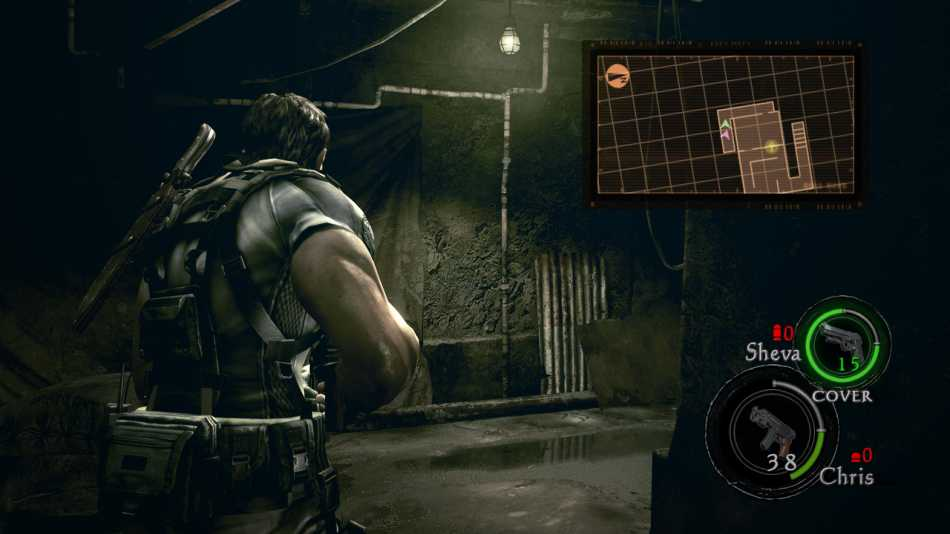
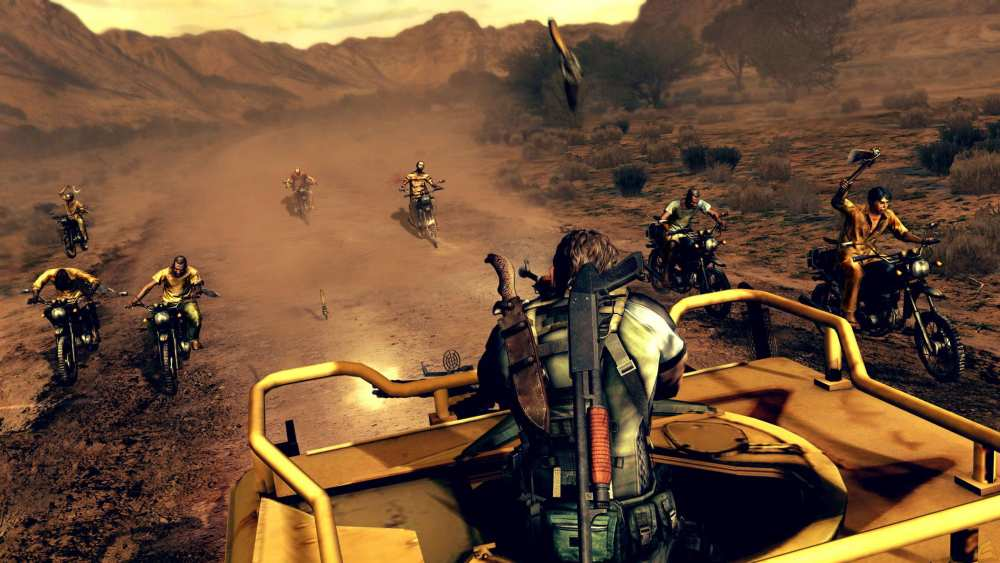
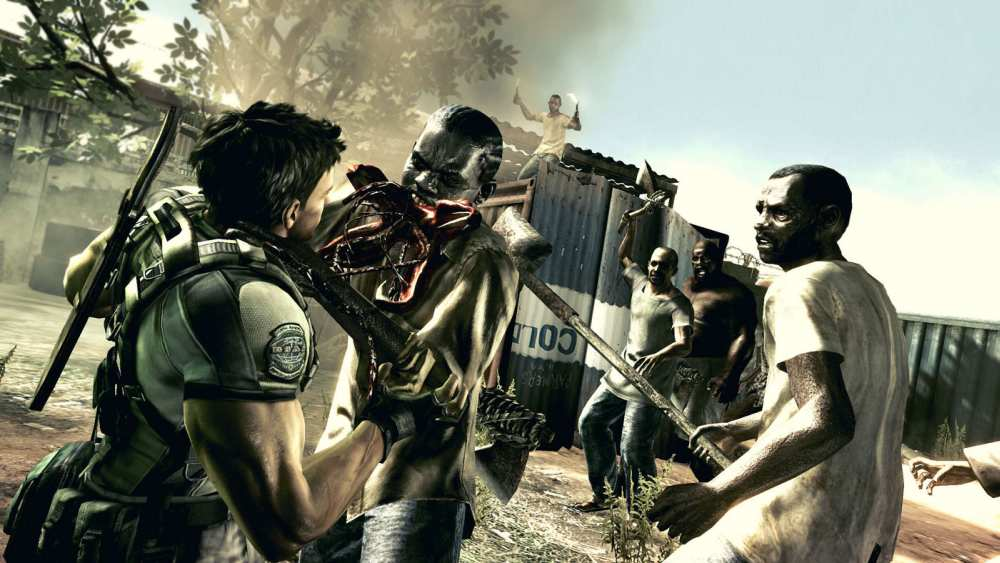
Resident Evil 5 starts you off as Chris Redfield, a familiar face from earlier in the series, as he chases down a bio-terrorism threat in Africa. As you soon find out, there is a New and Improved Las Plagas parasite, which sends its unwitting hosts into a zombified and suggestible state. The new breed is, on the whole, smarter, faster and more dexterous. While some zombies are content to swing their fists or throw an empty bottle at you, others will fight complex gun battles, using cover, deadly accuracy, and aspects of the environment to try and take you out. You'll still meet the shambling, growling hordes you're used to, but there's a much greater range of bad guys than before. They essentially fill any role an uninfected human might in a traditional action game. Newcomers to the series probably won't give this a second thought, but long-time fans may be bothered by it.
Accompanying you on your journey is Sheva Alomar, a young African woman in the Bio-terrorism Security Assessment Alliance (BSAA) who quickly becomes Chris' loyal partner. This is the foundation of the game's focus on co-op play, since a second player can take control of Sheva and work in tandem with you, either locally or over Xbox Live. For solo players, Sheva is controlled by the game's AI, to generally favorable results. Chris and Sheva each have their own inventory space, and you can shuffle items, guns, and ammunition between them as necessary. They back each other up in fights; when a zombie grabs and holds you, your partner can come to your aid and knock the zombie away. If you are close to death, your partner can resuscitate you.
The AI does a pretty good job at being where you want it, coming to your aid when you need it, and doing a respectable amount of damage to your enemies. It has no qualms about running itself out of ammo, but you can give it more or tell it to pick up more off the ground. The one major problem is that you can't really set up a plan with your AI partner. You can't tell them to stay here and cover you while you advance to a different spot, and you can't direct them toward a particular threat. The enemy AI is by turns intelligent and quite stupid. They'll chase you anywhere, scaling ladders quickly or jumping between rooftops, and they'll duck behind walls for cover. Unfortunately, they also have a habit of running up to you and standing still for five seconds before deciding to attack. You can also just run through big groups of some enemies without a scratch. It's probably necessary for the sake of letting the player have a chance to survive, but it's not believable stupidity, and makes it feel like they're just giving you something at which to throw your extra ammunition. Boss AI is almost nonexistent; they usually play out more like scripted encounters. For some of them, this works well.
The difficulty in fighting any of the game's enemies is strictly tied to how you control your character. Capcom made the decision to forbid movement while using your weapon in Resident Evil 5. If you don't like the idea of being unable to "run and gun," you should definitely try the demo first to see how it plays. The effect it has on gameplay is to make shooting your guns something that takes more thought and planning. Firing for extended periods becomes a dangerous proposition because zombies tend to come from all directions. If you stand still long enough, one will eventually come up behind you and attack. It makes situations where you're frantically firing into a group of onrushing enemies all the more tense, knowing that death may be creeping up on you unseen. Oh, and for whatever reason, Capcom decided to prevent you from moving while brandishing your knife as well. I can understand stopping to aim a gun, and maybe having your feet stop moving while actually swinging a blade, but why can't you walk and hold a knife at the same time? Perhaps they just didn't feel it was worth the time to code the changes for an infrequently used weapon. Either way, trying to hit things with your knife is annoying and often useless.
That said, Capcom didn't balance the stationary firing restriction with more responsive aiming. Even at the highest level of sensitivity, the controls are quite clunky to use when enemies are surrounding you. They did implement a button combo that flips you 180 degrees, and this helps to some extent. However, it's still fairly slow, and you almost always need to spend extra time finding your target after spinning around. Worse is when there are zombies to your right or left; button combos that flip you 90 degrees to one side or the other would have been quite welcome, but you're not given that option. Many similar games have implemented a tracking system for nearby enemies, either as dots on a mini-map or arrows on a HUD. Not so in Resident Evil 5; you're often forced into simply panning slowly around the room to see if anything is heading toward you.
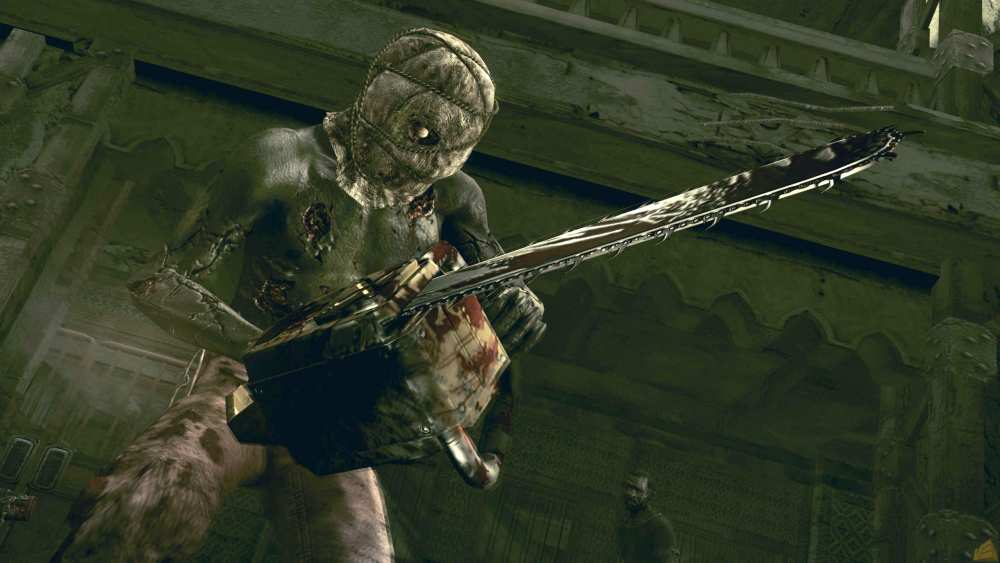
You'll also get to deal with a several types of enemies — such as dogs, spiders, and some bosses — who sometimes move more quickly than you can track them. They don't pose a huge threat to your character by themselves, but they often grab and hold you, allowing other, more dangerous enemies to get close. Those have their own associated problems — for one, a few of the more difficult enemies will just outright kill you if they get within melee range. While this makes sense from a realism perspective, it can be frustrating given the slowness of the movement system, and the requirement that you stop to deal damage. Add to this the huge amount of damage some of them can take, and you end up with regular enemies that feel tougher than the end-of-level bosses.
The boss encounters themselves are hit and miss. Resident Evil 5 makes gratuitous use of Quick-Time Events both during fights and in cut scenes. As the boss prepares to smash you with some tentacled appendage, you'll have a window of a second or so to press a button or get killed. This works decently when you're actually able to control your character, and it's used as part of a normal fight. In one of the later chapters, you get to fight a giant spider that's hanging onto a big, circular platform. As you attack the legs holding it in place, you dodge the ones that are free to swipe at you. It's a lot of fun. Unfortunately, many of the other QTEs are simply distracting. It's used continually in cut scenes to, presumably, keep the player engaged as the game characters are forced into decisions about fighting or dodging. But there's no real consequence to those actions; it's either linearly continue the scene or die (and start again very close to where you died).
One thing you'll notice is that many of the boss fights are just variations on a theme: chase bad guy, catch bad guy, watch bad guy turn into nigh-invulnerable, many-tentacled super zombie. But he has a weak spot! Some of these fights work better than others, and there are more original battles scattered throughout the game as well. For example, a battle with a hulking monstrosity that looks like a troll from Lord of the Rings is unique, but quite simple. The fight scenes with the mastermind who's orchestrating all these events (or, as I call him, "Neo") are more complex and interesting, but tend to suffer from QTEs that rely on fast movement, which is not the game's strong point.
The game ships with over 50 cut scenes of varying length. They're quite impressive to watch, and fans of the Resident Evil story won't be disappointed. They do an amazing job of developing the plot and tying the various levels together in a logical way. The scenes are framed and rendered in such a way that they look like movie footage shot by an actual camera, and it's done well. Monsters, characters, and explosions all look amazing. The story itself isn't high drama, but it's entertaining and serviceable — it's what you'd probably expect from a high-budget zombie flick. The big plot twist is depressingly predictable, but it sets up a cool fight. The settings and scenery during actual gameplay are excellent as well. You're taken through modern slums, primitive villages, underground labs, and a variety of other locales. There's quite a lot of detail, and Capcom took care to make everything colorful and interesting to look at.
Resident Evil 5 is a game that gets much better when you have somebody to play with. As I mentioned earlier, the AI is reasonable, but it doesn't compare to having another human to watch your back or help you kill something. The movement and aiming issues become much less problematic when playing with a friend, since you can stand back to back and limit the area one person has to cover. Once you've defeated the main campaign, you also open up Mercenaries mode, which can be played solo or with a friend. Much like in the previous games, you're dropped into a level with plenty of ammo and plenty of zombies to fight. You have a time limit, but glowing pillars scattered around the map will add time to the clock, and enemies will get stronger as the round goes on. The primary campaign forces you to manage your ammunition fairly strictly — if your accuracy isn't great you can expect to run out of bullets frequently — so being able to just fight without worrying about it makes Mercenaries even more entertaining.
The inventory and weapon selection systems are dominated by ammunition limits. Since you aren't given much of any one type of bullet, you're forced to carry around several different guns. These guns and their associated ammo don't leave much room for healing items, grenades, or proximity bombs, so those are used sparingly. You get the standard shooter-game implements — pistols, shotguns, machine guns, rifles — and the lack of ammo will force you to switch between them fairly often. It can be annoying, especially when you're restricted to a pistol or machine gun when you want to use something more powerful. They also give you a few more impressive weapons as the game goes on, but those are used less frequently. Regardless of the ammunition situation, the weapons themselves are nicely designed. You'll have a broad array of tools for the situations you're given, and each gun has a distinct feel.
It wouldn't be a Resident Evil 5 review without mentioning the concerns of racism that were raised when it was revealed that the game would be set in Africa. To put it bluntly: it's a non-issue. The plot is a natural development of moving the Resident Evil story to a new continent. They make it clear that the zombified people are victims, and that the real evil is the corporation behind the experiments.
Whether or not you enjoy Resident Evil 5 is likely to be dependent on how much you like the controls and whether or not you have a buddy you can play with. The plot is cheesy, but in an entertaining way, and it's basically shown to you as a movie interspersed with gameplay. Fans of the story will be pleased — there are tons of unlockable visuals and bits of information. If you were hoping for a more traditional survival game, you may be disappointed. The action is definitely ramped up, and there aren't really any scary moments. However, it's definitely a worthy addition to the Resident Evil franchise, and the amount of care and effort Capcom put into this game is quite evident.
-
Review: Resident Evil 5
The Resident Evil series has been a pillar of the survivor-horror genre for over a decade, with over 40 million copies sold and several books and movies to show for it. Resident Evil 4 was one of the most highly acclaimed games of 2005, and the lengthy development period given to its successor shows how important it was to Capcom to maintain that level of quality. More than that, the gameplay changes made to Resident Evil 5 make it clear that they're not simply trying to replicate success, but to really establish what they want the series to be. For better or for worse, the series is being pushed toward a bit more action, and the co-op element is almost a necessity. Read on for the rest of my thoughts.- Title: Resident Evil 5
- Developer: Capcom
- Publisher: Capcom
- System: Xbox 360, PS3
- Reviewer: Soulskill
- Score: 7/10
Resident Evil 5 starts you off as Chris Redfield, a familiar face from earlier in the series, as he chases down a bio-terrorism threat in Africa. As you soon find out, there is a New and Improved Las Plagas parasite, which sends its unwitting hosts into a zombified and suggestible state. The new breed is, on the whole, smarter, faster and more dexterous. While some zombies are content to swing their fists or throw an empty bottle at you, others will fight complex gun battles, using cover, deadly accuracy, and aspects of the environment to try and take you out. You'll still meet the shambling, growling hordes you're used to, but there's a much greater range of bad guys than before. They essentially fill any role an uninfected human might in a traditional action game. Newcomers to the series probably won't give this a second thought, but long-time fans may be bothered by it.
Accompanying you on your journey is Sheva Alomar, a young African woman in the Bio-terrorism Security Assessment Alliance (BSAA) who quickly becomes Chris' loyal partner. This is the foundation of the game's focus on co-op play, since a second player can take control of Sheva and work in tandem with you, either locally or over Xbox Live. For solo players, Sheva is controlled by the game's AI, to generally favorable results. Chris and Sheva each have their own inventory space, and you can shuffle items, guns, and ammunition between them as necessary. They back each other up in fights; when a zombie grabs and holds you, your partner can come to your aid and knock the zombie away. If you are close to death, your partner can resuscitate you.
The AI does a pretty good job at being where you want it, coming to your aid when you need it, and doing a respectable amount of damage to your enemies. It has no qualms about running itself out of ammo, but you can give it more or tell it to pick up more off the ground. The one major problem is that you can't really set up a plan with your AI partner. You can't tell them to stay here and cover you while you advance to a different spot, and you can't direct them toward a particular threat. The enemy AI is by turns intelligent and quite stupid. They'll chase you anywhere, scaling ladders quickly or jumping between rooftops, and they'll duck behind walls for cover. Unfortunately, they also have a habit of running up to you and standing still for five seconds before deciding to attack. You can also just run through big groups of some enemies without a scratch. It's probably necessary for the sake of letting the player have a chance to survive, but it's not believable stupidity, and makes it feel like they're just giving you something at which to throw your extra ammunition. Boss AI is almost nonexistent; they usually play out more like scripted encounters. For some of them, this works well.
The difficulty in fighting any of the game's enemies is strictly tied to how you control your character. Capcom made the decision to forbid movement while using your weapon in Resident Evil 5. If you don't like the idea of being unable to "run and gun," you should definitely try the demo first to see how it plays. The effect it has on gameplay is to make shooting your guns something that takes more thought and planning. Firing for extended periods becomes a dangerous proposition because zombies tend to come from all directions. If you stand still long enough, one will eventually come up behind you and attack. It makes situations where you're frantically firing into a group of onrushing enemies all the more tense, knowing that death may be creeping up on you unseen. Oh, and for whatever reason, Capcom decided to prevent you from moving while brandishing your knife as well. I can understand stopping to aim a gun, and maybe having your feet stop moving while actually swinging a blade, but why can't you walk and hold a knife at the same time? Perhaps they just didn't feel it was worth the time to code the changes for an infrequently used weapon. Either way, trying to hit things with your knife is annoying and often useless.
That said, Capcom didn't balance the stationary firing restriction with more responsive aiming. Even at the highest level of sensitivity, the controls are quite clunky to use when enemies are surrounding you. They did implement a button combo that flips you 180 degrees, and this helps to some extent. However, it's still fairly slow, and you almost always need to spend extra time finding your target after spinning around. Worse is when there are zombies to your right or left; button combos that flip you 90 degrees to one side or the other would have been quite welcome, but you're not given that option. Many similar games have implemented a tracking system for nearby enemies, either as dots on a mini-map or arrows on a HUD. Not so in Resident Evil 5; you're often forced into simply panning slowly around the room to see if anything is heading toward you.
You'll also get to deal with a several types of enemies — such as dogs, spiders, and some bosses — who sometimes move more quickly than you can track them. They don't pose a huge threat to your character by themselves, but they often grab and hold you, allowing other, more dangerous enemies to get close. Those have their own associated problems — for one, a few of the more difficult enemies will just outright kill you if they get within melee range. While this makes sense from a realism perspective, it can be frustrating given the slowness of the movement system, and the requirement that you stop to deal damage. Add to this the huge amount of damage some of them can take, and you end up with regular enemies that feel tougher than the end-of-level bosses.
The boss encounters themselves are hit and miss. Resident Evil 5 makes gratuitous use of Quick-Time Events both during fights and in cut scenes. As the boss prepares to smash you with some tentacled appendage, you'll have a window of a second or so to press a button or get killed. This works decently when you're actually able to control your character, and it's used as part of a normal fight. In one of the later chapters, you get to fight a giant spider that's hanging onto a big, circular platform. As you attack the legs holding it in place, you dodge the ones that are free to swipe at you. It's a lot of fun. Unfortunately, many of the other QTEs are simply distracting. It's used continually in cut scenes to, presumably, keep the player engaged as the game characters are forced into decisions about fighting or dodging. But there's no real consequence to those actions; it's either linearly continue the scene or die (and start again very close to where you died).
One thing you'll notice is that many of the boss fights are just variations on a theme: chase bad guy, catch bad guy, watch bad guy turn into nigh-invulnerable, many-tentacled super zombie. But he has a weak spot! Some of these fights work better than others, and there are more original battles scattered throughout the game as well. For example, a battle with a hulking monstrosity that looks like a troll from Lord of the Rings is unique, but quite simple. The fight scenes with the mastermind who's orchestrating all these events (or, as I call him, "Neo") are more complex and interesting, but tend to suffer from QTEs that rely on fast movement, which is not the game's strong point.
The game ships with over 50 cut scenes of varying length. They're quite impressive to watch, and fans of the Resident Evil story won't be disappointed. They do an amazing job of developing the plot and tying the various levels together in a logical way. The scenes are framed and rendered in such a way that they look like movie footage shot by an actual camera, and it's done well. Monsters, characters, and explosions all look amazing. The story itself isn't high drama, but it's entertaining and serviceable — it's what you'd probably expect from a high-budget zombie flick. The big plot twist is depressingly predictable, but it sets up a cool fight. The settings and scenery during actual gameplay are excellent as well. You're taken through modern slums, primitive villages, underground labs, and a variety of other locales. There's quite a lot of detail, and Capcom took care to make everything colorful and interesting to look at.
Resident Evil 5 is a game that gets much better when you have somebody to play with. As I mentioned earlier, the AI is reasonable, but it doesn't compare to having another human to watch your back or help you kill something. The movement and aiming issues become much less problematic when playing with a friend, since you can stand back to back and limit the area one person has to cover. Once you've defeated the main campaign, you also open up Mercenaries mode, which can be played solo or with a friend. Much like in the previous games, you're dropped into a level with plenty of ammo and plenty of zombies to fight. You have a time limit, but glowing pillars scattered around the map will add time to the clock, and enemies will get stronger as the round goes on. The primary campaign forces you to manage your ammunition fairly strictly — if your accuracy isn't great you can expect to run out of bullets frequently — so being able to just fight without worrying about it makes Mercenaries even more entertaining.
The inventory and weapon selection systems are dominated by ammunition limits. Since you aren't given much of any one type of bullet, you're forced to carry around several different guns. These guns and their associated ammo don't leave much room for healing items, grenades, or proximity bombs, so those are used sparingly. You get the standard shooter-game implements — pistols, shotguns, machine guns, rifles — and the lack of ammo will force you to switch between them fairly often. It can be annoying, especially when you're restricted to a pistol or machine gun when you want to use something more powerful. They also give you a few more impressive weapons as the game goes on, but those are used less frequently. Regardless of the ammunition situation, the weapons themselves are nicely designed. You'll have a broad array of tools for the situations you're given, and each gun has a distinct feel.
It wouldn't be a Resident Evil 5 review without mentioning the concerns of racism that were raised when it was revealed that the game would be set in Africa. To put it bluntly: it's a non-issue. The plot is a natural development of moving the Resident Evil story to a new continent. They make it clear that the zombified people are victims, and that the real evil is the corporation behind the experiments.
Whether or not you enjoy Resident Evil 5 is likely to be dependent on how much you like the controls and whether or not you have a buddy you can play with. The plot is cheesy, but in an entertaining way, and it's basically shown to you as a movie interspersed with gameplay. Fans of the story will be pleased — there are tons of unlockable visuals and bits of information. If you were hoping for a more traditional survival game, you may be disappointed. The action is definitely ramped up, and there aren't really any scary moments. However, it's definitely a worthy addition to the Resident Evil franchise, and the amount of care and effort Capcom put into this game is quite evident.
-
Review: Resident Evil 5
The Resident Evil series has been a pillar of the survivor-horror genre for over a decade, with over 40 million copies sold and several books and movies to show for it. Resident Evil 4 was one of the most highly acclaimed games of 2005, and the lengthy development period given to its successor shows how important it was to Capcom to maintain that level of quality. More than that, the gameplay changes made to Resident Evil 5 make it clear that they're not simply trying to replicate success, but to really establish what they want the series to be. For better or for worse, the series is being pushed toward a bit more action, and the co-op element is almost a necessity. Read on for the rest of my thoughts.- Title: Resident Evil 5
- Developer: Capcom
- Publisher: Capcom
- System: Xbox 360, PS3
- Reviewer: Soulskill
- Score: 7/10
Resident Evil 5 starts you off as Chris Redfield, a familiar face from earlier in the series, as he chases down a bio-terrorism threat in Africa. As you soon find out, there is a New and Improved Las Plagas parasite, which sends its unwitting hosts into a zombified and suggestible state. The new breed is, on the whole, smarter, faster and more dexterous. While some zombies are content to swing their fists or throw an empty bottle at you, others will fight complex gun battles, using cover, deadly accuracy, and aspects of the environment to try and take you out. You'll still meet the shambling, growling hordes you're used to, but there's a much greater range of bad guys than before. They essentially fill any role an uninfected human might in a traditional action game. Newcomers to the series probably won't give this a second thought, but long-time fans may be bothered by it.
Accompanying you on your journey is Sheva Alomar, a young African woman in the Bio-terrorism Security Assessment Alliance (BSAA) who quickly becomes Chris' loyal partner. This is the foundation of the game's focus on co-op play, since a second player can take control of Sheva and work in tandem with you, either locally or over Xbox Live. For solo players, Sheva is controlled by the game's AI, to generally favorable results. Chris and Sheva each have their own inventory space, and you can shuffle items, guns, and ammunition between them as necessary. They back each other up in fights; when a zombie grabs and holds you, your partner can come to your aid and knock the zombie away. If you are close to death, your partner can resuscitate you.
The AI does a pretty good job at being where you want it, coming to your aid when you need it, and doing a respectable amount of damage to your enemies. It has no qualms about running itself out of ammo, but you can give it more or tell it to pick up more off the ground. The one major problem is that you can't really set up a plan with your AI partner. You can't tell them to stay here and cover you while you advance to a different spot, and you can't direct them toward a particular threat. The enemy AI is by turns intelligent and quite stupid. They'll chase you anywhere, scaling ladders quickly or jumping between rooftops, and they'll duck behind walls for cover. Unfortunately, they also have a habit of running up to you and standing still for five seconds before deciding to attack. You can also just run through big groups of some enemies without a scratch. It's probably necessary for the sake of letting the player have a chance to survive, but it's not believable stupidity, and makes it feel like they're just giving you something at which to throw your extra ammunition. Boss AI is almost nonexistent; they usually play out more like scripted encounters. For some of them, this works well.
The difficulty in fighting any of the game's enemies is strictly tied to how you control your character. Capcom made the decision to forbid movement while using your weapon in Resident Evil 5. If you don't like the idea of being unable to "run and gun," you should definitely try the demo first to see how it plays. The effect it has on gameplay is to make shooting your guns something that takes more thought and planning. Firing for extended periods becomes a dangerous proposition because zombies tend to come from all directions. If you stand still long enough, one will eventually come up behind you and attack. It makes situations where you're frantically firing into a group of onrushing enemies all the more tense, knowing that death may be creeping up on you unseen. Oh, and for whatever reason, Capcom decided to prevent you from moving while brandishing your knife as well. I can understand stopping to aim a gun, and maybe having your feet stop moving while actually swinging a blade, but why can't you walk and hold a knife at the same time? Perhaps they just didn't feel it was worth the time to code the changes for an infrequently used weapon. Either way, trying to hit things with your knife is annoying and often useless.
That said, Capcom didn't balance the stationary firing restriction with more responsive aiming. Even at the highest level of sensitivity, the controls are quite clunky to use when enemies are surrounding you. They did implement a button combo that flips you 180 degrees, and this helps to some extent. However, it's still fairly slow, and you almost always need to spend extra time finding your target after spinning around. Worse is when there are zombies to your right or left; button combos that flip you 90 degrees to one side or the other would have been quite welcome, but you're not given that option. Many similar games have implemented a tracking system for nearby enemies, either as dots on a mini-map or arrows on a HUD. Not so in Resident Evil 5; you're often forced into simply panning slowly around the room to see if anything is heading toward you.
You'll also get to deal with a several types of enemies — such as dogs, spiders, and some bosses — who sometimes move more quickly than you can track them. They don't pose a huge threat to your character by themselves, but they often grab and hold you, allowing other, more dangerous enemies to get close. Those have their own associated problems — for one, a few of the more difficult enemies will just outright kill you if they get within melee range. While this makes sense from a realism perspective, it can be frustrating given the slowness of the movement system, and the requirement that you stop to deal damage. Add to this the huge amount of damage some of them can take, and you end up with regular enemies that feel tougher than the end-of-level bosses.
The boss encounters themselves are hit and miss. Resident Evil 5 makes gratuitous use of Quick-Time Events both during fights and in cut scenes. As the boss prepares to smash you with some tentacled appendage, you'll have a window of a second or so to press a button or get killed. This works decently when you're actually able to control your character, and it's used as part of a normal fight. In one of the later chapters, you get to fight a giant spider that's hanging onto a big, circular platform. As you attack the legs holding it in place, you dodge the ones that are free to swipe at you. It's a lot of fun. Unfortunately, many of the other QTEs are simply distracting. It's used continually in cut scenes to, presumably, keep the player engaged as the game characters are forced into decisions about fighting or dodging. But there's no real consequence to those actions; it's either linearly continue the scene or die (and start again very close to where you died).
One thing you'll notice is that many of the boss fights are just variations on a theme: chase bad guy, catch bad guy, watch bad guy turn into nigh-invulnerable, many-tentacled super zombie. But he has a weak spot! Some of these fights work better than others, and there are more original battles scattered throughout the game as well. For example, a battle with a hulking monstrosity that looks like a troll from Lord of the Rings is unique, but quite simple. The fight scenes with the mastermind who's orchestrating all these events (or, as I call him, "Neo") are more complex and interesting, but tend to suffer from QTEs that rely on fast movement, which is not the game's strong point.
The game ships with over 50 cut scenes of varying length. They're quite impressive to watch, and fans of the Resident Evil story won't be disappointed. They do an amazing job of developing the plot and tying the various levels together in a logical way. The scenes are framed and rendered in such a way that they look like movie footage shot by an actual camera, and it's done well. Monsters, characters, and explosions all look amazing. The story itself isn't high drama, but it's entertaining and serviceable — it's what you'd probably expect from a high-budget zombie flick. The big plot twist is depressingly predictable, but it sets up a cool fight. The settings and scenery during actual gameplay are excellent as well. You're taken through modern slums, primitive villages, underground labs, and a variety of other locales. There's quite a lot of detail, and Capcom took care to make everything colorful and interesting to look at.
Resident Evil 5 is a game that gets much better when you have somebody to play with. As I mentioned earlier, the AI is reasonable, but it doesn't compare to having another human to watch your back or help you kill something. The movement and aiming issues become much less problematic when playing with a friend, since you can stand back to back and limit the area one person has to cover. Once you've defeated the main campaign, you also open up Mercenaries mode, which can be played solo or with a friend. Much like in the previous games, you're dropped into a level with plenty of ammo and plenty of zombies to fight. You have a time limit, but glowing pillars scattered around the map will add time to the clock, and enemies will get stronger as the round goes on. The primary campaign forces you to manage your ammunition fairly strictly — if your accuracy isn't great you can expect to run out of bullets frequently — so being able to just fight without worrying about it makes Mercenaries even more entertaining.
The inventory and weapon selection systems are dominated by ammunition limits. Since you aren't given much of any one type of bullet, you're forced to carry around several different guns. These guns and their associated ammo don't leave much room for healing items, grenades, or proximity bombs, so those are used sparingly. You get the standard shooter-game implements — pistols, shotguns, machine guns, rifles — and the lack of ammo will force you to switch between them fairly often. It can be annoying, especially when you're restricted to a pistol or machine gun when you want to use something more powerful. They also give you a few more impressive weapons as the game goes on, but those are used less frequently. Regardless of the ammunition situation, the weapons themselves are nicely designed. You'll have a broad array of tools for the situations you're given, and each gun has a distinct feel.
It wouldn't be a Resident Evil 5 review without mentioning the concerns of racism that were raised when it was revealed that the game would be set in Africa. To put it bluntly: it's a non-issue. The plot is a natural development of moving the Resident Evil story to a new continent. They make it clear that the zombified people are victims, and that the real evil is the corporation behind the experiments.
Whether or not you enjoy Resident Evil 5 is likely to be dependent on how much you like the controls and whether or not you have a buddy you can play with. The plot is cheesy, but in an entertaining way, and it's basically shown to you as a movie interspersed with gameplay. Fans of the story will be pleased — there are tons of unlockable visuals and bits of information. If you were hoping for a more traditional survival game, you may be disappointed. The action is definitely ramped up, and there aren't really any scary moments. However, it's definitely a worthy addition to the Resident Evil franchise, and the amount of care and effort Capcom put into this game is quite evident.
-
Review: Resident Evil 5
The Resident Evil series has been a pillar of the survivor-horror genre for over a decade, with over 40 million copies sold and several books and movies to show for it. Resident Evil 4 was one of the most highly acclaimed games of 2005, and the lengthy development period given to its successor shows how important it was to Capcom to maintain that level of quality. More than that, the gameplay changes made to Resident Evil 5 make it clear that they're not simply trying to replicate success, but to really establish what they want the series to be. For better or for worse, the series is being pushed toward a bit more action, and the co-op element is almost a necessity. Read on for the rest of my thoughts.- Title: Resident Evil 5
- Developer: Capcom
- Publisher: Capcom
- System: Xbox 360, PS3
- Reviewer: Soulskill
- Score: 7/10
Resident Evil 5 starts you off as Chris Redfield, a familiar face from earlier in the series, as he chases down a bio-terrorism threat in Africa. As you soon find out, there is a New and Improved Las Plagas parasite, which sends its unwitting hosts into a zombified and suggestible state. The new breed is, on the whole, smarter, faster and more dexterous. While some zombies are content to swing their fists or throw an empty bottle at you, others will fight complex gun battles, using cover, deadly accuracy, and aspects of the environment to try and take you out. You'll still meet the shambling, growling hordes you're used to, but there's a much greater range of bad guys than before. They essentially fill any role an uninfected human might in a traditional action game. Newcomers to the series probably won't give this a second thought, but long-time fans may be bothered by it.
Accompanying you on your journey is Sheva Alomar, a young African woman in the Bio-terrorism Security Assessment Alliance (BSAA) who quickly becomes Chris' loyal partner. This is the foundation of the game's focus on co-op play, since a second player can take control of Sheva and work in tandem with you, either locally or over Xbox Live. For solo players, Sheva is controlled by the game's AI, to generally favorable results. Chris and Sheva each have their own inventory space, and you can shuffle items, guns, and ammunition between them as necessary. They back each other up in fights; when a zombie grabs and holds you, your partner can come to your aid and knock the zombie away. If you are close to death, your partner can resuscitate you.
The AI does a pretty good job at being where you want it, coming to your aid when you need it, and doing a respectable amount of damage to your enemies. It has no qualms about running itself out of ammo, but you can give it more or tell it to pick up more off the ground. The one major problem is that you can't really set up a plan with your AI partner. You can't tell them to stay here and cover you while you advance to a different spot, and you can't direct them toward a particular threat. The enemy AI is by turns intelligent and quite stupid. They'll chase you anywhere, scaling ladders quickly or jumping between rooftops, and they'll duck behind walls for cover. Unfortunately, they also have a habit of running up to you and standing still for five seconds before deciding to attack. You can also just run through big groups of some enemies without a scratch. It's probably necessary for the sake of letting the player have a chance to survive, but it's not believable stupidity, and makes it feel like they're just giving you something at which to throw your extra ammunition. Boss AI is almost nonexistent; they usually play out more like scripted encounters. For some of them, this works well.
The difficulty in fighting any of the game's enemies is strictly tied to how you control your character. Capcom made the decision to forbid movement while using your weapon in Resident Evil 5. If you don't like the idea of being unable to "run and gun," you should definitely try the demo first to see how it plays. The effect it has on gameplay is to make shooting your guns something that takes more thought and planning. Firing for extended periods becomes a dangerous proposition because zombies tend to come from all directions. If you stand still long enough, one will eventually come up behind you and attack. It makes situations where you're frantically firing into a group of onrushing enemies all the more tense, knowing that death may be creeping up on you unseen. Oh, and for whatever reason, Capcom decided to prevent you from moving while brandishing your knife as well. I can understand stopping to aim a gun, and maybe having your feet stop moving while actually swinging a blade, but why can't you walk and hold a knife at the same time? Perhaps they just didn't feel it was worth the time to code the changes for an infrequently used weapon. Either way, trying to hit things with your knife is annoying and often useless.
That said, Capcom didn't balance the stationary firing restriction with more responsive aiming. Even at the highest level of sensitivity, the controls are quite clunky to use when enemies are surrounding you. They did implement a button combo that flips you 180 degrees, and this helps to some extent. However, it's still fairly slow, and you almost always need to spend extra time finding your target after spinning around. Worse is when there are zombies to your right or left; button combos that flip you 90 degrees to one side or the other would have been quite welcome, but you're not given that option. Many similar games have implemented a tracking system for nearby enemies, either as dots on a mini-map or arrows on a HUD. Not so in Resident Evil 5; you're often forced into simply panning slowly around the room to see if anything is heading toward you.
You'll also get to deal with a several types of enemies — such as dogs, spiders, and some bosses — who sometimes move more quickly than you can track them. They don't pose a huge threat to your character by themselves, but they often grab and hold you, allowing other, more dangerous enemies to get close. Those have their own associated problems — for one, a few of the more difficult enemies will just outright kill you if they get within melee range. While this makes sense from a realism perspective, it can be frustrating given the slowness of the movement system, and the requirement that you stop to deal damage. Add to this the huge amount of damage some of them can take, and you end up with regular enemies that feel tougher than the end-of-level bosses.
The boss encounters themselves are hit and miss. Resident Evil 5 makes gratuitous use of Quick-Time Events both during fights and in cut scenes. As the boss prepares to smash you with some tentacled appendage, you'll have a window of a second or so to press a button or get killed. This works decently when you're actually able to control your character, and it's used as part of a normal fight. In one of the later chapters, you get to fight a giant spider that's hanging onto a big, circular platform. As you attack the legs holding it in place, you dodge the ones that are free to swipe at you. It's a lot of fun. Unfortunately, many of the other QTEs are simply distracting. It's used continually in cut scenes to, presumably, keep the player engaged as the game characters are forced into decisions about fighting or dodging. But there's no real consequence to those actions; it's either linearly continue the scene or die (and start again very close to where you died).
One thing you'll notice is that many of the boss fights are just variations on a theme: chase bad guy, catch bad guy, watch bad guy turn into nigh-invulnerable, many-tentacled super zombie. But he has a weak spot! Some of these fights work better than others, and there are more original battles scattered throughout the game as well. For example, a battle with a hulking monstrosity that looks like a troll from Lord of the Rings is unique, but quite simple. The fight scenes with the mastermind who's orchestrating all these events (or, as I call him, "Neo") are more complex and interesting, but tend to suffer from QTEs that rely on fast movement, which is not the game's strong point.
The game ships with over 50 cut scenes of varying length. They're quite impressive to watch, and fans of the Resident Evil story won't be disappointed. They do an amazing job of developing the plot and tying the various levels together in a logical way. The scenes are framed and rendered in such a way that they look like movie footage shot by an actual camera, and it's done well. Monsters, characters, and explosions all look amazing. The story itself isn't high drama, but it's entertaining and serviceable — it's what you'd probably expect from a high-budget zombie flick. The big plot twist is depressingly predictable, but it sets up a cool fight. The settings and scenery during actual gameplay are excellent as well. You're taken through modern slums, primitive villages, underground labs, and a variety of other locales. There's quite a lot of detail, and Capcom took care to make everything colorful and interesting to look at.
Resident Evil 5 is a game that gets much better when you have somebody to play with. As I mentioned earlier, the AI is reasonable, but it doesn't compare to having another human to watch your back or help you kill something. The movement and aiming issues become much less problematic when playing with a friend, since you can stand back to back and limit the area one person has to cover. Once you've defeated the main campaign, you also open up Mercenaries mode, which can be played solo or with a friend. Much like in the previous games, you're dropped into a level with plenty of ammo and plenty of zombies to fight. You have a time limit, but glowing pillars scattered around the map will add time to the clock, and enemies will get stronger as the round goes on. The primary campaign forces you to manage your ammunition fairly strictly — if your accuracy isn't great you can expect to run out of bullets frequently — so being able to just fight without worrying about it makes Mercenaries even more entertaining.
The inventory and weapon selection systems are dominated by ammunition limits. Since you aren't given much of any one type of bullet, you're forced to carry around several different guns. These guns and their associated ammo don't leave much room for healing items, grenades, or proximity bombs, so those are used sparingly. You get the standard shooter-game implements — pistols, shotguns, machine guns, rifles — and the lack of ammo will force you to switch between them fairly often. It can be annoying, especially when you're restricted to a pistol or machine gun when you want to use something more powerful. They also give you a few more impressive weapons as the game goes on, but those are used less frequently. Regardless of the ammunition situation, the weapons themselves are nicely designed. You'll have a broad array of tools for the situations you're given, and each gun has a distinct feel.
It wouldn't be a Resident Evil 5 review without mentioning the concerns of racism that were raised when it was revealed that the game would be set in Africa. To put it bluntly: it's a non-issue. The plot is a natural development of moving the Resident Evil story to a new continent. They make it clear that the zombified people are victims, and that the real evil is the corporation behind the experiments.
Whether or not you enjoy Resident Evil 5 is likely to be dependent on how much you like the controls and whether or not you have a buddy you can play with. The plot is cheesy, but in an entertaining way, and it's basically shown to you as a movie interspersed with gameplay. Fans of the story will be pleased — there are tons of unlockable visuals and bits of information. If you were hoping for a more traditional survival game, you may be disappointed. The action is definitely ramped up, and there aren't really any scary moments. However, it's definitely a worthy addition to the Resident Evil franchise, and the amount of care and effort Capcom put into this game is quite evident.
-
Review: Resident Evil 5
The Resident Evil series has been a pillar of the survivor-horror genre for over a decade, with over 40 million copies sold and several books and movies to show for it. Resident Evil 4 was one of the most highly acclaimed games of 2005, and the lengthy development period given to its successor shows how important it was to Capcom to maintain that level of quality. More than that, the gameplay changes made to Resident Evil 5 make it clear that they're not simply trying to replicate success, but to really establish what they want the series to be. For better or for worse, the series is being pushed toward a bit more action, and the co-op element is almost a necessity. Read on for the rest of my thoughts.- Title: Resident Evil 5
- Developer: Capcom
- Publisher: Capcom
- System: Xbox 360, PS3
- Reviewer: Soulskill
- Score: 7/10
Resident Evil 5 starts you off as Chris Redfield, a familiar face from earlier in the series, as he chases down a bio-terrorism threat in Africa. As you soon find out, there is a New and Improved Las Plagas parasite, which sends its unwitting hosts into a zombified and suggestible state. The new breed is, on the whole, smarter, faster and more dexterous. While some zombies are content to swing their fists or throw an empty bottle at you, others will fight complex gun battles, using cover, deadly accuracy, and aspects of the environment to try and take you out. You'll still meet the shambling, growling hordes you're used to, but there's a much greater range of bad guys than before. They essentially fill any role an uninfected human might in a traditional action game. Newcomers to the series probably won't give this a second thought, but long-time fans may be bothered by it.
Accompanying you on your journey is Sheva Alomar, a young African woman in the Bio-terrorism Security Assessment Alliance (BSAA) who quickly becomes Chris' loyal partner. This is the foundation of the game's focus on co-op play, since a second player can take control of Sheva and work in tandem with you, either locally or over Xbox Live. For solo players, Sheva is controlled by the game's AI, to generally favorable results. Chris and Sheva each have their own inventory space, and you can shuffle items, guns, and ammunition between them as necessary. They back each other up in fights; when a zombie grabs and holds you, your partner can come to your aid and knock the zombie away. If you are close to death, your partner can resuscitate you.
The AI does a pretty good job at being where you want it, coming to your aid when you need it, and doing a respectable amount of damage to your enemies. It has no qualms about running itself out of ammo, but you can give it more or tell it to pick up more off the ground. The one major problem is that you can't really set up a plan with your AI partner. You can't tell them to stay here and cover you while you advance to a different spot, and you can't direct them toward a particular threat. The enemy AI is by turns intelligent and quite stupid. They'll chase you anywhere, scaling ladders quickly or jumping between rooftops, and they'll duck behind walls for cover. Unfortunately, they also have a habit of running up to you and standing still for five seconds before deciding to attack. You can also just run through big groups of some enemies without a scratch. It's probably necessary for the sake of letting the player have a chance to survive, but it's not believable stupidity, and makes it feel like they're just giving you something at which to throw your extra ammunition. Boss AI is almost nonexistent; they usually play out more like scripted encounters. For some of them, this works well.
The difficulty in fighting any of the game's enemies is strictly tied to how you control your character. Capcom made the decision to forbid movement while using your weapon in Resident Evil 5. If you don't like the idea of being unable to "run and gun," you should definitely try the demo first to see how it plays. The effect it has on gameplay is to make shooting your guns something that takes more thought and planning. Firing for extended periods becomes a dangerous proposition because zombies tend to come from all directions. If you stand still long enough, one will eventually come up behind you and attack. It makes situations where you're frantically firing into a group of onrushing enemies all the more tense, knowing that death may be creeping up on you unseen. Oh, and for whatever reason, Capcom decided to prevent you from moving while brandishing your knife as well. I can understand stopping to aim a gun, and maybe having your feet stop moving while actually swinging a blade, but why can't you walk and hold a knife at the same time? Perhaps they just didn't feel it was worth the time to code the changes for an infrequently used weapon. Either way, trying to hit things with your knife is annoying and often useless.
That said, Capcom didn't balance the stationary firing restriction with more responsive aiming. Even at the highest level of sensitivity, the controls are quite clunky to use when enemies are surrounding you. They did implement a button combo that flips you 180 degrees, and this helps to some extent. However, it's still fairly slow, and you almost always need to spend extra time finding your target after spinning around. Worse is when there are zombies to your right or left; button combos that flip you 90 degrees to one side or the other would have been quite welcome, but you're not given that option. Many similar games have implemented a tracking system for nearby enemies, either as dots on a mini-map or arrows on a HUD. Not so in Resident Evil 5; you're often forced into simply panning slowly around the room to see if anything is heading toward you.
You'll also get to deal with a several types of enemies — such as dogs, spiders, and some bosses — who sometimes move more quickly than you can track them. They don't pose a huge threat to your character by themselves, but they often grab and hold you, allowing other, more dangerous enemies to get close. Those have their own associated problems — for one, a few of the more difficult enemies will just outright kill you if they get within melee range. While this makes sense from a realism perspective, it can be frustrating given the slowness of the movement system, and the requirement that you stop to deal damage. Add to this the huge amount of damage some of them can take, and you end up with regular enemies that feel tougher than the end-of-level bosses.
The boss encounters themselves are hit and miss. Resident Evil 5 makes gratuitous use of Quick-Time Events both during fights and in cut scenes. As the boss prepares to smash you with some tentacled appendage, you'll have a window of a second or so to press a button or get killed. This works decently when you're actually able to control your character, and it's used as part of a normal fight. In one of the later chapters, you get to fight a giant spider that's hanging onto a big, circular platform. As you attack the legs holding it in place, you dodge the ones that are free to swipe at you. It's a lot of fun. Unfortunately, many of the other QTEs are simply distracting. It's used continually in cut scenes to, presumably, keep the player engaged as the game characters are forced into decisions about fighting or dodging. But there's no real consequence to those actions; it's either linearly continue the scene or die (and start again very close to where you died).
One thing you'll notice is that many of the boss fights are just variations on a theme: chase bad guy, catch bad guy, watch bad guy turn into nigh-invulnerable, many-tentacled super zombie. But he has a weak spot! Some of these fights work better than others, and there are more original battles scattered throughout the game as well. For example, a battle with a hulking monstrosity that looks like a troll from Lord of the Rings is unique, but quite simple. The fight scenes with the mastermind who's orchestrating all these events (or, as I call him, "Neo") are more complex and interesting, but tend to suffer from QTEs that rely on fast movement, which is not the game's strong point.
The game ships with over 50 cut scenes of varying length. They're quite impressive to watch, and fans of the Resident Evil story won't be disappointed. They do an amazing job of developing the plot and tying the various levels together in a logical way. The scenes are framed and rendered in such a way that they look like movie footage shot by an actual camera, and it's done well. Monsters, characters, and explosions all look amazing. The story itself isn't high drama, but it's entertaining and serviceable — it's what you'd probably expect from a high-budget zombie flick. The big plot twist is depressingly predictable, but it sets up a cool fight. The settings and scenery during actual gameplay are excellent as well. You're taken through modern slums, primitive villages, underground labs, and a variety of other locales. There's quite a lot of detail, and Capcom took care to make everything colorful and interesting to look at.
Resident Evil 5 is a game that gets much better when you have somebody to play with. As I mentioned earlier, the AI is reasonable, but it doesn't compare to having another human to watch your back or help you kill something. The movement and aiming issues become much less problematic when playing with a friend, since you can stand back to back and limit the area one person has to cover. Once you've defeated the main campaign, you also open up Mercenaries mode, which can be played solo or with a friend. Much like in the previous games, you're dropped into a level with plenty of ammo and plenty of zombies to fight. You have a time limit, but glowing pillars scattered around the map will add time to the clock, and enemies will get stronger as the round goes on. The primary campaign forces you to manage your ammunition fairly strictly — if your accuracy isn't great you can expect to run out of bullets frequently — so being able to just fight without worrying about it makes Mercenaries even more entertaining.
The inventory and weapon selection systems are dominated by ammunition limits. Since you aren't given much of any one type of bullet, you're forced to carry around several different guns. These guns and their associated ammo don't leave much room for healing items, grenades, or proximity bombs, so those are used sparingly. You get the standard shooter-game implements — pistols, shotguns, machine guns, rifles — and the lack of ammo will force you to switch between them fairly often. It can be annoying, especially when you're restricted to a pistol or machine gun when you want to use something more powerful. They also give you a few more impressive weapons as the game goes on, but those are used less frequently. Regardless of the ammunition situation, the weapons themselves are nicely designed. You'll have a broad array of tools for the situations you're given, and each gun has a distinct feel.
It wouldn't be a Resident Evil 5 review without mentioning the concerns of racism that were raised when it was revealed that the game would be set in Africa. To put it bluntly: it's a non-issue. The plot is a natural development of moving the Resident Evil story to a new continent. They make it clear that the zombified people are victims, and that the real evil is the corporation behind the experiments.
Whether or not you enjoy Resident Evil 5 is likely to be dependent on how much you like the controls and whether or not you have a buddy you can play with. The plot is cheesy, but in an entertaining way, and it's basically shown to you as a movie interspersed with gameplay. Fans of the story will be pleased — there are tons of unlockable visuals and bits of information. If you were hoping for a more traditional survival game, you may be disappointed. The action is definitely ramped up, and there aren't really any scary moments. However, it's definitely a worthy addition to the Resident Evil franchise, and the amount of care and effort Capcom put into this game is quite evident.
-
Review: Resident Evil 5
The Resident Evil series has been a pillar of the survivor-horror genre for over a decade, with over 40 million copies sold and several books and movies to show for it. Resident Evil 4 was one of the most highly acclaimed games of 2005, and the lengthy development period given to its successor shows how important it was to Capcom to maintain that level of quality. More than that, the gameplay changes made to Resident Evil 5 make it clear that they're not simply trying to replicate success, but to really establish what they want the series to be. For better or for worse, the series is being pushed toward a bit more action, and the co-op element is almost a necessity. Read on for the rest of my thoughts.- Title: Resident Evil 5
- Developer: Capcom
- Publisher: Capcom
- System: Xbox 360, PS3
- Reviewer: Soulskill
- Score: 7/10
Resident Evil 5 starts you off as Chris Redfield, a familiar face from earlier in the series, as he chases down a bio-terrorism threat in Africa. As you soon find out, there is a New and Improved Las Plagas parasite, which sends its unwitting hosts into a zombified and suggestible state. The new breed is, on the whole, smarter, faster and more dexterous. While some zombies are content to swing their fists or throw an empty bottle at you, others will fight complex gun battles, using cover, deadly accuracy, and aspects of the environment to try and take you out. You'll still meet the shambling, growling hordes you're used to, but there's a much greater range of bad guys than before. They essentially fill any role an uninfected human might in a traditional action game. Newcomers to the series probably won't give this a second thought, but long-time fans may be bothered by it.
Accompanying you on your journey is Sheva Alomar, a young African woman in the Bio-terrorism Security Assessment Alliance (BSAA) who quickly becomes Chris' loyal partner. This is the foundation of the game's focus on co-op play, since a second player can take control of Sheva and work in tandem with you, either locally or over Xbox Live. For solo players, Sheva is controlled by the game's AI, to generally favorable results. Chris and Sheva each have their own inventory space, and you can shuffle items, guns, and ammunition between them as necessary. They back each other up in fights; when a zombie grabs and holds you, your partner can come to your aid and knock the zombie away. If you are close to death, your partner can resuscitate you.
The AI does a pretty good job at being where you want it, coming to your aid when you need it, and doing a respectable amount of damage to your enemies. It has no qualms about running itself out of ammo, but you can give it more or tell it to pick up more off the ground. The one major problem is that you can't really set up a plan with your AI partner. You can't tell them to stay here and cover you while you advance to a different spot, and you can't direct them toward a particular threat. The enemy AI is by turns intelligent and quite stupid. They'll chase you anywhere, scaling ladders quickly or jumping between rooftops, and they'll duck behind walls for cover. Unfortunately, they also have a habit of running up to you and standing still for five seconds before deciding to attack. You can also just run through big groups of some enemies without a scratch. It's probably necessary for the sake of letting the player have a chance to survive, but it's not believable stupidity, and makes it feel like they're just giving you something at which to throw your extra ammunition. Boss AI is almost nonexistent; they usually play out more like scripted encounters. For some of them, this works well.
The difficulty in fighting any of the game's enemies is strictly tied to how you control your character. Capcom made the decision to forbid movement while using your weapon in Resident Evil 5. If you don't like the idea of being unable to "run and gun," you should definitely try the demo first to see how it plays. The effect it has on gameplay is to make shooting your guns something that takes more thought and planning. Firing for extended periods becomes a dangerous proposition because zombies tend to come from all directions. If you stand still long enough, one will eventually come up behind you and attack. It makes situations where you're frantically firing into a group of onrushing enemies all the more tense, knowing that death may be creeping up on you unseen. Oh, and for whatever reason, Capcom decided to prevent you from moving while brandishing your knife as well. I can understand stopping to aim a gun, and maybe having your feet stop moving while actually swinging a blade, but why can't you walk and hold a knife at the same time? Perhaps they just didn't feel it was worth the time to code the changes for an infrequently used weapon. Either way, trying to hit things with your knife is annoying and often useless.
That said, Capcom didn't balance the stationary firing restriction with more responsive aiming. Even at the highest level of sensitivity, the controls are quite clunky to use when enemies are surrounding you. They did implement a button combo that flips you 180 degrees, and this helps to some extent. However, it's still fairly slow, and you almost always need to spend extra time finding your target after spinning around. Worse is when there are zombies to your right or left; button combos that flip you 90 degrees to one side or the other would have been quite welcome, but you're not given that option. Many similar games have implemented a tracking system for nearby enemies, either as dots on a mini-map or arrows on a HUD. Not so in Resident Evil 5; you're often forced into simply panning slowly around the room to see if anything is heading toward you.
You'll also get to deal with a several types of enemies — such as dogs, spiders, and some bosses — who sometimes move more quickly than you can track them. They don't pose a huge threat to your character by themselves, but they often grab and hold you, allowing other, more dangerous enemies to get close. Those have their own associated problems — for one, a few of the more difficult enemies will just outright kill you if they get within melee range. While this makes sense from a realism perspective, it can be frustrating given the slowness of the movement system, and the requirement that you stop to deal damage. Add to this the huge amount of damage some of them can take, and you end up with regular enemies that feel tougher than the end-of-level bosses.
The boss encounters themselves are hit and miss. Resident Evil 5 makes gratuitous use of Quick-Time Events both during fights and in cut scenes. As the boss prepares to smash you with some tentacled appendage, you'll have a window of a second or so to press a button or get killed. This works decently when you're actually able to control your character, and it's used as part of a normal fight. In one of the later chapters, you get to fight a giant spider that's hanging onto a big, circular platform. As you attack the legs holding it in place, you dodge the ones that are free to swipe at you. It's a lot of fun. Unfortunately, many of the other QTEs are simply distracting. It's used continually in cut scenes to, presumably, keep the player engaged as the game characters are forced into decisions about fighting or dodging. But there's no real consequence to those actions; it's either linearly continue the scene or die (and start again very close to where you died).
One thing you'll notice is that many of the boss fights are just variations on a theme: chase bad guy, catch bad guy, watch bad guy turn into nigh-invulnerable, many-tentacled super zombie. But he has a weak spot! Some of these fights work better than others, and there are more original battles scattered throughout the game as well. For example, a battle with a hulking monstrosity that looks like a troll from Lord of the Rings is unique, but quite simple. The fight scenes with the mastermind who's orchestrating all these events (or, as I call him, "Neo") are more complex and interesting, but tend to suffer from QTEs that rely on fast movement, which is not the game's strong point.
The game ships with over 50 cut scenes of varying length. They're quite impressive to watch, and fans of the Resident Evil story won't be disappointed. They do an amazing job of developing the plot and tying the various levels together in a logical way. The scenes are framed and rendered in such a way that they look like movie footage shot by an actual camera, and it's done well. Monsters, characters, and explosions all look amazing. The story itself isn't high drama, but it's entertaining and serviceable — it's what you'd probably expect from a high-budget zombie flick. The big plot twist is depressingly predictable, but it sets up a cool fight. The settings and scenery during actual gameplay are excellent as well. You're taken through modern slums, primitive villages, underground labs, and a variety of other locales. There's quite a lot of detail, and Capcom took care to make everything colorful and interesting to look at.
Resident Evil 5 is a game that gets much better when you have somebody to play with. As I mentioned earlier, the AI is reasonable, but it doesn't compare to having another human to watch your back or help you kill something. The movement and aiming issues become much less problematic when playing with a friend, since you can stand back to back and limit the area one person has to cover. Once you've defeated the main campaign, you also open up Mercenaries mode, which can be played solo or with a friend. Much like in the previous games, you're dropped into a level with plenty of ammo and plenty of zombies to fight. You have a time limit, but glowing pillars scattered around the map will add time to the clock, and enemies will get stronger as the round goes on. The primary campaign forces you to manage your ammunition fairly strictly — if your accuracy isn't great you can expect to run out of bullets frequently — so being able to just fight without worrying about it makes Mercenaries even more entertaining.
The inventory and weapon selection systems are dominated by ammunition limits. Since you aren't given much of any one type of bullet, you're forced to carry around several different guns. These guns and their associated ammo don't leave much room for healing items, grenades, or proximity bombs, so those are used sparingly. You get the standard shooter-game implements — pistols, shotguns, machine guns, rifles — and the lack of ammo will force you to switch between them fairly often. It can be annoying, especially when you're restricted to a pistol or machine gun when you want to use something more powerful. They also give you a few more impressive weapons as the game goes on, but those are used less frequently. Regardless of the ammunition situation, the weapons themselves are nicely designed. You'll have a broad array of tools for the situations you're given, and each gun has a distinct feel.
It wouldn't be a Resident Evil 5 review without mentioning the concerns of racism that were raised when it was revealed that the game would be set in Africa. To put it bluntly: it's a non-issue. The plot is a natural development of moving the Resident Evil story to a new continent. They make it clear that the zombified people are victims, and that the real evil is the corporation behind the experiments.
Whether or not you enjoy Resident Evil 5 is likely to be dependent on how much you like the controls and whether or not you have a buddy you can play with. The plot is cheesy, but in an entertaining way, and it's basically shown to you as a movie interspersed with gameplay. Fans of the story will be pleased — there are tons of unlockable visuals and bits of information. If you were hoping for a more traditional survival game, you may be disappointed. The action is definitely ramped up, and there aren't really any scary moments. However, it's definitely a worthy addition to the Resident Evil franchise, and the amount of care and effort Capcom put into this game is quite evident.
-
Ext4 Data Losses Explained, Worked Around
ddfall writes "H-Online has a follow-up on the Ext4 file system — Last week's news about data loss with the Linux Ext4 file system is explained and new solutions have been provided by Ted Ts'o to allow Ext4 to behave more like Ext3." -
UK Gov't May Track All Facebook Traffic
Jack Spine writes "The UK government, which is becoming increasingly Orwellian, has said that it is considering snooping on all social networking traffic including Facebook, MySpace, and bebo. This supposedly anti-terrorist measure may be proposed as part of the Intercept Modernisation Programme according to minister Vernon Coaker, and is exactly the sort of deep packet inspection web inventor Sir Tim Berners-Lee warned about last week. The measure would get around the inconvenience for the government of not being able to snoop on all UK web traffic." -
UK Gov't May Track All Facebook Traffic
Jack Spine writes "The UK government, which is becoming increasingly Orwellian, has said that it is considering snooping on all social networking traffic including Facebook, MySpace, and bebo. This supposedly anti-terrorist measure may be proposed as part of the Intercept Modernisation Programme according to minister Vernon Coaker, and is exactly the sort of deep packet inspection web inventor Sir Tim Berners-Lee warned about last week. The measure would get around the inconvenience for the government of not being able to snoop on all UK web traffic." -
Flying Car Passes First Flight Test
waderoush writes "Terrafugia — the Massachusetts company building a 'roadable aircraft' (that's flying car to you and me) — revealed at a press conference Wednesday that the Transition vehicle has been taken aloft for its maiden flight. The craft, which can fly up to 460 miles at 115 mph and then fold up its wings for 65-mph highway driving, was the subject of two hotly debated Slashdot posts on May 8 and May 13 of last year. The company said the first flight took place in Plattsburgh, NY; retired Air Force Colonel Phil Meteer was at the controls." -
Flying Car Passes First Flight Test
waderoush writes "Terrafugia — the Massachusetts company building a 'roadable aircraft' (that's flying car to you and me) — revealed at a press conference Wednesday that the Transition vehicle has been taken aloft for its maiden flight. The craft, which can fly up to 460 miles at 115 mph and then fold up its wings for 65-mph highway driving, was the subject of two hotly debated Slashdot posts on May 8 and May 13 of last year. The company said the first flight took place in Plattsburgh, NY; retired Air Force Colonel Phil Meteer was at the controls." -
Flying Car Passes First Flight Test
waderoush writes "Terrafugia — the Massachusetts company building a 'roadable aircraft' (that's flying car to you and me) — revealed at a press conference Wednesday that the Transition vehicle has been taken aloft for its maiden flight. The craft, which can fly up to 460 miles at 115 mph and then fold up its wings for 65-mph highway driving, was the subject of two hotly debated Slashdot posts on May 8 and May 13 of last year. The company said the first flight took place in Plattsburgh, NY; retired Air Force Colonel Phil Meteer was at the controls." -
EPIC Urges FTC To Investigate Google Services
snydeq writes "The Electronic Privacy Information Center filed a 15-page complaint asking the FTC to force Google to stop offering online services that collect data until the presence of adequate privacy safeguards is verified. The EPIC also wants Google to disclose all data loss or breach incidents, citing several incidents where data held by Google was at risk, the most recent of which occurred earlier this month with its Google Docs. The EPIC complaint [PDF] also listed other security flaws in Gmail and Google Desktop, a desktop indexing program, and urged Google to donate $5 million to a public fund that will support research into technologies such as encryption, data anonymization and mobile location privacy." EPIC has raised privacy concerns about Google before, and about Windows XP as well. -
EPIC Urges FTC To Investigate Google Services
snydeq writes "The Electronic Privacy Information Center filed a 15-page complaint asking the FTC to force Google to stop offering online services that collect data until the presence of adequate privacy safeguards is verified. The EPIC also wants Google to disclose all data loss or breach incidents, citing several incidents where data held by Google was at risk, the most recent of which occurred earlier this month with its Google Docs. The EPIC complaint [PDF] also listed other security flaws in Gmail and Google Desktop, a desktop indexing program, and urged Google to donate $5 million to a public fund that will support research into technologies such as encryption, data anonymization and mobile location privacy." EPIC has raised privacy concerns about Google before, and about Windows XP as well. -
EPIC Urges FTC To Investigate Google Services
snydeq writes "The Electronic Privacy Information Center filed a 15-page complaint asking the FTC to force Google to stop offering online services that collect data until the presence of adequate privacy safeguards is verified. The EPIC also wants Google to disclose all data loss or breach incidents, citing several incidents where data held by Google was at risk, the most recent of which occurred earlier this month with its Google Docs. The EPIC complaint [PDF] also listed other security flaws in Gmail and Google Desktop, a desktop indexing program, and urged Google to donate $5 million to a public fund that will support research into technologies such as encryption, data anonymization and mobile location privacy." EPIC has raised privacy concerns about Google before, and about Windows XP as well.