Slashdot Mirror
Domain: sourceforge.net
Stories and comments across the archive that link to sourceforge.net.
Comments · 31,462
-
PointGrey
We developed a motion capture system for a bit of a different application (6-DOF joint movement tracking for biomed research). Getting the cameras working is trivial compared to the processing required to actually get 3d motion capture working reliably. Of course, we were going for something that probably has to be much more accurate than what you need, but it's not a trivial manner to write the software for something like this. Of course, there may be stuff out there you can use. Anyway, here's a brief rundown of what we were using and what might help.
We used 3 point-grey cameras (the flea). They might be a bit expensive for what you want, but all their cameras are top-quality, and they are intended for use in computer vision applications, and thus come with some source code pre-written that you can use for the interface. http://www.ptgrey.com/
We actually used windows machines at the request of the lab, but we did originally look into linux. The cameras are firewire, and the best linux drivers we've found for these types of cameras are the the libdc1394 drivers on sourceforge: http://sourceforge.net/projects/libdc1394/
The Open computer vision library is also invaluable. It has a lot of pre-written functions to deal with the more basic processing problems. It's got most of the major filters and algorithms in there that you'll need to extract the info from the camera pictures. Here: http://sourceforge.net/projects/opencvlibrary
I'm not sure how you're planning on combining or calibrating the system, but we used a static set of known coordinates and used DLTs to actually give the real 3D coordinates. A good tutorial is here: http://www.kwon3d.com/theory/dlt/dlt.html
Lastly, good trackers can really help the processing a good deal. Our trackers used a 4-ball system because we needed the accuracy and refrences for the angular rotations, but even a 1-ball tracker can be well designed. If the ball is a significant bright point on the image, simple thresholding is all that is needed in terms of preprocessing before you extract location in the image. Reflective paint or another bright source is KEY. If you're going colour, a distinct colour is also a good option.
good luck. -
As good /.'ers
shouldn't we link to VirtualDub, Sourceforge and its download links a few thousand times?
-
As good /.'ers
shouldn't we link to VirtualDub, Sourceforge and its download links a few thousand times?
-
Here's a link to my F/OSS Competitor
(Hiya, I'm the author of TFA and Bingo Card Creator). Here's the closest OSS program to my software: http://sourceforge.net/projects/bingo-cards/ . Feel free to use it if it fits your needs better. (I'll be perfectly honest: I think I do a much better job. For example, I have features such as "actually runs on a Windows PC instead of crashing on install" and "prints without leaving the program". If I didn't think I could do a better job than what was available for free, I wouldn't have invested my time and money into the project.) If not, you can do things the traditional way by paying your educational publisher of choice $15 a bingo card set. If you plan on doing this activity twice, ever, I really do save you money.
-
Re:URL to a photo?
To get some sense of scale Celestia is a very good help.
-
Watch out for the pixel count
I would definitely be wary of anything too cheap or with a higher MP count.
Preferably, try not to have the pixel count too high.
Typically, webcams are fairly lousy in terms of noise and focus. Getting a
cam which is pushing the MPs is really just going to be asking for trouble.
As far as linux go, I believe that mtp cameras are pretty much all going to
work.
http://ptp.sourceforge.net/ -
Love the Clintonesque "define sex" attitude
What really gets me as a web developer is his "Standards? Define standards? We're just groping in the dark like everybody else." attitude. Safari, Opera and Firefox seem to be figuring it out okay. As a web developer, I can design a web page and have those three browsers look pretty much the same with only minor differences. Then I spend an inordinate amount of time figuring out how to hack it in IE.
I mean, what's so difficult about figuring out how compliant you are? Get a list of the CSS 2.1 spec and make a checklist out of it. "Child selectors, check. Pseudo selectors, check. Box model, check." Do the math - (IE7 CSS implementation/CSS spec)*100 = Percent compliant. Is it perfect? Probably not but it's a start for pete's sake.
Actually, I've given up wasting time on IE (including IE 7) and just run Dean Edward's IE7 script. It's just becoming less and less worth supporting IE down to the pixel. As web developers, we're tired and we've had enough. Don't expect us to jump for joy simply because you've begun making IE a little bit better toward standards. Nothing short of 90% compliance will be worthwhile. And if you get there, don't expect a big sloppy kiss from the web developer community either because it's been long overdue.
On the other hand, I welcome Microsoft's slide toward irrelevance and the inevitable renaissance of a non-microsoft controlled web. So...I guess keep up the good work Chris!
-
For OS X users
http://doublecommand.sourceforge.net/ will remap Caps Lock to Control, among other things. I'm trying it for a while, but I'm too used to using Caps Lock for small acronyms like OS X and URL and prolly will turn it off soon.
-
Can IE7 run AI Mind.html?
Artificial intelligence is a philosopher's stone of "arete" for the Web browser.
-
Re:OT? MS mobile sucks
- For Linux sync, check out the SynCE project. It doesn't support WM5 (the latest Pocket PC OS) yet, but the experience you describe suggests you have an older version of the OS.
- ActiveSync is supposed to sync-on-connect. There must be some configuration error. You definitely should not need to "export" any data; at worst, you'd just have to start syncing manually.
- Older Pocket PCs, like older Palms, stored data in RAM. Newer (WM5) devices store data in ROM, and are therefore not susceptible to losing data upon battery failure.
- A copy of Outlook is (and has been) included with every Pocket PC sold. Did you got the device secondhand?
There are certainly legitimate gripes about Pocket PCs, but these aren't.
--bdj
-
Re:wonderful screen shots...
Or, download Slacke17, the newest Enlightenment, packages for Slackware as a slackpack. It even makes a 700 Mhz PIII look cool and fast!
http://slacke17.sourceforge.net/
ttyl
Farrell -
Re:Anyone can start one.
To start a you tube you will need:
FFMPEG http://ffmpeg.mplayerhq.hu/: for video conversion
FlowPlayer http://flowplayer.sourceforge.net/howto.html: displaying flash video
or Flash Video Player http://jeroenwijering.com/?item=Flash_Video_Player
FFMPEG-PHP http://ffmpeg-php.sourceforge.net/: If php is used a nice extension for getting screen shots of videos, not necessary though
flvtool2 http://rubyforge.org/projects/flvtool2/: so you can seek though the created flash file
Then all you need is leverage framework or cms in php, or phython, or something and you are done. (well sort of!) -
Re:Anyone can start one.
To start a you tube you will need:
FFMPEG http://ffmpeg.mplayerhq.hu/: for video conversion
FlowPlayer http://flowplayer.sourceforge.net/howto.html: displaying flash video
or Flash Video Player http://jeroenwijering.com/?item=Flash_Video_Player
FFMPEG-PHP http://ffmpeg-php.sourceforge.net/: If php is used a nice extension for getting screen shots of videos, not necessary though
flvtool2 http://rubyforge.org/projects/flvtool2/: so you can seek though the created flash file
Then all you need is leverage framework or cms in php, or phython, or something and you are done. (well sort of!) -
Re:The math doesn't work, trust me
Bingo Card Creator, software to help elementary school teachers make bingo cards. If you really want to spite me with an open source alternative, http://sourceforge.net/projects/bingo-cards would probably be the closest thing to my program. Oh no, I just spited myself!
-
Re:tip #1
Tip #1: Use a Palm OS device.
I'm sure you realize that PalmOS devices store *ALL* of their data in cleartext, right? Marking those records private and protecting them with a password?
Futile, just fetch the records directly (and pilot-link is the de-facto tool for this) and open it in an editor, or run strings(1) across it to see everything in cleartext.
There are applications, such as GNU/Keyring and others that can help you secure your passwords, memos, data and whatever else you want on PalmOS devices.
In short, never trust the vendor's default application suite to do what you want, or be as secure as you need.
-
Re:Extra information
I have a few minutes before I rush off to work...
Yes I can arrange for administrative rights on all the target machines (I believe due to their set up anyone who can access the Administrator account on one will have the same rights on another). And yes they are all part of the same domain so if that is not workable a user with access to all of them can be created.
I've cast a quick eye over unattended and it certainly DOES look interesting (the points discussing other installation processes were enlightening too).
To the person who suggested frontmotion - that's interesting but I would like a en_GB build, it throws away the Mozilla branding (because it's not officially blessed) and has the disadvantage of not being a trusted source.
To the person who posted a bugzilla link - thanks, a quick skim is already proving informative. -
Re:what about printers?
My HP printer works fine, thanks to hplip (which, incidentally, is also a Debian package).
-
Re:Keeping Firefox up to date on Windows
You'll have to spec your problem a bit more tightly, I'm afraid... Do you have administrative access on the machines you wish to install stuff onto, through a domain or something (if you've been added to the local administrator group on each of the target machines)? If so, you could use unattended, and make a service using perl to modify the registry to start unattended on next reboot, and go through and do all the installation tasks. I estimate about a week to do all the research, right now the part that isn't in place is the service that adds stuff to the registry, AFAICT....
Cheers,
Michael -
sf.net won't be happy
First of all, I thought the GPL could not be modified. In fact, this is the very first sentence of the GPL:
Everyone is permitted to copy and distribute verbatim copies
of this license document, but changing it is not allowed.
Secondly, sourceforge.net clearly states that they are for hosting OSI-compliant projects ONLY. I wouldn't be suprised if sf.net terminates their hosting, only before asking them to revert the license. -
Re:Patch for no military use
This patch restricts the field of endeavour of the Program in such a way that this license collides with paragraph 6 of the Open Source Definition. Therefore, this modified version of the GPL is no more OSI compliant.
x tTo summarize: this is a project released under a non-Free license, and is also not Open Source according to the OSI. I hope that Sourceforge (which claims to provide hosting and resources only to Free software) will immediately stop hosting their project files.
This is a violation of Stallman's Freedom 0 - military users don't even have the freedom to run the software, let alone modify it! Sourceforge should take a stand on principle.
-
Need to fix the home page...
http://sourceforge.net/projects/gpu/
They need to update the shrink-wrap license description:
Project Admins: akoese, artee, dangermaus, delphifreak71, edsartori, paulatreides, ptea, redshift_eric, seeschloss, shakezilla, simbasabi, wppetersen
Operating System: WINE, All 32-bit MS Windows (95/98/NT/2000/XP), Linux
License: GNU General Public License (GPL)
Category: Gnutella, 3D Rendering, Scientific/Engineering, Frameworks, Clustering, Distributed Computing -
Harm
From the 'No Military License':
"... The Program and its derivative work will neither be modified or executed to harm any human being nor through inaction permit any human being to be harmed. This is Asimov's first law of Robotics."
Aside from the obvious direct military applications, would this restrict its use by people who create laws which allow harm to come to humans? The "harm" clause is quite subjective in its definition. How they perceive harm may be different from how others percieve harm. This may be struck down in the courts as being "too broad" and find it is not a valid license as has been done many times in the past in regards to laws (both state and federal laws).
-- The software industry is driven by wanting more while using less; which is why Microsoft products provide successively more options and features while leaving you with less free drive space, less free memory, less stability and less peace of mind. --me
sTc -
Patch for no military use
Below is what was added to the GPL:
PATCH FOR NO MILITARY USE
This patch restricts the field of endeavour of the Program in such a way that this
license collides with paragraph 6 of the Open Source Definition. Therefore, this
modified version of the GPL is no more OSI compliant.
The Program and its derivative work will neither be modified or executed to harm a
ny human being nor through inaction permit any human being to be harmed.
This is Asimov's first law of Robotics.
You can find the full text of the license at: http://gpu.sourceforge.net/GPL_license_modified.tx t -
Re:science; business
AFAIK, Matlab deals mostly in ordinary floats, and does none of the esoteric things you mention to develop perfectly exact numbers. That's mainly the province of symbolic mathematics packages such as Mathematica, Maple, and (for something just as powerful that's actually Free Software) Maxima. These programs are actually capable of performing exact arithmetic even on irrational and transcendental numbers, by using rational numbers where this is possible, and by representing irrational/transcendental numbers as functions involving only rational numbers that can be used calculate the number to arbitrary precision, e.g. they might represent pi by using one of the many available power series expansions for it, and use their symbolic mathematics system to take care of the manipulations. Needless to say, this is very expensive, and massive overkill for almost everything but mathematics research and some specialized work in theoretical physics.
-
Re:Thats a cool thing with open source
"I welcome any example where it took 4 weeks for a fix for a main package."
Well offhand, here is one opened 3 years ago which still hasn't been fixed, though it would be difficult to exploit. Basically what happens is that that a machine with trust level 4 (the default is 3, so again this would be difficult to exploit) to gain level 5 access (meaning they can run arbitrary commands on computer running the service. No, STAF/STAX is not as big as Linux (which is why I was talking about open source in general, not just Linux, which isn't even the software this article was about), but it is used in many corporate environments as an automated testing tool.
-
WikiPedia on iPod!
I'd love to be able to have the whole WikiPedia available on my iPod (or cell phone), but without destroyinginfo.edu.org - Speedy information and news from the Top 10 educational organisations.
-
GNome, Window Maker and other leaders.All should show up pre 1999. They look just as good as Windows 98 did and were widely deployed and easy to get. They might also have included a screen shot of TWM to show how things progressed.
- TWM, 1987
- FVWM, 1993 (Enlightenment puts it at 1992)
- Next Step publishes Open Step which is quickly followed by
- AfterStep, Window Maker and others much nicer than Windows 95. Most are still available and usable with the latest and greatest free software.
- Enlightenment, released 1996, still a leader.
- Gnome used Enlightenment until they moved to Sawfish. The history has just begun
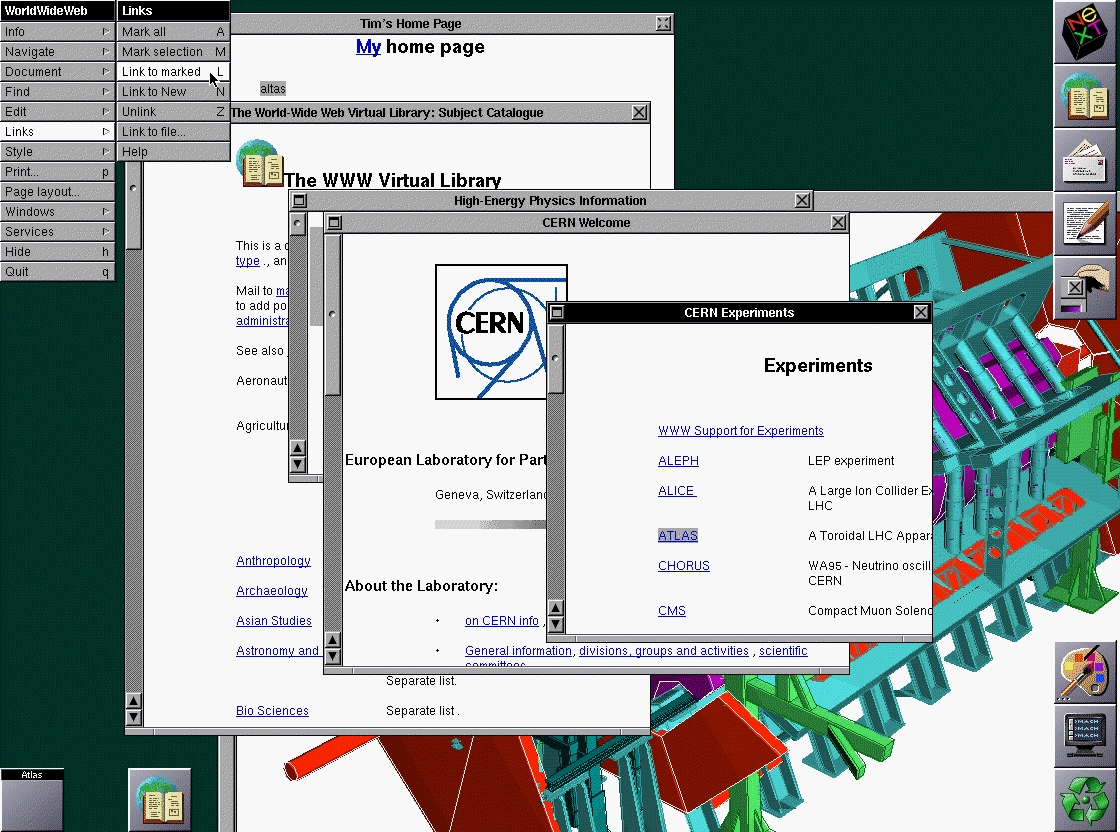
Of course, everyone should see the first web browser from 1990 (actually a screen shot from 1993, but much the same) running on a Next.
It might be hard to dig up screenshots all of desktops, but not much harder than the ones they found. It's nice to see someone including KDE in the line up so people can see a little of what they have been missing, like Virtual desktops, since the early 90's.
-
Re:No need for a Firefox extention
Correction: it seems privoxy development is alive and well
-
Re:Math
http://equ.sourceforge.net/, XMMS plugin equalizer, works with any format.
The wide selection of plugins is the reason I still use XMMS, it's the only player that plays every audio file I have. -
Re:Errr...
The only open-source tool I know of is called FindBugs developed by the University of Maryland and available at http://findbugs.sourceforge.net/.
However, it only performs static analysis on Java programs. -
Re:Cinema Craft Encoder
-
MediaCoder
-
Re:BSD's new signs of life
Besides, I'm hard pressed to think of GTK+ as dominant. You'll notice that KDE has begun its path into the Macintosh and Win32 markets, both places where Gnome doesn't tread.
Give me a break. Firstly, GTK+ is not the same thing as GNOME. Secondly, GTK+ is and has been available free for Win32 for years. I recently wrote a Python program that used GTK and Glade for a project I was working on. The program ran out of the box (with all the dependencies installed, of course) on Debian and Win32, and I chose this Python/Glade/GTK+ technology combination because I needed to get the entire program written in a weekend, I needed it to work on both Windows and Linux, and I knew that the technology was stable enough to Just Work (TM). It did.
-
Re:The Next Big Thing
You mean like DOSBox?
-
Re:Oh really?
The cost of your space has nothing to do with how you organize that space.
Yet it has everything to do with whether I delete things or not. Much space can be had for little money. Since email doesn't take up much space I lose nothing by keeping it around.Your eyes still need to look at the tail of that 5000-message-blob in your inbox, EVERY TIME YOU OPEN IT.
I don't need to look at it. I only look at the tail of it unless I need to find something that I've looked at before.Your brain has to subconciously categorize each of those messages.. EVERY TIME!
My brain? You claim to know a lot about me. If my brain is subconsciously categorizing my messages then I doubt it is doing it every time. Since 99% of my Inbox doesn't change most of the subconscious categorization is done and is already indexed. My brain only needs to diff the index against the new arrivals.No wonder some people I know never get anything done until I've reminded them 5 times. They've got finished projects, to-do items, calendar items, junk mail, forwarded crap, outdated crap, and who-knows-what in their inbox.
So these people either lack good tools, the knowledge to use the tools they have, or don't have a good methodology that works for them to manage information. Do you have a point?Do yourself, and the people you work with, a favor: keep your inbox reserved for new messages only.
If we're going to be giving orders, how about you not go around telling people how you think they should run their lives. You don't even know me. You have no idea of what tools I have for managing my personal information nor how efficient I am at finding information in it that I need. I think I'm quite capable of knowing how best to organize my information for my own retrieval. It's not my fault that your coworkers can't use basic email management tools and concepts.do you keep your bills in your mailbox after the postman has delivered them? No, you probably put them in a "bills to pay" pile.
I sometimes do let them sit in the mailbox. Where I live the mailman still delivers mail door to door. My mailbox is a slot on the side of my garage (many other people have a small box on the wall of the house next to the front door). Mail goes into the slot and falls down into a box mounted on the wall inside. I have been known to leave some mail in there from time to time until I want to get to it. Otherwise I would just have to bring it inside and sit it somewhere until that time I was ready to get to it. Sometimes I don't check my snail mail except once a week (Saturday or Sunday). You got a problem with that?
I'm surprised that you'd bring that up since in the rest of your email you seem to know me well enough that you'd lecture me on my email management methodology. -
Re:For the same reason language choice always matt
http://ficl.sourceforge.net/
If you liked neon you might like ficl; it has the same features you mentioned with choice of early and late binding.
Many forth object systems do.
I did a port of Ficl to MS Smartphone 2002/2003 but couldn't get permission to release it.
(By port I mean filling in some missing libc functions)
Sam -
Re:A good idea and a good implementation
Take for example, expose's ability to show you every window you have open at the same time. This is trivial to do. But it's such an amazingly useful thing and it's implemented elegantly.
Those of us who've been using 3DDesktop under *nix for the past four or five years would agree.
While I'm not a regular OS X user these days I really haven't seen a single thing in any release that was a completely original idea from Apple, except for the bits they took from their previous OSes (System7-9, especially). Implementing other people's idea in a visually appealing fashion has been Apple's only strength. Now if they could just make it *efficient* as well...
-
10.2 - 10.4 lost space
A free program called Space.app ran on 10.2. My addiction to multiple desktops runs deep. It worked flawlessly until I upgraded to 10.4.
-
Re:So what's the best real solution to the problem
This is not always true. Some two-factor systems are actually well thought out and resolve both of your problems. Check out http://sourceforge.net/projects/wikid-twofactor for an example. It uses Public Key Crypto to allow you to easily register your single "token" at any number of totally autonomous sites. Your private key is never shared with anyone and the websites you use it with have no idea where else you bank/shop/etc. It's real two-factor, so you not only need the pub/priv keys but you need to know the PIN that you setup for that site. This isn't stored locally so a stolen token gets the thief exactly nothing. This system also uses mutual authentication to ensure the site you're logging into is really the site you think it is. Use your phone, PDA, laptop, etc. to generate the (single use) passcode and that's a really tight system.
-
Re:So what's the best real solution to the problem
Or a free, opensource two-factor solution like http://sourceforge.net/projects/wikid-twofactor
-
Re:Nine attempts? Not with OTPs.
I gotta agree. There are real two-factor solutions that make this and other problems go away. Even open source solutions http://sourceforge.net/projects/wikid-twofactor/ that totally remove cost as an excuse for not being secure. Keylog a One-Time-Passcode (OTP) all you want, it's only good once. Add to that that you can generate the code on a separate device (like a phone or pda) for use logging in on your PC and that's pretty tight, even beats a race attack. Top that off with mutual authentication to prevent a man-in-the-middle or DNS attack. Why aren't companies doing this? Instead they roll out flawed systems like the HSBC junk or the pretty pictures tech that is becoming popular. This is a solved problem.
-
Re:How to trick key loggers
Keeping passwords in text files seems like a bad idea. If you want to keep passwords safe on a networked machine you should be using something like http://keepass.sourceforge.net/. Additionally if you are worried about key loggers never type in your password even after failed attempts, just copy and paste the letters of your password into the password field (getting the letters from a web page, or typing out the alphabet and numbers 0 to 9, etc...); this is the only way to be sure that your password will never show up on the keyboard logger.
-
Re:Don't worryHe also forgot these steps:
0: dban
1: autonuke -
A better solution?
Maybe the solution to untrainable filters, if there really is a way to do this, is to use other means. If you're concerned about all this check out the ASSP project at http://assp.sourceforge.net/ or http://www.magicvillage.de/~Fritz_Borgstedt/assp/ for the absolute latest stuff, and don't worry so much about the Bayes part of things. It uses bayesian filtering also, but it incorporates a wide array of other methods to block spam which happen before it even gets to the bayesian filters.
-
Independent Nvidia open driver effort - Nouveau
This seems like a good on-topic thread in which to mention the freedesktop.org (X.org folks) effort to write a 100% open source 3D driver for the NVidia cards -- nouveau
http://nouveau.freedesktop.org/wiki/
If you're an owner of an nVidia card, please do all you can to help contribute! They appear to be suprisingly far along.
--
Slashcode bug # 497457 - unfixed since December 2001 - Go look it up! -
Re:Wow.
-
Re:How to be smarter
I use assp as my spam filter: http://assp.sourceforge.net/ It always filtered spam very well for me but the latest version added an interesting technique that has reduced the amount of spam that's even hitting the filters to near zero. Since SMTP is considered "unreliable" a sending server will retry on failure. Apparently, spammers tend not to bother retrying. ASSP builds tables using an identity triplet (I can't remember the three message/source attributes it uses). On first view of a given triplet, ASSP responds with a SMTP error suggesting the source retry later. ASSP tables the triplet and allows that traffic to pass later on a retry. The triplet expires after some period. I'm not aware of any false rejections and the messages hitting the dump mailbox has dropped from around 10 a day to a couple a week. I suppose one might argue that it increases packet traffic and I assume spammers will workaround it but I suspect the extra packet traffic is far exceeded by the spam that I would otherwise handle and it handles the spammers for now. Sentience unnecessary perhaps.
-
Challenge Response systems...
Yeah, they're annoying, and doubly annoying for anyone joe jobbed, and poorly setup C/R systems annoying mailing lists, but there's one thing that can't be beat about them: You can guarantee a human at the other end (assuming it takes more than a just pressing reply) and you can track spammers down that bother to put the effort in. Oh, and you don't need to "upgrade" SMTP or get someone to adjust your DNS server (Here's looking at you, SPF!) to get them to work.
The net cost of getting humans to reply to C/R mails means spam becomes expensive.
Yes, it sucks, and yes, there's the people out there that refuse to work with C/R systems. But I don't care. I don't need to talk to everyone on the internet, and the 1% - 2% that won't deal with C/R can FOAD for all I care.
The issues of C/R systems having infinite loops, etc, have been worked out over the years. That doesn't happen anymore with the latest versions. I would reccomend looking at either TMDA for a server side solution, or ASK for a client side solution.
(Of course, there's specific instances where C/R systems are simply too annoying, like trying to get sales leads, etc, but for the average person, that's not an issue.)
The best design would be a SPAM filter with a C/R system for mail that isn't marked SPAM. Joe jobs become much less of an issue, and you still don't get any SPAM. -
Re:Delphi compile speed
the Delphi grammer is supposedly proprietary and a trade secret, and that no one else can build a parser that handles all of the corner cases
Of course it's possible to build a parser which handles all corner cases, be it not in one shot since there is indeed no design document to base yourself on. But by now at least we (the Free Pascal Compiler) do support most of it.
I am kinda switching over to Java Swing for the GUI, C++ through the JNI for the hardcore numeric stuff -- a person sees the handwriting on the wall about Borland longevity. I kinda want to get off Windows by the time Vista, Aero, and whatever Windows-specific GUI gobbeldygook takes hold, and Java looks attractive to me. It is easy to get spoiled by GC and some other Java hacks, but I miss the fast compiles -- javac is dog slow.
You might want to have a look at Lazarus. Although the underlying Free Pascal Compiler is not as fast as Delphi, it's a lot faster than most other compilers (and javac). Have a look here for a small unscientific test. Can't compare to Delphi, because the compiler itself is not written in a Delphi-compilable way.
For Java, try using IBM's jikes compiler instead (not to be confused with the JikesRVM -- jikes is simply a Java compiler, not a whole virtual machine).
Eclipse, on the other hand, is still something I am struggling with -- it is IBMish in its weirdness about a whole bunch of stuff -- how do you just take a bunch of
Java does specify the dependencies in the source as part of the language. You have to "import" all packages you need, much like a uses clause (and it allows for both more fine-grained and coarse-grained control regarding what you want to import).
The only difference is indeed, as you mentioned, that packages should recide in a directory called the same (or in a jar file). This organisation however avoids problems you can have in Pascal if you e.g. have multiple units with the same name in different directories. It does not necessitate the use of "makefiles of some kind of external metadata" in any way though (unless you consider directories falling under that).
If there are two features, no, make that three features! that make Delphi problematic for the future, they are 1) Delphi has some real solid Windows lock-in, especially since Kylix didn't go anywhere -- the Delphi extension to Pascal are quite Windows-specific even if you are not doing GUI programming,
Most Delphi extensions can be perfectly ported to other platforms. FPC runs on Dos, Windows, Linux, Mac OS X, FreeBSD, Solaris, Gameboy Advance,
2) while Delphi is great and everything, it is behind the times with collection classes and other library richness of everything from Java to Python -- what collection classes are there are also tied into the VCL and bloat non-GUI or GUI-non-VCL programs,
I do agree with you here (in spite of the fact that there are some third party container collections for Delphi).
-
Re:Could you get around this...
>I hope this is something which makes the closed source WLAN (it's working, it's ok) fans
>a bit quieter.
Wlan? Think NVIDIA + http://eckbox.sourceforge.net/