Slashdot Mirror
Domain: sourceforge.net
Stories and comments across the archive that link to sourceforge.net.
Stories · 1,414
-
Generic GUI Wrapper For Python
An Anonymous Coward writes "IBM is working on a generic GUI wrapper to allow Python developers to write cross-platform GUIs. The anygui project will expose a common set of functions to the programmer and choose which backend gui toolkit to use for the given platform: TK, WIN32, GTK, Bethon, etc. Currently the software is in an alpha stage. The article also has some example code." Update: 10/27 23:53 GMT by T : Magnus Lie Hetland wrote to point out that though this article is hosted at IBM, "Anygui has nothing to do with IBM. It is, in fact, an independent Open Source project currently hosted at SourceForge." -
Mesa 4.0 Implements OpenGL 1.3 Spec
Jacek Fedorynski writes: "Version 4.0 of the Mesa 3D Graphics Library has been released. The first thing in the changelog says "Mesa 4.0 implements the OpenGL 1.3 specification"." That was quick. Perhaps the next revision of the OpenGL specification will say "Now fully compliant with the Mesa 3D vision." -
Can BeOs Live On As Open Source?
OSBlue writes: "After Palm announced the buyout of Be, Inc.'s intellectual property & Technology and after some consequent indications from several key people that Palm has no interest at Be's products and especially in BeOS, a number of the BeOS believers tried to find a new home. Some found comfort in AtheOS, others joined BeUnited's effort to license the BeOS source code, while some developers formed efforts like BlueOS and OpenBeOS. OpenBeOS consists from a number of BeOS developers who are trying to recreate the BeOS Kits in a form of a new, complete and open source Operating System that has source and if possible binary compatibility with BeOS 5. One of the most important people in this effort, Michael Phipps, is interviewed by OSNews. -
Professional Audio on Linux?
twilightzero asks: "Recently a friend of mine who is chief engineer at a medium size recording studio/radio station has become increasingly unhappy with Windows (and would like to stay away from Macs) and has asked me if there is any sort of professional audio solution for Linux. Has anybody, anywhere ever tried this? Is it possible to buy a pro audio card with Linux drivers and just run Sound Forge in WINE or do you need an entirely native package?" This is one of those questions that just needs to be answered. What Open Source sound packages out there are good enough for even the professionals to use when they need to make their squeaks, squeals, and whistles. Also, what can they use to put their created sounds together into some semblance of music? As an addendum, coasterfreak asks: "Being an avid Linux user and composer is a bit of a problem right now. I've never run across any decent music creation programs for Linux. I've used Finale and Cakewalk before, but have yet to see them for Linux. I've heard rumors of something coming from the Debain crew, but nothing more than rumors." Can anyone confirm or deny them?Just as a bit of a helpful hint, how many of you have tried Audacity yet? It looks to be a fairly feature rich sound editor, and it supports mixing tracks, plugin sound effects, and is cross platform, to boot! Maybe this is a decent spring board for those of you looking to start experimenting with sound under Linux, but I'm not quite sure it's ready for professionals yet...this based on the version number of 0.97 rather than any actual experience, so I'd take the word of those who have said they have used it rather than mine. It would be great if Audacity is further along than it looks.
-
Preemptible Linux Kernel: Interviews and Info
An anonymous submitter sends: "MontaVista and Robert Love are developing a patch for the Linux kernel to make it fully preemptible. Lots of users are involved, and tests show huge reductions in latency. Robert's kernel patches are here. Finally, an interview with Robert, on preemption and more." -
GNU-Darwin Packages For Mac OS X.1, Darwin-1.4.1
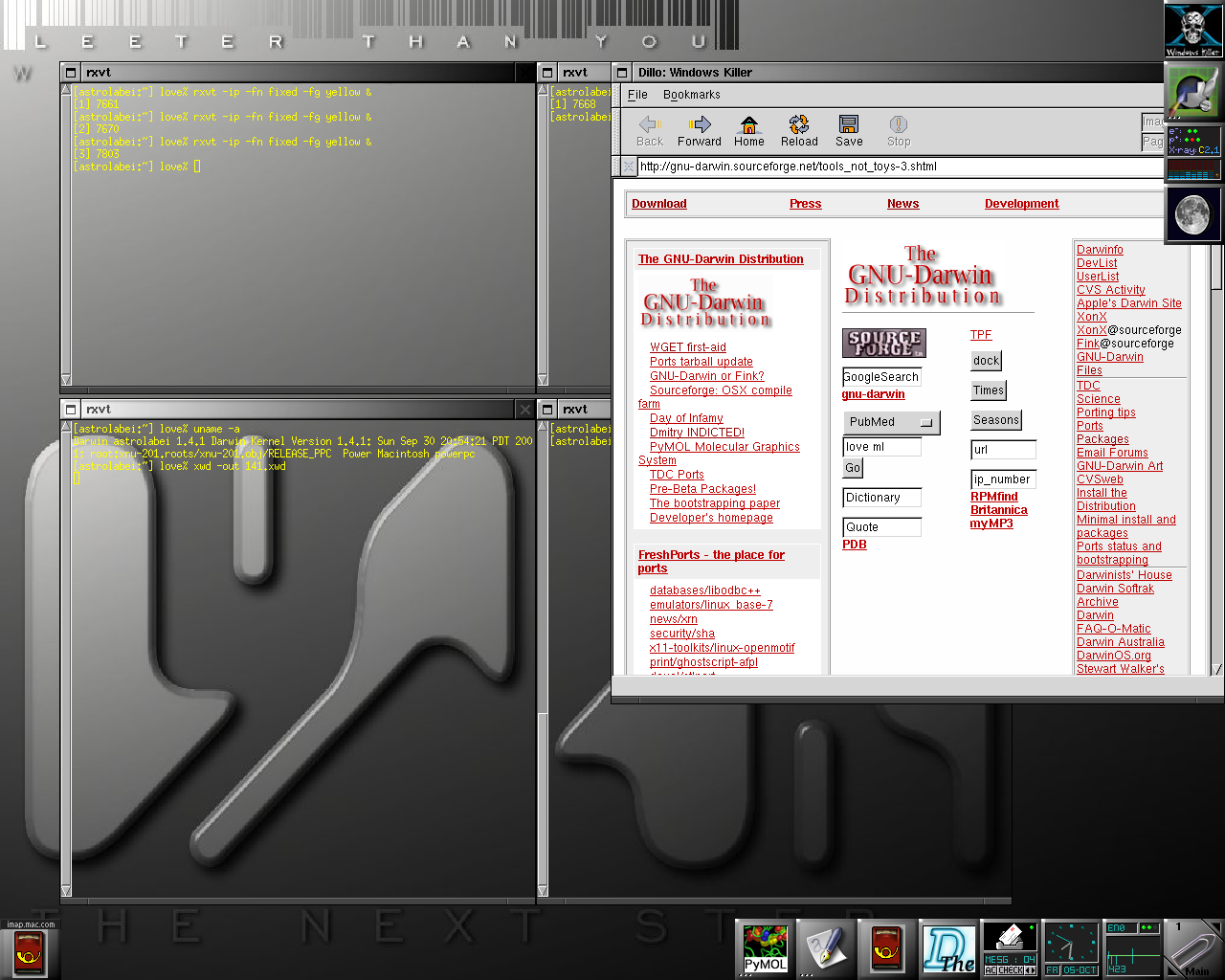
proclus writes: "The GNU-Darwin packages are compatible with Apple's newly released Darwin-1.4.1, and we now have Net Installation instructions for Darwin-only users. Our Bootable Installer CD is now in beta, thanks to the efforts of GNU-Darwin developer rrp. As you can see in the screenshot, our packages work fine with the XFree86 software which is now a part of Apple's Darwin distribution. We have recently packaged the latest versions of Mac OS X.1 compatible OpenSSH and XFree86. (Our older OpenSSH and XFree86 packages appear to be broken.) It is important for OS X.1 users to upgrade their OpenSSH. This is a great time to check out our other packaged offerings, which are also Darwin-1.4.1 and Mac OS X.1 compatible. OSX.1 users who are new to GNU-Darwin might like to try our new Net Installer. Just follow the OS X-specific directions at the top of the script. " -
GNU-Darwin Packages For Mac OS X.1, Darwin-1.4.1
proclus writes: "The GNU-Darwin packages are compatible with Apple's newly released Darwin-1.4.1, and we now have Net Installation instructions for Darwin-only users. Our Bootable Installer CD is now in beta, thanks to the efforts of GNU-Darwin developer rrp. As you can see in the screenshot, our packages work fine with the XFree86 software which is now a part of Apple's Darwin distribution. We have recently packaged the latest versions of Mac OS X.1 compatible OpenSSH and XFree86. (Our older OpenSSH and XFree86 packages appear to be broken.) It is important for OS X.1 users to upgrade their OpenSSH. This is a great time to check out our other packaged offerings, which are also Darwin-1.4.1 and Mac OS X.1 compatible. OSX.1 users who are new to GNU-Darwin might like to try our new Net Installer. Just follow the OS X-specific directions at the top of the script. " -
GNU-Darwin Packages For Mac OS X.1, Darwin-1.4.1
proclus writes: "The GNU-Darwin packages are compatible with Apple's newly released Darwin-1.4.1, and we now have Net Installation instructions for Darwin-only users. Our Bootable Installer CD is now in beta, thanks to the efforts of GNU-Darwin developer rrp. As you can see in the screenshot, our packages work fine with the XFree86 software which is now a part of Apple's Darwin distribution. We have recently packaged the latest versions of Mac OS X.1 compatible OpenSSH and XFree86. (Our older OpenSSH and XFree86 packages appear to be broken.) It is important for OS X.1 users to upgrade their OpenSSH. This is a great time to check out our other packaged offerings, which are also Darwin-1.4.1 and Mac OS X.1 compatible. OSX.1 users who are new to GNU-Darwin might like to try our new Net Installer. Just follow the OS X-specific directions at the top of the script. " -
GNU-Darwin Packages For Mac OS X.1, Darwin-1.4.1
proclus writes: "The GNU-Darwin packages are compatible with Apple's newly released Darwin-1.4.1, and we now have Net Installation instructions for Darwin-only users. Our Bootable Installer CD is now in beta, thanks to the efforts of GNU-Darwin developer rrp. As you can see in the screenshot, our packages work fine with the XFree86 software which is now a part of Apple's Darwin distribution. We have recently packaged the latest versions of Mac OS X.1 compatible OpenSSH and XFree86. (Our older OpenSSH and XFree86 packages appear to be broken.) It is important for OS X.1 users to upgrade their OpenSSH. This is a great time to check out our other packaged offerings, which are also Darwin-1.4.1 and Mac OS X.1 compatible. OSX.1 users who are new to GNU-Darwin might like to try our new Net Installer. Just follow the OS X-specific directions at the top of the script. " -
GNU-Darwin Packages For Mac OS X.1, Darwin-1.4.1
proclus writes: "The GNU-Darwin packages are compatible with Apple's newly released Darwin-1.4.1, and we now have Net Installation instructions for Darwin-only users. Our Bootable Installer CD is now in beta, thanks to the efforts of GNU-Darwin developer rrp. As you can see in the screenshot, our packages work fine with the XFree86 software which is now a part of Apple's Darwin distribution. We have recently packaged the latest versions of Mac OS X.1 compatible OpenSSH and XFree86. (Our older OpenSSH and XFree86 packages appear to be broken.) It is important for OS X.1 users to upgrade their OpenSSH. This is a great time to check out our other packaged offerings, which are also Darwin-1.4.1 and Mac OS X.1 compatible. OSX.1 users who are new to GNU-Darwin might like to try our new Net Installer. Just follow the OS X-specific directions at the top of the script. " -
GNU-Darwin Packages For Mac OS X.1, Darwin-1.4.1
proclus writes: "The GNU-Darwin packages are compatible with Apple's newly released Darwin-1.4.1, and we now have Net Installation instructions for Darwin-only users. Our Bootable Installer CD is now in beta, thanks to the efforts of GNU-Darwin developer rrp. As you can see in the screenshot, our packages work fine with the XFree86 software which is now a part of Apple's Darwin distribution. We have recently packaged the latest versions of Mac OS X.1 compatible OpenSSH and XFree86. (Our older OpenSSH and XFree86 packages appear to be broken.) It is important for OS X.1 users to upgrade their OpenSSH. This is a great time to check out our other packaged offerings, which are also Darwin-1.4.1 and Mac OS X.1 compatible. OSX.1 users who are new to GNU-Darwin might like to try our new Net Installer. Just follow the OS X-specific directions at the top of the script. " -
GNU-Darwin Packages For Mac OS X.1, Darwin-1.4.1
proclus writes: "The GNU-Darwin packages are compatible with Apple's newly released Darwin-1.4.1, and we now have Net Installation instructions for Darwin-only users. Our Bootable Installer CD is now in beta, thanks to the efforts of GNU-Darwin developer rrp. As you can see in the screenshot, our packages work fine with the XFree86 software which is now a part of Apple's Darwin distribution. We have recently packaged the latest versions of Mac OS X.1 compatible OpenSSH and XFree86. (Our older OpenSSH and XFree86 packages appear to be broken.) It is important for OS X.1 users to upgrade their OpenSSH. This is a great time to check out our other packaged offerings, which are also Darwin-1.4.1 and Mac OS X.1 compatible. OSX.1 users who are new to GNU-Darwin might like to try our new Net Installer. Just follow the OS X-specific directions at the top of the script. " -
GNU-Darwin Packages For Mac OS X.1, Darwin-1.4.1
proclus writes: "The GNU-Darwin packages are compatible with Apple's newly released Darwin-1.4.1, and we now have Net Installation instructions for Darwin-only users. Our Bootable Installer CD is now in beta, thanks to the efforts of GNU-Darwin developer rrp. As you can see in the screenshot, our packages work fine with the XFree86 software which is now a part of Apple's Darwin distribution. We have recently packaged the latest versions of Mac OS X.1 compatible OpenSSH and XFree86. (Our older OpenSSH and XFree86 packages appear to be broken.) It is important for OS X.1 users to upgrade their OpenSSH. This is a great time to check out our other packaged offerings, which are also Darwin-1.4.1 and Mac OS X.1 compatible. OSX.1 users who are new to GNU-Darwin might like to try our new Net Installer. Just follow the OS X-specific directions at the top of the script. " -
KDE 3.0 Alpha1 Available for Developers
Dre writes: "Just a few weeks after the release of the rock-solid KDE 2.2.1, the KDE Project today announced the release of KDE 3.0 Alpha1. Targeted at developers who want to get a head start on porting or writing applications to KDE 3, the release is pretty much a straight port of the KDE 2.2 branch to Qt 3. However, for developers this brings an impressive array of new features to KDE, including new database classes, new data-aware widgets, improved RAD development with a much-enhanced Qt Designer, a new powerful regular expression class (with full Unicode support), improved internationalization support (including the ability to mix different character sets in the same text), bi-directional language support (for languages such as Arabic and Hebrew), multi-monitor (Xinerama and multi-screen) support, better integration of pure Qt applications into KDE, and hardware-accelerated alpha blending. With the Qt port out of the way, the KDE developers can now focus on the planned KDE improvements. Read the full announcement here, or go straight to the source (alternative link)." -
Ask A Tech-Savvy Lobbyist About The Politics Of Computing
Morgan Reed is a lobbyist in Washington, D.C. with the law firm of Venable, Baetjer, Howard & Civiletti. He has represented a wide range of clients, from the International Pizza Hut Franchise Holders Association (really) to the Telecommunications Industry Association and the National Association of Software and Service Companies (NASSCOM). That means he's paid to personally persuade (not to mention cajole and badger) lawmakers with real shoe-leather tactics, on issues that few lawmakers have the time to personally spend years learning about. He's also a Slashdot reader and Linux hacker, with work on the Linux Router Project (LEAF/ LRP). Morgan has volunteered to expand your knowledge about the intersection of technology and politics. Ask Morgan (one question per post, please) about how clueful politicians are when it comes to technology, what tactics are likely to impress your representatives to make intelligent tech-related decisions, and what you can do to steer the course of legislation which could affect your freedoms. We'll pass your questions on to Morgan, who will get back with answers shortly. -
Darwin Team Answers & Develop on Darwin
Lagos writes "In July Darwin developers at Apple had a call for questions. Their answers were posted on Monday and may be found here. There is some discussion of Apple's place within the Open Source community, though most of the questions answered are more technical." Along the same Darwinian lines, this submission came in: Maktoo writes "Maccentral is reporting that SourceForge.net has added PowerMac G4 Servers running MacOS X 10.1 into their Compile Farm. Now any apps you have going on SourceForge, you can test to see if it'll run on OS X! Gotta love that BSD heritage... OS X is already going to benefit greatly from all the apps it can use in the UNIX/Linux space. This just makes life easier for developers to bring even more." -
Darwin Team Answers & Develop on Darwin
Lagos writes "In July Darwin developers at Apple had a call for questions. Their answers were posted on Monday and may be found here. There is some discussion of Apple's place within the Open Source community, though most of the questions answered are more technical." Along the same Darwinian lines, this submission came in: Maktoo writes "Maccentral is reporting that SourceForge.net has added PowerMac G4 Servers running MacOS X 10.1 into their Compile Farm. Now any apps you have going on SourceForge, you can test to see if it'll run on OS X! Gotta love that BSD heritage... OS X is already going to benefit greatly from all the apps it can use in the UNIX/Linux space. This just makes life easier for developers to bring even more." -
FreeBSD Ports for GNU/Linux
proclus writes: "GNU-Darwin has provided a special FreeBSD ports tarball (20 Mb) for GNU/Linux users. We have modified the FreeBSD Ports System to bring thousands of free software offerings within the reach of every GNU/Linux user. The system is not fully automated yet, but you can untar it in your home directory and try it. Just follow these directions. This system provides full access to the FreeBSD ports, so that users can compile and install software in their home directories. Root access is not required." -
FreeBSD Ports for GNU/Linux
proclus writes: "GNU-Darwin has provided a special FreeBSD ports tarball (20 Mb) for GNU/Linux users. We have modified the FreeBSD Ports System to bring thousands of free software offerings within the reach of every GNU/Linux user. The system is not fully automated yet, but you can untar it in your home directory and try it. Just follow these directions. This system provides full access to the FreeBSD ports, so that users can compile and install software in their home directories. Root access is not required." -
FreeBSD Ports for GNU/Linux
proclus writes: "GNU-Darwin has provided a special FreeBSD ports tarball (20 Mb) for GNU/Linux users. We have modified the FreeBSD Ports System to bring thousands of free software offerings within the reach of every GNU/Linux user. The system is not fully automated yet, but you can untar it in your home directory and try it. Just follow these directions. This system provides full access to the FreeBSD ports, so that users can compile and install software in their home directories. Root access is not required." -
File Sharing: Decentralizing, Open-Source Fasttrack
Eloquence writes: "I've written a comparison of current file sharing software; what's interesting is that the original centralized indexing concepts are losing ground because of filters, and most relevant file sharing systems by now use at least a server-network, or a completely decentralized architecture. Unfortunately, most networks are proprietary, but at least there is now an open-source client to access the most popular network, Fasttrack's Kazaa/Morpheus, which was originally only accessible under Windows (around 500,000 users online at any time)." -
Managing Open Source Projects
Stephanie Black contributes this review of a book which might be nice to have around if someone suggests that Open Source is "not for business use." Managing Open Source Projects is one of a class of books that will probably expand hugely in the next few years. Managing Open Source Projects author Jan Sandred pages 189 publisher John Wiley & Sons rating 9 reviewer Stephanie Black ISBN 0-471-40396-2 summary A HOWTO on putting the principles and advantages of Open Source programming to work.
First Impressions There is a word for this book: SWEEEET!It's short, too, but before you grumble about paying nearly 30 bucks for something that's less than 200 pages, you might want to look at the concept of quality. It's worth every blessed dime, plus taxes (if applicable).
Managing Open Source Projects opens with a history of the movement, thus providing background information and context to prospective or actual managers of Open Source projects. In this sense alone, Sandred has set himself apart from numerous other authors on the subject, providing an overview of a movement which has been over 30 years in the making, and whose restructuring of the "old-economy" is just beginning.
The development of the browser wars is dealt with in this history, a subject not everyone is familiar with. What it amounts to is a lesson in 'instant karma' that Netscape Inc. learned after doing a lot of damage to the Mosaic browser, ("mozilla" comes from "Mosaic killer"), and subsequently having the same done unto them by the Redmond Contingent(TM). Sandred sort of implies that this lesson had more than a cursory role in the 1998 opening of the Mozilla source code, which staggered the industry all round. Obviously, Netscape learned several somethings from the experience.
The author moves on to discuss the relevance of open source to business. (You knew *that* was coming, didn't you?). Sandred raises the common assumption of business known as Brooks' Law ('the performance of programming teams does not scale so as to increase the productivity of the team'), and then uses the history of Linux development to illustrate the inadequacy of this model in describing the open source development process. In sum, Sandred asserts that the differentiating factor is what he calls the "political attitude" of the open source model, which breeds a different leadership style. The "administrative overhead" required by each member of a development team may increase with each new developer, but without the geographic restrictions posed by a code farm, there is a wider base of "administrators" to choose from. (Now you know what to tell your boss.).
Chapters 8-10 cover a variety of tools useful (and commonly used) in building open source works, and methodologies used to set up the project (including the team). You've heard of Sourceforge, right? CVS? Or maybe "The Slashdot Effect"?
Highlights There are some portions of Managing Open Source Projects that are guaranteed "feel good" items which remind any open source developer of why we do what we do.In his discussion of open source philosophy, Sandred points out that the viability of the open source model is not restricted to software:
"With computers, perfect copies of a digital work can easily be made, modified, and distributed by others, with no loss to the original work. Individuals interact and share informa- tion,and then react and build upon it; this is not only natural, it is also the only way for individuals to succeed in a commu- nity. In essence, the idea of open source is basic to the natural propagation of digital information among humans in a society. This is why the traditional notion of copyright does not really make sense on the Internet." (p. 52)
He points out that the United Nations has adopted an open source approach to distributed assets, including (especially) information. The link between democracy and freedom of information is clear, and iterated not only by Sandred, but by UN Secretary-General Kofi Annan, and Dr. Gro Harlem Brundtland, Secretary-General of the World Health Organization.
It's not "just" a software development model anymore.
Imperfections There are some small issues this writer has to take with Mr. Sandred's pronouncements, among them the following:"All software cannot be developed open source. Open source software tends to concentrate on infrastructural design and back-end software. Open source benefits from incremental de- sign, which means back-end systems. End-user applications are hard to write. These applications deal with graphical user interfaces, which are very complex to write, almost always customized, and comprise other skills like graphical inter- face design." (p.160)
This writer would, upon reflection, argue with pretty much everything in this paragraph, save for the self-evident last statement. Both the GNOME and KDE projects are about providing desktop applications, and the managers to go with them. Most window managers provide applications to go with their "suites". There are productivity software suites in progress.Ah, well, it's one bad moment of two in the entire book.
Mr. Sandred makes an unwitting gaffe in his discussion of "Five Open Source Commandments" in Chapter 12: the last of these reads 'Join a project rather than starting your own.' While joining another project is helpful, even useful, it does not replace the "developer's personal itch" that Sandred quotes from Eric Raymond's 19 lessons (Cathedral and the Bazaar, O'Reilly, 1999), in Chapter 2. Do both!
Conclusion Don't just sit there -- go get the book, even if you're not currently involved in, or planning on, managing an open source project. The information is timely, the pace is lively, and Sandred has provided a wealth of insight into the open source movement's past, present and future. While some of his work has perceptual errors, these are few. The rest of it is pure gold.
You can purchase this book at Fatbrain. -
Filesystems, Metadata and Future OS Integration?
wdebruij asks: "After reading the 'The Mac, Metadata, and the World' article posted a few days earlier I was wondering what metadata progress is made outside of the Mac platform. I'm currently programming a set-based metadata system working on top of the standard file-system (called AtomsNet) and would like to know how the Slashdot community sees the future of metadata support in operating systems. The Resource Description Format and MPEG7 look like promising initiatives, but I do not know of any real life implementations so far." -
Fast, Open Alternative to Java
DrInequality writes: "For those of you out there who admire the portability of Java but want something faster or open source, the answer to your prayers is finally here. The Internet Virtual Machine is open source, fast and supports C, C++, Java and ObjectiveC. There are some cool demos for Linux (requires Redhat 6.0 or above, and OpenGL 1.2 or Mesa 3.41) here (1.5MB) and for Windows (requires glut32.dll, here) here (1.5MB)." We mentioned this last year; perhaps it has improved. I'm sure a lot of people would be interested in a language as portable as Java but speedier. -
Fast, Open Alternative to Java
DrInequality writes: "For those of you out there who admire the portability of Java but want something faster or open source, the answer to your prayers is finally here. The Internet Virtual Machine is open source, fast and supports C, C++, Java and ObjectiveC. There are some cool demos for Linux (requires Redhat 6.0 or above, and OpenGL 1.2 or Mesa 3.41) here (1.5MB) and for Windows (requires glut32.dll, here) here (1.5MB)." We mentioned this last year; perhaps it has improved. I'm sure a lot of people would be interested in a language as portable as Java but speedier. -
Programming Linux Games
Long-suffering Slashdot reader WrinkledShirt contributes this review of John Hall's Programming Linux Games, and lays out the good and the bad in a book that's one of the few of its kind. More games are always good -- hopefully books like this one will spark some inspiration. Programming Linux Games author John Hall pages 415 publisher No Starch Press rating 7.5 reviewer WrinkledShirt ISBN 1-886411-49-2 summary Well-written guide to a wide range of game-writing tools for Linux, but not a definitive reference work for any single task.
IntroductionThe potential for linux gaming has really exploded in the last couple of years. In many cases, the potential has been realized -- Unreal Tournament, SimCity 3000, Tribes 2, Quake 3, Alpha Centauri, and many other successful Windows titles, have all been brought to Linux, with Loki leading the charge. Judging by the bottom line, there's a definite shortage of true cash-cow success stories in this enigmatic part of the industry, and hence, a shortage of good reference material for naive people hoping to produce that next cash cow.
However, we've reached such a point of critical mass of knowledge and technology that books had to start appearing sometime. So, despite the fact that there's no overwhelming market demand for Linux games and a high ratio of hobbyists to dedicated game developers for the OS, here we have a book aiming at taking amateur Linux game development to the next level.
However, much of the technology out there for game programming in Linux is still heavily in development, with many of the APIs and libraries still a long way away from a 1.0 release. Allegro and Clanlib are a couple of exceptions to this trend -- both are popular APIs that sadly don't get much more than a passing mention in the book. Their sexier counterpart, Sam Lantinga's SDL, gets a fair amount of treatment (no surprise there, considering John Hall was the lead author for a team based within Loki) -- but even this fairly feature-complete library, which Loki uses to port its games over from Windows, isn't explored in its entirety.
Instead, there are also crash courses in BSD sockets, package management, TCL, the framebuffer and various sound APIs, and what we end up with here is the consummate cookbook, a jack-of-all-trades-and-master-of-none tome that introduces us to a wide variety of Linux gaming topics while stopping short of being a definitive reference for any of them. Such is John Hall's work, an interesting, wide-ranging introduction to game programming for an operating system that few believed was capable of it not too long ago.
John Hall, an experienced game developer, participated in Loki's Civilization, Call to Power game hack, and is currently working for Treyarch developing that company's Spider-Man title for the PS2.
The GoodAs far as cookbooks go, this is a good one, and there isn't much concerning Linux game API programming that isn't touched on. There's an ongoing case study (Penguin Warrior) that is developed over the course of the book. Each chapter introduces a fairly deep concept, gives a decent function reference related to the concept, then incorporates the knowledge into proof-of-concept code, and then uses the new-found knowledge to enrich the case study. The tone is straightforward and the execution is solid. The final game works well enough to give confidence that the reader could take the knowledge in this book and apply it to his or her own project, either to add new features or re-think old ones.
The book is also well-written -- the sample code is extremely well-commented and good error-handling is in place. He makes no assumptions about the knowledge of the reader, dealing with such introductory topics in Linux programming as vi vs Emacs, the FSH and make, although he never gets annoying or patronizing. *cough cough* LaMothe *cough*
Individual chapters stand out as being great introductory resources for material that doesn't have much in the way of documentation. The important aspects of SDL get good treatment in one complete and comprehensive unit. There's also a thorough chapter on audio programming, comparing and contrasting OpenAL, OSS, ALSA, Ogg Vorbis, and ESD (among others), and all this after showing off SDL's sound capabilities one chapter earlier. Many of the pitfalls associated with each of the different technologies, as well as the pitfalls of sound programming in general, are covered here. It's a great jumping-off point for those who don't know much about the audio end of things.
There's even a really neat chapter on incorporating TCL script interpretation within a program written in C. For anyone who's had trouble throwing together their own text parser for initialization scripts, or who's fed up with the constant recompiles needed when tweaking for the most arbitrary of changes of the game's AI, the information in this chapter is a godsend. In the Penguin Warrior case study, it's almost spooky how effective TCL turns out to be in making the computer ship chase and evade the human player.
Finally, I want to reiterate the effective use of the case study, Penguin Warrior. Having seen the way other game programming texts handle using samples to illustrate game programming concepts -- which is often a mish-mash, to say the least -- the way this book approached the issue is refreshing: there's one major project, and each chapter brings us closer to that project's completion. The code works as intended and goes a long way to convince the reader that the libraries and techniques explored in this book are near-commercial-level quality. (Networked games turned out to be choppy on my machine, but that was the only real black mark I could find in the program's execution.) If nothing else, John Hall deserves a good deal of thanks for proving that game development on Linux is a realistic and rewarding endeavor.
The Not So GoodAt times, the generalist nature of the book left me wondering if Hall couldn't have gone just a little bit further in some of the topics. There's a decent enough synopsis about deployment using Loki's install tool, as well as packaging in general, although nothing related to the Penguin Warrior game itself, so we don't get to see the theory in practice as much as it could have been. Also, he teases us by early on by starting with the compiler, moving to the make utility, talking a bit about package management, and then mentions automake, but he stops short of really explaining how to bring that into an existing project. Considering all the fun little dependencies needed for multimedia programming in Linux, this would have been a valuable bit of information for anyone not used to deploying on the platform.
Another instance of this so-close-yet-so-far approach occurs when he talks about incorporating Mesa into an SDL program. He tantalizes us with a code sample illustrating how to use the SDL as a replacement for glut, but that's all -- the material doesn't really get deep enough to convince readers that a 3D neophyte really can abandon glut for the SDL, particularly when many OpenGL reference materials out there rely heavily on glut as a teaching aid for windowing and other utility functions. Loki primarily used SDL to handle its 3D utility programming, so at least we know it's possible, but given the exploding popularity of 3D games it's too bad this wasn't covered more.
It's sometimes hard to tell exactly who the book is intended for. The introductory chapters include discussions on topics such as the different gaming genres out there, despite the fact that game programming hopefuls who don't know that Quake is a first-person shooter must make up a really narrow audience. Also, it's almost enough to give one whiplash to see how quickly he dives into using ioctl() when only a couple of chapters earlier he was explaining the basics of using gcc. Next up soon after that? Strap yourself in, we'll be writing straight to /dev/fb0! It's almost comical to think about how much dangerous knowledge a newbie's been given over the course of the book. Still, like I said earlier, he never talks down to the reader, who because of this might feel compelled against better judgement to be whisked along into subject matter that really needs other support material to be of any real use.
Hall's a humble enough guy, which is great insofar as writing style is concerned, but in one of the last chapters, he starts questioning some of the choices he made while coding Penguin Warrior throughout the book. Specifically, he says he probably should have used C++ instead of C, Scheme instead of TCL, and UDP instead of TCP for the networking, and this is cold comfort for people who would have hoped that the author would have picked the best plan of attack from the beginning. That said, C, TCL, and TCP are appropriate choices due to the simplicity of execution and the fact that they introduce useful techniques from a design point of view. Still, there's no point giving readers a sense of wistful "What if?" if you don't have to. It also highlights that this book is more a beginner's API reference than a game programming book per se.
To take that point further, there also really isn't much in the way of abstract game programming theory. This book could have really distinguished itself as special if some content related strictly to game development was here. There's a mention of Gamasutra here, a method of quick division there, the equation of a distance from a point to a line thrown into the mix, and that's pretty much all there is. Topics not really covered include optimization, pathfinding, and cracker-proofing your code, and what is talked about on the subjects of artificial intelligence design, collision detection, and physics is all rudimentary ... For coverage on these sorts of topics, you'll have to look elsewhere.
Finally, and this is really not the fault of the author or the book, but one wonders if the time was right for much of this material -- or, at the very least, its highly generalist approach. DRI is making its presence felt, the various audio APIs out there are improving all the time, and the LSB is coming along nicely, but until there's a proven and stable multimedia base to work from, no definitive guide can be written, and this sort of organized dogpile is really the best we can hope for with so much stuff to cover. The SDL is a top-notch library for graphics programming, and it's likely an entire book could have been spent strictly on graphics programming using it, and the depth that such a book could have attained far surpasses what we're given here. Plus, in a year from now, who knows where any of these sound APIs will be? Of course, these might prove to be just esoteric issues in the grand scheme of this book.
ConclusionDespite the criticisms I have of this book, I really don't want the message that is conveyed here to be anything but positive. There's a lot working for this book -- the chapters on SDL, sound programming and incorporating TCL and C are excellent, and will be especially helpful for people who are novices in these areas. Considering the alternatives (hitting dryly-written online docs or constantly shaking your Google to see what falls out), this book is a very attractive option. Programming a fully-functional multiplayer game would probably require more effort than might be suggested by the brevity of the chapter on socket programming, but that chapter is a solid introduction as well. The book as a whole is well-written and succeeds for the most part in its endeavor to make the best of a chaotic situation. I'd recommend this book to anybody who appreciates the messy-kitchen style of learning, or to anyone with decent hacking skills who just needs to break the ice when it comes to the Linux game APIs. And even though it gets slightly schizophrenic in its attempt to be both an introductory text and a definitive reference, this is the sort of book that could kickstart a new movement in Linux game development.
Table of Contents (exploded version here)- The Anatomy of a Game
- Linux Development Tools
- Linux Gaming APIs
- Mastering SDL
- Linux Audio Programming
- Game Scripting Under Linux
- Networked Gaming with Linux
- Gaming with the Linux Console
- Finishing Penguin Warrior
- To Every Man a Linux Distribution
- Glossary of Terms
- Bibliography
Related LinksSample Code
No Starch Press
Loki
SDL (List of SDL games)
OpenAL
DRI
Mesa
libsndfile
Gamasutra
You can purchase this book from Fatbrain. -
Global File System (GFS) Relicensed under SPL
thk writes "Sistina, the main developer of the Global File System, has changed its license from GPL to SPL (Sistina Public License). SPL is basically a free-for-non-profit-use license. Interestingly, the change came just after beta testing, leaving some users a bit miffed. The GFS is an important component of some GPL clustering projects, such as Compaq's SSIC project. The Sistina press release is here." -
VA Linux to Sell Proprietary Version of Sourceforge
Cassivs writes: "There's an article claiming that VA Linux is planning on selling a proprietary, closed-source version of SourceForge, SourceForge Enterprise Edition. See the letter to SourceForge members assuring them that VA Linux will continue to provide free hosting/etc. at SourceForge. They will also continue to maintain a GPL version of the code, SourceForge Open Edition." VA is Slashdot's corporate parent. -
VA Linux to Sell Proprietary Version of Sourceforge
Cassivs writes: "There's an article claiming that VA Linux is planning on selling a proprietary, closed-source version of SourceForge, SourceForge Enterprise Edition. See the letter to SourceForge members assuring them that VA Linux will continue to provide free hosting/etc. at SourceForge. They will also continue to maintain a GPL version of the code, SourceForge Open Edition." VA is Slashdot's corporate parent. -
FreeRails, Sister Project of FreeCiv
lukel writes: "Recently development on the freerails project - an open source Railroad Tycoon like game - has been making good progress. Clients are being written in C++ (SDL/Qt) and Java. There are screenshots, notes on design, and a wish list on the homepage We're still in the early stages of development - slashdotter's insight please!" -
FreeRails, Sister Project of FreeCiv
lukel writes: "Recently development on the freerails project - an open source Railroad Tycoon like game - has been making good progress. Clients are being written in C++ (SDL/Qt) and Java. There are screenshots, notes on design, and a wish list on the homepage We're still in the early stages of development - slashdotter's insight please!" -
FreeRails, Sister Project of FreeCiv
lukel writes: "Recently development on the freerails project - an open source Railroad Tycoon like game - has been making good progress. Clients are being written in C++ (SDL/Qt) and Java. There are screenshots, notes on design, and a wish list on the homepage We're still in the early stages of development - slashdotter's insight please!" -
FreeRails, Sister Project of FreeCiv
lukel writes: "Recently development on the freerails project - an open source Railroad Tycoon like game - has been making good progress. Clients are being written in C++ (SDL/Qt) and Java. There are screenshots, notes on design, and a wish list on the homepage We're still in the early stages of development - slashdotter's insight please!" -
Welcome to Slashdot 2.2
Welcome to Slashdot, now running Slashcode 2.2. Since we never upgraded Slashdot to 2.0, this is a huge deal. The changes are numerous, but non-obvious unless you happen to be a fairly frequent user who actually hits most of the functionality on the site. Read on for an executive summary of major features and random props to folks that made it happen.Ok, lets start with a minor vanity thing that I love. Krow set it up so you can hit unix style homepages to get fellow user info pages. Its just nicer to look at and easier to remember. I love it.
Messaging is in place. If you're logged in, hit your user preferences page and you'll see the option to configure it. You'll see notification on the homepage when you have messages. There are a variety of message types, like notification of replies to your comments, or moderations done to you. You can choose from a couple of different delivery mechanisms currently, right now email and web. Eventually we'll offer other options, but if people submit patches from CVS, "Eventually" will be sooner. Jabber is definitely planned. Inter-User messaging should happen soon too. Also note that the messaging replaces the old headline-mailer. I think you'll enjoy some of the other stuff you see there. All this messaging is the 0th child of Pudge.
Journals are a long awaited feature that people on Slashcode.com really like, so we brought it over here. Everyone contributed bits and pieces to this sucker, and its fairly complex so don't be surprised if there are some bugs. Users can enable or disable comments. Journals also features Friends Lists. This will be extended in the future, but for now you can use it to track a quick list of journals you want to scan regularly. Eventually friends will be bigger, but we'll worry about that after 2.2 settles down.
Discussions can now be created to house your own little chats without bugging us. This replaces the old hidden sids which were bugs to some, and features to others.
There are rss feeds scattered throughout the site now that will need to be documented so people can find them. The user help stuff will be updated soon.
There are several new user options for comment display. I'll let you poke around them yourself and see how they work. Some you'll like, some you won't. You'll notice that the old 'Fake Email Address' is now gone. We decided that it simply was to easy to abuse, so instead we offer auto spam proofing of your real email address. Of course this is purely optional for you paranoid spam-free types. This is Jamie's, as was the new domain linking stuff, and countless other usability features.
Meta Moderation received an overall at the maniacal hands of Cliff. Under previous versions of Slashcode, meta moderations were single autonomous events, and therefore fairly easy to manipulate by malicious users. Now M2's are tallied and when a consensus is reached, judgement is made (and karma is adjusted appropriately).
The 1% of submissions that are accepted will show up on User Info pages now. So now the 99% of you who have your submissions rejected will have something else to complain about to me an average of 15 times a day.
Forgotten passwords can be resent even if you don't remember your nickname. I can't fathom how so many people could forget their nicks, but you sure did. CowboyNeal is dancing in the streets with Mic Jagger and David Bowie knowing that he will have to respond to half as many people who can't figure out how to login. Also, plain text passwords aren't sent in emails any more, so while we're still not pretending Slashdot is secure, its more secure then it was.
A huge new deal is the fact that all the old articles have been re-imported back into the database. 2 million of them. Old discussions will continue to be closed out as they age, but users will still be able to adjust order and threshold when they view them. This was a really nasty task for Cliff since he had to import nearly 4 years of HTML back into the database... including a dozen different comment formats that evolved over that time. A huge task, but one that he managed to pull off by the deadline. And I think any users who read older stories will appreciate it.
CaptTofu fixed tons of security issues and greatly improved a lot of the security stuff that most of you will never notice. But believe me it makes dealing with bots and denial of service attacks a lot easier now (for example, if a robot is hitting us as they so often do, we can ban them without restart httpd). Tofu also had to "Manage" the team, which makes cat herding seem like a party.
We have some new hardware too. Replacing our 6 600mhz web servers are 5 shiny new dual ghz boxes. OSDNs Netops staff mercilessly beat these things into submission. Thanks to Yazz, Kurt, Toad and Trish. And also props go out to Uriah on the West Si-eed for helping with some raid bios problems that messed with our database stuff and really though us for a loop.
We also gotta thank the guys at SourceForge for having a functional bug tracking system that we (and the trolls *sigh*) could use. We love you all, and we shouldn't let little things like a language barrier stand between us. Lets both port to ML. Its like switzerland for web pages!
I also wanna thank Hemos for being our man on the inside, and Richard French, OSDN boss-man for giving us the room to put this all together.
I know I forgot to thank someone, and I apologize, but its past midnight and I've been going for 16 hours today.
Allright this is only scratching the surface. There are so many more little things that you'll notice, and either submit thinking they are bugs, or hate, or love, or whatever. But we're not fooling ourselves by thinking that we're out of the woods yet. There are still several dozen significant bugs that need fixing so we're gonna keep going. And then we have to update the FAQ with all new FAQs and corrections to the old FAQs! The real test will be when loads pick up. We expect that there will continue to be brief periods of trouble for the next couple days, but it shouldn't be significant since we did a lot of load testing, and managed to get the new setup to handle 2x Slashdot's normal peak load. We think things will be all right, but thanks to you all for having patience.
Now holy shit, I'm gonna sleep.
-
Help Stress Test The New Slashdot
Here's you chance to generate wasteful http traffic without even having to run unpatched IIS! We're ready to test Banjo, our new fancy setup w/ new code and new hardware. We plan to keep testing until we think the system is ready. You are also welcome to submit Bug Reports, although it would be helpful if you skimmed the list of bugs before submitting new ones so we don't have 300 of you tell us that your user info page has other people's comments listed on it again. The new hardware is mostly in place, but the code hasn't been fully optimized yet, so run your wgets... write your bots... whatever makes you happy, but please don't be malicious: just try to load and submit web pages. And don't be surprised, its gonna go up and down like a yo yo as we fix things. -
FreeCiv 1.12.0 Released
wmulvihillDxR writes "For you Civilization addicts, check out FreeCiv. They have just released version 1.12! Highlights of changes include the isometric view we all know and love. You can download here(gz) or here(bz2). This project is a great example of the things open source can accomplish." -
Help Test Exciting All-New Slashdot "Banjo"
After far too long in development, Slashdot is ready to move to the latest version of Slashcode. To this end, we really need people to test our development box, aka Banjo. This is not a load test, so please don't beat the crap out of it (yet!). Please read comments, post comments, and test out wacky new features like Journaling and the assorted new messaging options. It is mostly identical but there are several cool surprises. We have many optimizations still to add, and only have a fraction of our "real" hardware on Banjo so don't worry about speed, instead look for things that don't work right (or at all!) and send those bug reports. (Known issues: imported comments are misattributed, and comment searching is disabled. Don't report these things please ;)) -
Separate Code Files And Commingling?
ScottyB writes: "According to an article in the Washington Post, 'Microsoft Seeks to Revisit Code Ruling,' Microsoft is asking the Appeals Court to revisit the 'commingling' issue in its ruling." As the article states, "'Microsoft did not commingle software code specific to Web browsing with software code used for other purposes in the same files,' the company said. 'Rather, in organizing software code into files, Microsoft placed related functions close to one another' to benefit users.'" Wouldn't being in the same binaries or binary distribution constitute commingling?" -
The Faceless Astronauts
jmott wrote to us with an article from USA Today that talks about the decline of popularity/fame of today's astronauts, compared to the days of Buzz, Shepard and others. It's not surprising that NASA is having fiscal problems when space travel has become not something of marvel, but of everyday import. -
Proceedings Of OSS Workshop Available Online
josephfeller writes: "Making Sense of the Bazaar: 1st Workshop on Open Source Software Engineering was held on May 15, 2001 as part of the 23rd International Conference on Software Engineering (ICSE 2001). The full text of the 18 position papers and slides from the four presentations are available at http://opensource.ucc.ie/icse2001/." -
A Kernel With Everything
jd writes: "Ever thought the Linux kernel lacked features? Wanted to out-do that kernel guru next door? Well, the FOLK project might just be the answer. 34 additional Linux kernel projects, rolled into one gigantic mega-patch, with more on the way. (* Stability not included.) Projects include the obscure (eg: HP's scheduler plugin system), the arcane (eg: MPLS and SCTP), the bizzare (eg: Software Suspend) and the insanse (eg: VAX & PPC-64 architectures)." Note: this is neither necessary nor called for. It's just a symptom of hackers having fun and poking at boundaries. Don't put this on any production servers unless you are very disgruntled. -
GnuCash Developer Robert Merkel Responds
These are Robert's answers to questions about GnuCash you posted on June 18th. He says, "Some of the answers to the questions here were the result of discussions with the other people at LDG, where others were more qualified to speak on various topics, so the readers are really getting the benefit of our collected wisdom (well, we hope it's wisdom :) )"1) Why the GPL?
by noz
I'm not sure if this will be a very popular question, but I'm always interested in why people have chosen the GNU GPL.Developed under the GPL, you have no need to worry about obsolescence: GnuCash will be there for you.
The GPL expresses many ideals, and there is a differing philosophy between Free Software the Open Source. Perhaps that's a bit broad, but what are your ideals and how do they relate to the GPL?
Robert:
The simple answer is that GnuCash is based on the X-Accountant codebase, which was GPL'd when Robin Clark released it based way back in 1997. If we wanted to use that code, we were obliged to use the GPL. If that code had been released under another DFSG-free license, I'm sure the developers would have been happy to continue under the same license.There's more to it, though, as you have indicated in your question. I like the GPL, would generally use it on a project of my own, and I believe the GPL has been very good for GnuCash's development and will continue to be so.
The GPL it makes it clear to people who contribute code to GnuCash that their code will remain free forever. There's nothing wrong with corporate sponsorship of free software; in fact most of the core GnuCash developers work for the Linux Developers Group, which is sponsoring GnuCash development and intends to sell, extend, and support it. The entire management of LDG is GnuCash developers, so there's not much question of Bad People doing Bad Things within the corporate framework, but sometimes Bad Things happen anyway, and in those cases the GPL's protection is very valuable. And, for us, Bad Things really did happen.
Gnumatic sponsored GnuCash development for about a year. Like a lot of other small companies, Gnumatic got in financial trouble during the Bust. Thanks to the GPL, the work done on GnuCash during 2000 was not lost, and the developers were able to start a new company (LDG) to continue the work. This was an inconvenient distraction, but not a fatal blow to the project, as it was to the products of many other companies who went out of business during the current downturn.
Also, having GnuCash under the GPL helps us at the Linux Developers Group continually improve our tools without having to argue with clients about it. We are aiming to make the GnuCash code base a useful tool set for small-business accounting, ecommerce, and general financial solutions consulting. When we talk to clients, we don't have to try to convince them to like the GPL, since there's no choice involved. If we start from our tools, the work is under the GPL, period; that's the way the license works. We don't have any choice but to put our improvements back under the GPL, and clients seem to understand "we have to do it this way" better than "we really, really think it's a good idea to do it this way".
2) Online Banking Plugins?
by Tin Weasil
Online banking is a great feature that I would love to see incorporated into GnuCash. I realize that there are probably a ton of obsticles to making this a reality, so here is my question:Would it be possible to incorporate some sort of perl plugin to GnuCash that would go out to a bank's web site, access the banking account information on the site, access the relevant data and then format it in a way that could be pasted into the existing GnuCash data?
My bank, Region Bank, allows customers to access their checking account via a web browser. I hate to see this resource going to waste.
Robert:
Banks generally provide machine-readable account information in a couple of formats: QIF (Quicken Interchange Format), which is an old and broken text export format used by just about every personal finance program, and OFX (Online Financial Xchange), with its first cousin QFX (Quicken Financial Xchange), which is an SGML/XML protocol for both getting information and initiating on-line banking activity such as funds transfers.If your bank provides downloadable QIF files, as many do, you can import them into GnuCash easily right now. We are working on the ability to use GnuCash's built-in web browser to log on to the bank with SSL and download the QIF directly into GnuCash without having to save to a file, but until then, it won't break your arm to download with a normal browser and import the file into GnuCash.
At the moment, GnuCash doesn't support OFX, but we are working on it. OFX support is definitely in the top 10 most demanded features; however, it's a very large and complicated specification and will take some time to get right.
Non-US users have other protocols that will have to be addressed one at a time. For example, Germany uses a system called HBCI. At least one German GnuCash developer (Christian Stimming) is working on HBCI support now, but I have no idea how long it will take.
Even given significant developer and user interest, it's going to be challenging to get environments where we can test any implementation (you need some kind of test account with somebody who runs the kind of server you wish to talk to, and they don't just give those accounts away willy-nilly). Having corporate sponsorship of GnuCash will hopefully prove to be useful here. We might also run into the kind of NDA-type issues that I'll discuss in my answer to question 5, which might get a little nasty.
So, in summary, you can do some things now to get information from on-line sources in QIF format. OFX downloads and interactive banking activity are in the nearby but not immediate future.
3) Custom Reports
by jmauro
Is there any possiblity or chance that custom reporting mechnisms can be added into GNUCash? (I.E. A number of rules can be set up to group certain transactions into groups and generate different reports based on other sets of rules.) It is the one thing in the 1.4 release that I thought was needed. The reports that were there seemed limited and I resorted to copying data into gnumeric to generate the reports I wanted. Does 1.6 correct this, or am I still limited to a number of default reports? Is there currently work on this area, or if not where in the code can I best look to start to add this capablity.Robert:
The GnuCash reporting system is designed to provide both a bunch of reports that are broadly customizable and a straightforward framework for adding your own totally custom reports. We are partway there on both counts, but in any case the improvement since 1.4 is pretty great.The set of reports that ships with gnucash-1.6 is much better than the set that shipped with 1.4, and includes several totally new features, like piecharts and bargraphs, style sheets, and save/restore of your customized reports. You can do most of the standard reporting stuff to look at your income, expenses, and assets by category and within date ranges, or list transactions matching certain patterns. The reports and graphs related to stock portfolios are pretty limited, but we are trying to find interested folks to work on these and other "sophisticated investor" features during the current development cycle.
You can customize every report through a GUI configuration interface, which generally allows you to control the appearance of the report, date ranges, what accounts are examined, etc. You can also select a "style sheet" for each report. The style sheets are separately editable, so you can build and save a "business" style sheet with your company logo and so on that you can apply to any report.
Writing custom reports requires a little knowledge of Scheme at the moment, but the ability is there and there are good examples to work from. The Scheme report generation system is very powerful and allows you to do absolutely any kind of analysis that you want to do, but it's a little intimidating for new users.
We are looking at a simplified interface using something like KDE's Kugar system, which is a simple report specification language. It's open-source so we may just steal it directly. There's a useful customization "sweet spot" that we haven't hit yet (more powerful than changing colors and titles, but less than a complete new report).
4) XML and billing
by LL
Currently there are a number of XML billing initiatives such as XMLPay, VisaXML, etc... How do you see these trends influencing the design and development of GNUcash ... in particular do you think that your users are only looking for a simple view/format/verify client (think IMAP server + XML extensions) while GNUcash moves towards being the agent of record (aka a specialised ASP?) Of you do see GNUcash as a drop-in replacement for existing monolithic accounting packages? In summary, given that the market for electronic businesses and purchases (greater use of international currency, direct attachment to electronic settlement, near real-time risk management) is going to change, how do you think GNUcash should respond?Robert:
The issues here are similar to those in the online banking question above. We're working on supporting a lot of this stuff but it's a bit tricky.We are talking to people from CheckFree and PayTrust about direct integration with their services, and we have a bit of code called gPal by Alp Toker which is a GTK Paypal interface; we're going to try to steal parts of it to add direct Paypal support in the soon-ish timeframe.
Right now, GnuCash doesn't really have the infrastructure needed for a "Make it so" button; it's designed to be a record of financial transactions you've done, not an agent for actually performing the transactions. We want to change that because people are really foaming at the mouth to get online bill payment working.
As far as the XML-based initiatives you mention, I'm not familiar with them. If they look like they will be widely used, it makes sense to try to support them; I'm guessing they will be at least kissing cousins to OFX/QFX, which means that once we get those working we should be able to reuse some work.
5) Cool stuff, but...
by RareHeintz
Is anything being done to make GnuCash competitive with Quicken and other products? The tour at the web site depicts a competitive feature set, but there's more to it than auto-incrementing check numbers: I, for one, would rather use the GPL'ed alternative, but most consumers will look for convenience-related features - for example, integration with their favorite online bill-paying service.Though my question is about GnuCash specifically, I guess it does address the larger issue about how Open Source projects compete for market share and mind share with the products of well-capitalized corporations that can form strategic partnerships that (despite the shortcomings of Closed Source software generally) offer real value to consumers. Any thoughts?
Robert:
Everything we do with GnuCash is aimed at making it competitive (ultimately, superior) to Quicken and other products. We want our program to be people's choice because it's the best available, not just because it's free (in both senses). Quicken is still ahead of GnuCash in many areas, and as you point out, sometimes closed-source companies have big advantages. All I can say is "We're working on it".The Linux Developers Group, as a company, can make the kinds of partnerships you describe and pass the results on to our clients and the GnuCash community as a whole... but we won't be in the business of violating other people's copyrights, and that will probably mean controlling access to information we receive from third parties.
For example, people want real-time stock quotes. Well, you have to pay for that, and we would get our pants sued off if we tried to buy a feed from Reuters and redistribute it to everybody and their dog for free. We are in the process of setting up direct integration of real-time quotes in Gnucash as a paid service for our customers; the code to get the quotes is free software, but you have to have authentication to use the service. That means we can have a meaningful agreement with an information source to get the quotes and pass the cost on to our customers.
This may end up happening for other services as well. We won't write proprietary extensions to Gnucash, but there may well be information that we don't own that we can only share with customers under a specific agreement with an outside party. In these cases, the code to get the information will be free but the information won't be.
6) Documentation
by quartz
Will the next major release feature some decent documentation? Extensive documentation is the only thing I miss from GNUCash. Having only recently come to live in the US, I have enough trouble understanding the local economics, so it would be good to have a nice tutorial for my personal finance management program as a starting point.Robert:
Hey, I've *never* lived in the US, so I still have a great deal of trouble understanding just what those crazy Yanks* are up to :)As to the documentation, we do our best, and, to be honest, I think our best is better than many of the open source projects out there. I revised, with help, a fair bit of the documentation for this release, and as well as documenting just about every new feature, we wrote a quickstart guide for new users, as well as a "what's new" guide for people upgrading for 1.6. Now, if only I can figure out a way of speeding up the process of taking a squillion new screenshots (didn't get that finished, but I'll try to get them done for 1.6.1) I'll be happy.
However, what people like yourself seem to be asking for is a tutorial on basic personal accounting, using GnuCash for the examples. We provide a little of this in the documentation (for instance, Chris Browne wrote some nice clear explanations of depreciation expenses) but there's certainly room for a lot more of that kind of thing. What would be *really* ideal is if somebody wrote a book on "managing your personal finances with GnuCash" and possibly even bundled a GnuCash CD. Hmmm, there's an idea . . .
I also wrote an introductory tutorial-style article for the April Linux Journal. Unfortunately, it's not online (unless you're an LJ subscriber), and it talks about GnuCash 1.4.x so some things are a little out of date, but if people can find it, it might help a little.
*To an Aussie, a "Yank" (or "Seppo", the derivation of which is kind of amusing but a little difficult to explain) is a citizen of the US. While it's often prefixed with "crazy", "loony" or a variety of epithets, we're casting slurs on all US citizens rather than a subset :)
7) Palm Conduit?
by woggo
I'm likely not alone in my need to be able to sync my finance software with my Visor. Are there any plans to link GnuCash to a Palm-based money manager program, a la Quicken and PocketQuicken? Or are there any plans to develop a new, GPLed "PocketGnuCash"?Robert:
I have a Palm myself, and I'd really like this feature. I looked at doing something about it ages ago (just using the Palm's builtin expense tracker), but the old 1.4.x binary file format didn't support storing the required metadata (whereas storing metadata with the new XML file format and the engine improvements is almost trivially easy). However, by the time the new file format arrived, I was too busy trying to write reports and other stuff.The PalmCoins project, moreover, is working on a proper GPL'd Palm-based financial application. Their stated goal is to fully support synchronization with GnuCash, and we'd be overjoyed to have that kind of functionality available. If you really want it too, go help these guys out!
Another possibility that we have started thinking seriously about is raised by the availability of Linux-based handhelds. The GUI-independent parts of the GnuCash codebase are actually pretty small and wouldn't tax a reasonably well-specified handheld device. Combined with a stripped-down GUI, a handheld version of GnuCash would IMHO make a pretty enticing application for handheld users and manufacturers . . .
8) Integer based currency type
by kbrown1
A while ago I was hesitant to use GnuCash because I discovered that it uses floating-point numbers instead of integers to store currency values. What have you done to work around the round-off errors inherent in such a system, and do you plan to migrate to an integer based system? If so, when?Robert:
GnuCash 1.6 stores all quantities and performs all calculations using an exact (integer-based) numeric representation. Our code was the result of extended, er, "discussions" on issues of currency representation and rounding, and consequently it provides pretty comprehensive facilities for determining and specifying the appropriate precision, and exactly how results should be rounded (or not) to that precision, if required.In practice, errors that were actually the fault of the floating-point representation were very rare, but "very rare" doesn't really cut it if we want GnuCash to become a <buzzword>enterprise-ready</buzzword> business accounting system. Getting this stuff right took a lot of time and effort, and doesn't result in any new user-visible features. We really have tried very hard to get the bedrock good, so that we can add even more gloss in future releases.
9) Taxes
by ichimunki
Moreso than simple home accounting software, I'm interested in electronic tax filing. Any plans to integrate GnuCash with any existing filing services, or to integrate tax features into the program (if there are any, I apologize for overlooking them)? As tax preparation and filing are services many of us are comfortable paying a fee for (especially online), I don't wonder if there isn't a revenue stream in there somewhere, as well.Robert:
There are some tax-preparation features in GnuCash 1.6 (via the Tax Report and TAXTXF export), and we hope to get more soon. The problem with tax preparation is that the rules are constantly changing and they are different for every town, state/province, and country.We haven't really looked at integration with existing filing services, but that sounds like a pretty reasonable approach. You'd have to ask the author of the Tax Report, Richard "Gilligan" Uschold, how his current work could lead to that.
My only concern with electronically submitting tax forms is that I'd imagine you could face large fines (or, highly unlikely as it may be) prison, for submitting an incorrect tax return, not to mention the risk of security holes . . . so it's a feature that you'd have to plan with some considerable care. However, I'm not sure what the other developers, particularly US-based ones, think of the idea.
One area of tax preparation which I do personally intend to look at is GST/VAT/Sales Tax. In jurisdictions with a value-added tax, the ability to track and conveniently report the amounts of that tax collected at sales time, and included in goods purchased by your business is essential. There has been some debate on the lists as to how we tackle it, and hopefully soon we'll be able to resolve such debate and actually get on with implementation.
10) Illuminati & Mafia (+5, funny)
by FortKnox
I heard that GnuCash is the Accounting program of choice for the Mafia and Illuminati (the whole Trilateral Commission, I believe). My question is: Do you plan on adding features for efficent money laundering to help your best customers?Robert:
/me checks over his shoulder to make sure no-one's lookingWell, actually, the true world conspiracy is cricket. The Mafia and Illuminati are really just small pieces in the plan - as is Linux. While big US corporations attempt to lock up American sports in pay-per-view and sponsorship deals, we're steadily working on open-source server and streaming media solutions, which we'll spread far and wide . . . and all that will be left to broadcast is . . . cricket. We'll make ourselves incredibly rich selling cheap-n-nasty sports memorabilia to every sports bar in America (cricket has such long periods between any action, it's perfect for lots of advertising slots), as well as online betting with reputable subcontinental and middle eastern bookmakers - and that's where GnuCash fits in . . .
oh wait, there's a bunch of guys in suits and sunglasses at the door, oh, f*&Y*&, help me please, they're dragging me away from the keyb67*
---------------
- Robert Merkel
rgmerk@mira.net -
C Styled Script - C-like Scripting Language
Exomorph writes: " C Styled Scripting (CSS) has just been released for Linux! (Already available for Windows, and OS/2) You can use CSS like an interpreter (Like Perl) or as a scripting engine within your own applications. It follows the C syntax very closely and has now been released under the GNU General Public License." Is anyone using this? -
More Trouble With AOL And GAIM
Mark Spencer, author of the well-known GAIM instant messaging client, wrote the following account of how large, lawyer-laden AOL is dealing with software projects with names similar to its AIM service. Trouble is that (among other things) AIM wasn't registered as a trademark when GAIM appeared. Does anyone believe that the two are "confusingly similar"? It reminds me of Parker Brothers objecting to clue.com -- is the Air Force next? Update: 06/25 10:53 PM by T : Russell Balch of Akridge & Balch will be representing the GAIM project; if you're interested in helping the GAIM authors in this legal fight, Mark writes: "We've set up an account on paypal ("paypal@linux-support.net") for contributions. Left over money or all of it if we can't get enough to pay for the letter will be refunded as much as possible through paypal."Well, AOL is at it again. In 1998, I wrote a program called GAIM which provided Linux users with a way to participate in AOL's Instant Messenger (tm) service. GAIM is one of the best examples of Open Source software in action, because even though I have not personally coded on it in years, momentum as continued through multiple maintainers to make it one of the best instant messaging programs available. From its humble beginnings as a two-week long project I started to teach myself GTK programming, to today where it is included in virtually ever Linux distribution, FreeBSD, and others, it has shown how even highly non-technical software can benefit from the Open Source model. We even receive numerous requests to port it to windows, because people like it more than the native AIM client in windows.
In July of 1999, I received a letter from AOL's Legal Representation requesting that we remove their AOL trademark and logo from our web site and product name, which we promptly did. Now, in 2001, the same firm has sent us notice requiring that we change the name of the product (that they clearly have known for almost 2 years) because they believe GAIM's name to be confusingly similar to the AIM trademark that they applied for in 2000, almost two years after gaim was released. We have until June 29, 2001 to prepare a response to their charges. Similar notices have been sent to the owners of the "AIMY," "KAIM," "wmGAIM," "TAIM," "phpaim," "blaim," "libfaim," "jaim," "eaim," and "maim" projects.
We have consulted with an attorney who believes we stand on a strong foot for the following reasons:
- "gaim" and others are not confusingly similar to "aim."
- Since AOL has been aware of our name for over two years and has not expressed any concern at the use of "aim" in the name of the product even while expressing concern over their AOL trademark and logo, they may have implicitly given us license to use it.
- AOL's trademark was filed for nearly two years after GAIM was first released. Unlike patents, it is sometimes permissible, however, to pursue a trademark since "first commercial use."
We are nearly out of options at this point, however, for the gaim project. We either will have to have some legal defense for gaim and the other projects, or will be obliged to change names.
If anyone out there is a lawyer, and is willing to take on this project to support these projects, please contact us by sending e-mail to gaimdefense@marko.net. We have a lawyer who is willing to do the requisit trademark research and send a letter for $500, so if you feel strongly enough that you are willing to contribute money to the project, please contact us and let us know that too.
Unfortunately, in the legal world, it's not just sufficient to be right, you have to have the finances, determination and other resources to fight the battle. There is always a balance tha requires picking and choosing the battles so important that you are willing fight, and those that you choose do not wish to spend resources defending. The question is, do the 40,000+ gaim users out there believe strongly enough that the defense of the "gaim" name is an important battle to fight.
-
Ogle Does CSS and DVD Menus
javilon noted that a new DVD Player for Linux has appeared, and this one supports CSS and is the first player to implement menus. It's called Ogle and is developed by a few students at Chalmers University of Technology ins Sweden. It's really exciting to see several different groups independently and together developing players. The only question is when will the MPAA give up? -
Write Your Own Freenet-based Game
lhdentra writes "Linux Journal is carrying an article by Brandon Wiley of the Everything Over Freenet project explaining how you can create your very own turn-based game, running over Freenet. He claims it's faster than playing chess by post." -
Red Hat In The Black
-
X + VNC + SSH + Keyboard Shortcuts = Dueling Network WMs?
nil0lab asks: "I want to use keystrokes to switch between various systems and go from workspace to workspace within each system with another set of keystrokes." By using a combination of VNC, SSH and the right window manager, nil0lab wants to be able to look at any desktop on his network. Sounds cool, and I bet there are a lot of us who could put a trick like this to use. nil0lab has a partial solution, however there are still issues that need to be solved, and this is where he needs your help."Here's my partial solution:
- I run blackbox (google cache) with bbkeys (google cache) on my local box (debian+xfree86-4). This gives me workspaces. I programmed ctrl-alt-1 through ctrl-alt-9 to give me workspaces 1-9.
- In each workspace I run Tridia's version of vncviewer to connect to a different remote box (debian, suse, aix). (Actually, one is to the local box for consistency and my mobility)
- I run the same window manager on each of the remote systems. I tried using blackbox with bbkeys there too but with -config to define different keys but there seems to be some conflict. I settled on flwm for the remote boxes: its minimal decorations and low memory impact seems to give good response over 256Kbps - T1 grade lines + ssh. It also supports keyboard-oriented operation (ctrl-F1 thru ctrl-F12) to get to different workspaces. (Tho Ctrl-F8 pos up the vncviewer's pop-up menu.)
Downsides: (1) flwm seems to support switching windows within a workspace fairly well, but since focus follows mouse, any little bump of the mouse changes the focus back. (2) copy and paste don't work very well (first you gotta copy, then you gotta use the popup thingy to transfer remote to local, then you go to the other one and use its popup thingy to transfer local to remote, then you paste, and then it doesn't work half the time and you have no idea which step wasn't done just so or there's some limitation.) (3) each vncviewer is in a window so it is subject to being minimized or defocused or resized. tried the vncviewer's fullscreen mode but it seemed to block changing workspaces under the local bbkeys control.
Is there a better way?"
-
Zero-Knowledge Ceases Linux Support
AtlCyberCzar writes: "Zero Knowledge to Stop Supporting Linux... Zero Knowledge Systems, the Canadian-based software maker of security and privacy software "Freedom", has announced today that it will no longer support Linux. Their reasons? "Due to strong customer preference for the Windows platform, there will be no further releases of Freedom for Linux." As if that's not bad enough: "During this period, you are encouraged to migrate to a supported platform..." Only problem: Only supported platform now is Windows. Gee, here I thought most Linux users migrated from Windows. I haven't met one yet that actually migrated to it. Email Freedom Support and let them know that there are also preferences for other operating systems, too!" It's a shame. This means I'll never end up using their software, and I would gladly pay for their service, if they would serve me.My brief experience with Freedom's software - I attempted to run their first version, on Windows. It didn't work on my machine, and totally killed networking when I uninstalled it.
Fine, I said. I'll wait, because the concept here is great, and obviously what they're doing is pretty technically challenging.
So when version 2 came out I tried again, this time on my Debian GNU/Linux system. (I had defenestrated myself in the meantime.) They only offered support and downloads for Red Hat systems. However, if I compiled from source, including a "kernel shim" and some modules and a half-dozen other knick-knacks inserted into the system at various places, it should theoretically work, they said. (Zero Knowledge described the process as "non-trivial", hah-hah.) I tried. I think I almost got it working. I asked for help. Couldn't get any. I gave up.
Oh, and while I'm at it, they never made it easy for broadband users to use their system either - it was (I'm not entirely sure this is still true, so I'm hedging a bit) geared entirely toward dial-up users. Hmmm, they have a product which is attractive to technically-inclined people, and they're limiting it to inferior operating systems and slow internet connections. What is wrong with this picture?
So, that's my story of attempting to use Freedom. The Zero Knowledge people badgered Slashdot for a while, asking if we would do a review of their software. See above for why we never did. Frankly, I'm not at all surprised that the population of Red Hat Linux users is much smaller than the number of Windows users using their service. Linux users probably would have been a bigger chunk if they had ever reached out to people not using Red Hat. I suppose it's a pretty good thing that I didn't end up actually using their system, because they would be cutting me off with this decision - I'm obviously not going to "upgrade" to Windows.
Cryptobox has been in the news recently. They're another project trying to do roughly what Zero Knowledge is trying. Secure, anonymous communications over the internet is obviously a nice target, but just as obviously a very hard one to hit. I'm still waiting. I'm willing to pay. Here's my optimum criteria:
- Easy installation packages for both client and server (apt-get install foo)
- Must not fsck up the the machine upon installation or removal
- Both client and server source available
- Reasonably low service fee, if there's a fee (ideally, the server cloud would be provided by volunteers, I'd be happy to be one)
- Best possible anonymity and security
These are in rough order of priority. A system which offers a significant improvement in anonymity but perhaps has various attacks which could be made against it, BUT is easy to install and meets all the other criteria, is far far better than a system which is theoretically invulnerable but impossible to install, or worse, not deployed at all. Everyone building these types of systems keeps attempting to get it perfect on the first try, and as a result, there is nothing.
-
Office/HR Management Software for Unix?
skuzzlebutt asks: "If you are dragging your office (kicking and screaming, no less) into the dynamic and typically, more affordable world of Linux and Open Source to keep those licensing and external help desk call costs down, have you considered your Office Management Software needs yet? I'm talking about things like HR Management, Scheduling, and the like. Snooping around on Freshmeat and SourceForge, the pickin's were pretty slim (I found one package at SF, but it has been posted for a year with no file releases), and Google wasn't much help either. I work as a developer for B of A and am also an MBA candidate; between these two roles, I run into many small business owners who are complaining about licensing costs, limited support options, can't-upgrade-unless-we-get-that-$75M-grant, and so forth. Has anyone had any success/horror stories for particular pre-fab commercial packages (be they open, closed, gratis, paid, etc)?"