Slashdot Mirror
Domain: spaceweather.com
Stories and comments across the archive that link to spaceweather.com.
Comments · 201
-
Re:Sun Spots could be partly to blame?
I thought the same thing, but according to SpaceWeather.com, there has not been a X-class flare in the last 24 hours - just a minor C6 flare. Sunspot 431 poses a 10% threat of an X-class flare in the next 24 hours.
-
Re:More Imagery at NASA SOHO Site
Yes, and if you go to spaceweather.com you can get sign up for emails about solar events and increased auroral activity.
-
Pictures of it
Nbc 5 has some nice pictures of the meteor. The slideshow is really cool. Spaceweather.com also has some more information concerning it.
I was one of the people that felt and heard the sonic boom it created, my sister witnessed it in the sky. -
Meteor Acoustics
Any many say you can hear them too! See, for example Leonid Meteor Sounds. Could be the power of suggestion, but one theory says that EMF from the ionization induces sounds in metallic nearby objects.
Check out Slash for Astronomy at
M57: The Ring -
For those with only a passing interest
For all of the armature astronomers out there with a passing interest in this stuff, here are some helpful links for this years storm:
Where to find a dark place to view from: DarkSky.org
The storm forecast by city (US/World) from NASA: NASA
Astronomy Links In General:
NASA's J-Pass Satellite Passes: Near earth objects(Java,Email)
NASA's SkyWatch 1.4: Excellent for finding events (Java)
Satellite Related Software: For UNIX, Mac, Windows, Palm & more
SpaceWeather.com: Plan to see the auroras
SlashDot.org: Leonid's Last Year
Weather.com: Don't forget to check before you leave
By MichaelCrawford: This
Tips: viewing and what I bring with me.
-
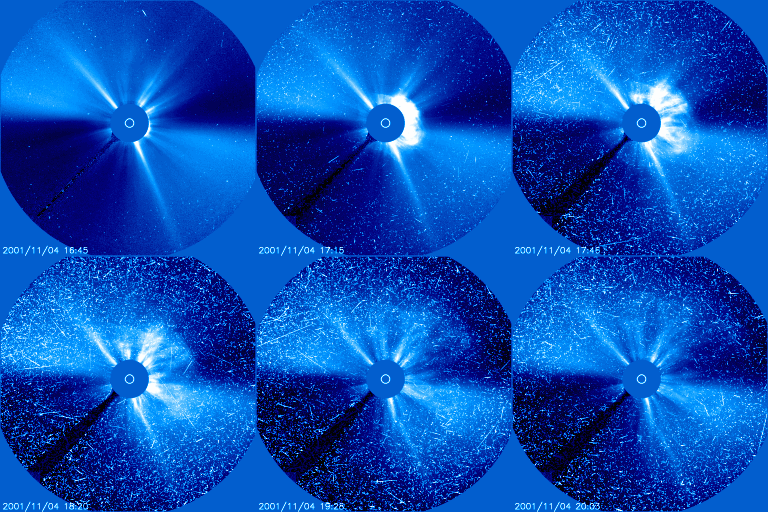
Re:PredictabilityFlares are not "predicted" easily. The physics is not well understood, and the observational resolution (e.g., from magnetographs) is not good enough to predict well where or when a flare will pop up. In any event, geomagnetic storms are not caused by flares but mostly by Coronal Mass Ejections (CMEs) that hit the Earth. Some flares result in CMEs and some do not. The CMEs that affect us are the ones that hit us, but not all CMEs hit us. Spacecraft like SOHO might see a flare eruption, but they cannot reliably tell if the CME is heading towards or away from Earth. The best candidates seem to be what they call "halo events." One of the big problems with CMEs is that they are very hard to detect because the amount of light they give off is millions of times less intense than then background light from the Sun.
We also get hit by CMEs that are caused by "backside events," which are flares or other disturbances that erupt behind the limb of the Sun and we didn't see them occur. STEREO is supposed to help there.
One researcher in the field of solar weather forecasting put the maturity level of space weather forecasting 50 years behind that of terrestrial weather forecasting. That was the state in 2000 and not much has improved since. The biggest difference is that for Earth weather forecasting we have continuous global weather observations on both the ground and from space. There is only a tiny fraction of coverage for space weather, and as I mentioned in my first post it still isn't clear what kinds of instruments are sufficient.
Good information resources on space weather can be found at the Space Environment Center at NOAA's web site. They have a nice education page on space weather. For a look into what the space weather field priorities are, one place to start is the Living With A Star program page.
-
Space Weather
Some people are way ahead of you.
Ironically, I think their forcasts are more accurate than our local guys.
=Smidge= -
Best time to lookI've never seen them myself either, but I'd love to. According to this page,
The best time to look for an aurora on any given night, unfortunately, is toward the middle of the night and into the morning (If you're an early riser that's okay!). It's always best to look for a weak green glow low in the northern sky. But when big disturbances occur, the aurora can be seen much earlier in the evening and much higher in the sky. If a bright display occurs early in the evening, there is a good chance that another display will follow a couple of hours later. Its colors can vary from green to red, and you can see much shimmering.
You can also keep tabs on SPACE.com's 3-day Aurora Forecast and keep an eye on SpaceWeather.com. -
FALSE ALARM! No X class flares today! (yet)Nothing listed on www.spaceweather.com indicates an X class flare at 13:00 utc today nor do any of the other usual websites.
This is the information from SEC (NOAA): Only a few C class events are listed:
0221 UTC C2.8
0955 UTC C8.8
0930 UTC C6.7
You can easily see all the recent events from this plot of solar X-ray flux: (updated in real-time)
There was a minor X class flare last friday (as you can see from the plot!). This is what the poster may be refereing to:
8/30/02 1329 UTC X1.5 Sunspot 95
It was a limb event and isn't headed our way. The plot shows there were no X-ray flares today!
X class flares are fairly common (once every 2-3 weeks these days...) Usually they are near the limb or backside events and don't effect us other than a little radio interference. We might see an earth directed one from region 95 in the next few days. (But don't count on it!) If there is an X-ray event indicated by www.spaceweather.com, then check this alert page at Solar Terestrial Dispatch. These impact predictions are often very accurate! (Only updated if there is a strong earth directed event!) -
FALSE ALARM! No X class flares today! (yet)Nothing listed on www.spaceweather.com indicates an X class flare at 13:00 utc today nor do any of the other usual websites.
This is the information from SEC (NOAA): Only a few C class events are listed:
0221 UTC C2.8
0955 UTC C8.8
0930 UTC C6.7
You can easily see all the recent events from this plot of solar X-ray flux: (updated in real-time)
There was a minor X class flare last friday (as you can see from the plot!). This is what the poster may be refereing to:
8/30/02 1329 UTC X1.5 Sunspot 95
It was a limb event and isn't headed our way. The plot shows there were no X-ray flares today!
X class flares are fairly common (once every 2-3 weeks these days...) Usually they are near the limb or backside events and don't effect us other than a little radio interference. We might see an earth directed one from region 95 in the next few days. (But don't count on it!) If there is an X-ray event indicated by www.spaceweather.com, then check this alert page at Solar Terestrial Dispatch. These impact predictions are often very accurate! (Only updated if there is a strong earth directed event!) -
Links to more video, still photos
The folks at Yale were not the only ones looking at the sky that night. SpaceWeather.com has some links to other images here.
-
Re:Uh, flybys only happen once every 50 years?
Asteroids zip by the earth fairly often. You can see the closest ones in the Potentially Hazardous Asteroid (PHA) section of the spaceweather.com page.
What is unusual about this one is that it will be 8th magnitude, which will be easily visible in binoculars or a telescope even in a slightly or moderately light-polluted area. Most of the asteroids that zip by are 12th-14th magnitude and therefore only visible in moderate to large aperture telescopes with dark skies. -
Source of Some Space SoundsNice sounds from our magnetosphere: http://www-pw.physics.uiowa.edu/mcgreevy/
For live sounds, check out NASA's Online VLF Receiver
These sounds were incorporated into a song by totally badass producer Si Begg:
S.I. Futures - Ionic Funk
-
Check Space Weather when sailing
right here - current conditions:
Solar Wind speed: 512.9 km/s
density:3.5 protons/cm3
plus more.
-
Moon occulting Saturn is NOT rare
The moon is a 1/2-degree diameter disk sweeping the sky in pretty much the same plane as the planets. So it occults planets and stars quite frequently.
Here are pictures from the Nov/Dec 2001 series on encounter, a few months ago! -
Re:If plants can go naked so can we (eventually).
You might be getting it from a movie, but it's actually correct. Unfortunately, Mars' atmosphere would be considered a usable vacuum here for many purposes. Even more unfortunately, it's probably not correctable over the long term. Mars lacks a significant magnetic field. This results in erosion of the atmosphere by the solar wind. Unless a way is found to create a large enough magnetic field to protect an artificial atmosphere, it will bleed off into space as the original one did. This also leaves inhabitants much more vulnerable to radiation from solar flares and similar events.
-
I Listened to the Leonids
Now this isn't as cool as hearing meteors unaided with my ears. But while I was outside watching the Leonids here in Cupertino, I was also watching and listening to NASA's Meteor-radar with a linux program called baudline. There was a lot of activity that night, about a hit a second. Unfortunately I can't correlate the radar hits with the visuals since I live in California and the meteor radar is in other states (NM TX and AL). Still it was cool.
Right now the meteor radar is getting a hit about every 20 seconds. Sweet, I just saw a 70 second streak with a doppler shift of about 183 Hz. That is screaming at about 17X earth rotation! (If I wasn't so lazy I'd calculate that in MPH or m/s)
How did I do it? I just piped the real-time NASA stream into the standard input (stdin) of baudline, then equalized it with about 10 seconds of quietness, and then watched and listened away. I used this command line:
mpg123 -s http://icecast.msfc.nasa.gov:8000/forward-scat | baudline -stdin -channels 1 -overlap 100 -fftsize 2048 -mem 9 -record -samplerate 22050 -session meteor_radar
If the geocities site for baudline craps out, try again later, or try the mirror site. The downloaded md5sum for baudline_0.87_i686.tar.gz should be 72f949826ac81a461a8b4b5c5551f366 -
Re:It should be green not red!
The red is caused by a higher energy effect. If I remember correctly, it is caused by Oxygen molecules. So during a CME it's not surprising you would see red aurora.
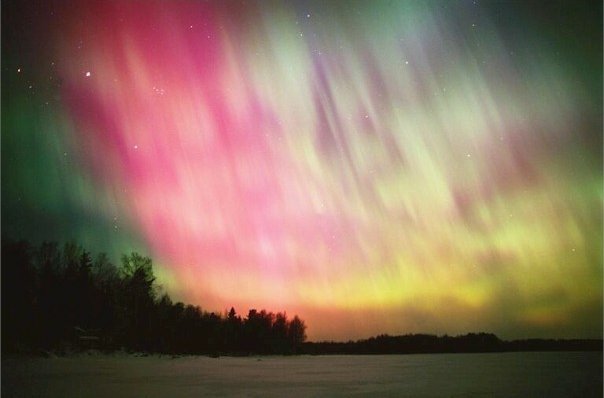
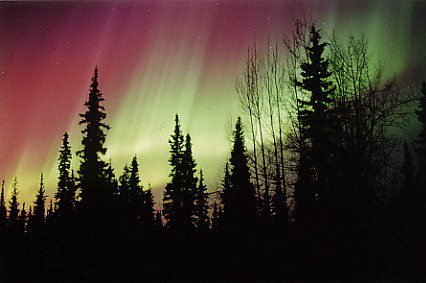
What strikes me about these images is that the Aurora is very red in these images. The aurora was always green when I saw it. Rarely there would be a little red in it for a short time.
From Alaska.edu:
All-red auroras are seen near the beginnings of large magnetic storms, and only during some of these. At such times, large numbers of electrons originating on the sun stream into the high atmosphere. There they strike oxygen atoms resident at altitudes 200 to 500 km and cause them to emit quanta of pure red light. Normal green auroras and green auroras tinged with reddish lower borders occur at much lower altitude, typically near 100 km. The electrons that produce these auroras are more energetic than those creating blood-red auroras so they penetrate more deeply into the atmosphere. During their passage through the upper reaches, these electrons also cause red emissions from oxygen atoms but the red color usually is so much weaker than the green that it is detected only with special instruments.
Milalwi -
Pictures!did anyone see anything as remotely beautiful as what is in this article?
spaceweather.com has collected some pictures taken by amateurs Monday night.
-
Missed it?
If you missed the auroras you can alway check out some beautiful pictures of them here. The auroras were so bright in some places that they could be seen from brightly lit cities, cool...
-
Re:Photo buffs please chime in!!
You can always check out the Aurora gallerys on this page, the photographers decsribe a bit about how they did and what equipment they used to get those beautiful pictures. Mostly people use ASA 400 with a 10 to 20 sec exposure time, but of course that depends on which lens you use. And the best way to learn is to try several exposure times and or films and remember to make notes for each photo you take (just to know what you did right and what went wrong). Often you can get pretty good pictures even if the aurora is faint, but thats a matter of exposure time and luck. But look at the photo details at the page, those guys know how to do it right
I havent seen any predictions about where on the scale this blob is, but it is possibly a R2 (or lower) - which means moderate effects. That is, only limited radio blackouts on the sunlit side. -
More information...
Here's some facts about how to do if you want to look at this meteor shower. For those who really wants to read alot about this, here's an extensive guide to meteor showers and their observation. They are best wieved in the late evening. The peak for the meteor shower is calculated to be today (2001-10-09) but remember that the date of maximum is approximate, viewing is possible +/- 2 days of it. The radiant at maximum will be at 262 degrees, ie. RA 17h 28.2m, Dec +54, which is about 2 degrees north of the star beta Draconis, called Restaban, on the shortest side of the head of Draco. (Need a glossary or a star chart?) Anyway these are slow meteors, at about 20 km/sec, so they will be very distinctive - and much easier to catch on photographs!
If you don't wanna go out to look for the showers, you can always tune in to NASA's forward scatter meteor radar system at the Marshall Space Flight Center in Huntsville. On a typical day, when there's no intense meteor shower, radar listeners will hear about one ping per minute or so. Rates could become substantially higher during a meteor shower.
Some recently updated graph of Giacobinids 2001 from observations shows unfortunately that they seem to be rather weak this year, just about 5-6 per hour
But there will be more meteor showers this month, for example the Orionids (October 21-22) which are predicted to be stronger than the Draconids (atleast compared with the observational data for the Draconids recently reported -
URLs for Aurora monitoring
My apologies for not mentioning that the utility was Windoze only.
Here are the URLs for some useful aurora data.
NOAA POES satellite
http://www.sec.noaa.gov/pmap/pmapN.html
GOES8 Proton Flux
http://www.sec.noaa.gov/rt_plots/pro_3d.html
Space Weather Now
http://www.sec.noaa.gov/SWN/
For images of recent auroras, go to Space Weather
http://www.spaceweather.com -
Re:Behind the times
The largest recorded since we've started measuring these things was an X20 in 1989. Quebec's power system overloaded that year.
According to this table, the 1989 flare is tied for #1 with one from April of this year (at least, in terms of X-ray intensity). However I don't remember hearing about any significant power or communication disruptions from the April flare. -
Coronal mass ejection hit earth
Looks like around 2000UT, the CME hit our earth, pushing the veolicity up to around 800, and now it's about 750.. if it's clear out where you live, probably, above 55 degrees magnetic latitude will have a good chance of seeing some northern lights.. keep your eye on POES Auroral Activity or space.com's Aurora Cam. Plus, watch spaceweather.com for updates in the next day about the storm
-
Behind the timesYou missed yesterday's, which was a brilliant X2.6. Today's was only an M8 (equiv to X0.8). If today's is a chest x-ray, yesterday's was three. The largest recorded since we've started measuring these things was an X20 in 1989. Quebec's power system overloaded that year.
Spaceweather.com reported yesterday:
This morning at 1038 UT a powerful X2.6 solar flare erupted near the large sunspot 9632. A radiation storm (currently S2-class) is in progess and intensifying.The explosion also hurled a lopsided halo coronal mass ejection (CME) into space. The Earth-directed CME, pictured right in a SOHO coronagraph animation, will sweep past our planet late Tuesday or Wednesday and probably trigger geomagnetic storms.Interested in what the solar flares have affected in the past (from Roman legions to gas line explosions to Galaxy IV)?
We're at the height of the 11 year solar flare cycle. I wonder what will happen tomorrow..
-
Re:More information at spaceweather.com
I don't want to seem overly picky here, but it's actually an X2.6 class flare - the resulting radiation storm is an S3 class event.
-
More information at spaceweather.com
http://www.spaceweather.com has more information about this flare.
It is a class S3 flare, which is strong enough to expose people travelling in commercial jets at high altitude to radiation equivalent to 1 chest x-ray. On average, the Sun only has about a dozen storms this strong or stronger every solar cycle (11 years). In other words, it's a fairly big one. (reference: http://www.sec.noaa.gov/NOAAscales/#SolarRadiation Storms -
Another resource
Another great resource for information on solar activity is SpaceWeather.com.
NASA always has several informative mailing lists that can at times be very interesting. -
Space Weather
See the SpaceWeather page for more details. There's a link to live radar echos there also.
-
UPDATE: Massive Coronal Ejection Sunday Morning
Sunspot 9393 with the surface area 13 times larger than the Earth, has ejected a coronal mass due to arrive Tuesday. A smaller ejection Thursday resulted in fantastic Aurora displays as far south as Carlsbad, NM, and Stoneville, NC. The downside is that the resulting magnetic storm could disrupt satellites, or even interfere with powergrids.
Though the ejection did occur on 4/1/01, this isn't April Fool's joke. SpaceWeather.com rates this ejection as M5, capable of causing significant radio interference, though probably unlikely to interfere with power transmission. But the spot 9393 is still facing Earth and appears to be building up to another ejection which could be much more devastating (especially if you live in California where the grid is already so stretched).
-
UPDATE: Massive Coronal Ejection Sunday Morning
Sunspot 9393 with the surface area 13 times larger than the Earth, has ejected a coronal mass due to arrive Tuesday. A smaller ejection Thursday resulted in fantastic Aurora displays as far south as Carlsbad, NM, and Stoneville, NC. The downside is that the resulting magnetic storm could disrupt satellites, or even interfere with powergrids.
Though the ejection did occur on 4/1/01, this isn't April Fool's joke. SpaceWeather.com rates this ejection as M5, capable of causing significant radio interference, though probably unlikely to interfere with power transmission. But the spot 9393 is still facing Earth and appears to be building up to another ejection which could be much more devastating (especially if you live in California where the grid is already so stretched).
-
sign up for aurora alerts, get real-time infoThe sun is currently near the maximum of its approximately 11-year cycle, so more auroral displays are likely in coming weeks. If this kind of stuff interests you, I suggest signing up for the e-mail alert from spaceweather.com so you get advance notice of events that are likely to trigger auroral displays.
Also, you can check out real-time satellite maps showing the extent of the auroral circle (in both N and S hemispheres) at www.sec.noaa.gov (note that the site has down -- or overwhelmed -- intermittently over the past day or so). Of course, if you live someplace dark you can just go outside and see for yourself, but if you're in a light-polluted area like me you can at least tell beforehand whether it's worth taking a drive to someplace with better skies. (Which I attempted to do last night, but unfortunately clouds thwarted my valiant attempt
-
Pictures here
The pictures are here. Some great desktop wallpaper. Surprisingly, a few look exactly like the wallpaper that comes bundled with Mac OS X.
-
SpaceWeather's Aurora Gallery
For those of you that just want the purdy pictures, have a look at:
http://www.spaceweather.com/aurora/gallery_20mar0
1 Or alternatively just go direct to a few pictures found in the gallery:
- http://www.spaceweather.com/aurora/images/20mar01
/ eklund5.jpg - Tiedye style northern lights! \;) - http://www.spaceweather.com/aurora/images/20mar01
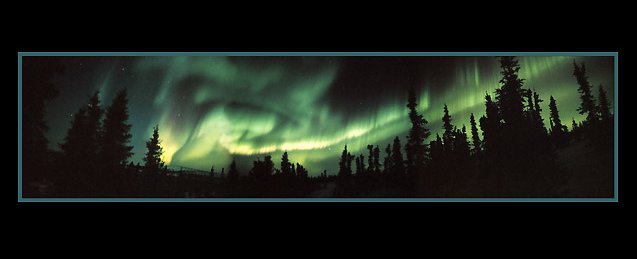
/ zimmerman1.jpg - An imposing vibrant green light in the Alaskan skies - http://www.spaceweather.com/aurora/images/20mar01
/ curtis1.jpg - A photo taken during a quick changing aurora borealis storm.
Enjoy! These things are really a lot more impressive in person, as they dance around the night sky. Picture those early Windows 3.1 screensavers superimposed into space and you'll get an idea of what I'm talking about. (Please, stay seated, Bill Gates doesn't actually rule the universe, that was just a for-instance.)
- http://www.spaceweather.com/aurora/images/20mar01
-
SpaceWeather's Aurora Gallery
For those of you that just want the purdy pictures, have a look at:
http://www.spaceweather.com/aurora/gallery_20mar0
1 Or alternatively just go direct to a few pictures found in the gallery:
- http://www.spaceweather.com/aurora/images/20mar01
/ eklund5.jpg - Tiedye style northern lights! \;) - http://www.spaceweather.com/aurora/images/20mar01
/ zimmerman1.jpg - An imposing vibrant green light in the Alaskan skies - http://www.spaceweather.com/aurora/images/20mar01
/ curtis1.jpg - A photo taken during a quick changing aurora borealis storm.
Enjoy! These things are really a lot more impressive in person, as they dance around the night sky. Picture those early Windows 3.1 screensavers superimposed into space and you'll get an idea of what I'm talking about. (Please, stay seated, Bill Gates doesn't actually rule the universe, that was just a for-instance.)
- http://www.spaceweather.com/aurora/images/20mar01
-
SpaceWeather's Aurora Gallery
For those of you that just want the purdy pictures, have a look at:
http://www.spaceweather.com/aurora/gallery_20mar0
1 Or alternatively just go direct to a few pictures found in the gallery:
- http://www.spaceweather.com/aurora/images/20mar01
/ eklund5.jpg - Tiedye style northern lights! \;) - http://www.spaceweather.com/aurora/images/20mar01
/ zimmerman1.jpg - An imposing vibrant green light in the Alaskan skies - http://www.spaceweather.com/aurora/images/20mar01
/ curtis1.jpg - A photo taken during a quick changing aurora borealis storm.
Enjoy! These things are really a lot more impressive in person, as they dance around the night sky. Picture those early Windows 3.1 screensavers superimposed into space and you'll get an idea of what I'm talking about. (Please, stay seated, Bill Gates doesn't actually rule the universe, that was just a for-instance.)
- http://www.spaceweather.com/aurora/images/20mar01
-
SpaceWeather's Aurora Gallery
For those of you that just want the purdy pictures, have a look at:
http://www.spaceweather.com/aurora/gallery_20mar0
1 Or alternatively just go direct to a few pictures found in the gallery:
- http://www.spaceweather.com/aurora/images/20mar01
/ eklund5.jpg - Tiedye style northern lights! \;) - http://www.spaceweather.com/aurora/images/20mar01
/ zimmerman1.jpg - An imposing vibrant green light in the Alaskan skies - http://www.spaceweather.com/aurora/images/20mar01
/ curtis1.jpg - A photo taken during a quick changing aurora borealis storm.
Enjoy! These things are really a lot more impressive in person, as they dance around the night sky. Picture those early Windows 3.1 screensavers superimposed into space and you'll get an idea of what I'm talking about. (Please, stay seated, Bill Gates doesn't actually rule the universe, that was just a for-instance.)
- http://www.spaceweather.com/aurora/images/20mar01
-
most amazing
this is one of the most amazing ones i've seen.
--- -
Aurora pictures...
Here's a bunch...
Aurora pictures -
Re: YOU can do it at home too!
just tune any quality FM reciever to a dead area(no signal and quiet) at the lowest freq. you can; and listen close. you might hear something like this.
for an explanation of whats going on and a link to NASA's radio meteor detection system at Marshall Space Flight Center go here: http://www.spaceweather.com/glossary/forwardscatte r.html
-
Re: YOU can do it at home too!
just tune any quality FM reciever to a dead area(no signal and quiet) at the lowest freq. you can; and listen close. you might hear something like this.
for an explanation of whats going on and a link to NASA's radio meteor detection system at Marshall Space Flight Center go here: http://www.spaceweather.com/glossary/forwardscatte r.html
-
Listen to the Quadrantids!!
Let's face it, it will be too dang cold to watch the Quadrantids. And most of us have seen a meteor shower before.
So instead, go LISTEN to them. NASA has set up a meteor-scatter detection system at Marshall Space Flight Center that listens in for the Ch. 4 television carrier. Every time a meteor leaves an ionized trail, a Ch. 4 carrier from beyond the horizon is reflected, and you can hear it.
You can hear something like 10 meteors for every one you can see. Amateur radio operators sometimes work meteor scatter using morse code, but you can see that you've got to send really fast to get anything out. There are also special packet radio protocols for using meteor scatter. -
hmmm....
Finally a space article that didn't come from cnn...
Kudo's
To bad Space Elevators are the Super Dense Optical Storage Devices of Space Industry. A Red Herring.
suggested Space News Site's spaceflightnow
SpaceDaily
NasaWatch
SpaceWeather
Nasa
It's ashame that SpaceOnline bit the dust and was absorbed by space.com, along with SpaceViews
If you want some real action become a Nasa click worker at http://clickworkers.arc.nasa.gov/top
Maybe Slashdot will even do a story on it...
I wait with herring baited breath -
spaceweather.comCheck out spaceweather.com .
I don't think that there is a 40% chance of electrical outages, but rather a 40% chance of a storm that could cause aurora(s?).
It seems the relative strength of these storms is nothing to write home about.
-
Re:aurora-underground.org?
What this site needs to become is sort of like a Weather Underground for auroras.
Well, there already are other similar services. The Alaska page already mentioned is a good one. Spaceweather.com is a fairly good site as well. And there are also sites for reporting your own aurora observations. The Auroral Activity Page is for world wide aurora observations, while this page at the University of Minnesota is for the midwest of the U.S. and Canada.
-- -
Re:Sunspot info site
Another site worth checking out is SpaceWeather.com which has daily pictures of the sun (and spots), coronal holes, solar flare and geomagnetic storm forecasts and other useful information.
-
Re: better source of info.www.spaceweather.com (hyperlinked)
Also check out Nasa's science site about this event. They also have an active email newsletter that keeps you up to date on interesting space stuff like this.
-
Re:UhhYep. We're in the height of the 11-year solar activity cycle. Check out the Space Weather Bureau for more info.
blessings, -
Re:How fast?Ahh, there may be no drag in a vacum, but there isn't a vacum in space. It's only a near vaccume. The other thing is this will be operating in the solar wind bubble around Sol. It is much more dense than 1 atom per cubic meter. It's more like 3 to 7 protons per cubic centimeter average. It varries from minute to minute because of the activities of the sun.
For a current look at the density around earth, check out NASA's Spaceweather site. You can find graphs of the solar wind's speed, density, composition, and polairity at the ACE Solar Wind Observatory site. Look under ACE Plots.