Slashdot Mirror
Domain: speedmatters.org
Stories and comments across the archive that link to speedmatters.org.
Comments · 13
-
Careful California
Verizon promised this to us, moons ago, and now we have a noncompetitive arrangement where handshakes or coin flips decide WHICH ISP gets the monopoly. http://www.speedmatters.org/bl... Now the rates in NJ lead the planet. Careful Ca,Careful!
-
Re:No, they are the reality of physics
No, you are wrong. It is NOT a matter of Physics. It could be at some time in the future but right now it is a matter of greed.
The USA ranks 31st in the world in average Internet bandwidth. It's not a matter of population density. Do those other 31 countries know something about Physics that we do not? It's not unusual tor cable and telco drones to astroturf such sites claiming that US speeds are "fine". Obviously we have lost our "1st world" Internet status to countries whose standard of living is way below ours.
Compare your speed in the US with other locations in the US HERE .
The 1996 Communications Act gave cable and telcos $200B to finish the fiber optic installations started by many local governments frustrated by refusals of those cable and telcos to move from Copper to glass, because of Copper's physical limitations to carry high bandwidth traffic. That act also prohibited local governments from "competing" against the cable and telcos, but it did not contain performance penalty clauses (imagine that!) so the cable and telcos pocketed the money and promptly forgot about the fiber optic. Oh, that act RE-DEFINED the definition of "high" bandwidth down to 200,000 b/s, which is about the top end of V.92 speeds. Now, you have telcos using phrasex like "fasterize your internet speed with ***", as they sell actually low speed DSL Tier connections, VOIP and Dish TV for $89/m for "life". In France, for $30/m, you can get 40Mb/s with free nation wide phone and 200 TV channels. Of course, France must know some Physics that is unknown in the US.
-
Re:Well,
The U.S. is no more "backwards" than the EU. Both average around 7 megabit/s speeds so that we Americans are on part with our European cousins. Here, check out the statistics for yourself.
Sweden (11 Mbit/s)
Delaware (10)
Washington (9)
Netherlands,RI,NJ,MA (8)
VA,NY,CO,CT,AZ,Germany (7)[citation needed]
Seriously, I see you posting this shit all the time and it's blatantly false. Even if those averages were correct, it still doesn't speak to the infrastructural capacity. In the EU it is possible to get speeds up to and above 100Mbps for less than we pay for 5Mbps here in the US. With the exception of a few grant-funded ISPs serving small local areas, it is not possible to get 100Mbps in the US for an affordable price.
In any case, I do have a source for my assertion that your claim of averages is complete bullshit. Feel free to counter with your own source.
http://www.speedmatters.org/document-library/sourcematerials/cwa_report_on_internet_speeds_2008.pdf -
Re:More proof it's too late for copyright.
i believe the main problem associated with these ridiculously large storage capacities is that the exponential growth of storage capacity has been faster than the exponential growth of bandwidth.
1.5TB is the largest hard drive that isn't overly expensive, which (at the 1.9Mb/s bandwidth which is the median internet speed in America, is 76.6 days. Even in Japan (with a median of 61Mb/s) it takes 58 hours.
20 years ago with a 56k dialup and a 300MB hard drive it would only take 12 hours to copy it.
(hard drive capacity from http://www.pcguide.com/ref/hdd/hist-c.html , http://www.speedmatters.org/document-library/sourcematerials/sm_report.pdf , http://en.wikipedia.org/wiki/Modem and a few other places for an estimate of connection speed, i might be a little high for the historical estimate here)
I don't see this situation improving any time soon.
-
Re:Nope. Government AND private companies
OH boy, the 'but the US is huge' argument that comes up every time broadband in the US is discussed. I'd buy that if our metro areas were chocked full of fiber speeds and just the rural areas were slow. The fact is that even in our largest metro areas the US broadband is horrid.
A recent study shows that even our smalled state, Rhode Island, with population density of over 1000 per square mile, has an average speed of only 6.7 Mbps. If you can't make that dense of an area high speed there is something seriously wrong with our system. Namely the Telco lobby arm is so strong that their gov't sanctioned monopoly remains and speeds don't improve.
-
Wealth matters...
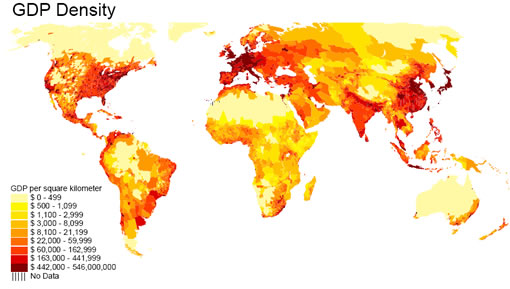
Sorta sorry for hot-linking someone else's gaphic, but this GDP-density graphic does indicate the same trends the study found as indicated on the graphic on Page 1 of Speedmatters.org's report. Seems logical to me that it would given how the FCC is oriented these days. The same way "party line" phone systems disappeared last from "economically less advanced areas" so will slow internet access. It almost always takes government intervention for services like this to be rolled out to non-rich zones of the country.
Thoughts?
-Matt
-
Re:Throttlingonly valid if it is done on the same scale. Except that your scale is meaningless.
What does British Telecom have to do with internet access in the Netherlands? What does XS4ALL have to do with internet access in Britain? The European Union isn't so old that network infrastructure has become a continental issue, internet providers there are still very much bounded by the geopolitical borders they grew up in.
Meanwhile in the US, what does California and Florida have in common with Texas and Wisconsin? If you said AT&T, you win! On the one hand you can argue that that's not fair since it's only true after the recent merging of the Baby Bells, but on the other hand that nationwide infrastructure was laid out by Ma Bell before the breakup in 1984, leading to less than 25 years of separation anxiety and independent development. Development since the merger has been under the AT&T umbrella: in Houston, TX after the purchase the promised SBC Lightspeed (fiber-to-the-premises) fiber rollout was scrapped and replaced with ATT Uverse (fiber-to-the-node). The premise of nationwide holding of network infrastructure continues to be true even for nations that are 2500 miles wide, without "lumping" in Canada (not sure where you're getting that idea, OECD's data here treats Canada as it's own nation).
Metropolitan states like New Jersey, Maryland, or Massachusetts are just as fast as metropolitan states like France, Germany, or Italy.
But do you have numbers that show that? The PDF here is a report based on different data (median connection rates as determined by an online speed test) but they show that Maryland has a median speed of 2.04mbps, Massachusetts at 3mbps, and New Jersey, 3.68. Now, this state-by-state comparison here is based on actual results of speed tests rather than the marketing claims (as the OECD report is based on) so at the same time, this basis of this report is both A) more accurate with regards to real world performance, and B) probably has a huge bias towards people who think their internet connection is "too slow" and want to see what speed they're actually getting for their money, but if you can find a breakdown of the marketing material that went into the OECD report by state, I'm all for seeing what companies in New Jersey are claiming to be able to deliver. -
Re:We're on the slow network, too.
I got 3979 kbps down and 729 kbps up from Finland in the test on this page.
-
Need some laws
Just because there are some stupid laws doesn't mean we don't need some public policy to encourage build out, prohibit redlining of certain neighborhoods, promote rural broadband development, protect consumers to make sure they are getting the speed and quality they are paying for. There are some examples of good public policy at http://www.speedmatters.org./
-
FCC wrong on many things
Not only is their methodology on zip codes flawed but their whole definition of what is "high speed" is way off. The FCC needs to update its definition. The minimum high speed should be is 2 MPPS upstream and 1 MBPS downstream. For other countries that would still be slow but we need to start somewhere. Even when we pay for higher speeds there is no consumer protection that requires providers to give you what you pay for. The only way for these issues to be addressed is a serious public policy encouraging real high speed broadband, affordable for every American. It is not going to happen by itself. Other countries (like Japan) have 100 MBPS for the same as we are paying. We need to take steps now. There is some good information on the state of American broadband and proposals for change on http://www.speedmatters.org./
-
Re:Along these lines...
You say: "Comcast says I get 4Mbps of bandwidth. But they really divided 400Mbps across 100 customers, said I get 4Mbps (that's a simplified version). Now that everybody wants to download stuff from YouTube, Comcast finds that they don't actually have enough bandwidth to give everyone 4MBps." In your hypothetical example the problem seems to me is that they only have the "400 mbps" to divide among those 100 customers. The real problem in the US is that there is the lack of capacity and the lack of speed. We need public policy to support the building of high speed, affordable access to every part of America, like they have in so many other countries. Would we be worried about slower speeds if everyone had a 100 mbps like they have in Japan. We are concentrating on the wrong issue. We need the FCC to increase its definition of high speed; we need a serious broadband map of America to show where we have what speeds and at what cost; we need consumer protections so people get what they pay for; we need protections against discriminatory behavior on the internet; we need to stimulate investments and growth really high speed network. That's what the FCC should be concentrating on. http://www.speedmatters.org/ has good policy suggestions on this issue.
-
We need a MAP and a PLAN
Creating a Broadband Map of America that clearly shows what is available, what speeds, at what costs in every part of American is a crucial FIRST step to providing high speed internet to all Americans (we also need to increase the FCC definition of high speed from the ridiculously low 200 kbps). We also need Public Policy to make it happen. Of course companies will cherry-pick the most profitable areas. That's why we need tax incentives, public/private partnership and other programs to make sure there is build out everywhere. We already have the Universal Service Fund. It could be redirected to help fund high speed broadband in communities that are not "high profit." The internet is becoming a necessity, not a luxury. So much education and so many government services require the internet that it no one should be left out. For more proposals on this check out http://www.speedmatters.org./
-
Re:Government owned communitcations networks: Bad
The only way we can really get the speed, affordability and universal access is NOT by government ownership but with Public Policy that encourages build-out, requires high quality and high speed and supports growth and innovation. A good example that people might want to check out is Connect Kentucky http://connectkentucky.org/ which is sponsored by the state without ownership: "ConnectKentucky develops and implements effective strategies for technology deployment, use, and literacy in Kentucky, creating both the forum and the incentive for interaction among a variety of people and entities that would not otherwise unite behind common goals and a shared vision. This level of teamwork is making Kentucky a better place for business and a better place to live." Also see http://speedmatters.org/ for other examples are PUBLIC POLICY options, NOT public ownership ones. The US speeds are a joke compared to many other countries. We need the fastest internet possible and the countries that have it the fastest (like Japan) primarily use Fiber.