Slashdot Mirror
Domain: sun.com
Stories and comments across the archive that link to sun.com.
Comments · 7,362
-
Re:Insightful?
Java programs use up so much at the moment that I doubt there's enough silicon in the world to produce them once Java goes 64 bit!!!
It is not the programs themselves as he JVM that takes up memory, and Sun has merged code from Apple that allows a single JVM to run all your Java programs. I'm guessing that will not stop the usual trolling though.
As for the other part of your statement, there already exists plenty of 64 bit JVMs, and as usual, my programs work fine without me having to change a single line of code:
http://java.sun.com/j2se/1.4.2/install-solaris-64. html
http://e-docs.bea.com/wljrockit/docs142/certif.htm l
There are more 64 bit JVMs available from IBM and others, for Windows, Linux, Unix... -
Nothing Scales like this baby..
-
Go with Sun
http://www.sun.com/software/products/messaging_sr
v r/home_messaging.xml The Sun Java System Messaging Server is a high-performance, highly secure messaging platform--the leader in the service provider messaging market. Scaling from thousands to millions of users, the Java System Messaging Server is suitable for both service providers and enterprises interested in consolidating email servers and reducing total cost of ownership of communications infrastructure. It also provides extensive security features that help ensure the integrity of communications through user authentication, session encryption, and the appropriate content filtering to help prevent spam and viruses. -
Consider Openwave or Sun Enterprise Mail Platform
I'd check out the Sun Mail platform or the Openwave platform. They are pay for, but scale very large! Sun also licenses per employee instead of per mailbox, which is a plus for email providers. The Sun Platform has a plugin for Outlook that allows it to totall mimic outlook back end things like calander and such. http://www.openwave.com/ http://www.sun.com/software/javaenterprisesystem/
i ndex.xml Just my opinion, For what it's worth. -
ISPs do it
There are ISP-grade products that do it. Sun has one. See http://www.sun.com/software/products/messaging_sr
v r/home_messaging.xml
You need to break up the jobs of message storage, client connections, and mail transfer into isolated components that can scale independent of each other and be clustered for scalability and high-availability.
Message Transfer Agents (MTAs) are often dedicated for either inbound and outbound and also interface to scanning software (e.g. BrightMail Anti-Spam & Anti-Virus, see: http://enterprisesecurity.symantec.com/products/pr oducts.cfm?ProductID=642%20) to check for the usual suspects. For inbound mail, they leveraage directory servers (which replicate with ease) to find the specific message store used to host the mailbox for the inbound message, and then route it correctly. These are load balanced for availability and scalability.
A user's mailbox will only exist on a single message store, but the message stores can be clustered for high-availability.
Client connections similarly allow an array of "message multiplexors" to scale that end of the problem. The multiplexors speak webmail, IMAP, and POP. Similar to the MTAs, they are load balanced. A user can connect to any multiplexor and a directory server is used to find that user's proper message store to connect them to their mailbox.
To the end user it looks like a single server that does POP, IMAP, and WebMail. In truth it's broken into components to achieve high scalability and availability.
A single message store can usually store a few hundred thousand mailboxes -- for a million mailboxes you'd probably only need a handful of them. -
Sun's Java Messaging Server (AKA Netscape/iPlanet)Don't let the word "Java" put you off and click here. It definitely scales that high with ease, does all the mail transfer protocols that you require, has webmail plus it can interface to SMS, SpamAssassin and AV tools. Not to mention the rest of the Sun Java Enterprise System of course, especially the LDAP server which makes delegated account administration much easier. Most importantly for you it scales very well indeed and supports clustering which should help with your uptime requirements.
That said, it's a beast of a system, not the easiest thing in the world to administrate by a long shot and Sun's commitment to further development seems a little "lacking" lately. It's also not especially cheap, but you should be able to negotiate some massive discounts on a deployment of that scale (well, what did you expect from Sun?). You should definitely also be thinking about getting a few people on Sun certification courses if you do go down that route.
-
Sun's Java Messaging Server (AKA Netscape/iPlanet)Don't let the word "Java" put you off and click here. It definitely scales that high with ease, does all the mail transfer protocols that you require, has webmail plus it can interface to SMS, SpamAssassin and AV tools. Not to mention the rest of the Sun Java Enterprise System of course, especially the LDAP server which makes delegated account administration much easier. Most importantly for you it scales very well indeed and supports clustering which should help with your uptime requirements.
That said, it's a beast of a system, not the easiest thing in the world to administrate by a long shot and Sun's commitment to further development seems a little "lacking" lately. It's also not especially cheap, but you should be able to negotiate some massive discounts on a deployment of that scale (well, what did you expect from Sun?). You should definitely also be thinking about getting a few people on Sun certification courses if you do go down that route.
-
Re:When will it be available in Linux ?
kprobes is not comparable to dtrace, to see a comparison between dtrace and kprobes check out
dtrace vs. krpobes
systemtap is in its infancy and being designed without safety as a priority, dtrace was created to be 100% safe to run anytime, even in production. systemtap is being made for the kernel hacker to debug the kernel. With possibly some userland probes and safety as an after thought. Sure they talk about safety as a goal. But as documented dtrace_usenix.pdf
dtrace was created from the start to be safe and secure. They even sacrafice some functionality to keep production servers safe. Systemtap is like building a bank they build the building, bring in the money, and desks, and machines, and promise that top of the line doors, windows and safe will top of the line and installed any day now. -
Good for Ruby!OOOH! Someone please tell me that the OSX port is close behind. I'd been living on a mac for quite a while, but after seeing the how dtrace can help with Ruby dev I'd switched to Solaris for my Ruby optimization (which is up to about 30% of my work now). If I can start doing this on my powerbook, I'll be a super happy camper.
I'm not sure how this benefits Sun, but something as awesome as this, I'm willing to assume it's altruism, and I appreciate it.
-
Re:Just so you all know....
In fact if you read my blog posting announcing the retirement of SISSL you'll find that was in fact the intention all along.
-
Re:It's a start...
good move, now do the same for Java
If you want an open-source Java compiler and an open-source Java virtual machine, there is nothing stopping you from writing one. The Java Language Specification is available for free from Sun's web site, and so is the Java Virtual Machine Specification. These should give you enough information to make a GPLed implementation if you wish to do so.
Sun's JVM and compiler are not the only implementations of Java out there. This is because Java is a standard. This gives you the ultimate freedom, because if you don't like the license of one of the implementations, you can in theory create your own implementation that has whatever license you like. I really don't get why people think Sun needs to open source their Java software. Nobody bitched and moaned when AT&T didn't provide a GPL C or C++ compiler implementation. Instead, people created their own implementation. You may have heard of it; it's called gcc. How is the Java situation any different at all?
-
Re:It's a start...
good move, now do the same for Java
If you want an open-source Java compiler and an open-source Java virtual machine, there is nothing stopping you from writing one. The Java Language Specification is available for free from Sun's web site, and so is the Java Virtual Machine Specification. These should give you enough information to make a GPLed implementation if you wish to do so.
Sun's JVM and compiler are not the only implementations of Java out there. This is because Java is a standard. This gives you the ultimate freedom, because if you don't like the license of one of the implementations, you can in theory create your own implementation that has whatever license you like. I really don't get why people think Sun needs to open source their Java software. Nobody bitched and moaned when AT&T didn't provide a GPL C or C++ compiler implementation. Instead, people created their own implementation. You may have heard of it; it's called gcc. How is the Java situation any different at all?
-
Re:a couple of surprises in article
"...I am surprised Solaris was so high. Other than Sun's high licensing costs..."
Excuse me??? Do you realize that Solaris 10 is free? -
This isn't about OpenSource...
... It's about open FORMATS. You shouldn't confuse the two. The state specified the format, NOT the software. They arn't going to deploy a large installation of un-supported software - even if it is free!
They are going to want to use StarOffice! Open formats, compatible with free software (for the little people), gives discounts to large organisations and government and most importantly since they have paid for it, they have a support network.
This proposal is much more likely to move their office suite dependance from Microsoft to Sun. -
Sun has an online documentSun has Site Planning Guide for Entry-Level Servers for free.
Chapter 1 describes site planning assistance that is available from Sun, site planning process and concepts, data center location, and route to the data center.
Chapter 2 explains environmental requirements of the data center, including temperature, humidity, cooling, and airflow.
Chapter 3 gives information about rackmounting the servers and how to locate rows of racks in the data center.
Chapter 4 discusses power and cooling issues relating to the servers, including power sources and heat output and cooling requirements.
Chapter 5 lists shipping, physical, configurations, electrical, environmental, rackmounting, and clearance for service specifications for the servers. It also provides specifications for Sun cabinets.
Chapter 6 provides a site planning checklist that you can use when planning your data center and preparing for system installations.
-
Re:Alternatives to THIS bookFor a quick overview, there's the book from Sun, "Enterprise Data Center Design and Method", which covers concepts on dealing with airflow, rack placement, power requirements, etc. The first chapter is available from Sun Blueprints:
Data Center Design Philiosophy
Sun also has some articles on disaster planning and such in the Data Center section of Sun Blueprints.
Oh -
Re:Alternatives to THIS bookFor a quick overview, there's the book from Sun, "Enterprise Data Center Design and Method", which covers concepts on dealing with airflow, rack placement, power requirements, etc. The first chapter is available from Sun Blueprints:
Data Center Design Philiosophy
Sun also has some articles on disaster planning and such in the Data Center section of Sun Blueprints.
Oh -
Re:Not for big problems, then
Zero extra cost apart from electricity.
Btw, see this interesting blog about the cost of just electricity in a big data centre:
http://blogs.sun.com/roller/page/marchamilton/2005 0829 -
Re:Get a real OS and real FS
It comes with solaris 10, didn't read the url did you? Here's another one you won't read:
http://www.sun.com/software/solaris/get.jsp
MS doesn't innovate they regulate, steal ideas, call them their own using marketing techniques, not giving credit where it is due. -
Get a real OS and real FS
-
Re:Most Useful Certs Are Not For Software Develope
-
Re:J2EE is..
disclaimer: I work for JBoss, but have been a J2EE programmer for as long as I can remember =)
Most of the enterprise Java community actually agrees with you, hence why the EJB3 specification is highly derived and influenced from Hibernate. Value Objects, Home interfaces, and redundant configurations are just some of the things that have been all but completely removed from the new spec. But "removal of annoying features" isn't the only thing that EJB3 is focusing on. There is also a sharp focus on the Keep It Simple Stupid methodology that made Hibernate so popular to begin with. There are sane/default configurations for practically everything now, and DB->Entity mapping has finally been addressed as a non-vendor specific detail of the spec. Don't forget the fact that EJB3 Entities can also be easily detached and re-attached to the container, as well as used completely outside of the J2EE container.
I encourage to check out the new annotation/POJO based EJB3 spec here:
http://java.sun.com/products/ejb/docs.html
Or, for a walkthrough of EJB3 and how to use it in JBoss, see our (IMO) excellent trailblazer:
http://trailblazer.demo.jboss.com/EJB3Trail/
And just for shits and grins, you should also check out JBossIDE's Hibernate & EJB3 Tools (shameless project plug!):
http://www.jboss.com/products/jbosside -
Re:Taking the Java programmer certification test..
Word.
I did the SCJP and it taught me alot about some nooks and crannies I never used. That may be different from an MCSE or MCSD in some regards. The SCJP has you learn a bunch about garbage collection, some nitty gritty JVM details, etc. Nothing you could not learn on your own. It is also the gateway test to the other Java exams. Some of those actually do indicate if you are a decent developer: the Sun Certified Java Developer exam requires you to develop a business type app NEARLY FROM SCRATCH (no J2EE, etc) and then they review your design as part of that process. That is alot different than just memorizing details.
But for the most part, certifications for a language do not mean you are a good developer, but if you really are good they should be like icing on the cake.
Now if you hate all people who have certifications (and ignore their resumes... like an earlier posts states), I think you might have some personal issues...
-
Re:Didn't see that coming
[When googling for expresso] I get mostly software related stuff
That's a big problem with software developers and marketers trying to choose cool names for their stuff.
Oh, how I miss the days when java was coffee, expresso was bitter coffee, latte was bitter coffee with steamed milk, and Postum was still a mystery.
100 years from now kids are going to wonder why we named tasty caffine beverages after some crappy internet software. -
Re:In addition.NET is Free source (as in free speech, mono or dotGNU)
Java isn't
That's right, there's no open source Java solutions. You also can't download the source code.
Oh wait...
-
System.setSecurityManager() does this...More right here:
You can just do this at server startup and lock it down as much as you want.
-- ac at home
-
Re:Yeay! Security plus portability minus cost...
Java: price: free, well it is free Sure, but not as in beer. Can I independently create my own JVM and distribute it?
Well, actually, yes you can. Theres nothing stopping you reimplimenting a JVM to the released specifications, infact Kaffe is one such reimplementation. Go get a book detailing the VM specifications and how to implement a good VM from Sun!
-
Full out of box solution.
It's not free, but great support and full everything right out of the box, including IMAP, POP, SMTP, HTTP, authentication, account management, quotas and everything else you could possibly want.
If your company can't afford it, that sucks, but I'd rather use that than try and get courier, postfix, pop3d and squirrellmail or whatever to all work together.
http://www.sun.com/software/products/messaging_srv r/home_messaging.xml -
Ah, there's the rub...
The documentation and source code are (or were) revenue generating portions of the business.I can understand charging for access to source code, but the idea that a customer should have pay to learn how to use a product he has been sold is, to me, obscene.
I've often thought that one of the reasons Java took off like wildfire was because Sun gave away not only the runtime environment & the compiler, but also the API:
http://java.sun.com/j2se/1.5.0/docs/api/
By glancing at a few "Hello World!" tutorials and then perusing the API, you could [and, to this day, still can] teach yourself Java in about a day.Nowadays everyone does it (compare MSDN), but circa 1995, it was a pretty revolutionary idea - back then, everybody else required you to purchase a 750 page 10 lb $100 hardcover treatise just to be able to teach yourself the syntax that would produce "Hello World!".
And the idea that you would sell a product to a customer and then refuse to demonstrate to that customer how to use the product you just sold him strikes me as not only a monstrously awful business model, but, quite frankly, more than a little sadistic.
-
SUN page describing real uses of service computing
-
Enlightenment is about eye candy...
Whoever who finds E17 cool and usable should be forced to use ratpoison for a while.
Oh boy, these days I'm so fed up with eye candy I sometimes find myself missing the Athena toolkit. And that is serious... -
10 years...
and we still can't get away from the fucking start menu.
-
Re:You build it, one is born every minute to buy i
Why on earth would one use this in a server?
I'm sorry, you must be referring to those toy computers you refer to as a server--they don't need this.
I suppose someone having something more than a...what do you kids call it now? Pentium? 486?...might possibly need more power. -
Re:Definitely unnecessary
Not quite 30 drive bays, but big cases with many drive bays do exist: Sun E450.
-
Another assessment of the Allard interview
Check out http://blogs.sun.com/roller/page/ChrisM/weblog?ca
t name= for another detailed assessment of the J Allard interview. Pretty good insight! -
DRM from the Sun trenches
The Sun people already have various opinions and projects on DRM.
-
Re:SMT in Sparc
Sun's Niagara "combines chip multiprocessing (CMP) and SMT to do Chip Multithreading.
-
Athlon 64 wins performance prize
It depends on the game, but the Athlon 64 usually beats the Pentium 4.
http://www.tomshardware.com/cpu/20050627/athlon_fx 57-06.html#opengl
The Opteron, high-end cousin of the Athlon 64, is a great chip for servers. We have a Sun V40z, and the guys I work with are always amazed at how fast it is, and we've only got single core processors -- with dual cores, it'll smoke just about anything:
http://www.sun.com/servers/entry/v40z/index.jsp -
Re:A lot like Sun's Niagara
There used to be a very very good pdf over at Sun's site at this address but unfortunately it is now defunct. If anyone has saved that pdf, please make it available somewhere as it is/was very informative.
-
Re:Worried? Why?
GNU/OpenSolaris to be quite accurate.
-
A disservice to Sun
I don't think a lot of folks around here realize that the original article from the Register is actually a disservice for Sun. Think about it -- the fact that they are making more and more of their core software not only available on Linux, but also available for free (as in beer) to me looks like they have finally started to take it seriously and they are trying to deversify. Just recently they've announced the Technology Preview programm for their compilers on Linux which will let Linux developers get an access to something that really blows gcc and even commercial compiler vendors out of the water. In short, I don't really think Sun wants to kill Linux with Solaris, but rather try to cash-in on both. Which, if executed correctly, might have a good chance for success.
-
Re:The reports of my death are greatly exaggerated
What does Solaris 10 offer that Linux doesn't?
Support for the next 10 years? ABI compatibility going back about 15 years? Heck, try writing device drivers betwen kernel releases that are 3 years apart. I personally know of some Solaris device drivers that were written for Solaris 2.5 and still work under Solaris 9.
Does Red Hat have a life cycle as long as Sun has for Solaris? Linux is a decent system (that I use), but in many ways it is still young and developing. -
Re:The reports of my death are greatly exaggerated
Sun has been pushing x86 pretty hard for about a year now. At USENIX last year Sun said that if the Linux version of an application ran faster on similar hardware than the Solaris version of said application then it's a bug.
Sun's very serious about x86 but the Sparc builds are being released at the same time. What a lot of people forget is that Linux on x86 cannot compete with Sun's high-end servers. -
Re:Let me guess: it has Java!I just spent the last two weeks in hell at work trying to install, configure and use Solaris10/x86 (yes it is free to stuff around with at least: go here and download or order a media pack: http://www.sun.com/software/javaenterprisesystem/
g et.xmlI may be very rusty but I used to be a pretty hardcore SUN admin person and I was completely screwed: I found the documentation to be the worst kind of useless toilet paper.
Just one pieve: SUN seem very confused about what kind of admin gui they really want: Swing, command line or web portal: for historical reasons they have them all... good luck !
Going back to WinFriggen2K was a RELIEF... my idiot big button installers where all back. (for instance: compare the simplicity of installing a win32 service versus a service on SUN properly). The Java Desktop is very pretty though.
-
Re:If Sun gets very serious?!?It seems to me that Sun has never gotten very serious about putting out Free Software for x86, not only because they can't make any money off it, but also because it cuts into the profits from their products that they can make money off of.
OpenOffice.org's GLOW directly competes with their Java Calendar Server software.
Sun developers work on Glow: http://groupware.openoffice.org/glow/team.html
Additionally, Sun knows that Sparc is dying, that's why they're handing over a lot of control to Fujitsu. Sun'll be concentrating on x86 in the next five years, and I believe will start to make inroads in the commercial server market.
-
The tester responds...
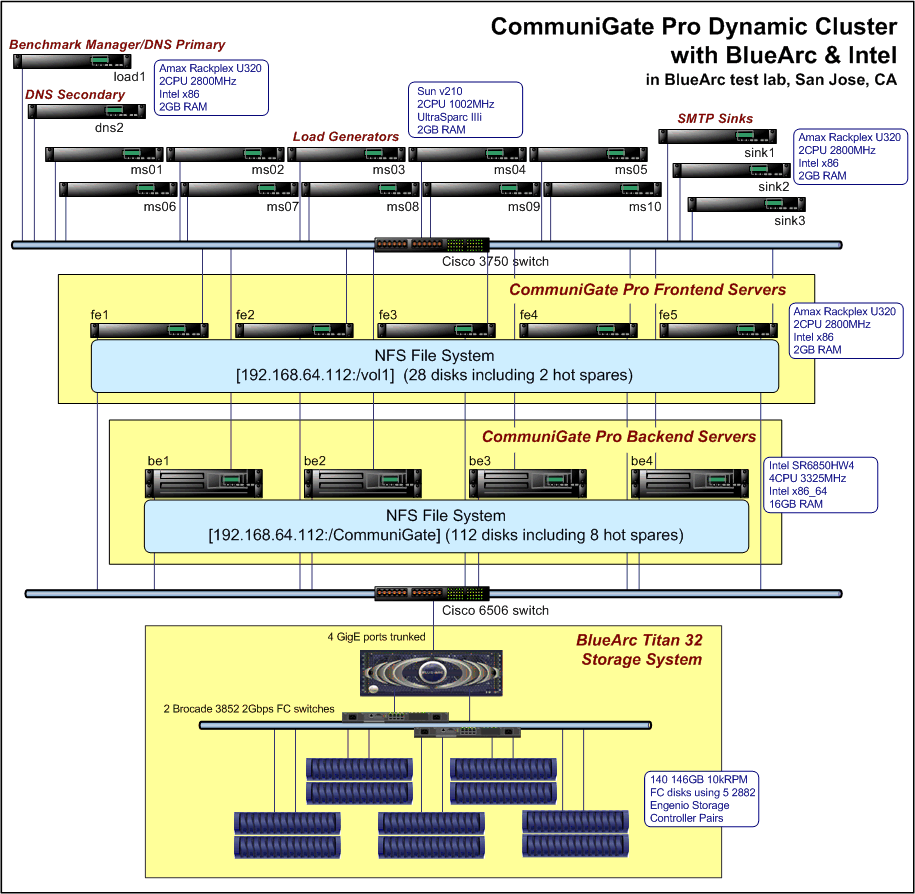
Just thought I'd add a few details and address some of the questions here. My name is Thom O'Connor and work for CommuniGate Systems (CGS), and was the one who put together and ran these tests - you can (mostly) verify this by looking at the comments in the source on the results page.
First off, on the SPECmail test itself. SPECmail is a standardized test (the only one I'm aware of for email) that attempts to closely regulate a level playing field for measuring email performance. It is critical to understand that this is not just measuring SMTP. The 30 million message a day text is a little vague, but it is important that this includes a distribution of delivery, relayed, and retrieved email. Sure, anyone can just relay many millions of messages an hour.
SPECmail does POP and SMTP, so the test measures not just MTA behaviour but also local delivery and then retrieval of the messages. The SPECmail test also uses Quality of Service (QOS) measurements such that a message injected via SMTP to the system MTAs (the CommuniGate Pro Frontend servers in this diagram) must then be delivered locally into the users' account, then be retrieved within 60 seconds. Satisfying the QOS criteria during the benchmark is often the most difficult part.
So, SPECmail itself just does POP and SMTP, which is a little 1990s I agree, but SPEC is coming out with a SPECimap test in the near future, and CGS is also very interested in seeing a SPEC VoIP/SIP test for measuring CommuniGate Pro's Real-Time capabilities.
A few others questions I've seen raised here:
1. The CommuniGate Pro Dynamic Cluster described in this test is fully and completely appropriate for production use in all aspects. In fact, if you're running a 2+ million user ISP on a CommuniGate Pro Dynamic Cluster, we'd recommend you to use these results as a guide for your architecture (although load balancers should be added to the gateway point for all inbound connections). In fact, CGS has ISP customers running architectures which match the layout of the described system almost exactly. All systems in the Cluster service all accounts - you could lose 4 Frontend Servers and 3 Backend Servers, and all users could still access their email (albeit with decreased capacity).
2. HyperThreading was disabled in the BIOS because the downloadable Solaris 10 x86 operating system would not (yet?) support the Intel x86_64 Potomoc chipset properly. That said, on top of the recent security vulnerabilities on the topic, we have also discovered miscellaneous threading and even NFS issues related to having HyperThreading enabled on Linux 2.6, FreeBSD 5.4, and Solaris 10 x86 systems.
3. On NFS...NFS is used safely and securely in this test. The integrity of data storage is one of the major criteria that the SPEC organization closely evaluates when reviewing a SPECmail submittal. Obviously, there are many ways to cheat and/or cut corners using Solid State Disks, unsafe RAM for message queueing, and other techniques that you would never want to use on your production message system. However, the test described here was performed using a standard (albeit excellent) BlueArc Titan Storage System with write caching only in NRRAM and using proper mount options and layout for security, redundancy, and data integrity.
Hope this clears up any misconceptions. Obviously, I'm clearly biased about the work here, but assembling and then passing a SPECmail test of this size is a gigantic effort. If anyone thinks -
Re:Solaris is not BSD
I'ved used Solaris and SunOS, and know the differences.
See this snipit from the Solaris Transiton Guide where they explain how to install the SunOS/BSD compat packages, and how to use the new Solaris commands http://docs.sun.com/app/docs/doc/805-6331/6j5vgg6a i?a=view
Or see the notes at the bottom of this page http://www.math.psu.edu/guide/node104.html -
SunRay!Is there a way to allow distributed content to head units while keeping servers down to one or 2 units?"
Sounds like a job for SunRay Server! You can even run the server software on Linux....
For those without a sense of humor: this may actually work--if it were me I'd be looking into it more than casually--but I'm mostly joking.
-
Active Directory integration? Just use SJS!Need AD integration? Just use the Sun Java System Messaging Server in conjunction with the Sun Java System Directory Server. From the SJS Messaging Server data sheet:
The Java System Messaging Server is a key component of the Java System Communications software portfolio, which also includes the Java System Calendar Server and Java System Instant Messaging plus the Java System Synchronization tool and the Java System Connector for Microsoft Outlook. Integration across these products enables features such as calendar event and task deadline reminders as well as offline forwarding of alerts.
Just use that in conjunction with the SJS Directory Server's identity synchronization with Windows AD environments and you're money.
-
Active Directory integration? Just use SJS!Need AD integration? Just use the Sun Java System Messaging Server in conjunction with the Sun Java System Directory Server. From the SJS Messaging Server data sheet:
The Java System Messaging Server is a key component of the Java System Communications software portfolio, which also includes the Java System Calendar Server and Java System Instant Messaging plus the Java System Synchronization tool and the Java System Connector for Microsoft Outlook. Integration across these products enables features such as calendar event and task deadline reminders as well as offline forwarding of alerts.
Just use that in conjunction with the SJS Directory Server's identity synchronization with Windows AD environments and you're money.