Slashdot Mirror
Domain: sun.com
Stories and comments across the archive that link to sun.com.
Comments · 7,362
-
Re:Your sig...
-
Netcraft resultsThe purpose, from the article:
"The goal is to make it more difficult for hackers to deface and/or hijack the website," said Lieutenant Colonel Ellen Krenke.
Well, Netcraft says it's running Solaris 8 machine running Sun-ONE-Web-Server/6.1.
How about putting the webserver up on Trusted Solaris and locking down the webserver to have fewer privs, like no write access (enforced via MAC, mandatory access controls) to the pages that you're worried about getting defaced?
But, teh intarweb isn't the only way to get info for overseas voting. From the article:
"In the meantime, overseas voters can contact their embassy or consulate, use the FVAP toll-free number or contact their local election official or secretary of state via telephone or the internet for more information on obtaining an absentee ballot," said Lieutenant Colonel Krenke.
-
Re:java
More info on this here.
It's called JIT, or Just In Time, compilation. Wanted to verify this name before I added it into a comment - I really shouldn't doubt myself.
T. -
Re:Pathetic
Who had thought Java would be more than a web-developers language 5 years ago?
the people who designed it to run on toasters? -
No religion wars, please
Could we please try lo list why "operator overloading" is such a troublesome feature?
The statement "since it is so easy to misuse" doesn't count: I'd like to know WHY it is so easy to misuses.
The statement "you'd better use other languages for mathematical calculus" doesn't apply either: I'm in a financial project and we use Java, and there are some pretty complicate expression even in economics.
The statement "I used it in C++ and it was a mess" is also not appropriate as an answer to my question: if Java will ever consider this feature, there's no reason why it should copy the C++ style.
On the other side (the operator overloading fans):
the statement "I'm not going to" doesn't apply; your colleague could do and you would kill him after tracing a bug
The statement "The expressive power of this feature is more important than the possible misuses" doesn't apply either: Java tries to avoid misuses by forcing programmers to behave properly and we should respect this philosophy (not meaning I'm against the feature.. only I'd like to have it without the major cons)
My opinion:
"Why it is so easy to misuse and mantain?"
1) At first glance you could not realize if the symbol "+" is a simple primitive "sum" or a more elaborate object operator
2) sometimes the notation is simply "out of this world" (ehm... meaning "not natural"
Example: (let me write in pseudo-Java)
Vector v1=new Vector();
Vector v2=new Vector();
Vector v3=v1+v2;
Vector v4=v2-v1;
3) if we choose a C++-like implementation we could have a "operator+" (-/*) method that has its own implementation (possibly different from add() or any other method in the class)
4) if we choose a C++-like implementation we wouldn't have just one place to look at to understand the meaning of operators (they could be overloaded twice or more times in the class hierarchy)
Any other reason in your opinion?
Then when we have all the reasons listed we could consider if there could be a way (compatible with "Java guidelines") to add this feature without incurring in all this misuse problems.
If we (or Sun
Last thing:
you can vote for this feature (or stand against it ) at this URL (registration needed) http://bugs.sun.com/bugdatabase/view_bug.do?bug_id =4905919 -
Re:"Sun is going to fail in this decade..."Why the shot at HP? Are you a Sun employee (e.g., http://www.sun.com/executives/realitycheck/) ?
BTW, HP is probably doomed too, unless they can win back all the people pissed about Dell's crash-happy NAS devices. Overpriced hardware are belong to us. At least Sun has Java...
-
Re:"Sun is going to fail in this decade..."who the hell installs a NEW Sun system these days?
Well, the Sun Opteron boxes are selling like hot cakes. The sales of UltraSPARC kit has increased by several 10s of percent in the last couple of quarters, so I suppose one or two people must be installing new Sun kit.
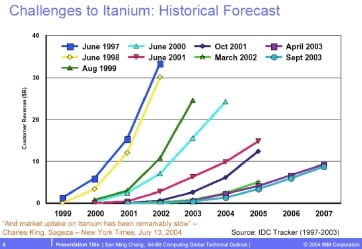
If we believed everything intel and HP were trelling us, we'd realise that every 64-bit platform other than itanic is doomed since itanic is taking over the world and resistance is futile.
But then what would I know? I'm just part of the slashbot groupthink.
-
Re:"Sun is going to fail in this decade..."who the hell installs a NEW Sun system these days?
Well, the Sun Opteron boxes are selling like hot cakes. The sales of UltraSPARC kit has increased by several 10s of percent in the last couple of quarters, so I suppose one or two people must be installing new Sun kit.
If we believed everything intel and HP were trelling us, we'd realise that every 64-bit platform other than itanic is doomed since itanic is taking over the world and resistance is futile.
But then what would I know? I'm just part of the slashbot groupthink.
-
"Open source freezes innovation"Says the convicted monopolist whose "innovation stifling" activities included:
- Justice Department blocks M$'s
acquisition of Intuit Quicken in
1994, fearing it would raise software prices and diminish innovation
- embracing Sun's Java into their own Windows-specific API which
resulted in a lawsuit that
ended in Sun's favor
- the infamous Halloween memos that outlined M$ strategy to blocking Linux from the market
- The web browser war against Netscape now Mozilla
- M$ was found to be bankrolling the SCO/IBM/Linux
debacle against the open source movement
- neutralizing w3c compliance by distributing Windows-eccentric webpage API libraries that lock Internet webpages into IE
- ITEF rejecting M$ patent pending proprietary Sender-ID as too restrictive and puts too much control into M$'s hands
- A list
of M$ innovations^W plagliarisms
- Justice Department blocks M$'s
acquisition of Intuit Quicken in
1994, fearing it would raise software prices and diminish innovation
-
Re:Real world vs. fanboy fantasiesI seriously doubt you have any qualifications whatsoever. You don't even know what you're talking about.
Expenses for file-server workloads under Windows, compared to LinuxOS
There is no such thing as LinuxOS.They compared Microsofts IIS to the Linux 7.0 webserver
There is no Linux 7.0. There is also no "Linux webserver". There is an Apache webserver often used on Linux. It's in version 2.0.x, I believe.Application development and support costs for Windows compared to an opensores solution like J2EE
There is no such word as "opensores". "Open sores" do not constitute a possible solution. Open Source may however. Java is not Open Source. Java runs on Windows. Open Source software runs on Windows. Please see Sun's Java website, Apache's HTTPD download page, OpenOffice.org's website, and The GIMP's websiteA full Windows installation, compared to installing Linux, on an Enterprise Server boxen: Is nearly three hours faster; Requires 77% fewer steps
"an... boxen" is ungrammatical, even at the lower register of informal speech used within the hacker subculture. Enterprise Server is not a company that makes hardware, as far as I can tell. Where did you get your figures? I've never spent more than an hour installing a Nix-like operating system, though dealing with driver issues on Windows gives me lots of headaches.Compared to the best known opensores webserver "Red Hat", Microsoft IIS:
Red Hat is not a webserver. "opensores" is not a word.Reliable companies with tried and tested products, or that bedroom coder Thorwaldes who publicly admits that he is in fact A HACKER???
There is no such person as Thorwaldes. Linus Torvalds is responsible for the kernel only, and even so is not exclusively responsible for it. Linus Torvalds is not a "bedroom coder" but is employed by OSDL, and was previously employed by Transmeta. You grossly misuse the term hacker.MCSE, MCDST, MS Office Specialist, widely respected Amigan
I fail to see a high school diploma, let alone a computer science degree, in that list. -
Re:OpenFirmware
I'd say OpenFirmware has fans because it's been doing most of what EFI promises to do 'real soon now' since the late '80s, and has been doing it as an IEEE standard for a decade.
And of course, there's the fact that OpenFirmware is still the only firmware standard out there with it's own official theme song. Ha!
-
Re:This seems backwards...
Next thing you know Microsoft will start asking Windows pirates to come forward on their own volition.
(Sheesh, this is like the time I discovered that there were 13 months in the year, according to Java, or bytes didn't necessarily have 8 bits)
-
Re:Innocent Spammers
If a user runs a executable that contains a virus, they have facilitated it themselves.
If the programmers of 'virtualstripper.exe' deliberatly hid a (undetectable) virus in it, then the user have facilitated their own system compromise.
However, unless I am not following your reasoning, I assert the following:
If the virus from 'virtualstripper.exe' seeks out other program files to infect and infects, for example, Acmeco's inoccuous 'helloworld.exe', should Acmeco be held responsible for what the programmers of 'virtualstripper.exe' did to their program via malware? Again, I say 'no' due to the remotely unlikely 'ubervirus' defense I mentioned earlier where an 'ubervirus' defeats a program's antitamper code and then infects the program.
If I am mistaken about what you truly mean, could you spell your argument all out in detail? I am not trying to be a smartass and am trying to conduct an honest, meaningful debate on this issue. This issue is very important to anyone who uses software: Case in point - Sun warns users in the JAVA software license agreement NOT to use it in a mission-critical and/or life-critical environment where software failure means disaster, injury, and death. -
Re:Innocent Spammers
If a user runs a executable that contains a virus, they have facilitated it themselves.
If the programmers of 'virtualstripper.exe' deliberatly hid a (undetectable) virus in it, then the user have facilitated their own system compromise.
However, unless I am not following your reasoning, I assert the following:
If the virus from 'virtualstripper.exe' seeks out other program files to infect and infects, for example, Acmeco's inoccuous 'helloworld.exe', should Acmeco be held responsible for what the programmers of 'virtualstripper.exe' did to their program via malware? Again, I say 'no' due to the remotely unlikely 'ubervirus' defense I mentioned earlier where an 'ubervirus' defeats a program's antitamper code and then infects the program.
If I am mistaken about what you truly mean, could you spell your argument all out in detail? I am not trying to be a smartass and am trying to conduct an honest, meaningful debate on this issue. This issue is very important to anyone who uses software: Case in point - Sun warns users in the JAVA software license agreement NOT to use it in a mission-critical and/or life-critical environment where software failure means disaster, injury, and death. -
More technical information on ZFS
-
More technical information on ZFS
-
Re:Yawn
The only slow programs in java are poorly implemented and use the Swing GUI toolkit in the wrong way. I personally like using Swing, and I use it efficiently, but in many cases the SWT toolkit by Eclipse will be jsut fine as well. SWT is a lighter, faster, toolkit that uses the native toolkit of the system. Java is extrememly fast, easily as fast as C++, if you need something faster then Java you should be using assembly. Read this. Also, the new JVMs by Sun have a feature called Hotspot, what this does is pretty much learn how your program works and adapts your program in real time to optimize it. What I mean is, the longer your program runs, the faster it gets because Hotspot learns what your program does more often and optimizes the bytecode in real time. You can not do this with native applications, itd be like rewriting the program on the fly without ever stopping it and having the effects take place instantly. This, along with no worries of buffer overflows, is a very good reason to use java. Java is a great language and any real coder knows that (just look at how many Apache projects are Java based), you'll only hear amateurs complain about java, just ignore them:)
Regards,
Steve -
Easy upgradesI am very impressed by some of the ideas coming from Sun regarding this file system:
"We're absolutely trying to make disk storage more like memory, and often use that analogy in our presentations. For example, when you add DIMMS to your computer, you don't run some 'dimmconfig' program or worry about how the new memory will be allocated to various applications; the computer just does the right thing. Applications don't have to worry about where their memory comes from. Likewise with ZFS, when you add new disks to the system, their space is available to any ZFS filesystems, without the need for any further configuration. In most scenarios it's fairly straightforward for the software to make the unequivocably best choices about how to use the storage. If you want to tell the system more about how you want the storage used, you'll be able to do that too (eg. this data should be mirrored but that not; it's more important for this data to be accessed quickly but that can be slower). We hope that with relatively modern hardware, all but the most complicated and demanding configurations will be handled adequately without any administrator intervention." read more
-
Re:What is their disk allocation scheme?
According to the information given in this blog it is possible to "show how much space is used in each disk. If you want to reduce the amount of space in a pool by removing a disk, you could use this to choose the least-full disk, thus minimizing the time it will take to migrate that data to other disks".
-
Links to real information
-
Some snippets from the article
ZFS achieves its impressive performance through a number of techniques:
* Dynamic striping across all devices to maximize throughput
* Copy-on-write design makes most disk writes sequential
* Multiple block sizes, automatically chosen to match workload
* Explicit I/O priority with deadline scheduling
* Globally optimal I/O sorting and aggregation
* Multiple independent prefetch streams with automatic length and stride detection
* Unlimited, instantaneous read/write snapshots
* Parallel, constant-time directory operations
ZFS has some similarities to NetApp's WAFL in that it uses "copy on write".
One of the fun things with ZFS is that it automatically stripes across all the storage in your pool. Disk size doesn't matter - it's all used. This even works across SCSI and IDE.
One of the important things is that volume management isn't a seperate feature. Effectively, all the current limitations of volume managers are blown away:
Just as it dramatically eases the suffering of system administrators, ZFS offers relief for your company's bottom line. Because ZFS is built on top of virtual storage pools (unlike traditional file systems that require a separate volume manager), creating and deleting file systems is much less complex. Not only does this eliminate the need to pay for volume manager licenses and allow for single support contracts, it lowers administration costs and increases storage utilization.
ZFS appears to applications as a standard POSIX file system--no porting is required. But to administrators, it presents a pooled storage model that eliminates the antique concept of volumes, as well as all of the related partition management, provisioning, and file system sizing problems. Thousands--even millions--of file systems can all draw from ZFS' common storage pool, each one consuming only as much space as it needs. The combined I/O bandwidth of all of the devices in that storage pool is always available to each file system.
This is also part of the stuff making admin and configuration far far simpler. The thing I like is that it should be far harder to go wrong with ZFS (not available in Solaris Express yet so I haven't seen this for myself).
The very high degree of reliability as standard is very welcome too:
Data can be corrupted in a number of ways, such as a system error or an unexpected power outage, but ZFS removes this fear of the unknown. ZFS prevents data corruption by keeping data self-consistent at all times. All operations are transactional. This not only maintains consistency but also removes almost all of the constraints on I/O order and allows changes to succeed or fail as a whole.
All operations are also copy-on-write. Live data is never overwritten. ZFS writes data to a new block before changing the data pointers and committing the write. Copy-on-write provides several benefits:
* Always-valid on-disk state
* Consistent, reliable backups
* Data rollback to known point in time
"We validate the entire I/O stack, start to finish, no guesswork involved. It's all provable data integrity," says Bonwick.
Administrators will never again have to run laborious recovery procedures, such as fsck, even if the system is shut down in an unclean fashion. In fact, Solaris Kernel engineers Bill Moore and Matt Ahrens have subjected ZFS to more than a million forced, violent crashes in the course of their testing. Not once has ZFS lost data integrity or leaked a single block.
For more technical info see Matt Ahrens's and Val Henson's blogs - since they're among the engineers who worked on it. -
Some snippets from the article
ZFS achieves its impressive performance through a number of techniques:
* Dynamic striping across all devices to maximize throughput
* Copy-on-write design makes most disk writes sequential
* Multiple block sizes, automatically chosen to match workload
* Explicit I/O priority with deadline scheduling
* Globally optimal I/O sorting and aggregation
* Multiple independent prefetch streams with automatic length and stride detection
* Unlimited, instantaneous read/write snapshots
* Parallel, constant-time directory operations
ZFS has some similarities to NetApp's WAFL in that it uses "copy on write".
One of the fun things with ZFS is that it automatically stripes across all the storage in your pool. Disk size doesn't matter - it's all used. This even works across SCSI and IDE.
One of the important things is that volume management isn't a seperate feature. Effectively, all the current limitations of volume managers are blown away:
Just as it dramatically eases the suffering of system administrators, ZFS offers relief for your company's bottom line. Because ZFS is built on top of virtual storage pools (unlike traditional file systems that require a separate volume manager), creating and deleting file systems is much less complex. Not only does this eliminate the need to pay for volume manager licenses and allow for single support contracts, it lowers administration costs and increases storage utilization.
ZFS appears to applications as a standard POSIX file system--no porting is required. But to administrators, it presents a pooled storage model that eliminates the antique concept of volumes, as well as all of the related partition management, provisioning, and file system sizing problems. Thousands--even millions--of file systems can all draw from ZFS' common storage pool, each one consuming only as much space as it needs. The combined I/O bandwidth of all of the devices in that storage pool is always available to each file system.
This is also part of the stuff making admin and configuration far far simpler. The thing I like is that it should be far harder to go wrong with ZFS (not available in Solaris Express yet so I haven't seen this for myself).
The very high degree of reliability as standard is very welcome too:
Data can be corrupted in a number of ways, such as a system error or an unexpected power outage, but ZFS removes this fear of the unknown. ZFS prevents data corruption by keeping data self-consistent at all times. All operations are transactional. This not only maintains consistency but also removes almost all of the constraints on I/O order and allows changes to succeed or fail as a whole.
All operations are also copy-on-write. Live data is never overwritten. ZFS writes data to a new block before changing the data pointers and committing the write. Copy-on-write provides several benefits:
* Always-valid on-disk state
* Consistent, reliable backups
* Data rollback to known point in time
"We validate the entire I/O stack, start to finish, no guesswork involved. It's all provable data integrity," says Bonwick.
Administrators will never again have to run laborious recovery procedures, such as fsck, even if the system is shut down in an unclean fashion. In fact, Solaris Kernel engineers Bill Moore and Matt Ahrens have subjected ZFS to more than a million forced, violent crashes in the course of their testing. Not once has ZFS lost data integrity or leaked a single block.
For more technical info see Matt Ahrens's and Val Henson's blogs - since they're among the engineers who worked on it. -
billion billion?
From the article:
Unlimited scalability
As the world's first 128-bit file system, ZFS offers 16 billion billion times the capacity of 32- or 64-bit systems.
Microsoft immediately countered by saying WinFS will now support "twelveteen million billion times" as much storage as Sun's ZFS, and is "a bazillion times" more secure.
When reached for comment, Sun CEO Scott McNealy replied "neener neener". Microsoft CEO Steve Ballmer responded by putting gum in Sun President Jonathan Schwartz's hair. -
billion billion?
From the article:
Unlimited scalability
As the world's first 128-bit file system, ZFS offers 16 billion billion times the capacity of 32- or 64-bit systems.
Microsoft immediately countered by saying WinFS will now support "twelveteen million billion times" as much storage as Sun's ZFS, and is "a bazillion times" more secure.
When reached for comment, Sun CEO Scott McNealy replied "neener neener". Microsoft CEO Steve Ballmer responded by putting gum in Sun President Jonathan Schwartz's hair. -
Re:Solaris Vs Linux?
there's currently no way to get Solaris for free.
-
Re:Solaris Vs Linux?From Andy Tucker's (one of Sun's Engineers) blog:
As you might expect, working on this involves lots of time spent meeting with lawyers about licenses and such. Obviously we have to worry about the legal stuff, but I'm also interested in hearing from other people outside the company about what you think we should do. Clearly we'll need to release the code under an open source (i.e., OSI approved) license . .
The term "open source" essentially refers that the source is open, meaning you can see it, read it, but they're very unclear about choosing the appropriate license itself.
They can even restrict it from redistribution, which means there can't be a GNU/Solaris, etc. If Sun's intention is to attack GNU/Linux, it should be GPLed IMO.
But that would again lead to forking (which is good anyways
-
Solaris threads sucked until Java came along
I used Solaris threads via C for years before Java was widely used and found that Solaris' threads/mutexes/condition-variables/etc was not really stable - random weirdness and crashes happened from time to time. Enter Java and a million Java programmers writing every possible crazy threaded program you can think of... great - an army of bug finders free of charge for Sun. (Can you say Thread.stop()?) Five years and ten major thread library patches and a thread library rewrite later - Solaris threads became pretty darn reliable. It's probably now as good as Dave Butenof's (spelling?) implementation for Tru64 UNIX. As a side note - I'm glad Sun ditched the M to N model for thread to lightweight process mapping and adopted the more intuitive 1:1 model that almost every other modern OS uses.
-
Re:What kind of license?
Clearly we'll need to release the code under an open source (i.e., OSI approved) license, but beyond that, what do you think are the requirements?
From Andy Tucker's weblog linked from the article. -
Re:solaris fan
The Solaris kernel is modular as well.
I made no claims about modularity. What does modularity have to do with being bloated?
Do you have any basis for claiming that the Solaris kernel is bloated?
Sun proudly proclaims so themselves; just look at feature lists. -
Re:What is Open?
Sun's Opteron is high end for most Slashdot readers (who think a computers performance is measured by how well it runs Doom 3), but compared to something like an E25K they're distinctly entry level
-
Re:What is Open?
Sun's Opteron is high end for most Slashdot readers (who think a computers performance is measured by how well it runs Doom 3), but compared to something like an E25K they're distinctly entry level
-
Re:Solaris Vs Linux?I believe he was referring to Trusted Solaris. There were two seperate kernels in development at Sun. One was the regular solaris most of us are use to and the other was something they called Trusted Solaris. I have had the....joy of working with it. According to their "master plan" they merged the two kernels in Solaris 10. So, you would have the features of Trusted Solaris (TSol) available, if you so desired.
TSol is one of the most secure OS's I've administered. I had the opportunity to speak with one of the kernel developers and the one quote I'd like to convey about what we talked about is "That which is not explicitly permitted is implicitly denined."
However, Linux can have this level of security also. If you go here you will see the webpage for Security-Enhanced Linux (SELinux). Although, it is only a technology demonstration and may not be suitable for a real world environment.
These OS's are based on mandatory access control policies using roles. This is where the quote comes in to play. If you do not specifically give permission for an executable or a user to perform a specific action, that action will fail. There is no root user. Regular users have no rights themselves but are granted roles they can assume. These roles are given the rights and permissions to perform the tasks they have been asigned. You can create a "backup-admin" role so that it will have access to the tape drive and be able to read all files on the system, but not write anywhere but the tape drive and not be able to do anything else.
Now, I have not read if this part of the code will be "Open Sourced" and it was not discussed in the article. However, it has to be deeply embedded into the OS kernel for it to work so I must assume that it will be a part of it.
Mark my words: Mandatory Access Control, Labeled Security, and Role Based Access are the future of secure operating systems. If an operating system does not do these things it will not be considered for use in environments that have a high priority for information security (infosec). IMO, anything that connects to the Internet or a WAN or hosts sensitive data should have infosec as a high priority. If SELinux is not further developed, or a suitable replacement is created, then Linux will fall off the infosec curve.
-
Re:Solaris Vs Linux?
You all really should look at the Solaris Security Toolkit and custom Jumpstart. It will install the patches on top of whatever Solaris version and release, then it will harden it according to predefined, customizable finish scripts. What you get out of that build process is a server with only non-root-login SSH open. No one should even be thinking of using Solaris 8, the latest solaris without built-in SSH. Solaris 9 also has a much better default inetd.conf that keeps more services closed than open (unlike 2.6, 7 and 8).
-
Re:Too little too late? OPENSTEP and Mac OS X nice
we finally got back a Sparcstation 5 here at work, and I've just finished installing OPENSTEP 4.2 on it.
Welcome to "I Love the '90s," Special Geek Edition!(the Lighthouse office suite)
-
The $20,000 question
So does this mean that Sun is going to give up trying to squeeze $20,000 from me just for upgrading my 10-proc Ultra Enterprise from Solaris 7 to Solaris 10?
Reality Check available here. Heh! -
Linux doesn't cost moreExcept when using the "Free Binary License" or a Hardware WITH OS discount. Free Binary License has cost everywhere from zero to $120 depending on the year (I've been using Solaris for 10 years) currently, registration is free - a media kit with physical DVD is $95.
To put Solaris on a piece of hardware with more than two (2) CPUs - you can't use the "Free Binary License" - thus you have to hope you can get the Solaris license along with that used Sun hardware you got off Ebay.
This is what has stopped me from fully populating the 8 CPU max on my SparcSERVER 1000 (7 years old, but still going strong). Hopefully with the OSS version of Solaris, I'll be able to hit Ebay up for some SPARC hardware upgrades.
-
...Sooner rather then later...
Hmm, Poor Jonny..He better that that cpu out soon..
is it just me.. http://blogs.sun.com/jonathan/ errors out
I get a net timeout error on his blog... Perhaps that's the TRUE test, put one of those fan-dangled 32-way core-thingys, and post on -
Future of SPARCso are we eventually going to lose the Sparc processors as well?
-
It doesn't matter really because...It is official; Netcraft confirms: Project Niagra is dying
One more crippling bombshell hit the already beleaguered Project Niagra community when IDC confirmed that Project Niagra market share has dropped yet again, now down to less than a fraction of 1 percent of all servers. Coming on the heels of a recent Netcraft survey which plainly states that Project Niagra has lost more market share, this news serves to reinforce what we've known all along. Project Niagra is collapsing in complete disarray, as fittingly exemplified by failing dead last in the recent Sys Admin comprehensive networking test.
You don't need to be a Genius to predict Project Niagra's future. The hand writing is on the wall: Project Niagra faces a bleak future. In fact there won't be any future at all for Project Niagra because Project Niagra is dying. Things are looking very bad for Project Niagra. As many of us are already aware, Project Niagra continues to lose market share. Red ink flows like a river of blood.
All major surveys show that Project Niagra has steadily declined in market share. Project Niagra is very sick and its long term survival prospects are very dim. If Project Niagra is to survive at all it will be among processor dilettante dabblers. Project Niagra continues to decay. Nothing short of a miracle could save it at this point in time. For all practical purposes, Project Niagra is dead.
Fact: Project Niagra is dying
-
It doesn't matter really because...It is official; Netcraft confirms: Project Niagra is dying
One more crippling bombshell hit the already beleaguered Project Niagra community when IDC confirmed that Project Niagra market share has dropped yet again, now down to less than a fraction of 1 percent of all servers. Coming on the heels of a recent Netcraft survey which plainly states that Project Niagra has lost more market share, this news serves to reinforce what we've known all along. Project Niagra is collapsing in complete disarray, as fittingly exemplified by failing dead last in the recent Sys Admin comprehensive networking test.
You don't need to be a Genius to predict Project Niagra's future. The hand writing is on the wall: Project Niagra faces a bleak future. In fact there won't be any future at all for Project Niagra because Project Niagra is dying. Things are looking very bad for Project Niagra. As many of us are already aware, Project Niagra continues to lose market share. Red ink flows like a river of blood.
All major surveys show that Project Niagra has steadily declined in market share. Project Niagra is very sick and its long term survival prospects are very dim. If Project Niagra is to survive at all it will be among processor dilettante dabblers. Project Niagra continues to decay. Nothing short of a miracle could save it at this point in time. For all practical purposes, Project Niagra is dead.
Fact: Project Niagra is dying
-
Re:Jonathan Schwartz
Can someone say haircuit?
This man clearly has no time to support his hair, because it is not part of his core business. Haircuts designed by an underpaid committee simply don't cut it. We suggest that he should open source his haircut using a GPL style license and let the community do all further development. ESR is already preparing a groundbreaking new paper named "The wig museum and the hairdresser's shop". -
Re:Blog?
Yeah, this sucks.
Time to start a new google bomb:
Pompus Asshole
There! -
Jonathan Schwartz
Wow.
Can someone say haircuit? -
Sun
-
this was accomplished years ago...
-
Write once, run everywhere
Pfft. That's already been done.
-
This was already tried...
Infrasearch was working on this, until Sun paid $8M for the company, them had them work on something else, then Gene Kan committed suicide. Be careful what you work on.
-
Re:Put down the Crack.Net pipeJava VMs anf Forth are very similar. I've had a job writing Java Bytecode by hand (for a javachip, building the higher-level bytecodes (like invoking methods) over the lower-level ones.
Both have a very similar stack, and both do all their operations on the stack in the same way.
Some of the first java chips were modified Forth chips (from patriot scientific). Others (the one from icompression) were very simple stack-based designs as well.
What advantage do you think Forth has over a VM? Both do well on stack-based architectures.
C works well on non-stack-based architectures with lots of registers (mips, arm, sparc, etc).
Both work about equally well (or you could sya, neither work well) on register-starved x86 based architectures.
Assembler is a different concept altogether. Note that when I was writing the high-level java bytecodes for a chip which ran Java bytecodes natively, I was using assembler _and_ a java VM at the same time.
-
Don't ..
-
Java Media Framework
Can't one just use the Java Media Framework API to stream movies over Java applets? http://java.sun.com/products/java-media/jmf/index
. jsp