Slashdot Mirror
Domain: technologyreview.com
Stories and comments across the archive that link to technologyreview.com.
Stories · 1,042
-
Tractor Beam Created Using Water Waves
KentuckyFC writes The idea that light waves can push a physical object is far from new. But a much more recent idea is that a laser beam can also pull objects like a tractor beam. Now a team of Australian physicists has used a similar idea to create a tractor beam with water waves that pulls floating objects rather than pushes them. Their technique is to use an elongated block vibrating on the surface of water to create a train of regular plane waves. When the amplitude of these waves is small, they gradually push the surface of the water along, creating a flow that pushes floating objects with it. However, when the amplitude increases, the waves become non-linear and begin to interact with each other in a complex way. This sets up a flow of water on the surface in the opposite direction to the movement of the waves. The result is that floating objects--ping pong balls in the experiment--are pulled towards the vibrating block, like a tractor beam. -
Silicon Valley To Get a Cellular Network Just For Things
An anonymous reader writes "MIT Technology Review reports that French company Sigfox will soon roll out a cellular data network in the San Francisco Bay Area aimed exclusively for low-bandwidth, low power devices such as household appliances and sensors. It's the U.S. debut for a technology already in use in France. The network uses the 900 MHz unlicensed spectrum used by cordless phones. Sigfox says that and their technology's very low bandwidth makes it possible to connect devices significantly more cheaply than with conventional cellular modems and service." -
The Limits of Big Data For Social Engineering
An anonymous reader writes "In his new book, Social Physics, MIT data scientist Alex 'Sandy' Pentland argues that by analyzing data from smartphones, social media, and credit-card systems, we'll soon be able to have a mathematical understanding of 'the basic mechanisms of social interactions.' Social scientists will be able to understand and predict the interactions of people the way physicists understand and predict the interactions of objects. That will, in turn, enable governments and businesses to create incentive systems to 'tune' people's behavior, making society more productive and creative. In a review of Pentland's book in Technology Review, Nicholas Carr argues that such data-based social engineering 'will tend to perpetuate existing social structures and dynamics' and 'encourage us to optimize the status quo rather than challenge it.' Carr writes, 'Defining social relations as a pattern of stimulus and response makes the math easier, but it ignores the deep, structural sources of social ills. Pentland may be right that our behavior is determined largely by social norms and the influences of our peers, but what he fails to see is that those norms and influences are themselves shaped by history, politics, and economics, not to mention power and prejudice.'" -
How To Build a Quantum Telescope
KentuckyFC (1144503) writes "The resolving power of telescopes is limited by the diffraction limit, a natural bound on resolution caused by the way light diffracts as it passes through a lens. But in recent years, physicists have worked out how to use quantum techniques to beat the diffraction limit. The trick is to create a pair of entangled photons, use one to illuminate the target and the other to increase the information you have about the first. All this is possible in the lab because physicists can use their own sources of light. Indeed, last month, physicists unveiled the first entanglement-enhanced microscope that beats the diffraction limit. But what about astronomy where the light comes from distant astrophysical sources? Now one physicist has worked out how to use quantum techniques to beat the diffraction limit in telescopes too. Her idea is to insert a crystalline sheet of excited atoms into the aperture of the telescope. When astrophysical photons hit this sheet, they generate an entangled pair of photons. One of these photons then passes through the telescope to create an image while the other is used to improve the information known about the first and so beat the diffraction limit. Of course, all this depends on improved techniques for increasing the efficiency of the process and removing noise that might otherwise swamp the astrophysical signal. But it's still the early days in the world of quantum imaging, and at least astronomers now know they're not going to be excluded from the fun." -
How the Internet Is Taking Away America's Religion
pitchpipe (708843) points out a study highlighted by MIT's Technology Review, which makes the bold claim that "Using the Internet can destroy your faith. That's the conclusion of a study showing that the dramatic drop in religious affiliation in the U.S. since 1990 is closely mirrored by the increase in Internet use," and writes "I attribute my becoming an atheist to the internet, so what the study is saying supports my anecdote. If I hadn't been exposed to all of the different arguments about religion, etc., via the internet I would probably just be another person who identifies as religious but doesn't attend services. What do you think? Have you become more religious, less religious, or about the same since being on the internet? What if you've always had it?" -
Data Mining the Web Reveals What Makes Puzzles Hard For Humans
KentuckyFC (1144503) writes "The question of what makes puzzles hard for humans is deceptively tricky. One possibility is that puzzles that are hard for computers must also be hard for people. That's undoubtedly true and in recent years computational complexity theorists have spent some time trying to classify the games people play in this way (Pac Man is NP hard, by the way). But humans don't always solve problems in the same way as computers because they don't necessarily pick the best method or even a good way to do it. And that makes it hard to predict the difficulty of a puzzle in advance. Cognitive psychologists have attempted to tease this apart by measuring how long it takes people to solve puzzles and then creating a model of the problem solving process that explains the data.
But the datasets gathered in this way have been tiny — typically 20 people playing a handful of puzzles. Now one researcher has taken a different approach by mining the data from websites in which people can play games such as Sudoku. That's given him data on the way hundreds of players solve over 2000 puzzles, a vast increase over previous datasets and this has allowed him to plot the average time it takes to finish different puzzles. One way to assess the difficulty of Sudoku puzzle is in the complexity of each step required to solve it. But the new work suggests that another factor is important too — whether the steps are independent and so can be attempted in parallel or whether the steps are dependent and so must be tried in sequence, one after the other. A new model of this puzzle-solving process accurately reproduces the time it takes real humans to finish the problems and that makes it possible to accurately predict the difficulty of a puzzle in advance for the first time. It also opens the way for other studies of human problem solving using the vast datasets that have been collected over the web. Indeed work has already begun on the Sudoku-like puzzle game, Nurikabe." -
MIT Researchers Create Platform To Build Secure Web Apps That Never Leak Data
rjmarvin writes: "Researchers in the MIT Computer Science and Artificial Intelligence Laboratory have developed a platform for building secure web applications and services that never decrypt or leak data. MIT researcher Raluca Ada Popa, who previously worked on the Google and SAP-adopted CryptoDB, and her team, have put a longstanding philosophy into practice: to never store unencrypted data on servers. They've redesigned the entire approach to securing online data by creating Mylar, which builds and updates applications to keep data secure from server breaches with constant encryption during storage, only decrypting the data in the user's browser. Integrated with the open-source Meteor framework, a Mylar prototype has already secured six applications by changing only 35 lines of code." -
Researchers Find Problems With Rules of Bitcoin
holy_calamity (872269) writes "Using game theory to analyze the rules of cryptocurrency Bitcoin suggests some changes are needed to make the currency sustainable in the long term, reports MIT Technology Review. Studies from Princeton and Cornell found that current rules governing the mining of bitcoins leave room for cheats or encourage behavior that could destabilize the currency. Such changes could be difficult to implement, given the fact Bitcoin — by design — lacks any central authority." The main problem discovered is that transaction fees do not provide enough incentive to continue operating as "miner" after there are no more bitcoins left to be mined. -
Spinoffs From Spyland: How Some NSA Technology Is Making Its Way Into Industry
An anonymous reader writes with this news from MIT's Technology Review: "Like other federal agencies, the NSA is compelled by law to try to commercialize its R&D. It employs patent attorneys and has a marketing department that is now trying to license inventions ... The agency claims more than 170 patents ... But the NSA has faced severe challenges trying to keep up with rapidly changing technology. ... Most recently, the NSA's revamp included a sweeping effort to dismantle ... 'stovepipes,' and switch to flexible cloud computing ... in 2008, NSA brass ordered the agency's computer and information sciences research organization to create a version of the system Google uses to store its index of the Web and the raw images of Google Earth. That team was led by Adam Fuchs, now Sqrrl's chief technology officer. Its twist on big data was to add 'cell-level security,' a way of requiring a passcode for each data point ... that's how software (like the infamous PRISM application) knows what can be shown only to people with top-secret clearance. Similar features could control access to data about U.S. citizens. 'A lot of the technology we put [in] is to protect rights," says Fuchs. Like other big-data projects, the NSA team's system, called Accumulo, was built on top of open-source code because "you don't want to have to replicate everything yourself," ... In 2011, the NSA released 200,000 lines of code to the Apache Foundation. When Atlas Venture's Lynch read about that, he jumped—here was a technology already developed, proven to work on tens of terabytes of data, and with security features sorely needed by heavily regulated health-care and banking customers.'" -
Facebook's Face Identification Project Is Accurate 97.25% of the Time
kc123 tips news that 'DeepFace,' the software research project created by Facebook engineers to identify people in pictures, is now accurate 97.25% of the time. In other words, it's almost as good at recognizing faces as humans, who are able to determine whether two photos show the same person 97.53% of the time. The article says DeepFace reaches that level of accuracy "regardless of variations in lighting or whether the person in the picture is directly facing the camera." It continues, "DeepFace processes images of faces in two steps. First it corrects the angle of a face so that the person in the picture faces forward, using a 3-D model of an 'average' forward-looking face. Then the deep learning comes in as a simulated neural network works out a numerical description of the reoriented face. If DeepFace comes up with similar enough descriptions from two different images, it decides they must show the same face. ... The deep-learning part of DeepFace consists of nine layers of simple simulated neurons, with more than 120 million connections between them. To train that network, Facebook’s researchers tapped a tiny slice of data from their company’s hoard of user images—four million photos of faces belonging to almost 4,000 people." -
Why Your Phone Gets OTA Updates But Your Car Doesn't
New submitter kjbullis writes with this snippet from Technology Review: "When Toyota recalled over two million cars last week because of flaws with antilock braking systems and other problems, the fix was simple — a few software updates .The implementation of that fix is far from simple. Every one of those cars has to be taken into a dealership to have the new software installed, an expensive process that can take months. Cars that haven't been fixed could, in some cases, suddenly stall and crash. There is an alternative — the same sort of remote software updates used for PCs and smart phones. Indeed, one automaker, Tesla Motors, already provides what it calls 'over-the-air updates,' which allowed it to execute a recent software fix without requiring anybody to bring in their cars. But other automakers are dragging their feet, both because they're worried about security and because they might face resistance from dealers." -
In an Age of Cyber War, Where Are the Cyber Weapons?
chicksdaddy writes "MIT Tech Review has an interesting piece that asks an obvious, but intriguing question: if we're living in an age of cyber warfare, where are all the cyber weapons? Like the dawn of the nuclear age that started with the bombs over Hiroshima and Nagasaki, the use of the Stuxnet worm reportedly launched a global cyber arms race involving everyone from Syria to Iran and North Korea. But almost four years after it was first publicly identified, Stuxnet is an anomaly: the first and only cyber weapon known to have been deployed. Experts in securing critical infrastructure including industrial control systems are wondering why. If Stuxnet was the world's cyber 'Little Boy,' where is the 'Fat Man'? Speaking at the recent S4 Conference, Ralph Langner, perhaps the world's top authority on the Stuxnet worm, argues that the mere hacking of critical systems is just a kind of 'hooliganism' that doesn't count as cyber warfare. True cyber weapons capable of inflicting cyber-physical damage require extraordinary expertise. Stuxnet, he notes, made headlines for using four exploits for "zero day" (or previously undiscovered) holes in the Windows operating system. Far more impressive was the metallurgic expertise needed to understand the construction of Iran's centrifuges. Those who created and programmed Stuxnet needed to know the exact amount of pressure or torque needed to damage aluminum rotors within them, sabotaging the country's uranium enrichment operation." -
The App That Tracks Who's Tracking You
Daniel_Stuckey writes "It's no secret that apps like maps or local weather know your current location, and you're probably cool with that because you want to use the handy services they provide in exchange. But chances are there are many other apps on your phone, anything from dictionaries to games, that are also geolocating your every move without your knowledge or permission. Now researchers are developing a new app to police these smartphone spies, by tracking which apps are secretly tracking you, and warning you about it. Before your eyes glaze over at the mention of yet another privacy tool, it's worth noting that this new app is the first to be able to provide this line of defense between snooping apps and smartphone users for Android phones. Android's operating system is engineered not to allow apps to access information about other apps. But a team at Rutgers University found a way around that, by leveraging a function of Android's API to send a signal whenever an app requests location information from the operating system. MIT Technology Review reported on the research today." -
Building Deception Into Encryption Software
holy_calamity writes "MIT Technology Review reports on a new cryptosystem designed to protect stolen data against attempts to break encryption by brute force guessing of the password or key. Honey Encryption serves up plausible fake data in response to every incorrect guess of the password. If the attacker does eventually guess correctly, the real data should be lost amongst the crowd of spoof data. Ari Juels, who invented the technique and was previously chief scientist at RSA, is working on software to protect password managers using the technique." -
How Machine Learning Can Transform Online Dating
First time accepted submitter hrb1979 writes "Thought I'd share an interview with Kang Zhao — the professor behind the machine learning algorithm which could transform online dating. His algorithm takes into account both a user's tastes (in an approach similar to the Netflix recommendation engine) and their attractiveness (by analyzing how many responses they get) — enabling the machine to 'learn' and hence propose higher potential matches. His research was recently covered in both a Forbes' article and the MIT Technology Review, though this interview provides more depth and color." -
Year In Communications: NSA Revelations Overshadow Communications Breakthroughs
MacRonin writes "Communications news in 2013 was dominated by serial revelations of the National Security Agency's mass collection of data from major Internet companies and mobile carriers, leading to widespread cries of governmental overreach. But those revelations, based on leaks from former NSA contractor Edward Snowden, were accompanied by remarkable advances in wireless communications. The Snowden documents also galvanized new efforts at making the Internet more secure and private. The folks at MIT Technology Review have their year-end rundown." -
Bursting the Filter Bubble
Jah-Wren Ryel writes with news that a few CS folks are working on a way to present opposing viewpoints without angering the reader. From the article: "Computer scientists have discovered a way to number-crunch an individual's own preferences to recommend content from others with opposing views. The goal? To burst the 'filter bubble' that surrounds us with people we like and content that we agree with. A recent example of the filter bubble at work: Two people who googled the term 'BP.' One received links to investment news about BP while the other received links to the Deepwater Horizon oil spill, presumably as a result of some recommendation algorithm." From the paper's abstract: "We found that recommending topically relevant content from authors with opposite views in a baseline interface had a negative emotional effect. We saw that our organic visualization design reverts that effect. We also observed significant individual differences linked to evaluation of recommendations. Our results suggest that organic visualization may revert the negative effects of providing potentially sensitive content." -
Group Thinks Anonymity Should Be Baked Into the Internet Itself Using Tor
Hugh Pickens DOT Com writes "David Talbot writes at MIT Technology review that engineers on the Internet Engineering Task Force (IETF), an informal organization of engineers that changes Internet code and operates by rough consensus, have asked the architects of Tor to consider turning the technology into an Internet standard. If widely adopted, such a standard would make it easy to include the technology in consumer and business products ranging from routers to apps and would allow far more people to browse the Web without being identified by anyone who might be spying on Internet traffic. The IETF is already working to make encryption standard in all web traffic. Stephen Farrell believes that forging Tor into a standard that interoperates with other parts of the Internet could be better than leaving Tor as a separate tool that requires people to take special action to implement. 'I think there are benefits that might flow in both directions,' says Farrell. 'I think other IETF participants could learn useful things about protocol design from the Tor people, who've faced interesting challenges that aren't often seen in practice. And the Tor people might well get interest and involvement from IETF folks who've got a lot of experience with large-scale systems.' Andrew Lewman, executive director of Tor, says the group is considering it. 'We're basically at the stage of 'Do we even want to go on a date together?' It's not clear we are going to do it, but it's worth exploring to see what is involved. It adds legitimacy, it adds validation of all the research we've done.'" -
Group Thinks Anonymity Should Be Baked Into the Internet Itself Using Tor
Hugh Pickens DOT Com writes "David Talbot writes at MIT Technology review that engineers on the Internet Engineering Task Force (IETF), an informal organization of engineers that changes Internet code and operates by rough consensus, have asked the architects of Tor to consider turning the technology into an Internet standard. If widely adopted, such a standard would make it easy to include the technology in consumer and business products ranging from routers to apps and would allow far more people to browse the Web without being identified by anyone who might be spying on Internet traffic. The IETF is already working to make encryption standard in all web traffic. Stephen Farrell believes that forging Tor into a standard that interoperates with other parts of the Internet could be better than leaving Tor as a separate tool that requires people to take special action to implement. 'I think there are benefits that might flow in both directions,' says Farrell. 'I think other IETF participants could learn useful things about protocol design from the Tor people, who've faced interesting challenges that aren't often seen in practice. And the Tor people might well get interest and involvement from IETF folks who've got a lot of experience with large-scale systems.' Andrew Lewman, executive director of Tor, says the group is considering it. 'We're basically at the stage of 'Do we even want to go on a date together?' It's not clear we are going to do it, but it's worth exploring to see what is involved. It adds legitimacy, it adds validation of all the research we've done.'" -
Google: Our Robot Cars Are Better Drivers Than You
An anonymous reader writes "At a robotics conference in Santa Clara, California, the head of Google's autonomous car project presented results of a study showing that the company's autonomous cars are already safer than human drivers — including trained professionals. 'We're spending less time in near-collision states,' he said. 'In addition to painting a rosy picture of his vehicles' autonomous capabilities, Urmson showed a new dashboard display that his group has developed to help people understand what an autonomous car is doing and when they might want to take over.' This follows another (non-Google) study earlier this week that found the adoption of autonomous cars could save thousands of lives and billions of dollars each year. Urmson also pointed out that determining liability for an accident is much easier using the data collected by the autonomous cars. At one point, a test car was read-ended, and the data showed it smoothly braking to a stop before being struck. 'We don't have to rely on eyewitnesses that can't be trusted as to what happened — we actually have the data. The guy around us wasn't paying enough attention. The data will set you free.'" -
Wikipedia's Participation Problem
holy_calamity writes "More people use Wikipedia than ever but the number of people contributing to the project has declined by a third since 2007, and it still has significant gaps in its quality and coverage. MIT Technology Review reports on the troubled efforts to make the site more welcoming to newcomers, which Jimmy Wales says must succeed if Wikipedia is to address its failings." -
Would You Secure Personal Data With DRM Tools?
museumpeace writes "From its own EmTech conference, Technology Review reports on a privacy strategy from Microsoft's Craig Mundie: When sharing music online took off in the 1990s, many companies turned to digital rights management (DRM) software as a way to restrict what could be done with MP3s and other music files — only to give up after the approach proved ineffective and widely unpopular. Today Craig Mundie, senior advisor to the CEO at Microsoft, resurrected the idea, proposing that a form of DRM could be used to prevent personal data from being misused." Mundie also thinks it should be a felony to misuse that data. He thinks larger penalties would help deter shady organizations from harvesting data the user isn't even aware of. "More and more, the data that you should be worried about, you don’t even know about." -
Qualcomm to Build Neuro-Inspired Chips
Bismillah writes "At the MIT Technology Review EmTech conference, Qualcomm announced that the company and partners will design and make neural processing units or NPUs starting next year. NPUs mimic the neural structures and how the brain processes information in a massively parallel way, while being extremely power efficient, and may end up in self-learning devices." -
'Dangerously Naive' Aaron Swartz 'Destroyed Himself'
theodp writes "In July, MIT drew criticism after issuing a report clearing itself in the suicide of Aaron Swartz. So, one wonders what Swartz supporters will make of The Lessons of Aaron Swartz, an MIT Technology Review op-edish piece penned by MIT EE/CS prof Hal Abelson, who chaired the review panel. Calling Swartz 'dangerously naïve about the reality of exercising that power [of technology], to the extent that he destroyed himself' (others say prosecutorial overreach destroyed him), Abelson questions 'whether the people who mentored Swartz and helped him achieve such brilliance and power had a responsibility to cultivate not only his technical excellence and his passion as an advocate but also, as my grandmother would have called it, seykhel-a wonderful Yiddish word that means a combination of intelligence and common sense.'" -
Automatic Translation Without Dictionaries
New submitter physicsphairy writes "Tomas Mikolov and others at Google have developed a simple means of translating between languages using a large corpus of sample texts. Rather than being defined by humans, words are characterized based on their relation to other words. For example, in any language, a word like 'cat' will have a particular relationship to words like 'small,' 'furry,' 'pet,' etc. The set of relationships of words in a language can be described as a vector space, and words from one language can be translated into words in another language by identifying the mapping between their two vector spaces. The technique works even for very dissimilar languages, and is presently being used to refine and identify mistakes in existing translation dictionaries." -
Facebook Launches Advanced AI Effort To Find Meaning In Your Posts
Hugh Pickens DOT Com writes "Tom Simonite reports at MIT Technology News that a new research group within Facebook is working on an emerging and powerful approach to artificial intelligence known as deep learning, which uses simulated networks of brain cells to process data. Applying this method to data shared on Facebook could allow for novel features, and perhaps boost the company's ad targeting. Deep learning has shown already potential to enable software to do things such as work out the emotions or events described in text even if they aren't explicitly referenced, recognize objects in photos, and make sophisticated predictions about people's likely future behavior. Facebook's chief technology officer, Mike Schroepfer, says that one obvious place to use deep learning is to improve the news feed, the personalized list of recent updates he calls Facebook's 'killer app.' Facebook already uses conventional machine learning techniques to prune the 1,500 updates that average Facebook users could possibly see down to 30 to 60 that are judged to be most likely to be important to them. 'The data set is increasing in size, people are getting more friends, and with the advent of mobile, people are online more frequently,' says Schroepfer. 'It's not that I look at my news feed once at the end of the day; I constantly pull out my phone while I'm waiting for my friend, or I'm at the coffee shop. We have five minutes to really delight you.'" -
Robots Join Final Assembly Line At US Auto Plant
moon_unit2 writes "MIT Technology Review has a story about BMW's new collaborative final-assembly-line robots. The move could be significant in the ongoing automation of work, as robots have previously been incapable of doing such jobs, and too dangerous to work in close proximity to humans. Robots like the ones at BMW's South Carolina plant will also cooperate with human workers, by handing them a wrench when they need it. Perhaps the next big shift in labor could be robot-human collaboration." -
45% of U.S. Jobs Vulnerable To Automation
An anonymous reader writes "A new report out of Oxford has found that the next 20 years will see 45% of America's workforce replaced by computerized automation. 'The authors believe this takeover will happen in two stages. First, computers will start replacing people in especially vulnerable fields like transportation/logistics, production labor, and administrative support. Jobs in services, sales, and construction may also be lost in this first stage. Then, the rate of replacement will slow down due to bottlenecks in harder-to-automate fields such engineering. This "technological plateau" will be followed by a second wave of computerization, dependent upon the development of good artificial intelligence. This could next put jobs in management, science and engineering, and the arts at risk.' 45% is a big number. Politicians have been yelling themselves hoarse over the jobs issue in this country for the past few years, and the current situation isn't anywhere near as bad. At what point will we start seeing legislation forbidding the automation of certain industries?" -
Technologies Like Google's Self-Driving Car: Destroying Jobs?
Nerval's Lobster writes "For quite some time, some economists and social scientists have argued that advances in robotics and computer technology are systematically wrecking the job prospects of human beings. Back in June, for example, an MIT Technology Review article detailed Erik Brynjolfsson (a professor at the MIT Sloan School of Management) and a co-author suggesting that the evolution of computer technology was "largely behind the sluggish employment growth of the last 10 to 15 years." Of course, technological change and its impact on the workforce is nothing new; just look at the Industrial Revolution, when labor-saving devices put many a hard-working homo sapien out of economic commission. But how far can things go? There are even arguments that the technology behind Google's Self-Driving Car, which allows machines to rapidly adapt to situations, could put whole new subsets of people out of jobs." -
MIT Reports 400 GHz Graphene Transistor Possible With 'Negative Resistance'
An anonymous reader writes "The idea is to take a standard graphene field-effect transistor and find the circumstances in which it demonstrates negative resistance (or negative differential resistance, as they call it). They then use the dip in voltage, like a kind of switch, to perform logic. They show how several graphene field-effect transistors can be combined and manipulated in a way that produces conventional logic gates. Graphene-based circuit can match patterns and it has several important advantages over silicon-based versions. Liu and co can build elementary XOR gates out of only three graphene field-effect transistors compared to the eight or more required using silicon. That translates into a significantly smaller area on a chip. What's more, graphene transistors can operate at speeds of over 400 GHz." -
Carbyne: a Form of Carbon Even Stronger Than Graphene
New submitter Dialecticus writes "Sebastian Anthony at ExtremeTech has written an article about research into the physical properties of carbyne, an elusive form of carbon. A new mathematical analysis by Mingjie Liu and others at Rice University suggests that carbyne may achieve double the strength of graphene, stealing its crown and becoming the strongest material known to man. 'While carbyne cannot be stretched, it can be bent into an arc or circle — and by doing so, the additional strain between the carbon atoms alters the electrical bandgap. This property could lead to some interesting uses in microelectromechanical systems (MEMS). By adding different molecules to the end of a carbyne chain, such as a methylene (CH2) group, carbyne can also be twisted — much like a strand of DNA — again adding strain and modifying the electrical bandgap. By "decorating" carbyne chains with different molecules, other properties can be added, too: Tack some calcium atoms on the end, which like to mop up spare hydrogen molecules, and suddenly you have a high-density, reversible hydrogen storage sponge. It’s also important to note that, just like graphene, carbyne is just one atom thick. This means that, for a given mass of carbyne, its surface area is relatively massive. A single gram of graphene, for example, has a surface area of about five tennis courts. This could be very important in areas such as energy storage (batteries, supercapacitors), where the surface area of the electrode is directly proportional to the energy density of the device.'" -
Easily-Captured Asteroids Identified
Hugh Pickens DOT Com writes "Long overlooked as mere rocky chunks leftover from the formation of the solar system, asteroids have recently gotten a lot more scrutiny as NASA moves forward with plans to capture, tow, and place a small asteroid somewhere near our planet. Two different private space companies, Planetary Resources and Deep Space Industries, plan to seek out and mine precious metals and water from near-Earth asteroids. Now Adam Mann reports that astronomers have identified 12 candidate Easily Retrievable Objects (EROs) ranging in size from approximately 2 meters to 60 meters in diameter that already come (cosmically) close enough to our planet — close enough that it would take a relatively small push to put them into orbits at Lagrange points near Earth using existing rocket technology. For example, 2006 RH120 could be sent into orbit at L2 by changing its velocity by just 58 meters per second with a single burn on 1 February 2021. Moving one of these EROs would be a 'logical stepping stone towards more ambitious scenarios of asteroid exploration and exploitation, and possibly the easiest feasible attempt for humans to modify the Solar System environment outside of Earth (PDF),' write the authors in Celestial Mechanics and Dynamical Astronomy. None of the 12 ERO asteroids are new to astronomers; in fact, one of them became briefly famous when it was found to be temporarily orbiting the Earth until 2007. But until now nobody had realized just how easily these bodies could be captured." -
Math Advance Suggest RSA Encryption Could Fall Within 5 Years
holy_calamity writes "The two encryption systems used to secure the most important connections and digital files could become useless within years, reports MIT Technology Review, due to progress towards solving the discrete logarithm problem. Both RSA and Diffie-Hellman encryption rely on there being no efficient algorithm for that problem, but French math professor Antoine Joux has published two papers in the last six months that suggest one could soon be found. Security researchers that noticed Joux's work recommend companies large and small begin planning to move to elliptic curve cryptography, something the NSA has said is best practice for years. Unfortunately, key patents for implementing elliptic curve cryptography are controlled by BlackBerry." -
Hacking Group Linked To Chinese Army Caught Attacking Dummy Water Plant
holy_calamity writes "MIT Technology Review reports that APT1, the China-based hacking group said to steal data from U.S. companies, has been caught taking over a decoy water plant control system. The honeypot mimicked the remote access control panels and physical control system of a U.S. municipal water plant. The decoy was one of 12 set up in 8 countries around the world, which together attracted more than 70 attacks, 10 of which completely compromised the control system. China and Russia were the leading sources of the attacks. The researcher behind the study says his results provide the first clear evidence that people actively seek to exploit the many security problems of industrial systems." -
Microsoft's Cooperation With NSA Either Voluntary, Or Reveals New Legal Tactic
holy_calamity writes "When Microsoft re-engineered its online services to assist NSA surveillance programs, the company was either acting voluntarily, or under a new kind of court order, reports MIT Technology Review. Existing laws were believed to shelter companies from being forced to modify their systems to aid surveillance, but experts say the Foreign Intelligence Surveillance Court may now have a new interpretation. Microsoft's statement about its cooperation with NSA surveillance doesn't make it clear whether it acted under legal duress, or simply decided that to helping out voluntarily was in its best interest." -
Technology, Not Law, Limits Mass Surveillance
holy_calamity writes "U.S. citizens have historically been protected from government surveillance by technical limits, not legal ones, writes independent security researcher Ashkan Soltani at MIT Tech Review. He claims that recent leaks show that technical limits are loosening, fast, with data storage and analysis cheap and large Internet services taking care of data collection for free. 'Spying no longer requires following people or planting bugs, but rather filling out forms to demand access to an existing trove of information,' writes Soltani." -
How Facial Analysis Software Could Help Struggling Students
moon_unit2 writes "Tech Review has a story on research showing that facial recognition software can accurately spot signs that programming students are struggling. NC State researchers tracked students learning java and used an open source facial-expression recognition engine to identify emotions such as frustration or confusion. The technique could be especially useful for Massive Open Online Courses — where many thousands of students are working remotely — but it could also help teachers identify students who need help in an ordinary classroom, experts say. That is, as long as those students don't object to being watched constantly by a camera." -
Private Networks For Public Safety
JonZittrain writes "Projects like the New American Foundation's Commotion are designing ad hoc mesh networking to keep communications open when governments want to censor. Former FCC Chairman Julius Genachowski and I argue that mutual-aid-based networks can be helpful for public safety, too, after attacks or natural disasters. There should be easy practices for anyone to open up an otherwise-closed Wi-Fi access point if it's still connected to broadband and is near people in trouble, and separately, to develop delay- and fault-tolerant fallback ad hoc networks so users' devices can communicate directly with one another and in a mesh. This can happen even while full packet-based ad hoc mesh is being figured out. The ideas have been developed a little in workshops at Harvard's Berkman Center and the FCC. Why not bring the human rights and public safety communities together towards a common goal?" -
Bitcoin's Success With Investors Alienates Earliest Adopters
holy_calamity writes "Digital currency Bitcoin is gaining acceptance with mainstream venture capitalists, reports Technology Review, but at the price of its famed anonymity and ability to operate without central authority. Technology investors have now ploughed millions of dollars into a handful of Bitcoin-based payments and financial companies that are careful to follow financial regulations and don't offer anonymity. That's causing tensions in the community of Bitcoin enthusiasts, some of whom feel their currency's success has involved abandoning its most important features." -
One-Time Pad From Caltech Offers Uncrackable Cryptography
zrbyte writes "One-time pads are the holy grail of cryptography — they are impossible to crack, even in principle. However, the ability to copy electronic code makes one-time pads vulnerable to hackers. Now engineers at the California Institute of Technology in Pasadena, have found a way around this to create a system of cryptography that is invulnerable to electronic attack. Their solution is based on a special kind of one-time pad that generates a random key through the complexity of its physical structure, namely shining a light through a diffusive glass plate." -
Los Alamos National Labs Has Working Hub-and-Spoke Quantum Network
New submitter hutsell writes with this excerpt from MIT's Technology Review: "Richard Hughes and his associates at the Los Alamos National Laboratory in New Mexico announced today that they have been sending perfectly secure messages with their Quantum Internet that has been in operation for the last two and a half years." Original paper. Unlike current quantum networks that only allow point-to-point networking, the system at Los Alamos combines traditional and quantum links to route messages through a hub while retaining the security advantages of quantum networking. -
The Smart Grid Has Arrived
SternisheFan sends this excerpt from MIT's Technology Review: "The first comprehensive and large scale smart grid is now operating. The $800 million project, built in Florida, has made power outages shorter and less frequent, and helped some customers save money, according to the utility that operates it. ... Dozens of utilities are building smart grids — or at least installing some smart grid components, but no one had put together all of the pieces at a large scale. Florida Power & Light's project incorporates a wide variety of devices for monitoring and controlling every aspect of the grid, not just, say, smart meters in people's homes. ... Many utilities are installing smart meters — Pacific Gas & Electric in California has installed twice as many as FPL, for example. But while these are important, the flexibility and resilience that the smart grid promises depends on networking those together with thousands of sensors at key points in the grid — substations, transformers, local distribution lines, and high voltage transmission lines. (A project in Houston is similar in scope, but involves half as many customers, and covers somewhat less of the grid.) In FPL's system, devices at all of these places are networked — data jumps from device to device until it reaches a router that sends it back to the utility — and that makes it possible to sense problems before they cause an outage, and to limit the extent and duration of outages that still occur. The project involved 4.5 million smart meters and over 10,000 other devices on the grid." -
What's Holding Back 3-D Printing
An anonymous reader writes "An article at MIT's Technology Review makes the case that the complexity of the design tools behind 3-D printing are what's holding it back from widespread adoption. Many of the devices are indeed prohibitively expensive, but the inability for your average person — or even your average tech hobbyist — to pick it up and start experimenting is an even bigger obstacle. 'That means software innovation could be more important to 3-D printing than gradual improvements in the underlying technology for shaping objects. That technology is already 30 years old and is widely used in industry to create prototypes, molds, and, in some cases, parts for airplanes. ... Although additive manufacturing allows for designs that can't be made easily in any other way — such as complex shapes with internal cavities — so far, companies have mostly used 3-D printing to create prototypes or models of familiar products.'" -
Artificial Skin Sensitivity Rivals That of Human Skin
New submitter hebbosome writes "Researchers at Georgia Tech have provided a glimpse of a future full of highly-sensitive robots. Their nanoelectronic pressure sensors, comparable in sensitivity to human skin, are made out of new type of vertical transistor (abstract). 'In Wang’s nanowire transistors, the gate traditionally used in electronics is eliminated. Instead, the current flowing through the nanowires is controlled by the electrical charge generated when strain or force applied is to the transistors.' 'The arrays include more than 8,000 functioning piezotronic transistors, each of which can independently produce an electronic controlling signal when placed under mechanical strain.' They could immediately be used in human-machine interfaces for capturing electronic signatures, and, down the road, in robots and prosthetics." -
Samsung Researching How To Let You Control Your Phone With Your Brain
Nerval's Lobster writes "Samsung is testing a way to control your mobile device with your brainwaves. If that project succeeds, it would truly be a case of science fiction brought to real life. According to MIT Technology Review, Samsung's Emerging Technology Lab is collaborating with Roozbeh Jafari, assistant professor of electrical engineering at the University of Texas, Dallas, on the early-stage research. That research involves placing a cap 'studded with EEG-monitoring electrodes' atop the head of a convenient subject, who then concentrates on an onscreen icon blinking at a particular rate. Concentrate hard enough, and the subject can launch and interact with applications. However, Samsung also indicated that mind-controlled mobile devices are quite a ways off, if they ever appear in a market-ready form at all. 'Several years ago, a small keypad was the only input modality to control the phone, but nowadays the user can use voice, touch, gesture, and eye movement to control and interact with mobile devices,' Insoo Kim, Samsung's lead researcher, told the Review. 'Adding more input modalities will provide us with more convenient and richer ways of interacting with mobile devices.' In any case, it's a crazy concept, the sort of thing Philip K. Dick might have written up as a short story; but it's one evidently grounded in reality." -
Why Self-Driving Cars Are Still a Long Way Down the Road
moon_unit2 writes "Technology Review has a piece on the reality behind all the hype surrounding self-driving, or driverless, cars. From the article: 'Vehicle automation is being developed at a blistering pace, and it should make driving safer, more fuel-efficient, and less tiring. But despite such progress and the attention surrounding Google's "self-driving" cars, full autonomy remains a distant destination. A truly autonomous car, one capable of dealing with any real-world situation, would require much smarter artificial intelligence than Google or anyone else has developed. The problem is that until the moment our cars can completely take over, we will need automotive technologies to strike a tricky balance: they will have to extend our abilities without doing too much for the driver.'" -
Moore's Law and the Origin of Life
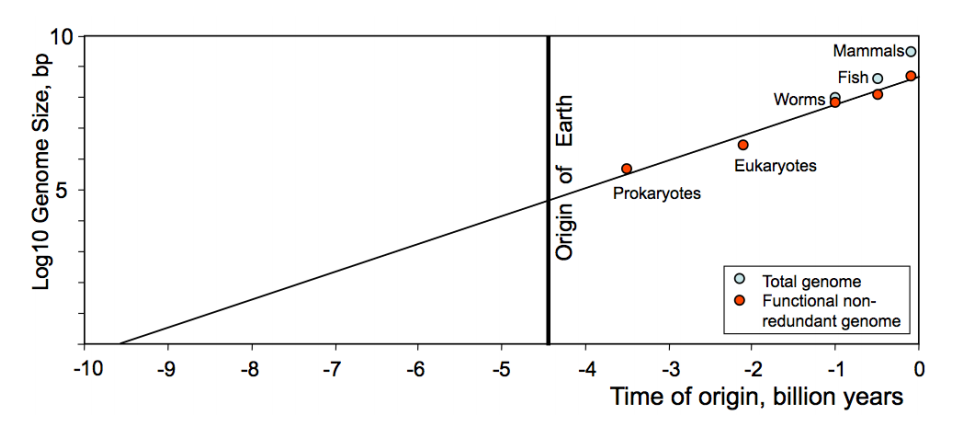
DoctorBit writes "MIT Technology Review is running a story about an arXiv paper in which geneticists Alexei A. Sharov and Richard Gordon propose that life as we know it originated 9.7 billion years ago. The researchers estimated the genetic complexity of phyla in the paleontological record by counting the number of non-redundant functional nucleotides in typical genomes of modern day descendants of each phylum. When plotting genetic complexity against time, the researchers found that genetic complexity increases exponentially, just as with Moore's law, but with a doubling rate of about once every 376 million years. Extrapolating backwards, the researchers estimate that life began about 4 billion years after the universe formed and evolved the first bacteria just before the Earth was formed. One might image that the supernova debris that formed the early solar system could have included bacteria-bearing chunks of rock from doomed planets circling supernova progenitor stars. If true, this retro-prediction has some interesting consequences in partly resolving the Fermi Paradox. Another interesting consequence for those attempting to recreate life's origins in a lab: bacteria may have evolved under conditions very different from those on earth." -
Moore's Law and the Origin of Life
DoctorBit writes "MIT Technology Review is running a story about an arXiv paper in which geneticists Alexei A. Sharov and Richard Gordon propose that life as we know it originated 9.7 billion years ago. The researchers estimated the genetic complexity of phyla in the paleontological record by counting the number of non-redundant functional nucleotides in typical genomes of modern day descendants of each phylum. When plotting genetic complexity against time, the researchers found that genetic complexity increases exponentially, just as with Moore's law, but with a doubling rate of about once every 376 million years. Extrapolating backwards, the researchers estimate that life began about 4 billion years after the universe formed and evolved the first bacteria just before the Earth was formed. One might image that the supernova debris that formed the early solar system could have included bacteria-bearing chunks of rock from doomed planets circling supernova progenitor stars. If true, this retro-prediction has some interesting consequences in partly resolving the Fermi Paradox. Another interesting consequence for those attempting to recreate life's origins in a lab: bacteria may have evolved under conditions very different from those on earth." -
A German Parking Garage Parks Your Car For You
moon_unit2 writes "Tech Review has a story about a garage in Ingolstadt, Germany, where the cars park themselves. The garage is an experiment set up by Audi to explore ways that autonomous technology might practically be introduced; most of the sensor technology is built into the garage and relayed to the cars rather than inside the cars themselves. It seems that carmakers see the technology progressing in a slightly different way to Google, with its fleet of self-driving Prius. From the piece: 'It's actually going to take a while before you get a really, fully autonomous car,' says Annie Lien, a senior engineer at the Electronics Research Lab, a shared facility for Audi, Volkswagen, and other Volkswagen Group brands in Belmont, California, near Silicon Valley. 'People are surprised when I tell them that you're not going to get a car that drives you from A to B, or door to door, in the next 10 years.'" -
Obama Wants To Fund Clean Energy Research With Oil & Gas Funds
An anonymous reader writes "The Obama Administration has put forth a proposal to collect $2 billion over the next 10 years from revenues generated by oil and gas development to fund scientific research into clean energy technologies. The administration hopes the research would help 'protect American families from spikes in gas prices and allow us to run our cars and trucks on electricity or homegrown fuels.' In a speech at Argonne National Laboratory, Obama said the private sector couldn't afford such research, which puts the onus on government to keep it going. Of course, it'll still be difficult to get everyone on board: 'The notion of funding alternative energy research with fossil fuel revenues has been endorsed in different forms by Republican politicians, including Alaskan senator Lisa Murkowsi. But the president still faces an uphill battle passing any major energy law, given how politicized programs to promote clean energy have become in the wake of high-profile failures of government-backed companies.'"