Slashdot Mirror
Domain: textfiles.com
Stories and comments across the archive that link to textfiles.com.
Stories · 39
-
Re-Discovering The 'Lost Civilization' of Dial-Up BBS's (ieee.org)
An anonymous Slashdot reader writes: Two new articles take a look at "social media's dial-up ancestor" from back in the 20th century. First a new article in IEEE Spectrum remembers a time when tens of thousands of dial-up bulletin board systems kept modems busy all around the world playing chintzy "door" games, downloading textfiles and ANSI art, and reading messages left on FidoNet's "echo" forums. "To understand how the Internet became a medium for social life, you have to widen your view beyond networking technology and peer into the makeshift laboratories of microcomputer hobbyists of the 1970s and 1980s...amateurs tinkering in their free time to build systems for computer-mediated collaboration and communication." And the former sysop at "The Cave" has also written a new article about visiting the few surviving BBSes, some still in operation since 1983, many now accessible via telnet, and some still even delivering messages over FidoNet's phone-to-phone network.
Anyone else have fond memories of visiting (or running) a BBS? -
Jason Scott of Textfiles.com Is Trying To Save a Huge Storage Room of Manuals
martiniturbide writes: Remember Jason Scott of Textfiles.com, who wanted your AOL & Shovelware CDs earlier this year? Right now -- at this moment! -- he trying to save the manuals in a huge storage room that was going to be dumped. It is a big storage room and some of these manuals date back to the thirties. On Monday a team of volunteers helped him to pack some manuals to save them. Today he needs more volunteers at "2002 Bethel Road, Finksburg, MD, USA" to try to save them all. He is also accepting Paypal donations for the package material, transportation and storage room payment. You can also check his progress on his twitter account. -
Jason Scott of Textfiles.com Is Trying To Save a Huge Storage Room of Manuals
martiniturbide writes: Remember Jason Scott of Textfiles.com, who wanted your AOL & Shovelware CDs earlier this year? Right now -- at this moment! -- he trying to save the manuals in a huge storage room that was going to be dumped. It is a big storage room and some of these manuals date back to the thirties. On Monday a team of volunteers helped him to pack some manuals to save them. Today he needs more volunteers at "2002 Bethel Road, Finksburg, MD, USA" to try to save them all. He is also accepting Paypal donations for the package material, transportation and storage room payment. You can also check his progress on his twitter account. -
Jason Scott of Textfiles.com Wants Your AOL & Shovelware CDs
eldavojohn writes: You've probably got a spindle in your closet, or a drawer layered with them: the CD-ROM discs that were mailed to you or delivered with some hardware that you put away "just in case." Now, of course, the case for actually using them is laughable. Well, a certain eccentric individual named Jason Scott has a fever — and the only cure is more AOL CDs. But his sickness doesn't stop there, "I also want all the CD-ROMs made by Walnut Creek CD-ROM. I want every shovelware disc that came out in the entire breadth of the CD-ROM era. I want every shareware floppy, while we're talking. I want it all. The CD-ROM era is basically finite at this point. It's over. The time when we're going to use physical media as the primary transport for most data is done done done. Sure, there's going to be distributions and use of CD-ROMs for some time to come, but the time when it all came that way and when it was in most cases the only method of distribution in the history books, now. And there were a specific amount of CD-ROMs made. There are directories and listings of many that were manufactured. I want to find those. I want to image them, and I want to put them up. I'm looking for stacks of CD-ROMs now. Stacks and stacks. AOL CDs and driver CDs and Shareware CDs and even hand-burned CDs of stuff you downloaded way back when. This is the time to strike." Who knows? His madness may end up being appreciated by younger generations! -
Internet Archive Launches Arcade of Classic Games In the Browser
SternisheFan tips news that the Internet Archive has launched the "Internet Arcade," a collection of over 900 arcade games from the '70s, '80s, and '90s that are free to play in an emulated, browser-based environment. The Arcade makes use of JavaScript Mess, which the crew at the Archive has been working on for several years. Obviously, a lot of people are going to migrate to games they recognize and ones that they may not have played in years. They’ll do a few rounds, probably get their @$%^& kicked, smile, and go back to their news sites. A few more, I hope, will go towards games they've never heard of, with rules they have to suss out, and maybe more people will play some of these arcades in the coming months than the games ever saw in their "real" lifetimes. And my hope is that a handful, a probably tiny percentage, will begin plotting out ways to use this stuff in research, in writing, and remixing these old games into understanding their contexts. -
Internet Archive Launches Arcade of Classic Games In the Browser
SternisheFan tips news that the Internet Archive has launched the "Internet Arcade," a collection of over 900 arcade games from the '70s, '80s, and '90s that are free to play in an emulated, browser-based environment. The Arcade makes use of JavaScript Mess, which the crew at the Archive has been working on for several years. Obviously, a lot of people are going to migrate to games they recognize and ones that they may not have played in years. They’ll do a few rounds, probably get their @$%^& kicked, smile, and go back to their news sites. A few more, I hope, will go towards games they've never heard of, with rules they have to suss out, and maybe more people will play some of these arcades in the coming months than the games ever saw in their "real" lifetimes. And my hope is that a handful, a probably tiny percentage, will begin plotting out ways to use this stuff in research, in writing, and remixing these old games into understanding their contexts. -
Archive.org Hosts Massive Collection of MAME ROMs
An anonymous reader writes to point out a giant gift to the world from the Internet Archive: a massive collection of MAME ROMs, playable in your browser using Javascript Mess. From the blog post announcing this extension of the already mind-blowing Internet Archive: "Like the Historical Software collection, the Console Living Room is in beta – the ability to interact with software in near-instantaneous real-time comes with the occasional bumps and bruises. An army of volunteer elves are updating information about each of the hundreds of game cartridges now available, and will be improving them across the next few days. Sound is still not enabled, but is coming soon. Faster, more modern machines and up-to-date browsers work best with the JSMESS emulator." -
Prince of Persia Source Code Released On Github
rbarreira writes "The source code for the original Prince of Persia game has been released on github by its author, Jordan Mechner. This release comes three weeks after Jordan announced the find of a box containing old floppy disks that had been forgotten in the back of a closet for 20+ years. A 'digital archeology' effort was launched to recover the contents of the floppy disks, with the help of Jason Scott from textfiles.com. Some photos from the 'copy party' have also been posted." -
Telehack Re-Creates the Internet of 25 Years Ago
saccade.com writes "Telehack.com has meticulously re-created the Internet as it appeared to a command line user over a quarter century ago. Drawing on material from Jason Scott's TextFiles.com, the text-only world of the 1980s appears right in your browser. If you want to show somebody what the Arpanet looked like (you didn't call it the "Internet" until the late '80s) this is it. Using the 'finger' command and seeing familiar names from decades ago (some, sadly, ghosts now) sends a chill down your spine." -
The Art of the Animated GIF
theodp writes "Some artists work in oils, some in pastels, some in acrylics. Photographer Jamie Beck and motion graphics artist Kevin Burg? Their medium of choice is animated GIFs. 'We wanted to tell more of a story than a single still frame photograph but didn't want the high maintenance aspect of a video,' said the two of their unusual collaboration. Needless to say, these are not your father's GeoCities 'Under Construction' GIFs — it can take several hours of manual editing for Beck and Burg to breathe the whisper of life into each image." -
Geocities To Be Made Available As a 900GB Torrent
An anonymous reader writes "Felt a shortage of the blink tag in your life lately? Well, have no fear. One year after Geocities was shut down in a cost-cutting move by Yahoo, a group self-styled as 'The Archive Team' have announced they will be releasing a ~900GB torrent file archive. It doesn't have every single site, but they believe they got most of it. The team believes that it's important to not just delete our digital culture, and as crazy as Geocities may have been, it was an important cultural milestone in the history of showing that anyone could create content online." -
Archive Team Is Busy Saving Geocities
jamie found this note from Jason Scott, who organizes the Archive Team. They are busy downloading as much of Geocities as they can before it vanishes from the Net after Yahoo pulled the plug. (Note: that textfiles.com link is a good candidate for Readability.) "..after 48 hours of work, Archive Team has saved over 200,000 Geocities sites. We're now pulling in new sites at the rate of something like 5 a second. Is that fast enough? We'll see, won't we. ... A side-effect of the whole process is I now know way, way, way too much [sic] about Geocities than I ever expected to. We've had to dissect every aspect of how the site functions to understand how to mirror things, from its history through how it does crazy javascript ads. Some of it is stupid and some is hilarious... We think we have most every site from 1999 and before on Geocities that was left. ... It is more important to me to grab the data than to figure out how to serve it later. People who have been talking about copyright and stuff seem to think I'm going to sell it or take credit or some crap. I don't see how the final collection won't end up online, but how is elusive — maybe a torrent of a bunch of zip files, or as a curated collection, or as a bunch of hard drives. However it is, I'll make sure people can get it, somehow." -
Protection From Online Eviction?
AOL has been shutting down its free Web services, in some cases with little or no notice to users, and they are not the only ones. This blog post on the coming "datapocalypse" makes the case that those who host Web content should be required to provide notice and access to data for a year, and be held strictly accountable the way landlords are before they can evict a tenant. Some commenters on the post argue that you get what you pay for with free Web services, and that users should be backing up their data anyway. What do you think, should there be required notice and access before online hosts take user data offline for good? -
Tales from a BBS Junkie
Jason Scott writes "As someone who is bathed in Bulletin Board System (BBS) history nearly every waking hour, I can sometimes feel like I'm the only one going completely out of his way to find narratives. It's easy enough to copy together a bunch of floppy disks or scan a bunch of printouts but that's not really the glue of what put the online world together and why it still holds a strong meaning for people who were there. As a result, I'm always seeking out people to tell their stories from a personal perspective, or at least take a good shot at putting together the human side of the whole BBS era for the sake of those who missed it. If I'm lucky, I stumble upon a few sites where people do a great job of cobbling together what they didn't throw out from their teenage years. I might even find an extended story out on a website, spanning multiple pages." Read the rest of Jason's review. COMMODORK: Sordid Tales from a BBS Junkie author Rob O'Hara pages 167 publisher Lulu.com rating 8 reviewer Jason Scott ISBN 978-1-84728-582-9 summary A memoir of one young teenager's life in the BBS world in the 1980s
With Rob O'Hara's book Commodork: Sordid Tales from a BBS Junkie, I believe we have the world's first BBS Memoir. Weighing in at around 160 pages, O'Hara covers his life from 1977 through to 2002, tracing the effect that Bulletin Boards, videogames, and computers have had on his life. Just 33 years old, it might seem strange for someone to write an autobiographical narrative so soon, but like a lot of youth who've grown up in the age of the home computer, O'Hara's gotten a lot of living done in that short time.
This is a self-published book, or more accurately, an author-controlled book. It is currently distributed by Lulu.com, an on-demand printer that provides you with a very "book"-looking book that you would be hard-pressed to think didn't come right off the shelves of the local chain bookstore. The only difference is there's no professional editor jamming through the work before it gets to you. It's easy to find flaws in a lack of slickness and flow in a self-published book, but also no real filtering out of "the good stuff", either. So I think of this book as a real sweet homebrew creation, rough-hewn but full of heart, not unlike the boards it talks about.
Because of this, the first few dozen pages are choppy. O'Hara works his way around his memories to find his voice: He tries to explain what it is that drives a person to still keep a pile of Commodore 64s in his garage, or build a 20-machine arcade in his back yard (the author includes a picture of this great-looking playroom), or even to want to talk about this history in the first place. He covers it from different angles: the urge to be a collector, the nostalgic dad remembering his carefree days, and the computer guy with the cred built up from now-decades of experience with the machines. He also struggles, initially, with who the book is for: folks completely unaware of the history of the BBS and home computers of the 1980s, or other 30 and up computer geeks who want to take a joyride through a shared childhood? In doing so, he actually touches on some great thoughts on what attracts people to old pieces of plastic and microchips, and why things were so different for him.
A sixth of the way in, O'Hara dispenses with the helping hand, cracks his knuckles, and goes in whole hog. Instead of asking if anyone gets it, he assumes you've gotten this far because you want to know it, jams the wayback machine into full throttle, and plunges into the world of BBSing for a teenager in Oklahoma. Except, of course, it's really every BBS kid's childhood: The little bargains, the quiet victories, the betrayals, the triumphs.
The heart and soul of the book actually are warez. Warez in the old sense, of newly-acquired one-off floppies of games, painstaking bargained for, traded, and spread out to gain fame and reputation. Throughout the book, it comes back to the warez, and O'Hara does an absolutely fantastic job of capturing the sense of power and expression that engulfs a teenager who has been able to use his skills or his patience to get his hand on a program that nobody else has and then turn around and use that slight lead to his advantage. The methods he uses are laid out in brilliant detail; one involves registering with bulletin boards in a city his family will be vacationing in shortly, allowing his far away "exotic" location to be verified by the system operator, and then traveling to that city and leeching them dry for a free local call.
O'Hara never lets it get dry and technical; it's about people he met while trading software, the kind of people who he partied with, got into fights with, or loved. He's not always nice and he's not always the hero; what really rings true is how none of it feels pumped up or faked, dressed up as some inherently soul-searching activity where every moment in bristling with poignant meaning. That said, some of it rings very close to the heart indeed.
In fact, this book's greatest effect may be the touchstone it provides for one's own experiences. Even as Rob's younger self is getting drunk at a BBS party and stumbling in panic from a perceived bust into the flatbed of a parked truck to sleep it off, I'm harkening back in my own mind to events that accompanied my BBSing that I'd forgotten wholly and totally. But I was there again, saving my own warez for the right moment, meeting my own soon-to-be-lifelong friends, making my own grievous mistakes. Anyone who used BBSes for any period of time will want to run to their keyboards and tell their own story; I see a lot of long e-mails in Mr. O'Hara's future.
One small disclaimer: On page 14 of the edition of the book I have, Rob mentions my BBS Documentary, but just to say it's not what he was aiming for with his book. And he's right; we don't step in each other's territory and his book does what my film couldn't; go front to end on one boy's story to turning into a man online. And for that, I thank him, and I think a lot of others will too.
Is it for everyone? No way, but a book that takes on its subject so intensely shouldn't be. If you or an older sibling or parent touched a plastic-and-metal home computer, sipped your bandwidth through a modem, or held a 5 1/4" floppy disk in your bag to give to someone else, this book is your book. It might even be your memories, too.
It's a good book and can be ordered through Lulu or directly from the author, who sells autographed copies.
Slashdot welcomes readers' book reviews -- to see your own review here, read the book review guidelines, then visit the submission page. -
Tales from a BBS Junkie
Jason Scott writes "As someone who is bathed in Bulletin Board System (BBS) history nearly every waking hour, I can sometimes feel like I'm the only one going completely out of his way to find narratives. It's easy enough to copy together a bunch of floppy disks or scan a bunch of printouts but that's not really the glue of what put the online world together and why it still holds a strong meaning for people who were there. As a result, I'm always seeking out people to tell their stories from a personal perspective, or at least take a good shot at putting together the human side of the whole BBS era for the sake of those who missed it. If I'm lucky, I stumble upon a few sites where people do a great job of cobbling together what they didn't throw out from their teenage years. I might even find an extended story out on a website, spanning multiple pages." Read the rest of Jason's review. COMMODORK: Sordid Tales from a BBS Junkie author Rob O'Hara pages 167 publisher Lulu.com rating 8 reviewer Jason Scott ISBN 978-1-84728-582-9 summary A memoir of one young teenager's life in the BBS world in the 1980s
With Rob O'Hara's book Commodork: Sordid Tales from a BBS Junkie, I believe we have the world's first BBS Memoir. Weighing in at around 160 pages, O'Hara covers his life from 1977 through to 2002, tracing the effect that Bulletin Boards, videogames, and computers have had on his life. Just 33 years old, it might seem strange for someone to write an autobiographical narrative so soon, but like a lot of youth who've grown up in the age of the home computer, O'Hara's gotten a lot of living done in that short time.
This is a self-published book, or more accurately, an author-controlled book. It is currently distributed by Lulu.com, an on-demand printer that provides you with a very "book"-looking book that you would be hard-pressed to think didn't come right off the shelves of the local chain bookstore. The only difference is there's no professional editor jamming through the work before it gets to you. It's easy to find flaws in a lack of slickness and flow in a self-published book, but also no real filtering out of "the good stuff", either. So I think of this book as a real sweet homebrew creation, rough-hewn but full of heart, not unlike the boards it talks about.
Because of this, the first few dozen pages are choppy. O'Hara works his way around his memories to find his voice: He tries to explain what it is that drives a person to still keep a pile of Commodore 64s in his garage, or build a 20-machine arcade in his back yard (the author includes a picture of this great-looking playroom), or even to want to talk about this history in the first place. He covers it from different angles: the urge to be a collector, the nostalgic dad remembering his carefree days, and the computer guy with the cred built up from now-decades of experience with the machines. He also struggles, initially, with who the book is for: folks completely unaware of the history of the BBS and home computers of the 1980s, or other 30 and up computer geeks who want to take a joyride through a shared childhood? In doing so, he actually touches on some great thoughts on what attracts people to old pieces of plastic and microchips, and why things were so different for him.
A sixth of the way in, O'Hara dispenses with the helping hand, cracks his knuckles, and goes in whole hog. Instead of asking if anyone gets it, he assumes you've gotten this far because you want to know it, jams the wayback machine into full throttle, and plunges into the world of BBSing for a teenager in Oklahoma. Except, of course, it's really every BBS kid's childhood: The little bargains, the quiet victories, the betrayals, the triumphs.
The heart and soul of the book actually are warez. Warez in the old sense, of newly-acquired one-off floppies of games, painstaking bargained for, traded, and spread out to gain fame and reputation. Throughout the book, it comes back to the warez, and O'Hara does an absolutely fantastic job of capturing the sense of power and expression that engulfs a teenager who has been able to use his skills or his patience to get his hand on a program that nobody else has and then turn around and use that slight lead to his advantage. The methods he uses are laid out in brilliant detail; one involves registering with bulletin boards in a city his family will be vacationing in shortly, allowing his far away "exotic" location to be verified by the system operator, and then traveling to that city and leeching them dry for a free local call.
O'Hara never lets it get dry and technical; it's about people he met while trading software, the kind of people who he partied with, got into fights with, or loved. He's not always nice and he's not always the hero; what really rings true is how none of it feels pumped up or faked, dressed up as some inherently soul-searching activity where every moment in bristling with poignant meaning. That said, some of it rings very close to the heart indeed.
In fact, this book's greatest effect may be the touchstone it provides for one's own experiences. Even as Rob's younger self is getting drunk at a BBS party and stumbling in panic from a perceived bust into the flatbed of a parked truck to sleep it off, I'm harkening back in my own mind to events that accompanied my BBSing that I'd forgotten wholly and totally. But I was there again, saving my own warez for the right moment, meeting my own soon-to-be-lifelong friends, making my own grievous mistakes. Anyone who used BBSes for any period of time will want to run to their keyboards and tell their own story; I see a lot of long e-mails in Mr. O'Hara's future.
One small disclaimer: On page 14 of the edition of the book I have, Rob mentions my BBS Documentary, but just to say it's not what he was aiming for with his book. And he's right; we don't step in each other's territory and his book does what my film couldn't; go front to end on one boy's story to turning into a man online. And for that, I thank him, and I think a lot of others will too.
Is it for everyone? No way, but a book that takes on its subject so intensely shouldn't be. If you or an older sibling or parent touched a plastic-and-metal home computer, sipped your bandwidth through a modem, or held a 5 1/4" floppy disk in your bag to give to someone else, this book is your book. It might even be your memories, too.
It's a good book and can be ordered through Lulu or directly from the author, who sells autographed copies.
Slashdot welcomes readers' book reviews -- to see your own review here, read the book review guidelines, then visit the submission page. -
Hundreds of Hours of BBS Documentary Interviews
Jason Scott writes "Hi, this is Jason Scott, director of the BBS Documentary, a 4 year project to tell the story of the dial-up bulletin board systems of the 70s, 80s and 90s. The documentary's out, for sale, and is completely Creative Commons licensed. But like most documentaries, there's tons of stuff left on the cutting room floor. And that just won't do. I'm happy to announce that I have partnered with archive.org to present what will be hundreds of hours of interviews online. The BBS Documentary Interview Collection will be extended edits of the 205 interviews I conducted, presented as video and audio files, along with ZIP archives of all the photos and supporting materials for that interview. And of course, every minute is Creative Commons licensed as well. It's going to take me upwards of half a year to edit and upload the half-terabyte of files; I hope people watch a few hours here and there to get an even deeper knowledge of the history of the BBS, or maybe even make a documentary of their own." -
Geeks as the Media at Notacon
sinnergy writes "One of the Midwest's only remaining "hacker" cons, Notacon, will be happening April 8-10, 2005 in Cleveland. As an interesting subtext, an extraordinary amount of interest in independent media coverage for this event has been occurring. One project includes Jason Scott's Notacon Radio project. The Packet Sniffers are doing their own Notacon TV project. In addition, numerous other online media outlets, oline radio shows and bloggers have really picked up on the idea of events like these being truly valuable to the geek community. Even the local geek radio show is keen on the idea. Richard Thieme, one of the event's selected speakers, has promoted the hacker con as being one of the final bastions of open speech. Is this the birth of a new trend or is this simply geeks doing what they always do... spreading the word about something new and different going on in their world?" -
Slashback: Indymedia, Starfighter, Mozparty
Slashback, below, brings updates and followups to several recent Slashdot stories, including Diebold's (trivial) financial penalty for copyright abuse, reviews of 'The Last Starfighter,' an inquiry into the best response to the recent seizure of Indymedia's servers in the UK, and the upcoming, distributed Mozparty2 to celebrate the 1.0 releases of Firefox and Thunderbird. Read on for the rest.An apology might be a nice start. Chris writes "The UK government has broken its silence on the Indymedia server raid and is claiming that there 'no UK law enforcement agencies were involved'; see Richard Allan's blog for the whole written answer. This means that the potential for taking legal action against Rackspace in the UK needs to be explored -- were any UK laws (eg the Data Protection Act 1984 or the Regulation of Investigatory Powers Act 2000) broken? Are there any UK cyber law experts on Slashdot with any suggestions...?"
Is Google private enough for you? XeRXeS-TCN writes "Following on from the recent concerns reported on Slashdot about the Google Desktop, the CEO of Copernic has warned about user privacy. Google Desktop Search allows users to opt out of sending the company back detailed usage data, but it isn't possible to firewall it completely. Much more ominously, Google's product manager Marissa Mayer said she expected the private queries to generate more hits for google.com. Most people, she believed, would choose to combine personal and web searches resulting in more revenue for Google's ad business. More on this at The Reg."
If this is a dupe, then Murphy was right. Vcullen writes "The Formula that scientists recently proposed to calculate Murphy's Law has recently been turned into an easy to use online Murphy's Law calculator. So now you can work out what the probability of it happening on any given situation!"
Nice shooting, kid. Bravo! Jason Scott writes "Inspired by the Slashdot story about the arrival of 'The Last Starfighter: The Musical' off-Broadway, I drove from Boston to New York City and back in one day to attend a matinee. I have written a review of what I experienced on my weblog. As I say in the review, 'If spoilers do not interest you, if you only want the simplest of directions and want to make the next right move, then heed these words: if you live within driving, walking, bus or train distance of New York City, see this musical. Immediately.'"
And ottffs writes with his own impressions: "I was recently in Manhattan presenting at ACM Multimedia 2004 conference. I was lucky enough to be able to attend the premiere of 'The Last Starfighter: the musical' on Friday night. I have posted a review and some pics to my blog."There goes the next office party budget. JimMarch(equalccw) writes "After losing a major copyright case in which Diebold was punished for exercising their copyright in a wrongful fashion (copyWRONG?), the other shoe has dropped: the court says Diebold owes the ISPs and webmasters who complained a total of $125,000. "
Anyone care to start one for El Paso? loconet writes "Following the success of Mozilla's 1.0 release parties, where Mozilla supporters from all over the world celebrated the release of Mozilla 1.0, comes Mozparty 2 celebrating the upcoming 1.0 release of Mozilla Firefox and Mozilla Thunderbird. According to the Mozparty site, currently there are 1007 ppl partying in 109 parties from which the biggest party is in Mexico."
-
Slashback: Indymedia, Starfighter, Mozparty
Slashback, below, brings updates and followups to several recent Slashdot stories, including Diebold's (trivial) financial penalty for copyright abuse, reviews of 'The Last Starfighter,' an inquiry into the best response to the recent seizure of Indymedia's servers in the UK, and the upcoming, distributed Mozparty2 to celebrate the 1.0 releases of Firefox and Thunderbird. Read on for the rest.An apology might be a nice start. Chris writes "The UK government has broken its silence on the Indymedia server raid and is claiming that there 'no UK law enforcement agencies were involved'; see Richard Allan's blog for the whole written answer. This means that the potential for taking legal action against Rackspace in the UK needs to be explored -- were any UK laws (eg the Data Protection Act 1984 or the Regulation of Investigatory Powers Act 2000) broken? Are there any UK cyber law experts on Slashdot with any suggestions...?"
Is Google private enough for you? XeRXeS-TCN writes "Following on from the recent concerns reported on Slashdot about the Google Desktop, the CEO of Copernic has warned about user privacy. Google Desktop Search allows users to opt out of sending the company back detailed usage data, but it isn't possible to firewall it completely. Much more ominously, Google's product manager Marissa Mayer said she expected the private queries to generate more hits for google.com. Most people, she believed, would choose to combine personal and web searches resulting in more revenue for Google's ad business. More on this at The Reg."
If this is a dupe, then Murphy was right. Vcullen writes "The Formula that scientists recently proposed to calculate Murphy's Law has recently been turned into an easy to use online Murphy's Law calculator. So now you can work out what the probability of it happening on any given situation!"
Nice shooting, kid. Bravo! Jason Scott writes "Inspired by the Slashdot story about the arrival of 'The Last Starfighter: The Musical' off-Broadway, I drove from Boston to New York City and back in one day to attend a matinee. I have written a review of what I experienced on my weblog. As I say in the review, 'If spoilers do not interest you, if you only want the simplest of directions and want to make the next right move, then heed these words: if you live within driving, walking, bus or train distance of New York City, see this musical. Immediately.'"
And ottffs writes with his own impressions: "I was recently in Manhattan presenting at ACM Multimedia 2004 conference. I was lucky enough to be able to attend the premiere of 'The Last Starfighter: the musical' on Friday night. I have posted a review and some pics to my blog."There goes the next office party budget. JimMarch(equalccw) writes "After losing a major copyright case in which Diebold was punished for exercising their copyright in a wrongful fashion (copyWRONG?), the other shoe has dropped: the court says Diebold owes the ISPs and webmasters who complained a total of $125,000. "
Anyone care to start one for El Paso? loconet writes "Following the success of Mozilla's 1.0 release parties, where Mozilla supporters from all over the world celebrated the release of Mozilla 1.0, comes Mozparty 2 celebrating the upcoming 1.0 release of Mozilla Firefox and Mozilla Thunderbird. According to the Mozparty site, currently there are 1007 ppl partying in 109 parties from which the biggest party is in Mexico."
-
7 hour BBS Documentary Nearly Ready
spyrochaete writes "Jason Scott, proprietor of textfiles.com, is nearing completion of his 3-DVD, 7 hour documentary on the history of the BBS. This documentary is 3 years in the making and is a patchwork of nearly 250 interviews spanning hundreds of hours. Trailers and samples are available for download (also available in low quality for you 300 BAUDers out there). Pre-order before Nov. 10 and you can submit a paragraph to be included on a file on one of the DVDs." -
Slashback: Documentary, Directory, FUD
Slashback tonight brings some updates and clarifications to previous stories, including news of the successful production of both a BBS documentary and an open-source directory. Read on for more!I goof, therefore I am sorry. Many readers submitted rebuttals to the claim I repeated that an Israeli web portal was the first to give users 1GB email accounts; Protein Shake, for one, writes that Spymac has them beat. "Forget Google, forget Israel's web portal... 1 GB e-mail is already out there. At least a few weeks ago. From their site '1 GB e-mail account, 350 MB combined storage, personal blog, forum, gallery, auctions and more...'"
"And this was back when phone lines were just strings painted to resemble copper ..." Jason Scott writes "The BBS Documentary, announced on Slashdot nearly three years ago, has wrapped up filming. With over TWO HUNDRED interviews in the can, I've been spending a lot of my spare time (and not-so-spare time) editing, but I decided to put out the first of what will likely be a few trailers for it. Stop by and check out how I've spent the last few years. The Documentary will be released as a 3-DVD set later this year."
It's like Who's Who, only different. Another gargantuan effort completed on a different front: Tony Stanco writes with word that "The 910-page Open Source Reference Book is available for download."
The project was announced just over a year ago; considering the contents that's not a bad turnaround.
It's nearly enough to make one cynical. Alex Wolfe writes "In a move worthy of the Luddites, the New York City Council is quietly trying to ban the Segway . The Council has proposed a law that's technically a ban on motorized scooters, but Harris Siliver, founder of Citystreets, an urban improvement organization, says the NYC Department of Transportation is specifically targeting the electric, non-polluting Segway. Silver is joined in his opposition to the bill by Apple cofounder Steve Wozniak."
Get out much? If you just can't get enough random flamebait, here's a small fix to follow the anti-Linux FUD spread earlier this month by Green Hills CEO Dan O'Dowd. InfoSec writes "This morning's Security Focus page had an article about Consumer Grade *nix. The writer of the article slams Linux for not having free automated updates, enabling services in default installations, and not warning users when they are using 'root'. Uhmm, I could be wrong, but hasn't Mandrake been doing that for quite some time?"
apt-get update seems to count as free updates to me (though those folks do take donations), and root-use warnings may not be perfectly applied, but they are found in various forms (depending on distro) at OS, WM, and application levels, including notices that certain tasks can only be run as root or other superuser. (I think it's Xchat that calls me "an idiot" when I've tried to run it as root.)
-
Homebrew Carts and Coin-Ops - Phillyclassic 5
Jason Scott writes "I've put up my gallery of images from Phillyclassic 5, taken on Saturday, March 20th (and posted that night). Phillyclassic is a large classic games convention being held in King of Prussia, PA. They have a very informative webpage with details... I drove 600 miles in one day to stop in, and it was worth it. Homebrew carts for sale, lots of free arcade games to play, and all manner of vendors and characters. The convention's not over, either.. it lasts throughout Sunday the 21st, so if you didn't know about it, get down there! If you're nearby, you have no excuse!" -
ACiD Productions Releases Final Artpack
Jason Scott writes "Among the people I have interviewed for the forthcoming BBS Documentary are members of what was known, throughout the 90s, as the 'ANSI Scene'. They released artpacks of ANSI art on BBSes across the world, and then later on the Internet. Among these were members of the group known as ANSI Creators in Demand, or ACiD. Besides inventing the artpack, the group has continued to release them for the last 13 years... until now. The group's leader, RaDMan, has announced the arrival of the 100th and final artpack. Clocking in at a mind-boggling 400 megabytes plus, it contains high-rez, ASCII, and of course ANSI art, as well as a huge selection of music. It even has a rap featuring RaDMan himself claiming domination over the art scene. The download page lets you grab it in FTP, HTTP, and Bittorrent. If you ever spent an evening poring over the latest 'pack', now's the time to see ACiD's last hurrah." -
Book Review: Hacking TiVo
Jason Scott writes "TiVo: You love it or you haven't met it. For those who have it (or are thinking of getting one), a new book is out about all the different ways to modify, increase capacity, or even program TiVos. Whether you want to just add a little capacity to your TiVo's drives or turn it into a full-blown home entertainment center hooked into your home LAN, Jeff Keegan has written a massive and all-encompassing book on this rewarding art." Read on for the rest of Jason's review. Hacking TiVo: The Expansion, Enhancement and Development Starter Kit author Jeff Keegan pages 500 publisher Wiley Publishing, Inc. rating 10 reviewer Jason Scott ISBN 0764543369 summary Everything from admining how cool TiVos are to turning them into your home entertainment server. Exhaustive, elaborate, and funny.As a relatively early convert to the TiVo way of life, I always found it hard to describe to people who didn't have one why their lives could be changed by it. If I was lucky, I could get friends to visit and with a few short minutes of demonstration, I'd sold another one. If they were farther away, I just hoped they would stop by some day and I'd have another convert. Why was I so intent on this? Because if you watch TV, or even if you don't watch as much as you used to, TiVo can change your life completely. It frees you from the tyranny of watching shows when you're told to watch them, and then goes on to turn your entire television experience from one bombarded with ads and missing all the "good stuff" on scattered random channels, to a true symbiotic relationship where you sit down in front of the tube and every single moment is one filled with shows you want to watch about stuff you're interested in.
A lot of Slashdot readers know what I'm talking about, because they have a TiVo or other PVR in their home right now. So when I tell you that this book will take your TiVo to the next level, I hope you get as excited as I was after reading the dozens of tricks, programs, and hacks this book lists.
The opening chapter describes, in succinct but energetic fashion, why every person with a TV should have a TiVo. Keegan's description may fall towards the evangelical side of things, but he goes out of his way to explain why his feelings are so strong. In fact, this book has an interesting side-effect: converting those who don't own a TiVo. Just a quick browse through the first few chapters will have someone who's heard of TiVo but never used one chomping at the bit to get down to the store. To the TiVo army, this is a powerful munition indeed.
From there, it's a powerful spiral into chapter after chapter of modifications, starting with back doors in the code and moving into opening the TiVo's case (explained with lots of clear pictures), adding storage, and even working with the TiVo's OS (a variation of Linux) to turn it into a web-accessible site or to improve performance.
One inspiring chapter describes the author's experience at a baseball game, having his father go to get refreshments and missing some great plays, and the author pulling out his Palm Pilot with cellular modem to tell his TiVo over the web to record the game's highlights on the news. With that tantalizing trick presented, Keegan goes into the whole involved deal, everything from modifying the TiVo to creating the external server to feed the TiVo information.
As I said, the tricks come fast and furious: TiVo as a way to browse photo galleries. TiVo pulling down the current weather and presenting the radar maps. TiVo printing Caller ID information on the screen when someone calls. By the time you're done with the book, you'll be wondering what there is that you can't do with it. And that, to me, is the sign of a truly great instructional book.
A warning: If you want a neutral voice in the author, this isn't the book for you. Keegan's enthusiasm drips from many pages, written in the tone of the guy down the street with the new toy who simply has take you to the den and show you how cool it is, describing in greater and greater detail all the cool stuff he's discovered tinkering with it. The author's wife, newborn daughter, mother and father make appearances all throughout the book, including a particularly touching description of having his father design an assembly language program to manipulate an LED display. No, really, it's touching. I did a search for Jeff and information on him and I found a photo of him in this costume. Honestly, I'm speechless. The man has achieved what we call "full commitment."
By about halfway through the book it stops being an instruction manual and begins being a full-on reference book, giving you explicit instructions on programming in Tcl, mucking about in Linux, and generally being a hard-core warranty violator. One appendix is dedicated to being a Tcl reference list while another hits you up for some basic Linux training (to be able to work comfortably in the OS).
Keegan has also been kind enough to include a CD-ROM with pretty much all the programs and utilities needed to accomplish what's in his book. It's a telling personal trait that he apologizes for putting it all on a CD instead of enabling readers to go out and search for the programs themselves.
To say I learned things in this book is an amazing understatement. Just to know that some of these things are even possible with my TiVo guarantee how I'll be spending the next few hundred dollars, buying larger drives, getting a cache card, and wiring the machine for ethernet. And Yes, it tells you how to get the shows off of your TiVo onto your computer's hard drive.
When I ordered this book from Amazon, I found out it was an Amazon exclusive, so that's the only place to get it right now. On the other hand, I was able to get my copy in a very short time, so I'm fine with that ... but I hope that you can get it in other places in the future. Regardless, it was worth the money I paid for it, especially since Amazon had 30 percent off in some effort to push to product. Great for me; I'm glad this book came into my collection and I think any TiVo owner (or hopeful TiVo owner) will agree.
Slashdot welcomes readers' book reviews -- to see your own review here, read the book review guidelines, then visit the submission page. -
30th Anniversary of the Microcomputer
FreezerJam writes "The Toronto Star is running an article on the 30th anniversary of the launch of the MCM/70, the first personal computer, complete with tape drive and APL programming environment. For those of you checking your timeline, this is over a year before the article on the Altair 8800 was published. Microcomputers? Blame Canada!" There's also a story in the Globe and Mail. -
Come to Rubi-Con in Detroit, March 28-30
Jason Scott writes "The 5th annual Rubi-Con hacker conference is about to begin just outside of Detroit, Michigan. From the 28th to the 30th of March, there'll be talks, movies, and general tomfoolery. Last year had 600 attendees and we expect a ton more this year. If you've never been to a hacker conference before, this is an easy place to start. Check out the schedule, speakers and fun at the Rubi-con website." -
The 25th Anniversary of the BBS
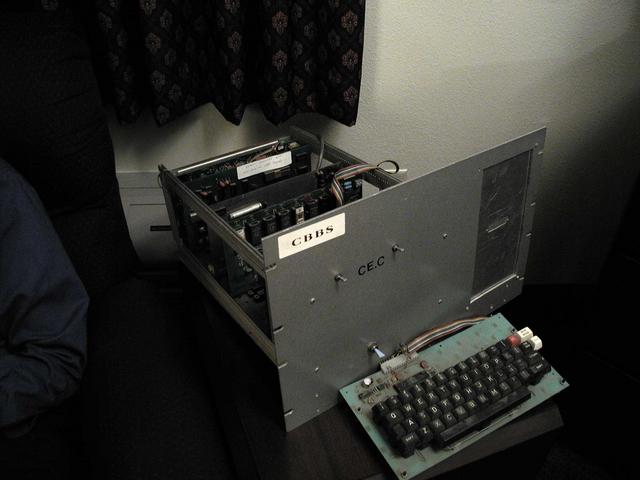
Jason Scott writes "25 years ago today, Ward Christensen and Randy Suess officially announced the creation of a little project they threw together with a 300 baud Hayes modem, a Z-80 based S-100 computer, and a phone line. They called it "Chicago Bulletin Board System" (CBBS) and it was the first dial-up BBS. From this beginning, BBSes grew into the many thousands and became an entire industry, and when the Internet started to mature with the World Wide Web, the users who had cut their teeth on BBSes moved over to it. So raise a toast to these two fellows for a quarter century of great online times." -
The 25th Anniversary of the BBS
Jason Scott writes "25 years ago today, Ward Christensen and Randy Suess officially announced the creation of a little project they threw together with a 300 baud Hayes modem, a Z-80 based S-100 computer, and a phone line. They called it "Chicago Bulletin Board System" (CBBS) and it was the first dial-up BBS. From this beginning, BBSes grew into the many thousands and became an entire industry, and when the Internet started to mature with the World Wide Web, the users who had cut their teeth on BBSes moved over to it. So raise a toast to these two fellows for a quarter century of great online times." -
Put The Demoscene In Your DVD Player
Jason Scott writes "With the recent story on slashdot about a big demo party, it might be good to let everyone know about the absolutely incredible Mind Candy DVD, where a very dedicated group of people from "the scene" have spent two years painstaking recovering demos from obscurity, finding the old 286 and 386 hardware, installing the needed (obsolete) cards, and capturing them perfectly in full digital glory. They also have information on what exactly the "scene" is, in case you've missed this incredibly creative use of computers from the past 20 years. This whole process cost them thousands of dollars and untold hours. Check it out, see what you missed... or never forgot." -
The BBS Documentary: A One Year Report
Jason Scott writes: "Readers of Slashdot might remember some stories posted about a BBS Documentary that was being filmed. Well, we're at about a year of production and I've released a status report about the project, including some pictures, some statistics (over 120 hours of footage have been filmed!) and some information about where the project is heading. If you remember reading about it last year and are wondering what's up with it, check it out." -
BBS Documentary Starting To Film
Jason Scott writes "Well, the BBS Documentary, after years of research and 4 months of pre-production, is set to film starting the first week in January. Once the filming starts, it's a solid year or more of interviews, travel, and hopefully some great footage of some very unique and interesting people. I'd like to thank Slashdot for the burst of letters and support, and I really appeciate the contacts they've helped me make with an amazing spectrum of folks to interview. The list is not complete, but I've so far gotten a great list of interviewees who helped make the Dial-Up BBS what it is in history (and today, I rush to add). Of course, the research is never done, and I encourage people to check out the BBS Software List and the timeline to help me flesh them out even more." -
BBS Documentary Starting To Film
Jason Scott writes "Well, the BBS Documentary, after years of research and 4 months of pre-production, is set to film starting the first week in January. Once the filming starts, it's a solid year or more of interviews, travel, and hopefully some great footage of some very unique and interesting people. I'd like to thank Slashdot for the burst of letters and support, and I really appeciate the contacts they've helped me make with an amazing spectrum of folks to interview. The list is not complete, but I've so far gotten a great list of interviewees who helped make the Dial-Up BBS what it is in history (and today, I rush to add). Of course, the research is never done, and I encourage people to check out the BBS Software List and the timeline to help me flesh them out even more." -
BBS Documentary Starting To Film
Jason Scott writes "Well, the BBS Documentary, after years of research and 4 months of pre-production, is set to film starting the first week in January. Once the filming starts, it's a solid year or more of interviews, travel, and hopefully some great footage of some very unique and interesting people. I'd like to thank Slashdot for the burst of letters and support, and I really appeciate the contacts they've helped me make with an amazing spectrum of folks to interview. The list is not complete, but I've so far gotten a great list of interviewees who helped make the Dial-Up BBS what it is in history (and today, I rush to add). Of course, the research is never done, and I encourage people to check out the BBS Software List and the timeline to help me flesh them out even more." -
A Documentary About Bulletin Board Systems
Windrip writes: "Jason Scott is compiling a history of the BBS. The BBS documentary is a virtual park bench waiting for people who want to reminisce about the good old days of FIDO, 9600 baud, zmodem. /. had an earlier post from Jason about textfiles.com, now he's looking for a few of the million stories in the naked net." -
Every BBS That Ever Was
Jason Scott writes: "With a collection of over 30,000 textfiles from the 1980's, I suddenly got a rather weird thought: Why not start taking all the BBSes mentioned in all the textfiles and create a really, really huge BBS list? A few weeks later, I'm up past 77,000 BBSes listed, with many including the Sysop's name, software used, and if you're lucky a relatively accurate timespan for the years that BBS graced the telephone network. I've imported FidoNet nodelists, WildCat! customer lists, and a whole range of other lists as I find them (USBBS List, Darwin List, etc.). Come by and remember what places sucked up all YOUR long distance calls and sleepless nights, trying to get past the busy signals. I'm also making an open call for everyone and anyone to send me old BBS lists to integrate. With luck, we can have some sort of permanent record of all the BBSes we ever knew." -
Every BBS That Ever Was
Jason Scott writes: "With a collection of over 30,000 textfiles from the 1980's, I suddenly got a rather weird thought: Why not start taking all the BBSes mentioned in all the textfiles and create a really, really huge BBS list? A few weeks later, I'm up past 77,000 BBSes listed, with many including the Sysop's name, software used, and if you're lucky a relatively accurate timespan for the years that BBS graced the telephone network. I've imported FidoNet nodelists, WildCat! customer lists, and a whole range of other lists as I find them (USBBS List, Darwin List, etc.). Come by and remember what places sucked up all YOUR long distance calls and sleepless nights, trying to get past the busy signals. I'm also making an open call for everyone and anyone to send me old BBS lists to integrate. With luck, we can have some sort of permanent record of all the BBSes we ever knew." -
Every BBS That Ever Was
Jason Scott writes: "With a collection of over 30,000 textfiles from the 1980's, I suddenly got a rather weird thought: Why not start taking all the BBSes mentioned in all the textfiles and create a really, really huge BBS list? A few weeks later, I'm up past 77,000 BBSes listed, with many including the Sysop's name, software used, and if you're lucky a relatively accurate timespan for the years that BBS graced the telephone network. I've imported FidoNet nodelists, WildCat! customer lists, and a whole range of other lists as I find them (USBBS List, Darwin List, etc.). Come by and remember what places sucked up all YOUR long distance calls and sleepless nights, trying to get past the busy signals. I'm also making an open call for everyone and anyone to send me old BBS lists to integrate. With luck, we can have some sort of permanent record of all the BBSes we ever knew." -
Enormous 80s Textfile Archive
Jason Scott writes "I have opened a new WWW site dedicated to the textfiles (also known as "g-philes" or "etexts") that populated the BBS World of the 1980's. Of course, in doing so, I have also gathered together many, many files from the 60's, 70's, and 90's. The purpose of this is to provide a central repository for this important part of online culture to bring back memories or show where we came from. The site is called www.textfiles.com and is well past 9,000 textfiles online. " -
Enormous 80s Textfile Archive
Jason Scott writes "I have opened a new WWW site dedicated to the textfiles (also known as "g-philes" or "etexts") that populated the BBS World of the 1980's. Of course, in doing so, I have also gathered together many, many files from the 60's, 70's, and 90's. The purpose of this is to provide a central repository for this important part of online culture to bring back memories or show where we came from. The site is called www.textfiles.com and is well past 9,000 textfiles online. "