Slashdot Mirror
Domain: tuwien.ac.at
Stories and comments across the archive that link to tuwien.ac.at.
Stories · 15
-
Researchers Create Simulation Of a Simple Worm's Neural Network (tuwien.ac.at)
ClockEndGooner writes: Researchers at the Technische Universitat Wein have created a simulation of a simple worm's neural network, and have been able to replicate its natural behavior to completely mimic the worm's natural reflexive behavior. According to the article, using a simple neural network of 300 neurons, the simulation of "the worm can find its way, eat bacteria and react to certain external stimuli. It can, for example, react to a touch on its body. A reflexive response is triggered and the worm squirms away. This behavior is determined by the worm's nerve cells and the strength of the connections between them. When this simple reflex network is recreated on a computer, the simulated worm reacts in exactly the same way to a virtual stimulation -- not because anybody programmed it to do so, but because this kind of behavior is hard-wired in its neural network." Using the same neural network without adding any additional nerve cells, Mathias Lechner, Radu Grosu, and Ramin Hasani were able to have the nematode simulation learn to balance a pole "just by tuning the strength of the synaptic connections. This basic idea (tuning the connections between nerve cells) is also the characteristic feature of any natural learning process." -
Holographic Principle Could Apply To Our Universe
New submitter citpyrc sends this news from the Vienna University of Technology: The "holographic principle" asserts that a mathematical description of the universe actually requires one fewer dimension than it seems. What we perceive as three dimensional may just be the image of two dimensional processes on a huge cosmic horizon. Up until now, this principle has only been studied in exotic spaces with negative curvature. This is interesting from a theoretical point of view, but such spaces are quite different from the space in our own universe. Results obtained by scientists at Vienna (abstract) now suggest that the holographic principle even holds in a flat spacetime, like ours. -
More Quantum Strangeness: Particles Separated From Their Properties
Dupple sends word of new quantum mechanical research in which a neutron is sent along a different path from one of its characteristics. First, a neutron beam is split into two parts in a neutron interferometer. Then the spins of the two beams are shifted into different directions: The upper neutron beam has a spin parallel to the neutrons’ trajectory, the spin of the lower beam points into the opposite direction. After the two beams have been recombined, only those neutrons are chosen which have a spin parallel to their direction of motion. All the others are just ignored. ... These neutrons, which are found to have a spin parallel to its direction of motion, must clearly have travelled along the upper path — only there do the neutrons have this spin state. This can be shown in the experiment. If the lower beam is sent through a filter which absorbs some of the neutrons, then the number of the neutrons with spin parallel to their trajectory stays the same. If the upper beam is sent through a filter, than the number of these neutrons is reduced.
Things get tricky when the system is used to measure where the neutron spin is located: the spin can be slightly changed using a magnetic field. When the two beams are recombined appropriately, they can amplify or cancel each other. This is exactly what can be seen in the measurement, if the magnetic field is applied at the lower beam – but that is the path which the neutrons considered in the experiment are actually never supposed to take. A magnetic field applied to the upper beam, on the other hand, does not have any effect. -
Nanoscale Race Car Gets 3D Printed With a Laser
An anonymous reader writes "Researchers at the Vienna University of Technology have managed to perfect 3D printing at the nanoscale. What may look like a grain of sand to the human eye could in fact be a detailed racing car model, a reproduction of a famous church, or London Bridge. The 3D printer relies on a laser beam directed by mirrors through a liquid resin onto a surface. It can print at 5 meters per second, which is a world record, and the end result is only a few hundred nanometers in size. The next hurdle: printing with bio-material so we can start making our own body parts/organs." -
From Austria, the World's Smallest 3D Printer
fangmcgee writes "Printers which can produce three-dimensional objects have been available for years. However, at the Vienna University of Technology, a printing device has now been developed which is much smaller, lighter and cheaper than ordinary 3D-printers. With this kind of printer, everyone could produce small, tailor-made 3D-objects at home, using building plans from the internet — and this could save money for expensive custom-built spare parts." -
Bandwidth Use In MMOs
Massively is running a story about bandwidth costs for MMOs and other virtual worlds. It's based on a post at the BBC on the same subject which references a traffic analysis (PDF) done for World of Warcraft. Quoting: "If you're an average user on capped access, the odds are you have roughly 20Gbytes per month to allocate among all of your Internet usage (it varies depending on just where you are). For you, sucking back (for example) a 2GB World of Warcraft patch isn't something you can just do. It's something you have to plan for — and quite often you have to plan for in the following month. Even a 500MB download has to be handled with caution. MMOGs as a rule don't use a whole lot of bandwidth in actual operation. However, the quantity definitely rises in busy areas with lots of players, where there are large numbers of mobs, or on raids, and takes quite a much larger jump if you're using voice as well." -
GM Says Driverless Cars Will Be Ready By 2018
Gregor Stipicic writes "Cars that drive themselves — even parking at their destination — could be ready for sale within a decade, General Motors Corp. executives say. 'This is not science fiction,' Larry Burns, GM's vice president for research and development, said in a recent interview. GM plans to use an inexpensive computer chip and an antenna to link vehicles equipped with driverless technologies. The first use likely would be on highways; people would have the option to choose a driverless mode while they still would control the vehicle on local streets, Burns said. He said the company plans to test driverless car technology by 2015 and have cars on the road around 2018." -
European Students to Put Microsatellite Into Orbit
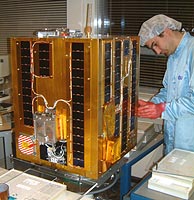
Astervitude writes "A Frankenstein's microsatellite made out of parts "donated" by university students across Europe will be launched on September 30 atop a Russian booster. Space.com reports that more than 400 students "spread across 23 universities and 12 countries" spent 18 months designing and building the SSETI Express. While its acronym sounds suspiciously similar to that of a project that seeks to uncover signs of intelligent life beyond Earth, the SSETI or Student Space Exploration Technology Initiative mission is actually part of an effort by the European Space Agency "to boost student interest in space technology and offer some hands-on experience." The satellite itself weighs a mere 136 pounds and is the "size of a small washing machine", as shown in this ESA photo. Visitors to the mission site may want to check out the contest page for ham radio operators to help collect data from the satellite." -
European Students to Put Microsatellite Into Orbit
Astervitude writes "A Frankenstein's microsatellite made out of parts "donated" by university students across Europe will be launched on September 30 atop a Russian booster. Space.com reports that more than 400 students "spread across 23 universities and 12 countries" spent 18 months designing and building the SSETI Express. While its acronym sounds suspiciously similar to that of a project that seeks to uncover signs of intelligent life beyond Earth, the SSETI or Student Space Exploration Technology Initiative mission is actually part of an effort by the European Space Agency "to boost student interest in space technology and offer some hands-on experience." The satellite itself weighs a mere 136 pounds and is the "size of a small washing machine", as shown in this ESA photo. Visitors to the mission site may want to check out the contest page for ham radio operators to help collect data from the satellite." -
Distributed Computing For Businesses?
Meostro asks: "I've run several distributed computing clients in the past, and it felt nice to contribute to these projects that are saving the world. I recently became the admin of my company's branch datacenter, so my access to computing power has gone from 4 assorted boxes up to 20 servers and around 400 desktops. My ambition has grown by equal bounds, so I want to do some distributed processing on at least a few of these. We do food warehousing and distribution, so there's no protein folding, DSP or weather modelling work that would significantly contribute to our business. I've done some simple work with optimizing routes for our trucks, but our business doesn't seem to present many other problems that require lots of processing. What are some good business-specific tasks you have used distributed or grid computing to work through?" -
Best Sci-Fi Space Battles?
ardor asks: "Recently, while watching Babylon5, I wondered about the space dogfights in popular sci-fi outings. I find the space battle in Star Wars VI to be still one of the best in existence, and some battles from B5 are amazing too. But where are more good space fights? I've found them to be surprisingly rare. Most are very short, or not very big (less than 5 ships). I know, large & complex scenes are very expensive, nevertheless I mean some with tons of small interceptor & bomber ships, large/huge cruisers, stations, and so forth. Have you watched a really awesome space battles, and if so, what show/movie was it?" -
Can You Trust Microsoft On Security?
simetra writes "Here's a shocker... This story on Yahoo! is pointing out the obvious. How many of these until the suits start believing us?" Maybe the article is just trying to stir up trouble, though: ladislavb points out that Windows XP is an Operating System you can trust. (The review is also available on mirror1, mirror2, mirror3, mirror4.) -
Slashback: Imagination, Redistribution, Stiction
Tirelessly flogging the dead horses of industry, crunching gravel where Angels fear to tread past sundown, gathering wool that no sheep has ever known, and shooting nanodarts packed with moss spores deep into any stones which happen to roll by, here's another helping -- Large but not SuperSized -- of assorted errata and addenda. Even some lizards.Igor, throw that switch, would you? It's getting drafty in here. After all the attention that the various projects working to codify the the Human Genome have gotten in the past few years, the audacity of what Celera and the Human Genome Project itself are doing has seemingly faded into the commonplace. That may change soon, as first drafts of the genetic sequence of a human being are expected both from Celera and the HGP.
Phasers back on stun, and bring us back to DefCon 3. Turn down that klaxon, ensign. According to this CNN story, that darn Serbian Badman Trojan may not have been much of a threat; despite dire predictions otherwise by NetSec echoed by everyone from CNN to Slashdot. At least, the FBI doesn't seem too concerned. Thanks to ghoti, who alerted us to the downgrade.
All I want is friggin' sharks with friggin' lasers on their heads ... If you enjoyed reading Time-Digital's recent Neal Stephenson interview, you may be intrigued by the article contributed by The Original Bobski, pondering questions like ""How can the future-fiction business hope to compete against our reality of humanoids who wear life-altering computers and elongate their lives with superdrugs and genetic mutation? How is it possible for any self-respecting science fiction writer to hope to stay ahead of the headlines?" Neal himself is quoted, along with a passel of SciFi writers who might be familiar to regular readers of the Slashdot Book Reviews section. Seems that The Future just keeps on arriving ...
iCrave TV: OK for Sasketchewanians, not Pittsburgers. julez writes "Back in April www.icravetv.com was taken offline because of numerous lawsuits. This article on CBC online says that they are set to relaunch their service in the fall on a subscription basis. Some stations will remain free, but, like cable, "specialty channel packages" will cost you $8-$9 a month. And of course, it will only be availble to Canadians via some unnamed security software." From the article: "The privately held Internet company showed 17 Canadian and U.S. stations when its site started last November. The service drew more than 800,000 viewers in its first month." That's a market, folks. ("Quick, shut it down! Somebody might make some money if we're not careful!") Read more about iCrave on Slashdot.
If Nike builds sneakers like this, we'd happily worship the swoosh. After the wall-climbing robot tech that hemos pointed out a few days ago, ABCNews.com serendipitously featured some more information about the Real Thing. Real Geckos, that is. How do they stick to walls? Well, here are some hints: no glue, no suction cups, no bubble gum and no special effects.
-
Whatever Happened To 4GL Tools?
ghoti asks: "A while back, I read about 4GL tools, and what could be done with them. Now I wonder why nobody is using them. The idea sounded so logical: Design a program at an abstract level, then add more information until the tool can create code or at least a framework. Now this might not be the best way to go about writing Quake IV, but for many applications, this would be very nice. Is anybody using such tools? Why not?" -
IBM Prototypes 200 ppi LCD
ghoti writes "IBM has developed a 200 ppi LCD. This is an interesting development, since you can put much more information into the same space - and keep it readable as well. And fonts would look a lot better, too ... So finally, those 32 MB graphics cards will become mainstream ..." Is 200 ppi worth it? It definitely would make anti-aliasing fonts under X less of a priority ;)