Slashdot Mirror
Domain: ucr.edu
Stories and comments across the archive that link to ucr.edu.
Comments · 689
-
Picture and other info
Certainly has a plethora of "design" uses if not many "functional" uses.
Check out the picture: The liquid in a magnetic field
And those of you with Interscience acccess here's the pdf
A neat aspect of this is it simply reflects light. It's not a light source. I could see a pool in Vegas using a derivative of this (albeit with a NO PACEMAKER SIGN on it) to make a multi-color pool. Or imagine what the Cirque du Soleil engineers could do with this.
I agree those, in terms of LCD replacement we'd really have to see what the chip guys can do. -
Witten 3D;Re:How does a dimension have a scale?
Loops and Strings 2007 with discussion of Witten's amazing new paper on on 3D Gravity.
MoonshineMath blog
October 10, 1995
This Week's Finds in Mathematical Physics (Week 66)
John Baez introduction to the Monster Group.
Background on Conformal Field Theory (needed to follow Witten's paper:
Wikipedia pretty good intro.
-- Prof. Jonathan Vos Post -
Re:Bombula
Trillions of kilometers? That's about 1/10th of a light year, you need at least 8 light years for interstellar travel (and we'd be pretty amazingly lucky to have intelligent life so close to us).
Try "gajillion bazillion manyillian kilometers". Interstellar space travel is pretty ridiculous, and not just because we can't think of a technology that could do it, but because a technology that could do it and not take millenniums would be impossible.
Most of all why would they bother coming all this way? If they did want to travel so far just to say "hello, what's up?" why not do it via radio? This would be much faster and easier.
Actually travelling can be much faster than radio. Special relativity limits communication between fixed parties to the speed of light, because it limits observed travel to the speed of light. Contrary to popular opinion, it does not limit subject travel to any speed whatsoever. While the traveller will never "technically" see his destination approaching with a velocity faster than the speed of light, he will see the distance to is destination relativistically contracting as his speed increases.
Therefore, in a space craft that could accelerate and 1g for half the trip, then decelerate at 1 g for half the trip, Special Relativity predicts you would reach the center of the galaxy in 20 years, covering a distance of (from earth perspective) 30 thousand light years. From earth perspective, our max speed was 0.999999999 c and it took us hundreds of thousands of years to get there. Our perceived speed at any instant was never any faster, but because of the changing length contraction, at journey's end, our perceived distance travelled over time was 1500*c.
These are the lengths of time it would take to travel to the following places using the 1g acceleration/deceleration method. (From http://math.ucr.edu/home/baez/physics/Relativity/S R/rocket.html)
4.3 ly nearest star ==> 3.6 years
27 ly Vega ==> 6.6 years
30,000 ly Center of our galaxy ==> 20 years
2,000,000 ly Andromeda galaxy ==> 28 years
n ly ==> 1.94 arccosh (n/1.94 + 1) years
As an added bonus, if you made the trip to Andromeda, you'd get observe 2 million years of galaxy evolution over your 28 year trip. -
Re:Higgs bosonYup, which suggests that discovering it, and understanding it, may give us some control over mass and inertia.. or, to put that in layman's terms: anti-gravity If you have control over mass, you have control the m component of the special theory of relativity, and thus control over how much energy a particle represents. If you can come up with negative mass (necessary for gravitic repulsion), you can come up with negative energy.
Negative energy. Wormholes and warp drives. I think anti-gravity could quite possibly be the least interesting aspect of control over mass... -
Re:Higgs bosonYup, which suggests that discovering it, and understanding it, may give us some control over mass and inertia.. or, to put that in layman's terms: anti-gravity If you have control over mass, you have control the m component of the special theory of relativity, and thus control over how much energy a particle represents. If you can come up with negative mass (necessary for gravitic repulsion), you can come up with negative energy.
Negative energy. Wormholes and warp drives. I think anti-gravity could quite possibly be the least interesting aspect of control over mass... -
Fields are not aether
That sounds like Aether to me.
Nah, fields are mathematical formulations. Quantum field theory provides the virtual particles that more physically explain force interactions via probability amplitudes and so on. In fact, this is exactly what gave Feynman his quantum electrodynamics and subsequent Nobel prize (that he disliked). -
Re:Don't hold your breathAre you just nitpicking? No. If momentum has been conserved since the big bang, then there is surely a center of mass frame, and also a center of mass. Where do you think the center of mass of the universe is located? Consider the most popular geometries, planar and spherical. Where is the center of an infinite plane? Where is the center of a spherical surface? (Note: this is not "where is the center of a sphere", but rather, "which point on the surface of a sphere is its center"?) Both are ill defined: there is no unique point which is the center of a plane or a spherical surface.
The cosmic background isotropic frame is something analogous to a "center of momentum" frame, although it is not a "center of mass" frame. (Nitpicking, momentum is not globally conserved in general relativity, either, nor is energy; see here, noting the discussion of the unification of energy and momentum. Nevertheless, you can pick a particular frame in which there is spatial translation invariance — the cosmic background isotropic frame — which is what gives rise to momentum conservation in flat spacetime. In that sense, you can consider momentum to be conserved in that frame.) -
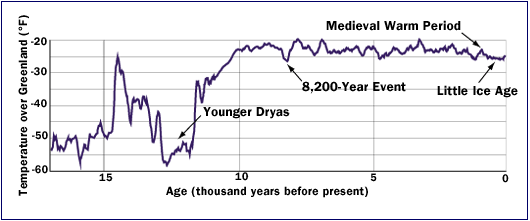
Re:Finally, someone said it
http://math.ucr.edu/home/baez/temperature/greenla
n d.18kyr.gif Nope seems to be reality -
Re:Pegs that variable in the Fermi equation...
I suppose that you are referring to Stephen Hawking? But perhaps you ought to refer to number 8 on the Crackpot Index.
-
Minimal life forms in 1997?Minimal life forms have been discovered/done since 1997, at least. One has 54 base pairs. While (like a virus) they need a host, they can reproduce, if one accepts this as a minimal definition of "life". Not sure how this relates to what is being patented, though.
Reference:
Eigen and Oehlenschlager, 30 years later - a new approach to Sol Spiegelman's and Leslie Orgel's in vitro evolutionary studies: dedicated to Leslie Orgel on the occasion of his 70th birthday, M. Eigen and F. Oehlenschlager, Orig. Life Evol. Biosph. 5-6 (1997), 437-457. http://math.ucr.edu/home/baez/subcellular.html#EO Spiegelman's monster
-
Re:Crippling ignorance?
(I'm tempted to call it crackpot theory but will leave that to an actual physicist)
Yes, it's a crackpot theory.
- sash, physicist.
(yes, mazarin5 came first on this, but I couldn't resist anyway...) -
Re:Nature is nothing if not clever'so typical' of what? These are all statistical correlations, they haven't described any biochemical reaction path from VitD to cancer, so they are just making a partially educated guess. They are totally wrong about the VitD causation for auto-immune disease.
Vitamin D,25 is not the active form. Other metabolites, such as vitamin D,1,25 are the active forms. High vitamin D,1,25 can cause by itself a lot of the symptoms of auto-immune disease. Since D,1,25 is converted from D,25, the low D,25 is a result of rapid conversion to D,1,25. Adding more D,25 just adds fuel to the inflammatory fire.
Start here: http://vitamind.ucr.edu/biochem.html
It is not due to vitamin D deficiency but is caused by not having enough calcium in the diet.
Much of previous beliefs about Vitamin D are being changed, see this
from the USDA website [ href="http://www.ars.usda.gov/research/publication s/publications.htm?SEQ_NO_115=169216"
]
It is not due to vitamin D deficiency but is caused by not having enough calcium in the diet.
this paper describes the disregulation of the vitamin d metabolism in the disease process. Macrophages can drive the vitamin D,25 levels low by generating damaging high levels of vitamin D,1,25. So, the current knowledge that low vitamin D causes disease is backwards, low vitamin D can be a indication of a disease process that is driving the D,25 levels low, while driving D,1,25 high.
One interesting point for Slashdot readers, is that a lot
of the lastest Vitamin D research is being driven by computer
modeling of the Vitamin D molecule and the various nuclear receptors it affects. see http://winmlm.neostrada.pl/vitamindbook/vitamindne wresearch.pdf
I would like to be clear that I'm not disagreeing with the result that higher VitaminD is correlated with Cancer. I'm just pointing out that it is likely not as simple as somebody eating too many eggs,
and just needing to cut back.
However, I do disagree with the side comment made that high Vitamin D might cause autoimmune disease. The research (and my personal experience) is that Vitamin D disregulation is caused by the autoimmune disease and clears up when the disease clears up. -
Re:Nature is nothing if not clever'so typical' of what? These are all statistical correlations, they haven't described any biochemical reaction path from VitD to cancer, so they are just making a partially educated guess. They are totally wrong about the VitD causation for auto-immune disease.
Vitamin D,25 is not the active form. Other metabolites, such as vitamin D,1,25 are the active forms. High vitamin D,1,25 can cause by itself a lot of the symptoms of auto-immune disease. Since D,1,25 is converted from D,25, the low D,25 is a result of rapid conversion to D,1,25. Adding more D,25 just adds fuel to the inflammatory fire.
Start here: http://vitamind.ucr.edu/biochem.html
It is not due to vitamin D deficiency but is caused by not having enough calcium in the diet.
Much of previous beliefs about Vitamin D are being changed, see this
from the USDA website [ href="http://www.ars.usda.gov/research/publication s/publications.htm?SEQ_NO_115=169216"
]
It is not due to vitamin D deficiency but is caused by not having enough calcium in the diet.
this paper describes the disregulation of the vitamin d metabolism in the disease process. Macrophages can drive the vitamin D,25 levels low by generating damaging high levels of vitamin D,1,25. So, the current knowledge that low vitamin D causes disease is backwards, low vitamin D can be a indication of a disease process that is driving the D,25 levels low, while driving D,1,25 high.
One interesting point for Slashdot readers, is that a lot
of the lastest Vitamin D research is being driven by computer
modeling of the Vitamin D molecule and the various nuclear receptors it affects. see http://winmlm.neostrada.pl/vitamindbook/vitamindne wresearch.pdf
I would like to be clear that I'm not disagreeing with the result that higher VitaminD is correlated with Cancer. I'm just pointing out that it is likely not as simple as somebody eating too many eggs,
and just needing to cut back.
However, I do disagree with the side comment made that high Vitamin D might cause autoimmune disease. The research (and my personal experience) is that Vitamin D disregulation is caused by the autoimmune disease and clears up when the disease clears up. -
Re:Universal gravityWell, if everything has gravity, then the universe itself has a gravitational pull. Eventually the mass of the universe would be such that any light trying to escape it would be pulled back inside, which would make the universe appear to be black hole from anyone on the outside looking in... It sounds like your teacher may have had the misconception that the universe is an expanding sphere, with stars and galaxies on the inside, and a void outside into which the matter expands.
That's not how Big Bang cosmology works, however. In that theory, all of space is filled with matter, and space itself expands, carrying the matter with it. There is no "edge".
Consequently, it doesn't make much sense to speak of light trying to "escape" the universe, since the universe has no boundary. That's why it's problematic to speak of the whole universe as a "black hole".
For a related FAQ, see here. -
Lots of scientific journals need to be boycotted
If you are about to publish a scientific paper, please read this call to action by the ever wonderful John Baez first and make your choice accordingly.
-
Re:Give us RIOTS!
An FPGA core in the CPU would make for some very interesting optimisations. But there is a problem: programs that used it would be very specialised, and forward/backward support would not be easy to arrange. If you compiled a program for, say, an Intellium 9000 processor and made use of the onboard Xiltera 90 FPGA, your program might not work when Intellium brought out the 9001 processor with the new Xiltera 110 FPGA. This is because FPGA bitstreams are extremely specialised: they work for exactly one FPGA model, not a family or product range. If this were not the case, then FPGA designs would be constrained by legacy support, which would be expensive at such a low level.
The solution to this might be just-in-time compilation of a platform independent netlist, using a CPU-specific driver provided by the OS. But none of the current FPGA manufacturers are willing to licence out their compilation tools for this purpose. And even if they did, the resource requirements for the tools are very high (they are slow). There are some academic projects involving hardware JIT (example), and these include more efficient versions of the place and route tools, so maybe one of those will provide the future direction.
An additional issue is how to stop bad bitstreams damaging the CPU. Bad software (illegal instructions) can't damage the CPU hardware, but FPGA bitstreams could... -
Re:Dangerous?
Newton's law underwent some serious revisiting in 1905 when a chap called Einstein realised that masses are not constant/absolute but in fact relative, and this is why the modern relativistic notation differs quite a bit from the original F=ma.
Not so. Even in Einstein's relativity, mass is invariant. -
Free Machine Language/Assembly books
You can fire up an emulator and start with something simple like Machine Language for Beginners...
Or download the PDF of The Art of Assembly Language from the book's fugly website.
-
Re:How to get started?
Art of Assembly Language by Randall Hyde, it's a very thorough introduction. http://webster.cs.ucr.edu/AoA/index.html
I read through the first 7 chapters of the 16-bit version just to get a feel for what sort of operations a CPU actually do when a program runs, it was very easy to read and understand. That was a while ago, I've not tried hard to advance to writing Win32 programs in assembly, because from what I could gather from brief scanning through Win32 ASM tutorials it is a right PITA to even get 'Hello World' to work in a window. There are example code to cut&paste in the tutes of course, but understanding *why* the code does what is quite involved, and without understanding there is no point doing anything in ASM. -
Re:How to get started?
Try the "Art of Assembly Language Programming" available free at this website http://webster.cs.ucr.edu/AoA/index.html it should get you started.
-
Re:How do you verify the credentials ...
At this point, I wouldn't trust anything I read in there to be true...I sincerely doubt that any of the editors or contributors have any credentials. Those types of folks tend to get published in real world journals, magazines and books.
I can't speak about most of the articles on Wikipedia one way or another, but I will say, as someone who does research in quantum physics, that the wiki articles on quantum mechanics and quantum information topics are characteristically pretty good in terms of content (though not necessarily quality of writing), and I would be very surprised if there aren't a number of Ph.D. scientists who contribute to them, given the high level of some of the information there.
Just because people get published in journals it doesn't follow that they won't also publish stuff for free online. See for example John Baez's extensive collection or writing. Also bare in mind that most journals (aside from a few review journals) are for publishing new discoveries while Wikipedia is mostly about sumaraizing and explaining existing knowledge, so they're somewhat orthogonal.
-
Re:More likely
There's more to this problem than just the issue of time. What if intelligent life exists in another galaxy (We have now identified more than 100,000 other galaxies in the universe.)
http://math.ucr.edu/home/baez/physics/Relativity/S R/rocket.html
According to the calculations in that article, using 1g acceleration someone from Andromeda (2 million light years) could reach us with only 28 years passing on board their ship. Sounds nice. Outside the ship, however, millions of years would have passed, which means that the visiting aliens would have had to leave their home planet before there was any human life on earth in order to arrive today.
Also, the fuel requirement, assuming 100% efficiency, is 4000 tons of fuel for every 1 kilogram of ship weight. And that's only if the visiting aliens want to go sailing past us. If they want to stop and visit, they have to start slowing down at the half-way point of the journey, which means:
1. They have to know exactly where they are going so that they know when to start slowing down. Coming from Andromeda, how would they even know that earth would be a desirable destination?
2. It greatly increases the fuel requirement -- 4 thousand million tons of fuel per kilogram of ship weight.
-
Re:More likely
You are correct... some interesting comments here http://math.ucr.edu/home/baez/physics/Relativity/
S R/rocket.html From the article, for 1g acceleration: Distance Location On Ship Time.
4.3 ly nearest star 3.6 years
27 ly Vega 6.6 years
30,000 ly Center of our galaxy 20 years
2,000,000 ly Andromeda galaxy 28 years
-
Economics of interstellar travel
Does anyone think we can afford that? The U.S.'s manned space and Moon/Mars initiative is strangling NASA and forcing it to shut down many of its science programs (here, here, here, here, here). It hasn't even started to get into the real spending for a Moon mission, let alone a Mars mission.
An interstellar mission would cost orders of magnitude more than an interplanetary mission. Who would ever fund it? Even an international collaboration would be hard pressed to put together much more than the currently planned Mars mission. And governments wouldn't be too keen to start a mission that can outlive entire nations before we hear the results.
"Frontier spirit" just doesn't cut it against those scales of money and time.
The only thing that likely could spur a manned interstellar mission, barring drastic improvements in technology, is the impending destruction of human civilization — and who would see that coming in time, with enough certainty, to spur the development of a crash program like that? (Especially given the wars likely to ensue if people are that sure of the annihilation of the human race.)
No, I don't see it happening unless we get much, much better technology. It costs enough just to lift things off Earth, let alone build and launch a working intergenerational starship. (The economics of space development given launch costs and the absence of space industry is an extra can of worms... and I am also not economically optimistic of the development of orbital factories or space elevators or the like.) -
Re:Evidence
Right now, the theory with the most evidence in its favor is the theory which includes a dark energy described by Einstein's cosmological constant. In that theory, the universe's expansion will continue to accelerate forever, although not at such a great rate that there is a "Big Rip" which tears atoms apart. That is the "heat death" scenario, in which the universe lasts forever and runs down until nothing much is going on. Because of the accelerating expansion, we will see fewer and fewer distant galaxies as time goes on, because they will accelerate away from us faster than light can reach us. Ultimately we will only see a few local galaxies in the cluster in which we are bound.
This scenario is explored in more detail here.
However, it's possible that the dark energy is dynamical instead of constant, and so the expansion of the universe could accelerate or possibly even reverse and decelerate. With enough deceleration, a Big Crunch is still feasible. There are also the scenarios in which our universe spawns new "universes", such as the one discussed here. -
Re:Self vs University trained ...
I think C adds a bit more than a library.
True, but the post I responded to had an example that was merely a call to printf.
I'm not really an expert in assembly but the addition of for example logical statements and loop structures in a language really do make a difference. And that is not library stuff.
FWIW, many CISC instruction sets have loop instructions, in x86:
for (i = 10; --i; ) { [some work] }
mov ecx, 10; label: [some work]; loop label;
The high level control structures are merely a convenience, something that is portable and more readable for the masses. Logical and loop operations in C typically only generate two or three assembly instructions in x86.
A higher level language is usually considered a higher level language partly because its library.
I don't think so. For example consider the UCR standard library for x86:
http://webster.cs.ucr.edu/AsmTools/MASM/stdlib/std libv1.html
High level languages are primarily for portability and convenience. There is also specialization of the convenience motivation for specific audiences. -
Re:Possible to make unlimited energy?
The reason the wiki article goes on about the second law (entropy increases) is because the first law (energy is conserved) is seen as being fairly obvious, e.g. a ball will never bounce higher than the level it was dropped from, and the first law applies both forwards and backwards in time. The second law is weird, since it is time inhomogeneous (entropy increases when time goes forward, and therefore would decrease as time goes backwards), and it seems to be more a statistical result than a scientific one.
It's interesting to note that the first law, conservation of energy, is not true within General Relativity within any bounded region, due to the existence of gravitational waves. Here's an article about it http://math.ucr.edu/home/baez/physics/Relativity/G R/energy_gr.html/. I provide only this as evidence that I'm not talking out of my arse - I could understand GR once, many years ago, but not now. -
Re:So work with it rather than fight it...
A funded journal would still be the best way to get the relevant information all in one place
The best place to get the relevant information is a peer-reviewed journal. There's no reason why it shouldn't be free; the publishers add almost no value. John Baez (a physicist) has a good article on this. Here's an example of a respected free journal.
Don't believe the publishers' FUD.
-
Re:actuallyDoes anything validate that particular point of the theory? The large number of experimental confirmations of relativity. Inertiality isn't actually a word, and I would presume it means a state of staying still, so in fact your state of motion would be staying still. It means motion subject to no external forces, i.e., constant velocity. The speed of light is not well-defined in a non-inertial frame of reference; it can have any value between 0 and infinity. The speed of light is different depending on the medium of its transit, and it does seem 'obvious' that if you had a proper measuring device and were travelling at near c yourself, then you would measure only a low speed for the speed of light that is moving in the same direction as you. It may seem "obvious", but it's wrong. That, again, is the point. light doesn't have infinite speed, therefore if you are moving at the speed of light, the light next to you will appear immobile. That was Einstein's original thought experiment, but he found that the answer was not "light is at rest with respect to you", but "nothing capable of measuring the speed of light can travel at the speed of light". He also found that if you're traveling arbitrarily close to the speed of light, say 99.9999999% of c, that the light next to you will travel at c. If it were possible to measure the speed of light with a radar gun, then it should be going slower if you are travelling in the same direction, and 'faster' if you were moving in the opposite direction. Except that doesn't actually happen. It's only "obvious" and logical if you make Newtonian assumptions about the nature of space and time. In relativity, the dual phenomena of time dilation and length contraction "conspire" to render the speed of light always c, no matter how fast you are moving.
-
Re:Black hole reproductionDue to some phyics which I don't understand, it is more likely to be antimatter which falls into it. It's not "more likely to be antimatter" which falls in. Matter and antimatter fall in with equal probability. It's the virtual particle with negative energy — be it matter or antimatter — which always falls in. That's the case 100% of the time because any virtual particle which enters the horizon must have negative energy "relative to" an external observer (crudely speaking).
You can read more about this point here.
Incidentally, no astrophysical sized black hole is currently evaporating, because the cosmic microwave background radiation is currently hotter than any such black hole's Hawking temperature. Thus, it gains more mass by absorbing the CMBR than it loses by Hawking radiation. It won't shrink from Hawking radiation until the CMBR cools below its Hawking temperature, which won't happen for ~10^66 years for a solar mass black hole (see here. If very light holes were created in the Big Bang, they could be still around and shrinking at the moment, though. -
Re:Someone help me understand relativityOf course the distance between pulses slows, but that is because the visual "recording" of the event is being stretched out over a longer "beam" of light. No, it's not just that. As I said before, there is also real time slowing, plus the finite speed of light. Relativity is not just Newtonian physics with a finite speed of light tacked on. It makes fundamentally different assumptions about time. Everything I've read just assumes that time travels at a different rate, and so the math must account for it. Why is this? Einstein originally assumed it for reasons that may sound esoteric (he wanted a mechanics that was compatible with Maxwell's theory of electromagnetism). There are many different sets of assumptions from which it can be derived.
You can get to relativity if you assume that light has a finite speed that is the same according to all observers. That's the usual way in which it is derived. Has it been proven? There are plenty of experiments which demonstrate time dilation (see here). -
Re:Someone help me understand relativity
The time dilation is not just an apparent effect due to the finite speed of light, it is also a real effect of time slowing down. Light not only shows up late, it comes slower. i.e., pulses of light sent at time 1, 2, 3,
You'll probably have to just sit down and learn enough special relativity to calculate what happens. To get the flavor of things, though, you can read this FAQ. I find the spacetime diagram explanation to be the clearest. -
Re:paraphrasing Douglas AdamsThe best page I ever saw describing what near c travel would be like is The Relativistic Rocket. It details what would happen if one were to travel for extended periods of time in a ship with constant acceleration. (Preferrably at 1g).
It provides equations giving the velocity and distance travelled by the ship in terms of time as viewed from where the rocket was launched and within the rocket itself. That and the explanations are definitely worth a read.
-
Re:Cool... hope it didn't cost too much
A hundred years ago a couple of guys tried to measure our speed through the "ether". They found that there was no ether. This lead to the idea that light must travel at the same speed no matter what reference frame you're in. This (and a few other things) lead to the ideas of quantum physics.
That's interesting -- another addition to the always-growing list of things I didn't know. I poked around for a link and found this: Is The Speed of Light Constant? Scroll down to the "Special Relativity" section for a description of how the search for the Speed of Light in the Ether led to the discovery of the slippery notion of "spacetime". -
Re:No there would not be a controversy
Ooh, you've just hit #34. 40 points!
-
Re:Global warming shows danger of exaggerating
The environmental left, which seems to be run by anti-capitalist intellectuals and the general misfits, though the foot soldiers are normal caring people that want to leave the world better, not worse, adopted the Marxist/Leninist ends justify the means, and it blew up in their faces. For example,there is now pretty much incontrovertible evidence that humans ARE causing an unprecedented shift in certain chemicals that tend to correlate with climate change in the past, and evidence that we are causing climate change. However, the champions of this are the same malcontents that championed global cooling, zero population growth because we were going to run out of food, and other problems that do not exist.
Actually, scientists also "championed" global climate changes being correlated to rising CO2 levels. The above statement almost lumps them in with all anti-capitalist leftists. Some hippie scientist also 'championed' the idea that the earth revolved around the sun at a time when it was politically unsavory . He paid for it in the short term, but he was still right, and the lies of his opposition ultimately caught up with them.
The interesting thing about the environmental commie leftists is that now George w. Bush has to start agreeing with them, at least with respect to polar bears. But, polar bears may stage a comeback and totally blow the hippies' credibility out of the water. One can only hope. -
Re:Black hole questionSo TFA mentions enormous black holes.
What happens to them? What's the lifecycle? They sit around, and get bigger every once in a while whenever something falls into them. Same as ordinary stellar black holes. At some point do they get big enough to suck themselves into their own little inaccessable chunk of spacetime? There is no upper limit on the size of a black hole, but at some point it has sucked up most of the matter nearby, and doesn't thus grow much after that. Or does Hawking radiation manage to eventually make a black hole evaporate away? That's possible, but supermassive black holes radiate very weakly. (The bigger the hole, the less it radiates.) They can't evaporate at all until the cosmic background radiation cools to below the black hole's Hawking temperature; otherwise, they absorb energy from the cosmic background and grow. A supermassive black hole will take about a googol (!) years to evaporate (see here) — assuming that black holes can completely evaporate out of existence. While I'm at it, is there any evidence that black holes attract dark matter? Not directly, no, since we can't directly detect dark matter. We know that galaxies attract dark matter, but we can't localize the attraction well enough to attribute specific parts of the attraction to black holes. However, since dark matter is attracted by gravity in general, there is no reason why it shouldn't be attracted by a black hole's gravity. -
Re:Heh!
OK!
First is WMAP Cosmology 101: Big Bang Concepts. I think this page is reputable, because the domain is map.gsfc.nasa.gov. There are a few things about this link- First, it makes no real commitments to shape. It says it's possible that the universe has a more complex shape than "closed sphere, flat, or open," but it's unwilling to commit to anything. That said, it suggests flat, by pointing out that "If the density just equals the critical density, the universe is flat, but still presumably infinite.
Another important thing to note there, is that they use the terms "universe" and "visible universe" almost interchangably. (See, for example, the first paragraph under "The Origin of the Cosmic Microwave Background.") This jives with what Wikipedia says about "Observable universe:" "Both popular and professional research articles in cosmology often use the term "universe" to mean "observable universe"." I try not to use Wikipedia, but if it points out something that seems to agree with other websites, I conditionally take it. So: When they talk about the "size" of the universe, they almost always mean the size of the observable universe. (see also...)
Yet another thing to note here, is that it says that the universe doesn't necessarily start at a point. The Big Bang may have occurred everywhere. The "bang" is about the space that is appearing between all galaxies, not that the universe was first bound into a nutshell, and then exploded outwards. A picture I have made in my head, (which may reflect astrophysicists understand, which may not reflect astrophysicists understanding,) is that, plausibly, first there was stuff everywhere, infinitely, in all direction, but, that as time passed, "additional blank space" was put between all the things that exist. The entire observable universe came from just one small tiny dot of the stuff that is everywhere. The space that we see is mostly stuff that was added, since time began. So it's not so much that the universe started out small, and then grew large, as it is that the universe started out infinite, and that infinite universe is scaling outward, like scaling the real numbers out by some multiplier, over and over and over again. (Supporting link: "In this picture the Big Bang occurred everywhere."
Here's another website, on curious.astro.cornell.edu. Cornell "astro"
Here's a 2006 educational publication, chapter 4 says that the universe is very nearly flat. This is typical of what I've seen on most sites. Note that in 5.1, he notes that the universe may be infinite; This, too, is fairly typical, in sites I see.
There are a number of newspaper articles, that have news of astronomers finding "hints" at one shape, or another shape, but there's nothing conclusive. In my experience, these articles are usually (A) confusing, and very likely (B) confused, and seem to be okay with that: "What will these wacky scientists come up with, next?" A funnel, a soccer ball, a pill,
When -
Re:Almost there...
so if I turn on my headlights of my spacecraft and i'm travelling at the speed of light, will they work? http://math.ucr.edu/home/baez/physics/Relativity/
S peedOfLight/headlights.html -
Re:Almost there...When talking about the universe expanding, people seem to only refer to the distances between galaxies increasing. But surely if the universe is expanding, it should be expanding on every level (ie macro and micro). No, that's not true. Systems that are bound (gravitationally, electrostatically, etc.) resist cosmological expansion. See this FAQ.
-
Re:Here's the problem though...If one point in space is expanding fast enough ("edge" of space) in relationship to another point (us), and then if the first object was accellerated to close to light speed velocities, away from the second point, wouldn't it appear as if the first object was moving away from the second object faster than the speed of light? Not exactly; this is an issue of relativistic addition of velocities. The thing is, we know the speed of light within space is constant, and under normal circumstances (all that we know, anyway) can't be breached. But that isn't accounting for the displacement due to "expanding space". Is it, then, possible to observe two extremely distant objects as moving away from each other faster than the speed of light? It's possible for us to see two objects moving away from each other faster than the speed of light, even in a non-expanding universe. We just can't see them moving away from us faster than light.
-
Re:Look and calculate all you want
The one question I have about the Big Bang is, if everything in the universe was in one place at one time, wouldn't the universe have been contained within a black hole?
No.
Is there a distance fro the center of the universe where light bends sufficiently to start returning to the center?
There is no center of the universe.
Is that why the universe appears to be uniformly distributed around us?
The universe is thought to be uniformly distributed around us ("isotropic") either because it started out distributed evenly, or perhaps more likely because inflation smoothed out whatever irregularities once existed.
If the universe is oscillating, then would we see the beginning of other previous universes if we look for the light that has oscillated back and forth?
It's possible for light from earlier in the universe's history to circumnavigate the universe and reappear from another direction. However, in light of inflation, it is thought unlikely that the universe is closed or small enough for us to see that. Also, cyclic universe theories with "previous universes" usually imply that no light from a previous universe will make it through a Big Bang event to be seen by us (even if we could see through the cosmic background radiation). -
Re:Look and calculate all you want
The one question I have about the Big Bang is, if everything in the universe was in one place at one time, wouldn't the universe have been contained within a black hole?
No.
Is there a distance fro the center of the universe where light bends sufficiently to start returning to the center?
There is no center of the universe.
Is that why the universe appears to be uniformly distributed around us?
The universe is thought to be uniformly distributed around us ("isotropic") either because it started out distributed evenly, or perhaps more likely because inflation smoothed out whatever irregularities once existed.
If the universe is oscillating, then would we see the beginning of other previous universes if we look for the light that has oscillated back and forth?
It's possible for light from earlier in the universe's history to circumnavigate the universe and reappear from another direction. However, in light of inflation, it is thought unlikely that the universe is closed or small enough for us to see that. Also, cyclic universe theories with "previous universes" usually imply that no light from a previous universe will make it through a Big Bang event to be seen by us (even if we could see through the cosmic background radiation). -
Re:Journalism?
I don't think any working scientist would deny that it's easier to publish work that fits with prevailing viewpoints and paradigms than to publish work that goes against them. That's perhaps not a problem - after all, if your one experiment flies in the face of well-established existing theory, is it more likely that (a) you've discovered a fundamental flaw with an enormous body of research, or (b) your findings were a Type I error?
But this notion that there's a conspiracy to keep out dissenting views seems a little nutty to me. Sure, big-shot scientists get their egos invested in their theories. But balanced against that is the fact that almost every scientist I know lives and breathes for the surprising or counterintuitive discovery or for the mysterious (replicable) anomaly that needs to be figured out -- that's why they went into science in the first place. Most scientists I know love to play the contrarian. You may need to produce more evidence if you're totally coming from left field, but you'll get an audience when you do. -
Re:Institutional Bias
-
Check the crackpot index
http://math.ucr.edu/home/baez/crackpot.html
The Telegraph article gets a pretty high score. -
Re:String Theory?
That doesn't seem to make much sense; the appropriately-large block of matter would then itself be generating gravitons, not blocking pull of two masses but adding to it
You can't block out gravitons (contrary to the original poster) for a similar reason; gravity is universally attractive, so you can't have the attraction + repulsion that combines to screen a force out like in electromagnetism.
The whole concept of a "graviton" has never made any sense to me. I see gravity as the curve in space-time; why need a particle to account for it?
Consistency between relativity and quantum theory in the form of quantum field theory requires that any gravitational theory behave like graviton particles in the weak-field limit. This is true even in quantum gravity theories which are described fundamentally in terms of quantum spacetime, not particles: gravitons will still emerge as an approximation. (e.g., in loop quantum gravity, "gravitons" should correspond to a particular propagating pattern of distortion in the spin networks that make up quantum spacetime. In string theory, gravitons are particular vibrational modes of closed loops of string.)
How could a particle that is being expelled by something work to pull something else closer?
That is not an objection to gravitons; you could say the same about the photons which attract oppositely charged particles in quantum electrodynamics. See this FAQ.
Unless I'm just not wrapping my head around this at all, can anyone explain how a graviton would be supposed to work? (I understand that if anyone really could, there would probably be a Nobel prize and a gaggle of physicists waiting to talk to them.
Physicists do know exactly how gravitons work at low energies; there is a unique theory of them. At high energies, when gravitons interact with each other, the nonlinearities cause the theory to break down, and it needs to be replaced by a full blown theory of quantum gravity. -
Re:Thanks for the troll submission
I guess the biggest point that I was trying to make is that it's not complete. You can't hold it against the same scrutiny as you would, say, QED, because it's not at the same stage of completeness.
That's what you should have said, then.
It's true, you can't judge a theory until it's done. String theory is not done at all.
However, what I think they're saying, what I was saying at least, is that you can judge from the methodology used if it's going to give a useful result or not. As 't Hooft pointed out, at least some string theorists have resorted to problem-solving tactics that will end up creating more problems than they solve.
There's also a general legitimacy problem, not only within string theory (although it's particularily bad there) but within Theoretical Physics as a whole. Some areas of the field are so abstract nowadays, that few know what the heck it's all about. For instance the Bogdanoff affair (http://math.ucr.edu/home/baez/bogdanoff/). Two guys got PhDs on the basis of papers that simply didn't make any sense to anyone. And noone's quite sure whether it was sheer fraud or an honestly intended but ultimately pseudoscientific result.
But the extremely abstract nature of modern theoretical physics makes it very vunerable to this unless they interact with others. And string theory is isolated, even for being theoretical physics.
I think that even if turns out to be the right place to go, it might not be the right way to get there. Intermediate theories such as supersymmetry exist, and are not as isolated from 'real' physics.Is it even worth attempting then? Emphatically YES!
I agree. I think most critics do as well (although perhaps not the most skeptical ones). It's more or less the only line of attack we've got towards a GUT, and we should persue it.
The real question is: How hard should we persue it? Is it getting more resources than it deserves?
It's the most important field of theory in the sense that it could provide a GUT. But it's the least important one in the sense that a GUT would have little impact on most applied physics.
Personally, I'm waiting for the Holy Grail of molecular physics: A way to solve to the molecular Schrödinger equation that scales linearly. It's been mathematically proven one exists (at least in the density-functional reformulation). We just have no clue what it is. Or even a straightforward way to find out!
Anyway.. Sorry 'bout the "no clue" remark before, that was an uncalled for. I guess I'm just a bit touchy about erroneous statements on my field of expertise. -
To clarify
This is particularly ironic since the article referred to the discovery of light pressure earlier. Everyone knows those little bulbs with white and black fans that "demonstrate" this effect. What most people don't know is that it isn't a perfect vacuum in there and, gosh, the dark side gets slightly hotter than the white side. That means the gas heats up on one side, expanding, you know the rest. IIRC they spin leading with the white side. It should be the other way since you have twice as much momentum transfer to reflect light (white) than to simply absorb it (black).
This apparatus is a Radiometer. And it's not really working by the expansion of gas on 'hotter black side' -- the pressure throughout is essentially constant. The effect is caused by the movement of the rareified gas at the edges of the vein due to the temperature gradient.
Better explanation (and historical context): http://math.ucr.edu/home/baez/physics/General/Ligh tMill/light-mill.html
When the apparatus is refined, by using a much better vacuum, suspending the 'blades' in a way with less resistance, and coating them in inert material the light pressure can be observed directly -- it will spin with the dark side leading. The link above says this was first achieved in 1901. -
Re:Question for the cosmologists
Just adding the velocities works when the speeds are much less that the speed of light. But relativity says that the exact result for speeds u and v is
w = (u + v)/(1 + u*v/c^2)
which is close to u + v when u,v are much smaller than the speed of light. (Taken from this site.)
This gives about 97% the speed of light in your case.
There's a few good links if you just google it.
Incidentally, things like this are part of the reason why I understand that I don't understand relativity.