Slashdot Mirror
Domain: umd.edu
Stories and comments across the archive that link to umd.edu.
Comments · 746
-
24/7 Surveillance a Completely Reasonable Reaction
We must consider the facts. Since Sept. 11, 2001, SEVENTEEN Americans have been killed in domestic terrorist attacks, according to the Global Terrorism Database. If that's not reason enough to set up a nationwide network of surveillance cameras recording our every public act, I don't know what would be. We must protect the 0.0000056 percenters of our population from terrorism. http://www.start.umd.edu/gtd/search/Results.aspx?chart=country&casualties_type=f&casualties_max=&start_yearonly=1970&end_yearonly=2010&dtp2=all&country=217
-
Paywalled into obscurity - try this thread instead
Topological Superconductors - 300K and higher, but still not usable
The relevant google search.
A relevant result from Joint Quantum InstituteUltraconductors got killed in the 2008 market crash. Had they not got killed, they were making superconductors out of plastic, they called it Ultraconductor. (Not to be confused with the speaker cables of the same name). This stuff conducted at room temperature a million times better than silver! I have no doubt they could have done it, had the economy not killed them. Here are the relevant patents.
US Patent 5,777,292 - Materials having high electrical conductivity at room teperatures and
US Patent 6,804,105 - Enriched macromolecular materials having temperature-independent highHere's a 2005 interview (.pdf, sorry), which may give some insight about Ultraconductor.
The 2000 Nobel Prize in Chemistry (pdf) offers some good info about conductive polymers.
US Patent 7,014,795 discusses the growth of crystalized electron pairs (otherwise referred to as polarons in other places), the diagrams are especially helpful.
I believe it is well within the capabilities of any non-chemistry adverse hackerspace to eventually create polymer cables which are 10 to 10 million times better than silver at conducting electricity.
-
Re:sounds like a great mythbusters episode...
Um, last time I checked, our government was labeling a goodly chunk of its citizens (note: this is left AND right) as potential domestic terrorists LARGELY because they disagree with the administration.
Left: http://www.dailykos.com/story/2012/1...ist-Org-by-FBI
Right: http://start.umd.edu/start/publicati...STerrorism.pdfSo, when the US gov't starts calling *everyone* terrorists, one has to start looking at the administration suspiciously, no?
-
Re:Relevant amendments:
>
To my mind, provided that the algorithm doing the conversion is appropriately protected, pseudonymisation may be one good method of reducing the risk associated with the processing of personal data, protecting it in the event for a data breach, and thus be a form of security measure, but is unlikely to stop the data from being capable of identifying the individual, in the hands of the party carrying out the pseudonymisation.
With all respect, your mind and common sense are superseded by better minds:
Robust De-anonymization of Large Sparse Datasets
Our techniques are robust to perturbation in the data and tolerate some mistakes in the adversary’s background knowledge.
We apply our de-anonymization methodology to the Netflix Prize dataset, which contains anonymous movie ratings of 500,000 subscribers of Netflix, the world’s largest online movie rental service. We demonstrate that an adversary who knows only a little bit about an individual subscriber can easily identify this subscriber’s record in the dataset. Using the Internet Movie Database as the source of background knowledge, we successfully identified the Netflix records of known users, uncovering their apparent political preferences and other potentially sensitive informationDeanonymizing Mobility Traces: Using Social Networks as a Side-Channel
Location-based services, which employ data from smartphones, vehicles, etc., are growing in popularity. To reduce the threat that shared location data poses to a user’s privacy, some services anonymize or obfuscate this data. In this paper, we show these methods can be effectively defeated: a set of location traces can be deanonymized given an easily obtained social network graph.
I know... series (scroll to the bottom of the page)
A LOT About Your Web Browser and Computer
The Country, Town, and City You Are Connecting From (IP Geolocation)
What Websites You Are Logged-In To (Login-Detection via CSRF)
I Know Your Name, and Probably a Whole Lot More (Deanonymization via Likejacking, Followjacking, etc.)
Who You Work For
Your [Corporate] Email Address, and moreDe-anonymizing social networks
Network de-anonymization task is of multifold significance, with user profile enrichment as one of its most promising applications. After the deanonymization and alignment, we can aggregate and enrich user profile information from different online networking services and make the bundled profiles available for end-users as well as third-party applications.
Actually you know what? lmgtfy
-
The hum that helps to fight crime (ENF)
Archived @:
http://slexy.org/view/s21UWKzafS
http://hpaste.org/79175
https://paste.debian.net/plain/216145
======
The hum that helps to fight crime (ENF) Electrical Network Frequency analysis"For the last seven years, at the Metropolitan Police forensic lab in south London, audio specialists have been continuously recording the sound of mains electricity.
It is an all pervasive hum that we normally cannot hear. But boost it a little, and a metallic and not very pleasant buzz fills the air.
"The power is sent out over the national grid to factories, shops and of course our homes. Normally this frequency, known as the mains frequency, is about 50Hz," explains Dr Alan Cooper, a senior digital forensic practitioner at the Met Police.
Any digital recording made anywhere near an electrical power source, be it plug socket, light or pylon, will pick up this noise and it will be embedded throughout the audio.
This buzz is an annoyance for sound engineers trying to make the highest quality recordings. But for forensic experts, it has turned out to be an invaluable tool in the fight against crime.
While the frequency of the electricity supplied by the national grid is about 50Hz, if you look at it over time, you can see minute fluctuations.
Comparing the unique pattern of the frequencies on an audio recording with a database that has been logging these changes for 24 hours a day, 365 days a year provides a digital watermark: a date and time stamp on the recording.
Philip Harrison, from JP French Associates, another forensic audio laboratory that has been logging the hum for several years, says: "Even if [the hum] is picked up at a very low level that you cannot hear, we can extract this information."
It is a technique known as Electric Network Frequency (ENF) analysis, and it is helping forensic scientists to separate genuine, unedited recordings from those that have been tampered with."
- http://www.bbc.co.uk/news/science-environment-20629671
- http://cryptogon.com/?p=32789#
Met lab claims 'biggest breakthrough since Watergate'
Power lines act as police informers- http://www.theregister.co.uk/2010/06/01/enf_met_police/
#
Noisy, muffled, incoherent recordings are an audio engineerâ(TM)s worst nightmare, but all too often they contain vital evidence in criminal trials. Itâ(TM)s the job of the forensic audio specialist to extract that evidence.
- http://www.soundonsound.com/sos/jan10/articles/forensics.htm
#
(discussion forum) Electrical network frequency analysis, Mains frequency variations detectable in digital audio recordings?
- http://www.hydrogenaudio.org/forums/index.php?showtopic=81346
#
Met Police use electrical 'hum' to solve crimes
The Metropolitan Police is using the "hum" of background noise produced by mains electricity to help solve crimes, it has been disclosed.
#
Related Research
- http://www.ece.umd.edu/~ravig/Research.html#
Engineers Use Electrical Hum To Fight Crime
-
Re:Time to go to the press...
A number of years ago at my university, some CS students did a project on the security of the campus' electronic door locks, made by a major security systems company.
Instead of fixing the system, the University Registrar wanted to press criminal charges against the students because they "accessed the data on their University ID cards (which are property of the school) in an unauthorized manner." In the end, cooler heads prevailed, but the system still has not been fixed, and many CS professors are now leery of security research about University systems.
-
(ENF) Electrical Network Frequency analysis
Archived @:
http://slexy.org/view/s21UWKzafS
http://hpaste.org/79175
https://paste.debian.net/plain/216145
==
The hum that helps to fight crime (ENF) Electrical Network Frequency analysis"For the last seven years, at the Metropolitan Police forensic lab in south London, audio specialists have been continuously recording the sound of mains electricity.
It is an all pervasive hum that we normally cannot hear. But boost it a little, and a metallic and not very pleasant buzz fills the air.
"The power is sent out over the national grid to factories, shops and of course our homes. Normally this frequency, known as the mains frequency, is about 50Hz," explains Dr Alan Cooper, a senior digital forensic practitioner at the Met Police.
Any digital recording made anywhere near an electrical power source, be it plug socket, light or pylon, will pick up this noise and it will be embedded throughout the audio.
This buzz is an annoyance for sound engineers trying to make the highest quality recordings. But for forensic experts, it has turned out to be an invaluable tool in the fight against crime.
While the frequency of the electricity supplied by the national grid is about 50Hz, if you look at it over time, you can see minute fluctuations.
Comparing the unique pattern of the frequencies on an audio recording with a database that has been logging these changes for 24 hours a day, 365 days a year provides a digital watermark: a date and time stamp on the recording.
Philip Harrison, from JP French Associates, another forensic audio laboratory that has been logging the hum for several years, says: "Even if [the hum] is picked up at a very low level that you cannot hear, we can extract this information."
It is a technique known as Electric Network Frequency (ENF) analysis, and it is helping forensic scientists to separate genuine, unedited recordings from those that have been tampered with."
- http://www.bbc.co.uk/news/science-environment-20629671
- http://cryptogon.com/?p=32789#
Met lab claims 'biggest breakthrough since Watergate'
Power lines act as police informers- http://www.theregister.co.uk/2010/06/01/enf_met_police/
#
Noisy, muffled, incoherent recordings are an audio engineerâ(TM)s worst nightmare, but all too often they contain vital evidence in criminal trials. Itâ(TM)s the job of the forensic audio specialist to extract that evidence.
- http://www.soundonsound.com/sos/jan10/articles/forensics.htm
#
(discussion forum) Electrical network frequency analysis, Mains frequency variations detectable in digital audio recordings?
- http://www.hydrogenaudio.org/forums/index.php?showtopic=81346
#
Met Police use electrical 'hum' to solve crimes
The Metropolitan Police is using the "hum" of background noise produced by mains electricity to help solve crimes, it has been disclosed.
#
Related Research
- http://www.ece.umd.edu/~ravig/Research.html#
Engineers Use Electrical Hum To Fight Crime
- http://science.slashdot.org/story/12/12/12/1331243/engineers-
-
Re:One question
In the US, divorce rates climbed dramatically through the 60s and 70s (with the advent of no-fault divorce laws), and have slowly declined since then from the peak they hit around 1980. This graph is normalized by the number of married people, but the same trend holds when normalized by total population.
-
Re:The problem with protests.
Violence in suffrage movement actually happened, so I don't understand your post.
This post argues there was no violence on the part of the movement, but they certainly endured violence.
However, over in England violence on the part of the movement was a tactic. "Meanwhile, and in striking contrast, the woman suffrage movement in Great Britain under such leaders as Emmaline Pankhurst, escalated its militant tactics. By 1910, it had moved from mass meetings, marches, and heckling of cabinet ministers, to arson, violence, and hunger strikes. The radical tactics enacted by British suffragists captured the media's attention and helped gain their victory." -
ATTENTION!!!
I hate to be so frank myself, but I call your attention to the replacement version of Windows!
-
Re:It Believes
Because terrorists are dumb and they do keep trying to target aircraft.
False and false - a quick check of the Global Terrorism Database reveals that less than 0.2% of all terrorist attacks since 1991 were aircraft hijackings, and in fact less than 0.7% were targeted at any kind of airline-related infrastructure at all. Over 99% of terrorist attacks do not involve airlines or airports. (Anyone can download the database, and confirm these figures.)
-
University of Maryland TRIGA rector
(Before 9/11) I went on a tour of the University of Maryland TRIGA training reactor (picture looking into core), and yes you could see the Cherenkov radiation at the bottom of the pool when the reactor was running.
-
Email history
I mean, I will say I have no personal experience with this having not been alive at the time, but it is my understanding that in the early days of personal computers there were many email providers with proprietary systems that were not capable of sending messages between networks.
From http://www.cs.umd.edu/class/spring2002/cmsc434-0101/MUIseum/applications/emailhistory.html :
"In the late-1970's and 1980's the phenomenal growth of personal computers (Apple II 1978 - 1985; IBM PC 1983 and Apple Macintosh 1984) created a whole new genre of email technologies. Some of these systems were proprietary 'dial-up' systems such as MCI Mail, EasyLink, Telecom Gold, One-to-One, CompuServe, AppleLink etc. For two people to exchange messages remotely on these systems they had to both be subscribers. The proprietary systems did not interoperate or transmit messages from one system to another, or for the few systems that did these were notoriously unreliable...."I guess I have the "advantage" of having been alive way back then
From my limited perspective as a Californian geek who graduated high school in '86...
In the mid 80's there were a lot of BBS's, and many of them were isolated nodes. A fair number of them did pass messages back and forth, however. But the number of users back in the day was ridiculously small compared to today.At the same time, in the 80's, all the major universities in the States had interconnected email. Again, the number of users was tiny - mostly CompSci majors. People studying others subjects very often did not own a computer.
In the late 80's, many of the small BBS's started to integrate with the internet (lowercase 'i', which used to indicate nodes that would store and forward email and news), and you could send and receive email to many different kinds of BBS from any internet node.
And, of course, in the mid 90's, we all explained to our parents what email is and how it works.
So there was a small window in the mid or late 80's when there were some BBSs and companies with proprietary email systems that did not connect. But at the same time (and for some time before) there was the university system. For the vast majority of people who heard the term 'email', the first time they heard it it was interconnected.
-
Re:One question
..But email wasn't always decentralized, so there's no reason why social networking couldn't end up decentralized as well, if people demand it...
Wait. What? When was email not decentralized? Which is to say: when was email centralized?
I mean, I will say I have no personal experience with this having not been alive at the time, but it is my understanding that in the early days of personal computers there were many email providers with proprietary systems that were not capable of sending messages between networks.
From http://www.cs.umd.edu/class/spring2002/cmsc434-0101/MUIseum/applications/emailhistory.html :
"In the late-1970's and 1980's the phenomenal growth of personal computers (Apple II 1978 - 1985; IBM PC 1983 and Apple Macintosh 1984) created a whole new genre of email technologies. Some of these systems were proprietary 'dial-up' systems such as MCI Mail, EasyLink, Telecom Gold, One-to-One, CompuServe, AppleLink etc. For two people to exchange messages remotely on these systems they had to both be subscribers. The proprietary systems did not interoperate or transmit messages from one system to another, or for the few systems that did these were notoriously unreliable...."You could certainly state that by not being interoperable this wasn't technically email, but that's not really the point -- if social networks became decentralized in the same way I bet people in thirty years would be claiming Facebook wasn't technically a social network either.
I think the real, "killer app" win here would be if they could make it easily to fully segregate your data.
Circles work fine for me. Most people seem to care very little.
Well, we're both going on purely anecdotal evidence, but FWIW: Most people I know care a lot. Some care enough to make multiple separate accounts on the same network. Most do as I do and simply refuse to add large numbers of people. For example, I will never add a coworker on Facebook unless we're hanging out outside of work and I get to know them fairly well. I refuse to add ANY family members. My Facebook account is for friends only, because there's no way to ensure that what I post to one group won't end up visible to everything. Shit, just the other day my privacy settings somehow got altered so that all of my posts were set to 'public' rather than 'friends'. I sure as hell didn't change that (at least not intentionally); and I wouldn't have even known if someone else hadn't noticed and pointed it out to me. I think most people would have a larger 'friends' list if they could ensure this separation -- which to me implies that they'd like to be able to do so.
Google+ is better by far, and would probably be sufficient, but my point was more that if you phrased it and built it as 'profile isolation!' or something it would be easier to understand for most users and provide a more compelling use case than saying 'more user friendly privacy controls!' -- even if it's the exact same thing.
On an unrelated note -- basing your profile address on a domain name? Really? Why not a more decentralized approach?
Right. Because what I really want is 1000 commercial sites all responding to queries for Kurt Werle with data about me they have scrapped off the web.
This is one of the biggest invisible features of the walled gardens of Facebook & gPlus: the walls. Because if you think that email spam is bad, wait until you start to get Diaspora spam from Russia, China, and a million zombie boxes all running bogus diaspora nodes.
I fail to see how this is a problem. That's kind of the point of social networks -- you only see posts from people you have agreed to see posts from. Unless you're talking about the common 'message' feature on most networks -- in which case there's really no difference between that and email, and the same technology that manages to keep my Gmail completely devoid of spam should work just as well in something like diaspora.
-
It would help
Looking at their stats their pilots can produce about 6W/kg for 2 minutes with the aid of those handcranks. That's not particularly impressive, to be honest. Wander down to a club cycling race and you'll find plenty of guys that can do better than that. If the point of the exercise was purely to break the record, the assistance of an elite athlete or two would make the job a whole lot easier.
-
The site with the video
-
Simular effect with simple filter
The Lytro camera has special optics that basically separates the light entering the lens from different angles. Knowing the rough angle of the light rays allows you to combine them in different ways to change the focal length of the image, as opposed to a traditional camera, in which they are permanently combined as the CCD captures the light at a set focal length. This comes with a trade-offs as light from each set of angles is essentially captured as a separate image, giving you say 12x12 sub images on the CCD, so the resolution of each sub-image is much lower than you would get using the full CCD for an image.
Since Ren Ng published his seminal paper making the connection between refocusing a light-feild and Fourier Slice theory, there has been additional work which shows that you can achieve the same thing using a simple filter, rather than a whole new set of optics. The benefit of this is that it is cheaper to manufacture, and you can easily switch out the filter to adjust the trade-off between image resolution and depth of field, but come with an additional cost of a slight loss of total light (due to the filter). Here is one of those papers.
There are two basic approaches. The first heterodynes the light (a filter acts as multiplication) such that light that enters at different angles is shifted to different frequencies. So with this approach you get "subimages" in the frequency domain rather than the spacial domain, which can be seperated and recombined in software. The result and trade-offs are essentially the same but with simpler hardware.
The other is based on refocusing as a deconvolution operation, but the filter modifies the point-spread-function of the camera, such that it's frequency response doesn't have any zeros, so you don't loose data at those frequencies like you would with a simple rectangular aperture.
-
Re:From my understanding...
The way I prefer to state this is that "Dark Matter" is a sign that there is something we don't know about the physics of large scale matter. We know that there is missing physics, but we don't know where it is. If it is in some new "Cold Dark Matter," (or CDM) the missing physics is in quantum field theory. If, as in Milgrom's MOND hypothesis, the problem is with gravity on large scales or weak accelerations, the missing physics is in gravitation. Your idea would put the missing physics in extra-dimensions, i.e., brane theory, which I regard as perfectly plausible. The point is, we don't know. All we really do know is that there is a hole in the system. We call that hole "Dark Matter," but at present there is no proof that this is necessarily due to non-interacting particles (i.e., CDM).
Note that this can get tricky. Dark Matter cannot be baryons (i.e., normal matter, like us) because that would violate various constraints from nucleosynthesis. However, there may be some missing baryonic matter, so in some cases evidence for dark matter may not _require_ Dark Matter or CDM. Also, if you are going to explain Dark Matter as some new gravitational type field, that may also require new particles, and so may have a CDM type analogue. And, of course, if you are mucking around with field theories you may conceivably change the nucleosynthesis constraints.
Now, in cases such as this (specifically the original case, the Bullet Cluster), there have been claims that the separation of Dark Matter and visible matter invalidates MOND. Milgrom disagrees.
My personal feeling is that we are too distant and, even more importantly, have much too short an observational history, to be able to do pure physics with galaxy clusters, and that a proof or disproof of CDM or MOND or brane theory will have to come elsewhere, in the lab, in solar system observations, or through observations of gravitational waves. (CDM would have the normal gravitational waves of General Relativity, while the relativistic version of MOND, TeVeS, would not. Brane theories predict different deflection / delay of light due to matter than General Relativity. Both can be tested here, in the solar system.)
-
don't forget the organization itself
While it's popular to focus on code metrics (defect count, test-based metrics, etc.), when it comes to how to improve software quality, don't forget that it's strongly related to organizational characteristics. Whether you look at it via Conway's Law, via Fred Brooks's analysis, or via recent empirical research [pdf], it's pretty clear that software developed in an organization isn't independent of the organization itself, and sometimes the way the company is structured/managed is the problem.
-
interesting study, but not completely new
This study adds useful new information, but it's not the first finding of animals exhibiting what's sometimes called "directed altruism", helping another animal in response to what appears to be communication of emotional state. Even Darwin remarked that "many animals certainly sympathize with each other’s distress or
danger", though of course his evidence for that claim wasn't up to modern standards.Here's an interesting review from 2008.
-
Re:How they know...
Also this article says it is too hard to do a CFD...
http://complex.umd.edu/MHD_nonlinear_lab.html.html
"The wide range of time and length scales relevant to turbulent flows at realistic geophysical and astrophysical parameters prohibits direct numerical simulation, and makes any computational study difficult and time intensive." -
Re:Some turtle attack advice
These guys would have you believe differently.
-
Signaling bidders?
I wonder if they were part of a collusive bidding effort. http://www.cramton.umd.edu/papers2000-2004/cramton-schwartz-collusive-bidding.pdf Probably just Google being geeky again though.
-
Re:unreasonable pricing encourages copyright viola
Citation needed; are you saying that all costs associated with the product, including not just the research,
Journals do not pay for research.
authoring,
Journals do not pay the authors of the papers they print.
editing/cite/fact-checking/vetting process,
The reviewers are almost always volunteers.
publication,
Almost all printed copies of journals are send to libraries that have the ability to print and bind an electronic copy of the journal, if need be. The only reason libraries don't is that the publishers hold the copyrights to the papers in the journal.
but also scanning/OCRing the work,
I don't know of many researchers who send printed copies of their work to journals. Everyone I know submits their papers electronically, sometimes sending TeX/LaTeX source. Additionally, when papers are accepted, researchers are often asked to do part of the work of formatting the paper for print, preparing a "camera ready" copy of the paper.
paying for hosting to make it available online,
There, finally something useful that journals do. Useful, but redundant -- this is not something we need the publishers to do, because major universities have all the computing power and bandwidth needed to do this.
paying for indexing systems, etc., are ALL on the public dime? Highly doubt that, sir.
Probably because you have no idea how research is published. Publishing companies don't have anything close to the kind of expenses you seem to think they have. Even running the servers on which electronic copies of papers reside, the one useful thing journals do, is not as expensive as you might think; an individual Slashdot story will be probably be viewed more times than a typical research paper (with the exception of revolutionary work, which is not very common).
If nobody paid the access fees, they wouldn't be making any money; their costs would not be zero; and therefore they would be losing money.
Except that universities and large companies pay for subscriptions to journals, and they pay a lot. Consider the following, from the University of Maryland:
http://www.lib.umd.edu/CLMD/Faculty/provost.html
$1 million per year, and $100 thousand on top of that, paid to Elsevier for journal subscriptions. That is regardless of whether or not anyone was actually reading the journals. This is not some kind of exceptional case; these sorts of fees are common for libraries.
The real question is, what exactly are universities paying for? Hosting an electronic archive, and maintaining a microfilm archive as a backup, is something that major universities are already equipped to do. For $1 million per year, a university could host an electronic archive for all research in an entire field; most of the cost of such an electronic archive is in storage (again, a single article is accessed fairly infrequently). If the top universities were working together on this, not only could electronic access be maintained without requiring the publishers, but they could cover the cost of microfilm backups, ensuring access far into the future. -
Re:A link to the actual press release
lol. justify everything with jobs or infrastructure or decreased use of fossil fuels.
Not everything, just this specific project. Read much?
cut programs, raise taxes
Isn't this exactly what I was advocating? Did you even bother to read my post?
"I dont care if we dont have the money to pay for it. . . think about the environment!"
When did I say anything about the environment? Oh, that's right, I didn't.
Perhaps you should work on your reading comprehension before repeating nonsense you heard on whatever idiotic right-wing blog you frequent.
To which i respond "Think about a defaulting treasure auction", but no one wants to talk about that, which WILL happen in the next 10 years
This is how I know you're an idiot. "defaulting treasure auction" -- it's "treasury". Honestly, I doubt you even know what a treasury auction is.
Infrastructure and renewable energy are smart investments for the reasons I stated earlier. Remember: This is money already allocated for the loan guarantee program. Moreover, it's a *loan* not a grant. Even if it wasn't, we'd still see a positive return on that investment from the high-quality jobs created (and that's just one reason).
It's typical of the right to make a lot of noise about an issued, then do nothing about it. (Didn't I hear "jobs jobs jobs" during the midterms only to see nothing job-related happen once they took over the house? Oh, yeah, they were too busy making *really* sure that federal funds don't pay for abortion. Small government, unless it's a "moral" issue -- then more regulation and more intrusion is okay in their twisted minds...)
Take a look at the link I sent earlier. It seems that the American people can do a better job at cutting spending that our congressional moral majority. How did they manage to find more money?
They did exactly what the GOP refuse to do, they cut defense and INCREASED spending on job training, higher education aid, energy conservation, and renewable energy. Yes, Social Security is okay, as is Medicare, and other social programs that the American People find valuable.
See, Real Americans want America to be great -- that means good jobs, renewable energy, strong infrastructure, and social programs that allow ALL Americans equal opportunity.
-
Re:A link to the actual press release
End the pointless wars (the foreign ones and the one on drugs) and increase taxes. End the ridiculous military contracts, and close a whole bunch of military bases. Just for starters.
I'd also say kill the wasteful private prison system.
Oh, you weren't serious? Figures.
2 billion isn't a whole lot, and it's an investment that will pay for itself in infrastructure, jobs, and decreased dependence on fossil fuels. This project is just good stewardship.
-
Re:"Creative"
AFAIK the waterfall model was first used as an example of a flawed broken process in 1970.
http://en.wikipedia.org/wiki/Waterfall_model
http://www.cs.umd.edu/class/spring2003/cmsc838p/Process/waterfall.pdf -
Test flight streaming...
And the summary forgot to include that the test flight is today ?
Supposedly... don't have silverlight.
-
Test flight streaming...
And the summary forgot to include that the test flight is today ?
Supposedly... don't have silverlight.
-
Re:Follow up, from their home page, they brag thus
We need Paul Harvey to tell us "the rest of the story". This survey tells us a fact which manages to sound scary even though it is not being compared to any other facts, specifically the ones concerning crimes linked to classified ads.
This tactic reminds me of this Dilbert cartoon. -
Re:I'll be first to say WTF
For more information about what experts think about P =? NP, check out Bill Gasarch's wonderfully entertaining poll: http://www.cs.umd.edu/~gasarch/papers/poll.pdf
-
call it our point
I'm a USAmerican and while I'll admit to sucking at math, I think it's a stretch to say I suck "so badly." I'm not exactly sure what The Problem with America Today is, but if I had to guess I'd say a lot of it has to do with extremely large organizations motivated solely by profit (AKA news media) manipulating the international discourse in ways that are profitable, which has nothing to do with a sane representation of reality. It's probably not even that satisfyingly conspiratory, unfortunately, but I do know that I've never seen anyone ram together a few legitimate data points like I have in this blog post (which I'm reproducing in entirety here to save everyone the effort of having to click through to a foreign environment):
In the style of Harper's Index, if with so much less elegance...
Number of deaths in the USA due to fundamentalist Islamic terrorists in 9/2001: 2,996
Estimated number of those that were US citizens: 2,669
Number of deaths in the USA due to traffic accidents in the same month: 3,303
Number of deaths in the USA due to fundamentalist Islamic terrorists between 9/12/2001 and 12/31/2008: 0
Number of deaths in the USA due to traffic accidents in approximately the same period: 303,841
Total approved, as of 12/2009, for the three military operations initiated to combat terrorism in response to 9/11 (excluding funds for CIA, FBI, TSA, Homeland Security, etc.): $1,086,000,000,000
Estimated budget for the National Highway Traffic Safety Administration over the same period: $6,520,000,000
The NHTSAs budget, expressed as a percent of the amount allocated for these military operations: 00.
Estimate, in 2008, for the final total cost of the Iraq war alone: $3,000,000,000,000
Amount allocated to the military per terrorism related US citizen death in the USA since 9/11/2001: $406,893,967.78
Amount allocated to the NHTSA per traffic related death: $21,458.59
Amount allocated to the military per terrorism related US citizen death in the USA since 9/12/2001: Undefined
Percentage of causes of death in the USA that kill more people than terrorism: 100
Percentage of causes of death in the USA that receive more public money for prevention than terrorism: 0
Percent change in gross federal debt between 2001 and 2010: 232.97
Percentage of gross federal debt in 2001 that would have been eliminated by 1.086 trillion dollars: 18.8
Amount each US household would receive given 1.086 trillion dollars evenly distributed: $9443.48
Rank of defense, excluding expenditure on active military operations, among all categories of federal spending: 1
Percentage of federal spending in 2009 that went to defense: 23
Percentage of federal income in the same year that came from individual income tax: 43
Percentage that came from social security/social insurance tax: 42
Percentage that came from corporate income tax: 7
Sources: http://www-fars.nhtsa.dot.gov http://en.wikipedia.org/wiki/Casualties_of_the_September_11_attacks http://en.wikipedia.org/wiki/NHTSA Global Terrorism Database, with specific query used The Cost of Iraq, Afghanistan, and Other Global War on Terror Operations Since 9/11, by the Congressional Research Service (pdf) The three trillion dollar war -
Re:Good, but overrated products
The Beatles had a couple of things on their side that these others didn't and that was better recording equipment and more ability (ie. Money) to tool around the studio getting the sound that they wanted.
Nonsense.
Pink Floyd recorded Piper At The Gates Of Dawn in 1967 in Abbey Road studios - same place and same time when The Beatles were recording Sgt. Peppers' Lonely Hearts Club Band. Various sources mention that both bands visited each other during the recording sessions in Spring 1967 (Pink Floyd visited The Beatles when the latter were recording It's Getting Better). 1. http://www.cs.umd.edu/~dekhtyar/pfdb/beatles.html 2. http://en.wikipedia.org/wiki/Pink_Floyd#The_Piper_at_the_Gates_of_Dawn
Floyd certainly admired the Beatles, and it would be splitting hairs to differentiate between admiration and influence -- they go hand in hand.
From the horses mouth, in an interview with Waters: You can draw a line between what I'm interested in and what I'm not interested in," he said. "On one side you can name Dylan and Lennon, who observe the world and have "feelings", and write songs directly from those feelings. On the vapid side you have pop groups who need material and write songs to fill the hole, rather than getting somebody else. But they might just as well get somebody else, because it's a manufacturing process. It's not poetry, because it doesn't spring from heart or guts or wherever John Lennon's or Dylan's songs came from.
Certainly the revolution between 1965 and 1975 was a group effort, with many musicians involved, but clearly the Beatles were leading the charge. (And for what it's worth, I don't like or own any of the Beatles' music, though I've owned almost every Floyd album released and several bootlegs. These days I'm ambivalent about music because I'm tired of the old, and there's little new of value being produced.)
-
Re:Economic opportunity
The war on drugs is a failure because the majority of the country does drugs, its trivial to not get caught, and best of all, a good portion of the people doing the 'enforcement' are drug users themselves.
Well, five minutes of googling got me to Center for Substance Abuse Research from the University of Maryland. They compiled these stats for the state of Maryland (unfortunately I couldn't find nationwide stats, but feel free to reply with numbers and citations if you find that they look significantly different). In 2005, 17.1% of all adult arrests were drug related. Out of those, 76.9% were possession-related, and only the remaining 23.1% were sales-related.
From the above stats, it doesn't look like the cops, in Maryland at least, are taking it easy on the drug-using population. I'm also willing to bet that once these people leave jail, they're not going to start living clean lives, again, feel free to look up info on how many of these people are repeat offenders. If you try to argue that their time in jail just wasn't punishment enough, I invite you to google up living conditions in one of those places. If you argue that they're not spending enough time in jail, I suggest you look up the relative sentence time and compare them to theft, or violent crimes.
The world isn't black and white, this is true, but your still a pussy and I'd be willing to bet you exert 0 control over the people around you. I'd put $100 on saying that you get used as a door mat on a daily basis, even if you don't' realize it.
I strive to exert zero control over the people around me. I don't believe I have any right to exert any more than that. In a consistent manner, I'm very resistant to attempts by others to control my life, so I'm fairly certain that, at the very least, I wouldn't get used as a door mat by you.
I came from the shitty 'back to the wall about to starve death' situation, I got out without breaking the law. The friends I had which instead turned into thieves and murders (yes, murderers) are in fact still in the same situation they were in to start with.
Fantastic. I think we can all agree you are a better man than your friends are. Nevertheless, those people with weaker moral character exist, and you haven't shown me any evidence that they would have turned out any different if they had been punished more severely. So you have enough character to not turn to crime when your back is to the wall. The problem is that there are many people who are not as strong-willed. If we can prevent the crime by making sure their back isn't to the wall, and removing the temptation, it's a win for everyone.
-
Re:Link to the orginal articleThis very useful comment was found in TFA.
This story was part of "The Transformation Age", a pubic TV documentary with Robert X Cringely back in 2008 from MPT and the Univ of MD. The whole Kodak segment is available to watch online at http://www.rhsmith.umd.edu/transformationage/download/kodak.mov Steve Sasson was a really nice guy. Alas, the first digital photo was lost forever. It was a pic of a co-worker, and was 10,000 pixels –
-
Re:Enforcing culture...?
The Latin character set evolved initially for stone carving.
No.
-
Re:Revisionism
-
Re:C too complex? Hilarious.
That's exactly the point... it's too close to the hardware. Yes, it gives you really fine-grained control over what happens, and you can tweak it to make it as fast as possible. With the speed of today's computers, though, you shouldn't (usually) need that amount of optimization. Plus, the compiler should be robust enough to optimize the program nearly as well as you could anyway.
umm... did you miss the part where the guy also bitched that interpreted languages are "too slow"?
so which is it? where on this stone are you going to squeeze the blood from? it's a tradeoff and the menu of available programming language choices is already comprehensive. this guy expresses it better and more comprehensively than i care to in a
http://eatthedots.blogspot.com/2008/07/why-is-c-faster-than-python.html
and compiler research has only yielded 4% annual improvement in performance per Proebsting's law
http://research.microsoft.com/en-us/um/people/toddpro/papers/law.htm
http://www.cs.umd.edu/class/spring2006/cmsc430/lec18.4p.pdfand compiler researchers concede that a competent human will outperform a compiler for the foreseeable future. so your statement about compilers is total hand-waving away of facts inconvenient to your argument.
-
Re:Why haven't we evolved to see IR or microwave?
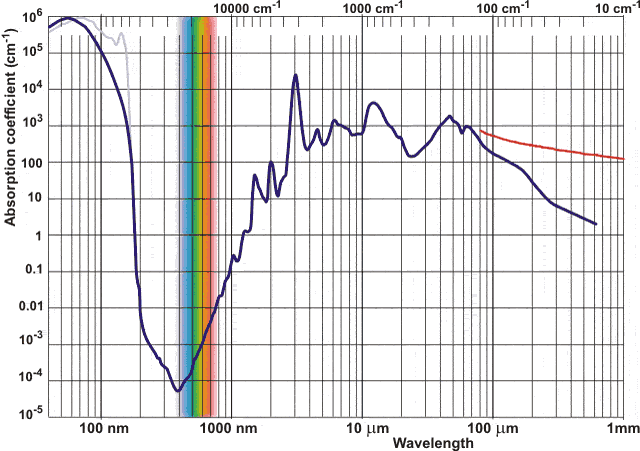
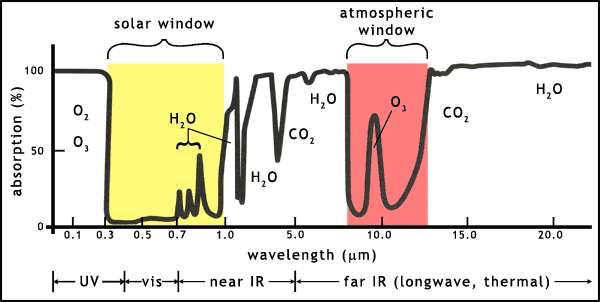
Evolution doesn't particularly care if something is good, just if it is "good enough". We've evolved to the great humbling oafs that we are now throughout a variety of intermediate stages -- but all of them have something in common: we've been on earth, and, it is believed, underwater. Let me just show you two graphs; one of the measured absorption coefficient of water (beware the axes: it's a semi-logarithmic plot), and, secondly, the absorption spectrum of the atmosphere. If you look at one and then the other, you'll see that the only window where both materials aren't as clear as the reason for Jar Jar Blink's conception is roughly the range ~300-~1000nm. This corresponds to what we dub "the visible spectrum" and is the part of the EM spectrum where the vast majority of life on earth is either pigmented or sees -- where "the sun is brightest", as most of the light from the sky is reaching the environment in which organisms live (aquatic or not). It also roughly corresponds with the peak of the Sun's blackbody spectrum. When you consider that we can measure light from all over the universe coming to us in wavelengths ranging from the tens of metres to less than a tenth of a fermi [femtometer], you have to concede that we really are a product of our environment. Oh -- and IANAL, IANABiologist, but I am a biophysicist
-
Re:Why Can't It Just Act As Write-Back Cache?
Wait, what? Oh I see - are you proposing to add a fully associative cache in front of the 4GB Flash memory to speed up cache lookups and thus lazily storing writes as well?
I thought you were caching the stored data in a cache. I must admit I kinda glossed over the "fully associative with write-back" bit
I suppose that can work - SLC is great for caching writes on. However, it's a lot more work than simply copying hot reads onto the Flash and caching them there. What you're proposing means a lot of new work on the disk controller, whereas now they simply slapped a caching thing on top of what they had.
However, at http://www.cs.umd.edu/class/sum2003/cmsc311/Notes/Memory/fully.html they explain fully associative caches nicely and add that "The hardware for finding the right slot, then picking the slot if more than one choice is available is rather large, so fully associative caches are not used in practice".
I don't think it really matters how Seagate exactly decides to cache stuff - right now they do read-cache only and it would be nice if they did a write-cache as well. You can do that just fine without using fully associative caches for the addressing.
Doing caching right is just not a trivial thing, especially if you have to do it on a tiny embedded platform.
-
Re:There is no way NASA mixed the measurement syst
As others have pointed out below, while it it true there was a units mix-up, this error wasn't caught due to other, more wide ranging problems. IEEE did a great writeup of this a while back (article link - didn't link to IEEE directly since you probably have to be a member to see the article). Very interesting reading. In summary...
First the spacecraft was asymmetric, causing some issues with the stabilizing flywheels and the onboard thrusters (used for major course corrections). Second, the person doing the calculations for the major course corrections noticed that the burn time (calculated using the bad units) didn't look right compared with previous missions. However, his management made him prove that the calculations were wrong, instead of proving they were right (presumably knowing that they would be different, given the first point about the asymmetries). He didn't catch the units error, and since he couldn't prove they were wrong they went along as if nothing happened. The article was really pointing out that while this was a technical error, the more fundamental issue was a management and culture issue. To me this made for an interesting case study in how to handle unknowns in a mission critical system - assuming things are wrong until proven otherwise, not vice versa.
(I don't seem to have the Spectrum issue with me, but I seem to remember it had some other articles about related management/culture failures). -
Re:Nice pretty picture
Hi, AC! I see you were modded down, and probably rightfully so, but I chose to answer anyway. Isn't life grand?
I simply asked you a polite question.
No, you didn't "simply ask a polite question." You went on a rude, nonsensical rant. Let's review:
Nice pretty picture... especially when you consider it's a picture of something that very possibly doesn't even exist. [Jane Q. Public, Sunday March 28, @07:10PM]
This comment is similar to all the other crackpots in this thread who dispute modern physics which clearly shows that some amount of some kind of dark matter exists.
It exists. Educate yourself. [Abcd1234, Sunday March 28, @07:44PM]
Abcd1234 clearly assumed you were expressing support for MOND, and helpfully linked impressive evidence which convinced many physicists that dark matter explains the evidence better than MOND. Then I chimed in:
... Measurements of galactic rotational velocities conflict with expected velocities based on the amount of matter observed to be present.
The next day:
... There are alternative theories, such as MoND, that might explain this (since it explains the apparent gravitational anomalies in spiral galaxies, it is possible that it could explain this kind of gravitational anomaly equally as well). Most "evidence" I have seen that is supposed to support the Dark Matter theory tends to also support the alternative theories.
You present as evidence exactly the same sort of imaging techniques that were used to make the image in question? That's really lame.
Nonsense. You made what sounded like a general statement about dark matter "very possibly" not even existing, which implies that physicists who overwhelmingly do think it exists are either incompetent or suffering from frequent hallucinations. The only reasonable objection to dark matter was MOND, and the Bullet Cluster presented very strong evidence that seems to rule out MOND with no dark matter. It's not "exactly the same technique" as the current survey because the main point of the Bullet Clust
-
Gene Patents Don't Interfere With Research
Hopefully this will go a long way in ensuring that patents on genes do not stand in the way of research.
If you look at the empirical data, gene patents don't interfere with research. In a survey of 414 biomedical researchers at universities, government, and nonprofit institutions, none of the 381 respondents reported abandoning a line of research due to patents and only five delayed completion of an experiment for more than one month. Only one respondent reported paying for access to research materials covered by a patent and the fee was under $100. The paper concluded that "access to patents on knowledge inputs rarely imposes a significant burden on academic biomedical research." John P. Walsh, et al, "View from the Bench: Patents and Material Transfers," 309 Science 2002 (September 2005).
-
Re:Nice pretty picture
Thanks. It's worth noting that the Bullet Cluster results you linked to are only the most recent development in dark matter's nearly 80 year history:
1933 - Zwicky studies the Coma cluster of galaxies and is surprised to find that these galaxies are orbiting each other much faster than he predicted based on their visible mass. He proposes that each galaxy actually contains much more mass than is visible.
1959 - Measurements of galactic rotational velocities conflict with expected velocities based on the amount of matter observed to be present. The dark matter concept proposed by Zwicky is found to solve this problem too.
1970s - Big Bang nucleosynthesis has trouble reconciling observations of high deuterium density with the expansion rate of the universe. Non-baryonic dark matter solves this problem as well.
At this point, dark matter was simply an hypothesis. MOdified Newtonian Dynamics (MOND) was another hypothesis with equal weight. But then in 2006 measurements of the Bullet Cluster supported the dark matter hypothesis over the MOND hypothesis.
Simultaneously, WMAP (2001-present) measured the microwave background radiation and independently confirmed the existence of dark matter. It also revealed an even larger amount of "dark energy" which confirmed the 1998 discovery that the expansion of the universe is accelerating.
-
Sonic boom or not? Math
Some debate here as to whether what we're seeing is a sonic boom, or just loud low-frequency sound waves. Let's do the math...
Basic question: is the rocket going at Mach 1 or greater when the phenomenon happens?
In the video, the launch happens at 0:38, and the ripples are seen at 1:53, 75 seconds later.
Here's a handy document showing the launch profile of an Atlas V. It doesn't show velocity vs time, but on page 19 there's an acceleration vs time graph for the Atlas V 401, the specific vehicle used in this launch. It shows the average thrust during the first 75 seconds is 1.4 +/-
Subtract out 1 g for gravity pulling the rocket down, to get a vehicle acceleration of 0.4 +/- 0.05 g, which over 75 seconds will lead to a final velocity of 294 +/- 36 m/s.
The speed of sound is 330 m/s. So at the time we see the ripples, the rocket is riiiiight about at the speed of sound, maybe a little over, maybe a little under, impossible to tell.
This transition to supersonic flow is often chaotic and irregular, which would explain the intense but complicated ripples seen. If the rocket was going at mach 2 or 3, we'd see a perfectly shaped set of concentric rings; if it was going at far less than mach 1, we'd see nothing at all.
-
As seen on TV...
Saw this some years back on the Christmas Lectures that the Beeb run... They did it wih a tray of marshmallows... Can't find a link to that though, but did find this one: http://www.physics.umd.edu/ripe/icpe/newsletters/n34/marshmal.htm
-
IP is not hobbling traditional research
The article makes some vague statements that IP limits traditional biotech research. In fact, empirical studies do not back up such claims. John Walsh, Charlene Cho, Wesley Cohen, View from the Bench: Patents and Material Transfers , 309 Science 2002-2003 (2005). Some highlights:
"Thus, of 381 academic scientists, even including the 10% who claimed to be doing drug development or related downstream work, none were stopped by the existence of third-party patents, and even modifications or delays were rare, each affecting around 1% of our sample."
"In addition, 22 of the 23 respondents to our question about costs reported that there was no fee for the patented technology, and the 23rd respondent said the fee was in the range of $1 to $100."
19% of the respondents reported that other scientists had not complied with material transfer requests (i.e. requests for data or samples), but analysis found that "The patent status of the requested material had no significant effect on noncompliance."
An additional, more focused case study of a highly-commercialized area of research with a lot of patent activity found that "only 3% of respondents reported stopping a project in the past 2 years because of a patent."
-
Re:It's easier to measure it by tasks accomplished
In a waterfall system, you're kind of stuck evaluating developers by how much "stuff" they produce (documentation, code, tests, etc.) instead of quality because you don't keep track of the individual tasks like you would in Agile.
There was never such a thing as "waterfall" in widespread use - it's purely an Agile myth that, before Agile, it was either waterfall or pure uncontrolled chaos. In fact, waterfall was a label used to describe a flawed, non-working model long before Agile.
And, of course, keeping tracks of individual tasks is by no means exclusive to Agile, and was also practiced long before it, including systems which Agile followers now mislabel as "waterfall". In fact, it's not even contradictory to the true waterfall model.
-
Re:Chernobyl again?
Chernobyl was a vigorous demonstration of the failure to apply Montemerlo's Law: "Don't do nuthin' dumb."
-
Re:What does this say about Vivek Kundra?
Dvorak? Isn't he famous for trolling[1] people to get more ad hits?
He makes insinuations that Vivek might not have the degree he claimed to have. But he doesn't do a thorough investigation, and just shoots his mouth first.
Maybe the UMD newsdesk is wrong (they could be after all), but they did say that:
"Vivek Kundra moved from chief technology officer of D.C. to being the first federal chief information officer, working in the White House. Kundra holds an undergraduate degree from UM in psychology and a master's of science in information technology. "
See: http://www.newsdesk.umd.edu/facts/mm/08-09/mar.cfm
Perhaps the UMD newsdesk was sloppy, but given the other stuff I see, it just looks like Dvorak is trolling again.