Slashdot Mirror
Domain: userland.com
Stories and comments across the archive that link to userland.com.
Stories · 17
-
Podcasting
SFEley (Stephen Eley) writes "Todd Cochrane's Podcasting: The Do-It-Yourself Guide has been heavily pushed in the podcasting community as the first of a wave of podcasting books to be released in the next several months. All of these books will surely cover the same themes, more or less: what podcasts are, how to listen to them, and how to produce your own. The popularity of podcasting is exploding right now, with coverage in every press outlet and Apple hyping it as The Next Big Thing. It's easy to see that there will be a huge demand for these books, even if they don't do much more than state the obvious. So what about this one? Other than being the first, does it offer any compelling virtues for the would-be podcaster or listener?" Read on for Eley's answer to that question. Podcasting: Do-It-Yourself Pirate Radio for the Masses author Todd Cochrane pages 281 publisher Wiley rating 4 reviewer Stephen Eley ISBN 0764597787 summary How to find, record, and publish podcasts
Before we can even begin to talk about the book, we ought to cover the preliminaries. If you've been living under a rock for most of 2005, you may not know that podcasting is the latest Internet publishing wave, getting most of the same hype that blogging has gotten but much faster. In its simplest form, it's just people producing audio files (talk, music, whatever) and syndicating them over an RSS feed. Listeners can then use one of several apps to automatically download them and load them onto an MP3 player. The mainstream media, feeling some embarrassment for missing the last few Web boats, has jumped on podcasting and given it, frankly, a lot more press than it probably deserves right now.
A note on the author: Todd Cochrane produces Geek News Central, a very popular tech podcast wherein he reads out news headlines and offers commentary. He also founded and manages the Tech Podcast Network, a consortium of other technology podcasts that band together for cross-promotion, content standards and advertising, and he's the main force behind the heavily advertised and sponsored Podcast Awards. It's fair to say that Cochrane has done a lot for podcasters in various ways, and although I've disagreed with him on some of the details of his projects, I respect him highly for his tremendous energy and the work he's done to make podcasting a respectable form of media.
Another note (and disclaimer) on myself: I also have my own podcast, a moderately popular one that narrates science fiction short stories. In a practical sense this makes me both a podcaster and a literary editor. Which means, in turn, that I have a sensitivity both to poor information on podcasting and poor writing.
And with all that said... I'm afraid Podcasting: The Do-It-Yourself Guide is a marginal book at best. It doesn't suck, and there's nothing horribly wrong with the information it gives, but it has two endemic problems. Cochrane's responsible for both, but I put the real blame on his editors at Wiley, who likely ignored them in their rush to get the book out before any others.
The first problem is the writing. It's possible that this bothers me more than it would others. Todd Cochrane may be an intelligent, selfless, wonderful guy -- I truly believe that he is -- but the man can't write. The entire book exhibits a rushed, forced-casual, eighth-grade English paper style that grates on me like nails on a chalkboard. Cochrane even admits this in his acknowledgments: "Early on, I made it clear to Chris [Webb], my acquisitions editor, that I was a geek/tech guy first and that he did not want to see my English grades. Even so, he assured me that I was their man, and I went to work."
Well, Chris Webb, you're a dumbass. You picked someone who admitted he couldn't write to write a book on a breakthrough technology. As a result, the book is vague, meandering, and frequently redundant, e.g.: "You will want to use this Recording Control window to control your default recording device." That phrase ("You will want to ...") crops up everywhere: the book's not only in second person, but it's a second person that tells the reader what he/she wants. The only sentence opener that appears more often is "Obviously" -- which frequently precedes a thought that is neither obvious nor related to the sentence before it.
You will also want to ignore the poor punctuation and comma splices, the frequent intersplicing of Notes and Tips paragraphs that seem indistinguishable (in both font and content) from the main text, and very often, the simple use of the wrong words. In many cases this is simply amusing: "[Dave Winer's] analogy was that it was taking longer to download the video than it was to play it." Uh, that's not an analogy, dude. In at least one case it leads to a technically incorrect statement: "The reading on the software-controlled meter in my audio-recording package showed nearly 40 dB of baseline noise," when what he really meant was a noise floor of -40 dB. Two very different things.
The other major problem is the narrow perspective. It's really Podcasting: The Do-It-Todd-Cochrane's-Way Guide. Everything in this book is about Cochrane. Every example is his own podcast, every screenshot of a Web page is his own, and he's got multiple photos of himself in various dorky situations. Any photos of other podcasters? Mur Lafferty, perhaps, or Soccergirl? You wish. I have no problem with Cochrane using himself as a starting point, but it's a very diverse field, and nobody podcasts with quite the same gear or the same techniques as anybody else. Cochrane says he spent significant time interviewing software developers for the chapters on applications, but there's no indication anywhere that he spoke to any other podcasters in writing this book. That's a huge mistake, rushed deadlines or no rushed deadlines. Not only does it reduce the book's utility, but it also makes the prose seem dreary, monotonic, and egocentric.
So there's my overview. For those who think the book may still have some use to you (and it might, if you can put up with the above) I'll break it down by section:
Part I: Listening to the Podcast Revolution This section has three chapters, and they're useless. The book begins, "Do you have specific interests? How about triathlons? I have to admit, most radio broadcasts don't deal with those kind of subjects. But that's about to change." Yeah, okay. The problem here (beyond the clumsy writing) should be obvious: if you have no idea what podcasting is, you're not interested enough to buy a book on podcasting. The first chapter, "What Is a Podcast?" has Cochrane spiraling around the subject of podcasting for twelve pages without ever giving a simple definition. Then we've got two chapters which together describe the leading software tools used to download podcasts, and tutorials for using them to subscribe to -- can you guess? -- Todd Cochrane's podcast. To be fair, it was a pretty decent overview of the major client applications at the time of the book's writing; which means it's already obsolete, as iTunes 4.9 has totally changed the landscape since then. Of course, that can't be helped. The real weakness of this section is its superfluity: if you're willing to pay $20 for a book on podcasting, it's because you want to make podcasts. Even Grandma's not going to buy this book to learn how to listen to them.
Part II: Joining the Revolution: Your Own Podcast Here's where the book starts to get genuinely interesting. The obligatory but stupid chapters on listening to podcasts are behind us; now it's all about making them. The first chapter here, "Choosing a Podcast Format," actually has little to criticize. His basic message is sound: Follow your passions; develop a show structure and follow it; and be aware of copyright issues if you're playing music. All of that is good advice, and his detailed description of his own show structure and notes is appropriate here. This is followed by a completely unnecessary chapter about computer choices, in which he shows his Windows colors and comes off a trifle condescending toward the Mac. ("In researching materials for this book, I found I could not do the reviews justice unless I had a Mac, so I purchased a Mac Mini ... I knew that if I could record a podcast on a Mac Mini, it would probably make the Mac fans happy.") Then, at last, he delivers the first truly crunchy chapter: "The Semiprofessional Podcast Studio." This chapter's honestly very good, running the gamut of sound cards, microphones, mixers, Firewire interfaces (he dismisses USB interfaces rather unfairly), digital recorders, even quiet case fans. Some of it's hand-waved, and some of it's so vague it's just silly: "A condenser microphone is generally never found in households. People might have them, but they usually are not aware that they do." On the other hand, his discussion of quality sound cards does have much of value (barring the "40dB of baseline noise" misstatement I mentioned above), and he gives one of the best descriptions of mixers and effects processors for novices that I've found. If you have no idea what sort of equipment you might need for quality sound in your podcast, you'll get a decent grounding here. Not an excellent grounding, but perhaps enough to parse a little bit more of the serious sound FAQs on the Web.
Part III: Recording Your Podcast and Performing Postproduction Tasks (Yes, the man can't even name things with brevity.) There's one weak chapter here and two great ones. In "Recording Locations," Cochrane reveals that you can podcast at home, in your car, at a restaurant, or walking around. Whee. Then we get to the actual process of recording and postproduction, and the book honestly shines. He describes step-by-step how to set up Audacity (the excellent freeware Win/Mac/Linux sound editor) to record, how to set up a typical mixer, and best of all, how to set levels properly. Levels are the bane of any audio amateur, and these half-dozen pages are gold; it's the one thing a novice podcaster is likely to turn back to and reference several times over in his first few recordings -- or ought to, anyway. His advice on noise reduction, amplifying, and normalizing is spot-on, the steps listed for MP3 encoding are simple but solid, and he even gives several good options for ID3 tagging. (A step too often overlooked by podcasters.) I could complain about a few weird digressions -- e.g., the postproduction chapter tells you how to upload to Openpodcast.org, which is an utterly bizarre thing to advise -- but they're easily ignored, and overall this section truly shines.
Part IV: Hosting and Preparing to Publish Your Podcast This section's ... okay. His chapter on hosting is mostly a treatise on how to evaluate service agreements, which is valuable enough in itself but can be overkill for someone just starting out. There are a few math exercises for estimating bandwidth -- useless when you don't know your potential audience size -- and a brief list of "podcast-friendly hosts" which is, of course, already obsolete. His coverage of publishing methods is about weblog software -- wait, scratch that, it's about MovableType. He's infatuated with MT, and devotes several pages on a step-by-step for hacking MT's code and templates to support enclosures with full-source RSS code listings, then mentions virtually offhand that Wordpress and Radio Userland support enclosures out of the box. This is another case where having multiple podcaster perspectives would have helped. Finally, we get a chapter named "The Life Breath of a Podcast: RSS 2.0 With Enclosures," just barely longer than its title, which covers how to use FeedForAll to hand-crank an RSS file if you don't have blogging software that will make one for you. It might have been a valuable chapter if he'd spent any real time explaining RSS 2.0 or enclosures.
Part V: It's Show Time A closing section that's nearly pointless, but mercifully brief. There's an entire chapter about using graphical FTP clients -- lame because anyone who's that blinking-twelve was lost back at Chapter 6. The meaty chapter is called "Feedback, Promotion, and Paying the Bills," and it has some moderately useful information and some large gaps. Feedback apparently means "have a mailing list and a voicemail line, and hang out on Skype." Okay. Promotion's about directory listings and exchanging promos with other podcasters; then he offers a long commentary on advertising and why it's a fine thing to have. Unfortunately, other than creating a media kit he has nothing much to say on how to contact and market your show to advertisers. And the final chapter of the book, "Where Do We Go From Here?" offers a few vapid musings of the sort all podcasters talk about over beer: we're going to kill mainstream radio, podcasts will band together and commercialize, all the starving children of the world will have an MP3 player ... And Yes, in his final sentences he invokes the already-tired "Podcasting Revolution" chestnut. Not much to say here, but rest assured, he says it.
So there you have it. That's the entire book. Worth buying? That depends. If you're itching to get started with podcasting, if you're an absolute beginner when it comes to sound recording, if the online resources at Podcast411 and other sites don't float your boat, and if you can't wait a few more months for books like Podcast Solutions and Podcasting for Dummies to come out ... then sure. There are at least three or four good chapters in here with information you can use. It's not all the information, and you have to take Cochrane's style and limited viewpoint with a big grain of salt, but it'll get you started. For less than twenty bucks, at least it isn't a high-risk investment.
On the other hand, if you're the bootstrapping type, or you already know most of what you're doing, then there's not much in here you can't figure out online and through experience. And if you're patient, there will be other books, and I'm almost positive they'll be better written.
You can purchase Podcasting: the Do-It-Yourself Guide from bn.com. Slashdot welcomes readers' book reviews -- to see your own review here, read the book review guidelines, then visit the submission page. -
Slashback: Hippocampus, Matter, Blogs
Slashback tonight brings you updates, clarifications and even a followup question on recent Slashdot stories on the iLoo, Verizon's pay-phone hot spots, the artificial hippocampus, Google and blogs, patenting smart matter and more -- read on below for the details. I have room for an entire artificial brain in there! The Evil Couch writes "In an update to an older Slashdot story The Guardian has a story saying that the scientists at USC-LA are about to connect a silicon model of the hippocampus to a rat's brain. If it's a successful replacement for the meat hippocampus, they plan on scaling it up and testing it on monkeys and then hopefully humans."Why not a quarter for 15 minutes of access? amy's robot writes "After announcing plans to do so just last week, Verizon has activated the WiFi hotspots built in to their Manhattan payphones. Here's official info and a FAQ along with a map of the hotposts. The catch: you have to be a Verizon Online subscriber to use them, but they're free if you are."
So the blogs can stop fleeing to the hills. GeekLife.com writes "Dave Winer received a note from Google PR stating 'Just want to be sure you know that there's been no consideration of removing weblogs from our index.' Seems The Register's speculation may have somehow been unfounded."
I'd rather see a patent for smart toothpaste. Wil McCarthy writes "Last week on this forum, there was some heated discussion about my nonfiction book, Hacking Matter , and specifically about the patent application included in the book's appendix. I was accused of the intellectual property equivalent of cybersquatting: patenting a speculative idea and then sitting back and waiting 'for someone to actually do the hard work of inventing a useful product before gouging them for royalties.' In this scenario, my book has a chilling effect on an entire industry, stifling innovation.
What may have been lost in the shuffle is the fact that I'm not 'just' a science fiction writer or science journalist. First and foremost I'm an engineer, and to the best of my knowledge the idea of "wellstone," or bulk programmable matter woven from fibers surfaced with quantum dots, is original to me. The patent merely codifies these facts. Also, notably, the field of quantum dot research is lively and growing, but not at all focused on materials science applications. Thus there is no extant programmable matter industry to be squelched by my efforts.
Nor have I, per the discussion, patented a device which a person skilled in the art could not produce. It's true that some embodiments of the invention require nanometer precision in three dimensions and are thus beyond present-day manufacturing capabilities, but other less capable embodiments could be produced today. I didn't provide a working model to the patent office because I wasn't required to, having filed a Provisional Patent Application prior to the RPA.
As I make clear in the book, my interest is in hastening the arrival of programmable matter as both an industry and a field of inquiry. My partner and I are presently engaged in discussions to fund the development of a prototype quantum dot fiber which would be broadly, programmably self-doping at liquid nitrogen temperatures. We're also quite willing to license the technology to interested parties at non-gouge rates, and any suggestion to the contrary is simply foolish. If my aim is to change the world, what do I stand to gain by stifling development of my own invention?"
Sorting through the evidence. CowboyRobot writes "Edward Tufte (known for his book, Envisioning Information) analyzes the Boeing explanation for the Columbia disaster, pointing out design flaws and how those flaws conceal ambiguity in the report."
Tufte's analyis is the kind that should be applied to many more situations -- he dissects the way reassuring, blandly obfuscated PowerPoint slides can be used to slip through statements that might cause justified concern if spoken in plain language.
Dr. Whonow? Mechanik writes "You may remember the previous Slashdot story about the BBC doing a Flash treatment of one of Douglas Adams's Dr. Who scripts, Shada. Just wanted to let everyone know that Part Two is now available."
Welcome to Stepford. ragingmime writes "The Boston Globe has an interesting story on the Polyphonic "hit song science" technology that Slashdot mentioned a while ago. The Globe mentions specific things that the software measures and give opinions from various people in the music industry. It's an interesting - and kinda creepy - read."
Boilerplate or camera tricks? andrel writes "In his Slashdot interview Michael Robertson answered question 10 with:
I believe that if you purchase a product, you should have the right to change it, move it, or alter it for your own personal needs. The seller should have the right to say that you void the warranty or refuse to support it if you change it, but you should still have right as the purchaser to make that choice. This goes for music, software and personal computers. [emphasis added]
Too bad Lindows.Com doesn't share his values. The license agreement for LindowsOS explicitly prohibits users from modifying it (section 1.1.a.iv for individuals and 1.1.b.iv for businesses). As for voiding the warranty, well according to section 4 there wasn't one there in the first place. The EULA also claims that you may not allow a visiting friend to use your LindowsOS computer, nor may you use it to conduct business(both in section 1.1.a.iii)."
Robertson reads Slashdot; I hope we'll see his reaction to this soon.
Imagine the course of a canoe paddled by Microsoft and SCO. SolipsistX writes "The Seattle Times is reporting that Microsoft now says that the iLoo is not a joke. Apparently, execs killed the project after it became a laughing stock. The announcement yesterday that it was a joke was caused by miscommunication, says Microsoft. Needless to say, this does not help Microsoft's Trustworthy Computing initiative."
-
Content Syndication With RSS
Alex Moskalyuk writes "Ben Hammersley's Content Syndication with RSS is a step-by-step guide to implementing RSS. This standard is gaining popularity among the Web community, and some of your favorite sites might syndicate their content as RSS feeds. The new O'Reilly publication focuses on many aspects of this standard, and is of primary interest to developers, Web site designers, data architects and anyone interested in distributing their data around the Web." So if you have a steady stream of information for your customers, family, or fans, read on for the rest of Alex's review. Content Syndication With RSS author Ben Hammersley pages 222 publisher O'Reilly rating 8/10 reviewer Alex Moskalyuk ISBN 0596003838 summary Introduction and guide for RSS implementationsThe first three chapters are primarily discussing the multiplicity of RSS standards. While with some other technologies it might seem a bit excessive, remember that RSS is a forked project with the forks at this moment bearing little resemblance to one another. The abbreviations even have different abbreviations - RSS means Really Simple Syndication if you are using RSS 0.91 or RSS 0.92, that was developed by Dave Winer. RSS means RDF Site Summary if the version you're using RSS 1.0. The development credits in this case go to RSS DEV team. To confuse you even more, the RSS 2.0 standard is deciphered as... correct, Really Simple Syndication again.
Hence chapter 4 discusses Winer's implementation (simplistic and user-friendly), while chapter 6 focuses on RSS 1.0 (RDF-compliant and data-architect-friendly), and chapter 8 talks about RSS 2.0 (improved RSS 0.9x). Chapter 4 is available online as a PDF file. Section 4.4 is recommended for those interested in promoting their RSS feeds as it provides pretty good reference to meta data.
Chapter 9 is perhaps of special interest to Web developers and administrators out there. It presents several code samples to properly parse RSS and present the result in readable HTML. The examples include (a) parsing with XML::Simple in Perl, (b) parsing with Perl regular expressions, (c) parsing with XML::Simple and sending the headlines to cell phones via WWW::SMS, (d) parsing via XSLT transformation. Python, PHP and ASP folks might feel left out due to the abundance of Perl examples, but if you got so far in the book, you can probably apply the regular expressions example or search for appropriate support for RSS format in your preferred language.
Going beyond the standard itself, RSS directories, aggregators and readers are discussed. Author makes a distinction between the last two by classifying Meerkat-like services into aggregators and desktop or Web applications designed to present the information to the user into readers. The chapter also provides information about Syndic8, its API, and describes the feed registration process. OReilly's Meerkat is also discussed in chapter, together with reference table for its API (you can make Meerkat generate HTML or RSS news headlines on certain topic or using certain keywords by providing a right query to its Web interface).
The book is quite a smooth read for a text describing the details of data specification. The chapters are informative and the book is not overloaded with useless information just to increase the page count. The tips are quite useful for someone, who is knew to the field and answers some questions not covered by standards (e.g., how often should you request an RSS feed, what to do if you're being screen-scraped, etc.)
I like the way the author divided the chapters into RSS 0.9x/2.0 and RSS 1.0 and kept two worlds apart. Most of the time you probably won't be interested in developing a feed to support both standards, but would like to focus just on one. The examples in Perl are perfect with me, although for someone new to Perl or programming in general those examples with abundant regular expressions might look a bit convoluted. Kudos to the author for not expanding on the topic, like many do, and providing an example of a script for RSS manipulation in every possible language out there.
What's missing? I wish more pages were dedicated to desktop RSS readers. FeedReader, HotSheet, Syndirella, Beaver and SharpReader are excellent end user applications currently gaining some popularity among those who'd prefer to browse the favorite headlines at a glance, instead of going to a dozen of sites every morning. To be fair, there's a huge list of readers in Appendix, and some applications mentioned above only came around in the last few months, which was probably after the book hit the press. Some sites also didn't make it into the book. I like DailyRotation and FreshNews that borrow from Meerkat's versatility and provide their own feed portal.
Overall, the book is a pretty good developer's guide to RSS standard. Accompanied with helpful illustrations and numerous tips it's an excellent resource for those unfamiliar with RSS and a helpful reference for those who have been doing Web syndication for a while.
You can purchase Content Syndication With RSS from bn.com. Slashdot welcomes readers' book reviews -- to see your own review here, read the book review guidelines, then visit the submission page. -
Content Syndication With RSS
Alex Moskalyuk writes "Ben Hammersley's Content Syndication with RSS is a step-by-step guide to implementing RSS. This standard is gaining popularity among the Web community, and some of your favorite sites might syndicate their content as RSS feeds. The new O'Reilly publication focuses on many aspects of this standard, and is of primary interest to developers, Web site designers, data architects and anyone interested in distributing their data around the Web." So if you have a steady stream of information for your customers, family, or fans, read on for the rest of Alex's review. Content Syndication With RSS author Ben Hammersley pages 222 publisher O'Reilly rating 8/10 reviewer Alex Moskalyuk ISBN 0596003838 summary Introduction and guide for RSS implementationsThe first three chapters are primarily discussing the multiplicity of RSS standards. While with some other technologies it might seem a bit excessive, remember that RSS is a forked project with the forks at this moment bearing little resemblance to one another. The abbreviations even have different abbreviations - RSS means Really Simple Syndication if you are using RSS 0.91 or RSS 0.92, that was developed by Dave Winer. RSS means RDF Site Summary if the version you're using RSS 1.0. The development credits in this case go to RSS DEV team. To confuse you even more, the RSS 2.0 standard is deciphered as... correct, Really Simple Syndication again.
Hence chapter 4 discusses Winer's implementation (simplistic and user-friendly), while chapter 6 focuses on RSS 1.0 (RDF-compliant and data-architect-friendly), and chapter 8 talks about RSS 2.0 (improved RSS 0.9x). Chapter 4 is available online as a PDF file. Section 4.4 is recommended for those interested in promoting their RSS feeds as it provides pretty good reference to meta data.
Chapter 9 is perhaps of special interest to Web developers and administrators out there. It presents several code samples to properly parse RSS and present the result in readable HTML. The examples include (a) parsing with XML::Simple in Perl, (b) parsing with Perl regular expressions, (c) parsing with XML::Simple and sending the headlines to cell phones via WWW::SMS, (d) parsing via XSLT transformation. Python, PHP and ASP folks might feel left out due to the abundance of Perl examples, but if you got so far in the book, you can probably apply the regular expressions example or search for appropriate support for RSS format in your preferred language.
Going beyond the standard itself, RSS directories, aggregators and readers are discussed. Author makes a distinction between the last two by classifying Meerkat-like services into aggregators and desktop or Web applications designed to present the information to the user into readers. The chapter also provides information about Syndic8, its API, and describes the feed registration process. OReilly's Meerkat is also discussed in chapter, together with reference table for its API (you can make Meerkat generate HTML or RSS news headlines on certain topic or using certain keywords by providing a right query to its Web interface).
The book is quite a smooth read for a text describing the details of data specification. The chapters are informative and the book is not overloaded with useless information just to increase the page count. The tips are quite useful for someone, who is knew to the field and answers some questions not covered by standards (e.g., how often should you request an RSS feed, what to do if you're being screen-scraped, etc.)
I like the way the author divided the chapters into RSS 0.9x/2.0 and RSS 1.0 and kept two worlds apart. Most of the time you probably won't be interested in developing a feed to support both standards, but would like to focus just on one. The examples in Perl are perfect with me, although for someone new to Perl or programming in general those examples with abundant regular expressions might look a bit convoluted. Kudos to the author for not expanding on the topic, like many do, and providing an example of a script for RSS manipulation in every possible language out there.
What's missing? I wish more pages were dedicated to desktop RSS readers. FeedReader, HotSheet, Syndirella, Beaver and SharpReader are excellent end user applications currently gaining some popularity among those who'd prefer to browse the favorite headlines at a glance, instead of going to a dozen of sites every morning. To be fair, there's a huge list of readers in Appendix, and some applications mentioned above only came around in the last few months, which was probably after the book hit the press. Some sites also didn't make it into the book. I like DailyRotation and FreshNews that borrow from Meerkat's versatility and provide their own feed portal.
Overall, the book is a pretty good developer's guide to RSS standard. Accompanied with helpful illustrations and numerous tips it's an excellent resource for those unfamiliar with RSS and a helpful reference for those who have been doing Web syndication for a while.
You can purchase Content Syndication With RSS from bn.com. Slashdot welcomes readers' book reviews -- to see your own review here, read the book review guidelines, then visit the submission page. -
Content Syndication With RSS
Alex Moskalyuk writes "Ben Hammersley's Content Syndication with RSS is a step-by-step guide to implementing RSS. This standard is gaining popularity among the Web community, and some of your favorite sites might syndicate their content as RSS feeds. The new O'Reilly publication focuses on many aspects of this standard, and is of primary interest to developers, Web site designers, data architects and anyone interested in distributing their data around the Web." So if you have a steady stream of information for your customers, family, or fans, read on for the rest of Alex's review. Content Syndication With RSS author Ben Hammersley pages 222 publisher O'Reilly rating 8/10 reviewer Alex Moskalyuk ISBN 0596003838 summary Introduction and guide for RSS implementationsThe first three chapters are primarily discussing the multiplicity of RSS standards. While with some other technologies it might seem a bit excessive, remember that RSS is a forked project with the forks at this moment bearing little resemblance to one another. The abbreviations even have different abbreviations - RSS means Really Simple Syndication if you are using RSS 0.91 or RSS 0.92, that was developed by Dave Winer. RSS means RDF Site Summary if the version you're using RSS 1.0. The development credits in this case go to RSS DEV team. To confuse you even more, the RSS 2.0 standard is deciphered as... correct, Really Simple Syndication again.
Hence chapter 4 discusses Winer's implementation (simplistic and user-friendly), while chapter 6 focuses on RSS 1.0 (RDF-compliant and data-architect-friendly), and chapter 8 talks about RSS 2.0 (improved RSS 0.9x). Chapter 4 is available online as a PDF file. Section 4.4 is recommended for those interested in promoting their RSS feeds as it provides pretty good reference to meta data.
Chapter 9 is perhaps of special interest to Web developers and administrators out there. It presents several code samples to properly parse RSS and present the result in readable HTML. The examples include (a) parsing with XML::Simple in Perl, (b) parsing with Perl regular expressions, (c) parsing with XML::Simple and sending the headlines to cell phones via WWW::SMS, (d) parsing via XSLT transformation. Python, PHP and ASP folks might feel left out due to the abundance of Perl examples, but if you got so far in the book, you can probably apply the regular expressions example or search for appropriate support for RSS format in your preferred language.
Going beyond the standard itself, RSS directories, aggregators and readers are discussed. Author makes a distinction between the last two by classifying Meerkat-like services into aggregators and desktop or Web applications designed to present the information to the user into readers. The chapter also provides information about Syndic8, its API, and describes the feed registration process. OReilly's Meerkat is also discussed in chapter, together with reference table for its API (you can make Meerkat generate HTML or RSS news headlines on certain topic or using certain keywords by providing a right query to its Web interface).
The book is quite a smooth read for a text describing the details of data specification. The chapters are informative and the book is not overloaded with useless information just to increase the page count. The tips are quite useful for someone, who is knew to the field and answers some questions not covered by standards (e.g., how often should you request an RSS feed, what to do if you're being screen-scraped, etc.)
I like the way the author divided the chapters into RSS 0.9x/2.0 and RSS 1.0 and kept two worlds apart. Most of the time you probably won't be interested in developing a feed to support both standards, but would like to focus just on one. The examples in Perl are perfect with me, although for someone new to Perl or programming in general those examples with abundant regular expressions might look a bit convoluted. Kudos to the author for not expanding on the topic, like many do, and providing an example of a script for RSS manipulation in every possible language out there.
What's missing? I wish more pages were dedicated to desktop RSS readers. FeedReader, HotSheet, Syndirella, Beaver and SharpReader are excellent end user applications currently gaining some popularity among those who'd prefer to browse the favorite headlines at a glance, instead of going to a dozen of sites every morning. To be fair, there's a huge list of readers in Appendix, and some applications mentioned above only came around in the last few months, which was probably after the book hit the press. Some sites also didn't make it into the book. I like DailyRotation and FreshNews that borrow from Meerkat's versatility and provide their own feed portal.
Overall, the book is a pretty good developer's guide to RSS standard. Accompanied with helpful illustrations and numerous tips it's an excellent resource for those unfamiliar with RSS and a helpful reference for those who have been doing Web syndication for a while.
You can purchase Content Syndication With RSS from bn.com. Slashdot welcomes readers' book reviews -- to see your own review here, read the book review guidelines, then visit the submission page. -
Roogle: RSS Search Engine
-
CDs Want To Be Free
Dotnaught writes: "An article that I wrote about a new music promotion service called fightcloud.com and CD pricing in general has just gone up on Salon. And heeding the advice of Dave Winer, I also posted the full transcript of the interview on my Web log, Lot 49, for those curious about what got left on the cutting room floor." Rather than complaining that Big Recording's CDs are overpriced, it sounds like this company is simply demonstrating that music (even on physical media) just don't have to cost that much. -
Google Releases Web APIs
skunkeh writes "Google have released the first beta of their Web APIs package. Used in conjunction with a free license key this SOAP based web service allows developers to execute up to 1000 automated queries a day, but is currently available for non-commercial use only. The download comes with Java and .NET code examples and includes a WSDL description for use with other SOAP supporting languages." There's also a write up about uses on Userland. -
Programming Jabber
Reader cpfeifer contributes the review below of O'Reilly's Programming Jabber: if your job (or hobby) includes instant messaging in all its glory, Jabber is a free-beer, free-speech framework for setting up instant messaging systems not bound to a single server in the middle. As cpfeifer points out, instant messaging can mean a lot more than popping an on-screen note to your friend in Des Moines -- machines and programs can use a general purpose communication system like this, with no human middleman required. Programming Jabber author D.J. Adams pages 4555 publisher O'Reilly rating 9 reviewer http://cpfeifer.blogspot.com ISBN 0596002025 summary A detailed guide for developers to understanding and extending the Jabber messaging framework. Examples in Perl, Python and Java. The ScenarioJabber was first conceived by Jeremie Miller (pic) in early 1998 in an effort to unify the disparate instant messaging networks. Instant Messaging networks rely on the network effect to gain and retain marketshare. The concept is the same when applied to any sort of participatory network whether it's a junk exchange, or content exchange, the value of the network increases with the square of the number of participants.
If this is true, then doesn't it follow that it is in the best interests of the IM networks to establish peering agreements with each other so that their users can directly contact users on other networks without having to install each client?
Hello, Jabber.When I first picked up this book, I expected to understand the Jabber protocol in sufficient depth to implement my own IM client. Instead, the approach this book takes is that Jabber isn't just an XML-based protocol strictly for IM, rather it is a general purpose event notification protocol that has some very nice message routing and user management features built into it. While i was reading about the messages that Jabber has defined as part of the protocol, I could easily see other applications/devices generating Jabber messages to notify subscribers (either other systems, or people) of events.
Part 1 of the book focuses on getting you up to speed on the basics of Jabber technology: motivation, major features, XML protocol sample and compiling/configuring your own Jabber server. Chapter 2 presents the "10,000 foot view" of Jabber technology. In here you will find a sample client-query request/response flow with full HTTP headers, discussed step by step. The next two chapters are a very in-depth discussion of installing and configuring your own Jabber server. When you dive into a custom configuration of a fleet of Jabber servers (a "constellation" in Jabber terminology), it really starts to hit home that the real problem Jabber solves is far deeper than just IM.
From there, part 2 kicks off with a detailed discussion of the most basic building blocks of Jabber technology: resource identifiers, XML handling mechanism and the set of XML elements/attributes that make up the vocabulary of the Jabber protocol. Each element/attribute is presented with an annotated example and sample client/server interactions where appropriate. Examples can make or break a technical book, and these examples do a good job of illustrating how the element/attribute is used.
The following chapters take you through using standard Jabber features, user registration/authorization, messages, presence, groupchat, components and the event model to enable new applications. One very interesting application presented is enabling developers to receive CVS commit notifications via Jabber.
What's Bad?I know the /. community is suspicious of glowing book reviews where everything is wonderful and nothing could be done to improve the book, so I'll nitpick. My major problem with this book is that the overwhelming majority of the sample applications are written in PERL/TK. This isn't a problem in and of itself, but I'm not a PERL/TK developer. If I build a Jabber solution, it will be in java, so PERL/TK samples don't do me a lot of good. I think equal time should be given to implementing Jabber using the two most-used languages, as defined by the number and activity of open source projects using Jabber technology.
What's Good?This book covers everything relevant to Jabber technology, from lowest level inner workings and extensibility examples for developers to configuration and deployment for admins. Most of the book is spent looking directly at the Jabber XML protocol, instead of a specific API implementation. This way, the book covers the technology and doesn't get lost in how one particular API models the protocol.
So What's In It For Me?If you want to implement an inside-the-firewall IM solution for your company/group/tribe or investigate integrating event notification into an application, this is a great starting point. If you're just curious about Jabber and want to know how it works, then this will give you enough information to get you hooked.
Table of ContentsPART 1: Getting Started with Jabber
- Chapter 1. Introducing Jabber
- Chapter 2. Inside Jabber
- Chapter 3. Installing the Jabber Server
- Chapter 4. Server Architecture and Configuration
PART 2: Putting Jabber's Concepts to Work
- Chapter 5. Jabber Technology Basics
- Chapter 6. Jabber Namespaces
- Chapter 7. User Registration and Authorization
- Chapter 8. Using Messages and Presence
- Chapter 9. Groupchat, Components, and Event Models
- Chapter 10. Pointers for Further Development
Appendix A. The Jabber.xml Contents
Appendix B. The IQRPC Classes for JabberRPCResponder
Index
O'Reilly has posted other reviews of the book on their site. You can purchase Programming Jabber from bn.com. Want to see your own review here? Just read the book review guidelines, then use Slashdot's handy submission form. -
A Modest Proposal For Decentralized Membership
There's an interesting proposal on DaveNet about creating a decentralized system for membership in different websites. It's kinda like what Microsoft Passport attempts to do, but without the centralized privacy concerns. It's a concept that we've talked about within OSDN - a decentralized login service - and it appears that the protocols are reaching the point that it'd possible and useful. I guess the issue would be what data gets passed around and such. -
Dave Winer On Microsoft, SOAP, XML-RPC In NYT
daveuserland writes: "Lots of activity in XML-over-HTTP. An article in today's NY Times about Microsoft, SOAP, UserLand and me. My comments. In the meantime XML-RPC keeps growing with solid interop. 29 implementations in the new XML-RPC directory. The politics are intense but everything's going well." It sounds like Dave understands this .Net thing; even after hearing about it for a few years, I've yet to hear a really lucid explanation of why I should want my apps and personal data floating in an amorphous cloud, but maybe that's just me. -
The Opportunity of SOAP
A reader writes: "There's an interesting piece on DaveNet concerning SOAP and some of Dave's predictions for it. He also talks about SOAP being in a flexible phrase, and the potentials for it, if it is used correctly. The point about the multiplicity of Dot.Nets is a good mental exercise too. Will development happen that way?" -
Bill Gates on Freedom
kgutwin writes "Here's something I found interesting: Bill Gates on Freedom. A short essay by Bill Gates written for the 24 Hours of Democracy Project. For all the talk on Slashdot about freedom of speech and censoring on the Internet, I found it interesting to read Bill's ideas on the subject. Frankly, I had no idea his views could be so, well, agreeable." Unfortunately, the main reason that Microsoft and the telecommunications companies opposed the Communications Decency Act (which is what he's talking about) is that they were afraid they'd be sucked into enforcing it - having to act as censors themselves. Now that there's no danger of that, they no longer support free speech to any significant degree. -
More DeCSS Time-Warner Hypocrisy
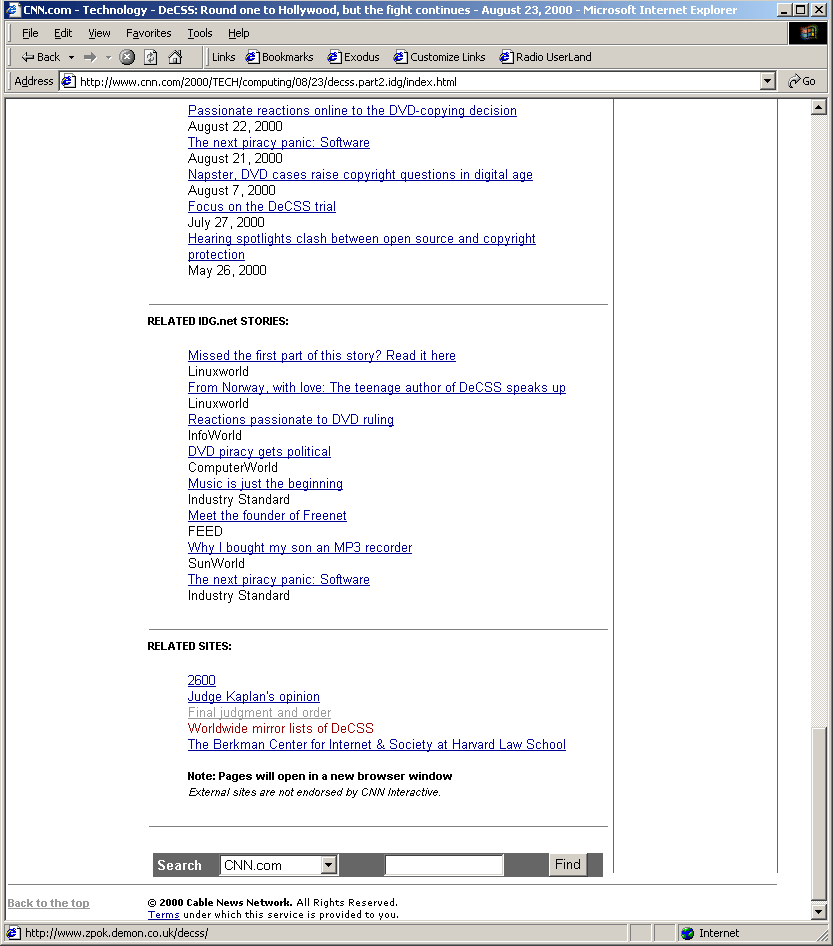
Sethb writes "Scripting News has the scoop about CNN linking to the source code for DeCSS. CNN is a subsidiary of Time-Warner, so in effect they're suing 2600 and others for something that they are doing themselves!" Update: 08/26 02:05 AM by michael : CNN has deleted the link from their story after reporters asked about it. But the screenshots are out there. -
Manic Depressive Geeks
goingware writes: "I think a relevant followup to your recent article Slashdot meets the Pinkerton Corp. is the article Friends in High Places in the March 30, 2000 edition of the Metro San Jose. Included in the article is a link to a letter I wrote to Dave Winer's Scripting News about the relationship between programming and madness. The ad in the Metro seeking bipolar tech workers for the story promised confidentiality, but I chose to allow them to run my name and photo because I run a Web site for manic depressive people to educate them and their loved ones about the illness." -
Netscape's What's Related is XML
Those of you who've poked around with Netscape 4.5 have noticed that wacky little What's Related button on the location bar. (yeah, there's some controversy about that too, but thats not what this is about). Did ya know its actually an XML App? Check out this Davenet article where you can see the truth. It's pretty cool. Thanks to Archimedes for sending this our way. -
Mozilla Survey
An anonymous reader shot in a link to this poll at scripting.com where you can vote on Netscape, and your likelihood to use it now that the source is available. Update Dave decided to close the poll, so save your time.