Slashdot Mirror
Domain: usgs.gov
Stories and comments across the archive that link to usgs.gov.
Comments · 1,416
-
Re:Volcanic emissions compared to human output
I took the liberty of creating a link for a Google search for you, since you're too busy trolling to do it yourself.
Your claim was that 'The eruption of Mt. Pinatubo, for instance, launched more stuff into the atmosphere than all human activity during the 19th and 20th centuries combined.' . Even at a subset, that means you are claiming that the eruption put more CO2, SO2, Nitrogen oxides and particulates into the atmosphere than all human activities for the past 200 years. You've made an absurd claim that you can't back up in a couple of sentances, which looks a lot more like trolling than my post.
Mt. Pinatubo put around 17 Million tonnes of Sulphur dioxide into the atmosphere (17Tg). Humans emit 66Tg PER YEAR. However, volcanic emissions are injected higher than human ones, making the contribution for a single year approxamately equal.
Mt Pinatubo put around 44 Million tonnes CO2 into the atmosphere. That's around half a day's worth of human emissions. 3 Million tonnes HCl, the vast majority of which rained straight out.
And the effect was a short lived pulse of cooling; the particulates come out in a few months. This is why you don't see anything about longer term effects. There are none.
So, contrary to what is endlessly repeated and recycled, volcanoes do not have anything near the impact of humans and the figures - could you be bothered to research them - support this entirely.
-
Good oneYou know, the Instituto de Pesquisas Tecnológicas do Estado de São Paulo Identified 23 seismicgenic zones in Brazil:
- - Boa Vista SZ, related to the Guiana-Central Belt, between the Caroni and Maecuru blocks;
- - Cruzeiro do Sul SZ, along the Serra do Divisor and Acre suture zones, between the Juruá Block and the Peruvian subandine domain;
- - Manaus SZ, at the Rio Negro, Madeira and Médio Tapajós suture zones, and the Japurá, Maecuru and Juruena blocks;
- - Belém SZ, in the Belém Block, with some influence of the Amapá and Gurupi suture zones;
- - Aripuanã SZ, on the Rondônia Belt, between the Juruena and Parecis blocks;
- - Itacaiúnas SZ, near the Central Pará suture zone, between the Belém and Araguacema blocks;
- - São Luís SZ, near the Gurupi suture zone;
- - Sobral SZ, along the Granja suture zone, between the São Luís and Ceará blocks;
- - Pacajus SZ, adjacent to the Jaguaribe suture zone in Southeastern Ceará;
- - Açu SZ, practically restricted to the Rio Grande Block, between its junction with the Pernambuco Block and the Patos suture zone;
- - Caruaru SZ, restricted to the Pernambuco Block, which southern and southeastern boundaries seem to be extension of the Salvador suture belt;
- - Cuiabá SZ, restricted to the Pantanal Block, between the Guaporé and Coxim suture zones;
- - Porangatu SZ, in the Porangatu Block, between the Porto Nacional and Ceres suture zones;
- - Passos SZ, on and adjacent to the Itumbiara and Alterosa suture zones;
- - Paraguaçu SZ, in the Serrinha Block;
- - Jequitinhonha SZ, along the Abre-Campo suture zone and the Governador Valadares Lineament; at the junction of the Brasília and Vitória blocks;
- - Paraopebas SZ, near the southern border of the Brasília Block;
- - Ribeirão Preto SZ, in the Paraná Block, between the Ribeirão Preto and Presidente Prudente suture zones;
- - Presidente Prudente SZ, also in the Paraná Block, between the Ribeirão Preto, Presidente Prudente and Três Lagoas suture zones;
- - Pinhal SZ, in the São Paulo Block, near the junction of the Ribeirão Preto and Alterosa suture zones, and coincident to the Moji-Guaçu Uplift;
- - Cananéia SZ, along the Ubatuba suture zone and the coastal flexure related to the Santos Basin;
- - Cunha SZ, at the Ubatuba and Abre-Campo suture zones, between the Brasília, Vitória and São Paulo blocks, as well as at the domain of the Mantiqueira Uplift, and the flexure zone related to the Santos Basin;
- - Santos SZ, near the Ubatuba suture zone, at the western border of Santos and Campos offshore basins and the São Paulo Plateau.
So P, S, Rayleigh, and Love waves (i.e., seismic waves) aren't transmitted from those seismic zones through your central plateau (basalt)? Maybe the magic Smurfs keep the waves out, much like the smoke from the smoking sections stays out of the non-smoking sections of the open-room restaurants.
Oh, wait, you said that seismic waves are due to "terrain accomodation" instead of "earthquakes." Maybe that has something to do with the earthquake weather y'all get down there?
Damn, I wish I'd known that before I got my Geophysics degree. Oh well, I guess I can just go ahead and go into the glamorous world of fast food.
-
it's natural saltYour argument would make sense only if the farmers and cities were distilling the water and returning the solids to the river. They're not, so there's no "tragedy of the commons" here.
The salt in the Dolores River comes from natural underground salt formations. Ground water passes through a collapsed salt anticline and becomes brine. You can read the technical report at http://water.usgs.gov/pubs/wri/wri02-4275/ and see photos at http://www.geo.mtu.edu/~jeh/Photos/Captions/capda
y 4.html.Natural salt water is not uncommon in this region. The Great Salt Lake formed long before the Industrial Age.
-
Reminds me of...
Reminds me of something I heard about a geothermal generator near Cloverdale, CA. They have at least one earthquake a week because the station pumps water down into the ground to create steam to power their turbines. Take a look at this earthquake map. It's a map of all earthquakes in the California/Nevada area for the past week. Check out the area around Cloverdale. There will ALWAYS be at least one quake per week in that area.
-
Re:No magic bullet to generate power yet.
Solar - inefficient, one of the most expensive methods of generating electricity, although prices are dropping.
Of the ones on your list, this is still the least evil, and least intractible. Right now, to meet the USA's energy needs it would at least 15 *trillion* dollars to set up enough photo-electric collectors. This is about 1.5 times the USA's annual GDP, [293027571 * 37800 / 10^12 = 11.07 trillion dollars ] and so, is a tad expensive, though when one considers that most people own houses with mortgages that far exceed their annual personal incomes, not totally out of line.
Still with a combined 10X improvement in photo electricity (cost and efficiency) and/or conservation, it becomes a no-brainer (modulo the environmental effects of solar energy taking heat from the ground, but we can always add some CO2 to the atomosphere if we cool the planet down too much).
Calculations for those interested (I am assuming centralized solar plants in the deserts of the USA):
http://www.jc-solarhomes.com/solar_energy_facts.h
t m says each square metre can receives 1 KW hr per hr. Assume 20% efficiency for photovoltaics. So 0.2 KW hr per hr per metre.http://www.infoplease.com/ipa/A0001729.html says a kw hour is 3412 BTUs, so photo voltaics produce 0.2 * 3412 = 682.4 BTU/hr per square metre.
http://energy.cr.usgs.gov/energy/stats_ctry/Stat1
. html says the 1998 U.S. energy consumption was about 94 quadrillion BTUs. Assuming 8 * 365 hours of decent sunshine in the desert year around, and round 94 up to 100, that's 100 * 10^15 / (8 * 365 ) = 34 * 10^12 BTUs/sunshine hour.(34 * 10^12 ) / (682.4 ) = 49 * 10^9 square metres = 49 * 10^9 / 10^6 = 49000 square kilometres = 223 KM by 223 KM or 140 miles by 140 miles for a single central power plant.
http://store.yahoo.com/sancor/50w.html will sell you a 502mm x 939mm for $519, or 519 / (502 * 939) * 1000000 = $1101 per sq metre. Let's be hopeful that in quantity, wholesale lots, we could buy this for $300 per sq metre. So 49 * 10^9 * 300 = 14.7 trillion dollars.
-
Re:Finally!What I want to know is how an equivalent amount of trees planted -- say, equivalent to the number we've cut down -- would affect the heat transfer from south to north.
Forest cover is 3/4ths of what it was in 1630. (Powell)
"The forest cover in the U.S. has actually increased in the last 100 years" Note also the climate has been altered as the central prairie has been replaced by farmland...and erosion control effects.
-
Re:I Love Bees
There's another recent finding from stuff in ancient amber: air. Atmospheric oxygen in the cretaceous period seems to have been > 30%, with a reduction to around current levels at the K/T boundary. Maybe crocs were better at adapting to that? They are fairly inactive critters today, probably were back then too.
link
-
Plain numbers: US can improve efficiency
US has about 4% of the world population, yet consumes more than 25% of world energy production according to this statistics http://energy.cr.usgs.gov/energy/stats_ctry/Stat1
. html
(1998).
Just to compare, EU represents about 6% of the world population, and consumes 16% of the worlds energy, hence the average european consumes only 40% of the energy resources of the average american. China, about 25% of the world population consumes 10% of the energy. (see http://www.eia.doe.gov/emeu/cabs/euro.html)
Comparing the EU and US economies, they are about equal size. This means european energy to money conversion is about 40% more effective than US. Taking into account the larger population of Europe the production per capita is about 65% of US, but the average efficiency per capita (that is the conversion of energy to money per capita) is some 60% better (consuming 40 units of the energy to produce 65 units of value).
In other words, US can do a lot to improve efficiency! If US were as efficient as EU, US would maintain BNP and comply with Kyoto.
So what's the problem? Who has the interest of keeping US production inefficient? -
Re:(D) One problem
Coal is largely composed of organic matter, but it is the inorganic matter in coal minerals and trace elements that have been cited as possible causes of health, environmental, and technological problems associated with the use of coal. Some trace elements in coal are naturally radioactive. These radioactive elements include uranium (U), thorium (Th), and their numerous decay products, including radium (Ra) and radon (Rn).
Read the original report.
-
Re:And this is a bad thing?And then St. Helens erupts again, pumping more gasses into the atmosphere that we puny humans ever could imagine.
Check your facts. Human activities release more than 150 times the amount of CO2 emitted by volcanoes. That was the first hit on Google for "volcanoes co2 human".
-
Re:"Quake Weather" - myth
Both of these quakes were preceded by what the locals all felt was "quake weather", a sort of 'strange heat and cold' combination that just seemed like it was building up pressure over the land.
Not really. I was closer to the '89 quake than San Francisco was (at Ft. Ord), but we hadn't felt any magic weather around that time. And though I'm a Southern California native my wife, who was standing next to me as it hit, grew up in that area. And again, I'm a California native and have been paying attention to details back since I went through the '71 Sylmar quake.
The USGS, among others, has addressed this.
Generally, people reinforce either their feelings right after a quake, or remember the time they "felt" that weather just before one and forget the majority of the times they've "felt" that weather and no quake has happened
-
Re:Junk science strikes again
Was this some sort of ironic post? All your blames against the enviro-extremists, can be equally repeated. Negate through your own post and you have pretty much what can be said about the ignorant american techno fanatism that works to destroy the world for its own benefit claiming that if you can earn money then it must be good.
America has about 4% of the world population, yet consumes more than 25% of world energy production according to this statistics http://energy.cr.usgs.gov/energy/stats_ctry/Stat1. html
(1998).
Just to compare, EU represents about 6% of the world population, and consumes 16% of the worlds energy - the average european consumes only 40% of the energy resources of the average american. China, about 25% of the world population consumes 10% of the energy. (see http://www.eia.doe.gov/emeu/cabs/euro.html)
Comparing the EU and US economies, they are about equal size. This means european energy to money conversion is about 40% more effective than US. Taking into account the larger population of Europe the production per capita is about 65% of US, but the average efficiency per capita (that is the conversion of energy to money per capita) is some 60% better (consuming 40 units of the energy to produce 65 units of value).
In other words, US can do a lot to improve efficiency!
Continuing with status quo, America has a lot to loose if the world should even out the energy consumption to countries like China, India and the rest of the developing countries.
If everyone in the world consume the same ammount of energy as the average american then the consumption would 5-double. This is both far beyond sustainable consumption and production capacity. If the rest of the world get such access to energy resources, prices would skyrocket and this would put the american lifestyle under pressure.
This is why american anti-enviro extremists regard any movement towards sustainable development as anti-american. US has a huge interest in keeping the rest of the world poor.
I met a guy - he claimed to be internationally minded because he had a stamp in his passport - he was republican, and told me that going into Iraq was a brilliant move. Not because US needed the energy, but because there were plans building a pipeline from China. So the war was really about preventing other potential consumers getting access, or put another way, keep developing countries poor. "Brilliant", he said.
Appaerently you think it is unfair that others get a piece of the cake. This is why people favoring a sustainable development regard american policies as anti-world, and this also explains why americans are becomming increasingly less popular if at all welcome in the rest of the world.
The american lifestyle is not sustainable and the only way that the world as a whole can become a better place is if America gives up wasting energy and resources.
I'm European, I'm not particular anti-american, I'm just pro-world.
-
Re:Still burning hydrocarbons though
A coal plant can send more radioactive waste than a safe nuclear reaction by a large margin. At least with nuclear, you know where the radioactive material is and can contain it. In coal, it is in everything in trace amounts. But so much coal is used in a day that a very significant amount of radioactive material is released each day.
Radioactive Elements in Coal and Fly Ash: Abundance, Forms, and Environmental Significance -
Re:Contrails? Not lately.
Amazing! Right now I'm in a hut located in the Royal Gardens (see the parent poster's map) not very far from you. I just saw your
-
Re:Contrails? Not lately.To be fair, the vog (smog from the Kilauea volcanic vents around Pu`u `O`o) can block your view if contrail production:
- vog at Pu`u `O`o on 8 Oct
- vog near the Puka Nui spatter cone on 24 Sep
- vog over PKK tube S of Pu`u `O`o on 24 Sep
You have to know when you look to see contrails in Hawaii: knowing Kona and Hilo flight schedules, avoiding the afternoon rain, being upwind from the vog, etc. You can see contrails around the SE and S section of Hawaii on a regular basis.
-
Re:Contrails? Not lately.To be fair, the vog (smog from the Kilauea volcanic vents around Pu`u `O`o) can block your view if contrail production:
- vog at Pu`u `O`o on 8 Oct
- vog near the Puka Nui spatter cone on 24 Sep
- vog over PKK tube S of Pu`u `O`o on 24 Sep
You have to know when you look to see contrails in Hawaii: knowing Kona and Hilo flight schedules, avoiding the afternoon rain, being upwind from the vog, etc. You can see contrails around the SE and S section of Hawaii on a regular basis.
-
Re:Contrails? Not lately.To be fair, the vog (smog from the Kilauea volcanic vents around Pu`u `O`o) can block your view if contrail production:
- vog at Pu`u `O`o on 8 Oct
- vog near the Puka Nui spatter cone on 24 Sep
- vog over PKK tube S of Pu`u `O`o on 24 Sep
You have to know when you look to see contrails in Hawaii: knowing Kona and Hilo flight schedules, avoiding the afternoon rain, being upwind from the vog, etc. You can see contrails around the SE and S section of Hawaii on a regular basis.
-
Re:Contrails? Not lately.To be fair, the vog (smog from the Kilauea volcanic vents around Pu`u `O`o) can block your view if contrail production:
- vog at Pu`u `O`o on 8 Oct
- vog near the Puka Nui spatter cone on 24 Sep
- vog over PKK tube S of Pu`u `O`o on 24 Sep
You have to know when you look to see contrails in Hawaii: knowing Kona and Hilo flight schedules, avoiding the afternoon rain, being upwind from the vog, etc. You can see contrails around the SE and S section of Hawaii on a regular basis.
-
Re:Volcano In Motion
There are better pictures of the action at:
http://vulcan.wr.usgs.gov/Volcanoes/MSH/Images/MSH 04/
They are generally posted withing 24 hours of being taken, and there are high-res versions that make great desktop wallpapers. -
Telecoms?! You must be crazy...
You're stupid to have your money in anything other than precious metals, i.e. gold.
That's right kids, gold, part of the only market that will never ever crash. (Even finding a huge golden asteroid would do nothing to the price.)
Telecoms rarely beat expectations by any impressive margins, have very little future growth potential (unless they start doing the ubiquitis-service-provider thing, which is already a saturated market), and frankly I'm surprised it's even a question to a slashdotter to dump telecoms like a bad habit. You of all people know that telecoms are data-pushers and that's becoming a very hard market to stay competitive in.
Gold, gold, gold, gold, gold, gold, and if you want to diversify your portfolio plenty of cobalt and TUNGSTEN. Tungsten is in a very interesting place right now, as most economically exploitable tungsten is gonna run out by 07, but other deposits in developing countries could continue 1995 levels of use to continue well into the 21st. However in the short term as the easy supply dwindles one will see a large upward price adjustment that should be rather easy to exploit.
(My tungsten numbers from http://pubs.usgs.gov/pdf/circular/c930-o.html) -
Radioactivity from coal burning
Yes, and those coal plants churn out all kinds of radioactivity.
Most people don't realize this.
Or, wait, did you think you were being ironic?
That would be funny!
-
Single data point on a volcanic islandThe data comes from a single source on a volcanic island (Hawaii). http://volcanoes.usgs.gov/Hazards/What/VolGas/vol
g as.html http://www.essc.psu.edu/cgi-bin/essc.cgi?news&leth al_italian_co2&index.html Gee, I wonder where that CO2 could have come from. I also wonder how much money they get for that grant. Have there been any studies of CO2 levels in thick forests for 40 years? What about large cities?A lot of the people that don't want to believe in "Global Warming" aren't against the idea that the Earth is increasing in temperature, just that humans have a measurable impact on it. We are insignificant compared to the natural processes of the planet alone. The temperature on a geological timeline moved up and down "A LOT" (technical term) and since we've been running around with R12 and chain saws it's been pretty stable. But, it's way too soon to say, oh yeah WE doomed the planet... Everybody hold your breath and read your Junior Skeptic magazine or plant a tree or something.
-
DenialOk.
Measurements of CO2 in the atmosphere have been continuous for almost 50 years at Mauna Loa Observatory, 12,000ft up a mountain in Hawaii, regarded as far enough away from any carbon dioxide source to be a reliable measuring point.
About Mauna Loa:
Rising gradually to more than 4 km above sea level, Mauna Loa is the largest volcano on our planet. Mauna Loa is among Earth's most active volcanoes, having erupted 33 times since its first well-documented historical eruption in 1843.
Through September, more than 580 earthquakes were centered beneath Mauna Loa's summit caldera and the adjacent part of the southwest rift zone. Such a concentrated number of deep LP earthquakes from this part of Mauna Loa is unprecedented, at least in our modern earthquake record dating back to the 1960s.
Spot the coincidence. -
Re:More on sinksHaving 3 active volcanoes now raised the CO2 levels the last 2 years. Yeah. And even though volcanoes produce large (even lethal) amounts of CO2 localy, they are dwarved by men-made sources world wide.
Scientists have calculated that volcanoes emit between about 130-230 million tonnes (145-255 million tons) of CO2 into the atmosphere every year (Gerlach, 1999, 1992). This estimate includes both subaerial and submarine volcanoes, about in equal amounts. Emissions of CO2 by human activities, including fossil fuel burning, cement production, and gas flaring, amount to about 22 billion tonnes per year (24 billion tons). Human activities release more than 150 times the amount of CO2 emitted by volcanoes--the equivalent of nearly 17,000 additional volcanoes like Kilauea (Kilauea emits about 13.2 million tonnes/year)!
-
Re:Sorry, Clicked submit too early:
Nice...
Here is one for California and Nevada:
http://pasadena.wr.usgs.gov/recenteqs/latest.htm
If you click the squares on the map, it takes you to info (location, strength, etc.) about the quake.
There are specific maps for northern and southern California, as well. -
Re:Sounds Great But...
Tin foil hats and conspiracy theories asside, NASA is technically a govornment research facility, doing research in a wide variety of fields, not just Air and Space.
I have not seen a copy lately, but one of the publications that NASA has generated in the past was a report on all the research projects they have been involved in, and the interim and final results of most if not all of those projects. The end result of this publication is the free availability of those research results to any company interested in new products and the efficacy of new procedures.
As you note there is some loss of efficiency within NASA because of its size and the size of its administration. Additionally the fact that it is doing basic research in a variety of areas, including research that will result in a dead end, (it's not at all unusual for some area of basic research to result in the discovery that 'that doesn't work') and you will see expenses that outweigh what you would like to see.
Additionally the data that NASA collects has provided a significant boost to the accuracy of information that had been collected in the past, but no one was sure of it. As an example if you collect sea floor toppology information by sounding from the surface, how much varience should you allow for to deal with the fact that your 'surface' is varying in hight as an artifact of the relationship of the sun, and moon with respect to your own position? Additionally as a result of the different densities of the sea floor and the underlying magma, the absolute surface gravity at the 'surface' has an effect on where you are actually positioned relative to 'sea level'. At least one NASA project was able to provide a surface gravitational topology map that was used to improve the accuracy of the sea floor maps generated by earlier methods. The results make it easier for sea floor studies to be persued as a result of having a better idea of what can be done at the actual depths the new maps predict.
As another example of why NASA is one of the better agencies for this type of research, Bill Gates and Co. have been asking various legislative branches to increas spending on basic research. Why? because for someone like Microsoft, Basic Research is a black hole for funding. They know that in the long term doing basic research is a great source of earning money, however the timeframes involved are outside of what they feel is reasonable to ask their stockholders to support.
As a place to look for another organization that 'might' be 'better' for doing earthquake research, the USGS (United States Geological Society) http://www.usgs.gov/ does do earthquake research as part of their stock in trade. See their Science link http://www.usgs.gov/science.html for their general topics, and their Earthquake tracking page http://earthquake.usgs.gov/ for earthquakes in the US, and around the world for the past week.
Summary, I would expect nothing less of NASA than that they persue basic research in a variety of fields and publish their results so that anyone, govornment, or civilian, can make use of those results. The fact exists that there are other civilian and govornment agencies that are producing useful research, who may not be able to spend the time, money, or other resources that NASA may be able to produce. I strongly suspect that the USGS doesn't feel like their toes have been stomped on by the publication of these findings.
-Rusty -
Re:Sounds Great But...
Tin foil hats and conspiracy theories asside, NASA is technically a govornment research facility, doing research in a wide variety of fields, not just Air and Space.
I have not seen a copy lately, but one of the publications that NASA has generated in the past was a report on all the research projects they have been involved in, and the interim and final results of most if not all of those projects. The end result of this publication is the free availability of those research results to any company interested in new products and the efficacy of new procedures.
As you note there is some loss of efficiency within NASA because of its size and the size of its administration. Additionally the fact that it is doing basic research in a variety of areas, including research that will result in a dead end, (it's not at all unusual for some area of basic research to result in the discovery that 'that doesn't work') and you will see expenses that outweigh what you would like to see.
Additionally the data that NASA collects has provided a significant boost to the accuracy of information that had been collected in the past, but no one was sure of it. As an example if you collect sea floor toppology information by sounding from the surface, how much varience should you allow for to deal with the fact that your 'surface' is varying in hight as an artifact of the relationship of the sun, and moon with respect to your own position? Additionally as a result of the different densities of the sea floor and the underlying magma, the absolute surface gravity at the 'surface' has an effect on where you are actually positioned relative to 'sea level'. At least one NASA project was able to provide a surface gravitational topology map that was used to improve the accuracy of the sea floor maps generated by earlier methods. The results make it easier for sea floor studies to be persued as a result of having a better idea of what can be done at the actual depths the new maps predict.
As another example of why NASA is one of the better agencies for this type of research, Bill Gates and Co. have been asking various legislative branches to increas spending on basic research. Why? because for someone like Microsoft, Basic Research is a black hole for funding. They know that in the long term doing basic research is a great source of earning money, however the timeframes involved are outside of what they feel is reasonable to ask their stockholders to support.
As a place to look for another organization that 'might' be 'better' for doing earthquake research, the USGS (United States Geological Society) http://www.usgs.gov/ does do earthquake research as part of their stock in trade. See their Science link http://www.usgs.gov/science.html for their general topics, and their Earthquake tracking page http://earthquake.usgs.gov/ for earthquakes in the US, and around the world for the past week.
Summary, I would expect nothing less of NASA than that they persue basic research in a variety of fields and publish their results so that anyone, govornment, or civilian, can make use of those results. The fact exists that there are other civilian and govornment agencies that are producing useful research, who may not be able to spend the time, money, or other resources that NASA may be able to produce. I strongly suspect that the USGS doesn't feel like their toes have been stomped on by the publication of these findings.
-Rusty -
Re:Sounds Great But...
Tin foil hats and conspiracy theories asside, NASA is technically a govornment research facility, doing research in a wide variety of fields, not just Air and Space.
I have not seen a copy lately, but one of the publications that NASA has generated in the past was a report on all the research projects they have been involved in, and the interim and final results of most if not all of those projects. The end result of this publication is the free availability of those research results to any company interested in new products and the efficacy of new procedures.
As you note there is some loss of efficiency within NASA because of its size and the size of its administration. Additionally the fact that it is doing basic research in a variety of areas, including research that will result in a dead end, (it's not at all unusual for some area of basic research to result in the discovery that 'that doesn't work') and you will see expenses that outweigh what you would like to see.
Additionally the data that NASA collects has provided a significant boost to the accuracy of information that had been collected in the past, but no one was sure of it. As an example if you collect sea floor toppology information by sounding from the surface, how much varience should you allow for to deal with the fact that your 'surface' is varying in hight as an artifact of the relationship of the sun, and moon with respect to your own position? Additionally as a result of the different densities of the sea floor and the underlying magma, the absolute surface gravity at the 'surface' has an effect on where you are actually positioned relative to 'sea level'. At least one NASA project was able to provide a surface gravitational topology map that was used to improve the accuracy of the sea floor maps generated by earlier methods. The results make it easier for sea floor studies to be persued as a result of having a better idea of what can be done at the actual depths the new maps predict.
As another example of why NASA is one of the better agencies for this type of research, Bill Gates and Co. have been asking various legislative branches to increas spending on basic research. Why? because for someone like Microsoft, Basic Research is a black hole for funding. They know that in the long term doing basic research is a great source of earning money, however the timeframes involved are outside of what they feel is reasonable to ask their stockholders to support.
As a place to look for another organization that 'might' be 'better' for doing earthquake research, the USGS (United States Geological Society) http://www.usgs.gov/ does do earthquake research as part of their stock in trade. See their Science link http://www.usgs.gov/science.html for their general topics, and their Earthquake tracking page http://earthquake.usgs.gov/ for earthquakes in the US, and around the world for the past week.
Summary, I would expect nothing less of NASA than that they persue basic research in a variety of fields and publish their results so that anyone, govornment, or civilian, can make use of those results. The fact exists that there are other civilian and govornment agencies that are producing useful research, who may not be able to spend the time, money, or other resources that NASA may be able to produce. I strongly suspect that the USGS doesn't feel like their toes have been stomped on by the publication of these findings.
-Rusty -
Re:The Cause of Global Warming
In fact, it's damn near ridiculous. These arguments always are.
I'm not making an argument; I'm presenting evidence, gathered by NASA, measured several different ways, all of which agree.
You, on the other hand, are an anonymous coward making some unsuppored claims that disagree with all published data I've ever seen. Very convincing of you...
In any case, look for the phrase "Comparison of CO2 emissions from volcanoes vs. human activities." on this USGS page. Or you can choose any of the other pages you find on volcanic CO2. If you're too lazy to read it, let me summarize it: humans add about 100x the CO2 to the atmosphere than volcanos do.
-
Re:All over?
Guess what. It's not all over.... The earthquakes have started again...
Update from 2 hours ago from USGS
Mount St. Helens Update, October 1, 2004, 7:00 P.M.
Current status is Alert-Level 2-Volcano Advisory
The increasingly energetic seismic swarm of the past week culminated in a small 25-miunute-long eruption around noon today from a vent just south of the lava dome. The vent opened in a portion of the glacier that had become increasingly crevassed and uplifted over the past few days. This deformation was probably driven by piston-like uplift of a portion of the lava dome and crater floor. The eruption sent a steam and minor ash plume to an altitude of about 10,000 ft. It drifted southwestward accompanied by minor ashfall in areas close to the volcano. Seismicity dropped to a low level for several hours after the eruption, but is gradually increasing with earthquakes (maximum Magnitude about 3) occurring a rate of 1-2 per minute. We infer that the system is repressurizing. As a result, additional steam-and-ash eruptions similar to today's could occur at any time.
-
Not really
But it is right in the middle of it
-
Re:What makes Slashdot great
The USGS link points to a Microsoft Corporation website. Am I missing something or is this correct? Googling the link provided me with something more appropriate, namely this.
-
Re:There are map suites with good zoomThe nice thing about these maps is that they are meant to be used down to the street level and even let you select every available address in America.
Geography is not about street maps. It uses topographical maps. Street maps are vector maps while topographical maps are raster, *always*. This has to do with the nature of the measurements.
You can get topographical maps down to 30m resolusion though (NASA shuttle radar project a few years ago, now at USGS here
-
Re:neat-oYeah, geology vs. meteorology (got caught up in the video
I was talking about the one in the northeast recently, but can't get find the info. Then there was one in Kentucky recently (register low). Actually revisiting the usgs site just now, there's a lot of activity everywhere.
-
Re:Theres one in Mexico also.
-
Re:VolcanoCamThe volcano cam is not down perse, but it's been hit and miss all day. I'm currently looking at an image from 13:24:01 PDT this afternoon. Now that the link is front and center on
I was looking at it before the article even came up on Slashdot and it was pre-slashdotted.
-
Re:How severe?
Well, I'm not a vulcanologist, and I didn't even sleep in a Holiday Inn last night, but I do follow vulcanology as something of a hobby, and know a little bit about the Mount St. Helens 1980 eruption.
First off, it's not the lava that people should be worried about. Lava flows are for the most part slow. Movies like Volcano and LotR:RotK would have you believe that lava flows are fast, huge, and unavoidable, but for the most part, surface flows are generally localized at any given point in time and move on the average less than 1mph. Steep inclines and subterranean channels can get it to move faster, but it's surface lava that is life-threatening. However, due to its slow progress, it's usually possible to get out of the way of a lava flow (assuming the terrain allows it -- I've been on the lava delta of Kilauea and I wouldn't want to be caught outrunning lava out there -- rocky, glassy hell).
Instead, it's the pyroclastic flows, lahars, tephra, and in the case of the May 1980 eruption, the massive landslide and the lateral blast that are far more destructive than a lava flow. A slow moving lahar (mudflow) can still travel at about 10mph and that's past the ability of most people to sustain at a jog for any length of time. Even getting to higher ground is not a guarantee of being able to escape a lahar. Pyroclastic flows can get up to about 100mph of very hot ash and gas and are for the most part unavoidable. But it was the lateral blast from the 1980 eruption that caused the devastation, sending large chunks of the mountain travelling at over 300mph more than 15 miles away. The blast itself was measured to be roughly equivalent to a 7 megaton explosion. That's almost certain doom within the blast radius. Check here for more info on volcano hazards.
However, it's highly unlikely for MSH to have another eruption during our lifetimes with devastation on the scale of the 1980 blast. I don't think that there's enough earth left between the mountain and the magma chamber to produce a landslide of that proportion again on MSH. Also, from what I've seen so far, it is more likely that a phreatic eruption will occur than a plinian eruption. It is still capable of pyroclastic flows and lahars, but I'm hesitant to believe that a blast and landslide capable of the destruction of the 1980 eruption can occur there again any time soon. Some more good information about the 1980 eruption can be found here.
Anyway, as I said before, I'm an amateur on the subject, so for better or possibly more correct info, I'd suggest contacting the USGS. All things considered though, let's just hope none of us ever have to witness an eruption of the Yellowstone Caldera. It would likely be one of the last things most people on the planet would ever see. -
Re:How severe?
Well, I'm not a vulcanologist, and I didn't even sleep in a Holiday Inn last night, but I do follow vulcanology as something of a hobby, and know a little bit about the Mount St. Helens 1980 eruption.
First off, it's not the lava that people should be worried about. Lava flows are for the most part slow. Movies like Volcano and LotR:RotK would have you believe that lava flows are fast, huge, and unavoidable, but for the most part, surface flows are generally localized at any given point in time and move on the average less than 1mph. Steep inclines and subterranean channels can get it to move faster, but it's surface lava that is life-threatening. However, due to its slow progress, it's usually possible to get out of the way of a lava flow (assuming the terrain allows it -- I've been on the lava delta of Kilauea and I wouldn't want to be caught outrunning lava out there -- rocky, glassy hell).
Instead, it's the pyroclastic flows, lahars, tephra, and in the case of the May 1980 eruption, the massive landslide and the lateral blast that are far more destructive than a lava flow. A slow moving lahar (mudflow) can still travel at about 10mph and that's past the ability of most people to sustain at a jog for any length of time. Even getting to higher ground is not a guarantee of being able to escape a lahar. Pyroclastic flows can get up to about 100mph of very hot ash and gas and are for the most part unavoidable. But it was the lateral blast from the 1980 eruption that caused the devastation, sending large chunks of the mountain travelling at over 300mph more than 15 miles away. The blast itself was measured to be roughly equivalent to a 7 megaton explosion. That's almost certain doom within the blast radius. Check here for more info on volcano hazards.
However, it's highly unlikely for MSH to have another eruption during our lifetimes with devastation on the scale of the 1980 blast. I don't think that there's enough earth left between the mountain and the magma chamber to produce a landslide of that proportion again on MSH. Also, from what I've seen so far, it is more likely that a phreatic eruption will occur than a plinian eruption. It is still capable of pyroclastic flows and lahars, but I'm hesitant to believe that a blast and landslide capable of the destruction of the 1980 eruption can occur there again any time soon. Some more good information about the 1980 eruption can be found here.
Anyway, as I said before, I'm an amateur on the subject, so for better or possibly more correct info, I'd suggest contacting the USGS. All things considered though, let's just hope none of us ever have to witness an eruption of the Yellowstone Caldera. It would likely be one of the last things most people on the planet would ever see. -
Re:How severe?
Well, I'm not a vulcanologist, and I didn't even sleep in a Holiday Inn last night, but I do follow vulcanology as something of a hobby, and know a little bit about the Mount St. Helens 1980 eruption.
First off, it's not the lava that people should be worried about. Lava flows are for the most part slow. Movies like Volcano and LotR:RotK would have you believe that lava flows are fast, huge, and unavoidable, but for the most part, surface flows are generally localized at any given point in time and move on the average less than 1mph. Steep inclines and subterranean channels can get it to move faster, but it's surface lava that is life-threatening. However, due to its slow progress, it's usually possible to get out of the way of a lava flow (assuming the terrain allows it -- I've been on the lava delta of Kilauea and I wouldn't want to be caught outrunning lava out there -- rocky, glassy hell).
Instead, it's the pyroclastic flows, lahars, tephra, and in the case of the May 1980 eruption, the massive landslide and the lateral blast that are far more destructive than a lava flow. A slow moving lahar (mudflow) can still travel at about 10mph and that's past the ability of most people to sustain at a jog for any length of time. Even getting to higher ground is not a guarantee of being able to escape a lahar. Pyroclastic flows can get up to about 100mph of very hot ash and gas and are for the most part unavoidable. But it was the lateral blast from the 1980 eruption that caused the devastation, sending large chunks of the mountain travelling at over 300mph more than 15 miles away. The blast itself was measured to be roughly equivalent to a 7 megaton explosion. That's almost certain doom within the blast radius. Check here for more info on volcano hazards.
However, it's highly unlikely for MSH to have another eruption during our lifetimes with devastation on the scale of the 1980 blast. I don't think that there's enough earth left between the mountain and the magma chamber to produce a landslide of that proportion again on MSH. Also, from what I've seen so far, it is more likely that a phreatic eruption will occur than a plinian eruption. It is still capable of pyroclastic flows and lahars, but I'm hesitant to believe that a blast and landslide capable of the destruction of the 1980 eruption can occur there again any time soon. Some more good information about the 1980 eruption can be found here.
Anyway, as I said before, I'm an amateur on the subject, so for better or possibly more correct info, I'd suggest contacting the USGS. All things considered though, let's just hope none of us ever have to witness an eruption of the Yellowstone Caldera. It would likely be one of the last things most people on the planet would ever see. -
Re:How severe?
Well, I'm not a vulcanologist, and I didn't even sleep in a Holiday Inn last night, but I do follow vulcanology as something of a hobby, and know a little bit about the Mount St. Helens 1980 eruption.
First off, it's not the lava that people should be worried about. Lava flows are for the most part slow. Movies like Volcano and LotR:RotK would have you believe that lava flows are fast, huge, and unavoidable, but for the most part, surface flows are generally localized at any given point in time and move on the average less than 1mph. Steep inclines and subterranean channels can get it to move faster, but it's surface lava that is life-threatening. However, due to its slow progress, it's usually possible to get out of the way of a lava flow (assuming the terrain allows it -- I've been on the lava delta of Kilauea and I wouldn't want to be caught outrunning lava out there -- rocky, glassy hell).
Instead, it's the pyroclastic flows, lahars, tephra, and in the case of the May 1980 eruption, the massive landslide and the lateral blast that are far more destructive than a lava flow. A slow moving lahar (mudflow) can still travel at about 10mph and that's past the ability of most people to sustain at a jog for any length of time. Even getting to higher ground is not a guarantee of being able to escape a lahar. Pyroclastic flows can get up to about 100mph of very hot ash and gas and are for the most part unavoidable. But it was the lateral blast from the 1980 eruption that caused the devastation, sending large chunks of the mountain travelling at over 300mph more than 15 miles away. The blast itself was measured to be roughly equivalent to a 7 megaton explosion. That's almost certain doom within the blast radius. Check here for more info on volcano hazards.
However, it's highly unlikely for MSH to have another eruption during our lifetimes with devastation on the scale of the 1980 blast. I don't think that there's enough earth left between the mountain and the magma chamber to produce a landslide of that proportion again on MSH. Also, from what I've seen so far, it is more likely that a phreatic eruption will occur than a plinian eruption. It is still capable of pyroclastic flows and lahars, but I'm hesitant to believe that a blast and landslide capable of the destruction of the 1980 eruption can occur there again any time soon. Some more good information about the 1980 eruption can be found here.
Anyway, as I said before, I'm an amateur on the subject, so for better or possibly more correct info, I'd suggest contacting the USGS. All things considered though, let's just hope none of us ever have to witness an eruption of the Yellowstone Caldera. It would likely be one of the last things most people on the planet would ever see. -
Re:How severe?
Well, I'm not a vulcanologist, and I didn't even sleep in a Holiday Inn last night, but I do follow vulcanology as something of a hobby, and know a little bit about the Mount St. Helens 1980 eruption.
First off, it's not the lava that people should be worried about. Lava flows are for the most part slow. Movies like Volcano and LotR:RotK would have you believe that lava flows are fast, huge, and unavoidable, but for the most part, surface flows are generally localized at any given point in time and move on the average less than 1mph. Steep inclines and subterranean channels can get it to move faster, but it's surface lava that is life-threatening. However, due to its slow progress, it's usually possible to get out of the way of a lava flow (assuming the terrain allows it -- I've been on the lava delta of Kilauea and I wouldn't want to be caught outrunning lava out there -- rocky, glassy hell).
Instead, it's the pyroclastic flows, lahars, tephra, and in the case of the May 1980 eruption, the massive landslide and the lateral blast that are far more destructive than a lava flow. A slow moving lahar (mudflow) can still travel at about 10mph and that's past the ability of most people to sustain at a jog for any length of time. Even getting to higher ground is not a guarantee of being able to escape a lahar. Pyroclastic flows can get up to about 100mph of very hot ash and gas and are for the most part unavoidable. But it was the lateral blast from the 1980 eruption that caused the devastation, sending large chunks of the mountain travelling at over 300mph more than 15 miles away. The blast itself was measured to be roughly equivalent to a 7 megaton explosion. That's almost certain doom within the blast radius. Check here for more info on volcano hazards.
However, it's highly unlikely for MSH to have another eruption during our lifetimes with devastation on the scale of the 1980 blast. I don't think that there's enough earth left between the mountain and the magma chamber to produce a landslide of that proportion again on MSH. Also, from what I've seen so far, it is more likely that a phreatic eruption will occur than a plinian eruption. It is still capable of pyroclastic flows and lahars, but I'm hesitant to believe that a blast and landslide capable of the destruction of the 1980 eruption can occur there again any time soon. Some more good information about the 1980 eruption can be found here.
Anyway, as I said before, I'm an amateur on the subject, so for better or possibly more correct info, I'd suggest contacting the USGS. All things considered though, let's just hope none of us ever have to witness an eruption of the Yellowstone Caldera. It would likely be one of the last things most people on the planet would ever see. -
Decription of Alert Levels
From USGS Volcano-Warning Schemes in the United States (These are specific to the Cascade Range volcanoes in Washington and Oregon.):
Notice of Volcanic Unrest Alert Level ONE
This alert level is declared by USGS-CVO when significant anomalous conditions are recognized that could be indicative of an eventual hazardous volcanic event. The most likely such anomalous condition would be sustained, elevated seismicity. A "notice of volcanic unrest" expresses concern about the potential for hazardous volcanic activity but does not imply imminent hazard. Among the possible outcomes are: (1) anomalous condition is determined not symptomatic of an eventual hazardous volcanic event, leading to cancellation of "notice of volcanic unrest;" (2) symptomatic activity wanes, leading to cancellation of the "notice of volcanic unrest;" (3) conditions evolve so as to indicate progress toward hazardous volcanic activity, leading to issuance of a "volcano advisory" or "volcano alert."
Volcano Advisory Alert Level TWO
This alert level is declared by USGS-CVO when monitoring and evaluation indicate that processes are underway that have significant likelihood of culminating in hazardous volcanic activity but when the evidence does not indicate that a life- or property-threatening event is imminent. This alert level is used to emphasize heightened concern about potential hazard. Among the possible outcomes are: (1) precursory activity wanes, leading either to cancellation of the "volcano advisory" or to a downgrade of alert level to "notice of volcanic unrest;" (2) conditions evolve so as to indicate that a life-threatening volcanic or hydrologic event is imminent or underway, leading to issuance of a "volcano alert." "Volcano advisory" statements, supplemented as appropriate by "updated volcano advisory" statements will clarify as fully as possible USGS-CVO understanding of the hazard implications.
Volcano Alert Alert Level THREE
This alert level is declared by USGS-CVO when monitoring and evaluation indicate that precursory events have escalated to the point where a volcanic event with attendant volcanologic or hydrologic hazards threatening to life and property appears imminent or is underway. Depending upon further developments, a "volcano alert" will be maintained, updated, downgraded to a "volcano advisory," or canceled. A "volcano alert" statement will indicate, in as much detail as possible, the time window, place, and expected impact of an anticipated hazardous event. "Updated volcano alert" statements will amplify hazard information as dictated by evolving conditions. -
Re:You do know what is under yellowstone, don't yo
You can get much more information about Yellowstone's volcanos from the Yellowstone Volcanoe Observatory website.
-
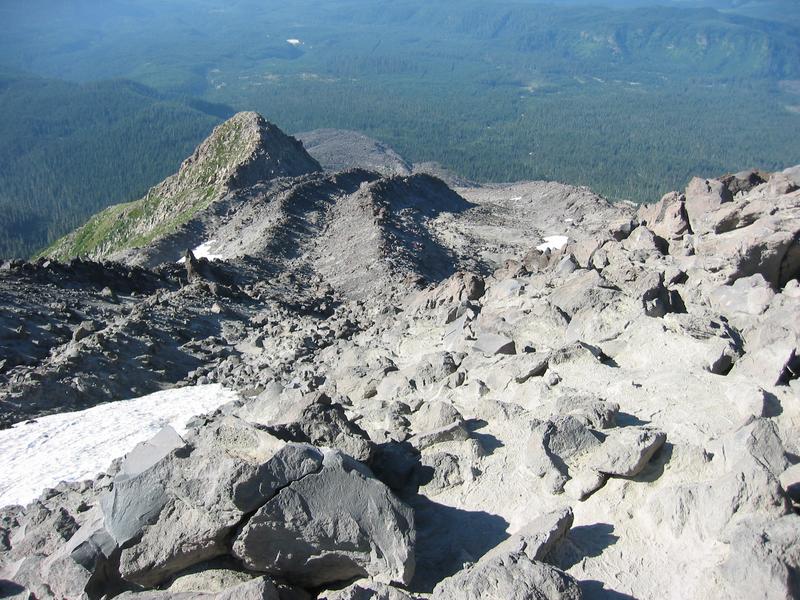
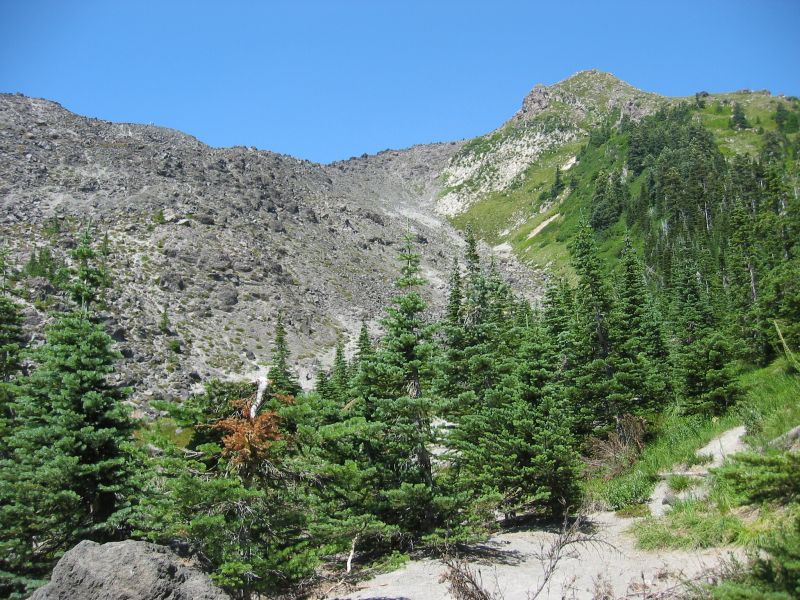
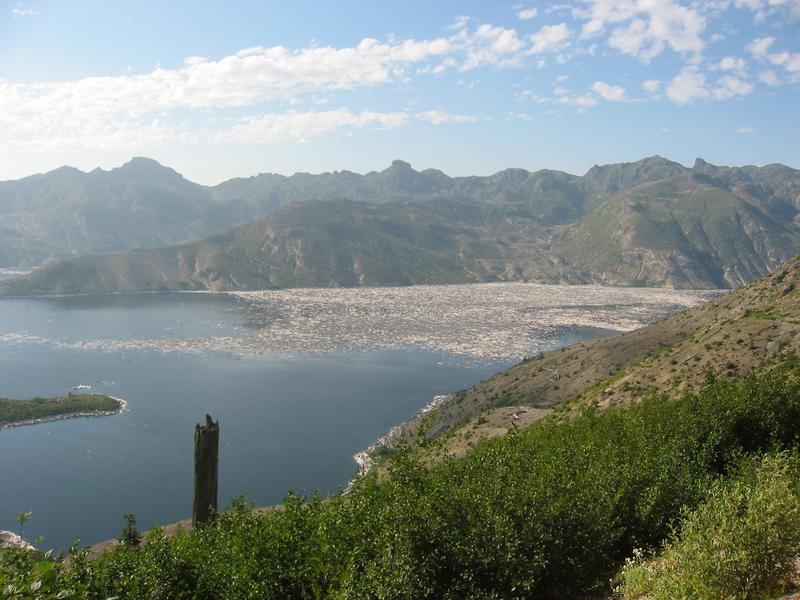
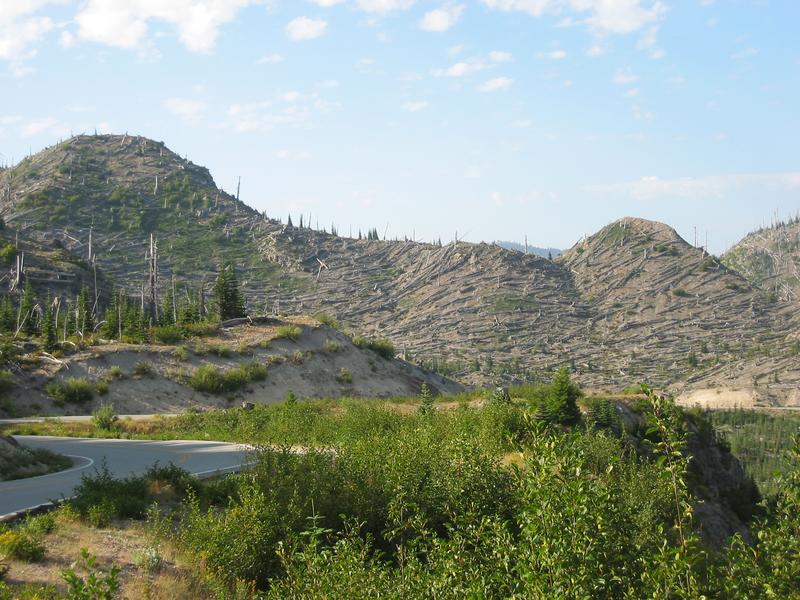
Re:A wonderful place to visitUhhh... are you kidding?
I was there last summer, 23 years since the 1980 eruption, and the power with which that thing erupted is still evident all over the area.
For instance:
- A picture from high on the flank of the mountain looking back down one of the lava flows from the 1980 eruption. Notice the green patch on the hill to the left, which was missed by the lava flow.
- Looking at the same spot, this time from below. You can really see the effects of that hill here -- it diverted the lava, and everything behind it is green, while everything else was destroyed.
- A panorama from the rim of the mountain, looking down into the crater. This should give you an idea of how big a crater the eruption left. The top of the mountain was simply blown away. Even while we were there, every few minutes we could here rock tumbling down into the crater, some of them huge boulders. The sides of the caldera still aren't stable, 23 years after the fact.
- Spirit Lake. All that gray stuff you see are trees. Thousands of them. They were all killed in 1980 eruption, and are now just floating on the lake. It's called the "floating forest" of Spirit Lake.
- This is a hillside about TEN MILES from the blast site. See how the trees were just blown right over? And no, this one isn't a clearcut. According to this page, most of the trees within a 600 square kilometer area were blown over by the blast.
-
Re:Lahars
The worst lahar in the last few centuries happened in Nevado del Ruiz, Colombia in 1985. 23000 people died when the town of Armero was buried under the mud flow.
-
For Parrot Heads
I don't get it... Did Leonard Bernstein conduct REM or toss Michael Stipe into a volcano?
Mostly we have earthquakes here in central California, but looks like the west coast is getting the east coast treatment. Two sets of earth quakes in 24 hours, centered around Parkfield (earthquake capitol of California, they say, dunno about you, but that sounds like a ringing endorsement for a place to live if ever there was one) plus another one near Bakersfield and I figure Mt. St. Helens has got nothing on us. Shakes to the left, magma to the right, it's more like Fins, but Volcano is probably more fitting. (BTW this new lameness minimum line-length thing is a real bugbear, how's someone supposed to post something valid without adding piles of unnecessary comments just to bloat the thing out to some arbitrary average length? It's the kind of thing Pythons careers were born lampooning. Were we not once criticized for writing run-on sentences and paragraphs -- maybe I should review Dead Poets Society stuff for measuring proper enjoyment of a poem with a ruler.) Your comment has too few characters per line (currently 39.6).Your comment has too few characters per line (currently 39.6). It's like telling someone they're house is on fire, but they won't hear you properly unless you use proper manners (Excuse my interruption, kind sir, but your house is a great inferno and I beg you consider your options regarding the welfare of your family and posessions, like, totally forsooth and stuff like that there.) [this is for the lameness filter which utterly blows and encourages lots of unnecessary text to be inserted into a comment by some inexplicable logic to reign in people who do puny posts or obscene artwork, but is really a drag if you're trying to post a quote or some code which is formatted. I hope you enjoy this interlude as much as I did typing it.]
Volcano -- Jimmy Buffett (Words and music)
Now I don't know, I don't know
I don't know where I'm a gonna go
When the volcano blow
Let me say now I don't know, I don't know
I don't know where I'm a gonna go
When the volcano blow
Ground she's movin' under me
Tidal waves out on the sea
Sulphur smoke up in the sky
Pretty soon we learn to fly
Let me hear ya now I don't know, I don't know
I don't know where I'm a gonna go
When the volcano blow
Now my girl quickly say to me
Mon you better watch your feet
Lava come down soft and hot
You better lava me now or lava me not
Let me say now I don't know, I don't know
I don't know where I'm a gonna go
When the volcano blow
Mr Utley... (Michael Utley plays a piano instrumental)
No time to count what I'm worth
'Cause I just left the planet earth
Where I go I hope there's rum
Not to worry mon soon come
Now I don't know, I don't know
I don't know where I'm a gonna go
When the volcano blow
One more now I don't know (ah he don't know)
I don't know (he don't know, mon)
I don't know where I'm a gonna go
When the volcano blow
But I don't want to land in New York City
Don't want to land in Mexico (no no no)
Don't want to land on no Three Mile Island
Don't want to see my skin aglow (no no no)
Don't want to land in Commanche Sky park
Or in Nashville, Tennessee (no no no)
Don't want to land in no San Juan airport
Or the Yukon Territory (no no no)
Don't want to land no San Diego
Don't want to land in no Buzzards Bay (no no no)
Don't want to land on no Ayotollah
I got nothing more to say
I don't know, I don't know
I don't know where I'm a gonna go
When the volcano blow
Just a one more, I don't know (he don't know)
I don't know (I don't know, man)
I don't know where I'm a gonna go
When the volcano blow -
Re:Portland Oregon threatened in last eruptionHowever on the west side of the mountain, there was a nuclear power plant on the Columbia river about 50 miles (80 km) away. If the volcano had blown out through the west side of the mountain instead of the north side, there was the serious possiblility that the shock wave would have ruptured the reactor coolant tanks and damaged the control and safety systems. In a worst case, this could have led to the release of radioactive material into the last 50 miles of the Columbia river. The river would have been closed for shipping. Which means that the port of Portland would have been closed, stopping shipment of massive amounts of grain to Asia from the Pacific Northwest. It would have also caused the extinction of the fisheries, such as salmon and steelhead trout in the Columbia.
It's unlikely that even the most massive eruption from Mt. St. Helens could have threatened the plant. The incredible first lateral blast only travelled 25km and IIRC the pyroclastic flows only extended about 20km. Ashfall would not have been a problem for the plant, and the quakes associated with vulcanism are (Hollywood aside) fairly small.
In the event, they had a pretty good idea that Mount St. Helens was going to erupt through its side. The area that bulged was called Goat's Roack and was actually the result of an earlier eruption through the side of the cone.
What no one had predicted was that the whole side of the mountain would slide off. Instantly a huge section of the magma below the mountain depressurised - like a champagne cork blowing off. And that did the damage.
What we have now is young magma pushing up under the mountain. We'll probably see a series of small eruptions as the dome is built, extended and then blown apart. We could have centuries of this sort of activity ahead of us.
The eruption was too bad because Mt. St. Helens was a perfect cone before the eruption. It looked like Mt. Fuji in Japan. Now it looks like a million-seat football stadium: a big hole with a circular ridge around half of it.
You're not thinking long-term - the cone of Mt. St. Helens was only a few tens of thousands of years old, it will rebuild itself in the next few millennia. In the meantime, sit back and watch the mountain heal itself.
Best wishes,
Mike. -
USGS Pictures, before & after
See the following link to see various pictures of Mt. St. Helens, before and after the May 18, 1980 eruption.
http://vulcan.wr.usgs.gov/Volcanoes/MSH/Images/may 18_images.html (Courtesy of USGS) -
Re:You think Mt. St. Helens was big...
USGS info on the Yellowstone Volcano.
-
Re:Related to California Quake a few days ago?
I just hope this won't trigger any activity for a Yellowstone supervolcanic eruption.