Slashdot Mirror
Domain: visualexpert.com
Stories and comments across the archive that link to visualexpert.com.
Comments · 15
-
The alternative
We should be comparing how good the AI is against what it would be replacing. We know that a computer won't be perfect, but it's pretty damned obvious that humans are far off mark as well. Human witnesses are also terrible at facial recognition as evidence by the number of wrongful incarcerations. There's one particular case, where an expert on eyewitness testimony was accused of a rape and picked out of a lineup by the victim, but was at the time of the crime on television, where he was talking about the unreliability of eyewitness testimony of all things.
At least with a computer, we'll be properly skeptical of it. With humans, we're too susceptible to being drawn in to what they say (regardless of whether they're genuinely mistaken or willfully deceptive) and people will continue to maintain some false recollection, even if they're not being malicious, long after other evidence should be sufficient to dismiss it. Worse still, other humans tend to gravitate towards whatever they've heard from someone else first and weight it disproportionately to information they receive later. That can still happen when interacting with computers, but I don't believe that we assign them the same amount of trust. -
Re:I probably would have hit her
Both parent and GP are wrong.
GP - "From what I saw on the video, it was only about
Human eyes would detect this much earlier live than the video shows. This is pointed out a few times here, and in the next article.Parent - "Average reaction time to visual stimulus is about a quarter of a second."
You clearly googled something like "human reaction time", and that is the answer. However, in tests of driving, response time is typically much longer
http://copradar.com/redlight/f..."It is common practice for accident reconstructionists simply to use a standard reaction time number, such as 1.5 seconds, when analyzing a case."
http://www.visualexpert.com/Re... -
Re: The Driver was Texting
I also will say that in the video I could see the pedestrian while still a way out where the car should have started braking and it could have avoided killing her. [...] If the driver were paying a lot more attention to the road than the phone then this also could have been prevented.
I first see the white of her shoes at the 3 second mark. She is hit at around the 4.5 second mark. Since mean human reaction time is 1.5 seconds, you would have had no ability to avoid this pedestrian.
That driver shouldn't have been texting, but he was 0% at fault. There is no way he could have avoided her; human biology is literally incapable of reacting that fast. At best he could have put himself in danger by jerking the wheel and acting erratically.
-
Re: The Driver was Texting
I detected movement 3, maybe 4 seconds before impact.
No you didn't. You can look at the time on the video in the article, and her white shoes were visible at the 3 second mark. She was hit at about the 4.5 second mark. That is 1.5 seconds to react from when you first she a faint white blur that may be something, and about 1 second from when you can actually tell it is a person on the road and not some bag flying in the wind.
Mean reaction time for a human driver is 1.5 seconds. That means it takes 1.5 seconds from when you see a pedestrian to when you start to press the break and/or begin to swerve the car. Obviously that is the mean, meaning you could be a bit quicker, but police should never fault anyone for not reacting withing a couple seconds.
That woman would have been dead in nearly 100% of cases with a human driver. The biggest difference is many human drivers may have swerved or acted erratically and caused more harm to the driver as well. I agree with others here that a LIDAR or even night vision cameras could and probably should have saved her life, but no human would have done better.
-
Re:Who is more likely to be 'fooled'?
Split second reactions??
Reaction times vary greatly with situation and from person to person between about 0.7 to 3 seconds (sec or s) or more. Some accident reconstruction specialists use 1.5 seconds. A controlled study in 2000 (IEA2000_ABS51.pdf) found average driver reaction brake time to be 2.3 seconds.
In combination with this you should also read: http://www.visualexpert.com/Re...
Humans are terrible.... especially while being distracted while talking to someone, fiddling with the radio or taking a zip of a coffee.. Or just tired because waking up early or tired after a long day at work.
For the reaction time of the Tesla i have not found any numbers, but i have a hard time to see that it would be more than a few 100ms from one a obvious obstacle appearing in front of the car... probably a bit more if it detects that something may be moving into the path of the car, like someone running out into the street in front of the car.. (if that is implemented and stable yet?)
-
Re: This is called Kaya Kalpa in yoga
It took about 5 minutes for me, but had to be *total* dakness. So dark I couldn't tell if my eyes were open or shut. This was in a lab where we were doin nuclear emission spectroscopy (just gas discharge tubes). Any outside light would pollute the results, so the lab was really dark until we turned on the juice. During that period I could see as clearly as i'm seeing this screen flowing sheets of glowing pastel paint sliding down a wall that wasn't there. Not true hallucinations of course--by definition if you know it's not real it's not a hallucination. Phosphenes I think they were called.
Anyhow, very beautiful and unusual. I don't think my lab partners saw anything--at least they didn't say they did. Or they were afraid people would think they were nuts.
Later i blacked out my dorm room & reproduced the effect. And learned it's really hard to produce absolute darkness. Tinfoil is *full* of tiny holes! And black paint is not as opaque as it seems.
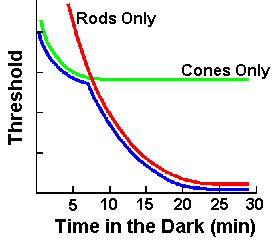
5 minutes is not long enough to fully adapt the human visual system see: http://www.visualexpert.com/im... 5-8 minutes your cones (the photoreceptors concentrated in the central visual field that are used to encode color) and 20+ minutes for the rod (what we use to see in low light situation) to full adapt. Phosphenes are normal and can be produced by placing slight pressure on the eye. Also interesting dark adaptation can be done independently in each eye. Black out one eye for 8 minutes or so (easier to do than a whole room) then open both your eyes. It is a fun and a little disorienting experience if done correctly.
-
Re:Yup, and it doesn't matter.
I also think that autonomous vehicles will be much safer than human-driven vehicles. We can keep making them better based on experience while on the other hand we would keep adding new inexperienced human drivers. I'm sure that we can correct any problems that we may find with early autonomous vehicles. I doubt that we'll ever be able to correct human distraction, emotional reactions, bad judgement and general stupidity.
Do you have any stats on the percentage of accidents caused by physical wear and tear on brakes rotors and axles? Or on the "other thousands of extraneous factors" that you've considered? How do those compare to the percentage caused by any sort of human error?
The following claims human error is the sole cause 57% of the time and a contributing factor 90% of the time, while mechanical fault is the sole cause only 2.4% of the time.
-
How safe do you think driving is?
Engineering is done by humans as as the thousands of poorly engineered building,bridges, cars, planes,trains, consumer products killing thousands/millions have shown us is that engineering is no guarantee of safety.
Could you cite those statistics for death caused not by human error?
Because, according to the CDC, 35,000+ people died of auto accidents in 2010, compared to only just under 17,000 for all "other" non-transport, non-firearm, non-poisoning, non-fall, non-fire/smoke, non-drowning deaths. And that was a GOOD year for automotive deaths -- one of the lowest in decades. For all the national panic over September 11th, we lose well over 10x that number of people every year thanks to auto accidents. More people die every year from car accidents than from firearms, fire, and poison combined.
That's just the fatalities! Only about 8% of crashes result in fatalities thanks to nearly miraculous advances in modern medicine. There are about 6 million crashes per year and about 2.3 million people sent to the hospital as a result. That's about a $70 billion drain on the economy every year. 44% of people with spinal cord injuries obtained them from a car accident.
Getting in a car is the single most dangerous thing you do every day.
While engineering may be no guarantee of perfect safety, but it's practically a guarantee of lowered risks. Human error was the sole cause of 57% of all accidents and a contributing factor in over 90% Mechanical error alone was only 2.4%. The top three contributing factors to accidents are driver inattention, alcohol, and speed. A driverless system (that obeys traffic laws) eliminates all three.
To make the argument that driverless cars would be less safe than humans is a joke, especially when it's such a low bar to reach.
-
Science and law are different
Science is reality. Law is verisimilitude.
Science is supposed to generate results that are not contradicted by experiment. Kuhn aside, it is not done purely by popular vote - if one guy publishes a repeatable experiment that differs from current consensus, eventually other guys will repeat it, publish as well, and the consensus will change. Science has the luxury of being able to say "we don't know enough now to decide" and "we used to believe X, but experiment contradicts that, so now we believe Y".
Law is supposed to generate results that are acceptable to the majority of citizens. It has to make decisions with evidence that is often questionable or missing. It tries to be long-term internally consistent (adherence to precedent). The gold standard in law is a jury decision - a sample of the population looks at the evidence and makes a choice, which often comes down to whose lawyer's story sounded better to them.
Lawyers and the law in general are only interested in science when it supports their primacy in running society. I will believe otherwise when juries are routinely told that eyewitenss identification is unreliable - in some states in the US, it is illegal to mention this well-established fact in front of a jury.
-
Re:I might just be a luddite, but
Illumination on roads is a tricky issue, to be sure.
There is fairly strong evidence that improved lighting significantly decreases both the rate and the severity of accidents. See, for example, this summary by the Royal Society for the Prevention of Accidents. You do have to be careful not to draw conclusions beyond what is actually supported by the stats in each case, but there seems to be a clear pattern there. I'm reasonably sure I once read a paper arguing that lighting our motorways 24/7 would be the most cost-effective way to save lives on the road today, though I can't immediately find it.
For the same reason, there is often a good argument for using brighter headlights on cars. Typical headlights of a few years ago didn't necessarily provide enough illumination out to a safe stopping distance for high speed travel, even for skilled drivers, with good vision, driving within the speed limit, in capable vehicles, on a straight road, in good weather. Obviously in practice that's a rare combination, and worsening any of those criteria only increases the need for better illumination. If nothing else, we have much better understanding of the visual limitations of older drivers now, particularly the dramatic reduction in how much light gets through as people get older.
That said, your point about being blinded by other cars' headlights is a very serious concern, and I totally agree with you that it's a problem that needs addressing as a priority. Personally, I'm hopeful that the current trend in adaptive lighting, where lights are directed differently as driving conditions change, will allow us to continue using brighter and wider beams, but without allowing them to drift up to the point where they will dazzle other drivers.
There also seems to be research going on into adaptive materials that might be used in vehicle windscreens or night-driving glasses that would act as a filter for exceptionally bright lights, and even into HUDs that actively highlight hard-to-see dangers in low-light conditions based on thermal imaging, RADAR, and other cool toys. Given that there is a lot of money to be made in improving road safety, aside from the obvious social desirability of doing so, I suspect if we look back on this discussion in ten years the night driving technology that is starting to appear on high-end vehicles today will seem like something from (if you'll excuse the pun) the dark ages.
-
This gets slashdotted? There are studies all over!
http://www.visualexpert.com/FAQ/Part6/cfaqPart6.html There is a new gizmo for web users called Google Search. http://www.visualexpert.com/sbfaqimages/fonts.gif
-
This gets slashdotted? There are studies all over!
http://www.visualexpert.com/FAQ/Part6/cfaqPart6.html There is a new gizmo for web users called Google Search. http://www.visualexpert.com/sbfaqimages/fonts.gif
-
Black or white text?
So Apple is using the color scheme that is exactly the ideal, as recommended by numerous independent studies and researchers and as recommended by every design and usability manual I have ever read.
Can you cite a reference? I find that for me a light background with dark text is easier for me to read.
This seems to to agree with my observations (so I stopped looking
From Visual Expert:
Probably, the optimal background would be a very light, desaturated blue. The light background produces high brightness contrast against dark letters. By toning down the white, the screen is less likely to act as a glare source. Finally, the use of some blue will produce aerial perspective and provide a bit of foreground-background separation.
-
Re:Decent review, one quibble
Here's a reference that discusses the pros and cons for black/white vs white/black.
-
Re:Sophistry
Reality is what we percieve to be real. That is going to be different from person to person. There is no such thing as one reality.
You confuse a view on reality with reality itself. Imagine a picture on a harddisk. In reality it consists of magnetic charges on a platter. If I watch the picture in a text editor, I will see a bunch of numbers. That is one particular view on reality. If I display the picture in a viewer, I will see a two dimensional graphic. That is another view.
A regular user will probably only know the a picture by the last view. That does not mean that the harddisk does no longer exist. It's just that the user is ignorant of reality.
It was only four years ago, a doctor cannot be considered a casual observer and since he was in a comma in hospital he had every available health monitoring system attached to him. But in saying that I never honestly expected you to believe me.
It is very telling that you lambast him just for offering a possible alternate explanation. Why would that be wrong? Is it because you are not willing to consider rational explanations?
Yep! Check out this or read the book, 'The Heavenly Man'. I understand that you may not find the article substantial and will probably never read the book, but do you really expect Communist China to document how one of their Christian prisoners survived with no food or water for 74 days and post it on the net?
What I know is that people lie. Human memory is notoriously unreliable and people change their memory of past events to conform with their beliefs. Personal recounts are even more suspect when a person stands to gain from it, which is true for the 'Heavenly Man,' who now earns his money by telling his amazing story. You simply cannot trust these kinds of unverifiable stories. What you do, to assume the story is right until proven otherwise, cannot be called scientific.
Wrong. Only a change of heart will do.
No, please look up the definition of atheist.