Slashdot Mirror
Domain: w3.org
Stories and comments across the archive that link to w3.org.
Comments · 6,785
-
Re:They _Should_ Replace It
Luckily I'm seeing more and more of these issues being solved with newer CSS standards:
http://www.w3.org/TR/css3-mult...
http://caniuse.com/#feat=multi...
http://www.w3.org/TR/css3-flex...
http://caniuse.com/#feat=flexb... -
Re:They _Should_ Replace It
Luckily I'm seeing more and more of these issues being solved with newer CSS standards:
http://www.w3.org/TR/css3-mult...
http://caniuse.com/#feat=multi...
http://www.w3.org/TR/css3-flex...
http://caniuse.com/#feat=flexb... -
Re:DRM should not be in HTML5
HTML doesn't mention DRM. See for yourself: http://www.w3.org/TR/2014/PR-h...
There's Encrypted Media Extensions, which everyone says is "ZOMG DRM", but it's an entirely separate document, and no more insidious than EncryptedXML.
You can't "standardize" DRM, it's literally impossible.
-
Re:nail in W3C coffin
Most of the HTML5 specifications gets developed here first:
http://www.whatwg.org/specs/we...
Then eventually after a long process will end up here:
However Picture-tag actually came from the community first, not the W3C or the vendors directly:
http://responsiveimages.org/ only later did it become http://www.w3.org/community/re... and later became part of the HTML5-specification.Ehmm. W3C is the community, WhatWG is the vendors. The whole point of WhatWG was to coordinated between browser vendors.
-
Re:nail in W3C coffin
Most of the HTML5 specifications gets developed here first:
http://www.whatwg.org/specs/we...
Then eventually after a long process will end up here:
However Picture-tag actually came from the community first, not the W3C or the vendors directly:
http://responsiveimages.org/ only later did it become http://www.w3.org/community/re... and later became part of the HTML5-specification.Ehmm. W3C is the community, WhatWG is the vendors. The whole point of WhatWG was to coordinated between browser vendors.
-
Re:nail in W3C coffin
Most of the HTML5 specifications gets developed here first:
http://www.whatwg.org/specs/we...
Then eventually after a long process will end up here:
However Picture-tag actually came from the community first, not the W3C or the vendors directly:
http://responsiveimages.org/ only later did it become http://www.w3.org/community/re... and later became part of the HTML5-specification. -
Re:nail in W3C coffin
Most of the HTML5 specifications gets developed here first:
http://www.whatwg.org/specs/we...
Then eventually after a long process will end up here:
However Picture-tag actually came from the community first, not the W3C or the vendors directly:
http://responsiveimages.org/ only later did it become http://www.w3.org/community/re... and later became part of the HTML5-specification. -
Re:nail in W3C coffin
Not to spoil your rant, but the picture tag is defined here: http://www.w3.org/html/wg/draf...
Notice the hostname.
-
srcset attribute
I thought we already had this with the img tag's srcset attribute. Do we really need a new tag?
-
Re:COBOL was better than JavaScript.
> the web would likely have been replaced by some other set of technologies.
A dream. I can no more stand this pile of crap.
The Web, [...], is a joke. The Web was done by amateurs -- Alan Kay
-
Re:It's about time!
Or if you can't be bothered to write compliant HTML. Oops, Google fails.
Sites with accessibility issues such as content that can only be accessed with JavaScript enabled, should also be deprioritized.
-
Re:Not Ready Yet...
-
Firefox + 60fps = No Go
Unfortunately YouTube's 60fps support pokes a pretty big hole in the current state of Firefox.
To play back 60fps videos you need to be using the HTML5 player and stream the 1080p version. The Flash player will not work here.
The problem? Firefox doesn't support Media Source Extensions, which is what YouTube uses for DASH adaptive streaming. Mozilla's developers are working on the matter, but only for WebM for now. H.264/MP4 MSE support will have to wait.
The end result is that 1080p60 playback works great on Chrome, Safari, and even IE11, but is all but useless on Firefox.
I don't want to slag the Firefox devs too badly (hey, it's a free browser), but once again FOSS orthodoxy is getting in the way of practical feature development. H.264 support took an embarrassingly long time to come, and now Firefox is the only browser that that can't play back 1080p60 on YouTube.
Between this and their constant attempts to turn Firefox into a Chrome-alike, it's getting harder and harder to justify using Firefox.
-
Re:Just Google?
Better-er question: why use the teletype tag? It's non-standard.
-
Re:Latin unification too
>
Even in HTML you only get to set one language for the entire document. Good luck writing a page in Chinese about learning Japanese. The ones I have seen tend to use GIFs to represent the characters that Unicode can't differentiate, but that means you can't copy/paste them and the fonts don't match.
Most elements in HTML accept the lang attribute. Please refer to the W3C
-
Why did it take half a century to write?
Couldn't you implement Xanadu today in a few weeks using XInclude and some social conventions?
http://www.w3.org/TR/2006/REC-...
The content could be, by convention, kept in place and merely added to in an XML library, and the documents themselves could be implemented by an XML document populated with nothing but XIncludes. Links could be represented by XML fragments using XIncludes as well.
-
Re:Linux soon?
Nothing will be compromised, because the distributions for people who care about FreedomLibre(tm) or whatever we're calling it this week will offer builds without the feature, perhaps exclusively.
True, but that is not the point being presented there. The concern is if it is appropriate for an organization whose primary goal is to make the benefits of the social value of the Web "available to all people, whatever their hardware, software, network infrastructure, native language, culture, geographical location, or physical or mental ability" go out of its way to enable an application that is inherently contradictory to that goal?
Because its existence threatens your non-DRM'ed media how?
Not at all. But on the other hand, if it doesn't advance the very reason for the group to exist, what is the motivation to include it in the standard at all? It is not only up to the developers, the stated purpose of the group is to advance a Web that is "FreedomLibre(tm) or whatever we're calling it this week".
-
em vs. i vs. blockquote
The <em> element is for "emphatic stress". The <i> element is for other types of unemphasized "offset text" (or "text in an alternate voice" as this explanation puts it), such as foreign language loan phrases, technical terms being defined, taxonomic names including a genus (roadrunner, Geococcyx californianus; coyote, Canis latrans), and the like. A long time ago (pre-D2), Slashdot's stylesheet added excessive side margins for the <blockquote> element. To work around this, some users got in the habit of putting quoted lines in an alternate voice (<i>) rather than using a block quotation. I seem to remember having switched my own posting style from <i> quoting to <blockquote> quoting soon after D2's introduction.
-
em vs. i vs. blockquote
The <em> element is for "emphatic stress". The <i> element is for other types of unemphasized "offset text" (or "text in an alternate voice" as this explanation puts it), such as foreign language loan phrases, technical terms being defined, taxonomic names including a genus (roadrunner, Geococcyx californianus; coyote, Canis latrans), and the like. A long time ago (pre-D2), Slashdot's stylesheet added excessive side margins for the <blockquote> element. To work around this, some users got in the habit of putting quoted lines in an alternate voice (<i>) rather than using a block quotation. I seem to remember having switched my own posting style from <i> quoting to <blockquote> quoting soon after D2's introduction.
-
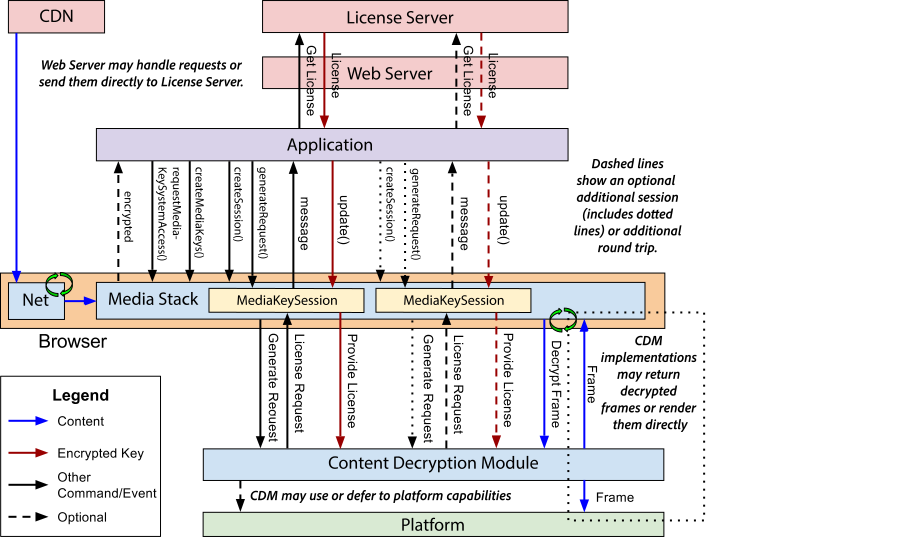
CDM may render the frames directly
http://www.w3.org/TR/encrypted...
sandbox? i do not think so. lets talk about DMA and other holes to get system access.
-
Re:Write to Mozilla CTO Andreas Gal, he's responsi
This isn't for Youtube.
Google is an author of EME, which is probably an indicator that they do intend to use it.
-
Re:What a fscking disaster
Youtube uses EME for 1080p streams, no EME and you only get 720p or lower
Youtube uses Media Source Extensions for 1080p streams. That's completely different; it's a way to source data to a <video> element from Javascript. They use it to implement their dynamic HTTP streaming, where rather than just sucking down a file you suck down individual file segments allowing dynamic quality adjustments based on your available bandwidth. There's no DRM involved.
-
Neither are allowed under the standard
> That's not lieing anymore than telling the server that you've opted in when you haven't.
Both of those would be a lie, which is why neither are allowed under the standard.
The standard says that the browser "must not send a tracking preference expression if a tracking preference is not enabled. This means that no expression is sent for each of the following cases: -
Political reasons for URIs to change
I always thought that URIs were supposed to handle precisely this - that they were supposed to be unique, universally accessible identifiers for contents and resources - identifiers that, once assigned, wouldn't need to be changed to access the same contents or resources in the future.
That's the intent: cool URIs don't change. But in the real world, URIs disappear for political reasons. One is the change in organizational affiliation of an author. This happens fairly often to documents hosted "for free" on something like Tripod/Geocities, a home ISP's included web space, or a university's web space. Another is the sale of exclusive rights in a work, invention, or name to a third party. A third is the discovery of a third party's exclusive rights in a work, invention, or name that make it no longer possible to continue to offer a work at a given URI.
-
Re:Yes...
I picked the 1993 date from his RFC http://www.w3.org/MarkUp/draft...
Which is also the date that wikipedia article states as the date it was formally defined as a draft standard. -
p2p social messaging system
Perhaps there is already someone doing this?
Yes, there are a number: diaspora, Friendica, and an emerging system based around RSS, this type of thing is usually called the federated social web. This is my own overview.
meta data and messaging data is spread around different peers as encrypted chunks
This is my proposal for exactly that
-
Re:Two solutions (Encrypt or leave)
-
Re:Open Standards, Not stupid plugins.
HTML 5 is ideal but one of my problems with using pure HTML and JavaScript for certain tasks is that implementation can vary wildly and performance even more so. Browser A might implement only a part of the standard, Browser B might implement the entire standard and Browser C has no support and worse is when all of them fully support the standard but Browser A is super slow compared to Browser B and Browser C is basically unusable.
I guess that's the price you pay for deciding to ride the bleeding edge. When HTML5 reaches the Recommendation status perhaps the browser developers will concentrate on supporting it (the standard) rather than speculating on which of their proposed implementations will give "the bigger market share"/"scratch their biggest itch". Until then there will continue to be a lot dog-waving by the tails.
Oh wait... HTML 4 was a different dog, same leg action - but good developers worked with the differences.Bleeding edge has a great view, but not everyone enjoys it e.g. nothing more annoying than listening to butthurt little boys that insist on riding bikes without seats.
-
Re:Reinvention of RDF + SPARQL
SPARQL 1.1 supports updates (insert/delete) and the SPARQL CONSTRUCT operator can be used to build query results in a nested graph format. Additionally SPARQL protocol defines a standard HTTP binding protocol that can generate output in CSV and JSON formats in addition to XML. To me it appears OData is a reimagining of W3C's Semantic Web efforts.
-
Re:gmpg.org?
Read this article about systems rendering the http links in DTD headers from XHTML specs - http://www.w3.org/blog/systeam...
It's from 2008, still stands.
-
Re:Its Easy
Yeah, I realized that after I hit submit.
I do that all the time, I was just bein' snarky. It's gotten me far on this site and, since I'm not sure how much longer I'm gonna stick around, I'm trying to get a few more jabs in.
Also, I was forced to use non-compliant markup (<br> rather than </br>)
Ahem, what? The first two lines of HTML in
<!DOCTYPE html>
<html lang="en">In HTML5, the slash is not only optional for void element, such as <br>, it belongs at the end (e.g. <br/>)of the opening (and only) tag, not at the beginning (as it would be placed in a closing tag). While SlashCode is, as you so eloquently put it, shit, your HTML could probably use a bit of spit-shine, as well.
-
Re:Its Easy
Yeah, I realized that after I hit submit.
I do that all the time, I was just bein' snarky. It's gotten me far on this site and, since I'm not sure how much longer I'm gonna stick around, I'm trying to get a few more jabs in.
Also, I was forced to use non-compliant markup (<br> rather than </br>)
Ahem, what? The first two lines of HTML in
<!DOCTYPE html>
<html lang="en">In HTML5, the slash is not only optional for void element, such as <br>, it belongs at the end (e.g. <br/>)of the opening (and only) tag, not at the beginning (as it would be placed in a closing tag). While SlashCode is, as you so eloquently put it, shit, your HTML could probably use a bit of spit-shine, as well.
-
Re:Ivory tower Drama
It was a mistake the created tables for the specific purpose of tabular data. They should have called them something more generic like: tiles or grids. And saved us a lot of grief with CSS.
You mean, like CSS Grid?
-
If it's gone use 410, not 404
Sure we get the odd server down. But we also have cases where we have a deliberate take down of information, due to legal, or personal reasons.
If it's gone use 410, not 404, see: http://www.w3.org/Protocols/rf...
-
Re:Become?
A tag to disable active content was proposed more than ten years ago. http://lists.w3.org/Archives/Public/www-html/2002May/0021.html
Mozilla proposed CSP some years later: https://wiki.mozilla.org/index.php?title=Security/CSP/Spec&oldid=133465
If this sort of thing was widely implemented this malware thing might have been easily blocked - apparently the malware ads didn't require the victim to click! And many of those XSS worms in the past might not have spread.
But nobody really cares about security.
-
Java, C#, and JavaScript all have graphics libs
Java, C#, and JavaScript all have graphics and canvas component libraries. All these libraries render graphics differently on different systems. In the C++ universe, programmers have had to use 3rd-party libs like Qt, so a C++ standard library for graphics is long overdue.
-
Re:iPads do support HTML5
I assume the parent was referring to IE's use of pointer events instead of the touch events. While many may accuse Microsoft of trying to split the web, this move was most likely done for two reasons.
- Apple has been working to patent touch events
- The ability to simplify event handling with one type of event that is input method independent -- working for mouse, touch, and pen.
As a web developer I find the pointer event method to be technically superior to touch events. At present, patches to add pointer events to Blink-based browsers (the patch might have been added before the split from WebKit) and to Firefox exist, but I do not believe they have yet landed in other browsers. Sadly, with the lack of touch events it does bloat up code to support two different event models for touch browsers at this time.
-
Re:Update the ecma standard
Actually, that is what is going on.
asm.js is that potential bytecode and TypedArrays are the first step.
There are things being added to ECMA standard which allow for things other languages can already do (I forgot which ones right now. I don't want to spend the time to look them up right now).
Lots of other things are also available or being worked on:
- WebGL == OpenGL ES
- http://www.w3.org/TR/WebCryptoAPI/ exposes some of the browsers cryptographic functions as an API.
- WebRTC is encrypted video and voice (kind of like VoIP) and Peer2Peer networking.
- WebAPI is about giving you access to hardware and networking: https://wiki.mozilla.org/WebAPI
- https://payswarm.com/ and https://wiki.mozilla.org/WebAPI/WebPayment are about adding "inApp-/webstore payment" system to the web.That is just from the top of my head. And I didn't even mention all things that went into HTML5 or related standards.
-
Re:Already has good adoption
Since when is WebRTC text-only? From Google's original announcement:
Today, Google made available WebRTC, an open source software package for real-time voice and video on the web that we will be integrating in Chrome.
-
JS file APIs, MTP, and Rhmsoft File Manager
If Google was actually interested in pushing the limits of the Web as a platform, they'd find a way to provide local file access from JavaScript.
Google could even call it something like chrome.fileSystem or File API.
I bought a Nexus 10 and was horrified to learn that it had no out-of-the-box capability to access local files of any kind
Then you didn't try plugging your into a Windows PC to copy files on and off it using MTP. (On Linux, recent versions of gvfs have added MTP support, and it should land in Ubuntu LTS next year.) The other way is to go to Google Play Store and download Rhmsoft File Manager. I use it on my first-generation Nexus 7 tablet to browse SMB shares over Wi-Fi, copy files to the device's internal memory, and launch them on the device.
it can't even display something as simple and universal as a PDF file on a USB flash drive.
I'm over 98 percent sure that the USB flash drive came formatted in a file system on which Microsoft owns one or more United States patents. Google and ASUS don't want to pay more royalties to Microsoft than they have to, which is why a lot of devices have been dropping support for microSD cards and USB flash drives. Use MTP over USB or SMB over Wi-Fi to copy local files onto your device.
-
Re:How about Yahoo "bots", Bing "bots" ?
Actually, bingbot is particularly stupid. It has downloaded several zip files of public domain material (each exceeding 1GB with total over 10GB) from our web site at home. It does so about once per month despite the fact that these files are unchanging, instead of merely doing a conditional GET and checking for a 304 return. The various googlebots all do it this way, as do other bots (e.g. docomo, yahoo, yandex).
We don't yet bar bingbot, but if it starts dowloading several GB at times when other visitors are looking at videos (mostly 720p and 1080p), it will find itself in the wrong part of robots.txt. If I get really irritated, then it will get customized garbage results, just like the ZmEu crap...
And you can't just exclude the problem files instead of blocking the whole site?
Well, yes I could, obviously enough. But then the googlebot and other bots would be handicapped (I expect a change to at least two of those PD zipfiles during 2014). In summary, bingbot does it wrong while other bots do it right. These PD zipfiles are the most egregious examples, but there are also many smaller files where bingbot does it wrongly. So I'm likelier to bar bingbot than to bar other bots or to exclude these specific files.
As I said, bingbot is earnestly hoping for a customized middle finger instead of getting the entire >100GB site every time it looks. In short, bingbot does it wrongly.
-
Re:How about Yahoo "bots", Bing "bots" ?
Actually, bingbot is particularly stupid. It has downloaded several zip files of public domain material (each exceeding 1GB with total over 10GB) from our web site at home. It does so about once per month despite the fact that these files are unchanging, instead of merely doing a conditional GET and checking for a 304 return. The various googlebots all do it this way, as do other bots (e.g. docomo, yahoo, yandex).
We don't yet bar bingbot, but if it starts dowloading several GB at times when other visitors are looking at videos (mostly 720p and 1080p), it will find itself in the wrong part of robots.txt. If I get really irritated, then it will get customized garbage results, just like the ZmEu crap...
And you can't just exclude the problem files instead of blocking the whole site?
-
Re:How about Yahoo "bots", Bing "bots" ?
Actually, bingbot is particularly stupid. It has downloaded several zip files of public domain material (each exceeding 1GB with total over 10GB) from our web site at home. It does so about once per month despite the fact that these files are unchanging, instead of merely doing a conditional GET and checking for a 304 return. The various googlebots all do it this way, as do other bots (e.g. docomo, yahoo, yandex).
We don't yet bar bingbot, but if it starts dowloading several GB at times when other visitors are looking at videos (mostly 720p and 1080p), it will find itself in the wrong part of robots.txt. If I get really irritated, then it will get customized garbage results, just like the ZmEu crap...
-
Re:what is MEP?
It's Member of European Parliament.
I wish more authors/websites would use the tag.
-
Re:Headaches for developers?
It's on the list/planned to add eventually:
https://wiki.mozilla.org/WebAPI
http://www.w3.org/2011/07/DeviceAPICharter.html -
actually a step in the right direction
before you think it, i'm no MS shill, i use Linux and only Linux. that said, the MSIE team is doing it right this time with IE11.
while many people here are slamming on the basis of standards compliance, there is something you should know: it's broken because they are striving standards compliance.
as we all know, there are plenty of MSIE exclusive ways of doing things in the DOM and render hacks that have had to be done so you end up with code that has "browser detection" to apply browser specific hacks. MSIE is making a clean break from all of that. so all those IE only apps like Outlook Web App will now fail because all the IE specific stuff has been removed. they went so far as to remove "MSIE" from their user agent string to prevent any old code from detecting it as Internet Explorer.
IE10 user agent string: Mozilla/5.0 (compatible; MSIE 10.0; Windows NT 6.1; WOW64; Trident/6.0)
IE11 user agent string: Mozilla/5.0 (Windows NT 6.3; Trident/7.0; rv 11.0) like Geckoso while it seems to have growing pains, as far as IE goes, IE11 is a step in the right direction.
some nice differences:
Deprecation of file:// based Proxy configuration scripts
Deprecation of document modes
Deprecated VBScript in IE11 mode pages
navigator.plugins -- now a supported extensibility point <-- ironically chrome is removing this support
ActiveX now behaves like a navigator plugin.
Silverlight plugin is not installed by default (they got Netflix to support HTML5 via Encrypted Media Extensions aka DRM in the HTML5 spec)more info:
http://www.nczonline.net/blog/2013/07/02/internet-explorer-11-dont-call-me-ie/
http://blogs.msdn.com/b/ieinternals/archive/2013/09/24/internet-explorer-11-changelist-change-log.asp -
Re:Internet democracy
<a href="example.com">...</a>
<a href="http://example.com">...</a>
See the difference?Fucking slashdot changed my links from wikipedia to slashdot.
Are you complaining because
Or because someone failed to teach you about absolute and relative URLs?Either way, it seems a little unreasonable to blame
(Now the tablet UI, I'm with you all the way blaming
No I'm complaining because slashdot took a perfectly valid absolute URL and somehow munged it into something other than what I'd entered before pressing submit. The only difference between that post and the dozens of others I've made previously is that I was using a tablet to do it. Fucked if I know why they would do something different to html embedded in a post from a tablet versus a desktop but I know what was in the textarea before I sumbitted and it sure as fuck was an absolute url with wikipedia in the hostname section.
-
Re:Internet democracy
<a href="example.com">...</a>
<a href="http://example.com">...</a>
See the difference?Fucking slashdot changed my links from wikipedia to slashdot.
Are you complaining because
Or because someone failed to teach you about absolute and relative URLs?Either way, it seems a little unreasonable to blame
(Now the tablet UI, I'm with you all the way blaming
-
Re:Anyone noticed
At least with open source DRM you know they are only doing what they say. Not a big difference, but also not a big cost.
That's not going to happen. The only thing that makes DRM schemes work at all is security-through-obscurity. If we have an open source DRM module then anyone who can read C/C++/whatever can look at the source and see not only the encryption algorithm used, but also where in memory to look for the encryption key. DRM is stupid, but it's not that stupid.
Which is probably why (if I understand the proposal correctly) the proposal is for an API rather than an implementation. In fact...
This specification does not define a content protection or Digital Rights Management system. Rather, it defines a common API that may be used to discover, select and interact with such systems as well as with simpler content encryption systems
So "it's ok, it's going to be open source" isn't terribly reassuring, either.
-
simple, the W3C does not represent you.
the W3c is comprised of these guys
http://www.w3.org/Consortium/Member/List
theyre major corporations like Microsoft, Sony BT, Cox, Square Enix Comcast and at&t. these guys either have direct pressure to, or direct interest in pushing DRM whether you like it or not. they outnumber individual members and can basically determine the course as they see fit by lobbying and intimidating other members into concensus. in short, asking the W3C is functionally incapable of representing the interests of anything more than a collection of large corporations. Sort of like the US Government.