Slashdot Mirror
Domain: w3.org
Stories and comments across the archive that link to w3.org.
Comments · 6,785
-
Re:SGML?I dunno..."Standard Generalized Markup Language" vs. "eXtensible Markup Language". There are hints in the names as to what they're for.
In point of fact, XML is not just intended for rendering non-document structured data (XHTML being one example of this, just as HTML is an example of this relating to SGML).
XML and SGML both had the intent of allowing open definitions of document content within a specific framework (delimiters, keywords, general syntax rules), and XML is a restricted subset of SGML. The fact that the most common use of XML to date has been for data and data transformation does not make it a data-container-only language any more than the same fact makes SGML a data-container-only language. The difference comes in the specific restrictions used in XML that make it more practical to implement.
All that aside, if we go back to heredity, if SGML is not covered by the patent, and XML is substantially a subset of SGML, then does it make sense that XML should be covered by the patent? In Dec, 1997 you find an example of a way to create an XML declaration in SGML. The RFC says in section 4:
XML, as a subset of SGML, has the same security considerations as specified in [RFC-1874].
XML is defined here as 'An initiative from the W3C defining an "extremely simple" dialect of SGML suitable for use on the World-Wide Web.', which says to me that the patent holder and the USPTO ought to examine the relationship between SGML and XML more closely, as well as examining the SGML-based applications that still exist.
Seeing as how SGML is not designed specifically for web-based transactions, it is probably broad enough to cover any situation that the patent applies to, unless they have somehow designed a process that implements SGML/XML-like behavior outside of computing devices.
-
Re:SGML?
Heh. Even the technical term for an XML data is a "document". Ever heard of DOMDocument objects?
-
How Does It Apply At All?
Okay, besides the fact that the patent is for a non-heirachrial data format, and XML most certainly is Hierarchial, what about prior art? XML came out of SGML. And XML itself was already a draft by 1996! XML Draft Nov 1996
-
Re:Extra! Extra!
At least the HTML of their page is standards compliant:
http://validator.w3.org/check?uri=http://www.flock .com
Unlike that of Microsoft's Internet Explorer site:
http://validator.w3.org/check?uri=http://www.micro soft.com/windows/ie/default.mspx
But then again, that's not surprising. -
Re:Extra! Extra!
At least the HTML of their page is standards compliant:
http://validator.w3.org/check?uri=http://www.flock .com
Unlike that of Microsoft's Internet Explorer site:
http://validator.w3.org/check?uri=http://www.micro soft.com/windows/ie/default.mspx
But then again, that's not surprising. -
Compressed HTML + images
I seem to remember Opera, ages ago, could read zipped HTML+images.
It's in the HTTP specification, all web browsers should be able to read compressed HTML or images, not just Opera. Whether they do or not is another question. The server, however, does have to pass on the encoding information in the headers. -
Compressed HTML + images
I seem to remember Opera, ages ago, could read zipped HTML+images.
It's in the HTTP specification, all web browsers should be able to read compressed HTML or images, not just Opera. Whether they do or not is another question. The server, however, does have to pass on the encoding information in the headers. -
More like...
...buying a Steak Egg and Cheese Bagel, then buying another one in a few months and realizing they added unwanted mayonnaise.* I also hope the W3C, etc. do have upcoming Recommendations/standards/wtf-they-call-'em, they check over them to prevent any errata that could give Microsoft (further) implementation legroom ("IE6 and IE7 reserve white space for [an] empty legend tag. The HTML 4.01 spec does not specify what should happen in this case."). (said HTML 4.01 spec)
*Disclaimer: This actually happened to me; remind me not to get another #7 for breakfast.**
**Disclaimer disclaimer: I love their other artery-blockers so much, and have so little hard feelings about said bagel, that I just linked to them with a nice word.
-
Bloomberg TV
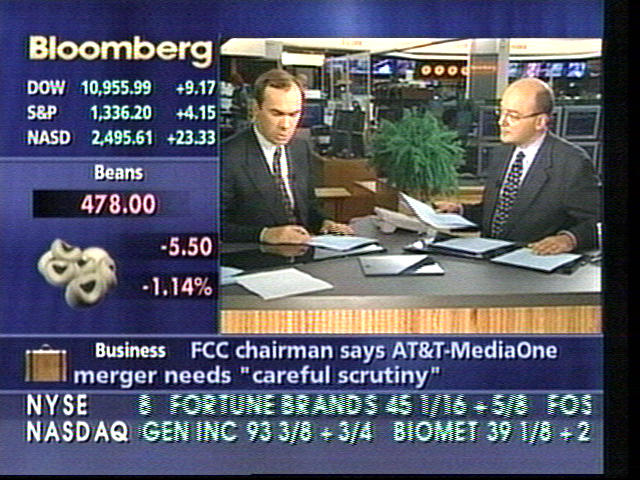
Some have mentioned it but here is a screenshot of their NORMAL broadcast:
http://www.w3.org/Talks/1999/0512-tvweb-www8/IMG06 .JPG
Oddly enough there was an interesting article about CNN's "Situation Room" with video walls and such. They talk about how the producer wanted to be like a war room in the White House or Pentagon or some such nonsense. Essentially this article discusses exactly your point.
Here is the link:
http://www.wired.com/news/politics/0,1283,68859,00 .html -
Re:Why not use HTML?
regarding point (2), it is possible to define pages and sizes and such in CSS level 2
http://www.w3.org/TR/REC-CSS2/page.html -
not valid XHTML
They could atleast use valid XHTML!
-
Re:This, I like.
It seems their page fails to validate, at least according to the W3C's HTML Validator.
http://validator.w3.org/check?uri=http://www.mi6.g ov.uk/output/Page79.html
However, the one error is quite minor. Merely a "GET" which must be changed to "get". -
No respect for standard HTML ...
The W3C Validator Finds seventeen errors in the press release page, including a missing Document Type Declaration.
-
No respect for standard HTML ...
The W3C Validator Finds seventeen errors in the press release page, including a missing Document Type Declaration.
-
Re:AJAX is a retarded term
Did I say that a webmail application is a "Javascript"?
No you claimed that AJAX apps, however, ARE implemented in Javascript. and have been attempting to make the case that AJAX is just javascript.
You fail to accept that javascript is just a glue that brings together the XMLHTTPRequest object with the ability to affect the DOM and CSS. All this glued together with an easy to use library and a Server-Side Framework and you have AJAX. Remove the DOM, CSS, XMLHTTPRequest, client side scripting, or the server framework and you no longer have AJAX.
Its NOT JAVASCRIPT! AJAX is what you get when you have all of those together.
This makes no sense whatsoever, unless you're saying "browsers will add more scripting languages".
Take a look at Ruby on Rails, MonoRail or any of the other AJAX enabled frameworks and you'll see almost no javascript on the developers side. These Frameworks use helpers and tags to generate the needed clientside code. The next step is for the browsers to simplify there side of the equation. Think:
<ajax type="button" update="some_css_id">
You could go start coding it up in the Firefox now. Submit it to the W3C and be the guy they talk about instead of Jesse James Garrett.
This is unlikely to happen, and even if it did, it has no bearing on the argument.
I wonder how many times that quote has been stated to the folks that have changed the way we see the world. AJAX is not javascript its a new way of dealing with an old problem. As people look at the problem through the AJAX glasses, they'll see new and better ways of doing it.
Now I've been sarcastic, but I've tried not to be rude. I've enjoyed our little discussion. But please don't insult me. Now lets discuss the subject I've no authority on, Quoting from the W3C DOM Spec:
"The goal of the DOM specification is to define a programmatic interface for XML and HTML. The DOM Level 1 specification is separated into two parts: Core and HTML. The Core DOM Level 1 section provides a low-level set of fundamental interfaces that can represent any structured document, as well as defining extended interfaces for representing an XML document."
"The Document Object Model does not define "the true inner semantics" of XML or HTML. The semantics of those languages are defined by W3C Recommendations for these languages. The DOM is a programming model designed to respect these semantics. The DOM does not have any ramifications for the way you write XML and HTML documents; any document that can be written in these languages can be represented in the DOM."
That last line pretty much somes up which of us has no authority to say what was said. -
Re:That's IrrevellantThat's not the right attitude. The problem lies with web browsers that accept non-standard code.
Uhh.. that would be all of them. If you're reading this page, then your browser is interpreting invalid HTML 4.01.
If you would like to try an experiment to prove it, then do a "View Source" on this page and then save it off as "test.htm". Then upload and validate it here http://validator.w3.org/file-upload.html
I would guess that you decided that it was the web browser's fault, when you thought that IE would interpret invalid HTML while FireFox wouldn't, but it turns out that FireFox interprets invalid HTML too.
Most web pages are invalid HTML, or XHTML, or DHTML, or whatever the W3C is calling the latest version of it.
You can try validating other sites here http://validator.w3.org/detailed.html, you can just enter the URL.
I think that the blame for allowing this particular exploit lies in both camps -- but the blame for creating the problem was the authors.
-
Re:That's IrrevellantThat's not the right attitude. The problem lies with web browsers that accept non-standard code.
Uhh.. that would be all of them. If you're reading this page, then your browser is interpreting invalid HTML 4.01.
If you would like to try an experiment to prove it, then do a "View Source" on this page and then save it off as "test.htm". Then upload and validate it here http://validator.w3.org/file-upload.html
I would guess that you decided that it was the web browser's fault, when you thought that IE would interpret invalid HTML while FireFox wouldn't, but it turns out that FireFox interprets invalid HTML too.
Most web pages are invalid HTML, or XHTML, or DHTML, or whatever the W3C is calling the latest version of it.
You can try validating other sites here http://validator.w3.org/detailed.html, you can just enter the URL.
I think that the blame for allowing this particular exploit lies in both camps -- but the blame for creating the problem was the authors.
-
Re:IE is too forgivingVery few web-sites, including this one, use valid HTML. Pick a web site and then check it out on the W3C Validator: http://validator.w3.org/detailed.html
Slashdot now blocks you from checking it's site using the validator.... Not long ago though, (when it switched to HTML 4.01) it did allow it, and none of the Slashdot pages I checked passed validation.
Oh... and this invalid HTML renders just fine in FireFox, as well as pretty much any other browser.
-
Re:IE is too forgiving
XHTML requires closing tags on all non-empty elements. See http://www.w3.org/TR/2002/REC-xhtml1-20020801/#h-
4 .3 -
Re:IE is too forgiving
But XHTML does require closing tags on all non-empty elements. See http://www.w3.org/TR/2002/REC-xhtml1-20020801/#h-
4 .3 -
Re:IE is too forgiving
from the w3.org :
html 3.2 standard: http://www.w3.org/TR/REC-html32#dtd
html 4.0 standard: http://www.w3.org/TR/1998/REC-html40-19980424/stru ct/lists.html
both state (though in example): that LI elements do not need to be terminated.
So it is not the wrong rendering, it valid HTML.
I don't know about XHTML (couldn't look it up so quickly) but going on the basics, it looks as though it is not necessary there either, since the only elements a UL or OL can have are LI elements. Therefor, if another LI at the same level start it is unambigiously that it is also the end of the privious one.
But if you go by the definition of XML then yes, it should not be omitted, but HTML is not XML.
But don't blame a browser for a buggy definition. You can Blame IE for having nonstandard tags, and allowing for example <b>some text<i>some more text</b>and then something else</i> -
Re:IE is too forgiving
from the w3.org :
html 3.2 standard: http://www.w3.org/TR/REC-html32#dtd
html 4.0 standard: http://www.w3.org/TR/1998/REC-html40-19980424/stru ct/lists.html
both state (though in example): that LI elements do not need to be terminated.
So it is not the wrong rendering, it valid HTML.
I don't know about XHTML (couldn't look it up so quickly) but going on the basics, it looks as though it is not necessary there either, since the only elements a UL or OL can have are LI elements. Therefor, if another LI at the same level start it is unambigiously that it is also the end of the privious one.
But if you go by the definition of XML then yes, it should not be omitted, but HTML is not XML.
But don't blame a browser for a buggy definition. You can Blame IE for having nonstandard tags, and allowing for example <b>some text<i>some more text</b>and then something else</i> -
Re:IE is too forgiving
I have a 3d party site that brands its content for us but does it using and tags. The tag is forbidden by the W3C standard
http://www.w3.org/TR/REC-html40/struct/objects.htm l#h-13.2
Notice "Start tag: required, End tag: forbidden"
Which is pretty unambiguous.
That sites response to letting them know that they were putting out "Forbidden" tags was to come up with a "Compatiability Matrix" for which browsers and vesions of browsers would work with there site.
This is unfortunately the attitude of many sites and site designers. If it works for I.E. then we are done. We just docuement the bug with a compatibility matrix and we are golden. The problem here is in the branding, if you have Netscape and some versions of Firefox and a few others, our company logo will not show.
My contention is if you have a product that only works for one browser you have a client server application not a web application. -
Re:IE is too forgiving
HTML 4.01, a standard that web browsers should support, allows this.
http://www.w3.org/TR/html4/struct/lists.html -
Re:IE is too forgiving
LI does not require a closing tag. Take a look at the spec:
http://www.w3.org/TR/REC-html40/struct/lists.html -
Re:Cross-browser?
Javascript is an accepted WWW standard. There is no reason for any app developer to not use javascript to his heart's content.
Yeah, fuck those blind people and their screen readers. Hey, W3C ALSO recommends having a static fallback site! link
Number 7 quick tip:
Scripts, applets, & plug-ins. Provide alternative content in case active features are inaccessible or unsupported. -
Re:Cross-browser?
Actually, he should have said ECMAScript, which is what is referred to as JavaScript.
It's standardized and accepted by the ECMA (European Computer Manufacturor's Association)
Standard 262
And the W3C provides a binding specification for it: for example
So, yeah, it very much is an accepted internet standard. -
Re:Cross-browser?
Ever read this thingy? Or any of the other publications from this w3c thing?
They pay a lot of attention to ensuring things keep working, and dgrade in a nice gracefull way instead of just borking.
And yes, in 2005 there are still quite a few relevant browsers that do not support JS, and which would be extremely usable with a webmail application still. This concerns virtually all browsers on handheld devices. -
Re:Why?
I would be really curios to see your "vector shadow effect" compared to a raster based one. To me, it seems imposible to have complex, photorealistic effects created with vector.
SVG has a clever way around this problem. Remember that vector graphics are, in the end, a kind of programming language that tells the computer what to draw, and they generate a bitmap image upon execution. Now, SVG also has commands to perform filter operations on that bitmap after it has been constructed (just to be clear: in SVG rendering model, each element gets rendered into a separate temporary canvas which then get pasted on top of each other, and filter effects can be applied to these temporary canvases). You get a number of filter primitives, and can construct a custom filter by combining them.
Here's an example SVG file that produces an image with a drop-shadow and highlight. I'd posted it here, but Slashdots lame lameness filter complained about too many junk characters
Please note that Inkscape and Inkview don't currently support filters, so you need to use something like Batik to view the file properly.
Even the most complex vector creations can be distinguished from those raster-based equivalents.
They most certainly can, and every comparison I've ever seen reinforces my resolve to use SVG rather than raster graphics, even if it is a bit more complex to use. As soon as you need to zoom or rotate, raster graphics gives craptacular quality, but vector graphics stay razor-sharp.
-
It all depends on what you call informationThere is a lot of none-sense out there and duplicate information which would be redundant to consider more than once - or at all. What I foresee is a trip further down the road - well we are talking about 300 year time scales - where information is represented more by some kind of semantic network - more of an auto-classifying semantic web - than the current textual level representation. Interpreting meaning - or meaning type - will eventually be key to mining out what is really worth indexing.
Google are harvesters of everything from geographical to academic info - what I'm suggesting is that the *.google idea be broken down into the */*/*/.google. Hell, you might even be able to subscribe to data which is published as pointless/statements/indexing/future/google and one day get back this page! That said, if I were a clever indexing bot of the future, I would advise myself not to index this particular post.
Perhaps Google and its cache are really the start of Megadodo ( google -> first-person -> megoogle -><dyslexia> -> megooddle -> <illiteracy> -> megadodo )Publications, one of the great publishing houses of Ursa Minor Google-Beta and its Hitch Hikers Guide to the Galaxy. All wrapped in pretty e-ink digital paper. Has there ever been a better example of pruning redundent data in the whole history of the world than:
"Did you mean Ear wigs?
Search Results:
1 - Earth - Mostly Harmless"
-
Backstory comment, bunch of links...
I mentioned this in my journal almost 2 years ago (yet another rejected submission:) All links are still good, mostly covering the e-book and fair access for the blind.
There are over 10 million visually impaired people just in the US who are being blinded by the DMCA. On the back page of Software Developer, Warren Keuffel has a commentary (free reg) that summarizes what he found to be issues still brewing over the use of the DMCA to prevent people from implementing technology designed to translate eBooks into Braille. XML is being used now to facilitate the translations of eBooks and other electronic formats and to help disabled people get simple access to reading material that others of us may take for granted. The DMCA effectively blocks many of these new innovations (go figure). Is short, the American Federation for the Blind has sent comments the US Copyright office, Congress is looking at the issue, The Association of American Publishers is fighting it, all the while fair-use and disabled students continue to suffer. -
Re:Killing Karma...
The difference between the CSS extensions "-moz-border-radius" in FF and "filter" in IE is that the first one is correct according to the W3.
-
Re:Who needs SOAP? We've got CORBA!!!
In fact one of the
-
Re:quirks and tables
You said a lot of stuff I agree with, including the @import hack. Another hack that works for hiding CSS from NN4 is the ciao
The one thing I disagree with is the assertion that CSS is ready to do complicated layouts, letting us get rid of tables altogether. The advantage of table-based layout is that it allows one to resize the window, and keep the general layout, even if the window is too small to fit all of the elements. CSS encourages people to use absolute coordinates to place items on a page; this is, IMHO, a return to the old days of "You must have a screen with a minimum of 1024x768 resolution to view this page". We can somewhat work around this with the max-width CSS property; however, IE doesn't support max-width. Yes, there is the non-validating "width: expression(some javascript)" hack for IE; but I don't feel confortable using CSS hacks for current browsers (since the hacks may suddenly stop working in the next release of the browser); I only feel confortable using hacks for dead browsers, namely IE4, NN4, and Opera 5.
So, until Max-width exists for over 50% of the browsing public, I'll continue to use tables for layout. And, yes, it would be nice if a browser that did the CSS2 tables actually existed. -
Re:Invalid markup, to boot.
Google doesn't validate... http://validator.w3.org/check?uri=http://www.goog
l e.com -
Re:Invalid markup, to boot.
Well, www.microsoft.com validates cleanly, but the IE page doesn't.
http://validator.w3.org/check?uri=http://www.micro soft.com/windows/ie/default.mspx
http://validator.w3.org/check?uri=http://www.micro soft.com -
Re:Invalid markup, to boot.
Well, www.microsoft.com validates cleanly, but the IE page doesn't.
http://validator.w3.org/check?uri=http://www.micro soft.com/windows/ie/default.mspx
http://validator.w3.org/check?uri=http://www.micro soft.com -
Re:Invalid markup, to boot.
-
Re:Invalid markup, to boot.
-
Re:Invalid markup, to boot.
-
Re:Invalid markup, to boot.
Uh oh...
http://validator.w3.org/check?uri=http://www.appl
e .com/macosx/features/safari/Apparently there is no attribute "HEGIHT".
-
Invalid markup, to boot.
It appears that their site fails to validate, at least according to the W3C Markup Validator.
http://validator.w3.org/check?uri=http://www.flock .com/home/
I would have expected the web page of a web browser to at least be standards-compliant. The Mozilla, Opera and Konqueror pages all validate cleanly:
http://validator.w3.org/check?uri=http://www.mozil la.org
http://validator.w3.org/check?uri=http://www.opera .com
http://validator.w3.org/check?uri=http://www.konqu eror.org -
Invalid markup, to boot.
It appears that their site fails to validate, at least according to the W3C Markup Validator.
http://validator.w3.org/check?uri=http://www.flock .com/home/
I would have expected the web page of a web browser to at least be standards-compliant. The Mozilla, Opera and Konqueror pages all validate cleanly:
http://validator.w3.org/check?uri=http://www.mozil la.org
http://validator.w3.org/check?uri=http://www.opera .com
http://validator.w3.org/check?uri=http://www.konqu eror.org -
Invalid markup, to boot.
It appears that their site fails to validate, at least according to the W3C Markup Validator.
http://validator.w3.org/check?uri=http://www.flock .com/home/
I would have expected the web page of a web browser to at least be standards-compliant. The Mozilla, Opera and Konqueror pages all validate cleanly:
http://validator.w3.org/check?uri=http://www.mozil la.org
http://validator.w3.org/check?uri=http://www.opera .com
http://validator.w3.org/check?uri=http://www.konqu eror.org -
Invalid markup, to boot.
It appears that their site fails to validate, at least according to the W3C Markup Validator.
http://validator.w3.org/check?uri=http://www.flock .com/home/
I would have expected the web page of a web browser to at least be standards-compliant. The Mozilla, Opera and Konqueror pages all validate cleanly:
http://validator.w3.org/check?uri=http://www.mozil la.org
http://validator.w3.org/check?uri=http://www.opera .com
http://validator.w3.org/check?uri=http://www.konqu eror.org -
you mean...
-
you mean...
-
you mean...
-
Re:No its not
The semantic web expects everyone to agree on one ontological framework (one master ontology)..
The Semantic Web does not expect everyone to agree on one ontological framework. At the core of the Semantic Web Architecture is the concept of XML namespaces which allow you to differentiate overlapping ontologies. In other words, the Semantic Web is designed to take into account different views of the same domains and provides mechanisms to map between these different views.
The problem is that this process puts far far far too much responsiblity on the web page author. First, they must be aware of this obsecure project. Second, they must understand ontologies and markup their pages honestly. Third, they must maintain this knowledge against shifting ontologies, and the drift of human language both geographically and over time.
The problem of effeciently creating, managing and maintaining semantic metadata is a valid concern but I believe it is something that can eventually be solved. There are already many examples of technology which can automatically extract metadata from webpages, mp3s and other forms of media. Even ontology creation can be automated to some degree.
I think your biggest misconception is that you see the Semantic Web as something which is suppose to replace the existing web with some kind of magical AI. The Semantic Web is merely suppose to opperate in parallel to the existing web structure much the same way RSS feeds or bittorrents do. Some site might contain metadata, others won't. Some ontologies will overlap, some domains won't be covered by any ontology. The point is not to store all human knowledge in one large, machine-readable file, it's to create a set of tools which researchers can use to express _some_ of the complex relationships between concepts within a specific domain.
Quit pimping the semantic web. It only makes you look ignorate in the eyes of the AI community.
While I agree that the Semantic Web has been 'pimped' a little more than it should have I know that semantic reasoning and knowledge-based systems are far from being viewed as "ignorate" concepts in the eyes of the AI community.
-
Re:You keep saying that word...