Slashdot Mirror
Domain: wikimedia.org
Stories and comments across the archive that link to wikimedia.org.
Stories · 150
-
What Should We Do About Wikipedia's Porn Problem?
Larry Sanger writes "In 2011, the Wikimedia Board committed to installing a 'controversial content' filter even weaker than Google's SafeSearch, as proposed by the '2010 Wikimedia Study of Controversial Content.' Since then, after growing opposition by some Wikipedians, some board members have made it clear that they do not expect this filter to be finished and installed. Nevertheless, Wikipedia continues to host an enormous amount of extremely gross porn and other material most parents don't want their kids stumbling across. And this content is some of the website's most-accessed. Nevertheless, children remain some of Wikipedia's heaviest users. Jimmy Wales has recently reiterated his support for such a filter, but no work is being done on it, and the Foundation has not yet issued any statement about whether they intend to continue work on it." (In case it isn't obvious from the headline and summary, these articles discuss subject matter that may not be appropriate for workplace reading.) -
GMU Prof Teaches How To Falsify Wikipedia — and Get Caught
Hugh Pickens writes "Yoni Appelbaum reports in the Atlantic that as part of their coursework in a class that studies historical hoaxes, undergraduates at George Mason University successfully fooled Wikipedia's community of editors, launching a Wikipedia page detailing the exploits of a fictitious 19th-century serial killer named Joe Scafe. The students, enrolled in T. Mills Kelly's course, Lying About the Past, used newspaper databases to identify four actual women murdered in New York City from 1895 to 1897, along with victims of broadly similar crimes, and created Wikipedia articles for the victims, carefully following the rules of the site. But while a similar page created previously by Kelly's students went undetected for years, when students posted the story to Reddit, it took just twenty-six minutes for a redditor to call foul, noting the Wikipedia entries' recent vintage and others were quick to pile on, deconstructing the entire tale. Why did the hoaxes succeed in 2008 on Wikipedia and not in 2012 on Reddit? According to Appelbaum, the answer lies in the structure of the Internet's various communities. 'Wikipedia has a weak community, but centralizes the exchange of information. It has a small number of extremely active editors, but participation is declining, and most users feel little ownership of the content. And although everyone views the same information, edits take place on a separate page, and discussions of reliability on another, insulating ordinary users from any doubts that might be expressed,' writes Appelbaum. 'Reddit, by contrast, builds its strong community around the centralized exchange of information. Discussion isn't a separate activity but the sine qua non of the site. If there's a simple lesson in all of this, it's that hoaxes tend to thrive in communities which exhibit high levels of trust. But on the Internet, where identities are malleable and uncertain, we all might be well advised to err on the side of skepticism (PDF)."" -
Wikimedia Treats Their Operations Like Their Projects
An anonymous reader writes "Wikimedia Foundation is now treating their infrastructure like one of their projects, in that volunteers can edit it. Thanks to Wikimedia Labs, the volunteers can make changes to the infrastructure via puppet and git. After code review, changes can be deployed to production. After years of having no new root or shell-level volunteers, it's now possible for anyone to contribute to how Wikimedia projects are run from an infrastructure perspective." -
Wikipedia Mobile Apps Switch To OpenStreetMap
Techdirt reports that the latest versions of Wikipedia's mobile apps have switched to OpenStreetMap from Google Maps. Says Techdirt's commentary: "One wonders how Google didn't see this coming — or if they did, what exactly their strategy is here. OpenStreetMap is gaining a lot of momentum, and in some areas even features much better data. The real lesson here is that there's never an incumbent that isn't at risk of being unseated, no matter how widespread the adoption of their product or service—especially if they make an anti-customer decision like Google when it put a price tag on Maps. The situation also points to the long-term strength of open solutions: while a crowdsourced system like OpenStreetMap never could have put together a global mapping product as quickly as Google did, over time it has become a serious competitor in terms of both quality and convenience." -
Maine Senator Wants Independent Study of TSA's Body Scanners
OverTheGeicoE writes "U.S. Senator Susan Collins, the top Republican on the homeland security committee, plans to introduce a bill that would require a new health study of the X-ray body scanners used to screen airline passengers nationwide. If the bill becomes law, TSA would be required to choose an 'independent laboratory' to measure the radiation emitted by a scanner currently in use at an airport checkpoint and use the data to produce a peer-reviewed study, to be submitted to Congress, based on its findings. The study would also evaluate the safety mechanisms on the machine and determine 'whether there are any biological signs of cellular damage caused by the scans.' Many Slashdotters are or have been involved in science. Is this a credible experimental protocol? Is it reasonable to expect an organization accused of jeopardizing the health and safety of hundreds of millions of air travelers to pick a truly unbiased lab? Would any lab chosen deliver a critical report and risk future funding? Should the public trust a study of radiology and human health designed by a US Senator whose highest degree is a bachelor's degree in government?" -
Canary Islands Eruption Could Create New Land
wanzeo writes "An undersea volcano is erupting off the coast of the Canary Islands, bringing the potential for new land formation. The lava peak has grown 100 meters from the ocean floor, and is now just 70 meters from the surface. It has been seen ejecting rocks from the sea and producing jets of water 20 meters high. Increasing seismic activity has been monitored since July, an indication that magma is rapidly moving toward the surface. Local residents have been evacuated because of the potential danger from falling rocks or violent steam explosions if the lava gets too close." -
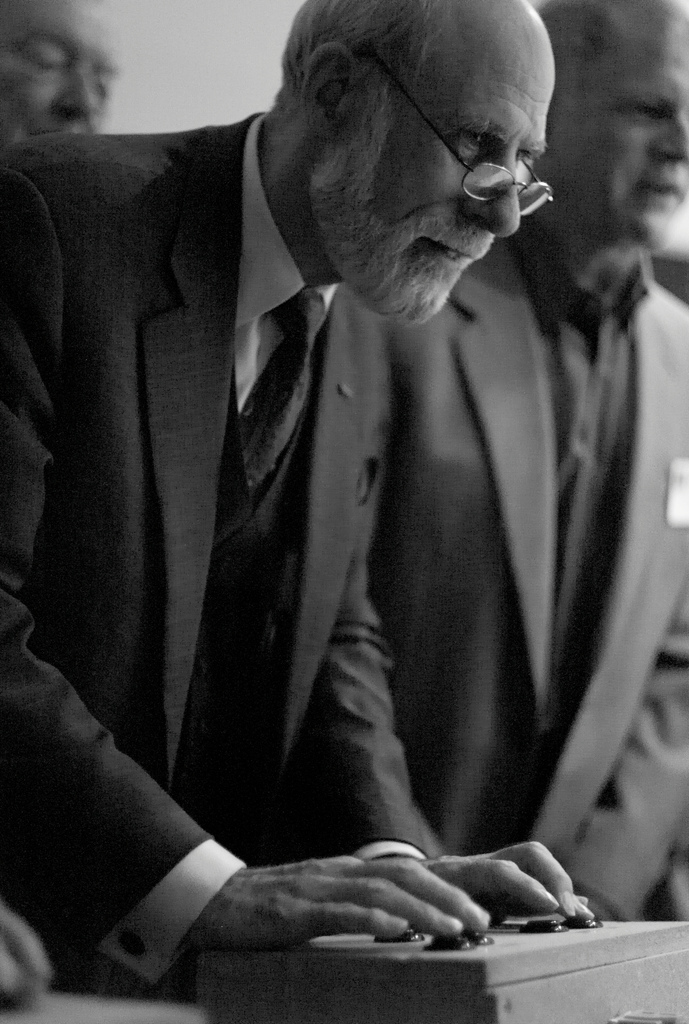
Vint Cerf Answers Your Questions About IPv6 and More
Last week, you asked questions of "father of the Internet" Vint Cerf; read on below for Cerf's thoughts on the present and future of IPv6, standards and nomenclature, the origin of his beard, and more. Thanks, Vint! What can we do to get ISPs to switch on IPv6?
by jandrese
One of the biggest hurdles to IPv6 adoption today is that the average home user simply cannot get an IPv6 address from their ISP. Tunnels are hacker toys, and completely impractical/impossible for people who are using their ISP's "home router". What do you think we can do to convince ISPs to start rolling out IPv6 [i]before[/i] there is a crisis? Everybody agrees that the transition will go smoother if we take it slow and easy, but nobody is willing to make the first step, and IPv4 addresses aren't still being inexorably depleted the world over.
VC: I have been asking myself (and others) this question for some years now! When you try to explain that they can't really expand the Internet effectively relying solely on cascading NAT boxes they kind of glaze over. Sadly, now that we really are in the IPv4 end-game, there is not much choice but to deploy NATs to try to make dual-stack work as a transition plan. If ISPs had started implementing IPv6 5 years ago we would not have this problem. I think only pressure from consumers, businesses and governments to demand IPv6 implementation will help. Even then, I can imagine the bean counters insisting that there be incremental revenue for implementing IPv6 despite the simple fact that the only serious path to supporting smart devices (including smart grid, mobiles with IP addresses, etc) is through implementation of IPv6. We are also going to have to find some incentives for users to upgrade their home routers to handle both IPv4 and IPv6. Maybe a trade-in policy???
IPV6, and a related question
by gr8_phk
With IPv6 we could all have fixed IP addresses (or blocks of them) at home. Is this likely to happen? What do you see as the pros and cons from the ISP point of view for doing this? I think the reasons I want it are the reasons they don't, but I'd like to know how someone with your perspective sees it.
VC: We could actually have a fairly large group of IPv6 addresses at each termination point. An advantage is that one could then run servers but some ISPs might find that problematic because of the potential uplink traffic. I ended up paying for "business" class service to assure fixed IP addresses for that reason. I did not have servers of video or imagery in mind, but, rather, controllers and sensors (and ability to print remotely, for instance).
Hardware accelerated IPv6
by vlm
Hardware accelerated ipv4 routing/switching was out there, I dunno, at least a decade ago, or more. Your expectations on the rollout of hardware accelerated ipv6 switching?
VC: It probably won't happen until there is clear evidence of an IPv6 tipping point. Of course, it makes every bit of good sense and the IPv6 format is better geared to hardware assist than IPv4.
Why the colon in IPv6?
by jandrese
The biggest thing I hate about IPv6 is that the standard format uses colon as the digit separator. On most keyboards, that is a fairly awkward character to type, especially in rapid fire between groups of hex digits. Also, it causes problems for the many many programs that specify ports after IP addresses with a colon (like URIs!). IPv4's use of the period instead is much nicer. If you didn't want to reuse the period (so programs can distinguish between the two types of addresses more easily), why not use dash instead? It's just as visually appealing and doesn't require you to hit shift to type it. It would have saved a whole lot of ugly brackets around IP addresses.
Any aesthetic qualities of the colon are lost when you have to do this:
http:/// [http] [1005:3321:5a52:4fca::1]:8080/
instead of: http://1005-3321-5a52-4fca--1:8080/ [1005-3321-5a52-4fca--1]
And that second example was noticeably quicker for me to type.
Edit: And of course because this is Slashdot it made a huge mess of the first URL and forced me to mess it up slightly to be readable!
VC: The colon was needed to allow for compressed display of IPv6 addresses and to avoid confusion with a dotted representation of IPv4. It was apparently the only character thought to be unencumbered for this purpose at the time. Other slashdot readers may have additional comments on this.
Hindsight is 20/20
by eldavojohn
If there was one thing you could go back and change about TCP/IP -- something that is far too entrenched to change now -- what would it be?
VC: Well, I wish I had realized we'd need more than 32 bits of address space! At the time, I thought this was still an experiment and that, if successful, we would develop a production version. I guess IPv6 is the production version! I would also have included a lot of strong authentication mechanisms but at the time we were standardizing TCP/IP (version 4), there was no practical public key crypto capability ready in hand.
.here TLD?
by TheLink
Do you think there should be a .here TLD, reserved officially for local use in an analogous way to the way that the RFC1918 IP addresses are reserved officially for private use?
Currently many are coming up with their own ad hoc TLDs for local use. In my opinion this is suboptimal. Having a standard official TLD would allow more interesting things to "organically grow" on it.
(See also: http://tools.ietf.org/html/draft-yeoh-tldhere-01)
VC: Hard to say, honestly. I am not sure just what ".here" might actually mean unless intended to be self-referential (in other words, the server is the same as the referring party - kind of like 127.0.0.1? In that case, it need only be a reserved term rather than something you register in.
Ooh! Settle An Argument For Me!
by Greyfox
Though my deep and thoughtful meditation on IP addressing, I have realized that an IP address is simply a number. We canonically break it up into 4 smaller numbers that are presumably easier to remember. However if you stack all the bits of those smaller numbers together, you get a bigger number, and that number is actually the address. Moreover, every C standard library that I have ever tried is able to resolve this bigger number to the correct address. If I ping a 10 digit number in that address range, the C standard library will figure it out. It is my position that this is a feature and not a bug.
It seems that the OS X Firefox Guys don't agree with me. Admittedly they do have an RFC on the subject, but their browser breaks a known behavior that every other TCP/IP client program on the planet exhibits, including other operating system versions of Firefox!
Would you kindly bludgeon one of us into submission? I don't really care which side of the argument you come down on, but one of us has to be able to say "Because Vint Cerf said so!"
Oh, and while I've got you, I'm sick of writing stateless http applications. May I have your permission to go back to writing plain old socket servers on other ports, providing data based on whatever query format I feel like implementing? It kind of looks like REST, I suppose, except that I don't have to load 14 layers of frameworks to get to that point.
VC: LOL! actually, most of us assumed that any way to generate the 32 number should be acceptable since the connection process doesn't actually use the text representation of the IP address. I think any value in the range 0 to 2^32-1 should be acceptable as an IP reference. As to stateless operation, I know what you mean; you have to get used to figuring out how to stash intermediate state (cookies usually)...
SMTP, DNS, U.S. Customs
by molo
It seems that it is getting more and more difficult to successfully run your own SMTP server. See, for example, this post responding to the idea that a user was going to move off gmail to their own server. Are there any prospects for meaningful SMTP reform that would lower the barrier to entry for legitimate emailers?
DNS has been often criticized as a centralized single point of failure / censorship. Have you been following the development of namecoin and P2P DNS? Are these systems viable in your estimation? How would you improve them or encourage their adoption?
The U.S. Customs department recently created headlines in seizing domains. These seizures appear to be extra-legal (not founded in law), but ICANN has gone along with them. Are those fair statements? Should ICANN's trustworthiness be suspect as a result of this process?
VC: On SMTP, the problem is spam. If SMTP relays could be authenticated in some way, perhaps running your own would work better. As of now, it is a problem to validate relays and most ISPs don't allow it. Maybe we will make some progress in this when we can strongly authenticate/validate end points in the network better. Regarding alternatives to DNS, it would be interesting to find alternatives to DNS that might be less prone to the business models that produce domaining, for example, but I have not yet seen evidence that such an outcome is likely to gain traction. I am not sure that ICANN has any ability to resist effectively the so-called seizures of domain names by the DHS/ICE. I am disturbed by the argument that this is comparable to FBI "seizures" of contraband for many reasons but I think the ability to resist this would rest on a successful court challenge to the practice, not to an ICANN policy.
Smart Grid
by kiwimate
You're currently on the Governing Board of the NIST Smart Grid Interoperability Panel. What is the state of standards development, and how big an impact does it have to move national infrastructure communications into the public IP arena so far as our ability to strengthen and expand our infrastructure? Conversely, how big are the threats in this new world?
VC: The process is moving along reasonably well although adoption of the standards that are emerging in the US will depend on endorsement by FERC and NERC. I think the standards can be very beneficial to the creation of interoperable energy management systems, edge devices, and device controllers. I am pleased that IPv6 forms a major basis for edge communication but concerned that the domestic ISPs, with some notable exceptions, have been slow to roll out support for IPv6. I imagine that an IPv6-equipped mobile could easily become a remote controller for a wide range of IPv6-labelled devices.
What would you like to see developed next?
by techmuse
I'm curious what technologies you would like to see developed next, or what you think would be most important to develop next. In other words, what do you think researchers should work on now that would be most significant? (Oh, and thank you for changing my life!)
V: My major wish right now, apart from ISP implementation of IPv6, DNSSEC and more end/end crypto and strong, 2-factor authentication, is the implementation of true broadcast IP. Satellites raining IP(v6) packets to Earth in range of millions of receivers could make widespread digital distribution of information far more efficient.
Interplanetary Internet
by immakiku TCP/IP started as a military project but has been adapted for all the Internet applications we see today. What sort of applications do you foresee/imagine for the Interplanetary Internet, aside from the stated purpose of coordinating NASA devices?
VC: The primary terrestrial applications are military tactical communications and enhanced mobile communications. I see a role for these delay and disruption tolerant protocols in public safety networking as well. All devices in the system could also serve as relays to allow for the dynamic creation of Mobile Ad hoc Networks, making more resilient emergency services communications and any number of popular user apps on mobiles.
The IP of TCP/IP
BY WHOM
The head of UN's WIPO believes that the Internet (and obviously the stack on which it runs) should have been patented. How do you believe it would have evolved, would TCP/IP be protected by patents?
VC: This is really pretty silly. Bob Kahn and I consciously did NOT patent or control distribution of the design and protocol specifications for TCP/IP for the simple reason that we wanted no intellectual property barriers to the adoption of TCP/IP as an international standard. I see absolutely no utility in the proposition to patent TCP/IP. It would have given a reason for SNA, DECNET and other proprietary protocols to persist since their inventors/purveyors could have argued that licensing TCP/IP (had it been patented) would be of no interest to them - indeed, its use opened up interoperability among many brands of computers (and networks) leading to more competition.
Has the Internet become too centralized?
by slashsloth
That is to say, do you think that too much power & control now lies in the hands of the Internet Service Providers, thereby making it, at least in terms of control if not routing, too centralized & too easily manipulated by the powerful few. I guess this question stems from a viewpoint that it should be somehow democratic & free (as in free speech). Also do you share my pedantic belief that the public Internet should be spelt with a capital 'I'?
VC: As to the latter, yes, I strongly believe that the capital was intended to refer to the public Internet (I have written on this in the past). We accepted the notion that "internet" could use the protocols but be private and disconnected from the public Internet but that "Internet" referred to the latter. Some people disagree but I still believe it to be a useful distinction. As to centralization, it is possible that the lack of competition among Internet access providers is a bad outcome. I have always been a proponent of intra-modal competition through open access to underlying transport networks but not everyone agrees with me.
How can we bring trust back to the internet?
by Madman
One of the secrets of the internet's massive success is the lack of controls over it; if there had been strict security and processes in place it would likely not have come about. One of the downsides is that all our security measures are tacked-on, there is no built-in security to the protocols used on the internet and as a result security is a massive problem. How do we go from the wild west to having at least a reasonable level of trusted computing?
VC: Better and stronger authentication would help. 2-factor "passwords" and registration of devices. We may also need to adopt international norms for acceptable usage of the net with some kind of enforceable rules with reciprocity. Until we have some collective and cross-border ability to bring miscreants to justice, we will continue to see relatively unconstrained behaviors including harmful ones.
No more "peace and love" in software designs
by BeforeCoffee
I take it that the "route around failures" and other original design features of TCP/IP and the Internet as a whole relied upon trusting others always having good intentions and cooperating. Those designs were necessary at the time and the reason the internet exists today.
Nowadays distrust, firewalls, and coding defensively is the norm (or it should be). In that light, the internet's design seems creaky and vulnerable.
Do you have any thoughts or feelings on how software has changed and seemingly become so treacherous since you first designed TCP/IP? Would you advocate a ground-up redesign of internet transports and protocols starting with TCP/IP?
VC: I have always been a fan of trying clean-sheet designs. Sometimes you discover retrofits that don't require a re-design. In other cases (such as delay and disruption tolerance) you need serious re-implementation of new designs. It is clear that authentication, various forms of cryptographic protections and the like are needed at several layers in the architecture. Deploying something wholly new is hard, though.
Future of the Internet
by H0bb3z
Do you feel the security concerns over collected information will trump the leveraging of information in future Internet technologies? Will there be a separate "opt-in" or "opt-out" web to cater to each preference?
Context: There have been many controversies recently regarding the collection of data and the privacy of individual information. As we move forward, I've heard a mixed set of messages regarding the direction we should expect to see.
Consumerism is indeed driving innovation and everything is going mobile these days (there's an app for that I think). One example I heard recently of the benefit of the convergence of information and mobility: a consumer can point their mobile phone at a shelf of groceries, get an active "overlay" of information regarding the products and determine which best suits the customer needs. On the flip side, sensors that track customer behavior are installed at the grocery shelf and based on detected behavior (like stopping for a moment to reminisce about Coco-Puffs even though you know they are bad for you) initiates a coupon for whatever the vendor may feel would provide enough motivation to purchase their product -- in the example a $1 off coupon to the mobile phone of a shopper.
Will this become reality in the future?
I think there are benefits to be had, but also am fiercely protective of my personal information and preferences.
VC: At least in America, we have tended to readily give up privacy in exchange for convenience. Credit card information bases being a good example of that. If one can divorce identity from behavior patterns, it might be acceptable to many to benefit from system reactions to our choices and behavior if these are not correlated with identity.
Postel and Crocker
by vlm
So you went to high school with Postel and Crocker, according to Wikipedia; did you guys hang out all along or meet up decades later?
V: Crocker and I have been best friends since about 1959. Jon was in a later class and we didn't know him until we all reconvened at UCLA in the late 1960s.
A Simple Pogonological Question
by eldavojohn
What level of success does TCP/IP owe to your glorious beard?
VC: LOL!! not much! I just got tired of nicks and cuts from shaving my whole face and went with the beard!! I did shave it off once, but quickly re-grew it after being painfully reminded why I had grown it in the first place!!! -
Wikimedia Foundation Enables HTTPS For All Projects
An anonymous reader writes "The Wikimedia Foundation has enabled HTTPS for all of its projects (Wikipedia, Wikimedia Commons, etc.), to enable secure log-in and browsing privacy. Their blog post goes into detail about how the service is configured, linking to configuration files and implementation documentation. It also mentions that HTTPS Everywhere will have updated rules for this change soon." -
Wikimedia Foundation Releases Their Server Config
An anonymous reader writes "The Wikimedia Foundation has released their Puppet configuration in a public git repository. They describe this as the first step in a project called Wikimedia Test/Dev Labs, letting users participate in the operations of Wikipedia and other Wikimedia Foundation sites." -
Wikimedia Foundation Releases Their Server Config
An anonymous reader writes "The Wikimedia Foundation has released their Puppet configuration in a public git repository. They describe this as the first step in a project called Wikimedia Test/Dev Labs, letting users participate in the operations of Wikipedia and other Wikimedia Foundation sites." -
Appropriations Bill Threatens Future Space Science Missions
ColdWetDog writes "A brief story in the Atlantic notes that the U.S. Senate's energy appropriations bill has failed to supply funds to continue Plutonium-238 production, needed for radioisotope generators for NASA's interplanetary probe programs. No PU-238 means no more missions like Cassini-Huygens, or ones that go places where solar cells won't produce enough power. The article notes that the only other source of PU-238 is Russia — either through the government or through trolling through Siberia and the Russian coastline looking for old Soviet Era lighthouses and power stations." -
Warrantless Wiretapping Cases At the 9th Circuit
sunbird writes "The EFF argued several critical cases yesterday before the Ninth Circuit Court of Appeals. Both Hepting v. AT&T and Jewel v. National Security Agency raise important questions regarding whether the NSA's warrantless wiretapping program (pdf summary of evidence), disclosed by whistleblower Mark Klein and implemented by AT&T and other telecoms, violates the Fourth Amendment to the U.S. Constitution. The full text of the Klein declaration and redacted exhibits are publicly available (pdf). ... The Klein evidence establishes that AT&T cut into the fiber optic cables in San Francisco to route a complete copy of internet and phone traffic to the 'SG3' secure room operated by the NSA. The trial court dismissed the Hepting lawsuit (pdf order) based on the 2008 Congressional grant of immunity to telecoms. Similarly, the trial court in Jewel dismissed (pdf order) the lawsuit against the government agencies and officials based on the state secrets privilege. Both cases were argued together before the same panel of judges. The audio of the oral argument will be available after noon PDT [17:00 GMT] today." -
Theoretical Shoe Inserts Could Power Your Gadgets
In his first accepted submission, Anon8---) writes "As published on nature.com, a process called electrowetting, 'in which a conductive liquid droplet, placed on an electrode, is physically deformed by an applied electric charge,' could be used to provide 10 watts of juice to smartphones and other gadgets as you walk. 'The technique depends on the use of a dielectric material — which is usually an insulator but that can be polarized in an electric field — to coat the electrode. When the dielectric is charged the droplet can wet the surface more easily, and deforms. In his system, Krupenkin runs this process backwards, using the changing physical form of liquid drops between dielectric-coated plates to generate charge and therefore electrical power.' So far, Krupenkin and Ashley Taylor have been able to produce a few milliwatts of power along tiny channels a few millimeters wide. They have patented the idea and are now concentrating on scaling up the device and designing a shoe to contain it." -
Wikipedia May Censor Images
KiloByte joins the ranks of accepted submitters, writing "To appease 'morality' watchdogs, Wikipedia is contemplating the introduction of a censorship feature, where images would be flagged for containing sexual references, nudity, 'mass graves,' and so on. At least in the initial implementation, it is supposed to be 'opt-in.' However, with such precedents as the UK censoring artistic nudity, Turkey censoring references to the Armenian genocide or China's stance on information about the Tiananmen massacre (note that any sensitive photos, like the Tank Man, are already absent!), I find it quite hard to believe this feature won't be mandatory for some groups of readers — whether it's thanks to an oppressive government, an ISP or a school." -
L.A. Artist Contemplates Future Traffic Flow, With Hot Wheels
John3 writes "American artist Chris Burden is finishing up his latest work titled Metropolis II for display this fall in Los Angeles. There's a fascinating five minute documentary on YouTube about his miniature city and the traffic that flows through it. He comments 'The idea that a car runs free, those days are about to close.' Whether you agree or disagree, he certainly has built one of the coolest Hot Wheels layouts I've ever seen." -
L.A. Artist Contemplates Future Traffic Flow, With Hot Wheels
John3 writes "American artist Chris Burden is finishing up his latest work titled Metropolis II for display this fall in Los Angeles. There's a fascinating five minute documentary on YouTube about his miniature city and the traffic that flows through it. He comments 'The idea that a car runs free, those days are about to close.' Whether you agree or disagree, he certainly has built one of the coolest Hot Wheels layouts I've ever seen." -
Widespread Hijacking of Search Traffic In the US
Peter Eckersley writes "The Netalyzr research project from the ICSI networking group has discovered that on a number of U.S. ISPs' networks, search traffic for Bing, Yahoo! and sometimes Google is being redirected to proxy servers operated by a company called Paxfire. In addition to posing a grave privacy problem, this server impersonation is being used to redirect certain searches away from the user's chosen search engine and to affiliate marketing programs instead. Further analysis is available in a post at the EFF." -
The Uncanny Valley Explained
ColdWetDog writes "Scientists now believe they've figured out what causes the uncanny valley response. They compared functional MRI scans of volunteers watching two different types of videos: those showing human-appearing androids, and those showing the humans that the robots were created to mimic. 'The results suggest that the uneasiness we feel could be caused by a "perceptual mismatch between appearance and motion."' Basically, the brain seemed to react in a strongly negative manner when the robotic motions of the android didn't match its human-like appearance." -
Wikipedia Edits Around the World
billlava writes "Wikipedia continues on its inexorable march toward becoming the repository for the world's knowledge — to the tune of four and a half edits a second. Just who is doing all these edits? And where do they live? Erik Zachte compiled data from a day in May 2011 into an interesting set of animations and maps to show update activity as it occurred during the day." -
Is Your Antivirus Made By the Chinese Government?
guanxi writes "Huawei, a large Chinese telecom and IT company with close ties to the Chinese military has faced obstacles doing business in other countries, because governments are concerned about giving them access to critical infrastructure. Huawei Symantec is a joint venture with one of the world's largest IT security companies which sells security products in the US. Would the Chinese or other governments take the opportunity to create back doors into western IT networks? Wouldn't they be crazy not to?" -
President Obama To Appear On Mythbusters
Muondecay writes "President Obama will be featured in the December 8th MythBusters episode, 'Archimedes Solar Ray,' during which he will challenge Adam and Jamie to revisit an ancient and somewhat controversial myth: Did Greek scientist and polymath Archimedes set fire to an invading Roman fleet using only mirrors and the reflected rays of the sun during the Siege of Syracuse? This is part of a White House effort to highlight the importance of science education." -
Wikimedia Trying P2P Video Distribution
bigmammoth writes "One potential problem with campaigns and programs to increase video on Wikimedia sites is that video is many times more costly to distribute than text and images. The P2P-Next consortium has created an HTML5 streaming BitTorrent browser add-on to try and help experiment with ways to reduce the costs of video distribution. As described in a Wikimedia tech blog post, once the SwarmPlayer add-on is installed, and when using the multimedia beta, video on the site will be streamed via the hybrid HTTP / BitTorrent SwarmPlayer. For smooth playback the Swarmplayer downloads high priority pieces over HTTP while getting low priority bits from the BitTorrent swarm. The same technology is available for experimentation with any site via the standalone version of the Kaltura HTML5 Media library." -
EFF Asks Verizon Whether Etisalat Deserves CA Trust
Peter Eckersley writes "Today EFF published an open letter to Verizon, calling for investigation of a trusted SSL Certificate Authority. Etisalat is a majority state-owned telecom of the United Arab Emirates with operations throughout the Middle East. You may remember that last year Etisalat installed malware on its subscribers' BlackBerry phones, and was recently pivotal in the UAE's threat to disconnect BlackBerry devices altogether if Research In Motion did not provide a backdoor for BES servers' crypto. This company, which appears to be institutionally hostile to the existence and use of secure cryptosystems, is in possession of a master certificate for HTTPS, encrypted POP and IMAP, and other SSL-based security systems. Etisalat's CA certificate is not trusted directly by Mozilla and Microsoft, but was instead delegated as an Intermediate CA by Verizon. As a result, we are asking Verizon to investigate whether it is appropriate for Etisalat to continue holding this certificate, and to consider revoking it." -
EFF Asks Verizon Whether Etisalat Deserves CA Trust
Peter Eckersley writes "Today EFF published an open letter to Verizon, calling for investigation of a trusted SSL Certificate Authority. Etisalat is a majority state-owned telecom of the United Arab Emirates with operations throughout the Middle East. You may remember that last year Etisalat installed malware on its subscribers' BlackBerry phones, and was recently pivotal in the UAE's threat to disconnect BlackBerry devices altogether if Research In Motion did not provide a backdoor for BES servers' crypto. This company, which appears to be institutionally hostile to the existence and use of secure cryptosystems, is in possession of a master certificate for HTTPS, encrypted POP and IMAP, and other SSL-based security systems. Etisalat's CA certificate is not trusted directly by Mozilla and Microsoft, but was instead delegated as an Intermediate CA by Verizon. As a result, we are asking Verizon to investigate whether it is appropriate for Etisalat to continue holding this certificate, and to consider revoking it." -
EFF Asks Verizon Whether Etisalat Deserves CA Trust
Peter Eckersley writes "Today EFF published an open letter to Verizon, calling for investigation of a trusted SSL Certificate Authority. Etisalat is a majority state-owned telecom of the United Arab Emirates with operations throughout the Middle East. You may remember that last year Etisalat installed malware on its subscribers' BlackBerry phones, and was recently pivotal in the UAE's threat to disconnect BlackBerry devices altogether if Research In Motion did not provide a backdoor for BES servers' crypto. This company, which appears to be institutionally hostile to the existence and use of secure cryptosystems, is in possession of a master certificate for HTTPS, encrypted POP and IMAP, and other SSL-based security systems. Etisalat's CA certificate is not trusted directly by Mozilla and Microsoft, but was instead delegated as an Intermediate CA by Verizon. As a result, we are asking Verizon to investigate whether it is appropriate for Etisalat to continue holding this certificate, and to consider revoking it." -
Wales Supports Purging Porn From Wikipedia
Larry Sanger writes "Jimmy Wales recently took a bold position against pornography on Wikimedia Commons: 'Wikimedia Commons admins who wish to remove from the project all images that are of little or no educational value but which appeal solely to prurient interests have my full support.' Wales also restarted the "Commons:Sexual content" policy page. His basic complaint is that Wikimedia Commons hosts too much unnecessary porn, and he wants to get rid of it. He underscored his seriousness this way, stating that we can expect 'a strong statement' from the WMF soon: 'If the Wikimedia Foundation wants to declare that it is OK for Commons to be a porn host, they can do that, and I'll not be able to continue. That isn't going to happen, though, and in fact you should expect a strong statement from the Board and/or Sue in the next few days.'" (More, below.) Sanger continues: "This comes about a month after I originally posted my report about depictions of child sexual molestation on Wikimedia Foundation servers to the FBI, which Slashdot duly ripped to shreds (as only Slashdot can), and a little over a week after the FoxNews.com story. The latter coverage reported that one of my senators, and my representative to Congress, had forwarded the matter to the FBI's Assistant Director of Congressional Affairs. I'm happy to be able to congratulate Jimmy Wales for his good judgment on this, and I look forward to the larger Wikimedia community approaching these issues with a little more sanity." -
Wales Supports Purging Porn From Wikipedia
Larry Sanger writes "Jimmy Wales recently took a bold position against pornography on Wikimedia Commons: 'Wikimedia Commons admins who wish to remove from the project all images that are of little or no educational value but which appeal solely to prurient interests have my full support.' Wales also restarted the "Commons:Sexual content" policy page. His basic complaint is that Wikimedia Commons hosts too much unnecessary porn, and he wants to get rid of it. He underscored his seriousness this way, stating that we can expect 'a strong statement' from the WMF soon: 'If the Wikimedia Foundation wants to declare that it is OK for Commons to be a porn host, they can do that, and I'll not be able to continue. That isn't going to happen, though, and in fact you should expect a strong statement from the Board and/or Sue in the next few days.'" (More, below.) Sanger continues: "This comes about a month after I originally posted my report about depictions of child sexual molestation on Wikimedia Foundation servers to the FBI, which Slashdot duly ripped to shreds (as only Slashdot can), and a little over a week after the FoxNews.com story. The latter coverage reported that one of my senators, and my representative to Congress, had forwarded the matter to the FBI's Assistant Director of Congressional Affairs. I'm happy to be able to congratulate Jimmy Wales for his good judgment on this, and I look forward to the larger Wikimedia community approaching these issues with a little more sanity." -
Wales Supports Purging Porn From Wikipedia
Larry Sanger writes "Jimmy Wales recently took a bold position against pornography on Wikimedia Commons: 'Wikimedia Commons admins who wish to remove from the project all images that are of little or no educational value but which appeal solely to prurient interests have my full support.' Wales also restarted the "Commons:Sexual content" policy page. His basic complaint is that Wikimedia Commons hosts too much unnecessary porn, and he wants to get rid of it. He underscored his seriousness this way, stating that we can expect 'a strong statement' from the WMF soon: 'If the Wikimedia Foundation wants to declare that it is OK for Commons to be a porn host, they can do that, and I'll not be able to continue. That isn't going to happen, though, and in fact you should expect a strong statement from the Board and/or Sue in the next few days.'" (More, below.) Sanger continues: "This comes about a month after I originally posted my report about depictions of child sexual molestation on Wikimedia Foundation servers to the FBI, which Slashdot duly ripped to shreds (as only Slashdot can), and a little over a week after the FoxNews.com story. The latter coverage reported that one of my senators, and my representative to Congress, had forwarded the matter to the FBI's Assistant Director of Congressional Affairs. I'm happy to be able to congratulate Jimmy Wales for his good judgment on this, and I look forward to the larger Wikimedia community approaching these issues with a little more sanity." -
Volcano Futures
Now that the volcanic ash cloud is easing off from Europe and airports are re-opening, it's time to look ahead a bit. The first question is, will the Eyjafjallajökull (.OGG) volcano's ash cloud visit the US? According to Discovery News, the answer is: not likely. This article also provides good current answers, as best scientists know, to other questions such as "How long will this volcano keep erupting?" (could be months), and "Will the ash cloud cause cooling in Europe?" (nope). New Scientist looks at the question of whether planes can fly safely through volcanic ash clouds — and concludes there's a lot we don't know. "Ever since a Boeing 747 temporarily lost all four engines in an ash cloud in 1982, the International Civil Aviation Organization has stipulated that skies must be closed as soon as ash concentration rises above zero. The ICAO's International Airways Volcano Watch uses weather forecasting to predict ash cloud movements, and if any projections intersect a flight path, the route is closed. But although it is certain that volcanic ash like that hanging over northern Europe can melt inside a jet engine and block airflow, nobody has the least idea about just how much is too much. After a week of losing millions every day, airlines are starting to ask why we can't do better." -
Larry Sanger Tells FBI Wikipedia Distributes "Child Pornography"
Taco Cowboy writes with news that Larry Sanger, the co-founder of Wikipedia, has reported to the FBI what he says is child pornography on Wikipedia, including links (redacted in the letter just linked) to entries about pedophilia and the genre of manga known as lolicon. The Register has up an article with some analysis, which mentions the opinion of at least one attorney whose "reading of the statute [requiring reporting of child porn images] is that it does apply to the Wikimedia Foundation." Update 20100414 5:00 GMT: Larry Sanger has posted a general reply in response to critics of his report to the FBI, in which he addresses the form, content, and motivation of his complaint, and offers some discussion of the relevant statute. -
Journalism Students Assigned To Write On Wikipedia
Hugh Pickens writes "eCampus News reports that at the University of Denver, journalism students are assigned to write Wikipedia entries as part of a curriculum that stresses online writing and content creation, and students have so far composed 24 Wikipedia articles this year, covering topics from the gold standard to the San Juan Mountains to bimetallism, an antiquated monetary standard. Journalism instructors Lynn Schofield Clark and Christof Demont-Heinrich say students are told to check their sourcing carefully, just as they would for an assignment at a local newspaper. 'Students are leery about mentioning Wikipedia, because they might be subjected to criticism. But I tell them it's an online source of knowledge that just has some information that might be questionable, but that doesn't mean you have to dismiss all of [its content],' says Demont-Heinrich, who first assigned the Wikipedia writing to students in his introductory course taught during the university's recent winter semester. He said the Wikipedia entries didn't require old-school shoe leather reporting — because the online encyclopedia bars the use of original quotes — but they teach students how to thoroughly research a topic before publishing to a site that has over 350 million unique visitors and gets over 10 billion page views a month. 'I see journalism as being completely online within the next two to five years,' says Demont-Heinrich. 'If you're not trained to expect that and write for that, then you're not going to be ready for the work world.'" -
Wikipedia Explains Today's Global Outage
gnujoshua writes "The Wikimedia Tech Blog has a post explaining why many users were unable to reach Wikimedia sites due to DNS resolution failure. The article states, 'Due to an overheating problem in our European data center many of our servers turned off to protect themselves. As this impacted all Wikipedia and other projects access from European users, we were forced to move all user traffic to our Florida cluster, for which we have a standard quick failover procedure in place, that changes our DNS entries. However, shortly after we did this failover switch, it turned out that this failover mechanism was now broken, causing the DNS resolution of Wikimedia sites to stop working globally. This problem was quickly resolved, but unfortunately it may take up to an hour before access is restored for everyone, due to caching effects." -
Wikipedia Disputes Editor Exodus Claims
eldavojohn writes "The Wikimedia blog has a new post from Erik Moeller, deputy director of the Wikimedia Foundation, and Erik Zachte, a data analyst, to dispute recent reports about editors leaving Wikipedia (which we discussed on Wednesday). They offer these points to discredit the claims: 'The number of people reading Wikipedia continues to grow. In October, we had 344 million unique visitors from around the world, according to comScore Media Metrix, up 6% from September. Wikipedia is the fifth most popular web property in the world. The number of articles in Wikipedia keeps growing. There are about 14.4 million articles in Wikipedia, with thousands of new ones added every day. The number of people writing Wikipedia peaked about two and a half years ago, declined slightly for a brief period, and has remained stable since then. Every month, some people stop writing, and every month, they are replaced by new people." They also note that it's impossible to tell whether someone has left and will never return, as their account still remains there." -
Panel Recommends Space Science, Not Stunts
wisebabo writes "A panel reporting to President Obama is recommending that we skip landing on the Moon and Mars and instead consider progressively deeper space voyages (first to the L1 Earth-Moon point, then perhaps the L2 Earth-Sun point, then a Mars flyby/orbit or asteroid visits). While in Mars orbit, the astronauts could send robotic probes to land on the surface, which could be much more effective than current rovers without the 10-minute time lag to Earth. I, for one, whole-heartedly agree that this approach would lead to 'the most steady cadence of steady improvement,' and keep us from inconsistent achievements in space (like not leaving Earth orbit for 40 years). Some would say that this approach would be lacking in the photo-ops necessary to maintain interest in the space program (no footprints on Martian soil) but I think there would be plenty of cool vistas — perhaps a rendezvous with a comet, or even orbiting one of the moons of Jupiter, assuming they figure out radiation shielding — to keep the taxpayer dollars flowing. The science return would be much greater because it would hopefully utilize both man and machine at their best; robots on one-way trips down into a gravity well while the humans provide the intuition and flexibility from orbit." -
New Developments In NPG/Wikipedia Lawsuit Threat
Raul654 writes "Last week, it was reported that the UK's National Portrait Gallery had threatened a lawsuit against an American Wikipedian for uploading pictures from the NPG's website to Wikipedia. The uploaded pictures are clearly in the public domain in the United States. (In the US, copies of public domain works are also in the public domain. UK law on the matter is unclear.) Since then, there have been several developments: EFF staff attorney Fred von Lohmann has taken on the case pro-bono; Eric Moeller, Wikimedia Foundation Deputy Director, has responded to the NPG's allegations in a post on the WMF blog; and the British Association of Picture Libraries and Agencies has weighed in on the dispute in favor of the NPG." -
New Developments In NPG/Wikipedia Lawsuit Threat
Raul654 writes "Last week, it was reported that the UK's National Portrait Gallery had threatened a lawsuit against an American Wikipedian for uploading pictures from the NPG's website to Wikipedia. The uploaded pictures are clearly in the public domain in the United States. (In the US, copies of public domain works are also in the public domain. UK law on the matter is unclear.) Since then, there have been several developments: EFF staff attorney Fred von Lohmann has taken on the case pro-bono; Eric Moeller, Wikimedia Foundation Deputy Director, has responded to the NPG's allegations in a post on the WMF blog; and the British Association of Picture Libraries and Agencies has weighed in on the dispute in favor of the NPG." -
UK's National Portrait Gallery Threatens To Sue Wikipedia User
jpatokal writes "The National Portrait Gallery of London is threatening litigation against a Wikipedia user over his uploading of pictures of some 3,000 paintings, all 19th century or earlier and firmly in the public domain. Their claim? The photos are a 'product of a painstaking exercise on the part of the photographer,' and that downloading them off the NPG site is an 'unlawful circumvention of technical measures.' And remember, the NPG's taxpayer-funded mission is to 'promote the appreciation and understanding of portraiture in all media [...] to as wide a range of visitors as possible!'" -
UK's National Portrait Gallery Threatens To Sue Wikipedia User
jpatokal writes "The National Portrait Gallery of London is threatening litigation against a Wikipedia user over his uploading of pictures of some 3,000 paintings, all 19th century or earlier and firmly in the public domain. Their claim? The photos are a 'product of a painstaking exercise on the part of the photographer,' and that downloading them off the NPG site is an 'unlawful circumvention of technical measures.' And remember, the NPG's taxpayer-funded mission is to 'promote the appreciation and understanding of portraiture in all media [...] to as wide a range of visitors as possible!'" -
Milky Way's Spiral Arms Could Not Have Caused Climate Change
KentuckyFC writes "One of the puzzles of Earth's climate history is an apparent 140-million-year cycle in the climate record. Various astronomers think this can be explained by the passage of the Sun through the spiral arms of the Milky Way, which also seems to have had a period of about 140 million years. The thinking is that in regions of denser star populations, supernovas would have been more common, bathing the Earth in cosmic rays more often. These cosmic rays would then have seeded the formation of clouds that cool the planet. But in recent years, astronomers have mapped out the structure of the galaxy in much more detail. And now a pair of US astronomers have reanalyzed this climate change idea in light of the new evidence. Their conclusion is that the climate change cycle cannot possibly have coincided with the movement of the Sun through the spiral arms. So whatever caused the 140-million-year climate change cycle on Earth, it wasn't the Sun's passage through the galaxy." -
Wikipedia Launches a New Mobile Interface, Seeks Help
hampton2600 writes "The Wikimedia Foundation is proud to present our new mobile site optimized for modern high-end phones. The interface is focused on being clean and easy to read on your mobile device. We currently officially support reading on the iPhone and Android phones. The new gateway is written entirely in Ruby (using the Merb framework) and the Git repository can be found here. We are looking for open source help with supporting other phone types and translations into new languages. Currently 8 languages are supported, but we'd like to support all languages Wikipedia supports. This is an active project and we are looking for new features, etc. from the community." -
Wikipedia Moving From GFDL To Creative Commons License
FilterMapReduce writes "The Wikimedia Foundation has resolved to migrate the copyright licensing of all of its wiki projects, including Wikipedia, from the GNU Free Documentation License to the Creative Commons Attribution-Share Alike 3.0 License. The migration is scheduled to be completed on June 15. After the migration, reprints of material from the wikis will no longer require a full copy of the GFDL to be attached, and the attribution rules will require only a link to the wiki page. Also, material submitted after the migration cannot be forked with GFDL "invariant sections," which are impossible to incorporate back into a wiki in most cases. The GFDL version update that made the migration possible and the community vote that informed the decision were previously covered on Slashdot." -
Theora Ahead of H.264 In Objective PSNR Quality
bigmammoth writes "Xiph hackers have been hard at work improving the Theora codec over the past year, with the latest versions gaining on and passing h.264 in objective PSNR quality measurements. From the update: 'Amusingly, it also shows test versions of Thusnelda pulling ahead of h.264 in terms of objective quality as bitrate increases. It's important to note that PSNR is an objective measure that does not exactly represent perceived quality, and PSNR measurements have always been especially kind to Theora. This is also data from a single clip. That said, it's clear that the gap in the fundamental infrastructure has closed substantially before the task of detailed subjective tuning has begun in earnest.' Momentum is building with a major Open Video Conference in June, the impending launch of Firefox 3.5 and excitement about wider adoption in a top-4 web site. It's looking like free video codecs may pose a serious threat to the h.264 bait-and-switch plan to start charging millions for internet streaming of h.264 in 2010." -
Wikipedia Opts Out Of Phorm
ais523 writes "Wikipedia (and other websites run by Wikimedia) have requested to opt-out from Phorm; according to the email they sent, they 'consider the scanning and profiling of our visitors' behavior by a third party to be an infringement on their privacy.'" Another reader points to this post on techblog.wikimedia.org which includes a confirmation from Phorm that those sites will be excluded. -
Wikipedia Opts Out Of Phorm
ais523 writes "Wikipedia (and other websites run by Wikimedia) have requested to opt-out from Phorm; according to the email they sent, they 'consider the scanning and profiling of our visitors' behavior by a third party to be an infringement on their privacy.'" Another reader points to this post on techblog.wikimedia.org which includes a confirmation from Phorm that those sites will be excluded. -
Huge German Donation Marks Wikipedia's Evolution
Raul654 writes "In December, we discussed the German Federal Archive's agreement, at the urging of Wikimedia Deutschland, to donate 100,000 pictures to Wikipedia under the Creative Commons Attribution-ShareAlike license. At the time that was the largest picture donation ever to Wikipedia, and thought to be largest in the history of the free culture movement. Now Wikimedia Deutschland has reached a similar agreement with the Saxon State and University Library, which will donate 250,000 pictures to Wikipedia under CCA-ShareAlike. On a not-unrelated note: Microsoft has announced that it will discontinue its Encarta encyclopedia." -
UK ISPs Are Censoring Wikipedia
Concerned Wikipedian writes "Starting December 4th, Wikipedia administrators noticed a surge of edits from certain IP addresses. These IPs turned out to be the proxies for the content filters of at least 6 major UK ISPs. After some research by Wikipedians, it appears that the image of the 1970s LP cover art of the Scorpions' 'Virgin Killer' album has been blocked because it was judged to be 'child pornography,' and all other attempts to access Wikimedia foundation sites from these ISPs are being proxied to only a few IP addresses. This is causing many problems for Wikipedia administrators, because much of the UK vandalism now comes from a single IP, which, when blocked, affects potentially hundreds of thousands of anonymous users who intend no harm and are utterly confused as to why they are no longer able to edit. The image was flagged by the the Internet Watch Foundation, which is funded by the EU and the UK government, and has the support of many ISPs and online institutions in the UK. The filter is fairly easy to circumvent simply by viewing the article in some other languages, or by logging in on the secure version of Wikipedia." -
German Gov't Donates 100,000 Images To Wikipedia
Raul654 writes "The German Federal Archive has agreed to donate 100,000 images to Wikipedia under the German version of the Creative Commons Attribution Share-Alike License. These pictures cover a period from 1860 to present. This is the largest picture donation ever to Wikipedia, and possibly the largest in the history of the free culture movement." Apparently, this is part of a project which will eventually make 11 million photos available for public use. -
German Gov't Donates 100,000 Images To Wikipedia
Raul654 writes "The German Federal Archive has agreed to donate 100,000 images to Wikipedia under the German version of the Creative Commons Attribution Share-Alike License. These pictures cover a period from 1860 to present. This is the largest picture donation ever to Wikipedia, and possibly the largest in the history of the free culture movement." Apparently, this is part of a project which will eventually make 11 million photos available for public use. -
GFDL 1.3 Is Out, Allows Migration To CC
David Gerard writes "Version 1.3 of the GNU Free Documentation License is out (FAQ). This license is little-used, except on the #8 site in the world: Wikipedia. And this version includes special provisions to re-license wiki-based content from GFDL to the much simpler Creative Commons Attribution-ShareAlike license 3.0, as requested by the Wikimedia Foundation. Wikipedia plans to hold a public consultation process to decide whether and how to migrate to CC-BY-SA. The discussion is already running hot and heavy." -
Ogg Theora In Firefox, With Wikimedia Support
An anonymous reader writes "Ogg Theora support for the HTML5 <video> tag is in the Firefox 3.1 nightlies. Theora is the only video format allowed on Wikimedia Commons, so Wikimedia people are pushing Wikipedia readers to download a nightly and try it out. Break it, crash it, report bugs, get it into good shape and nullify Apple and Nokia's FUD the best way possible. They may have gotten the words 'Vorbis' and 'Theora' removed from the HTML5 spec, but the market will tell them when their browsers are sucking."