Slashdot Mirror
Domain: wikimedia.org
Stories and comments across the archive that link to wikimedia.org.
Comments · 6,832
-
Re:Back story flaw?
Hey kids, want to hear how Cancer Man got bitten by a radioactive spider?
I thought Cancer Man was burned by a pissed-off dragon...
https://secure.wikimedia.org/wikipedia/en/wiki/Tickling_the_Dragons_Tail
-
Re:Duh - Who else would have done it?
Besides, Israel itself has described cyberattacks as terrorism.
So that implies Stuxnet was "state-sponsored terrorism". In which case, the US should add itself to that list it keeps...
-
Re:Duh - Who else would have done it?
Besides, Israel itself has described cyberattacks as terrorism.
So that implies Stuxnet was "state-sponsored terrorism". In which case, the US should add itself to that list it keeps...
-
Re:Conspiracy theory
"...the NSA is the *only* intelligence agency that, as a group, gives a damn about our rights."
So, you're saying that to save the village they had to destroy it?
But they did not quite succeed in its destruction. Or in "saving" it, in the long term.
-
Re:welcome to civilization
when Australia was established as a penal colony, they only sent men and boys.
Mate, that's just plain wrong. 34% of convicts on the First Fleet were female.
-
Re:Why do we need this?
This is one of the dumbest comments I've read on slashdot. You're confusing quantization with extent. The article is very obviously talking about covering a larger part of the visible color gamut. RGB is represented by the triangle in this graph: http://upload.wikimedia.org/wikipedia/commons/8/8f/CIExy1931_sRGB.svg You'll note it doesn't even cover 50% of visible colors. Most TVs and displays can't even reproduce the full RGB space. The 24-bit/16.7M merely refers to the number of colors and affects how smooth gradients are, and has nothing to do with the range of colors that can be reproduced.
For fuck's sake, I didn't expect this level of stupidity from someone with a sub-1M user ID!
Has nothing to do with how much the TV or screen can reproduce. It has everything to do with how well the brain can discriminate the various wavelengths. So while it is theoretically true that the technique may produce more colors, whatever that means exactly, if the human brain cannot discriminate between them, what good does it do?
This is not an issue of physics, but of biology, but then maybe I'm just to much of a dumb fuck to know what I'm talking about.
It seems likely.
The CIE xy chromaticity space (used in the image GP linked) is derived from the tristimulus model, so it already takes a fair chunk of the biology into account. The CIE u'v' space is a furtther development, explicitly selected for perceptual uniformity & linearity, thus covering the rest of the biology, and it shows the same damn thing -- sure, xy gives too much area to greens (which are outside the sRGB gamut), but OTOH it shortchanges purples (which are also outside sRGB); in a perceptual space, sRGB still obviously includes less than half the visible colors. See e.g. the picture at the bottom of this page.
-
Re:Why do we need this?
This is one of the dumbest comments I've read on slashdot. You're confusing quantization with extent. The article is very obviously talking about covering a larger part of the visible color gamut. RGB is represented by the triangle in this graph: http://upload.wikimedia.org/wikipedia/commons/8/8f/CIExy1931_sRGB.svg You'll note it doesn't even cover 50% of visible colors. Most TVs and displays can't even reproduce the full RGB space. The 24-bit/16.7M merely refers to the number of colors and affects how smooth gradients are, and has nothing to do with the range of colors that can be reproduced.
For fuck's sake, I didn't expect this level of stupidity from someone with a sub-1M user ID!
Has nothing to do with how much the TV or screen can reproduce. It has everything to do with how well the brain can discriminate the various wavelengths. So while it is theoretically true that the technique may produce more colors, whatever that means exactly, if the human brain cannot discriminate between them, what good does it do?
This is not an issue of physics, but of biology, but then maybe I'm just to much of a dumb fuck to know what I'm talking about.
-
Re:MOAR Pixels!
Troll much? RGB doesn't even cover 50% of colors visible to the human eye. It's represented by the triangle here: http://upload.wikimedia.org/wikipedia/commons/8/8f/CIExy1931_sRGB.svg The larger superset is the full CIE XYZ color space visible to the human eye.
-
Re:Why do we need this?
This is one of the dumbest comments I've read on slashdot. You're confusing quantization with extent. The article is very obviously talking about covering a larger part of the visible color gamut. RGB is represented by the triangle in this graph: http://upload.wikimedia.org/wikipedia/commons/8/8f/CIExy1931_sRGB.svg You'll note it doesn't even cover 50% of visible colors. Most TVs and displays can't even reproduce the full RGB space. The 24-bit/16.7M merely refers to the number of colors and affects how smooth gradients are, and has nothing to do with the range of colors that can be reproduced.
For fuck's sake, I didn't expect this level of stupidity from someone with a sub-1M user ID! -
Re:Why do we need this?
It doesn't even overlap 50%. Full RGB color space is the triangle in this graph; note the area it covers of all visible colors: http://upload.wikimedia.org/wikipedia/commons/8/8f/CIExy1931_sRGB.svg
-
Re:Wider Gamut, not usually an advantage for TV.
Uh, Rec. 709 is a small portion of the visible color gamut. It's represented by the triangle in this graph: http://upload.wikimedia.org/wikipedia/commons/8/8f/CIExy1931_sRGB.svg Note the area it covers of the overall visible gamut is maybe 50%.
-
Re:Yeah, I only like my colors 100% "pure"
Single frequency peak. That is a pure colour. When you look at a typical incandescent light it is a broadband signal spread across the visible range and well into infrared (hence their inefficient at lighting a room despite being very efficient way of converting electrical energy into photons). For an LCD displaying pure red the peaks actually look rather fat around the red with minor peaks in the green and blue range as well as the backlight bleeding through the display. These imperfections is what makes the primary colours not pure and is also the reason the LCDs can't display black.
A fully saturated colour on your display is not a fully saturated colour. For comparison take a green LED and try and generate the same colour visually in photoshop. It can't be done on an LCD display. Really high end displays do come close in the red and blue areas though.
Pure colours are those emitted by single peak sources. Lasers and diodes are are good example as the energy of the photons emitted is related to the bandgap in the semiconductor and thus is quite well controlled and of a single frequency.
To visualise this on a graphic take a look at this: https://upload.wikimedia.org/wikipedia/commons/thumb/6/60/Cie_Chart_with_sRGB_gamut_by_spigget.png/537px-Cie_Chart_with_sRGB_gamut_by_spigget.png The CIE diagram displays the visual range of colours the human eye can perceive. It's stretched to represent our enhanced sensitivity to greens. Points along the outside edge of the diagram represent pure single frequency colours. The point with the temperatures in Kelvin represent black body sources like the sun which are broadband. Finally the sRGB triangle is formed by the three primary colours which match 99.9% of the LCDs on the market. As you can see our standard displays cover less than half of the visible range of colours.
I measured an OLED display with a spectrometer once. The three peaks were right at the edges of the horseshoe at 460nm, 530nm, and 620nm. Not perfect coverage for the human eye but still amazingly better than what most monitors can do.
-
Re:Yeah, I only like my colors 100% "pure"
Well, yes and no the chart is technically not wrong if you have a single frequency light source like a laser. The trouble is that most real world objects emit a spectrum of light. This chart shows the cone response relative to frequency so the cone's response is an integral over the spectrum*sensitivity. The problem is that in all commonly current display technologies (CRT, LCD, LED, OLED, 3-chip DLP) you only have a fixed number of frequencies to work with. For example say you have red (600nm), green (540nm) and blue (440nm). Well, it turns out you can't actually produce all combinations with just three wavelengths as real world objects do with infinite wavelengths.
The reason for this if you look at the response chart is that the curves overlap, you can't simply decompose them into three components you can set individually. Any wavelength you send to stimulate the M cones also stimulate the S or L cones. And our vision is particularly good at picking up on those differences, it's a two-stage process like illustrated here. Even if the mix in the SML cones is mostly right the Cg and Cb cells are extremely good at picking up on differences in the relative mix. Ideally you'd like more wavelengths or white light + a color wheel like used in single chip DLP, but it's not that easy and you need a signal with the extended information like xvYCC.
-
Re:Yeah, I only like my colors 100% "pure"
Well, yes and no the chart is technically not wrong if you have a single frequency light source like a laser. The trouble is that most real world objects emit a spectrum of light. This chart shows the cone response relative to frequency so the cone's response is an integral over the spectrum*sensitivity. The problem is that in all commonly current display technologies (CRT, LCD, LED, OLED, 3-chip DLP) you only have a fixed number of frequencies to work with. For example say you have red (600nm), green (540nm) and blue (440nm). Well, it turns out you can't actually produce all combinations with just three wavelengths as real world objects do with infinite wavelengths.
The reason for this if you look at the response chart is that the curves overlap, you can't simply decompose them into three components you can set individually. Any wavelength you send to stimulate the M cones also stimulate the S or L cones. And our vision is particularly good at picking up on those differences, it's a two-stage process like illustrated here. Even if the mix in the SML cones is mostly right the Cg and Cb cells are extremely good at picking up on differences in the relative mix. Ideally you'd like more wavelengths or white light + a color wheel like used in single chip DLP, but it's not that easy and you need a signal with the extended information like xvYCC.
-
Re:Not "big data"
You can download Wikipedia's database in various formats.
-
Re:What happens...
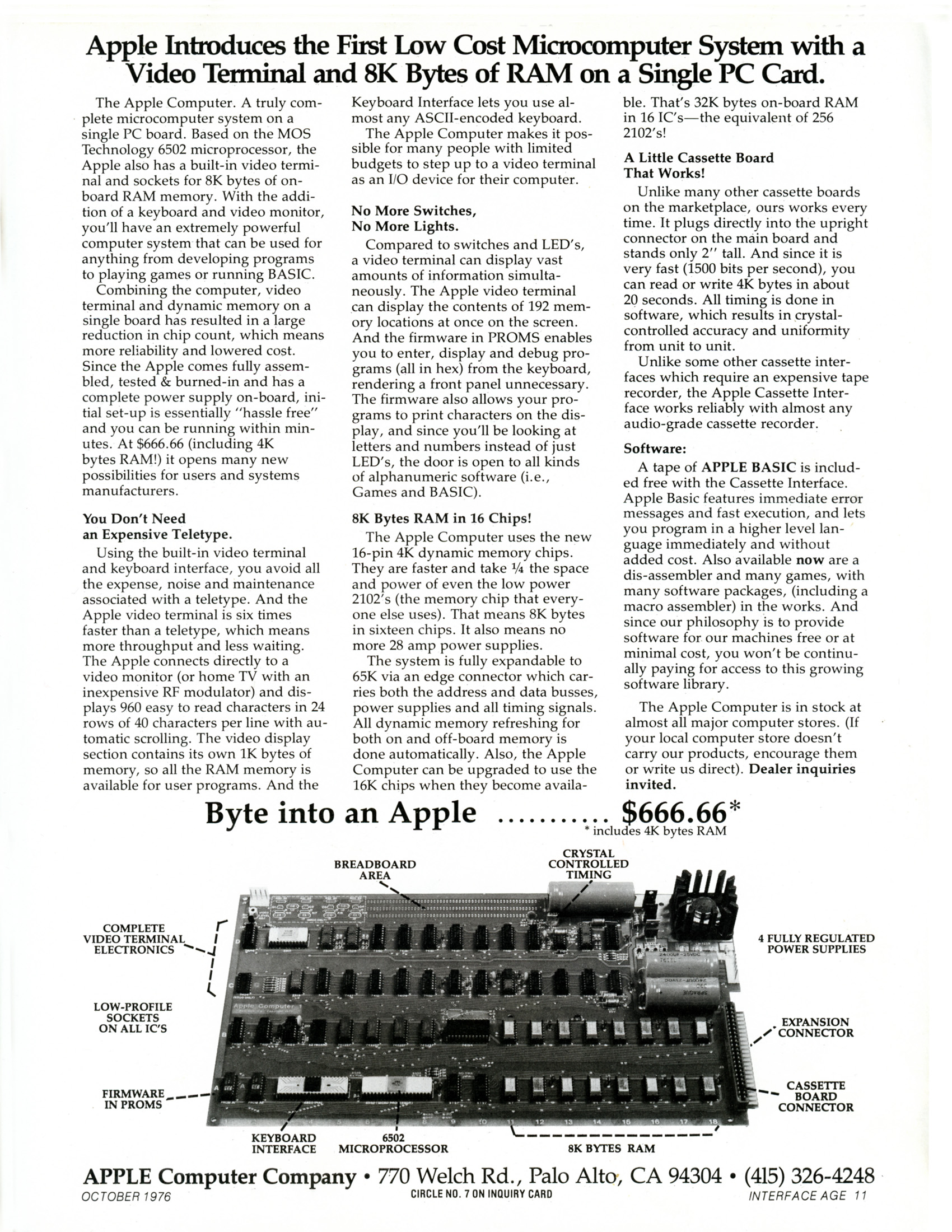
Well, technically they probably wouldn't know what it was immediately simply because the Apple I shipped as basically a motherboard. People had to buy their own case, power supply, etc -- no different than the custom-built PCs of today. So unless the 'Genius' opened the case, they wouldn't necessarily even know it was an Apple product.
It's interesting to note that even back then, Apple's philosophy was sell the hardware, give away the software [big jpg ahead].
From the Apple I ad: "And since our philosophy is to provide software for our machines free or at minimal cost, you won't be continually paying for access to this growing software library."
-
Re:'Windows Classic' theme?
LXDE (lubuntu) for the win.
This is what a 16 color OS looks like. Not too terribly exciting is it? Hey wait. It looks like a lo-res version of Eight!http://upload.wikimedia.org/wikipedia/en/1/15/Windows_3.0_workspace.png
-
How to get US dollars?
Every nation need dollars to buy OPEC oil.
https://secure.wikimedia.org/wikipedia/en/wiki/Nixon_ShockWhat happens if US doesn't need anything from rest of the world?
-
Re:Credit Cards and ATM's
ATM machines mean most of the money is locked away in safes - and spread out over many branches, convenience stores, etc.
This is an ATM.
This is an ATM machine!So you won't find any money inside of an ATM machine. ATM machines only build ATMs, so they are full of ATM parts. If you are after money, you should more likely go after the ATM itself.
And knowing is half of the battle!
-
Jewish genetic studies
Depending on whose calculations you like, Jacob's birthdate was probably about 1650 BCE, and there are number of Y-chromosomal genetic studies of descendents of his son Cohen (Most of whom have names that are variant spellings, like Cohan, Kohan, Garfinkel, etc.) There's a good Wikipedia article on Jewish genetics.
But no, genetic mixing isn't that as thorough and widespread as you'd think. People tend to marry people from the same culture, who speak the same languages, non-nomadic people tend to marry within their own village, nomadic people within their own tribe. Very few non-Jewish non-Arabs have Jacob as an ancestor (or at least have Rachel or Leah as ancestors - polygamy stuck around for another 1500-2000 years in that area.)
Some connections are easier to trace (paternal lines through Y-chromosome, maternal through mitochondria), though of course you don't get any information from your father's mother's mitochondria or your mother's father's Y-chromosome, so you're mostly limited to statistical analysis from other traits unless there are distinct mutations available to work with.
It does look like we're all descendants of "Mitochondrial Eve" about 200,000 years ago, and "Y-Chromosomal Adam" about 140,000 years ago, though of course there were lots of other humanish men and women around back then - they're just the ones whose easily traceable genes stuck around
-
Re: Statistical agenda here?
If you're lumping black Africans all into one cluster, you've missed both Hatta's point and the point of that Wordpress article. Those "two principal components" aren't some fundamentally significant choice of axes, they're components that let you get a visually distinct separation between groups that you've already clustered. So that picture was useful in showing differences between Africans, Europeans, Asians, Australians, and Native Americans. But if you were to split the Africans into 10 or 20 clusters, you'd see a lot more variation between those clusters than between the Europeans and the nearest African groups. For instance, compare the Kalahari Bushmen with the Eastern and Western Pygmy groups in the Congo, the Zulus, the Mau-Mau and other Kenyans, the Bantu groups, the Berbers in Morocco, the Tuareg, etc.
Or for more precision, look at the Wikipedia pages for the L0 mitochondria haplogroup vs. L1, L3, L6, etc. and this picture. Non-African humans are all part of subgroups L3M and L3N, people who left Africa for Arabia a while back. (L3N is mostly in Europe, L3M mostly in Asia.) The Y-chromosome data isn't as well-sampled, but Wikipedia's Y-Chromosomal Adam page also suggests that most of the diversity's in Africa.
And yes, there's also evidence of Neandertal in European genetics and Denisovans in Melanesia, though not in the Y chromosomes or mitochondria, and some other hominids in Sub-Saharan African genetics as well.
-
Re: Statistical agenda here?
If you're lumping black Africans all into one cluster, you've missed both Hatta's point and the point of that Wordpress article. Those "two principal components" aren't some fundamentally significant choice of axes, they're components that let you get a visually distinct separation between groups that you've already clustered. So that picture was useful in showing differences between Africans, Europeans, Asians, Australians, and Native Americans. But if you were to split the Africans into 10 or 20 clusters, you'd see a lot more variation between those clusters than between the Europeans and the nearest African groups. For instance, compare the Kalahari Bushmen with the Eastern and Western Pygmy groups in the Congo, the Zulus, the Mau-Mau and other Kenyans, the Bantu groups, the Berbers in Morocco, the Tuareg, etc.
Or for more precision, look at the Wikipedia pages for the L0 mitochondria haplogroup vs. L1, L3, L6, etc. and this picture. Non-African humans are all part of subgroups L3M and L3N, people who left Africa for Arabia a while back. (L3N is mostly in Europe, L3M mostly in Asia.) The Y-chromosome data isn't as well-sampled, but Wikipedia's Y-Chromosomal Adam page also suggests that most of the diversity's in Africa.
And yes, there's also evidence of Neandertal in European genetics and Denisovans in Melanesia, though not in the Y chromosomes or mitochondria, and some other hominids in Sub-Saharan African genetics as well.
-
Re: Statistical agenda here?
If you're lumping black Africans all into one cluster, you've missed both Hatta's point and the point of that Wordpress article. Those "two principal components" aren't some fundamentally significant choice of axes, they're components that let you get a visually distinct separation between groups that you've already clustered. So that picture was useful in showing differences between Africans, Europeans, Asians, Australians, and Native Americans. But if you were to split the Africans into 10 or 20 clusters, you'd see a lot more variation between those clusters than between the Europeans and the nearest African groups. For instance, compare the Kalahari Bushmen with the Eastern and Western Pygmy groups in the Congo, the Zulus, the Mau-Mau and other Kenyans, the Bantu groups, the Berbers in Morocco, the Tuareg, etc.
Or for more precision, look at the Wikipedia pages for the L0 mitochondria haplogroup vs. L1, L3, L6, etc. and this picture. Non-African humans are all part of subgroups L3M and L3N, people who left Africa for Arabia a while back. (L3N is mostly in Europe, L3M mostly in Asia.) The Y-chromosome data isn't as well-sampled, but Wikipedia's Y-Chromosomal Adam page also suggests that most of the diversity's in Africa.
And yes, there's also evidence of Neandertal in European genetics and Denisovans in Melanesia, though not in the Y chromosomes or mitochondria, and some other hominids in Sub-Saharan African genetics as well.
-
Re:To republicans maybe
- the value of gold is stable, and the goods priced in gold are either keeping their price or their prices are falling
You avoided the question about the 1980s. Someone who bought 1oz of gold for 850USD in 1980 and sold it for 300USD in 2000 could look at the cost of candy bars or Big Macs and would not ascribe gold's price decrease to massive dollar deflation in that period. There had been a speculative increase in the gold price prior to 1980 and this graph suggests that the same thing is happening again. Perhaps "irrational exuberance" on the part of gold buyers?
-
Re:WTF?
What the GP meant by the PowerBook 100 was the first to use the now familiar truely portable clamshell formfactor is, the screen is hinged at the back, the keyboard is set back and the pointing device is in the font. All laptops today use this formfactor nothing uses this formfactor anymore.
-
Re:Options?
The most empirically supported type of talk therapy, CBT, is effective only in anxiety disorders.
I didn't know talking was involved... maybe screaming... but I figure for a lot of guys, you gotta be really fucking depressed before CBT starts to look like a cure.
-
Re:Elephant metric system
The pound is a unit of mass and separately a unit of force.
https://secure.wikimedia.org/wikipedia/en/wiki/Pound_(force)
https://secure.wikimedia.org/wikipedia/en/wiki/Pound_(mass)
So it is the slug and the newton, in your scenario. The space dinosaur has 0 lbs of weight, but a mass of x lbs. -
Re:Elephant metric system
The pound is a unit of mass and separately a unit of force.
https://secure.wikimedia.org/wikipedia/en/wiki/Pound_(force)
https://secure.wikimedia.org/wikipedia/en/wiki/Pound_(mass)
So it is the slug and the newton, in your scenario. The space dinosaur has 0 lbs of weight, but a mass of x lbs. -
Re:Implications
is that "militants"? it's so hard to remember the correct terminology of 1776.
It's "rebels", or "traitors", whichever you prefer.
-
the googles, they burn!
You go first.
I really don't want to get retinal burn-in of something like this! (not goatse, much worse.)
Kudos to whatever troll replaced Jaron Lanier's wikipedia profile picture with that of a Psychlo from the movie Battlefield Earth! -
Re:So, I suspect that a good strong cup of tea ...
And "by 1" could be referring to a unit that specifies a large, critical quantity. But I think you got the idea?
Each can of soda you drink increases your risk for cardiovascular disease by 20%. Two daily cans results in doubling your risk for hypertriglyceridemia.
-
I Don't Get It
Any third option for the foreseeable future is a hippie pipe dream
I don't get it, all the free market preachers are promising that my energy problems will shortly be solved by the free market but your view is such a fatalistic-don't-even-try-jaded response that you seem to doubt the free market can provide.
And if anyone thinks that solar panels and wind turbines are going to supply Tokyo with even a fraction of its power needs, you've obviously never been there.
I haven't been there. But no one's asking those solutions to go from zero to powering Tokyo over night. Look how gradually it's taken wind power to start in the United States (current numbers here). Japan is comparable at our state level and is looking at connecting with Korea, China, Russia and Mongolia power grids to buy more renewable energy. So why call these hippie pipe dreams? If these are hippie pipe dreams, when will our innovation kick in and 'save us' from nuclear and coal?
(unless you count regular, sustained blackouts as an option)
Did you hear that Japan did actually make small adjustments following Fukushima and called the movement setsuden?
I don't think the situation is as dire as you describe it and, frankly, dismissing all the alternative efforts really undermines what we should be working toward which are transitional phases until some breakthrough comes in fusion or an unforeseen source. -
I Don't Get It
Any third option for the foreseeable future is a hippie pipe dream
I don't get it, all the free market preachers are promising that my energy problems will shortly be solved by the free market but your view is such a fatalistic-don't-even-try-jaded response that you seem to doubt the free market can provide.
And if anyone thinks that solar panels and wind turbines are going to supply Tokyo with even a fraction of its power needs, you've obviously never been there.
I haven't been there. But no one's asking those solutions to go from zero to powering Tokyo over night. Look how gradually it's taken wind power to start in the United States (current numbers here). Japan is comparable at our state level and is looking at connecting with Korea, China, Russia and Mongolia power grids to buy more renewable energy. So why call these hippie pipe dreams? If these are hippie pipe dreams, when will our innovation kick in and 'save us' from nuclear and coal?
(unless you count regular, sustained blackouts as an option)
Did you hear that Japan did actually make small adjustments following Fukushima and called the movement setsuden?
I don't think the situation is as dire as you describe it and, frankly, dismissing all the alternative efforts really undermines what we should be working toward which are transitional phases until some breakthrough comes in fusion or an unforeseen source. -
Re:there is no such problem.
Look at these: http://commons.wikimedia.org/wiki/Category:Videos_from_Polissons_et_galipettes They may be black-and-white, but they are as hardcore as anything made today. Several of them are included in Wikipedia articles.
-
Re:Not a problem
Using factual labels, or the Commons category system, was actually the idea. Another part of the idea was letting users and user groups compile filter lists according to their own preferences, by adding individual files or categories. In other words, have people crowdsource filter lists, according to various criteria. Other users would then be able to pick these filter lists and add them to their own Wikimedia account, adapt them as appropriate, etc. In other words, a filter list would be much like an editor's watchlist – something totally personal and private that each editor could adjust as they wished. There would be no pre-defined filters from the Wikimedia side. See e.g. http://meta.wikimedia.org/wiki/Controversial_content/Brainstorming#Reformulation_of_the_Proposal:_Personal_filter_lists and other, similar proposals on that page.
-
Re:"Real science will also be done"
I find it hillarious to think of curmungeonly old astrologers complaining about the kids these days reading the stars all wrong!
It happens, and fairly often. The mumbo-jumbo of astrology has its own intricacies, some of which are even related to actual reality. For example, there are virulent spats between tropical astrologers and sidereal astrologers because of the precession of the equinoxes. Apparently, the precession of the equinoxes was not understood by the Babylonians who originated tropical astrology...
Posting as AC to avoid undoing a mod.
-
Re:Excellent calibration image. (was: Re:links)
Quite funny your post
-
Neutrality
Neutrality means reflecting real-world views in accurate proportions, rather than adopting a fringe position. Wikipedia is the only mainstream site that does not have an adult filter. It pinches thousands of private sexual images from Flickr, where they are behind an age-18 wall, and puts them in public view on Wikimedia sites, without even asking Flickr account holders for their consent: http://commons.wikimedia.org/w/index.php?title=Commons%3ADeletion_requests%2FFile%3ATasting_a_condom.jpg&diff=67108318&oldid=66957446
Wikimedia provides unfiltered access to a bestiality video in response to a harmless search term like "devoirs" (homework) or "vacances" (holidays).
The first search result when entering toothbrush as a search term shows a woman masturbating with one: http://tch995319.tch.www.quora.com/Why-is-the-second-image-returned-on-Wikimedia-Commons-when-one-searches-for-electric-toothbrush-an-image-of-a-female-masturbating
Wikimedia hosts sexually explicit material without any of the contributors adding and managing this material on Wikimedia sites having the legally required records for 18 USC 2257 compliance. Hundreds of uploads are just pure exhibitionism of Wikimedia contributors taking videos and photos of their dicks, or of themselves masturbating in their bathrooms.
http://commons.wikimedia.org/wiki/File:Masturbation.gif
How is that jerky (pun intended) video realistically useful for an educational purpose?
See the images listed at http://en.wikipedia.org/wiki/Wikipedia:BADIMAGES
See http://meta.wikimedia.org/wiki/Controversial_content/Problems for random image searches on Wikipedia and Wikimedia Commons bringing up adult material
See http://wikipediocracy.com/2012/04/11/wikimedia-commons-pornography-concerns-just-right-wing-prudery/ -
Neutrality
Neutrality means reflecting real-world views in accurate proportions, rather than adopting a fringe position. Wikipedia is the only mainstream site that does not have an adult filter. It pinches thousands of private sexual images from Flickr, where they are behind an age-18 wall, and puts them in public view on Wikimedia sites, without even asking Flickr account holders for their consent: http://commons.wikimedia.org/w/index.php?title=Commons%3ADeletion_requests%2FFile%3ATasting_a_condom.jpg&diff=67108318&oldid=66957446
Wikimedia provides unfiltered access to a bestiality video in response to a harmless search term like "devoirs" (homework) or "vacances" (holidays).
The first search result when entering toothbrush as a search term shows a woman masturbating with one: http://tch995319.tch.www.quora.com/Why-is-the-second-image-returned-on-Wikimedia-Commons-when-one-searches-for-electric-toothbrush-an-image-of-a-female-masturbating
Wikimedia hosts sexually explicit material without any of the contributors adding and managing this material on Wikimedia sites having the legally required records for 18 USC 2257 compliance. Hundreds of uploads are just pure exhibitionism of Wikimedia contributors taking videos and photos of their dicks, or of themselves masturbating in their bathrooms.
http://commons.wikimedia.org/wiki/File:Masturbation.gif
How is that jerky (pun intended) video realistically useful for an educational purpose?
See the images listed at http://en.wikipedia.org/wiki/Wikipedia:BADIMAGES
See http://meta.wikimedia.org/wiki/Controversial_content/Problems for random image searches on Wikipedia and Wikimedia Commons bringing up adult material
See http://wikipediocracy.com/2012/04/11/wikimedia-commons-pornography-concerns-just-right-wing-prudery/ -
Neutrality
Neutrality means reflecting real-world views in accurate proportions, rather than adopting a fringe position. Wikipedia is the only mainstream site that does not have an adult filter. It pinches thousands of private sexual images from Flickr, where they are behind an age-18 wall, and puts them in public view on Wikimedia sites, without even asking Flickr account holders for their consent: http://commons.wikimedia.org/w/index.php?title=Commons%3ADeletion_requests%2FFile%3ATasting_a_condom.jpg&diff=67108318&oldid=66957446
Wikimedia provides unfiltered access to a bestiality video in response to a harmless search term like "devoirs" (homework) or "vacances" (holidays).
The first search result when entering toothbrush as a search term shows a woman masturbating with one: http://tch995319.tch.www.quora.com/Why-is-the-second-image-returned-on-Wikimedia-Commons-when-one-searches-for-electric-toothbrush-an-image-of-a-female-masturbating
Wikimedia hosts sexually explicit material without any of the contributors adding and managing this material on Wikimedia sites having the legally required records for 18 USC 2257 compliance. Hundreds of uploads are just pure exhibitionism of Wikimedia contributors taking videos and photos of their dicks, or of themselves masturbating in their bathrooms.
http://commons.wikimedia.org/wiki/File:Masturbation.gif
How is that jerky (pun intended) video realistically useful for an educational purpose?
See the images listed at http://en.wikipedia.org/wiki/Wikipedia:BADIMAGES
See http://meta.wikimedia.org/wiki/Controversial_content/Problems for random image searches on Wikipedia and Wikimedia Commons bringing up adult material
See http://wikipediocracy.com/2012/04/11/wikimedia-commons-pornography-concerns-just-right-wing-prudery/ -
Re:Links?
Check the images in this list: http://en.wikipedia.org/wiki/Wikipedia:BADIMAGES
Media like those in Wikipedia's "Bad Images" list can, even if they are not included in any article, come up in random media searches run on Wikipedia, as long as just one word in the file name or description matches the user's search term. Example:
http://en.wikipedia.org/w/index.php?title=Special%3ASearch&profile=images&search=male+human&fulltext=Search (NSFW, sexual)
http://en.wikipedia.org/w/index.php?title=Special%3ASearch&profile=images&search=foot&fulltext=Search (NSFW, gore)
For more examples see http://meta.wikimedia.org/wiki/Controversial_content/Problems -
Bad image list
Check the images on this page: http://en.wikipedia.org/wiki/Wikipedia:BADIMAGES
That does include images of mutilation and dismemberment, and these files come up in random searches.
An image of a naked woman having her throat cut in a bathtub (Fake sacrifice.jpg) was deleted only the other day, after it had been on Commons for years (the image was a simulation, not a real murder). http://commons.wikimedia.org/wiki/Commons:Deletion_requests/File:Lesbic_use_of_nipple_clamps_and_strap-on_dildo.jpg -
Re:Not a problem
No top-ranking website provides unfiltered access to sexually explicit stuff. Not Google, not YouTube, not Flickr.
Where do all the people come from who shout "censorship" when it is proposed that Wikipedia should be doing what all other mainstream sites are doing? I don't see anyone demanding that Google should do away with safe search, or that Flickr should mix in their uploaders' porn with search results for harmless search terms like forefinger, backhand, jumping ball, cucumber, or toothbrush: http://meta.wikimedia.org/wiki/Controversial_content/Problems
So, all those who think Flickr are evil censors, please camp on Flickr's door and tell them to discontinue their content categories. Everybody doing a search in Flickr should see porn. Camp on Google's door please, and tell them they are evil censors as long as they offer safe search. Everybody should see porn.
When they have succeeded in changing policy at Google and Flickr, we can talk again. Until then, Wikimedia is just a bizarre outlier run by juvenile idiots. (Only 15% of Wikimedians have children, only 2% are mothers.)
Boycott them. No more donations until they wake up. -
Re:porn? where?
Which top-ten website would keep this http://commons.wikimedia.org/wiki/Special:ListFiles/Handcuffed lying around unfiltered? Flickr has images like that behind an age-18 wall. Wikimedia pinches the same images from Flickr, and puts them on public display. How is that a charitable purpose deserving of tax exemption? How does it make it an educational site for children? If that's so educational, why is no one sending kids to the adult area of Flickr? It's the same images. Another issue is that Flick account holders aren't even asked if they want their images dragged out of the obscurity of Flickr, and put up on the world's no. 5 website. And if they complain that their privacy has been violated, Wikimedia administrators regularly tell them to jump in the lake
-
Re:So?
-
Re:Not a problem
No. You can be searching for an image of a toothbrush or for a picture of a tennis backhand and you end up being shown sexual images, both in Wikipedia and in Commons. See http://meta.wikimedia.org/wiki/Controversial_content/Problems The video of the nun having sex with a dog comes up as a top result for any French schoolchild entering devoirs (homework) or vacances (holidays) as a search term in Commons, or as a file search term in Wikipedia
-
Re:Not a problem
Don't blame me. You asked for it!
https://commons.wikimedia.org/wiki/File:Dede_Cucumber_0433.jpg
It's less on Wikipedia itself and more in the images that people upload to Wikipedia that can be accessed through certain searches. The problem is some of the searches, like "cucumber" in this case, are innocuous at face value. -
links
everyone is asking for links, and since i know reading the article isn't in the plans....
needless to say NSFW.
http://commons.wikimedia.org/w/index.php?title=Category:Sexual_penetrative_use_of_cucumbers&oldid=66888173
http://commons.wikimedia.org/w/index.php?title=Category:GIF_videos_of_male_masturbation&oldid=67780152
http://commons.wikimedia.org/wiki/File:Sexual_intercourse_with_vaginal_lubricative_fluid.jpgetc etc
-
links
everyone is asking for links, and since i know reading the article isn't in the plans....
needless to say NSFW.
http://commons.wikimedia.org/w/index.php?title=Category:Sexual_penetrative_use_of_cucumbers&oldid=66888173
http://commons.wikimedia.org/w/index.php?title=Category:GIF_videos_of_male_masturbation&oldid=67780152
http://commons.wikimedia.org/wiki/File:Sexual_intercourse_with_vaginal_lubricative_fluid.jpgetc etc
-
links
everyone is asking for links, and since i know reading the article isn't in the plans....
needless to say NSFW.
http://commons.wikimedia.org/w/index.php?title=Category:Sexual_penetrative_use_of_cucumbers&oldid=66888173
http://commons.wikimedia.org/w/index.php?title=Category:GIF_videos_of_male_masturbation&oldid=67780152
http://commons.wikimedia.org/wiki/File:Sexual_intercourse_with_vaginal_lubricative_fluid.jpgetc etc