Slashdot Mirror
Domain: wikipedia.org
Stories and comments across the archive that link to wikipedia.org.
Stories · 7,048
-
Fantasy Author Robert Jordan Passes Away
willith writes "James Oliver Rigney Jr, author of the long-running fantasy series The Wheel of Time and better known to millions of fans by the pen name Robert Jordan, died on 16 Sept 2007 from cardiac amyloidosis. Jordan announced he had been diagnosed with the disease in March 2006 and vowed to beat the odds, but determination and gumption sometimes just aren't enough in the face of a disease with a median survival time of just over two years. Jordan was in the process of writing the twelfth and final book in the Wheel of Time series, A Memory of Light, but the book was not slated for release until 2009 and is still incomplete. While there is hope that the book will still be finished from Jordan's notes, this is devastating news to all of us who have been reading the series since 1990." -
Fantasy Author Robert Jordan Passes Away
willith writes "James Oliver Rigney Jr, author of the long-running fantasy series The Wheel of Time and better known to millions of fans by the pen name Robert Jordan, died on 16 Sept 2007 from cardiac amyloidosis. Jordan announced he had been diagnosed with the disease in March 2006 and vowed to beat the odds, but determination and gumption sometimes just aren't enough in the face of a disease with a median survival time of just over two years. Jordan was in the process of writing the twelfth and final book in the Wheel of Time series, A Memory of Light, but the book was not slated for release until 2009 and is still incomplete. While there is hope that the book will still be finished from Jordan's notes, this is devastating news to all of us who have been reading the series since 1990." -
Is nVidia Support for Older 3D Games Fading?
BrendaEM writes "A thread on Through the Looking Glass depicts the plight of fans of the original Thief Series and System Shock 2, who are asking nVidia fix rendering issues these 3D 16-bit games on their newer video cards and drivers. In the case of the original Thief series, in which the games build tension by their use of light and shadow, the rendering has been badly degraded from that which was originally intended. In another Slashdot article, the author asked the question whether or not video games were art. If one of the greatest video games of all time, with a growing wealth of hundreds of fan produced missions, as well as an entire full-sized expansion, does not play well because legacy support diminishes, then what will happen to lesser 3D video games?" -
Is nVidia Support for Older 3D Games Fading?
BrendaEM writes "A thread on Through the Looking Glass depicts the plight of fans of the original Thief Series and System Shock 2, who are asking nVidia fix rendering issues these 3D 16-bit games on their newer video cards and drivers. In the case of the original Thief series, in which the games build tension by their use of light and shadow, the rendering has been badly degraded from that which was originally intended. In another Slashdot article, the author asked the question whether or not video games were art. If one of the greatest video games of all time, with a growing wealth of hundreds of fan produced missions, as well as an entire full-sized expansion, does not play well because legacy support diminishes, then what will happen to lesser 3D video games?" -
Science vs. Homeopathy
Mr. E writes "Ars Technica has an interesting look at pseudoscience as it applies to homeopathy. While most discussions about what science is get derailed by the larger controversies surrounding them, Ars chose a relatively uncontroversial pseudo-science to examine so that they could examine the factors which make homeopathy a psuedo-science: ignoring settled issues in science, misapplication of real science, rejection of scientific standards, claims of suppression, large gaps between the conclusion and evidence, and a focus only on the fringes of what we currently understand." -
Time Running Out for Public Key Encryption
holy_calamity writes "Two research teams have independently made quantum computers that run the prime-number-factorising Shor's algorithm — a significant step towards breaking public key cryptography. Most of the article is sadly behind a pay-wall, but a blog post at the New Scientist site nicely explains how the algorithm works. From the blurb: 'The advent of quantum computers that can run a routine called Shor's algorithm could have profound consequences. It means the most dangerous threat posed by quantum computing - the ability to break the codes that protect our banking, business and e-commerce data - is now a step nearer reality. Adding to the worry is the fact that this feat has been performed by not one but two research groups, independently of each other. One team is led by Andrew White at the University of Queensland in Brisbane, Australia, and the other by Chao-Yang Lu of the University of Science and Technology of China, in Hefei.'" -
FASA Studios Now Out of Business
PhoenixOne writes "Another chapter in the long and sometimes-frustrating history of the name 'FASA' comes to a close today, as Microsoft's FASA Studio has closed its doors. 'It is my sad duty to announce that FASA Studio has officially closed its doors. Today was the official last day of employment for those of us who had not moved on to other positions within Microsoft Game Studios. While the rumors have been circulating forever, we chose to wait on an official announcement because we didn't want people's attention distracted from our last product, Shadowrun, a game we love.'" -
Scientists Create Di-positronium Molecules
doxology writes "The BBC reports that scientists have been able to create di-positronium molecules. A di-positronium molecule consists of two positronium atoms, exotic atoms which are made from an electron and a positron (the anti-particle of the electron). A potential use of these molecules is to make extremely powerful gamma-ray lasers, possibly on sharks." -
Sun Acquires CFS/Lustre, Becomes Windows OEM
anzha writes "Sun Microsystems announced today that they are acquiring Cluster File Systems Inc. CFS owns the intellectual property related to and develops the open source file system known as Lustre." Relatedly Sun has also signed an agreement with Microsoft to be a Windows OEM. "Sun and Microsoft will work together to ensure that Solaris runs well as a guest on Microsoft virtualization technologies and that Windows Server runs well as a guest on Sun's virtualization technologies. Sun and Microsoft will work together on a support process for customers who are using the virtualization solutions. This joint commitment to customers ensures that Windows and Solaris will provide a solid virtualization experience." -
Republic.com 2.0
sdedeo writes "Republic.com 2.0 is an updated and reworked version of Cass Sunstein's Republic.com, which was reviewed on slashdot back in April 2001. That earlier version was written before blogger was purchased by google, before wikipedia broke "10,000th most popular" on alexa, and — most importantly for Cass — before the terrorist attacks of September 11th unleashed a torrent of political blogging that has yet to peak." Read on for the rest of Simon's review Republic.com 2.0 author Cass R. Sunstein pages 251 publisher Princeton University Press rating 8 reviewer Simon DeDeo ISBN 978-0-691-13356-0 summary Provocative but flawed Cass is one of the few people in the world who holds a senior faculty position in jurisprudence at a law school and yet can be expected to understand crucial notions of internet content creation such as versioning control, trackbacks and google juice.
I was first introduced to Cass in his 2003 book, Why Societies Need Dissent. One of the reasons for his appeal among the geek community is not only his content — he's hardly the first person to write about the internet — but also his reliance on provocative thought experiments. Notably, in Dissent, he uses one to explain why you should be suspicious of group-signed letters — an argument he modifies for Republic.com 2.0, so you won't miss it. You may dispute his applications of such arguments to the real world, but it's certainly the case that they're both new and non-trivial.
Cass is not one to beat around the bush, and one of the first things you'll encounter in Chapter One is the assertion that "the view that free speech is an 'absolute'" is "utterly implausible." I think he does himself a disservice by highlighting this and leaving the explanation to a much later chapter; Cass is opposed to "viewpoint discrimination" by the government, for example, and he's far more mild than you'd expect.
The central argument in Republic.com 2.0 is unchanged: greater control over, and filtering of, the content one receives may have adverse consequences for democracy. By this time, most slashdot readers are familiar with the basic idea — when they're not complaining about troll-ratings and slashdot group-think.
It goes like this: increasingly popular software tools allow you to filter to an unprecedented extent not only the kind of information you receive, but also its political or ideological slant. Fans of a particular idea ("open source is good", "affirmative action is anti-American", "a conservative cabal runs the United States for the benefit of corporations") can choose their news sites and blogcircles so that they will rarely, if ever, encounter the opposition except at second hand and in caricature. This is bad.
Before engaging this idea, it's worth stepping back. The internet — and the software on top of it — has often been referred to as the Platonic ideal of participatory democracy. One of Cass's points is the extent to which it's a half-truth: not every feature is faithfully reproduced, and one crucial one — the "public forum", which he uses in a technical, legal sense — is gone.
I grew up in London, and Hyde Park's Speaker's Corner was for me a touchstone of what democracy should be. Supreme Courts the world over agree, and the "public forum" — a geographical location — emerged as a space where courts could not interfere with public expressive activity. The internet is, of course, awash with such things (an unmoderated comment stream is not hard to find), but the crucial difference is that one need never see them while, in the real world, "public forums" — at least in the United States — include the streets and parks we use every day.
For Cass, the public forum extends to what he refers to as "general interest intermediaries" (GIIs): massive circulation sources that, while not granting the same rights-of-access to the public that a park does, provide regular encounters with facts and points-of-view that can be counted on to surprise the reader. My own view — one echoed by the blogosphere both right and left — is that since 9/11, more and more of these GIIs have failed us. Time after time, outlets such as the New York Times, CNN, Fox News, the New Republic and Time Magazine have not only marginalized legitimate views, but also misreported crucial facts.
While Cass provides fascinating psychological studies of how we turn towards the news that flatters us, I think that one of the reasons for the explosive growth of online communities and online reporting is not that we are polarizing ourselves in a positive-feedback runaway, but rather that more and more people are becoming aware of the structural failures of the GII.
A classic example that friends of mine on the left cite is the "cocktail party" atmosphere of the Washington journalism circuit, where criticizing too aggressively the Bush administration led to a freeze-out on interviews and insider information. (Friends on the right complain to me more often about particular arguments being frozen out.)
Cass pays insufficient attention, in my mind, to these arguments, and his view of the blogosphere is jaundiced at best. For Cass, the blogosphere is the source of urban legends, not their debunking, whereas any glance at the front page of political blogs, slashdot (or, more charmingly, snopes) will reveal plenty of debunking being done on the GII in the comments.
His evidence that blogs — and not just controlled psychological experiments — actually do elicit group polarization is disappointingly thin, and relies on over interpreted linkage studies and anecdotal evidence that show major "hubs" in the political blogging world, like instapundit, Atrios, and talkingpointsmemo, acting as strong filters that reinforce the party line. Chris Bowers and Matt Stoller (also a close friend) have done a more detailed study of linkage patterns and come to very different conclusions.
There are problems with Cass's arguments, and in the end I don't think his snapshot of the internet in 2007 holds up. He's frustrating at times and, ironically, when he frustrates the most he reminds me of a blowhard blogger. The provocative nature of his thought experiments is worth the price of admission alone, however, and his legal-historical background on the nature of free speech in deliberative democracy is fascinating reading. Pundits of the blogosphere would be remiss in not reading his book.
Simon DeDeo is a astrophysicist and literary critic. He lives in Chicago, Illinois.
You can purchase Republic.com 2.0 from amazon.com. Slashdot welcomes readers' book reviews -- to see your own review here, read the book review guidelines, then visit the submission page. -
New Wonder Weed to Fuel Cars?
Hugh Pickens writes "Jatropha, an ugly, fast-growing and poisonous weed that has been used as a remedy for constipation, may someday power your car. The plant, resilient to pests and resistant to drought, produces seeds with up to 40 per cent oil content that when crushed can be burned in a diesel car while the residue can be processed into biomass for power plants. Although jatropha has been used for decades by farmers in Africa as a living fence because its smell and taste repel grazing animals, the New York Times reports that jatropha may replace biofuels like ethanol that require large amounts of water, fertilizer, and energy, making their environmental benefits limited. Jatropha requires no pesticides, little water other than rain and no fertilizer beyond the nutrient-rich seed cake left after oil is pressed from its nuts. Poor farmers living close to the equator are planting jatropha on millions of acres spurred on by big oil companies like British Petroleum that are investing in jatropha cultivation." -
Ophcrack Says Your Password Is Insecure
javipas writes "An insightful article at Jeff Atwood's Coding Horror reveals the power inside Ophcrack, an Open Source program that is capable of discovering virtually any password in Windows operating systems. The article explains how passwords get stored on Windows using hash functions, and how Ophcrack can generate immense tables of words and letter combinations that are compared to the password we want to obtain. The program is available in Windows, Mac OS and Linux, but be careful: the generated tables that Ophcrack uses are really big, and you should allow up to 15 Gbytes to store these tables." -
English Wikipedia Gets Two Millionth Article
reybrujo writes to inform us of a milestone for the English-language Wikipedia: the posting of its two millionth article. At the time of this posting there is uncertainty over which article achieved the milestone. "Initial reports stated that the two millionth article written was El Hormiguero, which covers a Spanish TV comedy show. Later review of this information found that this article was most likely not two million, and instead a revised list of articles created around two million has been generated, and is believed to be correct to within 3 articles. The Wikimedia foundation, which operates the site, is expected to make an announcement with a final decision, which may require review of the official servers' logs." -
PHP5 Vs. CakePHP Vs. RubyOnRails?
OldJavaHack writes "If you could start a website (with MySQL for persistence) from scratch and you had a choice of PHP5, CakePHP, or RubyOnRails — which would you choose and why? Things to consider in your decision: 1. Maturity of solution; 2. Features; 3. Size of community of skilled users (to build a team); 4. Complexity/ease of use (for neophytes to master); 5. Greatest strength of your choice, and the greatest weaknesses of the other two. Here is a comparison of capabilities." -
Making War On Light Pollution
Hugh Pickens writes "Almost thirty years ago I worked in the Middle East helping install a nationwide communications system and had the opportunity to be part of a team doing microwave link tests across Saudi Arabia's Empty Quarter. Something I've never forgotten were the astonishing nights I spent in the desert hundreds of miles from the nearest city where the absence of light made looking at the sky on a moonless night feel like you were floating in the middle of the galaxy. In Galileo's time, nighttime skies all over the world would have merited the darkest Bortle ranking, Class 1. Today, the sky above New York City is Class 9 and American suburban skies are typically Class 5, 6, or 7. The very darkest places in the continental United States today are almost never darker than Class 2, and are increasingly threatened. Read a story from the New Yorker on what we have lost to light pollution and how some cities are adopting outdoor lighting standards to save the darkness." -
Would You Pay Pennies For Game Features?
Friday at GDC Austin saw the day starting with a keynote that may seem unusual to players unfamiliar with the Asian online gaming market. Nexon is a major player from the country of South Korea, boasting a handful of titles that see more users in a month than many well-known online games made here in the US. All of the company's titles, regardless of genre, have one thing in common: they're free to play, sort of. Microtransactions, the practice of paying a very small amount of money for an object or service, is what provides Nexon its revenue ... and plenty of revenue it is. Nexon America's director Min Kim gave a discussion on the realities of rolling Microtransaction-based titles out in the states, with a case study of the success of Maple Story's launch in our country. -
Are Relational Databases Obsolete?
jpkunst sends us to Computerworld for a look at Michael Stonebraker's opinion that RDBMSs "should be considered legacy technology." Computerworld adds some background and analysis to Stonebraker's comments, which appear in a new blog, The Database Column. Stonebraker co-created the Ingres and Postgres technology while a researcher at UC Berkeley in the early 1970s. He predicts that "column stores will take over the [data] warehouse market over time, completely displacing row stores." -
Numerically Approximating the Wave Equation?
ObsessiveMathsFreak writes "I'm an applied mathematician who has recently needed to obtain good numerical approximations to the classic second-order wave equation, preferably in three space dimensions. A lot of googling has not revealed much on what I had assumed would be a well-studied problem. Most of the standard numerical methods, finite difference/finite element methods, don't seem to work very well in the case of variable wave speed at different points in the domain, which is exactly the case that I need. Are any in this community working on numerically solving wave equation problems? What numerical methods do you use, and which programs do you find best suited to the task? How do you deal with stability issues, boundary/initial values, and other pitfalls? Are there different methods for electromagnetic wave problems? Finally, when the numbers have all been crunched, how do you visualize your hard-earned data?" -
Numerically Approximating the Wave Equation?
ObsessiveMathsFreak writes "I'm an applied mathematician who has recently needed to obtain good numerical approximations to the classic second-order wave equation, preferably in three space dimensions. A lot of googling has not revealed much on what I had assumed would be a well-studied problem. Most of the standard numerical methods, finite difference/finite element methods, don't seem to work very well in the case of variable wave speed at different points in the domain, which is exactly the case that I need. Are any in this community working on numerically solving wave equation problems? What numerical methods do you use, and which programs do you find best suited to the task? How do you deal with stability issues, boundary/initial values, and other pitfalls? Are there different methods for electromagnetic wave problems? Finally, when the numbers have all been crunched, how do you visualize your hard-earned data?" -
Antique Voyager Technology
sea_stuart writes with a story from the Tidbinbilla space tracking station, outside Canberra, Australia. It is still communicating with the two Voyager spacecraft 30 years after they were launched and 18 years after Voyager 2 passed close by Neptune. Here's a little background on Voyager 1 and Voyager 2. "The bank of computers that would look at home in black-and-white episodes of Doctor Who cannot be junked... [T]he 1970s hardware is now our world's only means of chatting with two robot pioneers exploring the solar system's outer limits. Today Voyager 1 is humanity's most remote object, 15.5 billion kilometers from the sun. Voyager 2 is 12.5 billion kilometers from it. Both continue beaming home reports, but now they are space-age antiques. 'The Voyager technology is so outmoded,' said Tidbinbilla's spokesman, Glen Nagle, 'we have had to maintain heritage equipment to talk to them.'" -
Antique Voyager Technology
sea_stuart writes with a story from the Tidbinbilla space tracking station, outside Canberra, Australia. It is still communicating with the two Voyager spacecraft 30 years after they were launched and 18 years after Voyager 2 passed close by Neptune. Here's a little background on Voyager 1 and Voyager 2. "The bank of computers that would look at home in black-and-white episodes of Doctor Who cannot be junked... [T]he 1970s hardware is now our world's only means of chatting with two robot pioneers exploring the solar system's outer limits. Today Voyager 1 is humanity's most remote object, 15.5 billion kilometers from the sun. Voyager 2 is 12.5 billion kilometers from it. Both continue beaming home reports, but now they are space-age antiques. 'The Voyager technology is so outmoded,' said Tidbinbilla's spokesman, Glen Nagle, 'we have had to maintain heritage equipment to talk to them.'" -
Bugging Catches Up To SIP Phones
SkiifGeek writes "After news at the end of last year that mobile phones could be remotely eavesdropped, and there being a long history of remote eavesdropping possible on normal telephones, it was only a matter of time until VoIP devices were found to be eavesdropable (whether intentionally or not). In the last week there have been several exploit code releases, and it seems that some vendors who chose to write their own SIP networking stacks are at risk of their devices being easily eavesdropped on." -
SCADA Systems a Target for Hackers?
superstick58 writes "As a system integrator, I am often providing control solutions that utilize sophisticated Ethernet networks and as they say in the biz 'link top floor to shop floor.' Forbes has an article about the security issues that exist in SCADA systems. When I look back at some of the systems I have put in which include direct I/O control over ethernet and distributed HMI monitoring, if I can get access from the internet, it would be easy to bring down power for a plant or at the very least make operators in the building very uncomfortable. How vulnerable are the manufacturing centers of the world?" -
The "Loudness War" and the Future of Music
An anonymous reader notes an article up at IEEE Spectrum outlining the history and dangers of the accelerating tendency of music producers to increase the loudness and reduce the dynamic range of CDs. "The loudness war, what many audiophiles refer to as an assault on music (and ears), has been an open secret of the recording industry for nearly the past two decades and has garnered more attention in recent years as CDs have pushed the limits of loudness thanks to advances in digital technology. The 'war' refers to the competition among record companies to make louder and louder albums by compressing the dynamic range. But the loudness war could be doing more than simply pumping up the volume and angering aficionados — it could be responsible for halting technological advances in sound quality for years to come... From the mid 1980s to now, the average loudness of CDs increased by a factor of 10, and the peaks of songs are now one-tenth of what they used to be." -
Gen Con 2007 In A Nutshell
Another year, another Gen Con? Hardly. This year was the 40th anniversary of Gen Con, marked the announcement of the newest edition of Dungeons and Dragons, and was the first year videogame companies were actively sought out as exhibitors. Put together this resulted in what felt like record crowds, a healthy dealer's hall, and an instant conversation-starter with every other person at the event. Read on for notes on the new tabletop releases, thoughts on the new edition of D&D, impressions of the videogames that were in attendance, and a shameful admission of weakness. Gen Con remains a bastion of tabletop gaming, but I'll admit it: I didn't get as strong a sense of the new tabletop game releases as I have in previous years. Instead, I spent time I would have normally put towards demoing games with dice and pieces towards getting a handle on the handful of videogames at the event. It seemed like almost every one was a Massively Multiplayer Online Game, but there were several representatives of other genres as well.
What I did glean from this year's event is summed up very well by well-known designer Robin Laws: "This year was a holding pattern." Many of the companies making products for the Open Gaming License/d20 system seem to have died back. With the announcement of Fourth Edition, there will be a resurgence the year after next, but for this year things seemed to be fairly quiet.
This Year's Releases
So what was released this year? Biggest hits at the con, by far, were the Battlestar Galactica RPG, Changeling: The Lost, and the new version of Talisman. The Battlestar tabletop game is a sister product to the Serenity (as in Firefly) RPG, both of which use the same rules-set ("Cortex"), and are published by Margaret Weis Productions. The Serenity game has a fairly impressive following, with the core book already being on its fourth printing just a year after it was released. Battlestar seemed to be offering up a similar buzz. The Weis booth was also playing host to voice actor Jason Marsden, who plays the part of Tasslehoff Burrfoot in the upcoming animated Dragonlance movie. They showed off a trailer for the film, currently slated for release later this year.
White Wolf gamers may not have been waiting with baited breath for a new version of Changeling; it was never as popular as their 'big three' of Vampire, Werewolf, and Mage. Just the same, I saw a number of copies of the updated title walking away from the White Wolf/CCP booth this year. The attraction of EVE Online in the same booth didn't stop White Wolf players from picking up the latest in the 're-imagined' World of Darkness.
Talisman is probably a name familiar to long-time boardgame players. Under the Black Industries imprint, Games Workshop is re-releasing their classic adventure game with a slightly updated look and a few tweaks to the rules. From what I heard, though, it's almost entirely the same game that you knew back in the day. It just won't cost hundreds of dollars on eBay anymore. Lines for the title were going down the rows and out the door of the exhibit hall, and my impression is that they sold out pretty much every day they had new product to sell.
It didn't have as much buzz as other announcements at the con, but well worth noting was the formation of a company called Catalyst Game Labs. Catalyst is a new outfit formed from the ashes of "Fantasy Productions", or FanPro as it was more commonly called. FanPro has been publishing the Shadowrun RPG since FASA gave up the ghost a few years back, and while the quality of the books has been fairly high it would be kind to say that they've been released on any kind of regular schedule. The new company marks a turn for one of the most well-known intellectual properties in pen and paper gaming, with two new books (Emergence and Augmentation) available just at this convention. Working together with the folks behind the Classic Battletech line, they now having backing and a business plan. If you're a Shadowrun fan, there's going to be a lot to look forward to in the coming years.
Dungeons and Dragons Fourth Edition
The biggest news was, of course, the announcement that Wizards of the Coast is going to be releasing the fourth edition of Dungeons and Dragons next year. At a press event the day before their public announcement to Gen Con attendees, they tried to lay out the groundwork for their ambitious new plan. Essentially, these new books have been eight years in the making. The R&D team at WotC is looking to adapt Dungeons and Dragons to the way that it's played, and stop forcing gamers to play the game the way the game is set up. While the switchover from 2nd edition rules to 3.0 was an amazing step, it was in some ways still black magic. They now have a large base of knowledge to work from, that's going to let them change the game in fundamental ways. They hope it will be for the better.
The biggest changes will be mechanical. My review of the Saga Edition of the Star Wars RPG discussed the significant rules changes that title underwent; the R&D folks as much as admitted that book was sort of a 'test run' for concepts they'll be incorporating into fourth edition. The focus is going to be on ease of play for everyone, both in front of and behind the DM screen. Party roles will be more clearly defined. Encounters will be reformatted, and monsters retuned to more understandable roles and difficulty levels. It may just be hyperbole, but the designers are aiming to 'make D&D feel heroic again.' On the far end of the scale, this means that epic-level play will now be a core part of the game. That is, the Player Handbook will support level progression from 1-30. Levels 1-10 will be known as 'heroic' levels, where characters are better than the average human but still 'normal'. Levels 10-20 are 'paragon' levels, where characters accomplish feats only possible in a fictional environment. Levels 20-30 are 'epic' levels, where heroes will be able to step out into the world and change the course of history. Desiigner Chris Perkins put it this way: "We want first level to be more than 'run away, it's a kobold.' Gone are the days of the four hit point Wizard."
On top of that, WotC feels as though a new edition is necessary to support the other three columns of their ambitious new plan. Physical books are the most important part, but there are three other pieces that feed into the game. The first is community, exemplified by the terribly-named Gleemax.com website. Gleemax is going to offer up a single place where D&D gamers can come together to discuss the game, as well as CCGs, boardgames, and the lot; a MySpace for tabletop nerds, essentially.
Unfortunately, it's not clear how separate that piece will be from the ambitious D&DInsider.com. That site, essentially an outgrowth of the official Wizards of the Coast website content, is going to be a central hub for Dungeons and Dragons players. The late, lamented Dungeon and Dragon magazines will be available online there, and the site will also play host to the most novel concept in the fourth edition bag of tricks: The D&D Game Table. The Game Table is an online playspace, where groups can get together around a virtual table to actually play Dungeons and Dragons online. DMs will be able to lay out dungeon maps, place monsters, and run games. Players will have access to online versions of their purchased physical rulebooks, can make characters using a character creation tool, and can even create their own virtual miniatures for their characters. Voice chat will bring the whole group together. The WotC folks were very clear: this is not meant to take the place of your regular game. It's a place to go if your gaming group is spread across the country (or world) as so often happens in our busy modern world. They also envision a future where players who don't have regular games can hop online and connect with other folks to play in a regular campaign.
This last will likely be aided by the fourth leg of this concept: organized play. The RPGA has always been associated with but not a part of Dungeons and Dragons, if that makes any sense. With fourth edition the organized play campaigns will become a central component to the game experience. From your home, to the gaming store, online with the D&D Game Table, and all the way to conventions, the goal is for gamers to have a fun and slightly more formal handrail for gaming together. With a renewed interest in adventure publishing, designer goals seem to be to bring back the days when every D&D gamer could talk of playing through modules like Keep on the Borderlands or Tomb of Horrors.
All of this combines to an extremely ambitious goal: a brand new D&D. Just from anecdotal experience, from talking with players and retailers at the convention, my own gaming store, and from reading comments here on the site, the general reaction seems to be anger. The reason is understandable; 3.5 books aren't cheap, and many gamers have invested heavily in the current edition. In the latest D&D Podcast even the designers themselves admitted that 3.5 isn't 'that broken.' Thankfully, there's still quite some time before even the Player's Handbook comes out. The folks at Wizards have a good long while to explain to us what exactly they're planning to do. A long time to convince us, to reassure people that they really aren't ditching the OGL (full support), that their favorite campaigns will be supported (new Realms book next year, Eberron in 09), that it's worth shelling out another $90 for the upgrade. They've already begun, in fact; their ongoing design and development series has already put up posts on party roles, the new vision for Fighters, and what it's like to face a dragon in the new edition. If they even come close to delivering on what these articles imply, next year is going to be an interesting time to be a gamer.
Warhammer Online
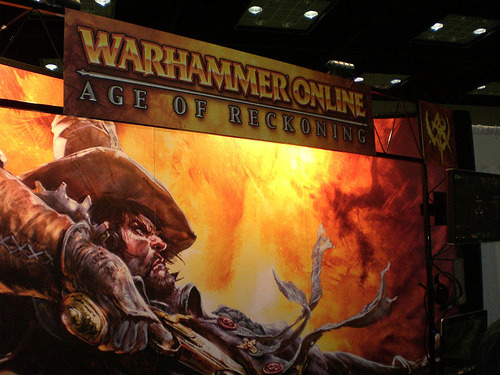
Last year, I wrote this about WAR: "I wasn't very impressed, either with Mythic's showing or with the game itself. The buzz around the convention seemed to be that it is 'too much' of a World of Warcraft (WoW) ripoff." What a difference a year makes. Since then Mythic was purchased by EA, development has gone into high gear, and the company has done a tremendous job of getting out the word on what exactly Warhammer is all about. The result? A booth that was swarming with people from the moment the doors open until the exhibit hall closed. Their enthusiasm reflects my own; it's far and away the game I'm most looking forward to next year. I had the chance to take a Goblin Shaman for a spin in the Greenskins starting area, and the development team's cry of "War is everywhere" seems to have made for some inspired gaming.
Yes, it's primarily the same old level 1 experience you have in every other game. Kill grunts, gain xp, learn2play. But right away you start to see the difference. The Tome of Knowledge, for example, not only tracks what quests you're on, but tells you how many stunties you've killed (damn dwarves). Nearby a public quest is ongoing, as players struggle to kill the swarming squigs harrying a friendly giant. UI-wise, it looks like World of Warcraft redux, until you start to see all the extra doo-dads. My Goblin Shaman built up Waugh as he fought, which would have allowed me to heal more effectively had I been in a group. Morale rose as I fought too, allowing me to fire off special abilities just because I'd been fighting for a while. It's violent, it's fast, it's easy to pick up and play. And it's freaking hilarious. That dark British sense of humor seen in the tabletop game comes through loud and clear in-world, with everything from ability names (Brain Bursta, Geddup!) to quest themes. One of your very first encounters has you being tossed across a valley to the top of a dam, where you stuff unconscious dwarves into barrels and toss them over the side. I didn't even get a chance to check out Realm vs. Realm combat, the game's most exciting offering, and already I'm convinced of the title's potential. It's still in development, still getting the kinks worked out, but even in its half-finished state I think Warhammer is in a great position to turn heads next year.
Gods and Heroes
Perpetual's in-development Roman title, on the other hand, appears to be a bit adrift. At first blush it looks ready to succeed, with an inspiring and somewhat unconventional concept. The game focuses on combat in a mythical Roman setting where gods walk the land and monsters fill the wilderness. Combat with minion NPCs is the main mechanical draw. The minion system is a great addition to the genre, taking concepts seen in standard pet classes and the more advanced heroes of Guild Wars: Nightfall, and punching them up to the next level. On top of an interesting game setting and some new tweaks to gameplay, an ambitious animation system makes the game look as cinematic as it's described. Instead of blindly hacking at each other, fights involve stabbings, tosses, stamps, and throws. It's incredibly impressive when the animation system synchs up and pulls things off.
Unfortunately, there's a problem with that. Combat previously was 'locked', meaning that when two characters were fighting they were held fast so that animations could go off at set times. This looked really good, but playtesters found it too constraining. Perpetual listened, and has removed the locks. They're not working to tweak animation timing so that things will still look as cinematic as ever even without the lock system in place. It's still Beta, and there's time to get this stuff squared away ... but I have to be honest; the game felt like it was more than the two or three months away from launch than the company is claiming. When animations hit they look great, but right now combat is a mess to look at, moving through the world feels slow and cumbersome, and even the much-vaunted minion AI still needs to be tweaked. This game is doing a lot of things right, make no mistake, and I trust that when it launches it's going to garner some interest from players looking for something new. I just hope that the company gives Gods and Heroes the time it needs to succeed; right now it seems like it still needs a lot of work.
Fallen Earth
Big-name Massive games get a lot of press, but with the technologies behind MMOGs becoming ever better-understood smaller companies are starting to aim for a piece of that online pie. Fallen Earth is just such a game, backed by Icarus Studios. There's no word on a release date yet, but the little slice of the world I saw was fairly compelling. Assuming it goes live in the next six months or so, fans of the Fallout series will be able to sate their hunger on this post-apocalyptic treat. Fallen Earth imagines a southwest US ravaged by nuclear war and disease. In this bleak landscape you take on the role of an adventurer, working for the factions that control the vital resources of the area. Combat is a unique blend of FPS and RPG, with player skill determining if a shot hits and mechanics determining how much damage is done. The game feels like a fitting tribute to the complex CRPGs of yore. While it doesn't seem like it will reach widespread appeal, the players in this niche are going to have a lot to enjoy in this bleak, violent, and surprisingly funny Massive game.
Legends of Norrath
A collectible card game wrapped inside a Massively Multiplayer game sounds like crazy talk, but the folks at SOE are betting this will be a big hit. Certainly the concept is simple enough: give players of EverQuest and EverQuest 2 something to do while they're waiting for a group, or just as a way to mix things up a bit from the standard grind/kill/grind gameplay of a fantasy MMOG. While it's a simple idea, the execution is surprisingly robust. Players will be able to purchase virtual cards for a fairly low fee, or find them in booster packs dropped by in-world monsters. Decks can be constructed with the aid of a deck-building wizard (the software, not magical kind), and put to use combating players of both titles or NPC opponents. Gameplay seems to be of the 'easy to learn, hard to master' type that is quite prevalent in CCGs, with a few EverQuest-specific twists. The game will also offer up in-game loot from certain cards, just like a certain other CCG based on a MMOG ...
Pirates of the Burning Sea
I'll come clean: if the epic battle ever comes, I'll be siding with the buccaneers vs. the ninjas. It was a great pleasure, then, to get to have some more hands-on time with this most atypical online game. Although, again, I fear that broad market appeal may not be within reach, Pirates is shaping up to be darn fine game. The ship-to-ship combat is rock solid, immensely fun to play, and feels completely different from any other MMO experience you've ever had. There's a stateliness to the combat that makes the smoothly gliding schooners and soaring cannonballs somehow epic in scope. Swordplay is still a little rough, with the team still polishing in anticipation of a launch later this year. Even with the rough edges, this isn't your standard fantasy hack and slash. Players kick sand into the faces of their foes before a well-placed boot to the stomach takes them down. It's not fantasy, it's not sci-fi, it's piratical, and if you like Massively Multiplayer games you owe it to yourself to give Pirates of the Burning Sea a try.
Eye of Judgement
One of the few non-MMOGs at the event, this strange videogame/collectible card game/strategy game hybrid was drawing crowds simply because of its awesome visuals. The in-game art is definitely the first thing you notice, and is stunningly well-done. I was surprised by how much I enjoyed this game, which has players angling for control of a three-by-three grid. Cards are played onto each square of the grid, where they're analyzed by the new PlayStation Eye camera and animated on the television screen. While it initially comes off as just eye candy, a few minute's play reveals the numerous layers of depth to the game. Cards have facings, for example, and must be angled to ensure their blind spots are protected. Grid squares are aligned with different elements, as are creatures, requiring players to not only control the board but consider where their thralls are placed. It deserves commentary at length, but suffice it to say that it's not going to get the kind of success it deserves. Given the strange hoops required to jump through to play, this inspired title is just not going to find the audience it should. If you have a PS3, though, I highly recommend at least giving this a unique experience a try when it comes out later this year; they're even including the eye for no extra cost.
Conclusions
Last year I was lamenting the decision to include videogames in Gen Con's mission statement, worrying that this would be the end of the convention I've grown to love over the years. That was, of course, before seeing the lackluster showing of the E3 Media event and the closure of Gen Con So Cal. "Gen Con Indy" is now the only Gen Con, and is one of the furthest east offerings for gamers when it comes to videogames. In short: videogames coming to Gen Con may be the best thing to happen to it since the move to Indianapolis. Between the MMOGs, the D&D announcement, and a huge number of attendees, the convention felt revitalized. There was a hum and a murmer to the hallways that's been lower key in previous years. It was, as always, a chance to see game designers in their natural element, and all of the folks at WotC seemed to have an extra spring in their step this year.
The tabletop gamer is a dying breed; it's well acknowledge that Massively Multiplayer games are killing them off. Playing with your friends is so much easier in your home from a PC, and is something that can be done regardless of what time zone everyone is in. This year, though, I had hope that maybe we might not be dying off so quickly as I thought. Fourth edition is an obvious strike back, an attempt by Wizards of the Coast to fight 'the enemy' on its own terms while applying eight years of careful observation back into the game mechanics.
It's incredibly risky, and the future of the most popular and well-known tabletop game hangs in the balance as a result. On the one hand, this could blow the tabletop hobby firmly into the mainstream. Dice rollers could take their place at the side of the World of Warcraft players, proudly explaining their misunderstood hobby to their relatives in terms they can understand. Or, this could completely alienate the D&D playerbase and collapse the house that the d20 built. I personally am excited. I'm excited about the possibility of a Dungeons and Dragons game without the kruft. I'm excited about the chance to play online with friends across the country. I'm excited about organized play tied directly into the core game. And I'm excited about the future of a Gen Con with no imitators on the west coast, new attendees drawn by electronic gaming, and ever-more-professional game design companies working on the hobby I love.
I'm also, sadly, excited about the future of the World of Warcraft CCG. Perhaps because of my exposure to Legends of Norrath and Eye of Judgement, my demo of the now-year-old game left me vulnerable to the dealers in the exhibit hall. I've spent the last few days happily tweaking my Blue Shaman deck, and look foward to running it against all comers at PAX. Anyone have a Parvink or two they'd be willing to trade? -
MMORPG Used to Model Real World Disease
Oxygen99 writes "The Times is reporting on a paper by researchers in the US who argue that the spread of 'corrupted blood' in World of Warcraft might provide clues to the way a real world population would cope with the prospect of a global pandemic. In the study, to be published in The Lancet next month, Professor Lofgren of Rutgers University and Professor Fefferman of Tufts University, suggest that: 'If, God forbid, a disease broke out in London, you could see what would happen if people were told immediately of the risk. Would there be panic and chaos, or would it allow them to psychologically accept the danger and act accordingly? What would happen if we made people feel too reassured? These are all things that have a great impact on the number of people who would be affected. They are also things we just don't know, so [virtual games] could be of great value in helping us understand what their true emotional responses would be.'" -
German Physicists Claim Speed of Light Broken
Byzanthy writes "Two German physicists claim to have broken the speed of light by using 'microwave photons.' According to Einstein's special theory of relativity, it would require an infinite amount of energy to accelerate any object beyond the speed of light. However, Dr Gunter Nimtz and Dr Alfons Stahlhofen, of the University of Koblenz, say they did it by using a phenomenon known as quantum tunneling. The pair say they have conducted an experiment in which microwave photons — energetic packets of light — traveled 'instantaneously' between a pair of prisms that had been moved up to 3ft apart." New Scientist, however, is running an article that suggests Einstein can rest easy. Aephraim Steinberg, a quantum optics expert at the University of Toronto, explains that the German physicist's results aren't necessarily wrong, they are just being interpreted incorrectly. -
Spirit Outlasts Viking 2 Lander
ScottMaxwell writes "Spirit, the Mars rover designed for a 90-day mission, has now outlasted the Viking 2 lander. Viking 2 survived until its 1281st sol (Martian day); Spirit is now on sol 1282 and counting. Assuming both rovers continue to weather the ongoing dust storms, Spirit's sister, Opportunity, will reach the same age in a few weeks. They aren't breathing down the neck of the all-time record just yet, though — the Viking 1 lander lasted 2245 sols on the surface of Mars; Spirit and Opportunity won't break that record for another 2.7 Earth years." -
Spirit Outlasts Viking 2 Lander
ScottMaxwell writes "Spirit, the Mars rover designed for a 90-day mission, has now outlasted the Viking 2 lander. Viking 2 survived until its 1281st sol (Martian day); Spirit is now on sol 1282 and counting. Assuming both rovers continue to weather the ongoing dust storms, Spirit's sister, Opportunity, will reach the same age in a few weeks. They aren't breathing down the neck of the all-time record just yet, though — the Viking 1 lander lasted 2245 sols on the surface of Mars; Spirit and Opportunity won't break that record for another 2.7 Earth years." -
New Explanation For the Industrial Revolution
Pcol writes "The New York Times is running a story on Dr. Gregory Clark's book 'A Farewell to Alms,' which offers a new explanation for the Industrial Revolution and the affluence it created. Dr. Clark, an economic historian at the University of California Davis, postulates that the surge in economic growth that occurred first in England around 1800 came about because of the strange new behaviors of nonviolence, literacy, long working hours, and a willingness to save. Clark's research shows that between 1200 and 1800, the rich had more surviving children than the poor and that he postulates that this caused constant downward social mobility as the poor failed to reproduce themselves and the progeny of the rich took over their occupations. 'The modern population of the English is largely descended from the economic upper classes of the Middle Ages,' Clark concludes. Work hours increased, literacy and numeracy rose, and the level of interpersonal violence dropped. Around 1790, a steady upward trend in production efficiency caused a significant acceleration in the rate of productivity growth that at last made possible England's escape from the Malthusian trap." -
Google Partners With OIN For Linux
lymeca writes "Groklaw reports that Google has become the Open Invention Network's first end-user licensee. The OIN was established by companies such as IBM, Red Hat, and somewhat ironically Novell to accumulate patents and license them royalty-free to any company promising not to leverage their own patent portfolio against key applications available on GNU/Linux, including many GNU projects as well as Linux itself. Google's support bolsters the OIN's effectiveness as a shield against patent attacks against GNU/Linux and many popular applications that run on it." -
Mars Phoenix Probe Successfully Launched
necro81 writes "The Mars Phoenix lander, built from the ashes of two earlier Mars missions, successfully launched atop a Delta II rocket from Canaveral this morning. The mission takes the 350-kg lander to northern latitudes (comparable to Greenland or Siberia) to investigate subsurface ice for the chemical precursors of life. The lander should arrive on Mars on May 25, 2008. 'NASA has never attempted to land a spacecraft on Mars at such a high northern latitude. A lander intended for the red planet's South Pole went silent immediately upon arrival in 1999. That failure, combined with the loss of the companion Mars orbiter, prompted NASA to cancel a 2001 lander mission. The parts from that scrapped mission were used for Phoenix, thus its name, which alludes to the mythological bird that rises from its own ashes.'" -
Mars Phoenix Probe Successfully Launched
necro81 writes "The Mars Phoenix lander, built from the ashes of two earlier Mars missions, successfully launched atop a Delta II rocket from Canaveral this morning. The mission takes the 350-kg lander to northern latitudes (comparable to Greenland or Siberia) to investigate subsurface ice for the chemical precursors of life. The lander should arrive on Mars on May 25, 2008. 'NASA has never attempted to land a spacecraft on Mars at such a high northern latitude. A lander intended for the red planet's South Pole went silent immediately upon arrival in 1999. That failure, combined with the loss of the companion Mars orbiter, prompted NASA to cancel a 2001 lander mission. The parts from that scrapped mission were used for Phoenix, thus its name, which alludes to the mythological bird that rises from its own ashes.'" -
New Theory Explains Periodic Mass Extinctions
i_like_spam writes "The theory that the dinosaurs were wiped out by an asteroid impact, the K-T extinction, is well known and supported by fossil and geological evidence. Asteroid impact theory does not apply to the other fluctuations in biodiversity, however, which follow an approximate 62 million-year cycle. As reported in Science, a new theory seems to explain periodic mass extinctions. The new theory found that oscillations in the Sun relative to the plane of the Milky Way correlate with changes in biodiversity on Earth. The researchers suggest that an increase in the exposure of Earth to extragalactic cosmic rays causes mass extinctions. The original paper describing the findings is available online." -
Music Piracy Documentary Released As Torrent
goodbye_kitty writes "The producers of a new documentary film analyzing global music piracy have decided to 'put their money where their mouth is' by releasing the film as a free Xvid download (hosted by the Pirate Bay, as one would expect). The film explores the blurred line between 'fair use' and piracy, and includes interviews with DJ Danger Mouse (creator of the now infamous 'grey album'), Lawrence Lessig (founder of Creative Commons), the lads from the Pirate Bay, and even some guy from the MPAA. Here is a link to the torrent." -
China's Open Document Format Fight
eldavojohn writes "While there's been a lot of talk of the open document formats in the states, China is facing the same dilemma. A ZDNet blog examines the issue by pointing out they will most likely merge their current standard with either OOXML or ODF. The bulk of their post points out why OOXML shouldn't be ISO certified and is the biggest problem for Microsoft's standard: 'Another Standard, Microsoft does not support, is the specification RFC 3987, which defines UTF-8 capable Internet addresses. Consequently, OOXML does not support, to use Chinese characters within a Web address.' This would be problematic for many languages, not just Chinese." -
NASA Contractors Censoring Saturn V Info
cybrpnk2 writes "Get ready to surrender your data sheets, study reports and blueprints of the Saturn V to stay in compliance with ITAR. Armed guards are reportedly taking down and shredding old Saturn V posters from KSC office walls that show rough internal layouts of the vehicle, and a Web site that is a source for various digitized blueprints has been put on notice it may well be next. No word yet if the assignment of a Karl Rove protege high up in NASA has any connection." -
NASA Contractors Censoring Saturn V Info
cybrpnk2 writes "Get ready to surrender your data sheets, study reports and blueprints of the Saturn V to stay in compliance with ITAR. Armed guards are reportedly taking down and shredding old Saturn V posters from KSC office walls that show rough internal layouts of the vehicle, and a Web site that is a source for various digitized blueprints has been put on notice it may well be next. No word yet if the assignment of a Karl Rove protege high up in NASA has any connection." -
Judge Permits eBay's "Buy It Now" Feature
stalebread points to a Reuters story reporting that a federal judge refused to issue an injunction against eBay's "Buy It Now" feature. Quoting: "Judge Jerome B. Friedman of Federal District Court denied a motion by the Virginia company, MercExchange, for a permanent injunction to stop eBay from using the feature. The Supreme Court ruled last year that, although eBay infringed upon MercExchange's patent for the service, it was up to the lower court to decide whether eBay had to stop using it. 'MercExchange has utilized its patents as a sword to extract money rather than as a shield to protect its right to exclude or its market share, reputation, good will, or name recognition, as MercExchange appears to possess none of these,' he wrote." -
Reboot To Get A Reboot
superstick58 writes "Reboot, one of the first CG animated TV shows is returning as a trilogy of feature-length films. This was a great cartoon for me, perhaps it also helped stimulate other developing nerds to embrace the computers that are supposedly run by these enjoyable CG characters." -
The Nanomechanical Computer
eldavojohn writes "The BBC is reporting on a newly proposed type of nanomechanical computer that mimics J. H. Müller & Charles Babbage's work on mechanical computational devices — just on a much smaller scale. The paper is published today in the New Journal of Physics and cites three reasons to build a computer with nanomechanical transistors over bipolar-junction or field-effect transistors: '(i) mechanical elements are more robust to electromagnetic shocks than current dynamic random access memory based purely on complimentary metal oxide semiconductor technology, (ii) the power dissipated can be orders of magnitude below CMOS, and (iii) the operating temperature of such an NMC can be an order of magnitude above that of conventional CMOS.'" -
Wikipedia Corrects Encyclopedia Britannica
javipas writes "Despite all the controversy about Wikipedia's work model, no one can argue the potential of a project that has so effectively demonstrated the usefulness of the 'wisdom of crowds' concept. And that wisdom has detected a large number of mistakes in one of the most revered founts of human knowledge, the Encyclopedias Britannica. Among the wrong information collected on this page are the name at birth of Bill Clinton and the definition of the NP problems in mathematics." -
Wikipedia Corrects Encyclopedia Britannica
javipas writes "Despite all the controversy about Wikipedia's work model, no one can argue the potential of a project that has so effectively demonstrated the usefulness of the 'wisdom of crowds' concept. And that wisdom has detected a large number of mistakes in one of the most revered founts of human knowledge, the Encyclopedias Britannica. Among the wrong information collected on this page are the name at birth of Bill Clinton and the definition of the NP problems in mathematics." -
Deathly Hallows / OOTP Movie Discussion
At midnight on Friday Harry Potter and the Deathly Hallows was released, ending the ten year run of J.K. Rowling's extremely popular book series. I imagine that there are a few folks here who have already read the book and want to talk about it. Likewise, the movie version of Order of the Phoenix was recently released (a film I was kind of underwhelmed by). So ... what did you think of them? Be forewarned: I imagine the comments will be filled with spoilers. -
Humans Evolved From a Single Origin In Africa
Invisible Pink Unicorn writes "Researchers at the University of Cambridge have combined studies of global human genetic variations with skull measurements worldwide to show conclusively the validity of the single origin hypothesis. The alternative hypothesis contended that different populations independently evolved from Homo erectus to Home sapiens in different areas. The lead researcher explains, 'The origin of anatomically modern humans has been the focus of much heated debate. Our genetic research shows the further modern humans have migrated from Africa, the more genetic diversity has been lost within a population. However, some have used skull data to argue that modern humans originated in multiple spots around the world. We have combined our genetic data with new measurements of a large sample of skulls to show definitively that modern humans originated from a single area in Sub-saharan Africa.' The article abstract is available from Nature." -
Möbius Strip Riddle Solved
BigLug writes with news that two experts in non-linear dynamics, Gert van der Heijden and Eugene Starostin of University College London, have developed an algebraic equation that describes the Möbius strip — something that, you may be surprised to learn, had never been done since the form's discovery in 1858. ABC.net.au has an accessible short summary: "What determines the strip's shape is its differing areas of 'energy density,' they say. 'Energy density' means the stored, elastic energy that is contained in the strip as a result of the folding. Places where the strip is most bent have the highest energy density; conversely, places that are flat and unstressed by a fold have the least energy density." -
The Computer Virus Turns 25 in July
bl8n8r writes "In July of 1982, an infected Apple II propogated the first computer virus onto a 5-1/4" floppy. The virus, which did little more than annoy the user, Elk Cloner, was authored in Pittsburgh by a 15-year-old high school student, Rich Skrenta. The virus replicated by monitoring floppy disk activity and writing itself to the floppy when it was accessed. Skrenta describes the virus as "It was a practical joke combined with a hack. A wonderful hack." Remember, he was a 9th grader when he did this." -
The Computer Virus Turns 25 in July
bl8n8r writes "In July of 1982, an infected Apple II propogated the first computer virus onto a 5-1/4" floppy. The virus, which did little more than annoy the user, Elk Cloner, was authored in Pittsburgh by a 15-year-old high school student, Rich Skrenta. The virus replicated by monitoring floppy disk activity and writing itself to the floppy when it was accessed. Skrenta describes the virus as "It was a practical joke combined with a hack. A wonderful hack." Remember, he was a 9th grader when he did this." -
Fructose As Culprit In the Obesity Epidemic
drewtheman writes "According to an interview with Dr. Robert Lustig, Professor of Pediatric Endocrinology from the University of California, San Francisco, fructose, once touted as diabetic-friendly because it doesn't raise insulin levels directly, could be a major culprit for the obesity epidemic, high blood pressure, and elevated blood levels of LDL in Americans and others worldwide as they adopt American-style diets. Fructose comprises 50% of table sugar and up to 90% of high-fructose corn syrup, both ingredients found in copious quantity in most American prepared foods." -
Fructose As Culprit In the Obesity Epidemic
drewtheman writes "According to an interview with Dr. Robert Lustig, Professor of Pediatric Endocrinology from the University of California, San Francisco, fructose, once touted as diabetic-friendly because it doesn't raise insulin levels directly, could be a major culprit for the obesity epidemic, high blood pressure, and elevated blood levels of LDL in Americans and others worldwide as they adopt American-style diets. Fructose comprises 50% of table sugar and up to 90% of high-fructose corn syrup, both ingredients found in copious quantity in most American prepared foods."