 Slashdot Mirror
Gen Con 2007 In A Nutshell
Another year, another Gen Con? Hardly. This year was the 40th anniversary of Gen Con, marked the announcement of the newest edition of Dungeons and Dragons, and was the first year videogame companies were actively sought out as exhibitors. Put together this resulted in what felt like record crowds, a healthy dealer's hall, and an instant conversation-starter with every other person at the event. Read on for notes on the new tabletop releases, thoughts on the new edition of D&D, impressions of the videogames that were in attendance, and a shameful admission of weakness.
Gen Con remains a bastion of tabletop gaming, but I'll admit it: I didn't get as strong a sense of the new tabletop game releases as I have in previous years. Instead, I spent time I would have normally put towards demoing games with dice and pieces towards getting a handle on the handful of videogames at the event. It seemed like almost every one was a Massively Multiplayer Online Game, but there were several representatives of other genres as well.
What I did glean from this year's event is summed up very well by well-known designer Robin Laws: "This year was a holding pattern." Many of the companies making products for the Open Gaming License/d20 system seem to have died back. With the announcement of Fourth Edition, there will be a resurgence the year after next, but for this year things seemed to be fairly quiet.
This Year's Releases
So what was released this year? Biggest hits at the con, by far, were the Battlestar Galactica RPG, Changeling: The Lost, and the new version of Talisman. The Battlestar tabletop game is a sister product to the Serenity (as in Firefly) RPG, both of which use the same rules-set ("Cortex"), and are published by Margaret Weis Productions. The Serenity game has a fairly impressive following, with the core book already being on its fourth printing just a year after it was released. Battlestar seemed to be offering up a similar buzz. The Weis booth was also playing host to voice actor Jason Marsden, who plays the part of Tasslehoff Burrfoot in the upcoming animated Dragonlance movie. They showed off a trailer for the film, currently slated for release later this year.
White Wolf gamers may not have been waiting with baited breath for a new version of Changeling; it was never as popular as their 'big three' of Vampire, Werewolf, and Mage. Just the same, I saw a number of copies of the updated title walking away from the White Wolf/CCP booth this year. The attraction of EVE Online in the same booth didn't stop White Wolf players from picking up the latest in the 're-imagined' World of Darkness.
Talisman is probably a name familiar to long-time boardgame players. Under the Black Industries imprint, Games Workshop is re-releasing their classic adventure game with a slightly updated look and a few tweaks to the rules. From what I heard, though, it's almost entirely the same game that you knew back in the day. It just won't cost hundreds of dollars on eBay anymore. Lines for the title were going down the rows and out the door of the exhibit hall, and my impression is that they sold out pretty much every day they had new product to sell.
It didn't have as much buzz as other announcements at the con, but well worth noting was the formation of a company called Catalyst Game Labs. Catalyst is a new outfit formed from the ashes of "Fantasy Productions", or FanPro as it was more commonly called. FanPro has been publishing the Shadowrun RPG since FASA gave up the ghost a few years back, and while the quality of the books has been fairly high it would be kind to say that they've been released on any kind of regular schedule. The new company marks a turn for one of the most well-known intellectual properties in pen and paper gaming, with two new books (Emergence and Augmentation) available just at this convention. Working together with the folks behind the Classic Battletech line, they now having backing and a business plan. If you're a Shadowrun fan, there's going to be a lot to look forward to in the coming years.
Dungeons and Dragons Fourth Edition
The biggest news was, of course, the announcement that Wizards of the Coast is going to be releasing the fourth edition of Dungeons and Dragons next year. At a press event the day before their public announcement to Gen Con attendees, they tried to lay out the groundwork for their ambitious new plan. Essentially, these new books have been eight years in the making. The R&D team at WotC is looking to adapt Dungeons and Dragons to the way that it's played, and stop forcing gamers to play the game the way the game is set up. While the switchover from 2nd edition rules to 3.0 was an amazing step, it was in some ways still black magic. They now have a large base of knowledge to work from, that's going to let them change the game in fundamental ways. They hope it will be for the better.
The biggest changes will be mechanical. My review of the Saga Edition of the Star Wars RPG discussed the significant rules changes that title underwent; the R&D folks as much as admitted that book was sort of a 'test run' for concepts they'll be incorporating into fourth edition. The focus is going to be on ease of play for everyone, both in front of and behind the DM screen. Party roles will be more clearly defined. Encounters will be reformatted, and monsters retuned to more understandable roles and difficulty levels. It may just be hyperbole, but the designers are aiming to 'make D&D feel heroic again.' On the far end of the scale, this means that epic-level play will now be a core part of the game. That is, the Player Handbook will support level progression from 1-30. Levels 1-10 will be known as 'heroic' levels, where characters are better than the average human but still 'normal'. Levels 10-20 are 'paragon' levels, where characters accomplish feats only possible in a fictional environment. Levels 20-30 are 'epic' levels, where heroes will be able to step out into the world and change the course of history. Desiigner Chris Perkins put it this way: "We want first level to be more than 'run away, it's a kobold.' Gone are the days of the four hit point Wizard."
On top of that, WotC feels as though a new edition is necessary to support the other three columns of their ambitious new plan. Physical books are the most important part, but there are three other pieces that feed into the game. The first is community, exemplified by the terribly-named Gleemax.com website. Gleemax is going to offer up a single place where D&D gamers can come together to discuss the game, as well as CCGs, boardgames, and the lot; a MySpace for tabletop nerds, essentially.
Unfortunately, it's not clear how separate that piece will be from the ambitious D&DInsider.com. That site, essentially an outgrowth of the official Wizards of the Coast website content, is going to be a central hub for Dungeons and Dragons players. The late, lamented Dungeon and Dragon magazines will be available online there, and the site will also play host to the most novel concept in the fourth edition bag of tricks: The D&D Game Table. The Game Table is an online playspace, where groups can get together around a virtual table to actually play Dungeons and Dragons online. DMs will be able to lay out dungeon maps, place monsters, and run games. Players will have access to online versions of their purchased physical rulebooks, can make characters using a character creation tool, and can even create their own virtual miniatures for their characters. Voice chat will bring the whole group together. The WotC folks were very clear: this is not meant to take the place of your regular game. It's a place to go if your gaming group is spread across the country (or world) as so often happens in our busy modern world. They also envision a future where players who don't have regular games can hop online and connect with other folks to play in a regular campaign.
This last will likely be aided by the fourth leg of this concept: organized play. The RPGA has always been associated with but not a part of Dungeons and Dragons, if that makes any sense. With fourth edition the organized play campaigns will become a central component to the game experience. From your home, to the gaming store, online with the D&D Game Table, and all the way to conventions, the goal is for gamers to have a fun and slightly more formal handrail for gaming together. With a renewed interest in adventure publishing, designer goals seem to be to bring back the days when every D&D gamer could talk of playing through modules like Keep on the Borderlands or Tomb of Horrors.
All of this combines to an extremely ambitious goal: a brand new D&D. Just from anecdotal experience, from talking with players and retailers at the convention, my own gaming store, and from reading comments here on the site, the general reaction seems to be anger. The reason is understandable; 3.5 books aren't cheap, and many gamers have invested heavily in the current edition. In the latest D&D Podcast even the designers themselves admitted that 3.5 isn't 'that broken.' Thankfully, there's still quite some time before even the Player's Handbook comes out. The folks at Wizards have a good long while to explain to us what exactly they're planning to do. A long time to convince us, to reassure people that they really aren't ditching the OGL (full support), that their favorite campaigns will be supported (new Realms book next year, Eberron in 09), that it's worth shelling out another $90 for the upgrade. They've already begun, in fact; their ongoing design and development series has already put up posts on party roles, the new vision for Fighters, and what it's like to face a dragon in the new edition. If they even come close to delivering on what these articles imply, next year is going to be an interesting time to be a gamer.
Warhammer Online
Last year, I wrote this about WAR: "I wasn't very impressed, either with Mythic's showing or with the game itself. The buzz around the convention seemed to be that it is 'too much' of a World of Warcraft (WoW) ripoff." What a difference a year makes. Since then Mythic was purchased by EA, development has gone into high gear, and the company has done a tremendous job of getting out the word on what exactly Warhammer is all about. The result? A booth that was swarming with people from the moment the doors open until the exhibit hall closed. Their enthusiasm reflects my own; it's far and away the game I'm most looking forward to next year. I had the chance to take a Goblin Shaman for a spin in the Greenskins starting area, and the development team's cry of "War is everywhere" seems to have made for some inspired gaming.
Yes, it's primarily the same old level 1 experience you have in every other game. Kill grunts, gain xp, learn2play. But right away you start to see the difference. The Tome of Knowledge, for example, not only tracks what quests you're on, but tells you how many stunties you've killed (damn dwarves). Nearby a public quest is ongoing, as players struggle to kill the swarming squigs harrying a friendly giant. UI-wise, it looks like World of Warcraft redux, until you start to see all the extra doo-dads. My Goblin Shaman built up Waugh as he fought, which would have allowed me to heal more effectively had I been in a group. Morale rose as I fought too, allowing me to fire off special abilities just because I'd been fighting for a while. It's violent, it's fast, it's easy to pick up and play. And it's freaking hilarious. That dark British sense of humor seen in the tabletop game comes through loud and clear in-world, with everything from ability names (Brain Bursta, Geddup!) to quest themes. One of your very first encounters has you being tossed across a valley to the top of a dam, where you stuff unconscious dwarves into barrels and toss them over the side. I didn't even get a chance to check out Realm vs. Realm combat, the game's most exciting offering, and already I'm convinced of the title's potential. It's still in development, still getting the kinks worked out, but even in its half-finished state I think Warhammer is in a great position to turn heads next year.
Gods and Heroes
Perpetual's in-development Roman title, on the other hand, appears to be a bit adrift. At first blush it looks ready to succeed, with an inspiring and somewhat unconventional concept. The game focuses on combat in a mythical Roman setting where gods walk the land and monsters fill the wilderness. Combat with minion NPCs is the main mechanical draw. The minion system is a great addition to the genre, taking concepts seen in standard pet classes and the more advanced heroes of Guild Wars: Nightfall, and punching them up to the next level. On top of an interesting game setting and some new tweaks to gameplay, an ambitious animation system makes the game look as cinematic as it's described. Instead of blindly hacking at each other, fights involve stabbings, tosses, stamps, and throws. It's incredibly impressive when the animation system synchs up and pulls things off.
Unfortunately, there's a problem with that. Combat previously was 'locked', meaning that when two characters were fighting they were held fast so that animations could go off at set times. This looked really good, but playtesters found it too constraining. Perpetual listened, and has removed the locks. They're not working to tweak animation timing so that things will still look as cinematic as ever even without the lock system in place. It's still Beta, and there's time to get this stuff squared away ... but I have to be honest; the game felt like it was more than the two or three months away from launch than the company is claiming. When animations hit they look great, but right now combat is a mess to look at, moving through the world feels slow and cumbersome, and even the much-vaunted minion AI still needs to be tweaked. This game is doing a lot of things right, make no mistake, and I trust that when it launches it's going to garner some interest from players looking for something new. I just hope that the company gives Gods and Heroes the time it needs to succeed; right now it seems like it still needs a lot of work.
Fallen Earth
Big-name Massive games get a lot of press, but with the technologies behind MMOGs becoming ever better-understood smaller companies are starting to aim for a piece of that online pie. Fallen Earth is just such a game, backed by Icarus Studios. There's no word on a release date yet, but the little slice of the world I saw was fairly compelling. Assuming it goes live in the next six months or so, fans of the Fallout series will be able to sate their hunger on this post-apocalyptic treat. Fallen Earth imagines a southwest US ravaged by nuclear war and disease. In this bleak landscape you take on the role of an adventurer, working for the factions that control the vital resources of the area. Combat is a unique blend of FPS and RPG, with player skill determining if a shot hits and mechanics determining how much damage is done. The game feels like a fitting tribute to the complex CRPGs of yore. While it doesn't seem like it will reach widespread appeal, the players in this niche are going to have a lot to enjoy in this bleak, violent, and surprisingly funny Massive game.
Legends of Norrath
A collectible card game wrapped inside a Massively Multiplayer game sounds like crazy talk, but the folks at SOE are betting this will be a big hit. Certainly the concept is simple enough: give players of EverQuest and EverQuest 2 something to do while they're waiting for a group, or just as a way to mix things up a bit from the standard grind/kill/grind gameplay of a fantasy MMOG. While it's a simple idea, the execution is surprisingly robust. Players will be able to purchase virtual cards for a fairly low fee, or find them in booster packs dropped by in-world monsters. Decks can be constructed with the aid of a deck-building wizard (the software, not magical kind), and put to use combating players of both titles or NPC opponents. Gameplay seems to be of the 'easy to learn, hard to master' type that is quite prevalent in CCGs, with a few EverQuest-specific twists. The game will also offer up in-game loot from certain cards, just like a certain other CCG based on a MMOG ...
Pirates of the Burning Sea
I'll come clean: if the epic battle ever comes, I'll be siding with the buccaneers vs. the ninjas. It was a great pleasure, then, to get to have some more hands-on time with this most atypical online game. Although, again, I fear that broad market appeal may not be within reach, Pirates is shaping up to be darn fine game. The ship-to-ship combat is rock solid, immensely fun to play, and feels completely different from any other MMO experience you've ever had. There's a stateliness to the combat that makes the smoothly gliding schooners and soaring cannonballs somehow epic in scope. Swordplay is still a little rough, with the team still polishing in anticipation of a launch later this year. Even with the rough edges, this isn't your standard fantasy hack and slash. Players kick sand into the faces of their foes before a well-placed boot to the stomach takes them down. It's not fantasy, it's not sci-fi, it's piratical, and if you like Massively Multiplayer games you owe it to yourself to give Pirates of the Burning Sea a try.
Eye of Judgement
One of the few non-MMOGs at the event, this strange videogame/collectible card game/strategy game hybrid was drawing crowds simply because of its awesome visuals. The in-game art is definitely the first thing you notice, and is stunningly well-done. I was surprised by how much I enjoyed this game, which has players angling for control of a three-by-three grid. Cards are played onto each square of the grid, where they're analyzed by the new PlayStation Eye camera and animated on the television screen. While it initially comes off as just eye candy, a few minute's play reveals the numerous layers of depth to the game. Cards have facings, for example, and must be angled to ensure their blind spots are protected. Grid squares are aligned with different elements, as are creatures, requiring players to not only control the board but consider where their thralls are placed. It deserves commentary at length, but suffice it to say that it's not going to get the kind of success it deserves. Given the strange hoops required to jump through to play, this inspired title is just not going to find the audience it should. If you have a PS3, though, I highly recommend at least giving this a unique experience a try when it comes out later this year; they're even including the eye for no extra cost.
Conclusions
Last year I was lamenting the decision to include videogames in Gen Con's mission statement, worrying that this would be the end of the convention I've grown to love over the years. That was, of course, before seeing the lackluster showing of the E3 Media event and the closure of Gen Con So Cal. "Gen Con Indy" is now the only Gen Con, and is one of the furthest east offerings for gamers when it comes to videogames. In short: videogames coming to Gen Con may be the best thing to happen to it since the move to Indianapolis. Between the MMOGs, the D&D announcement, and a huge number of attendees, the convention felt revitalized. There was a hum and a murmer to the hallways that's been lower key in previous years. It was, as always, a chance to see game designers in their natural element, and all of the folks at WotC seemed to have an extra spring in their step this year.
The tabletop gamer is a dying breed; it's well acknowledge that Massively Multiplayer games are killing them off. Playing with your friends is so much easier in your home from a PC, and is something that can be done regardless of what time zone everyone is in. This year, though, I had hope that maybe we might not be dying off so quickly as I thought. Fourth edition is an obvious strike back, an attempt by Wizards of the Coast to fight 'the enemy' on its own terms while applying eight years of careful observation back into the game mechanics.
It's incredibly risky, and the future of the most popular and well-known tabletop game hangs in the balance as a result. On the one hand, this could blow the tabletop hobby firmly into the mainstream. Dice rollers could take their place at the side of the World of Warcraft players, proudly explaining their misunderstood hobby to their relatives in terms they can understand. Or, this could completely alienate the D&D playerbase and collapse the house that the d20 built. I personally am excited. I'm excited about the possibility of a Dungeons and Dragons game without the kruft. I'm excited about the chance to play online with friends across the country. I'm excited about organized play tied directly into the core game. And I'm excited about the future of a Gen Con with no imitators on the west coast, new attendees drawn by electronic gaming, and ever-more-professional game design companies working on the hobby I love.
I'm also, sadly, excited about the future of the World of Warcraft CCG. Perhaps because of my exposure to Legends of Norrath and Eye of Judgement, my demo of the now-year-old game left me vulnerable to the dealers in the exhibit hall. I've spent the last few days happily tweaking my Blue Shaman deck, and look foward to running it against all comers at PAX. Anyone have a Parvink or two they'd be willing to trade?

What I did glean from this year's event is summed up very well by well-known designer Robin Laws: "This year was a holding pattern." Many of the companies making products for the Open Gaming License/d20 system seem to have died back. With the announcement of Fourth Edition, there will be a resurgence the year after next, but for this year things seemed to be fairly quiet.
This Year's Releases
So what was released this year? Biggest hits at the con, by far, were the Battlestar Galactica RPG, Changeling: The Lost, and the new version of Talisman. The Battlestar tabletop game is a sister product to the Serenity (as in Firefly) RPG, both of which use the same rules-set ("Cortex"), and are published by Margaret Weis Productions. The Serenity game has a fairly impressive following, with the core book already being on its fourth printing just a year after it was released. Battlestar seemed to be offering up a similar buzz. The Weis booth was also playing host to voice actor Jason Marsden, who plays the part of Tasslehoff Burrfoot in the upcoming animated Dragonlance movie. They showed off a trailer for the film, currently slated for release later this year.
White Wolf gamers may not have been waiting with baited breath for a new version of Changeling; it was never as popular as their 'big three' of Vampire, Werewolf, and Mage. Just the same, I saw a number of copies of the updated title walking away from the White Wolf/CCP booth this year. The attraction of EVE Online in the same booth didn't stop White Wolf players from picking up the latest in the 're-imagined' World of Darkness.
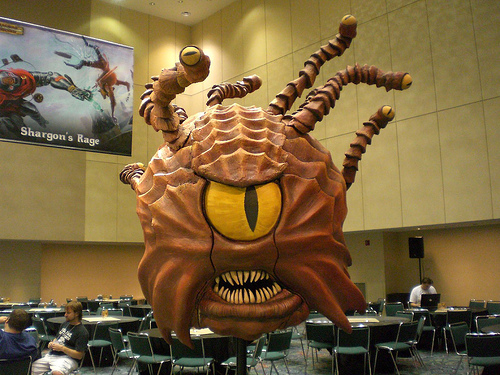
Talisman is probably a name familiar to long-time boardgame players. Under the Black Industries imprint, Games Workshop is re-releasing their classic adventure game with a slightly updated look and a few tweaks to the rules. From what I heard, though, it's almost entirely the same game that you knew back in the day. It just won't cost hundreds of dollars on eBay anymore. Lines for the title were going down the rows and out the door of the exhibit hall, and my impression is that they sold out pretty much every day they had new product to sell.
It didn't have as much buzz as other announcements at the con, but well worth noting was the formation of a company called Catalyst Game Labs. Catalyst is a new outfit formed from the ashes of "Fantasy Productions", or FanPro as it was more commonly called. FanPro has been publishing the Shadowrun RPG since FASA gave up the ghost a few years back, and while the quality of the books has been fairly high it would be kind to say that they've been released on any kind of regular schedule. The new company marks a turn for one of the most well-known intellectual properties in pen and paper gaming, with two new books (Emergence and Augmentation) available just at this convention. Working together with the folks behind the Classic Battletech line, they now having backing and a business plan. If you're a Shadowrun fan, there's going to be a lot to look forward to in the coming years.
Dungeons and Dragons Fourth Edition
The biggest news was, of course, the announcement that Wizards of the Coast is going to be releasing the fourth edition of Dungeons and Dragons next year. At a press event the day before their public announcement to Gen Con attendees, they tried to lay out the groundwork for their ambitious new plan. Essentially, these new books have been eight years in the making. The R&D team at WotC is looking to adapt Dungeons and Dragons to the way that it's played, and stop forcing gamers to play the game the way the game is set up. While the switchover from 2nd edition rules to 3.0 was an amazing step, it was in some ways still black magic. They now have a large base of knowledge to work from, that's going to let them change the game in fundamental ways. They hope it will be for the better.

The biggest changes will be mechanical. My review of the Saga Edition of the Star Wars RPG discussed the significant rules changes that title underwent; the R&D folks as much as admitted that book was sort of a 'test run' for concepts they'll be incorporating into fourth edition. The focus is going to be on ease of play for everyone, both in front of and behind the DM screen. Party roles will be more clearly defined. Encounters will be reformatted, and monsters retuned to more understandable roles and difficulty levels. It may just be hyperbole, but the designers are aiming to 'make D&D feel heroic again.' On the far end of the scale, this means that epic-level play will now be a core part of the game. That is, the Player Handbook will support level progression from 1-30. Levels 1-10 will be known as 'heroic' levels, where characters are better than the average human but still 'normal'. Levels 10-20 are 'paragon' levels, where characters accomplish feats only possible in a fictional environment. Levels 20-30 are 'epic' levels, where heroes will be able to step out into the world and change the course of history. Desiigner Chris Perkins put it this way: "We want first level to be more than 'run away, it's a kobold.' Gone are the days of the four hit point Wizard."
On top of that, WotC feels as though a new edition is necessary to support the other three columns of their ambitious new plan. Physical books are the most important part, but there are three other pieces that feed into the game. The first is community, exemplified by the terribly-named Gleemax.com website. Gleemax is going to offer up a single place where D&D gamers can come together to discuss the game, as well as CCGs, boardgames, and the lot; a MySpace for tabletop nerds, essentially.
Unfortunately, it's not clear how separate that piece will be from the ambitious D&DInsider.com. That site, essentially an outgrowth of the official Wizards of the Coast website content, is going to be a central hub for Dungeons and Dragons players. The late, lamented Dungeon and Dragon magazines will be available online there, and the site will also play host to the most novel concept in the fourth edition bag of tricks: The D&D Game Table. The Game Table is an online playspace, where groups can get together around a virtual table to actually play Dungeons and Dragons online. DMs will be able to lay out dungeon maps, place monsters, and run games. Players will have access to online versions of their purchased physical rulebooks, can make characters using a character creation tool, and can even create their own virtual miniatures for their characters. Voice chat will bring the whole group together. The WotC folks were very clear: this is not meant to take the place of your regular game. It's a place to go if your gaming group is spread across the country (or world) as so often happens in our busy modern world. They also envision a future where players who don't have regular games can hop online and connect with other folks to play in a regular campaign.
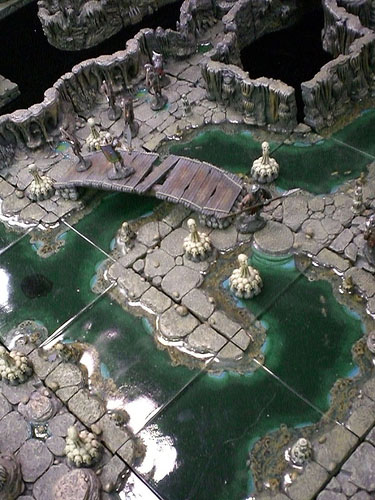
This last will likely be aided by the fourth leg of this concept: organized play. The RPGA has always been associated with but not a part of Dungeons and Dragons, if that makes any sense. With fourth edition the organized play campaigns will become a central component to the game experience. From your home, to the gaming store, online with the D&D Game Table, and all the way to conventions, the goal is for gamers to have a fun and slightly more formal handrail for gaming together. With a renewed interest in adventure publishing, designer goals seem to be to bring back the days when every D&D gamer could talk of playing through modules like Keep on the Borderlands or Tomb of Horrors.
All of this combines to an extremely ambitious goal: a brand new D&D. Just from anecdotal experience, from talking with players and retailers at the convention, my own gaming store, and from reading comments here on the site, the general reaction seems to be anger. The reason is understandable; 3.5 books aren't cheap, and many gamers have invested heavily in the current edition. In the latest D&D Podcast even the designers themselves admitted that 3.5 isn't 'that broken.' Thankfully, there's still quite some time before even the Player's Handbook comes out. The folks at Wizards have a good long while to explain to us what exactly they're planning to do. A long time to convince us, to reassure people that they really aren't ditching the OGL (full support), that their favorite campaigns will be supported (new Realms book next year, Eberron in 09), that it's worth shelling out another $90 for the upgrade. They've already begun, in fact; their ongoing design and development series has already put up posts on party roles, the new vision for Fighters, and what it's like to face a dragon in the new edition. If they even come close to delivering on what these articles imply, next year is going to be an interesting time to be a gamer.
Warhammer Online
Last year, I wrote this about WAR: "I wasn't very impressed, either with Mythic's showing or with the game itself. The buzz around the convention seemed to be that it is 'too much' of a World of Warcraft (WoW) ripoff." What a difference a year makes. Since then Mythic was purchased by EA, development has gone into high gear, and the company has done a tremendous job of getting out the word on what exactly Warhammer is all about. The result? A booth that was swarming with people from the moment the doors open until the exhibit hall closed. Their enthusiasm reflects my own; it's far and away the game I'm most looking forward to next year. I had the chance to take a Goblin Shaman for a spin in the Greenskins starting area, and the development team's cry of "War is everywhere" seems to have made for some inspired gaming.
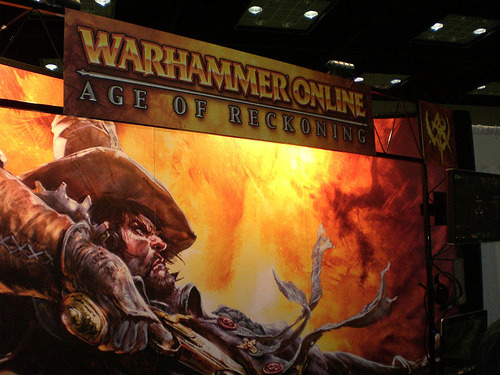
Yes, it's primarily the same old level 1 experience you have in every other game. Kill grunts, gain xp, learn2play. But right away you start to see the difference. The Tome of Knowledge, for example, not only tracks what quests you're on, but tells you how many stunties you've killed (damn dwarves). Nearby a public quest is ongoing, as players struggle to kill the swarming squigs harrying a friendly giant. UI-wise, it looks like World of Warcraft redux, until you start to see all the extra doo-dads. My Goblin Shaman built up Waugh as he fought, which would have allowed me to heal more effectively had I been in a group. Morale rose as I fought too, allowing me to fire off special abilities just because I'd been fighting for a while. It's violent, it's fast, it's easy to pick up and play. And it's freaking hilarious. That dark British sense of humor seen in the tabletop game comes through loud and clear in-world, with everything from ability names (Brain Bursta, Geddup!) to quest themes. One of your very first encounters has you being tossed across a valley to the top of a dam, where you stuff unconscious dwarves into barrels and toss them over the side. I didn't even get a chance to check out Realm vs. Realm combat, the game's most exciting offering, and already I'm convinced of the title's potential. It's still in development, still getting the kinks worked out, but even in its half-finished state I think Warhammer is in a great position to turn heads next year.
Gods and Heroes
Perpetual's in-development Roman title, on the other hand, appears to be a bit adrift. At first blush it looks ready to succeed, with an inspiring and somewhat unconventional concept. The game focuses on combat in a mythical Roman setting where gods walk the land and monsters fill the wilderness. Combat with minion NPCs is the main mechanical draw. The minion system is a great addition to the genre, taking concepts seen in standard pet classes and the more advanced heroes of Guild Wars: Nightfall, and punching them up to the next level. On top of an interesting game setting and some new tweaks to gameplay, an ambitious animation system makes the game look as cinematic as it's described. Instead of blindly hacking at each other, fights involve stabbings, tosses, stamps, and throws. It's incredibly impressive when the animation system synchs up and pulls things off.
Unfortunately, there's a problem with that. Combat previously was 'locked', meaning that when two characters were fighting they were held fast so that animations could go off at set times. This looked really good, but playtesters found it too constraining. Perpetual listened, and has removed the locks. They're not working to tweak animation timing so that things will still look as cinematic as ever even without the lock system in place. It's still Beta, and there's time to get this stuff squared away ... but I have to be honest; the game felt like it was more than the two or three months away from launch than the company is claiming. When animations hit they look great, but right now combat is a mess to look at, moving through the world feels slow and cumbersome, and even the much-vaunted minion AI still needs to be tweaked. This game is doing a lot of things right, make no mistake, and I trust that when it launches it's going to garner some interest from players looking for something new. I just hope that the company gives Gods and Heroes the time it needs to succeed; right now it seems like it still needs a lot of work.
Fallen Earth
Big-name Massive games get a lot of press, but with the technologies behind MMOGs becoming ever better-understood smaller companies are starting to aim for a piece of that online pie. Fallen Earth is just such a game, backed by Icarus Studios. There's no word on a release date yet, but the little slice of the world I saw was fairly compelling. Assuming it goes live in the next six months or so, fans of the Fallout series will be able to sate their hunger on this post-apocalyptic treat. Fallen Earth imagines a southwest US ravaged by nuclear war and disease. In this bleak landscape you take on the role of an adventurer, working for the factions that control the vital resources of the area. Combat is a unique blend of FPS and RPG, with player skill determining if a shot hits and mechanics determining how much damage is done. The game feels like a fitting tribute to the complex CRPGs of yore. While it doesn't seem like it will reach widespread appeal, the players in this niche are going to have a lot to enjoy in this bleak, violent, and surprisingly funny Massive game.
Legends of Norrath
A collectible card game wrapped inside a Massively Multiplayer game sounds like crazy talk, but the folks at SOE are betting this will be a big hit. Certainly the concept is simple enough: give players of EverQuest and EverQuest 2 something to do while they're waiting for a group, or just as a way to mix things up a bit from the standard grind/kill/grind gameplay of a fantasy MMOG. While it's a simple idea, the execution is surprisingly robust. Players will be able to purchase virtual cards for a fairly low fee, or find them in booster packs dropped by in-world monsters. Decks can be constructed with the aid of a deck-building wizard (the software, not magical kind), and put to use combating players of both titles or NPC opponents. Gameplay seems to be of the 'easy to learn, hard to master' type that is quite prevalent in CCGs, with a few EverQuest-specific twists. The game will also offer up in-game loot from certain cards, just like a certain other CCG based on a MMOG ...
Pirates of the Burning Sea
I'll come clean: if the epic battle ever comes, I'll be siding with the buccaneers vs. the ninjas. It was a great pleasure, then, to get to have some more hands-on time with this most atypical online game. Although, again, I fear that broad market appeal may not be within reach, Pirates is shaping up to be darn fine game. The ship-to-ship combat is rock solid, immensely fun to play, and feels completely different from any other MMO experience you've ever had. There's a stateliness to the combat that makes the smoothly gliding schooners and soaring cannonballs somehow epic in scope. Swordplay is still a little rough, with the team still polishing in anticipation of a launch later this year. Even with the rough edges, this isn't your standard fantasy hack and slash. Players kick sand into the faces of their foes before a well-placed boot to the stomach takes them down. It's not fantasy, it's not sci-fi, it's piratical, and if you like Massively Multiplayer games you owe it to yourself to give Pirates of the Burning Sea a try.
Eye of Judgement
One of the few non-MMOGs at the event, this strange videogame/collectible card game/strategy game hybrid was drawing crowds simply because of its awesome visuals. The in-game art is definitely the first thing you notice, and is stunningly well-done. I was surprised by how much I enjoyed this game, which has players angling for control of a three-by-three grid. Cards are played onto each square of the grid, where they're analyzed by the new PlayStation Eye camera and animated on the television screen. While it initially comes off as just eye candy, a few minute's play reveals the numerous layers of depth to the game. Cards have facings, for example, and must be angled to ensure their blind spots are protected. Grid squares are aligned with different elements, as are creatures, requiring players to not only control the board but consider where their thralls are placed. It deserves commentary at length, but suffice it to say that it's not going to get the kind of success it deserves. Given the strange hoops required to jump through to play, this inspired title is just not going to find the audience it should. If you have a PS3, though, I highly recommend at least giving this a unique experience a try when it comes out later this year; they're even including the eye for no extra cost.
Conclusions
Last year I was lamenting the decision to include videogames in Gen Con's mission statement, worrying that this would be the end of the convention I've grown to love over the years. That was, of course, before seeing the lackluster showing of the E3 Media event and the closure of Gen Con So Cal. "Gen Con Indy" is now the only Gen Con, and is one of the furthest east offerings for gamers when it comes to videogames. In short: videogames coming to Gen Con may be the best thing to happen to it since the move to Indianapolis. Between the MMOGs, the D&D announcement, and a huge number of attendees, the convention felt revitalized. There was a hum and a murmer to the hallways that's been lower key in previous years. It was, as always, a chance to see game designers in their natural element, and all of the folks at WotC seemed to have an extra spring in their step this year.
The tabletop gamer is a dying breed; it's well acknowledge that Massively Multiplayer games are killing them off. Playing with your friends is so much easier in your home from a PC, and is something that can be done regardless of what time zone everyone is in. This year, though, I had hope that maybe we might not be dying off so quickly as I thought. Fourth edition is an obvious strike back, an attempt by Wizards of the Coast to fight 'the enemy' on its own terms while applying eight years of careful observation back into the game mechanics.
It's incredibly risky, and the future of the most popular and well-known tabletop game hangs in the balance as a result. On the one hand, this could blow the tabletop hobby firmly into the mainstream. Dice rollers could take their place at the side of the World of Warcraft players, proudly explaining their misunderstood hobby to their relatives in terms they can understand. Or, this could completely alienate the D&D playerbase and collapse the house that the d20 built. I personally am excited. I'm excited about the possibility of a Dungeons and Dragons game without the kruft. I'm excited about the chance to play online with friends across the country. I'm excited about organized play tied directly into the core game. And I'm excited about the future of a Gen Con with no imitators on the west coast, new attendees drawn by electronic gaming, and ever-more-professional game design companies working on the hobby I love.
I'm also, sadly, excited about the future of the World of Warcraft CCG. Perhaps because of my exposure to Legends of Norrath and Eye of Judgement, my demo of the now-year-old game left me vulnerable to the dealers in the exhibit hall. I've spent the last few days happily tweaking my Blue Shaman deck, and look foward to running it against all comers at PAX. Anyone have a Parvink or two they'd be willing to trade?
It would be nice to make a DnD universe and make it a MMORPG like WoW.
The author (zonk) says 40th anniversary, that would put the start of DnD in the 60s, not the 70s where it belongs. It is a glaring, terrible error to start the article off with.
My family and friends are of the type to talk a good game...but to actually get off our asses and drive to Indy to go is another matter. I used to go all the time when it was up in Wisconsin, but no one wants to drive the 5 hours now to go.
Thinking of dumping my family and friends...It's time I venture forth into the world and leave them behind!
Oh wait...they're buying me pizza. Ok, I'll stay a little longer....then I'm outta here! Ooooo...they brought beer too!
"Leo Fender was in a 'state of grace' when he designed the Stratocaster." -- Paul Reed Smith
They took their biggest Living campaign, and killed it.
And why? So they can try to force us into the same arena where pimply Drizzt-wannabes run around.
They just killed the RPGA and D&D. Good for them.
Do not belong at GenCon for the same reason WOTC, WizKids, GW, and all the other vendors who do belong at GenCon don't belong at E3 or CES to peddle their non-electronic products.
The last of my 8 trips to GenCon was 2003, and even then the video games ate up 20% of the vendor hall. I can't imagine there was much space left for the small tabletop publishers this year.
It was GenCon's 40th anniversary, not Dungeons and Dragons.
Zonk must have failed his Spot and Listen checks all weekend.
Greyhawk is boring. So is FR. Completely bland, boring, generic fantasy settings.
I kind of wish they weren't starting a living FR. I just hope they keep doing things like Xen'drik Expeditions, which has been tons of fun and a unique experience, especially if you play in the Cabal of Shadows. Besides allowing evil characters, it has 4 "subsects" which you can choose to join... Each sect has their own secret missions, and it's not uncommon for one player's secret mission to directly conflict with another's. Adds a lot to the game.
Of, and of course, it's Eberron, which actually tries to tread new ground instead of following the same old Swords & Sorcery formula as 90% of the settings out there.
So, lets see... Battletech releases a new box set (with minis), the techmanual and starter guide, and an update to Total Warfare and all we get 'is its a good day for shadow run players'. Typical.
Honestly, I have to question the statements about the new Battlestar Galactica RPG that Zonk made. I played in each of the two modules/rounds offered at GenCon and in both cases registration was sold out, but we had to resort to finding willing players using generic tickets to sit a playable table. I just don't think it was as wildly successful as Zonk is making it out to be. I wandered over to the Margret Weis booth several times and it looked to me that the 'big sellers' were the Serenity corebook and literary books being sold. Maybe sales will pick up with the new season or when the book goes to Amazon, I can't speak to that, but while a good setting, it's not the big hit they were hoping it to be.
If you want to talk about an EXCELLENT game that was, in my experience, full-up all the time - check out Witch Hunter by Paradigm Concepts [Paradigm Concepts, Inc.]. It's a fairly imaginative setting that exploded at Origins this year. The game was popular enough that for almost every slot it was offered, the team in charge of the campaign - 'Witch Hunter: Dark Providence' - had to find judges so they could offer more tables per slot. Paradigm, by the way, is the superb team behind the Living Arcanis campaign.
Who cares about what games are being re-re-re-re-rewritten? Where are the pics of the girls in the skimpy anime outfits?
Weaselmancer
rediculous.
Help! We're all trapped in this bloody great big nutshell!
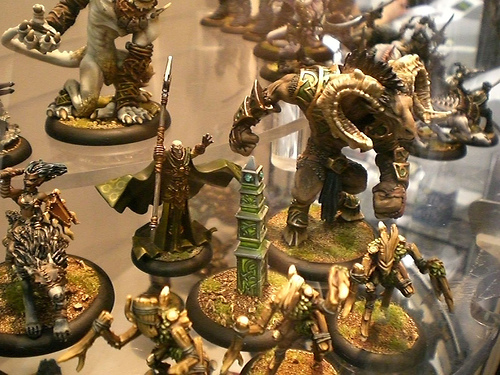
Just an FYI - the 6th picture down (http://images.slashdot.org/articles/07/08/gencon6 .jpg) is of a few of the miniatures from the Privateer Press game Hordes. Hordes is releasing their first expansion, Evolution, and it's part of the larger tabletop/miniature combat world that is Iron Kingdoms/Warmachine/Hordes. For those who are tired of Warhammer, or who want to try something new, I can't recommend these games enough. Last year Hordes won the Origins Award for Miniature Game of the Year. The models are beautifully sculpted, the game is solid and it's loads of fun.
Just brining it up since there was no mention of what the picture was in the article. That's all.
"The last of my 8 trips to GenCon was 2003, and even then the video games ate up 20% of the vendor hall. I can't imagine there was much space left for the small tabletop publishers this year."
2010 will be the new convention hall.
Blah, blah, blah. The real story? Everyone's pissed about D&D 4e, because they just bought 3e, then 3.5e. I heard more than one person looking to dump their D&D gear entirely and get out of the system.
GenCon organization was also something of a disaster. Preorders set for will call were shipped instead. Badges were missing. People weren't in the system. There was a huge long line for the single will-call booth (the only place to pick up preorders), and a whole row of on-site stations (for those who just showed up). Not the greatest way to serve those who signed up over 8 months in advance. Tables were moved---which happens---and GMs were lost between buildings---which shouldn't.
That said, it was still fun; the exhibition hall isn't where people spent most of their time, either. I had the opportunity to play True Dungeon this year with a great group. We survived. It was far too expensive (at $35 a ticket for a 2-hour event), especially when you can essentially get kicked out of the game in the first 12 minute segment. Fortunately none of our team had that problem. The story was a bit disjointed and illogical, but the puzzles and other gameplay (battles and magic) were fun.
I was somewhat suprised to see the videogame section this year. I got an opportunity to play Eye of Judgement (which was cool), but the little time I spent in the exhibition hall was mostly a quick glance of the tabletop vendors, so I can't elaborate too much here. All in all, enough to do that even with minimal sleep you'll still see only a fraction of what's there.
Don't think of it as a flame---it's more like an argument that does 3d6 fire damage
It's been our groups experience over the years, that D&D is pretty clearly designed up to level 12, and not much further. It'll be interesting to see is 4.0 "fixes" that.
Yes, I am a smart ass; it's better than the alternative.
. . . first game convention -- ORIGINS '77 out on Staten Island -- and I didn't remember until I read this.
Man, have things changed.
Back then, RPGs were a minority presence. Historical miniatures games and boardgames were the thing. Roleplayers were considered immature and dweeby newcomers.
There were enough companies around to create a pretty packed and boisterous dealer's room. Avalon Hill was still its own company, and SPI, the juggernaut of well-produced brainy wargames, was still alive and vigorous.
TSR had a medium sized booth. D&D back then was three small, brown-covered books packaged in a small white box. (REAL old timers had three brown-covered books in a small brown box.) I recall buying STAR EMPIRES, Chainmail, and The Dragon #13. Metamorphosis: Alpha was on sale, if I remember right.
Game Designer's Workshop introduced TRAVELLER, if I'm not mistaken. I didn't buy it, but I did pick up a copy of Triplanetary, their vector-movement spaceship wargame. Still have it!
I stopped by the FGU (Fantasy Games Unlimited) booth, a miniatures rules company just starting to do RPGs. They would become my first publisher a few years later.
I only remember two bits of programming. A very funny British guy described some roleplaying adventures in one. In another, the late Ernie Gygax, subbing for his dad, talked about stuff.
* * *
It's a lost world, really. The medium is the message, and these days the medium is the computer screen and keyboard / mouse interface. On one level gaming is more inclusive and social (there's GIRLS out there!); on the other, it's kind of antisocial and weird. Back in the day people physically gathered together and shared food. They may have smelled bad and been cranky and wonkish, but they actually left the house. Memorizing big thick rules manuals was an intellectual feat in itself. Some spent weeks painting hundreds of little figures all by themselves . . . none of this buying special surprise collector packs of pre-colored minis.
Nurse? NURSE! Where's my dentures?
That had to be the quietest announcement of the con.
I didnt find out about it until I was told by a friend, who read about it on slashdot...
Thanks to file sharing, I purchase more CDs
Thanks to the RIAA, I buy them used...
The 4e announcement may have been quiet at GenCon, but it was news everywhere else. The Wizards web page went down when the 4e announcement was supposed to come online. Naysayers have been bemoaning 4e ever since.
Other pen-and-paper RPGs can benefit from 4e's announcment. Castles & Crusades (Troll Lord Games) may become more popular with the disillusioned; C&C is old-school roleplaying. Basic Fantasy, OSRIC, Labyrinth Lord, and a host of new RPGs in the old-school vein are on the market.
Beyond those games, Gygax's own Lejendary Adventures has been out for a few years as well.
My little brother attended this for WoW...
Yeah. That's what we noticed at the ENnies too.
Total Warfare got nominated for "Best Regalia".
?!?!?!?
Because Classic BattleTech is primarily a boardgame that can use miniatures, has a heavily developed game world and an RPG component, it's sort of relegated to a limbo within the game community.
Even so, it doesn't mean we aren't appreciated. The CBT QuickStart rules won not one, but TWO ENnies this year. That may not put it in Ptolus territory, but still. We're happy with what we get.
Oh, and did I mention that CBT also runs some of the largest single-system, single-game events at the con? Save for maybe a few hours in the "so late, it's early" morning, the events were packed. Even after being relegated to back rooms.
Chas - The one, the only.
THANK GOD!!!
My greatest pet-peeve: the run for tickets the day registration opens. The servers grind to a halt, all the events are eaten up in the first hour. My wife and I bought tickets just to have events which I'm sure took some away from someone who probably cried when they were full. We then turned some in the convention that conflicted, but some we just skipped. I think this is just leading to many no-shows and people needed to use generics.
Personally, everything seemed to go much better when you had a chance to think about what you wanted, put it on the form with an alternate, mail it, and hoped for the best. At least got some of your events then could plan on seminars or open play. Of course, I ran 4-6 events myself for years...so I might not be an authority!
Also another let down...the Killer Breakfast (one of my favorites) is getting old. Seems more of a showcase for Hickman's ability to make DVD's and videos than for the "players" (a large number didn't get on stage because we just HAD to do "Chainmail Woman" ... and this is now a paid event).
Still I'll be there next year....
I love the sound of distortion in the morning -- webcommando
For those who didn't RTFA:
Gencon2007: "Help! I'm trapped in a nutshell!"
I'm wondering about the changes WotC made to character levels for D&D 4e, specifically with respect to the balancing of the various classes.
The old D&D "balanced" mages vs. fighters by having the mages be pathetic at very low levels, and awesome at high levels, and that was just broken. (That's "balanced" in the same way that putting your head in the oven and your feet in the freezer is "comfortable".) There was a quote saying "Gone are the days of the four hit point Wizard" but no details. Does anyone know more about this?
I'm sure they won't do it this way, but the groups I used to play with had a system that I thought worked very well to balance mages vs. everyone else: a "spell points" system, where a mage had to power spells (and didn't forget them when casting them).
The mage needed to memorize the spells, and we used the standard table from the Player's Handbook for how many and what level spells the mage could memorize. The power cost of a spell was the square of the level of the spell, and "mana points" came at about 8 per level of the mage. (We had a formula to calculate it but the answer was always 8.) We also had a rule that a mage could cast a spell "out of his books" without memorizing it, but it was really, really slow. And in dire emergencies, a mage could use points from Constitution as mana points (only the very low level mages ever did).
Thus your first-level mage would know one spell he or she could snap off quickly (probably Magic Missile) but could very slowly cast Detect Magic or whatever out of the books, and could cast 8 spells per day; and your 20th-level mage would have two 9th level spells memorized, but would seldom cast them (as they would burn 81 out of a daily pool of only 160 mana points!). Medium-to-high level mages tended to use the Fireball spell (level 3 and therefore costing 9 mana points) as a pretty good spell that wasn't too expensive.
I felt this was a much, much better way to balance out the classes.
While in high school, I wrote up an article describing the above and submitted it to Dragon magazine. Editor Kim Mohan sent me a rejection letter, saying this proposed change was "too radical" to publish.
steveha
lf(1): it's like ls(1) but sorts filenames by extension, tersely
Don't forget that Starcraft II was playable and Blizzard had a nice LAN party set up in the convention hall where there you could play Red vs. Blue on teams of (I think) 3 vs 3.
A non D&D-ripped-off MMO would be even nicer.
... a pure D&D setting would be the same concepts arranged in a slightly different pattern.
WoW is, for all intents and purposes, a DnD-based game. Levels, classes, alignments
Even something as unoriginal-but-different as Traveller would be nice.
Anyone know where the teaser clip can be found on the internet for the upcoming dragonlance movie? I hope its good, and not an embarrassment like the Dungeons & Dragons movie was.
Is this some kind of huge dork gossip column here?
Seriously, can you possibly get any more canonical in the world of nerd-dom than roleplaying.
Remember to roll to determine whether to mod me down, and again to determine in which way!
I read the script, and I think it would help my character's motivation if he was on fire. -Bender
I do not see any evidence anecdotally (which is all this reviewer has) that table top gaming is somehow in decline vs Massive Multiplayer Online Games. While the market for MMOG is very large (9 million WoW players and counting) a lot of that is that the audience of WoW and similar games is just much larger than for tabletop games in general since the barrier for consumers to entry is just much lower. Just because MMOG are popular does not mean that table top gaming is becoming less so. My own experience is that tabletop gaming is probably as popular as ever. Of course MMOG are more popular than ever. It is not a zero sum game however as most of the people I play Privateer Press Warmachine with also play MMOG, and SCA, and etc... Certainly around here the miniatures gaming is very strong. Our Privateer Press Warmachine/Hordes tournaments are completely filled and getting more popular all the time. A great game combined with a great community is a killer combination, not to mention Privateer Press is one of the coolest companies out there. If anything over the long term an increase of MMOG will likely increase tabletop gaming, not decrease it as more people are exposed to the whole pantheon of gaming out there.
There's a "spell points" system available as an option for 3.5 (In Unearthed Arcana, I believe) and they have hinted at something like that in 4.0.
I strongly disagree with anyone's assertion that a low level mage in D&D is underpowered. I keep seeing this argument over and over again (on Slashdot especially) and I just can't understand it. If you can't figure out how to abuse your spells, then play a fighter and learn how to do it by watching someone more experienced play the party mage. There's a plethora of spells available at low levels that can be completely game imbalancing. Most become useless at higher levels, but then you've got gems like cone of cold and chain lightning to throw around. It's just a thinking man's game.
Here's a recipe for easy-mode as a wizard for the future: roll your level 1 mage as an Elf and pick Sleep as one of your starting spells. Stay away from your party and whenever someone gets close to you, drop a sleep spell at your feet. Easy kills. You can easily have the highest AC in the party at level 1 (+4 mage armor/+5 Shield spell and +5 dex if you're an elf) and that D4 hit die can be really helped by picking Toughness or a decent con bonus... Though you might want to pick Combat Casting over Toughness... And since you're an Elf, you can take a longsword as your starting weapon. So use magic missile/light crossbow at range and sleep + longsword coup-de-grace if your enemies get too close. Other ridiculously overpowered spells at first level you could look into are Color Spray, Charm Person, True Strike, etc. And then when you hit level 3 you can pick up Invisibility and Scorching Ray and then the fun really starts.
Maxim: People cannot follow directions.
Increases in truth directly with the length of time spent explaining them
When the poster said 'Like WoW' they meant "Good"
The Kruger Dunning explains most post on
I strongly disagree with anyone's assertion that a low level mage in D&D is underpowered. I keep seeing this argument over and over again (on Slashdot especially) and I just can't understand it.
Try playing a mage using the rules from AD&D First Edition and see if you still say this. None of your little tricks will work, they sound like 3e or 3.5e stuff (feats etc) and in the 1e D&D a first-level mage could only cast one, single spell per day. You couldn't use any armour, there was no "mage armour" spell, you could only use a quarterstaff as a weapon, etc. GP was correct that under the old rules, mages were pathetic at low levels.
And, I don't remember if this was optional or not, but there was a rule about rolling for which spells you would get, and you might start out with no decent combat spells. In D&D 1e the two good 1st level mage spells were Sleep and Magic Missile; other combat spells like Burning Hands had very limited practicality (Burning Hands did very little damage by itself, and it was best used to ignite burnable things near your target).
In the 1e days, low level mages seriously were desperate for magic items like wands, because one or two spells per day doesn't cut it!
Honestly, proof of this should get you some kind of special annotation to your slashdot username- a flaming asterisk, goblin ASCII art or just...something.
I have not had this much nerd envy in a while.
I don't think your AC calculations are very realistic:
The Shield spell only gives +4 to AC, and at first level, it only lasts 1 minute.
Casting both shield and mage armor will use up both your first level spells.
Getting +5 to AC from dex at first level is pretty extreme - I think wizards need int for casting high level spells someday more than the dex.
I like the idea of using the elf immunity to sleep, but I don't think its broken. At first level, you'd get to cast sleep twice (or once if you memorize mage armor or magic missile).
I assumed they meant it quite literally. The Star Wars Saga Edition which they talk about being the testbed for D&D 4th Edition has greatly increased hit points. At 1st level, you start out with maximum hit points x3, + your Con bonus. So, if 4th Edition uses that model, even if mages still have d4 hit dice, they would start out with 12 hit points at 1st level, +/- Con bonus.
Have you seen the state of the UK GenCon(http://www.consupport.com/index.asp?Con=61) this year?
I live in Reading and doubt I'll bother.
But where's the socialization?
Most people are UTTERLY ineffective at conveying emotion via typing. In fact, most of the "chats" I've seen online are supremely disjointed collections of random thoughts, strung together by the most outrageous grammar, and executed with more spelling errors than stars in the heavens. *LOL*
Seriously, as nice as it is to try to game online, the experience is still too slow to permit enough real-time reaction to situations. No laughter at a dropped pair of dice, no pauses to pay the pizza guy. No human interaction aside from that which is The Game. There's no time to decompress from potentially gritty and gory combat sequences.
On one hand, it serves to desensitize the players. On the other hand, it serves to desensitize the players.
This might be construed as a Good Thing, simply because we're essentially breeding a line of workers (Betas/Gammas) who will have Fun at their Jobs. And these online versions of the games provide excellent training for an eventual life of sequestered performance in a career, punctuated by achievement of milestone life goals in a frenetic salmon-spawning manner.
There's still something good about hanging out with a couple of friends on a rainy day, around a table, and just laughing and playing.
Thoughts?
-v
"Say, Hobbit. Halfling is racist." -v
I didn't see any mention of True Dungeon. http://www.truedungeon.com/true/dungeon.html
I didn't see any mention of True Dungeon. http://www.truedungeon.com/true/dungeon.html It usually sells out the first day tickets are available.
The funny thing a lot of people miss here..... and many places not just /.
This is a GROUP/TEAM game. The mage may not have a large repetoire of spells at low level but was an asset when needed to supplement the fighters and others during combat.
It isn't like you have a single Mage wandering around alone with no one else.
Then at high levels the Mage was great for helping the fighter out and softening up the bad guys for the fighters.
"They that can give up essential liberty to obtain a little temporary safety deserve neither liberty nor safety." - BF
Lost in the Noise of GenCon's other announcements was crafty Games' Fantasy Craft. Crafty is formed of the authors of the acclaimed Spycraft RPG, which is what 3.5 should have been. Fantasy Craft is a fantasy supplement to Spycraft, adding back in the fantasy elements that were removed when it became a modern game. This is cool, very cool, and it is a point of light among all the depressing announcements at Gen Con.
Red Dragon Inn -- http://www.slugfestgames.com/games_rdi.php
and Whack A Catgirl -- http://games.asmadi.net/ourgames.php
One minute is ten rounds. If your combat goes longer than ten rounds at first level, you're dead anyway.
Black and grey are both shades of white.
... their ongoing design and development series has already put up posts on party roles, the new vision for Fighters, and what it's like to face a dragon in the new edition.
Rules and source material are good and useful. I buy them. I have even published them. But why would any self-respecting DM wait for Dungeons & Dragons R&D to approve a new vision for "what it's like to face a dragon" or anything else?
If they even come close to delivering on what these articles imply, next year is going to be an interesting time to be a gamer.
It's been an interesting time for 30+ years... If you choose to make it that way.
This is what I am guessing will be the case, but with the heavy use of DR to which they allude, they could give a static HD for all and have armor take care of the hitpoint to output ratio by tweaking DR.
"Little is much when little you need."
The funny thing a lot of people miss here..... and many places not just /.
This is a GROUP/TEAM game.
Actually, no, I didn't miss that. Now granted, my experience with D&D is limited to the original books, the "Basic Set", and AD&D First Edition and Second Edition; the newer editions may have already done something to improve these issues.
The mage may not have a large repetoire of spells at low level
"may not"? A mage started out with one, single, solitary spell per day. It sounds like in recent editions that was expanded a bit. Also, a mage couldn't have any better weapon than a quarterstaff. Not only did a mage have 1d4 per level of hit points, but the mage was forbidden to have armor or a shield. (We used to play that, instead of rolling the die for your first level, you would get the max. So a mage would at least start with 4 hit points.)
It just wasn't fun to hear the GM announce a combat, to cast one spell, and then to cower at the back of the combat for however many rounds. The older versions of D&D didn't even have "feats" so a 1st-level mage who had cast his/her one spell really had very little to do. I used to buy ground black pepper and carry it in a special pocket, to throw in attackers' eyes, and I would buy throwing darts and burning oil when I could to have some kind of ranged attack.
In town, just doing standard role-playing, the mage was as good as anyone else; but our games tended to be rather combat-heavy, and it was boring sitting there while others fought a combat.
By the way, one of the GMs changed the "psionics" rules a bit. He reasoned that psionic combat must happen "at the speed of thought" so once a psionic combat started, only the psionic characters did anything until the combat was over (that is, one side of the psionic combat completely defeated). It sure was boring for everyone else with absolutely nothing to do until the psionic combat was resolved. This taught me that in a game like D&D, it's really only fun if everyone has something they can be doing.
(Don't judge that GM too harshly. We were all young, and IIRC he's also the one who had the brilliant idea to make spells cost their square in points.)
Then at high levels the Mage was great for helping the fighter out
A 20th-level Mage can cast two 9th-level spells just as a warmup, and then can start casting 8th-level, 7th-level and on down. A 20th-level mage has a truly staggering array of spells. (Granted they will take a while to re-memorize later.)
9th-level spells include Meteor Swarm! 20th-level mages can do a lot more than "helping the fighter out"; they can fry legions of the enemy before the fighters get a chance to do anything at all.
So, something that reduces the traditional power of high-level mages while increasing the power of very-low-level mages sounds like a good thing to me.
steveha
lf(1): it's like ls(1) but sorts filenames by extension, tersely
I have been around from the beginning too. At work so I cannot reference exactly but I could have sword that you got bonus spells if your INT was high enough. Also your top end spells were limited by Int as well. Though I might be misremembering bonuses for a Cleric of high WIS.
Quaterstaff was 1D6 but I prefered Dagger even though it was 1D4. As the saying goes... if your Wizard had to use his dagger you were in trouble.
I still prefer the 1st Edition AD&D back of the Player's Handbook Bard.
"9th-level spells include Meteor Swarm! 20th-level mages can do a lot more than "helping the fighter out"; they can fry legions of the enemy before the fighters get a chance to do anything at all."
So all the Orcs and Kobolds and low level Demons or Devils that a Fighter can take out with ease are wiped out. Now the Wizard blew his 9th level spells and next comes the overlord of those low level cannon fodder and he is doing quite well thank you as the Wizard no longer has Meteor Swarm to use to soften him up.
"Actually, no, I didn't miss that. Now granted, my experience with D&D is limited to the original books, the "Basic Set", and AD&D First Edition and Second Edition; the newer editions may have already done something to improve these issues."
It seems that 3.0 and 3.5 have helped to make the LONE Adventurer more possible. Hell if you remember the average party was supposed to be 6 and in 3.0 they made it 4.
As to someone elses comment about video games... right on down to the rules about monsters coming back to a dungeon fast (Repopping bad guys).
"They that can give up essential liberty to obtain a little temporary safety deserve neither liberty nor safety." - BF
"So all the Orcs and Kobolds and low level Demons or Devils that a Fighter can take out with ease are wiped out. Now the Wizard blew his 9th level spells and next comes the overlord of those low level cannon fodder and he is doing quite well thank you as the Wizard no longer has Meteor Swarm to use to soften him up."
Noticing something of my own.... He may not have Meteor Swarm but he has a 20D6 Fireball.
"They that can give up essential liberty to obtain a little temporary safety deserve neither liberty nor safety." - BF
I guesstimate that I've spent some 1200 euros (about 1600 USD right now) on 3.0/3.5/d20 products over the years. That's a lot of money! And in retrospect, some of those books really weren't very good.
But then I consider what I spent on my current computer... And I don't think it'll provide me much gaming fun after 8 years, unlike those 3rd edition books. Hell, there are lots of 2nd edition books that I still would like to get, even though I can no longer stand the system. The setting material, adventure hooks, artwork, etc. are still good.
I don't know if the new edition will be a significant improvement over 3rd. As long as it's sufficiently better (or just different enough) to make me and my friends excited about rolling up new characters, though, the 90 bucks or so that the new core books will cost will be very well spent. It's not easy to get more hours of fun for that kind of money.
"The mage needed to memorize the spells, and we used the standard table from the Player's Handbook for how many and what level spells the mage could memorize. The power cost of a spell was the square of the level of the spell, and "mana points" came at about 8 per level of the mage. (We had a formula to calculate it but the answer was always 8.) We also had a rule that a mage could cast a spell "out of his books" without memorizing it, but it was really, really slow. And in dire emergencies, a mage could use points from Constitution as mana points (only the very low level mages ever did)."
Holy crap. . . that was more or less exactly our fix as well. Squared spell points, standard level bonus, Constitution backup, everything (except the casting out the book, though I like that addition as well). The other fix we included was the ability to cast spells that were your own level: second-level mages could cast second-level spells, and so on.
Maybe they meant it was "too radical" in the 80s sense of the term.
I don't think video games are a threat to board games or tabletop games. In fact, with games like Carcassonne making the leap onto the Xbox 360, there's evidence that people are playing and enjoying both kinds of games. Games and gaming in general are on the rise, including board games and cards games of all sorts. Our show tends to focus on these types of games. This week, we include a variety of interviews from the show room floor, including game designers, publishers, artists, and inventors. Next week, we conclude with our own impressions of the con.
Spiel on!
Stephen
Come play Arcanis. It's got better writing and story than Greyhawk ever had (IMHO), and it's been promised to stay 3.5 through at least the end of this storyarc.
Anyway, I thought WotC already killed the RPGA when they booted Arcanis, Spycraft, etc. I mean - they were worried about competition from companies like Paradigm, which is six guys with other jobs?
Doesn't help when the overlord has either high reflex saving throws, or fire immunity though... Ooops :P
As another aside, it had tie-ins to Planescape, Spelljammer, and Ravenloft.
In fact one of the sorcerer queens was supposed to have ended up trapped in the ravenloft setting along with her whole city?
Please show me exactly where in my post I called you a moron? I called "anyone who purchased D&D books as a financial investment" a moron. I did not say "Sudog is a moron for buying D&D books". You would only be taking my broad statement as a personal slander if you are one of those morons who bought them as a financial investment.
Those are called semantics; the meaning and intent was clear, and you wouldn't have made the statement at all unless you considered me to be part of that group. If you had assumed I was not looking for an economic investment you wouldn't have said anything. In searching for the truth of the matter, at the best you were trolling me for it, and in that event I still get to call you names.
Old Heinlein books in mint condition get a few dollars. Early publishings with limited covers perhaps? Most SF in the 50's and 60's never had more than 100,000 copies printed in one publishing. Scarcity raises value. There are millions of copies of the 3rd ed. books. Considering this, $5-10 for a used 3.0 book is pretty reasonable.
In non-mint mostly crappy condition, Stranger in a Strange Land fetched exactly $5. The Mote in God's Eye fetched exactly $3.99. That's pretty fucking good considering their original prices were $2.50 and $4.50 respectively. Even taking inflation into account, that's $14.58 and $19.73 respectively, which means crappy, stained editions are 1/3 and around 1/4 their original cost.
For a current Manual of the Planes v3.0, Abebooks has them listed right now for $4.80. Used. I paid $48 for it, new. That's 1/10th of its original value and that's mostly because it's a relatively rarer book.
For my Player's Handbook, v3.0, Abebooks has them listed right now for $3.87. New, it was $37. That's 1/10th its original value again.
v3.5? More than double that, for a book that's four years newer. But they're dead ends, both of them.
From your previous post, your implication was towards people who bought the books as an investment, as per definition 3.
Now you're just being inconsistent. First you're saying you're not calling me a moron, and then you're saying that you inferred from my original post that I did mean the word "investment" in the economic sense. Internal inconsistencies like this, in a reply, generally indicate that someone (you) is trying to weasel his way out of something he now thinks was stupid. Just admit you were sorry--is that so fucking hard? You're anonymous for Christ's sake. You really think your reputation on here (of all fucking places) needs to be protected?
I certainly felt that I got my money's worth from the expense. If you feel you didn't get your dollar's worth from it, that's totally your call.
You know, for someone who claims to comprehend English, you're doing a remarkably bad job of it. I did have fun--why the fuck else would I go out and spend $500 on the v3.0 books if I wasn't on fucking board? And your recall of recent notes seems to be spotty too: I fucking said as much when I told you I bought them to begin with! Plus, the fact that I'm currently playing v3.5, but haven't purchased any of v3.5 books, should indicate that I'm still having fun with people I like to spend time with. What you're missing is the point I make about WotC's market exploitation, which is what my complaint is all about. If WotC were smarter, they wouldn't cannibalise their market by releasing patch errata to get people to buy new books. People get resentful about that. If you come out with a new book, fucking make it worth the additional $45 and we'll fucking buy it!
See, that's what we're all angry about. WotC is releasing books the same way stupid computer companies release books: by doing it in an underhanded or lazy-ass way and not just moving-the-fuck-on with a new game system. Their lack of imagination is directly translated into marketing ploys like the v3.5 fiasco and their rapidly shrinking release timetables
Maxim: People cannot follow directions.
Increases in truth directly with the length of time spent explaining them
Second edition mages were more abusable than third, however, in my opinion. You could specialize as a necromancer, get a 1st level spell that animated animals, buy 100 chickens (at 1cp each) and animate them day-by-day as chicken zombies or skeletons. You get 200 experience points per spell-cast (which thankfully went away in third edition) so at most after 10 days you're level 2 and have 10 undead chickens. Undead in 2nd edition caused fear, so it was pathetically easy to beat low level humans and demihumans with swarms of undead chickens and then it's downhill from there. Otherwise specialize as an illusionist and make an illusion of a dancing sword while you hide and have it kill your enemies. There's plenty of other abuses, but I can't remember them off the top fo my head right now.
Maxim: People cannot follow directions.
Increases in truth directly with the length of time spent explaining them
Piratebay.
Bittorrent.
Printer.
Some assembly required.
Seriously, it'll be interesting to see how the new edition does in an age where people can, uh, "check" the contents of new books before they invest 3 to 4 digits in yet another series of quickly outdated rulebooks.
There are many reasons why books, including D&D books, have been largely immune to piracy thus far: practical factors (convenience, eye health) and psychological ones (aesthetic value, social status, sense of palpability). But file sharing was nascent in 2000, and - let's face it- right no one cares to steal DND books except already-invested 3E players, most of whom would prefer to buy the books anyway.
That will be different this time around and I forsee that, if the new edition isn't at all better than 3E, people will be able to decline before investing (and investing themselves) in 60 bucks of starter material. That won't kill the game, because Wizards is hellbent on pushing it and there will always be enough people who simply must have the newest RPG rules in the best-looking books, but it will shrink the hobby yet again.