Slashdot Mirror
Domain: wikipedia.org
Stories and comments across the archive that link to wikipedia.org.
Stories · 7,048
-
Responsible Disclosure — 16 Opinions
An anonymous reader writes, "Disclosure. Just a word, but in the security field it is the root of progress, sharing knowledge and getting bugs fixed. SecurityFocus published an interesting collection of quotes about the best disclosure processes. The article features 11 big vendors, 2 buyers of vulnerabilities, and 3 independent researchers. What emerges is a subtle picture of the way vendors and researchers differ over how much elapsed time constitutes 'responsible.' Whereas vendors ask for unlimited patience, independent researchers look for a real commitment to develop a patch in a short time. Nice read." Wikipedia has an entry for "full disclosure" but none for "responsible disclosure." -
"Xena" To Be Named Eris
rdwald writes, "After over a year of hanging in maybe-planet limbo, newly-classified 2003 UB313, nicknamed Xena, now has a permanent name: Eris, goddess of strife. Its moon will be named Dysnomia, after the goddess of lawlessness — in Greek mythology, Eris's daughter — certainly not a reference there... I don't think I'm alone when I say, 'Hail Eris! All hail Discordia!'" In the same IAU announcement (PDF), Pluto was given its official minor planet number: 134340. -
Digital Identities Now Available
Largecranium writes, "I-names, the only globally unique, resolvable namespace in parallel to the DNS system and compatible with OpenID, are being introduced during Digital ID World in Santa Clara. I-Names are only as useful as the services they enable; the services that are available today are interesting but not life-changing. The ones that are coming in the next 6-12 months could change the way people interact online. I-names and their value (today and tomorrow) are casually explained at iwantmynamenow.com." I-names are the lineal descendant of the technology that began as XNS and continues evolving today as XDI. -
Digital Identities Now Available
Largecranium writes, "I-names, the only globally unique, resolvable namespace in parallel to the DNS system and compatible with OpenID, are being introduced during Digital ID World in Santa Clara. I-Names are only as useful as the services they enable; the services that are available today are interesting but not life-changing. The ones that are coming in the next 6-12 months could change the way people interact online. I-names and their value (today and tomorrow) are casually explained at iwantmynamenow.com." I-names are the lineal descendant of the technology that began as XNS and continues evolving today as XDI. -
Interview Lawyers Who Defend Against RIAA Suits
Attorneys Ty Rogers and Ray Beckerman maintain a blog called Recording Industry vs The People, subtitled, "A blog devoted to the RIAA's lawsuits of intimidation brought against ordinary working people," which was most recently linked from Slashdot on Sept. 10. They've agreed to answer your questions about RIAA suits -- and they obviously will not preface their answers with "IANAL," although we must note that they cannot give specific legal advice about specific cases. For that you need to engage an attorney yourself. (Luckily, their site contains a directory of lawyers willing to defend against RIAA suits.) In any case, these guys obviously know more than the average bear (or lawyer) about how the RIAA goes about suing music fans, how to keep from getting sued by the RIAA, and how to fight back if you do get sued, so we're glad they're willing to help us learn more about this apparently endless legal mess. Usual Slashdot interview rules apply. -
Faster Global Warming From Permafrost Melt
jc42 writes, "A recent study published in Nature documents the accelerating release of methane from melting permafrost. Methane is a greenhouse gas 23 times more potent than carbon dioxide, so this may signal more rapid warming in the near future. If you don't subscribe to Nature, the Guardian has a good summary of the piece." It's not just Siberian permafrost. One of the major concerns is bogs — they account for a relatively small percent of total surface space, but have a large amount of carbon locked up. No one is sure if the greenhouse effect will cause them to lock up more, or to release more carbon. -
Faster Global Warming From Permafrost Melt
jc42 writes, "A recent study published in Nature documents the accelerating release of methane from melting permafrost. Methane is a greenhouse gas 23 times more potent than carbon dioxide, so this may signal more rapid warming in the near future. If you don't subscribe to Nature, the Guardian has a good summary of the piece." It's not just Siberian permafrost. One of the major concerns is bogs — they account for a relatively small percent of total surface space, but have a large amount of carbon locked up. No one is sure if the greenhouse effect will cause them to lock up more, or to release more carbon. -
HP's Dunn as Newsweek Cover Girl
theodp writes "In The Boss Who Spied on Her Board, Newsweek likens HP Chairwoman Pattie Dunn's attempts to escape culpability with her I-knew-nothing defense to both a head of state, who wants 'plausible deniability' while ordering an assassination plot, and to Henry II, who had the Archbishop of Canterbury removed by simply muttering 'Will no one rid me of this troublesome priest?' in front of his knights." -
A Replacement for the i-Opener?
kenh writes "For years my father has gotten along the Information Superhighway with just an i-Opener and an Earthlink account. However, the internet has moved too far ahead for his burned-in-ROM browser to be useful to him anymore, and dial-up is a bit slow these days. While investigating various options (Apple Macintosh, Knoppix Linux/Ubuntu Linux with USB key file storage, WebTV) I didn't find any that were very appealing, for a variety of reasons. Right now, I'm looking for something that has: dial-up support, no update/anti-virus/etc pop-ups, and no software 'update' downloads, support for PDFs, Flash, Javascript, and other features necessary to accommodate more modern websites. The i-Opener was 'foolproof', and if things went wrong, you could just shut it off and try again, Everything I see today lacks that ability (to varying extents)." What decent i-Opener replacements, if any, exist today? -
U.S. Arrests Online Gambling Company Chairman
imaginaryelf writes "Reuters reports that U.S. authorities have arrested Peter Dicks, the chairman of U.K. based online sports betting company Sportingbet Plc, while he was passing through Dallas. Just two months ago, the CEO of another U.K. based online sports betting company, BetOnSports, was arrested on U.S. soil as well. They are both charged with violating the 1961 Federal Wire Act, which can be broadly interpreted as declaring all forms of online gambling illegal in the U.S. Is online gambling the Alcohol Prohibition of the 21st century?" -
Enigma-Cracking Bombe Recreated
toxcspdrmn writes "Volunteers at Bletchley Park have recreated a working replica of the electromechanical bombe used to crack the Germans' Enigma encryption. The bombe was designed by Polish cryptologists and refined by Alan Turing and colleagues at Bletchley Park. The replica joins a recreated electronic Colossus — generally considered the first electronic computer. Impressive work when you consider that Winston Churchill ordered the originals to be completely destroyed at the end of WWII." -
Boardroom Spying Debacle at HP
theodp writes "As word spread that HP was dumping Board member George Keyworth for press leaks, Newsweek broke the bigger story: HP Chairwoman Patricia Dunn was so obsessed with finding the leaker that she authorized a team of independent electronic-security experts to spy on the phone records of calls made from HP Directors' home and private cell phones. Not only that, phone records were obtained via pretexting, the controversial practice of obtaining information under false pretenses. After Dunn laid out the surveillance scheme for the Board last May, HP Director Tom Perkins quit on the spot, characterizing Dunn's actions as illegal and unethical. HP is also coming under fire for playing dumb to the SEC about the reasons behind Perkins' resignation. Perkins, who helped launch HP's computer division in the 60's, has asked the FTC, FCC and the Justice Department to investigate." -
Will Solve Captcha for Money?
alx_lo writes "Captchas are a nice idea to protect your blog or guestbook from being spammed by robots. But what good is this protection when you can hire "data entry specialists" to solve captchas for $0.60 per hour for 50 hours a week? Anyone here who can think up a solution that does not include drastically changing the global economy? How about captchas that require cultural background knowledge to solve?" -
Another 150,000 Years of CO2 Data
An anonymous reader writes, "We've known since 2004 that the past 440,000 years have shown atmospheric carbon dioxide levels varying between about 200 and 300 ppmv, the difference in extremes being the difference between advancing ice sheets and our current clime. In 2005 the data were analyzed back to 650,000 years and were found to be much the same — Al Gore was proud to be able to show that then-new analysis in his 2006 movie An Inconvenient Truth. Now all 800,000 years of the ice column have been analyzed, and the data show much the same pattern, according to the researcher: 'When carbon dioxide changed there was always an accompanying climate change. Over the last 200 years human activity has increased carbon dioxide to well outside the natural range' — to 380 ppmv." -
Explaining DRM to a Less-Experienced PC User?
An anonymous reader asks: "I have a question for Slashdot users eager for a challenge. How would one explain – at a casual level – the concept of, and problems with, DRM to someone who is competent using a computer, but with little technical knowledge?" -
Bloggers 1, Smoke-Filled Room 0
MarkusQ writes "A few days ago a bi-partisan bill (PDF) to create a searchable on-line database of government contracts, grants, insurance, loans, financial assistance, earmarks and other such pork was put on 'secret hold' using a procedure that does not appear to be mentioned in the Constitution or in the Senate bylaws. This raised the ire of bloggers left and right and started an all out bi-partisan effort to expose the culprit by process of elimination. As it turns out it was our old friend the right honorable Senator from Alaska, Mr. 'Series of Tubes', Ted 'Bridge to Nowhere' Stevens." -
New Xbox 360 BackCompat Update
docdude316 writes "Gamespot is reporting that the Xbox 360 got another backward compatibility update Monday. The article says 'Microsoft has updated its Xbox 360 backward-compatibility list, this time adding 39 new games and updating support for nine more. That brings the total number of Xbox games playable on the Xbox 360 up past the 250 mark.' More backward compatibility is a good thing, but where's Psychonauts and Conker?" No Pyschonauts yet == BOOOO! And where is Jet Set Radio Future? -
New Xbox 360 BackCompat Update
docdude316 writes "Gamespot is reporting that the Xbox 360 got another backward compatibility update Monday. The article says 'Microsoft has updated its Xbox 360 backward-compatibility list, this time adding 39 new games and updating support for nine more. That brings the total number of Xbox games playable on the Xbox 360 up past the 250 mark.' More backward compatibility is a good thing, but where's Psychonauts and Conker?" No Pyschonauts yet == BOOOO! And where is Jet Set Radio Future? -
New Yorker on Perelman and Poincaré Controversy
b4stard writes "The New Yorker has an interesting article on the recent proof of the Poincaré conjecture and the controversy surrounding it. This is a very nice read, which, among other things, sheds some light on what may have motivated Perelman in refusing to accept the Fields medal." From the article: "The Fields Medal, like the Nobel Prize, grew, in part, out of a desire to elevate science above national animosities. German mathematicians were excluded from the first I.M.U. congress, in 1924, and, though the ban was lifted before the next one, the trauma it caused led, in 1936, to the establishment of the Fields, a prize intended to be 'as purely international and impersonal as possible.'" -
IAU Demotes Pluto to 'Dwarf Planet' Status
davidwr writes "It's official. Pluto's been demoted. It's now one of several 'dwarf planets.' I guess we can drop the 'Period' from 'Mary's violet eyes make John stay up nights.'" (Of course, no one says you have to privately agree with the International Astronomical Union.) Several readers have contributed links to the BBC's coverage of the downgrade, as well as the usefully illustrated story at MSNBC. -
Personal Firewalls Mostly Useless, Says Mail & Guardian
hweimer writes "More and more security researchs come to the conclusion that personal firewalls are ineffective in controlling outbound traffic. An article in the Mail & Guardian online mentions a test that 'showed that the software often causes more problems than it solves. Not one of the six firewall programs the magazine tested, regardless of whether commercial or freeware, could prevent all attempts from the test programs at establishing outgoing connections between the PC and the internet.' Simple PoCs are available, too." -
Catan on Live, PopCap on Steam
Two interesting bits of news on the casual gaming front today. GI.biz reports that PopCap games has signed a deal with Valve to have their games offered on Steam. The casual Xbox Live Arcade will also be getting some new visitors, though of a much more hard-core variety. Classic German boardgame Settlers of Catan will headline a trio of titles for Microsoft's downloadable games service, Gamespot reports. From that article: "Outpost Kaloki X is about to have some genre company on Xbox Live Arcade, as all three titles will call on strategic thinking from the players. The announced games include the civilization-building Settlers of Catan, the tile-based city-building game Carcassonne, and the Arabian-themed stock-market game Alhambra set to be available through the Xbox." -
Catan on Live, PopCap on Steam
Two interesting bits of news on the casual gaming front today. GI.biz reports that PopCap games has signed a deal with Valve to have their games offered on Steam. The casual Xbox Live Arcade will also be getting some new visitors, though of a much more hard-core variety. Classic German boardgame Settlers of Catan will headline a trio of titles for Microsoft's downloadable games service, Gamespot reports. From that article: "Outpost Kaloki X is about to have some genre company on Xbox Live Arcade, as all three titles will call on strategic thinking from the players. The announced games include the civilization-building Settlers of Catan, the tile-based city-building game Carcassonne, and the Arabian-themed stock-market game Alhambra set to be available through the Xbox." -
Catan on Live, PopCap on Steam
Two interesting bits of news on the casual gaming front today. GI.biz reports that PopCap games has signed a deal with Valve to have their games offered on Steam. The casual Xbox Live Arcade will also be getting some new visitors, though of a much more hard-core variety. Classic German boardgame Settlers of Catan will headline a trio of titles for Microsoft's downloadable games service, Gamespot reports. From that article: "Outpost Kaloki X is about to have some genre company on Xbox Live Arcade, as all three titles will call on strategic thinking from the players. The announced games include the civilization-building Settlers of Catan, the tile-based city-building game Carcassonne, and the Arabian-themed stock-market game Alhambra set to be available through the Xbox." -
Video Projector on a Chip?
Stile 65 writes "Cornell researchers have made a 0.2mm-squared mirror mounted on carbon fibers that can oscillate at 2.5KHz, 'caus[ing] a laser beam to scan across a range of up to 180 degrees.' These can be mounted on a chip, and in combination with lasers, arrays of such mirrors on a chip can be made into a video projector. From the article: ''"It would be an incredibly cheap display," [Cornell grad student Shahyaan] Desai said. And the entire device would be small enough to build into a cell phone to project an image on a wall."' This display is made possible because of the innovative use of carbon fiber instead of silicon in MEMS. Unlike a standard DMD, this type of device would have one mirror per scanline, not one mirror per pixel, allowing the chip to be much smaller." -
Video Projector on a Chip?
Stile 65 writes "Cornell researchers have made a 0.2mm-squared mirror mounted on carbon fibers that can oscillate at 2.5KHz, 'caus[ing] a laser beam to scan across a range of up to 180 degrees.' These can be mounted on a chip, and in combination with lasers, arrays of such mirrors on a chip can be made into a video projector. From the article: ''"It would be an incredibly cheap display," [Cornell grad student Shahyaan] Desai said. And the entire device would be small enough to build into a cell phone to project an image on a wall."' This display is made possible because of the innovative use of carbon fiber instead of silicon in MEMS. Unlike a standard DMD, this type of device would have one mirror per scanline, not one mirror per pixel, allowing the chip to be much smaller." -
Geologists Angry About New 'Pluton' Definition
An anonymous reader writes "According to a story over at Nature, some geologists are ticked off at the International Astronomical Union for using the word 'pluton' to describe a round object orbiting the sun with a period more than 200 years. A pluton, it seems, is a common type of rock formation that exists in most Geology 101 curricula. IAU head Owen Gingerich is quoted as saying that he was only peripherally aware of the definition, and because it didn't show up on MS Word's spell check, he didn't think it was that important." -
Gen Con 2006 in a Nutshell
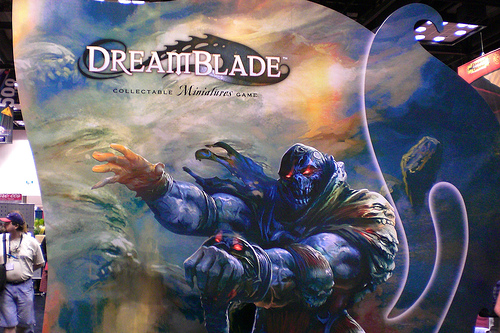
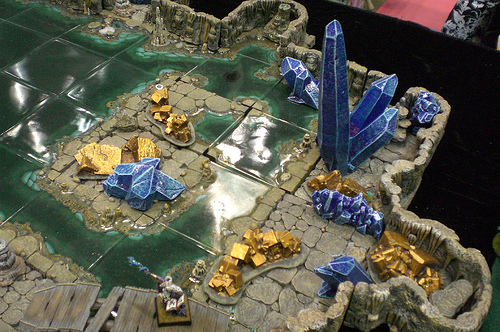
Another year, another trip into the heart of dorkness. Gen Con Indy 2006 was marked, not so much by the big releases (because there weren't that many this year), but by changes in the wind. Several newer systems were in their second year, garnering praise for their continued quality. Some games that we saw last year weren't even around this year. Others were just not doing as well as their creators would have hoped. The focus, though, was entirely on the games ... and next year's convention. The talk in the halls and on the exhibit hall floor, when not about dice and mechanics, surrounded what Gen Con will be like next year and the changes that videogames will bring to the event. Read on for my comments about what I saw this year, what worked, what didn't, and a few words on what might result from next year's changes. The most notable launch this year (if only by force of advertising alone) was Wizards of the Coast's (WotC) Dreamblade. A 'collectable miniatures' game, WotC is building on their experience with the D&D and Star Wars miniature games to try for another hit along the lines of Magic: The Gathering. You can't doubt their sincerity: a $20K tournament was held at the convention, and $1000 mini-tournaments are going to be held across the country in the coming weeks. It's difficult to describe the 'genre' of the game, but the gent demoing the title at the Wizards booth likened it to a cross between Magic and Chess. In Dreamblade, you take on the role of a Psionic master, creating creatures out of dreamstuff. Strange and twisted nightmares are summoned onto a board. You advance these creatures across the board, trying to hold certain areas while simultaneously destroying your opponent's. The game is broken up into discrete turns, and a game session has a limited number of turns before it is over. The mechanics seemed very simple to pick up, but there was a good deal of strategy inherent in the interaction between board, creatures, and players.
Last year's con report had me talking about another Wizards launch, a card game called Hecatomb. You may recall me saying 'The quick Demo I had the chance to take in wasn't enough to make me run off and buy it, but I look forward to taking a closer look in the future.' Hecatomb has since joined the creepy creatures it portrayed in deathless slumber. Just one year later, a friend bought eight starter sets of last year's 'next big thing' from a dealer for $10 and a trio of lollipops. I imagine the game died because of poor sales, but I couldn't tell you for sure what happened there. If anyone has details, please share. As surprised as I was this year to learn Hecatomb had already succumbed to market forces, I was even more surprised to see them launching a new game so soon afterwards. Dreamblade has a weightier feel than Hecatomb did last year, though. While I don't think it will be replacing D&D minis any time soon, I also have the feeling it won't be gone by the time Gen Con Indy 2007 rolls around.
Beyond card games, last year also saw the launch of a few powerhouses in the table-top roleplaying market. Shadowrun 4th edition, Mutants and Masterminds 2nd edition, and Mage: The Awakening all took the stage, to varying amounts of applause. A year later, and each of them has been well received by their intended audiences. The superhero title Mutants and Masterminds has had brisk sales as gamers come to love its very different approach to the d20 system. New supplements include a GM's guide, a campaign setting, and a brand-new powers book. Mage, as successor to White Wolf's 'Ascension' line, continues to impress old and new gamers alike. A new sister product was on offer at the con, Promethean: the Created. Promethean is a storytelling game about crafted creatures, golems or monstrosities from the labs of Frankensteinian scientists. I didn't have a chance to catch a demo, but a flip through the book and initial player reactions would indicate White Wolf is living up to its usual level of quality. Shadowrun has had a somewhat slow year, product-wise, but FanPro was offering a major release at their booth: Street Magic. This first real look at magic in the 2070s answers a lot of questions, and begins to get players and GMs into the feel of the reworked setting. From talking to the folks at their booth, and observing games around the con, adoption of the refined 4th edition rules has been a huge success. Having run a campaign with the new rules, I can definitely vouch for their simplicity and transparency.
Another 'continuing success' story revolves around the booth manned by the buccaneers of Privateer Press. Publishers of the tactical miniatures games Warmachine and Hordes, as well as the RPG setting Iron Kingoms, Privateer runs a bustling booth. As it's usually packed with enthusiastic fans, I've never really had the chance to check out their products. I'm very much late to the party, but I finally had the chance to take in some demos and I wanted to be sure to mention them. I'm not much of a wargamer, but the high-fantasy-meets-steampunk on the battlefield feel of their titles was enough to turn my head. Warmachine's uncomplicated game mechanics made a demo a highly enjoyable experience, and the incredible detail the figurines sport is something all lead-crafters should strive for. Beyond the simplicity of their wargaming offerings, I also had the chance to enjoy a session of the Iron Kingdoms RPG. Despite its D&D roots, the title felt very different from many 'traditional high fantasy' games I've played. In an industry built around new takes on old concepts, it was great to see the lengths they've gone to in order to step beyond what we think of as Dungeons and Dragons.
There were some brand-new products and announcements in the offing this year as well. An announcement I heard mentioned several times as I walked the hall is next year's plan to reintroduce the d20 Star Wars RPG. The discontinued product line is going to be relaunched, with a slimmed-down rules system and a lot of detail dropped into the game's tweaks. The reappearance of Runequest was a smaller, but just as appreciated, product event. The new line by Mongoose is a relaunch of the 1978 Chaosium title, with industry heavyweights like Robin Laws and Kenneth Hite contributing material. RuneQuest was a predecessor game for some of the most popular titles in the industry today, and so it will be very interesting to see how the new rules and setting appeal to gamers of today. The largest launch at the con, if only by virtue of physical size, was the Ptolus campaign setting from Malhavoc Press. Weighing in at over 700 pages, the book feels almost brobdingnagian to hold; just finding a comfortable position to read the thing was something of a challenge. It's well worth the effort, though. The depth of information, quality of production, and freshness of the setting are inspiring. At $120, it's certainly not for everyone, but it made quite an impression at an overall fairly quiet convention.
Two previews this year may have dipped below the radar for some convention attendees, if only by virtue of the challenges in playing them. While not yet officially launched, the World of Warcraft Trading Card Game and the EVE: Second Genesis Collectible Card Game were visible from many places in the convention hall. Actually getting the chance to learn more about them, though, was something of a trial. In point of fact, I didn't get the chance to play either of them. I can't really fault EVE's creators for my lack of information: EVE's double-decker booth had an intimidatingly long line for much of the convention. I go to Gen Con primarily to play games, and I just never had the time to wait around. If anyone has first-hand experience with CCP's newest endeavor, please feel free to share. The WoW CCG, on the other hand, was actually being demoed by appointment only. I didn't make the cut. If you're interested in the game itself, Upper Deck has a Gen Con blog, which ran for much of last weekend. In between the sycophantic statements, the author talks about some fairly interesting game mechanics that I'm sure would have been really interesting to check out.
If you'd rather your gaming be electronic in nature, there were several titles showing on the exhibit hall floor. A harbinger of next year's hoped-for flood, the few titles showing typified the computer games of years past: based in roleplaying and for roleplayers. Unsurprisingly, Dungeons and Dragons Online (DDO) was there again this year. A much less enthusiastic crowd surrounded their booth; the game's launch left few who hadn't already been exposed to the game and desperately wanted to play. Despite the lack of a fervent crowd, Turbine was proudly showing off the next module for the title and seemed to be honestly seeking player feedback on where to go next. There were several developers on-hand speaking to the con-goers, and the one that came up to me began 'Hi there. Do you have any complaints about the game?' While I'm still not sure about where they've gone with DDO, it's good to see they're honestly seeking input on what they've done so far. Mythic, on the other side of a wall from Turbine, was far less interested in such feedback. Their booth was staffed by PR and marketing hires; while perfectly nice and very willing to walk me through a demo of Warhammer Online, my technical questions about the game went over their heads. I wasn't very impressed, either with Mythic's showing or with the game itself. The buzz around the convention seemed to be that it is 'too much' of a World of Warcraft (WoW) ripoff. The thematic links between Warhammer and WoW are obvious, but Mythic didn't seem terribly interested in distancing itself from the millions-strong Blizzard title. Another very familiar face was Neverwinter Nights 2, the unapologetic sequel to the 2002 Bioware title. Essentially 'just' a prettier version of the first game, with updates to the Dungeons and Dragons 3.5 rules-set, it was still one of the most popular PC games at the convention. The module construction tool was available for perusal as well. While I only had a few minutes to slap together a bare-bones adventure, the whole experience was very intuitive. They've obviously made some major improvements over the Aurora set, and have made the members of the (still-active) Neverwinter community very pleased.
Pleased would also be the best way to describe my reaction to the highly original Pirates of the Burning Sea, (PotBS) which I got to have my first hands-on time with at the convention. Far from 'yet another boring fantasy knock-off', PotBS is going to have Massive gamers yarring in delight when it launches. Ship combat is fast paced, while still remaining highly strategic. There are a number of factions to fight for or against, and a highly involved PvP system that will allow for real 'ownership' of the game world. Pirates was far and away the highlight of my Gen Con experience, and I'm very much looking forward its commercial launch. They're announcing their ship date on the 25th of the month, at PAX, and I certainly hope it's sooner rather than later. A quirky, already available title also on the show floor was the engaging Pox Nora. Essentially an online fantasy miniatures game, Pox is priced at the appealing level of free. Gameplay is a one-on-one skirmish between two players. They pit their randomly assigned figurine armies against each other, taking control of strategic areas of the game board while trying to destroy the other player's units and structures. It's a little odd to get used to at first, but I highly recommend giving it a try if you have some free time.
Free time was the last thing I had this past weekend. As with every year I barely managed to scratch the surface of what was going on around the con. I didn't make it to the ENnies again, and so wasn't there to see table-top gaming's awards show make legends of products and people. I was particularly glad to see that Paizo's Shackled City Adventure Path got several firm nods. The new editions of Shadowrun and Mutants and Masterminds were also highly lauded. I picked up the new Order of the Stick book, No Cure for the Paladin Blues, but didn't have a chance to play the OOTS card/board game. The reaction from a few people I spoke to was kind of 'eh', but they sold out their entire stock on the first day of the convention just the same. I played the live action corridor romp True Dungeon again this year, and this time around it just plain old sucked eggs. My group made it to the last room perfectly fine (where we died, which is to be expected), but the entire event felt poorly planned and executed compared to previous experiences. I will definitely not be playing again next year. I also didn't have the inclination or finances to buy one of the two massive D&D figurines Wizards of the Coast was showing off at the convention. The Gargantuan Black Dragon, already available, stood wing-to-wing with the as yet unreleased Colossal Red. Along with the enormous Cthulu HorrorClix figure (another game I didn't get to play this con), they ensured there were many people lugging around too-big boxes for much of the event. I also didn't get a chance to see the screenings of The Gamers 2, or attend the Videogames Live concert that coincided with the weekend's festivities. There's always so much going on at Gen Con, it's a yearly trial to prioritize what 'has' to be done.
One thing I did get to see was a trailer for Dungeon Runners, one of the new 'free' games that NCSoft is developing. The presence of videogames was notably larger this year, with a room set aside for the videogaming tournaments and a large screen in one of the main hallways displaying trailers for upcoming titles. Last year (and in years previous) videogames were relegated to some out-of-the-way corner of the convention, as more traditional gaming types retained the attention of advertisers, companies, and attendees. All of these elements were signs of things to come. As you've no doubt heard by this point, the downsizing of E3 next year has resulted in a number of pretenders to the throne. Gen Con LLC has announced their intention to try for the crown. Gen Con So Cal will be moved to the LA Convention center next year, and Indy is going to be offering an additional 43,000 square feet to videogame publishers and developers that would like to get some face time with the pen-and-paper set. Opinions were decidedly mixed at the convention, and I have to say that I'm more than a little trepidacious about what these changes might mean for the 'best four days in gaming'.
The Indy convention is the successor to the con held in Milwaukee for many years. It has always held a place of honor as the 'con of cons', but that place is no longer assured. I simply can't see game publishers wanting to trek out to the Midwest, when there is a perfectly good alternative a few months later on the West coast. I'm definitely biased, being a midwesterner myself, but I hate to think of the tradition of Gen Con being tossed aside in a bid for videogaming advertising dollars. Gen Con has always been about wargaming, pen and paper RPGs, miniatures, card games ... it's nerdy and 'uncool', to be sure, but for the people who care about such things this convention has always been a place they could call 'home'. The cover for this year's events booklet even bought into that sentiment, saying in as many words "Welcome to Gen Con ... Welcome Home!"
The slick production values of an E3-like spectacle have no place in the world of shoulder-dragon-wearing gamer hippies, chicks in chainmail bikinis, and smelly dorks chortling over the latest escapades of Drizzt Do' Urden. If videogames come to Gen Con on their terms, with bright lights and booth babes, the Gen Con that I've enjoyed for so many years will be over and done with. If Peter Adkinson and Co. are serious about incorporating electronic gaming into this pen-and-paper palace, they're going to need to bring videogames to us on our terms. Keep things friendly, keep them relatively quiet, and speak honestly about what you have to offer. The future of Gen Con will be written in the events of 2007 and despite my fears I'll be there for yet another year of dice, cards, and German board games. It is, after all, a little piece of home. -
Poincare Conjecture Proof Completed
Flamerule writes "A New York Times article has finally provided an update on the status of Grigori Perelman's 2003 rough proof of the Poincaré Conjecture. 3 years ago, Perelman published several papers online explaining his idea for proving the conjecture, but after giving lectures at MIT and several other schools (covered on Slashdot) he returned to Russia, where he's remained silent since. Now, mathematicians in the US and elsewhere have finally finished going over his work and have produced several papers, totaling 1000 pages, that give step-by-step, complete proofs of the conjecture. In addition to winning some or all of the $1,000,000 Millennium Prize, Perelman now seems to be the favorite to receive a Fields Medal at the International Mathematics Union meeting next week, but it's not clear that he'll even show up!" -
Poincare Conjecture Proof Completed
Flamerule writes "A New York Times article has finally provided an update on the status of Grigori Perelman's 2003 rough proof of the Poincaré Conjecture. 3 years ago, Perelman published several papers online explaining his idea for proving the conjecture, but after giving lectures at MIT and several other schools (covered on Slashdot) he returned to Russia, where he's remained silent since. Now, mathematicians in the US and elsewhere have finally finished going over his work and have produced several papers, totaling 1000 pages, that give step-by-step, complete proofs of the conjecture. In addition to winning some or all of the $1,000,000 Millennium Prize, Perelman now seems to be the favorite to receive a Fields Medal at the International Mathematics Union meeting next week, but it's not clear that he'll even show up!" -
Poincare Conjecture Proof Completed
Flamerule writes "A New York Times article has finally provided an update on the status of Grigori Perelman's 2003 rough proof of the Poincaré Conjecture. 3 years ago, Perelman published several papers online explaining his idea for proving the conjecture, but after giving lectures at MIT and several other schools (covered on Slashdot) he returned to Russia, where he's remained silent since. Now, mathematicians in the US and elsewhere have finally finished going over his work and have produced several papers, totaling 1000 pages, that give step-by-step, complete proofs of the conjecture. In addition to winning some or all of the $1,000,000 Millennium Prize, Perelman now seems to be the favorite to receive a Fields Medal at the International Mathematics Union meeting next week, but it's not clear that he'll even show up!" -
Astronomers Make Important Dark Matter Discovery
saudadelinux writes "To quote a press release on NASA's site, astronomers using the Chandra X-ray Observatory have discovered 'how dark and normal matter have been forced apart in an extraordinarily energetic collision.' There will be a briefing at noon, August 21 ET, on this discovery, with streaming media provided by NASA, and some details of the research posted on Harvard's Chandra site just beforehand." -
The Game Design of Survivor
Wired has an article looking at a game designer working in a fairly unique space: reality television. Clive Thompson discusses the game design of the show Survivor , done mostly by the show's creator Mark Burnett. From the article: "While tweaking Survivor, he closely studied John Nash's game theory in order to better engineer the hysteria and emotional blowouts of each season's finale. 'What Nash's theory predicts is that whenever you have a group of people competing, they collude to squeeze one guy out, again and again, until there's only two guys left,' Burnett notes. 'Yet when there are only two of us left, we're surprised when one of us [screws] each other over. That's the fun part. It surprised John Nash himself, but it happens every time.'" -
Compress Wikipedia and Win AI Prize
Baldrson writes "If you think you can compress a 100M sample of Wikipedia better than paq8f, then you might want to try winning win some of a (at present) 50,000 Euro purse. Marcus Hutter has announced the Hutter Prize for Lossless Compression of Human Knowledge the intent of which is to incentivize the advancement of AI through the exploitation of Hutter's theory of optimal universal artificial intelligence. The basic theory, for which Hutter provides a proof, is that after any set of observations the optimal move by an AI is find the smallest program that predicts those observations and then assume its environment is controlled by that program. Think of it as Ockham's Razor on steroids. Matt Mahoney provides a writeup of the rationale for the prize including a description of the equivalence of compression and general intelligence." -
Compress Wikipedia and Win AI Prize
Baldrson writes "If you think you can compress a 100M sample of Wikipedia better than paq8f, then you might want to try winning win some of a (at present) 50,000 Euro purse. Marcus Hutter has announced the Hutter Prize for Lossless Compression of Human Knowledge the intent of which is to incentivize the advancement of AI through the exploitation of Hutter's theory of optimal universal artificial intelligence. The basic theory, for which Hutter provides a proof, is that after any set of observations the optimal move by an AI is find the smallest program that predicts those observations and then assume its environment is controlled by that program. Think of it as Ockham's Razor on steroids. Matt Mahoney provides a writeup of the rationale for the prize including a description of the equivalence of compression and general intelligence." -
What's Spreading "the AJAX Wildfire"?
An anonymous reader writes "AJAXWorld Magazine is running an article entitled "What's So Special About AJAX?" in which the majority of the contributors agree among themselves that AJAX "heralds a new, global sense of what the web can be and what the web can do, in ways that are so different but so much better than what we have been used to." While many of those the magazine consulted adduced technical reasons for the spread what one of them, Rich Internet Application pioneer Coach Wei, calls "the AJAX wildfire," only two mention how human nature — including that of software developers — is, well, notoriously susceptible to the latest fad. Which side would you agree with?" -
James A. Van Allen - Dies at 91
Diamonddavej writes "The New York Times reports that the respected astrophysicist, James A. Van Allen, died yesterday at the age of 91. Apparently the fellow regularly worked at his office/laboratory up until a month ago. Prof. Van Allen team designed the Geiger counter that flew aboard Americas first orbiting satellite, Explorer 1. It detected unexpectedly intense levels of radiation caused by energetic particles trapped in the Earth magnetic field, the magnetosphere. The belts of radiation were mapped and characterised by later missions and were named the Van Allen belts in honour of their discoverer." -
James A. Van Allen - Dies at 91
Diamonddavej writes "The New York Times reports that the respected astrophysicist, James A. Van Allen, died yesterday at the age of 91. Apparently the fellow regularly worked at his office/laboratory up until a month ago. Prof. Van Allen team designed the Geiger counter that flew aboard Americas first orbiting satellite, Explorer 1. It detected unexpectedly intense levels of radiation caused by energetic particles trapped in the Earth magnetic field, the magnetosphere. The belts of radiation were mapped and characterised by later missions and were named the Van Allen belts in honour of their discoverer." -
James A. Van Allen - Dies at 91
Diamonddavej writes "The New York Times reports that the respected astrophysicist, James A. Van Allen, died yesterday at the age of 91. Apparently the fellow regularly worked at his office/laboratory up until a month ago. Prof. Van Allen team designed the Geiger counter that flew aboard Americas first orbiting satellite, Explorer 1. It detected unexpectedly intense levels of radiation caused by energetic particles trapped in the Earth magnetic field, the magnetosphere. The belts of radiation were mapped and characterised by later missions and were named the Van Allen belts in honour of their discoverer." -
Bittorrent Implements Cache Discovery Protocol
An anonymous reader writes "CacheLogic and BitTorrent introduce an open-source Cache Discovery Protocol (CDP) that allows ISP's to cache and seed Bittorrent traffic. Currently, Bittorrent traffic is suffering from bandwidth throttling ISP's that claim that Bittorrent traffic is cluttering their pipes. This motivated the developers of the most popular Bittorrent clients implement protocol encryption to protect bittorrent users from being slowed down by their ISP's. However, Bram Cohen, the founder of Bittorrent doubted that encryption was the solution, and found (together with CacheLogic) a more ISP friendly alternative." -
Mac Pro, Mac OS X Virtual Desktops Announced at WWDC
haym37 writes "Of the many announcements yet to come at WWDC, the first is the announcement of the Mac Pro. The Mac Pro contains two Intel Xeons, up to 3 GHz, and is supposed to be 1.6x to 2.1x the speed of the PowerMac G5 quad. It can hold up to 2 TB of internal storage and up to 16 GB of memory. The graphics card can be up to a Radeon x1900 or an FX4500. The case will be the same as the PowerMac." MacRumors.com is providing running coverage from the floor (Note: "[U]pdates will be automatically inserted at the top of the updates section. Do not reload manually."), including another announcement that OS X will include virtual desktops. What a great idea! -
Lotus 'Agenda' Returns as Open-Source 'Chandler'
RobotRunAmok writes "Before there was Outlook, or Evolution, or The Brain, there was Lotus Agenda, a DOS-based Personal Information Manager created by Mitch Kapor. Wired is reporting that Kapor is throwing 5 Million USD at the Open Source Applications Foundation to create an open-source resurrection of this PIM-Of-The-Gods in the form of Chandler, available now as an alpha for Windows, Linux, and Mac. For the Agenda hardcore among us, it's as though Atlantis is rising..." -
Lifeboat Foundation Nanoshield
Maria Williams writes "KurzweilAI.net says: Tomorrow's biggest danger may be nanoweapons (grey goo and other) created with molecular manufacturing. The Lifeboat Foundation proposes development of detection methods, such as infrared satellite surveillance for nanobot signatures, along with a three-layer defense system, with devices such as an orbiting mirror to focus concentrated sunlight on an ecophagic outbreak." -
Lifeboat Foundation Nanoshield
Maria Williams writes "KurzweilAI.net says: Tomorrow's biggest danger may be nanoweapons (grey goo and other) created with molecular manufacturing. The Lifeboat Foundation proposes development of detection methods, such as infrared satellite surveillance for nanobot signatures, along with a three-layer defense system, with devices such as an orbiting mirror to focus concentrated sunlight on an ecophagic outbreak." -
Lifeboat Foundation Nanoshield
Maria Williams writes "KurzweilAI.net says: Tomorrow's biggest danger may be nanoweapons (grey goo and other) created with molecular manufacturing. The Lifeboat Foundation proposes development of detection methods, such as infrared satellite surveillance for nanobot signatures, along with a three-layer defense system, with devices such as an orbiting mirror to focus concentrated sunlight on an ecophagic outbreak." -
Lifeboat Foundation Nanoshield
Maria Williams writes "KurzweilAI.net says: Tomorrow's biggest danger may be nanoweapons (grey goo and other) created with molecular manufacturing. The Lifeboat Foundation proposes development of detection methods, such as infrared satellite surveillance for nanobot signatures, along with a three-layer defense system, with devices such as an orbiting mirror to focus concentrated sunlight on an ecophagic outbreak." -
Lifeboat Foundation Nanoshield
Maria Williams writes "KurzweilAI.net says: Tomorrow's biggest danger may be nanoweapons (grey goo and other) created with molecular manufacturing. The Lifeboat Foundation proposes development of detection methods, such as infrared satellite surveillance for nanobot signatures, along with a three-layer defense system, with devices such as an orbiting mirror to focus concentrated sunlight on an ecophagic outbreak." -
Domesday Book Goes Online
Accommodate Students writes "The Domesday Book has gone online. As one of the earliest public records goes online, anyone with an internet connection will be able to access this important document. Amongst other interesting facts, the BBC is reporting that the Book can still be used today in court for property disputes. In an interesting development, the National Archives are making online searches free, but downloads of data will cost £3.50 (approx $6.50 US). Similar launches of historical websites in the past have struggled to keep up with server loads in their first days and weeks, so it remains to be seen whether the Domesday Book online will be more or less fragile than the parchment originals." -
Castlevania Retrospective, Xbox Live Bound
astrokid writes "From last week, 1up is running an informative look back at the Castlevania series. Although I am looking forward to Portrait of Ruin for the Nintendo DS, I really hope Konami finds a way to release a 2D game for one of the next gen systems." Funny you should mention that. An anonymous reader writes "The greatest Castlevania game -- and possibly 2D game -- of all time, Symphony of the Night, is headed to Xbox 360 Arcade!." -
Japan Plans a Moonbase by 2030
Aglassis writes "The Japanese Aerospace Exploration Agency (JAXA) announced at a conference that they are planning to build a Moonbase by 2030. Since JAXA doesn't currently have a 100 ton-class heavy lift rocket or a human transportation system perhaps now is a good time for JAXA to join in with NASA on the Project Constellation rocket program."