 Slashdot Mirror
Domain: wikipedia.org
Stories and comments across the archive that link to wikipedia.org.
Stories · 7,048
-
America 'Has Become a War Zone'
An anonymous reader writes, quoting Business Insider: "Eight different law enforcement agencies in Indiana have purchased massive Mine-Resistant Ambush Protected vehicles (MRAP) that were formerly used in Iraq and Afghanistan, Mark Alesia reports for the Indy Star. Pulaski County, home to 13,124 people, is one of the counties that have purchased an 55,000 pound, six-wheeled patrol vehicles, from military surplus. When asked to justify the purchase of a former military vehicle, Pulaski County Sheriff Michael Gayer told the Indy Star: "The United States of America has become a war zone."' -
Ask Slashdot: A 'Mavis Beacon' For Teaching Smartphone and Tablet Typing?
theodp writes: "Where have you gone, Mavis Beacon? A nation of smartphone and tablet typists could use your help. You've seen people type fast-and-furiously on smartphones and tablets, so you know it can be done, but how exactly do these one- and two-fingered wonders (YouTube video) manage to do so? Is it their reaction time? Technique? Both? Back in the day, touch-typing teachers showed kids the secrets to higher word-per-minute scores on their Smith Coronas. Later, typing tutor software got kids up-to-speed on PCs. So, with over 1 billion smartphones and 200 million or so tablets shipped in 2013, what are the best software and tutorials that teach mobile typing techniques? And what platform specific features — iOS, Android, WP8/Win8, BB — do you find make your mobile typing life a whole lot easier?" -
Ask Slashdot: A 'Mavis Beacon' For Teaching Smartphone and Tablet Typing?
theodp writes: "Where have you gone, Mavis Beacon? A nation of smartphone and tablet typists could use your help. You've seen people type fast-and-furiously on smartphones and tablets, so you know it can be done, but how exactly do these one- and two-fingered wonders (YouTube video) manage to do so? Is it their reaction time? Technique? Both? Back in the day, touch-typing teachers showed kids the secrets to higher word-per-minute scores on their Smith Coronas. Later, typing tutor software got kids up-to-speed on PCs. So, with over 1 billion smartphones and 200 million or so tablets shipped in 2013, what are the best software and tutorials that teach mobile typing techniques? And what platform specific features — iOS, Android, WP8/Win8, BB — do you find make your mobile typing life a whole lot easier?" -
Virginia DMV Cracks Down On Uber, Lyft
An anonymous reader writes 'Talk about regulatory capture! As radio station WTOP reports, "The Virginia Department of Motor Vehicles says that ride services Lyft and Uber are violating state law and must stop operating immediately. The DMV sent cease and desist orders to both companies Thursday." Who benefits most? It's not the people who are voting with their dollars and feet — seems more like the current stable of taxi drivers and others blessed by the state of Virginia. Good thing there's no call for or benefit from greater per-car occupancy, or experimentation more generally with disruptive disintermediation. Given enough bribe money down the road, I'm sure a deal can be struck, though.' -
Aspiring Astronaut Gideon Gidori Invents a New Holiday: Star Day (Video)
Gideon wants to be an astronaut. You could even describe him as "space-obsessed." He wants to be the first astronaut from Tanzania. The only African to make it into space so far is Mark Shuttleworth, who is from South Africa. Can Gideon talk Elon Musk into launching from Tanzania, which is directly on the equator? How about bringing in other space buffs and entrepreneurs? Don't think this is a silly idea. Gideon is only 14, but he's a straight-A student at the Florida Air Academy, and before that was one of the top students at Shepherds Junior School in Arusha, which Mama Lucy Kamptoni originally financed by raising and selling chickens. Gideon's scholarships to Shepherds and later to Florida Air Academy have been financed in part by EpicChange.org, which is also helping him spread the word about Star Day (tomorrow; June 7), the holiday Gideon created, which is being celebrated all over the world even in this, its first year of existence. You can celebrate it, too. All you have to do, weather permitting, is sleep outdoors under the stars, and maybe make a wish or two. After all, wishing (and a lot of studying and hard work) have helped Gideon get to where he is today, and may yet help him become Tanzania's first astronaut. -
Aspiring Astronaut Gideon Gidori Invents a New Holiday: Star Day (Video)
Gideon wants to be an astronaut. You could even describe him as "space-obsessed." He wants to be the first astronaut from Tanzania. The only African to make it into space so far is Mark Shuttleworth, who is from South Africa. Can Gideon talk Elon Musk into launching from Tanzania, which is directly on the equator? How about bringing in other space buffs and entrepreneurs? Don't think this is a silly idea. Gideon is only 14, but he's a straight-A student at the Florida Air Academy, and before that was one of the top students at Shepherds Junior School in Arusha, which Mama Lucy Kamptoni originally financed by raising and selling chickens. Gideon's scholarships to Shepherds and later to Florida Air Academy have been financed in part by EpicChange.org, which is also helping him spread the word about Star Day (tomorrow; June 7), the holiday Gideon created, which is being celebrated all over the world even in this, its first year of existence. You can celebrate it, too. All you have to do, weather permitting, is sleep outdoors under the stars, and maybe make a wish or two. After all, wishing (and a lot of studying and hard work) have helped Gideon get to where he is today, and may yet help him become Tanzania's first astronaut. -
Aspiring Astronaut Gideon Gidori Invents a New Holiday: Star Day (Video)
Gideon wants to be an astronaut. You could even describe him as "space-obsessed." He wants to be the first astronaut from Tanzania. The only African to make it into space so far is Mark Shuttleworth, who is from South Africa. Can Gideon talk Elon Musk into launching from Tanzania, which is directly on the equator? How about bringing in other space buffs and entrepreneurs? Don't think this is a silly idea. Gideon is only 14, but he's a straight-A student at the Florida Air Academy, and before that was one of the top students at Shepherds Junior School in Arusha, which Mama Lucy Kamptoni originally financed by raising and selling chickens. Gideon's scholarships to Shepherds and later to Florida Air Academy have been financed in part by EpicChange.org, which is also helping him spread the word about Star Day (tomorrow; June 7), the holiday Gideon created, which is being celebrated all over the world even in this, its first year of existence. You can celebrate it, too. All you have to do, weather permitting, is sleep outdoors under the stars, and maybe make a wish or two. After all, wishing (and a lot of studying and hard work) have helped Gideon get to where he is today, and may yet help him become Tanzania's first astronaut. -
US Marshals Seize Police Stingray Records To Keep Them From the ACLU
An anonymous reader writes 'A routine request in Florida for public records regarding the use of a surveillance tool known as stingray took an extraordinary turn recently when federal authorities seized the documents before police could release them. "This is consistent with what we've seen around the country with federal agencies trying to meddle with public requests for stingray information," Wessler said, noting that federal authorities have in other cases invoked the Homeland Security Act to prevent the release of such records. "The feds are working very hard to block any release of this information to the public." ... "We've seen our fair share of federal government attempts to keep records about stingrays secret, but we've never seen an actual physical raid on state records in order to conceal them from public view," the ACLU wrote in a blog post today.' -
Nanoparticles Used To Create Thermal 'Barcodes'
Rambo Tribble (1273454) writes 'Researchers from the Worcester Polytechnic Institute, in Massachusetts, have developed nanoparticles with distinct melting points, which they suggest be used as forensic "barcodes" to identify the origins and integrity of things such as explosives and currency [PDF]. To demonstrate the technique, the researchers used the explosive, TNT, as a test case. Commenting on the viability of the approach, researcher Dr Ming Su said, 'The nanoparticle does not participate in any chemical reaction, and it will not effect the function of the existing object. The only thing it will do is to provide a thermal signature.' He added, 'Nanoparticles are so small, they can be put into any objects.' The BBC has more approachable coverage.' -
Lepton Universality In Question, a Standard Model Assumption
Charliemopps writes: "Over the past few years, more and more experiments have started to question one of the core assumptions of the standard model: Lepton Universality. Simply put, the weak nuclear force is assumed to work equally on all Leptons (electron, muon and tau). Two years ago The Babar experimental collaboration reported that measurements indicated this may not have been the case. But the measurements were not accurate enough to be definitive.
Now, a report from The LHC shows that they have analyzed their entire dataset of proton-proton collisions and found a rather large discrepancy. These measurements are still not all that accurate. These decays happen so rarely that even with this huge data set there is still about a 1% change they are incorrect. One explanation for such measurements is an as-yet-undiscovered, charged Higgs particle. It would have to be extremely heavy: greater than 109GeV possibly even as high as 150GeV. This is predicted by some models outside of the Standard Model, like Supersymmetry." -
Lepton Universality In Question, a Standard Model Assumption
Charliemopps writes: "Over the past few years, more and more experiments have started to question one of the core assumptions of the standard model: Lepton Universality. Simply put, the weak nuclear force is assumed to work equally on all Leptons (electron, muon and tau). Two years ago The Babar experimental collaboration reported that measurements indicated this may not have been the case. But the measurements were not accurate enough to be definitive.
Now, a report from The LHC shows that they have analyzed their entire dataset of proton-proton collisions and found a rather large discrepancy. These measurements are still not all that accurate. These decays happen so rarely that even with this huge data set there is still about a 1% change they are incorrect. One explanation for such measurements is an as-yet-undiscovered, charged Higgs particle. It would have to be extremely heavy: greater than 109GeV possibly even as high as 150GeV. This is predicted by some models outside of the Standard Model, like Supersymmetry." -
Lepton Universality In Question, a Standard Model Assumption
Charliemopps writes: "Over the past few years, more and more experiments have started to question one of the core assumptions of the standard model: Lepton Universality. Simply put, the weak nuclear force is assumed to work equally on all Leptons (electron, muon and tau). Two years ago The Babar experimental collaboration reported that measurements indicated this may not have been the case. But the measurements were not accurate enough to be definitive.
Now, a report from The LHC shows that they have analyzed their entire dataset of proton-proton collisions and found a rather large discrepancy. These measurements are still not all that accurate. These decays happen so rarely that even with this huge data set there is still about a 1% change they are incorrect. One explanation for such measurements is an as-yet-undiscovered, charged Higgs particle. It would have to be extremely heavy: greater than 109GeV possibly even as high as 150GeV. This is predicted by some models outside of the Standard Model, like Supersymmetry." -
Star Within a Star: Thorne-Zytkow Object Discovered
astroengine writes: "A weird type of 'hybrid' star has been discovered nearly 40 years since it was first theorized — but until now has been curiously difficult to find. In 1975, renowned astrophysicists Kip Thorne, of the California Institute of Technology (Caltech) in Pasadena, Calif., and Anna Zytkow, of the University of Cambridge, UK, assembled a theory on how a large dying star could swallow its neutron star binary partner, thus becoming a very rare type of stellar hybrid, nicknamed a Thorne-Zytkow object (or TZO). The neutron star — a dense husk of degenerate matter that was once a massive star long since gone supernova — would spiral into the red supergiant's core, interrupting normal fusion processes. According to the Thorne-Zytkow theory, after the two objects have merged, an excess of the elements rubidium, lithium and molybdenum will be generated by the hybrid. So astronomers have been on the lookout for stars in our galaxy, which is thought to contain only a few dozen of these objects at any one time, with this specific chemical signature in their atmospheres. Now, according to Emily Levesque of the University of Colorado Boulder and her team, a bona fide TZO has been discovered and their findings have been accepted for publication in the Monthly Notices of the Royal Astronomical Society Letters." -
The Disappearing Universe
StartsWithABang writes: "If everything began with the Big Bang — from a hot, dense, expanding state — and things have been cooling, spreading out, but slowing down ever since, you might think that means that given enough time (and a powerful enough space ship), we'll eventually be able to reach any other galaxy. But thanks to dark energy, not only is that not the case at all, but most of the galaxies in our Universe are already completely unreachable by us, with more leaving our potential reach all the time. Fascinating, terrifying stuff." -
Ask Slashdot: Where's the Most Unusual Place You've Written a Program From?
theodp writes: "Michael Raithel was polling the SAS crowd, but it'd be interesting to hear the answers to the programming questions he posed from a broader audience: 1. What is the most unusual location you have written a program from? 2. What is the most unusual circumstance under which you have written a program? 3. What is the most unusual computing platform that you wrote a program from? 4. What is the most unusual application program that you wrote?" -
'Godfather of Ecstasy,' Chemist Sasha Shulgin Dies Aged 88
EwanPalmer (2536690) writes "Alexander 'Sasha' Shulgin, the chemist, pharmacologist and author known for popularizing the drug MDMA as well as creating and synthesizing hundreds of psychoactive drugs, has died aged 88. Shulgin was known for discovering, creating and personally testing hundreds of psychoactive chemicals and documenting the results, along with his wife, in his books and papers. He is also known for introducing the positive aspects of MDMA to psychologists, which in term helped it become a popular recreational drug in the 1980s." With less irritation from auto-playing video sound, try the BBC. -
Optical Levitation, Space Travel, Quantum Mechanics and Gravity
An anonymous reader writes "Light doesn't just make things brighter; it can also push things around. Normally this "radiation pressure" force is so small you don't notice it. But if you get a really big mirror then you could use it to power a space ship to the stars. This is the idea behind solar sails. The impact of light is more obvious on small things. Scientists are thinking about levitation of a mirror that would be large enough to see with the naked eye. If this turns out to work, the motion of the floating mirror could be used to probe the physics that connects quantum theory and general relativity." -
Optical Levitation, Space Travel, Quantum Mechanics and Gravity
An anonymous reader writes "Light doesn't just make things brighter; it can also push things around. Normally this "radiation pressure" force is so small you don't notice it. But if you get a really big mirror then you could use it to power a space ship to the stars. This is the idea behind solar sails. The impact of light is more obvious on small things. Scientists are thinking about levitation of a mirror that would be large enough to see with the naked eye. If this turns out to work, the motion of the floating mirror could be used to probe the physics that connects quantum theory and general relativity." -
Daniel Ellsberg: Snowden Would Not Get a Fair Trial – and Kerry Is Wrong
Daniel Ellsberg, no slouch himself in bringing to public awareness documents that reveal uncomfortable facts about government operations, says that "Edward Snowden is the greatest patriot whistleblower of our time." Ellsberg says, in an editorial at The Guardian pointed out by reader ABEND (15913), that Snowden cannot receive a fair trial without reform of the Espionage Act. According to Ellsberg, "Snowden would come back home to a jail cell – and not just an ordinary cell-block but isolation in solitary confinement, not just for months like Chelsea Manning but for the rest of his sentence, and probably the rest of his life. His legal adviser, Ben Wizner, told me that he estimates Snowden's chance of being allowed out on bail as zero. (I was out on bond, speaking against the Vietnam war, the whole 23 months I was under indictment). More importantly, the current state of whistleblowing prosecutions under the Espionage Act makes a truly fair trial wholly unavailable to an American who has exposed classified wrongdoing. Legal scholars have strongly argued that the US supreme court – which has never yet addressed the constitutionality of applying the Espionage Act to leaks to the American public – should find the use of it overbroad and unconstitutional in the absence of a public interest defense. The Espionage Act, as applied to whistleblowers, violates the First Amendment, is what they're saying. As I know from my own case, even Snowden's own testimony on the stand would be gagged by government objections and the (arguably unconstitutional) nature of his charges. That was my own experience in court, as the first American to be prosecuted under the Espionage Act – or any other statute – for giving information to the American people." Ellsberg rejects the distinction made by John Kerry in praising Ellsberg's own whistleblowing as patriotic, but Snowden's as cowardly and traitorous. -
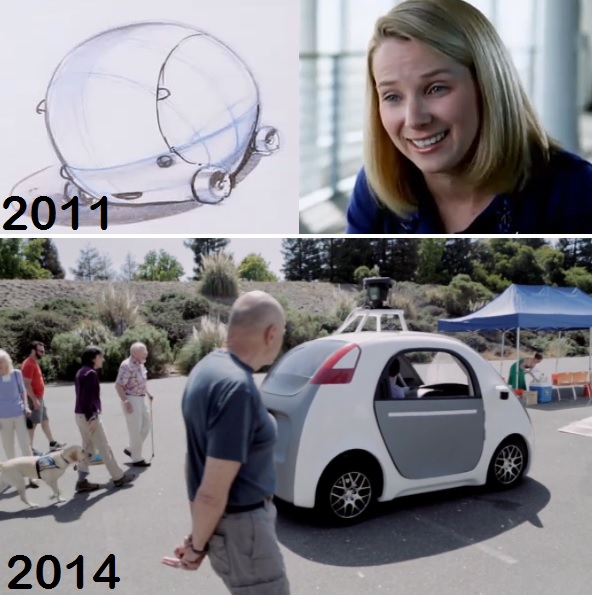
Is Google CEO's "Tiny Bubble Car" Yahoo CEO's "Little Bubble Car"?
theodp (442580) writes "Back in 2011, then-Google VP and now-Yahoo CEO Marissa Mayer brainstormed with BMW to sketch out an idea she had for self-driving 'little bubbles' that could ease office commutes. Here's Mayer's pitch from a BMW film short: 'All I really need is a little bubble that drives itself and when it runs into something, it doesn't hurt that much...and...you know, like it doesn't actually take up that much fuel because it's so lightweight and it's good for the environment for that reason.' So, with Google's newly-built, steering wheel-less self-driving car being described as a 'tiny bubble-car', one wonders if Google CEO Larry Page's "Tiny Bubble Car" has its roots in Mayer's 'Little Bubble Car,' especially considering the striking similarity of Mayer's concept car sketch and Google's built vehicle." Seems to me there's been plenty of concept art (as well as actual tiny bubble-like cars, even if they generallly have had steering wheels) for car designers to draw on. -
New Federal Database Will Track Americans' Credit Ratings, Other Financial Info
schwit1 (797399) writes "As many as 227 million Americans may be compelled to disclose intimate details of their families and financial lives — including their Social Security numbers — in a new national database being assembled by two federal agencies. The Consumer Financial Protection Bureau posted an April 16 Federal Register notice of an expansion of their joint National Mortgage Database Program to include personally identifiable information that reveals actual users, a reversal of previously stated policy. The FHFA will manage the database and share it with CFPB. A CFPB internal planning document for 2013-17 describes the bureau as monitoring 95 percent of all mortgage transactions. FHFA officials claim the database is essential to conducting a monthly mortgage survey required by the Housing and Economic Recovery Act of 2008 and to help it prepare an annual report for Congress." -
New Federal Database Will Track Americans' Credit Ratings, Other Financial Info
schwit1 (797399) writes "As many as 227 million Americans may be compelled to disclose intimate details of their families and financial lives — including their Social Security numbers — in a new national database being assembled by two federal agencies. The Consumer Financial Protection Bureau posted an April 16 Federal Register notice of an expansion of their joint National Mortgage Database Program to include personally identifiable information that reveals actual users, a reversal of previously stated policy. The FHFA will manage the database and share it with CFPB. A CFPB internal planning document for 2013-17 describes the bureau as monitoring 95 percent of all mortgage transactions. FHFA officials claim the database is essential to conducting a monthly mortgage survey required by the Housing and Economic Recovery Act of 2008 and to help it prepare an annual report for Congress." -
German Intelligence Agency Planning To Follow Big NSA Brother On Shoestring
An anonymous reader, tongue in cheek, writes"Facebook, Twitter, et al are tools for terrorists planning to do whatever terrorists do, Germany's BND has discovered. Inevitably, real-time monitoring of these sites is necessary and urgently required [original, in German], not least because that Snowden chap has shown we're running behind the U.S. and UK. And Spain. And Italy. In short, it's a national emergency — 300 million euros, presto please — and if we do this smartly, we could even get a sense of what the population outside Germany thinks. And while we're at it, why not throw in automated enemy face recognition too — and biometry and-and a program to deform the faces of our own spies' selfies, so the enemy cannot google them. Time to invest in national security startups." -
Terran Computational Calendar Introduces Minimonths, Year Bases, and Datemods
First time accepted submitter TC+0 (3672227) writes "Inspired by comments regarding its first incarnation, the Terran Computational Calendar's recent redefinition now includes dynamic support for 'leap duration', 'year bases', and 'datemods'. Here's the new abstract from terrancalendar.com (wikia mirror) captured at 44.5.20,6.26.48 TC+7H:
Synchronized with the northern winter solstice, the terran computational calendar began roughly* 10 days before the UNIX Epoch. Each year is composed of 13 identical 28-day months, followed by a 'minimonth' that houses leap days (one most years and two every 4th but not 128th year) and leap seconds (issued by the IERS during that year). Each date is an unambiguous instant in time that exploits zero-based numbering and a handful of delimiters to represent the number of years and constant length months, days, hours, minutes, and seconds that have elapsed since 0TC (the calendar's starting point). An optional 'year base' may be applied to ignore erratic leap duration. Arithmetic date adjusting 'datemods' can be applied to define things like weeks, quarters, and regional times." -
Terran Computational Calendar Introduces Minimonths, Year Bases, and Datemods
First time accepted submitter TC+0 (3672227) writes "Inspired by comments regarding its first incarnation, the Terran Computational Calendar's recent redefinition now includes dynamic support for 'leap duration', 'year bases', and 'datemods'. Here's the new abstract from terrancalendar.com (wikia mirror) captured at 44.5.20,6.26.48 TC+7H:
Synchronized with the northern winter solstice, the terran computational calendar began roughly* 10 days before the UNIX Epoch. Each year is composed of 13 identical 28-day months, followed by a 'minimonth' that houses leap days (one most years and two every 4th but not 128th year) and leap seconds (issued by the IERS during that year). Each date is an unambiguous instant in time that exploits zero-based numbering and a handful of delimiters to represent the number of years and constant length months, days, hours, minutes, and seconds that have elapsed since 0TC (the calendar's starting point). An optional 'year base' may be applied to ignore erratic leap duration. Arithmetic date adjusting 'datemods' can be applied to define things like weeks, quarters, and regional times." -
Terran Computational Calendar Introduces Minimonths, Year Bases, and Datemods
First time accepted submitter TC+0 (3672227) writes "Inspired by comments regarding its first incarnation, the Terran Computational Calendar's recent redefinition now includes dynamic support for 'leap duration', 'year bases', and 'datemods'. Here's the new abstract from terrancalendar.com (wikia mirror) captured at 44.5.20,6.26.48 TC+7H:
Synchronized with the northern winter solstice, the terran computational calendar began roughly* 10 days before the UNIX Epoch. Each year is composed of 13 identical 28-day months, followed by a 'minimonth' that houses leap days (one most years and two every 4th but not 128th year) and leap seconds (issued by the IERS during that year). Each date is an unambiguous instant in time that exploits zero-based numbering and a handful of delimiters to represent the number of years and constant length months, days, hours, minutes, and seconds that have elapsed since 0TC (the calendar's starting point). An optional 'year base' may be applied to ignore erratic leap duration. Arithmetic date adjusting 'datemods' can be applied to define things like weeks, quarters, and regional times." -
Terran Computational Calendar Introduces Minimonths, Year Bases, and Datemods
First time accepted submitter TC+0 (3672227) writes "Inspired by comments regarding its first incarnation, the Terran Computational Calendar's recent redefinition now includes dynamic support for 'leap duration', 'year bases', and 'datemods'. Here's the new abstract from terrancalendar.com (wikia mirror) captured at 44.5.20,6.26.48 TC+7H:
Synchronized with the northern winter solstice, the terran computational calendar began roughly* 10 days before the UNIX Epoch. Each year is composed of 13 identical 28-day months, followed by a 'minimonth' that houses leap days (one most years and two every 4th but not 128th year) and leap seconds (issued by the IERS during that year). Each date is an unambiguous instant in time that exploits zero-based numbering and a handful of delimiters to represent the number of years and constant length months, days, hours, minutes, and seconds that have elapsed since 0TC (the calendar's starting point). An optional 'year base' may be applied to ignore erratic leap duration. Arithmetic date adjusting 'datemods' can be applied to define things like weeks, quarters, and regional times." -
Terran Computational Calendar Introduces Minimonths, Year Bases, and Datemods
First time accepted submitter TC+0 (3672227) writes "Inspired by comments regarding its first incarnation, the Terran Computational Calendar's recent redefinition now includes dynamic support for 'leap duration', 'year bases', and 'datemods'. Here's the new abstract from terrancalendar.com (wikia mirror) captured at 44.5.20,6.26.48 TC+7H:
Synchronized with the northern winter solstice, the terran computational calendar began roughly* 10 days before the UNIX Epoch. Each year is composed of 13 identical 28-day months, followed by a 'minimonth' that houses leap days (one most years and two every 4th but not 128th year) and leap seconds (issued by the IERS during that year). Each date is an unambiguous instant in time that exploits zero-based numbering and a handful of delimiters to represent the number of years and constant length months, days, hours, minutes, and seconds that have elapsed since 0TC (the calendar's starting point). An optional 'year base' may be applied to ignore erratic leap duration. Arithmetic date adjusting 'datemods' can be applied to define things like weeks, quarters, and regional times." -
ISEE-3 Satellite Is Back Under Control
brindafella writes: "Over the last two days, the (Reboot Project for the International Sun/Earth Explorer 3 (ISEE-3) satellite has successfully commanded ISEE-3 from Earth, using signals transmitted from the Aricebo Observatory. Signals were also received by cooperating dishes: the 21-meter dish located at Kentucky's Morehead State University Space Science Center; the 20-meter dish antenna in Bochum Observatory, Germany, operated by AMSAT Germany; and SETI's Allen Telescope Array, California. ISEE-3 was launched in 1978, and last commanded in 1999 by NASA. On May 15, 2014, the project reached its crowdfunding goal of US$125,000, which will cover the costs of writing the software to communicate with the probe, searching through the NASA archives for the information needed to control the spacecraft, and buying time on the dish antennas. The project then set a 'stretch goal' of $150,000, which it also met with a final total of $159,502 raised. The goal is to be able to command the spacecraft to fire its engines to enter an Earth orbit, and then be usable for further space exploration. This satellite does not even have a computer; it is all 'hard-wired.'" -
ISEE-3 Satellite Is Back Under Control
brindafella writes: "Over the last two days, the (Reboot Project for the International Sun/Earth Explorer 3 (ISEE-3) satellite has successfully commanded ISEE-3 from Earth, using signals transmitted from the Aricebo Observatory. Signals were also received by cooperating dishes: the 21-meter dish located at Kentucky's Morehead State University Space Science Center; the 20-meter dish antenna in Bochum Observatory, Germany, operated by AMSAT Germany; and SETI's Allen Telescope Array, California. ISEE-3 was launched in 1978, and last commanded in 1999 by NASA. On May 15, 2014, the project reached its crowdfunding goal of US$125,000, which will cover the costs of writing the software to communicate with the probe, searching through the NASA archives for the information needed to control the spacecraft, and buying time on the dish antennas. The project then set a 'stretch goal' of $150,000, which it also met with a final total of $159,502 raised. The goal is to be able to command the spacecraft to fire its engines to enter an Earth orbit, and then be usable for further space exploration. This satellite does not even have a computer; it is all 'hard-wired.'" -
ISEE-3 Satellite Is Back Under Control
brindafella writes: "Over the last two days, the (Reboot Project for the International Sun/Earth Explorer 3 (ISEE-3) satellite has successfully commanded ISEE-3 from Earth, using signals transmitted from the Aricebo Observatory. Signals were also received by cooperating dishes: the 21-meter dish located at Kentucky's Morehead State University Space Science Center; the 20-meter dish antenna in Bochum Observatory, Germany, operated by AMSAT Germany; and SETI's Allen Telescope Array, California. ISEE-3 was launched in 1978, and last commanded in 1999 by NASA. On May 15, 2014, the project reached its crowdfunding goal of US$125,000, which will cover the costs of writing the software to communicate with the probe, searching through the NASA archives for the information needed to control the spacecraft, and buying time on the dish antennas. The project then set a 'stretch goal' of $150,000, which it also met with a final total of $159,502 raised. The goal is to be able to command the spacecraft to fire its engines to enter an Earth orbit, and then be usable for further space exploration. This satellite does not even have a computer; it is all 'hard-wired.'" -
Happy 95th Anniversary, Relativity
StartsWithABang (3485481) writes "It's hard to believe, but there are people alive today who remember a world where Newtonian gravity was the accepted theory of gravitation governing our Universe. 95 years ago today, the 1919 solar eclipse provided the data that would provide the test of the three key options for how light would respond to the presence of a gravitational field: would it not bend at all? Would it bend according to Newton's predictions if you took the "mass" of a photon to be E/c^2? Or would it bend according to the predictions of Einstein's wacky new idea? Celebrate the 95th anniversary of relativity's confirmation by reliving the story." -
Bunnie Huang Shows Off His Open Source Laptop (Video)
Bunnie Huang is both a hardware and software hacker, but that's greatly understating the case: renaissance man is more like it. Bunnie doesn't just tinker with one-off system modifications or console mods (though he's done that, too) -- he creates and repurposes at scale. (He's also an author, respected researcher with interesting thoughts on a wide range of topics, like how to think of the H1N1 flu from the point of view of a security researcher.) Bunnie's latest long-term project has been mentioned a few times on Slashdot: It's an open-source laptop computer that goes much farther than some other open-source hardware projects, and as a bonus includes an FPGA as well as a conventional -- but unusual -- processor. (Bunnie grants that there are still bits that aren't quite open source, but points out that we also don't have the software that runs the fabs; there's a point of diminishing returns.) A crowd funding campaign (via CrowdSupply) was successful enough to also fund several stretch goals, including a general purpose breakout board. I talked with Bunnie at the recent Bay Area Maker Faire. (Expect more from that show in coming weeks.) He walked us through the state of the hardware, and talked about some of the design decisions that go into making a computer that is of, by, and for hackers. (Alternate video link) -
Misogyny, Entitlement, and Nerds
PvtVoid writes: "Jeopardy champion Arthur Chu pens a heartfelt takedown of misogyny in nerd culture: 'I’ve heard and seen the stories that those of you who followed the #YesAllWomen hashtag on Twitter have seen—women getting groped at cons, women getting vicious insults flung at them online, women getting stalked by creeps in college and told they should be "flattered." I’ve heard Elliot Rodger’s voice before. I was expecting his manifesto to be incomprehensible madness—hoping for it to be—but it wasn’t. It’s a standard frustrated angry geeky guy manifesto, except for the part about mass murder. I've heard it from acquaintances, I've heard it from friends. I've heard it come out of my own mouth, in moments of anger and weakness.
What the f*$# is wrong with us? How much longer are we going to be in denial that there's a thing called "rape culture" and we ought to do something about it? ... To paraphrase the great John Oliver, listen up, fellow self-pitying nerd boys — we are not the victims here. We are not the underdogs. We are not the ones who have our ownership over our bodies and our emotions stepped on constantly by other people's entitlement. We're not the ones where one out of six of us will have someone violently attempt to take control of our bodies in our lifetimes.'" -
Virtual DVDs, Revisited
Bennett Haselton writes: "In March I asked why Netflix doesn't offer their rental DVD service in 'virtual DVD' form -- where you can 'check out' a fixed number of 'virtual DVDs' per month, just as you would with their physical DVDs by mail, but by accessing the 'virtual DVDs' in streaming format so that you could watch them on a phone or a tablet or a laptop without a DVD drive. My argument was that this is an interesting, non-trivial question, because it seems Netflix and (by proxy) the studios are leaving cash on the table by not offering this as an option to DVD-challenged users. I thought some commenters' responses raised questions that were worth delving into further." Read on for the rest of Bennett's thoughts.This isn't a silly wish-fulfillment question like "Why doesn't Papa John's give pizzas away for free?" or "Why doesn't Gmail come with more free storage space?" This is about why Netflix and the studios won't take our money for something they could legally provide -- the exact same service that they provide for regular DVDs, but in streaming virtual-DVD form. In other words, consider Bob who wants to pay Netflix $15 a month for their standard DVD-rental service, watching up to 10-20 movies per month for the flat monthly fee -- but he only wants to watch them on a phone or tablet. A profit-seeking company, with the rights to provide the movies in any format, would offer Bob that deal. But they don't offer that option, so Netflix and the studios get nothing, and Bob probably figures out how to pirate movies for free instead. Why would a profit-maximizing company turn down the opportunity to take Bob's money? If the free market never obstructs deals which are a win-win for everybody, why doesn't that happen here?
Some quick responses: A few users said that they wouldn't want to switch from DVDs to "virtual DVDs" even if they could, since they prefer regular DVDs because they have limited bandwidth or Internet access, or their main TV was hooked up to a DVD player but not an Internet streaming device, etc. So to clarify, what I was asking is why Netflix doesn't offer the option of checking out virtual DVDs instead of real ones. So of course anyone who preferred regular DVDs could still get those, but you would have the option of having streaming "virtual DVDs" instead of (or at the same time as) the regular DVDs mailed to your house.
A couple of people argued that the real difference is because of the first sale doctrine -- once Netflix has bought a copy of the DVD, it can do whatever it wants with the DVD, including renting it to customers an unlimited number of times, without re-negotiating the rights with the studio. On the other hand, if Netflix wants to stream a movie to its users, it has to obtain the studio's permission, which could come with any number of restrictions (Netflix streaming is geographically limited to U.S. users) and could be revoked at any time. Hence, no virtual DVDs.
Unfortunately, that explanation doesn't work because Netflix generally acquires DVDs from studios as part of a cooperative agreement, not because once Netflix has the DVDs "they can do anything they want and the studios can't stop them". And any time Netflix acquires a DVD from the studio as part of a cooperative agreement, it really doesn't matter what the pricing agreement is between them, you are still left with the non-trivial question: Why don't they just add in the potential customers of "virtual DVDs", and then they would have more money to divide up all around?
Suppose the studio sells the DVD to Netflix for a flat fee of $50. Netflix pays this much because they expect enough users to check out that DVD, that the DVD will be responsible for bringing in an average of $60 worth of users' membership fees. Now, Netflix knows that if they bought the rights to a "virtual DVD" -- which could only be "checked out" to one user at a time -- they would be able to make $66 over the lifetime of a that virtual DVD, since they'd be able to make slightly more by including the users who didn't want to deal with regular DVDs. So they offer the studio $55 to acquire a single "virtual DVD", which can only be "checked out" to one user at a time, but which they have the rights to "check out" to people forever. The studio makes $55 instead of $50, Netflix makes a net profit of $11 instead of $10, and a few additional users get to check out a movie that they otherwise wouldn't have. Everybody should be happy with this change -- which makes it an interesting question as to why it doesn't happen.
Or, suppose that the studio negotiates a different royalty-based deal with Netflix: the studio gives Netflix the DVD, and Netflix pays them 50 cents each time the DVD is mailed to a user and returned. Netflix likes that deal because if the user is paying $15/month to rent an average of 20 movies per month, that's still 75 cents for Netflix for each DVD mailing, leaving them with 25 cents left over after paying the studio's royalty. But Netflix figures that if they offered a virtual DVD plan -- 20 "virtual DVD" rentals per month, for the same $15 -- they could rope in a few new paying users that they didn't have before, taking $15 per month from each user, paying $10 to the studios (50 cents royalty each time a "virtual DVD" is "checked out"), and having $5 left over. Plus of course the studios get $10 from each user that they weren't getting before. Again, win-win for everyone, so a bit of a mystery why they don't do it.
The moral of these two examples is that as long as the DVDs are provided as a cooperative agreement between Netflix and the studios, there is no simple explanation for why they don't offer virtual DVDs as an option. It doesn't matter whether the DVDs are bought by Netflix for a one-time fee, or rented by the month, or paid for in royalties based on the number of times that they are rented out, or paid for in royalties based on the number of days each user keeps them before mailing it back -- in all cases, virtual DVDs would bring in some additional money, which could be divided between Netflix and the studios so that they both come out ahead.
In rare cases the DVDs are actually not acquired as part of a cooperative agreement -- in 2012, Disney refused to provide copies of John Carter to Netflix, so Netflix simply went out and bought copies at retail and mailed those copies to their subscribers. In that case, of course, it's trivially true that Netflix could not provide "virtual DVDs" of John Carter to their users, because it would have been illegal without Disney's permission. But in the vast majority of cases where Netflix is providing DVDs to users with the studio's knowledge and cooperation, that's where it's puzzling that virtual DVDs are not an option.
In the last article I ended up concluding that the reason was price discrimination -- whereby a company provides two different tiers of service, at about the same cost to themselves, but where the cheaper version of the service comes with some inconvenience that is deliberately put in place to steer less thrifty shoppers to the more expensive version. In other words, maybe DVDs are inconvenient on purpose, to steer users towards spending $2-$5 to download a digital copy of each movie they want to watch, instead of watching 20 movies per month for $15. You can get cheap movies, but you have to be willing to deal with clunky DVDs. (The irony, of course, being that DVDs originally became popular because they were so much more convenient than their VHS tape predecessors.)
I'm not sure if my non-obvious answer is right. However I think the "obvious answers" are wrong.
Well, I'll manage. In 2013 I wrote about low-tech tablet hacks including #2, using C-clamps to mount a shelf to another bookshelf, and then attach a tablet holder to hold a tablet above my head while watching movies in bed, which is still to this day the most comfortable way I've ever found to watch a movie. It turns out it works for a portable DVD player as well, but for all the people who moaned at the last pictures going "When did Slashdot turn into Pinterest?", I didn't bother taking a picture this time. Just picture something that's such a hacky solution it looks almost steampunk, but these days, so does a portable DVD player.
-
Virtual DVDs, Revisited
Bennett Haselton writes: "In March I asked why Netflix doesn't offer their rental DVD service in 'virtual DVD' form -- where you can 'check out' a fixed number of 'virtual DVDs' per month, just as you would with their physical DVDs by mail, but by accessing the 'virtual DVDs' in streaming format so that you could watch them on a phone or a tablet or a laptop without a DVD drive. My argument was that this is an interesting, non-trivial question, because it seems Netflix and (by proxy) the studios are leaving cash on the table by not offering this as an option to DVD-challenged users. I thought some commenters' responses raised questions that were worth delving into further." Read on for the rest of Bennett's thoughts.This isn't a silly wish-fulfillment question like "Why doesn't Papa John's give pizzas away for free?" or "Why doesn't Gmail come with more free storage space?" This is about why Netflix and the studios won't take our money for something they could legally provide -- the exact same service that they provide for regular DVDs, but in streaming virtual-DVD form. In other words, consider Bob who wants to pay Netflix $15 a month for their standard DVD-rental service, watching up to 10-20 movies per month for the flat monthly fee -- but he only wants to watch them on a phone or tablet. A profit-seeking company, with the rights to provide the movies in any format, would offer Bob that deal. But they don't offer that option, so Netflix and the studios get nothing, and Bob probably figures out how to pirate movies for free instead. Why would a profit-maximizing company turn down the opportunity to take Bob's money? If the free market never obstructs deals which are a win-win for everybody, why doesn't that happen here?
Some quick responses: A few users said that they wouldn't want to switch from DVDs to "virtual DVDs" even if they could, since they prefer regular DVDs because they have limited bandwidth or Internet access, or their main TV was hooked up to a DVD player but not an Internet streaming device, etc. So to clarify, what I was asking is why Netflix doesn't offer the option of checking out virtual DVDs instead of real ones. So of course anyone who preferred regular DVDs could still get those, but you would have the option of having streaming "virtual DVDs" instead of (or at the same time as) the regular DVDs mailed to your house.
A couple of people argued that the real difference is because of the first sale doctrine -- once Netflix has bought a copy of the DVD, it can do whatever it wants with the DVD, including renting it to customers an unlimited number of times, without re-negotiating the rights with the studio. On the other hand, if Netflix wants to stream a movie to its users, it has to obtain the studio's permission, which could come with any number of restrictions (Netflix streaming is geographically limited to U.S. users) and could be revoked at any time. Hence, no virtual DVDs.
Unfortunately, that explanation doesn't work because Netflix generally acquires DVDs from studios as part of a cooperative agreement, not because once Netflix has the DVDs "they can do anything they want and the studios can't stop them". And any time Netflix acquires a DVD from the studio as part of a cooperative agreement, it really doesn't matter what the pricing agreement is between them, you are still left with the non-trivial question: Why don't they just add in the potential customers of "virtual DVDs", and then they would have more money to divide up all around?
Suppose the studio sells the DVD to Netflix for a flat fee of $50. Netflix pays this much because they expect enough users to check out that DVD, that the DVD will be responsible for bringing in an average of $60 worth of users' membership fees. Now, Netflix knows that if they bought the rights to a "virtual DVD" -- which could only be "checked out" to one user at a time -- they would be able to make $66 over the lifetime of a that virtual DVD, since they'd be able to make slightly more by including the users who didn't want to deal with regular DVDs. So they offer the studio $55 to acquire a single "virtual DVD", which can only be "checked out" to one user at a time, but which they have the rights to "check out" to people forever. The studio makes $55 instead of $50, Netflix makes a net profit of $11 instead of $10, and a few additional users get to check out a movie that they otherwise wouldn't have. Everybody should be happy with this change -- which makes it an interesting question as to why it doesn't happen.
Or, suppose that the studio negotiates a different royalty-based deal with Netflix: the studio gives Netflix the DVD, and Netflix pays them 50 cents each time the DVD is mailed to a user and returned. Netflix likes that deal because if the user is paying $15/month to rent an average of 20 movies per month, that's still 75 cents for Netflix for each DVD mailing, leaving them with 25 cents left over after paying the studio's royalty. But Netflix figures that if they offered a virtual DVD plan -- 20 "virtual DVD" rentals per month, for the same $15 -- they could rope in a few new paying users that they didn't have before, taking $15 per month from each user, paying $10 to the studios (50 cents royalty each time a "virtual DVD" is "checked out"), and having $5 left over. Plus of course the studios get $10 from each user that they weren't getting before. Again, win-win for everyone, so a bit of a mystery why they don't do it.
The moral of these two examples is that as long as the DVDs are provided as a cooperative agreement between Netflix and the studios, there is no simple explanation for why they don't offer virtual DVDs as an option. It doesn't matter whether the DVDs are bought by Netflix for a one-time fee, or rented by the month, or paid for in royalties based on the number of times that they are rented out, or paid for in royalties based on the number of days each user keeps them before mailing it back -- in all cases, virtual DVDs would bring in some additional money, which could be divided between Netflix and the studios so that they both come out ahead.
In rare cases the DVDs are actually not acquired as part of a cooperative agreement -- in 2012, Disney refused to provide copies of John Carter to Netflix, so Netflix simply went out and bought copies at retail and mailed those copies to their subscribers. In that case, of course, it's trivially true that Netflix could not provide "virtual DVDs" of John Carter to their users, because it would have been illegal without Disney's permission. But in the vast majority of cases where Netflix is providing DVDs to users with the studio's knowledge and cooperation, that's where it's puzzling that virtual DVDs are not an option.
In the last article I ended up concluding that the reason was price discrimination -- whereby a company provides two different tiers of service, at about the same cost to themselves, but where the cheaper version of the service comes with some inconvenience that is deliberately put in place to steer less thrifty shoppers to the more expensive version. In other words, maybe DVDs are inconvenient on purpose, to steer users towards spending $2-$5 to download a digital copy of each movie they want to watch, instead of watching 20 movies per month for $15. You can get cheap movies, but you have to be willing to deal with clunky DVDs. (The irony, of course, being that DVDs originally became popular because they were so much more convenient than their VHS tape predecessors.)
I'm not sure if my non-obvious answer is right. However I think the "obvious answers" are wrong.
Well, I'll manage. In 2013 I wrote about low-tech tablet hacks including #2, using C-clamps to mount a shelf to another bookshelf, and then attach a tablet holder to hold a tablet above my head while watching movies in bed, which is still to this day the most comfortable way I've ever found to watch a movie. It turns out it works for a portable DVD player as well, but for all the people who moaned at the last pictures going "When did Slashdot turn into Pinterest?", I didn't bother taking a picture this time. Just picture something that's such a hacky solution it looks almost steampunk, but these days, so does a portable DVD player.
-
PHP Next Generation
An anonymous reader writes "The PHP Group has put up a post about the future of PHP. They say, 'Over the last year, some research into the possibility of introducing JIT compilation capabilities to PHP has been conducted. During this research, the realization was made that in order to achieve optimal performance from PHP, some internal API's should be changed. This necessitated the birth of the phpng branch, initially authored by Dmitry Stogov, Xinchen Hui, and Nikita Popov. This branch does not include JIT capabilities, but rather seeks to solve those problems that prohibit the current, and any future implementation of a JIT capable executor achieving optimal performance by improving memory usage and cleaning up some core API's. By making these improvements, the phpng branch gives us a considerable performance gain in real world applications, for example a 20% increase in throughput for Wordpress. The door may well now be open for a JIT capable compiler that can perform as we expect, but it's necessary to say that these changes stand strong on their own, without requiring a JIT capable compiler in the future to validate them.'" -
Servo Stock 3D Printer Brings Closed-Loop Control To Reprap
A limitation of current (affordable) 3D printers is their use of open loop controllers and stepper motors which limits reliability (drove the motor too quickly and skipped a step? Your model is ruined) and precision (~300 steps per revolution). A new project, Servo Stock instead uses cheap RC Servomotors combined with Hall Effect sensors, using a closed-loop controller to precisely position the extruder. The Servo Stock is derived from the delta robot Reprap Rostock (which is pretty cool even with stepper motors). The sensors give a resolution of 4096 ticks per rotation, and the controller can currently position the motors to within +/-2 ticks. They've also simplified the printer electronics by driving as much as possible from the controlling computer using Bowler, a new communication protocol for machine control. The Servo Stock also includes sensors for the hot end, presumably to be used to control the filament feed rate and temperature. The hardware models are fully parametric, allowing reasonably straightforward scaling of the design. Source for the hardware, firmware, and software is available.A note on the video: the extruder platform is tilted in the video, but a project update indicates it was fixed by making the support arms more rigid.
-
Servo Stock 3D Printer Brings Closed-Loop Control To Reprap
A limitation of current (affordable) 3D printers is their use of open loop controllers and stepper motors which limits reliability (drove the motor too quickly and skipped a step? Your model is ruined) and precision (~300 steps per revolution). A new project, Servo Stock instead uses cheap RC Servomotors combined with Hall Effect sensors, using a closed-loop controller to precisely position the extruder. The Servo Stock is derived from the delta robot Reprap Rostock (which is pretty cool even with stepper motors). The sensors give a resolution of 4096 ticks per rotation, and the controller can currently position the motors to within +/-2 ticks. They've also simplified the printer electronics by driving as much as possible from the controlling computer using Bowler, a new communication protocol for machine control. The Servo Stock also includes sensors for the hot end, presumably to be used to control the filament feed rate and temperature. The hardware models are fully parametric, allowing reasonably straightforward scaling of the design. Source for the hardware, firmware, and software is available.A note on the video: the extruder platform is tilted in the video, but a project update indicates it was fixed by making the support arms more rigid.
-
Servo Stock 3D Printer Brings Closed-Loop Control To Reprap
A limitation of current (affordable) 3D printers is their use of open loop controllers and stepper motors which limits reliability (drove the motor too quickly and skipped a step? Your model is ruined) and precision (~300 steps per revolution). A new project, Servo Stock instead uses cheap RC Servomotors combined with Hall Effect sensors, using a closed-loop controller to precisely position the extruder. The Servo Stock is derived from the delta robot Reprap Rostock (which is pretty cool even with stepper motors). The sensors give a resolution of 4096 ticks per rotation, and the controller can currently position the motors to within +/-2 ticks. They've also simplified the printer electronics by driving as much as possible from the controlling computer using Bowler, a new communication protocol for machine control. The Servo Stock also includes sensors for the hot end, presumably to be used to control the filament feed rate and temperature. The hardware models are fully parametric, allowing reasonably straightforward scaling of the design. Source for the hardware, firmware, and software is available.A note on the video: the extruder platform is tilted in the video, but a project update indicates it was fixed by making the support arms more rigid.
-
Servo Stock 3D Printer Brings Closed-Loop Control To Reprap
A limitation of current (affordable) 3D printers is their use of open loop controllers and stepper motors which limits reliability (drove the motor too quickly and skipped a step? Your model is ruined) and precision (~300 steps per revolution). A new project, Servo Stock instead uses cheap RC Servomotors combined with Hall Effect sensors, using a closed-loop controller to precisely position the extruder. The Servo Stock is derived from the delta robot Reprap Rostock (which is pretty cool even with stepper motors). The sensors give a resolution of 4096 ticks per rotation, and the controller can currently position the motors to within +/-2 ticks. They've also simplified the printer electronics by driving as much as possible from the controlling computer using Bowler, a new communication protocol for machine control. The Servo Stock also includes sensors for the hot end, presumably to be used to control the filament feed rate and temperature. The hardware models are fully parametric, allowing reasonably straightforward scaling of the design. Source for the hardware, firmware, and software is available.A note on the video: the extruder platform is tilted in the video, but a project update indicates it was fixed by making the support arms more rigid.
-
Mesa 10.2 Will Feature Better Adreno Driver, OpenMAX, Cherryview Support
Via Phoronix comes news that Mesa 10.2 will be released in a few days with several interesting new features. Highlights include OpenGL 2.1 support for Freedreno (the driver for the Qualcomm graphics chips), video encoding and decoding on GCN Radeons using the new OpenMAX state tracker, and initial support for Intel's upcoming Cherryview Atom SoC. Progress is being made toward OpenGL 4 support, and the llvmpipe software rasterizer finally supports OpenGL 3.2. The release won't feature a few things: the Intel Sandybridge driver still does not support OpenGL 3.3, the R9 290 Radeons are still not working (despite claims by AMD a couple of years ago that cards starting with the Radeon 8000 series would be supported by the Free Software driver at hardware release time), and OpenCL support is still experimental. -
US Nuclear Plants Expanding Long-Term Waste Storage Facilities
mdsolar (1045926) writes with news of nuclear plants across the U.S. dealing with the consequences of the failure of Yucca Mountain. From the article: "The steel and concrete containers used to store the waste on-site were envisioned as only a short-term solution when introduced in the 1980s. Now they are the subject of reviews by industry and government to determine how they might hold up — if needed — for decades or longer. With nowhere else to put its nuclear waste, the Millstone Power Station overlooking Long Island Sound is sealing it up in massive steel canisters on what used to be a parking lot. The storage pad, first built in 2005, was recently expanded to make room for seven times as many canisters filled with spent fuel. ... The government is pursuing a new plan for nuclear waste storage, hoping to break an impasse left by the collapse of a proposal for Nevada's Yucca Mountain. The Energy Department says it expects other states will compete for a repository ... But the plan faces hurdles including a need for new legislation that has stalled in Congress." There's always recycling or transmutation. -
PHK: HTTP 2.0 Should Be Scrapped
Via the HTTP working group list comes a post from Poul-Henning Kamp proposing that HTTP 2.0 (as it exists now) never be released after the plan of adopting Google's SPDY protocol with minor changes revealed flaws that SPDY/HTTP 2.0 will not address. Quoting: "The WG took the prototype SPDY was, before even completing its previous assignment, and wasted a lot of time and effort trying to goldplate over the warts and mistakes in it. And rather than 'ohh, we get HTTP/2.0 almost for free', we found out that there are numerous hard problems that SPDY doesn't even get close to solving, and that we will need to make some simplifications in the evolved HTTP concept if we ever want to solve them. ... Wouldn't we get a better result from taking a much deeper look at the current cryptographic and privacy situation, rather than publish a protocol with a cryptographic band-aid which doesn't solve the problems and gets in the way in many applications ? ... Isn't publishing HTTP/2.0 as a 'place-holder' is just a waste of everybody's time, and a needless code churn, leading to increased risk of security exposures and failure for no significant gains ?" -
Haiku Gains Support For Current Radeon HD Cards
As reported by Phoronix, the Haiku operating system "has added (untested) support for the newest AMD Radeon graphics cards to its open-source driver for the BeOS-compatible operating system." (Specifically, that support is for the "Mullins" and "Hawaii" graphics processors.) Impressive that this project keeps the BeOS flag raised and continues to modernize; Haiku has been around since 2001 — years longer than Be, Inc. itself lasted. -
Microsoft Office Mix: No-Teacher-Left-Behind Course Authoring
theodp (442580) writes "While they aim to democratize learning, the Massive Open Online Course (MOOC) movement has, for the most part, oddly left K-12 teachers out of the online content creation business. ZDNet's Simon Bisson reports on Office Mix, Microsoft's new PowerPoint plug-in and associated cloud service, which Bisson says makes it easy to create and distribute compelling educational content (screenshots). GeekWire's Frank Catalano also makes an interesting case for why Office Mix's choice of PowerPoint, "the poster child for delivering boring presentations in non-interactive settings," could still be a disrupter in the online content creation space. By the way, MOOC.org, the collaboration of edX and Google which also aims to help "teachers easily build and host courses for the world to take," is slated to go live in the first half of 2014. It'll be interesting to see how MOOC.org's authoring tools differ from Google Research's Course Builder effort." -
New Semiconductor Could Improve Vehicle Fuel Economy By 10 Percent
cartechboy writes: "Automakers are scrambling to increase vehicle fuel economy every year as regulations increase, so when an automaker finds a way to possibly increase fuel economy by 10 percent with one new part, that gets some attention. Today that automaker is Toyota, and the part is a new semiconductor. Toyota's power control units (PCU) in its hybrids use semiconductors to govern the flow of electricity between the battery and the electric motor. Unfortunately, they're also an electrically restrictive component. Toyota says the PCU accounts for a quarter of the total electrical power losses in a hybrid drive system, and semiconductors alone make up a full fifth of the total. Reduce electrical losses through a semiconductor, and you can make your hybrid system (and therefore your car) more efficient. Toyota has done this, in theory at least, using a new silicon carbide material for its semiconductors, rather than a standard silicon unit. The future could be shaped by individual parts, and this new semiconductor tech is one piece of that puzzle." -
Ask Slashdot: Communication With Locked-in Syndrome Patient?
cablepokerface writes "We've had a significant family catastrophe last weekend. My sister-in-law (my wife's sister) is 28 years old and was 30 weeks pregnant till last Saturday. She also had a tumor — it was a benign, slow growing tumor close to her brain-stem. Naturally we were very worried about that condition, but several neurologists assessed the situation earlier and found the tumor to be a problem, but not big enough for her to require immediate surgery, so we decided to give the baby more time. She was symptomatic, but it was primarily pain in her neck area and that was controlled with acceptable levels of morphine.
Then, last Saturday, our lives changed. Probably forever. In the hospital, where she was admitted earlier that week to keep an eye on the baby, the tumor ruptured a small vessel and started leaking blood into the tumor, which swelled up to twice its size. Then she, effectively, had a stroke from the excess blood in the brain stem. In a hurry, the baby was born through C-section (30 weeks and it's a boy — he's doing fine). Saturday night she had complex brain surgery, which lasted nine hours. They removed the blood and tumor that was pressing on the brain.
Last Sunday/Monday they slowly tried to wake her up. The CT scan shows all higher brain functions to work, but a small part of the brain stem shows no activity. She is locked-in, which is a terrible thing to witness since she has virtually no control of any part of her body. She can't breathe on her own, and the only things she can move, ever so slightly, are her lips, eyelids and eyes. And even that's not very steady. Blinking her eyes to answer questions tires her out enormously, as she seems to have to work hard to control those. The crowd on Slashdot is a group of people who have in-depth knowledge of a wide range of topics. I'm certainly not asking for pity here, but maybe you can help me with the following questions: Does anyone have any ideas on how to communicate better with her? Is there technology that could help? Like brain-wave readers or something? Does anyone have any ideas I haven't thought of regarding communication with her, or maybe even experience with it?" -
Four Weeks Without Soap Or Shampoo
An anonymous reader writes "A biotech start-up from Massachusetts has an unusual product: a bottle full of bacteria you're supposed to spray onto your face. The bacteria is Nitrosomonas eutropha, and it's generally harmless. Its main use is that it oxidizes ammonia, and the start-up's researchers suspect it used to commonly live on human skin before we began washing it away with soaps and other cleaners. Such bacteria are an area of heavy research in biology right now. Scientists know that the gut microbiome is important to proper digestion, and they're trying to figure out if an external microbiome can be similarly beneficial to skin. A journalist for the NY Times volunteered to test the product, which involved four straight weeks of no showers, no soap, no shampoo, and no deodorant. The sprayed-on bacteria quickly colonized her skin, along with other known types of bacteria — and hundreds of unknown (but apparently harmless) strains. She reported improvements to her skin and complexion, and described how the bacteria worked to curtail (but not eliminate) the body odor caused by not washing. At the end of the experiment, all of the N. eutropha vanished within three showers." -
Researchers Experiment With Explosives To Fight Wildfires
aesoteric writes: "Australian researchers are a step closer to demonstrating whether explosives — rather than water — can be used to extinguish an out-of-control wildfire. The research uses a blast of air to knock the flame off its fuel source — a technique used in the oil & gas industry for decades. The latest tests were conducted in New Mexico. Firefighters are reported to be quietly optimistic about the research's potential."
.jpg)