Slashdot Mirror
Domain: wikipedia.org
Stories and comments across the archive that link to wikipedia.org.
Stories · 7,048
-
Celebrating Dungeons & Dragons' 40th Anniversary
disconj writes "With the 40th anniversary of the release of Dungeons & Dragons coming up this weekend, the Internet is ablaze with reflections on its legacy. Dave Ewalt gives an intro for the uninitiated. Ethan Gilsdorf explains how 'all I need to know about life I learned from Dungeons & Dragons'. Finally, Jon Peterson presents a video show-and-tell of rare artifacts from D&D's development." The real question is how many characters have you lost in Tomb of Horrors? -
Great Firewall of UK Blocks Game Patch Because of Substring Matches
Sockatume writes "Remember the fun of spurious substring matches, AKA the Scunthorpe problem? The UK's advanced 'intelligent' internet filters do. Supposedly the country's great new filtering regime has been blocking a patch for League of Legends because some of the filenames within it include the substring 'sex.' Add one to the list of embarrassing failures for the nation's new mosaic of opt-out censorship systems, which have proven themselves incapable of distinguishing between abusive sites and sites for abuse victims, or sites for pornography versus sites for sexual and gender minorities." -
New Supernova Seen In Nearby Galaxy M82
The Bad Astronomer writes "A new and potentially bright supernova was just discovered in the nearby galaxy M82. This is a Type Ia supernova, the catastrophic explosion of a white dwarf. It appears to be on the rise, and may have been caught as much as two weeks before peak brightness. It's currently already brighter than magnitude 12, and may get to mag 8, easy to see in small telescopes. The galaxy is less than 12 million light years away, so this may become one of the best-studied supernovae in recent times. Type Ia supernovae are used to measure dark energy, so seeing one nearby is a huge boon to astronomy." -
European Research Network GÉANT Turns Spacecraft Data Into Music
New submitter samshead writes in with a bit of interesting news from GÉANT (the European research network): "GÉANT ... recently demonstrated its power by sonifying 36 years’ worth of NASA Voyager spacecraft data and converting it into a musical duet. ... To compose the spacecraft duet, 320,000 measurements were first selected from each spacecraft, at one hour intervals. Then that data was converted into two very long melodies, each comprising 320,000 notes using different sampling frequencies ... The result of the conversion into waveform, using such a big dataset, created a wide collection of audible sounds, lasting just a few seconds (slightly more than 7 seconds at 44.1kHz) to a few hours (more than 5hours using 1024Hz as a sampling frequency). A certain number of data points, from a few thousand to 44,100 were each 'converted' into 1 second of sound." Listen to the song (it plays using HTML5 audio if you pretend to be an iPhone, otherwise it requires Flash). -
CES 2014: A Bedbug Detector that Looks Interesting but has Detractors (Video)
This is a slightly puzzling product. To begin with, Christopher Goggin, shown as the inventor of the Electronic Dog Nose (as featured in Popular Science) may not be the actual inventor, at least according to some of the comments attached to that 2011 Popular Science article. Yet other comments on the same article claim that the unit Goggin supposedly ripped off is totally different from his, and doesn't work, while his does. A report (pdf) on bed-bugs.co.uk says the device "...clearly fails to perform to the manufacturers specification and procedures." Goggin's badge at CES showed his company affiliation as Datt Solutions Group, but Datt's website did not mention him as of Jan. 21, 2013, several weeks after CES 2014 closed. A New York Real Estate blog is skeptical, as are others. Goggin also claims to have a laser device that will kill the bedbugs you find. It sounds great. But a person who prefers the tried and true to new products that may or may not work might want to use old-fashioned, all-natural Diatomaceous earth, which kills not only bedbugs but other insect pests, and costs very little compared to most other methods. If that method doesn't work, then it may be time to try dogs, lasers, and other ways to find and kill bedbugs, which have been spotted everywhere from luxury hotels to housing projects, even in taxicabs and movie theaters. -
Sites Blocked By Smartfilter, Censored in Saudi Arabia
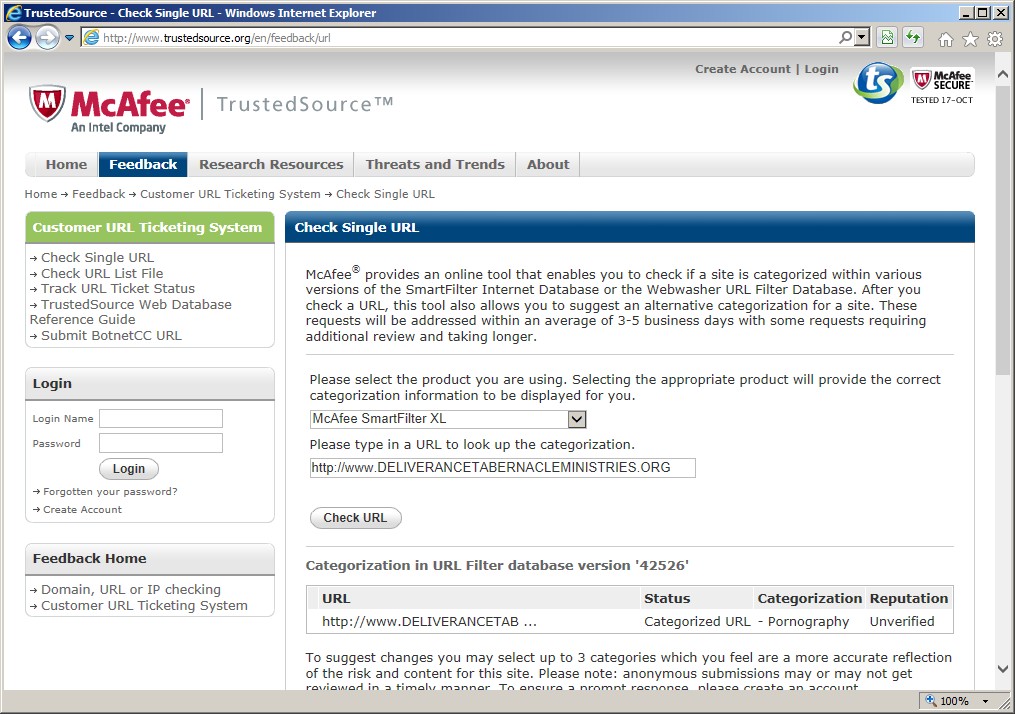
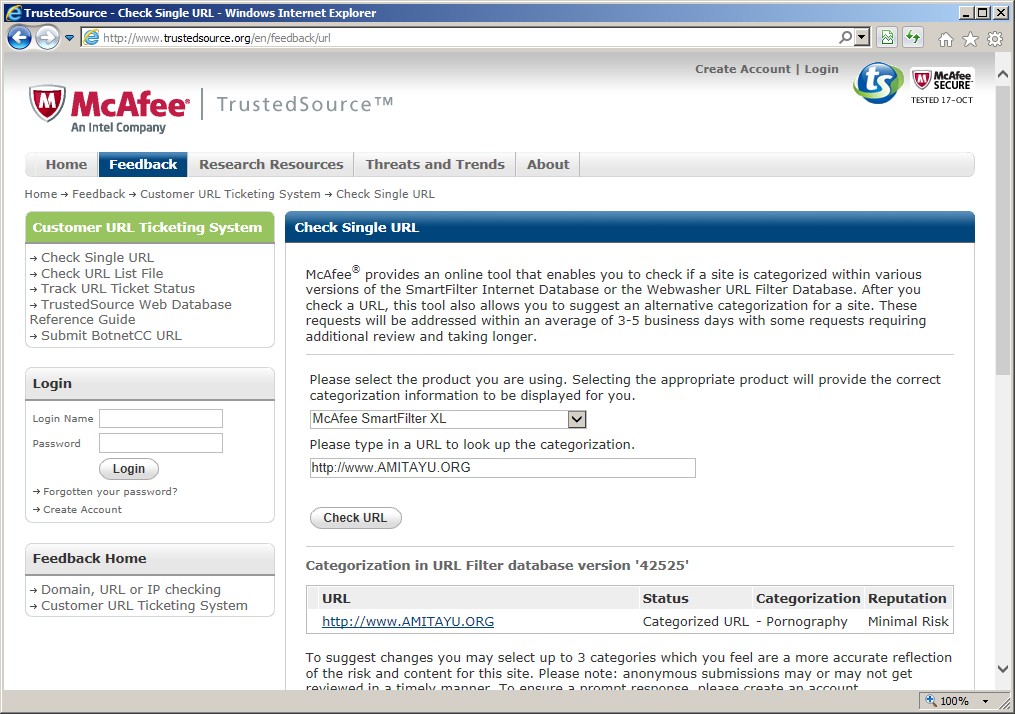
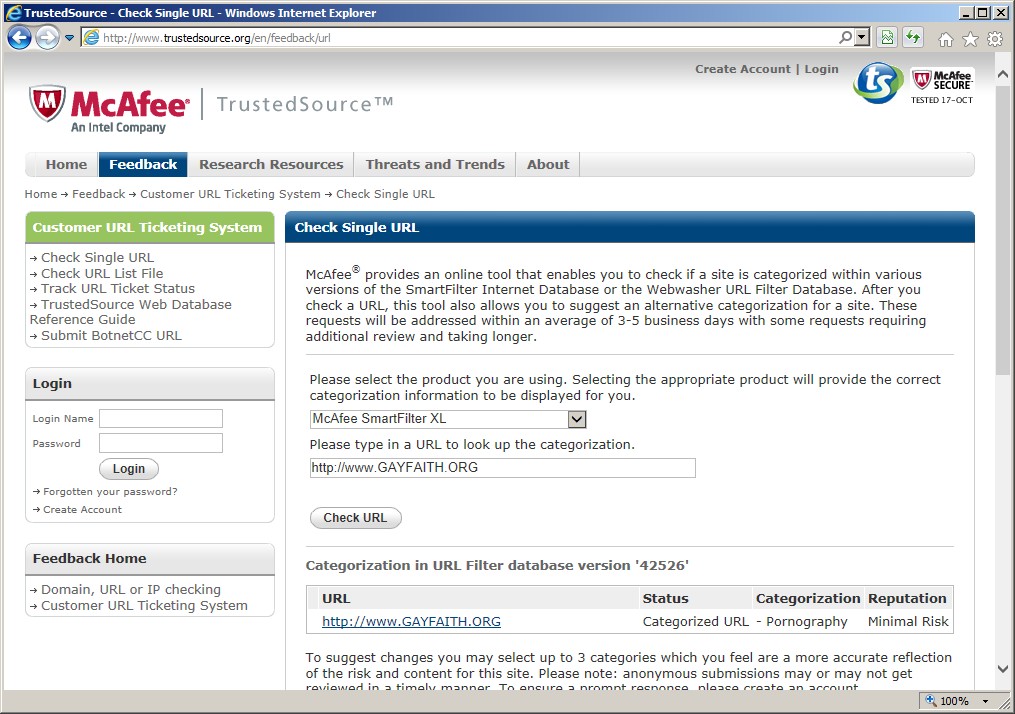
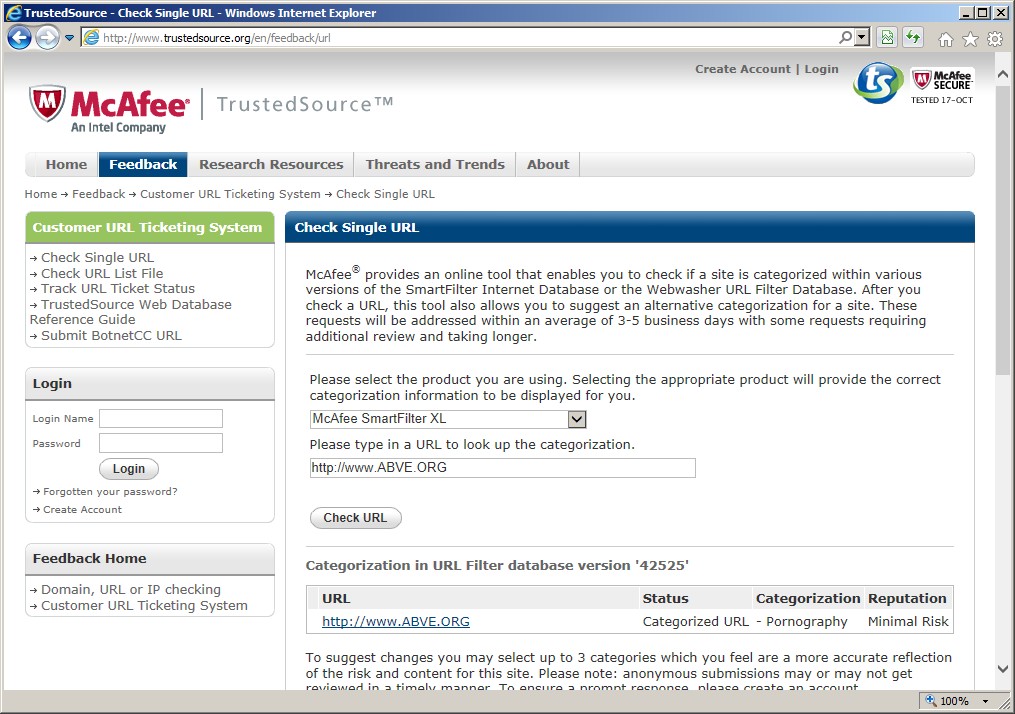
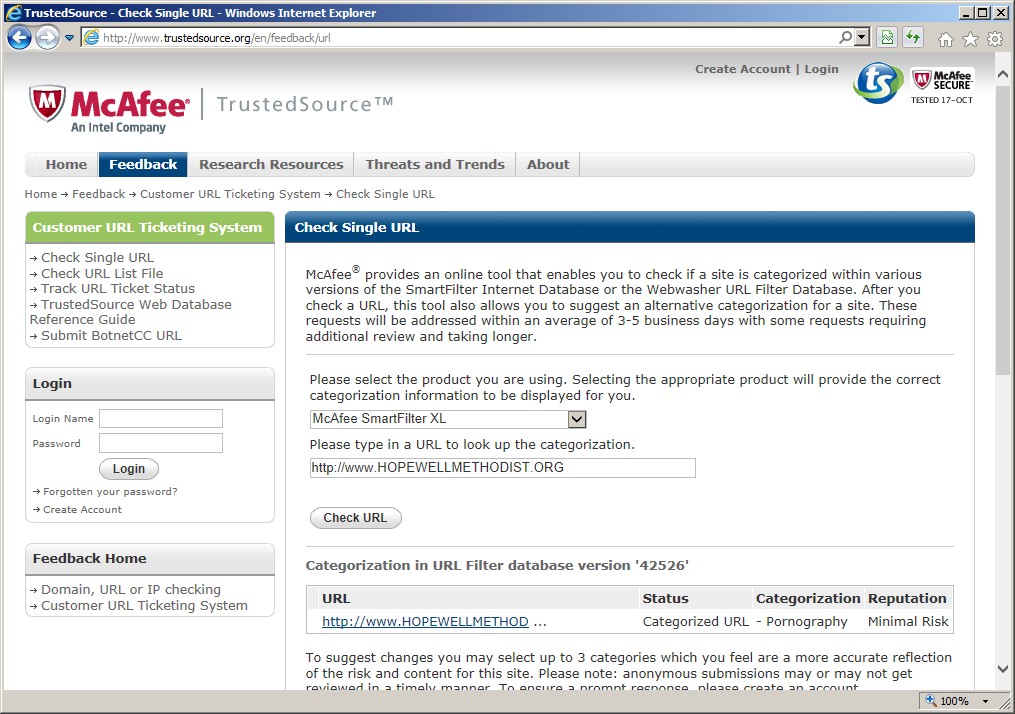
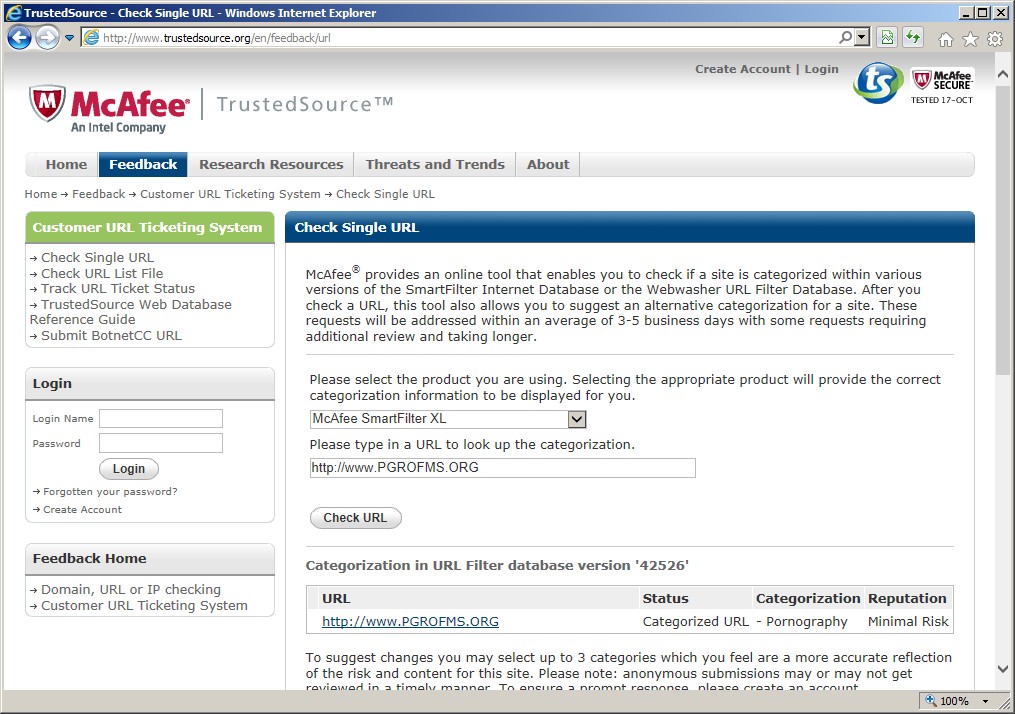
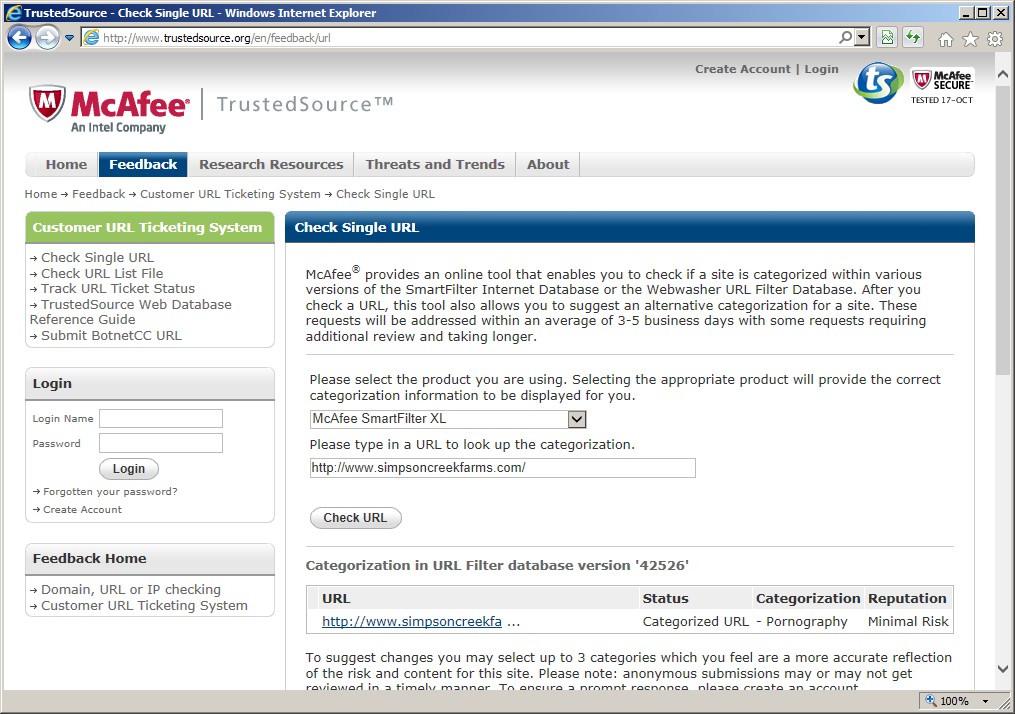
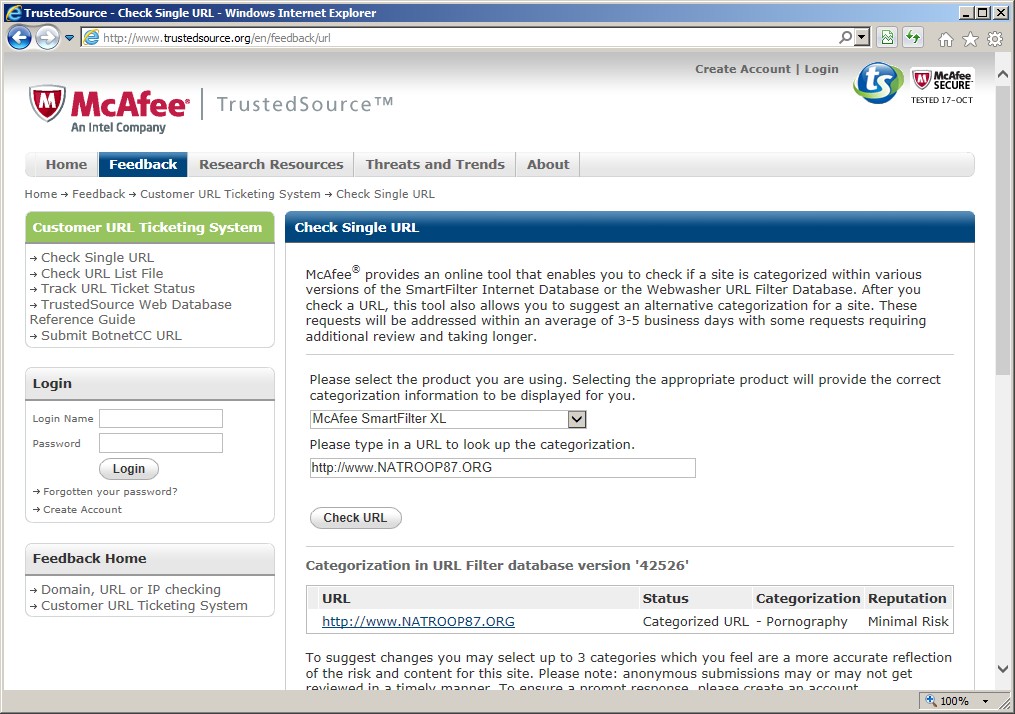
Slashdot contributor Bennett Haselton writes: "Internet users in Saudi Arabia, along with most users in the United Arab Emirates, are blocked by their respective government censors from accessing the websites of the Trinity Davison Lutheran Church, Deliverance Tabernacle Ministries in Pittsburgh, the Amitayu Buddhist Society of Taiwan, and GayFaith.org. An attempt to access any of those websites yields an error page like this one. However, the sites are not blocked because they conflict with the religions beliefs of those countries' governments. Rather, they are blocked because Smartfilter -- the American-made blocking program sold by McAfee, and used for state-mandated Internet censorship in those countries -- classifies those sites as "pornography". You can see the screen shots here, here, here and here." Read on for the rest of Bennett's thoughts.I found these blocked sites by starting with a combination of URL lists and ad hoc spidering, and running as many sites as possible through the Saudi filters to catch the ones that were blocked. Some of the sites were blocked for reasons that were easy to guess -- for example, http://www.bighornbasinsfw.org/, the home page of the Big Horn Basin, Wyoming chapter of Sportsmen for Fish & Wildlife, was almost certainly blocked because of the slang term "nsfw" in their URL. http://www.AgainstPornography.org and http://www.SearchingForMySpermDonorFather.org were presumably blocked because of the presence of the words "porn" and "sperm".
On the other hand, there appears to be no rational reason why the Filipino American Women's Network, the Tuscon Jazz Institute, or the Sacramento Police Activities League would have been blocked by Smartfilter, even by accident. A partial list of the blocked sites that I found is in the blog post I wrote for Citizen Lab, an Internet censorship research center at the University of Toronto.
Articles about sites that are erroneously blocked by Internet censorship software, have a storied history. The first widely read piece was the article "Keys to the Kingdom" written by Brock Meeks and Declan McCullagh in 1996, calling out Cyber Patrol for blocking EnviroLink.org and the University of Newcastle Computer Science Department, and CYBERsitter for blocking the National Organization for Women. I made a minor name for myself and the Peacefire.org site in the late 1990's by writing more pages about sites blocked by other products, including some (like X-Stop and SurfWatch) which no longer exist, and others that are still around, including Smartfilter. I was also one of six people comprising the Censorware Project, a loosely organized group of volunteers that published a few more reports.
By the early 2000's, however, it became clear that anyone whose mind was likely to be changed by information about what kinds of sites were blocked by blocking software, would have changed their mind already (or would, if they came across the research that had already been done up to that point). So the further reports on Internet blocking software errors, by me and other people, slowed to a trickle. I wrote a report in January 2002 on the latest list of sites blocked by Cyber Patrol, a product that most people today have forgotten. In 2006 I worked with the ACLU of Washington to publish a report on sites erroneously blocked by FortiGuard, a program used on computers in some libraries in central Washington, as part of the ACLU's suit to challenge the constitutionality of the program's use on public library terminals. (The Washington State Supreme Court rejected the lawsuit on the grounds that, regardless of what sites were blocked on the computers, it didn't matter because an adult library patron could request for the filter to be turned off.) In 2007 I wrote an article for Slashdot titled "From Bess to Worse" listing some sites that were blocked by an Internet filtering program called Bess (which was later bought out by Smartfilter and discontinued).
Most people's awareness of this debate, if they had heard about it at all, was limited to the perception that "breast cancer sites" and sites about "chicken breast recipes" were sometimes filtered by Internet blocking programs. Or they heard that "Beaver College" actually had to change its name to avoid being censored by web filters. As I tried to explain in a FAQ (written, according to the Wayback Machine, in 1999, but which still broadly holds true today), these examples are true, but they miss the point. These examples make it sound as if blocking software companies are doing the best job they can under the circumstances, and that the errors are unavoidable due to limitations on machine intelligence. In reality, any software algorithm that blocks the American Board of Vocational Experts, the Hopewell United Methodist Church, and the Patriot Guard Riders of Mississippi, as "pornography" (as Smartfilter currently does), is probably not the best algorithm the company could have come up with -- but there's no incentive for them to try harder, because few people will ever look that deep.
And yet, people continue to remember the "breast cancer site" examples. This sounds to me like an example of the narrative fallacy -- people remember that breast cancer sites were blocked, because there's a tidy explanation. There is no tidy explanation for most other examples of blocked sites, so the meme never spreads very far. Conveniently for the blocking companies, the blocked-site errors which make the company look most sloppy (the Kennels at Simpson Creek Farms, the St. Francis Institute of Milwaukee, etc.) are precisely the ones that, due to the narrative fallacy, most people won't remember or hear about.
One company, CYBERsitter, did manage to make a few blocking decisions in the 1990s that were egregious enough that their antics did make the news, and did finally raise some people's awareness that the controversy over private Internet filtering extended beyond "breast cancer sites". After TIME Magazine's website published an article (no longer online) that criticized CYBERsitter's blocking policies, CYBERsitter responded by blocking TIME Magazine's pathfinder.com domain. A few months earlier, CYBERsitter had blacklisted the monthly e-Zine "The Ethical Spectacle, after the Spectacle's founder, Jonathan Wallace, published an article criticizing CYBERsitter for blocking my own Peacefire.org website. And Peacefire.org had been blocked, in turn, because of a page I wrote (now very much out of date) listing some of the sites that CYBERsitter blocked, including the International Gay and Lesbian Human Rights Commission and Mother Jones. (Nowadays, of course, nobody would be surprised that filtering companies block Peacefire.org, since the site publishes ample instructions on how to get around Internet blockers. But at the time, the site's first and only article was the list of sites blocked by CYBERsitter, which is why CYBERsitter received so much criticism for blocking the domain in retaliation.) CYBERsitter also threatened to have Meeks and McCullagh criminally prosecuted for writing "Keys to the Kingdom" and threatened to sue me over the page that I had made.)
The moral, it seems, is that if you want an example of a censored web site to stick in people's minds, it either has to be a forgivable error, or an insane vindictive dick move -- because in either of those cases, people will understand why it happened. The vast swaths of censored websites on the spectrum in between, the ones for which there is no rational explanation for the blocking, go ignored.
These days, though, American and Canadian "censorware" makers have also come under fire for selling censoring software to foreign governments which use them for country-wide censorship. Most of the criticism focuses, naturally, not on the kinds of sites that are accidentally blocked by the blocking software, but on the immorality of these companies enabling statewide foreign censorship in the first place. Netsweeper, Blue Coat, and McAfee have all made the claim that "Once we sell their product to them, we have no control over what they do with it" -- which, as I wrote previously in Slashdot, is nonsense, because for the product to be effective, it has to rely on updates to the blocked-site list, which are provided at regular intervals by the manufacturer. Cut off the updates, and the product will not work, at least not as well.
So the fact that McAfee has classified the Boy Scout Troop 87 of North Andover, the Pan-Iranist Party of Iran, and Reptile Conservation International as "Pornography" is (rightly) overshadowed by the fact that McAfee is selling to government censors in Saudi Arabia and the UAE in the first place. However, as long as the filters are installed, these blocked sites are at least part of the problem for users in those countries, just as much as they are for students or cubicle workers in the U.S. whose network administrators happen to use Smartfilter. And, of course, I sampled only a miniscule fraction of the Web to find these examples of blocked sites, so the true number of stupid blocks affecting Saudi and UAE users is likely to be much larger. For each individual example, you might reasonably ask, "Is it really a big deal if Saudis are blocked from accessing Boy Scout Troop 87 of North Andover?" But it adds up.
-
Sites Blocked By Smartfilter, Censored in Saudi Arabia
Slashdot contributor Bennett Haselton writes: "Internet users in Saudi Arabia, along with most users in the United Arab Emirates, are blocked by their respective government censors from accessing the websites of the Trinity Davison Lutheran Church, Deliverance Tabernacle Ministries in Pittsburgh, the Amitayu Buddhist Society of Taiwan, and GayFaith.org. An attempt to access any of those websites yields an error page like this one. However, the sites are not blocked because they conflict with the religions beliefs of those countries' governments. Rather, they are blocked because Smartfilter -- the American-made blocking program sold by McAfee, and used for state-mandated Internet censorship in those countries -- classifies those sites as "pornography". You can see the screen shots here, here, here and here." Read on for the rest of Bennett's thoughts.I found these blocked sites by starting with a combination of URL lists and ad hoc spidering, and running as many sites as possible through the Saudi filters to catch the ones that were blocked. Some of the sites were blocked for reasons that were easy to guess -- for example, http://www.bighornbasinsfw.org/, the home page of the Big Horn Basin, Wyoming chapter of Sportsmen for Fish & Wildlife, was almost certainly blocked because of the slang term "nsfw" in their URL. http://www.AgainstPornography.org and http://www.SearchingForMySpermDonorFather.org were presumably blocked because of the presence of the words "porn" and "sperm".
On the other hand, there appears to be no rational reason why the Filipino American Women's Network, the Tuscon Jazz Institute, or the Sacramento Police Activities League would have been blocked by Smartfilter, even by accident. A partial list of the blocked sites that I found is in the blog post I wrote for Citizen Lab, an Internet censorship research center at the University of Toronto.
Articles about sites that are erroneously blocked by Internet censorship software, have a storied history. The first widely read piece was the article "Keys to the Kingdom" written by Brock Meeks and Declan McCullagh in 1996, calling out Cyber Patrol for blocking EnviroLink.org and the University of Newcastle Computer Science Department, and CYBERsitter for blocking the National Organization for Women. I made a minor name for myself and the Peacefire.org site in the late 1990's by writing more pages about sites blocked by other products, including some (like X-Stop and SurfWatch) which no longer exist, and others that are still around, including Smartfilter. I was also one of six people comprising the Censorware Project, a loosely organized group of volunteers that published a few more reports.
By the early 2000's, however, it became clear that anyone whose mind was likely to be changed by information about what kinds of sites were blocked by blocking software, would have changed their mind already (or would, if they came across the research that had already been done up to that point). So the further reports on Internet blocking software errors, by me and other people, slowed to a trickle. I wrote a report in January 2002 on the latest list of sites blocked by Cyber Patrol, a product that most people today have forgotten. In 2006 I worked with the ACLU of Washington to publish a report on sites erroneously blocked by FortiGuard, a program used on computers in some libraries in central Washington, as part of the ACLU's suit to challenge the constitutionality of the program's use on public library terminals. (The Washington State Supreme Court rejected the lawsuit on the grounds that, regardless of what sites were blocked on the computers, it didn't matter because an adult library patron could request for the filter to be turned off.) In 2007 I wrote an article for Slashdot titled "From Bess to Worse" listing some sites that were blocked by an Internet filtering program called Bess (which was later bought out by Smartfilter and discontinued).
Most people's awareness of this debate, if they had heard about it at all, was limited to the perception that "breast cancer sites" and sites about "chicken breast recipes" were sometimes filtered by Internet blocking programs. Or they heard that "Beaver College" actually had to change its name to avoid being censored by web filters. As I tried to explain in a FAQ (written, according to the Wayback Machine, in 1999, but which still broadly holds true today), these examples are true, but they miss the point. These examples make it sound as if blocking software companies are doing the best job they can under the circumstances, and that the errors are unavoidable due to limitations on machine intelligence. In reality, any software algorithm that blocks the American Board of Vocational Experts, the Hopewell United Methodist Church, and the Patriot Guard Riders of Mississippi, as "pornography" (as Smartfilter currently does), is probably not the best algorithm the company could have come up with -- but there's no incentive for them to try harder, because few people will ever look that deep.
And yet, people continue to remember the "breast cancer site" examples. This sounds to me like an example of the narrative fallacy -- people remember that breast cancer sites were blocked, because there's a tidy explanation. There is no tidy explanation for most other examples of blocked sites, so the meme never spreads very far. Conveniently for the blocking companies, the blocked-site errors which make the company look most sloppy (the Kennels at Simpson Creek Farms, the St. Francis Institute of Milwaukee, etc.) are precisely the ones that, due to the narrative fallacy, most people won't remember or hear about.
One company, CYBERsitter, did manage to make a few blocking decisions in the 1990s that were egregious enough that their antics did make the news, and did finally raise some people's awareness that the controversy over private Internet filtering extended beyond "breast cancer sites". After TIME Magazine's website published an article (no longer online) that criticized CYBERsitter's blocking policies, CYBERsitter responded by blocking TIME Magazine's pathfinder.com domain. A few months earlier, CYBERsitter had blacklisted the monthly e-Zine "The Ethical Spectacle, after the Spectacle's founder, Jonathan Wallace, published an article criticizing CYBERsitter for blocking my own Peacefire.org website. And Peacefire.org had been blocked, in turn, because of a page I wrote (now very much out of date) listing some of the sites that CYBERsitter blocked, including the International Gay and Lesbian Human Rights Commission and Mother Jones. (Nowadays, of course, nobody would be surprised that filtering companies block Peacefire.org, since the site publishes ample instructions on how to get around Internet blockers. But at the time, the site's first and only article was the list of sites blocked by CYBERsitter, which is why CYBERsitter received so much criticism for blocking the domain in retaliation.) CYBERsitter also threatened to have Meeks and McCullagh criminally prosecuted for writing "Keys to the Kingdom" and threatened to sue me over the page that I had made.)
The moral, it seems, is that if you want an example of a censored web site to stick in people's minds, it either has to be a forgivable error, or an insane vindictive dick move -- because in either of those cases, people will understand why it happened. The vast swaths of censored websites on the spectrum in between, the ones for which there is no rational explanation for the blocking, go ignored.
These days, though, American and Canadian "censorware" makers have also come under fire for selling censoring software to foreign governments which use them for country-wide censorship. Most of the criticism focuses, naturally, not on the kinds of sites that are accidentally blocked by the blocking software, but on the immorality of these companies enabling statewide foreign censorship in the first place. Netsweeper, Blue Coat, and McAfee have all made the claim that "Once we sell their product to them, we have no control over what they do with it" -- which, as I wrote previously in Slashdot, is nonsense, because for the product to be effective, it has to rely on updates to the blocked-site list, which are provided at regular intervals by the manufacturer. Cut off the updates, and the product will not work, at least not as well.
So the fact that McAfee has classified the Boy Scout Troop 87 of North Andover, the Pan-Iranist Party of Iran, and Reptile Conservation International as "Pornography" is (rightly) overshadowed by the fact that McAfee is selling to government censors in Saudi Arabia and the UAE in the first place. However, as long as the filters are installed, these blocked sites are at least part of the problem for users in those countries, just as much as they are for students or cubicle workers in the U.S. whose network administrators happen to use Smartfilter. And, of course, I sampled only a miniscule fraction of the Web to find these examples of blocked sites, so the true number of stupid blocks affecting Saudi and UAE users is likely to be much larger. For each individual example, you might reasonably ask, "Is it really a big deal if Saudis are blocked from accessing Boy Scout Troop 87 of North Andover?" But it adds up.
-
Linus Torvalds: Any CLA Is Fundamentally Broken
sfcrazy writes "The controversy over Canonical's Contributor License Agreement (CLA) has once again surfaced. While Matthew Garrett raises valid points about the flaws in Canonical's CLAs, Linus Torvalds says 'To be fair, people just like hating on Canonical. The FSF and Apache Foundation CLA's are pretty much equally broken. And they may not be broken because of any relicencing, but because the copyright assignment paperwork ends up basically killing the community. Basically, with a CLA, you don't get the kind of "long tail" that the kernel has of random drive-by patches. And since that's how lots of people try the waters, any CLA at all – changing the license or not – is fundamentally broken.'" -
Nagios-Plugins Web Site Taken Over By Nagios
New submitter hymie! writes "Nagios is a commonly used IT tool that monitors computers, networks, and websites. It supports the use of plug-ins, many of which were developed independently by the community. Holger Weiß, formerly of nagios-plugins.org, announced that 'Yesterday, the DNS records [of nagios-plugins.org] were modified to point to web space controlled by Nagios Enterprises instead. This change was done without prior notice. To make things worse, large parts of our web site were copied and are now served (with slight modifications) by Nagios. Again, this was done without contacting us, and without our permission. This means we cannot use the name 'Nagios Plugins' any longer.' Further discussion is available in a Bugzilla thread." -
Telescope Designer and Astronomer John Dobson, 1915-2014
As noted by Sky & Telescope, SpaceWatchtower, and many other sources, astronomer and telescope innovator John Dobson died yesterday in Burbank, California, at the age of 98. He's famous as an inspiration for others to explore astronomy, in part through the San Francisco Sidewalk Astronomers, which he co-founded in 1967, and as designer of the telescope variety which bears his name. -
Programmer Privilege
An anonymous reader writes "Philip Guo, an Asst. Professor of Computer Science at the University of Rochester, has written a thoughtful article on his education in programming. Guo explains that he was no particular coding wizard while growing up, but when he jumped into a CS major when he went to college at MIT, he received all sorts of passive and active encouragement — simply because he 'looked the part.' He says, 'Instead of facing implicit bias or stereotype threat, I had the privilege of implicit endorsement. For instance, whenever I attended technical meetings, people would assume that I knew what I was doing (regardless of whether I did or not) and treat me accordingly. If I stared at someone in silence and nodded as they were talking, they would usually assume that I understood, not that I was clueless. Nobody ever talked down to me, and I always got the benefit of the doubt in technical settings.' Guo compares this to the struggles faced by other minority groups and women to succeed in a field that is often more skeptical of their abilities. 'I want those people to experience what I was privileged enough to have gotten in college and beyond – unimpeded opportunities to develop expertise in something that they find beautiful, practical, and fulfilling.'" -
GNU Guile Scheme Gets a Register VM and CPS-Based IL
In late November, Andy Wingo pushed a new register VM to Guile's (the GNU implementation of the Scheme language) master branch. It brought a number of performance improvements, but led to a bit of a conceptual mismatch between the compiler's direct-style intermediate language and the virtual machine. Earlier this week Andy Wingo announced a new continuation-passing style intermediate language for Guile. From the article: "To recap, we switched from a stack machine to a register machine because, among other reasons, register machines can consume and produce named intermediate results in fewer instructions than stack machines, and that makes things faster. To take full advantage of this new capability, it is appropriate to switch at the same time from the direct-style intermediate language (IL) that we had to an IL that names all intermediate values. ... In Guile I chose a continuation-passing style language. ... Guile's CPS language is composed of terms, expressions, and continuations. It was heavily inspired by Andrew Kennedy's 'Compiling with Continuations, Continued' paper. ... The optimizations I have currently implemented for CPS are fairly basic. Contification was tricky. One thing I did recently was to make all non-tail $call nodes require $kreceive continuations; if, as in the common case, extra values were unused, that was reflected in an unused rest argument. This required a number of optimizations to clean up and remove the extra rest arguments for other kinds of source expressions: dead-code elimination, the typical beta/eta reduction, and some code generation changes." The article describes the CPS language provided by Guile and explains the reasons behind choosing CPS over SSA or A-Normal Form. The Guile manual contains draft documentation. The new VM and Intermediate Language will be released with Guile 2.2, which should be out later this year. -
GNU Guile Scheme Gets a Register VM and CPS-Based IL
In late November, Andy Wingo pushed a new register VM to Guile's (the GNU implementation of the Scheme language) master branch. It brought a number of performance improvements, but led to a bit of a conceptual mismatch between the compiler's direct-style intermediate language and the virtual machine. Earlier this week Andy Wingo announced a new continuation-passing style intermediate language for Guile. From the article: "To recap, we switched from a stack machine to a register machine because, among other reasons, register machines can consume and produce named intermediate results in fewer instructions than stack machines, and that makes things faster. To take full advantage of this new capability, it is appropriate to switch at the same time from the direct-style intermediate language (IL) that we had to an IL that names all intermediate values. ... In Guile I chose a continuation-passing style language. ... Guile's CPS language is composed of terms, expressions, and continuations. It was heavily inspired by Andrew Kennedy's 'Compiling with Continuations, Continued' paper. ... The optimizations I have currently implemented for CPS are fairly basic. Contification was tricky. One thing I did recently was to make all non-tail $call nodes require $kreceive continuations; if, as in the common case, extra values were unused, that was reflected in an unused rest argument. This required a number of optimizations to clean up and remove the extra rest arguments for other kinds of source expressions: dead-code elimination, the typical beta/eta reduction, and some code generation changes." The article describes the CPS language provided by Guile and explains the reasons behind choosing CPS over SSA or A-Normal Form. The Guile manual contains draft documentation. The new VM and Intermediate Language will be released with Guile 2.2, which should be out later this year. -
GNU Guile Scheme Gets a Register VM and CPS-Based IL
In late November, Andy Wingo pushed a new register VM to Guile's (the GNU implementation of the Scheme language) master branch. It brought a number of performance improvements, but led to a bit of a conceptual mismatch between the compiler's direct-style intermediate language and the virtual machine. Earlier this week Andy Wingo announced a new continuation-passing style intermediate language for Guile. From the article: "To recap, we switched from a stack machine to a register machine because, among other reasons, register machines can consume and produce named intermediate results in fewer instructions than stack machines, and that makes things faster. To take full advantage of this new capability, it is appropriate to switch at the same time from the direct-style intermediate language (IL) that we had to an IL that names all intermediate values. ... In Guile I chose a continuation-passing style language. ... Guile's CPS language is composed of terms, expressions, and continuations. It was heavily inspired by Andrew Kennedy's 'Compiling with Continuations, Continued' paper. ... The optimizations I have currently implemented for CPS are fairly basic. Contification was tricky. One thing I did recently was to make all non-tail $call nodes require $kreceive continuations; if, as in the common case, extra values were unused, that was reflected in an unused rest argument. This required a number of optimizations to clean up and remove the extra rest arguments for other kinds of source expressions: dead-code elimination, the typical beta/eta reduction, and some code generation changes." The article describes the CPS language provided by Guile and explains the reasons behind choosing CPS over SSA or A-Normal Form. The Guile manual contains draft documentation. The new VM and Intermediate Language will be released with Guile 2.2, which should be out later this year. -
Why Transitivity Violations Can Be Rational
ananyo writes "Organisms, including humans, are often assumed to be hard-wired by evolution to try to make optimal decisions, to the best of their knowledge. Ranking choices consistently — for example, in selecting food sources — would seem to be one aspect of such rationality. If A is preferred over B, and B over C, then surely A should be selected when the options are just A and C? This seemingly logical ordering of preferences is called transitivity. Furthermore, if A is preferred when both B and C are available, then A should 'rationally' remain the first choice when only A and B are at hand ... But sometimes animals do not display such logic. For example, honeybees and gray jays have been seen to violate the Independence of Irrational Alternatives, and so have hummingbirds ... Researchers have now used a theoretical model to show that, in fact, violations of transitivity can sometimes be the best choice (original paper) for the given situation, and therefore rational. The key is that the various choices might appear or disappear in the future. Then the decision becomes more complicated than a simple, fixed ranking of preferences. So while these choices look irrational, they aren't necessarily." -
CES 2014: 3-D Scanners are a Logical Next Step After 3-D Printers
A number of companies are either selling or preparing to sell 3-D scanners. Aside from fun (but interesting) uses, like duplicating chess pieces or possibly reproducing a miniature of Rodin's famous sculpture, Fallen Caryatid Carrying Her Stone, Matterform anticipates archeologists reproducing artifacts so that students can study them without handling the precious originals. This video is an interview with Matterform co-founder Drew Cox, who was exhibiting Matterform's scanner at CES 2014. MakerBot is also selling a scanner, as are a growing number of others. In fact, even though Matterform talks about being a low-cost (pre-order price $579) scanner for home use, as opposed to a commercial one that costs thousands. There are also several interesting hand-held scanners out there. Sense sells theirs for $399. Structure has one for $349 that's essentially a peripheral for an iPad. And this is just a random selection from a brief Google search. Use "3-D Scanner" as your search term and you'll find multiple Google pages full of 3-D scanners and information about them -- including software being developed at ETH zurich that turns your smartphone into a 3-D scanner. -
How Quickly Will the Latest Arms Race Accelerate?
First time accepted submitter tranquilidad writes "Russia was concerned enough about the U.S. development of a Prompt Global Strike (PGS) capability in 2010 that they included restrictions in the New Start treaty (previously discussed on Slashdot). It now appears that China has entered the game with their 'Ultra-High Speed Missile Vehicle.' While some in the Russian press may question whether fears of the PGS are 'rational' it appears that the race is on to develop the fastest weapons delivery system. The hypersonic arms race is focused on 'precise targeting, very rapid delivery of weapons, and greater survivability against missile and space defenses' with delivery systems traveling between Mach 5 and Mach 10 after being launched from 'near space.'" -
CES 2014: Ohio Company is Bringing Military-Grade Motion Sensors to Gaming
In a town called Portsmouth, Ohio, a company called Yost Engineering (YEI) Technology has quietly been making motion sensing devices for military, aerospace, industrial, robotics, and other commercial motion capture uses, including rotoscoping for the film/video industry. Now they want to bring this same technology to gaming. They tried a Kickstarter campaign in 2013, but only got a little less than 1/2 of their target amount pledged. They're going to do Kickstarter again, starting Feb. 14, 2014 -- and this time, they've been working on PR before asking for money. You can see what they're up to in gaming sensor development at www.priovr.com/. Or go to the main YEI Technology corporate site, which has a whole bunch of free downloads in addition to the usual product blurbs. -
Why We Think There's a Multiverse, Not Just Our Universe
An anonymous reader writes "It's generally accepted that the Universe's history is best described by the Big Bang model, with General Relativity and Quantum Field Theory as the physical laws governing the underlying framework. It's also accepted that the Universe probably started off with an early period of cosmic inflation prior to that. Well, if you accept those things — as in, the standard picture of the Universe — then a multiverse is an inevitable consequence of the physics of the early Universe, and this article explains why that's the case." -
Why We Think There's a Multiverse, Not Just Our Universe
An anonymous reader writes "It's generally accepted that the Universe's history is best described by the Big Bang model, with General Relativity and Quantum Field Theory as the physical laws governing the underlying framework. It's also accepted that the Universe probably started off with an early period of cosmic inflation prior to that. Well, if you accept those things — as in, the standard picture of the Universe — then a multiverse is an inevitable consequence of the physics of the early Universe, and this article explains why that's the case." -
Why We Think There's a Multiverse, Not Just Our Universe
An anonymous reader writes "It's generally accepted that the Universe's history is best described by the Big Bang model, with General Relativity and Quantum Field Theory as the physical laws governing the underlying framework. It's also accepted that the Universe probably started off with an early period of cosmic inflation prior to that. Well, if you accept those things — as in, the standard picture of the Universe — then a multiverse is an inevitable consequence of the physics of the early Universe, and this article explains why that's the case." -
Physicists Claim First Observation of a Quantum Cheshire Cat
KentuckyFC writes "Last year, a group of theoretical physicists suggested a bizarre experiment based on a quantum phenomenon known as weak measurement. Unlike ordinary measurements that always change the state of a quantum object, a weak measurement extracts such a small amount of information that it leaves the quantum state intact. For example, a weak measurement can detect the presence of a photon by the deflection it causes when it bounces off a mirror. However, this does not change the photon's quantum state. The new idea was to make two weak measurements on a quantum system that is in a superposition of states, the goal being to separate the location of this quantum system from its properties, like a Cheshire cat. Now a group of experimentalists say they've observed a quantum Cheshire cat for the first time in an experiment involving neutrons. They passed a beam of neutrons through a magnetic field to align their spins and then sent them through an interferometer in which the neutrons pass down both arms of the experiment at the same time. They then used weak measurements to locate the neutrons in one arm while measuring their magnetic properties in the other. Voila! A quantum Cheshire cat." -
Smart Toothbrush Aims For Better Brushing Habits
Hugh Pickens DOT Com writes "These days, it seems just about every imaginable thing is 'connected.' There's connected thermostats, locks, refrigerators, forks, and so many more. Now we can add toothbrushes to the list. Brandon Griggs reports at CNN that the Kolibree toothbrush syncs wirelessly with an iPhone or an Android device to track brushing habits, announce whether you have brushed thoroughly enough and reward you for good oral hygiene. 'It works just like a regular toothbrush,' says Renee Blodgett. 'The only difference is that all the data is stored on your phone so you can see how you're brushing.' Users download a mobile app and connect via Bluetooth, and the Kolibree documents every brushing via three sensors that record 1) how long you brush, 2) whether you brush all four quadrants of your mouth, and 3) whether you brush up and down (good) instead of just side to side (bad). 'Before Kolibree, the issue is that there has been no easy and quick way to monitor whether you're doing an A+ job or a C- one when you brush, so how can you improve on a habit you don't have any data about?.' There's a bit of gameplay built in, which challenges users to do better next time, and the company has created an API, hoping that third-party developers will come up with additional apps that will inspire users to brush more and more effectively writes Daniel Terdiman. 'With individual health getting more attention than ever, it's certainly possible people will see the benefit of something that keeps a close eye on how well they're treating their teeth, and which challenges them to do better.'" -
Smart Toothbrush Aims For Better Brushing Habits
Hugh Pickens DOT Com writes "These days, it seems just about every imaginable thing is 'connected.' There's connected thermostats, locks, refrigerators, forks, and so many more. Now we can add toothbrushes to the list. Brandon Griggs reports at CNN that the Kolibree toothbrush syncs wirelessly with an iPhone or an Android device to track brushing habits, announce whether you have brushed thoroughly enough and reward you for good oral hygiene. 'It works just like a regular toothbrush,' says Renee Blodgett. 'The only difference is that all the data is stored on your phone so you can see how you're brushing.' Users download a mobile app and connect via Bluetooth, and the Kolibree documents every brushing via three sensors that record 1) how long you brush, 2) whether you brush all four quadrants of your mouth, and 3) whether you brush up and down (good) instead of just side to side (bad). 'Before Kolibree, the issue is that there has been no easy and quick way to monitor whether you're doing an A+ job or a C- one when you brush, so how can you improve on a habit you don't have any data about?.' There's a bit of gameplay built in, which challenges users to do better next time, and the company has created an API, hoping that third-party developers will come up with additional apps that will inspire users to brush more and more effectively writes Daniel Terdiman. 'With individual health getting more attention than ever, it's certainly possible people will see the benefit of something that keeps a close eye on how well they're treating their teeth, and which challenges them to do better.'" -
Metal-Free 'Rhubarb' Battery Could Store Renewable Grid Energy
sciencehabit writes "A molecule nearly identical to one in rhubarb may hold the key to the future of renewable energy. Researchers have used the compound to create a high-performance 'flow' battery, a leading contender for storing renewable power in the electric utility grid. If the battery prototype can be scaled up, it could help utilities deliver renewable energy when the wind is calm and the sun isn't shining." Abstract. -
Google Ports Capsicum To Linux, and Other End-of-Year Capsicum News
An anonymous reader writes "Security researcher Robert Watson at the University of Cambridge has posted a blog article describing recent progress on the Capsicum security model, which will shortly appear in FreeBSD 10.0 enabled by default, and has now been ported to Linux by Google, who have posted patches with the intent to upstream to the Linux kernel." Capability systems are pretty interesting. -
Mystery of FBI Documents Posted To US Press In 1971 Solved
AHuxley writes "A team of eight antiwar activists broke into an FBI office in Media, Pennsylvania and removed at least 1000 documents. Once removed and sorted, the bulk of the files showed FBI spying on U.S. political groups. COINTELPRO had been found. 43 years later five of the participants have come forward." -
Mystery of FBI Documents Posted To US Press In 1971 Solved
AHuxley writes "A team of eight antiwar activists broke into an FBI office in Media, Pennsylvania and removed at least 1000 documents. Once removed and sorted, the bulk of the files showed FBI spying on U.S. political groups. COINTELPRO had been found. 43 years later five of the participants have come forward." -
23-Year-Old X11 Server Security Vulnerability Discovered
An anonymous reader writes "The recent report of X11/X.Org security in bad shape rings more truth today. The X.Org Foundation announced today that they've found a X11 security issue that dates back to 1991. The issue is a possible stack buffer overflow that could lead to privilege escalation to root and affects all versions of the X Server back to X11R5. After the vulnerability being in the code-base for 23 years, it was finally uncovered via the automated cppcheck static analysis utility." There's a scanf used when loading BDF fonts that can overflow using a carefully crafted font. Watch out for those obsolete early-90s bitmap fonts. -
Cartels Are Using Firetruck-Sized Drillers To Make Drug Pipelines
Daniel_Stuckey writes "In the beginning, they used catapults, dune buggies, 'jalapeños,' $1 million submarines, and sophisticated drug tunnels to move drugs northward. Now, Mexican drug cartels are taking to high-end industrial drills to carve out literal drug pipelines into the U.S. It's the next big leap in the evolution of the narcos' ingenious smuggle tech. The future of borderland drug running, it turns out, is boring. Jason Kersten reports on the phenomenon in a great GQ feature that focuses on the Sinaloa Cartel, the international crime syndicate believed to be behind the first known narco pipeline in 2008: '...Mexican authorities, responding to reports of a cave-in and flooding near the [All-American] canal, discovered a tunnel unlike anything they'd ever seen. Only ten inches wide, it was essentially a pipe. The Mexican cops traced it back to a house about 600 feet from the border, where they found a tractor-like vehicle with a long barrel on its side—a horizontal directional drill, or HDD.'" -
New Views of Supernova 1987A Reveal Giant Dust Factory
New submitter ihtoit writes "Astronomers using the ALMA radio telescope in Chile have released images and data showing the oft-postulated but unobserved (until now) dust shell ejected by the supernova remnant SN1987A. 'We have found a remarkably large dust mass concentrated in the central part of the ejecta from a relatively young and nearby supernova,' astronomer Remy Indebetouw, of the National Radio Astronomy Observatory (NRAO) and the University of Virginia, said in a statement. 'This is the first time we've been able to really image where the dust has formed, which is important in understanding the evolution of galaxies.' SN1987A was the first cataloged supernova event in our Galactic neighborhood in 1987. It lies 168,000 light years (987 quadrillion miles) away in the Large Magellanic Cloud, which means that at the time of the explosion, woolly mammoths still roamed Europe and Mitochondrial Eve saw her first sunrise." From the article, the significance: "'Really early galaxies are incredibly dusty and this dust plays a major role in the evolution of galaxies,' Mikako Matsuura, a scientist associated with the study ... said ... 'Today we know dust can be created in several ways, but in the early universe most of it must have come from supernovas. We finally have direct evidence to support that theory.'" -
Australian Team Working On Engines Without Piston Rings
JabrTheHut writes "An Australian team is seeking funding for bringing an interesting idea to market: cylinder engines without piston rings. The idea is to use small grooves that create a pressure wave that acts as a seal for the piston, eliminating the piston ring and the associated friction. Engines would then run cooler, could be more energy efficient, and might even burn fuel more efficiently, at least according to the article. Mind you, they haven't even built a working prototype yet. If it works I'd love to fit this into an older car." -
Experiments Reveal That Deformed Rubber Sheet Is Not Like Spacetime
KentuckyFC writes "General relativity is mathematically challenging and yet widely appreciated by the public. This state of affairs is almost entirely the result of one the most famous analogies in science: that the warping of spacetime to produce gravity is like the deformation of a rubber sheet by a central mass. Now physicists have tested this idea theoretically and experimentally and say it doesn't hold water. It turns out that a marble rolling on deformed rubber sheet does not follow the same trajectory as a planet orbiting a star and that the marble's equations of motion lead to a strangely twisted version of Kepler's third law of planetary motion. And experiments with a real marble rolling on a spandex sheet show that the mass of the sheet itself creates a distortion that further complicates matters. Indeed, the physicists say that a rubber sheet deformed by a central mass can never produce the same motion of planet orbiting a star in spacetime. So the analogy is fundamentally flawed. Shame!" -
"Clinical Trials" For Programming Languages?
theodp writes "High school junior Charles Dawson's New Year resolution is to write a new program in different language each week. It's an ambitious project for someone of any age, and while it won't give him an in-depth appreciation of programming language differences, it'll certainly give him greater insight into the strengths of certain languages than would perusing the Hello World Wikipedia article. Lots of claims are made about the comparative productivity of programming languages, but have there been any landmark studies that measure the efficacy of a programming language's productivity claims in a 'clinical trial' of sorts? Would head-to-head tests against other languages be a better way of sorting out Popularity vs Productivity vs Performance claims, or is relying on more nebulous claims of superiority the best we can do?" -
"Clinical Trials" For Programming Languages?
theodp writes "High school junior Charles Dawson's New Year resolution is to write a new program in different language each week. It's an ambitious project for someone of any age, and while it won't give him an in-depth appreciation of programming language differences, it'll certainly give him greater insight into the strengths of certain languages than would perusing the Hello World Wikipedia article. Lots of claims are made about the comparative productivity of programming languages, but have there been any landmark studies that measure the efficacy of a programming language's productivity claims in a 'clinical trial' of sorts? Would head-to-head tests against other languages be a better way of sorting out Popularity vs Productivity vs Performance claims, or is relying on more nebulous claims of superiority the best we can do?" -
Polar Vortex Sends Life-Threatening Freeze To US
Hugh Pickens DOT Com writes "Reuters reports that the Midwestern United States is shivering through the region's lowest temperatures in twenty years as forecasters warn that life-threatening cold is heading eastward as a polar vortex of freezing Arctic weather sweeps across the United States. 'The coldest temperatures in almost two decades will spread into the northern and central U.S. today behind an arctic cold front,' says the National Weather Service. 'Combined with gusty winds, these temperatures will result in life-threatening wind chill values as low as 60 degrees below zero (Fahrenheit/minus 51 degrees Celsius).' The coldest temperature reported in the lower 48 states on Sunday was minus 40 F (-40 C) in the towns of Babbitt and Embarrass, Minnesota. Meteorologists warn that the wind-chill factor could make it feel twice as cold, causing frostbite to exposed parts of the body within minutes. Eleven people have already died in weather-related incidents in the past week, including a 71-year-old woman with Alzheimer's who wandered from her home in upstate New York and was found frozen to death only 100m away. Polar vortexes occur seasonally at the North Pole, and their formation resembles that of hurricanes in more tropical regions: fast-moving winds build up around a calm center. Unlike a hurricane, these are frigid polar winds, circling the Arctic at more than 100 miles per hour. The spinning winds typically trap this cold air in the Arctic. But the problem comes when the polar vortex weakens or splits apart, essentially flinging these cold wind patterns out of the Arctic and into our backyards. 'All the ingredients are there for a near-record or historic cold outbreak,' says meteorologist Ryan Maue. 'If you're under 40, you've not seen this stuff before.'" -
The Far Future of Our Solar System
An anonymous reader writes "Sure, the Universe is expanding, the galaxies are accelerating away from one another, and it's looking more and more like they'll never re-collapse. The timeline of the far future looks pretty grim on large scales. But what's to come of our Solar System: of the Earth, our Moon and our Sun? This tour of the far future of the Solar System, scaling the timescales to the Big Bang being '1 Universe year' ago, puts it all in perspective." -
Object Blocking Giant Tunnel Borer Was an 8" Diameter Pipe
An anonymous reader writes "A few weeks ago we discussed news that a tunnel boring machine measuring 57.5 feet in diameter was halted underneath Seattle after running into a mysterious object. Project engineers have now figured out what the object is: an 8-inch-diameter pipe. In 2002, researchers for another project — the replacement of the Alaskan Way viaduct — drilled down into the ground to take water samples. They used the 115-ft-long pipe as a well casing. As it turns out, this well site was listed in the contract specifications given to all bidders for the tunnel's construction. In addition, the crew manning the machine noticed that it was chewing up pieces of metal, and they removed part of the pipe and kept going. Only later did they realize that significant damage had been done to the machine's cutting face. Officials aren't sure how long repairs will take, or how much they will cost." -
Boeing Moving X-37B Operations To the Kennedy Space Center
schwit1 writes "A spy plane used by the U.S. Air Force is about to get a new home: a garage at Kennedy Space Center that once housed NASA orbiters during the space shuttle era. The move was announced Friday by Boeing, the Chicago-based company that built the X-37B orbital test vehicle and is in charge of repairing the spacecraft whenever it returns to Earth. Previously, Boeing had refurbished the 29-foot-long spacecraft at Vandenberg Air Force Base in California, but the company decided to relocate its fix-up shop in Florida, where the vehicle now launches." -
Eye Tracking Coming To Video Games
An anonymous reader writes "Over the past several years, we've had a spate of new input methods for playing video games. Instead of just pushing buttons, now we can wave body parts around, yell at the screen, or even (weakly) control things with our thoughts. Now, we're adding an eye-tracking sensor bar. It's being created by SteelSeries, but it's based on tech from a Swedish company called Tobii, who built similar tech for cars. 'Inside the device there are two cameras and an infrared light source. The infrared light reflects off your pupil and cornea, which is then captured by the two camera sensors. Throw in a healthy serving of Tobii's proprietary image processing algorithms, and a physiological 3D model of the eye, and you can work out the position of the eye and the direction of the gaze with high accuracy. Tobii doesn't seem to put an exact figure on the resolution/accuracy, merely saying that "within less than a centimeter" is possible.' Of course, the biggest question will be how well it works, but it seems like it could be a useful supplement to normal control schemes. I can see how it would be nice to simply flick your eyes to an icon to do something, or to make it easier to dig through your in-game inventory." -
US Justice Blocks Implementation of ACA Contraceptive Mandate
theodp writes "First approved for contraceptive use in the U.S. in 1960, 'The Pill' is currently used by more than 100 million women worldwide and by almost 12 million women in the U.S. But just hours before the Affordable Care Act was to go into effect, Justice Sonia Sotomayor issued a stay temporarily blocking a mandate requiring health insurance coverage of birth control, and gave the Obama administration until Friday to respond to the Supreme Court on the matter. Sotomayor's order applies to a group of nuns, the Little Sisters of the Poor, and other Roman Catholic nonprofit groups that use the same health plan, known as the Christian Brothers Employee Benefit Trust (PDF). The group is one of many challenging the federal requirement for contraceptive coverage, but a decision on the merits of that case by the full Supreme Court could have broader implications. One imagines Melinda Gates is none too pleased. So, will U.S. health care require a Department of Personal Belief Exemptions that are dictated by employers (PDF, 'The Trustees of CBEBT and the management of Christian Brothers Services are dedicated to protecting the employers participating in the CBEBT from having to face the choice of violating their faith or violating the law')?" -
Researchers Confirm Exoplanet Has Clouds Using Hubble Telescope
Exoplanet GJ 1214 b was discovered in 2009 by the MEarth project. Researchers now have strong evidence that it has an atmosphere. "[A] team of astronomers led by UChicago's Laura Kreidberg and Jacob Bean have detected clear evidence of clouds in the atmosphere of GJ 1214b from data collected with the Hubble Space Telescope. The Hubble observations used 96 hours of telescope time spread over 11 months. This was the largest Hubble program ever devoted to studying a single exoplanet. ... The first spectra, which were obtained by Bean in 2010 using a ground-based telescope, suggested that the planet's atmosphere either was predominantly water vapor or hydrogen-dominated with high-altitude clouds. ... More precise Hubble observations made in 2012 and 2013 allowed the team to distinguish between these two scenarios. ... The best explanation for the new data is that there are high-altitude clouds in the atmosphere of the planet, though their composition is unknown. Models of super-Earth atmospheres predict clouds could be made out of potassium chloride or zinc sulfide at the scorching temperatures of 450 degrees Fahrenheit found on GJ 1214b." -
Jade Rabbit Spotted By American Eagle (LRO)
An anonymous reader writes "Having already imaged the Apollo landing sites on the Moon, the Lunar Reconnaissance Orbiter has now added China's recent lander and rover to its collection of snapshots." -
Ask Slashdot: Life Organization With Free Software?
BigZee writes "For many years, I've used a page-a-day diary as both a planner and a method for taking notes. While not perfect, it's proven to be an approach that's worked fairly well for me. Conscious of the limitations, I want this to become more electronic. In principle, I want to be able to use my Nexus 7 for this function. There are some limitations: My workplace uses MS Outlook. However, I am not able to use Evernote (or similar) on my workplace machine. This limits possible integration along the lines proposed with GTD. What I want is to be able to take notes that are organized by date as well as being integrated to a calendar (preferably Google). Additionally, I want to be able to prioritize my work along lines similar to GTD. I'm not averse to spending money for the right software but prefer to use free software where possible. Can anyone suggest what could be used?" The above-linked Wikipedia page lists some relevant Free software as well as closed-source options. If you use such organizing software, though, how do you use it, and how well do you find it works? -
4 Tips For Your New Laptop
Bennett Haselton writes with four big tips for anyone blessed by the holiday buying frenzy with a new laptop; in particular, these are tips to pass on to non-techie relatives and others who are unlikely to put (say) "Install a Free operating system" at the very top of the list: Here's Bennett's advice, in short: (1) If you don't want to pay for an anti-virus program, at least install a free one. (2) Save files to a folder that is automatically mirrored to the cloud, for effortless backups. (3) Create a non-administrator guest account, in case a friend needs to borrow the computer. (4) Be aware of your computer's System Restore option as a way of fixing mysterious problems that arose recently." Read on for the expanded version; worth keeping in mind before your next friends-and-family tech support call. > If you or a friend -- especially a non-techie friend -- received a laptop for Christmas, these are my favorite low-cost high-benefit tips that anyone can follow. They apply to any operating system, although I'm writing from a Windows-centric point of view.Yes, a lot of this will be obvious stuff to techies, but I've found that if a human asks a techie "I just got a new laptop, can you give me any advice?", the answer frequently will (a) not cover these crucial bases, and/or (b) include a lot of unhelpful stuff to impress the listener. The following is a baseline for what I think a useful answer should consist of. (And if you're the techie, you may want to walk the laptop owner through following these directions, since I'm not actually spelling out what icons you have to click on, etc.)
(1) If you don't want to pay for an anti-virus program, at least install a free one.
Your PC probably came with a trial version of an anti-virus program that will stop working after a month unless you upgrade to the paid version. Of course you can do that if you want. Especially if you ever think you might want phone tech support for your anti-virus software, I expect it's better for a product that you've paid money for.
On the other hand, I know people who thought that if they didn't want to pay for the upgrade to their PC's default anti-virus program, their only option was to let it expire and let their computer run unprotected. If you don't want to pay for a non-free program, install a free one -- Wikipedia has a list of 15 different free or freemium anti-virus products for Windows. PC Magazine gave their "Editor's Choice" award for best free Windows anti-virus to Malwarebytes Anti-Malware 1.70 in 2013 and AVG Anti-Virus Free in 2012, so either of those will work.
(Yes, I know you guys know this. But pass the word on to your Mom or kid brother with the new laptop.)
(2) Save files to a folder that is automatically mirrored to the cloud, for effortless backups.
The era in which everybody talks about backing up, but nobody actually does it, should have ended completely in 2013. Old-style backups, even the incredibly easy options, still mostly required you stop what you were doing for a minute, connect to a remote server or connect a piece of hardware to your computer, and twiddle your thumbs while waiting for some copy process to execute. So nobody bothered.
With cloud-mirrored folders, there's no excuse any more. I found out about Dropbox by asking a mailing list, "I would really like it if there were an online backup service that let me open and close files from a local folder so that there was no delay, but as soon as I made any changes, would automatically be queued to be backed up over the network to a remote host," and my listmates said, "That already exists." Windows 8 comes with the similar SkyDrive service already built in.
You can read a detailed comparison of Dropbox vs. SkyDrive vs. Google Drive, but the key point is to use one of them to mirror one of your local folders to the cloud, and get into the habit of saving stuff to that folder. Obviously this may not apply to you if you have something special going on (if you're creating large multimedia files that won't fit within the several-gigabyte limit imposed by these services, or if your privacy concerns are great enough that you don't want to back up files online), but it's good enough for most people. The horror stories about people saving months or years of writing, and then losing it all in a hard drive crash, should never happen to anyone again.
(3) Create a non-administrator guest account, in case a friend needs to borrow the computer.
Some of my friends and relatives have no problem telling people, "No, I don't care if you need to check the weather, you can't touch my computer!" But if you can't resist the urge to be helpful if someone needs to borrow your laptop for a few minutes, then eventually one of those people will mess it up somehow -- either by installing a game, or visiting a website that installed malware on your computer, or just changing a system setting that you can't figure out how to change back.
When the day comes when someone needs to borrow your computer, you may be too rushed or might not know how to create an unprivileged non-administrator account that they can log in under. So go ahead and do it when your computer is brand new, while the thought is still fresh in your mind. Then if people who borrow your computer sign in under that account, in almost all cases, nothing that they do while logged in should interfere with your user experience when you log them off and log back in as yourself.
That's not a completely secure solution to stop someone from accessing private files on your computer. (There are many pages describing how to boot up a Windows machine from a Linux CD, in order to access files on the computer -- they are usually described as "disaster recovery" options, but they can also be used to access files on a PC without the password.) However, it will stop most casual users from messing up your computer while they borrow it.
(4) Be aware of your computer's System Restore option as a way of fixing mysterious problems that arose recently.
I say "be aware" because, unlike the other three tips, this may not ever be something that you have to actually do. However, intermediate-level computer users just need to understand what it means: to restore your computer's settings and installed programs to a recently saved snapshot, while leaving your saved files untouched. This means if your computer has started acting funny in the last couple of days, you may be able to fix the problem by restoring to a snapshot that was saved before the problems started.
Intermediate users sometimes confuse this with either (a) restoring files from backup, or (b) doing a system recovery (which generally refers to restoring your computer to the state in which it left the factory). So if you're the techie doing the explaining, make sure they understand the difference. (A system recovery will often fix problems, too, but then of course you'll have to re-install all your software; a system restore is more convenient since it only undoes the most recent system changes.)
So these are the first four things I would tell people who were the recipient of a new laptop. What would you tell them?
-
4 Tips For Your New Laptop
Bennett Haselton writes with four big tips for anyone blessed by the holiday buying frenzy with a new laptop; in particular, these are tips to pass on to non-techie relatives and others who are unlikely to put (say) "Install a Free operating system" at the very top of the list: Here's Bennett's advice, in short: (1) If you don't want to pay for an anti-virus program, at least install a free one. (2) Save files to a folder that is automatically mirrored to the cloud, for effortless backups. (3) Create a non-administrator guest account, in case a friend needs to borrow the computer. (4) Be aware of your computer's System Restore option as a way of fixing mysterious problems that arose recently." Read on for the expanded version; worth keeping in mind before your next friends-and-family tech support call. > If you or a friend -- especially a non-techie friend -- received a laptop for Christmas, these are my favorite low-cost high-benefit tips that anyone can follow. They apply to any operating system, although I'm writing from a Windows-centric point of view.Yes, a lot of this will be obvious stuff to techies, but I've found that if a human asks a techie "I just got a new laptop, can you give me any advice?", the answer frequently will (a) not cover these crucial bases, and/or (b) include a lot of unhelpful stuff to impress the listener. The following is a baseline for what I think a useful answer should consist of. (And if you're the techie, you may want to walk the laptop owner through following these directions, since I'm not actually spelling out what icons you have to click on, etc.)
(1) If you don't want to pay for an anti-virus program, at least install a free one.
Your PC probably came with a trial version of an anti-virus program that will stop working after a month unless you upgrade to the paid version. Of course you can do that if you want. Especially if you ever think you might want phone tech support for your anti-virus software, I expect it's better for a product that you've paid money for.
On the other hand, I know people who thought that if they didn't want to pay for the upgrade to their PC's default anti-virus program, their only option was to let it expire and let their computer run unprotected. If you don't want to pay for a non-free program, install a free one -- Wikipedia has a list of 15 different free or freemium anti-virus products for Windows. PC Magazine gave their "Editor's Choice" award for best free Windows anti-virus to Malwarebytes Anti-Malware 1.70 in 2013 and AVG Anti-Virus Free in 2012, so either of those will work.
(Yes, I know you guys know this. But pass the word on to your Mom or kid brother with the new laptop.)
(2) Save files to a folder that is automatically mirrored to the cloud, for effortless backups.
The era in which everybody talks about backing up, but nobody actually does it, should have ended completely in 2013. Old-style backups, even the incredibly easy options, still mostly required you stop what you were doing for a minute, connect to a remote server or connect a piece of hardware to your computer, and twiddle your thumbs while waiting for some copy process to execute. So nobody bothered.
With cloud-mirrored folders, there's no excuse any more. I found out about Dropbox by asking a mailing list, "I would really like it if there were an online backup service that let me open and close files from a local folder so that there was no delay, but as soon as I made any changes, would automatically be queued to be backed up over the network to a remote host," and my listmates said, "That already exists." Windows 8 comes with the similar SkyDrive service already built in.
You can read a detailed comparison of Dropbox vs. SkyDrive vs. Google Drive, but the key point is to use one of them to mirror one of your local folders to the cloud, and get into the habit of saving stuff to that folder. Obviously this may not apply to you if you have something special going on (if you're creating large multimedia files that won't fit within the several-gigabyte limit imposed by these services, or if your privacy concerns are great enough that you don't want to back up files online), but it's good enough for most people. The horror stories about people saving months or years of writing, and then losing it all in a hard drive crash, should never happen to anyone again.
(3) Create a non-administrator guest account, in case a friend needs to borrow the computer.
Some of my friends and relatives have no problem telling people, "No, I don't care if you need to check the weather, you can't touch my computer!" But if you can't resist the urge to be helpful if someone needs to borrow your laptop for a few minutes, then eventually one of those people will mess it up somehow -- either by installing a game, or visiting a website that installed malware on your computer, or just changing a system setting that you can't figure out how to change back.
When the day comes when someone needs to borrow your computer, you may be too rushed or might not know how to create an unprivileged non-administrator account that they can log in under. So go ahead and do it when your computer is brand new, while the thought is still fresh in your mind. Then if people who borrow your computer sign in under that account, in almost all cases, nothing that they do while logged in should interfere with your user experience when you log them off and log back in as yourself.
That's not a completely secure solution to stop someone from accessing private files on your computer. (There are many pages describing how to boot up a Windows machine from a Linux CD, in order to access files on the computer -- they are usually described as "disaster recovery" options, but they can also be used to access files on a PC without the password.) However, it will stop most casual users from messing up your computer while they borrow it.
(4) Be aware of your computer's System Restore option as a way of fixing mysterious problems that arose recently.
I say "be aware" because, unlike the other three tips, this may not ever be something that you have to actually do. However, intermediate-level computer users just need to understand what it means: to restore your computer's settings and installed programs to a recently saved snapshot, while leaving your saved files untouched. This means if your computer has started acting funny in the last couple of days, you may be able to fix the problem by restoring to a snapshot that was saved before the problems started.
Intermediate users sometimes confuse this with either (a) restoring files from backup, or (b) doing a system recovery (which generally refers to restoring your computer to the state in which it left the factory). So if you're the techie doing the explaining, make sure they understand the difference. (A system recovery will often fix problems, too, but then of course you'll have to re-install all your software; a system restore is more convenient since it only undoes the most recent system changes.)
So these are the first four things I would tell people who were the recipient of a new laptop. What would you tell them?
-
If UNIX Were a Religion
Hugh Pickens DOT Com writes "Charles Stross has written a very clever article where he describes the religious metaphor he uses with non-technical folks to explain the relationship between Mac OS X and UNIX. There is one true religion in operating systems says Stross and it is UNIX although there's also an earlier, older, more arcane religion with far fewer followers, MULTICS, from which UNIX sprang as a stripped-down rules-deficient heresy. If MULTICS is Judaism then UNIX is Christianity. By the mid-1970s there were two main sects: AT&T UNIX, which we may liken unto the Roman Catholic Church, and BSD UNIX, which we may approximate to the Orthodox Churches. In an attempt to control the schisms, the faithful defined a common interoperating subset of the one true religion that all could agree on—the Nicene Creed of UNIX which is probably POSIX. Stross says that today the biggest church in the whole of UNIX is Mac OS X, which rests on the bedrock of Orthodox BSD but "has added an incredible, towering superstructure of fiercely guarded APIs and proprietary user interface stuff that renders it all but unrecognizable to followers of the Catholic AT&T path." But lo, in the late 1980s, UNIX succumbed to the sins of venality, demanding too much money from the faithful and so, in 1991 Linus Torvalds nailed his famous source code release to the cathedral door and kicked off the Reformation. 'The Linux wars were brutal and unforgiving and Linux itself splintered into a myriad of fractious Protestant churches, from the Red Hat wearing Lutherans to the Ubuntu Baptists.' More recently, a deviant faith has sprung from Linux. 'Android is the Church of Latter Day Saints of UNIX: hard-working, sober, evangelizing the public, and growing at a ferocious rate. There are some strange fundamentalist Mormon Android churches living in walled communities under the banners of Samsung and Amazon, but for the most part the prosperous worship at the Church of Google.' Stross notes that as with all religion, those sects with most in common are the ones who hold the most vicious grudges against one another. 'Is that clear?'" -
If UNIX Were a Religion
Hugh Pickens DOT Com writes "Charles Stross has written a very clever article where he describes the religious metaphor he uses with non-technical folks to explain the relationship between Mac OS X and UNIX. There is one true religion in operating systems says Stross and it is UNIX although there's also an earlier, older, more arcane religion with far fewer followers, MULTICS, from which UNIX sprang as a stripped-down rules-deficient heresy. If MULTICS is Judaism then UNIX is Christianity. By the mid-1970s there were two main sects: AT&T UNIX, which we may liken unto the Roman Catholic Church, and BSD UNIX, which we may approximate to the Orthodox Churches. In an attempt to control the schisms, the faithful defined a common interoperating subset of the one true religion that all could agree on—the Nicene Creed of UNIX which is probably POSIX. Stross says that today the biggest church in the whole of UNIX is Mac OS X, which rests on the bedrock of Orthodox BSD but "has added an incredible, towering superstructure of fiercely guarded APIs and proprietary user interface stuff that renders it all but unrecognizable to followers of the Catholic AT&T path." But lo, in the late 1980s, UNIX succumbed to the sins of venality, demanding too much money from the faithful and so, in 1991 Linus Torvalds nailed his famous source code release to the cathedral door and kicked off the Reformation. 'The Linux wars were brutal and unforgiving and Linux itself splintered into a myriad of fractious Protestant churches, from the Red Hat wearing Lutherans to the Ubuntu Baptists.' More recently, a deviant faith has sprung from Linux. 'Android is the Church of Latter Day Saints of UNIX: hard-working, sober, evangelizing the public, and growing at a ferocious rate. There are some strange fundamentalist Mormon Android churches living in walled communities under the banners of Samsung and Amazon, but for the most part the prosperous worship at the Church of Google.' Stross notes that as with all religion, those sects with most in common are the ones who hold the most vicious grudges against one another. 'Is that clear?'" -
If UNIX Were a Religion
Hugh Pickens DOT Com writes "Charles Stross has written a very clever article where he describes the religious metaphor he uses with non-technical folks to explain the relationship between Mac OS X and UNIX. There is one true religion in operating systems says Stross and it is UNIX although there's also an earlier, older, more arcane religion with far fewer followers, MULTICS, from which UNIX sprang as a stripped-down rules-deficient heresy. If MULTICS is Judaism then UNIX is Christianity. By the mid-1970s there were two main sects: AT&T UNIX, which we may liken unto the Roman Catholic Church, and BSD UNIX, which we may approximate to the Orthodox Churches. In an attempt to control the schisms, the faithful defined a common interoperating subset of the one true religion that all could agree on—the Nicene Creed of UNIX which is probably POSIX. Stross says that today the biggest church in the whole of UNIX is Mac OS X, which rests on the bedrock of Orthodox BSD but "has added an incredible, towering superstructure of fiercely guarded APIs and proprietary user interface stuff that renders it all but unrecognizable to followers of the Catholic AT&T path." But lo, in the late 1980s, UNIX succumbed to the sins of venality, demanding too much money from the faithful and so, in 1991 Linus Torvalds nailed his famous source code release to the cathedral door and kicked off the Reformation. 'The Linux wars were brutal and unforgiving and Linux itself splintered into a myriad of fractious Protestant churches, from the Red Hat wearing Lutherans to the Ubuntu Baptists.' More recently, a deviant faith has sprung from Linux. 'Android is the Church of Latter Day Saints of UNIX: hard-working, sober, evangelizing the public, and growing at a ferocious rate. There are some strange fundamentalist Mormon Android churches living in walled communities under the banners of Samsung and Amazon, but for the most part the prosperous worship at the Church of Google.' Stross notes that as with all religion, those sects with most in common are the ones who hold the most vicious grudges against one another. 'Is that clear?'" -
If UNIX Were a Religion
Hugh Pickens DOT Com writes "Charles Stross has written a very clever article where he describes the religious metaphor he uses with non-technical folks to explain the relationship between Mac OS X and UNIX. There is one true religion in operating systems says Stross and it is UNIX although there's also an earlier, older, more arcane religion with far fewer followers, MULTICS, from which UNIX sprang as a stripped-down rules-deficient heresy. If MULTICS is Judaism then UNIX is Christianity. By the mid-1970s there were two main sects: AT&T UNIX, which we may liken unto the Roman Catholic Church, and BSD UNIX, which we may approximate to the Orthodox Churches. In an attempt to control the schisms, the faithful defined a common interoperating subset of the one true religion that all could agree on—the Nicene Creed of UNIX which is probably POSIX. Stross says that today the biggest church in the whole of UNIX is Mac OS X, which rests on the bedrock of Orthodox BSD but "has added an incredible, towering superstructure of fiercely guarded APIs and proprietary user interface stuff that renders it all but unrecognizable to followers of the Catholic AT&T path." But lo, in the late 1980s, UNIX succumbed to the sins of venality, demanding too much money from the faithful and so, in 1991 Linus Torvalds nailed his famous source code release to the cathedral door and kicked off the Reformation. 'The Linux wars were brutal and unforgiving and Linux itself splintered into a myriad of fractious Protestant churches, from the Red Hat wearing Lutherans to the Ubuntu Baptists.' More recently, a deviant faith has sprung from Linux. 'Android is the Church of Latter Day Saints of UNIX: hard-working, sober, evangelizing the public, and growing at a ferocious rate. There are some strange fundamentalist Mormon Android churches living in walled communities under the banners of Samsung and Amazon, but for the most part the prosperous worship at the Church of Google.' Stross notes that as with all religion, those sects with most in common are the ones who hold the most vicious grudges against one another. 'Is that clear?'"