Slashdot Mirror
Domain: wikipedia.org
Stories and comments across the archive that link to wikipedia.org.
Stories · 7,048
-
Intel Lynnfield CPU Bests Nehalem In Performance/Watt
Vigile writes "Not many people have debated that Intel's Nehalem architecture is the fastest available for consumer desktop computers since it was released last year, but quite a few have complained about the cost of the platform. Intel just released new Lynnfield-based processors under both the Core i7 and Core i5 names and tests are showing the new CPUs beating Nehalem in both performance-per-watt and performance-per-dollar tests to a startling degree. And while raw performance probably still goes to the Nehalem-based Core i7 CPUs, the lower prices of motherboards and memory for Lynnfield processors will likely more than make up for it." Update: 09/08 14:03 GMT by T : There are more eye-wateringly exhaustive examinations of the new chips all over the Web; here's HotHardware's version, and Tom's Hardware's. -
Can the Ares Program Be Salvaged?
MarkWhittington writes "The Augustine Commission has not officially presented its findings to the White House, but already a push back is starting to occur over the possibility that the Ares 1 rocket will be canceled after three billion dollars and over four years of development. According to a story in the Orlando Sentinel contractors involved in the development of the Ares 1 have started a quiet but persistent public relations campaign to save the Ares 1, criticized in some quarters because of cost and technical problems." -
Con Kolivas Returns, With a Desktop-Oriented Linux Scheduler
myvirtualid writes "Con Kolivas has done what he swore never to do: returned to the Linux kernel and written a new — and, according to him — waaay better scheduler for the desktop environment. In fact, BFS appears to outperform existing schedulers right up until one hits a 16-CPU machine, at which point he guesses performance would degrade somewhat. According to Kolivas, BFS 'was designed to be forward looking only, make the most of lower spec machines, and not scale to massive hardware. i.e. [sic] it is a desktop orientated scheduler, with extremely low latencies for excellent interactivity by design rather than 'calculated,' with rigid fairness, nice priority distribution and extreme scalability within normal load levels.'" -
Code-Breaking Quantum Algorithm On a Silicon Chip
Urchin writes "Shor's quantum algorithm, which offers a way to crack the commonly-used RSA encryption algorithm, has been demonstrated on a silicon chip for the first time. The algorithm was first demonstrated on large tabletop arrays 3 years ago, but the photonic quantum circuit can now be printed relatively easily onto a silicon chip just 26 mm long. You can see the abstract from the team's academic paper in the journal Science; the full text requires a subscription." -
AMC Releasing a New "The Prisoner" In November
DynaSoar writes "The Prisoner is one of the most influential and enduring TV shows to have appeared during the 1960s. This single-season (1967-68), 17-episode series, starring its co-writing, co-directing executive producer Patrick McGoohan, maintains a steady fan base and gains more with each syndication re-release. For over 40 years there have been announced intentions and projects to resurrect this surreal psychodrama combining science fiction, allegory, and spy thriller in a new series or movie (but always without McGoohan, who adamantly refused, saying 'he'd done it'). Finally, since December 2008 a remake has been in the can. In November 2009, AMC will begin airing an original six-part mini-series of The Prisoner starring James Caviezal as the spy who resigns only to find himself abducted and transported to 'The Village,' where he is renamed (or rather renumbered) Number Six, and where the minds behind his incarceration attempt to pry and/or trick secrets from his brain. Chief among those minds is the visible face of the administration, Number Two, played by Ian McKellen. Unlike the original, with a new Number Two in each episode, McKellen appears throughout. To promote the upcoming release, AMC is presenting (along with a ton of 'additional material') the entire original 17 episodes, free for the streaming." -
AMC Releasing a New "The Prisoner" In November
DynaSoar writes "The Prisoner is one of the most influential and enduring TV shows to have appeared during the 1960s. This single-season (1967-68), 17-episode series, starring its co-writing, co-directing executive producer Patrick McGoohan, maintains a steady fan base and gains more with each syndication re-release. For over 40 years there have been announced intentions and projects to resurrect this surreal psychodrama combining science fiction, allegory, and spy thriller in a new series or movie (but always without McGoohan, who adamantly refused, saying 'he'd done it'). Finally, since December 2008 a remake has been in the can. In November 2009, AMC will begin airing an original six-part mini-series of The Prisoner starring James Caviezal as the spy who resigns only to find himself abducted and transported to 'The Village,' where he is renamed (or rather renumbered) Number Six, and where the minds behind his incarceration attempt to pry and/or trick secrets from his brain. Chief among those minds is the visible face of the administration, Number Two, played by Ian McKellen. Unlike the original, with a new Number Two in each episode, McKellen appears throughout. To promote the upcoming release, AMC is presenting (along with a ton of 'additional material') the entire original 17 episodes, free for the streaming." -
ES&S To Buy Diebold, Blackbox Voting To Sue
Gottesser writes "Long-time election rights activist Bev Harris (she had an HBO special a while back where she hired Hari Hursti to hack an optical scan voting machine) just sent this out: 'Diebold/Premier Election Systems is being purchased by Election Systems & Software (ES&S). According to a Black Box Voting source within the companies, there will be a conference call among key people at the companies within the next couple hours. An ES&S/Diebold-Premier acquisition would consolidate most US voting under one privately held manufacturer. And it's not just the concealed vote-counting; these companies now also produce polling place check-in software (electronic pollbooks), voter registration software, and vote-by-mail authentication software.' Our voting system is heading toward a server-centric model with our vote being delivered to us by computers under lock and key far away from public oversight. Here's ES&S's press release. Wikipedia's got something on the ongoing string of ES&S controversies as well." -
Mount Wilson Observatory In Danger From L.A. Fire
An anonymous reader writes "Mount Wilson is in danger from the Station fire burning near L.A. Their servers have gone offline, but there's a temporary mirror cam. It doesn't look good. Picture twenty-four on the L.A. Times photo gallery shows the observatory from the air. If anyone has any inside news on the condition of the facility, I'm sure there are lots of people on Slashdot who would love to hear it." -
Collaborative Filtering and the Rise of Ensembles
igrigorik writes "First the Netflix challenge was won with the help of ensemble techniques, and now the GitHub challenge is over, and more than half of the top entries are also based on ensembles. Good knowledge of statistics, psychology and algorithms is still crucial, but the ensemble technique alone has the potential to make the collaborative filtering space a lot more, well, collaborative! Here's a look at the basic theory behind ensembles, how they shaped the results of the GitHub challenge, and how this pattern can be used in the future." -
Augmented Reality In a Contact Lens
Toe, The writes "Bionanotechnology researcher Babak A Parviz writes about his research toward producing a computer interface in a contact lens. At the moment, they have only embedded a single LED, but they foresee a much more complex interface such as detailed in Vernor Vinge's Rainbows End. Such lenses potentially could also read human bio-information from the eye, providing medical information on the order of what is now taken from blood tests, but on a continuous basis. An example would be monitoring glucose levels for diabetics. The author states that, 'All the basic technologies needed to build functional contact lenses are in place,' and details what refinements and advances will be necessary to bring this technology to reality." -
Alan Turing Apology Campaign Grows
chrb writes "Several British news sources have recently reported on the growing campaign that calls for an apology to Alan Turing for his persecution by the British government. The petition to the Prime Minister was started by John Graham-Cumming, who has also written to the Queen requesting a Knighthood for Turing, but admits that a pardon is 'unlikely,' saying, 'The most important thing to me is that people hear about Alan Turing and realize his incredible impact on the modern world, and how terrible the impact of prejudice was on him.'" -
Alan Turing Apology Campaign Grows
chrb writes "Several British news sources have recently reported on the growing campaign that calls for an apology to Alan Turing for his persecution by the British government. The petition to the Prime Minister was started by John Graham-Cumming, who has also written to the Queen requesting a Knighthood for Turing, but admits that a pardon is 'unlikely,' saying, 'The most important thing to me is that people hear about Alan Turing and realize his incredible impact on the modern world, and how terrible the impact of prejudice was on him.'" -
TwIP - An IP Stack In a Tweet
Adam Dunkels writes "Inspired by the Twitter-sized program that crashes Mac OS X, I just wrote a really, really rudimentary IP stack called twIP, small enough to fit in a Twitter tweet. Although twIP is very far away from a real IP stack, it can do the first task of any IP stack: respond to pings. The entire source code can be found in this 128-character-long tweet. For those who are interested in low-level network programming, a code walkthrough with instructions on how to run the code under FreeBSD is available here. The FAQ: Q: why? A: for fun." -
Laughing Gas Is Major Threat To Ozone Layer
Hugh Pickens writes "The Christian Science Monitor reports that according to new research, nitrous oxide, the colorless, sweet-smelling gas with a long history as a medical and dental anesthetic is the next big threat to Earth's protective ozone layer. Its role in destroying ozone has long been recognized, as well as its role as a heat-trapping greenhouse gas but the new study puts nitrous oxide's ability to deplete ozone into numbers comparable to those used for other ozone-depleting gases covered by the 1987 Montreal Protocol. The researchers note that the health of the ozone layer has been improving since the adoption of the protocol and that nitrous oxide looms large today as an artificial destroyer of the ozone layer, in part because the emissions of other harmful chemicals have been so sharply reduced." (Continues.) "Globally, Earth's ozone layer has thinned by 5 to 6 percent since 1980, before CFCs and their ilk came into wide use, according to Akkihebbal Ravishankara, who led the study. He and his colleagues note that 6 percent may appear to be a small number, but it still can lead to significant effects on organisms at Earth's surface. The researchers did not make any policy recommendations in light of their finding. 'It is not for us to gauge how much risk there is,' says Ravishankara. In any event, Ravishankara says, at the moment researchers could not say with confidence 'how much nitrous oxide comes from where.'" -
Laughing Gas Is Major Threat To Ozone Layer
Hugh Pickens writes "The Christian Science Monitor reports that according to new research, nitrous oxide, the colorless, sweet-smelling gas with a long history as a medical and dental anesthetic is the next big threat to Earth's protective ozone layer. Its role in destroying ozone has long been recognized, as well as its role as a heat-trapping greenhouse gas but the new study puts nitrous oxide's ability to deplete ozone into numbers comparable to those used for other ozone-depleting gases covered by the 1987 Montreal Protocol. The researchers note that the health of the ozone layer has been improving since the adoption of the protocol and that nitrous oxide looms large today as an artificial destroyer of the ozone layer, in part because the emissions of other harmful chemicals have been so sharply reduced." (Continues.) "Globally, Earth's ozone layer has thinned by 5 to 6 percent since 1980, before CFCs and their ilk came into wide use, according to Akkihebbal Ravishankara, who led the study. He and his colleagues note that 6 percent may appear to be a small number, but it still can lead to significant effects on organisms at Earth's surface. The researchers did not make any policy recommendations in light of their finding. 'It is not for us to gauge how much risk there is,' says Ravishankara. In any event, Ravishankara says, at the moment researchers could not say with confidence 'how much nitrous oxide comes from where.'" -
Spammers Use Holes In Democrats.org Security
Attila Dimedici writes "According to Cloudmark, 419 spammers are using the democrats.org website to relay email and bypass spam filters. 'The abuse, which dates back at least to the beginning of this month, helps evade filters that internet service providers employ to block the messages. ... The messages were sent courtesy of this page, which allows anyone with an internet connection to send emails. The PHP script employs no CAPTCHA or other measure to help ensure there is a real human being behind each email that gets funneled through the service. The service allows messages to be sent to 10 addresses at a time and even provides a way for people to import contacts they have stored in their address book.'" -
Lori Drew Cyberbullying Case Dismissed
Trepidity writes "About seven weeks after the judge tentatively overturned Lori Drew's guilty verdict for 'cyberbullying' following her online harassment of a teenager that was linked to the teenager's suicide, the case was finally officially dismissed. In a 32-page opinion (PDF), the court avoided a minefield of possible follow-on effects that civil-liberties groups had warned of by holding that merely violating a website's Terms of Service cannot constitute 'unauthorized access' for the purposes of the Computer Fraud and Abuse Act (18 U.S.C. 1030)." -
Lori Drew Cyberbullying Case Dismissed
Trepidity writes "About seven weeks after the judge tentatively overturned Lori Drew's guilty verdict for 'cyberbullying' following her online harassment of a teenager that was linked to the teenager's suicide, the case was finally officially dismissed. In a 32-page opinion (PDF), the court avoided a minefield of possible follow-on effects that civil-liberties groups had warned of by holding that merely violating a website's Terms of Service cannot constitute 'unauthorized access' for the purposes of the Computer Fraud and Abuse Act (18 U.S.C. 1030)." -
Nokia Makes LGPL Version of PyQt
EtaCarinae writes "Nokia didn't succeed in convincing Riverbank to change its licensing terms on PyQt, and so decided to create their own LGPL'ed version of it. From the FAQ at the PySide site: 'Nokia's initial research into Python bindings for Qt involved speaking with Riverbank Computing, the makers of PyQt. We had several discussions with them to see if it was possible to use PyQt to achieve our goals. Unfortunately, a common agreement could not be found , so in the end we decided to proceed with PySide.'" -
James Murdoch Criticizes BBC For Providing "Free News"
Hugh Pickens writes "News Corporation's James Murdoch says that a 'dominant' BBC threatens independent journalism in the UK and that free news on the web provided by the BBC made it 'incredibly difficult' for private news organizations to ask people to pay for their news. 'It is essential for the future of independent digital journalism that a fair price can be charged for news to people who value it,' says Murdoch. 'The expansion of state-sponsored journalism is a threat to the plurality and independence of news provision.' In common with the public broadcasting organizations of many other European countries, the BBC is funded by a television license fee charged to all households owning a television capable of receiving broadcasts. Murdoch's News Corporation, one of the world's largest media conglomerates, owns the Times, the Sunday Times and Sun newspapers and pay TV provider BSkyB in the UK and the New York Post, Wall Street Journal, and Fox News TV in the US." Note that James Murdoch is the son of Rupert Murdoch. -
James Murdoch Criticizes BBC For Providing "Free News"
Hugh Pickens writes "News Corporation's James Murdoch says that a 'dominant' BBC threatens independent journalism in the UK and that free news on the web provided by the BBC made it 'incredibly difficult' for private news organizations to ask people to pay for their news. 'It is essential for the future of independent digital journalism that a fair price can be charged for news to people who value it,' says Murdoch. 'The expansion of state-sponsored journalism is a threat to the plurality and independence of news provision.' In common with the public broadcasting organizations of many other European countries, the BBC is funded by a television license fee charged to all households owning a television capable of receiving broadcasts. Murdoch's News Corporation, one of the world's largest media conglomerates, owns the Times, the Sunday Times and Sun newspapers and pay TV provider BSkyB in the UK and the New York Post, Wall Street Journal, and Fox News TV in the US." Note that James Murdoch is the son of Rupert Murdoch. -
Apple Kicks HDD Marketing Debate Into High Gear
quacking duck writes "With the release of Mac OS X 10.6 Snow Leopard, Apple has updated a support document describing how their new operating system reports capacities of hard drives and other media. It has sided with hard drive makers, who for years have advertised capacities as '1 GB = 1,000,000,000 bytes' instead of the traditional computer science definition, and in so doing has kicked the debate between marketing and computer science into high gear. Binary prefixes for binary units (e.g. GiB for 'gibibyte') have been promoted by the International Electrotechnical Commission and endorsed by IEEE and other standards organizations, but to date there's been limited acceptance (though manufacturers have wholeheartedly accepted the 'new' definitions for GB and TB). Is Apple's move the first major step in forcing computer science to adopt the more awkward binary prefixes, breaking decades of accepted (if technically inaccurate) usage of SI prefixes?" -
A New Look At Brain Control
one_neuron_two_neuron writes "Researchers at Harvard have taken a new look at how electricity can make neurons fire in the brain. The scientists found some surprising things: if you stick an electrode in the brain and apply current, you don't just make a small group of neurons fire — many neurons fire a long way away from the electrode. That's probably because instead of activating the cell bodies of the neurons, their axons fire. Those axons are the wiring of the brain. Your cerebral cortex is something like a big pile of unwound yo-yos — if you stick an electrode into the cortex, you're much more likely to hit the strings (the axons), and the yo-yo connected to the string can be really far away. So, how will you ever hook up a computer to your brain? This data shows that we need to rethink how to do that with electrical current. If you stick an electrode in one place, neurons in a totally different place will fire. New optogenetic methods (e.g. using viral delivery of proteins) might work. Or possibly we will figure out how to make the brain learn to interpret these sparse, widespread electrical patterns. New optical techniques have made a dramatic impact on neuroscience recently, and this study uses pulsed-laser-scanning microscopy (two-photon microscopy) to take pictures of neurons deep inside the living brain. The academic paper (PDF) is available on the author's site." -
Entanglement Could Be a Deterministic Phenomenon
KentuckyFC writes "Nobel prize-winning physicist Gerard 't Hooft has joined the likes of computer scientists Stephen Wolfram and Ed Fredkin in claiming that the universe can be accurately modeled by cellular automata. The novel aspect of 't Hooft's model is that it allows quantum mechanics and, in particular, the spooky action at a distance known as entanglement to be deterministic. The idea that quantum mechanics is fundamentally deterministic is known as hidden variable theory but has been widely discounted by physicists because numerous experiments have shown its predictions to be wrong. But 't Hooft says his cellular automaton model is a new class of hidden variable theory that falls outside the remit of previous tests. However, he readily admits that the new model has serious shortcomings — it lacks some of the basic symmetries that our universe enjoys, such as rotational symmetry. However, 't Hooft adds that he is working on modifications that will make the model more realistic (abstract)." -
IBM Images a Single Molecule
chrb writes "New Scientist is reporting that researchers at IBM Zurich have managed to image a single molecule in detail for the first time. In the images of a pentacene molecule, the bonds between the carbon atoms are visible as five linked rings." -
An End To Unencrypted Digital Cable TV and the HTPC
Talinom writes "AnandTech has a writeup on how ClearQAM appears to be headed for an early death. From the article — 'At this point there's no reason to believe that cable companies won't deploy Privacy Mode across their networks, so it's a matter of 'when,' not 'if' this will happen. It goes without saying that if you're currently enjoying the use of a ClearQAM tuner to receive EB tier channels, you'll want to enjoy what time you have left, and look in to other solutions for the long-haul. At this pace, it looks like cable TV and computers will soon be divorcing.'" Update: 08/27 23:59 GMT by T : "EB" here stands for "Expanded Basic (cable service)"; Wikipedia as usual has a time-sucking, digressive, fascinating explanation about the tiers of cable TV service in the US. -
An End To Unencrypted Digital Cable TV and the HTPC
Talinom writes "AnandTech has a writeup on how ClearQAM appears to be headed for an early death. From the article — 'At this point there's no reason to believe that cable companies won't deploy Privacy Mode across their networks, so it's a matter of 'when,' not 'if' this will happen. It goes without saying that if you're currently enjoying the use of a ClearQAM tuner to receive EB tier channels, you'll want to enjoy what time you have left, and look in to other solutions for the long-haul. At this pace, it looks like cable TV and computers will soon be divorcing.'" Update: 08/27 23:59 GMT by T : "EB" here stands for "Expanded Basic (cable service)"; Wikipedia as usual has a time-sucking, digressive, fascinating explanation about the tiers of cable TV service in the US. -
British Video Recordings Act 1984 Invalid
chrb writes "BBC News is reporting that the British Video Recordings Act 1984 is invalid due to a 25 year old legal blunder. The Thatcher government of the day failed to officially "notify" the European Commission about the law, and hence it no longer stands as a legal Act. There will now be a period of around three months before the Act can be passed again, during which time it will be entirely legal to sell any video content without age-rated certifications." -
British Video Recordings Act 1984 Invalid
chrb writes "BBC News is reporting that the British Video Recordings Act 1984 is invalid due to a 25 year old legal blunder. The Thatcher government of the day failed to officially "notify" the European Commission about the law, and hence it no longer stands as a legal Act. There will now be a period of around three months before the Act can be passed again, during which time it will be entirely legal to sell any video content without age-rated certifications." -
Habitual Multitaskers Do It Badly
iandoh writes "According to a group of Stanford researchers, people who frequently multitask don't pay attention, control their memory or switch from one job to another as well as those who prefer to complete one task at a time. In other words, multitaskers are bad at multitasking. The research team is also studying how to design computer voices for cars that result in safer driving." Reader AliasMarlowe adds "The comparison involved multitasking with a number of attention or context related tests. For the study, multitasking was defined as consuming multiple media sources at once — gaming, TV, IM, email, etc. Interestingly, the habitual multitaskers were much worse at multitasking than the single taskers in these relatively straightforward tests. In self-assessment the multitaskers considered themselves good at it and the single taskers considered themselves bad at it. An extreme case of the Dunning-Kruger effect, perhaps, with consequences for business and society." -
Blizzcon 2009 Wrap-Up
Last year's Blizzcon was tremendously popular. So much so that their servers were unable to handle the strain of fans competing for 15,000 available tickets. This year, Blizzard was more prepared; they made an additional 5,000 tickets available and set up a queue so that the transaction servers weren't overwhelmed. CEO Mike Morhaime said during the keynote address that if you weren't able to get into the queue within 30 seconds of its opening, the tickets were sold out before your turn came. Tens of thousands more chose to order the pay-per-view coverage, demonstrating the extraordinary enthusiasm felt for Blizzard's games. Their presentations didn't disappoint. Read on for details on the status of StarCraft II, Diablo III, World of Warcraft: Cataclysm, and the new Battle.net. It's divided into sections by game in case you're only interested in one or two of them.
StarCraft II / Battle.netThe big StarCraft II news this year wasn't so much about the first installment, Wings of Liberty, as it was about two of the major features shipping with the game: the editor and Battle.net. Both look to be extremely powerful, and they're being given the same level of care and polish you'd expect from the game proper. Still, the devs spoke a little bit about their philosophy and vision for the game. One of the major themes is making sure the player has options. When selecting missions in the single-player campaign, players can choose from several different paths to advance the main plot. There are also optional missions; you can choose to skip them if you want, or you can finish them to open up new units that you wouldn't have access to otherwise.
Even within missions themselves, Blizzard wants to give you different ways to get the job done. One example they gave was an escort mission where you're shown the path some escaping civilians will be taken, so you can plan out how you want to prepare for attacks and decide how many resources to commit at a particular time. Another mission features high terrain surrounded by low terrain. Zerg attack frequently, and every so often, lava rises out of nearby crevasses and floods the low terrain. The goal of the mission is to build up a certain amount of money, which puts a new spin on resource planning. Spending a lot of money to fight off the Zerg goes contrary to the mission objective, but spending too little has its own risks. You can also decide to be as aggressive or as cautious as you want when playing chicken with the lava. Harvesting those extra few minerals can make a huge difference if you time it well enough.
This leads into another major theme: keeping all the missions unique and interesting. Even with the brief look at the single-player campaign that we've already seen, there are several cool new mechanics that make the game more than "build up an army and smash the other army" thirty times in a row. It'll do great things for replayability, and I think it will make the single-player portion of the game stand on its own more than in the original StarCraft. Solo-play in RTS games is often referred to as "training" for multi-player, but Blizzard doesn't look at it this way; the missions are far too unlike PvP to be useful in that regard. Instead, they've added what they call "Challenges," which do train you for common PvP scenarios. There will be mini-missions for things like maximizing your economy, learning how to counter particular units, or using micro-management skills to take out a superior force. You'll be able to keep trying, improve your scores, and track your performance — thanks to the new Battle.net.
Battle.net is shaping up to be a really impressive addition. Match-making is at the heart of it, but calling it simply a match-making system doesn't really do it justice. Communication, stat-tracking, and mod-sharing are also central to the new platform. Players will be able to create friends lists that span the different games, allowing somebody in World of Warcraft to talk with somebody playing Wings of Liberty. They're rolling out what is essentially an integrated IM client with all the features you'd expect for keeping track of people and conversations — multiple frames, online/offline notices, setting an alias for somebody, etc. I think it'll be an incredible boon for multi-player when people are able to look for groups in one game while playing another. Blizzard also made sure to mention that they were aware of the privacy concerns involved in such a system, and they'll be implementing controls to let you limit the amount of information you share.
The new system also supports looking at your performance in myriad ways. When reviewing a game, you'll be able to see how the players' economies developed, what their build orders were, unit production, battle details, and more. What's more, you'll get a much more useful replay system, allowing you to fast-forward, rewind, jump to particular points in the game, view from different places, and look at stats as they're being accumulated. In addition to this is a full achievement system with a ton of things to unlock and show off. One of the coolest parts is the ability to unlock and choose artistic decals which will then be rendered on your units in-game.
But, of course, the matchmaking system itself can't be overshadowed. Their goal when designing it was to give a competitive experience to as many people as possible, and it looks like they've found a way. As you play against other people and start to accumulate wins and losses, you are put in a League with players of a similar skill level. There are seven Leagues: Pro, Platinum, Gold, Silver, Bronze, Copper, Practice. The Leagues are broken down further into Divisions, which include opponents even closer to your skill level. Divisions are limited to 100 people. Players will be ranked against others in their Division, and there will be seasons of play. Tournaments held at the end of the season will determine Division winners, who can complete for the League championship. The idea is that everyone should be paired against people of their own skill level as much as possible, and everyone should have a reasonable chance of winning their division — even the most hopeless of casuals. Speaking of which — for the truly new (or truly terrible), there will be a few maps designed specifically to be "anti-rush" so that they can learn the basics without fear of being immediately crushed.
Another significant fact to keep in mind is that these ratings will be tied to Battle.net accounts, which will require the purchase of a Blizzard game to use. This allows for two great new controls: first, people will be much less likely to try cheating, since they can't just register a new account for free. Second, your game rating is tied to your account, so the problem of "smurfing" — when highly-skilled players make a new account for the sole purpose of being matched against (and then demolishing) newer players — is neatly eliminated. Providing meaningful, interesting matches to every player will go a long way toward a thriving, sustainable PvP community. Also, the rating system will apply to co-op match-making as well. Each team of players has its own rating, so you don't have to worry about dropping in the standings if you want to goof off with your friends in 3v3. Speaking of co-op, the match-making and game creation system has been streamlined in that regard as well. It's simple to, for example, join up with one friend and then drop into a 3v3 or 4v4 game as a group of two. You also don't have to jump through hoops to get your friends in a game and select settings before letting random people in to fill the extra slots.
The last major feature of the new Battle.net is the support for custom maps and mods. They're making it very easy to browse custom games and download maps without having to repeatedly get booted from a server or visit a third-party site. The Blizzard developers were extremely enthusiastic about what they called the StarCraft II Marketplace — essentially an App-Store-like interface for browsing and getting maps and mods. You could feel the wariness from the Blizzcon audience when this was announced; people were wondering if they would be required to pay for custom maps. But, for the most part, this won't be the case. The capacity for premium mods does exist, but the devs said that even a massively-popular mod like DotA would probably be too simple to expect people to pay for. The ability to charge was put into place so development teams that were interested could plan for a budget, in order to build extremely detailed or complex maps and mods. You can expect free access to all the great fan-made maps and mods that are typical of Blizzard games.
This naturally leads to questions about the editor that will be coming with StarCraft II. From what we've seen so far, the Blizzard devs are going out of their way to include a ridiculous amount of flexibility in the tools they are providing. They seem to have a tremendous respect for what fans have done with their previous games; fully one-third of their design staff has come out of the mod community, and they have every intention of contacting people who make incredible creations for StarCraft II. Put simply, everything in the single-player campaign can be done with their editor. Many things not in the single-player campaign can be done with the editor. They gave a few simple examples: nothing in StarCraft II makes use of an inventory, but the code is there to support it. One of the powerful Zerg units, an Ultralisk, was modified with spiny grafts on its back that rapidly shot back and forth to destroy smaller units. When the Ultralisk was surrounded, it gave off a huge circular flame wave, destroying what was, literally, a screen full of enemies.
Most impressive, though, were the two complicated examples. Using just the editor, they were able to transform the game into a third-person shooter. You took control of a unit (a Ghost, of course), and ran around the map (even underground) shooting Zerg, complete with a shooter UI, keyboard movement controls and mouse-look. They were also able to turn the game into a top-down scrolling space shooter. Take a look. And they're still adding features. They're looking for ways to create libraries that can be passed around — they want to give mod-makers the ability to work on different tasks at the same time. They're also very aware of the possibility that people might grab somebody else's custom map, make one minor change, and re-submit it as their own — Blizzard is making it very difficult to do this, and they're already working on a report and review system for objectionable content. The editor will be available during the beta, but probably not right away.
With all of this in development, it's easy to see why Blizzard is so focused on getting people to use Battle.net. The oft-repeated suggestion that it's just DRM to fight piracy isn't the case. Hearing them talk about it and finally seeing what Battle.net has to offer makes it plain that they really do think the gaming experience will be better for it. That said, the door to LAN play doesn't seem to be closed. Rob Pardo acknowledged that there are a number of fringe cases where access to the internet isn't available or networking concerns prevent decent gameplay, and they're still looking into ways to give people what they want. They're also continuing to look into ways to optimize for situations where people are playing with each other from the same location.
Diablo III
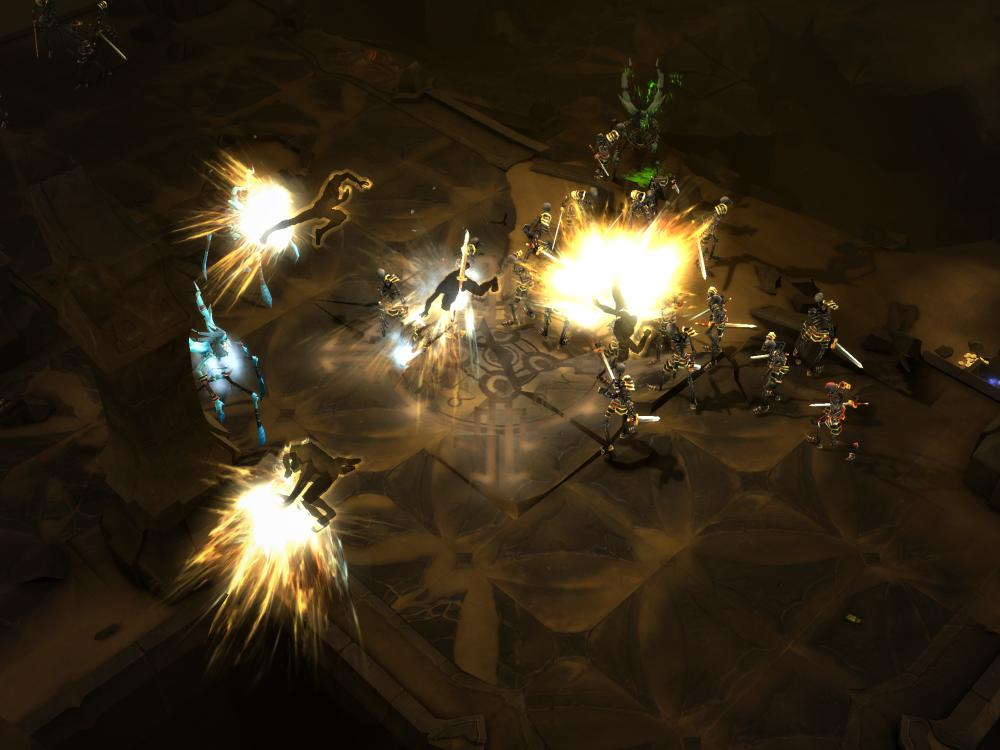
The big reveal for Diablo III this year was the new Monk class. It's the game's second melee character, after the Barbarian, but manages to have a completely distinct style and feel. The inspiration for the Monk came from rather disparate sources; pen-and-paper RPGs and arcade-style fighting games (think Street Fighter). Since a Monk is holy by nature, Blizzard felt he should have access to a bit of holy magic to enhance his martial-arts style of fighting. Interestingly, they drew on a more Eastern European background, rather than the archetypical Southeast Asian variety, and the departure works well; the character seems to have the discipline and focus expected of a devoted adherent while concealing a craziness that would make him try to kill a bear with his teeth. And win.
When designing the Monk, they wanted a fragile fighting class with more depth than just running up and smashing something. They looked at World of Warcraft's Rogue and Diablo II's Assassin, but decided each was ultimately unsatisfying for a game like Diablo III. They wanted something with a limited amount of skills but many ways to have those skills work together. Thus was born the combo system. Many of the Monk's major attacks have three different stages. Clicking on an enemy once gives you the first stage, clicking again (within a short period of time) gives you the second stage, and another click for the third stage. For example: Exploding Palm. The first stage hits for 35% of your weapon damage. Second stage hits for 50%. Third stage puts a damage-over-time bleed effect on the enemy, exacerbated by movement. If the enemy dies from the bleed effect, it explodes, causing a huge amount of damage to nearby enemies. This happens quite often, and it's a very powerful area-of-effect attack. Another example: Way of the Hundred Fists. The first attack is a quick dash, striking one enemy. The second stage is a rapid series of low-damage attacks. The third stage is a powerful area-of-effect damage and knock-back effect around the player.
Now, the most interesting part about these combos is that you can mix and match. You can take the first stage from one ability, second stage from another, and the third stage from still another. This lets you tailor the way you attack to fit whatever situation you're in. These combine with more typical single-stage abilities, although some of the abilities themselves are anything but typical. An attack called Seven Sided Strike makes the Monk zip around part of the screen, teleporting between enemies to attack them. It's great fun to use, and very reminiscent of combo attacks in arcade fighting games. It's not something you'd expect in a Diablo game, but it fits perfectly. Everything feels like an impact.
There were hands-on gaming areas set up throughout the convention, so we got to sit down and play through a level using the brand-new Monks, and it was probably the most entertaining time I spent there. Figuring out interesting ways to weave the abilities together is fun. Plus, one of the coolest things I noticed was how well two players could complement each other, even playing the same class. As I got comfortable with the Monk's skills and began to watch what my partner (also a Monk) was doing, I found that if I planned my attacks to play into his, we could tackle much stronger groups of monsters than we could otherwise. I could use my knock-back to bump a few monsters in to his area-attack or to give him a little space when he was vulnerable. We could layer our disorient spell so that monsters had less time to hit us. It gave me great hope for group synergy.
Blizzard had some neat tidbits on display within the level itself, too. Several boss monsters, and even some regular ones, required strategic movement and ability use — not just blindly running in the opposite direction waiting for our heath bars to fill up, as was often the case in Diablo II. By playing smart, we could avoid a lot of the damage, which is how it should be. There was also an interesting side-dungeon; upon zoning in, we were warned that the place was collapsing, and a timer began ticking down. As we moved further inside, the ceiling would periodically drop rocks on us, forcing us to dodge quickly or take damage. But here's the rub: the further you go into the dungeon the more and better loot you get from chests. So it becomes a race — a challenge. How far can you go before you can't get back? When the timer expires, everything collapses, and you die.
Several quests were available in the demo level as well. They all operate in a very smooth and story-driven manner. Several lessons have obviously been taken from World of Warcraft in that regard, but not in a way that undermines the Diablo style. They succeeded in showing a very dark thematic tone in a visually bright level. The developers spent some time talking about their design process and philosophy, and showed some examples of what they had in the works. They're trying to do interesting things with the monsters without making an individual monster too complex. Difficulty and complexity is achieved through combining different types of monsters. They have a variety of archetypes, such as swarmers, ranged attackers, enemies that weaken you in some way, monsters that alter or constrict your movement through area-effect spells, and many others. Knowing how to prioritize your targets will be a valuable skill.
Diablo III is a game that's already impressive, but very much still in development. Blizzard isn't ready to talk about many things; major decisions for the PvP system haven't been made yet, Battle.net integration is something for the future (though they will have cross-game communication, like the others), and the much-anticipated rune system for customizing skills is on hold until they finalize the skills themselves. Even things like the Barbarian's resource system and graphical effects are still going through new iterations, and they're trying to smooth out the bumps in monster design. They mentioned a sand-shark which would become much more powerful in the open desert (think Tremors), making the sand feel less safe to stand on than nearby rocks. Unfortunately, in playtesting, they found that it was hard to balance and confusing for the players, so they're tinkering with the design. I wouldn't expect this game before 2011.
A few more random snippets: the stash will be "gigantic," and there will still be endgame loot runs, but they will most likely be "diversified" such that you'd actively want to kill multiple bosses rather than the same one over and over. There will be some method for transferring items between your characters, and they're working on ways to prevent item duping/hacking. They want Diablo III to have a more meaningful economy than Diablo II. They don't feel like modding or map-making provides any substantial benefit for the game, and they don't plan to support it. They like the idea of using the Horadric Cube to craft items, but wouldn't be satisfied duplicating the way it was implemented.
World of Warcraft: Cataclysm
The unveiling of World of Warcraft's third expansion was perhaps the biggest hit of the conference. It was clear since the launch of The Burning Crusade that Blizzard has gotten much better at quest and zone design since the original two continents were created. Wrath of the Lich King only emphasized that point; comparing the landscape of Howling Fjord to that of Desolace made you wonder that they were part of the same game. Players had been asking for a better leveling experience for years, and their demands did not go unnoticed. Cataclysm is easily the biggest expansion, and is sure to further solidify the game's place at the top of the MMO food chain.
So, what do we know about Cataclysm? Well, it'll affect every zone on Kalimdor and the Eastern Kingdoms, some to greater extent than others. Northrend will be affected too, though not as much. The Outland, being separate from the world of Azeroth, won't undergo significant physical change, but quests and dialogues will be updated to reflect such a major event. In addition to the remodeling of the two major continents, several entirely new areas will be available to players as well, including an underwater zone. The phasing technology introduced in Wrath is being upgraded to affect terrain, and players will be able to use their flying mounts in Azeroth.
That's a lot to digest, but the WoW developers just kept piling on more information throughout the convention. There are five new high-level zones for taking players from level 80 to 85. Two of them, Mount Hyjal and the Sunken City of Vashj'ir, are starter zones. Vashj'ir is the underwater zone. The devs promised to "make sure it won't be annoying." From what they described, most of the combat will be done on the bottom of the ocean, with characters able to move around and fight much like normal. They'll also be able to detach themselves from the bottom and swim through the water above them. Underwater mounts will be introduced that move as quickly as flying mounts, and there may even be some areas at the bottom of the sea that will be enclosed, containing air. They showed some concept art that was very bright and colorful, what you might expect from a documentary on a lively reef on the Discovery channel. Hyjal will be under siege by an old enemy — Ragnaros. He's not too happy about what happened to him the last time around, and he's trying to take out his anger on the World Tree.
Deepholm was termed the "hub" of the new 80-85 areas; it will facilitate quick transport to any of them. A temple in the center of the zone is where the expansion's villain, Deathwing, broke through and caused the cataclysm. It's designed to feel like an enclosed space, and the art we've seen makes it look like a giant cavern, which will definitely give it a different feel from any zone we've seen before. Uldum is a long-awaited addition to Azeroth. As it turns out, it was always "there," but Titan-created machines prevented anyone from seeing it. The cataclysm broke those machines, so it's open season on this Egypt-inspired zone. Twilight Highlands is home to the Twilight's Hammer cult, the ones who helped to free Deathwing. It'll have Grim Batol, one of the new raids, as well as new port towns for both the Horde and the Alliance.
The cataclysm will have political ramifications as well, resulting in two new playable races. The Goblins will be forced from their neutrality into partnership with the Horde, and a break in the Greymane Wall puts the Worgen squarely on the side of the Alliance. They each get their own starting zone (levels 1-15), and both will have fairly powerful racial abilities; Worgen get a sprint ability, slightly increased damage, and a bonus to skinning — which they don't require a knife to do. Goblins get price discounts regardless of reputation, engineering abilities (one launches them at their target, another fires rockets, but they share a cooldown), and a bonus to their alchemy skill, which includes increased effects from potions. You don't need to worry that these are more powerful than the old races — all of them will be updated to a similar level of usefulness when Cataclysm launches. Oh, and race changes will become available at some point as well.
More big news: rated battlegrounds will be arriving with Cataclysm. They will function differently from arenas in that you won't have particular teams, and your rating will never go down — only up. Every week a particular battleground can be used for rated matches. If you win, you gain rating determined by your current rating and the quality of your opponents. If you lose, your rating stays the same. Winning also awards you a number of arena points per game. Arenas will be shifting to this system as well. Your rating will determine the maximum number of points you can earn in a week. You won't have rated teams for battlegrounds, but you will need to queue as a group. A variety of new bonuses and awards are being introduced, including epic ground mounts and the return of honor titles, like Grand Marshal.
Also on the PvP front, a new world-PvP zone will be opening: an island called Tol Barad. The intent is to combine the battles in Wintergrasp with the daily quest hub of the Isle of Quel'Danas. When the battle isn't active, players from both factions can do daily quests and choose whether or not they want to rumble on their own terms. When the fight is underway, daily quests shut down until there is a victor. The winner gets access to an instance and a few more daily quests. The action will be spread out over a larger area in order to avoid some of the crippling lag that plagued Wintergrasp on some servers, and different areas will have different types of combat. There will be a new battleground too, the Battle of Gilneas, which will have players trying to capture districts of a city. There will probably be new arena maps as well.
Perhaps as significant as the physical changes to World of Warcraft are the changes to itemization that are in the works. Mana per 5 is being rolled into Spirit. Attack Power will be abandoned for Strength and Agility. Spell Power will be rolled into Intellect. Defense and Armor Penetration are going away (almost) entirely. Block value is gone too; blocks now absorb a flat percentage of the damage, making it a useful stat against bosses. The intent is to streamline gear so that players don't need giant spreadsheets to figure out whether something is an upgrade. Most of these stats will be replaced by a new stat called "Mastery," which "makes you better at what you do best." The talent trees are being revised to remove talents that give a passive bonus to your character, since that's kind of boring. Instead, simply spending points in a particular talent tree will give you appropriate passive bonuses. The further you go, the better the bonuses are. It will allow for more meaningful choices in how the characters is played. The system will be smart enough to know what weapon specialization you use, and if you go all the way down to the bottom of a tree, you'll see some really interesting bonuses. One they showed for Paladins granted a percentage reduction in cooldown duration.
Some big class changes are underway too; Hunters will no longer use mana, but instead adopt the Focus system used by their pets. This lets them ignore Intellect gear and reduces the need for cooldowns on their abilities, since that can be handled by their resource system. Warlocks are seeing a substantial change in the way Soul Shards work. No longer will they have to carry around a few dozen in their bags; instead, they'll acquire a max of three, held in a UI system similar to Death Knight Runes. They won't be easily recharged during combat, but grant substantial boosts to spell effects. For example, one might be used to make a long summoning spell or their biggest, slowest damage spell instant-cast instead.
It wouldn't be an expansion without a new profession, and once again Blizzard is doing it in a way they haven't done before; Archaeology is a new secondary profession, so everyone can get it without taking up one of their primary profession slots. It's also the key to a new max-level character progression system called "Paths of the Titans." This will be a way to gradually improve your character once you've hit the level cap. Progress will be limited; they don't want people to feel obligated to grind it out, so it'll become available slowly. There are 10 ranks to each Path, and you get bonuses to your character at every rank. The bonuses are not class specific, so it's feasible for a warrior and a priest to pick the same one; it just depends on what abilities you'd like. The examples they gave included a passive damage reduction to your character and an activated ability that reduced damage to nearby allies. It uses the glyph system, but the glyphs come from Archaeology rather than Inscription. Another way to customize will be an ability called Reforging. It will let you exchange part of one stat on an item for another. For example, a ring with 10 Intellect could be changed to a ring with 5 Intellect and 5 Spirit.
That's not all with regard to customization, however. Cataclysm will be introducing a Guild leveling system. Almost everything you do — boss kills, level-ups, skill-ups, PvP, etc. — contributes toward your guild gaining levels, to a maximum of 20. Guilds will have their own talent trees, which only apply to its members. Blizzard showed a few of the possible talents; one reduced repair costs, and another granted a mass resurrection spell. They also talked about talents for removing reagent costs and having extra gold drop from monsters. There will also be Guild Achievements and Guild Heirlooms. Heirloom recipes can be purchased, allowing anyone of that profession within the guild to craft the item. If a person with one of those items leaves the guild, the item is put back in the guild bank.
It was an eventful two days for the WoW team. They mentioned a variety of other news, too. They're doing away with spell ranks; they all just scale with level now. Incidentally, this opens the door to a mentoring system, which they may decide to implement at some point. They're making "big changes" to fishing so it will be "more fun." Players with two gathering professions will be able to track both simultaneously. The terrain phasing system will let you see entire coastlines change as the cataclysm progresses. There will be a guild news feed, not to mention cross-faction, cross-realm, and cross-game communication through Battle.net. Cross-server instance groups (aimed at PUGs) are planned for the next major patch. The revamped leveling zones will lead to each other in a more contiguous manner, so expect some high level zones to become low-level zones, and vice versa.
All in all, it looks like the WoW devs have been busy cramming every cool feature they could manage into this expansion, while simultaneously addressing some of the game's biggest weaknesses. It's getting hard to see how new MMOs will ever be able to compete against something like this. Blizzard wants new players to have this experience, so it's likely they'll integrate Cataclysm into the base game. It'll be interesting to see whether the development cycle takes longer than the previous expansions, since it seems like Cataclysm will require a lot more work. I'm sure we'll have a better idea after the next Blizzcon!
-
Sunspots May Be Different During This Solar Minimum
PhreakOfTime writes "According to Bill Livingston and Matt Penn of the National Solar Observatory in Tucson, Arizona, sunspot magnetic fields are waning. The two respected solar astronomers have been measuring solar magnetism since 1992. Their technique is based on Zeeman splitting of infrared spectral lines in radiation emitted by iron atoms in the vicinity of sunspots. Extrapolating their data (PDF) into the future suggests that sunspots could completely disappear within decades." To motivate their interest the researchers mention the Maunder Minimum, which occurred beginning in 1645 and coincided with the coldest part of the so-called "Little Ice Age." Sunspot counts during this period were as low as 1/1,000 of the numbers seen in modern times. -
New Species of Worms Found To Release "Bombs"
caffiend666 writes "A newly found deep ocean worm 'can cast off green glowing body parts, a move scientists think may be a defensive effort to confuse attackers. Researchers have dubbed the newly discovered critters "green bombers." ... The first of the new species has been given the scientific name Swima bombiviridis. ... [T]he worms are able to regenerate the body parts.' So, it's a naturally occurring animal that rips off its arms and throws them, and we're not talking about a game from ID Software?" -
Initial Tests Fail To Find Gravitational Waves
eldavojohn writes that though gravitational waves are "predicted to exist by Einstein's Theory of General Relativity, the initial tests run by the Laser Interferometer Gravitational-Wave Observatory Scientific Collaboration (LIGO) failed to find anything. It doesn't disprove their existence although it does rule out a subset of string theory. From the article, 'For example, some models predict the existence of cosmic strings, which are loops in space-time that may have formed in the early universe and gotten stretched to large scales along with the expansion of the universe. These objects are thought to produce bursts of gravitational waves as they oscillate. Since no large-amplitude gravitational waves were found, cosmic strings, if they exist at all, must be smaller than some models predict.' The scientists working in Washington and Louisiana (in tandem to rule out flukes) will now move on to Advanced LIGO which will analyze a volume of space 1,000 times larger. If they don't find any gravitational waves in that experiment, the results will be more than unsettling to many theorists." -
Taiwan University Students Build Tour-Guide Robot
BobB-nw writes "A group of engineering students and their professor at National Taiwan University have built a robot that can map out the area it's operating in and offer guided tours. The robot, named 'Hsiao Mei,' uses laser mapping and GPS technology to navigate on its own, including around corners and obstacles such as tables and chairs. In the first public demonstration on Thursday, an engineering student with a wireless remote control first took the robot through the floor of a small museum on the university's campus so it could create a map for itself. After the initial run-through, the robot was able to make an unaided journey around the floor." -
Robots Make the Coins Go 'Round, Down Under
inkslinger77 writes "Computerworld has a cool slideshow of a Kuka Titan robot and a bunch of AGVs managing the circulation of coins at the Australian Mint. There's also a lengthier article where the head of the project talks about the main reason robots were employed. One of the reasons being that they radically reduce OH&S risk: 'We are finding that the AGVs are much safer and more reliable. Robots are never affected by having a bad night with the baby and falling asleep at the wheel. They are extremely accurate and they always do the same task in the same way.'" -
Alternative Orion Missions Proposed
skywatcher2501 writes "Lockheed Martin, the company producing NASA's new Orion spacecraft, published three videos (news article in German) showing alternative Orion missions. Great efforts are made to show Orion's flexibility as a space transportation system beyond the goals of the Constellation program." The three videos, respectively, illustrate ISS missions with cargo in low-Earth orbit; autonomous use of the service module; and maintenance missions from low-earth orbit to geosynchronous orbit. -
Alternative Orion Missions Proposed
skywatcher2501 writes "Lockheed Martin, the company producing NASA's new Orion spacecraft, published three videos (news article in German) showing alternative Orion missions. Great efforts are made to show Orion's flexibility as a space transportation system beyond the goals of the Constellation program." The three videos, respectively, illustrate ISS missions with cargo in low-Earth orbit; autonomous use of the service module; and maintenance missions from low-earth orbit to geosynchronous orbit. -
Alternative Orion Missions Proposed
skywatcher2501 writes "Lockheed Martin, the company producing NASA's new Orion spacecraft, published three videos (news article in German) showing alternative Orion missions. Great efforts are made to show Orion's flexibility as a space transportation system beyond the goals of the Constellation program." The three videos, respectively, illustrate ISS missions with cargo in low-Earth orbit; autonomous use of the service module; and maintenance missions from low-earth orbit to geosynchronous orbit. -
US Navy Tries To Turn Seawater Into Jet Fuel
Hugh Pickens writes "New Scientist reports that, faced with global warming and potential oil shortages, the US Navy is experimenting with making jet fuel from seawater by processing seawater into unsaturated short-chain hydrocarbons that with further refining could be made into kerosene-based jet fuel. The process involves extracting carbon dioxide dissolved in the water and combining it with hydrogen — obtained by splitting water molecules using electricity — to make a hydrocarbon fuel, a variant of a chemical reaction called the Fischer-Tropsch process, which is used commercially to produce a gasoline-like hydrocarbon fuel from syngas, a mixture of carbon monoxide and hydrogen often derived from coal. The Navy team have been experimenting to find out how to steer the CO2-producing process away from producing unwanted methane by finding a different catalyst than the usual one based on cobalt. 'The idea of using CO2 as a carbon source is appealing,' says Philip Jessop, a chemist at Queen's University adding that to make a jet fuel that is properly 'green,' the energy-intensive electrolysis that produces the hydrogen will need to use a carbon-neutral energy source; and the complex multi-step process will always consume significantly more energy than the fuel it produces could yield. 'It's a lot more complicated than it at first looks.'" -
Relativistic Navigation Needed For Solar Sails
KentuckyFC writes "Last year, physicists calculated that a solar sail about a kilometer across with a mass of 300 kg (including 150 kg of payload) would have a peak acceleration of roughly 0.6g if released about 0.1AU from the Sun, where the radiation pressure is highest. That kind of acceleration could take it to the heliopause — the boundary between the Solar System and interstellar space — in only 2.5 years; a distance of 200 AU. In 30 years, it could travel 2500AU, far enough to explore the Oort Cloud. But the team has discovered a problem. Ordinary Newtonian physics just doesn't cut it for the kind of navigational calculations needed for this journey. Because the sail has to be released so close to the Sun, it becomes subject to the effects of general relativity. And although the errors these introduce are small, they become magnified over the course of a long journey, sending the sail roughly 1 million kilometers off course by the time it reaches the Oort Cloud. What these guys are saying is that if ever such a sail is launched (and the earliest estimate is 2040), the navigators will have to be proficient in a new discipline of relativistic navigation." -
Predicting Malicious Web Attacks
KentuckyFC writes "Recommendation systems attempt to guess what books, movies, or news people are likely to be interested in. Companies such as Amazon, Google, and Netflix have developed algorithms to mine vast databases looking for correlations that they then use to recommend new items. Now a team of computer scientists has used some of the same filtering techniques to predict the origin of malicious Web attacks so that they can be blacklisted in advance. The team mined a database of hundreds of millions of security logs looking for correlations between victims. The correlations were then used to produce a predictive blacklist of potential attackers. The team says its algorithm is up to 70 per cent more successful at predicting the origin of attacks than current state-of-the-art predictive blacklisting." -
Why the BSA Is Less Reviled Than the RIAA
Hugh Pickens writes "The Business Software Alliance (BSA) is a trade group established in 1988 representing a number of the world's largest software makers whose principal activity is trying to stop copyright infringement of software produced by its members, performing roughly the same function for the software industry that the RIAA performs for the music industry. Yet, as Bill Patry, author of a 7-volume treatise on US copyright law and currently Senior Copyright Counsel at Google, notes on his blog the BSA is a 'far less unpopular organization' than the RIAA because there are three key differences between the BSA's campaigns and the RIAA's. First, BSA's members have always offered their products for sale to the public, through any channel that wants to sell them. Second, BSA's members are consumer-oriented; they try to develop products that respond to consumers' needs, and not, the reverse: focusing on what they want to sell to consumers. Third, because consumers can easily purchase BSA's members products, those who copy without paying are simply scofflaws. 'I think the fact that the public does not object to BSA's campaign proves my point [that]... people do not want things for free; they are willing to pay for them,' writes Patry. 'It should not be surprising that when consumers are not treated with respect, they react negatively. That's something the software industry learned long ago, and that's why people don't object to the BSA's enforcement campaign.'" -
English Wikipedia Reaches 3 Million Articles
FunPika writes "It has taken more than eight years and the work of vast numbers of people around the world, but the English version of Wikipedia has finally amassed more than three million articles. The site broke through the 3 million barrier early on Monday morning UK time, with the honors taken by a short article about Norwegian actor Beate Eriksen — a 48-year-old cast member of a popular local soap opera." -
NASA Developing Nuclear Reactor For Moon and Mars
Al writes "NASA recently finished testing a miniature nuclear reactor that would provide power for an astronaut base on the Moon or Mars. The reactor combines a small fission system with a Stirling engine to make a 'safe, reliable, and efficient' way to produce electricity. The system being tested at NASA's Glenn Research Center can produce 2.3 kilowatts and could be ready for launch by 2020, NASA officials say. The reactor ought to provide much more power than solar panels but could prove controversial with the public concerned about launching a nuclear power source and placing it on the Moon or another planet." -
Open Source GSM Network At Dutch Hacker Convention
solevita writes "Harald Welte, who's been interviewed previously by Slashdot, has written on his blog about operating an Open Source GSM network at the recent HAR2009 conference. Photographs and a description of the setup, run under license of the Dutch regulatory authority, are provided; essentially the setup consisted of a pair of BTS' (Base Transceiver Stations) running at 100mW transmit power each and tied to a tree. In turn these provided access to the Base Station Controller (BSC), in this case a Linux server in a tent running OpenBSC. The system authenticated users with a token sent via SMS; in total 391 users subscribed to the service and were able to use their phones as if they were on any other network. Independent researchers are increasingly examining GSM networks and equipment, Welte's work proves that GSM is in the realm of the hackers now and that this realm of mobile networking could be set for a few surprises in the future." -
14-Year-Old Wins International Programming Contest
marcog123 writes "The International Olympiad in Informatics was held earlier this week in Bulgaria. The IOI is a programming competition for high school learners up to 20 years of age that has a focus on problem solving and algorithms. It was won by 14-year-old Henadzi Karatkevich of Belarus (PDF, list of gold medalists), beating the world's top high school programmers, including 18- and 19-year-olds, to become the youngest winner in the IOI's 21-year history. Competition is really tough, with some countries taking months off school to concentrate only on IOI training. Henadzi first entered the IOI in 2006 when he was only 11 years old and won silver (missing gold by only six points). He won gold in 2007 and 2008. He has the opportunity to enter for the next three years; that is, unless he follows the path of Terence Tao, who won IMO gold at 12 and then went to university the following year. If he continues his current streak, he will easily surpass the current record of six IOI medals by South Africa's Bruce Merry." -
14-Year-Old Wins International Programming Contest
marcog123 writes "The International Olympiad in Informatics was held earlier this week in Bulgaria. The IOI is a programming competition for high school learners up to 20 years of age that has a focus on problem solving and algorithms. It was won by 14-year-old Henadzi Karatkevich of Belarus (PDF, list of gold medalists), beating the world's top high school programmers, including 18- and 19-year-olds, to become the youngest winner in the IOI's 21-year history. Competition is really tough, with some countries taking months off school to concentrate only on IOI training. Henadzi first entered the IOI in 2006 when he was only 11 years old and won silver (missing gold by only six points). He won gold in 2007 and 2008. He has the opportunity to enter for the next three years; that is, unless he follows the path of Terence Tao, who won IMO gold at 12 and then went to university the following year. If he continues his current streak, he will easily surpass the current record of six IOI medals by South Africa's Bruce Merry." -
Airborne Laser Successfully Tracks, Hits Missile
fructose writes "The Airborne Laser managed to acquire, track, and illuminate a test missile a few days ago. According to the press release, the Boeing plane 'used its infrared sensors to find a target missile launched from San Nicolas Island, Calif ... issued engagement and target location instructions to the beam control/fire control system ... fired its two solid-state illuminator lasers to track the target and ... fired a surrogate high-energy laser at the target, simulating a missile intercept.' The sensors on board the missile confirmed the 'hit.' Michael Rinn, ABL's program director, said, 'Pointing and focusing a laser beam on a target that is rocketing skyward at thousands of miles per hour is no easy task, but the Airborne Laser is uniquely able to do the job.' The next steps will be to test the high-power laser at full strength in flight and do a complete system test later this year. Its success or failure will determine whether the project gets canceled. Looks like the Real Genius fans out there are finally living the dream." -
Sony To Convert Online Bookstore To Open Format
Dr_Barnowl writes "The BBC reports that Sony is to convert its online bookstore to the EPUB format. While this format still allows DRM, it's supported on a much wider variety of readers. Is this a challenge to the Kindle? It's nice to see Sony opening up to the idea of open standards. Even if you still have reservations about buying a Sony device, you might be able to patronize their bookstore sometime soon."