Slashdot Mirror
Domain: wolfram.com
Stories and comments across the archive that link to wolfram.com.
Stories · 95
-
Economics Nobel Laureate Paul Romer Is a Python Programming Convert (qz.com)
Economist Paul Romer, a co-winner of the 2018 Nobel Prize in economics, uses the programming language Python for his research, according to Quartz. Romer reportedly tried using Wolfram Mathematica to make his work transparent, but it didn't work so he converted to a Jupyter notebook instead. From the report: Romer believes in making research transparent. He argues that openness and clarity about methodology is important for scientific research to gain trust. As Romer explained in an April 2018 blog post, in an effort to make his own work transparent, he tried to use Mathematica to share one of his studies in a way that anyone could explore every detail of his data and methods. It didn't work. He says that Mathematica's owner, Wolfram Research, made it too difficult to share his work in a way that didn't require other people to use the proprietary software, too. Readers also could not see all of the code he used for his equations.
Instead of using Mathematica, Romer discovered that he could use a Jupyter notebook for sharing his research. Jupyter notebooks are web applications that allow programmers and researchers to share documents that include code, charts, equations, and data. Jupyter notebooks allow for code written in dozens of programming languages. For his research, Romer used Python -- the most popular language for data science and statistics. Importantly, unlike notebooks made from Mathematica, Jupyter notebooks are open source, which means that anyone can look at all of the code that created them. This allows for truly transparent research. In a compelling story for The Atlantic, James Somers argued that Jupyter notebooks may replace the traditional research paper typically shared as a PDF. -
60-Year-Old Maths Problem Partly Solved By Amateur (theguardian.com)
An amateur mathematician has made the first breakthrough in more than 60 years towards solving a well-known maths problem. From a report: Aubrey de Grey, who is more widely known as a maverick biologist intent on extending the human lifespan, has taken the academic world by surprise after announcing a new solution to the so-called Hadwiger-Nelson problem. The problem sounds deceptively simple, but despite some professionals spending years trying to crack it, progress has stalled since shortly after the puzzle was first posed in 1950. "Literally, this is the first progress in more than 60 years," said Gil Kalai, a mathematician at Hebrew University of Jerusalem.
The problem is as follows. Imagine a collection of dots connected by lines. The dots can be arranged any way at all, the only rule is that all the connecting lines must be of equal length. For instance, in a square the diagonal would not be joined up, but the outer edges would be. Now, colour in all the dots so that no two connected points have the same colour. How many colours are required. For a square, the answer would be two. But the Hadwiger-Nelson problem asks what the minimum would be for any configuration -- even one that extends across a plane of infinite size. -
Golden State and the Mathematical Magic of Seventy-Three (newyorker.com)
Charles Bethea has written a fascinating piece on the number '73' for The New Yorker. Below are some tidbits from the story but I urge you to hit the New Yorker link and read the story in entirety there. Bethea writes: "I am aware of the Warriors's push for seventy-three wins," Ken Ono, a professor of mathematics at Emory University and the author of "The Web of Modularity: Arithmetic of the Coefficients of Modular Forms and q-series," said recently. [...] Professor Ono worked as a math consultant on a film called "The Man Who Knew Infinity," which stars Dev Patel and Jeremy Irons, and which screens this week at the Tribeca Film Festival, in New York. The movie centers on the friendship of the legendary Indian mathematician Srinivasa Ramanujan (Patel) and his Cambridge University colleague G. H. Hardy (Irons), and it depicts a famous story that Hardy once told about Ramanujan. "I remember once going to see him when he was ill at Putney," Hardy said. "I had ridden in taxicab number 1729 and remarked that the number seemed to me rather a dull one, and that I hoped it was not an unfavorable omen. "No," he replied. "It is a very interesting number; it is the smallest number expressible as the sum of two cubes in two different ways." One cubed plus twelve cubed, and nine cubed plus ten cubed. This was the first of what came to be known as "taxicab numbers." [...] So what does Professor Ono think of seventy-three? "I really like the number seventy-three," he said. "It is the sixth 'emirp.'" An emirp, he explained, is a prime number that remains prime when its digits are reversed. (Emirp, of course, is 'prime' spelled backward.) -
Ask Slashdot: Math-Related Present For a Bright 10-Year-Old?
peetm writes: I have an above averagely bright nephew, aged 10, who's into maths and whose birthday is coming up soon. I'd like to get him a suitable present – most likely one that's mathematically centred. At Christmas we sat together while I helped him build a few very simple Python programs that 'animated' some simple but interesting maths, e.g., we built a factorial function, investigated the Collatz conjecture (3n + 1 problem) and talked about, but didn't implement Eratosthenes' Sieve – one step too far for him at the moment perhaps. I've looked about for books that might blend computing + maths, but haven't really found anything appropriate for a 10-year-old. I should be indebted to anyone who might suggest either a suitable maths book, or one that brings in some facet of computing. Or, if not a book, then some other present that might pique his interest. -
Stephen Wolfram: No Need To Teach With 'Toy Programming Languages' Like Scratch (wolfram.com)
theodp writes: From Stephen Wolfram's blog post announcing the Wolfram Programming Lab: "It's a very important — and in fact transformative — moment for programming education. In the past one could use a 'toy programming language' like Scratch, or one could use a professional low-level programming language like C++ or Java. Scratch is easy to use, but is very limited. C++ or Java can ultimately do much more (though they don't have built-in knowledge), but you need to put in significant time—and get deep into the engineering details—to make programs that get beyond a toy level of functionality. With the Wolfram Language, though, it's a completely different story. Because now even beginners can write programs that do really interesting things. And the programs don't have to just be 'computer science exercises': they can be programs that immediately connect to the real world, and to what students study across the whole curriculum. Wolfram Programming Lab gives people a broad way to learn modern programming — and to acquire an incredibly valuable career-building practical skill. But it also helps develop the kind of computational thinking that's increasingly central to today's world." So, when it comes to programming education, are schools hitchIng their cart to the wrong horse? -
Stephen Wolfram: No Need To Teach With 'Toy Programming Languages' Like Scratch (wolfram.com)
theodp writes: From Stephen Wolfram's blog post announcing the Wolfram Programming Lab: "It's a very important — and in fact transformative — moment for programming education. In the past one could use a 'toy programming language' like Scratch, or one could use a professional low-level programming language like C++ or Java. Scratch is easy to use, but is very limited. C++ or Java can ultimately do much more (though they don't have built-in knowledge), but you need to put in significant time—and get deep into the engineering details—to make programs that get beyond a toy level of functionality. With the Wolfram Language, though, it's a completely different story. Because now even beginners can write programs that do really interesting things. And the programs don't have to just be 'computer science exercises': they can be programs that immediately connect to the real world, and to what students study across the whole curriculum. Wolfram Programming Lab gives people a broad way to learn modern programming — and to acquire an incredibly valuable career-building practical skill. But it also helps develop the kind of computational thinking that's increasingly central to today's world." So, when it comes to programming education, are schools hitchIng their cart to the wrong horse? -
Stephen Wolfram's Free Book Teaches the Wolfram Language To Kids
theodp writes: Stephen Wolfram received a PhD in particle physics at age 20 (his thesis committee included Richard Feynman). So it's probably not too surprising that Wolfram's new book, An Elementary Introduction to the Wolfram Language (free on the web), aspires to teach those new to programming how to do much more than just move Minecraft and Star Wars characters around. "The goal of the book," explains Wolfram in a blog post, "is to take people from zero to the point where they know enough about the Wolfram Language that they can routinely use it to create programs for things they want to do. And when I say 'zero', I really mean 'zero'. This is a book for everyone. It doesn't assume any knowledge of programming, or math (beyond basic arithmetic), or anything else. It just starts from scratch and explains things. I've tried to make it appropriate for both adults and kids. I think it'll work for typical kids aged about 12 and up." -
Interviews: Ask Stephen Wolfram a Question
Stephen Wolfram's accomplishments and contributions to science and computing are numerous. He earned a PhD in particle physics from Caltech at 20, and has been cited by over 30,000 research publications. Wolfram is the the author of A New Kind of Science, creator of Mathematica, the creator of Wolfram Alpha, and the founder and CEO of Wolfram Research. He developed Wolfram Language, a general multi-paradigm programming language, in 2014. Stephen has graciously agreed to answer any questions you may have for him. As usual, ask as many as you'd like, but please, one per post. -
Interviews: Ask Stephen Wolfram a Question
Stephen Wolfram's accomplishments and contributions to science and computing are numerous. He earned a PhD in particle physics from Caltech at 20, and has been cited by over 30,000 research publications. Wolfram is the the author of A New Kind of Science, creator of Mathematica, the creator of Wolfram Alpha, and the founder and CEO of Wolfram Research. He developed Wolfram Language, a general multi-paradigm programming language, in 2014. Stephen has graciously agreed to answer any questions you may have for him. As usual, ask as many as you'd like, but please, one per post. -
Wolfram Language Demo Impresses
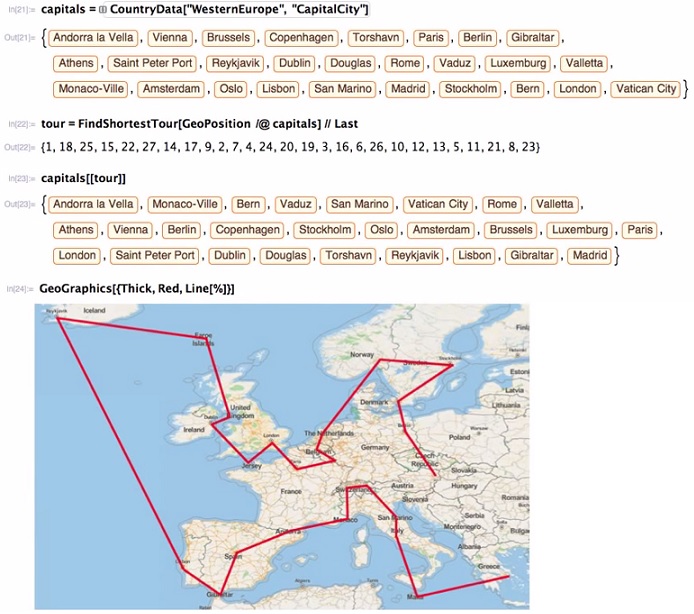
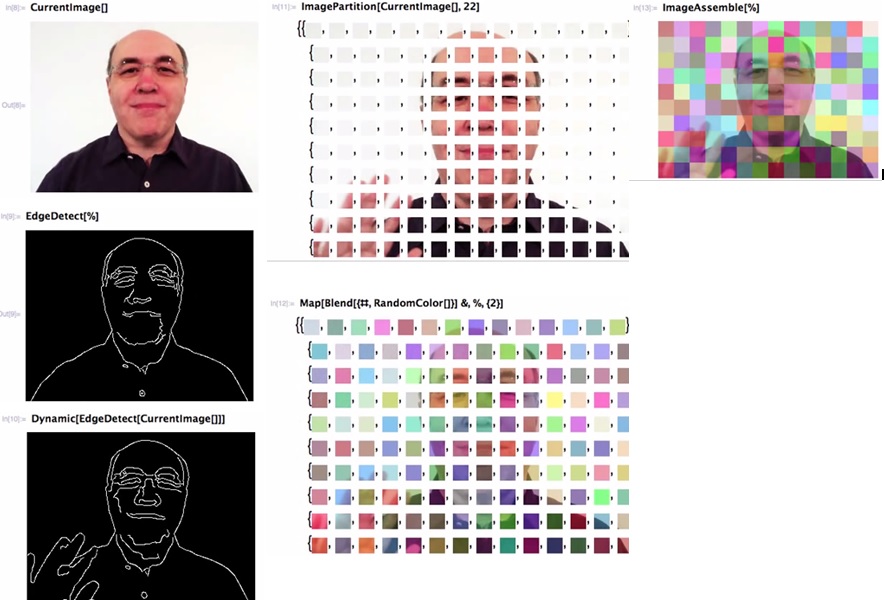
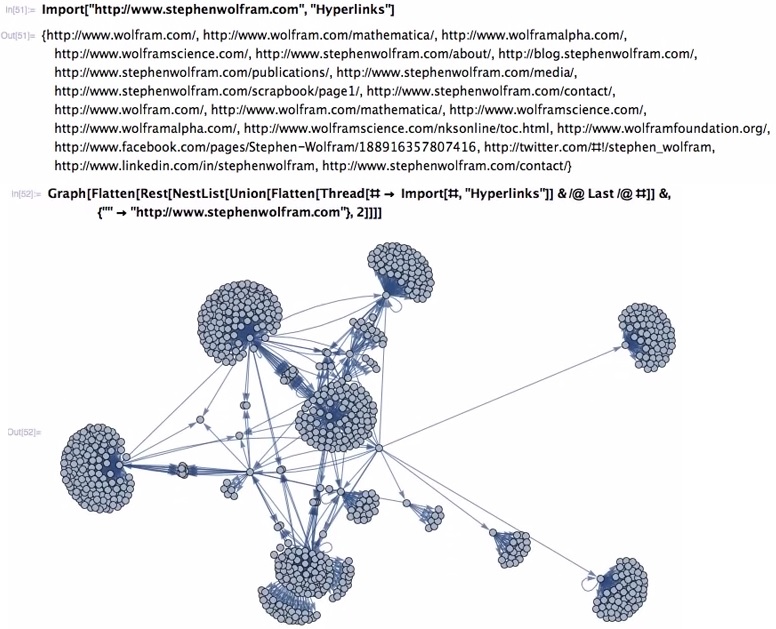
theodp writes "The devil will be in the details, but if you were stoked about last November's announcement of the Wolfram programming language, you'll be pleased to know that a just-released dry-but-insanely-great demo delivered by Stephen Wolfram does not disappoint. Even if you're not in love with the syntax or are a FOSS devotee, you'll find it hard not to be impressed by Wolfram's 4-line solution to a traveling salesman tour of the capitals of Western Europe, 6-line camera-capture-to-image-manipulation demo, or 2-line web crawling and data visualization example. And that's just for starters. So, start your Raspberry Pi engines, kids!" -
Wolfram Language Demo Impresses
theodp writes "The devil will be in the details, but if you were stoked about last November's announcement of the Wolfram programming language, you'll be pleased to know that a just-released dry-but-insanely-great demo delivered by Stephen Wolfram does not disappoint. Even if you're not in love with the syntax or are a FOSS devotee, you'll find it hard not to be impressed by Wolfram's 4-line solution to a traveling salesman tour of the capitals of Western Europe, 6-line camera-capture-to-image-manipulation demo, or 2-line web crawling and data visualization example. And that's just for starters. So, start your Raspberry Pi engines, kids!" -
Why Improbable Things Really Aren't
First time accepted submitter sixoh1 writes "Scientific American has an excellent summary of a new book 'The Improbabilty Principle: Why Coincidences, Miracles, and Rare Events Happen Every Day' by David J. Hand. The summary offers a quick way to relate statistical math (something that's really hard to intuit) to our daily experiences with unlikely events. The simple equations here make it easier to understand that improbable things really are not so improbable, which Hand call the 'Improbability Principle:' 'How can a huge number of opportunities occur without people realizing they are there? The law of combinations, a related strand of the Improbability Principle, points the way. It says: the number of combinations of interacting elements increases exponentially with the number of elements. The 'birthday problem' is a well-known example. Now if only we could harness this to make an infinite improbability drive!" -
Putting the Wolfram Language (and Mathematica) On Every Raspberry Pi
An anonymous reader writes "Working with the Raspberry Pi Foundation, effective immediately, there's a pilot release of the Wolfram Language — as well as Mathematica—that will soon be bundled as part of the standard system software for every Raspberry Pi computer. Quite soon the Wolfram Language is going to start showing up in lots of places, notably on the web and in the cloud." -
SXSW: Stephen Wolfram Jumps On Bandwagon For Cloud, Mobile Devices
Nerval's Lobster writes "At this year's SXSW conference, Stephen Wolfram—most famous in tech circles as the chief designer of the Mathematica software platform, as well as the Wolfram Alpha 'computation knowledge engine'—demonstrated his upcoming Programming Cloud, and indicated he was developing a mobile platform for engineering and mathematical applications based on the Wolfram programming language built for Mathematica. He also talked more broadly about the future of Wolfram Alpha, which he said will become more anticipatory of peoples' queries. 'People generally don't understand all the things that Wolfram Alpha can do,' Wolfram told the audience. His researchers are also working on a system modeler tool, which will allow researchers to simulate complex devices with tens of thousands of components; in theory, you could even use such a platform for 3D printing. Wolfram also wants to set Wolfram Alpha loose on documents, with the ability to apply complex calculations to, say, company spreadsheets. 'A whole bunch of things that I've been working on for 30 years are converging in a very nice way,' he said." -
Universal Turing Machine In Penrose Tile Cellular Automata
New submitter submeta writes "Katsunobu Imai at Hiroshima University has figured out a way to construct a universal Turing machine using cellular automata in a Penrose tile universe. 'Tiles in the first state act as wires that transmit signals between the logic gates, with the signal itself consisting of either a 'front' or 'back' state. Four other states manage the redirecting of the signal within the logic gates, while the final state is simply an unused background to keep the various states separate.' He was not aware of the recent development of the Penrose glider, so he developed this alternative approach." -
Wolfram Launches Computational Document Format
Barence writes "Wolfram Research has launched its own document format, which it claims is 'as everyday as a document, but as interactive as an app.' The Computational Document Format (CDF) allows authors to embed interactive charts, diagrams and graphics into their documents, allowing readers to adjust variables to see how increasing a price affects profits, for example, or display different segments of a brain scan. Wolfram aims to make the format easy enough for non-programmers to use, based on the linguistic commands used in its search engine. '[Currently] anyone who can make an Excel macro should easily be able to make interactivity for CDF,' said Conrad Wolfram. 'Where I'd like to get is that anyone who can make an Excel chart can make interactivity in CDFs.'" -
Students Claim New Paper Folding Record
A group of 15 students along with their teacher are claiming a new paper folding record. The group claims to have folded (in the same direction) 13,000 feet of toilet paper in half 13 times, breaking the old 2002 record of 12 times. From the article: "[teacher] Tanton has been leading students from St. Mark's on attempts to break the record for five years. But after several failed attempts, Tanton asked the MIT origami club, OrigaMIT, to help him and his students get access to MIT's Infinite Corridor." -
Gosper's Algorithm Meets Wall Street Formulas
peter.hill.1980 writes "Wall Street's money making formulas need to be as explicit as possible for efficiency purposes. An old, existing and famous formula — binomial options pricing formula — has now been scrutinized for theoretical optimality in a forthcoming paper by Evangelos Georgiadis of MIT using Gosper's Algorithm, proving that no general explicit or closed form expression exists for pricing." -
Wolfram Alpha Launches Tonight, On Camera
future.nerd tips news that Wolfram Alpha is set to be launched tonight at 8PM EST (00:00 GMT), and the entire process will be broadcast live, via webcast. Steven Wolfram said to PCPro, "We've been rather surprised that we haven't been able to find even a single publicly available record of the commissioning of any large website at all. So we thought we would document our own experience. We can't guarantee that everything will go smoothly. We fully expect to encounter unanticipated situations along the way. We hope that it'll be interesting for people to join us as we work through these in real time." In a related blog post, he explains how Wolfram Alpha interacts with Mathematica. -
Wolfram Research Releases Mathematica 7
mblase writes "Wolfram Research has released the seventh version of Mathematica, and it does a lot more than symbolic algebra. New features range from things as simple as cut-and-paste integration with Microsoft Word's Equation Editor to instant 3D models of mathematical objects to the most expensive clone of Photoshop ever. Full suites of genome, chemical, weather, astronomical, financial, and geodesic data (or support for same) is designed to make Mathematica as invaluable for scientific research as it is for mathematics." -
Wolfram Research Releases Mathematica 7
mblase writes "Wolfram Research has released the seventh version of Mathematica, and it does a lot more than symbolic algebra. New features range from things as simple as cut-and-paste integration with Microsoft Word's Equation Editor to instant 3D models of mathematical objects to the most expensive clone of Photoshop ever. Full suites of genome, chemical, weather, astronomical, financial, and geodesic data (or support for same) is designed to make Mathematica as invaluable for scientific research as it is for mathematics." -
Wolfram Research Releases Mathematica 7
mblase writes "Wolfram Research has released the seventh version of Mathematica, and it does a lot more than symbolic algebra. New features range from things as simple as cut-and-paste integration with Microsoft Word's Equation Editor to instant 3D models of mathematical objects to the most expensive clone of Photoshop ever. Full suites of genome, chemical, weather, astronomical, financial, and geodesic data (or support for same) is designed to make Mathematica as invaluable for scientific research as it is for mathematics." -
Wolfram Research Releases Mathematica 7
mblase writes "Wolfram Research has released the seventh version of Mathematica, and it does a lot more than symbolic algebra. New features range from things as simple as cut-and-paste integration with Microsoft Word's Equation Editor to instant 3D models of mathematical objects to the most expensive clone of Photoshop ever. Full suites of genome, chemical, weather, astronomical, financial, and geodesic data (or support for same) is designed to make Mathematica as invaluable for scientific research as it is for mathematics." -
Wolfram Research Releases Mathematica 7
mblase writes "Wolfram Research has released the seventh version of Mathematica, and it does a lot more than symbolic algebra. New features range from things as simple as cut-and-paste integration with Microsoft Word's Equation Editor to instant 3D models of mathematical objects to the most expensive clone of Photoshop ever. Full suites of genome, chemical, weather, astronomical, financial, and geodesic data (or support for same) is designed to make Mathematica as invaluable for scientific research as it is for mathematics." -
How To Import Raw Political Data For Crunching
Ed Pegg writes "For those that want to get their fingers stained red and blue with actual political data, resources beyond 538 and pollster can be accessed. In a blog item for Wolfram Research, Jeff Hamrick gives step by step details for how to import raw data from Mason-Dixon, Rasmussen, and Quinnipiac. Then he uses Mathematica to analyze the political data." Related: Slashdot developer Pudge presented at OSCON in July his own approach to gathering Washington-state polling data for analysis [PDF]. -
Wolfram's 2,3 Turing Machine Is Universal!
Rik702 writes "Wolframscience.com have announced that an undergraduate from Birmingham, UK has proved Wolfram's 2,3 Turing Machine is universal." You can read a pdf of the proof as well as some related coverage. -
Numerically Approximating the Wave Equation?
ObsessiveMathsFreak writes "I'm an applied mathematician who has recently needed to obtain good numerical approximations to the classic second-order wave equation, preferably in three space dimensions. A lot of googling has not revealed much on what I had assumed would be a well-studied problem. Most of the standard numerical methods, finite difference/finite element methods, don't seem to work very well in the case of variable wave speed at different points in the domain, which is exactly the case that I need. Are any in this community working on numerically solving wave equation problems? What numerical methods do you use, and which programs do you find best suited to the task? How do you deal with stability issues, boundary/initial values, and other pitfalls? Are there different methods for electromagnetic wave problems? Finally, when the numbers have all been crunched, how do you visualize your hard-earned data?" -
Fruit Flies Show Spark of Free Will
Lucas123 writes "A study performed at the Free University Berlin on human free will has produced some unexpected results showing that fruit flies may have a spark of free will in their tiny brains." From the article: "Their behavior seemed to match up with a mathematical algorithm called Levy's distribution ... Future research delving further into free will could lead to more advanced robots, scientists added. The result, joked neurobiologist Björn Brembs from the Free University Berlin, could be "world robot domination." -
Mathematica 6 Launched
Ed Pegg writes "Wolfram Research has just released Mathematica 6. That link, in addition to the usual 'dramatic breakthrough' material, has an amazing flash banner that simultaneously shows a thousand mathematical demonstrations all at once. The animations came from the Wolfram Demonstrations Project, a free service with 1200+ dynamically interactive examples of math, science, and physics, all with code. For the product itself, much is new or improved, with built-in math databases, improved visualizations, and more." -
Mathematica 6 Launched
Ed Pegg writes "Wolfram Research has just released Mathematica 6. That link, in addition to the usual 'dramatic breakthrough' material, has an amazing flash banner that simultaneously shows a thousand mathematical demonstrations all at once. The animations came from the Wolfram Demonstrations Project, a free service with 1200+ dynamically interactive examples of math, science, and physics, all with code. For the product itself, much is new or improved, with built-in math databases, improved visualizations, and more." -
Mathematica 6 Launched
Ed Pegg writes "Wolfram Research has just released Mathematica 6. That link, in addition to the usual 'dramatic breakthrough' material, has an amazing flash banner that simultaneously shows a thousand mathematical demonstrations all at once. The animations came from the Wolfram Demonstrations Project, a free service with 1200+ dynamically interactive examples of math, science, and physics, all with code. For the product itself, much is new or improved, with built-in math databases, improved visualizations, and more." -
Mathematica 6 Launched
Ed Pegg writes "Wolfram Research has just released Mathematica 6. That link, in addition to the usual 'dramatic breakthrough' material, has an amazing flash banner that simultaneously shows a thousand mathematical demonstrations all at once. The animations came from the Wolfram Demonstrations Project, a free service with 1200+ dynamically interactive examples of math, science, and physics, all with code. For the product itself, much is new or improved, with built-in math databases, improved visualizations, and more." -
Mathematica 6 Launched
Ed Pegg writes "Wolfram Research has just released Mathematica 6. That link, in addition to the usual 'dramatic breakthrough' material, has an amazing flash banner that simultaneously shows a thousand mathematical demonstrations all at once. The animations came from the Wolfram Demonstrations Project, a free service with 1200+ dynamically interactive examples of math, science, and physics, all with code. For the product itself, much is new or improved, with built-in math databases, improved visualizations, and more." -
Chinese Mathematicians Prove Poincare Conjecture
Joe Lau writes to mention a story running on the Xinhua News Agency site, reporting a proof for the Poincare Conjecture in an upcoming edition of the Asian Journal of Mathematics. From the article: "A Columbia professor Richard Hamilton and a Russian mathematician Grigori Perelman have laid foundation on the latest endeavors made by the two Chinese. Prof. Hamilton completed the majority of the program and the geometrization conjecture. Yang, member of the Chinese Academy of Sciences, said in an interview with Xinhua, 'All the American, Russian and Chinese mathematicians have made indispensable contribution to the complete proof.'" -
RSA-640 Factored
gslin writes to tell us MathWorld News is reporting that RSA-640 has been factored. F. Bahr, M. Boehm, J. Franke, and T. Kleinjung, memebers of the German Federal Agency for Information Technology Security (BSI) announced they had cracked the 193-digit number last Friday using the General Number Field Sieve. The team purportedly used 80 opteron CPUs and 5 months to achieve victory. -
An Experiment in A New Kind of Music
waynegoode writes "Stephen Wolfram's Wolfram Research has produced an new application: WolframTones-- 'An Experiment in A New Kind of Music'. It combines the principles in Stephen's book, 'A New Kind of Science' and Mathematica to 'instantly create unique music' in many different styles. They describe it as pretty neat as well as being scientifically interesting, and useful. After listening to some compositions and creating a few random ones myself, I must agree that it is. And anyone who has listen to the radio the last few years could certainly use some unique music." -
An Experiment in A New Kind of Music
waynegoode writes "Stephen Wolfram's Wolfram Research has produced an new application: WolframTones-- 'An Experiment in A New Kind of Music'. It combines the principles in Stephen's book, 'A New Kind of Science' and Mathematica to 'instantly create unique music' in many different styles. They describe it as pretty neat as well as being scientifically interesting, and useful. After listening to some compositions and creating a few random ones myself, I must agree that it is. And anyone who has listen to the radio the last few years could certainly use some unique music." -
An Experiment in A New Kind of Music
waynegoode writes "Stephen Wolfram's Wolfram Research has produced an new application: WolframTones-- 'An Experiment in A New Kind of Music'. It combines the principles in Stephen's book, 'A New Kind of Science' and Mathematica to 'instantly create unique music' in many different styles. They describe it as pretty neat as well as being scientifically interesting, and useful. After listening to some compositions and creating a few random ones myself, I must agree that it is. And anyone who has listen to the radio the last few years could certainly use some unique music." -
42nd Mersenne Prime Confirmed
Jazzer_Techie writes "The possible Mersenne Prime discovered last week has now been confirmed. This prime has 7,816,230 digits, which makes it not only the largest Mersenne Prime, but also the largest prime of any kind ever discovered. For those who don't want to take time to read the article, the prime is 2^25,964,951 - 1." -
42nd Mersenne Prime Confirmed
Jazzer_Techie writes "The possible Mersenne Prime discovered last week has now been confirmed. This prime has 7,816,230 digits, which makes it not only the largest Mersenne Prime, but also the largest prime of any kind ever discovered. For those who don't want to take time to read the article, the prime is 2^25,964,951 - 1." -
42nd Mersenne Prime Probably Discovered
RTKfan writes "Chalk up another achievement for distributed computing! MathWorld is reporting that the 42nd, and now-largest, Mersenne Prime has probably been discovered. The number in question is currently being double-checked by George Woltman, organizer of GIMPS (the Great Internet Mersenne Prime Search). If this pans out, GIMPS will have been responsible for the eight current largest Mersenne Primes ever discovered." -
42nd Mersenne Prime Probably Discovered
RTKfan writes "Chalk up another achievement for distributed computing! MathWorld is reporting that the 42nd, and now-largest, Mersenne Prime has probably been discovered. The number in question is currently being double-checked by George Woltman, organizer of GIMPS (the Great Internet Mersenne Prime Search). If this pans out, GIMPS will have been responsible for the eight current largest Mersenne Primes ever discovered." -
Open Source Math Software For Education?
Rui Carmo writes "Now here's something you don't get asked every day, but which a friend happens to need for her kids: If you had to suggest Open-Source software for mathematics - somewhere from high-school to freshman level, and not merely for 'pure' mathematics, but also applicable to physics and statistics (the kids are considering going into Applied Maths and Engineering), what would you point people toward, assuming they have access to both Linux and Windows? I know this is a niche thing and that there is nothing out there that even comes close to Wolfram's excellent Mathematica (which I used on my old NeXTCube), but surely something along the lines of (or simpler than) Calculation Center exists?" The Knoppix-based Quantian might be a good place to start; what math software do you recommend? -
Open Source Math Software For Education?
Rui Carmo writes "Now here's something you don't get asked every day, but which a friend happens to need for her kids: If you had to suggest Open-Source software for mathematics - somewhere from high-school to freshman level, and not merely for 'pure' mathematics, but also applicable to physics and statistics (the kids are considering going into Applied Maths and Engineering), what would you point people toward, assuming they have access to both Linux and Windows? I know this is a niche thing and that there is nothing out there that even comes close to Wolfram's excellent Mathematica (which I used on my old NeXTCube), but surely something along the lines of (or simpler than) Calculation Center exists?" The Knoppix-based Quantian might be a good place to start; what math software do you recommend? -
Twin Prime Proof Proffered
HateBreeder writes "Continuing on a previous slashdot story regarding Arenstorf's proof of the existence of Infinitely Many Prime Twins, it seems that a hole has recently been found in the proof, however mathematicians remain hopeful that the proof can be corrected." -
Physicists Finally Solve the Falling-Paper Problem
neutron_p writes "The so-called "falling paper" problem has long intrigued scientists. James C. Maxwell pondered the tumbling motions of playing cards in 1853. Why don't flat things fall straight down? Pieces of paper fall down, then rise into the air, then glide along, then again rise... It occurs in a seemingly chaotic manner. Now researchers at Cornell University have solved the falling paper problem by calculating the motions of a scientific journal page in flight and there were a few surprises." There's also a story in the Cornell Sun. -
'Tit for Tat' Defeated In Prisoner's Dilemma Challenge
colonist writes "Tit for Tat, the reigning champion of the Iterated Prisoner's Dilemma Competition, has been defeated by a group of cooperating programs from the University of Southampton. The Prisoner's Dilemma is a game with two players and two possible moves: cooperate or defect. If the two players cooperate, they both have small wins. If one player cooperates and the other defects, the cooperator has a big loss and the defector has a big win. If both players defect, they both have small losses. Tit for Tat cooperates in the first round and imitates its opponent's previous move for the rest of the game. Tit for Tat is similar to the Mutual Assured Destruction strategy used by the two nuclear superpowers during the Cold War. Southampton's programs executed a known series of 5 to 10 moves which allowed them to recognize each other. After recognition, the two Southampton programs became 'master and slave': one program would keep defecting and the other would keep cooperating. If a Southampton program determined that another program was non-Southampton, it would defect." Update: 10/14 15:08 GMT by J : If anyone wants to try writing their own PD strategy and see how it fares in a Darwinian contest, I'll host a tournament of Slashdot readers. Here are the docs, sample code, notes on previous runs, and my email address. -
General Solution for Polynomial Equations?
An anonymous reader writes "On september 9, several media reported that a young Dutch student found a formula to determine the roots of any polynomial equation. Does this conflict with Abel's proof that such a formula cannot exist? Here is the news item (in Dutch) on his school's homepage." Another reader writes "A Dutch student at the Fontys school of physics has solved a math problem of several centuries old: finding the roots of any polynomial equation. Arxciv copy here. Although an exact solution has been proven impossible for higher orders, this is not the case for numeric solutions." -
Russian May Have Solved Poincare Conjecture
nev4 writes "Reuters (via Yahoo News) reports that Grigori Perelman from St. Petersburg, Russia appears to have solved the Poincare Conjecture. The Poincare Conjecture is one of the 7 Millenium Problems (another is P vs NP, also covered on /. recently). Solving a Millenium Problem carries a reward of $1M, but apparently Perelman isn't interested..." nerdb0t provides some background in the form of this MathWorld page from 2003. -
A C Compiler For The HP49g+
Cheese Source writes "As previously mentioned on Slashdot, HP's latest and greatest calculator is the HP49g+. While it sports a very powerful (for a calculator) ARM9 cpu, it is only 3 times the speed of the 49g, running at 4MHz. This is because it has to emulate an older processor. Of course, some calculator geeks are now writing adapting a free, open-source C compiler for it. Based on GCC, you can now make programs that run natively on the CPU between 12 and 203MHz. 1000 factorial is calculated and displayed in the blink of an eye (the built in command takes 30 seconds). It will also allow for some great games."