Slashdot Mirror
Domain: wustl.edu
Stories and comments across the archive that link to wustl.edu.
Stories · 41
-
Be True To Your CS School: LinkedIn Ranks US Schools For Job-Seeking Programmers
theodp writes "The Motley Fool reports that the Data Scientists at LinkedIn have been playing with their Big Data, ranking schools based on how successful recent grads have been at landing desirable software development jobs. Here's their Top 25: CMU, Caltech, Cornell, MIT, Princeton, Berkeley, Univ. of Washington, Duke, Michigan, Stanford, UCLA, Illinois, UT Austin, Brown, UCSD, Harvard, Rice, Penn, Univ. of Arizona, Harvey Mudd, UT Dallas, San Jose State, USC, Washington University, RIT. There's also a shorter list for the best schools for software developers at startups, which draws a dozen schools from the previously mentioned schools, and adds Columbia, Univ. of Virginia, and Univ. of Maryland College Park. If you're in a position to actually hire new graduates, how much do you care about applicants' alma maters? -
Schizophrenia Is Not a Single Disease
An anonymous reader writes: New research from Washington University has found that the condition known as schizophrenia is not just a single disease, but instead a collection of eight different disorders. For years, researchers struggled to understand the genetic basis of schizophrenia. This new method was able to isolate and identify the different conditions (each with its own symptoms) currently classified under the same heading (abstract, full text). "In some patients with hallucinations or delusions, for example, the researchers matched distinct genetic features to patients' symptoms, demonstrating that specific genetic variations interacted to create a 95 percent certainty of schizophrenia. In another group, they found that disorganized speech and behavior were specifically associated with a set of DNA variations that carried a 100 percent risk of schizophrenia." According to one of the study's authors, "By identifying groups of genetic variations and matching them to symptoms in individual patients, it soon may be possible to target treatments to specific pathways that cause problems." -
New Evidence That the Moon Was Created In a Massive Collision
derekmead writes "New evidence that the giant impact hypothesis is correct: A paper published today in Nature shares findings of a chemical analysis of Moon rocks that shows fractional differences between the makeup of the Earth and Moon that most likely were caused by the collision between Earth and a Mars-sized planet around 4.5 billion years ago. Although the two are quite similar, it's been previously shown that Moon rocks lack volatile elements, which suggests they may have evaporated during the incredibly intense heat and pressure created during an impact event. But if the hypothesis that light elements actually evaporated from Moon rocks during their formation is correct, you'd expect to find evidence of elements being layered by mass — heavier elements would condense first, and so on. That process is known as isotopic fractionation — a concept central to carbon dating — and the Washington University team's results suggest they found exactly that (abstract). They compared the blend of zinc isotopes in Moon rocks and Earth samples, and found that the Moon rocks held slightly higher proportions of heavier zinc isotopes. If the Moon was indeed once part of Earth — which has been shown by extensive modeling (PDF) — the difference in the balance of zinc profiles would most likely be explained by lighter zinc isotopes evaporating away following a collision." -
Complex Logic Circuit Made From Bacterial Genes
another random user writes "Just as electronic circuits are made from resistors, capacitors and transistors, biological circuits can be made from genes and regulatory proteins. Engineer Tae Seok Moon's dream is to design modular 'genetic parts' that can be used to build logic controllers inside microbes that will program them to make fuel, clean up pollutants, or kill infectious bacteria or cancerous cells. The circuit Moon eventually built consisted of four sensors for four different molecules that fed into three two-input AND gates. If all four molecules were present, all three AND gates turned on and the last one produced a reporter protein that fluoresced red, so that the operation of the circuit could be easily monitored." -
Vaporizing the Earth In the Name of Science
cylonlover writes "Unlike in old B movies, real scientists don't scream, 'Fools! I'll destroy them all!' before throwing the switch on their doomsday device. At least, most of the them don't. However, the August 10 issue of the Astrophysical Journal reports that a team of scientists are working on destroying the world – not once, but repeatedly (abstract). Fortunately, the world they're vaporizing exists only in a computer simulation and its destruction is in the service of learning more about planets revolving around other stars." -
Goodbye, IQ Tests: Brain Imaging Predicts Intelligence Levels
An anonymous reader writes "Research from Washington University in St. Louis has identified variations in brain scans that they believe identify portions of the brain that are responsible for intelligence (abstract). As suspected (and as explained by cartoons) brain size does play a small role; they said that brain size accounts for 6.7 percent of variance in intelligence. Recent research has placed the brain's prefrontal cortex, a region just behind the forehead, as providing for 5 percent of the variation in intelligence between people. The research from Washington University targets the left prefrontal cortex, and the strength of neural connections that it has to the rest of the brain. They think these differences account for 10 percent of differences in intelligence among people. The study is the first to connect those differences to intelligence in people." -
Platform Independent C++ OS Library?
quench writes "Hello! I have been away from Windows and Linux application software for 5 years or so, doing mainly C-like embedded C++ programming. Now, I am about to start a project emulating embedded hardware on Windows. Been there, doing #ifdef WIN32 and #ifdef LINUX stuff, don't really want to go there any more. What I actually need is a platform independent lib covering Windows and Linux variants to handle sockets, IPC and threads abstractions. And a rock solid but simple embedded database to emulate flash memory. My reflex said, go for ACE and Berkeley-DB. Tell me, am I out of time? Am I missing something new and trendy, easier to use and better? Did time stand still?" -
Neuron Path Discovery May Change Our Conception of Itching
Hugh Pickens writes "Historically, many scientists have regarded itching as just a less intense version of pain, though decades spent searching for itch-specific nerve cells have been unfruitful. Now, Nature reports that neuroscientist Zhou-Feng Chen and his colleagues at Washington University in St. Louis, Missouri have found the first behavioral evidence that there are separate circuits of nerve cells to convey itchiness and pain, and their studies suggest that itch and pain signals are transmitted along different pathways in the spinal cord. 'Most people accept that there are specific, highly specialized neurons for sensations like taste,' says Chen. 'But for pain and itch this is much more controversial.'" (Continues below.) "Two years ago, Chen's group discovered that a cell-surface protein called the gastrin-releasing peptide receptor (GRPR) is important for sensing itchiness but not pain in mice. When Chen and his colleagues destroyed GRPR-bearing neurons by means of a cell toxin, the mice reacted to painful stimuli just like normal mice, licking themselves and flinching or jumping in response to heat, highly irritant chemicals and mechanical pressure. But when the researchers injected the animals with chemicals that normally cause scratching, such as histamine, they barely responded, and the greater the number of GRPR-expressing neurons destroyed, the more subdued was the scratching response." -
Visualizing the Ideological History of SCOTUS
langelgjm writes "An interesting exercise in quantifying and visualizing ideological shifts, the website ScotusScores.com tracks changes in the ideological history of the US Supreme Court from 1937 to 2007. Ideological positions are quantified using Martin-Quinn scores, and the chart highlights the often-bumpy transitions (Thurgood Marshall to Clarence Thomas), as well as tendencies within each Justice's career." -
Corn Genome Sequenced
dooling writes "Later this week, the completion of the maize genome draft sequence will be announced. Maize has a large genome (slightly smaller than human) that is highly repetitive (about 80%). These facts made a whole-genome shotgun approach to sequencing infeasible. Therefore, a BAC-by-BAC approach was taken, similar to what was done for the Human Genome Project. Further work on the maize genome will focus on the parts of the genome that have genes, thereby avoiding the highly-repetitive regions of the genome (even though the maize genome is slightly smaller than human, it is thought to have about twice as many genes). You can read my take here." -
Corn Genome Sequenced
dooling writes "Later this week, the completion of the maize genome draft sequence will be announced. Maize has a large genome (slightly smaller than human) that is highly repetitive (about 80%). These facts made a whole-genome shotgun approach to sequencing infeasible. Therefore, a BAC-by-BAC approach was taken, similar to what was done for the Human Genome Project. Further work on the maize genome will focus on the parts of the genome that have genes, thereby avoiding the highly-repetitive regions of the genome (even though the maize genome is slightly smaller than human, it is thought to have about twice as many genes). You can read my take here." -
Nanotech and Wireless Guard Against Earthquakes
Roland Piquepaille writes "Two separate efforts using technology to protect people from earthquakes have recently been in the news. At the University of Leeds, UK, researchers will use nanotechnology and RFID tags to build a 'self-healing' house in Greece. The house's walls will contain nanoparticles that turn into a liquid when squeezed under pressure, flow into cracks, and then harden to form a solid material. The walls will also host a network of wireless sensors and RFID tags that can alert the residents to an imminent earthquake. Meanwhile, another team at the Washington University in St. Louis is using a wireless sensor network to limit earthquake damages." -
Which Rechargeable Batteries Do You Use?
kramer2718 asks: "I go through a lot of batteries in my digital camera, remote controls, etc. I'd like to go to the rechargeable route for the environment and for my pocketbook, but I don't know which rechargeable batteries are the best. Can anyone out there give me some advice about which brand and types of batteries work well?" -
Teen Plays Videogame With Brain Signals
SkyFire360 writes "A team of ECoG (ElectroCorticography) researchers from Washington University in St. Louis successfully wired a young man's brain up to a computer and began reading the neurological firings in his brain. After analyzing the action potentials created when a neuron fires, they were able to get two-dimensional control of a cursor. Taking the research one step further, they decided to connect an old Atari 2600 to the signal processing computer to see if the young man could control the videogame system." -
Using Cell Phones to Track Traffic
msh210 writes "The AP has reported (with additional information from KMOX-AM) that the Missouri Dept. of Transportation will be teaming up with a private company to track in-use cell phones on Missouri highways and state roads in an effort to monitor traffic flow. Individual information will not be stored, they say -- only the aggregate will be studied, using "sophisticated" math. (See also findlaw.com's commentary on privacy concerns. " -
Bird Brains Explain How Humans Learn to Talk
eaglebtc writes "A team of neuroscientists at MIT have made tremendous progress in understanding how birds learn to sing: a part of the brain called the basal ganglia is primarily responsible for controlling the learning of movement and the production of speech. This circuitry is also present in humans, and it is the same way that a baby's random babbling eventually becomes the proficient speech of adults. It is hoped that this research can provide further insights into Parkinson's Disease, an inherited genetic condition that causes rapid breakdown of motor control and speech production. The full research study is available as a downloadable PDF." -
Mother Nature Does Nuclear Power
wjwlsn writes "Back in the day (2 billion years ago), even before the time of iron men and wooden reactors, Mother Nature had mastered nuclear power. She built a passively safe system at Oklo that had fully automatic control and built-in waste containment, and operated it safely for about 150 million years. Now researchers at Washington University in St. Louis have deduced the operational characteristics by examining the isotopic composition of xenon contained in rock samples taken from the reactor site. More details at Eurekalert." -
Playing Games With One's Brainwaves
PolloDiablo writes "Researchers at Washington University in St. Louis have reported success with recording the signals a brain sends out to the other parts of the body and using them to play a game. The subjects had to move a cursor towards a target in a one-dimensional environment without using any bodypart, just pure brainpower. One subject had a success rate of 100%. This could prove a breakthrough in the use of prosthetics. The next step is repeating the same test in a 2-dimensional environment. Similar tests have been done with monkeys before but never with humans." -
Default AmigaOS4 Icon Set Revealed
Mike Bouma writes "A new screenshot showing OS4's default icon set by Martin 'Mason' Merz has been revealed. Also Q&A session 27 with Amiga's CTO Fleecy Moss is now available. Hyperion, Eyetech, AmigaWorld.net and many more exhibitors will attend the upcoming AmiGBG fair in Sweden." I also like the fantasy Amiga linked to from the Q&A session. -
Heavy Metal Frost on Highlands of Venus?
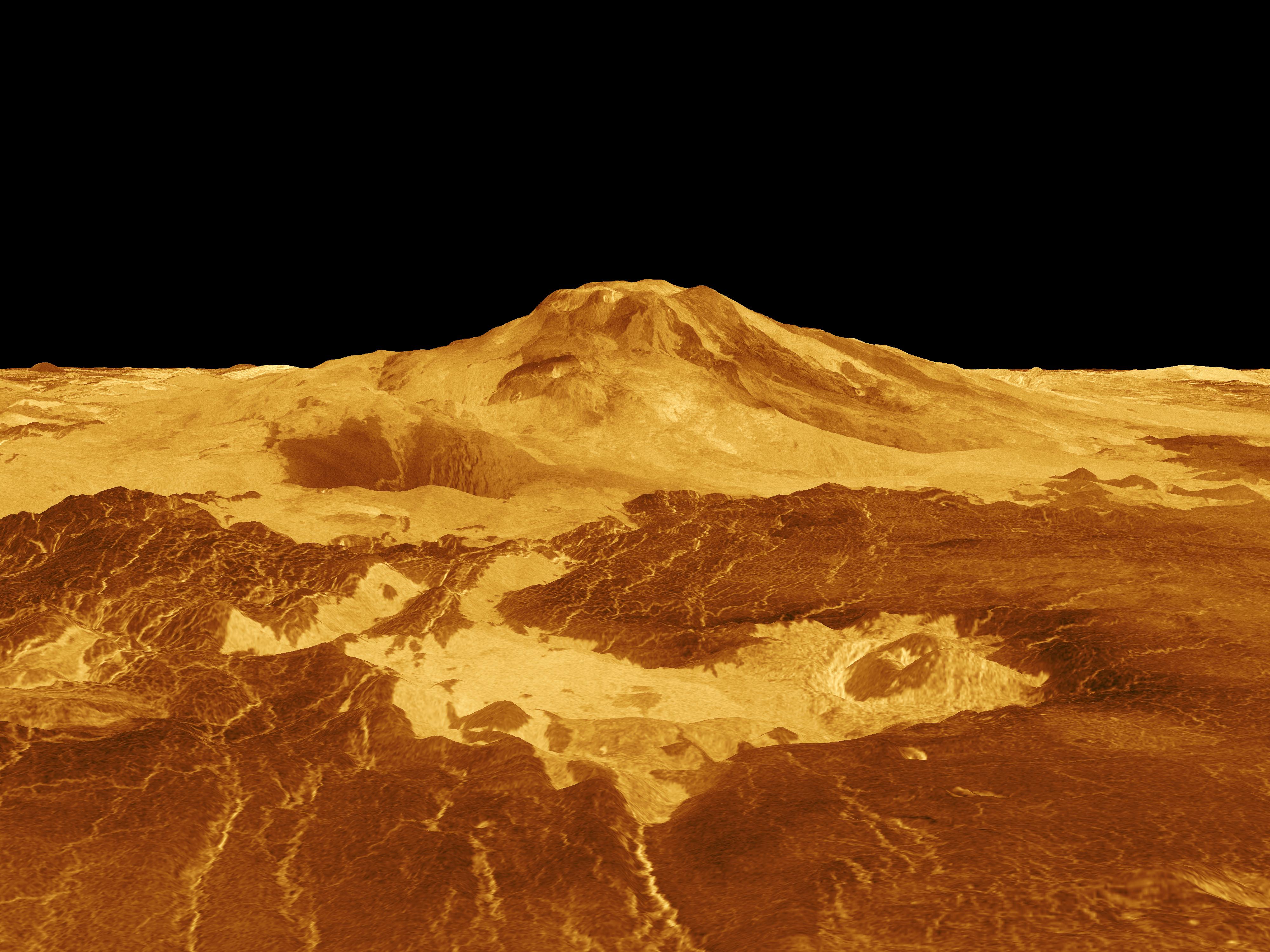
deglr6328 writes "The BBC is reporting that a paper published in the journal Icarus, suggests that the highlands of Venus are covered by a layer of Lead and Bismuth frost. The authors of the paper were looking for a way to explain the anomalous high reflectivity (and corresponding low emissivity) shown at high altitudes in synthetic aperture radar images sent back by the Magellan probe in the early 90's. The study concludes that Venus's lowlands are hot enough (~850F) to partially vaporize these metals into a mist which then condenses back out of the atmosphere to a solid on the surface of the cooler Venusian highlands." -
Not Your Father's Periodic Table
grahamkg writes "Science Daily has an article about a new periodic table of elements oriented toward cosmology. A PDF of the actual table can be found here." -
Collecting Stardust
An anonymous reader writes "Washington University in St. Louis space scientists are reporting the first definitive laboratory dissection of an interstellar dust particle, thus pulling out each grain's history individually. When collected at high-altitude, the origin of six grains are from outside our solar system. 'Space' is full of dust, or ejected material from long-dead stars. In this case, 3 of the 6 dust grains are from red giant stars, and perhaps 2 are from supernovae. In the next 5 years, there are six missions targeting a rendezvous with either a comet or asteroid, including the Stardust mission to return the first extraterrestrial samples since Apollo. That only leaves 100 billion comets left to explore in our own solar system's Oort cloud." Update: 02/28 17:22 GMT by M : Fixed university name. -
A Protein That Terminates 70% Of Common Cancers
Orne writes "BBC News reports here that researchers at the Washington University School of Medicine in St Louis have located 'a protein CUGBP2 (that) interacted with the mRNA for Cox-2 in eight types of human cancer cells.' Cox-2 (which is already known to affect inflammation in arthritis sufferers) is involved in growing blood vessels to feed cancer cells, leading to their uncontrolled growth. Raising CUGBP2 to normal levels puts the cancer's 'death' cycle back on track." -
Tailor-Made Cancer Drugs
pmineiro writes "A researcher at Washington University in St. Louis has developed a method for delivering an inactive drug complex into the body, which is only activated by certain messenger RNA sequences. This allows a drug to be selectively activated only in certain cellular contexts, e.g., cancer or HIV infection." -
Tailor-Made Cancer Drugs
pmineiro writes "A researcher at Washington University in St. Louis has developed a method for delivering an inactive drug complex into the body, which is only activated by certain messenger RNA sequences. This allows a drug to be selectively activated only in certain cellular contexts, e.g., cancer or HIV infection." -
Programming PHP
dooling writes "Continuing the tradition of well written O'Reilly 'Programming' books by those who know the language best, Programming PHP, co-written by the creator of PHP, Rasmus Lerdorf, provides a detailed overview of the popular PHP web-page scripting language. This book provides good programmers who have never used PHP enough information to do serious web development using PHP and serves as an excellent reference for web-page designers who dabble in PHP." Read on for the rest of his review. Programming PHP author Rasmus Lerdorf & Kevin Tatroe pages 507 publisher O'Reilly and Associates rating 7 reviewer dooling ISBN 1565926102 summary great PHP book for serious programmers, good reference While not as entertaining as Programming Perl, it isn't nearly as long either (and doesn't have to be). The book is written in a straightforward style and is very well organized. Appendices provide quick reference to all the PHP built-in functions and many PHP extensions. The most popular extensions, e.g., PEAR DB (database connectivity) and XML, have entire chapters devoted to them. Can't find a PHP extension for your favorite library? There's a chapter about writing your own PHP extensions, including writing C library wrappers.This book begins as most O'Reilly "Programming" books do: with a brief introductory chapter. In Programming PHP, this chapter is very short, so don't look to this book for a gentle introduction. On the other hand, this is the perfect book for you if you are just looking to learn a new scripting language. The following chapters go over syntax, data types, built-in functions, etc. These chapters are a little dry, but move quickly and effectively demonstrate the unique features of PHP (as compared to other scripting languages).
Of particular interest to programmers who are interested in expanding their horizons to developing dynamic web pages are the chapters on PHP web techniques, security, and application techniques. The web techniques chapter gives a quick overview of HTML and the GET and POST methods (and why you would want to use one or the other). It then covers a lot of useful tips and tricks that may be foreign to someone who has done little or no web development. Topics such as getting server information, form processing, sticky forms, file uploads, document expiration, and authentication are covered. It ends with an excellent discussion of maintaining state from page to page and visit to visit, covering cookies and PHP's (very cool) session support.
The security chapter covers standard things you want to keep in mind when creating dynamic HTML. No surprises here, but it is always good to be reminded. The application techniques chapter starts with a collection of best-practices, tips, and tricks to make your development process easier and better. It concludes with sections about error handling and performance tuning. As with the security chapter, there is nothing here a good programmer doesn't already know, but you can never hear it too many times.
I think this is a great book for programmers who want to start developing dynamic web sites with PHP. It gives a detailed overview of PHP, lots of valuable tips, and a good sense of PHP's strengths.
As someone who has written a lot of code, but only a little CGI, I really liked the chapters that discussed application development techniques specific to the web. Along those lines, not much time is spent on standard coding techniques, so if you want to use PHP but have never written any serious code, you may want to look elsewhere for an introduction. For the rest of you, just think, you may never have to use CGI.pm again.
The index seems adequate, although I must admit I did not use it much on the first read-through. The book is so well organized that, when reading it, you do not have to flip around much. Perhaps someone who has used this book as a reference can comment further on the quality of the index.
Contents are available on O'Reilly's page LinksSee Rasmus's page for links to where you can buy the book (maybe he gets a kickback for the link). Of course, you could always go to a local bookstore and purchase it.
You can purchase Programming PHP from bn.com. Slashdot welcomes readers' book reviews -- to see your own review here, read the book review guidelines, then visit the submission page. -
Robotic Photographer
Boojum137 writes " ExtremeTech has an article on a robotic wedding photographer named Lewis. Lewis's hardware stats are modest, so he uses a clever trick to locate people based on skin tone, which is also independent of race. After locating potential subjects with a myriad of sensors, including sonar, laser range finders, and infra-red, he tries to frame the shot according to photographic rules of composition. But the real innovation behind this "red trashcan" is its ability to fade into the background. According to Lewis's creators at Washington University's Media and Machines lab, because of the robot's passive nature, people tend to ignore it after short period of ogling. This allows for some great natural shots, instead of the typical forced and self-conscious shots from human wedding photographers. And, in case you were wondering, Lewis is going to live up to his name in November." -
Software Product Liability?
ben writes "Reuters just ran a story about the increasing number of calls for liability on the part of software developers, with a not-too-suprising focus on Microsoft and its uber-fallible IIS webserver. Given that many other engineering disciplines have some sort of accreditation and licensing body to enforce codes of professional ethics, I'm curious what impact the demand for such a creature in the software industry could have on Open Source developers, especially the part-time hobbyist ones. That is, establishment of some sort of Software Developer's license means the developer is potentially liable for whatever havoc his bugs may wreak, and traditionally the only environment with legal resources adequate to deal with such liability has been the megalithic corporate one." -
Hot Interconnects, Anyone?
Hot Interconnects 10 Program Chair John Lockwood writes: "Hot Interconnects (HotI) will be held this year on August 21-23 on the campus of Stanford University. We hope that you can attend. HotI is an international conference focusing on the hardware and software architecture and implementation of high-performance interconnects of all scales. Its themes include cross-cutting issues spanning computer systems and networking technologies for providing universal services over packet networks. The keynote speakers this year is Vint Cerf and Eric Brewer. Conference topics include network-attached storage, transport of voice and video over packet networks, high-performance network interfaces, novel switching and routing technologies capable of providing differentiated services, plug-and-play network interfaces, and active network architectures. Contributions focus on real products, prototypes, or experimental systems and their performance evaluation. For more information on the conference, see www.HotI.org" -
YAPC Location Announced
paulywog writes: "It hasn't been posted to the YAPC website yet, but the announcement was on usePerl this weekend. The site for the YAPC 2002 will be my alma mater, Washington University in St. Louis. Goofy name for a school in eastern Missouri, I know, but it's a great place for conferences. ... So, if you're in the St. Louis area and are a PERL fanatic, watch for upcoming information on yapc.org or the St. Louis Perl Monger's site." See also the Yet Another Society site. -
Fosset's Trying for Balloon Record Again
jcarley writes: "After crashing into the coral sea last time, adventurer Steve Fossett has launched from Western Australia on a another attempt at the first solo circumnavigation of the world in a balloon. These efforts seem highly prone to technical, weather or political disasters but so far it has been incident free. He has covered 1866km (1159 miles) so far and is in South Australia heading east. You can follow his progress." The site has quite a few cool images as well. -
Calendar: Code, Free Speech, Or Mathematics?
jdavidb writes: "Dr. John Conway (author of the famous "Game of Life") has a wonderful algorithm for finding the day of the week for any year in history that you can do in your head. It's so easy and elegant, in fact, that someone has decided to write a poem about it. Shades of DeCSS haikus! What a marvelous example of how mathematics is a form of (free and protected) speech. As if to further illustrate that computer code is just another form of speech, there is an implementation of this algorithm (in Perl of course)!" -
Wet Venus?
Porfiry writes "Researchers at Washington University in St. Louis, studying hydrous mineral decomposition rates at extreme temperatures, have concluded that hot and dry Venus may have been a wet planet in the past, like Earth and ancient Mars. The new evidence suggesting a wetter Venusian history comes from a series of experiments documenting the chemical stability of tremolite, a mineral that forms in the presence of water." This is a little bit similar to the Venus article we just posted, but still interesting. -
986MB/s With BSD And Gigabit Ethernet
WasterDave wrote in with this link to information about zero copy sockets on FreeBSD. Some hunting turned up more detailed information about NetBSD and Gigabit networking. Pointers to similar information for OpenBSD are appreciated... -
20th Century's Greatest Engineering Achievements
dgw1 writes "The National Academy of Engineering has produced an ordered list of the 20 greatest engineering achievements of the 20th century. I thought the articles about all of the entries were very interesting, even if I didn't agree with the order that some of the achievements were placed in. " -
Low Cost Network Attached Storage?
leperjuice asks: "I've been looking at options for Network Attached Storage for my home network. I can't run a single machine as a file server, and a NAS box sounds like an ideal solution. The problem is that the products are targeted at the business market, and the only item that comes close to a SOHO level is Quantum's Snap Server and those are still somewhat pricy and non-upgradeable (you can't buy a new drive and slap it in). Are there network attached SCSI/IDE enclosures, for example? Or am I stuck with having to transform a crappy box into a server? " -
Carmack Speaks
mbell writes: "Eurogamer.net's coverage of Razer-CPL has a write-up of a workshop that John Carmack gave on 3d games and hardware. Pretty interesting article, including some talk about id's next game." Kudos to Katherine (Don'tcha love alliteration?) for buying the round of drinks -- and the hints about the potential next game are cool. Think "Not Quake." -
Napster, Gnutella, Bans, Lawsuits And More
It's been a busy week for Napster and Gnutella... mbell sent us an MSNBC story on Gnutella which gets a lot of stuff right, but spends more time proclaiming that it's all about kiddie porn to really give the point fair time. the geek noted a wired bit about a San Diego ISP banning Napster from their clients: this is because it's a "Server", not because it's controversial software tho, but it's at least nice to know your ISP is watching what you do. The thing that bothers me most is that accounts were threatened even tho they weren't exceeding bandwidth quotas. Seems harsh. And finally NeoMage pointed out that the once amazing (face it, Kill 'm All and Master of Puppets are amazing albums) Metallica has become the first 'big name' band to sue Napster for copyright violations against the artists' music. -
Boeing uses real time open source CORBA ORB
An anonymous contributor wrote in saying " Boeing is using an open source CORBA ORB called TAO in its avionics systems. The idea is that complex systems can benefit from standard off the shelf software." I'm posting this story because it shows that Tao was able switch processing over from a broken processor, possibly making it useful for life-support equipment in hospitals or in space. -
Boeing uses real time open source CORBA ORB
An anonymous contributor wrote in saying " Boeing is using an open source CORBA ORB called TAO in its avionics systems. The idea is that complex systems can benefit from standard off the shelf software." I'm posting this story because it shows that Tao was able switch processing over from a broken processor, possibly making it useful for life-support equipment in hospitals or in space. -
Use Netscape Mirrors People!
Jamie Zawinksi wrote in to tell me to tell everyone to lay off Mozilla.org and try one of the many mirrors- the huge demand has crippled the machine. Hit the link below to get a decent list of com and edu mirrors. Update:Couple of neato things, A screenshot of NS5 was sent in by Christopher Blizzard, and an insider who requested anonymity sent us a picture from this mornings big event, wrote "The main three people in this picture are Jim Barksdale, Jamie, and Tara Hernandez. Tara is manager of the build team. Just to the left of JimB is Jim Roskind, who led the Java-ectomy." Thanks guys.ftp://odin.appliedtheory.com/pub/mirrors/mozilla/
http://www.gbnet.net/public/mozilla/
ftp://ftp.landfield.com/mozilla/
ftp://ftp.epix.net/pub/mozilla/
ftp://netscape.primehost.com/pub/ftp.mozilla.org/
ftp://wuarchive.wustl.edu/packages/www/mozilla/
ftp://ftp.muc.muohio.edu/pub/mozilla/
ftp://ftp.bogalusa.com/mozilla/
ftp://sod.off.net:211/pub/mozilla/
ftp://mirrors.javanet.net/pub/mirrors/mozilla/
ftp://ftp.tux.org/pub/net/mozilla/
ftp://ftp.cache-world.com/mirror/mozilla.org/
ftp://powermike.com/powermike.com/pub/ftp.mozilla.org
ftp://ftp.tos.net/pub/ftp.mozilla.org/
ftp://pfaffben.user.msu.edu/mozilla/
ftp://ftp.shuttle.org/mozilla/
ftp://mirror.neosoft.com/pub/mozilla/
http://www.us.inside.net/mozilla/
ftp://ftp.cise.ufl.edu/pub/mozilla/
http://sunsite.utk.edu/ftp/netscape-source/
ftp://mirror.tummy.com/pub/mozilla/
ftp://ftp.one.net/pub/mozilla/
ftp://ftp.mindwell.com/pub/mirrors/mozilla/
ftp://ftp.ntr.net/pub/mozilla/
ftp://ftp-netscape.connectnet.com/pub/netscape/source/
ftp://mozilla.meer.net/mozilla/
ftp://ftp.inetdev.org/mirrors/mozilla/
ftp://ftp.yggdrasil.com/mirrors/site/ftp.mozilla.org/pub/