Slashdot Mirror
Domain: youtube.com
Stories and comments across the archive that link to youtube.com.
Stories · 2,039
-
Russian Cargo Mission To ISS Spinning Out of Control
quippe writes: Many sources report that a Russian spacecraft, launched successfully (video) from Russia's Baikonur cosmodrome in Kazakhstan earlier Tuesday, is in big trouble now after having a glitch shortly after liftoff. There is a video on YouTube (credit: NASA) of the space ship spinning out of control. Recovery attempts haven't gone well so far, but they will continue. If they can't regain control, the ship will likely burn up when it falls back into the atmosphere. Current speculation points to greater-than-expected lift by the third-stage, because the apogee is 20km higher than planned. The ship does not seem to pose a threat to the ISS at the moment. -
Russian Cargo Mission To ISS Spinning Out of Control
quippe writes: Many sources report that a Russian spacecraft, launched successfully (video) from Russia's Baikonur cosmodrome in Kazakhstan earlier Tuesday, is in big trouble now after having a glitch shortly after liftoff. There is a video on YouTube (credit: NASA) of the space ship spinning out of control. Recovery attempts haven't gone well so far, but they will continue. If they can't regain control, the ship will likely burn up when it falls back into the atmosphere. Current speculation points to greater-than-expected lift by the third-stage, because the apogee is 20km higher than planned. The ship does not seem to pose a threat to the ISS at the moment. -
Think Tanks: How a Bill [Gates Agenda] Becomes a Law
theodp writes: The NY Times' Eric Lipton was just awarded a 2015 Pulitzer Prize for investigative reporting that shed light on how foreign powers buy influence at think tanks. So, it probably bears mentioning that Microsoft's 'two-pronged' National Talent Strategy (PDF) to increase K-12 CS education and the number of H-1B visas — which is on the verge of being codified into laws — was hatched at an influential Microsoft and Gates Foundation-backed think tank mentioned in Lipton's reporting, the Brookings Institution. In 2012, the Center for Technology Innovation at Brookings hosted a forum on STEM education and immigration reforms, where fabricating a crisis was discussed as a strategy to succeed with Microsoft's agenda after earlier lobbying attempts by Bill Gates and Microsoft had failed. "So, Brad [Microsoft General Counsel Brad Smith]," asked the Brookings Institution's Darrell West at the event, "you're the only [one] who mentioned this topic of making the problem bigger. So, we galvanize action by really producing a crisis, I take it?" "Yeah," Smith replied (video). And, with the help of nonprofit organizations like Code.org and FWD.us that were founded shortly thereafter, a national K-12 CS and tech immigration crisis was indeed created. -
Hubble Turns 25
Taco Cowboy points out that the Hubble Space Telescope turns 25 today. Hubble was launched on April 24, 1990, aboard the Space Shuttle Discovery from Kennedy Space Center, Florida. Currently, it is flying about 340 miles over the Earth and circling us every 97 minutes. While the telescope itself is not really much to look at, that silver bucket is pure gold for astronomers. Scientists have used that vantage point to make ground-breaking observations about planets, stars, galaxies and to reveal parts of our universe we didn't know existed. The telescope has made more than a million observations and astronomers have used Hubble data in more than 12,700 scientific papers, "making it one of the most productive scientific instruments ever built," according to NASA. ... NASA aims to keep Hubble operating through at least 2020 so that it can overlap with its successor. The James Webb Space Telescope is due to launch in October 2018 and begin observations in mid-2019. NASA celebrated by releasing a new, epic image from Hubble titled "Celestial Fireworks." It is accompanied by an impressive flythrough video. Some nice galleries of Hubble images have been put together at the NY Times and Slate, but a bigger collection is available directly from the official Hubble website. -
Does Lack of FM Support On Phones Increase Your Chances of Dying In a Disaster?
theodp writes "You may not know it," reports NPR's Emma Bowman, "but most of today's smartphones have FM radios inside of them. But the FM chip is not activated on two-thirds of devices. That's because mobile makers have the FM capability switched off. The National Association of Broadcasters has been asking mobile makers to change this. But the mobile industry, which profits from selling data to smartphone users, says that with the consumer's move toward mobile streaming apps, the demand for radio simply isn't there." But FEMA Administrator Craig Fugate says radio-enabled smartphones could sure come in handy during times of emergency. So, is it irresponsible not to activate the FM chips? And should it's-the-app-way-or-the-highway Apple follow Microsoft's lead and make no-static-at-all FM available on iPhones? -
Embedded Linux Takes to the Skies (Video)
This is an interview with Clay McClure. He makes his living designing 'custom Linux software solutions for technology start-ups in Atlanta and the San Francisco Bay area.' He also works on Embedded Linux for autonomous drones. Here's a link to slides from a talk he gave on exactly that topic: Flying Penguins - Embedded Linux Applications for autonomous UAVs, and that's far from all he has to say about making Linux-controlled drones. However, for some reason Timothy and Clay didn't talk about using drones for target practice. Perhaps they can discuss that another time.
NOTE: We urge you to read the transcript of this interview even if you prefer watching videos; it contains material we left out of the video due to sound problems. -
Hillary Clinton Declares 2016 Democratic Presidential Bid
An anonymous reader writes In a move that surprised no one, Hillary Clinton has officially announced she is entering the 2016 race for the White House. According to the Times: "Ending two years of speculation and coy denials, Hillary Rodham Clinton announced on Sunday that she would seek the presidency for a second time, immediately establishing herself as the likely 2016 Democratic nominee. 'I'm running for president,' she said with a smile near the end of a two-minute video released just after 3 p.m. 'Everyday Americans need a champion. And I want to be that champion,' Mrs. Clinton said. 'So I'm hitting the road to earn your vote — because it's your time. And I hope you'll join me on this journey.'" -
Copenhagen Suborbitals Test Rocket Engine
An anonymous reader writes Copenhagen Suborbitals, the amateur manned space program, is conducting a rocket engine test today. The event is being streamed Live in HD on YouTube. The rocket engine is named BPM 2 and is a prequel to a planned series of test of the BPM 5 rocket engine currently being built. The purpose of the BPM 2 test is primarily to test a newly constructed mobile test stand and to test various fuel additives before the BPM 5 test series are to begin later in the first half of 2015. -
First Alpha of Public Sector Linux Deployment System
New submitter mathiasfriman writes: SverigeLinux (SwedenLinux in Swedish) is a project financed by the Swedish Internet Fund that is developing a Linux deployment system for the public sector. It is based on DebianLAN and has just released its first public early alpha version. This 7 minute video shows how you can deploy up to 100 workstations with minimal Linux knowledge in under an hour, complete with DHCP, DNS and user data in LDAP, logins using Kerberos and centralized storage. The project has a home on GitHub and is looking for testers and developers. Don't worry, no Björgen Kjörgen; it's all in English. -
Why Some Developers Are Live-Streaming Their Coding Sessions
itwbennett writes Adam Wulf recently spent two weeks live-streaming himself writing every line of code for a new mobile app. He originally started to live-stream as 'a fun way to introduce the code to the community.' But he quickly learned that it helps him to think differently than when he was coding without the camera on. "Usually when I work, so much of my thought process is internal monologue," he said, "but with live streaming I try to narrate my thought process out loud. This has forced me to think through problems a little differently than I otherwise would, which has been really beneficial for me." -
Snowden Demystified: Can the Government See My Junk?
An anonymous reader writes Comedian and journalist John Oliver set out to understand US Government surveillance in advance of the June 2015 expiration of section 215 of the Patriot Act. What resulted was a humorous but exceptionally journalistic interview of Edward Snowden which distilled the issues down in a (NSFW) way everyone can understand. Regardless of whether you view Snowden as a despicable traitor or an honorable whistleblower, it's worth a watch. -
Rare Ideopathic Encephaly Tied to Higher IQ, Not Lower
Timothy writes Cranial deformation is commonly linked to brain dysfunction; it is one of the most common serious conditions affecting fetal growth. Multiple factors are involved, but in nearly every case on record the result is debilitating; stillbirth or neonatal death are common. A mutation, though, has been observed among members of a New Jersey family which represents a rare case of heritable encephaly tied not to dysfunction, but to higher-than-average intelligence, and with no evident negative health consequences.
Donald R. DeCicco (not his real name) and his wife Prymaat of Paramus, both French-born naturalized U.S. citizens, were born with unremarkable physical characteristics, apart from a specific constellation of physical abnormalities affecting maxillofacial and brain development. In both of their cases, brain development appears to be ordinary, but with all brain lobes occupying a volume that is both larger and narrower than typical. All medical tests (and the couple's success as educated, productive members of society) make it clear that their condition has not prevented ordinary life, and may even have enhanced it; a series of MRI and PET scans conducted by Johns Hopkins researchers indicated that their above-average cerebella are at least as active and neuron-rich as are more run-of-the-mill subjects' brains, and tests of memory, cognition, and reasoning place both DeCicco and Clorhone in the top percentile of American rest subjects. A daughter, Connie, shares both their unusual skeletal growth pattern, and is similarly highly intelligent; perhaps this form of heritable encephaly should be thought of as akin to Marfan syndrome, for its pairing of both high intelligence and a characteristic bone-growth pattern. At least one researcher quoted in the linked article believes that less extreme forms of the same anomaly can be observed in some historical and contemporary figures, citing as examples both Vladimir Putin and actor Richard Belzer as bearing some tendency toward the same characteristic shape.
First described by a family physician and described in the Journal of the Society of the Federal Health Professionals,the condition has been labeled Sandler's Syndrome. -
We're In a Golden Age of Star Trek Webseries Right Now
New submitter DakotaSmith writes: io9 has an article explaining why We're Living In The Golden Age Of Star Trek Webseries Right Now. If you're a true geek, you probably already know about Star Trek Continues and Star Trek: Phase II. (If you're a true geek and you don't know about them, run — do not walk, run — to watch "Lolani." Your brain— and more importantly, your heart — will love you for the rest of your life.)
But there's more to it than that. A lot more. How about the years'-long wait for Act IV of Starship Exeter : "The Tressaurian Intersection"? Or Yorktown: "A Time to Heal" — an attempt to resurrect an aborted fan film from 1978 starring George Takei? For fans of old-school Star Trek (the ones who pre-date "Trekker" and wear "Trekkie" as a badge of honor), not since 1969 has there been a better time to watch Star Trek: The Original Series.
(Oh, and there's plenty content out there for you "Trekkers" and NextGen-era fans. It all varies in quality, but it doesn't take much effort to find them. This is truly a Golden Age. Recognize it and enjoy it while it lasts.) -
We're In a Golden Age of Star Trek Webseries Right Now
New submitter DakotaSmith writes: io9 has an article explaining why We're Living In The Golden Age Of Star Trek Webseries Right Now. If you're a true geek, you probably already know about Star Trek Continues and Star Trek: Phase II. (If you're a true geek and you don't know about them, run — do not walk, run — to watch "Lolani." Your brain— and more importantly, your heart — will love you for the rest of your life.)
But there's more to it than that. A lot more. How about the years'-long wait for Act IV of Starship Exeter : "The Tressaurian Intersection"? Or Yorktown: "A Time to Heal" — an attempt to resurrect an aborted fan film from 1978 starring George Takei? For fans of old-school Star Trek (the ones who pre-date "Trekker" and wear "Trekkie" as a badge of honor), not since 1969 has there been a better time to watch Star Trek: The Original Series.
(Oh, and there's plenty content out there for you "Trekkers" and NextGen-era fans. It all varies in quality, but it doesn't take much effort to find them. This is truly a Golden Age. Recognize it and enjoy it while it lasts.) -
Control Anything With Gestures: Myo Bluetooth Protocol Released
First time accepted submitter Legendary Teeth writes The makers of the Myo Gesture Control Armband (Thalmic Labs) have just released the specs for the Bluetooth protocol it uses. While there are already official SDKs for Windows, Mac, iOS and Android, this means that now anyone can roll their own support for other platforms like Linux or Arduino without needing to use one of the official platforms as a bridge. Anything you can write code for that that can act as a Bluetooth GATT client would now be possible, really. If you aren't familiar with the Myo armband, it's a Bluetooth Low Energy device with 8 EMG pods and an IMU that you wear on your arm. It can read your muscle activity to detect gestures you make with you hands, which you can then use to do things like fly drones, play games, or control music. -
Control Anything With Gestures: Myo Bluetooth Protocol Released
First time accepted submitter Legendary Teeth writes The makers of the Myo Gesture Control Armband (Thalmic Labs) have just released the specs for the Bluetooth protocol it uses. While there are already official SDKs for Windows, Mac, iOS and Android, this means that now anyone can roll their own support for other platforms like Linux or Arduino without needing to use one of the official platforms as a bridge. Anything you can write code for that that can act as a Bluetooth GATT client would now be possible, really. If you aren't familiar with the Myo armband, it's a Bluetooth Low Energy device with 8 EMG pods and an IMU that you wear on your arm. It can read your muscle activity to detect gestures you make with you hands, which you can then use to do things like fly drones, play games, or control music. -
SuperMario 64 Coming To a Browser Near You!
Billly Gates writes Since Unity has been given a liberal license and free for non commercial developers it has become popular. A computer science student Erik Roystan Ross used the tool to remake SuperMario 64 with a modern Unity 5 engine. There is a video here and if you want to play the link is here. You will need Firefox or Chrome which has HTML 5 for gamepad support if you do not want to use the keyboard. "I currently do not have any plans to develop this any further or to resolve any bugs, unless they're horrendously game-breaking and horrendously simple to fix," says Ross. -
GNOME 3.16 Released
kthreadd writes Version 3.16 of GNOME, the primary desktop environment for GNU/Linux operating systems has been released. Some major new features in this release include a overhauled notification system, an updated design of the calendar drop down and support for overlay scrollbars. Also, the grid view in Files has been improved with bigger thumbnail icons, making the appearance more attractive and the rows easier to read. A video is available which demonstrates the new version. -
Better Disaster Shelters than FEMA Trailers (Video)
An aerospace engineer and Mississippi native named Michael McDaniel "watched helplessly as Hurricane Katrina forced thousands of people out of their homes and into crowded, poorly equipped 'shelters.'" This scenario led to Michael founding Reaction Housing and the creation of its first product, the Exo (as in exoskeleton) shelter. This company isn't holding its hand out for crowdfunding. It got $1.5 million in seed capital in March, 2014, later got another $10 million, and is now going into mass production of its Exo housing units.
Reaction Housing is not the only attempt to make post-disaster housing better, or at least less expensive, than the infamous FEMA trailers. A charity called ShelterBox in Lakewood Ranch, FL, fills boxes with everything a family or group of up to 10 people needs, including a heavy-duty tent, bedding, and kitchen supplies, in order to survive after a natural disaster. (Here's an interview video I shot in 2010 about ShelterBox.) Exo, ShelterBox or any one of dozens of other emergency housing alternatives are good to have around, ready to go, for the next Katrina, Sandy or Tsunami. High tech? Not necessarily, but technology has obviously made emergency housing faster and easier to erect than the "earthquake shacks" that were built in San Francisco to house people made homeless by the 1906 earthquake. -
Interviews: SMBC's Zach Weiner Answers Your Questions
Last week you had a chance to ask Saturday Morning Breakfast Cereal (SMBC) creator and monocle enthusiast Zach Weiner about his comics, reading classy, and his other projects. Below you'll find his answers to your questions. How did it start?
by Flavianoep
Expanding my question, what inspired you to write your webcomic?
Weiner: SMBC really started in like 1998? I had a geocities site called Saturday Morning Breakfast Cereal, where I posted essays and comics and such. It was purely for amusement, with no plan to make money.
Later it morphed into just comics, and people seemed to like it. Later still, I was working a shit job in Hollywood and desperately wanted to escape. So, I focused on comics, and a few years later I was able to quit my job!
Sacred cows?
by eldavojohn
Have there been any times you feared you went too far with your humor? If not, when have you received the most mail asserting that you did?
Weiner: Definitely, yeah. I actually once finished a comic (I forget the joke, but the image was very old people having sex) and then shelved it for being too crude. Then later I was out of ideas and needed an update.
I don’t actually get a lot of hatemail. Then one time I was blindsided was a comic where I had some fratboys finding out a frat brother was dead, and then drawing dicks on his face. Apparently that was a bit upsetting for some people.
Jokes you didn't tell
by gman003
You often tell jokes that rely on fairly advanced math, science or economics. Have there been any jokes you scrapped because you thought they were *too* advanced for your audience?
Weiner: Well, as a general rule, jokes of that sort aren’t reallllly funny? Like, they’re association-funny, but not actually clever. There are exceptions, but not many. I don’t think I’ve ever held back a good joke just because it was niche.
In fact, I could argue the Internet favors jokes like that, at least in the short term. Like, I once did a joke about using TI-83s as a stable reserve currency. Probably was not liked by most of my audience, but the people who DID like it shared it a lot. Or, similarly, I did one about the Chairman of the Fed dressing up as a ghost and haunting banks to boost consumption. Niche joke, but it got lots of shares.
Gender and skin color
by gsliepen
Dear Zach, I noticed that your comics feature a remarkable balance in gender and skin color of the people you draw. There are also many same-gender couples. How do you do this? Do you decide yourself for each comic, or do you roll some dice? Do you randomize other things this way as well, like glasses and clothes? By the way, I noticed that you maintain a list of things you cannot draw. But don't worry, you're way better than that Randall guy who can only draw black&white stick figures.
Weiner: What’s really weird is (possibly because my audience is a bunch of dorks) is that tons of people assume I have an algorithm or some random mechanism. The truth is I just don’t write gender/color/etc. into the script unless it’s relevant to the joke. Then, when I’m drawing I pick semi-randomly.
You don’t want to be completely random, because you could get in trouble. Like, if I’m drawing someone committing financial crime, I don’t want my random throw to be Jewish. In general, I try to avoid stereotypes. So, for instance, if there’s only one irrational character in the strip, I try to make it a dude. Also, when someone has to be the jerk in the strip, I generally draw a redhead, so I’m really drawing myself as the asshole?
Randall who? Rand Paul?
The Rise of Joke Theft on the Internet
by eldavojohn
I'm not talking about your humorous Sarah Silverman satire video but the actual people who misappropriate a joke for their own. I've seen it on Facebook where someone reads a joke on Reddit or XKCD or SMBC and just rehashes it as their own idea in a post knowing that no one else out there could possibly be wasting their time on something like SMBC. Do you see this as frequently as I do? In all honesty does this bother you or merely flatter you? Is it just a natural unavoidable quality of memes or do you think it's more sinister?
Weiner: Here’s the thing. In 1990, when I was 8, I used to redraw other people’s comics and show them off. But who gives a shit, because it’s an 8 year old. Now, it’s all public. I think the real danger is NOT that people like me get ripped off - it’s that young artists aren’t even allowed to imitate. Imitation is how you figure out what you like!
That said, it’s easy for me to not care, since I’m making a comfortable living. But, in general, I think with “joke theft” we should err on the side of tolerance. That said, when sites like 9gag take my stuff and watermark it, yeah, that pisses me off. But, there’s nothing you can really do.
Ren & Stimpy
by SupahVee
I see a fair bit of other influences in your comics, with Ren & Stimpy references seeming to show up here and there. What other comic have played a role in your work, and is there some bad experience in early childhood that clearly left you so scarred from Ren & Stimpy?
Weiner: Really? I definitely watched as a kid, but I’m curious what you see as Ren & Stimpy references! I’m at least not doing it on purpose. My early big comic influences were Scott Adams, Glen Baxter, and the comic The Parking Lot is Full. Since then, I’ve diverged a lot. These days I try to take more influence from books and concepts than other cartoonists. But, many comics continue to impress - xkcd, Hark a Vagrant, Buttersafe, Oglaf. Recently I’ve really enjoyed Whomp!
Intellectual Sources
by Gestahl
With respect to your "philosophical thought experiment" comics, how many of your comics are based in topics/ideas you learned before the end of your formal education, how many are based on things you have encountered in your "continuing education" (whether based on life experience, or just what you are currently reading about), and how many are "novel" intuition pumps?
Weiner: Most I’ve learned after. But, I was a pretty lousy college student. I try to read 3-5 books a week, and make time for deep reading as well. It’s harder now that I have a kid, but the kid provides some insight too, I suppose.
I don’t know how much is new. That said, I was very pleased to find out about Nozick’s Utility Monster AFTER I’d done a comic describing that exact idea! I was 40 years too late, but it’s neat to know that I came up with something a smarter guy came up with.
The Mrs. and the extended comic
by Anonymous Coward
How does your wife feel being portrayed in the comic?
Weiner: My wife likes the spotlight more than me! She’s actually doing some public science lecturing in the near future, if anyone’s interested.
So, I think she even enjoy the insulting ones (i.e. all of them).
Zach Weiner is awesome
by Jax Omen
I love Zach, met him at a comic-con in Seattle a couple years ago, he signed his SMBC-Theater DVD for us and posed for "photo bomb" pictures. Awesome dude. My question for Zach is, have you ever considered/pondered/done any longer-form comics, with a cohesive narrative? You have tons of goofy ideas, some quite entertaining, I'd love to see what you could do with a story-driven comic powered by your goofy ideas. Also: your wife is wrong, single-use monocles are an awesome idea, even if just for gag-gift purposes :P
Weiner: I’m working on one serious dramatic graphic novel and a few prose novels now. I’ve wanted to do longform stuff for a while, but it’s hard to find the time!
Glad you liked the monocles :) I think they’re hilarious, but I’ve never gotten so many angry messages (vapid consumerism! hipster bullshit! neckbearded nerds!) over a product before. It’s weird because people are ascribing all sorts of philosophical/social context to it that I just don’t see.
Any Public Response to the Common Criticism?
by eldavojohn
How do you respond to the criticism that by widely distributing your single use monocles to teenagers and adults, you'll be making highbrow socializing safer and therefore increase it to immoral levels?
Weiner: If one wishes to be a prig or a Puritan, one can flaunt one’s moral views about them, but they are not one’s concern. Besides, Individualism has really the higher aim. Modern morality consists in accepting the standard of one’s age. I consider that for any man of culture to accept the standard of his age is a form of the grossest immorality.
Do you have...
by serviscope_minor
Do you have any extra wisdom to share with us that's you know, like... woah? (For those less familiar with SMBC, this is one of my all time favorites.)
Weiner: Most people spend their lives in dread of the stuff that would make them happiest.
Also, no matter how good a giant Reese’s looks, it’ll never match your expectation. -
Mars One Delayed 2 Years, CEO Releases Video In Response To Criticism
CryoKeen writes It's interesting how different news sites spin #marsgate. From Yahoo News: "The private colonization project Mars One has pushed its planned launch of the first humans toward the Red Planet back by two years, to 2026. The delay was necessitated by a lack of investment funding, which has slowed work on a robotic precursor mission that Mars One had wanted to send toward the Red Planet in 2018, Mars One CEO Bas Lansdorp said in a new video posted today... 'We had a very successful investment round in 2013 that has financed all the things that we have done up to now. And we have actually come to an agreement with a consortium of investors late last year for a much bigger round of investments. Unfortunately, the paperwork of that deal is taking much longer than we expected,' Lansdorp said in the video." This Astrowatch article is a lot more scathing and to the point: "Mars One, the Dutch company planning to send people on a one-way trip to Mars, that recently selected a group of 100 hopefuls, struggles with criticism. In a Medium story this week, Mars One finalist Joseph Roche presented multiple reasons as to why he believed the entire operation is a complete scam. In response, the company published a video Thursday in which Bas Lansdorp, CEO and Co-founder of Mars One, replies to recent criticism concerning the feasibility of Mars One's human trip to Mars. He also revealed that the mission will be delayed for two years. Roche said that the 'only way' to get selected for the next round of the Mars One candidacy process was to donate money. 'My nightmare about it is that people continue to support it and give it money and attention, and it then gets to the point where it inevitably falls on its face,' Roche told Elmo Keep for Medium." -
"Hello Barbie" Listens To Children Via Cloud
jones_supa writes For a long time we have had toys that talk back to their owners, but a new "smart" Barbie doll's eavesdropping and data-gathering functions have privacy advocates crying foul. Toymaker Mattel bills Hello Barbie as the world's first "interactive doll" due to its ability to record children's playtime conversations and respond to them, once the audio is transmitted over WiFi to a cloud server. In a demo video, a Mattel presenter at the 2015 Toy Fair in New York says the new doll fulfills the top request that Mattel receives from girls: to have a two-way dialogue. "They want to have a conversation with Barbie," she said, adding that the new toy will be "the very first fashion doll that has continuous learning, so that she can have a unique relationship with each girl." Susan Linn, the executive director of Campaign for a Commercial-Free Childhood, has written a statement in which she says how the product is seriously creepy and creates a host of dangers for children and families. She asks people to join her in a petition under the proposal of Mattel discontinuing the toy. -
New Crop of LED Filament Bulbs Look Almost Exactly Like Incandescents
An anonymous reader writes A recent article posted on a green building site gives a detailed analysis of a creative new kind of LED bulb that has been popping up Europe and Asia over the last year. They look almost exactly like Tungsten filament bulbs, require no heat sink, and offer extremely high efficiencies in the 100-120 lm/W range. The article describes their construction, compares them to conventional LED bulbs, and describes the result of a report by the Swedish Energey Agency that analyzed the performance of several brands of these these bulbs on the European market. Particularly interesting are links to teardown videos. -
New Crop of LED Filament Bulbs Look Almost Exactly Like Incandescents
An anonymous reader writes A recent article posted on a green building site gives a detailed analysis of a creative new kind of LED bulb that has been popping up Europe and Asia over the last year. They look almost exactly like Tungsten filament bulbs, require no heat sink, and offer extremely high efficiencies in the 100-120 lm/W range. The article describes their construction, compares them to conventional LED bulbs, and describes the result of a report by the Swedish Energey Agency that analyzed the performance of several brands of these these bulbs on the European market. Particularly interesting are links to teardown videos. -
New Crop of LED Filament Bulbs Look Almost Exactly Like Incandescents
An anonymous reader writes A recent article posted on a green building site gives a detailed analysis of a creative new kind of LED bulb that has been popping up Europe and Asia over the last year. They look almost exactly like Tungsten filament bulbs, require no heat sink, and offer extremely high efficiencies in the 100-120 lm/W range. The article describes their construction, compares them to conventional LED bulbs, and describes the result of a report by the Swedish Energey Agency that analyzed the performance of several brands of these these bulbs on the European market. Particularly interesting are links to teardown videos. -
New Crop of LED Filament Bulbs Look Almost Exactly Like Incandescents
An anonymous reader writes A recent article posted on a green building site gives a detailed analysis of a creative new kind of LED bulb that has been popping up Europe and Asia over the last year. They look almost exactly like Tungsten filament bulbs, require no heat sink, and offer extremely high efficiencies in the 100-120 lm/W range. The article describes their construction, compares them to conventional LED bulbs, and describes the result of a report by the Swedish Energey Agency that analyzed the performance of several brands of these these bulbs on the European market. Particularly interesting are links to teardown videos. -
edX Welcomes 'The University of Microsoft' Into Its Fold
theodp writes: "At edX," explains the upscale MOOC founded by MIT and Harvard, "we believe in offering the highest quality courses, created by schools and partners who share our commitment to excellence in teaching and learning, both online and in the classroom." You know, like Building Cloud Apps with Microsoft Azure (course trailer). On Tuesday, edX welcomed Microsoft as its first corporate member to offer MOOCs on edX.org. "Through this program," said edX, "Microsoft will offer the edX global learning community courses to acquire the core development skills needed to be successful in the cloud-first, mobile-first world." The new initiative, explained Microsoft, expands upon an existing Microsoft partnership with edX to create interactive online courses using Office Mix and PowerPoint 2013. Classes start March 31st. -
Gritty 'Power Rangers' Short Is Not Fair Use
Bennett Haselton writes: Vimeo and Youtube are pressured to remove a dark, fan-made "Power Rangers" short film; Vimeo capitulated, while Youtube has so far left it up. I'm generally against the overreach of copyright law, but in this case, how could anyone argue the short film doesn't violate the rights of the franchise creator? And should Vimeo and Youtube clarify their policies on the unauthorized use of copyrighted characters? Read on for the rest."Power/Rangers", the 11-minute short directed by music video veteran Joseph Kahn, is still available on Youtube, where it was posted by the film's producer, Adi Shankar. Rival video site Vimeo removed the short film after receiving a copyright complaint from Haim Saban, the creator of the U.S. series, for using the characters without his permission.
The movie is OK. I think the people gushing about how amazing it is are mentally comparing it to the awful 1995 "Power Rangers" movie or the bland cartoon. But how are the director and his defenders arguing that the movie isn't a copyright violation?
The director said in one of a series of tweets: "Every image in POWER/RANGERS is original footage. Nothing was pre-existing. There is no copyrighted footage in the short." True, but this ignores the fact that characters themselves can be protected by copyright. Fan fiction sites can exist legally only to the extent that the character copyright owner grants permission (J.K. Rowling has explicitly given permission for the Harry Potter characters to be used in fan fiction; Anne Rice specifically prohibits fan fiction featuring her characters). Most obviously, when a studio like Warner Brothers produces their own gritty reboot of a character, they have to pay fees to the owner of that character, even if every frame of their movie is entirely the studio's own work. Why on Earth would the studio pay those fees, if they didn't have to?
The director also tweeted, "I am not making any money on it and I refuse to accept any from anyone." Well, everyone ought to know by now that that argument isn't going to fly if you put a copy of The Avengers on your personal home page. It's not obvious why that defense should work any better if you've violated someone's copyright by using their characters without permission, instead of just copying their movie.
Kahn also tweeted that the short film was not a copyright violation because it was "satire," and his supporters agreed, calling the film a "parody." (Copyright law holds that you can satirize or parody someone else's work without their permission; thus Jason Friedberg and Aaron Seltzer do not have to pay licensing fees for the movies that they rip off in their awful "parodies.") But no English speaker would use the word "satire" or "parody" to describe Kahn's movie, precisely because of the qualities that people loved about it (dark, violent, almost completely humorless). Most tellingly, as far as I can tell nobody did call it a satire or parody until that started being raised as a defense against copyright claims -- they called it a dark, gritty remake or re-imagining, because that's what it was, and calling it a "satire" sounds jarringly wrong unless you're in on the wink-wink pseudo-legal strategy.
Kahn also invoked "fair use" multiple times, but that's just begging the question: since "fair use" is a catch-all for several scenarios in which you can legally use copyrighted content without the owner's permission (parody/satire, brief excerpt for the purpose of commentary/criticism, etc.), which defense applies here? One of the criteria for "fair use" is how much of the original work you re-used -- if your online review of The Dark Knight links to a 10-second clip that you posted to show that the fight scenes are kick-ass, that might be OK, but a 30-minute excerpt would not be. But if we apply that logic to the use of a copyrighted character, in a story you're either using someone else's copyrighted character, or you're not. Given that characters are protected by copyright at all, it doesn't make much sense to talk about "using 0.5% of a character", the way that a 30-second clip would constitute only 0.5% of a 100-minute movie. It certainly wouldn't make sense in the case of Kahn's remake, where the copyrighted Power Rangers characters are onscreen in every single scene.
The director's defenders rightly pointed out the absurdity of Vimeo removing the short film just hours after giving it a "Staff Pick" award, but the real absurdity runs in the opposite direction -- how did Vimeo's staff give an award to the film that they should have known was a knockoff? Presumably they had heard of the Power Rangers and knew that the movie was using the characters without permission.
Moreover, there's not just a legal argument against an unauthorized "gritty reboot" of the Power Rangers, there's a moral one as well. The short film shows that Joseph Kahn is a technically competent director -- but there are many, many competent directors out there, making gritty sci-fi films of short and feature length, all competing for people's attention. By using the "Power Rangers" name for his piece, Kahn got way more views than he would have gotten if he had released it as "just another dark sci-fi short film." And despite his protestations that he's not making money from the film, it's bringing him exposure and connections which are almost certainly monetizable somewhere down the road, opportunities which come at the expense of other similarly talented directors. Does that seem fair?
Remember, we welcome reader-submitted essays and opinion pieces, not just news snippets, through the Slashdot submissions form .
-
Fedcoin Rising?
giulioprisco writes US economists are considering a government-sponsored digital currency. On February 3, David Andolfatto, Vice President of the Federal Reserve Bank of St. Louis, wrote a blog post based on a presentation he gave at the International Workshop on P2P Financial Systems 2015 [YouTube video]. The title of the blog post is "Fedcoin: On the Desirability of a Government Cryptocurrency." -
Should We Really Try To Teach Everyone To Code?
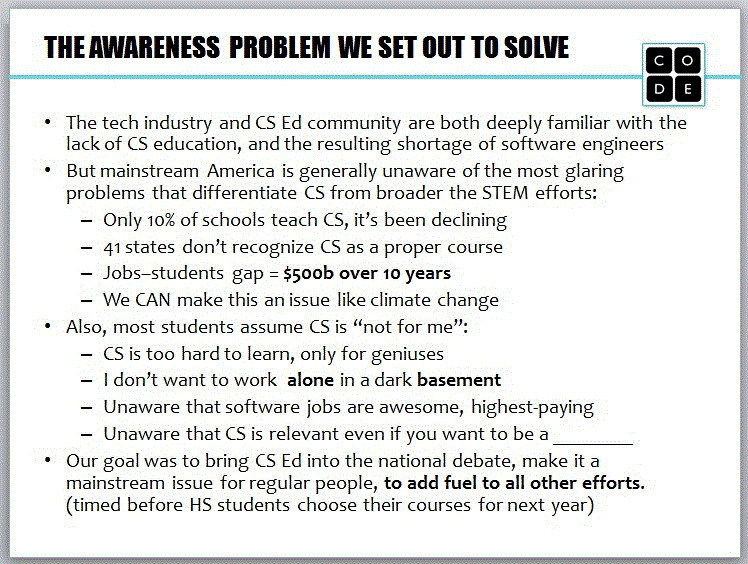
theodp writes: Gottfried Sehringer asks Should We Really Try to Teach Everyone to Code? He writes, "While everyone today needs to be an app developer, is learning to code really the answer? Henry Ford said that, 'If I had asked people what they wanted, they would have said faster horses.' I view everyone learning to code as app development's version of a faster horse. What we all really want — and need — is a car. The industry is falling back on code because for most people, it's the only thing they know. If you want to build an application, you have to code it. And if you want to build more apps, then you have to teach more people how to code, right? Instead, shouldn't we be asking whether coding is really the best way to build apps in the first place? Sure, code will always have a place in the world, but is it the language for the masses? Is it what we should be teaching everyone, including our kids?" President Obama thinks so, telling Re/code at Friday's Cyber Security Summit that 'everybody's got to learn to code early' (video). But until domestic girls (including his daughters) and underrepresented groups get with the program(ming), the President explained he's pushing tech immigration reform hard and using executive action to help address tech's "urgent need" for global talent. -
Five Glorious Years of Sun Images In a Four-Minute Video
An anonymous reader writes: In early 2010, NASA launched the Solar Dynamics Observatory. It carried a number of sensors dedicated to watching and measuring various aspects of the Sun. The SDO's team just celebrated its fifth anniversary by going through a half-decade worth of images, pulling out the most amazing ones, and stitching them into an amazing video (YouTube). It includes enormous flares, sunspots, the transit of Venus, and more. -
Something Resembling 'The Wheel of Time' Aired Last Night On FXX
eldavojohn writes: If you didn't partake in the DDOS attack on Dragonmount as fans tried to figure out just what the %&#% was going on last night, you should probably prepare yourself for Billy Zane filled disappointment and watch a curious pilot covering the prologue of The Eye of the World by Robert Jordan that apparently aired around 01:30 AM Eastern time on FXX. The reviews of said pilot are unkind and appear to contain question marks all the way down starting with Jordan's Widow disavowing its authorization.
The world of film and TV development is a confusing one, but it appears that NBC initially bought options to turn it into a mini series which were then optioned by Universal/Red Eagle Entertainment in conjunction with Red Eagle Games to do a coordinated release. Red Eagle games announced a combined effort with Jet Set games and around 2012 began releasing information on an "Aiel War" project to target mobile gaming platforms. But that appeared to die with its failed kickstarter attempt. It is suspected that Red Eagle Entertainment is behind the odd FXX airing last night. Was this an eleventh hour "use it or lose it" move by Red Eagle Entertainment without Universal's knowledge? In any case, it was a secretive, odd, low-budget, disappointing start to The Wheel of Time in film. -
Boston Dynamics Introduces Their Newest Four-Legged Robot, 'Spot'
MicroHex writes: Boston Dynamics, creators of "Big Dog" recently unveiled their newest creation, "Spot." Originally funded by DARPA to develop the technology behind Big Dog, Boston Dynamics is currently owned by Google and continues its robotics research. From the video: "Spot is a four-legged robot designed for indoor and outdoor operation. It is electrically powered and hydraulically actuated. Spot has a sensor head that helps it navigate and negotiate rough terrain. Spot weighs about 160 lbs." -
Rich Olson Embodies the Spirit of the Maker Movement (Video)
What kind of person builds a cloud chamber at home in his spare time -- and wants to make it easy for other people to make them, too? How about someone who uses a 3-D printer to make shifters for his bicycle? And then there's the spherical speaker enclosures and the alarm clock that shreds money if you don't wake up. The clock isn't original. Seattle resident Rich Olson (whose URL is nothinglabs.com) says someone else originally made it and he liked the idea. No 3-D printing or laser cutting required; just buy and hook up some inexpensive, easy-to-find components and off you go. Despite its lack of originality (which Rich freely admits), this little project got Rich mentioned everywhere from financial publications to the New York Daily News to Huffington Post's UK edition, which is somewhat amusing when you realize that Rich is not famous (outside of a small circle of maker-type people) and doesn't have anyone doing PR for him.
By day, Rich is a humble mobile app developer. But when he's done working he becomes Mr. 3-D and laser cut cool designer guy who does fun things in his workshop with CAD software, a 3-D printer, a laser cutter, and (of course) traditional cutting, drilling, and shaping tools. Since he's an open source devotee, Rich posts almost all of his designs online so you can make them yourself. Or modify them. Or use them to spur an entirely new idea that you can then make, and hopefully pass on to others. While it's interesting to see that Martha Stewart is now selling 3-D printer designs, Rich and his hobby are what the maker movement is really about. If you're so inclined, you can follow Rich on YouTube, where he posts a video now and then that shows what he's made recently or follow his low-volume blog to see what he's up to. -
Google-Advised Disney Cartoon Aims To Convince Preschool Girls Coding's Cool
theodp writes: Cereal and fast food companies found cartoons an effective way to market to children. Google is apparently hoping to find the same, as it teams with Disney Junior on a cartoon to help solve its computer science "pipeline" problem. The LA Times reports the tech giant worked with the children's channel on the new animated preschool series Miles From Tomorrowland, in an effort to get kids — particularly girls — interested in computer science. The program, which premieres Friday, introduces the preschool crowd to Miles Callisto, a young space adventurer, and his family — big sister (and coder extraordinaire) Loretta and their scientist parents Phoebe and Leo. Google engineers served as consultants (YouTube video) on the show. "When we did our computer science research, we found the No. 2 reason why girls in particular are not pursuing it as a career is because their perception was fairly negative and they associated it as a field for boys," said Julie Ann Crommett, Google's program manager for computer science in media. Can't wait for the episode where Google and Disney conspire to suppress Loretta's wages! -
YouTube Launches Multi-Angle Video Experiment
jones_supa writes YouTube is experimenting with a fun feature already known from DVDs: videos that let you switch between different camera angles while the video is playing. These multi-angle videos are only an experiment right now and there's only one demo video that actually showcases this feature so far. Provided that the user can supply multiple camera streams, YouTube tells that the multiplexing will be automatic, but that the technology is not ready to scale to everyone yet. If you want to give this a try, head over to Madilyn Bailey's channel. The YouTube team took her performance at the most recent YouTube Music Night and set it up as a multi-angle video. -
Washington May Count CS As Foreign Language For College Admission
theodp writes On Wednesday, Washington State held a public hearing on House Bill 1445, which proposes a study "to allow two years of computer sciences to count as two years of world languages for the purposes of admission into a four-year institution of higher education." Among the questions posed by the House Higher Education Committee to a UW rep at the hearing was the following: "What's the case for...not just world language is good, world language is well-rounded, but world language is so super-duper-duper good that you should spend two years of your life doing them and specifically better than something else like coding?" The promise of programming jobs, promoted by Microsoft execs and other MS folks like ex-Program Manager Audrey Sniezek (ironically laid off last summer), has prompted Kentucky to ponder a similar measure. -
Georgia Institute of Technology Researchers Bridge the Airgap
An anonymous reader writes Hacked has a piece about Georgia Institute of Technology researchers keylogging from a distance using the electromagnetic radiation of CPUs. They can reportedly do this from up to 6 meters away. In this video, using two Ubuntu laptops, they demonstrate that keystrokes are easily interpreted with the software they have developed. In their white paper they talk about the need for more research in this area so that hardware and software manufacturers will be able to develop more secure devices. For now, Faraday cages don't seem as crazy as they used to, or do they? -
Ask Slashdot: Is Pascal Underrated?
An anonymous reader writes In the recent Slashdot discussion on the D programming language, I was surprised to see criticisms of Pascal that were based on old information and outdated implementations. While I'm sure that, for example, Brian Kernighan's criticisms of Pascal were valid in 1981, things have moved on since then. Current Object Pascal largely addresses Kernighan's critique and also includes language features such as anonymous methods, reflection and attributes, class helpers, generics and more (see also Marco Cantu's recent Object Pascal presentation). Cross-platform development is fairly straightforward with Pascal. Delphi targets Windows, OS X, iOS and Android. Free Pascal targets many operating systems and architectures and Lazarus provides a Delphi-like IDE for Free Pascal. So what do you think? Is Pascal underrated? -
Rare Astronomical Event Will See Triple Moon Shadows On Jupiter
hypnosec writes Stargazers are in for a treat: they will be able to witness a rare astronomical event early tomorrow morning (January 24, 2015) where shadows of three of Jupiter's largest moons — Io, Europa, and Callisto — will fall upon Jupiter simultaneously. Griffith Observatory in Los Angeles will provide a live online broadcast on its Livestream channel. It will begin on January 24 at 0430 GMT (January 23 at 11:30 PM EST, 8:30 PM PST) and end at 0700 GMT (2:00 AM EST, 11:00 PM PST). They've also posted a short animated video of how the event will appear. -
SOTU: Community Colleges, Employers To Train Workers For High-Paying Coding Jobs
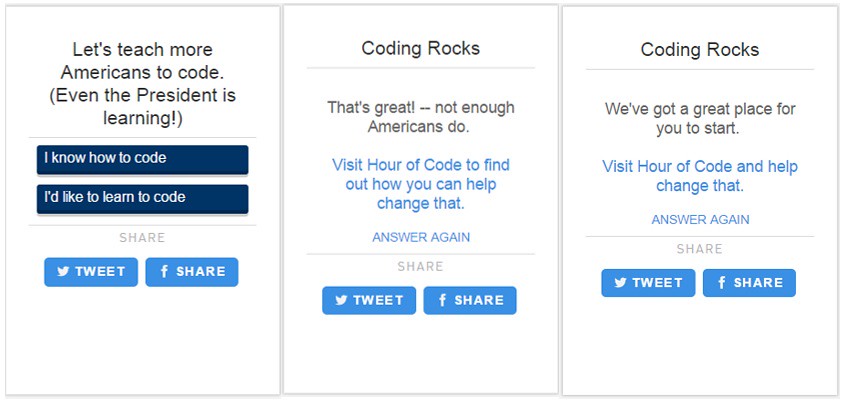
theodp writes: Coding got a couple of shout-outs from the White House in Tuesday's State of the Union Address. "Thanks to Vice President Biden's great work to update our job training system," said President Obama (YouTube), "we're connecting community colleges with local employers to train workers to fill high-paying jobs like coding, and nursing, and robotics." And among the so-called "boats" in the new "River of Content" that the White House social media folks came up with to enhance the State of the Union is a card intended to be shared on Twitter & Facebook which reads, "Let's teach more Americans to code. (Even the President is learning!)." President Obama briefly addressed human spaceflight, saying, "I want Americans to win the race for the kinds of discoveries that unleash new jobs – converting sunlight into liquid fuel; creating revolutionary prosthetics, so that a veteran who gave his arms for his country can play catch with his kid; pushing out into the Solar System not just to visit, but to stay." He also called once more for action on climate change. Politifact has an annotated version of the transcript for more background information on Obama's statements, and FiveThirtyEight has a similar cheat sheet. -
Police Nation-Wide Use Wall-Penetrating Radars To Peer Into Homes
mi writes At least 50 U.S. law enforcement agencies have secretly equipped their officers with radar devices that allow them to effectively peer through the walls of houses to see whether anyone is inside. The device the Marshals Service and others are using, known as the Range-R, looks like a sophisticated stud-finder. Its display shows whether it has detected movement on the other side of a wall and, if so, how far away it is — but it does not show a picture of what's happening inside. The Range-R's maker, L-3 Communications, estimates it has sold about 200 devices to 50 law enforcement agencies at a cost of about $6,000 each. Other radar devices have far more advanced capabilities, including three-dimensional displays of where people are located inside a building, according to marketing materials from their manufacturers. One is capable of being mounted on a drone. And the Justice Department has funded research to develop systems that can map the interiors of buildings and locate the people within them. -
Interviews: Alexander Stepanov and Daniel E. Rose Answer Your Questions
samzenpus (5) writes "Alexander Stepanov is an award winning programmer who designed the C++ Standard Template Library. Daniel E. Rose is a programmer, research scientist, and is the Chief Scientist for Search at A9.com. In addition to working together, the duo have recently written a new book titled, From Mathematics to Generic Programming. Earlier this month you had a chance to ask the pair about their book, their work, or programming in general. Below you'll find the answers to those questions." Early Soviet Computing?
by eldavojohn
Alexander Stepanov, I have never had a chance to ask someone as qualified as you about this topic. I grew up on the opposite side of the Iron Curtain and have constantly wondered if (surely there must have been) alternative computing solutions developed in the USSR prior to Elbrus and SPARC. So my question is whether or not you know of any hardware or instruction set alternatives that died on the vine or were never mass fabricated in Soviet times? I don't expect to you to reveal some super advanced or future predicting instruction set but it has always disturbed me that these things aren't documented somewhere -- as you likely know failures can provide more fruit than successes. Failing that, could you offer us any tails of early computing that only seem to run in Russian circles?
If you can suggest references (preferably in English) I would be most appreciative. I know of only one book and it seems to be a singular point of view.
Alex: I'm not sure I have any unique knowledge, but can only describe my own experience. The first computer I used was a mainframe called M-20 (or one of its derivatives). My first programming exam was pass/fail, but I had to take it several times before I passed. I had no idea how to write code -- I didn't attend lectures or participate in labs, and thought I could just study the book and take the test. But programming isn't like that; the only way to learn is to do it.
Then in my first job, I participated in the design of a minicomputer called TA-100 used to control hydroelectric power stations. I was one of thekey designers of the realtime operating system, a contributor to the instruction set, and the lead designer of the programming tools (debugger, assembler, linker, etc.) -- all written in assembly language. The fact that I started at a very low level -- gates and instructions -- continues to be useful to my work even today. About that time, the Soviet Union started copying American designs, but I was very fortunate to be able to design something original from scratch. The head designer of the TA-100, Aleksandr Gurevich, was a great mentor to me. Two of my senior colleagues, Ilya Neistadt and Natalya Davydovskaya, also spent a lot of time trying to teach me all the things I didn't know.
Despite my personal experience (many details of which I've forgotten), I'm not actually an expert on the history of Soviet computing. But there is a good website containing many articles in English about early Soviet computers. One radically different approach was the "Setun" ternary computer. Unfortunately, there is no detailed treatment of Soviet-era computing at the level of detail and insight found in the second ("Computer Zoo") volume of Computer Architecture by Blaauw and Brooks, which provides an exhaustive treatment of Western designs. In general, computer history is an important field and requires great dedication. My friend Paul McJones does a fabulous job on history of programming languages and other software artifacts. See, for example, his history of FORTRAN site. (He also created sites for Lisp and ALGOL.) Sadly, there is no comparable effort on Soviet computing.
Successor to C++
by Anonymous Coward
I remember you wrote that STL has nothing to do with C++, it was a framework for generic programming and that C++ was chosen for its first implementation because it was less deficient for that purpose compared with other commercial programming languages. That implies you'd like to develop a programming language from scratch. Is that so? If so, how is it going?
Alex: In my first experiments in building a component architecture, I tried to design a language from scratch, called Tecton, with Deepak Kapur and Dave Musser. Tecton was my second system (i.e. it suffered from The Mythical-Man Month's "Second System Effect"). It was an extremely high level language indeed, and had concepts, but was unusable for anything practical. Then I implemented a version of the library in Scheme (together with Aaron Kerschenbaum and Dave Musser), and then another version in Ada (with Dave Musser). I was hired by Bell Labs to join their C++ library team in 1987, which was my first exposure to C++. My C and C++ mentor was Andy Koenig, who helped me understand the overall logic of the language. Unfortunately at that time, C++ was not ready for STL.
I returned to the library work in 1993 at HP Labs, together with Meng Lee. C++ had just gotten templates, and we were able to create a large generic library. At Andy Koenig's suggestion, we submitted a version of it for inclusion in the C++ language standard. This became STL.
After STL was accepted into the standard in 1994, I started thinking about designing a minimal programming language that will allow even more intimate access to hardware than C/C++ and also provide support for concepts and generic programming. I was hoping that somebody would fund such an activity. I interviewed with several companies, proposing such a design, but there was no interest. A senior VP at Microsoft told me: "We are not interested in innovating in the direction you suggest." They were "innovating" in the direction of C#, trying to displace Java. The situation now is not any better. There might be some interest eventually, but it will happen after my retirement: I am no longer in the game.
STL
by serviscope_minor
I'm a huge fan of the STL, and I think the design has stood the test of time amazingly well. That said, you now hae a bunch of hindsight. What would you do differently knowing what you know now. Also if you were doing it today and using today's languages, how do you think it would differ?
Alex: STL is the result of many compromises. There was a tension between my research goals for generic programming and getting something approved by the different constituents of the standards committee with diverse technical, business, and personal agendas. Such compromises are inevitable in real life.
Having said that, here are some of the things I would have preferred were different:
As we discuss in From Mathematics to Generic Programming, my original name for iterators was "coordinates" (or more specifically, "linear coordinates"). The standards committee people told me that there was already a name for this concept, "iterator," so I should use that term. They were wrong -- they were confusing my coordinates with heavyweight stateful iterators found in languages such as CLU and Alphard. This unfortunate terminology still often leads to misunderstanding about the concept of iterator in generic programming. Furthermore, as far back as 1987 I knew that linear coordinates (i.e. iterators) were only one kind of coordinate structures, data types that allow one to navigate through data structures. There are coordinate structures that deal with multidimensional arrays, trees, graphs, etc. (See, for example, chapters 7 and 8 of Elements of Programming.)
Also, there are many different types of containers and STL provided only a rudimentary classification. Moreover, containers with ownership semantics constitute only one way of dealing with data structures. There are others. A properly designed library would be based on a far larger set of data structures than what I could include into STL. There are also simple mistakes in algorithmic interfaces. Partition should place non-satisfying elements before satisfying elements. Copy_n should return a pair. I should have included algorithms dealing with integer concepts. I should have resisted the pressure to include allocators.
It would make perfect sense to redesign STL from scratch when they put concepts into C++. I would recommend that a person who decides to do it, should carefully study both Elements of Programming and From Mathematics to Generic Programming. Both of these books expand on these issues.
Re:STL
by Pseudonym
Related question: C++ was originally conceived as "C + Simula", but something that is interesting about the STL is how non-object-oriented it is, in particular using no inheritance. If we were designing a new "better C" today, one that you'd be happy to implement a STL-like system in, knowing what we know now, would we bother with Simula-style objects at all?
Alex: I am still convinced that Simula/C++/Java style inheritance is unsound. I do believe, however, that there is sometimes a need for run-time dispatch. But run time dispatch should be done as a run-time concept dispatch. Imagine, say, writing code in terms of a pointer to forward iterator. One should be able to obtain affiliated types at run time. Eventually languages will unify object-orientation and generic programming, but nobody seems to work on it now.
Dan: Bjarne Stroustrup describes C++ as a multi-paradigm language. The features that support object-oriented programming and the features that support generic programming are, for the most part, independent. That doesn't mean that both sets of features are not useful. Could Alex have designed STL for a language that doesn't have object-oriented features? Sure. But as a programmer, I'm happy that both sets of features are available. Just because object-oriented features are not needed to implement STL doesn't mean they provide no value in the language.
Alex: C++ has evolved over many years, and many of its features (inheritance, templates, exceptions, namespaces, etc.) were incorporated based on other work. As a result, they don't always work well together, and even when they do, it's in a baroque way. Now that we as a community have many years of experience with these features, we could design a minimal language from scratch that incorporates these features in a more concise and elegant way.
Hardware evolution
by jonkalb
The STL is about three decades old. In that time, we've seen both OS and hardware evolution. What is the impact of these changes on how the STL should be used? How would the STL be different if it where implemented targeting modern environments?
Alex: STL is "only" two decades old, but yes, there have been important changes during that period that would lead to some different decisions. STL was actually designed on a Leading Edge PC with no cache and 640K memory. (Our group at HP Labs didn't have enough money in the budget for an HP PC. When HP CEO Lew Platt came to visit me, HP Labs' director rushed in beforehand to hide the Leading Edge PC.)
One of the biggest changes since then has been the growth of caches. Cache misses are very costly, so locality of reference is much more important now. Node-based data structures, which have low locality of reference, make much less sense. If I were designing STL today, I would have a different set of containers. For example, an in-memory B*-tree is a far better choice than a red-black tree for implementing an associative container.
Another change is the increase in pipeline depth and support for unaligned reads. Today it is cheaper to read extra data rather than to have a branch.
Most processors today also support SIMD instructions. Libraries should take advantage of them whenever they can.
Modern applications such as search engines and databases also use lots of collections of very small data items that can be stored compactly without an extra level of indirection by using variable-sized encodings. It is essential that the libraries provide support for these variable-size entities. Dan and I, together with colleagues at A9, worked on this. Sadly enough, we were not able to finish our work, although you can see some relevant code snippets using variable-sized types and a new data structure called "tape" here.
Search seemingly getting worse over time
by TWX
This is more for Daniel Rose, but to what do you attribute the seeming decline in the quality of search results? I used Digital's Alta Vista search engine when it was fairly new and it seemed revolutionary and seemed to provide me with exactly what I wanted. Over time that declined and Alta Vista as it was ceased to be, and Google initially also seemed to provide me with exactly what I wanted. Now it seems like I have to put a whole lot of thought into faking Google into performing a somewhat-boolean-style search for me, and normal boolean expressions themselves no longer seem to work.
Is this the result of attempting to dumb-down the interface for tailored results, or something else or more insidious? Obviously the amount of content on the Internet is growing, but the computing power to process through all of it is growing too, so I would expect it wouldn't be getting this much worse, this quickly.
Dan: This is a huge question, which could be the subject of a whole book by itself. But the short answer is that there are several factors that have made the search experience be (or at least seem) worse. Here are a few:
1. Size of the problem. In the early days of AltaVista, there were around 100,000 web sites. Today there are around a billion. Assuming the number of web pages has grown proportionally to the number of sites, that's a factor of 10^4. Search ranking algorithms have actually been improved a lot -- they might even be 10x better than they were in 1995. But they haven't improved by 10^4x.
2. Complexity of the problem. Originally, web search engines dealt with static HTML pages. Now they are expected to work with many different types of documents in different formats, with users having a much wider variety of search goals. At A9, which provides the search engine for Amazon.com, we optimized the system specifically for product search. Web search engines have to work for all kinds of search.
3. Adversarial relationship between sites and engines. In the early days of web search engines, most web sites were purely informational, and many were run by nonprofit organizations like universities. Even when for-profit companies put up web sites, most were offered as an informational service to their customers -- it was a cost to the company, not a source of revenue. Obviously, all that has changed. Now it's in the interest of most web site providers to drive traffic to their sites. To do that they want to rank higher in search results -- often even for queries where their content is not relevant. So there is basically an arms race between search companies, which want to accurately rank results by relevance, and so-called search engine optimizers, who want their clients' pages to rank higher regardless of relevance. This leads to all kinds of spam.
4. Business model. The invention of search advertising by Overture, and its adoption by Google and others, meant that it was more profitable to show an ad than an organic search result. I know of specific instances where search engine companies chose not to deploy relevance improvements, because that would reduce revenue (more people would click on the results, and fewer on the ads). Even if a company tries to have a separation between their relevance and advertising teams, it is very hard to serve two masters.
Regarding the use of boolean expressions, there is evidence both from cognitive psychology and from information retrieval research that most people don't understand boolean logic, and that this misunderstanding leads to worse results. So I claim that Google's decision to stop interpreting certain words and symbols as boolean operators is good user-centered design, not "dumbing down" -- but I wish they still provided an advanced search option for those who want it.
If you're interested in learning more about search user issues in particular, here's a lecture I gave at UC Berkeley about 10 years ago on that topic.
Re:Search seemingly getting worse over time
by MouseTheLuckyDog
I was wondering something similar. Often times recent news tends to overshadow search results.
Let me give a practical example. Grand Jury. proceedings have undergone serious reform since the 70s. In some states a target can demand to appear before the Grand Jury. In some states a No Bill precludes the State from representing the case. In others there must be clear new evidence before a case can be represented. I know one state has a three strikes rules for GJ proceedings ( sorry don't remember which).
The day before the Michael Brown shooting, a search on Grand Jury Missouri would have found several articles on the specific laws to Grand Jury proceedings in Missouri. The day the DA announced he would present the case to a Grand Jury, the same search gets hundreds of articles on news story about Michael Brown and Grand Jury proceedings, but it becomes impossible to find those same scholarly articles about the peculiarity of Missouri Grand Jury proceedings. Not even the relevant statutes from the state website. What can be done to mitigate this effect?
Dan: This is a good illustration of what a complex problem search is. There are two issues here: First, should search results change in response to news events? I think so; in your example, it's almost certainly what the majority of users are looking for.
Second, how can the search engine make sure that *other* relevant results are also findable? One way is to make sure that the results address a diversity of user intents. When I was at AltaVista and Yahoo, we did some research on how to identify different user intents and how to make sure the results were not dominated by just one. The query "grand jury Missouri" has at least two obvious intents: "give me information about the grand jury system in Missouri" and "tell me what is going on with the particular grand jury investigating Michael Brown's death."
There are techniques that can do this diversification, and some search engines use some of them. But perhaps a better approach is to recognize that information-seeking is a process, not a magic oracle. Search engines should be designed to facilitate a kind of dialogue with the user. At AltaVista, we had a feature called "Prisma" that would show 12 related queries right below the search box -- not just queries that shared substrings with what the user has typed (like autocomplete), but queries that were about the range of different topics discussed in the actual pages. So for the query "grand jury Missouri," one suggestion might be "Michael Brown news" and another might be "grand jury statute Missouri".
My advice to intelligent search users is to to imagine what terminology would be used in a hypothetical good result on your intended topic, and use those words. If you want to find information about the legal basis of the grand jury system in Missouri, don't just type "grand jury Missouri," type "grand jury statute Missouri." When I do that query today on Google, I get a 2009 publication from the state of Missouri explaining the grand jury process, and the text of the actual statute, both on the first page of results.
What's your time like?
by mlheur
How much of your time do you dedicate to computing vs doing other things; what are your other hobbies or is the work you do also your play time?
Alex: Over the course of my life I have gradually narrowed my focus to spending time on the few items that, to me, are the essential examples of their category. These are things that stood the test of time; I re-read the books I already have read; I listen to music I have listened many times before; etc, etc. Yes, there is a chance that I will miss a new Mozart or Euclid, but it is a chance I am willing to take. Also, like the Pythagoreans of old, I view these as part of a unity: music reflects mathematics, literature is connected with history, etc. My work and my play and my life are inseparable. This unity is also reflected in From Mathematics to Generic Programming, which blends math, programming, history, and sometimes philosophy and art. Here are some of my favorites:
Literature: Greek and Roman classics: Homer, Plato, Ovid, Seneca; Bible; "modern" novels from Swift and Sterne to Dickens and Anthony Trollope. Math and science classics: Euclid, Euler, Gauss, Poincare. I still use printed books, not e-books.
Music: Bach, Mozart, Beethoven, Schubert, Wagner, and Mahler. I tend to listen to many different interpretations of the same piece. I do not use MP3s or streaming music, but CDs and, recently, SACDs.
Movies and TV: Chaplin, Marx Brothers, Kurosawa, Satyajit Ray, Kenneth Clark's Civilization, Peter Brook's Mahabharata, Brideshead Revisited, Royal Shakespeare Company production of Nicholas Nickelby, Maigret with Bruno Cremer. I am a blu-ray enthusiast. I do not use Netflix or Amazon Instant Video.
I love dogs, especially Welsh corgis; I spend 1-2 hours a day walking my dog Maxwell. I no longer eat meat or milk. I have been very happily married for 45 years; my wife Helen is my closest friend. We are practicing Roman Catholics, go to church on Sundays and holidays of obligation and try to keep the commandments. Our political views are in line with Pope Francis: we believe in having an economically just society.
Dan: Ironically, during much of my career as a researcher and engineering manager, I had fairly little time for programming. But now that I am not currently working full time, one of the things I've been doing for fun is programming -- learning iOS development and writing a musical iPhone app. I also enjoy playing very basic guitar and piano, reading, and lately, writing fiction. I try to alternate between reading nonfiction and fiction. The last books I read are The Swerve: How the World Became Modern by Stephen Greenblatt (about how the rediscovery of an ancient Roman poem helped spur the Renaissance) and Dave Eggers' novel The Circle (a cautionary tale about social networking and privacy, which should be required reading for everyone who works at Facebook, Google, and Apple).
Re:ack-nak
by blue trane
When will programming evolve to use subject-predicate syntax, rather than function-argument? Function-argument goes back (at least) to Frege, and his prejudices against subject-predicate syntax (which dominates natural languages). But isn't changePassword(a,b) more ambiguous than "change the password from a to b"? Don't we get an "information gain" effect from using a syntax we are familiar with outside of programming? When you first come to a function-argument command such as (in Oz, which is used in the Paradigms of Computer Programming MOOC) {Push S X}, there is maximum entropy as to whether S is pushed, or pushed onto. "Push X onto S" has no entropy; you know immediately, from the syntax alone, what is pushed onto what.
Dan: I think you need to decouple your argument about entropy with your argument about subject-predicate syntax. IIRC, stack-based languages like Forth and Postscript (and old HP scientific calculators) had completely unambiguous syntax. You either push something on the stack or perform an operation on the required number of arguments at the top of the stack. But these are not subject-predicate syntax languages. So there is more than one way to have what you call no-entropy syntax. Another way to avoid ambiguity is to require that argument names be part of the function name, as Smalltalk and Objective-C do. Then instead of your function call being changePassword(a, b), it's [foo changePasswordFrom:a to:b] (where foo is the object getting the message).
Separate from the entropy issue, is there a cognitive benefit from having programming languages use syntax familiar from natural languages? Perhaps, but which natural language's syntax will you use? Many languages (e.g. Japanese) use a subject-object-verb syntax, while English uses subject-verb-object. Romance languages use SOV some of the time (e.g. with pronouns) and SVO the rest of the time. Talk about ambiguous argument order!
Furthermore, natural languages have evolved to convey all kinds of nuances and deliberate ambiguities that make it hard to specify anything precisely. As a small example, the English meaning of "and" and "or" is quite different from their Boolean interpretation. (If the waiter says that breakfast comes with juice or coffee, getting both is not an option.)
The business application language COBOL (the most popular language of the 1970s) was supposed to have "English-like" syntax, with expressions like "add 1 to x." I'm skeptical that this syntax made programming any easier, but it did lead to this old joke: "Did you hear about the new version of COBOL? It's called ADD 1 TO COBOL."
My opinion is that we will always have different languages with different styles of syntax, to meet the needs of different communities of programmers.
Why is Generic Programming often second class?
by Anonymous Coward
We see many programming languages with at least some support for Generics, but usually as a second class citizen, and often added as an afterthought in later releases, and subordinate to some other programming paradigm. Java is primarily OO, with generics added later. C# is also primarily OO, though with generic support. It took C++ several iterations to get generics, and C++ is "multi paradigm". Go doesn't have generics, and doesn't seem like it will not a while.
It seems to me like generic programming is sufficiently powerful as a paradigm to not need other paradigms like OO in the same language. In fact, in many ways, OO, which ties together data and algorithms, seems antithetical to generic programming. So, do you see a possibility of a programming language whose primary paradigm is generic programming? Why do language designers not get generics into the first releases of their languages, even now, when the issues would seem to be well known? What would such a language look like?
Alex: To design a language for generic programming, one needs to learn to program generically. One has to write lots of code before things become clear. In the Appendix B of Elements of Programming, Sean Parent and Bjarne Stroustrup outlined a minimal language needed for programming. The appendix is about 8 pages long. To make it real, it probably needs to grow by a factor of 3. So, something like 25 pages should be sufficient. I am too old to do it, but I wish that someone would try.
A more difficult problem is not to design the language: C++, after all, contains most of the things needed. The problem is to teach programmers to think abstractly. And that is a very difficult task. I do not know a single university where one could even learn the preliminaries: understanding the machine, and understanding abstract mathematics. Our new book, From Mathematics to Generic Programming, is an attempt to sketch what is needed. Hopefully some school will try to teach both assembly level programming and abstract algebra.
An even harder problem is to convince the software industry to build software out of carefully designed components. What I see, however, is the movement in the opposite direction. Hand-crafted, one-off, undisciplined code is impossible to replicate. Adobe did a fabulous job specifying Postscript; that allowed Peter Deutsch to single-handedly produce Ghostscript. Now Adobe is not going to specify Photoshop's behavior. Let the Gimp guys try to replicate it. While Linus Torvalds was able to replicate Unix from the carefully written System V interface definitions, no one could replicate Windows: being nonstandard creates barriers to entry. There are grave economic reasons making any progress unlikely while undisciplined programmers generate huge amount of capital. It's analogous to the programmer whose terrible spaghetti code gives him job security, since no one else can understand it.
Dan: The idea that object-oriented programming and generic programming are competing paradigms is, in my opinion, mistaken. They are really orthogonal approaches. As we discuss in our book, generic programming is really an attitude. This attitude is useful whether you are using an object-oriented approach or not.
I would love to have a real-world, efficient, popular language that supports generic programming -- including concepts, in particular -- as first-class features. But I see no reason why this language shouldn't also support OOP. -
President Obama Will Kibbitz With YouTube Stars
theodp (442580) writes "For better or worse, YouTube stars are a big deal these days. Last December, Microsoft and Code.org turned to YouTube Stars iJustine and The Fine Brothers to help recruit the nation's K-12 schookids for the Hour of Code. And next week, in what the White House is touting as the State of the YOUnion , President Obama will turn to a trio of YouTube Stars for advice on the issues of day following his State of the Union Address. "We're inviting a handful of YouTube creators to the White House to talk with the President in person," explains the White House Blog, "and you can watch it all live on Thursday, January 22. YouTube creators Bethany Mota, GloZell, and Hank Green will interview President Obama about the issues care they most about and what they're hearing from their audiences." Commenting on the choice of the YouTube interviewers, CNN's David Acosta asked (confused) WH Press Secretary Josh Earnest, "I'm just curious, was 'Charlie Bit My Finger' or 'David After Dentist' not available?" So, how long until the U.S. is redistricted into YouTube Channels?" -
President Obama Will Kibbitz With YouTube Stars
theodp (442580) writes "For better or worse, YouTube stars are a big deal these days. Last December, Microsoft and Code.org turned to YouTube Stars iJustine and The Fine Brothers to help recruit the nation's K-12 schookids for the Hour of Code. And next week, in what the White House is touting as the State of the YOUnion , President Obama will turn to a trio of YouTube Stars for advice on the issues of day following his State of the Union Address. "We're inviting a handful of YouTube creators to the White House to talk with the President in person," explains the White House Blog, "and you can watch it all live on Thursday, January 22. YouTube creators Bethany Mota, GloZell, and Hank Green will interview President Obama about the issues care they most about and what they're hearing from their audiences." Commenting on the choice of the YouTube interviewers, CNN's David Acosta asked (confused) WH Press Secretary Josh Earnest, "I'm just curious, was 'Charlie Bit My Finger' or 'David After Dentist' not available?" So, how long until the U.S. is redistricted into YouTube Channels?" -
President Obama Will Kibbitz With YouTube Stars
theodp (442580) writes "For better or worse, YouTube stars are a big deal these days. Last December, Microsoft and Code.org turned to YouTube Stars iJustine and The Fine Brothers to help recruit the nation's K-12 schookids for the Hour of Code. And next week, in what the White House is touting as the State of the YOUnion , President Obama will turn to a trio of YouTube Stars for advice on the issues of day following his State of the Union Address. "We're inviting a handful of YouTube creators to the White House to talk with the President in person," explains the White House Blog, "and you can watch it all live on Thursday, January 22. YouTube creators Bethany Mota, GloZell, and Hank Green will interview President Obama about the issues care they most about and what they're hearing from their audiences." Commenting on the choice of the YouTube interviewers, CNN's David Acosta asked (confused) WH Press Secretary Josh Earnest, "I'm just curious, was 'Charlie Bit My Finger' or 'David After Dentist' not available?" So, how long until the U.S. is redistricted into YouTube Channels?" -
President Obama Will Kibbitz With YouTube Stars
theodp (442580) writes "For better or worse, YouTube stars are a big deal these days. Last December, Microsoft and Code.org turned to YouTube Stars iJustine and The Fine Brothers to help recruit the nation's K-12 schookids for the Hour of Code. And next week, in what the White House is touting as the State of the YOUnion , President Obama will turn to a trio of YouTube Stars for advice on the issues of day following his State of the Union Address. "We're inviting a handful of YouTube creators to the White House to talk with the President in person," explains the White House Blog, "and you can watch it all live on Thursday, January 22. YouTube creators Bethany Mota, GloZell, and Hank Green will interview President Obama about the issues care they most about and what they're hearing from their audiences." Commenting on the choice of the YouTube interviewers, CNN's David Acosta asked (confused) WH Press Secretary Josh Earnest, "I'm just curious, was 'Charlie Bit My Finger' or 'David After Dentist' not available?" So, how long until the U.S. is redistricted into YouTube Channels?" -
President Obama Will Kibbitz With YouTube Stars
theodp (442580) writes "For better or worse, YouTube stars are a big deal these days. Last December, Microsoft and Code.org turned to YouTube Stars iJustine and The Fine Brothers to help recruit the nation's K-12 schookids for the Hour of Code. And next week, in what the White House is touting as the State of the YOUnion , President Obama will turn to a trio of YouTube Stars for advice on the issues of day following his State of the Union Address. "We're inviting a handful of YouTube creators to the White House to talk with the President in person," explains the White House Blog, "and you can watch it all live on Thursday, January 22. YouTube creators Bethany Mota, GloZell, and Hank Green will interview President Obama about the issues care they most about and what they're hearing from their audiences." Commenting on the choice of the YouTube interviewers, CNN's David Acosta asked (confused) WH Press Secretary Josh Earnest, "I'm just curious, was 'Charlie Bit My Finger' or 'David After Dentist' not available?" So, how long until the U.S. is redistricted into YouTube Channels?" -
President Obama Will Kibbitz With YouTube Stars
theodp (442580) writes "For better or worse, YouTube stars are a big deal these days. Last December, Microsoft and Code.org turned to YouTube Stars iJustine and The Fine Brothers to help recruit the nation's K-12 schookids for the Hour of Code. And next week, in what the White House is touting as the State of the YOUnion , President Obama will turn to a trio of YouTube Stars for advice on the issues of day following his State of the Union Address. "We're inviting a handful of YouTube creators to the White House to talk with the President in person," explains the White House Blog, "and you can watch it all live on Thursday, January 22. YouTube creators Bethany Mota, GloZell, and Hank Green will interview President Obama about the issues care they most about and what they're hearing from their audiences." Commenting on the choice of the YouTube interviewers, CNN's David Acosta asked (confused) WH Press Secretary Josh Earnest, "I'm just curious, was 'Charlie Bit My Finger' or 'David After Dentist' not available?" So, how long until the U.S. is redistricted into YouTube Channels?" -
President Obama Will Kibbitz With YouTube Stars
theodp (442580) writes "For better or worse, YouTube stars are a big deal these days. Last December, Microsoft and Code.org turned to YouTube Stars iJustine and The Fine Brothers to help recruit the nation's K-12 schookids for the Hour of Code. And next week, in what the White House is touting as the State of the YOUnion , President Obama will turn to a trio of YouTube Stars for advice on the issues of day following his State of the Union Address. "We're inviting a handful of YouTube creators to the White House to talk with the President in person," explains the White House Blog, "and you can watch it all live on Thursday, January 22. YouTube creators Bethany Mota, GloZell, and Hank Green will interview President Obama about the issues care they most about and what they're hearing from their audiences." Commenting on the choice of the YouTube interviewers, CNN's David Acosta asked (confused) WH Press Secretary Josh Earnest, "I'm just curious, was 'Charlie Bit My Finger' or 'David After Dentist' not available?" So, how long until the U.S. is redistricted into YouTube Channels?"