Slashdot Mirror
Domain: youtube.com
Stories and comments across the archive that link to youtube.com.
Stories · 2,039
-
Microsoft Research Brings Kinect-Style Depth Perception to Ordinary Cameras
mrspoonsi (2955715) writes "Microsoft has been working on ways to make any regular 2D camera capture depth, meaning it could do some of the same things a Kinect does. As you can see in the video below the team managed to pull this off and we might see this tech all around in the near future. What's really impressive is that this works with many types of cameras. The research team used a smartphone as well as a regular webcam and both managed to achieve some impressive results, the cameras have to be slightly modified but that's only to permit more IR light to hit the sensor." The video is impressive, but note that so are several of the other projects that Microsoft has created for this year's SIGGRAPH, in particular one that makes first-person sports-cam footage more watchable. -
Chicago Mayor Praises Google For Buying Kids Microsoft Surfaces
theodp (442580) writes "Google earned kudos from Chicago Mayor Rahm Emanuel this week for teaming up with Staples to fund the projects of 367 of the city's 22,519 public school teachers on "begfunding" site DonorsChoose.org. "Everything that you asked for...every project that the teachers put on to help their students learn, exceed and excel here in the city of Chicago, you now have fully funded," Mayor Emanuel said. "Chicago's hardworking public school teachers are doing all that they can-and more-to support their students, but they need more help," said Rob Biederman, head of Chicago Public Affairs at Google. "We jumped at the chance to join with DonorsChoose.org and Staples to make Chicago's local classroom wishes come true." So what kind of dreams did Google make possible? Ironically, a look at Google Chicago's Giving Page shows that the biggest project funded by Google was to outfit a classroom with 32 Microsoft Surface RT tablets for $12,531, or about 6.5% of the $190,091 Google award. Other big ticket projects funded by Google included $5,931 for a personal home biodiesel kit and $5,552 for a marimba (in the middle of the spectrum was $748 for "Mindfulness Education"). In addition to similar "flash-funding" projects in Atlanta (paper towels!) and the Bay Area, Google and DonorsChoose have also teamed up this year to reward teachers with $400,000 for recruiting girls to learn to code (part of Google's $50 million Made With Code initiative) and an unknown amount for AP STEM teachers who passed Google muster (part of Google's $5 million AP STEM Access grant)." -
Extracting Audio From Visual Information
rtoz writes Researchers at MIT, Microsoft, and Adobe have developed an algorithm that can reconstruct an audio signal by analyzing minute vibrations of objects depicted in video. In one set of experiments, they were able to recover intelligible speech from the vibrations of a potato-chip bag (video) photographed from 15 feet away through soundproof glass. -
Winners of Raspberry Pi Photography Contest 2014
coop0030 (263345) writes Adafruit held a 2014 Raspberry Pi Photography contest that has completed with the winners selected. You can see the winning photographs as well as all of the entries. Andrew Mulholland, using a Raspberry Pi powered LEGO panobot, is the winning photographer. He's also provided a video of how his winning photographs were put together. -
Researchers Create Virtual Reality 'Parties' To Treat Drug Addiction
Jason Koebler (3528235) writes To help people overcome drug addiction, researchers at the University of Houston's Graduate School of Social Work are building hyper-realistic virtual worlds to recreate situations that trigger cravings for nicotine, alcohol, weed, and now, hard drugs like heroin. Traditional relapse therapy usually involves roleplaying: Therapists often pretend to be a friend or some other familiar person and offer the patient their drug of choice in order to teach them avoidance strategies. By strapping patients into a virtual reality headset and running them through a familiar scenario where they commonly use the drug, like a party, the treatment can be much more realistic and effective, researchers say (video). -
Google, Linaro Develop Custom Android Edition For Project Ara
rtoz writes with this excerpt from an IDG story about the creation of an Android fork made just for Google's modular cell-phone project : A special edition of Android had to be created for the unique customizable design of Project Ara, said George Grey, CEO of Linaro. ... Android can already plug and play SD cards. But Grey said additional OS functionality is needed for storage, cameras and other modules that are typically inside smartphones, but can now be externally added to Project Ara. A lot of work is also being done on UniPro transport drivers, which connect modules and components in Project Ara. UniPro protocol drivers in Android will function much like the USB protocol, where modules will be recognized based on different driver "classes," such as those for networking, sensor, imaging, input and others. Some attachable parts may not be recognized by Android. For those parts, separate drivers need to be developed by module makers through emulators. "That will be need to be done in a secure system so the device can't do damage to the system," Grey said. Project Ara is a very disruptive concept, and it turns around conventional thinking on how to build phones, Grey said. -
A Look At the Firepick Delta Circuit Board Assembler (Video)
From the Firepick website: 'We are developing a really cool robotic machine that is capable of assembling electronic circuit boards (it also 3D prints, and does some other stuff!). It uses a vacuum nozzle to pick really tiny resistors and computer chips up, and place them down very carefully on a printed circuit board.' There are lots of companies here and in China that will happily place and solder components on your printed circuit board, but hardly any that will do a one-off prototype or a small quantity. And the components have gotten small enough that this is really a job for a robot (or at least a Waldo), not human fingers. || There are obviously other devices on the market that do this, but Firepick Delta creator Neil Jansen says they are far too expensive for small companies, let alone individual makers.
The Firepick Delta Hackaday page talks about a $300 price for this machine. That may be too optimistic, but even if it ends up costing two or three times that amount, that's still a huge step forward for small-time inventors and custom manufacturers who need to populate just a few circuit boards, not thousands. They have a Haxlr8r pitch video, and have been noticed by TechCrunch, 3DPrintBoard.com, and Adafruit, just to name a few. Kickstarter? Not yet. Maybe next year. Open source? Totally, complete with GitHub repository. And they were at OSCON 2014, which is where Timothy found them. (Alternate Video Link) -
SpaceX Executive Calls For $22-25 Billion NASA Budget
MarkWhittington (1084047) writes "While participating in a panel called "The US Space Enterprise Partnership" at the NewSpace Conference that was held by the Space Frontier Foundation on Saturday, SpaceX Chief Operating Officer Gwynne Shotwell opined that NASA's budget should be raised to $22-25 billion, according to a tweet by Space Policy Online's Marcia Smith. The theory is that a lot of political rancor has taken place in the aerospace community because of the space agency's limited budget. If the budget were to be increased to pay for everything on the space wish list, the rancor will cease.
The statement represents something of a departure of the usual mutual antagonism that exists between some in the commercial space community and some at NASA. Indeed Space Politics' Jeff Foust added a tweet, "Thought: a panel at a Space Frontier Foundation conf is talking about how to increase NASA budget. Imagine that in late 90s." The Space Frontier Foundation has been a leading voice for commercializing space, sometimes at the expense of NASA programs." -
Amputee Is German Long Jump Champion
hweimer (709734) writes "German long jumper Markus Rehm has written sports history yesterday, becoming the first disabled athlete to win a national able-bodied championship. His jump to 8.24 meters put him on the 9th place of the current season rankings and make him egligible to compete in the upcoming European championships, further sparking the debate whether his prosthetic leg provides him with an unfair advantage." -
Private Data On iOS Devices Not So Private After All
theshowmecanuck (703852) writes with this excerpt from Reuters summarizing the upshot of a talk that Jonathan Zdziarski gave at last weekend's HOPE conference: Personal data including text messages, contact lists and photos can be extracted from iPhones through previously unpublicized techniques by Apple Inc employees, the company acknowledged this week. The same techniques to circumvent backup encryption could be used by law enforcement or others with access to the 'trusted' computers to which the devices have been connected, according to the security expert who prompted Apple's admission. Users are not notified that the services are running and cannot disable them, Zdziarski said. There is no way for iPhone users to know what computers have previously been granted trusted status via the backup process or block future connections. If you'd rather watch and listen, Zdziarski has posted a video showing how it's done. -
Will Your Next Car Be Covered In Morphing Dimples?
cartechboy writes Golfing and cars, not much in common there. But that's about to change thanks to a new technology from a research lab at MIT called Smorphs. The idea is simple: put a set of dynamic dimples on the exterior of a car to improve its surface aerodynamics and make it slipperier, and therefore faster. Pedro Reis is the mechanical engineering and research spearheading this project. A while ago Mythbusters proved the validity of the dimpled car form in a much more low-tech way. The concept uses a hollow core surrounded by a thick, deformable layer, and a smoother outer skin. When vacuum is applied, the outer layers suck in to form the dimples. The technology is only in its very earliest stages, but we could see this applied to future vehicles in an effort to make them faster and more fuel efficient. -
SpaceX Releases Video of Falcon Rocket's Splashdown
First time accepted submitter cowdung (702933) writes In spite of Elon Musk's characterization of the landing as a KABOOM event. Judging by this video SpaceX has managed to land the first stage rocket booster nicely on the ocean after their Orbcomm launch on July 14th. It seems we're one step closer to a landing on dry land. Both this and the previous landing seem to have gone well. Hopefully the next landing test camera has something to deice the camera lens. -
Why My LG Optimus Cellphone Is Worse Than It's Supposed To Be
Bennett Haselton writes My LG Optimus F3Q was the lowest-end phone in the T-Mobile store, but a cheap phone is supposed to suck in specific ways that make you want to upgrade to a better model. This one is plagued with software bugs that have nothing to do with the cheap hardware, and thus lower one's confidence in the whole product line. Similar to the suckiness of the Stratosphere and Stratosphere 2 that I was subjected to before this one, the phone's shortcomings actually raise more interesting questions — about why the free-market system rewards companies for pulling off miracles at the hardware level, but not for fixing software bugs that should be easy to catch. Read below to see what Bennett has to say.How long would it have taken you to find these bugs, as a beta tester?
-
The phone's auto-correct changes single-quotes to double-quotes in contractions -- for example, when you type you're, the phone auto-corrects it to you"re .
-
When you backspace over part of a word that you've typed and then type the rest of the word, auto-correct corrects based on the letters that you type after you've finished backspacing, rather than the letters in the entire word that you've just completed. For example, if you type couchsurfing and the phone auto-corrects it to concurring, then backspace over all of the letters except the initial co, and then type "uch" followed by a space to form the word "couch", the Optimus changes "uch" to "such" to form "cosuch", because it thinks it's auto-correcting just the "uch" fragment and doesn't see the entire word "couch".
-
Taking a screen capture still doesn't work, just like it didn't work on the Stratosphere 2. There are official directions on how to do it, but you can follow the steps and nothing happens.
-
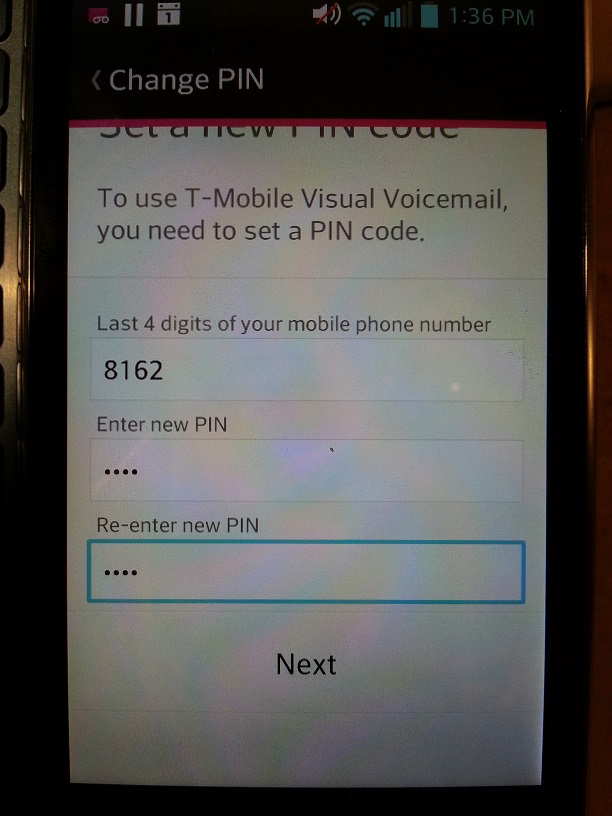
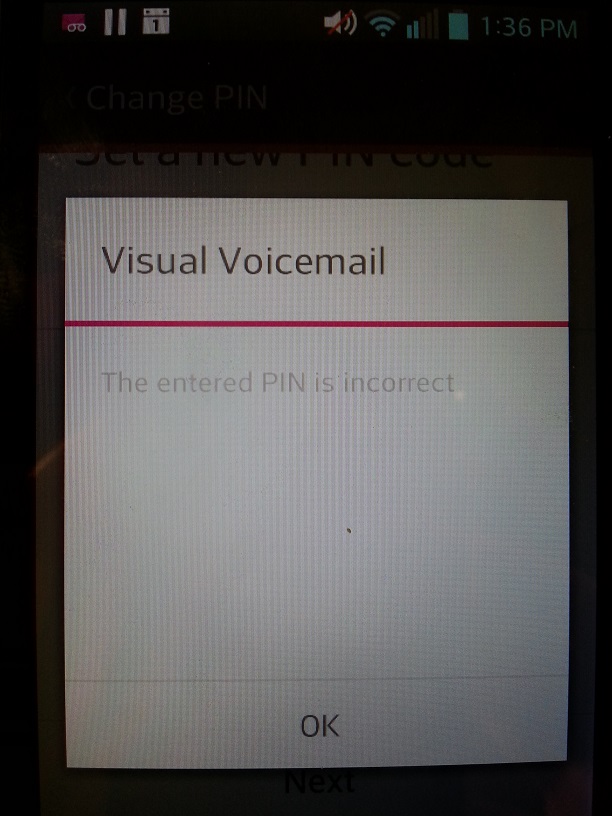
The first time I launched the voice mail application, the app prompted me to freely choose a new PIN code, and then sternly warned me, Mao-like, that my supposedly freely chosen PIN code was "incorrect". (I never got it working, and just called in to the voice mail number manually whenever I wanted to check my messages.)
-
When I bought a movie on Google Play and wanted to "pin" it to the phone -- i.e. download a static, non-streamed copy so that I could watch it offline, e.g. on a plane ride -- the phone didn't have enough internal storage left to save a copy of the movie (1.27 GB, most of it taken up in 1-2 MB increments by crapware already loaded on to the phone, so that only about 200 MB was left). So I tried saving the movie to a 32 GB SD card that I had plugged into the phone, but ran into the problem that Google Play wouldn't let me save the movie to the SD card, a problem described in Joe Levi's 2013 article "Why does Google hate your SD card?" and still not fixed almost a year later. (The comments posted on his article indicate that lots of people are pissed.)
Unlike the other bugs, this may be an example of stupidity not at the testing level but at the design specification level -- perhaps this was done in a misguided effort to prevent illegal copying. But, as Levi says of this theory, "If the DRM being used on Android is sufficient enough for content providers to accept it when media is saved internally, they should also accept it when media is saved to an SD card. Otherwise, the DRM isn't really that trustworthy, is it?" It's pointless from a copy-protection point of view, since anyone who wants to pirate a movie can just download it from various BitTorrent sites anyway; all this "feature" does is alienate people who are trying to pay for a movie legally.
-
In the Messaging (i.e. texting) app, you cannot search for messages by the name of the sender. Your conversations are listed in reverse chronological order by the date of the most recent message in each conversation, but to find a conversation with a particular person, you have to scroll down the entire list of conversations and keep your eyes peeled for the person's name.
- On certain mobile website forms (the Fandango site, for instance, and some others that I don't remember -- it's not clear why this happens on some website forms but not others), the phone won't let me type "special characters", the ones that appear in the upper-right corner of the keyboard keys (so that you can type the "@" symbol by first hitting the "Fn" key to access special characters, and then pressing the "2" key). This means that since I can't type the "@" symbol, I can't log in to any form that requires an email address as a username. (The workaround is to open the Gmail app, find an email address in an email message, copy the "@" symbol from the email address to the clipboard, and then paste it back in the browser form -- yes, I have to do every time I log in to a mobile site that has this problem.)
In my previous phone-suck article about the Samsung Stratosphere, I listed as many problems as I could think of at the time, and I completely forgot the fact that the phone recorded videos without any sound. (I know it wasn't a hardware problem with the microphone, since the phone app picked up my voice fine.) As part of my research into how to ruin Burning Man forever by telling "tourists" how to get there easily, I wanted to post a video of the quintessential Burning Man spectacle that makes all the dust and thirst and heat worthwhile -- and I had to post it with no sound recording, because Samsung's product testing is done by the same drunken bonobos that worked on the LG Optimus.
And both products raise the same question, not rhetorically, but seriously: How did this happen? More specifically, in a theoretical free market, any product improvement that costs only a small amount compared to the benefit it brings to consumers, should be implemented (and consumers will reward the company by paying additional dollars for the improvement, in proportion to the benefit it brings them). While it doesn't always work out that way in practice, it's hard to believe LG couldn't spring for a few English-language testers to point out that the phone shouldn't be correcting you're to you"re.
I think the answer in both cases is that the free market optimizes mainly for things that are easily quantifiable, like camera resolution and network speed, because those can be listed on the packaging and compared against other products. But the amount of stupid s*#t you run into while actually using the phone, is hard to define on an objective scale, so that's the first thing that companies will cut corners on, even if it's something that consumers would be willing to pay money for.
So my solution is still essentially the same as what I proposed after trashing the Stratosphere: Some Consumer-Reports-type outlet should rate phones on a Stupid S*#t Index (along with speed, reception, etc.), based on how much stupid s*#t they run into in a week of typical usage. Ideally the Stupid S*#t Index should be reduced to a number so that you can do a quick comparison between different models. If a cheap phone has a lot of stupid s*#t problems, but you don't mind because you want to save money, that's a valid choice, and if you want to pay more for a phone with less stupid s*#t, that's fine too. But people should know what they're buying.
More generally, I think people vastly overestimate the ability of the free market to meet consumer demand, in cases where the demand is for something that can't be easily quantified. I've spent a fair amount of time in "entrepreneurial" circles (while bouncing back and forth myself between entrepreneurship and regular jobs) and have heard the faithful reciting a lot of platitudes like "The market rewards the best product," or "Focus on building the best product you can make, and the customers will come." But most of them evidently didn't even believe it themselves -- they spent most of their efforts on search engine optimization, running content farms, networking with important business contacts, and other activities that didn't directly relate to the quality of their products. And who could blame them? Since their products weren't competing on qualities that were precisely quantifiable, there was no reason for any of them to try to create the "best" product, or even a particularly good one. And that strategy worked quite well for several of them.
On the other hand, when you're competing on a quantifiable metric like price, the best product or service can shoot straight to the top without wasting any time on zero-sum games like SEO or networking ass-kissery. If you're selling external hard drives on Amazon for $0.01, you'll make a lot of sales. You'll go broke, but in the meantime, the free market will connect you quite effectively with your customers.
So, make the mobile phone Stupid S*@t Index into something quantifiable, and maybe we'll have less stupid s#*t. One review body could publish the average rating from several different reviewers, or several different review bodies could publish their ratings and consumers could weight the averages themselves.
Not that it's a panacea -- I bought the LG Optimus not because it was the cheapest or because I didn't expect it to have bugs, but because it was the only offering with a slide-out keyboard, and I've become addicted to the precision of physical keys. (It is so much easier to let your fingertip feel its way to the right key first, and then actually press the key in a separate motion, rather than having to hope your fingertip lands on the right spot in the first place.) So I never returned the phone, they kept my money, and I suppose that makes me part of the problem.
-
-
Why My LG Optimus Cellphone Is Worse Than It's Supposed To Be
Bennett Haselton writes My LG Optimus F3Q was the lowest-end phone in the T-Mobile store, but a cheap phone is supposed to suck in specific ways that make you want to upgrade to a better model. This one is plagued with software bugs that have nothing to do with the cheap hardware, and thus lower one's confidence in the whole product line. Similar to the suckiness of the Stratosphere and Stratosphere 2 that I was subjected to before this one, the phone's shortcomings actually raise more interesting questions — about why the free-market system rewards companies for pulling off miracles at the hardware level, but not for fixing software bugs that should be easy to catch. Read below to see what Bennett has to say.How long would it have taken you to find these bugs, as a beta tester?
-
The phone's auto-correct changes single-quotes to double-quotes in contractions -- for example, when you type you're, the phone auto-corrects it to you"re .
-
When you backspace over part of a word that you've typed and then type the rest of the word, auto-correct corrects based on the letters that you type after you've finished backspacing, rather than the letters in the entire word that you've just completed. For example, if you type couchsurfing and the phone auto-corrects it to concurring, then backspace over all of the letters except the initial co, and then type "uch" followed by a space to form the word "couch", the Optimus changes "uch" to "such" to form "cosuch", because it thinks it's auto-correcting just the "uch" fragment and doesn't see the entire word "couch".
-
Taking a screen capture still doesn't work, just like it didn't work on the Stratosphere 2. There are official directions on how to do it, but you can follow the steps and nothing happens.
-
The first time I launched the voice mail application, the app prompted me to freely choose a new PIN code, and then sternly warned me, Mao-like, that my supposedly freely chosen PIN code was "incorrect". (I never got it working, and just called in to the voice mail number manually whenever I wanted to check my messages.)
-
When I bought a movie on Google Play and wanted to "pin" it to the phone -- i.e. download a static, non-streamed copy so that I could watch it offline, e.g. on a plane ride -- the phone didn't have enough internal storage left to save a copy of the movie (1.27 GB, most of it taken up in 1-2 MB increments by crapware already loaded on to the phone, so that only about 200 MB was left). So I tried saving the movie to a 32 GB SD card that I had plugged into the phone, but ran into the problem that Google Play wouldn't let me save the movie to the SD card, a problem described in Joe Levi's 2013 article "Why does Google hate your SD card?" and still not fixed almost a year later. (The comments posted on his article indicate that lots of people are pissed.)
Unlike the other bugs, this may be an example of stupidity not at the testing level but at the design specification level -- perhaps this was done in a misguided effort to prevent illegal copying. But, as Levi says of this theory, "If the DRM being used on Android is sufficient enough for content providers to accept it when media is saved internally, they should also accept it when media is saved to an SD card. Otherwise, the DRM isn't really that trustworthy, is it?" It's pointless from a copy-protection point of view, since anyone who wants to pirate a movie can just download it from various BitTorrent sites anyway; all this "feature" does is alienate people who are trying to pay for a movie legally.
-
In the Messaging (i.e. texting) app, you cannot search for messages by the name of the sender. Your conversations are listed in reverse chronological order by the date of the most recent message in each conversation, but to find a conversation with a particular person, you have to scroll down the entire list of conversations and keep your eyes peeled for the person's name.
- On certain mobile website forms (the Fandango site, for instance, and some others that I don't remember -- it's not clear why this happens on some website forms but not others), the phone won't let me type "special characters", the ones that appear in the upper-right corner of the keyboard keys (so that you can type the "@" symbol by first hitting the "Fn" key to access special characters, and then pressing the "2" key). This means that since I can't type the "@" symbol, I can't log in to any form that requires an email address as a username. (The workaround is to open the Gmail app, find an email address in an email message, copy the "@" symbol from the email address to the clipboard, and then paste it back in the browser form -- yes, I have to do every time I log in to a mobile site that has this problem.)
In my previous phone-suck article about the Samsung Stratosphere, I listed as many problems as I could think of at the time, and I completely forgot the fact that the phone recorded videos without any sound. (I know it wasn't a hardware problem with the microphone, since the phone app picked up my voice fine.) As part of my research into how to ruin Burning Man forever by telling "tourists" how to get there easily, I wanted to post a video of the quintessential Burning Man spectacle that makes all the dust and thirst and heat worthwhile -- and I had to post it with no sound recording, because Samsung's product testing is done by the same drunken bonobos that worked on the LG Optimus.
And both products raise the same question, not rhetorically, but seriously: How did this happen? More specifically, in a theoretical free market, any product improvement that costs only a small amount compared to the benefit it brings to consumers, should be implemented (and consumers will reward the company by paying additional dollars for the improvement, in proportion to the benefit it brings them). While it doesn't always work out that way in practice, it's hard to believe LG couldn't spring for a few English-language testers to point out that the phone shouldn't be correcting you're to you"re.
I think the answer in both cases is that the free market optimizes mainly for things that are easily quantifiable, like camera resolution and network speed, because those can be listed on the packaging and compared against other products. But the amount of stupid s*#t you run into while actually using the phone, is hard to define on an objective scale, so that's the first thing that companies will cut corners on, even if it's something that consumers would be willing to pay money for.
So my solution is still essentially the same as what I proposed after trashing the Stratosphere: Some Consumer-Reports-type outlet should rate phones on a Stupid S*#t Index (along with speed, reception, etc.), based on how much stupid s*#t they run into in a week of typical usage. Ideally the Stupid S*#t Index should be reduced to a number so that you can do a quick comparison between different models. If a cheap phone has a lot of stupid s*#t problems, but you don't mind because you want to save money, that's a valid choice, and if you want to pay more for a phone with less stupid s*#t, that's fine too. But people should know what they're buying.
More generally, I think people vastly overestimate the ability of the free market to meet consumer demand, in cases where the demand is for something that can't be easily quantified. I've spent a fair amount of time in "entrepreneurial" circles (while bouncing back and forth myself between entrepreneurship and regular jobs) and have heard the faithful reciting a lot of platitudes like "The market rewards the best product," or "Focus on building the best product you can make, and the customers will come." But most of them evidently didn't even believe it themselves -- they spent most of their efforts on search engine optimization, running content farms, networking with important business contacts, and other activities that didn't directly relate to the quality of their products. And who could blame them? Since their products weren't competing on qualities that were precisely quantifiable, there was no reason for any of them to try to create the "best" product, or even a particularly good one. And that strategy worked quite well for several of them.
On the other hand, when you're competing on a quantifiable metric like price, the best product or service can shoot straight to the top without wasting any time on zero-sum games like SEO or networking ass-kissery. If you're selling external hard drives on Amazon for $0.01, you'll make a lot of sales. You'll go broke, but in the meantime, the free market will connect you quite effectively with your customers.
So, make the mobile phone Stupid S*@t Index into something quantifiable, and maybe we'll have less stupid s#*t. One review body could publish the average rating from several different reviewers, or several different review bodies could publish their ratings and consumers could weight the averages themselves.
Not that it's a panacea -- I bought the LG Optimus not because it was the cheapest or because I didn't expect it to have bugs, but because it was the only offering with a slide-out keyboard, and I've become addicted to the precision of physical keys. (It is so much easier to let your fingertip feel its way to the right key first, and then actually press the key in a separate motion, rather than having to hope your fingertip lands on the right spot in the first place.) So I never returned the phone, they kept my money, and I suppose that makes me part of the problem.
-
-
Why My LG Optimus Cellphone Is Worse Than It's Supposed To Be
Bennett Haselton writes My LG Optimus F3Q was the lowest-end phone in the T-Mobile store, but a cheap phone is supposed to suck in specific ways that make you want to upgrade to a better model. This one is plagued with software bugs that have nothing to do with the cheap hardware, and thus lower one's confidence in the whole product line. Similar to the suckiness of the Stratosphere and Stratosphere 2 that I was subjected to before this one, the phone's shortcomings actually raise more interesting questions — about why the free-market system rewards companies for pulling off miracles at the hardware level, but not for fixing software bugs that should be easy to catch. Read below to see what Bennett has to say.How long would it have taken you to find these bugs, as a beta tester?
-
The phone's auto-correct changes single-quotes to double-quotes in contractions -- for example, when you type you're, the phone auto-corrects it to you"re .
-
When you backspace over part of a word that you've typed and then type the rest of the word, auto-correct corrects based on the letters that you type after you've finished backspacing, rather than the letters in the entire word that you've just completed. For example, if you type couchsurfing and the phone auto-corrects it to concurring, then backspace over all of the letters except the initial co, and then type "uch" followed by a space to form the word "couch", the Optimus changes "uch" to "such" to form "cosuch", because it thinks it's auto-correcting just the "uch" fragment and doesn't see the entire word "couch".
-
Taking a screen capture still doesn't work, just like it didn't work on the Stratosphere 2. There are official directions on how to do it, but you can follow the steps and nothing happens.
-
The first time I launched the voice mail application, the app prompted me to freely choose a new PIN code, and then sternly warned me, Mao-like, that my supposedly freely chosen PIN code was "incorrect". (I never got it working, and just called in to the voice mail number manually whenever I wanted to check my messages.)
-
When I bought a movie on Google Play and wanted to "pin" it to the phone -- i.e. download a static, non-streamed copy so that I could watch it offline, e.g. on a plane ride -- the phone didn't have enough internal storage left to save a copy of the movie (1.27 GB, most of it taken up in 1-2 MB increments by crapware already loaded on to the phone, so that only about 200 MB was left). So I tried saving the movie to a 32 GB SD card that I had plugged into the phone, but ran into the problem that Google Play wouldn't let me save the movie to the SD card, a problem described in Joe Levi's 2013 article "Why does Google hate your SD card?" and still not fixed almost a year later. (The comments posted on his article indicate that lots of people are pissed.)
Unlike the other bugs, this may be an example of stupidity not at the testing level but at the design specification level -- perhaps this was done in a misguided effort to prevent illegal copying. But, as Levi says of this theory, "If the DRM being used on Android is sufficient enough for content providers to accept it when media is saved internally, they should also accept it when media is saved to an SD card. Otherwise, the DRM isn't really that trustworthy, is it?" It's pointless from a copy-protection point of view, since anyone who wants to pirate a movie can just download it from various BitTorrent sites anyway; all this "feature" does is alienate people who are trying to pay for a movie legally.
-
In the Messaging (i.e. texting) app, you cannot search for messages by the name of the sender. Your conversations are listed in reverse chronological order by the date of the most recent message in each conversation, but to find a conversation with a particular person, you have to scroll down the entire list of conversations and keep your eyes peeled for the person's name.
- On certain mobile website forms (the Fandango site, for instance, and some others that I don't remember -- it's not clear why this happens on some website forms but not others), the phone won't let me type "special characters", the ones that appear in the upper-right corner of the keyboard keys (so that you can type the "@" symbol by first hitting the "Fn" key to access special characters, and then pressing the "2" key). This means that since I can't type the "@" symbol, I can't log in to any form that requires an email address as a username. (The workaround is to open the Gmail app, find an email address in an email message, copy the "@" symbol from the email address to the clipboard, and then paste it back in the browser form -- yes, I have to do every time I log in to a mobile site that has this problem.)
In my previous phone-suck article about the Samsung Stratosphere, I listed as many problems as I could think of at the time, and I completely forgot the fact that the phone recorded videos without any sound. (I know it wasn't a hardware problem with the microphone, since the phone app picked up my voice fine.) As part of my research into how to ruin Burning Man forever by telling "tourists" how to get there easily, I wanted to post a video of the quintessential Burning Man spectacle that makes all the dust and thirst and heat worthwhile -- and I had to post it with no sound recording, because Samsung's product testing is done by the same drunken bonobos that worked on the LG Optimus.
And both products raise the same question, not rhetorically, but seriously: How did this happen? More specifically, in a theoretical free market, any product improvement that costs only a small amount compared to the benefit it brings to consumers, should be implemented (and consumers will reward the company by paying additional dollars for the improvement, in proportion to the benefit it brings them). While it doesn't always work out that way in practice, it's hard to believe LG couldn't spring for a few English-language testers to point out that the phone shouldn't be correcting you're to you"re.
I think the answer in both cases is that the free market optimizes mainly for things that are easily quantifiable, like camera resolution and network speed, because those can be listed on the packaging and compared against other products. But the amount of stupid s*#t you run into while actually using the phone, is hard to define on an objective scale, so that's the first thing that companies will cut corners on, even if it's something that consumers would be willing to pay money for.
So my solution is still essentially the same as what I proposed after trashing the Stratosphere: Some Consumer-Reports-type outlet should rate phones on a Stupid S*#t Index (along with speed, reception, etc.), based on how much stupid s*#t they run into in a week of typical usage. Ideally the Stupid S*#t Index should be reduced to a number so that you can do a quick comparison between different models. If a cheap phone has a lot of stupid s*#t problems, but you don't mind because you want to save money, that's a valid choice, and if you want to pay more for a phone with less stupid s*#t, that's fine too. But people should know what they're buying.
More generally, I think people vastly overestimate the ability of the free market to meet consumer demand, in cases where the demand is for something that can't be easily quantified. I've spent a fair amount of time in "entrepreneurial" circles (while bouncing back and forth myself between entrepreneurship and regular jobs) and have heard the faithful reciting a lot of platitudes like "The market rewards the best product," or "Focus on building the best product you can make, and the customers will come." But most of them evidently didn't even believe it themselves -- they spent most of their efforts on search engine optimization, running content farms, networking with important business contacts, and other activities that didn't directly relate to the quality of their products. And who could blame them? Since their products weren't competing on qualities that were precisely quantifiable, there was no reason for any of them to try to create the "best" product, or even a particularly good one. And that strategy worked quite well for several of them.
On the other hand, when you're competing on a quantifiable metric like price, the best product or service can shoot straight to the top without wasting any time on zero-sum games like SEO or networking ass-kissery. If you're selling external hard drives on Amazon for $0.01, you'll make a lot of sales. You'll go broke, but in the meantime, the free market will connect you quite effectively with your customers.
So, make the mobile phone Stupid S*@t Index into something quantifiable, and maybe we'll have less stupid s#*t. One review body could publish the average rating from several different reviewers, or several different review bodies could publish their ratings and consumers could weight the averages themselves.
Not that it's a panacea -- I bought the LG Optimus not because it was the cheapest or because I didn't expect it to have bugs, but because it was the only offering with a slide-out keyboard, and I've become addicted to the precision of physical keys. (It is so much easier to let your fingertip feel its way to the right key first, and then actually press the key in a separate motion, rather than having to hope your fingertip lands on the right spot in the first place.) So I never returned the phone, they kept my money, and I suppose that makes me part of the problem.
-
-
Open Hardware and Digital Communications Conference On Free Video, If You Help
Bruce Perens writes The TAPR Digital Communications Conference has been covered twice here and is a great meeting on leading-edge wireless technology, mostly done as Open Hardware and Open Source software. Free videos of the September 2014 presentations will be made available if you help via Kickstarter. For an idea of what's in them, see the Dayton Hamvention interviews covering Whitebox, our Open Hardware handheld software-defined radio transceiver, and Michael Ossman's HackRF, a programmable Open Hardware transceiver for wireless security exploration and other wireless research. Last year's TAPR DCC presentations are at the Ham Radio Now channel on Youtube. -
Open Hardware and Digital Communications Conference On Free Video, If You Help
Bruce Perens writes The TAPR Digital Communications Conference has been covered twice here and is a great meeting on leading-edge wireless technology, mostly done as Open Hardware and Open Source software. Free videos of the September 2014 presentations will be made available if you help via Kickstarter. For an idea of what's in them, see the Dayton Hamvention interviews covering Whitebox, our Open Hardware handheld software-defined radio transceiver, and Michael Ossman's HackRF, a programmable Open Hardware transceiver for wireless security exploration and other wireless research. Last year's TAPR DCC presentations are at the Ham Radio Now channel on Youtube. -
The Improbable Story of the 184 MPH Jet Train
MatthewVD writes Almost half a century ago, New York Central Railroad engineer Don Wetzel and his team bolted two J47-19 jet engines, throttled up the engines and tore down a length of track from Butler, Indiana to Stryker, Ohio at almost 184 mph. Today, the M-497 still holds the record for America's fastest train. This is the story of how it happened. -
Phase-Changing Material Created For Robots
rtoz writes In the movie Terminator 2, the shape-shifting T-1000 robot morphs into a liquid state to squeeze through tight spaces or to repair itself when harmed. Now a phase-changing material built from wax and foam, and capable of switching between hard and soft states, could allow even low-cost robots to perform the same feat. The material developed by MIT researchers could be used to build deformable surgical robots. The robots could move through the body to reach a particular point without damaging any of the organs or vessels along the way. The Robots built from this material could also be used in search-and-rescue operations to squeeze through rubble looking for survivors. -
Interviews: Juan Gilbert Answers Your Questions
Last week you had a chance to ask the Associate Chair of Research in the Computer & Information Science & Engineering Department at the University of Florida, Juan Gilbert, about the Human Centered Computing Lab, accessibility issues in technology, and electronic voting. Below you'll find his answers to your questions. Internet Voting ?!!
by mtrachtenberg
Here are some questions for Professor Gilbert, regarding internet voting:
1. How will non-mathematicians know with certainty that votes have been properly received and counted?
Gilbert: What we do is called Televoting. It’s not internet voting the way most people think of it. Take a look at this video. You will see that the printed paper ballot is still the ballot of record.
2. If the security depends upon encryption, how will we know that encryption has not been broken by a secret agency with vast computing power? Further, how will we know that those involved in developing the encryption have not secretly offered back doors to such agencies, as has happened in the past?
Gilbert: The encryption isn’t the key in Televoting. We use standard encryption and could use more advanced encryption, but it’s not the key because the ballot of record is the printed ballot.
3. What will a voter do if they experience an election-day denial of service attack?
Gilbert: Denial of service attacks can be detected and terminated. There are many researchers working on this with success from my understanding.
4. How can we know that a vote has not been coerced if the voter votes from home (bullying spouse, etc...)?
Gilbert: Televoting is for military and overseas voters. However, there are many states that have mail-in voting, so this is no different than mail-in voting with respect to coercion.
5. What are the insurmountable difficulties with a paper-based election process that make internet voting desirable despite risks? Why is the United States no longer capable of counting cast ballots in public? It is clearly not the vast number of voters, since this is a distributed problem with a vast number of potential counters. What has become so broken among our pseudo-elites that this KISS approach is now considered so inappropriate?
Gilbert: I really don’t know how to answer this question. From my perspective, we use our technology to count the ballots and we do so in public, so it can be done.
Re:Internet Voting ?!!
by Anonymous Coward
Do you think either party will have enough political will to make internet voting a reality? Winning in politics in large part is about who can play the game best, do you think the parties will let the rules change?
Gilbert: I don’t know if they will change or not. I do the research to address societal issues, i.e. making voting more accessible, usable and secure for all voters. Once I have done the research, I share it with everyone and we simply state the facts and hopefully, the solutions are implemented. Only time will tell. Stay tuned
Re:Question
by Anonymous Coward
I watched your TED talk about multiple teacher single student learning. Has any further progress been made on the project or have you integrated it into any real-life schools?
Gilbert: We haven’t added anything new to it, but we have the platform and we can set it up. Our other projects have really taken us away from this project, but we are still very much interested in this issue.
Re:"culturally relevant computing or ethnocomputing"
by Anonymous Coward
You've said that you created the Application Quest program in response to the Michigan affirmative action rulings to help colleges keep diversity without giving preference to race. Are any colleges using the system or expressed interest? Have you had an backlash over your stance that the issue really isn't about race but about capacity?
Gilbert: Auburn University has used it, Clemson University is using it and there are others that I can’t name. We have used it in several pilots and in every case, Applications Quest (AQ) recommended applications that resulted in great diversity than the actual admitted applicants selected by the committee, the results were found in a fraction of the time and probably most important, AQ reached the same academic achievement levels as the committee.
People haven’t pushed back on my notion of the capacity issue. I think most people get it. For those that don't know about this; I have said that affirmative action, specifically, the use of race in admissions isn’t about race/ethnicity, gender, national origin, etc. It’s a capacity issue. Whenever you have more qualified applicants than you have available slots, offers, etc. you have to turn away someone who is qualified. If you could admit all of the qualified applicants, this would not be an issue. Therefore, I created AQ, which addresses the capacity issue and results in greater holistic diversity without preferential treatment to any attribute.
Accessibility
by Anonymous Coward
How much impact will wearables have on the accessibility of technology to people with disabilities? A smart watch is a lot easier to move around with than a laptop. Do you think these smaller devices will have a big impact or is this just another fad?
Gilbert: These devices are already having a huge impact for people with disabilities. The mobile phone has enhanced accessibility greatly with GPS, text to speech and speech recognition. This is not a fad, it’s reality and happening now.
Churn Rate
by Anonymous Coward
From what I can tell most of the work done at the Human Centered Computing Lab seems to be from students. Since this means a fairly quick churn rate does this make it harder to complete big projects or does the constant influx of new blood make up for that?
Gilbert: We work on things that address societal issues. Our students are excited to be a part of these projects and they keep coming. Plus, these students are PhD students; therefore, I have them for 3-6 years, so we do pretty well on keeping the projects afloat. The Prime III project is over 10 years old and I estimate more than 35 students (undergrad and graduate students) have worked on this project.
automotive interfaces
by DriveDog
Most of the recent changes I've seen to driver controls seem wrong-headed. So many require the driver to look down at some screen or closely-spaced identically-feeling buttons. Only a few decades ago, car makers began moving functions to stalks to put them within easy reach, but the makers' usage is so different that it's more confusing than ever, particularly in this day when people are more likely to drive several different vehicles in a single day. I like steering wheel-mounted buttons, but now there are so many it has again become confusing, and again, makers refuse to adopt any standard placements/usage. Can we have programmable controls that follow a driver from car to car, always working the way that particular driver prefers? Must we resort to voice control? I despise talking to my car or any other device, including my phone. Is there no solution until cars can be controlled by thought?
Gilbert: We like the idea of voice controls, but we have also considered something called MyDash. Imagine your dashboard being stored on your phone. When you enter the car, the phone connects with the car and loads your dash; therefore, you can take your dashboard with you. Now, this would require the manufacturers to agree on certain controls, but it’s certainly doable.
Perspectives on End-User Development
by TuringTest
With today programming languages, creating new new software requires learning a complex syntax with very specialized rules on how to combine words, even for creating very simple software (for example, web pages with trivial interactions such as folding and dragging items).
Some approaches to allow end users to build automated behavior exist, but they can only go so far. There are "drag and drop" interface builders for building web pages with forms, and graph languages for transforming data. But they only allow reusing pre-defined components which are built with traditional languages. Any behavior not supported by those components can not be added to the program.
There are also rule-based visual systems like Agentsheets that allow defining new behaviors without a strict complex syntax, but those are difficult to reason about when behaviors depend on several levels of nested rules.
My question is: what would be your preferred approach to achieve the goal of allowing end users build their own simple software programs? This assumes that we define "program" in a loose way, not necessarily in the traditional way but referring to any software artifacts for defining repeatable processes to handle information such as:
* building and classifying collections of related data, transforming the shape of parts of a document
* or for automation of actions in time (turning on and off lights and engines at particular times or in a pre-defined pattern, sending messages to groups of people that follow certain criteria under some triggering condition)...
All this without requiring that the user learns a scripting language or otherwise needs to form a mental model of how exactly the program's execution evolves in time within the machine components.
Gilbert: I don’t know if this is possible without an AI backend of some sort. What you are describing is an intelligent programming backend. Essentially, allow a user to specify the interaction and the system builds it. Interesting idea and I believe the drag and drop systems we have today work fairly well, but I don’t know if we will have a true AI backend that can write code using natural language input. -
Interviews: Juan Gilbert Answers Your Questions
Last week you had a chance to ask the Associate Chair of Research in the Computer & Information Science & Engineering Department at the University of Florida, Juan Gilbert, about the Human Centered Computing Lab, accessibility issues in technology, and electronic voting. Below you'll find his answers to your questions. Internet Voting ?!!
by mtrachtenberg
Here are some questions for Professor Gilbert, regarding internet voting:
1. How will non-mathematicians know with certainty that votes have been properly received and counted?
Gilbert: What we do is called Televoting. It’s not internet voting the way most people think of it. Take a look at this video. You will see that the printed paper ballot is still the ballot of record.
2. If the security depends upon encryption, how will we know that encryption has not been broken by a secret agency with vast computing power? Further, how will we know that those involved in developing the encryption have not secretly offered back doors to such agencies, as has happened in the past?
Gilbert: The encryption isn’t the key in Televoting. We use standard encryption and could use more advanced encryption, but it’s not the key because the ballot of record is the printed ballot.
3. What will a voter do if they experience an election-day denial of service attack?
Gilbert: Denial of service attacks can be detected and terminated. There are many researchers working on this with success from my understanding.
4. How can we know that a vote has not been coerced if the voter votes from home (bullying spouse, etc...)?
Gilbert: Televoting is for military and overseas voters. However, there are many states that have mail-in voting, so this is no different than mail-in voting with respect to coercion.
5. What are the insurmountable difficulties with a paper-based election process that make internet voting desirable despite risks? Why is the United States no longer capable of counting cast ballots in public? It is clearly not the vast number of voters, since this is a distributed problem with a vast number of potential counters. What has become so broken among our pseudo-elites that this KISS approach is now considered so inappropriate?
Gilbert: I really don’t know how to answer this question. From my perspective, we use our technology to count the ballots and we do so in public, so it can be done.
Re:Internet Voting ?!!
by Anonymous Coward
Do you think either party will have enough political will to make internet voting a reality? Winning in politics in large part is about who can play the game best, do you think the parties will let the rules change?
Gilbert: I don’t know if they will change or not. I do the research to address societal issues, i.e. making voting more accessible, usable and secure for all voters. Once I have done the research, I share it with everyone and we simply state the facts and hopefully, the solutions are implemented. Only time will tell. Stay tuned
Re:Question
by Anonymous Coward
I watched your TED talk about multiple teacher single student learning. Has any further progress been made on the project or have you integrated it into any real-life schools?
Gilbert: We haven’t added anything new to it, but we have the platform and we can set it up. Our other projects have really taken us away from this project, but we are still very much interested in this issue.
Re:"culturally relevant computing or ethnocomputing"
by Anonymous Coward
You've said that you created the Application Quest program in response to the Michigan affirmative action rulings to help colleges keep diversity without giving preference to race. Are any colleges using the system or expressed interest? Have you had an backlash over your stance that the issue really isn't about race but about capacity?
Gilbert: Auburn University has used it, Clemson University is using it and there are others that I can’t name. We have used it in several pilots and in every case, Applications Quest (AQ) recommended applications that resulted in great diversity than the actual admitted applicants selected by the committee, the results were found in a fraction of the time and probably most important, AQ reached the same academic achievement levels as the committee.
People haven’t pushed back on my notion of the capacity issue. I think most people get it. For those that don't know about this; I have said that affirmative action, specifically, the use of race in admissions isn’t about race/ethnicity, gender, national origin, etc. It’s a capacity issue. Whenever you have more qualified applicants than you have available slots, offers, etc. you have to turn away someone who is qualified. If you could admit all of the qualified applicants, this would not be an issue. Therefore, I created AQ, which addresses the capacity issue and results in greater holistic diversity without preferential treatment to any attribute.
Accessibility
by Anonymous Coward
How much impact will wearables have on the accessibility of technology to people with disabilities? A smart watch is a lot easier to move around with than a laptop. Do you think these smaller devices will have a big impact or is this just another fad?
Gilbert: These devices are already having a huge impact for people with disabilities. The mobile phone has enhanced accessibility greatly with GPS, text to speech and speech recognition. This is not a fad, it’s reality and happening now.
Churn Rate
by Anonymous Coward
From what I can tell most of the work done at the Human Centered Computing Lab seems to be from students. Since this means a fairly quick churn rate does this make it harder to complete big projects or does the constant influx of new blood make up for that?
Gilbert: We work on things that address societal issues. Our students are excited to be a part of these projects and they keep coming. Plus, these students are PhD students; therefore, I have them for 3-6 years, so we do pretty well on keeping the projects afloat. The Prime III project is over 10 years old and I estimate more than 35 students (undergrad and graduate students) have worked on this project.
automotive interfaces
by DriveDog
Most of the recent changes I've seen to driver controls seem wrong-headed. So many require the driver to look down at some screen or closely-spaced identically-feeling buttons. Only a few decades ago, car makers began moving functions to stalks to put them within easy reach, but the makers' usage is so different that it's more confusing than ever, particularly in this day when people are more likely to drive several different vehicles in a single day. I like steering wheel-mounted buttons, but now there are so many it has again become confusing, and again, makers refuse to adopt any standard placements/usage. Can we have programmable controls that follow a driver from car to car, always working the way that particular driver prefers? Must we resort to voice control? I despise talking to my car or any other device, including my phone. Is there no solution until cars can be controlled by thought?
Gilbert: We like the idea of voice controls, but we have also considered something called MyDash. Imagine your dashboard being stored on your phone. When you enter the car, the phone connects with the car and loads your dash; therefore, you can take your dashboard with you. Now, this would require the manufacturers to agree on certain controls, but it’s certainly doable.
Perspectives on End-User Development
by TuringTest
With today programming languages, creating new new software requires learning a complex syntax with very specialized rules on how to combine words, even for creating very simple software (for example, web pages with trivial interactions such as folding and dragging items).
Some approaches to allow end users to build automated behavior exist, but they can only go so far. There are "drag and drop" interface builders for building web pages with forms, and graph languages for transforming data. But they only allow reusing pre-defined components which are built with traditional languages. Any behavior not supported by those components can not be added to the program.
There are also rule-based visual systems like Agentsheets that allow defining new behaviors without a strict complex syntax, but those are difficult to reason about when behaviors depend on several levels of nested rules.
My question is: what would be your preferred approach to achieve the goal of allowing end users build their own simple software programs? This assumes that we define "program" in a loose way, not necessarily in the traditional way but referring to any software artifacts for defining repeatable processes to handle information such as:
* building and classifying collections of related data, transforming the shape of parts of a document
* or for automation of actions in time (turning on and off lights and engines at particular times or in a pre-defined pattern, sending messages to groups of people that follow certain criteria under some triggering condition)...
All this without requiring that the user learns a scripting language or otherwise needs to form a mental model of how exactly the program's execution evolves in time within the machine components.
Gilbert: I don’t know if this is possible without an AI backend of some sort. What you are describing is an intelligent programming backend. Essentially, allow a user to specify the interaction and the system builds it. Interesting idea and I believe the drag and drop systems we have today work fairly well, but I don’t know if we will have a true AI backend that can write code using natural language input. -
Take a Picture Just By Thinking About It, Using Google Glass With MindRDR App
rtoz (2530056) writes A London based company, This Place, is launching a new app "MindRDR" for providing one more way for controlling Google Glass. It will allow the users to control the Google Glass with their thoughts. This MindRDR application bridges the Neurosky EEG biosensor and Google Glass. It allows users to take photos and share them on Twitter and Facebook by simply using brainwaves alone. This Place has put the code of this app on GitHub for others to use it and expand on it. -
O3b Launches Four More Satellites To Bring Internet To 'Other 3 Billion'
An anonymous reader writes "O3b Networks is aiming to provide internet access through satellite, to the "other three billion" people in under-served equatorial regions (Africa, the Pacific, South America). O3b launched four more satellites [Thursday], to add to the four they already have in orbit. This is a very international effort; a Russian Soyuz rocket went up from South America, carrying satellites built in France. There's a video of the rocket and payloads coming together and a video of the rocket launch. There's also an academic paper describing using the O3b system from the Cook Islands in the Pacific, giving an idea of what it does and those all-important ping times." -
O3b Launches Four More Satellites To Bring Internet To 'Other 3 Billion'
An anonymous reader writes "O3b Networks is aiming to provide internet access through satellite, to the "other three billion" people in under-served equatorial regions (Africa, the Pacific, South America). O3b launched four more satellites [Thursday], to add to the four they already have in orbit. This is a very international effort; a Russian Soyuz rocket went up from South America, carrying satellites built in France. There's a video of the rocket and payloads coming together and a video of the rocket launch. There's also an academic paper describing using the O3b system from the Cook Islands in the Pacific, giving an idea of what it does and those all-important ping times." -
The View From Inside A Fireworks Show
kdataman (1687444) writes "There is a breathtaking video on Youtube of someone flying a quadcopter around and through a professional fireworks display. Of course, it was an illegal and dangerous thing to do. It also may inspire someone else to do something even more dangerous. But even so, I have watched it 4 times and get goosebumps every time. An article in Forbes says that unit is a DJI Phantom 2 with a GoPro Hero 3 Silver camera. The fireworks are in West Palm Beach, Florida." -
3D Printed PiGRRL - Raspberry Pi Gameboy
coop0030 (263345) writes "Celebrate the 25th anniversary of the classic gaming device, Game Boy, by building your own with 3d printing and DIY electronics. This project uses a Raspberry Pi and TFT touch screen to make an epic DIY Game Girl. The 3d printed enclosure houses all of the components and can be printed in your favorite color. It's controlled with SNES gaming controller components, reusing the printed circuit board, buttons and elastomers. The 3D files can be found on Thingiverse, and a video of the finished product is provided as well." -
3D Printed PiGRRL - Raspberry Pi Gameboy
coop0030 (263345) writes "Celebrate the 25th anniversary of the classic gaming device, Game Boy, by building your own with 3d printing and DIY electronics. This project uses a Raspberry Pi and TFT touch screen to make an epic DIY Game Girl. The 3d printed enclosure houses all of the components and can be printed in your favorite color. It's controlled with SNES gaming controller components, reusing the printed circuit board, buttons and elastomers. The 3D files can be found on Thingiverse, and a video of the finished product is provided as well." -
Algorithm-Generated Articles Won't Kill the Journalism Star
theodp writes: The AP's announcement that software will write the majority of its earnings reports, argues The Atlantic's Joe Pinsker, doesn't foretell the end of journalism — such reports hardly require humans anyway. Pinsker writes, "While, yes, it's true that algorithms can cram stories about vastly different subjects into the same uncanny monotone — they can cover Little League like Major League Baseball, and World of Warcraft raids like firefights in Iraq — they're really just another handy attempt at sifting through an onslaught of data. Automated Insights' success goes hand-in-hand with the rise of Big Data, and it makes sense that the company's algorithms currently do best when dealing in number-based topics like sports and stocks." So, any chance that Madden-like (video) generated play-by-play technology could one day be applied to live sporting events? -
Duolingo is a Free, Crowdsourced Language Learning App (Video)
This is an interview with Duolingo engineer Franklin Ditzler. He's not a smooth marketing guy getting all rah-rah about the company and what it does, just a coder who enjoys his job and seems to like where he works and what he's doing. Note that Duolingo is a free language teaching tool, and they seem determined to keep it free for language students by selling crowdsourced translation services to companies like CNN and BuzzFeed.
Duolingo founder and CEO Luis von Ahn is an associate professor in the Carnegie Mellon University Computer Science Department, and was one of the original developers behind reCAPTCHA. Google acquired ReCAPTCHA in 2009 for "an undisclosed sum," a bit of history that led TechCrunch to speculate back in 2011 that Google would buy Duolingo within six months -- which didn't happen. But don't despair. It's still possible that Google (or another big company) might absorb Duolingo. We'll just have to wait and see -- and possibly improve our foreign language skills while we wait. (Alternate Video Link) -
Project Tango is Giving Mobile Devices a Sense of Space and Motion (Video)
Project Tango is part of Google's Advanced Technology and Projects group (ATAP), which Wikipedia says was "...formerly a division of Motorola." Tango's goal is "to give mobile devices a human-scale understanding of space and motion." We humans and our forebears have spent millions of years learning to sense our surroundings, not as a set of static 2D images, but in 3D with motion. This YouTube video starring Johnny Lee, the Tango project lead Tim interviewed at Google I/O 2014, gives you some decent insight into Project Tango's goals -- in addition to our video, that is. (Alternate Slashdot Video Link) -
Improv Project, Vivaldi Tablet Officially Dead
sfcrazy (1542989) writes "It's a sad day for free software as one of the most ambitious free software projects, Improv, is officially dead. Along with the board also dies the promising Vivaldi tablet [video intro]. The developers have sent out emails to the backers of the project that they are pulling plugs on these. The end of the Improv project also means a disappointing end to the KDE Tablet project, as Aaron Seigo was funding both projects out of his own pocket (almost exactly $200,000 spent)." -
Perl Is Undead
Ptolemarch writes At the Yet Another Perl Conference beginning today in Orlando, the first keynote squarely blamed Slashdot for starting the "Perl is Dead" meme in 2005. Let's be clear: if Perl was ever dead, it must now be undead. If you can't be at YAPC, you can still watch it live. -
Perl Is Undead
Ptolemarch writes At the Yet Another Perl Conference beginning today in Orlando, the first keynote squarely blamed Slashdot for starting the "Perl is Dead" meme in 2005. Let's be clear: if Perl was ever dead, it must now be undead. If you can't be at YAPC, you can still watch it live. -
Perl Is Undead
Ptolemarch writes At the Yet Another Perl Conference beginning today in Orlando, the first keynote squarely blamed Slashdot for starting the "Perl is Dead" meme in 2005. Let's be clear: if Perl was ever dead, it must now be undead. If you can't be at YAPC, you can still watch it live. -
Continuous System For Converting Waste Plastics Into Crude Oil
rtoz writes: A MIT spinout company aims to end the landfilling of plastic with a cost-effective system that breaks down nonrecycled plastics into oil, while reusing some of the gas it produces to operate. To convert the plastics into oil, this new system first shreds them. The shreds are then entered into a reactor — which runs at about 400 degrees Celsius — where a catalyst helps degrade the plastics' long carbon chains. This produces a vapor that runs through a condenser, where it's made into oil. Much of the system's innovation is in its continuous operation (video). This company aims to produce more refined fuel that recyclers can immediately pump back into their recycling trucks, without the need for oil refineries. Currently, 2 trillion tons of plastic waste is sitting in U.S. landfills, so there is a huge demand for this technology. -
Steve Wozniak Endorses Lessig's Mayday Super PAC
Funksaw writes: Steve Wozniak, co-found of Apple Computer, has come out to endorse Lawrence Lessig's MAYDAY PAC in an animated audio recording. Mayday.US, (formerly MayOne.US) is Lessig's crowd-funded (citizen-funded!), kick-started Super PAC to end all Super PACs. In the video, Wozniak points out that we're never going to get anywhere on issues important to the Internet community and technology advocates if we don't fix the root cause of corruption. The video can be found at the Mayday PAC's new landing page, "theInternetHasASuperPAC.com." -
Girls Take All In $50 Million Google Learn-to-Code Initiative
theodp writes: On Thursday, Google announced a $50 million initiative to inspire girls to code called Made with Code. As part of the initiative, Google said it will also be "rewarding teachers who support girls who take CS courses on Codecademy or Khan Academy." The rewards are similar to earlier coding and STEM programs run by Code.org and Google that offered lower funding or no funding at all to teachers if participation by female students was deemed unacceptable to the sponsoring organizations. The announcement is all the more intriguing in light of a Google job posting seeking a K-12 Computer Science Education Outreach Program Manager to "work closely with external leaders and company executives to influence activities that drive toward collaborative efforts to achieve major 'moonshots' in education on a global scale." Perhaps towards that end, Google recently hired the Executive Director of the Computer Science Teachers Association (CSTA), who was coincidentally also a Code.org Advisory Board member. And Code.org — itself a Made With Code grantee — recently managed to lure away the ACM's Director of Public Policy to be its COO. So, are these kinds of private-public K-12 CS education initiatives (and associated NSF studies) a good idea? Some of the nation's leading CS educators sure seem to think so (video). -
It's Not a Car, It's a Self-Balancing Electric Motorcycle (Video)
Two gyros under the seat keep this vehicle standing up at a stop, which is easier on the driver's legs than putting a foot down the way you do while riding most motorcycles. And no vroom-vroom sound, either. This is an electric motorcycle. The prototype you see in the video gets up to around 20 MPH, but production models are supposed to hit 100 MPH, and go as far as a Tesla S on 1/6 the juice. So little tiny batteries are all the Lit C-1 needs to drive (up to) 200 miles with the gyros spinning merrily away -- keeping the C-1 upright even in crashes, as a simulation in this Lit Motors YouTube video shows. They claim to have more than 200 pre-orders against a projected retail price of $24,000, which is not shabby for a company that hasn't made a single production vehicle so far. (Alternate Video Link) -
SpaceX Falcon 9R Vertical Take-Off and Landing Test Flight
schwit1 (797399) writes "The competition heats up: SpaceX [Wednesday] released a new video of the most recent Falcon 9R vertical take-off and landing test flight. The flight was to test the deployment and use of fins for controlling the stage during its return to Earth. Watch them unfold and adjust themselves beginning at about 1:15 into the video. In the second half you can see them near the top of the stage. Yet another video from SpaceX of the world's most blase cows. You can imagine new cows to the herd, reacting to the launch as the conditioned cows just yawn, just another 100 foot tall rocket launching and landing nearby. Nothing to see here." -
3D Windowing System Developed Using Wayland, Oculus Rift
An anonymous reader writes Developed as part of a university master thesis is this "truly 3D" windowing system environment. The 3D desktop was developed as a Qt Wayland compositor and output to an Oculus Rift display and then controlled using a high-precision Razer mouse. Overall, it's interesting research for bringing 2D windows into a 3D workspace using Wayland and the Oculus Rift. The code is hosted as the Motorcar Compositor. A video demonstration is on YouTube. -
Was Watch Dogs For PC Handicapped On Purpose?
Advocatus Diaboli writes: Many PC gamers were disappointed that Ubisoft's latest AAA game, Watch_Dogs, did not look as nice as when displayed at E3 in 2012. But this week a modder discovered that code to improve the game's graphics on the PC is still buried within the released game, and can be turned back on without difficulty or performance hits. Ubisoft has yet to answer whether (or why) their PC release was deliberately handicapped. Gaming commentator Total Biscuit has a video explaining the controversy. -
SteamBoy Machine Team Promises a Portable Console for Valve's Steam Games
According to an article at The Escapist, a group of hardware developers is working on a portable version of the long-rumored SteamBox console, dubbed the SteamBoy. (Video tease.) This portable version wouldn't be as powerful as some other Steam-centric rigs, but a representative of this group says "it will be possible to play the majority of current games in Steam." While the exact hardware itself is still under wraps, the SteamBoy design should feature a Quad-Core CPU, 4GB RAM, a 32GB built-in memory card, and a 5" 16:9 touchscreen. ... The pictured SteamBoy looks like a combination of the Steam Controller and the PlayStation Vita, with two touchpads, 8 action buttons, 4 triggers, and two additional buttons to the rear. While that should certainly be as functional as a Steam Machine, we still aren't aware what the system specs will be. -
Saurabh Narain and His Homemade Lego-Based Rubik's Cube Solver (Video)
Here's another one Tim spotted at Maker Faire Bay Area 2014: A Rubik's Cube solver made by 12-year-old Saurabh Narain. He's in 7th grade -- and started soldering in 2nd grade and messing with Linux in 3rd grade. "What do you want to be when you grow up?" Tim asked. "An engineer..." (not that you couldn't have guessed). There may be faster Rubik's Cube solvers, and there may be slicker-looking ones, but Saurabh's is a lot more elegant, if you define engineering elegance as getting the most accomplished with the fewest possible parts, using the simplest possible design. And both of the fancier Rubik's Cuber solvers linked to in this paragraph were made by adult engineers, while Saurabh is 12. Can you imagine what he'll be like at 18? Or 28? Not that he's alone; there are lots of other engineering prodigies out there. The next 10 or 20 years are going to be amazing if we encourage young people to go into STEM, and even 5% of them are as smart as Saurabh. (Alternate Video Link) -
European iPhone Chargers Prone To Overheating
jones_supa sends word that Apple has launched an exchange program for European iPhone USB power adapters. The company says its A1300 adapters were bundled with the iPhone 3GS, iPhone 4, and iPhone 4S models, and were also sold on their own from Oct. 2009 to Sept. 2012. The reason for the recall is that the adapters "may overheat and pose a safety risk." No further details are provided (a YouTube video shows a teardown of the device). -
Interviews: Bruce Perens Answers Your Questions
A while ago you had the chance to ask programmer and open source advocate Bruce Perens about the future of open source, its role in government, and a number of other questions. Below you'll find his answers and an update on what he's doing now. Er...what's left in "open source" to talk about?
by xxxJonBoyxxx
Having lived through the entire lifecycle of "open source," it seems like its place in development communities and businesses is well-established, with a mix of different licensing and deployment models for whatever anyone wants to do. So...is there really anything interesting left in "open source" to talk about? (Software patents, maybe, but even that's picked up some case law.)
Perens: There's a lot to talk about, if you consider that “Open Source” is a way of introducing people to the ethos of Free Software as much as it is an economic and technical paradigm for software development. The ethos part of the job is hardly done.
There is always going to be a conflict of interest between a company's needs and your needs as a user or customer. Who has control? It should be you, rather than the company that made the software or a government that tells them what to put in it as the U.S. Government did with RSA Security.
Imagine the billions of dollars paid by companies that thought they were buying security while RSA had a clear conflict between the government's needs and those of the customer. Now, Heartbleed has shown us that there are some problems that don't have enough eyes, but I still can't think of any way to resolve the conflict-of-interest issue without giving everyone the right to read, modify, use, and redistribute software. A third-party can then audit and repair government-inserted security issues as Red Hat did by auditing GNU TLS and making their results and a patch public. If that same problem exists in proprietary systems – and I assure you it does – you can't see it, you can't fix it, you can't help yourself or others, and if others know something they can't help you. But we've not made much progress in selling that idea to the end-user.
State of the Union address / 16 this year
by Martin S.
The OSI is 16 this year and in many ways has experienced a difficult childhood but has grown stronger as a result. What challenges do you foresee for the future?
Perens: Please forgive me for interpolating your question a bit: the Open Source and Free Software movement are important to talk about, OSI the organization isn't. And of course Free Software is older than 16 years, it goes back to the genesis of software. We're still not where we need to be: to the point where everyone can run Free Software for every task, without the threat of litigation over patents, and without being locked in by digital rights management. Regarding Software Patents, we've backslid from the time that we were able to derail a thrust for a Pan-European unified software patent system. That's essentially happening without our objection now. Why? Because we're no longer seen as a movement for helping people and giving them control, we've positioned ourselves as merely an economic and software development paradigm. That was a bad move. Folks, pump up the philanthropic and helping-others aspects of what you do! You dis-empower yourselves and our movement when you fail to do so.
I think we've also backslid regarding DRM, as shown by the W3C accepting a DRM API into their standards process. Indeed, we've not made much progress regarding viewers and reader's rights to use any device, and to have a durable copy of their media that works today and forever because it isn't in some black-box format. A lot of us convert those Kindle books to open formats on the sly, just to preserve them for the future. We should be able to do that in the bright light of day without fear. Or we should not have to do it.
I have been encouraged by the Science Fiction writers. Very many of them refrain from use of DRM these days. Their revenues don't suffer. Neither did the revenues of my own book series. Unfortunately, readers other than the Sci-Fi market don't know what to ask for. Can we tell them convincingly?
I think we all need to think about what we're doing with our lives and how we can help improve electronic freedom for everyone. Together we have the power, we're just not using it.
Automation Technology Displacing Tomorrows Worker
by SethJohnson
I'd like to know your perspective on the future need for programmers while automation technology continues to displace workers in many industries.
Perens: I don't oppose automation displacing people from their jobs, but for a reason you might not expect. Human beings are demeaned when they perform “mechanical” tasks for their employment. They are not machines! Whether picking fruit or stock in a warehouse, People are not enriched by doing it and it does not exercise their unique capabilities as thinking entities. So, I'll ask a different question: When we can automate so much, why is it still necessary for so many to do the most demeaning sort of work just to feed, shelter, and clothe their families? Our society needs to move those people into rewarding work instead of the demeaning mechanical sort. We do a very good job at generating obscene amounts of wealth for a few while too many suffer. What are you doing about that?
Regarding whether programmers will be automated out of a job:
Once “computer” was a job title for people who did math all day, and the automation that so completely replaced them in that job was called an “electronic computer”. Those people moved on to other jobs, often as programmers.
What about the future need for programmers? There was a big, government-funded scientific research project to develop “automatic programming”. It produced what we today call the “compiler”. It reduced the price of programming, but that actually increased the demand for programmers.
The job market for programmers will dry up when all of the programs that a mass of people would ever desire have been written and perfected, regardless of how automated our tools become and how powerful future computers may be. I'm not sure that such an end of need is a possible condition. It's sort of like saying that there will be no further need for horse coach designers once the coach is perfected. We stopped needing what we could imagine in the 1830's, and went on to something else.
If we ever arrive at artificial general intelligence, we may obsolete human beings as no more than an evolutionary step on the way to something else. But that is only one of many possible futures, and not an impending one.
Obamacare
by MouseTheLuckyDog
Should the software used for Obamacare be open source. I don't just mean the website, but also things like the software controlling pharmaceuticals, X-rays, MRI, maintaining health records etc. ?
Perens: Allow me a slight diversion to talk about Obamacare. My wife, son, and I have each individually been denied private health insurance although we're healthy, for what is essentially medical trivia. One insurance company rejected us on the grounds of my son having a certain medical test, even though he passed it. I own my one-man company, and until this year had no way to provide my family with insurance. Fortunately for us my wife was able to get it through her employer, but we would have been sunk if she had lost her job.
I think Obamacare will do one really big thing that truly scares the Republican Party. It will free up millions of smart people to be self-employed, who formerly stayed in the corporate world. These folks are in their 40's and 50's, have families to take care of, but previously could not reliably get insurance on their own. The small-business revolution will come not because these people actually buy care through an exchange rather than getting it through a spouse's employer, but because they know that they can get it when they need it.
The small business revolution that Obamacare drives will create disruptive technology and thus economic churn as income moves from older established companies to more new ones. This shift from mega-business to smaller business erodes the Republican money base, and that's why the Republican Party must kill Obamacare at all costs, regardless of the damage to their own people.
Now, what about the software that is used for “safety of life and property” applications? This isn't just health systems under Obamacare, it's the stuff that operates elevators, aircraft and air traffic control, your automobile, anything where a failure can hurt people.
Karen Sandler does a great talk about this called “Unchain my Heart”. She has an implanted pacemaker due to cardiomyopathy (enlarged heart), and was justifiably reluctant to have one with proprietary software implanted.
There is no question that software failures have killed people going back to Therac-25 and probably earlier, and will continue to do so.
Software that is in life-and-property-critical applications should be disclosed. It can have all of the power of copyright protection, but it should be possible to audit it. Everyone should be able to discuss its issues, with quotes of the applicable source code as needed, on-line and under public view. If the security of your Bluetooth-enabled pacemaker is a crock (as embedded software so often is), we should be able to tell you about it, and get something done.
My experience is that people code better when the whole world is looking over their shoulder.
Credit for the OSS movement
by Anonymous Coward
Some years ago, around 2006, I attended a talk from Eric S. Raymond at a venue large enough to accommodate his massive ego and still leave room for attendees. He informed that he had essentially given HP their Open Source strategy. Your name was not mentioned once. I am curious what were your discussions like at HP during your time there, specifically in regards to the ideals of Free Software versus Open Source. My question specifically: What legal and financial hurdles and impacts, if any, did HP (and other companies) face when deciding between Open Source and Free Software models? I.e., what proprietary assets/IP could not be completely "freed"? What were the savings/costs associated with the decisions?
Perens: At some point I accumulated enough credit for achievements that it became unnecessary to fight over it :-) . But I am hardly without flaws. Most visible might be that I want to get things done and don't mind trampling others if that's what it takes. I try to keep my ego down enough so that I get through those narrow doors.
The worst problems I saw at HP had little to do with Open Source. What I remember most was the sadness. There were and are many smart people there, and so many of us were conscious that the company was in a sort of death spiral and that we couldn't do anything about it. The “pretexting” scandal was to the discredit of the board, the general counsel actually took the 5th in front of Congress on national television! Carly (the CEO) asked all of the employees to take a voluntary pay cut in the same month that she and other Board officers sold tens of Millions of dollars of HP stock. I remember my boss (a Section Manager, now the CTO) announcing at a meeting that an employee had gotten a “Reinvention Memo”. That meant lay-off, a sarcastic re-framing of HP's “Reinvent” motto that showed how even upper managers like him were in despair. There was a series of ill-advised acquisitions of second-best or declining companies that HP failed to turn around, and then sold for cents on the dollar two years after acquiring them. The Compaq merger put the company at the very top of a business with vanishingly-small margins.
There was one really bad day that I guess is safe to talk about now, more than 10 years later, because the information is already in the public and thus no longer subject to NDA: Microsoft showed HP their plans to sue the Open Source projects for the Linux Kernel, Samba, Sendmail, and a list of other projects. Someone immediately shot me an HP VP's memo recounting that meeting and concluding that we should back off of Open Source before the lawsuits started. When I passed it to my boss, I was told to keep it quiet. But I was hired to be an Open Source community leader first, and an HP officer second, and keeping quiet about that meant betraying the Open Source developer community. I just hated that and it poisoned my involvement with HP.
Microsoft eventually used SCO as a proxy to achieve what it disclosed to HP that day. I'd been warned long before that happened, and could do nothing until SCO announced their damaging but ultimately unsuccessful jihad against Linux.
What I think is worth remembering about HP is that it was once the great tech company that people wanted to work for, as Apple or Google might be for many today. I think a lot of what made it great left with Agilent. The Test and Measurement business was a low-volume, high-margin business that required lots of too-highly-paid old smart people who worked in expensive labs in Palo Alto, California. That became the most costly place to do anything largely due to HP's own success. But Test and Measurement was also the brain-trust of the company, and lent its creativity to all of HP's other aspects. So we lost a lot, I think, when Agilent was spun off of HP.
HP's problem regarding Open Source and Linux was that systems running Linux competed with other HP lines running HP-UX or Microsoft, and HP was structured as Organizational Silos. Each line had its own sales-people, and different lines competed with each other for the same customer. HP-9000 folks were always complaining because Linux undercut HP-UX and thus HP-9000, as were folks who sold Microsoft Windows systems based on x86. If I said anything in the press about Open Source or Linux, a customer would ask one of those single-line sales-people about it, and it would come back to my boss as a complaint rather than a sales opportunity.
HP was always to some extent in Microsoft's pocket, although they were also aware that Microsoft had screwed them and would continue to do so. HP de-emphasized further development of the HP 9000 hardware because Microsoft had told them in the late 80's that they were soon to have an enterprise-quality NT. HP believed it, but MS failed to deliver for a decade. That lost HP Billions while Sun Microsystems took the engineering workstation market from HP. The HP officer who made that decision of course went on to be a Microsoft executive.
What we did achieve at HP was a good process for deciding what to do with Open Source when individual opportunities came up. If you wanted to incorporate Open Source in a product, or you had a business reason to Open Source something, we resolved the legal issues, the community issues, we even handled some security aspects and achieved a reasonable level of reuse. That could all be achieved by middle managers. So, everybody in the company knew that it was OK to use Open Source, but there was a process you had to go through. It wasn't particularly expensive, it did sometimes sink multiple days of some engineer in doing paperwork, but that's just due diligence and we ended up on a better legal footing when we used Open Source than otherwise.
There were things we decided not to Open Source because there was no good business reason for doing so. We weren't UNICEF, so there had to be a business reason for everything. There were times when legacy customers would have gained benefit if we brought one of HP's nine legacy operating systems to Open Source, but untangling the proprietary software that originated with third parties from the rest was too difficult. There were a few times when it was decided not to Open Source a legacy product because we were afraid that IBM might use it to sell their hardware against ours. Once that happened with a system that had only 5000 existing customers, and it would have been better for the customers for HP to open it but the decision – not mine – was not to do so.
I've since helped other companies start their own internal Open Source Process, and still do so today.
What we never achieved within HP, what I never had the power to do, was: to get HP to completely stand behind any innovative product regardless of what that meant for old-line products, to make innovation the #1 job of the company, and to grow a brand-new company from the old one every year that they were in business. They needed to embrace disruptive technologies as a pioneer rather than have the disruption done to HP by competitors. I think they tried to kill the Silo organizational structure after I left, I don't know how successful that was.
Q3 for BP
by postbigbang
What are your five biggest fears for safety on the Internet today, and where do you believe responsible admins should put their efforts for those five?
Perens: Centralization: too much depends on too few companies. It's not entirely a matter of architecture, it's a matter of getting customers to distribute themselves. So maybe it's a social engineering problem to a great extent.
Conflict of interest: Back to those companies again. They are operating your internet infrastructure, and their interest isn't yours. I found out today that my kid's school is using Turnitin. The problems with that are well covered at Wikipedia. We need a way to provide sustainable infrastructure that works for the customer, instead of exploits them. I'm for non-profit common carriers and services, using Open Source.
Politics: we still don't have much of a footing, despite our numbers, and even our wealth! We need to get more of the people we listen to and admire into elected offices, and in communications regulators like ITU and FCC. Way too much of the leadership there is from the exploitation side.
Privacy: I am afraid we're going to shoot ourselves in the foot pursuing it. We're rapidly heading for a locked-down Internet as IETF pushes for an HTTPS-only web. From there it's only a very short step to certified browsers, user digital signature requirements, Open Source and anonymity both locked out of the system. Yes, the metadata thing is unsettling, but we also have to be clear that we employ spies to work for our country and to help protect us, and they have an important job to do. We need to work on the politics of regulation and oversight of our nation's espionage rather than the nerd approach, which is to attempt to treat a social problem as a bug in the network software.
Economics: If OpenSSL had been dual-licensed AGPL3 and commercial, we would probably not have Heartbleed. There would have been money from its commercial users. Imagine companies like Intuit using OpenSSL and not giving much back to its maintenance at all! That was a mistake. IMO dual-licensing has a bad reputation because of MySQL, and also because some folks at Red Hat have promoted against it. We need to revisit it.
Moderation
by symbolset
Do you find your views on blended/mixed license models evolving over time? Is it time to lay down the pitchforks some of the time?
Perens: PR isn't really a pitchfork. It's always been about people who are calling something Open Source when it is not. Not against mixed models. If you want to have something that has some community participation and doesn't meet the Open Source Definition, don't call it Open Source or Free Software and nobody will pursue you with pitchforks. We may continue to say our way is better, but that's fair.
In that vein, keep in mind that Creative Commons is not Open Source. A few, actually a minority, of creative commons licenses are. About the only right that all Creative Commons licenses have in common is the right to read.
Open source HARDWARE
by unixisc
What are your views on Open source hardware? Is it as important as open source software, or less important, or not important at all?
Perens: Let's please call it Open Hardware, in the interest of simplicity and good marketing. Unless you are interested in calling it Free-Libre Open Source Hardware or FLOSSHW. I bet there's somebody that silly.
I think it's important. But there's an important thing we should be aware of about Open Hardware. It's backwards in a way. Richard Stallman's Free Software movement opposed software being copyrighted. Copyright does not, for the most part, apply to hardware designs because they are functional (read about CAI v. Altai to understand this). Patents apply to hardware designs, but most Open Hardware designers never pursue a patent on their designs. What then do they license to others?
It turns out that we have a group of people at CERN, and one of my favorite lawyers and Yahoo, and even me, trying to add restrictions to something that is, for the most part, already in the public domain. And it came to me that this was backwards, and that we could be working against our own interest that way.
We all get to use the vast body of electronic designs that we've read about in magazines since the dawn of ham radio. Now, imagine if those were suddenly copyrighted and under enforceable licenses.
The problem is that when we start licensing things that are actually in the public domain, we create norms that the courts take seriously. And they start enforcing licenses on things that could not be licensed before. We really can write new law when what we do gets to a court case, and we want to be careful what law that is. If we were responsible for taking hardware designs from public domain to copyrighted status, we'd be shooting ourselves in the foot.
So, for a while I was uncomfortable with my own Open Hardware evangelism. Was I doing the right thing? I think I've worked out the right path now and will be warning the community about this issue.
There's also a lot of confusion about how effective Open Hardware licenses are. If you make a 3D printer and you think your license keeps other people from manufacturing copies, sorry! It does not protect your design unless you have filed patents. Copyright won't do it. It might keep people from selling the plans, but not the devices.
We also have a bunch of people who use “CC BY-NC” licenses on their designs and then call it Open Source Hardware! Funny how eager they are to call it “Open Source” and then they don't even follow the rules of Open Source. Open Source includes the right to use in any way. If it's “no commercial use allowed” like CC BY-NC, it's not Open Source.
So, there's room for a lot of education there.
Re:How do we address the weaknesses of Open Source
by Tiger4
More to the point, how do you reply to the criticism and practice that Open Source is worthless because there is no company to back it? I run into this all the time. First, no one stop shop to get tech support from if we have trouble. Second, No company to go after for liability. Third, no company to maintain regular bugfixes and general currency and freshness. We don't have a policy against Open Source, we just have a standard the vast majority of (perfectly adequate) software can never meet.
Perens: Well, I bet your employer doesn't do as well as Google. Or any number of companies that make money hand over fist while using an Open Source infrastructure. So, I thought I could stop evangelizing on this issue. But maybe not.
Having a shop to get tech support from is important. But you guys are kidding yourselves if you think there isn't one. Even IBM will do that. Indeed, they make a great deal of money implementing and maintaining solutions that are glued-together Open Source programs for the most part.
Or is it that you want a different company for every different program, like in the proprietary world. That's not so nice when you have to use them, is it? You spend the day trying to convince them that their product is broken and having to deal with them pointing fingers at each other rather than fixing your problem. Sometimes it's nicer when one contractor really can fix all of the pieces. How do you do that without Open Source?
The liability issue is a red herring. How often have you actually sued a software provider and collected all of your damages and court costs? Many of them would go bankrupt first. I am an expert witness on some of those cases, and they cost so much to fight that you lose even if you win.
But there are the big vendors like Microsoft, you're safe with them because they have the cash, right? How often do you hear of a customer actually collecting court costs and damages from them? Go read your EULA.
If you actually want liability that works, you need the vendor to provide insurance-backed support for your individual account. That means the insurance policy covers your account, not their other 10,000 customers, and it persists with you as the beneficiary if the vendor goes away. Most companies aren't willing to pay for that.
Regarding regular bug-fixes and freshness, this is another thing that it's difficult to get for proprietary software. Do you really know what the bugs are and if they are being fixed? I bet that information is a trade secret. This is an area in which it's easier to work with Open Source.
Again, I didn't think I still had to make this sale. Usually, the companies that think they don't use Open Source these days really do, it's just that engineering hasn't told management. I get called in to help the managers make policy when they find out.
Gun Ownership
by Tenebrousedge
You are on record as being rather firmly against private ownership of firearms. Frankly, I thought this extremity of anti-gun zealotry was a Republican myth, a straw man used to rile the rabble. I understand that people in less civilized territories will on rare occasion use guns for murder and atrocity, I am not aware of this impulse being a general hazard of gun ownership.
I'm from Alaska. All the people that I know who have guns have only ever used them for hunting. I'm less sympathetic to those who can acquire an alternate hobby besides shooting, but there are yet many places where hunting is a means of subsistence. I've known many people to bow-hunt, but I suspect if your dinner depended on your marksmanship you might prefer the more effective instrument. Does your plan involve screwing hunters as well as the millions of other lawful citizens?
Originally we are a revolutionary state, and I believe the People yet preserve the right to revolution. Furthermore, Mao was right about the origins of political power: violence is the defining characteristic of government. Do you believe that the 'tree of liberty' is no longer hematophagic? Else, by what means are we intended to obtain and keep self-governance?
Perens: I'll start by calling B.S. on your dialogue above. The existence of disapproval of the private ownership of firearms isn't a “Republican myth” unless you have never heard of the United Kingdom, where – the horrors! - private ownership of handguns and the like is not allowed. You should get out of the county sometime. Indeed, you'd have to be living in Plato's cave to be ignorant of Lincoln, the Kennedys, Martin Luther King and his mom, poor congressperson Giffords deprived of part of her brain and the power of speech, and 11,000 firearm murders in the U.S. every year. So thanks for taking advantage of my interview to give a little deceptive speech rather than just ask a question.
The last time I was in Denali, where 1000 pound grizzly bears would walk right in front of me down the main shopping street in town, I felt the urge to carry some large-bore repeating rifle. Not that it's easy to stop a grizzly. But I understand that out in the boonies, it's different than it is in Oakland.
There's a crime scene with some teenager shot dead a short drive from where I live, almost any evening. And unfortunately there is no shortage of people who decide to find a dozen innocent folks, often kids, to snuff before they take their own lives or persuade a cop to do it for them.
What of my right to life, liberty, and the pursuit of happiness when every nut-case seems to have been issued sufficient automatic weaponry to cut all that I love right out of this world?
I don't have firearms in my home, and my kid doesn't get more than a BB-gun to plink targets with, because I don't trust myself to be 100% sane for every moment of the rest of my life. People aren't built that way.
I learned that from my dad. He killed some Nazi soldiers and brought home a Luger, with the firing pin carefully removed and destroyed. So we had an authentic human trophy in the house, but not one that would fire. Dad was a reserve and was activated for both WWII and Korea. He had a Purple Heart, a bravery medal, and a panel chock full of campaign ribbons. But he wouldn't trust himself to be 100% sane for the rest of his days and keep a functional firearm at home.
Each society decides on the balance between liberty and protecting the weak from the strong. My problem with firearms is that they make you too strong for the safety of the people around you, and you are not capable of rationally wielding that strength throughout every moment of your life. People do break, and when they do, things happen for which every one of us should be sorry. So yes, I do believe the balance as it exists in the United States today is wrong. If you are not a subsistence hunter and you don't face ursus arctos and maritimus when you take out the garbage, I would indeed have you disable your weapons by leading the barrel, which is a more permanent means of disabling a firearm than just removing the firing pin.
In Jefferson's time, when individuals working together could fight off a regiment, individual ownership of firearms was an implicit limit on the power of the state. No longer can any number of people weigh their armor against that of a modern military, rather than pick at its edges dishonorably with IEDs. The Tree of Liberty today is renewed by the blood of journalists, not marksmen.
I grew up reading Heinlein, like so many of us, and was captured by the romantic image of the armed freeholder. R.A.H. didn't bother to preface his stories with any mention that he was a failure as a miner and too sickly for most of his life to survive without society's protection. For him, those stories were wish-fulfillment. Heinlein invented some aspects of modern warfare (his contribution to the Operations Room or CIC is most cited), further arming society against the individual and killing his own dream for good if it wasn't dead already.
Perhaps there are real freeholders protecting their rights with their guns somewhere, but mostly there are fat old guys with a 300-channel cable TV package and some freeholder fantasy going. Kids don't have to die for the sake of some old fart's toys.
It's damn past time that the anti-firearm folks got as much lobbying power as the NRA. There are enough of us. Count me in if you can make that work.
Thanks for the interview, folks!
Perens: I'd like to tell people what I'm up to this year.
At the moment, I'm CEO of a startup called Algoram. We make a power-efficient mobile software-defined-radio transceiver, which is to dual-licensed Open Hardware and commercial with some tricks that let us both be Open and preserve our revenue, and we're building dual-licensed Open Source and commercial software for digital radio communications. The radio can use any modulation on frequencies of 50 to 1000 MHz, although it's not made for spread-spectrum. Its major market will be commercial and municipal two-way radio, where they don't particularly want Open Source, but hams are experimenters and their Open Source development helps us.
A partner and I have funded the company out-of-pocket through getting our first product working. It's better to ask for venture funding when you already have something to sell.
I'm also operating my consulting firm to pay the bills. I work with law firms and companies that need help with Open Source. Sometimes they need policy and processes, some have been GPL violators who need a path to compliance. I am the bridge between law and engineering, explaining each side to the other, training engineers to identify legal problems in software and work with attorneys effectively, rewriting part of a customer's product to cure an infringement. I get to do good (by helping companies to comply with Free Software licenses) and pay the bills too.
I'm not doing the Free Software Evangelist job very much this year. Taking a break after working on this since about 1991 feels good. I haven't changed what I believe, but I won't be traveling much for Free Software conferences in 2014 and I've turned off a lot of writing and mailing-list participation. I will be back to that, but right now I'm focused on running a company and making something new. -
Interviews: Forrest Mims Answers Your Questions
A while ago you had the chance to ask amateur scientist, and author of the Getting Started in Electronics and the Engineer's Mini-Notebook series, Forrest Mims, a number of questions about science, engineering, and a lifetime of educating and experimenting. Below you'll find his detailed answers to those questions. inspirations
by lyapunov
You are the quintessential tinkerer with a non-standard education. What was the key inspiration that started you on this path? What do you feel provides the most inspiration in others, in particular kids, to learn and do hands on tasks?
Mims: Give kids a lab or robotics kit and watch their curiosity and creativity explode. Glue them to chairs in a classroom and watch them grow bored and disillusioned as their curiosity dissipates.
My dad was a US Air Force pilot as well as an artist and architect. He definitely encouraged curiosity, especially when he built a beautiful crystal radio set for my brother and me. During two 6th grade assemblies a visiting physicist and an Air Force meteorologist conducted fascinating demonstrations of cryogenics and weather balloons. As a teenager I read everything I could about transistor circuits in Popular Mechanics and Popular Electronics and “The Amateur Scientist” column in Scientific American. I even dreamed of someday writing for those magazines. An article in the July 1954 issue of National Geographic (“New Miracles of the Telephone Age”) included absolutely mesmerizing photos of transistors and silicon solar cells. Over the years hundreds of emails and letters have arrived from readers of my books who reported they were inspired as teenagers or young adults to enter electronics or science because of them. That was completely unexpected, for writing those books was just a part of my electronics hobby. So it seems that inspiration often begins at a very early age.
But young people don’t have an exclusive monopoly on exciting discoveries and projects. What can be more amazing than the molecular motors that walk along microtubules in our cells while towing huge loads? Then there’s my new project of using ultra-sensitive, homemade photometers to measure the brightness of the zenith sky during twilight to extract the altitude of atmospheric dust layers and the ozone layer. This is the most exciting science I’ve done in 20 years!
Re:No Question
by B1ackDragon
...I also have "Getting Started in Electronics" and a couple of "Engineer's Mini-Notebooks" still on my shelf, with the intention of giving them to my kids one day. Question for Mr. Mims: what was it like getting a completely handwritten book published? Did you approach RadioShack with the idea? Given all the modern publication options (self-pub, iBooks, etc.) and software to help, how would you go about it today? (I know, that's three questions...)
Mims: Interesting question. David Gunzel was Radio Shack’s technical editor back in 1978. Back then he sometimes agreed to witness pages in my lab notebooks, which were all hand printed and illustrated. One day Dave said that I should do a hand-lettered book for Radio Shack, so it was his idea. The result was Engineer’s Notebook, which sold more than 600,000 copies. This book was printed on toothed (roughened) Mylar with India ink—which meant entire pages had to be redone when a mistake was made. The middle finger of my right hand bled while printing this book. All 15 or so subsequent hand-lettered books were printed with a 0.7-mm mechanical pencil on stiff stock. This allowed errors to be easily erased and corrected. The Mini-Notebook series (all 16 volumes now merged into four) was prepared on paper, as was Getting Started in Electronics, which was completely planned, printed and drawn in 54 days, including rebuilding and testing every one of the 100 circuits four times to make sure there were zero errors. (It’s essential to rebuild circuits from the circuit drawings and not from memory!) Getting Started in Electronics has sold 1.3+ million copies and is still in print.
What book are you most proud of?
by TheBrez
What single book are you the most proud of, and see as your best work? Or which one have you had the most people tell you was the book they use/recommend the most?
Mims: Getting Started in Electronics remains my favorite book and still brings in many comments online and in emails. Science Projects, a Mini-Notebook, is a close second. From a scholarly perspective, Hawaii’s Mauna Loa Observatory: Fifty Years of Monitoring the Atmosphere was by far my most ambitious work. This book was four years in the making and was based on my many stays at Mauna Loa Observatory (1992 to present) to calibrate my atmospheric monitoring instruments.
Model Rocketry
by Anonymous Coward
Please retell the story of how you got started in Model Rocketry and some of your earlier projects, successes, and of course failures. Be sure to name names and clubs!
Mims: Great question! I’ve devoted space to this topic in a new memoir now being written. It all began way back in 1967 in Colorado Springs when my dad took me to a model rocket meeting staged by what became Estes Industries. For Christmas that year I received an Aerobee-Hi rocket kit. The rocket was quickly built and reached an altitude of 671 feet on its first flight. Before we moved to Colorado, where my dad was assigned as project officer for the Air Force Academy Chapel, I was seated in a hot seventh-grade classroom at Hamilton Junior High School watching a big fan by the door when the idea of a ram-air controlled rocket popped into my mind. The idea was a rocket that was steered not by fins but by air entering the open nose of a rocket and then jetted out ports in the nose cone. This project dominated my experimenting for several years, and its successes and failures will be covered in detail in the new memoir. The major success was confirmation that the ram air principle actually worked during test flights. The biggest failure was that the best made sun-homing test rocket control section worked great—but failed miserably during ground tests (suspended from a string looking at a flashlight) when the ram air scanner rapidly stopped during a course change and its inertia caused the entire rocket to spin.
The ram air project involved many test flights, and night flights were best since the rocket path could be easily recorded on film. To recover these rockets, I built a very small 2-transistor light flasher (which I still have). When I demonstrated the flasher during a night launch at a model rocket meeting in Portales, New Mexico, in 1969, George Flynn, editor of Model Rocketry magazine, asked me to write an article about its construction. I build a new flasher for the article, which was published in September 1969. I was very surprised when Flynn sent a check for $93.50 for the article. I told my wife Minnie that I wanted to become a freelance writer and showed my friend Ed Roberts the article. Ed and I were both assigned to the Air Force Weapons Laboratory in Albuquerque, NM, at the time, and we often discussed forming a company to sell electronic kits through Popular Electronics and Radio-Electronics magazines. When Ed saw the article in Model Rocketry, he agreed it was time to start a company. We invited Stan Cagle and Bob Zaller to join us in a meeting at Ed’s house, where we decided to call the company Micro Instrumentation and Telemetry Systems (MITS). You can read the details on my web site. Our first product was my light flasher circuit. I left both MITS and the Air Force after a year or so to become a freelance writer but stayed connected by writing manuals for various MITS products. I also arranged a meeting with Ed and Les Solomon of Popular Electronics when Les came to visit my wife Minnie and me. That meeting led to the Opticom article (a MITS light-wave communication system), various calculator articles and finally a cover story in January 1975 on the MITS Altair 8800, a microcomputer designed by Ed. The Altair was featured on the cover, which attracted Paul Allen’s attention. He bought the magazine in a Harvard Square news store and immediately took it to his high school friend Bill Gates. Within months, Paul was working at MITS, and Bill followed later. They organized Microsoft shortly thereafter. Paul Allen planned a great exhibit on the early days of microcomputing, which began in Albuquerque, not the West Coast. The exhibit is called STARTUP. It occupies an entire gallery at the New Mexico Museum of Natural History and Science in Albuquerque. On display are the first BASIC tape, early computer stuff, and the light flasher (and rocket) I built for Model Rocketry magazine.
projects
by Anonymous Coward
Of all the projects you have worked on, what has been your favorite? Personal or professional. (I would like to express my gratitude, getting started with electronics, got me started in electronics and I am now an engineer. I also have a "non-standard" education as they say, having mostly taught myself from reading and taking online free courses.
Mims: First, I’m glad you are largely self-taught. That’s often the best way.
Favorite Projects:
1. 1966-72: Various electronic travel aids for the blind, a project inspired by my blind great grandfather. The 2-transistor pulse generator for the LED was based on a $0.99 code practice oscillator board from a radio/TV repair shop when I was in college (spring 1966). That oscillator circuit dominated my learning curve for several years and evolved into the rocket light flasher that led to the founding of MITS.
2. 1990-Present: First sun photometers to use LEDs as spectrally selective photodiodes (still very involved with this after 25 years of near daily measurements).
3. 1990-Present: Compact 2-channel UV-B photometer for measuring the ozone layer to within 1-2% accuracy. The original two instruments (TOPS-1 and 2) found an error in NASA’s Nimbus 7 ozone instrument and led to my first publication in Nature. This work led to a 1993 Rolex Award. TOPS evolved into Microtops II, a sophisticated instrument engineered by Solar Light that’s used around the world to monitor the ozone layer, total water vapor and haze.
4. 2013-Present: Miniature photometers that measure twilight glows and enable the detection and elevation of stratospheric dust layers and the ozone layer. This is really exciting work and I will soon be comparing results from my homemade instruments with two lidars at the Mauna Loa Observatory.
a distinguished tinkerer, indeed
by swschrad
I grew up on your Popular Electronics crew, all those soldering wizards who educated us all. I'd like to hear the back-story of how you and AT&T got into a cage battle over optoelectronics
Mims: The Bell Labs story is told in Siliconnections and will be retold with new info in the new memoir. During my senior year in high school I reasoned that a solid state light detector should also function as a light source, much as an electromagnetic earphone could double as a microphone. Briefly, I connected an automobile spark coil to a CdS photocell—which emitted flashes of green light when stimulated by 12,000 volts from the coil. In 1972 I experimented with LEDs as photodiodes and described this in a book (Light Emitting Diodes, pp. 118-119). In the early 1980s I sent Bell Labs an invention disclosure for how an LED can be used as 2-way emitter/detector at either end of an optical fiber. They agreed in writing to contact me if they wanted to pursue my disclosure, but they never did. A few years later, Dave Gunzel, Radio Shack’s tech editor, sent me a Business Week article that announced Bell Labs had discovered what I submitted to them. I made 2 trips to New York to negotiate with them, but they wanted me to do work for them in return for me canceling my claim. In the end, I visited a sharp patent lawyer, and we sued. After a series of funny depositions and other adventures, the well-known Texas trial lawyer Bell Labs had hired told them they needed to settle the case. They did. They also abandoned a patent application they had filed (after I complained to a Federal judge).
Re:Ask him about Darwin
by femtobyte
Why do you trust science when it comes to electronics, but not when it comes to biology?
Mims: I trusted biology in the 6th grade when our science book showed a photo of Piltdown Man and explained how he was the missing link between apes and people. This book persuaded me to accept evolution and to almost reject Christianity. However, while researching Piltdown Man at an Air Force Academy library when I was in the 11th grade, I learned that the 1912 discovery was actually one of science’s biggest hoaxes. Even though some scientists never accepted Piltdown as authentic, the scientific consensus was that it was real, and this admission was not formalized for 40 years. That was three years before my sixth grade science book was handed to us gullible students and presented as scientific fact. While working with scientists at the Air Force Weapons Lab on a variety of sophisticated experiments involving rhesus monkeys, I decided to look more into evolution. I began collecting fossils and have since accumulated a fair number of insects encapsulated in ancient amber. By my mid-twenties, I made the conscious decision to reject Darwinian evolution in favor of what is now called intelligent design. (I prefer Superintelligent Design. ID is a misnomer, since no one has proposed the details of exactly how life has been intelligently designed ex nihilo.) The bottom line for me was that Piltdown taught me to be skeptical of scientific paradigms. Of course, that’s what science in general once taught. But these days we are supposed to accept anything that’s claimed to be the product of “scientific consensus.”
Back to your question, yes, I certainly trust science when it comes to electronics and biology. In fact, I’ve merged electronics and biology in a long term and ongoing study of daily photosynthetic radiation. I published a paper on 5-years of data using a homemade instrument in Photochemistry and Photobiology. Evolutionary science offers no viable explanation for the evolution of photosynthesis. I’ve also merged electronics and biology in an ongoing study of selective tannin deposition in the annual growth rings of various trees, especially two distinctive varieties of baldcypress (Taxodium distichum).
But I question paradigms and never trust pseudoscience, like the idea that life arose on its own through purely random processes. Occam’s razor recommends the simplest solution to a problem as being the best. Intentional design of living systems—the God hypothesis in my view, others have different ideas--is a far simpler explanation than random natural processes that have never been observed to create molecular motors and other absolutely indispensable elements of living cells. Back to electronics, it’s easy to conceive of an application, but implementing a circuit to implement the application is not a random process. I’ve built thousands of circuits, none of which were made by randomly wiring together components. The same applies to code. No one I know has ever randomly poked keys on a keyboard in an effort to create a new routine. In medicine, random events like this are called mutations, the vast majority of which are non-beneficial. When I designed the PIP processor from discrete TTL chips, it was necessary to design both the circuit and the microinstructions. PIP was built on our kitchen table, and was a bird’s nest of wires. Remove or replace a single wire or randomly change a microinstruction, and it would not work. But I was careful, and it worked. I published a book and 4 articles based on PIP, not one connection of which was random. In fact, as the designer of that rather difficult project, I might have been somewhat offended had someone suggested I relied on random processes for any aspect of its design and/or assembly. ; )
I apply these same standards to all science, so let’s briefly examine evolution.
1. RANDOM EVOLUTION. The random processes thought to underlie evolution occur throughout nature. I’ve built a Geiger counter to record the random arrival of subatomic particles, and I once wrote a program to quickly evaluate “random number generators” by plotting them as x,y coordinates. Imperfect generators were quickly revealed when their numbers formed streaks and bands across the screen. But I am unaware of how naturally random processes could have led to the first life forms, much less the information encoded within them. Consider the earliest cyanobacteria from the Precambrian. These ancient life forms were capable of cell division, and they included complex information that controlled their structure, metabolism and reproduction. Modern single-celled organisms multiply by various forms of division. In all cases, various molecular motors physically split and move the internal structures of the dividing cell, sometimes under great pressure. Consider kinesin motors that literally walk along internal microtubules towing huge loads. These motors are too small to image (they walk 8 nm per step at up to 100 steps/second), but Ron Vale’s team at the University of California at San Francisco has managed to affix glowing quantum dots to them so their movements can be observed in real time. There are many other kinds of molecular motors, including the sliders in muscle tissue and the rotary motors that drive flagella and perform amazing internal functions much like machines in a factory.
The evolution of these complex molecules, which had to exist in the earliest cells, is so improbable that the evolutionary literature is being increasingly criticized for failing to include evolutionary explanations for them. That’s a huge problem for evolutionary molecular biologists, some of whom I know. Do they really believe that a rotary nanomotor that spins an axle at a thousand or so rpm and can stop in only a revolution—all at an efficiency approaching 100 percent—somehow randomly arose from a cluster of molecules hanging out in a protocell? Do they really believe these motors can walk, slide and rotate while performing many functions absolutely essential to the life of a cell—all without a nervous system, brain, eyes or muscles? Ron Vale’s team, Harvard, the Discovery Institute and others have produced remarkable videos that show animations of molecular motors. Before committing yourself to the notion these highly complex machines evolved, have a look at some of their videos on YouTube and start asking questions. You will immediately realize why molecular biologists avoid discussing the supposed evolution of these nanomachines.
2. DARWIN. Moving on to higher forms of life, all of which rely on molecular motors, Darwin knew nothing about DNA, molecular motors and the self-assembling microtubules that support cell structures and serve as tracks for walking kinesin motors when he proposed his hypothesis of natural selection. Natural selection works great at macro levels. That’s why people have been able to select special characteristics of plants and animals to develop new varieties. But even dogs (Canis familiaris) can reproduce with their key predecessors (Canis lupis). Dogs have never evolved into anything other than dogs.
3. DARWIN’S ESCAPE CLAUSE. Charles Darwin injected a vital escape clause into his famous The Origin of Species when he recognized the absence of any fossils that transitioned into the remarkably diverse and complex creatures found in the Cambrian. Darwin wrote, “There is another and allied difficulty, which is much more serious. I allude to the manner in which species belonging to several of the main divisions of the animal kingdom suddenly appear in the lowest known fossiliferous rocks.To the question why we do not find rich fossiliferous deposits belonging to these assumed earliest periods prior to the Cambrian system, I can give no satisfactory answer.The case at present must remain inexplicable; and may be truly urged as a valid argument against the views here entertained.”
Today’s strict evolutionists are unhappy about Darwin’s views, for even today he would be unable to provide a satisfactory explanation. Thanks to Darwin for advocating the skeptical side of science, a side that is too often ignored or even banished when philosophical matters intervene. And that’s the final line. Ever since I was banished from Scientific American magazine after the editors asked if I believe in Darwinian evolution (no) or the sanctity of life (yes), a small number of dedicated atheists have attempted to discredit both me and my science. I know Christians who accept Darwinian evolution and those who do not. But hardline atheists have no choice but to resist any alternatives to evolution. This hasn’t impressed my editors, publishers, science colleagues and, yes, the atheist friends and colleagues with whom I have done considerable science. There just happen to be some determined atheists out there who seem to have a calling to flame anyone who rejects their philosophy in favor of a higher power or, more perhaps more appropriately in my case, a Creator. Your question doesn’t use that approach, and I appreciate that.
Makerspaces
by cowtamer
What do you feel about the Maker movement and Makerspaces in general?It seems to me as the Maker/tinkerer is the new equivalent to the electronics hobbyist. Do you believe new project designs need to keep this in mind? (i.e, present the design of an entire gadget instead of just the electronics)?
Mims: Fantastic question! Hobby electronics experienced a sharp reversal when it worked its way out of a hobby by evolving (under the lead of designers, of course) into commercially available computers. This was a major concern to many of us who judged science fairs. Physics and engineering experiments nearly disappeared while soft projects in environmental science multiplied.
Two developments have reversed the decline of hobby electronics:
1. ROBOTICS: The robotics movement has transformed many students from passive learners to active experimenters and designers. My current column in MAKE magazine proposes a new kind of robotics competition in which “Marsbots” slip behind a curtain to a scene visible only to spectators and perform a variety of tests of a simulated Martian environment and atmosphere. If this becomes a competition someday, students will learn many new concepts in math, electronics, mechanics, environmental sensing and monitoring, data analysis, and, of course, robotics. They will do all this in one major project while having loads of fun!
2. MAKER MOVEMENT: There’s always been a maker movement. It began with hand-woven baskets and hand-chipped flints. Today’s maker movement really took off when MAKE magazine arrived and began publishing projects that people were doing all along in private. Thanks to the highly creative team at MAKE, the movement has expanded well beyond what it once was.
You asked a key question: [Should we] present the design of an entire gadget instead of just the electronics? I think of it this way:
a. Present any circuit that does something useful, whether or not you have found what that use might be.
b. Present complete circuits that do something useful whenever possible.
c. Share your talents and aspirations by merging them into practical, useful projects.
d. Publish your projects! Nuts&Volts is a fantastic electronics magazine. MAKE is the ultimate maker’s magazine. If you make a scientific discovery submit your work to a scientific journal. If it’s published, you will have more credibility than ever before.
Doing electronics alone is fun, but it’s not always creative. I found my niche by using electronics to develop entirely new kinds of gadgets and instruments—like an oscilloscope the size of a postage stamp, a surface-mount organ assembled with conductive paint on a business card, and a stepped-tone generator that was renamed the “Atari Punk Console.” (I had no idea how much influence the latter circuit had until being asked to give a talk at Moogfest 2014. Search Google for more.)
Then there’s added value, as I’m trying to do with a range of compact, inexpensive instruments designed to monitor the atmosphere’s ozone layer, water vapor layer, haze and so forth. Some of these instruments use ordinary LEDs as spectrally-selective photodiodes instead of expensive filters.
Challenges faced by computer-aided learning
by LordMyren
You've written hobbyist-targetting books with Radio Shack that work through hands on projects hobbyists can do themselves. My question is, for those seeking to carry your mission in writing those books over to computer-aided or simulation based learning, what things of value did you create that will be the hardest to carry forwards and what are the greatest things of value that computer-assistance will uniquely be able to take & make it's own & go furthest with?
Mims: This is a tough questions. The Radio Shack books are really best for hands-on learning. I saw this firsthand while teaching basic electronics and experimental science to humanities majors at the University of the Nations in Hawaii and Switzerland. The students are from all over the world, and they all exhibited the same response, viz., lectures about science and electronics are boring at best, even when supplemented with cool videos and PowerPoints. But hands on learning is exciting and contagious. When students were given my Electronics Learning Lab one never knew what to expect. They were at first timid. But after 5 minutes they were building their first circuits. One class became so excited—and loud--while building light-sensitive tone generators that the classes on either side of mine gave up and walked in my class to see what was happening. Check out my YouTube video of a typical reaction of two students building a tone generator.
I will think more about your question, for there’s certainly a role for computer assisted learning. But based on many years of experience, I’m biased toward the hands-on approach.
Past vs present
by ArcadeMan
What's your opinion on the old ways, i.e. buying parts locally from Radio Shack and meeting people in local clubs compared to the new online way of buying parts and kits, publishing tutorials and forums full of people helping each other?More to the point, what do you think has been lost from the old way and what has been gained from the new way?
Mims: This is an intriguing question. While I was never a member of an electronics club, I know some people who were. I also spent time showing friends how to build circuits. I doubt if there’s a better way to learn to solder than watching an experienced person solder a connection. That’s how I taught my son Eric to solder when he was only four years old. About that time I organized the Albuquerque Academy Model Rocket and taught teens how to make rockets, design experiments and build instruments. Yes, maybe some of this firsthand instruction has been lost these days. But maybe robotics clubs and groups have brought back much of it. If asked to trade, I would take today’s approach of do-it-yourself electronics over the old days. Moving on to science, I really think the old method was better. Science today is dominated by labs filled with teams, often working with very costly equipment. Today’s amateur scientists have access to highly sophisticated equipment on the surplus market, so that’s a major advance. But it’s often difficult for even highly creative amateur scientists to win the recognition they deserve unless they publish in leading journals of science, the most difficult kind of publishing on the planet. -
Microsoft Fixing Windows 8 Flaws, But Leaving Them In Windows 7
mask.of.sanity sends this news from El Reg: "Microsoft has left Windows 7 exposed by only applying security upgrades to its newest operating systems. Researchers found the gaps after they scanned 900 Windows libraries using a custom diffing tool and uncovered a variety of security functions that were updated in Windows 8 but not in 7. They said the shortcoming could lead to the discovery of zero day vulnerabilities. The missing safe functions were part of Microsoft's dedicated libraries intsafe.h and strsafe.h that help developers combat various attacks. [Video, slides.]" -
Ask Slashdot: A 'Mavis Beacon' For Teaching Smartphone and Tablet Typing?
theodp writes: "Where have you gone, Mavis Beacon? A nation of smartphone and tablet typists could use your help. You've seen people type fast-and-furiously on smartphones and tablets, so you know it can be done, but how exactly do these one- and two-fingered wonders (YouTube video) manage to do so? Is it their reaction time? Technique? Both? Back in the day, touch-typing teachers showed kids the secrets to higher word-per-minute scores on their Smith Coronas. Later, typing tutor software got kids up-to-speed on PCs. So, with over 1 billion smartphones and 200 million or so tablets shipped in 2013, what are the best software and tutorials that teach mobile typing techniques? And what platform specific features — iOS, Android, WP8/Win8, BB — do you find make your mobile typing life a whole lot easier?" -
SpaceX Landing Video Cleanup Making Progress
Maddog Batty (112434) writes 'The fine people at the NASA Space Flight Forum are making good progress on restoring the corrupted landing video reported earlier. It worth looking at the original video to see how bad it was and then at the latest restored video. It is now possible to see the legs being deployed, the sea coming closer and a big flame ball as the rocket plume hits the water. An impressive improvement so far and it is still being actively worked on so further refinements are likely.' Like Maddog Batty, I'd suggest watching the restored version first (note: the video is lower on the page), to see just what a big improvement's been made so far. -
SpaceX Landing Video Cleanup Making Progress
Maddog Batty (112434) writes 'The fine people at the NASA Space Flight Forum are making good progress on restoring the corrupted landing video reported earlier. It worth looking at the original video to see how bad it was and then at the latest restored video. It is now possible to see the legs being deployed, the sea coming closer and a big flame ball as the rocket plume hits the water. An impressive improvement so far and it is still being actively worked on so further refinements are likely.' Like Maddog Batty, I'd suggest watching the restored version first (note: the video is lower on the page), to see just what a big improvement's been made so far.