Slashdot Mirror
Search
Search the archive with full-text matching across story titles, bodies,
and comments. Phrases are quoted; or, -word,
and parentheses behave as in a web search. Queries must be at least
3 characters.
Stories · 3,462
-
Claims of Apple Games Just PR Fluff?
GameSetWatch is running an editorial written by Alex Handy, the former editor of Game Developer magazine and a well respected figure in the games journalism business. Today he's discussing the recent show of support from EA and id Software for the Apple platform, essentially saying that he doesn't think much of it because it's all been said before. "We've been here before. I've been here before. Waaaaaaaay back in 1999, id was right there at MacWorld, with Carmack talking about how rad the OS was, and demanding that a multi-button mouse arrive. And this was Mac OS 9! People applauded. Those, like myself, who covered the Macintosh gaming world for a living saw a bright future ahead. EA wasn't there, but Activision was, and Aspyr was bringing Madden to the Mac anyway. MacSoft was bringing Unreal Tournament over, and StarCraft was still on the Mac, and still kicking ass. And then, nothing happened. There was a little while there when Mac game companies were expanding, and the best PC to Mac game porting house, Westlake Interactive, was barely able to keep up with all the demand for its services ... By 2001, the brief flash that was the Mac game boom was gone."
-
The Sopranos Ends With a ...
If you still have your copy sitting unwatched on your Tivo, I'd suggest that you stop reading before you are spoiled. The show is done at last and apparently fans are freaking out over the bizarre ending. At my house, we thought at first that the DVR crashed until the credits appeared in silence. Personally I thought that a show known for such excess tried to take an artful bow: It didn't work for me, but I get it at least. Anyway, I had a number of Sopranos submissions this morning and figured I'd just post this comment to give people who were interested in discussing the end of the show a nice place to discuss before they cancel their HBO.
-
A School District's Education in Free Software
david.jonathan.russe writes "The school district in Kamloops, BC, Canada has been working on a linux-based terminal infrastructure for several years. They now have a system in place district wide and they can not keep up with all of the requests for info. They have a great hybrid system, using diskless workstations all booting from local servers. 'The second-generation system cost the Kamloops district about $47,000 to implement, as well as the cost of training and the release time for personal study and taking exams. However, Ferrie has no doubt of the savings overall. License costs are disappearing as the district phases out its Novell NetWare licenses, and the district no longer needs to purchase productivity software. Ferrie also figures that the increased reliability represents a substantial savings, although he admits that it is hard to quantify. However, perhaps the greatest benefit of switching to free software is that the reliability of the new system frees up technical staff to do more than routine support.'" Linux.com and Slashdot are both owned by SourceForge.
-
A First Look At Firefox 3 Alpha 5
abhinav_pc writes "PC World is reporting that Mozilla today made an early testing release available from its Firefox 3 browser. This alpha version (code-named Gran Paradiso) for the first time adds the anticipated Places feature for bookmarks. Firefox 3 alpha 5 also features a new password manager. A new crash reporting system called Breakpad is also now available in some Mac OS X and Windows builds but is not yet supported on Linux. 'Places will also be less likely to lose data in the event of program or Windows crashes. In fact, according to Connor, "We haven't figured out how to make Places lose data." For backwards compatibility and manual backups, Firefox 3 will save bookmarks in the traditional bookmarks.htm file when it closes. For other bookmark upgrades, Mozilla is planning to enable bookmark tagging, and is considering building its own synchronization client into the browser capable of backing up and sharing bookmarks. '"
-
Sony Claims One Million PS3s Sold in EU / AU
GamesIndustry.biz reports that one million PlayStation 3s have been sold in the European and Australian markets. This breaks the record for Sony console sales in those sectors, as they've reached that number in only nine and half weeks. "Although released in Japan in November last year, the console has so far sold just under a million in the region, with 910,737 units sold, according to data from Media Create. The last hardware sales figures released by NPD in April showed that PS3 sales had reached over 1.3 million units in North America. According to Sony, Resistance: Fall of Man has sold 600,000 units in Europe, with MotorStorm reaching just over 500,000 sales."
-
How Big Will the iPhone Become?
palewook writes "Combine the best elements of an iPod with a BlackBerry's addictive usefulness, and you may just get Apple's Next Big Thing. Around 2009, when the lower cost version of iPhone appears, Business Week believes the yearly market for iPhones could be over 10 billion dollars a year. Its an interesting prediction; if those numbers come to pass, iPhone could become a bigger source of revenue than the traditional iPod. 'The answer may not come until 2009. By then, Apple should have begun creating lower-cost iPhone variants to reach consumers scared off by the introductory $499 price. It also will probably have moved into overseas markets and cut deals with more carriers to utilize higher-speed wireless networks. So while most analysts look for Apple to sell around 3 million units this year and 10 to 12 million in 2008, many figure that 20 million will move in 2009.'"
-
OpenOffice.org for Mac OS X Alpha Released!
An anonymous reader writes "Nearly 6 years after announcing a Mac port, OpenOffice.org has released the first release of OpenOffice.org for Mac OS X that can finally run without X11!! An alpha is available for download today, but a lot of help is still needed to make OpenOffice.org available for Mac OS X. The site is very blunt: 'WARNING: THIS SOFTWARE MAY CRASH AND MAY DESTROY YOUR DATA DO NOT USE THIS SOFTWARE FOR REAL WORK IN A PRODUCTION ENVIRONMENT. This is an alpha test version so that developers and users can find out what works and not, and make comments on how to improve it.' Currently missing functionality includes printing, pdf export, copy/pasting, and multiple monitors. That said, if you're interested in participating you can visit the Mac team to figure out how you can help today."
-
Zero Day Hole In Google Desktop
40by40 writes "A Web application security specialist has figured out a way to launch man-in-the-middle attacks against a computer with a fully patched Google Desktop installed. With knowledge of the Google Desktop security model (a combination of one-time tokens, iFrames and JavaScript), hacker Robert Hansen figured out a way to sit between a target launching a Google search query and manipulate the search results to take control of other programs on the desktop. From the article: 'This should drive home the point that deep integration between the desktop and the web is not a good idea, without tremendous thought put into the security model. As Google's site is unencrypted, and they place their content that can run executables on their site, it can be subverted by an attacker," Hansen warns. Hansen's advisory comes just days after a Chris Soghoian's exposé of a similar man-in-the-middle attack scenario against a remote vulnerability in the upgrade mechanism used by a number of commercial Firefox extensions.'"
-
Lord of the Rings Online Review
The circle is now complete. With Turbine's release of Lord of the Rings Online: The Shadows of Angmar (LOTRO), the Massively Mutliplayer game figuratively eats the tail of its originator in ouroboros-like fashion. Tolkien's work begat Dungeons and Dragons, the PC gaming market, CRPGs, and finally Massive games, and last month's release of LOTRO beautifully reconnects the future with the past. Replacing dice-wielding friends around a table has even, wonder of wonders, been done well. Polished gameplay and cutting-edge graphics abound; In direct contrast to the lackluster response to Turbine's other MMOG, Dungeons and Dragons Online, Lord of the Rings Online has had an overwhelmingly positive reaction from fans. Read on for my notes from the experience of trying on Hobbit feet for a month, and a few words about why LOTRO's quality is notable and highly encouraging.
- Title: Lord of the Rings Online: The Shadows of Angmar
- Publisher: Midway
- Developer: Turbine Inc.
- System: PC
- Genre: Massively Multiplayer Online Game
- Score: 4/5 - This game is above average, and excels in the genre it supports. A classic for the genre, likely to be a part of a genre fan's collection, and well worth a look for every gamer.
It's telling, and more than a little disconcerting, to note that every Massively Multiplayer game launched since WoW has had a very hard time garnering attention from traditional Massive gamers. Some expansions have worked out well, of course, and Guild Wars has succeeded by dodging the barrier of a monthly fee completely. New AAA MMOGs, though, have been grimly received. Some of the biggest games launched since WoW include: The Matrix Online, ArchLord, Dungeons and Dragons Online, Auto Assault, and Vanguard. Though each of these titles offers some interesting gameplay elements, none of them have managed to capture even a noticeable percentage of the WoW-playing audience.
The simple fact, then, that Lord of the Rings Online is a polished, competently executed, and genuinely fun Massively Multiplayer experience is not to be taken lightly. Adequacy should not be confused with disappointment. LOTRO is, literally, the first brand-new MMOG worth playing since World of Warcraft. As depressing as that is to contemplate, LOTRO's success is great news for fans of the books and movies; no one is turning in their grave as a result of this game's launch.
In the broadest sense, LOTRO compares favorably to World of Warcraft because it borrowed many components from the current king of the genre. LOTRO has adapted the general 'feel' of WoW's gameplay to a wholly new setting and experience. The result is a MMOG that will be extremely intuitive to anyone who has played other Massive games. Characters are chosen from a selection of classes and races, spend most of their time completing quests, fight opponents by selecting class abilities from a hotbar, and can band together with other players to take on challenges too dangerous to solo. The game can primarily be played by yourself, but common chat channels called Fellowships ensure that players looking for more long-term social commitments can achieve their goals. It's a sign of the times that WoW's success almost seems to demand some level of imitation from other products to be competitive. It should be stressed, though, that LOTRO is not just a poor man's WoW. This is no cheap knock-off, and the game is categorically not trying to be World of Warcraft. It would be more accurate to say that Turbine has recognized quality, and attempted to ensure that their own product lives up to expectations.
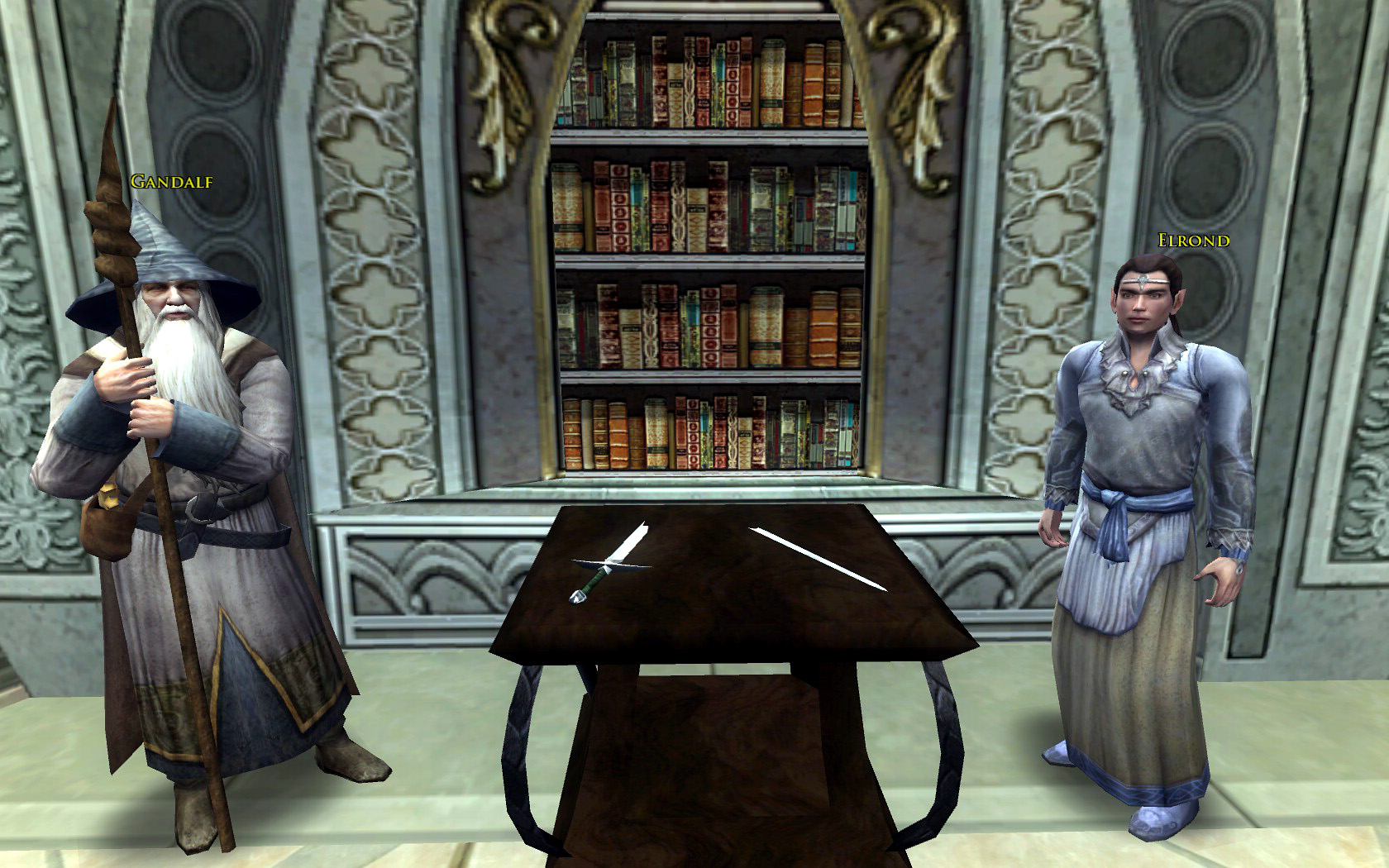
What separates LOTRO from the crowd, the thing that Turbine has sharpened and honed to cut players (at least temporarily) away from other games, is the Middle Earth license. The extraordinary care that the designers have taken to place players into Middle Earth is apparent in every aspect of the game. As in other titles set during the Rings trilogy, Turbine has wisely kept you fairly well removed from the main plot of the books. By following quests scattered throughout the world, your character dances around and through the journey of the One Ring. Though you can speak with every member of the Fellowship at some point in your travels, you are not asked to shoulder Frodo's burden. Instead, your character is woven deeply efforts of the free peoples to aid the ring-bearer and repel the forces of Mordor. The usual kill-it and fed-ex quests dot the land, and wouldn't look out of place in any other game. The sharp difference is that Turbine has leveraged Tolkien's amazing world-building efforts to make you actually care about what you're doing. Ranging from the practical (slaying goblins to keep the townspeople safe) to the ridiculous (running pies across the shire to spoil the Sackville-Baggins' party), quest text is remarkably well written. If you read and enjoyed the books, you're going to quickly find yourself pausing to read the tales these quests tell.
This pause, the interest in the lives of the NPCs, results in a different pace than you might be used to in other Massive games. It's, of course, an intrinsic part of the gameplay that you can set your own pace in a Massively Multiplayer game. That said many games compel you to rush everywhere, getting as much done as quickly as possible, playing for long stretches at a time to grind to the higher levels. LOTRO just doesn't have that vibe. Certainly, you can churn through the content as fast or slow as you'd like. There were max-level characters on the game servers within a week or two of the game's launch. For those with more appetite for story, or those grown tired of that pace in other online games, the breathtaking graphics and well-told tales encourage stopping to smell the roses. There's also just no compelling reason to grind your way to max-level in this game. Right now a big chunk of highest-level content is still in development, and for a Massively Multiplayer game LOTRO is quite reasonably priced. Anecdotal evidence from my own experiences and the experiences of other players indicates that Lord of the Rings Online is the kind of game that is most fun to play in fits and spurts. A few hours one day, a few hours the next ... it's so much fun running around the Shire, it's easy to see why a player would be in no rush to leave the lower levels.
Another element that encourages lingering rather that rushing, and can help assuage the hardcore players that might otherwise grumble, are the deeds. Deeds are a unique element to Lord of the Rings Online, a kind of achievement system somewhat reminiscent of those earned on the Xbox 360. They're discovered by doing the act the deed requires for the first time; for example, many require a certain number of monsters to be slain. The first time you kill a wolf in the Shire, your UI notes that you've begun work on the 'Wolf Slayer' deed. This can just be a blind grind-fest, if you're so inclined, but players have found that most deeds can be accomplished simply by going about their normal business of questing and traveling. Killing wolves as you encounter them in your travels eventually results in the completion of that deed, without needing to ruin your play experience with senseless repetition. Instead of Xbox Live gamerpoints, deeds earn your character two things: titles and virtues. Titles are simply that, strings that can be added on to your name. Completing the Wolf Slayer deed, for example, nets you the 'Fur Cutter' title. It's a simple customization, but the large number of deeds in the game allows for players to represent themselves in a myriad of different ways.
Virtues are much more important. Each completed deed gives you access to a virtue, an insubstantial descriptor that modifies your character's game statistics. As an example, completion of the Wolf Slayer deed earns the 'Discipline' virtue. Discipline increases melee damage and your character's resistance to injury. Each virtue modifies different character abilities and statistics, and are useful in different situations. A character's functionality can be changed dramatically just by swapping out what virtues they have slotted. It encourages differentiation between members of the same class, and a few wisely-chosen virtues can make the difference between victory and defeat.
Deeds aren't the only unique element LOTRO offers. The game's character classes are a nice tweak on the normal 'tank/mage/cleric' trinity that have been the standard in fantasy MMOs since EverQuest. While the basic party roles are all there, their Middle Earth wrapping pleasantly muddies the waters. The main Damage Per Second (DPS) class in the game, for example, is the Burglar, a rogue-type character. The character you'd expect to be most like the blaster/mage is the Loremaster, but he fulfills more of a crowd control role. He also has some healing skills, as do several other classes. The Minstrel is the primary healing class, but with multiple classes having the ability to heal it's not critical to ensure a Minstrel is in every party. This 'spreading the load' approach also allows Minstrels themselves to be a more front-line combatant than any priest or healer is in other games Their songs do damage to enemies, as well as providing short-term buffs for team-mates. Though for the most part these are all familiar roles in new packages, they 'feel' differently enough to provide a sense of novelty for veterans and new players alike.
Crafting within the game is well done, but simply doesn't feel as though it was made huge priority. You're forced to choose from one of three crafting classes, separate from your combat class. Each class has three vocations it covers, allowing for slightly more variety than in other games. While most of these crafts are par for the course, there are a few vocations that tweak things a bit. Farming, for example, is an actual crafting element in the game. You plant seeds, harvest crops, and sell them to other players; in Beta it was the best way to make money, and resulted in more than a few obvious jokes. There is also a Scholar vocation that has players collecting pieces of ancient wisdom together to make scrolls and potions. For the most part, though, crafting in Lord of the Rings Online is 'merely' competently executed. New players aren't introduced to the fundamentals of crafting explicitly enough before they're forced to make a choice, and after a choice is made quest support for crafting-friendly players can be a bit slack at low levels.
Merely 'okay' crafting, aside, the game world really does have an overall very high level of quality. Just the same, Lord of the Rings Online is not perfect. At launch, there are a number of complaints that users have grappled with. The single most disappointing game element has to be the game's UI. Though it is functional, that's about the only thing that can be said in its favour. LOTRO's UI features dull, uninformative icons and a general lack of polish. It may seem like a minor quibble but set against the general high level of quality throughout the rest of the game, and compared (as always) to WoW, it's quite a glaring oversight.
Early in the launch window as we are, there have been numerous complaints by players about the balance of the game's economy. While items seem well powered for their levels, and obtaining gear is a fairly well-tuned process, the costs associated with purchasing new abilities is astronomical. It's not out of the ordinary for a single new ability (obtainable from a trainer at a newly-achieved level) to cost half or more of the coin you have on-hand. Mileage will vary from player to player, of course, as some people place a higher emphasis on crafting and selling than others. The general consensus, just the same, seems to be that ability costs could use a revisit.
Given the respect for the setting it's another minor quibble, but the lack of any sort of tie-in to the Peter Jackson helmed movies is, in my mind, a lapse. Obviously, the license for that content is separate from the license that Turbine is working off of, and as such there's no reason to expect Elijah Woods or Hugo Weaving to make an appearance in the gameworld. Just the same, it's hard to listen to the kinda-generic fantasy music that greets you at login and not yearn for Howard Shore's stirring theme. Perhaps this might be a possibility in the future; that's one of the many beautiful things about the Massive genre - things are always changing.
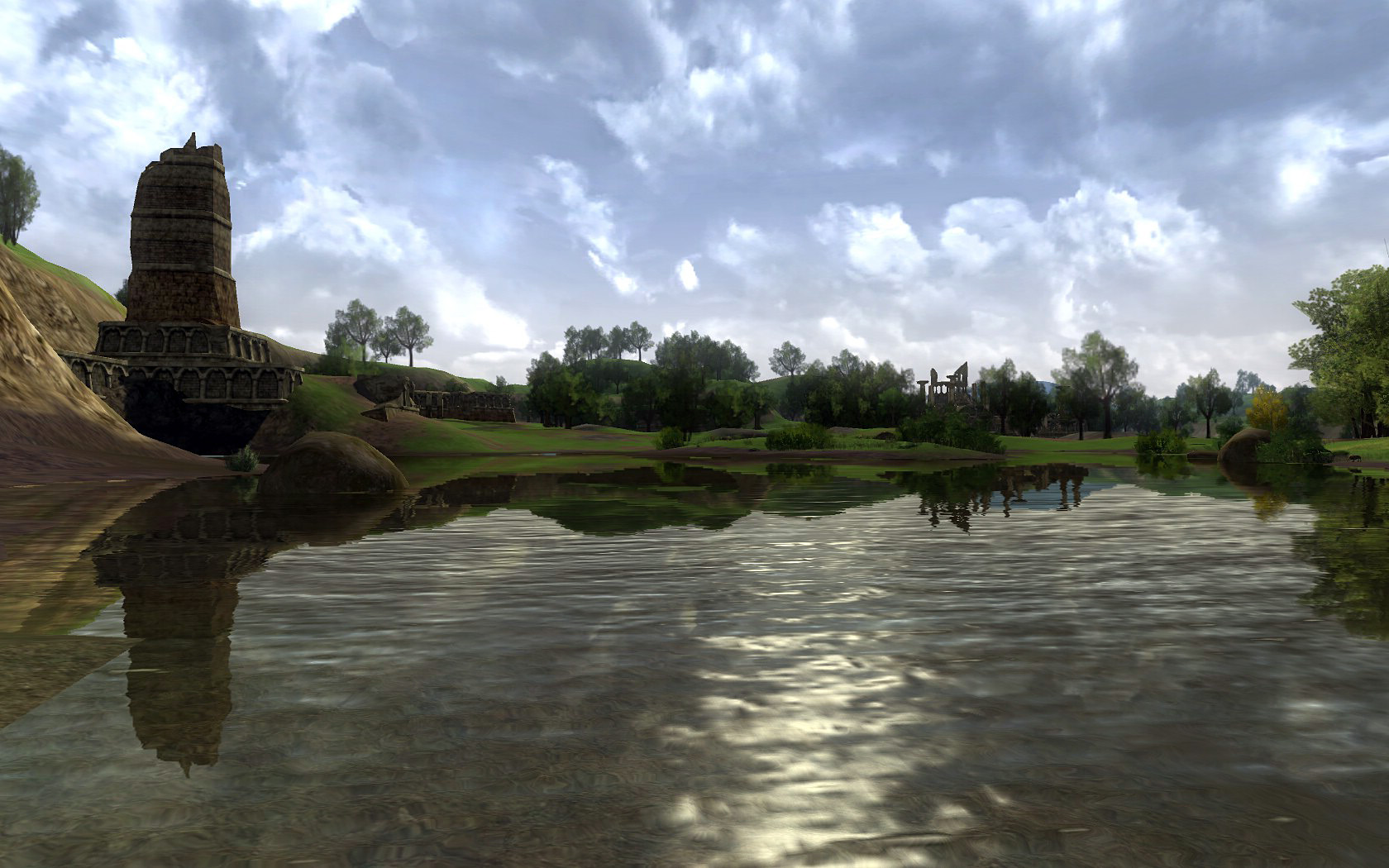
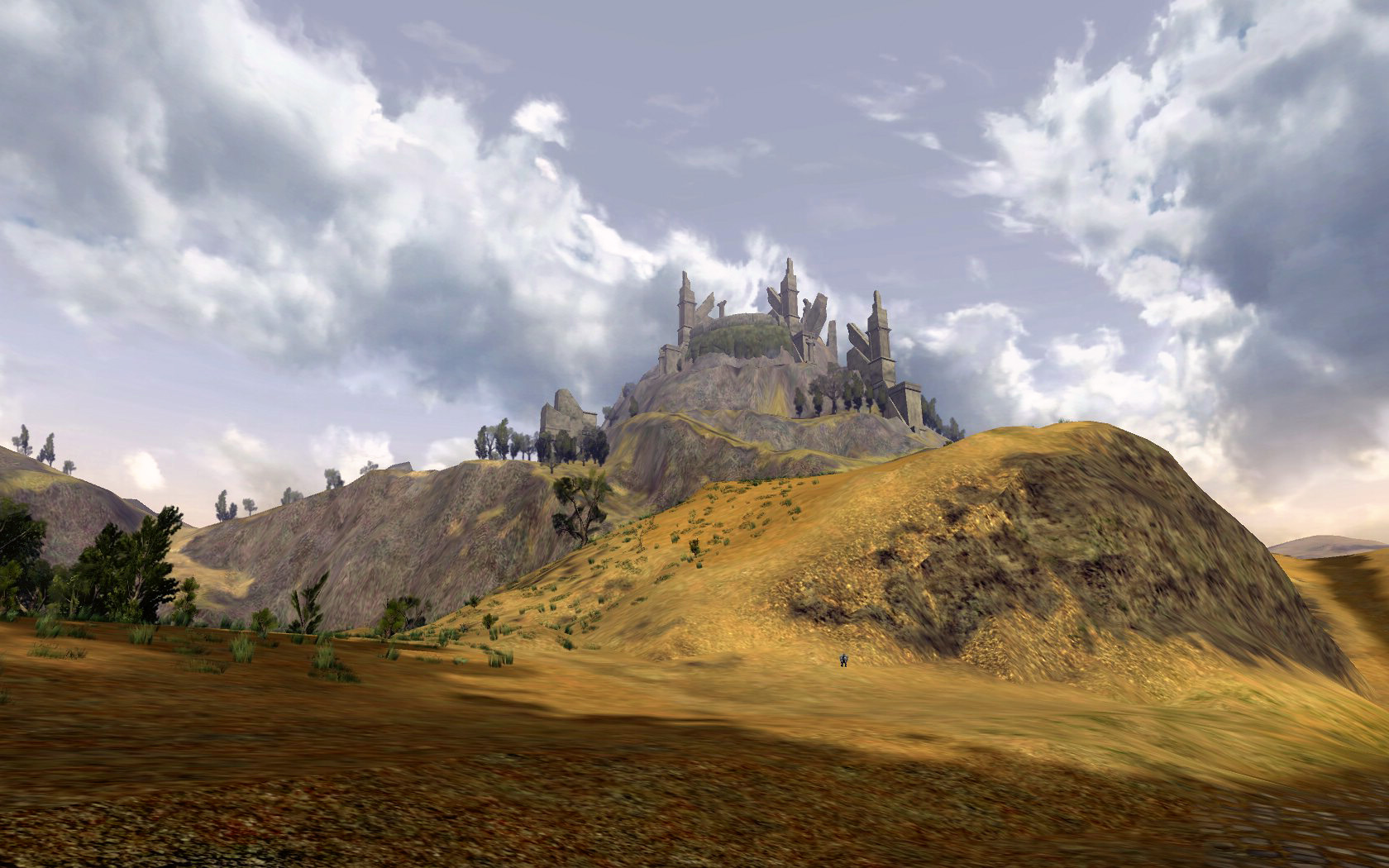
One thing that doesn't need changing, though, are Lord of the Rings Online's simply stunning graphics. Years from now the choice to go photo-realistic will make the game look horribly dated, all while World of Warcraft's stylized vision remains fresh and crisp. In the meantime, LOTRO offers a simply jaw-droppingly beautiful online experience. EverQuest 2's attempt at realistic graphics in an online game have resulted in goofily appealing characters, but they don't quite capture what I think the game was going for. Middle Earth, on the other hand, is insanely beautiful. The first time you reach a high point in the Shire it is completely worth it to stop, turn your settings all the way up, and just stare across the fields. While the story wraps you into the gameworld intellectually, LOTRO's graphical presentation brings that world to life on a visceral level; New Zealand has nothing on that place.
For the Massive gamer tired of endlessly played options, or the Tolkien fan disappointed with the lore content in Battle For Middle Earth II, Lord of the Rings Online is the perfect balm. While it doesn't try to move the genre forward in any readily appreciable ways, LOTRO is such a well-crafted experience that it's hard not to enjoy yourself. For some, their time in Middle Earth will be just a vacation from other online worlds. For others, though, this may just be the game you've been waiting for. A slower pace, a beautiful presentation, and a gripping story are all readied and waiting just a bit down the road. -
Can Blizzard Top StarCraft?
MSNBC is running an interview with Blizzard designer Rob Pardo discussing a number of facets of the upcoming StarCraft II. Informational tidbits include the fact that, unsurprisingly, the game won't be released this year, and some background on the game's long development cycle. "Penny Arcade figured it out! We keep games under code names and we teach developers to refer to games by their code name. And we're just really careful about talking about the game internally. We don't bring external folks through unannounced product areas. But I think even I'm surprised that we were able to keep it under wraps all the way to the end."
-
Nintendo Confirms Mario, Smash Bros. Coming This Year
Some excellent news for Nintendo fans: two of the 'big three' games are coming out this year. At an event held in Washington state Reggie Fils-Aime was able to confirm that Smash Bros. and Super Mario Galaxy will be released before the end of the year. Excellent to hear such news, of course ... but other people had different priorities. For Metroid fans, it does indeed look like Samus will have to wait until 2008. Other than that, the company was all good news in general: "Typically, about half of home consoles in Japan are placed in the living room -- with Wii that figure is 75%. In France, 15 of the top 15 games recently were Nintendo. In the US, Fils-Aime says they are seeing 'early signs of significant market change.' The number of female purchasers of hardware are up 42%. The number of people over age of 30 purchasing Nintendo DS is up 127%. Tighten that age range to people over 35, and the number is up 212%. 40% of Wii owners have connected to the internet. 3.3 million plus Virtual Console downloads." Game|Life has hands-on impressions of Brain Age 2 and Mario Strikers Charged , two of the new games shown off at the event.
-
Cleaning up Thunder Bluff
An anonymous reader writes "Colleen Hannon at Gamers With Jobs is mad as hell, and she's not going to take it anymore. 'Unless you're playing Neopets, online servers are full of foul-mouthed, racist junk-monkeys. The hate-filled miasma they spatter around them has reached the point where many people who could be on those services won't go, and those who do brave it won't go without a posse and riot gear.' She plays out every side of the argument: why things have gotten as bad as they've become, what publishers have and haven't done about it, and why she thinks things are now at unacceptable levels of incivility. She's calling on us gamers to get together and figure this out, because: 'If we wait for the new sheriff in town to fight this battle for us we might not like the town we're left with.' Is it as bad as she says?"
-
Vista's 40 Million License Sales In Context
Overly Critical Guy writes "Microsoft's figure of 40 million Vista OEM licenses sold has less impact when weighed against the expanded size of the PC market, according to IDC numbers. The myriad of factors involved in determining success in the market makes Microsoft's constant comparisons to Windows XP less reliable as a growth indicator — particularly with Microsoft refusing to reveal the number of actual activated Vista licenses. 'HP reported year-over-year PC sales growth of about 24 percent, or about twice worldwide PC sales growth. Whatever HP is doing right, it's more than just Vista ... If Microsoft wasn't so hung up on XP comparisons as the benchmark, it could really demonstrate that Vista sales are increasing. The first 20 million figure really represented four months of sales, and that could have been positive data because Microsoft protected its customers' holiday investments. For free! Instead of making that point, Microsoft got carried away with making comparisons back to XP.'"
-
MIT Media Lab Making Programming Fun For Kids
An anonymous reader passed us a link to an article on the Boston Globe's website, talking up efforts by MIT to make programming a non-threatening part of grade-school education. MIT has developed a new programming language designed to encourage experimentation and play. Called Scratch, the project eschews manuals and high-level concepts in favour of approachability. "Efforts to make computer programming accessible to young people began in the late 1970s with the advent of the personal PC, when another programming language with roots at MIT — Logo — allowed young people to draw shapes by steering a turtle around a screen by typing out commands. But the path to mastering most programming languages has been strewn with obstacles, since students needed to figure out not only the underlying logic but also master a brand new syntax, observe strict rules about semicolons and bracket use, and figure out what was causing error messages even as they learned the program."
-
Microsoft Details FOSS Patent Breaches
CptRevelation writes "Microsoft has released more detailed information on the patents supposedly in breach by the open-source community. Despite their accusations of infringement, they state they would rather do licensing deals instead of any legal action. 'Open-source programs step on 235 Microsoft patents, the company said. Free Linux software violates 42 patents. Graphical user interfaces, the way menus and windows look on the screen, breach 65. E-mail programs step on 15, and other programs touch 68 other patents, the company said. The patent figures were first reported by Fortune magazine. Microsoft also said Open Office, an open-source program supported in part by Sun Microsystems Inc., infringes on 45 patents. Sun declined to comment on the allegation.'"
-
Microsoft Says Free Software Violates 235 Patents
prostoalex writes "Microsoft told Fortune magazine that various free software products violate at least 235 patents, and it's time to expect users of this software to pay up patent licensing royalties: 'Microsoft General Counsel Brad Smith and licensing chief Horacio Gutierrez sat down with Fortune recently to map out their strategy for getting FOSS users to pay royalties. Revealing the precise figure for the first time, they state that FOSS infringes on no fewer than 235 Microsoft patents.'"
-
TiVo Awarded Patent For Password You Can't Hack
Davis Freeberg writes "TiVo has always been known for thinking outside of the box, but this week they were awarded an unusual patent related to locking down content on their hard drives. According to the patent, they've invented a way to create password security that is so tough, it would take you longer than the life of a hard drive in order to figure it out. They could be using this technology to prevent the sharing of content or it could be related to their advertising or guide data, but if their encryption technology is really that good, it's an interesting solution for solving the problem of securing networks."
-
HBO Exec Proposes DRM Name Change
surfingmarmot writes "An HBO executive has figured out the problem with DRM acceptance — it's the name. HBO's chief technology officer Bob Zitter now wants to refer to the technology as Digital Consumer Enablement. Because, you see, DRM actually helps consumers by getting more content into their hands. The company already has HD movies on demand ready to go, but is delaying them because of ownership concerns. Says Zitter, 'Digital Consumer Enablement would more accurately describe technology that allows consumers "to use content in ways they haven't before," such as enjoying TV shows and movies on portable video players like iPods. "I don't want to use the term DRM any longer," said Zitter, who added that content-protection technology could enable various new applications for cable operators.'"
-
Conservative Sarkozy Wins Presidency of France
Reader reporter tips us to a story just up at the NYTimes reporting that the tough-talking conservative candidate Nicolas Sarkozy has won election as the president of France. His opponent, Socialist Party candidate Ségolène Royal, the first woman to get as far as the runoff in a presidential contest in France, has conceded defeat. The vote went 53% to Sarkozy and the turnout was a remarkable (by American standards) 85% of registered voters. Sarkozy is seen as a divisive figure for his demand that immigrants learn Western values (and the French language).
-
New AACS Crack Called "Undefeatable"
Tuoqui writes "With all the focus on the infamous hexadecimal number, people may be ignoring a bigger weakness in the AACS armor, which emerged two weeks ago. Some hackers have figured out how to crack AACS in a way that cannot be defeated, even by revoking all the keys in circulation."