Slashdot Mirror
Search
Search the archive with full-text matching across story titles, bodies,
and comments. Phrases are quoted; or, -word,
and parentheses behave as in a web search. Queries must be at least
3 characters.
Stories · 13,059
-
Comcast To Offer Pay-As-You-Go TV, Broadband Service (dslreports.com)
An anonymous reader quotes a report from DSLReports: Comcast plans to roll-out prepaid cable TV and internet services later this year in portions of Illinois and four other states. According to a company announcement, Comcast's Xfinity Prepaid Services lets users sign up for TV or internet services and renew service for seven or 30 days at a time -- instead of paying by the month. A one-time setup fee of $80 includes equipment and 30 days of service, with users paying $15 for an additional seven days and $45 for an additional 30 days. "We want to create an easy, pay-as-you-go option for people who want more flexibility and predictability when buying our services," said Marcien Jenckes, Executive Vice President, Consumer Services, Comcast Cable. "And our partnership with Boost Mobile will give Xfinity Prepaid customers even more places where they can conveniently sign-up and pay-as-they-go."
-
Google Fiber Reminds People It's a 'Real Business' (dslreports.com)
An anonymous reader writes: While Google Fiber gets a massive amount of media hype (justly based on its disruptive speed and price point), the reality is that despite numerous city "launches" -- not that many people can actually get the service. But while many ISPs and analysts have dismissed Google Fiber as an adorable experiment that will never impact them, many of these folks have been forced to changing their tune as Google Fiber's list of planned launch cities grows larger. In a profile piece over at USAToday, the company once again notes that while Google Fiber may have begun as a PR exercise, it's now dead serious about being a large, nationwide disruptive kick in the ass for incumbent broadband providers. "It is indeed a real business, and it's serving to increase competition as well, and that's something that we don't mind," Google Fiber boss and former Qualcomm exec Dennis Kish tells the paper. "We think it's healthy for the market and for consumers."
-
Man Builds $1.5 Million Star Trek-Themed Home Theater (cepro.com)
CIStud writes: This $1.5 million "Star Trek" home theater is the envy of every geek on the planet. The theater is a reconstruction of the bridge of the Starship Enterprise from "Star Trek: Next Generation" and also includes $1 million worth of memorabilia from the classic sci-fi TV show. The home theater was created by financier Marc Bell with the help from Jay Miller of Boca Raton-based Acoustic Innovations. The two started working on the home cinema in 2002 -- before construction of Bell's house even began -- and it took them four years to complete. CEPro reports: "A D-Box controller manipulates hydraulics installed beneath the floorboards, meaning the entire room shakes when anything loud happens on screen. The room also includes a JBL Synthesis sound system, which at the time of installation was only used in commercial theaters. The audio system is currently being upgraded to Dolby Atmos specifications and Bell plans to install a 4K projector. A big movie fan, Bell has had over 3,500 films digitized, which are stored and streamed through a Kaleidescape server. He also spent approximately $35,000 on a Prima Cinema system, allowing him and his family to watch films at home the day they are released in commercial cinemas. A wraparound control center surrounds the 11 custom leather chairs in the theater, eight of which recline into beds, while the doors that open into the theater are exact replicas of the Turbolift doors as seen on the TV show. When someone steps on the circular "transporter," the doors open with that familiar "whoosh" sound." Bell apparently likes to spend his money on others too. He has rented a local movie theater for every Star Trek film released in the past 25 years and has taken all of his employees, friends and their children along on opening night. The Wall Street Journal posted a video on YouTube of the home theater.
-
Tesla's Autopilot Mode Reportedly Saves Pedestrian's Life (electrek.co)
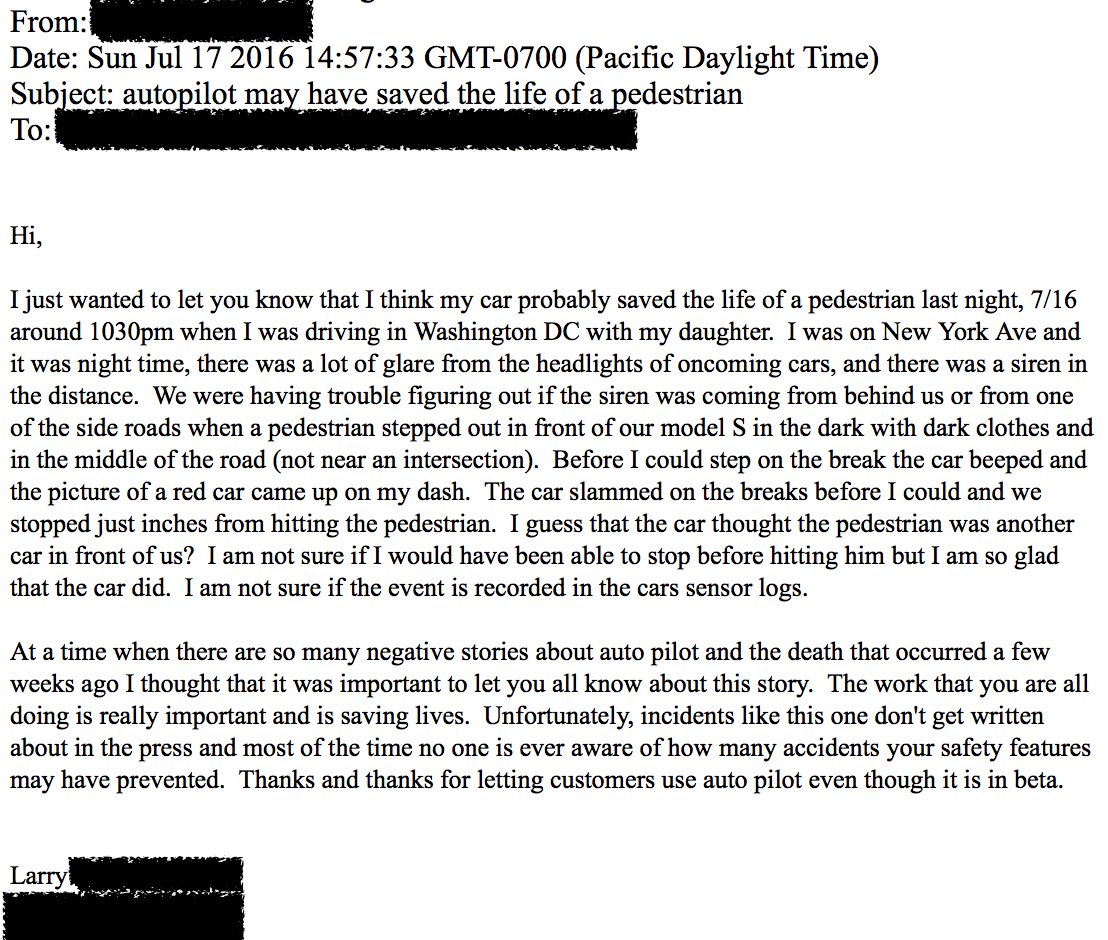
An anonymous reader writes: Following reports of Tesla's Autopilot mode being linked to a fatal crash, one Tesla Model S owner is reporting that the Autopilot mode has likely saved a pedestrian's life. The driver sent an email to Elon Musk explaining the situation, which was confirmed by Tesla through the vehicle logs: "I wanted to let you know that I think my car probably saved the life of a pedestrian last night, 7/16 around 10:30pm when I was driving in Washington DC with my daughter." The driver says him and his daughter were trying to locate where sirens were coming from "when a pedestrian stepped out in front of [their] Model S in the dark with dark clothes and in the middle of the road." The car slammed on its breaks before he could and "stopped just inches from hitting the pedestrian." The driver said, "I am not sure if I would have been able to stop before hitting him but I am so glad the car did." The Automatic Emergency Braking (AEB), which is standard on all Tesla vehicles and is part of Tesla's Autopilot mode, is what was at work here. It appears that many of the convenience features of Autopilot were not activated at the time of the incident. This is likely the first of many good press stories released by Elon Musk, who said he would consider releasing the stories of accidents prevented by the Autopilot mode with the authorization of the Tesla owners and by confirming the events through the vehicle logs. Elon Musk did also announce Tesla's 'Master Plan, Part Deux,' which includes new kinds of Tesla vehicles, expanded solar initiatives, updates on Tesla's 'autopilot' technology, and a ride-sharing program.
-
Verizon To Disconnect Unlimited Data Customers Who Use Over 100GB/Month
Verizon Wireless customers who have an unlimited data plan and use significantly more than 100GB a month will soon be disconnected from the network unless they agree to move to limited data packages that require payment of overage fees. Ars Technica reports: Verizon stopped offering unlimited data to new smartphone customers a few years ago, but some customers have been able to hang on to the old plans instead of switching to ones with monthly data limits. Verizon has tried to convert the holdouts by raising the price $20 a month and occasionally throttling heavy users but stopped that practice after net neutrality rules took effect. Now Verizon is implementing a formal policy for disconnecting the heaviest users.In a statement, Verizon said: "Because our network is a shared resource and we need to ensure all customers have a great mobile experience with Verizon, we are notifying a very small group of customers on unlimited plans who use an extraordinary amount of data that they must move to one of the new Verizon Plans by August 31, 2016." a Verizon spokesperson told Ars. "These users are using data amounts well in excess of our largest plan size (100GB). While the Verizon Plan at 100GB is designed to be shared across multiple users, each line receiving notification to move to the new Verizon Plan is using well in excess of that on a single device." FYI: The 100GB plan costs $450 a month.
-
EFF Is Suing the US Government To Invalidate the DMCA's DRM Provisions (boingboing.net)
Cory Doctorow, writes for BoingBoing: The Electronic Frontier Foundation has just filed a lawsuit that challenges the Constitutionality of Section 1201 of the DMCA, the "Digital Rights Management" provision of the law, a notoriously overbroad law that bans activities that bypass or weaken copyright access-control systems, including reconfiguring software-enabled devices (making sure your IoT light-socket will accept third-party lightbulbs; tapping into diagnostic info in your car or tractor to allow an independent party to repair it) and reporting security vulnerabilities in these devices. EFF is representing two clients in its lawsuit: Andrew "bunnie" Huang, a legendary hardware hacker whose NeTV product lets users put overlays on DRM-restricted digital video signals; and Matthew Green, a heavyweight security researcher at Johns Hopkins who has an NSF grant to investigate medical record systems and whose research plans encompass the security of industrial firewalls and finance-industry "black boxes" used to manage the cryptographic security of billions of financial transactions every day. Both clients reflect the deep constitutional flaws in the DMCA, and both have standing to sue the US government to challenge DMCA 1201 because of its serious criminal provisions (5 years in prison and a $500K fine for a first offense).Doctorow has explained aspects of this for The Guardian today. You should also check Huang's blog post on this.
-
Edward Snowden's New Research Aims To Keep Smartphones From Betraying Their Owners (theintercept.com)
Smartphones become indispensable tools for journalists, human right workers, and activists in war-torn regions. But at the same time, as Intercept points out, they become especially potent tracking devices that can put users in mortal danger by leaking their location. To address the problem, NSA whistleblower Edward Snowden and hardware hacker Andrew "Bunnie" Huang have been developing a way for potentially imperiled smartphone users to monitor whether their devices are making any potentially compromising radio transmissions. "We have to ensure that journalists can investigate and find the truth, even in areas where governments prefer they don't," Snowden told Intercept. "It's basically to make the phone work for you, how you want it, when you want it, but only when." Snowden and Huang presented their findings in a talk at MIT Media Lab's Forbidden Research event Thursday, and published a detailed paper. From the Intercept article: Snowden and Huang have been researching if it's possible to use a smartphone in such an offline manner without leaking its location, starting with the assumption that "a phone can and will be compromised." [...] The research is necessary in part because most common way to try and silence a phone's radio -- turning on airplane mode -- can't be relied on to squelch your phone's radio traffic. Fortunately, a smartphone can be made to lie about the state of its radios. The article adds: According to their post, the goal is to "provide field-ready tools that enable a reporter to observe and investigate the status of the phone's radios directly and independently of the phone's native hardware." In other words, they want to build an entirely separate tiny computer that users can attach to a smartphone to alert them if it's being dishonest about its radio emissions. Snowden and Haung are calling this device an "introspection engine" because it will inspect the inner-workings of the phone. The device will be contained inside a battery case, looking similar to a smartphone with an extra bulky battery, except with its own screen to update the user on the status of the radios. Plans are for the device to also be able to sound an audible alarm and possibly to also come equipped with a "kill switch" that can shut off power to the phone if any radio signals are detected.Wired has a detailed report on this, too.
-
Tesla's 'Master Plan, Part Deux' Includes Trucks, Buses and Ride-Sharing (latimes.com)
An anonymous reader writes from a report via Los Angeles Times: After teasing Part 2 of his "master product plan" for over a week, Elon Musk finally delivered. Los Angeles Times reports: "In a blog post published on the automaker's website, Musk introduced a multiyear, four-pronged strategy that includes new kinds of Tesla vehicles, expanded solar initiatives, updates on Tesla's 'autopilot' technology and a ride-sharing program. Commercial trucks, buses, a 'future compact SUV' and a 'new kind of pickup truck' will be added to Tesla's fleet of electric cars. A heavy-duty truck called the Tesla Semi and a shrunken bus that Musk called a 'high passenger density urban transport' vehicle are in early development stages 'and should be ready for unveiling next year,' he said. The smaller bus would be designed without a center aisle, with seats close to the entrances, and would be able to automatically pace themselves with traffic, the post said. The bus driver would become a 'fleet manager.' Musk also used the master plan to defend his bid for rooftop solar power provider SolarCity and said he aims to make Tesla's Autopilot robotic driver-assist system 10 times safer than cars that humans drive manually. Musk also plans to move Tesla into the popular ride-sharing business, not only with an Uber-like fleet but also with an app that lets Tesla owners rent out their vehicles when they're not using them, perhaps defraying a portion of their auto loans. This will happen, he said, 'when true self-driving is approved by regulators,' a turn of events that's at least several years away."
-
Verizon Begins Charging a Fee Just to Use an Older Router (dslreports.com)
Karl Bode, reporting for DSLReports: Several users have written in to note that Verizon has informed them the company will begin charging FiOS customers with an older router a new "Router Maintenance Charge." An e-mail being sent to many Verizon FiOS customers says that the fee of $2.80 will soon be charged every month -- unless users pay Verizon to get a more recent iteration of its FiOS gateway and router. Since Verizon FiOS often uses a MOCA coax connection and the gateway is needed for Verizon TV, many FiOS users don't have the ability to swap out gear as easily as with other ISPs. "Our records indicate that you have an older model router that is being discontinued," states the e-mail. "If you do plan to keep using your current router, we will begin billing, on 9.29.16, a monthly Router Maintenance Charge of $2.80 (plus taxes), to ensure we deliver the best support."
-
Engineer Gets Tired Of Waiting For Telecom Companies To Wire His town -- So He Does It Himself (backchannel.com)
Gurb, 75 kilometers north of Barcelona, is a quiet farming community of 2,500. It has suddenly become a popular place, thanks to being the birthplace of Guifi.net, one of the world's "most important experiments in telecommunications." It was built by an engineer who got tired of waiting for Telefonica, the Spanish telecom giant, to provide internet access to the people of his community. At first he wanted an internet access for himself, but it soon became clear that he also wanted to help his neighbors. Guifi has grown from a single wifi node in 2004, to 30,000 working nodes today, including some fiber connections, with thousands more in the planning stages. An article on Backchannel today documents the tale of Guifi. From the article: The project is a testament to tireless efforts -- in governance, not just in adding hardware and software -- by Ramon Roca (the engineer who started it) and his colleagues. They've been unwavering in their commitment to open access, community control, network neutrality, and sustainability. In 2004, he bought some Linksys WiFI hackable routers with a mission to get himself and his neighbors connected to the Internet. This is how he did it: Roca turned on a router with a directional antenna he'd installed at the top of a tall building near the local government headquarters, the only place in town with Internet access -- a DSL line Telefonica had run to municipal governments throughout the region. The antenna was aimed, line of sight, toward Roca's home about six kilometers away. Soon, neighbors started asking for connections, and neighbors of neighbors, and so on. Beyond the cost of the router, access was free. Some nodes were turned into "supernodes" -- banks of routers in certain locations, or dedicated gear that accomplishes the same thing -- that could handle much more traffic in more robust ways. The network connected to high-capacity fiber optic lines, to handle the growing demand, and later connected to a major "peering" connection to the global Internet backbone that provides massive bandwidth. Guifi grew, and grew, and grew. But soon it became clear that connecting more and more nodes wasn't enough, so he created a not-for-profit entity, the Guifi.net Foundation. The foundation, thanks to its cause and a cheerful community, has received over a million Euros to date -- from various sources including several levels of government. But as the article notes, a million Euros is a drop in the bucket next to the lavish subsidies and favors that state-approved monopolies such as Telefonica have enjoyed for decades. The article adds: The Guifi Foundation isn't the paid provider of most Internet service to end-user (home and business) customers. That role falls to more than 20 for-profit internet service providers that operate on the overall platform. The ISPs share infrastructure costs according to how much demand they put on the overall system. They pay fees to the foundation for its services -- a key source of funding for the overall project. Then they offer various kinds of services to end users, such as installing connections -- lately they've been install fiber-optic access in some communities -- managing traffic flows, offering email, handling customer and technical support, and so on. The prices these ISPs charge are, to this American (Editor's note: the author is referring to himself) who's accustomed to broadband-cartel greed, staggeringly inexpensive: 18 to 35 Euros (currently about $26-$37) a month for gigabit fiber, and much less for slower WiFi. Community ownership and ISP competition does wonders for affordability. Contrast this with the U.S. broadband system, where competitive dial-up phone access -- phone companies were obliged to let all ISPs use the lines as the early commercial Internet flourished in the 1990s -- gave way to a cartel of DSL and cable providers. Except in a few places where there's actual competition, we pay way more for much less.Read the story in its entirety here.
-
Firefox To Block Non-Essential Flash Content In August 2016, Require Click-To-Activate In 2017 (mozilla.org)
Mozilla has announced that it plans to discontinue support for Flash in Firefox. Starting next month, Firefox will block Flash content "that is not essential to the user experience." Also, starting sometime in 2017, the browser will require click-to-activate approval from users before a website activates the Flash plugin for any content. In a blogpost, the company writes:Mozilla and the Web as a whole have been taking steps to reduce the need for Flash content in everyday browsing. Over the past few years, Firefox has implemented Web APIs to replace functionality that was formerly provided only by plugins. This includes audio/video playback and streaming capabilities, clipboard integration, fast 2D and 3D graphics, WebSocket networking, and microphone/camera access. As websites have switched from Flash to other web technologies, the plugin crash rate in Firefox has dropped significantly. [...] We continue to work closely with Adobe to deliver the best possible Flash experience for our users.
-
Neuroscientists Have Isolated The Part Of The Brain That Controls Free Will (extremetech.com)
An anonymous reader quotes a report from ExtremeTech: Free will might have been the province of philosophers until now, but we've cracked the problem with an fMRI. Neuroscientists from Johns Hopkins report in the journal Attention, Perception, & Psychophysics that they were able to see both what happens in a human brain the moment a free choice is made, and what happens during the lead-up to that decision -- how activity in the brain changes during the deliberation over whether to act. The team devised a novel way to track a participant's focus without using cues or commands, avoiding a Schrodinger's-like dilemma of altering the process of choice by calling attention to it. Participants took positions in MRI scanners, and then were left alone to watch a split screen as rapid streams of colorful numbers and letters scrolled past on both sides. They were asked just to pay attention to one side for a while, then to the other side. When to switch sides, and for how long to look, was entirely up to them. Over the duration of the experiment, the participants glanced back and forth, switching sides dozens of times. In terms of connectivity in the brain, the actual process of switching attention from one side to the other was tightly linked with activity in the parietal lobe, which is sort of the top back quadrant of the brain. Activity during the period of deliberation before a choice took place in the frontal cortex, which engages in reasoning and plans movement. Deliberation also lit up the basal ganglia, important parts of the deep brain that handle motor control, including the initiation of motion. Participants' frontal-lobe activity began earlier than it would have if participants had been cued to shift attention, which demonstrates that the brain was planning a voluntary action rather than merely following an order. A report from Fast Company details how technology is making doctors feel like glorified data-entry clerks.
-
Safari Browser May Soon Be Just As Fast As Chrome With WebP Integration (thenextweb.com)
An anonymous reader writes from a report via The Next Web: The Safari browser included in Apple's iOS 10 and macOS Sierra software is testing WebP, technology from Google that allows developers to create smaller, richer images that make the web faster. Basically, it's a way for webpages to load more quickly. The Next Web reports: "WebP was built into Chrome back at build 32 (2013!), so it's not unproven. It's also used by Facebook due to its image compression underpinnings, and is in use across many Google properties, including YouTube." Microsoft is one of the only major players to not use WebP, according to CNET. It's not included in Internet Explorer and the company has "no plans" to integrate it into Edge. Even though iOS 10 and macOS Sierra are in beta, it's promising that we will see WebP make its debut in Safari latest this year. "It's hard to imagine Apple turning away tried and true technology that's found in a more popular browser -- one that's favored by many over Safari due to its speed, where WebP plays a huge part," reports The Next Web. "Safari is currently the second most popular browser to Chrome." What's also interesting is how WebP isn't mentioned at all in the logs for Apple's Safari Technology Preview.
-
Marissa Mayer Says Yahoo Continues To Make Solid Progress, Earnings Report Says Otherwise (fool.com)
tomhath quotes a report from Fool: Yahoo! CEO Marissa Mayer tried to emphasize the progress that the company has made. "We continue to make solid progress against our 2016 plan," Mayer said, and "in addition to our efforts to improve the operating business, our board has made great progress on strategic alternatives." The CEO argued that the results met or exceeded the company's own guidance. Yahoo! was able to post a revenue increase by changing the ways that it presents revenue related to its search agreement with Microsoft, and without that change, adjusted revenue of $1.055 billion was down 15% from the year-ago quarter. That was even worse than the 13% drop investors were expecting, and adjusted EBITDA fell by more than a third. That resulted in adjusted net earnings of $0.09 per share, missing the consensus forecast by a penny but also glossing over a $440 million net loss on a GAAP basis. The company took a $395 million goodwill impairment charge and an $87 million intangibles impairment charge related to its Tumblr unit, determining that the fair value of the division is less than the amount indicated on Yahoo!'s balance sheet. It was also revealed that Yahoo is writing down the value of its Tumblr acquisition by $482 million, citing lower projections for the social network's future performance, according to a report from CNNMoney. Last quarter, the company took a $230 million write-down on its Tumblr acquisition. Since Yahoo acquired Tumblr for $1.1 billion in 2013, Yahoo has written down more than half of its value.
-
Netflix Stock Price Tanks As Customers Quit Over Higher Prices (theverge.com)
An anonymous reader writes: Netflix released its earnings report (PDF) for the second quarter today, where it reported $1.97 billion in revenue and net income of $41 million. The company did however report only 1.54 million subscribers, which is below its projections of 2.5 million new subscribers. As a result, stock is down around 14 percent in after-hours trading. "Our global member forecast for Q2 was 2.5m and we came in at 1.7m. Gross additions were on target, but churn ticked up slightly and unexpectedly, coincident with the press coverage in early April of our plan to ungrandfather longer tenured members and remained elevated through the quarter," Netflix wrote. "We think some members perceived the news as an impending new price increase rather than the completion of two years of grandfathering." The company defended its price hikes, writing that "while ungrandfathering and associated media coverage may moderate near term membership growth, we believe that ungrandfathering will provide us with more revenue to invest in our content to satisfy members, thus driving longterm growth." In the past, Netflix gained 13 million new subscribers in 2014, and 17 million in 2015. Comcast will reportedly allow Netflix onto its X1 platform, which may entice more customers to the streaming service.
-
Germany To Require 'Black Box' in Autonomous Cars (reuters.com)
Autonomous cars should be able to account for themselves, that's the thinking behind new legislation proposed by German's transport ministry. The country is planning new laws that require self-driving cars to include a black box, Reuters reports, similar to the flight recorder required on aircraft. From the report: The fatal crash of a Tesla Motors Inc Model S car in its Autopilot mode has increased the pressure on industry executives and regulators to ensure that automated driving technology can be deployed safely. Under the proposal from Transport Minister Alexander Dobrindt, drivers will not have to pay attention to traffic or concentrate on steering, but must remain seated at the wheel so they can intervene in the event of an emergency. Manufacturers will also be required to install a black box that records when the autopilot system was active, when the driver drove and when the system requested that the driver take over, according to the proposals. The draft is due to be sent to other ministries for approval this summer, a transport ministry spokesman said.
-
Microsoft's New Xbox One S Will Go On Sale On August 2 -- Will You Buy One? (betanews.com)
Microsoft announced on Monday that its new Xbox One S console will go on sale on August 2. To recall, the Xbox One S is 40 percent smaller than the original Xbox One (also the power supply packed in the console itself), and has the processing muscle to stream video in 4K Ultra HD with HDR. BetaNews reports: August 2 is the big date which also sees the release of Windows 10 Anniversary Update. The Xbox One S also features up to 2TB of storage. In all, three versions of the console are available. It's the 2TB model that's grabbing the headlines and the attention of keen gamers, and this model will launch in "limited numbers" priced at $399. The console will launch in Australia, Canada, UK and United States among several other regions. For anyone looking for a slightly cheaper option, the 1TB model will cost $349, while $299 will get you a 500GB version. If you want to add to the single Xbox Wireless Controller included as standard, this will set you back a further $59.99.Are you planning to purchase one of these?
-
Cities Struggling To Crack Down On Airbnb Renters (latimes.com)
An anonymous Slashdot reader writes: A California man has been charged with eight misdemeanors for renting several apartments under his own name, and then subletting them all. "Apartments in Santa Monica that might fetch $3500 a month as ordinary rentals, are worth three or four times that on a daily or weekly basis," reports one newsweekly, and the subletter notes that he only received two years of probation plus a $3,500 fine, "what one of my properties makes in a month." On Wednesday three prominent U.S. Senators "called for a regulatory probe into whether short-term rental websites such as Airbnb are taking housing away from long-term renters and pushing up prices," but the number of Americans planning to use Airbnb this summer has apparently already doubled since last year.
The Hotel and Lodging Association of Alaska is complaining that the state's renters "are not required to follow the same state and federal safety mandates that are required for other hotels and lodges creating an unsafe and unfair market for consumers as well as hoteliers." But it seems like currently the only pushback is coming from local and city officials, like the short-term rental rules that Airbnb is currently fighting in their home city of San Francisco. For example, in Maine, the owner of one of Portland's 425 rentals units is now fighting a city order "demanding that he stop renting out part of his home through Airbnb. "Portland has a limited staff to enforce zoning rules, so it comes down on the most egregious cases, said City Hall spokeswoman Jessica Grondin."
I laughed at the quote from the City Hall spokeswoman. "It's kind of like speeding on the highway. You know it is illegal, you do it anyway, and you get caught." -
U.S. Curtails Federal Election Observers (fortune.com)
An anonymous reader quotes a report from Fortune: Federal election observers can only be sent to five states in this year's U.S. presidential election, among the smallest deployments since the Voting Rights Act was passed in 1965 to end racial discrimination at the ballot box. The plan, confirmed in a U.S. Department of Justice fact sheet seen by Reuters, reflects changes brought about by the Supreme Court's 2013 decision to strike down parts of the Act...
Attorney General Loretta Lynch said on Friday the Justice Department's ability to deploy election observers had been "severely curtailed" by the Supreme Court's decision... Dale Ho, director of the American Civil Liberties Union's Voting Rights Project, said federal observers are especially needed this year because 17 states have tightened restrictions on voting since the last presidential election. -
How (And Why) FreeDOS Keeps DOS Alive (computerworld.com.au)
FreeDOS was originally created in response to Microsoft's announcement that after Windows 95, DOS would no longer be developed as a standalone operating system, according to a new interview about how (and why) Jim Hall keeps FreeDOS alive. For its newest version, Hall originally imagined "what 'DOS' would be like in 2015 or 2016 if Microsoft hadn't stopped working on MS-DOS in favor of Windows" -- before he decided there's just no such thing as "modern DOS". An anonymous Slashdot reader writes: No major changes are planned in the next version. "The next version of FreeDOS won't be multitasking, it won't be 32-bit, it won't run on ARM," Hall said. "FreeDOS is still intended for Intel and Intel-compatible computers. You should still be able to run FreeDOS on your old 486 or old Pentium PC to play classic DOS games, run legacy business programs, and support embedded development."
By day, Hall is the CIO for a county in Minnesota, and he's also a member of the board of directors for GNOME (and contributes to other open source projects) -- but he still remembers using DOS's built-in BASIC system to write simple computer programs. "Many of us older computer nerds probably used DOS very early, on our first home computer..." he tells ComputerWorld. Even without John Romero's new Doom level, "The popularity of DOS games and DOS shareware applications probably contributes in a big way to FreeDOS's continued success." I'd be curious how many Slashdot readers have some fond memories about downloading DOS shareware applications.