Slashdot Mirror
Search
Search the archive with full-text matching across story titles, bodies,
and comments. Phrases are quoted; or, -word,
and parentheses behave as in a web search. Queries must be at least
3 characters.
Stories · 3,636
-
US Regaining Manufacturing Might With Robots and 3D Printing
For years, the U.S. has been hemorrhaging manufacturing jobs to China because of the vastly cheaper labor pool. But now, several different technologies have ripened to the point where U.S. companies are bringing some operations back home. 3D printing, robotics, AI, and nanotechnology are all expected to dramatically change the manufacturing landscape over the next several years. From the article: "The factory assembly that the Chinese are performing is child’s play for the next generation of robots—which will soon become cheaper than human labor. Indeed, one of China’s largest manufacturers, Taiwan-based Foxconn Technology Group, announced last August that it plans to install one million robots within three years to do the work that its workers in China presently do. It found Chinese labor to be too expensive and demanding. The world’s most advanced car, the Tesla Roadster, is also being manufactured in Silicon Valley, which is one of the most expensive places in the country. Tesla can afford this because it is using robots to do the assembly. ... 3D printers can already create physical mechanical devices, medical implants, jewelry, and even clothing. The cheapest 3D printers, which print rudimentary objects, currently sell for between $500 and $1000. Soon, we will have printers for this price that can print toys and household goods. By the end of this decade, we will see 3D printers doing the small-scale production of previously labor-intensive crafts and goods. It is entirely conceivable that in the next decade we start 3D-printing buildings and electronics."
-
Aussie Network Engineers Form Members-Only ISP
schliz writes "A group of Australian network engineers is planning to launch a not-for-profit internet service provider that will provide access to the nation's high-speed NBN fibre network for like-minded people. The cooperative, dubbed 'No ISP,' has no staff or add-on services to keep costs down. Members will be able to 'trade' excess download quota for a market-based price, depending on supply and demand."
-
An Olympic Games For Enhanced Athletes?
ananyo writes "With the Olympics due to kick off on 27 July in London, Nature has taken a look at how far science would be able to push human athletic abilities if all restrictions on doping were lifted. The article mentions anabolic steroids (up to 38% increase in strength), IGF-1 (4% increase in sprinting capacity), EPO/blood doping (34% increase in stamina), gene doping and various drugs and supplements, as well as more 'extreme' measures such as surgery and prosthesis. Hugh Herr, a biomechanical engineer at MIT, says performance-enhancing technologies will one day demand an Olympics all their own. But is that time already upon us?"
-
Why Junk Electronics Should Be Big Business
An anonymous reader writes "We've heard before about the problem of e-waste — computers and other high-tech gadgets that are tossed into landfills or shipped off to third-world countries when they reach end-of-life. But this article makes the case that there's a huge business opportunity here, with billions of dollars going to waste in the form of metals that could be reclaimed from these old and broken devices. 'At current rates of production, $16 billion (or 320 tons) in gold and $5 billion (7500 tons) in silver are put into media tablets, smartphones, computers, and other devices annually. With growth in demand for smartphones and media tablets showing little sign of diminishing in the next few years, the flow of gold and silver from deposit to waste facilities is only likely to accelerate. ... StEP claims that, in developing nations, 50 percent of the gold in e-waste is lost due to "crude dismantling processes" and only 25 percent of the remainder is recoverable due to the rudimentary technology to hand. In contrast, 25 percent of gold is lost to electronics dismantling in developed nations, and modern facilities are able to recover 95 percent of the rest.'"
-
Richard Stallman Speaks About UEFI
An anonymous reader writes "Despite weaknesses in the Linux-hostile 'secure boot' mechanism, both Fedora and Ubuntu decided to facilitate it, by essentially adopting two different approaches. Richard Stallman has finally spoken out on this subject. He notes that 'if the user doesn't control the keys, then it's a kind of shackle, and that would be true no matter what system it is.' He says, 'Microsoft demands that ARM computers sold for Windows 8 be set up so that the user cannot change the keys; in other words, turn it into restricted boot.' Stallman adds that 'this is not a security feature. This is abuse of the users. I think it ought to be illegal.'"
-
Sprint Finally Joins 4G LTE Wireless Race
alphadogg writes "Sprint, which has been building up its LTE smartphone lineup this year, Monday finally turned on a 4G LTE network in 15 cities to support those devices. Sprint, which is entering the LTE network race well behind AT&T and Verizon, has initially launched 4G LTE in cities across Georgia, Texas, Missouri and Kansas. Sprint says it will add markets throughout the rest of 2012 and expects to have largely completed its 4G LTE build-out by the end of 2013 (along with enhanced 3G coverage) to address the wireless voice and data needs of 250 million people across the United States. Sprint has some major catching up to do on the 4G LTE network rollout front, though the fact that LTE adoption by customers has been slow at least gives the carrier a bit of breathing room. LTE network demand is expected to surge later this year, assuming Apple rolls out an iPhone 5 with LTE support."
-
Cell Carriers Responded Last Year To 1.3M Law Enforcement Data Requests
Stirling Newberry writes "The New York Times reports: 'In the first public accounting of its kind, cellphone carriers reported that they responded to a daunting 1.3 million demands for subscriber data last year from law enforcement agencies seeking text messages, caller locations and other information in the course of investigations.' One stinging statistic: AT&T responds to an average of 700 requests per day, and turns down only 18 per week. Sprint gets 500,000 requests per year. While many requests are backed by court orders, most are not. Some include 'dumps' of tower data, which captures everyone near by at a certain time."
-
After Android Trial, Google Demands $4M From Oracle
MikeatWired writes "Google is seeking $4 million from Oracle to cover the costs it incurred during this spring's epic legal battle over the Android mobile operating system, reports Caleb Garling. In a brief filed in federal court on Thursday night, Google lead counsel Robert Van Nest argued that Oracle is required to pay his company's legal costs because judge and jury ruled in favor of Google on almost every issue during the six-week trial. 'Google prevailed on a substantial part of the litigation,' read Google's brief. '[Oracle] recovered none of the relief it sought in this litigation. Accordingly, Google is the prevailing party and is entitled to recover costs.' Google has not publicly revealed an itemized list of its expenses, but the total bill included $2.9 million spent copying and organizing documents. According to the brief, the company juggled a mind-boggled 97 million documents during the case."
-
Twitter Can't Keep Protestor's Data From Cops
Sparrowvsrevolution writes "On Monday, Twitter published its first-ever Transparency Report, detailing how many times governments around the world demanded its users' information and asked it to remove content. The results show that the U.S. government asked for more Twitterers' private data than all other governments combined: 679 requests in the first half of 2012, of which 75% were at least partially granted. That's more than all of last year, with half of 2012 still to go. Within hours, the issue of governments helping themselves to Twitter users' private data was illustrated in the case of Malcolm Harris, an Occupy Wall Street protester who had his Twitter data subpoenaed in a criminal case for 'disorderly conduct.' Twitter had fought the request, which will help prosecutors identify Harris as the tweets' source. But a Manhattan judge ruled that users have no expectation of privacy for their Twitter data."
-
Sony To Acquire Cloud Gaming Company Gaikai for $380 Million
Sony announced today that they've entered into an agreement to acquire Gaikai, Dave Perry's cloud gaming company, for $380 million. Sony said they will use the company to "establish a new cloud service" which will provide a "broad array of content ranging from immersive core games with rich graphics to casual content anytime, anywhere on a variety of internet-connected devices." The Digital Foundry blog discusses what this means for the gaming industry: "What the deal represents is acceptance from a major console platform holder that gaming is fast approaching its own Netflix or iPod moment — the point where convenience and accessibility to content becomes more important than the inevitable hit to fidelity demanded by the underlying technology. ... The quality of the experience comes down to two specific factors: image integrity and control response. The former is going to require significant increases in bandwidth, because the current 5mbps level needs to rise to 10-15mbps to really solve the artifacting issues that are present in the first-gen cloud systems as they stand right now. But in a world where top-end UK internet connections have leapt from 2mbps to 100mbps in less than a decade, this is only a matter of time."
-
Firm Threatens To Sue Consumer Websites For Harrassment
An anonymous reader writes "The BBC reports that RLP, a legal firm that sues shoplifters on behalf of retail groups, has shown its ignorance of the Streisand Effect by attempting to censor The Citizens Advice Bureau (CAB) and other consumer websites. RLP has accused CAB of harassment and is demanding that they and other consumer websites remove all 'defamatory posts' and publications. This is the latest salvo in a long running battle and although organizations like CAG (Consumer Action Group) have removed some offending posts, CAB and the Legal Beagles website are refusing to remove content and have accused RLP of trying to stifle reporting of adverse court judgments against them."
-
India Unblocks File-Sharing Sites
An anonymous reader writes with an update to news from last month that many popular file-sharing sites, including the Pirate Bay, had been blocked in India. Now, India's Madras High Court has amended its earlier decision. "The court order wasn’t targeted at a specific site or ISP and gave the copyright holder carte blanche to demand broad blockades. The ISPs were seen as the bad guys by subscribers and 'Anonymous' groups, but had no other option than to comply." Instead of forcing ISPs to block an entire site in order to prevent the sharing of a single file, now only particular URLs must be blocked. "The new order was issued following an appeal filed by a consortium of ISPs."
-
Hacker Group Demands "Idiot Tax" From Payday Lender
snydeq writes "Hacker group Rex Mundi has made good on its promise to publish thousands of loan-applicant records it swiped from AmeriCash Advance after the payday lender refused to fork over between $15,000 and $20,000 as an extortion fee — or, in Rex Mundi's terms, an 'idiot tax.' The group announced on June 15 that it was able to steal AmeriCash's customer data because the company had left a confidential page unsecured on one of its servers. 'This page allows its affiliates to see how many loan applicants they recruited and how much money they made,' according to the group's post on dpaste.com. 'Not only was this page unsecured, it was actually referenced in their robots.txt file.'"
-
Intel To Ship Xeon Phi For "Exascale" Computing This Year
MojoKid writes "At the International Supercomputing Conference today, Intel announced that Knights corner, the company's first commercial Many Integrated Core product will ship commercially in 2012. The descendent of the processor formerly known as Larrabee also gets a new brand name — Xeon Phi. The idea behind Intel's new push is that the highly efficient Xeon E5 architecture (eight-core, 32nm Sandy Bridge) fuels the basic x86 cluster, while the Many Integrated Core CPUs that grew out of the failed Larrabee GPU offer unparalleled performance scaling and break new ground. The challenges Intel is trying to surmount are considerable. We've successfully pushed from teraflops to petaflops, but exaflops (or exascale computing) currently demands more processors and power than it's feasible to provide in the next 5-7 years. Intel's MIC is targeted at hammering away at that barrier and create new opportunities for supercomputing deployments."
-
US Gov't Demands For Google Data Up 37% Over the Last Year
Sparrowvsrevolution writes "Governments are sticking their noses into Google's servers more than ever before. In the second half of 2011, Google received 6,321 requests that it hand over its users' private data to U.S. government agencies including law enforcement, and complied at least partially with those requests in 93% of cases, according to the latest update to the company's bi-annual Transparency Report. That's up from 5,950 requests in the first half of 2011, and marks a 37% increase in the number of requests over the same period the year before. Compared with the second half of 2009, the first time Google released the government request numbers, the latest figures represent a 76% spike. Data demands from foreign governments have increased even more quickly than those from the U.S., up to 11,936 in the second half of 2011 compared with 9,600 in the same period the year before, though Google was much less likely to comply with those non-U.S. government requests."
-
TSMC To Spend $10B Building Factory for 450mm Wafers
An anonymous reader writes "With demand for processors growing and costs rising, using larger wafers for manufacturing is highly desirable, but a very expensive transition to make. TSMC just announced it has received approval from the Taiwan government to build a new factory for 450mm wafers, with the total cost of the project expected to be between $8-10 billion. The move to larger wafers isn't without its risks, though. Building new facilities to handle production is the easy part. The industry as a whole has to overcome some major technical hurdles before 450mm becomes a viable replacement for the tried and tested 300mm process. TSMC's chairman Morris Chang has stated the next five years will be filled with technical challenges, suggesting 450mm wafers may not be viable until at least 2017."
-
Drones, Computer Viruses and Blowback
Hugh Pickens writes "Michael Crowley writes that using drones rather than soldiers to kill bad guys is appealing for many reasons, including cost, relative precision and reduction of risk to American troops. But there's plenty of evidence that drones antagonize local populations and create more enemies over the long term than we kill in the short term. The failed 2010 Times Square bomber, Faisal Shahzad, has said that about the U.S. drone campaign in Pakistan, and the Washington Post has described how drone strikes may be breeding sympathy for al-Qaeda in Yemen. 'It is the politically advantageous thing to do — low cost, no U.S. casualties, gives the appearance of toughness. It plays well domestically and it is unpopular only in other countries,' says Dennis Blair, director of national intelligence until May of 2010. 'Any damage it does to the national interest only shows up over the long term.' Now there's another component to the new warfare that threatens blowback: cyberwar. Like drones, cyberweapons are relatively cheap and do their work without putting American troops in harm's way. The blowback comes when those viruses get loose and inflict unintended damage or provide templates to terrorists or enemy nations that some experts think could lead to disaster and argue that cyberweapons are like bioweapons, demanding international treaties to govern their use. 'We may indeed be at a critical moment in history, when the planet's prospects could be markedly improved by an international treaty on cyberweapons, and the cultivation of an attendant norm against cyberwar,' writes Richard Wright. 'The ideal nation to lead the world toward this goal would be the most powerful nation on earth, especially if that nation had a pretty clean record on the cyberweapons front. A few years ago, America seemed to fit that description. But it doesn't now.'"
-
Intel To Launch TV Service With Facial Recognition By End of the Year
MojoKid writes "Despite television being a rather tough nut to crack, Intel is apparently hoping that its upcoming set-top box and subscription service will be its golden ticket to delivering more Intel processors to the living room. The service would be a sort of specialized virtual cable subscription that would combine a bundle of channels with on demand content. So what's Intel's killer feature that distinguishes it from the vast and powerful competition? Granular ratings that result in targeted ads. Intel is promising technology in a set-top box that can distinguish who is watching, potentially allowing Intel to target advertising. The technology could potentially identify if the viewer is an adult or a child, male or female, and so on, through interactive features and face recognition technology."
-
Canadian IP Lobby Calls For ACTA, SOPA & Warrantless Search
An anonymous reader writes "The Canadian intellectual property's lead lobby group, the Canadian IP Council (which represent the music, movie, software and pharma industries) released a new policy document (PDF) yesterday that identifies its legislative priorities for the coming years. Anyone hoping that the SOPA protests, the European backlash against ACTA, and the imminent passage of Canadian copyright reform might moderate the lobby group demands will be sorely disappointed. Michael Geist says it is the most extremist IP policy document ever released in Canada, calling for the implementation of ACTA, SOPA-style rules including website blocking and stopping search queries from resolving, liability for advertisers and payment companies, massive surveillance at the border and through delivery channels including searching through individual packages without court oversight, and spending hundreds of millions of tax dollars on private enforcement." Reader Bloozguy adds more legislative bad news for Canadians: Bill C30, the country's much-maligned warrantless internet surveillance bill, is coming back with new provisions that would give the U.S. government access to Canadian citizens' private data.
-
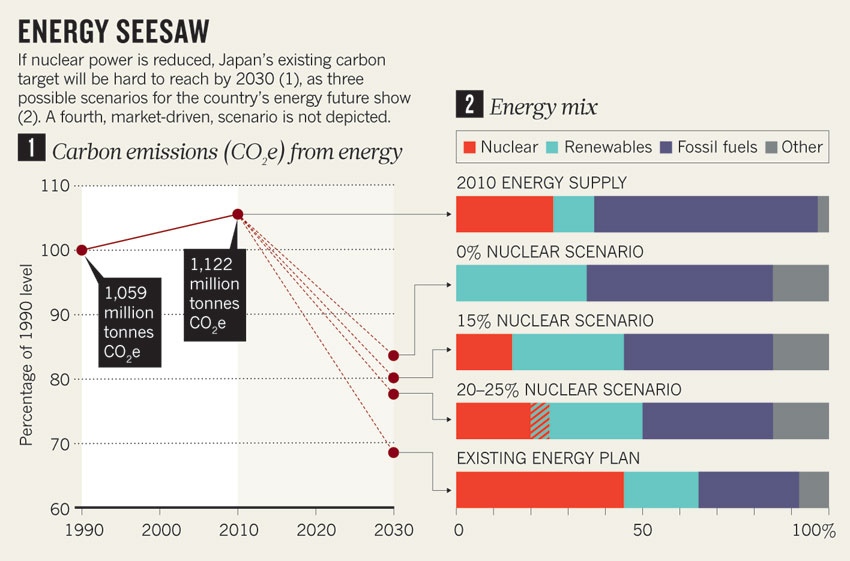
Committee Offers Scenarios for Japan's Energy Future
ananyo writes with a story about more concrete plans for a reduced or nuclear-free energy future for Japan. From the article: "It's official: nuclear power will have a much smaller role in Japan's energy future than was once thought. Since the meltdowns and gas explosions at the Fukushima Daiichi nuclear power station in March 2011, all of Japan's remaining reactors have been shut down for inspections and maintenance. The government offered a glimpse of their future, and that of the country's nuclear power in general, when it published an outline of four ways to satisfy Japan's future energy demands. One scenario recommends using a market mechanism to determine the nuclear contribution. Under the other three, nuclear power would supply at most one-quarter of Japan's energy by 2030 — and in one case, none at all. The scenarios come from a 25-person advisory committee to the industry ministry. The sharp reductions in the nuclear power part of the country's energy mix mean that Japan will struggle to reach the 31% reduction in carbon dioxide emissions that it had planned by 2030 (PDF)."