 Slashdot Mirror
3D Display, No Glasses Required
Shibatch writes "Hitachi, Ltd has developed a 3D display called Transpost which can be viewed from
any direction without wearing special glasses. 3D movies can be seen as floating in
the display. Also, 3D movies captured at other places can be shown on the display
in realtime. The principle of the device is that 2D images of an object taken from
24 different directions are projected to a special rotating screen. They also
developed a camera which can capture images from 24 directions simultaneously." The pictures are interesting, but ... translations, anyone?
Help me Obi Wan Kenobi, you're my only hope.
It's just strobe interference with the cameras!
I can't read japanese as well as I once could but I think it says, "Here is our video-capture of the opening scenes from Star Wars Episode IV"
The caption on the second link says, "Help us, Obi-Wan."
That's about all I can make out.
http://www.worldlingo.com/products_services/worldl ingo_translator.html
Of course not perfect translation, but should able to give some draft idea what it is talking about.
http://hhil.hitachi.co.jp/products/transpost.htm
just imagine, tele-surgery becoming standard, video calls to loved ones being more and more special, blind people missing out on something else and won't sombody think of the pr0no industry???
---- Design. Invent. Cheese.
the artist Dali played with lasers and 3d holograms in the eighties, of note was a woman in a rocking chair that just floated in thin air (about 6in tall) (red)
Old news, but the best article I've read on this yet is the New Scientistarticle from a couple of years ago in which they first (for me) described realtime rendering using existing games. Interesting stuff.
Basically its just layers of projected images, spinning around to give the impression of volume. Still really neat though.
Looks like two wholly different technologies to me. This article looks like StarWars-style holographic projection, while the article you link to is about LCD displays that has two different pictures depending on your viewing angle (that is, two different pictures for each eye, when it works).
It seems to me like a system such as this would be rather inappropriate for watching movies. For one thing, making a device any much larger than a normal-sized tube TV would start to get really impractical, as the spinny elements would start to generate a lot of noise (and you WOULD NOT want to be there if a large, high-speed spinning element broke off of its axis and started ricocheting about the room...).
Also, unlike conventional holograms, you would not be able to "touch" the image. Reach out to touch these images, and the rotate-o-thingy will lop your hand off.
I shudder to think of the safety (and power consumption, and noise) issues that would be involved in making a movie-screen-sized version of one of these...
Something like this is probably more useful for scientific and military visualization. I know it's corny, but think of the Star Wars-like 3D display in South Park, in the scene where Bill Gates gets shot by the army guy. Something like that display machine...
Honey, I shrunk the Cygwin
Used Babelfish and then paraphrased it so it wasn't as engrish:
:/
But from what I can read, I can tell you this:
The stereoscopic video display that can been seen from all 360 degrees is in development. Video can be displayed on the fly. - Hitachi, Ltd.
This time, Hitachi has developed a new stereoscopic video display that allows viewers to view it from all 360 degrees. With this technology, viewers can see a 3D picture as if the viewer was using special glasses. It is possible to enjoy this stereoscopic image which just floats in the air without special processing. In addition, using a special video recording system, it is possible to display the images in real-time. Through the network, the photograph is sent (along with positional vector details), and the image is displayed. Various applications in the field are expected as the new technology matures.
Only bothered to do the first paragraph, as what babelfish produces is really really bad engrish
# It's called 'Transpost'
# It uses LCDs and mirrors
It'll be much better if a native speaker translates for us.
Founder of Mirror Moon - Tsukihime Game Trans
Please, please, please, for the love of all that's intelligible, can people refrain from posting babelfish "translations".
It's okay for the odd word or phrase, but for a whole article, it's just wrong. Or, as babelfish would put it:
Please, for those the love for all the those that is understandable, can satisfy please of refrain of babelfish of the writing of the "translations" of the peoples. It is for the odd word or the approval of the sentence, but for a complete article, he is necessarily false. Or, babelfish that it puts...
evil math within Nature's Cubic Creation!
So you dont need glasses to see it, but I can imagine after squinting at 24 rotating mirrors projecting a fuzzy blob into a vague space just in front of your nose you soon *will* need glasses!
Baz
Transpost product homepage (Japanese w/ pictures) at Hitachi Human Interaction Lab.
Other products from this laboratory include Waterscape (English).
Holy crap. My cat already goes bonkers with the mouse pointer in 2D mode. 3D?! She's gonna friggin explode!
..........
... SLAM!!! Kitty head goes face first into hard cold monitor, while simultaneously knocking over a half can of warm Dr. Pepper all over my keyboard.
I can see it now...
She crouches down, eyes fixed on the Mecca that is my cursor, while time and space come to a stand still...
Eyes fixed, heart beating swiftly, she tactfully wiggles her butt, to confirm her primal instinct. This... this is her moment... her destiny...
She twitches her noes and squints her eyes, and runs off feeling sheepish, as I make a half ass attempt to clean off my keyboard with a dirty laundry, cause im to lazy to find paper towels.
From the article description and pics, this seems to be a relatively simple concept, but nicely implemented. Although I can't read the article, I'm guessing that the "3d" effect is a much better version of those "holograms" that appear to move when you tilt at different angles (e.g. Ken Griffey player appears to swing when you tilt his baseball card). But instead of 2-3 images on a flat card, you have 24 images on a cylinder. Needless to say, it's not "real 3D" as none of 24 images themselves have depth.
Some people mentioned a strobing projector around a rotating screen as being the method used here. I wonder if also some sort of projector facing upward from below could be reflected laterally in 24 directions by a 24 sided mirror.
They then go on to explain a little more about the technology. They take video feed from 24 different angles and then feed that into their projection system which I think is a number of projectors inside a single machine. They then project it upwards onto some sort of rotating screen/plate.
They then talk some more about how it's automatic and works in realtime over a network.
Lastly they just talk about how a color projector like this is possible and what some of the uses might be (business, entertainment). Then at the bottom, they define the terms "holography" and "hitachi human iteraction lab".
The porn industry seems to jump on new technology a lot faster than "mainstream" industries, proving the effectiveness of new tech so the big boys don't have to take any inwanted risks. Look at multi-angle DVD's, they are only just starting to show up in genres outside of porn, and how long has the technology been around?
Making the moon less necessary since 1998.
Informative? How can 24 discrete views POSSIBLY be called stereoscopic? This is an interesting technique that could allow for 3D video conferencing if scaled up sufficiently, though I doubt it would ever make sense for dramatic enetertainment.
That was classic intercourse!
You may be moderating this as funny but that is the most serious/insightful comment you will see here.
If you think about it, it is going to be really hard to show scenery ie mountain landscapes on this screen - you can only show objects standing in a void - the demo piccies here show a man standing in the middle of nowhere. Think about Star Wars and Princess Leia standing in the middle of nowhere in R2's projection - there are no walls around her...
So if you think about it, the only real use for this are artificial landscapes like Air Traffic Control displays, and people.
Porn is _the_ killer app for this one.
It looks more like the system from Actuality Systems. I am guessing it works by spinning a 180 degree screw shaped structure really quickly, and getting the timing right so you can project onto any point in space...
Actually, the Hitachi one seems to be spinning a flat plane, rather than a screw... The screw based method is described here
All the cameras involved would need to synchronize their frames ala time-based correctors we used to use for video editing, else you'd probably get some disconcerting flicker as you moved around it...
"Waste not one watt!" - CZ
Many people are dubious about 3D screens. This is understandable as there have been doezens of them and none has "made the grade"
The reason for this is simple: stereopsis is, while whiz-bang, is not "interesting". After the initial gee-whiz the grim reality of the lack of value added benefits for the cost always come into play.
Today the tag "3D" has a fuzzy meaning, but it is usually interpreted to mean mere stereopsis: artificial illusion created by presenting each eye a differing perspective of am in image.
The reason stereopsis fails is that it only provides a fractional increase in information, where as "holographic" (a misnomer) provides a full dimensions worth of information.
To explain it simplest: stereoptic images have one depth of focus, whereas a "holographic" image has thousands of "planes" of focus. A holographic image allows you to focus your eyes at different depths whereas a mere stereoscopic image keeps your eyes focused at one depth.
When it comes down to it, its about information density; fake stereroptic effects add no information. So we can conclude that "3D" technology won't ever become mainstream until true depth "holographic" imaging is available.
Bottom line: this screen is not worth its cost. Give us depth of field.
Either your images have to be very simple, or you need extremely powerful hardware, or the resolution sucks, or you're going to have to accept low frame rates.
I wonder how frame rate relates to the rotational speed of the projection surface.
Slashdot quality declines as the number of hot grits posts decreases. - Provolt's Law, Apr-09-2005
For those wondering how this system works here is the actual article:
Viewers gaze at a live three-dimensional image produced with groundbreaking technology unveiled by electronics giant Hitachi Ltd. on Tuesday. Hitachi's device is the first in the world that can record and instantly display three-dimensional images from 360 degrees.
Up until now two steps were required: special filming using lasers and the intermediate process of physically recording the image, meaning that the image could not be seen at the same time as filming.
The circular viewing device stands about 2 meters high and is 40 centimeters in diameter. The image of the person being filmed is portrayed onto a high-speed spinning screen from angled mirrors.
When viewed from the side, the person's face can be seen and their back is visible when viewing the object from the opposite direction.
The person or object being filmed is surrounded by 24 mirrors and recorded with a camera. This recorded image is instantly transmitted to a projector in the viewing device. (Mainichi Shimbun, Japan, Feb. 24, 2004)
To see the picture, which is larger than the ones on the Hitachi site, go to Mainichi Daily News and in the lower right corner of the current picturce click 'More'. When the pop-up occurs click 'Next' to see the single picture and the text I just posted.
I hope this helps.
Hitachi Co. Ltd. (CEO: Etsuhiko Shouyama) has developed a novel 3D image display technology, which allows a 360 degrees view from any direction. The technology allows a viewer to enjoy a 3D image that appears to be floating in the middle of the air. With the proprietary camera system, one can take and view a captured real-time 3D image. The taken image can be sent over a network and played in distant places simultaneously --- this makes a totally new presentation style possible. The technology is expected to be use as a new image-based information system in various fields.
Holography has been a well-known method for playing floating 3D images to date. However, playing a 3D image requires preparation of an interference pattern (hologram), and this make real-time playing of a captured 3D image impossible.
Real-time playing of a captured 3D image will bring, for example, projection of 3D images of a person or an object in the air, which has appeared in SF movies, to the real world. As a new style in oversea business, discussion of a product design or a presentation to a customer can be made based on the image of a sample freshly made here in Japan.
The Hitachi Human Interaction Laboratory in the Hitachi Fundamental Research Center has developed the 3D image display technology that allows one to view a real-time 3D image floating in the air from any direction. This comes with a demonstration system, cylindrical 3D image display "Transport." The developed display technology has the following features.
(1) 3D image display by a simple mechanism
The system is based on simultaneous projection of the images of a subject taken from multiple direction onto a proprietary prepared rotating screen. In the experimental display "Transport," the images of the subject taken from 24 different directions are projected to (a) mirror(s) at the top by (a) LCD projector(s) set in the base. The projected images are reflected by the mirror(s) to 24 mirrors placed around the rotating screen, and further directed on to the screen.
(2) Real-time display of captured 3D image
The Lab developed a proprietary camera system that automatically produces images of a subject from 24 different angles. Directly sending the images captured by the camera system to the LCD projector displays the captured 3D image in real time. The captured image can be sent to a distant place by connecting the camera system to "Transport."
The developed 3D image display technology can handle both still and animated images with full colors and from computer-generated graphics to real image captures. The technology may find various applications in business and entertainment as a unconventional display system for 3D image presentation and information distribution in the ubiquitous era.
(Notes about *1) holography and *2) Hitachi Human Interaction Lab)
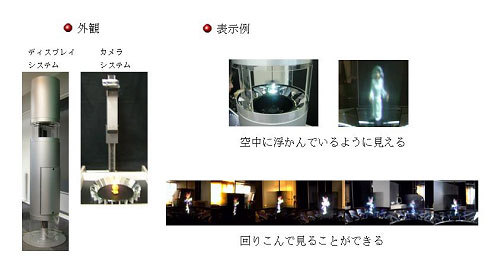
Left: Overviews of the display system (left) and the camera system(right)
Right: (top) "It appears to be floating in the air."
(bottom) "One can move around and see."
You are correct in this assertion. The infinite limit of this approach is a hologram. True holograms play out the 3-dimensional wavefront of light as reflected by the 3-dimensional object. Frames taken with a 2-dimensional camera are just that 2-d.
I interned at Holographic Studios with Jason Sapan in New York City. We would construct images like these using 16mm film frames and a cylinder of holographic film. This is similar to the technique in Logan's Run, but I don't think Jason did that one. This image type is called integral since it is an integral model of a 3-dimensional image kinda like sticking cheese wedges together to make a wheel of cheese. The wheel is round when you slap it together, but it is still an approximation and not a whole wheel. This design seems even worse than the cylinder hologram, because at least the cylinder can play out multiple angle truly at the same time.
As an experiment you can use a stereo pair of 2-d images and a real object. When you look at one of the stereo pair images with one eye you will see that it is flat. This is due to the scanning of a single eye as it looks at the scene. When you look at the real object with one eye you will see the foeveoal (center) scan of depth from the real object. That is why stereoscopy != depth. Reference "Practical Holography" by Graham Saxby for a more eloquent explanation.
This Hitachi display is not new technology and it has some problems, principally:
On the upside:
It would be most useful for applications such as air traffic control, etc.
It competes with the other autostereoscopic displays (the LCD shutter glasses will never break out of their nerd/medical/scientific-imaging market for social and multi-tasking reasons), of which there are only really 2 consumer-market viable architectures:
The other displays linked to in the comments, and various others not linked, are all variations on the parallax barrier approach. Again, not new. They have the benefits of:
They have the big downsides of:
The limited viewing angle practically requires most parallax barrier systems to use active head tracking systems, where the display identifies where your eyes are and retargets the imaging accordingly. This exposes the practical usefulness of the 3D image to a further potential degradation if the headtracking system is not spot on.
Sharp and Dresden both use parallax barrier. Dresden's is beautifully bright but its headtracking can unfortunately jump the image around very badly for some people -- speaking from experience, it is beyond unusable if you're one of the unlucky ones, the image is jumping inches in random directions on random sub-second intervals.
Another major disadvantage is the extreme difficulty of presenting a 2D image via parallax barrier systems, thereby sharply restricting its desktop market. If you want to write or read something, such as a spreadsheet or some code or a word document, you're out of luck -- you need another monitor.
The other approach has been developed by a single company comprising now 2 people (holographic artists) about 10-12 years ago. The Display: