 Slashdot Mirror
Cassini Alters Path. Phoebe Now In Sight!
Anonymous Explorer writes "This week the Cassini-Huygens
Spacecraft finally entered
the Saturn system and made its first
main-engine burn in five years in preparation of for the Phoebe flyby. This long
journey
has been one filled with much promise and peril. Launched in 1997,
Cassini is expected to have a rendezvous with
the moon Phoebe
on June 11. For those of us who are lazy, that's just a tad under two
weeks away. After the Phoebe flyby, it's on to the ringed planet, with an
anticipated July 1
ground orbit insertion. The ESA's
Huygens probe will descend into the atmosphere of Titan a few months
after Cassini is inserted into orbit. This mission
promises to be
one that brings a very psychedelic and beautiful area of our solar
system into clearer focus. This multinational
mission is one the
most ambitious scientific explorations yet undertaken and promises some
truly otherworldly images in the near future. With 31 moons/natural
satellites thus far discovered orbiting Saturn, there should be a lot
to keep us occupied. Anyone else excited about the journey
to a ringed world? Lets all enjoy this ride. It promises to
be a unique one as much as for the scenery as for the science. Informal
discussion regarding the Cassini-Huygens mission can be found at
#cassini on irc.freenode.net."


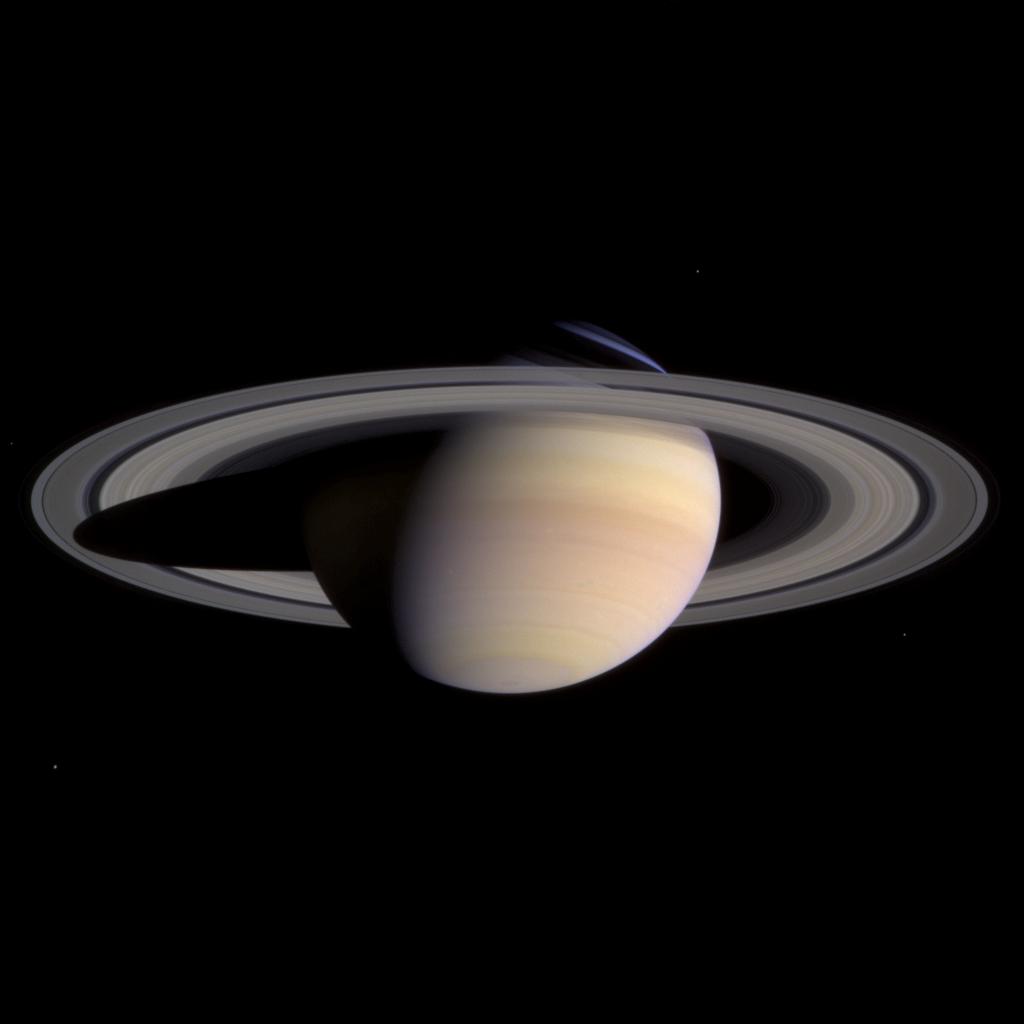
to keep her head down 'round about the 11th.
She gets a little freaked when things flyby without warning (although I've rather been looking forward to it myself).
I'm still trying to figure out though, why I, as the more massive of the pair, appear without question to be the captured object.
KFG
while we are talking about Cassini, let us remember the protesters who were so opposed to it.
Remember cassini is nasa's deadly space probe. It is nice to see that these groups have other stuff to protest these days. Hope that stuff is not as deadly as cassini...
The war with islam is a war on the beast
The war on terror is a war for peace
This mission promises to be one that brings a very psychedelic
Guess the mission engineers took the brown acid. Bummer.
bash: rtfm: command not found
Map and Images of Titan from Hubble Space Telescope
Nasa Titan Photojournal
Saturnian Satellite Fact Sheet
Phoebe best image so far, from Voyager2 in 1981!
Do you need a website upgrade?
It's gonna be nice to see a photo-intensive orbiting mission to one of the big gas giants. The Galileo orbiter for Jupiter had an antenna problem that greatly reduced the imaging volume.
However, based on Voyager flybys, Saturn's moons are not quite as photogenic as Jupiter's. Titan is covered with a thick feature-poor haze and most of the other moons are too small to have many of the interesting tidally-caused features of the Jupiter moons. But there are still some interesting features on some of the moons.
And, Cassini will drop a probe into Titan's atmosphere that should return some interesting images and data. Titan may have a methane ocean and the Titan probe may possibly land in it and float for a few hours. The ocean may have giant waves because the gravity is so weak compared to Earth, similar to the way that sand-dunes are easier to make on Mars because of the lower gravity there. Things can get taller and weirder under low gravity. It would be the first time liquid could be seen from the surface of another world (aside from the Apollo Tang drippings).
Table-ized A.I.
After the Phoebe flyby, it's on to the ringed planet
All the gas giants have rings, not just Saturn. They're not as easy to see, but they have been detected.
Learn something new.
IMHO quality images do more to create and maintain public enthusiasm for space exploration than all the statistics in the world about the benefits of the space program; far too many geeks and/or scientists underestimate and underutilize the best of all marketing tools we have for getting funding and support for the space program. I hope they don't forget about the value of a pretty picture.
"Everyone is entitled to their own opinion, but not their own facts."
Cassini is expected to have a rendezvous with the moon Phoebe on June 11. For those of us who are lazy, that's just a tad under two weeks away.
Does this mean that those of us who are not lazy have to wait a few more weeks before we can learn about Phoebe's observations?
Phoebe best image so far, from Voyager2 in 1981
"My God! It's full of pixels!"
Table-ized A.I.
I think astronomers realize the importance of beauty when trying to get public support. Check out the Hubble Heritage project. The main reason for this project is to take pretty astronomy pictures.
http://www.rootstrikers.org/
Does anyone else think its amazing that the thing actually works after five years of no activity? Seriously, I wouldn't trust my router, cable modem, or toaster (all devices of comparable embedded computing power) to run nonstop for five years. I think it speaks well for the Nasa engineers, and the things they actually do right. Its a shame only their mistakes make the news.
Even those who arrange and design shrubberies are under considerable economic stress at this period in history.
Funny, I never post AC. It says something about a person's character when they will only be controversial when they are not held accountable.
Anyway, I didn't say "environmentalists" are stupid. Most mean well, and some are even well informed and productive. Unfortunately, many mistake passion for evidence, and can't be bothered to investigate opposing viewpoints.
RTGs are hardened and designed to withstand explosion and extreme temperatures. They do not explode, and I believe that they do not even become active until after launch. Radiation has been "The R Word" since the 50's, but we actually use it all the time and know how to handle it. Only in cases of extreme incompetence and lack of precautions (see Chernobyl - 1986) do we need to be concerned.
Returning to the planet, a nuclear plant is far less likely to cause ANY harm than most power technologies or chemical processes (See Bophal, India). We KNOW that radiation can be dangerous, hence the extreme precations we take.
Incidently, NOTHING is 100% safe... along with fearing (and guarding against) the risk, you should consider the rewards.
"Faith: Belief without evidence in what is told by one who speaks without knowledge, of things without parallel." - A.B.
"first main-engine burrn in five years"
...
[only a] 78 mph change in speed
One thing that comes out again here, but only by implication, from these reports, is the amazing accuracy and precision (still amazing to me anyhow) of the ephemerides (~ solar system maps) used to plan these missions. They knew where Mars would be for MER to within, what, was it about a meter or two? Maybe not that close for Saturn but still good enough not to need main-engine course corrections in five years
Kudos to the chief JPL mapmaker Dr Myles Standish and his crew!
-wb-
This doesn't mean they're dangerous. They are all quite capable of surviving reentry and impact, and in one case (the NASA Nimbus B1 satellite in 1968) an RTG was recovered and actually reused in another spacecraft!
Furthermore even if one did break up in the atmosphere and somehow vapourise despite being made in a ceramic form that would stay in a few lumps, it would cause bugger all damage. Plutonium isn't especially radioactive, although it is moderately chemically toxic. The small amount in an RTG completely pales in comparison to the plutonium in the environment from all the nuclear tests, and those make up literally 0.5% of the radiation we receive each year. (The rest comes mostly from natural sources but a significant amount also from medical xrays.)
"Studies have shown that people who eat peanuts live longer than those who do not eat."
There is a preliminary plot of Cassini's possible orbital tour here . According to it, Cassini will make around 69 orbits during its planned mission. Note that one of Cassini's primary targets, Titan, orbits at around 40 Saturn radii, well outside the rings.
Oh, and, look for all the pretty pictures from Cassini to be posted over at CICLOPS (Cassini Imaging Central Laboratory for Operations).
Bush Lies On the Record.
Actually, Cassini will pass through Saturn's rings twice during orbital insertion. Although it will be "driving" through one of the gaps between rings, it will still be going directly through the ring plane.
I call troll.
It seems that you don't understand the concepts of risk and probability.
You never have a "certain probability". All you have is probability. Probability is a best guess in cases such as this since there are numerous factors to take into consideration.
72 lbs. of plutonium re-entering the atmosphere BY ITSELF without shielding would cause insignificant damage at best. It would be vaporized and scattered in the upper atmosphere, where cosmic radiation would rapidly turn most particles into unstable elements that breakdown even faster.
In fact, the chances of said particles reaching the surface of the earth is minimal. And even if it did, we are talking fractions of microcuries at best.
BUT IT WILL DAMAGE THE ENVIRONMENT! 36 kg of plutonium vs. 6.14X10^24 kg of Earth? With the way people make radiation sound, you'd think it was magical death wraith just waiting to be set loose on the poor undefended Earth.
And while we're talking about probabilities, I think you should be more concerned with your fellow drivers than an errant space probe. You're far more likely to die in a car crash than any sort of radioactive accident, least of all from a space probe.
To put it in perspective, you have a risk when you take a shower in the morning. There's a risk that you could slip, crak your head and die. The risk is small, but it's there. Does this mean you shouldn't take showers? Do you do a risk/cost analysis everytime you step in the shower? Do you have life insurance, a will, savings, etc. for anyone left behind? Do you estimate how much a funeral will cost? What taxes will be due? How much lawyers will cost? What about your job? The cost it would take to replace you? The list goes on. And this is all just based on you taking a shower.
Do you trully know your risk/cost? I doubt it. It's not possible to know all the repercussions of your demise because no one can predict the future. If you were smart though, you would be prepared as you could be for such a thing and you'd go on living your life and taking showers.
You're just one person. NASA has hundreds who run computer simulations, analysis, environmental impacts, emergency scenarios, etc. . The probe was launched in 1997, but they were probably testing the hell out of it for at least a decade. And NASA has been doing this since the 60's.
They are not infalliable, but they have numbers to back up their claims. And I would take a 100 scientist recommendation over an elitest snob.
~X~
~X~
We have a room on the irc.freenode.net servers called #cassini which is available to all who are interested in the Cassini project. Here you will find a wide range of interests discussed, from the informal to the most scientific details of the mission. Some of the Cassini staff have shown interest in participating to further support the project's public interest so don't be surprized to meet them there.
We also support the ' Maestro ' program which is the Public-Outreach software created for the Mars Exploration Rover Project from JPL . As a result, we helped maintain the #maestro room (also on freenode.net) which is still in operation today.
With such high interest building as Cassini-Huygens approaches orbital insertion and the Phoebe flyby, we expect a bigger rush in the next weeks. Join in and share the experience!
If you are not sure how to do 'IRC' there are many good primers online to help and you can visit http://freenode.net for details about connecting as well as links to assist you to set things up to chat online.
See all "/.'ers" there... ;^)
Pandelirium
http://www.pandelirium.net irc.freenode.net
#cassini
#maestro
#pandelirium