 Slashdot Mirror
Optimal 24 mark Golomb Ruler Proven
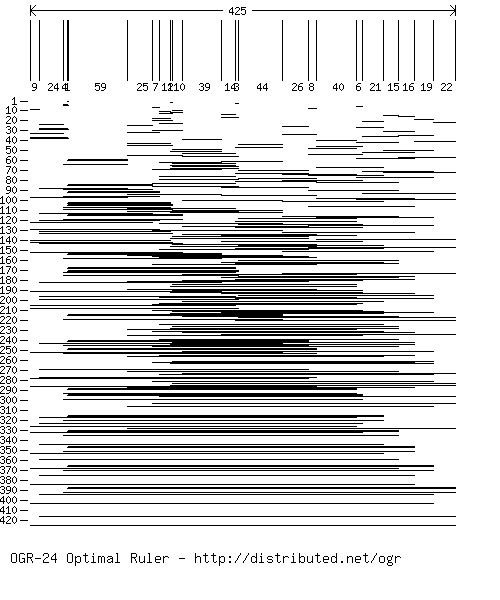
globring writes "Four years ago, distributed.net users undertook the search for the optimal 24 mark Golomb Ruler. This year sees the successful conclusion of that effort. The diagram of the optimal ruler can be seen here. If you have no idea what a Golomb Ruler is, you can read up on them. Work on finding the optimal 25 mark ruler is still in progress."
what's the point? Give me a slide rule any day.
What are you expecting to find here?
Brute forcing is like what some alchemists did - try all the combinations and get a result.
It's more interesting if you can find a "summary" or new point of view.
Also, IMO a solution (not talking about proof) that is magnitudes larger than the problem is not very good, and that a good solution is like good "compression".
The linked figure containing intrapair differences for the 24-mark OGR was very interesting to me.
I suppose I could look this up, but I'm too lazy at the moment, and I'm not an expert in math.
But I'm wondering if anyone knows what the distribution of intrapair differences looks like. Does it follow any known distribution? Is it something that someone has looked into?
I'm in statistics, so these things are interesting to me.
... welcome our new Golomb rulers...ah I mean overlords!
Three Squirrels
I read the article, and I still don't have much of an idea what a Golomb Ruler is good for, and why you need this in addition to a trusty straight-edge, tape measure, or laser distance finder. But hey, I'm not a mathematician.
I do know that people like to study problems that have no practical use (yet) and get completly engrossed in them.
Why bother with Fermat's Last Theorem? Why try to find the least number of colors necessary to color an n-dimensional map? Why obsess over twin primes?
Because it's darn fun , that's why!
Hail to all obessed mathematicians and impossible problem solvers !
Good luck with your 25, 26 and ... n -mark Golomb Rulers.
Slashdot beat the Amiga team in OGR-24, but the Amiga team is leading the Slashdot team in OGR-25: OGR-25 Team Listing
But the Dutch Power Cows leads in both efforts.
OGR-24 blocks have been scarce for the last few months, so the statistics have been rather erratic.
At least the OGR effort is more useful than the RC5-72 effort. We showed how quick DES and RC5-56 could be broken quickly with a bruce force attack with spare CPU cycles. But why do RC5-72? It's not that interesting.
I'm doing OGR-25 now, and when that's finished I might go on to something like folding @ home, if there's a client.
Irene KHAAAAAAN!
I dont get the scheme on top of http://members.aol.com/golomb20/intro.htm. The sequence is 1, 3, 5 and 2. How one can measure 6 with that ?
--
Go Debian!
Do Golomb rulers exist that can measure every integer distance from 1 up to their length?
That is, a ruler with marks at (0,1,2) can measure lengths of 1, 2, and 3 units, and is 3 units long. The sample ruler on the above-linked site has marks at (0,1,4,9,11), and can measure every length between 1 and 11 EXCEPT 6. You can swap the first two blocks (giving (0,3,4,9,11)) but then you lose the ability to measure 10.
I guess what I'm asking is whether these rulers exist, and how many are they? Or is there a point where they stop being possible?
golomb20
Seriously. This is the type of thing you expect to see at cs.foo.edu/~golomb20
Hey, I guess even mathematicians use aol. Well, ONE does, and maybe 19 other golombs before him.
gears are for wussies
I'm no expert on np-complete problems, and this is literally an off-the-cuff idea, so feel free to shoot it down or run with it:
Someone once proved that np-complete problems map to each other. That is, if you solve one, you've solved them all. this page linked in the main story suggests that Golumb Rulers are "like" np complete problems. If it is indeed np complete, then maybe an efficient-but-suboptimal solution to the Golomb Ruler problem will map to any other np-complete problem.
The same link mentions cyclic difference sets as a means of producing very efficient Golumb rulers, at least up to n=150.
If this technique maps to other problems, like the travelling-salesman problem, then "practical" albeit not-quite-optimal solutions can be found relatively easily. If you are a traveling salesman, do you really care if your 100-stop route has a small amount of waste, if finding a better solution might take 10 years of cpu time?
Likewise, if there are other "not quite optimal" solutions to np-complete problems for n>150, perhaps these solutions can be applied to the Golumb ruler problem, to generate "good enough" rulers of longer lengths.
Of course, if the Golumb ruler problem doesn't map to the other problems, then "nevermind."
Knowledge is how to play a game, intelligence is how to win, wisdom is knowing what game to play.
Say you have a Golomb ruler that's 100cm long. It has a bunch of scattered marks on it, and it can measure any number up to 100cm, if you want to take the time to figure out which two marks will yield the measurement you need. Wouldn't it just be easier to put 100 marks on the ruler, each 1cm apart?
Is there some situation in which creating the ruler is easy but putting marks on it is hard, so you want to minimize the number of marks? I'm having a hard time seeing the usefulness of this.
There are 2 kinds of people in this world. Those that can keep their train of thought,
Distributed.net has drug its feet for a LONG time on the OGR project. OGR-24 could have been solved a couple years ago if they had been more aggressive in re-issuing stubs.
I could go on, but I'm wondering if anyone knows of any more productive distributed computing projects? Folding at home always seemed a little dubious in its scientific merit, same with seti@home. I'm not much interested in finding bigger and bigger primes (sorry, but it seems rather pointless), so what's someone who wants to put spare computing power to good use to do?
AccountKiller
It's an interesting numerical puzzle, but misnamed.
A ruler is a practical object of use, and there's nothing optimal in practice about a ruler that has some of its markings missing!
-wb-
Gears are for wussies? Fixies are for little kids and posers.
This project attempts to evolve more efficient circuit designs than those designed by humans through genetic algorithms. In fact they already have evolved a few circuits that are better than human designs, just check the goals section on the page.h e/
http://www.informatics.sussex.ac.uk/users/mmg20/d
However, you could be responsible for evolving Skynet someday.
Replying to myself here.
RC5-72 is considered to be a parking effort, for whenever the OGR effort runs out of work. CPU speed being what it is today, you'd probably have a better payback chance for playing the lottery than cracking RC5-72.
Irene KHAAAAAAN!