 Slashdot Mirror
Old School Gameplay Collides With Modern Graphics
- Title: Quake IV
- Developer: Raven Software
- Publisher: Activision
- System: PC (360)
- Reviewer: Zonk
- Score: 7/10
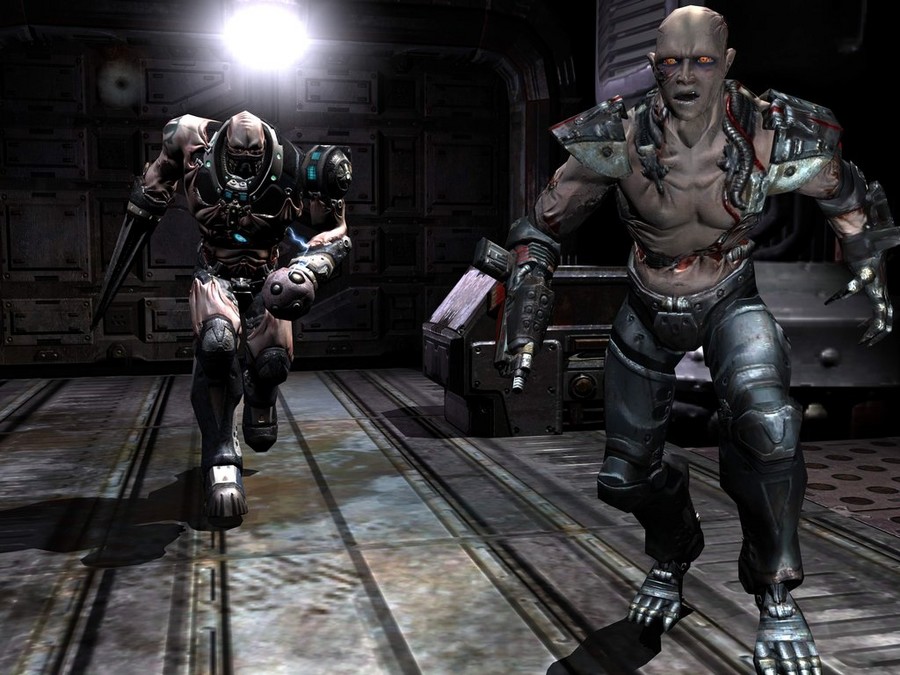
Quake IV is the story of a marine participating in the invasion of the planet Stroggos. After the events of Quake and Quake II, humanity has had enough and is taking the fight to the dirty space aliens that wrecked up our planet. The single-player mission that explores this story is well presented. The developers seem determined to have Quake stand up to more modern gaming experiences, and there are some successes on that front. Quake IV's AI is nothing particularly intriguing for most of the game. While both your soldier buddies and alien opponents will occasionally take some cover, for the most part they have a saturation-with-plasma-fire approach to combat. Towards the end of your combat tour, though, highly intelligent Strogg become your opponents. They're highly aggressive, have the same weapons you do, and know enough to get behind a crate when a grenade lands in front of them. It would have been interesting to fight more of these baddies throughout the game, as for the most part the average Strogg is cannon fodder.
The story itself features elements you'd never expect from a Quake title. There's a little bit of mission variety, for one, with some fetch the hoozle missions, escort missions, and rail shooting mixed in with the usual run and gun. While they all devolve into 'shoot things and keep moving' it's obvious that Raven put some thought into providing a variety of experiences. At least one level actually takes you out of the fighting and attempts to flesh out your understanding of protagonist Michael Kane's world. You're given the chance to wander around part of a dropship, encountering fellow marines and overhearing numerous scripted conversations. While it can't hold a candle to City 17, the non-combat detail is a first for the series and once again shows Raven's commitment to modernity.
The problem, such as it is, comes in the fact that the minute-to-minute gameplay is virtually unchanged from the Quake II days. It looks better, to be sure, but you run down a hallway, some Strogg jump out, you shoot them. Repeat until level clear, then repeat until game finish. While I personally have no problem with that venerable and highly enjoyable sequence of events, be forewarned that if you play Quake IV you're just not going to encounter many of the aspects that are hallmarks of modern FPS titles.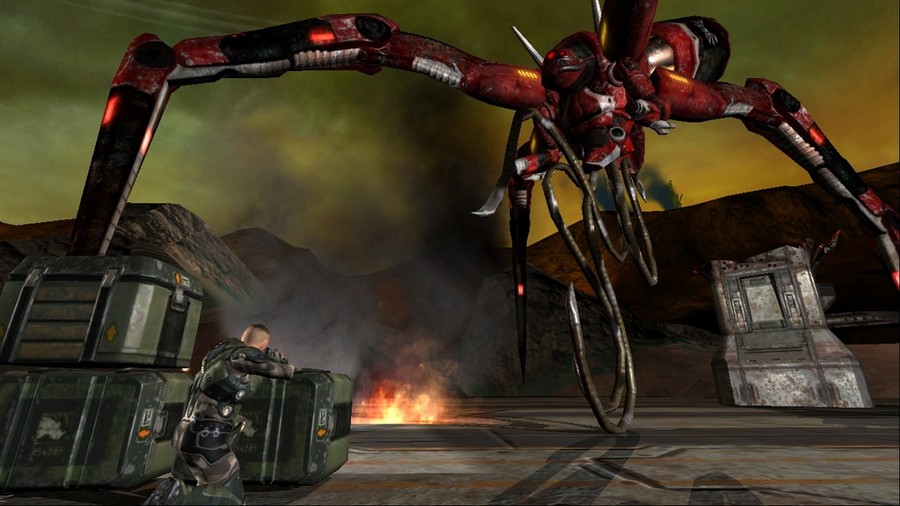
As you'd expect from something built on the Doom engine, Quake IV looks terrific. One reason that the graphics stand out so much is that, unlike in Doom 3, you can actually see the environments, objects, and creatures around you. While there are some dark sequences several of your weapons have flashlights built into them, making the darkness more ambiance than gameplay element. Character appearance and animation is top notch, and the scare factor of critters leaping at you is heightened by the sometimes disturbing ways in which Stroggification has warped your opponent's appearance. Composed sound elements plays a subdued role, with minimal musical cues doing their best not to get in the way of the action. Sound effects are loud and for the most part satisfying. Weapons have weight, and cries of anger and pain definitely get across success or failure as you shoot at an enemy.
If the last game in the series is any indication, there are a lot of you out there that couldn't care less about the last few paragraphs I've written. The multiplayer aspect to id games is always top notch, and this one is no exception. Quake IV is Quake 3 redux, right down to the jump-pads and the announcer. Weapons have no reload time, and level design is focused on making sure there are plenty of fragging opportunities. As with previous titles in the series Deathmatch seems to be the design focus. 16-player maps seem to be the order of the day, with several even lifted directly from Quake 3. Gameplay is extremely fast, and the twitch-bunnies you'll face online make the AI in the single player campaign look like statues. In order to get the kind of response I wanted from my online experience, I had to turn down some of the settings I was using for the single player missions. With some of the more expensive shinies turned off, the game responded quickly and I had no problems staying in the fight.
Despite the game's adherence to elements from previous Quake games, Quake IV somehow fails to capture nostalgia and comes off feeling retread. The modern graphics simply highlight the sometimes simplistic level design, and while there are some physics elements used in the game for the most part the Doom engine feels more funhouse than realistic environment. Gameplay, too, feels very much like the same experience we had in 1999. Nostalgia is one thing, but the fact that the Quake world has nothing new to offer after a six year lapse is frustrating. The bottom line: if you've played previous iterations in the Quake series and enjoyed them, you'll like Quake IV. It's a solid, fast, frantic style of FPS that is becoming far less common nowadays. The frustrating mix of new and old may throw gamers who aren't fans of the franchise and accepting of gameplay from the previous decade.
- Title: Star Wars Battlefront II
- Developer: Pandemic Studios
- Publisher: Lucasarts
- System: PC (PS2, PSP, XBox)
- Reviewer: Zonk
- Score: 8/10
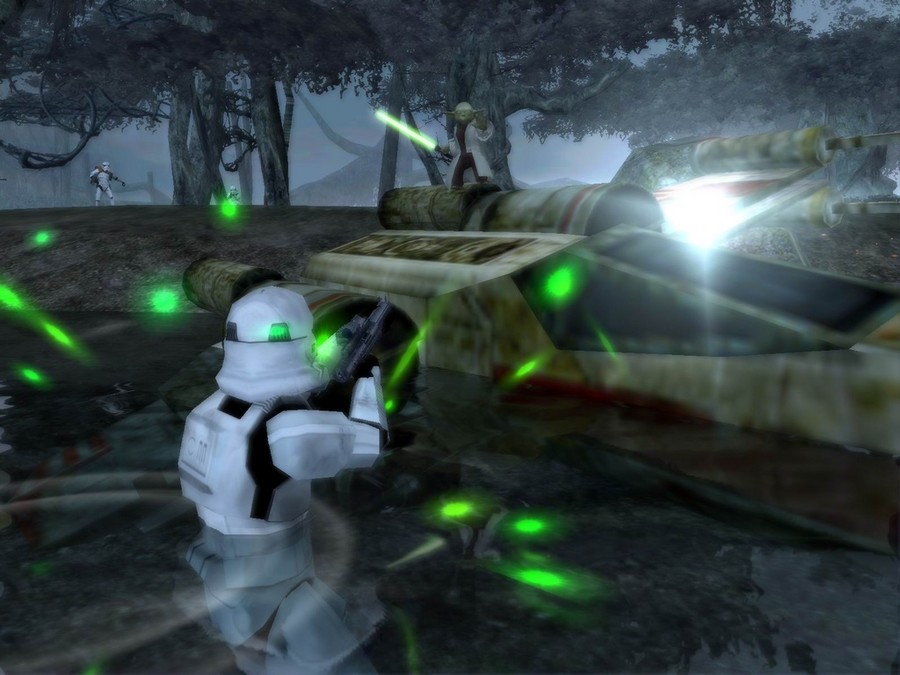
With the exception of the Super Star Wars series of titles back in the SNES days, Star Wars movie-specific game titles have almost universally disappointed. The blending of the mythology into a more cohesive whole makes for a much richer and ultimately more rewarding environment to set a game, and SWB II makes full use of all six movies. The single-player campaign starts you off in the final days of the Clone War, filling the boots of a Clone Trooper under the command of a Jedi Knight of the Republic. If you've played the previous title you'll have almost no trouble getting into the thick of it. Gameplay is essentially unchanged, preserving the wise decisions from the original title's designers. You'll have the option of choosing from among several unit types to spawn onto the battlefield. Each has a specific set of weapons to draw on, such as a heavy weapons trooper or a sniping unit. The average Battlefront mission tasks you with keeping control of several nodes scattered across the map. Nodes can be flipped from one side to the other by occupying the area around the node with troops. Most maps are won when all nodes have been converted to one side or the other. SWB II"s single-player campaign switches this up a little with non-node mission objectives. One level, for example, requires you to hold just one node for a specific length of time as a massive force of droids marches on your position. Another has you fighting off the monstrous Acklay creatures before they can kill too many of your troops. This variety adds a little more interest to what would otherwise be multiplayer games played between you and a bunch of AI.
The biggest change in Star Wars Battlefront II is the inclusion of space combat. While it's no Tie Fighter, space missions will please the dogfighter in every Star Wars fan. Most of them are fairly quick, with just one or two simple objectives (destroy these ships, keep this ship alive). Gameplay is fast and enjoyable, with a more straightforward version of the controls you might expect from other Star Wars titles. The straightforward design makes it easy to just hop in a craft and blow stuff up. Some single player missions have a little more to them, requiring you to fight in space and then land for another objective. Dropping the shield protecting a landing bay, piloting a troop transport inside, and then stealing data from the ship's computer is a highly satisfying experience. To provide the entire range of Star Wars gameplay, Jedi characters are also available. They're fast and powerful, and a side with one available to them has a great chance of prevailing. Control is similar to what you'd expect from Jedi Academy, and there are several force powers available to the Jedi that makes fighting one as a normal ground troop a short and stressful experience.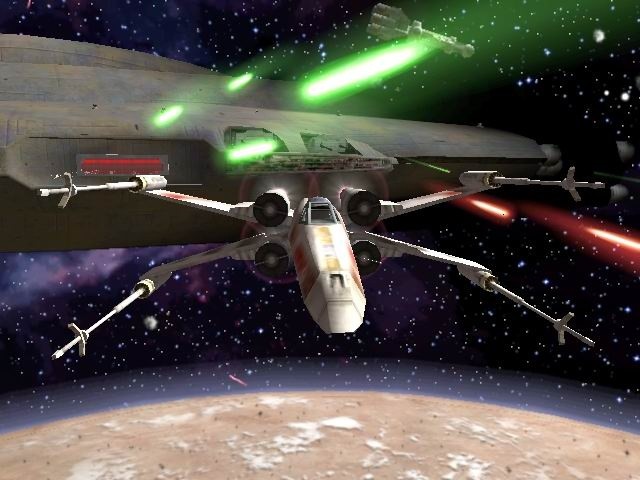
Visually SWB II is an obvious improvement over the previous title. There's a great deal of detail, and the overall presentation of the game has been refined. Both the visuals and soundscape do their best to adhere to the Star Wars universe, and succeed admirably. Ships explode, battle droids splinter, and gungans gargle with the sights and sounds you'd expect from a licensed title. As with all Star Wars games, the sound experience is particularly enjoyable. John Williams scores strain to be heard over the zip and pop of blaster fire or the scream of a passing Tie Fighter. While there aren't any appreciable physics elements, playing SWB II also probably won't strain your graphics card overmuch. The feel and look are dead on, dropping you into the mythos of the galaxy far, far away.
While the single player game is enjoyable, multiplayer is really this game's strong suit. Extremely large battles are possible, and every aspect of the single player campaign is available to multiplayer combatants. Maps are fairly roomy and are usually set in extremely evocative locales. While fighting on the snowy ground of Hoth was done to death five years ago, some of the new levels offer a distinctly different experience. Kashyyyk, Dagobah, and Coruscant are all battlefields in this (sometimes continuity breaking) free-for-all environment. Action isn't nearly as fast paced as Quake or Unreal Tournament, but that's okay. The joy to be had in popping off shots at a fleeing droid or charging Rebel soldier means that it's fun to savor the moment. The 'hold-the-node' gameplay is the default choice, but just like in the single player experience there are space battles and objective missions to be had as well. There was very little slowdown or technical problems related to the game during battle I participated in, and the necessarily aggressive tone that teams have to take to win matches ensures both offensive and defensive players will have a blast.
Given that it's only been a year since the last Battlefront title, it should come as no surprise that gameplay still feels fairly fresh. SWB II improves on already enjoyable gameplay by expanding the scope of the title. More Jedi, and space combat completes the full arc of what makes the Star Wars universe unique. While I don't expect that SMB II is going to be knocking Half-Life off of the top of the server population list anytime soon, it's a satisfying update to a title that scratches a dorky itch. Whether on foot or in space, Star Wars Battlefront II puts you in the moment like few other license titles can.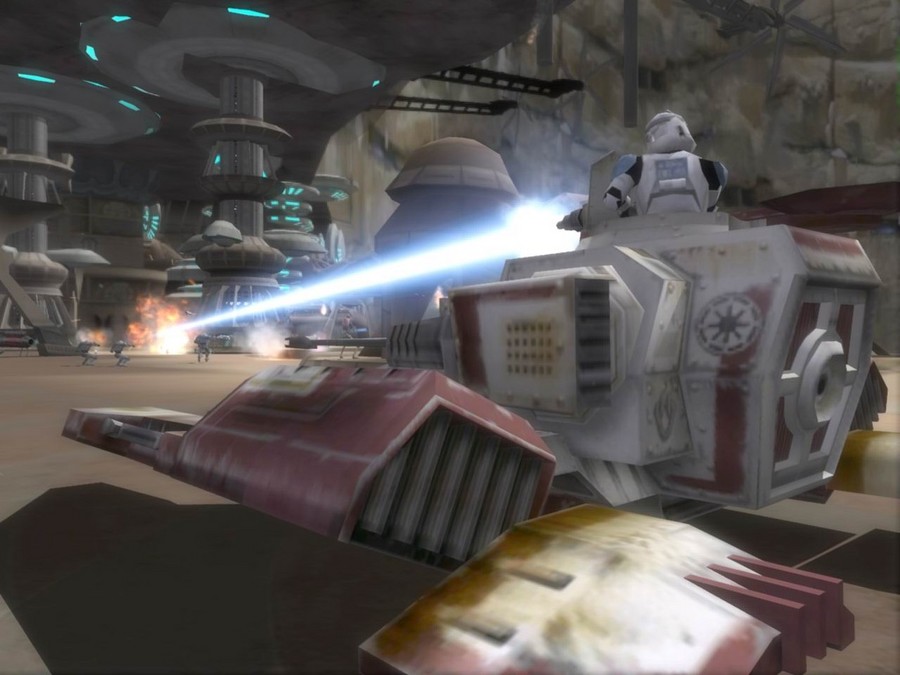
"With the exception of the Super Star Wars series of titles back in the SNES days, Star Wars movie-specific game titles have almost universally disappointed."
Bullshit. Games like X-Wing and Tie Fighter were very, very good games and well received. Also Dark Forces, Dark Forces 2, Jedi Knight, etc. All excellent games.
When I think oldschool I think of games like Kings Quest and Monkey Island or even further back to the old SSI and Avalon Hill wargames.
'Same speed C but faster'
I'm 26. I'm not even an old gamer. Some of you guys in your mid 30s, I bow to your TRUE old school heritage. What about me? Why the hell can't Nintendo crank out a 2D side scroller of Mario World for the cube? There's TONS of people like me with CASH now, that would be 50 bucks for a Super Mario World 2. I spent 20 weeks winning that game. I bet they would write one quicker! For that matter, why arent there Flash versions of new games in the older styles? Copyright be damned, those things float freely and uncredited. Why haven't I seen it yet? Nintendo CEO Mr. Miyagi could crank Mario World 2 out on the john some morning instead of reading the wall street journal. ARgh so frustrating. I have cash to spend on a near zero development cost product and it DOESNT EXIST. SOMEONE LISTEN TO THE RANDOM SLASHDOT MASSES WITH ALL CASH AND NO DRIVE
slashdot: where everyone yells sarcastic metaphors to themselves to understand the issue
Quake has always been successful even to technically superior games because it always had a high fun factor which many people considered higher than technically advanced games like Unreal. At the end of the day many people just wanted a fast on line game which doesn't require thought or much else other than killing.
I still remember the first time I logged on to a TCP/IP Quake 1 server on my 33.6 modem. I knew it would be something special. I played Quake quite a bit, and always tried the new versions, but they never seemed to be as good as the original. Thinking back, it's seems amazing that I was able to have a quality online game experience over a dial-up connection with a game as intense as Quake. The new versions of Quake, they looked good, but none of them *felt* like Quake. The weapons weren't as devastating, the movement was all wrong, it just didn't feel right. I haven't tried Quake IV yet, but I'm expecting more of the same. Does anyone else feel the same way? Quake to me was one of the first games to have a real online presence, and I'll always remember it fondly. It was also a time where you could find servers not overrun with high school boys, since most of the good connections were only at universities back in those days.
Is stuff like Pac-man, Frogger, Pong... the first computer games that the masses actually played. Stuff like Zork and the Infocom games, that were the first interactive adventures. You know... OLD school, not "older than last year" school. :-)
Why is game AI in FPS's always defined as "they can hide behind boxes?" Does that define sophistication for us now? It has been around since at least Half Life. People still ooh and ahh about it though, and I can't understand that.
I think the real test for an AI would be to guess where you are going to go and try to cut you off, time where you are and toss grenades at you without looking, perform ambushes on the fly, and so on. However, most of this can be done with scripting and I think it is easier to do it that way. So much of AI is game theory - the computer being able to guess where you are and what you are doing without actually seeing you. This is make-work in an fps though because the computer already "knows" exactly where you are, if the programmers want to take advantage of it.
I don't know about the rest of you guys, but I feel like I've been playing against the exact same AI for the last 10 years. The only thing that's changed is more intricate scripting.
I submitted this story last night, and it didn't get posted.
It's improved somewhat. You'll see snipers take up position in high places, that sort of thing.
Unfortunately, you'll also see bots in vehicles march into walls and get stuck (Utapau - clone wars), or bots roll-dodge right off a ledge into the waiting abyss (Death Star - either period).
Getting support from the AI is much improved. They will follow you in formation and rarely get stuck or wander off.
I guess he has never played zork on a mainframe :o)
Open Source Drum Kit, LPLC deve board - mjhdesigns.com
that the author should consider Quake 4 to be oldschool gameplay.
I guess I'm showing my age by considering the definition of oldschool gaming to cover games like Pacman and Atari 'Star Raiders'.
Have you tried portable consoles? Such as the GameBoy Micro, it has a wide selection of oldies and new games in old-school style.
Or you can wait for the Revolution to come out with downloadable games.
Just as a bit of opinioneering, I have been kinda miffed lately at the lack of co-op modes in games that have multi-player capability. Call of Duty would have been great with co-op. BF2 has a hacky kind of co-op, but not really. What gives? Is it a question of the quality of the AI or what?
.. pa-ra-bo-la, pa-ra-bo-la, 2 pi R, 2 pi R, where's your latus rectum, where's your latus rectum, 2 pi R
... instead I'll play my older games until game programmers learn how to program again. It's absolutely insane that in order to get a new game to play these days, you have to have a $1000 PC with a $200 video card. That's simply bullshit. Back in the day (before the Net got big), games that one would buy in a store would play on most machines. These days, you gotta take out a second mortgage just to buy a machine just to play fucking GAMES on. These are just GAMES.
Look, even console games get better over time because the programmers get better. Newer PS2 games look better and feel better than older PS2 games. The developers learn to do more with the same resources. Game developers these days simply don't give a shit, apparently. Do they really think that every potential customer is a spoiled 12 year old? I have a feeling that if they got back to programming again, that there'd be a lot of people such as myself who have to work for our money who'd be a lot willing to buy games again. Until then, I'll be happy shopping in the bargain bin.
I don't respond to AC's.