 Slashdot Mirror
Final Fantasy XII Review
The Final Fantasy series is almost twenty years old. When Square developed the first title in the series, the game's name was meant to coincide with designer Hironobu Sakaguchi's retirement. Instead, the game's popularity set the stage for a series that has now reached twelve 'main' titles and more than half a dozen offshoots. Almost everything about the series has changed over the years, except for popularity and a generally high level of quality. Final Fantasy XII has changed almost everything from the series norm, except the quality. The result is a game that very well may be considered the best Japanese RPG in years. It's a smarter, more adult, and absolutely beautiful title; the perfect balm for anyone not taken with The Elder Scrolls IV: Oblivion . Read on for my impressions of the newest and most ambitious chapter of the Fantasy that's never quite Final.
With a game as lengthy as Final Fantasy XII, a decent story would quickly become boring if you had to slog through the gameplay. In my estimation, though, the originality breathed into the tried-and-true combat system has transformed this series. Taking the best elements of the older turn-based battles and the auto-attacking tendencies of Final Fantasy XI, FFXII offers a welcome new approach to RPG combat. For starters, there are no 'random' attacks in FFXII. Monsters wander around dungeons in all their beautiful graphical glory, and whether to engage an enemy or flee is up to you. It's a welcome change, forgoing the frustration of random encounters dogging your steps on an overworld map.
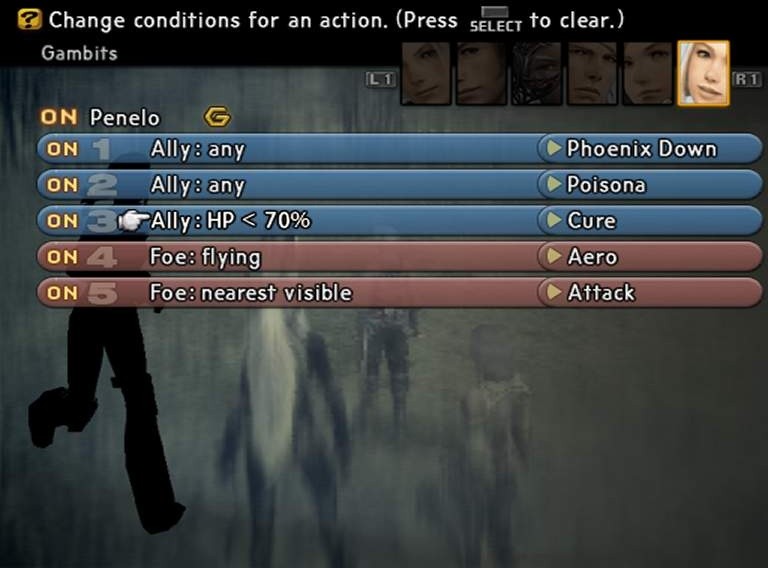
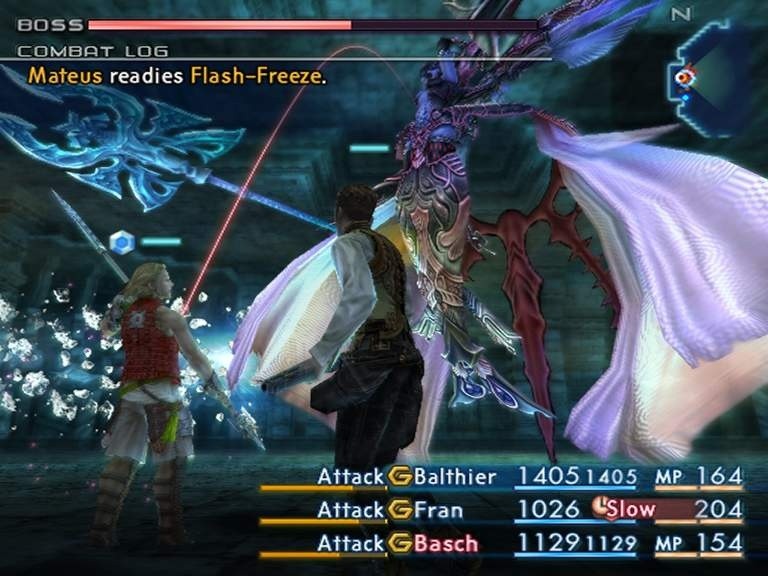
The real innovation here, though, lies in the 'Gambit system'. Each character has a certain number of Gambit slots. Each Gambit slot can be loaded with a specific command, with an extremely simple programming-like syntax allowing for some surprisingly complicated maneuvers. When loaded up, these Gambits dictate the actions of the characters within the game world. A Gambit could say 'If an Ally's HP is less than 80%, cast cure on them.' As you progress through the game, more esoteric criteria become available. Some allow you to target enemies based on their weaknesses, while others look for allies with detrimental conditions. This combat system can be overridden at any time with the simple push of a button, allowing the precision of a turn-based approach and the speed of the Gambits. Taken as a whole, Gambits allow the player to leave more of the 'nitty gritty' to the rules you've laid out. You don't have to make sure every character is healed up after a battle; they'll take care of that themselves. This frees you up to stay appraised of the whole battlefield, and in general means more fun per moment for the player. If this sounds like things are 'too easy', it should be pointed out that Gambits should either be heavily tweaked or turned off before boss battles. These non-stereotypical fights almost require a return to the series' turn-based roots, so that each character can execute the most efficient set of instructions possible. Gambits allow a wonderful blend of control and gameplay, and definitely aid in making the title the powerhouse that it is.
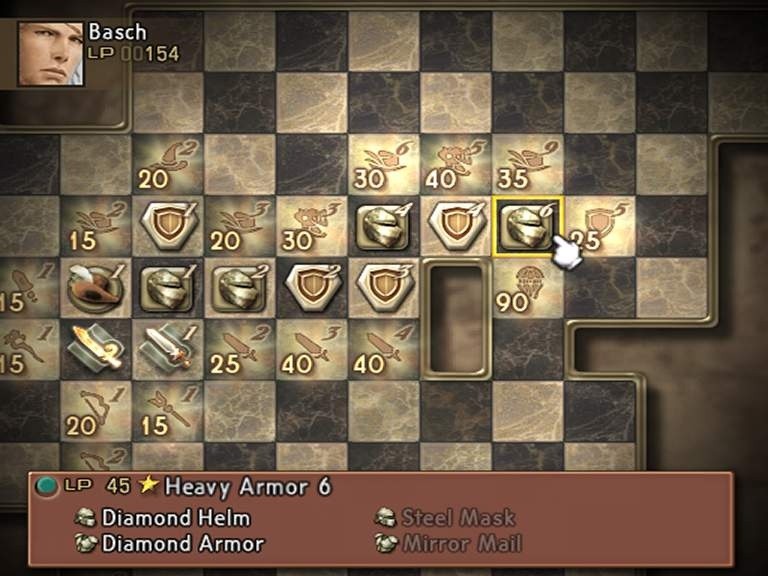
Other gameplay elements should be familiar to Final Fantasy players, but have received some additional tweaking. Each character can have their abilities focused by gaining new abilities and permissions on 'the license board'. License board points are obtained by defeating monsters, similar to but separate from the traditional experience points. While gaining levels does make a character stronger, it's the application of license points that makes them more versatile. A character focused on casting spells, for example, fills in the spellcasting part of the board with their points. There are board areas for weapons of varying types, armor, spells, simple stat buffs, and unique abilities called 'Technicks'. These last are non-magical moves that can produce a variety of quirky effects. One throws money at enemies to cause damage, while another damages opponents randomly based on what time of the day it is. These abilities, spells, and equipment are trained on the license board, but are unusable until actually purchased. While gil (the game's currency) is obtainable 'straight' from monsters, the most common way of paying the bills is by selling loot. Loot drops from monsters, and exists for no other purpose than to be sold for money. Entertainingly, you can increase your chances of gaining loot by 'Chaining'. Slaying several monsters in a row, all of which are of the same creature type, will allow you to start a loot chain. The more creatures you kill in a row of the same type, the better and more copious amounts of loot you'll receive. I've gotten chains up over 150 creatures, and by engaging in this entertaining activity it becomes easy to get the money you'll so desperately need.
Graphically, Final Fantasy XII may be one of the finest titles ever to grace the PS2. There are, of course, some jaggies and obvious pixilations. Despite that, the unique art style utilized to show off the world of Ivalice is absolutely breathtaking to behold. Character designs are iconic and memorable, while very distinct architectural styles makes it easy to understand where you are and differentiate from where you've been. They don't pull out the stops with well-imagined location concepts either, moving you from rotting tomb to scorching desert to a city floating on an island in the sky. Weather effects change locations you've been to previously, adding additional layers of complexity to an already quite dense graphical palette. Musically, the game stands shoulder-to-shoulder with the works of Nobuo Uematsu, the traditional composer for the series. Despite not being done by the master, Sakimoto's work has the same haunting weight and presence we've come to expect.
Given that the PS2's successor launched commercially in the U.S. today, it's fitting that the last-gen Sony system would see titles such as this be published on the way out the door. Along with titles like Okami and Bully, FFXII is the last gasp of a true winner in the world of videogames. The PS2 won the last generation exactly because of games like this. At the end of the day, it's not marketing or hype that makes a game great; it's solid gameplay, an engaging story, and an attractive presentation. Final Fantasy XII proves that you don't have to be 'next-gen' to be a truly great game. I only hope that the lessons learned in these late-generation titles transfer into the games of the next generation. It's always frustrating relearning things again.
The game elements of Final Fantasy XII, laid out separately, sound solid but fairly routine. Gambits are new, to be sure, but it's all pretty standard stuff. The key here is that it doesn't play like the standard stuff. Moving through the actual game in Japanese RPGs has gotten to be a real chore over the years. Unlike the freedom valued by American games in the same genre, the boxed-in storylines and gameplay have gotten mostly fairly stale. Even exceptionally good examples of the genre suffer from a a case of the been-there done-thats. All this makes Final Fantasy XII that much more enjoyable in aggregate. By stepping outside of series norms, the game's creators have had the chance to reintroduce us to the very gameplay and storytelling concepts which made the Final Fantasy series a powerhouse in the first place. I highly recommend this title to any fan of Japanese-style roleplaying games. If you've been put off by the stodgy nature of the genre in the past, I would even go so far as to say this may be the title that allows you to finally enjoy these games. Final Fantasy XII is a triumph for the series, and I sincerely hope marks the direction future games will be heading.
- Title: Final Fantasy XII
- Publisher/Developer: Square / Enix
- System: PS2
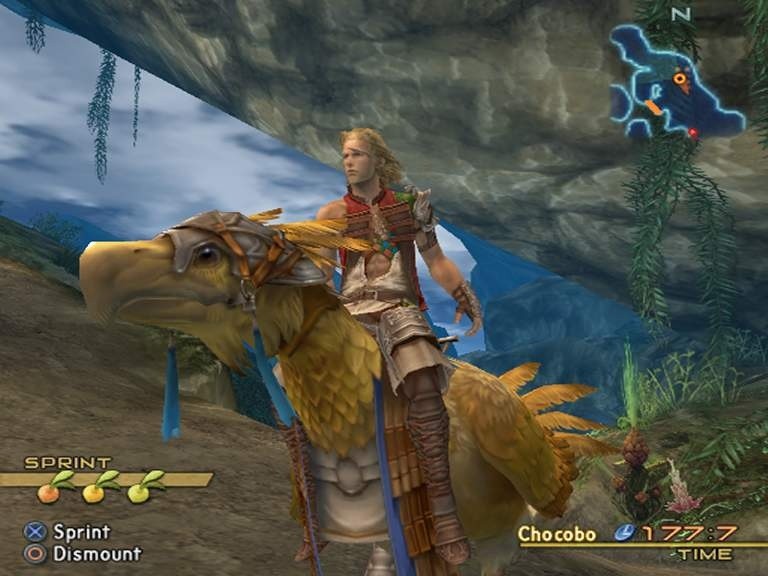
With a game as lengthy as Final Fantasy XII, a decent story would quickly become boring if you had to slog through the gameplay. In my estimation, though, the originality breathed into the tried-and-true combat system has transformed this series. Taking the best elements of the older turn-based battles and the auto-attacking tendencies of Final Fantasy XI, FFXII offers a welcome new approach to RPG combat. For starters, there are no 'random' attacks in FFXII. Monsters wander around dungeons in all their beautiful graphical glory, and whether to engage an enemy or flee is up to you. It's a welcome change, forgoing the frustration of random encounters dogging your steps on an overworld map.
The real innovation here, though, lies in the 'Gambit system'. Each character has a certain number of Gambit slots. Each Gambit slot can be loaded with a specific command, with an extremely simple programming-like syntax allowing for some surprisingly complicated maneuvers. When loaded up, these Gambits dictate the actions of the characters within the game world. A Gambit could say 'If an Ally's HP is less than 80%, cast cure on them.' As you progress through the game, more esoteric criteria become available. Some allow you to target enemies based on their weaknesses, while others look for allies with detrimental conditions. This combat system can be overridden at any time with the simple push of a button, allowing the precision of a turn-based approach and the speed of the Gambits. Taken as a whole, Gambits allow the player to leave more of the 'nitty gritty' to the rules you've laid out. You don't have to make sure every character is healed up after a battle; they'll take care of that themselves. This frees you up to stay appraised of the whole battlefield, and in general means more fun per moment for the player. If this sounds like things are 'too easy', it should be pointed out that Gambits should either be heavily tweaked or turned off before boss battles. These non-stereotypical fights almost require a return to the series' turn-based roots, so that each character can execute the most efficient set of instructions possible. Gambits allow a wonderful blend of control and gameplay, and definitely aid in making the title the powerhouse that it is.
Other gameplay elements should be familiar to Final Fantasy players, but have received some additional tweaking. Each character can have their abilities focused by gaining new abilities and permissions on 'the license board'. License board points are obtained by defeating monsters, similar to but separate from the traditional experience points. While gaining levels does make a character stronger, it's the application of license points that makes them more versatile. A character focused on casting spells, for example, fills in the spellcasting part of the board with their points. There are board areas for weapons of varying types, armor, spells, simple stat buffs, and unique abilities called 'Technicks'. These last are non-magical moves that can produce a variety of quirky effects. One throws money at enemies to cause damage, while another damages opponents randomly based on what time of the day it is. These abilities, spells, and equipment are trained on the license board, but are unusable until actually purchased. While gil (the game's currency) is obtainable 'straight' from monsters, the most common way of paying the bills is by selling loot. Loot drops from monsters, and exists for no other purpose than to be sold for money. Entertainingly, you can increase your chances of gaining loot by 'Chaining'. Slaying several monsters in a row, all of which are of the same creature type, will allow you to start a loot chain. The more creatures you kill in a row of the same type, the better and more copious amounts of loot you'll receive. I've gotten chains up over 150 creatures, and by engaging in this entertaining activity it becomes easy to get the money you'll so desperately need.
Graphically, Final Fantasy XII may be one of the finest titles ever to grace the PS2. There are, of course, some jaggies and obvious pixilations. Despite that, the unique art style utilized to show off the world of Ivalice is absolutely breathtaking to behold. Character designs are iconic and memorable, while very distinct architectural styles makes it easy to understand where you are and differentiate from where you've been. They don't pull out the stops with well-imagined location concepts either, moving you from rotting tomb to scorching desert to a city floating on an island in the sky. Weather effects change locations you've been to previously, adding additional layers of complexity to an already quite dense graphical palette. Musically, the game stands shoulder-to-shoulder with the works of Nobuo Uematsu, the traditional composer for the series. Despite not being done by the master, Sakimoto's work has the same haunting weight and presence we've come to expect.
Given that the PS2's successor launched commercially in the U.S. today, it's fitting that the last-gen Sony system would see titles such as this be published on the way out the door. Along with titles like Okami and Bully, FFXII is the last gasp of a true winner in the world of videogames. The PS2 won the last generation exactly because of games like this. At the end of the day, it's not marketing or hype that makes a game great; it's solid gameplay, an engaging story, and an attractive presentation. Final Fantasy XII proves that you don't have to be 'next-gen' to be a truly great game. I only hope that the lessons learned in these late-generation titles transfer into the games of the next generation. It's always frustrating relearning things again.
The game elements of Final Fantasy XII, laid out separately, sound solid but fairly routine. Gambits are new, to be sure, but it's all pretty standard stuff. The key here is that it doesn't play like the standard stuff. Moving through the actual game in Japanese RPGs has gotten to be a real chore over the years. Unlike the freedom valued by American games in the same genre, the boxed-in storylines and gameplay have gotten mostly fairly stale. Even exceptionally good examples of the genre suffer from a a case of the been-there done-thats. All this makes Final Fantasy XII that much more enjoyable in aggregate. By stepping outside of series norms, the game's creators have had the chance to reintroduce us to the very gameplay and storytelling concepts which made the Final Fantasy series a powerhouse in the first place. I highly recommend this title to any fan of Japanese-style roleplaying games. If you've been put off by the stodgy nature of the genre in the past, I would even go so far as to say this may be the title that allows you to finally enjoy these games. Final Fantasy XII is a triumph for the series, and I sincerely hope marks the direction future games will be heading.
Ok, so your big issue with the game is: a)boots b)not yet another mmo c)not playing a role in the story that last one is actually valid, but you don't get much of an ability to affect wow either now do you? The only game where I've ever had real ability to affect the world is in a mud, you might want to try them some time.
Although it will freak out many of the "hard core" Final Fantasy fans, this is a solid game and gives me a good feeling on the general direction of the franchise.
The reason why the "old guard players" balk at FF12 is that unlike the games before it, this one doesn't want you to micromanage the battles which gives these "old guard players" the sense they aren't doing anything. The trick is that previous games the tatics where actually fairly limited where you ended up duplicating what Gambit ends up automating. You tell your melee attackers to attack. You tell your healers to heal occationally. You tell your spell casters to zap stuff. Difference between FF12 and the others is that the game automates this for you instead of "rinse repeat" of the previous games. In the end it just degenerated to a lot of repeat actions anyway which is what computers are actually good at doing.
Gambits in themselves are interesting because it tickles the programmer in me. Given the API and resitrictions, what is the best way to "program" your party? There are several of solutions to some of the issues your party will face because just like software there are often different ways to tackle the same problem. A certain beauty can come from the correct Gambit strategy where they just do the right thing when they run into a challenging fight where it would be frantic if not hard handling the fighting yourself using the old fashion "Turn Base" or "ATB". A good Gambit order is like whiping up a good algorithm to solve a complex, somewhat losely defined problem.
This isn't a perfect game mind you. Just like FF9 it strattles "generations" and becomes an example of "what could have been". This is a glorious game pushing the envelope for PS2 where the problem is it screams for HD treatment on a more powerful machine. The weakness in the Gambit System is that it doesn't handle "one shot" actions easily. When the situation does change, you are often force to take over in an emergency situation.
Overall I'm very pleased with this game and I'm glad it is one of the "swan songs" for the PS2. From the way FF12 looks I can't wait for the next one even though most of it will be an entirely different game anyway.
From the description (complex plot, manipulated and fallen nobles, "Ivalice", etc) it's sounding an awful lot like Final Fantasy Tactics. Which is a good thing. :) Tactics was a great game. Even the bugs in the game were great -- they let you continue the game long after you normally would have been able to go little further (such as the level up/level down).
Hopefully, however, this is translated better. Summon: "Rich"
Rock Us, Dukakis.
That's his point, though, they stress suspension of disbelief to the breaking point.
People are willing to suspend disbelief for fictional stories as long as they remain internally consistent. If you create a world which contains a "highly trained" army of soldiers, and some 17-year old street urchin can out-class them after fighting various creatures for a couple of weeks, you're severely stretching the suspension of disbelief.
When you have people wielding swords that are as tall as a person that are about as effective in combat as someone chucking some form of neutrally-buoyant sports ball, you're stretching the suspension of disbelief.
So, yes, a game can stress the willing suspension of disbelief past the breaking point. In video games, though, you generally have to add a willingness to ignore completely illogical things that are done to prevent the game from sucking. So people accept the medkit being able to magically heal a guy instantly because it would suck otherwise. People accept the idea that your characters can become immensely powerful just by beating up random monsters along the country side because being forced to grind at a training dojo for a month would suck.
The suspension of disbelief required for a fantasy story may not be enough to get over the completely illogical concepts a game has for gameplay reasons, but for the game to be fun, you have to accept some compromises for realism. I don't know how Solid Snake manages to carry 20 guns, three cardboard boxes he can hide in, and assorted equipment, on his person, but it's more fun that way.
You are in a maze of twisty little relative jumps, all alike.
Well, yes, you could play wow and join the hordes of other people down the same cave as you all fighting copies of the same respawning monster as you in a world where no matter what anyone does, everything looks exactly the same every day. Give me a real RPG any day over games like World of Groundhog.
Doesn't it make you feel good to know that our freedoms are protected by politicans, lawyers and journalists.
People like to have a "main character" in movies, books, and games. It helps them to identify with the situation much better. Most of the strongest games (from a storytelling perspective) are ones with a strong lead character. Vaan is a good one because, as ou say, they represent the normal person. Most people would have trouble identifying with a Sky Pirate or Princess, but identifying with a 17 year old orphan is easy. This is why most fantasy books start off with the main character being a commoner who, unknown to him has magical powers/is prophesized/etc. It starts you somewhere you're familiar (bein a normal person) and greadually works you into being someone special. It makes you feel as if it could really happen to you.
Remember kids, tin foil doesn't work, so use LeadHat.
But Microsoft took a different approach than Sony that is just as valid, and perhaps more (at least in my opinion).
Microsoft made the 360 similar to the architecture of a regular PC. Meaning that games can be easilly ported to both platform.
For example, Square, the makers of the Final Fantasy franchise, have said that it took them around two months of coding to port Final Fantasy XI to the 360 (from it's PC version). They have also said that the same job would have taken them around 2 years to port it to the PS3s architecture since it is entirely new and "alien" to anything already existing. The entire core of the game would need to be re-written.
This means a bigger library of games for both the PC and the 360 platform. That compatibility has a tendancy to attract numerous different games based on numerous engines instead of making more similar games that uses engines adapted to a singular platform like those made by Sony.
Also, i think the fact that people are camping out for a PS3 is more due to the massive shortage of it than any "good" design made by Sony...