Slashdot Mirror


USPTO Examiner Rejected 1-Click Claims As "Obvious"

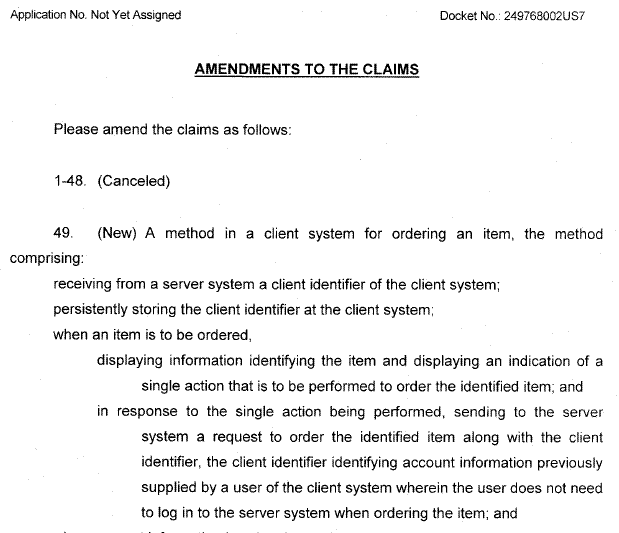
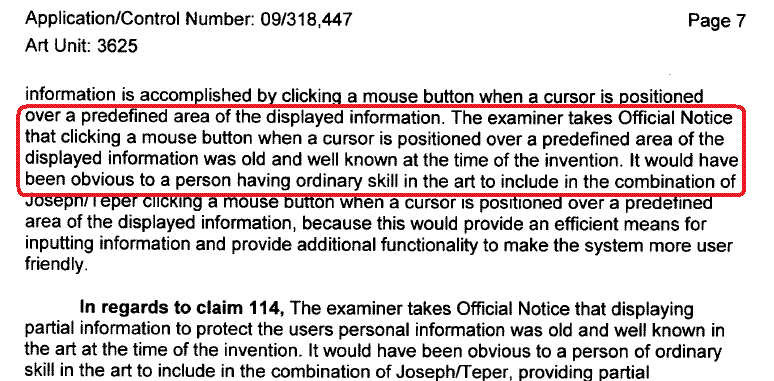
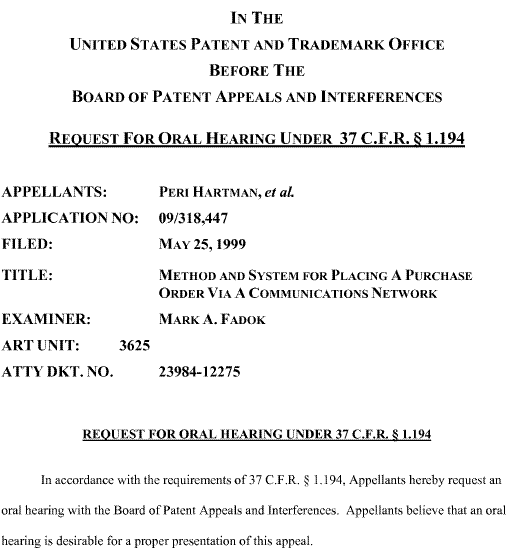
theodp writes "Faced with a duly unimpressed USPTO examiner who rejected its new 1-Click patent claims as 'obvious' and 'old and well known,' Amazon has taken the unusual step of requesting an Oral Appeal to plead its case. And in what might be interpreted by some as an old-fashioned stalling tactic, the e-tailer has also canceled and refiled its 1-Click claims in a continuation application. As it touted the novelty of 1-Click to Congress last spring, Amazon kept the examiner's rejection under its hat, insisting that 'still no [1-Click] prior art has surfaced.' The Judiciary Committee hearing this testimony included Rick Boucher (VA) and Howard Berman (CA), both recipients of campaign contributions from a PAC funded by 1-Click inventor Jeff Bezos, other Amazon execs, and their families."
51 of 195 comments (clear)

  1. Computers automate work by Anonymous Coward · · Score: 5, Insightful

    Probably 99% of patents where computers do work that could be done tediously and manually should be shot down.

    1. Re:Computers automate work by fmstasi · · Score: 5, Interesting

      No, all software patents should be shot down. Patents should only be given to inventions which operate in the physical world — mechanical devices, tools, electronic equipment, and so on. Patenting software is (more or less) patenting algorithms, and therefore to patenting mathematics; on the other hand, research works much better if information is shared freely. Also, software is already covered by copyright, so protecting it with patents also is overkill. Also... well, there are many reasons why software patents are a terrible idea. Everybody with an interest more than casual in the subject whould get familiar with the arguments given in http://www.nosoftwarepatents.com/.

    2. Re:Computers automate work by dosquatch · · Score: 4, Insightful

      A computer is a general-purpose machine. A computer's purpose is to process an organized collection of instructions to do a specific thing. These instructions are called "software". A computer without software is a doorstop. Patenting a particular collection of instructions (even if they do something really, really interesting) is, in effect, patenting the use of a thing for its intended purpose.

      It would be akin to patenting "a method for dialling my phone number" and then going after royalties every time my phone rings. Or "a method for using an automobile to get to work" and suing everyone in rushhour traffic.

      --
      "Hey, the third matrix movie would have been good except for the plot,story, and acting." --AC
    3. Re:Computers automate work by 4D6963 · · Score: 3, Interesting

      No, all software patents should be shot down. Patents should only be given to inventions which operate in the physical world.

      Software can operate in the physical world. That's why the USPTO started allowing software patents in 1981. Anyways, I like the europeean take on software patents, which says that "any invention which makes a non-obvious "technical contribution" or solves a "technical problem" in a non-obvious way is patentable even if a computer program is used in the invention." http://en.wikipedia.org/wiki/Software_patent#In_Eu rope

      I just don't see anyone can be against that.

      --
      You just got troll'd!
    4. Re:Computers automate work by fmstasi · · Score: 5, Insightful

      Well, that's the beauty of Wikipedia: I read the section of the article you quoted, and in this case I don't trust the author. Here is the text of the cited Article 52 (http://www.european-patent-office.org/legal/epc/e /ar52.html):

      Article 52
      Patentable inventions
      (1) European patents shall be granted for any inventions which are susceptible of industrial application, which are new and which involve an inventive step.
      (2) The following in particular shall not be regarded as inventions within the meaning of paragraph 1:
      (a) discoveries, scientific theories and mathematical methods;
      (b) aesthetic creations;
      (c) schemes, rules and methods for performing mental acts, playing games or doing business, and programs for computers;
      (d) presentations of information.
      (3) The provisions of paragraph 2 shall exclude patentability of the subject-matter or activities referred to in that provision only to the extent to which a European patent application or European patent relates to such subject-matter or activities as such.
      (4) Methods for treatment of the human or animal body by surgery or therapy and diagnostic methods practised on the human or animal body shall not be regarded as inventions which are susceptible of industrial application within the meaning of paragraph 1. This provision shall not apply to products, in particular substances or compositions, for use in any of these methods.

      So, "programs for computers" (and algorithms, mind you) are not patentable, period. IF you use a program for computers in a LARGER system, the system as a whole is (maybe) patentable. The point is not whether you solve a "technical problem" with the program; what else could you be doing, turning the computer's fingers?...

    5. Re:Computers automate work by crc32 · · Score: 2, Insightful

      Under your logic, nothing at all could be patented. After all, a gear is an "instruction" for the conversion or translation of angular motion. All machines are merely sets of instructions, at some level of abstraction. Patents are designed to cover the use of things. See section 101 of the patent act. PS: This is not to say that software patents are good/bad for other reasons.

      --
      "In order to make an apple pie from scratch, you must first create the universe." -- Carl Sagan, Cosmos
    6. Re:Computers automate work by dosquatch · · Score: 3, Insightful

      That's why the USPTO started allowing software patents in 1981.

      Technically, they didn't. Software is not, nor has it ever been, patentable as software. Software patents all come in under the ruling that allows business methods to be patented. That's why they all begin "A method for [...]" and go to such lingual gymnastics to avoid using the word "algorithm" ever.

      It might seem that this point is splitting a hair, but this happens to be a very important hair.

      --
      "Hey, the third matrix movie would have been good except for the plot,story, and acting." --AC
    7. Re:Computers automate work by kthejoker · · Score: 2, Informative

      It means if you invent a new automated welder, which relies on computer input to produce its output (but also does the actual welding), then this program in tandem with the welder would be considered a patentable device.

      It basically means that just because something uses a computer program doesn't mean it's *not* patentable. It's something you have to think about for a second, but it makes sense. It lets people patent things like ATMs, printers, and electronic parking meters.

    8. Re:Computers automate work by fmstasi · · Score: 2, Interesting

      Right. It also means that you are patenting the device, not the program; so, if you patent an innovative device, which uses an innovative program, the program itself is not patented.
      In theory, at least.

    9. Re:Computers automate work by Smidge204 · · Score: 4, Insightful

      That argument doesn't quite hold up.

      Discrete machine elements are the means to execute an instruction, not the instruction itself.

      The gear or linkage is the element that enables execution of the instructions and should be patentable. The speed, position or displacement of the gear is the instruction and should not be patentable. To get a different output for the same input, you must alter the elements to the extent that it can no longer be considered the same device. Unique devices can qualify for a patent.

      The transistor is the element that enables execution of instructions and should be patentable. The state of charge on a transistor is the instruction and should not be patentable. To get a different output for the same input, you need only change the state of charge on the transistors* - but the physical state of the machine is identical.

      The important distinction is the seperation of the physical device and it's purpose from the conditions it operates under. Two devices that serve the same purpose but are physically unique should be patentable. Two devices that are physically identical but used for different purposes should be patentable.** Altering the operating conditions of the same device to get a different result is obvious and should not be patentable.

      =Smidge=

      * - Does not count things like a new circuit design, which would produce a unique device and thus be patentable.

      ** - Providing that new use is not particularly "obvious."

    10. Re:Computers automate work by ancientt · · Score: 3, Interesting

      Level of abstraction? Okay, explain how you're a walrus.

      Software patents make as much sense as mechanical patents because both cover how to change something in one state to something that might be more useful in a different state. The usefulness of the patent is up for debate as it would be in any new industry, as is the innovation. The debatable questions are whether the innovation that goes into creating something that is novel in software deserves a patent, and whether allowing patents in software is good for society. Once those questions are sufficiently answered there will always be the secondary questions of a particular patent's worthiness, but it will be far easier to answer.

      --
      B) Eliminate all the stupid users. This is frowned upon by society.
    11. Re:Computers automate work by Bloke+down+the+pub · · Score: 2, Insightful

      Ooops. Here comes Microsoft with a program that looks, acts, and feels EXACTLY the same. Microsoft makes millions and millions. Your father makes... nothing. You get nothing. Your father hires a lawyer, spends hundreds of thousands of dollars chasing Microsoft around in court, Microsoft gets away without paying a dime. That's what life would be like without software patents.
      Not really, if it's that close a ripoff wouldn't it be covered by copyright? It's really just the same as rewriting a novel and changing the hero's name from Jake Grafton to Jack Griffin and sticking a different picture on the cover.
      --
      It's true I tell you, feller at work's next door neighbour read it in the paper.
    12. Re:Computers automate work by Laur · · Score: 2, Insightful

      Also, software is already covered by copyright, so protecting it with patents also is overkill.
      Even worse, software can (and frequently is in the US) protected by copyright, trade secret, and patents, all at the same time. In addition, vendors try to restrict your rights even further by draconian licenses. Overkill indeed.
      --
      When you lose something irreplaceable, you don't mourn for the thing you lost, you mourn for yourself. - Harpo Marx
    13. Re:Computers automate work by dgatwood · · Score: 3, Insightful

      Your argument fails to take into account the purpose of patents: to promote the progress of science and useful arts. Almost anything patentable in the physical space is doing something in a new way. Seeing the device is not enough to understand how it works, and the patent is designed to force the "how" to become public.

      In ssoftware, with the exception of mathematical algorithms (which are excluded from patents), the "how" part is always obvious to someone skilled in the art. Tell a skilled programmer what something does, and they will be able to write a piece of software that does the same thing. There is nothing for the human race as a species to gain from forcing that knowledge to be public. Whether the "how" is "implements the foo algorithm" or "supports purchasing without a shopping card", as soon as the question is asked, the solution is always obvious.

      Thus, the question is whether it should be reasonable to allow patents on something based solely on who did something first without regard to whether any first-year college grad would have done the same thing given the same set of problems. I would contend that the answer is no, that software should not be patentable because the entire process for creating software is obvious except for the very specific details of the source code.

      That said, if you want software patents, I would be willing to concede their usefulness if and only if they provide substantial "how" information that could not have been guessed---in other words, if applying for a patent meant making the source code for the patented portion open source and outside the scope of copyright. Copyright or patents: choose one. Allowing software to be both copyrighted and patented is wrong. There is no reason why software should have special protection above and beyond all other technical fields.

      As for one-click, no one else implemented it before because it was a fundamentally moronic idea. The last thing I want is to be able to spend money just by clicking on a link. I want some reasonable protection against accidental spending, and I want verification against somebody sitting down at my machine and buying something without me knowing it. No one did it before because the usefulness of the idea was not obvious, not because the idea or design itself wasn't obvious. There is a difference.

      Just my $0.02.

      --

      Check out my sci-fi/humor trilogy at PatriotsBooks.

  2. wtf? by User+956 · · Score: 4, Insightful

    'still no [1-Click] prior art has surfaced.'

    How can something surface when you're actively trying to drown it?

    --
    The theory of relativity doesn't work right in Arkansas.
    1. Re:wtf? by Anonymous Coward · · Score: 4, Insightful

      09 f9 11 02 9d 74 e3 5b d8 41 56 c5 63 56 88 c0

    2. Re:wtf? by Bloke+down+the+pub · · Score: 2, Funny

      You want prior art for 1 click? What about those old-style vending machines - you only had to press the button once to get the chocolate bar or can of soda. I say old-style because the new ones need 98 keypresses and a working knowledge of XML to get anything out of them. I guess that's progress.

      --
      It's true I tell you, feller at work's next door neighbour read it in the paper.
  3. I remember hearing about the 1 click patent by burris · · Score: 5, Insightful

    Back in '95 or '96. We all thought it was so plainly obvious. In fact, the key thing that makes one-click shopping possible, the browser cookie, was put into the browser specifically for the purpose of associating a browser/session with stored data on the back end (payment/shipping details, purchase list.) The reason nobody did it is because engineers thought it was a BAD IDEA. Forcing people to enter their credit card and billing address details was a form of SECURITY. Being able to purchase things with one click was just too easy. Someone could come up to your computer and ring up a bunch of charges. Keeping payment details for thousands of customers on your computer was deemed too large a risk. It wasn't until the Marketeers at Amazon thought this was a good idea that it came about.

    However, I think the fact that the cookie support was already in the browser is proof that the claims of the patent were obvious.

    1. Re:I remember hearing about the 1 click patent by catbutt · · Score: 5, Insightful

      Well if what you say is true, no one should really complain if no one but Amazon can do it. After all, its a bad idea.

      Just sayin'.

    2. Re:I remember hearing about the 1 click patent by caffeinemessiah · · Score: 3, Insightful
      Forcing people to enter their credit card and billing address details was a form of SECURITY.

      It seems you're using security as an argument against implementing 1-click. If thats the case, the argument isn't very well thought out. Even without 1-click, most sites offer to save your credit card and billing address, so it's just a matter of selecting which credit card to use without typing it in again. Furthermore, if someone comes up to your computer and rings up a bunch of stuff with 1-click, (a) the stuff's coming to your address anyway so they better be snooping your postal mail too (b) they would have to be authenticated with a username/password first to establish the cookie/session, unless you're in the habit of leaving un-expired sessions open on a public terminal and (c) if they had (b), they could do exactly the same thing without 1-click with ... TADA... just a few more clicks and your saved billing info!

      So it seems your reasons for not pioneering 1-click have more to do with saving credit/billing information on your own supposedly secure server rather than with the idea of 1-click itself. I don't see how that translates to 1-click being a BAD IDEA.

      --
      An old-timer with old-timey ideas.
    3. Re:I remember hearing about the 1 click patent by heinousjay · · Score: 2, Funny

      ...and the fox turned as he walked away, muttering "damn grapes were probably sour anyway."

      --
      Slashdot - where whining about luck is the new way to make the world you want.
    4. Re:I remember hearing about the 1 click patent by seanadams.com · · Score: 2, Insightful

      The reason nobody did it is because engineers thought it was a BAD IDEA.

      I think the 1-click patent is a crock for many reasons, but to play devils advocate here: this point actually undermines the obvious argument, because it suggests that people in the field thought it could not be done. When prior art teaches _away_ from doing something in a particular way, and the patent in question finds a way to "make it work" in spite of that, then the solution is likely to be deemed non-obvious. From the Teleflex ruling;

      The Court relied upon the corollary principle that when the prior art teaches away from combining certain known elements, discovery of a successful means of combining them is more likely to be nonobvious. Id., at 51-52. When Adams designed his battery, the prior art warned that risks were involved in using the types of electrodes he employed. The fact that the elements worked together in an unexpected and fruit-ful manner supported the conclusion that Adams's design
      was not obvious to those skilled in the art

    5. Re:I remember hearing about the 1 click patent by FST777 · · Score: 4, Insightful

      This patent is not the point. Software patents in general are the point. Especially those which are so patently obvious that any examiner who deems it patentable should be taken out and shot.

      --
      Free beer is never free as in speech. Free speech is always free as in beer.
    6. Re:I remember hearing about the 1 click patent by mysidia · · Score: 3, Insightful

      The reason nobody did it is because engineers thought it was a BAD IDEA. I think the 1-click patent is a crock for many reasons, but to play devils advocate here: this point actually undermines the obvious argument, because it suggests that people in the field thought it could not be done. When prior art teaches _away_ from doing something in a particular way, and the patent in question finds a way to "make it work" in spite of that, then the solution is likely to be deemed non-obvious. From the Teleflex ruling;

      Not really. It's different to say that people in a field to know how something could work and consciously decide it SHOULD NOT be done than to think that something CAN NOT be done.

      One-click is obvious, from a marketing/business method point of view. From a technological point of view, the way it can be done is obvious. It is at the point of risk assessment, "is the technology safe", where enginners would conclude it should not be done, despite it being an obvious system.

      Amazon's patent is not about a way of making one-click secure or safe. It is insecure, and it suffers from the problems that would lead engineers to believe it should not be done. It is risky in the sense that if you leave a browser open, your 12-year old could possibly get on your computer, find some $1000 product they want, hit the one-click buy, and complete an order using your saved credentials. Or if your next door neighbor figures out your one-click-site password, they could possibly one-click order some toy, and intercept the delivery.

      It was just as much a security risk back then as it is today, and just as obvious then as today. The difference is, since one site chooses to do it, customers require it now -- they know how to complete a transaction on Amazon, due to the site's popularity, and their familiarity with the process. Over time, people have come to accept that it's OK to save their CC information with a website, DESPITE the substantial risk of id theft involved in allowing any merchant to retain that sort of information.

      If customers have to enter their details on other sites, repeatedly, then they will be inconvenienced, so without considering the security implications: they will tend to stay with the sites that save their credentials, because it provides an upfront convenience, and the customers aren't thinking who use one-click aren't thinking enough about the security. Customers don't tend to think these things through, they offer a competitive advantage, despite the defects.

      Certainly Amazon does not advertise one-click can possibly pose a security risk, despite the fact that it may.

    7. Re:I remember hearing about the 1 click patent by Colin+Smith · · Score: 4, Insightful

      So it seems your reasons for not pioneering 1-click have more to do with saving credit/billing information on your own supposedly secure server rather than with the idea of 1-click itself. I don't see how that translates to 1-click being a BAD IDEA. Um. Because 1 click requires one to store the credit card information in database.

      OK, try to follow me here. If it's not a great idea to store credit card information in a potentially exploitable database and 1-click requires said store of credit card information in said http://news.com.com/2100-1023-236815.html">exploit able database it follows that 1-click is a bad idea.

      This is what is often called logic.

      --
      Deleted
    8. Re:I remember hearing about the 1 click patent by el+americano · · Score: 3, Insightful

      I tried this feature once. My order was promptly shipped to a prior address. I guess there's more than one reason to have an intermediate step before confirming the order.

      One click is now turned off for me.
      I wonder if that's part of the patent, "AND you can turn it off. Oooooh."

      --
      Those are my principles. If you don't like them I have others. -Groucho Marx
    9. Re:I remember hearing about the 1 click patent by decsnake · · Score: 2, Insightful


      Certainly Amazon does not advertise one-click can possibly pose a security risk, despite the fact that it may.

      d'ya think that the fact that its not on by default might be a hint to folks that its not secure? And that they know it?

    10. Re:I remember hearing about the 1 click patent by anothy · · Score: 4, Informative

      This is what is often called logic.
      sigh. yes, it's often called that.

      in logical terms, your argument is valid, but unsound; that is, at least one of the premises is untrue. specifically, you assert that "1-click requires said store of credit card information in said exploitable database", and your (mis-)linked example indicates that "said" database is a vendor's. that is not in any way required for 1-click to work. in common practice in online shopping sites generally, 1-click or no, the credit card number is sent one time to the CC processor, who responds with a unique key that the vendor uses in subsequent transactions. that key, not the CC number, is then stored in the database and used for subsequent transactions. the number is useless to anyone other than the initial vendor, thus eliminating the financial exposure to customers if the vendor's database is cracked.

      it's tempting to point out that this practice, which is generally considered best practice in the payments inudstry, simply shifts the burden from the vendor to the processor. this is untrue; instead, it reduces the exposure. the CC processor has this anyway; we're simply reducing the burden on the vendor. if the fact that the processor stores the information bothers you, then your argument is against credit/debit cards in general, not 1-click (and it'd be a reasonable argument to make; the entire system is frighteningly fragile).
      --

      i speak for myself and those who like what i say.
  4. No prior art is hand waving by Wizarth · · Score: 4, Insightful

    "No prior art" is being waved about as being the only significant aspect, and they are hoping no-one realizes the patent was rejected due to being obvious (or, not non-obvious).

    As prior art is the usual counter-argument to patents, since it can be clearly proven to someone without expertise in the field, it seems unusual that one has actually been rejected due to being obvious. And since people are so used to hearing about prior art being the significant factor, it may sway a few people.

    1. Re:No prior art is hand waving by seanadams.com · · Score: 4, Insightful

      True in the past, but the tides have started to turn as of the Teleflex ruling. Obviousness has for a long time been very difficult to show because the courts had used a too rigid definition. However, SCOTUS has said that merely using components in a way that their combination yields only the expected result could be sufficient, and has also encouraged the use of "common sense" in determining obviousness, as opposed to the very narrow test. I hope to see a lot more BS patents like this invalidated in the coming years.

  5. Prior art or not by Opportunist · · Score: 3, Insightful

    If something is SO obvious that any moron can come up with it, it deserves no patent.

    Patents exist so investition in research and development can be reimbused. If you have no expense for research and development, you deserve no patent.

    --
    We used to have a Bill of Rights. Now, with the rights gone, all we have left is the bill.
    1. Re:Prior art or not by seanadams.com · · Score: 4, Informative

      If something is SO obvious that any moron can come up with it, it deserves no patent.

      Actually it is even broader than that. A patent is considered obvious if not merely a moron, but even someone having ordinary skill in the relevant field, could have been expected to come up with the same solution.

      Patents exist so investition in research and development can be reimbused.

      Not quite. They exist to encourage invention, by securing the inventors exclusive right to produce his inventions. If the inventor happens to have some sunk costs then he might be better able to recover them by having a patent, but that is incidental.

      If you have no expense for research and development, you deserve no patent.

      So what if an idea comes by a stroke of pure genius?

    2. Re:Prior art or not by petermgreen · · Score: 5, Informative

      Patents exist so investition in research and development can be reimbused
      no they exist (at least under the american system) primerally to discourage trade secrets. You give your invention to the public in exchange for getting a time limited (and unlike copyrights patent time limits havn't exactly spiraled out of control) monopoly on the invention. Whether your idea is the result of years of R&D or a stroke of genius isn't really relavent.

      sadly the system has been abused in a number of ways
      1: obviousness: many patents give soloutions that would be obvious when presented with the problem. This means that next time someone runs into that problem they either have to pay the patent holder a license fee (if the patent holder will even accept one), take the legal risk of ignoring the patent or try and find a less obvious (and possiblly less efficiant) soloution to the same problem.
      2: prior art: again the system has been very poor at recognising prior art leading to people getting and keeping patents for things that are already public.
      3: areas patentable: a number of new areas (software, buisness methods) were made patentable by court descisions bypassing the normal procedures of governement. Now other countries are being pressured into making those things patentable as well. The lack of patented prior art (which is all the PTO seems to care about) means theese areas suffer from 1 and 2 far more than other areas.

      --
      note: i'm known as plugwash most places but i screwd up registering that here somehow in the past and now can't register
  6. This is only the start by deblau · · Score: 4, Insightful

    Expect more applications to get section 103 "obviousness" rejections, in the wake of KSR v. Teleflex.

    --
    This post expresses my opinion, not that of my employer. And yes, IAAL.
  7. Standard Patent Prosecution Procedure by aimless · · Score: 4, Insightful

    Nothing Mentioned here is out of the ordinary. All applications are rejected at least once...if it is not rejected your council has done something terribly wrong and drawn narrow-scope claims that will not yield any protection or competitive advantage. Cancellation and continuation are standard strategy as well. It would be more interesting to find that they were given a divisional; implying validity.

    I thought the one-click patent was brought to its knees by the /. community riding on the back of an old ski-lift ticket system as prior art.

    -A

    1. Re:Standard Patent Prosecution Procedure by Anonymous Coward · · Score: 5, Informative

      Mostly correct and I am glad someone said it, but ... minor point
      It would be more interesting to find that they were given a divisional; implying validity.
      Actually a divisional (aka a restriction requirement) says absolutely nothing about validity. What it says is you have a lot of claims in your application and the Examiner isn't going to be bothered to look at all of them. Split the application into multiple applications (so the Examiner gets more points, and the PTO more money) and then they'll look at the claims.

      Yes, pretty much everything gets a 103 (obvious) rejection. Sometimes this only means your Examiner put all your key words into a search engine and cited 5 unrelated pieces of prior art against you (i.e. the lazy Examiner). Sometimes, the 103 is well done. Merely telling me you have a 103 rejection tells me little.

      A continuation isn't a stalling tactic. It is a way to get better claims with the same filing date as the original, but after getting a look at the cited prior art. Perfectly normal. In fact, you often use a continuation with a "bird in the hand" strategy. You take the claims the Examiner allows in the parent application (which then issue as a patent), and then continue to argue the unallowed claims in the continuation. There is no stalling. Actually, a continuation is quicker than an appeal.

      I am glad to see an Examiner taking Official Notice. They do it rarely and even more rarely do it correctly. There is a correct way to take Official Notice and so few Examiner's follow it.

      Also the Oral Hearing in the Appeal is unusual, but something they are allowed by right. What is usual is waiving that right and just not showing up. But if Amazon has DC based attorneys, the PTO is just down the road.

  8. Boucher no slouch by GigsVT · · Score: 3, Informative

    That jab at Boucher is probably unfounded. He's definitely concerned about "IP" laws run amok, contributions notwithstanding.

    --
    I've had enough abrasive sigs. Kittens are cute and fuzzy.
    1. Re:Boucher no slouch by CptNerd · · Score: 2, Insightful

      This is Slashdot, where you can be praised to the stars one week and subject to "Two Minute Hate" the next. As far as contributions go, the conventional "wisdom" is that they always corrupt, no exceptions. Therefore, we should only elect people who have enough money to afford the election. Wait, no, we should never allow people to contribute to campaigns. No, wait, wait, we should only allow campaign contributions from the "right" people. Hm, well, we should all be taxed to pay for anyone and everyone who wants to run for office. Um, that is, not *everyone* or *anyone*, only the ones who "qualify" to run.

      Anyway, Boucher is now one of the "bad guys" because he took money from the current "bad guys". Next week we will be at war with Eastasia again...

      --
      By the taping of my glasses, something geeky this way passes
  9. Same trick? by Woodpeckeruk · · Score: 2, Interesting

    Amazon tried the same trick at the EPO (see IPKat post here), and got the application kicked out.

  10. There is prior art by jkechel · · Score: 5, Interesting

    http://en.wikipedia.org/wiki/Stellar_Crisis .. this game is from 1993, and you can buy in-game things with only one click. DONE

    1. Re: There is prior art by jkechel · · Score: 2, Interesting

      I know that the patent has a narrow scope, that's exactly why I proposed a browser-based game as prior art:
      1. its under control of a client
      2. provides information about the item (you can see what you want to buy including a descriptive name)
      3. only one action, that's the 1-click, by simply clicking on that item (also known in many many newer games like Command&Conquer where you buy&build by one click on a item)
      4. organising further informations about the user -> that's keeping track of you current score/stats in the game
      5. creating a 'order' .. well, simply DO assign the item to the user
      6. Not using a shopping-cart .. well, i don't know a single game using a shopping cart :)

      so, now please compare this to the patent itself: http://www.google.com/patents?id=O2YXAAAAEBAJ&dq=5 ,960,411

      -- cut --
      1. A method of placing an order for an item comprising:

              under control of a client system,

                      displaying information identifying the item; and
                      in response to only a single action being performed, sending a request to order the item along with an identifier of a purchaser of the item to a server system;

              under control of a single-action ordering component of the server system,

                      receiving the request;
                      retrieving additional information previously stored for the purchaser identified by the identifier in the received request; and

              generating an order to purchase the requested item for the purchaser identified by the identifier in the received request using the retrieved additional information; and
              fulfilling the generated order to complete purchase of the item
              whereby the item is ordered without using a shopping cart ordering model.

      -- end cut --

  11. "Put it on my tab" by dfoulger · · Score: 5, Insightful

    One-click has been around as long as bartenders have been extending credit to known customers, but I suppose you can't see prior art rising when its obscured by a head of foam.

    --
    Davis http://davis.foulger.net
    1. Re:"Put it on my tab" by Anonymous Coward · · Score: 3, Interesting

      There was a company (And still is) that had a patent on using the "*" and "#" key on your phone, but, only when calling Directory Assistance. Called "Metro One" (NASDAQ:INFO if they aren't delisted).

      Now, if Obvious was somehow forgotten in the world of telephony, I don't know what is in the rest of the world. But they had the patent based on "business process". How is using the * key different for a person calling 411 vs calling the local Energy company, or their own PBX? I don't know.

      But, they actually won a lawsuit after a competitor in the "411" business allowed their own customers to use the * and # keys on the DTMF phones (and DTMF tones were designed to allow for systems to interpret them for custom needs, with no specified control... so.. yea...) And they won!

      This is another case of very very very very very bad Patent law.

  12. Oral Appeal? by johnny+cashed · · Score: 4, Funny

    Mr. Examiner,

    I'd like to introduce you to our spokeslawyer, Heidi. She is ready to meet with you for her oral appeal.

  13. Hacking Congress ... again by supersnail · · Score: 4, Insightful

    In much the same way that script kiddies and east european phishers all know how to hack PCs. All of corporate America knows how to hack congress.

    Most hacks require only simple tools: PACs, straight contibutions, that important meeting with the lobbyist that needed to be in the lobby of a Hawian hotel.

    Some hacks require more subtle tools: "Where was I gonna site that factory - remind me?", "You know if you ever get tired of congress and want a real job.", "I have absolutly no control over the editors of my newspaper/TV station if they print bad things about you thats tough."

    It happens so regularly it doesnt even raise eyebrows anymore. So Bezos will probably lose his patents until congress changes the law so he can get them back.

    Wouldnt it be much more efficient and simpler to introduce a "pay per vote" system. Represenitives could auction of votes on e-bay, and, the house seat themselves could be auctioned by the higest bidder. (This is a varation on tax farming which served to Ottoman empire well for 600 years).

    The sad thing is that while all this malarky is going on Wolfowitz and Bolten are lecturing the rest of the world about the evils of corruption.

    --
    Old COBOL programmers never die. They just code in C.
  14. Amazon is a victim of the patent system, not v-v by joe_n_bloe · · Score: 4, Insightful

    Corporations have never determined the direction of the patent system. Corporations are legally and ethically bound to pursue business practices that are in the interests of shareholders. When the software patent genie was let out of the bottle in the 1980s, software companies had absolutely no option except to pursue their own patents vigorously.

    Amazon has never done the wrong thing by pursuing the "one-click" patent. Patents, especially software patents, are interpreted very narrowly. What sounds to a layman as a "patent on online sales" (for example) turns out to be much more specific in print, and more importantly has been interpreted very narrowly by Federal courts. You can't patent the process of online sales, but you can patent a detail of it. When a court sets out to determine the validity of such a detail, it doesn't examine it in the context of "is it a logical implementation of a larger, obvious system." The court sets out to determine whether it is a detail that someone else has used. Basically, as the law has been interpreted for the past two decades, whether something has already been patented is the greatest determining factor on whether it can be patented. That isn't how a layperson reads the law, and in fact it is probably contrary to the intent of the law. But that's how it is.

    The US Supreme Court has indicated an interest in changing the interpretation of software and process patents so that courts must interpret patents and patent applications in a way that sounds more in the spirit of the law. I don't think most conventional companies oppose this, because the expense and uncertainty involved in patent applications, cross-licensing, and God forbid, litigation, is considerable. Patent holding firms are probably distressed about it, but I think most people perceive patent holding companies as an aberration.

    The fact that Amazon has its "one-click" patent means that Amazon was doing the right thing as far as the system is concerned. It also means that the system is counterintuitive and, a majority of people probably think, out of whack with the original intent of US patent law.

  15. So did the Jetsons by cheekyboy · · Score: 2, Interesting

    Somehow I guess the IT geeks that write the patents forget that they got their ideas as 5 year olds watching the Jetsons and seeing
    them buy stuff on a 200inch plasma screen using voice recognition to the virtual shopping channel.

    A TV show can be prior art as it showcases the concept and idea perfectly so that even a 5 year old can understand it let alone a CEO earning $6m dollars.

    --
    Liberty freedom are no1, not dicks in suits.
  16. Re:Amazon is a victim of the patent system, not v- by Aladrin · · Score: 3, Insightful

    Get your head out of your ass for a moment.

    Just because something is legal and possible does NOT make it 'right'. If it was found that it was legal to kill people by some method, does that make it right for everyone to kill everyone they can by that method? Too extreme? How about a corporation that takes advantage of the tax system to pay as almost no taxes, so that everyone else has to pay their share? How about police that run reds lights in their cars because it's legal for them to, even when they don't have the need? How about a teacher that hands out religious pamphlets right outside the school grounds? How about someone standing outside a playground and screaming at the children?

    I bet I just hit on the sensibilities of most of the people that read this. There's plenty of examples of things that are totally legal, but not 'right' in any way.

    Amazon may be within their rights to attempt to patent this, but that does not mean they are 'doing the right thing' in any way shape or form. Amazon should be considering their customers in this. If it angers your customers, it's probably not a good idea. Since any global online retailer's goal is to have the whole world as customers, they should be thinking about everyone.

    --
    "If you make people think they're thinking, they'll love you; But if you really make them think, they'll hate you." - DM
  17. Re:it should be "braver than I" by julesh · · Score: 2, Informative

    because you would say "braver than I am".

    Err, no it shouldn't. Saying "A is braver than B" is perfectly grammatical. "A is braver than B is" is reduntant, and generally frowned upon. Following "than" in the former case should be an indirect pronoun, in this case "me".

    Your grammar-nazi status has been hereby revoked. Heil Fowler!

  18. How about refunding license payments if this falls by melted · · Score: 2, Interesting

    How about refunding license payments if this falls through? That'd be cool. Say, you've filed a patent and started charging people licensing fees based on the patent that's not yet granted. The patent is rejected. Shouldn't you refund the licensing fees? Can we do this for all patents, so that there's penalty for filing shitty, obvious patents, or patents where prior art exists?

  19. I'll tell you why by djw · · Score: 2, Insightful

    If someone develops a truly novel business model, why shouldn't they be able to patent it and profit from it, just as if they had developed a new machine?
    Because if the only environment where that business model can be successful is an artificial one in which the government has restrained all competition, then it's not really a business model.

    Machines are different because you have to not only design and build them but also develop mass production processes, and that takes time and money. Business methods have to succeed or fail on their own merits, or we don't have capitalism anymore.