 Slashdot Mirror
The Orange Box Review
"PC Gaming is dying," the analysts tell us. "The Massive genre is the only viable business model left," websites report. That they're off the mark is obvious to anyone that's actually played a PC game in the last few years; games like Sam and Max , Battlefield 2 , or any of the numerous puzzle titles available online prove the flexibility and strength of the PC platform. Then, every once in a while, you get an offering like the Orange Box. A value-packed storm of content from Valve, this single sku offers five complete games at an amazing price. That would be great, even if the games weren't any good ... but they are. They're very, very, very good. Read on for my impressions of Half-Life 2: Episode 2, Team Fortress 2, and (the cake is a lie) Portal.
Given the amount of time it has taken Valve to release this, the next chapter in the Half-Life saga, it's not surprising that their thinking about episodic content has changed significantly. At this point, rather than being a continuation of Half-Life 2, Valve now effectively sees these episodes combined as Half-Life 3. That new focus is evident in Episode Two, in terms of storytelling and pacing. It picks up just a few moments after Episode One left off, with Gordon and Alyx picking their way out the wreckage of a train in the forest outside of City 17. The story almost immediately kicks into gear, hooking you up with members of the resistance, pitting you against an antlion hive, and forcing you to drive through trackless wastes on the way to your ultimate destination. Though there is plenty of action, the storyline of the Half-Life tale is greatly advanced over the course of the game. There are a few answers handed out but, as with any middle child in a trilogy, there are many more maddening questions raised by the events of the game.
More than a year has passed since the release of Episode One, and as a result numerous promises about Episode Two's gameplay have been muddied as a result. Many of the most-discussed new gameplay elements (Strider-busters, open environments) only come into play at the game's climax. Primarily, you'll be following the same sort of well-crafted (but very much walled-in) path seen in previous entries in the series. For some, this may be a disappointment - a more open environment was a much-discussed element of this title during its development. Personally, I was pleased by the game's focus. A Valve hallmark has always been tightly crafted progress, measurable movement through the gamespace. That focus is sharpened to a knife's point in Episode Two, with the intermingling of action, story-based downtime, and quick puzzles being better than ever before. And that climax ... it's essentially a race against time, putting every skill you've learned over the course of three games to the test. It's fantastic.
From an audio/visual standpoint, Episode Two more than meets expectations set by the previous chapters in the series. The new Hunter designs are deadly works of art, and carry a sound design to match their menacing appearance. The imagery of the portal storm left in the wake of Episode One dominates the skyline for much of the game, providing not only a visual landmark but a very concrete reminder of what has come before. The voice acting, as always, hits a high water mark for emotional resonance; and there's quite a bit of emotion to convey in this title. Once again, you're left with a very high opinion of Alyx Vance and the other members of the resistance against the combine.
For me, that emotional connection was the takeaway from this chapter in the series. The gameplay is just as solid as it has been in the past (essentially flawless). Other than hunting the Hunters (they don't like tires in the face much), there weren't a lot of stand out combat or puzzle elements. Which was fine, because I very much focused on the storyline as it unfolded around me. Much like Empire Strikes Back Episode Two ends on a down note, making you question what the future will bring in a hard and sometimes confusing world. Unlike that trilogy, though, the end of Gordon Freeman's tale has yet to be told. Just one more game to go before we find out the ultimate fate of the Freeman.
Team Fortress 2
Team Fortress 2 is a substantial redressing of a venerable entry into multiplayer gaming. Built on the original Half-Life engine, the first Team Fortress game was one of the first examples of role-based team play on the PC. The older game, with its own quirks and peculiarities, is still beloved by thousands of FPS gamers; indeed, some of them feel somewhat put off by Valve's re-envisioning of the game. Grenades are no longer a weapon available to every class, each of the classes has undergone significant retooling, and the unique visual aesthetic more resembles a Pixar film than a hardcore multiplayer shooter. What those changes add up to, though, is one of the most approachable online shooters ever released for console or PC.
Valve has chosen to apply the same kind of design directives to online combat that it applies to the single-player experience of games like Half-Life 2. Playing the game online (there is no single-player component) is like a moment-to-moment tutorial. Nuances of play become obvious as you progress through a match in your chosen class. The Medic profession is the best example of this philosophy. The character's healing gun links him to a particular character, creating a bond between two players who (in all probability) don't know each other. Learning to play the Medic is an interplay between your positioning vs. your partner, your positioning vs. opponents, and deciding when to use the 'invincibility charge' that slowly builds up as you apply healing. As a member of another class you learn the nuances of keeping your healer protected or (if you're on the opposing team) that shooting the medic first is often the best approach.
This 'tutorial-as-you-go' experience applies to every one of the nine classes. The complete team roster is a balanced array of strengths and weaknesses. Assuming that your team can agree to not all play the same class, they should allow either effective offense or defense as the scenario allows. The other Valve hallmark shows up in these classes: they're all fun. Each offers a substantially different play experience, but you can have an amazingly good time with each of them. Whether you're dropping turrets into play or wielding a fast-firing heavy machine gun, you'll have the opportunity to participate and make a dent. And if you're not having fun, it's a matter of a few moment to switch to a different class.
TF2 has some weighty competition in the online FPS space this year, but from what I've seen none can compete with it in terms of approachability. Halo 3 played online is fun, to be sure, but the preternatural skills of your opponents gets really old after a while. Team Fortress 2 rewards skill, to be sure, but the shallowness of the learning curve and self-teaching mechanisms means that expertise in TF2 is a much lower piece of fruit. Ultimately, isn't that the sign of a great online game? One that lots of people can participate in?
Portal
Words are ill-suited tools to describe the sheer amusement value of Portal. At about three hours long, it's one of the shortest games you'll play this year. You have absolutely no offensive weaponry, no special powers, and for most of the game your only real opponent is yourself. It's still, bar none, one of the best games I've ever played. You likely already know the basic premise of the game: you have a gun that makes holes in space. The Portals connect two points in reality and allow movement through them. You'll be using the device to solve puzzles, move through levels, and generally keep yourself alive in the face of the game's environment.
These puzzles are an absolute distillation of the Valve philosophy. Every challenge provides you with all the instruction you need to escape ... though their solutions are not always immediately obvious. Each one is only slightly more difficult than the last, and builds incrementally on every lesson you've previously learned. Portal is not only an excellent game, it's also a microcosmic example of the human learning process. This results, near the end of the game, in astonishing feats you would never have thought possible at the start of your journey. This plottable line of advancement from the simple to the sublime is the core of the game.
That said, more than just fun gameplay makes this title stand out. Aside from the Portal gun, you have but two companions on your journey. The voice from the ceiling, telling you what to do while lying out of one side of her face, is an artificial personality. The other companion is a lifeless cube. If that sounds sort of grimly funny, you're already getting the joke, and the point. Portal is hilarious in an Edward Gorey-meets-Douglas Adams sort of fashion, dark humor mixing with futurism for the sake of futurism.
Portal, then, is funny and intelligent in equal measure. It's wholly unlike anything else released this year, and on its own validates the entry price for Orange Box purchasers. It is, in point of fact, well worth buying all on its lonesome if you are interested by the rest of the offerings Valve has here. It also has the benefit of having the one of the best game songs ever made as its finale track.
Conclusion
Valve's Orange Box is easily one of the best offerings available for any platform this year. It's an amazing value and variety, offering story, online play, and intellectual challenge in equal measure. Every component of the piece is so strong that it could stand on its own - together it's an unstoppable force of gaming goodness. It's worth noting that reality intrudes on every element of perfection - lag has been a problem for Xbox 360 Team Fortress 2 players, but a patch is on the way. Otherwise ... there's really very little to complain about here. It's boring and unfunny to say "the whole thing is terrific" and leave it at that.
But then, I'm a nerd. The whole thing is terrific. In the face of dozens of high-price AAA titles this Christmas season Valve's offering stands out from the crowd with a clusterbomb of content that won't be easily put down. People will be playing TF2 for literally years to come, if you're done with Episode Two you can go back through it gnome-style, and I fully expect Portal to be supported by fan-created rooms for a long, long time. It's well worth buying for anyone that enjoys the first-person perspective on gaming, regardless of what kind of gamer you are. Now if I could only get that song out of my head ...
- Title: The Orange Box
- Developer/Publisher: Valve
- System: PC (360, PS3)
- Genre: Story Based Shooter/Team Multiplayer Shooter/Shooter Puzzler
- Score: 5/5 - These games are all classic titles. They transcend genre, and are worth playing by almost any gamer. Certain to be a part of many serious gamers' collections, definitely worth purchasing, and a great value for your dollar.
Given the amount of time it has taken Valve to release this, the next chapter in the Half-Life saga, it's not surprising that their thinking about episodic content has changed significantly. At this point, rather than being a continuation of Half-Life 2, Valve now effectively sees these episodes combined as Half-Life 3. That new focus is evident in Episode Two, in terms of storytelling and pacing. It picks up just a few moments after Episode One left off, with Gordon and Alyx picking their way out the wreckage of a train in the forest outside of City 17. The story almost immediately kicks into gear, hooking you up with members of the resistance, pitting you against an antlion hive, and forcing you to drive through trackless wastes on the way to your ultimate destination. Though there is plenty of action, the storyline of the Half-Life tale is greatly advanced over the course of the game. There are a few answers handed out but, as with any middle child in a trilogy, there are many more maddening questions raised by the events of the game.

More than a year has passed since the release of Episode One, and as a result numerous promises about Episode Two's gameplay have been muddied as a result. Many of the most-discussed new gameplay elements (Strider-busters, open environments) only come into play at the game's climax. Primarily, you'll be following the same sort of well-crafted (but very much walled-in) path seen in previous entries in the series. For some, this may be a disappointment - a more open environment was a much-discussed element of this title during its development. Personally, I was pleased by the game's focus. A Valve hallmark has always been tightly crafted progress, measurable movement through the gamespace. That focus is sharpened to a knife's point in Episode Two, with the intermingling of action, story-based downtime, and quick puzzles being better than ever before. And that climax ... it's essentially a race against time, putting every skill you've learned over the course of three games to the test. It's fantastic.
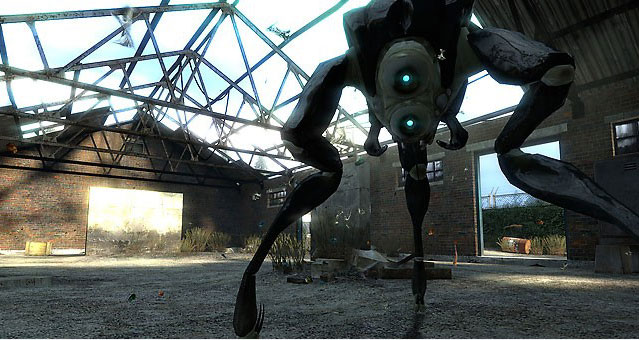
From an audio/visual standpoint, Episode Two more than meets expectations set by the previous chapters in the series. The new Hunter designs are deadly works of art, and carry a sound design to match their menacing appearance. The imagery of the portal storm left in the wake of Episode One dominates the skyline for much of the game, providing not only a visual landmark but a very concrete reminder of what has come before. The voice acting, as always, hits a high water mark for emotional resonance; and there's quite a bit of emotion to convey in this title. Once again, you're left with a very high opinion of Alyx Vance and the other members of the resistance against the combine.
For me, that emotional connection was the takeaway from this chapter in the series. The gameplay is just as solid as it has been in the past (essentially flawless). Other than hunting the Hunters (they don't like tires in the face much), there weren't a lot of stand out combat or puzzle elements. Which was fine, because I very much focused on the storyline as it unfolded around me. Much like Empire Strikes Back Episode Two ends on a down note, making you question what the future will bring in a hard and sometimes confusing world. Unlike that trilogy, though, the end of Gordon Freeman's tale has yet to be told. Just one more game to go before we find out the ultimate fate of the Freeman.
Team Fortress 2
Team Fortress 2 is a substantial redressing of a venerable entry into multiplayer gaming. Built on the original Half-Life engine, the first Team Fortress game was one of the first examples of role-based team play on the PC. The older game, with its own quirks and peculiarities, is still beloved by thousands of FPS gamers; indeed, some of them feel somewhat put off by Valve's re-envisioning of the game. Grenades are no longer a weapon available to every class, each of the classes has undergone significant retooling, and the unique visual aesthetic more resembles a Pixar film than a hardcore multiplayer shooter. What those changes add up to, though, is one of the most approachable online shooters ever released for console or PC.
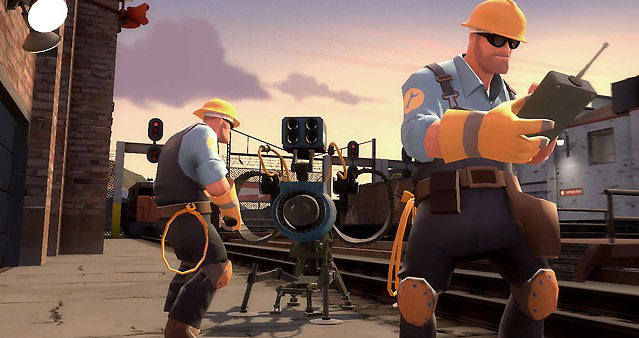
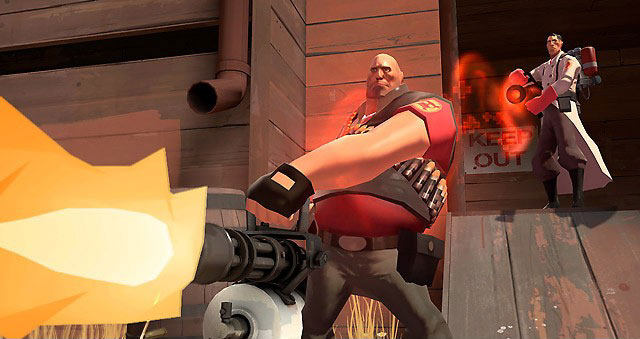
Valve has chosen to apply the same kind of design directives to online combat that it applies to the single-player experience of games like Half-Life 2. Playing the game online (there is no single-player component) is like a moment-to-moment tutorial. Nuances of play become obvious as you progress through a match in your chosen class. The Medic profession is the best example of this philosophy. The character's healing gun links him to a particular character, creating a bond between two players who (in all probability) don't know each other. Learning to play the Medic is an interplay between your positioning vs. your partner, your positioning vs. opponents, and deciding when to use the 'invincibility charge' that slowly builds up as you apply healing. As a member of another class you learn the nuances of keeping your healer protected or (if you're on the opposing team) that shooting the medic first is often the best approach.
This 'tutorial-as-you-go' experience applies to every one of the nine classes. The complete team roster is a balanced array of strengths and weaknesses. Assuming that your team can agree to not all play the same class, they should allow either effective offense or defense as the scenario allows. The other Valve hallmark shows up in these classes: they're all fun. Each offers a substantially different play experience, but you can have an amazingly good time with each of them. Whether you're dropping turrets into play or wielding a fast-firing heavy machine gun, you'll have the opportunity to participate and make a dent. And if you're not having fun, it's a matter of a few moment to switch to a different class.
TF2 has some weighty competition in the online FPS space this year, but from what I've seen none can compete with it in terms of approachability. Halo 3 played online is fun, to be sure, but the preternatural skills of your opponents gets really old after a while. Team Fortress 2 rewards skill, to be sure, but the shallowness of the learning curve and self-teaching mechanisms means that expertise in TF2 is a much lower piece of fruit. Ultimately, isn't that the sign of a great online game? One that lots of people can participate in?
Portal
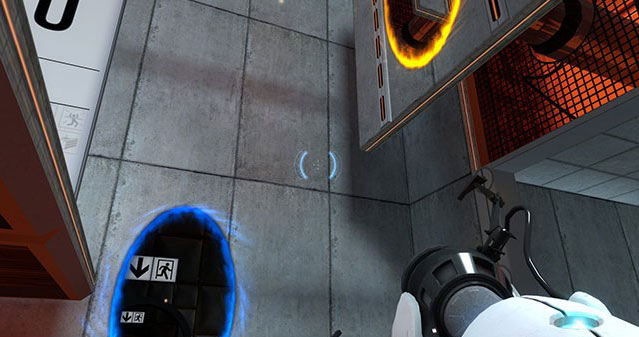
Words are ill-suited tools to describe the sheer amusement value of Portal. At about three hours long, it's one of the shortest games you'll play this year. You have absolutely no offensive weaponry, no special powers, and for most of the game your only real opponent is yourself. It's still, bar none, one of the best games I've ever played. You likely already know the basic premise of the game: you have a gun that makes holes in space. The Portals connect two points in reality and allow movement through them. You'll be using the device to solve puzzles, move through levels, and generally keep yourself alive in the face of the game's environment.
These puzzles are an absolute distillation of the Valve philosophy. Every challenge provides you with all the instruction you need to escape ... though their solutions are not always immediately obvious. Each one is only slightly more difficult than the last, and builds incrementally on every lesson you've previously learned. Portal is not only an excellent game, it's also a microcosmic example of the human learning process. This results, near the end of the game, in astonishing feats you would never have thought possible at the start of your journey. This plottable line of advancement from the simple to the sublime is the core of the game.
That said, more than just fun gameplay makes this title stand out. Aside from the Portal gun, you have but two companions on your journey. The voice from the ceiling, telling you what to do while lying out of one side of her face, is an artificial personality. The other companion is a lifeless cube. If that sounds sort of grimly funny, you're already getting the joke, and the point. Portal is hilarious in an Edward Gorey-meets-Douglas Adams sort of fashion, dark humor mixing with futurism for the sake of futurism.
Portal, then, is funny and intelligent in equal measure. It's wholly unlike anything else released this year, and on its own validates the entry price for Orange Box purchasers. It is, in point of fact, well worth buying all on its lonesome if you are interested by the rest of the offerings Valve has here. It also has the benefit of having the one of the best game songs ever made as its finale track.
Conclusion
Valve's Orange Box is easily one of the best offerings available for any platform this year. It's an amazing value and variety, offering story, online play, and intellectual challenge in equal measure. Every component of the piece is so strong that it could stand on its own - together it's an unstoppable force of gaming goodness. It's worth noting that reality intrudes on every element of perfection - lag has been a problem for Xbox 360 Team Fortress 2 players, but a patch is on the way. Otherwise ... there's really very little to complain about here. It's boring and unfunny to say "the whole thing is terrific" and leave it at that.
But then, I'm a nerd. The whole thing is terrific. In the face of dozens of high-price AAA titles this Christmas season Valve's offering stands out from the crowd with a clusterbomb of content that won't be easily put down. People will be playing TF2 for literally years to come, if you're done with Episode Two you can go back through it gnome-style, and I fully expect Portal to be supported by fan-created rooms for a long, long time. It's well worth buying for anyone that enjoys the first-person perspective on gaming, regardless of what kind of gamer you are. Now if I could only get that song out of my head ...

The review states that TFC, built on top of the Half-Life engine, was among the first to demonstrate class-based team play on the PC. This is not true, especially since Team Fortress started as a Quake mod!
I must admit that I didn't entirely understand the significance of Portal while I was playing it the first time through. I thoroughly enjoyed it and had honest fun (a rarity it seems, including my long gone 6-8 hours per day of World of Warcraft 7 days a week, which didn't remotely resemble anything like fun), but I often get so involved the mechanics of gameplay I miss some stuff. After beating it the first time through, I read some reviews and checked out some forums. With the perspective gained from hearing others talk about the emotional brilliance of the game, I played through it again, start to finish. The end result?
:(
Oh, Weighted Companion Cube, WHYYYYY?
ACs are modded -6. I don't read you, I don't mod you, I don't see you. Don't like it? Don't be a coward.
my new favort reviewer
http://www.escapistmagazine.com/articles/view/editorials/zeropunctuation/2541-Zero-Punctuation-The-Orange-Box
I for one bow down to our new Orange Box overlords.
I think Portal could have done with some human enemies, rather than just those wacky little bots. The idea of opening a portal over a spiky bit and then opening another portal beneath some guard's feet has strong appeal.
That said, it was a great game with some of the most memorable lines I've ever heard in a video game.
"Remember when the platform was sliding into the fire pit and I was all 'goodbye' and you were like 'NO WAY!' and then I was all 'we pretended we were going to murder you'. That was great."
I'm not saying the Orange Box is not quality product - it is.
But note that the orange box is in simultaneous console/PC release*. How does a major release like this coming out at the same time for consoles as the PC not confirm the trend for game makers to support consoles at least as well as, and in the future to a greater degree than, PC games?
* Well, 360 anyway - the PS3 version was delayed a bit.
Bioshock 2 was a great new PC gaming hit - that also came out for a console at the same time.
When you don't need a PC anymore for PC gaming... PC gaming is on the decline.
"There is more worth loving than we have strength to love." - Brian Jay Stanley
Half Life 2, and Half Life 2: Episode 1
If you already own these, and buy the Orange Box, you get an e-mail coupon, allowing you to *give* those two games to *anyone.* All they need to do is sign up for (if they don't already have it) a Steam account. You also do not have to give both to the same person.
Do you see the FNORDS? I refuse to post anonymously, as I am fireproof!
Another big plus for OB imo is that all the games are basically using 3+ year old engine so you don't really need to worry about whether you have the greatest hardware.
About a year ago, after playing nothing but PC games for 10+ years I got tired of upgrading hardware and all the other "work" that goes into PC gaming and said F-it and bought a Wii. I wasn't planning to buy any new PC games for awhile, but then I heard about OB and figured I'd give it a shot since my current PC ran HL2 just fine. Glad I bought it, Portal alone has kept be busy for two weeks.
The end of the first "map" on Portal is worth the whole game.
And my favorite quote (I paraphrase):
"Here at Aperture Technologies, we're bound by regulations to inform you that further progression through the training is very dangerous and may result in pain or physical disability, such as death."
Console Gaming
Pros
1. Buy once, will last you for five or so years until next console comes out, every game made for it will work for it, no worries.
2. Consoles have gotten more powerful with prettier graphics, intruding into PC territory
3. Perceived as less technically cumbersome than a computer, plug the game in and play
4. Used to be significantly cheaper than a top of the line gaming computer.
Cons
1. Closed architecture system
2. Games not hackable
3. User-created content completely unknown.
4. Getting as expensive as a good computer but with so many restrictions
5. Nobody can make small fun casual games for the system (changing some with the live arcades, but you still have to be vetted by the console manufacturer)
Computer Gaming
Pros
1. People already have a computer for serious work, games are a nice diversion.
2. Computer games could be geekier in subject matter, doing things like RTS or WWII wargames or highly detailed military sims.
3. Total hackability, open architecture, allows an online community with mods, new art, hacks, etc.
4. On the net long before the consoles were -- this advantage is no longer an exclusive.
5. Anyone can make a computer game, there's no barrier to entry for fun casual games.
Cons
1. Computers are expensive as hell, especially if you want to be on the bleeding edge.
2. You could buy a video card that would be good for six months or a Playstation, the price was the same. (Now you have to buy two high-end cards to equal the cost of a PS3.)
3. With the rise in the power of the consoles, computers are taking a beating from the competition
At the point we're at right now, the difference between console and PC basically comes down to the openness of the architecture and the DRM inflicted rather than any other factor.
Kwisatz Haderach
Sell the spice to CHOAM
This Mahdi took Shaddam's Throne
You should check out PortalMaps.net. They've already hacked the SDK together and are building new Portal maps.
I've already played the map por_facility_v100, and it's quite good-- a complex map, with lots of puzzles to solve, while introducing new elements (such as buttons that are too heavy for you to open-- only a block will do). Give it a try!
This statement is solely an opinion. Kindly take it as such in all cases.
I believe that "best game songs ever made" link should be to here.
You make an interesting point with TF2. A lot of the things that they have tried to eliminate in TF2, were really skills that had to be mastered over time in TF1.x. Things like rocket jumping and conc. grenade jumping take a lot of skill and are certainly not the obvious maneuver for the n00b. However, I have two counterpoints to argue.
First, let me put up my own disclaimer: I have not yet tried TF2, but have been re-obsessed with TFC after I realized that even though my install CD went missing years ago at a friends house, the box with CD Key on it that I still have can be used to download through steam (and run it in Linux under WINE!).
That being said, all of the physics exploiting moves were not in wide use when these games were first released. These skills were discovered, developed, demonstrated and passed on to others until it became common practice. So while those old skill may now be bannished, who knows what new 1337 5ki11z will be discovered and then perfected until we all use them. Don't forget, there is a collective learning curve with most online multi-player games. In the beginning, the relatively new player can do pretty well for himself, but then those putting in the overtime quickly start pwning and those who don't keep up, are all of a sudden not doing so well.
My second counterpoint, is that the game developers have tried to bring each role back to basics. In the original concept, you have your offensive players (actively attacking) and defensive/supporting players (passively attacking/supporting others). The medic and the engineer were intended originally, not to be used for offense. While relatively quick, their health/armor was relatively low, and their supershotgun takes a lot of skill to be affective on offense. However, grenades seem to be the great equalizer. When grenades are available, those two classes, as well as others, have a lot of offensive firepower. Rather than having medics healing teamates (a rarity), you have medics conc. jumping across maps and grenade spamming the defense. On maps like 2fort, engineers are possibly the most powerful player offensively thanks to the EMP grenades (I should know, I'm a devout TFC engineer). After a while, the teams stop working together, and start working for themselves. Everyone wants to have the high ranking (which means lots of kills), and forgetting about your other duties, like healing and building support devices like dispensers and teleporters. There's no "i" in Team Fortress (except Team Fortress Classic, but I guess that supports my argument of what the game had turned into).
Those who have played TF2 can certainly comment better than I on whether any of these things are happening, but I see a more authentic team experience, and don't worry, the moves people will be pulling off in two years, the developers would have never imagined.
"It's not whether you win or lose, it's how drunk you get." -- H. J. Simpson
Owners of the PC version of the Orange Box will be enjoying their games long after the owners of the console version. The reason is the modders. These games are going to have the crap modded out of them, and once these mods are available, what once was old is brand new again. Levels, game variations, all of these will be available on the PC and available for FREE. If you're lucky, maybe Valve will be nice and package some of them for download on the 360/PS3. You'll most likely be paying for it, though.
--------
This isn't the sig you're looking for. Move along.
Totally. When playing Pong against a garden gnome back in '76, it was not very challenging. It only returned a very small number of my serves, and played an insultingly stupid strategy of "playing dead", as though it would lull me into complacency and then surprise me at some point. Well, I kept playing and playing, but it never did come to life. It's almost as though the AI was missing a procedure call to move the paddle, or something.
You see? You see? Your stupid minds! Stupid! Stupid!
One thing that improved my perception of Valve as a company was their handling of Orange Box purchases for users who already had HL2 and HL2 Episode 1. I bought the Orange Box online through Steam, and it allowed me to give away full, downloadable copies of the games I already had to friends on Steam Community. Being able to send the HL2 games as a gift with just a click made me feel like a portion of my $50 was not being "wasted" on games I already owned.
Militant Agnostic: "I don't know, and damn it, neither do you!"
(disclaimer: I am a similar bhopping, rocket jumping TF vet)
You haven't spent enough time with TF2. For all the reasons that TF & TFC were great, TF2 is better.
The biggest difference isn't grenades, as you would know if you had spent more time with it. The biggest difference is that one player can't affect a match as much as teamwork can. In other words, one uber-1337 player on a team of nubs will never win a match in TF2. Only teams that can work together can truly dominate in TF2.
It is the only game I have ever played where this is the case (some other games come close).
burrocrisy
and that would be what? Ruling by jackasses? Never has a slashdot misspelling been more apropos
here are some reasons:
There's probably some other reasons but when it comes down too it, as a consumer, prices are not competitive for downloading and even with broadband, it can take time. Since I'm a gamer and I buy fun games, I always have some console games laying around to trade in. If I want a PC games, thats some extra money off that downloads will never be able to get, less Valve wants to buy my DS games. =) If it's 10pm on a Friday and the stores are closed, it's great to have a Download option if you have the urge. Downloading is not going to replace retail anytime soon, but it's a great compliment!
Cheers,
Fozzy
"The past was erased, the erasure was forgotten, the lie became truth." ~1984 George Orwell
- Resell credit retort: Gamestop rips you off when it comes to resell value. Gamecrazy does a better job yet they don't sell PC games. The more I don't buy console games the more I can spend on PC games.
- Physical media retort: Your backup is your credit card number and your (Steam/Ea Link/etc) login. If you ever lose the game or purchase another system, just reinstall Steam and you'll have access to all the games you purchased from Valve.
- Faster retort: With today's bandwidth availability in the United States you can obtain the game within an hour. Some games like World of Warcraft still require that you download 4 GB of updates even if you purchase the retail version.
- Printed literature retort: Welcome to the paperless generation! If i need guides or assistance there are online guides such as Thottbot.com that give me all the information I need. We need to save some trees.
- Swag retort: Actually you do. (Command and Conquer 3 Pre-purchase via EA Link)
- Store Discounts retort: Discounts do not come until the game has reached a certain age. However GameStop is known to keep PC games like C&C3 at $49.95 for the last 6 months and console games like Disgaea at $49.95 for over a year. Also, have you ever thought why Episode 1 and Half Life 2 was included in the Orange box? Because it's cheaper on steam. With the orange box you get an even bigger discount.
- Local support retort: The people (In my experience) at Gamestop have very little knowledge of PC gaming. All the information I need I can get from my friends or directly from the Companies (Valve and EA)
- Health: I get plenty of fresh air because I work FULL TIME during the week and go shopping and run errands on the weekends. Whenever I get a chance I'll play some Pump it up.
I suggest you think about how much companies can save by minimizing the cost of printing per SKU. There's a reason why PC gaming boxes shrunk from large dimensions to hand sized boxes to not having to print a box. I save money by not traveling to GameStop which gives me more funds to go on a plane and visit her in Florida.----- You know you have ego issues when you register a domain in your name.
There are communities already working on this. http://www.portalmaps.net/ & http://www.thinkingwithportals.com/ They also have nice tutorials for Hammer if you want to try to make some of your own.