 Slashdot Mirror
Hubble's Exoplanet Pics Outshined by Keck's
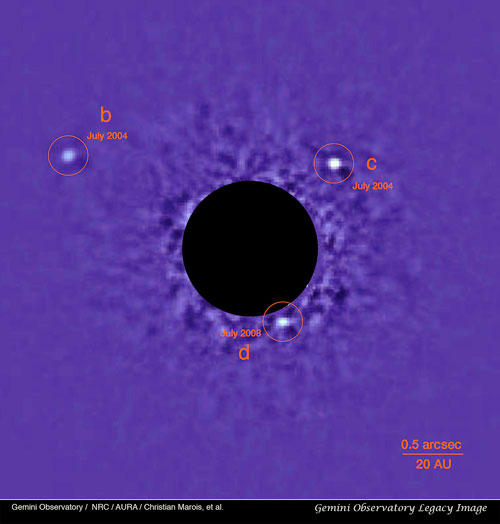
dtolman writes "Scientists at the Keck and Gemini telescopes stole the thunder of Hubble scientists announcing the first picture of an extrasolar world orbiting a star. Hubble scientists announced today that they were able to discover an extrasolar world for the first time by taking an actual image of the newly discovered exoplanet orbiting Fomalhaut — previous discoveries have always been made by detecting changes in the parent star's movement, or by watching the planet momentarily eclipse the star — not by detecting them in images. Hubble's time to shine was overshadowed though by the Keck and Gemini observatories announcing that they had taken pictures of not just one planet, but an entire alien solar system. The images show multiple planets orbiting the star HR 8799 — 3 have been imaged so far."
A planet orbiting Fomalhaut? Well, it seems Gene Wolfe was prescient in his work The Book of the New Sun when one of his characters contacts a wise civilization there on, as Wolfe uses the Arabic name, "the Fishes' Mouth".
Hello,
I think the discovery was made by the team led by Paul Kalas:
http://astro.berkeley.edu/~kalas/index.html
Math is beautiful... e^(pi*i)+1=0
that's not a planet...
Donald 'Duck' Dunn: We had a band powerful enough to turn goat piss into gasoline.
This came out after I posted the article... Hubble presents - Fomalhaut B! This graphic is particularly nice!
I wanna live on the left dot.
"Tell me doctor, with all of your defenses, are there any provisions for an attack by killer bees?"
they are massive, young, hot planets that are probably mostly gaseous and completely inhospitable. They'd get along great with my ex!
In the hubble picture, does anyone else see the shadow of the Enterprise?
Who would win this election: Andrew Weiner vs Andrew Weiner's weiner.
You have to see the orbital progression to get over the thought that it's just another speck of light noise. Here is a larger image showing the position of the planet from 2004 and 2006. Also, here is the url for the release showing the image of HR 8799 with its 3 planets.
If the "noise" obeys Kepler's laws, it's probably an image of something real.
Taking pictures of them *is* news. In fact, that's the point of these releases. These are the first direct images ever released. Before this, all evidence was indirect (oscillating plots of star brightness as the planet periodically eclipsed the host star, for instance).
no, not Sauron. That is clearly the Mote in God's Eye.
As deed holder via the International Star Registry, that includes a deed on any planets in orbit, I forbid it. Why, there might even be rich deposits of diamelles and/or Ginsu steak knives on that planet. I'm not giving it up without a fight.
For all intensive purposes, "whom" is no longer a word. That begs the question, "who cares"?
On Thursday 13th November 2008, Gemini Observatory in coordination with several institutions released the first images of an exo multi-planet system around star HR 8799 in the constellation of Pegasus. The discovery was made at Gemini North using the adaptive optics system ALTAIR and NIRI as the infrared imager on October 17, 2007. Follow up and confirming observations were made on the Keck II Telescope and Gemini North. Adaptive optics played a crucial role in obtaining these historic images of a young extra-solar multiple-planet system. The estimated age of the system implies planetary masses between 5 and 13 times that of Jupiter. These giant planets orbit at roughly 25, 40 and 70 times the Earth-Sun separation around their host star which is about 128 light-years from our sun. For more details see www.gemini.edu.
A clear conscience is usually the sign of a bad memory.
Not entirely sure why the summary touches on one being overshadowed by the other.
On the contrary, the two works are complimentary, and it is thus no coincidence that they have been released at the same time. Hubble shows an old cold planet on the edge of a solar system, while Keck shows some very young hot infra-red emitting planets close to their star. The two discoveries help elucidate the workings of other solar systems - and each is just as valuable as the other.
Some description of the technique. Under ADI.
To "Discovery" something is easy: you just make a documentary about it that's too dumbed-down for people who like documentaries but still too boring for those who don't, and add lots of unnecessary and repetitive CG animation.
Blank until
These are the first direct images ever released. Before this, all evidence was indirect (oscillating plots of star brightness as the planet periodically eclipsed the host star, for instance).
Well, except for HD 189733b, 2M1207 b and GQ Lup b.
HD189733b: not directly imaged, but has had a temperature map of it reconstructed from very careful analysis of the change in the light from the parent star as the planet transits in front of and behind it.
2M1207b: this orbits a brown dwarf, not a star.
GQ Lup b: not a planet by any reasonable stretch of the scientific imagination, unless you happen to have been a co-author of the original paper. Believe me: this one is dead, Jim, and was known by most of us to be so on arrival.
What they have right now can give a pretty accurate idea of the atmosphere on that planet. Pass the light from that dot through a diffraction grating and the spectrum will tell you which gases are present in what proportion in the atmosphere, and what is their temperature.
Plus they might all go there to try and convert the heathens.
Control is an illusion, order our comforting lie. From chaos, through chaos, into chaos we fly
So planets look a lot like noise. They really aren't all that much different than the expected noise levels on the images. Especially on the first one from Fomalhaut.
From far enough away, yes. Yes they do. For example, here's Earth from just outside the solar system, and the basis for Sagan's Pale Blue Dot.
http://veimages.gsfc.nasa.gov/601/PIA00452.tif (TIFF image)
That light blue pixel on the right is us. All of us. Taken from 6.4 billion kilometers away.
Deadpixel, indeed.
"Empathise with stupidity, and you're halfway to thinking like an idiot." - Iain M. Banks