Slashdot Mirror


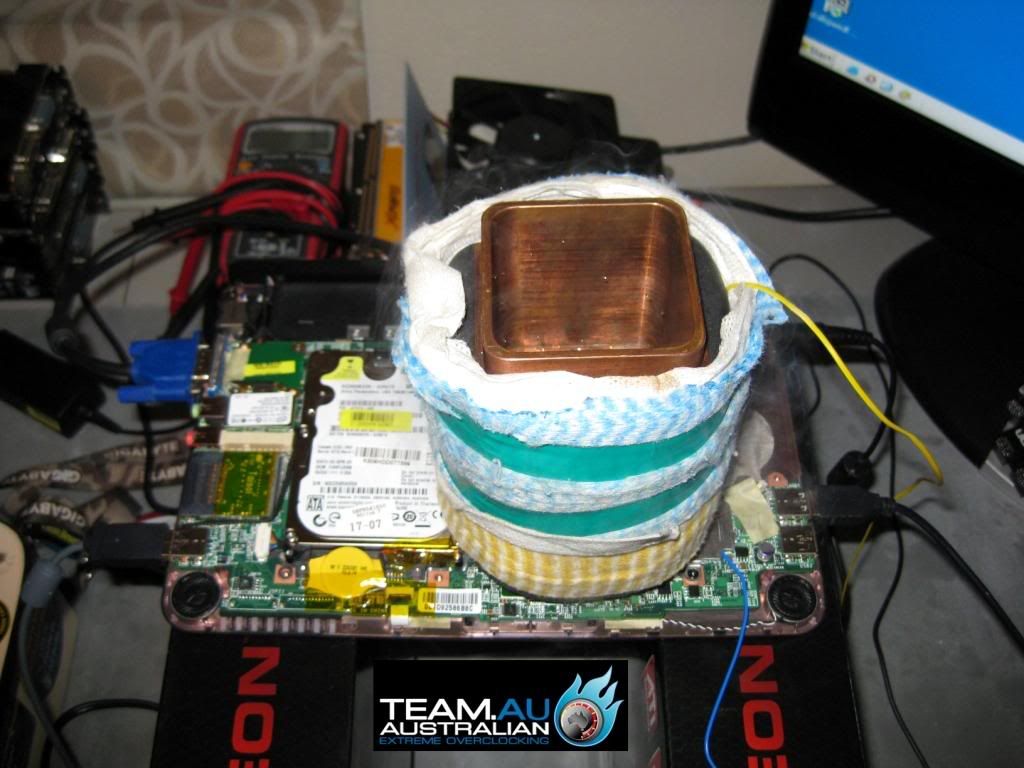
MSI Wind U100, Overclocked With Liquid Nitrogen

james writes "What do you get when you combine a MSI Wind U100 notebook with liquid nitrogen? The new Intel Atom frequency World Record ... and some damn cool pictures! A large copper pot is used, sitting on top of the GPU and chipset, and cold transfer through the original heatsink plate to the CPU. This was cooled down to about -20 C to achieve the new world mark. (Intel Atom N270 @ 2315mhz) For more information you can check out the original forum thread.
95 comments

  1. I'd like to see that go through airport security by ZirbMonkey · · Score: 1

    Sort of throws out the "portability" marketing scheme

  2. Bonus by Anonymous Coward · · Score: 4, Funny

    +5 hack points for being completely impractical. I like...

    1. Re:Bonus by fm6 · · Score: 2, Funny

      Plus an extra hack point for overclocking a low power CPU!

  3. NevergetthatpasttheTSA by bossanovalithium · · Score: 1

    Overhead locker blues with that baby, but it's very very cool !

    1. Re:NevergetthatpasttheTSA by morgan_greywolf · · Score: 1

      The liquid nitrogen is in a closed system right? So the explosive sniffers shouldn't catch it, right? It's not like the TSA is going to know that the notebook has liquid nitrogen in it. They're not that bright and they're not that coordinated.

    2. Re:NevergetthatpasttheTSA by larry+bagina · · Score: 1

      they're liable to confiscate it (if you're within 100 miles of a border) or just steal it outright.

      --
      Do you even lift?

      These aren't the 'roids you're looking for.

    3. Re:NevergetthatpasttheTSA by gblackwo · · Score: 2, Funny

      Maybe they won't sniff out the nitrogen (I'm not even sure that it is even sniffable, there is ton of it in the air- not exactly a weird element to have around). But they will likely catch the massive hollow copper beam they are using for a heat sink and at least want to check your bag.

    4. Re:NevergetthatpasttheTSA by Taibhsear · · Score: 1

      If the liquid nitrogen is in a closed system the apparatus would have to be either rather large or incredibly secured. Heat from the cpu would vaporize the nitrogen, that's a LOT of pressure. You don't want a closed system. Especially in a tiny netbook. Bright or not I'd imagine the TSA might suspect something if your laptop had a cloud of FOG around it...

      In other nerdiness, liquid nitrogen is actually really easy to make and is inexpensive. The problem is storage. You need a really good (read expensive) refrigeration unit that can take a lot of pressure and all sorts of safety precautions. If you don't you can get a jug with a venting lid, but that doesn't last long. We had a professor get a 30 gallon venting jug and some liquid nitrogen and it lasted about a week. Poor bastard thought it would last all year... (You have to vent it or it will explode. You also have to vent the room or you'll suffocate.)

    5. Re:NevergetthatpasttheTSA by Anonymous Coward · · Score: 0

      In other nerdiness, liquid nitrogen is actually really easy to make and is inexpensive.

      [citation needed]

    6. Re:NevergetthatpasttheTSA by Taibhsear · · Score: 1

      Liquid nitrogen (liquid density at the triple point is 0.707 g/mL) is the liquid produced industrially in large quantities by fractional distillation of liquid air

      The cost of liquid nitrogen depends on the distance from related facilities and the price of energy; the actual cost tends to range between 0.10 and 0.50 USD/L.

      both from wikipedia

      The process of making liquid nitrogen consists of condensing atmospheric gases (principally nitrogen and oxygen), separating the liquefied gases, packaging and handling, and delivering the liquids. The most expensive part of this process is packaging and handling. This is reflected in the relative costs for "cylinder" and "bulk" gas prices. In the US, liquid nitrogen usually costs about $2/gallon when delivered in dewars and about $.50/gallon when delivered and pumped into a bulk storage tank. Prices tend to be higher the farther away from the condensing plant you are and outside the continental United States.

      From Interesting Products

    7. Re:NevergetthatpasttheTSA by Anonymous Coward · · Score: 0

      That's on par with gasoline. Not exactly cheap for an industrial chemical, especially since industrial users are going to use it by the kL.

    8. Re:NevergetthatpasttheTSA by Retric · · Score: 1

      Where are you buying gas at 50c / gallon?

    9. Re:NevergetthatpasttheTSA by lysergic.acid · · Score: 1

      it's been a while since i've taken physics, so please excuse my ignorance. but how would the liquid nitrogen provide any additional cooling (compared to water) if it's in a closed system? i mean, doesn't the liquid nitrogen have to boil off/evaporate in order to provide cooling? so if it remains a pressurized liquid then isn't it just the same as a cooling pump or radiator? i mean, theoretically you could let the liquid nitrogen evaporate and then re-compress in a separate chamber, but i don't know how practical that is (i think you need Ammonia or HCFC for closed-cycle refrigeration).

      also, according the Wikipedia:

      Despite its reputation, liquid nitrogen's efficiency as a coolant is reduced by the fact that it boils immediately on contact with a warmer object, enveloping the object in insulating nitrogen gas. This effect is known as the Leidenfrost effect and applies to any liquid in contact with an object significantly hotter than its boiling point. More rapid cooling may be obtained by plunging an object into a slush of liquid and solid nitrogen than into liquid nitrogen alone.

      but solid nitrogen is probably more expensive and difficult to come by.

    10. Re:NevergetthatpasttheTSA by profplump · · Score: 1

      Exactly what part of liquid nitrogen do you think the explosive sniffers would alert on if it weren't in a closed system?

    11. Re:NevergetthatpasttheTSA by morgan_greywolf · · Score: 1

      Explosives sniffers often look for high concentration of nitrogen, since nitrogen is a key component in virtual all explosives. Perhaps you've heard of such things as Tri-Nitro-Toluene (TNT)? How about Composition C4? A key chemical component of cyclonite (C4 is cyclonite mixed with plasticizers) is nitric acid?

    12. Re:NevergetthatpasttheTSA by defnoz · · Score: 1

      Zomg, it's gonna blow!

  4. Man oh man... by T.E.D. · · Score: 4, Funny

    ...and you thought it was bad when your laptop's battery started leaking into your lap. Just wait until its liquid nitrogen cooling system starts leaking.

    1. Re:Man oh man... by Abstrackt · · Score: 3, Funny

      Well, the upside is you'd have no trouble getting it hard.

      --
      They say a little knowledge is a dangerous thing, but it's not one half so bad as a lot of ignorance. - Terry Pratchett
    2. Re:Man oh man... by Eccles · · Score: 1

      Well, the upside is you'd have no trouble getting it hard.

      They say that happens to lots of computers.

      --
      Ooh, a sarcasm detector. Oh, that's a real useful invention.
    3. Re:Man oh man... by T.E.D. · · Score: 1

      My mother always told me that nice computers never go down.

    4. Re:Man oh man... by snspdaarf · · Score: 1

      Frozen stiff?

      --
      Why, without your clothes, you're naked, Miss Dudley!
    5. Re:Man oh man... by Anonymous Coward · · Score: 0

      Look at the bright side. Liquid Nitrogen doesn't blow up!

    6. Re:Man oh man... by baKanale · · Score: 1

      But if they both leak at the same time they'll cancel each other out! Like global warming and nuclear winter!

  5. The REALLY impressive thing... by KingSkippus · · Score: 4, Funny

    This was cooled down to about -20 to achieve the new world mark.

    The really impressive thing isn't that they overclocked a processor, it's that they cooled it to -20 K!

    1. Re:The REALLY impressive thing... by Jeoh · · Score: 1

      What's even more impressive is that it was still running at 2315MHz. Imagine if it was above absolute zero... in a beowulf cluster!

    2. Re:The REALLY impressive thing... by zbharucha · · Score: 0

      There's no such thing as -20 K

    3. Re:The REALLY impressive thing... by Taibhsear · · Score: 1

      WOOSH!
      (hint: not the sound of liquid nitrogen being poured over you)

    4. Re:The REALLY impressive thing... by reset_button · · Score: 1

      Right. Not even that *WHOOSH* could cool something to -20 K.

    5. Re:The REALLY impressive thing... by dkf · · Score: 3, Informative

      There's no such thing as -20 K

      Not so, though it's a very strange thing indeed.

      --
      "Little does he know, but there is no 'I' in 'Idiot'!"
    6. Re:The REALLY impressive thing... by DeadlyBanana · · Score: 1

      I think this made me laugh more than the original joke. Yay Science!

    7. Re:The REALLY impressive thing... by Muad'Dave · · Score: 1

      Your processor can't deflect temperatures of _that_ magnitude!

      --
      Tiller's Rule: Never use a word in written form that you've only heard and never read. You will end up looking foolish.
    8. Re:The REALLY impressive thing... by Anonymous Coward · · Score: 0

      Well thats just great, what are you going to tell us next, that we can travel faster than light, that Windows is actually better than Linux?

    9. Re:The REALLY impressive thing... by vigour · · Score: 1

      There's no such thing as -20 K

      Depending on who you talk to, that's not strictly true.

      It is possible to have a negative Kelvin temperature, you can approach absolute zero asymptotically from either direction, you just can't reach 0 K.

      The most common example is the laser. When the active layer is excited, there is a population inversion where there are more excited states than ground states (in this case electrons sitting on higher energy levels). This is reversed on the emission of coherent photons, which brings the electrons back down to their ground state.

      Note: This ground state is still higher than that at 0 K, thermal energy excites some of the electrons, just not the majority.

      Another way of looking at it, is that something with a negative temperature is hotter than anything with a positive temperature. This is because energy will flow from the unstable negative temperature to the positive temperature.

  6. All this shows is that Atom is clock limited by Anonymous Coward · · Score: 5, Interesting

    All this shows is that Atom is clock limited by design. A 700MHz speed up - less than 50% in this case - from using liquid nitrogen? And all to get a CPU that's about as powerful as a 1.5GHz Pentium M or a 1.2GHz Core 2 Duo ...

    Atom is reasonably neat, but I would have been more impressed with under-volting to half power consumption. Or designing a better chipset.

    1. Re:All this shows is that Atom is clock limited by ByOhTek · · Score: 1

      Agreed, underclocking/volting is a massively overlooked aspect. I had a mobile processor in one of my servers a while ago (low cpu intensity), and managed to underclock it and save a lot of power (both in removing the fan from the heatsink, and reducing the voltage). Unfortunately, when the machine lost power (didn't have it on a UPS), it restored the multiplier/bus frequencies to the defaults, but not the voltages, and it wouldn't post any until I cleared the CMOS (Athlon Mobile 2500+, ABit NF7-S V2.0, for the curious)

      --
      Self proclaimed typo king, and inventor of the bear destroying coffee table (patent not pending).
    2. Re:All this shows is that Atom is clock limited by Anonymous Coward · · Score: 0

      you should probably be glad it didnt restore the voltages to default settings as well, running it without a fan (which obviously was needed in the stock scenario), could have damaged your hardware :)

    3. Re:All this shows is that Atom is clock limited by tlhIngan · · Score: 1

      All this shows is that Atom is clock limited by design. A 700MHz speed up - less than 50% in this case - from using liquid nitrogen? And all to get a CPU that's about as powerful as a 1.5GHz Pentium M or a 1.2GHz Core 2 Duo ...

      Atom is reasonably neat, but I would have been more impressed with under-volting to half power consumption. Or designing a better chipset.

      Well, Atom's market isn't in the high-performance desktop/laptop realm, it's in the netbook realm, where the primary goal (for the most part) is "cheap", followed by "small". Powerful isn't one of them, since a modern CPU is already more than powerful enough for surfing and email.

      It's basically the first step towards an embedded x86 SoC to compete in the embedded processor space. Even now, Atom is a battery guzzler compared to the ARM CPUs used in practically everything people buy - media players, cellphones, etc.

      The question is... has Intel finally started fabbing Atoms in one of their fabs, or are they still using the now-overloaded research fab?

    4. Re:All this shows is that Atom is clock limited by billcopc · · Score: 2, Interesting

      I say it's not cheap enough.

      What does an Atom processor and board cost ? $75 or so ? What does the cheapest Core-2 processor and board cost ? $90

      Somehow, I'm not impressed by those numbers. Bring the Atom kit down to $30 and we'll talk. Building it into $300 subnotes is not what I call impressive, they just scored because people are magpies and they like the cute little paperweights.

      --
      -Billco, Fnarg.com
    5. Re:All this shows is that Atom is clock limited by Dare+nMc · · Score: 2, Interesting

      underclocking/volting is a massively overlooked aspect.

      on a chip like the atom with a high emphasis on dynamic clock gating, I would assume under-clocking the CPU would only make the system less power efficient. Under clocking a dynamic clock CPU would only limit it's peak performance, when your system is waiting on the CPU, but not affect the low/average power draw of the CPU at all. (I realize your likely under clocking the memory, and everything else so that would help some.)

    6. Re:All this shows is that Atom is clock limited by hierophanta · · Score: 1

      meh, not really. it would have over heated with out the fan and turned itself off. (this is a daily occurrence for overclockers like me [that is not very good ones])

      its interesting that you didnt get all the factory defaults when you cleared CMOS though, that is strange

    7. Re:All this shows is that Atom is clock limited by hierophanta · · Score: 1

      i totally agree it would be nice to see the max undervolt w/ stock speed this chip can do. but this is the improved chip!

      just compare the atom n270 (in almost every netbook) to a comparable core duo or solo

      now look at the stated Thermal Design Power - its 2.5watts vs. 34w vs. 31w respectively. that is more than a couple of magnitudes less. and the voltage is lower for the Atom than the Core Duo/Solo too. the fact that this chip is reaching these speeds while consuming relatively no power is the part that makes my jaw drop.

      but i disagree that this shows the chip is clock limited by design. i think that the design pushing very near what the chip can do (much closer than Intel's other offerings in any case). this is why - i overclock my xeon quad from 2.13 to 3ghz with nothing more than the stock heat sink - this speed was limited by the heat being generated (it was over 85*C [also fyi 8hours orthos stable]). imagine how high i can get my chip up if it were are -20*C. ask any overclocker out there they will tell you that you can expect a 25%-33% overclock on a pure stock setup. (i.e. this atom stock setup is much closer to it's limits than typical chips being sold)

  7. Geez... by Capt+James+McCarthy · · Score: 3, Funny

    Better wear the insulated cod piece.

    --
    There are no loopholes. It's either legal or it's not.
  8. A "large copper put?" by The+Ultimate+Fartkno · · Score: 1

    Really?

    1. Re:A "large copper put?" by $RANDOMLUSER · · Score: 1

      I know my brain froze when I read that.

      --
      No folly is more costly than the folly of intolerant idealism. - Winston Churchill
  9. With the help of ... (drum roll) by Anonymous Coward · · Score: 0

    ...new glaciers caused by Global cooling

  10. -20C or -20F ??? by Anonymous Coward · · Score: 0, Redundant

    cooled down to about -20...
    -20C or -20F ???

  11. I miss my 486 by bigattichouse · · Score: 0, Offtopic

    486 + turkey cooking bag + freezer = fun for the whole family.
    --
    Looking for work? Keep one eye open on Craigslist.com http://www.bigattichouse.com/oneeyeopen.html

    --
    meh
  12. side-effects of mod cooling? by v1 · · Score: 4, Interesting

    I've always wondered why things like this don't cause physical problems related to thermal expansion/contraction - why doesn't the processor package crack due to the temp differences? Or condensation form in bad places etc? There's gotta be a whole list of bad side effects to worry about when supercooling one part of your computer...?

    --
    I work for the Department of Redundancy Department.
    1. Re:side-effects of mod cooling? by Eccles · · Score: 5, Funny

      I work for the Department of Redundancy Department.

      Which one?

      --
      Ooh, a sarcasm detector. Oh, that's a real useful invention.
    2. Re:side-effects of mod cooling? by Chief+Camel+Breeder · · Score: 4, Informative

      You might think so, but silicon seems to deal with it OK. When I worked in astronomical instrumentation, we built LN2-cooled CCD cameras with the chips cooled to about -150 deg C (they had heaters in the cryostats to hold this temperature; they went down to about -200 if the heaters were turned off). These things were thermal-cycled many times a year and we rarely lost a chip. Astro CCDs are big chips, albeit very simple compared to CPUs.

      Conversely, detectors cooled to liquid helium temperatures are likely to die if cycled up to room temperature a few times.

      With the CCD cryostats, the chips were in a vacuum vessel, so condensation wasn't normally a problem; all the water had been sucked out before cooling. If moisture did get in, then they had to be warmed and re-evacuated.

    3. Re:side-effects of mod cooling? by Lumpy · · Score: 5, Interesting

      Not really. you cant get condensation because there is no air with moisture anywhere near the motherboard. All that nitrogen is displacing the air faster than the air knows what to do. Same with overclocking with Co2.. No condensation.

      Now supercool it, then yank it out of the cooling bath, yes it will grow frost faster than anything. I killed my first K6 processor by using a over sized peltier cooler. I cooled it faster than the processor could create heat... I frosted the motherboard for a 3 inch circle around the processor, something melted some of the frost and it shorted two power pins and it went POOF.

      --
      Do not look at laser with remaining good eye.
    4. Re:side-effects of mod cooling? by v1 · · Score: 1

      But you never see these modding setups in a vacuum. I wonder how they cope with condensation say, shorting out the pins on the cpu package/socket?

      --
      I work for the Department of Redundancy Department.
    5. Re:side-effects of mod cooling? by squoozer · · Score: 4, Informative

      My guess as to why chips last so well when thermally cycled would be because they undergo very little contraction as they cool. Microchips are made from extremely pure single crystals of silicon (essentially) so they are already in a very low energy state. Cooling them down isn't going to change very much. I wouldn't be surprised if newer SOI chips break more often when thermally cycled as they are in a higher energy state to begin with. Anyway, I have no evidence of this, just a gut feel from studying materials at a wide range of temperatues.

      --
      I used to have a better sig but it broke.
    6. Re:side-effects of mod cooling? by MarkRose · · Score: 0, Redundant

      >>I work for the Department of Redundancy Department.

      >Which one?

      Both. :-)

      --
      Be relentless!
    7. Re:side-effects of mod cooling? by chaim79 · · Score: 1

      By waiving their flag of choice patriotically over the ensuing fireworks.

      --
      DEMETRIUS: Villain, what hast thou done?
      AARON: Villain, I have done thy mother.
      Shakespeare invents 'your mom'
    8. Re:side-effects of mod cooling? by nerdbert · · Score: 1

      There's been a long history of liquid nitrogen cooling. NCR was looking to do it for their mainframes back in the 80s.

      Yes, there are problems with condensation (usually attacked with stainless steel connections to keep the heat flow down), and sometimes boards will crack, but rarely packages.

      But the worst thing is that the life of your chip is vastly shortened. There are hot electron effects that shift the threshold voltage on the NMOS devices. Hot-e effect arise from the very high electric fields at the drain side of the device, that causes very high speed electrons to be generated, and those will periodically hit the oxide causing permanent degradation via charge trapping.

      Hot-e effects are bad because they're not uniform (they're pattern dependent since the time that the circuit spends in a transition is one of the biggest factors), so you can wind up altering the timing paths on the chip, and if they become skewed enough, you're screwed.

      Yes, hot-e effects are there at room temperature, but the way most folks design chips means that under worst case conditions you've got a life of 10 years. And running at high temperatures actually lowers hot-e effects (but don't get me started on metal migration!). But running at full supply in an LN2 immersion system will typically take your 10-year lifetime down to much less than 3 years.

    9. Re:side-effects of mod cooling? by tlhIngan · · Score: 1

      My guess as to why chips last so well when thermally cycled would be because they undergo very little contraction as they cool. Microchips are made from extremely pure single crystals of silicon (essentially) so they are already in a very low energy state. Cooling them down isn't going to change very much. I wouldn't be surprised if newer SOI chips break more often when thermally cycled as they are in a higher energy state to begin with. Anyway, I have no evidence of this, just a gut feel from studying materials at a wide range of temperatues.

      And probably from the fact that these experiments last only a short time, and are probably never repeated again? All these overclocking experiments are great, but it's also true that once it's done, well, it's a shelved project. If you're lucky, it'll be reassembled and work normally, but probably have a shortened lifetime (not that it matters - the thing will be long replaced even by then).

      The issue isn't the chip itself, it's the chip's bonding with the packaging and packaging with the circuit board - those undergo much larger stresses.

      But given that this is probably the last we'll see of that particular device, it'll probably end up collecting dust somewhere since it's been heavily modded to go out of spec. Or if it could be used again, well, used for a few months and then forgotten / tossed. If it breaks, it breaks - these things are supposed to be cheap - who really knows if it's because of the experiment or something else?

    10. Re:side-effects of mod cooling? by Molochi · · Score: 1

      A blob of Dielectric Grease. You cover the socket with it, before attaching the CPU so condensation doesn't form between the pins.

      --
      "The Adobe Updater must update itself before it can check for updates. Would you like to update the Adobe Updater now?"
    11. Re:side-effects of mod cooling? by billcopc · · Score: 1

      We coat the boards with an insulating polymer, most commonly the "Spray-on electrical tape" stuff. You cover the whole board with several layers of that gunk, so condensation forms on the insulant and drips off. Some long-term installations use a drip pan, but most guys only run it for the benchmark, then go back to sane temps for regular operation.

      --
      -Billco, Fnarg.com
    12. Re:side-effects of mod cooling? by Anonymous Coward · · Score: 0

      most of the CCDs I've worked with have a note in the data sheet the cooling/heating must be limited to something like 5K/min

    13. Re:side-effects of mod cooling? by ungulation · · Score: 1

      They are not solely made of Silicon. They also have layers of copper interconnects and dielectrics. I wonder if their thermal expansions are relatively similar?

    14. Re:side-effects of mod cooling? by grrrl · · Score: 1

      Thermal expansion coefficients are governed by the material - single crystal silicon has a very different thermal expansion coefficient to single crystal sapphire, for example. SOI silicon is also single crystal just on an insulator, so its thermal expansion is exactly the same as standard silicon. Perhaps you mean strained-silicon? Even then it's still single crystal and unlikely to have a thermal expansion coefficient that is much different from standard silicon. I'm not sure of exactly how much they change to LN2 temperatures (77 K), but it's not much, and the article only goes to 244 K (if it is -20 F they mean as I expect).

      The biggest issue is the _difference_ in expansion coefficients between the silicon, the SiO2, the 'S' and the 'I' in an SOI system, the metal layers and whatever other insulating layers are used between the metal tracks. If everything cooled and warmed with the same thermal expansion ratios, then it wouldn't be a problem no matter how many times you cycled it.

  13. A better link for the pictures. by AltGrendel · · Score: 3, Informative
    --
    The simple truth is that interstellar distances will not fit into the human imagination

    - Douglas Adams

  14. What the hell is a put? by SpasticWeasel · · Score: 3, Funny

    The author clearly has a very broad definition of cool.

    --
    No sooner do I get over one, then you put a better one right next to me. Bastards.
  15. Could have been done earlier.... by TheNecromancer · · Score: 2

    was cooled down to about -20 to achieve the new world mark.

    They could have done this alot easier by performing the experiment in my back yard in January (I live in the upper Midwest).

    --
    Attention all planets of the Solar Federation! We have assumed control! - Neil Peart
    1. Re:Could have been done earlier.... by ceoyoyo · · Score: 1

      If they did it in my backyard in January I wonder if they'd get another couple hundred MHz? (I live around 55N in Canada)

      The -20 makes it sound like the LN02 is a bit of a gimmick. You can achieve that temperature a lot more easily.

    2. Re:Could have been done earlier.... by FrameRotBlues · · Score: 1

      I think they didn't want to test it outdoors in February at International Falls because you can't type with gloves on, and your fingers don't stay attached if you take the gloves off.

      I live in MN, and if I leave my Dell D820 in the car overnight between October and April, and then power it up in the morning, the fan will kick on and it will boot incredibly slow. I've always presumed this is some sort of preventative action to keep the processor from heating up too fast and snapping something... but nobody has been able to give me a straight answer on this.

  16. ob. Futurama reference... by Tastecicles · · Score: 5, Funny

    first one, then t'other.

    --
    Operation Guillotine is in effect.
  17. Is overclocking still worth it by Zo0ok · · Score: 1

    It was long ago but I remember good overclocking. My PII 350 MHz ran perfectly at 392 MHz (bus at 112 MHz instead of 100 MHz). It made some sense (since a 400 Mhz CPU was about $150 more expensive) actually. Since then I have not attempted overclocking anything (perhaps because I got an Apple computer).

    Is overclocking still worth it? Does it make sense?

    Or is it mostly a challenge for fun and glory today?

    1. Re:Is overclocking still worth it by gblackwo · · Score: 1

      Yes and no. I was running an E6600 dual core 2.4ghz chip at 3ghz no problem (this is a very common overclock for that chip). I ended up clocking it back to 2.4 to save electricity since I wasn't noticing a huge increase in system performance.

    2. Re:Is overclocking still worth it by Anonymous Coward · · Score: 0

      It makes sense on low-end C2D chips - and that's about it. It used to be pointless in the end of the Athlon/Pentium 4 era, but C2Ds run so cool that you can relatively easily overclock them on air.

      Still, you can spend $50 more and get the high-end chip which is more reliable and doesn't destroy the warranty, plus CPUs are not major bottlenecks in anything these days.

      So yeah, if you want you can overclock and get something real out of it, but it just simply isn't worth it for most of us who overclocked in the 486/Pentium (1 and 2) era. Mostly because you can pay 150% the price and get the high-end chip.

    3. Re:Is overclocking still worth it by Anonymous Coward · · Score: 1, Informative

      Is overclocking still worth it? Does it make sense?

      It's not worth as much, and it's not the same beast as it was ten years ago, but at least its gotten easier. There's a bigger selection of hardware and cooling equipment. Consequently, a small increase in speed (1-10%) doesn't amount to much for the average user, with all the other bottlenecks. A big monitor, good graphics card, high performance SSD and gigabit ethernet have more of a positive impact than overclocking, from the average geek's point of view.

      Whether it's worth it to overclock a processor, always depends on who does it and why. Every percent can save hours, for math intensive tasks.

      Or is it mostly a challenge for fun and glory today?

      People that push overclocking beyond 25% of the rated speed, are doing it for fun and glory.

      Lastly, because of the way things are progressing. In five years, 12% will be the fringe, a few more years and 6%, and so on until finally there wont be any way to overclock. In the end, the last option will be temperature-dependent clock rate. Speed it up by 1% when you're not doing anything. Right in the bios where spread spectrum used to be (the joke of honor).

    4. Re:Is overclocking still worth it by hesiod · · Score: 1

      Mostly because you can pay 150% the price and get the high-end chip

      and overclock THAT one... err, yeah!

  18. room temp CPUs catch up in a year by peter303 · · Score: 1

    Its like the peole who wait in line overnight for new electronic hardware or movie takes that everyone else can buy online or at normal times. Both cool and assinine.

  19. Cold transfer? by Alpha+Whisky · · Score: 1

    Should have been heat transfer from the CPU to the pot (or put if you prefer) of liquid Nitrogen.

    Obligatory <Homer> "In this house we obey the laws of thermodynamics."</Homer>

    --
    it's = it is

    its = belonging to it

  20. Where's the ka-boom? by DrogMan · · Score: 2, Interesting

    It's generally not a good idea to keep liquid Nitrogen in a closed system - it expands by something like 700 times when it goes from liquid to gas, so either you need to keep it cool - hard to do if it's sitting on a hot-plate, or make the pot extremely pressure proof... And then you still need to keep it cool. Best to just let it boil away and top it up...

  21. Windows Vista by FourthLaw · · Score: 3, Funny

    What no Vista jokes yet? Must be the Slashdot holiday skeleton crew...

    --
    Skilled in differentiating ravens from a writing desks.
  22. Thus giving rise to the phrase... by SuperKendall · · Score: 1

    A large copper put is used, sitting on top of the gpu and chipset, and cold transfer through the original heatsink plate to the CPU. ... Shift or get off the pot.

    --
    "There is more worth loving than we have strength to love." - Brian Jay Stanley
  23. stupid by Sam36 · · Score: 0, Interesting

    absolutly worthless. They couldn't even get a 1ghz overclock on that think with liquid nitrogen? Remember those amd thunderbird cpus a few years ago that could overclock 1ghz+ over the stock speed and only using air cooling?

  24. It's a joke by KingSkippus · · Score: 1

    There's no such thing as -20 K

    You've probably gathered this by now, but it was a joke. When I'm around science geeks, it's always good for a cheap laugh. "Man, it's supposed to be really cold tonight! I heard it's going to be ten below absolute zero!" Kind of like, you know, "Mine goes to eleven!" Or "let's give it 110%."

    I just thought I'd poke a little fun at the submitter for breaking the cardinal rule of always specifying units. There's quite a bit of difference between 20 degrees Celsius and 20 degrees Fahrenheit, and depending on what country you call home, you could assume either one.

    1. Re:It's a joke by zbharucha · · Score: 1

      Sure, dude. (joking, relax)

    2. Re:It's a joke by Abstrackt · · Score: 1

      Our favorite nerdy line in high school was that time stopped for exactly three seconds.

      --
      They say a little knowledge is a dangerous thing, but it's not one half so bad as a lot of ignorance. - Terry Pratchett
  25. 350MHz needs liquid nitrogen... by Anonymous Coward · · Score: 0

    Uhm, my MSI Wind goes to 1984MHz with the default cooling and turbo mode... can't be that hard to get to 2315,7MHz, can it?

  26. Reminds me of by mmu_man · · Score: 1

    Project E.U.N.U.C.H. :)

  27. Is LN2 really necessary? by zippthorne · · Score: 1

    I mean, unless the processor *needs* to be at LN2 temperature wouldn't it be more practical just to increase the flow rate of a water cooling system?

    --
    Can you be Even More Awesome?!
    1. Re:Is LN2 really necessary? by Alastor187 · · Score: 2, Informative

      I mean, unless the processor *needs* to be at LN2 temperature wouldn't it be more practical just to increase the flow rate of a water cooling system?

      The processor is never going to be the same temperature as the liquid nitrogen (or any cooling median). As long as there is thermal resistance and/or heat being dissipated there will be some temperature difference.

      You could just increase the flow rate of a water cooling system, but that is not without issues either. For example, pumping power increases exponentially with flow rate and heatsink geometry is typically optimal for a given flow rate.

      Using the liquid nitrogen is just an easy way to get a high heat transfer rate by maximizing the temperature difference between the processor and cooling medium.

      What I wonder is why people just put the liquid nitrogen is simple hollow copper tube. This isn't any different than a natural convection air heatsink. Why not create fins inside and try to maximize surface area and convection?

  28. Beowulf by computerjunkie123 · · Score: 1

    Wow.. Imagine a Beowulf cluster of these

  29. Not necessarily by unassimilatible · · Score: 1

    All this shows is that Atom is clock limited by design. A 700MHz speed up - less than 50% in this case - from using liquid nitrogen? And all to get a CPU that's about as powerful as a 1.5GHz Pentium M or a 1.2GHz Core 2 Duo ...

    The motherboard could be limiting the FSB, since it isn't designed for overclocking. You have no way of knowing that this is a processor limitation.

    And these Atoms put a mere 4W at stock - while a Pentium M puts out 27W at load.

    --
    Slashdot "libertarians": Small government for me, big government for those I disagree with. -1, I disagree with you
  30. There is a forum dedicated to LN2 cooling by unassimilatible · · Score: 1

    Nice trick doing this to a laptop mobo, but LN2 cooling is hardly novel. Xtreme Systems has had a forum dedicated to LN2 cooling for years, and guys there are doing it everyday.

    Interestingly, the site owner did an overclocking demo for Intel. I guess Intel can't say they are anti-overclocking anymore.

    That forum will answer all of your questions. Frankly, LN2 suicide runs are fun, but I am more impressed with phase change systems that can run 24/7 like mine. :D

    --
    Slashdot "libertarians": Small government for me, big government for those I disagree with. -1, I disagree with you
  31. NoS for laptops? by Anonymous Coward · · Score: 0

    Same with overclocking with Co2

    You can just spray co2 direct on the CPU for cooling? Someone needs to sell a mod kit for laptops using those Co2 cans from pellet guns. When my EEE pc goes into rendering some intense 3D graphics, CPU takes a couple hits of C02, and over clocks it's self. Call it NoS for laptops, with some cool graphics NoS stickers for the CO2 canister.

  32. -20 F? why bother with LN2? by grrrl · · Score: 1

    Surely you can get it colder than -20 F (~244 K) using LN2 which is at a temperature of 77 K??

  33. copper pot by silent_artichoke · · Score: 1

    I think it was a Chester Copperpot

  34. "... and some damn cool pictures" by trastomatic · · Score: 1

    I guess you're always going to get cool pictures if liquid nitrogen is involved