 Slashdot Mirror
Things That Turbo Pascal Is Smaller Than
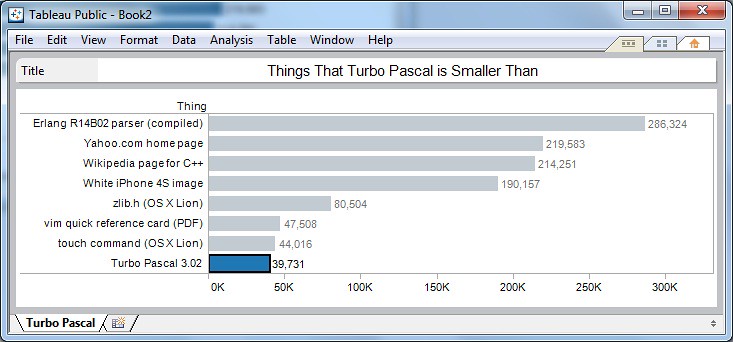
theodp writes "James Hague has compiled a short list of things that the circa-1986 Turbo Pascal 3 for MS-DOS is smaller than (chart). For starters, at 39,731 bytes, the entire Turbo Pascal 3.02 executable (compiler and IDE) makes it less than 1/4th the size of the image of the white iPhone 4S at apple.com (190,157 bytes), and less than 1/5th the size of the yahoo.com home page (219,583 bytes). Speaking of slim-and-trim software, Visicalc, the granddaddy of all spreadsheet software which celebrated its 32nd birthday this year, weighed in at a mere 29K."
When I think back to playing vast adventure games, like Below the Root, that amazingly fit on two sides of a 5.25" floppy, but the same game now would probably be written to take up a CD-ROM, even using the same graphics. Programmers have lost the ability to optimize.
I think they have the hability (some of them at least) but don't have the need or the time.
Sig? Heil
Bytes are kind of weird. Can't they give these number in terms of Library of Congress?
More Twoson than Cupertino
Software grows to fill the available ram.
Code is always a tradeoff between codesize, development time and ram needed for execution. I'm fairly sure you can optimize code today to a point that would put those programs (which were optimized 'til they squeaked to squeeze out that last bit of performance) to shame, but why? What for? 30 years ago, needing a kilobyte of ram less was the make or break question. When drivers weighed in the 10kb range and you still calculated which ones you absolutely need to load for the programs you plan to run, where you turned off anything and everything to get those extra 2 kb to make the program run. Today, needing a few megabytes of ram more is no serious issue. And mostly because it just really doesn't matter anymore. Do you care whether that driver, that program, that tool needs a megabyte more to run? Do you cancel it because it does? No. Because it just doesn't matter.
We passed the point where "normal" people care about execution speed a while ago. Does it matter whether your spreadsheet needs 2 milliseconds longer to calculate the results? I mean, instead of 0.2 you now need 0.202 seconds, do you notice? Do you care? Today, you can waste processing time on animating cursors and create colorful file copy animations. Why bother with optimization?
Because, and that's the key here, optimizing code takes time. And that costs money. Why should anyone optimize code if there's really no need for it anymore? And it's not the "lazy programmers" or the studios that don't care about the customers. The customers don't care! And with good reason they don't. They do care about the program being delivered on time and for a reasonable price, but they don't care whether it needs a meg more of ram. Because it just friggin' doesn't matter anymore!
So yes, yes, programs back in the good ol' days were so much better organized and they used ram so much better, they had so much niftier tricks to conserve ram and processing time, but in the end, it just doesn't matter anymore today. You have more ram and processing power than your ordinary office program could ever use. Why bother with optimization?
We used to have a Bill of Rights. Now, with the rights gone, all we have left is the bill.
How easily we overlook the difference between "bloated" and "quantity of useful information".
Just the words on this page (no markup, no graphics, and after a few comments) would have exceeded the capacity of your beloved 5-1/4 floppy. That's only the raw information, without bloat.
My first screen (a DECScope) had 12 lines x 80 columns each (I couldn't afford the 2K RAM that would have given me 24 x 80.) The screen I'm reading this on can display over 2 million RGB pixels. Calling things "bloat" is like telling me I should honor a display that's less than the size of the "close [X]" icon, because 12x80 isn't "bloat".
By the same twisted logic, Turbo Pascal itself was bloatware, and I thought it produced horribly slow and big code. Assemblers were where the real efficiency lay, and they were a lot smaller than 39K.
Nostalgia is fine. But leave it in the past.
John
At 88,225 bytes, the image showing the comparison is also bigger. Oh the irony
Only if you enjoy choking on penises.
Turbo Pascal was pretty sweet, even though it came from Borland, and even if it was Pascal. It could compile 5,000 lines of code in the blink of the eye. Embedding assembly into it? No problem. It didn't care. The editor was supreme as well. Even when I stopped using TP, I still used the editor every day for a decade after the fact because it could do absolutely everything.
I'm not sure where all the hating is coming from, because TP did not generate hugely bloated executables. The only problem with it was that it eventually was discontinued, so special hacks like paspatch were required to patch TP compiled executables on the P II and higher to allow them to run.
It was actually closer to 512K with all of its dependencies, but it was damn fine.
"It's almost as if the existence of faster CPUs and larger memory has enticed some to be extremely lazy"
Or just made them focus on getting stuff done rather than implementing optimisations no one will ever notice.
Oh, and your MacBook startup vs. your Windows startup? That's because Windows supports an ever changing set of hardware configurations and retains support for legacy software. Your MacBook has the luxury of retaining a relatively small set of hardware configurations and Apple being happy to chuck backwards compatibility out the Window.
Sure Windows is slower to boot up but it works on more hardware and has superior backwards compat. Sure your MacBook has poor backwards compat. for older Mac software and wont ever support some hardware configurations, but it's got a better startup time. Those are the tradeoffs you face with this sort of thing.
Surely you understand this though if you're an optimisation guru, that you know, it's all about tradoffs? Or perhaps if you're one of those that's all about optimisation whatever the cost in man hours and however negligible the benefits then you don't understand that it's all about picking the right balance.
So no, don't "MOD PARENT DOWN!!!". You have a rose tinted view of an era when all software was ultra-optimised by super non-lazy ninja programmers, I remember it more as an era where software still took longer to load and performed far more poorly than it does now, crashed far more often in far more fatal manners, had far more dangerous security flaws like root access exploits rather than just SQL injection exploits, and where usability was out the window as you had to spend hours configuring your system to even get it to run a game or whatever.
I don't think the past was really as rosy as you think.
And that attitude is why we lost the phone and tablet markets. There was a time when Linux was perfect for older systems... the sort of specs that also happen to match up with new small platforms. But we got that 'screw em, let them buy a real computer' attitude and now /bin/touch on my Fedora 15 laptop is 60856 bytes. The little gadget in my XFCE tray to allow me to control the backlight is currently reporting 6200K in resident set. XFCE is supposed to be the 'lighter' alternative to the GNOME freak show. Ever wonder why Google passed all the userland by and made their own for Android? Well now you know and your attitude is what caused it.
Nokia was stupid enough to believe they could build small devices by reusing parts of the Linux desktop, they failed. Good grief, look how much bloat is in little things like esd or pulseaudio. Megabytes of resident set sitting around in case something wants to make a sound? In hardware that had as little as 64MB Ram (Nokia N770 tablet) that sort of resource misuse killed them.
There was a time when System V UNIX would run on machines with a MB or two of RAM, with terminals hanging off serial ports and a couple tens of megabytes of hard drive could run a retail operation.
Yes there is something to be said for trading developer time for hardware. The time to do that is vertical apps and other applications where the number of deployed systems is small compared to the developer hours available. In a mass deployed application the developers should be required to care a little more about what they are asking millions of users to throw away to the great God of the upgrade treadmill.
Democrat delenda est