Slashdot Mirror


IBM Snags Patent On Half-Day Off of Work Notifications

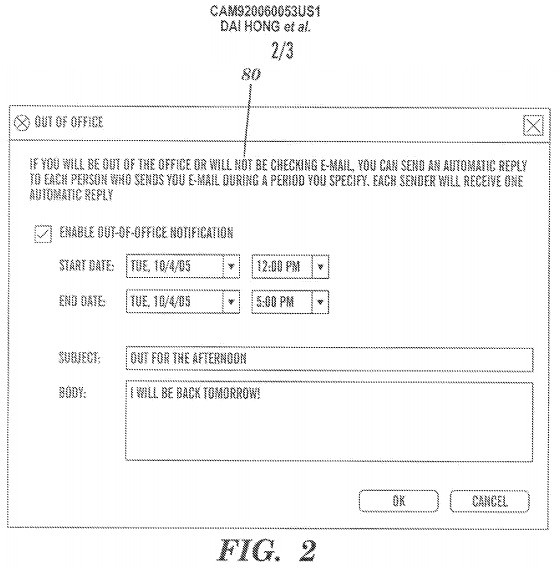
theodp writes "The USPTO appears to have lowered the bar on obviousness, awarding a patent to IBM Tuesday for its System for Portion of a Day Out of Office Notification. 'Out of office features in existing applications such as Lotus Notes, IBM Workplace, and Microsoft Outlook all implement a way to take a number of days off from one day to many days,' acknowledges purported patent reformer Big Blue. 'Yet, none of these applications contain the feature of letting a person take a half-day or in more general terms, x days and x hours off.' Eureka! And yes, the invention is every bit as obvious as you can imagine."
38 of 163 comments (clear)

  1. Huh by masternerdguy · · Score: 5, Funny

    Then I demand a patent on going to work.

    --
    To offset political mods, replace Flamebait with Insightful.
    1. Re:Huh by Forge · · Score: 2
      We have that where I work.

      I am not sure of the name of the package.. but it has a web interface that you can use to check how many days you have available and to apply for time off. I can use that to not just request a 1/2 day, but also to request just a few hours.

      Does this mean we (and whoever created our HR software) have to sue IBM? Or can we just ask for a cut when they start collecting license fees on this patent?

      --
      --= Isn't it surprising how badly I spell ?
    2. Re:Huh by networkBoy · · Score: 2

      We have it, in outlook.
      you simply schedule a half day meeting and tag it as OOO (makes it purple in the shared calendar .

      --
      whois gawk date unzip strip find touch finger mount join nice man top fsck grep eject more yes exit umount sleep dump
    3. Re:Huh by Canazza · · Score: 5, Informative

      My outlook does exactly this, it's almost identical to the image they submitted...
      http://canazza.files.wordpress.com/2012/01/outofofficeobviously.jpg

      --
      It pays to be obvious, especially if you have a reputation for being subtle.
    4. Re:Huh by NicknamesAreStupid · · Score: 4, Funny

      I am writing a patent for taking portions of a day to slack off. The calendar will display all kinds of bullshit excuses, including writing a patent.

    5. Re:Huh by CrankyFool · · Score: 5, Informative

      It's worth noting that while the USPTO just GRANTED the patent, it was filed back in 2006. I was all set to join the pile-on -- Outlook 2011 on the Mac has this feature -- but I can't recall Outlook, at least, having this feature back in 2006.

    6. Re:Huh by Canazza · · Score: 2

      Well, my screenshot was from Outlook 2007, so it's been around since then (released in Jan 07). The patent was filed in September 2006.
      My question is why it took 6 years to look at and grant the patent? We've now got countless mail clients that now use this as a standard feature.
      Have IBM been warning them they have a Patent Pending on this (or other, as yet ungranted) item? What happens to all these mail clients? How much will IBM be charging for use of this patent? What if they can't/wont pay up?

      --
      It pays to be obvious, especially if you have a reputation for being subtle.
    7. Re:Huh by Culture20 · · Score: 2

      But I was doing the same thing in 1995 with cron and vacation.

    8. Re:Huh by Biff+Stu · · Score: 4, Insightful

      Does this mean we (and whoever created our HR software) have to sue IBM? Or can we just ask for a cut when they start collecting license fees on this patent?

      No. It's a valid US patent.
      It means that IBM can sue whoever created your HR software and get an injunction to stop its sale in the US. Whoever makes your HR software would then need to fight IBM and a team of wicked sharp lawyers in court, and convince a bunch of dumb-fucks in East Texas, who have nothing better to do for three months than sit in a jury for $12 / day, that the patent isn't valid do to prior art or obviousness.

      Welcome to the giant cluster fuck that is the US patent system.

    9. Re:Huh by Dog-Cow · · Score: 2

      What you wrote has nothing to do with the title, summary, nor article. Congratulations for displaying your illiteracy.

    10. Re:Huh by nilloc · · Score: 2

      Just because you were doing it, you didn't patent it. And you have nothing published to claim prior art.

    11. Re:Huh by EdIII · · Score: 3, Funny

      I work in IT :)

      You can't tell if I have taken a half a day off or not.

      Boss: Uh why were you not at the office between 12 and 4?
      Me: I had to go to the datacenter.
      Boss: For what?
      Me: The EPS conduits were all gunked up because the flux capacitor in the power converter was 3 degrees out of phase.
      Boss: Ok. Isn't that what happened to my laptop last week?
      Me: Yes, but this was not caused by porn.

  2. It's time by cmdr_klarg · · Score: 5, Insightful

    It's time for pitchforks and torches at the USPTO...

    --
    THE SOFTWARE, IT NO WORKY!!!
    1. Re:It's time by jc42 · · Score: 5, Informative

      Sometimes I think the USPTO approves this kind of patent as a sort of protest; just to get attention and force Congress to give them rules allowing them to reject "obvious" inventions and reference prior art other than publications.

      Actually, the Patent Office folks have explained this publicly in the past. Their motive isn't to get rules and definitions from Congress. They agree that such things should be the Patent Office's job. Their motive is to get Congress to fund the required work. Some years back, when Congress passed the laws that radically expanded what could be patented, Congress also cut back on Patent Office funding. The Patent Office can't do the "obvious" checking of patent applications, because they can't legally hire (and train) the people that the job has required for the past decade or so. The flood of patent applications has become an astronomical number.

      The Patent Office folks made it pretty clear back then that their only possible approach was something that historians will find familiar: Approve them all, and let the Courts sort them out. Essentially, funding for patent examination has been moved into the Private Sector, aka the lawyers. This has, of course, radically increased the cost of a patent application, because the court system simply wasn't designed for this sort of task, and patent lawyers cost a lot more than patent examiners.

      As long as our political system remains in its current "privatization is the way to go" state, this is not likely to change. And if you're complaining about the way that the current patent system is a dead weight on economic development, you should understand that that's exactly its function. A patent is a tool for limiting use of a bit of technology to someone who can afford to defend the patent. That's intentional, and it has always been used by the big guys against the little guys. The only way to fix it is to limit what can be patented. A decade back, the US Congress took exactly the opposite approach, and radically expanded what was patentable. They did this knowingly, to limit access to technology to the big guys (aka campaign contributors ;-). This isn't going to be fixed as long as the crowd that did that is still running the US Congress.

      (Well, OK, there's an outside chance that the courts might cancel those laws on obvious Constitutional grounds. Anyone want to make a wager on when that might happen, how much the appeal process will cost, or how many years it'll take? ;-)

      --
      Those who do study history are doomed to stand helplessly by while everyone else repeats it.
    2. Re:It's time by Theaetetus · · Score: 3, Informative

      The Supreme Court didn't hear a software patent case from 1981 to 2008 and in those years the district courts essentially created software patents.

      Not district courts - the US Court of Appeals for the Federal Circuit. Sometimes called the "12th Circuit". And during those two decades, the Supreme Court declined hearing a bunch of appeals because they thought the lower court's decision was correct.

  3. Patent on asking to go to the bathroom, too? by DogDude · · Score: 4, Insightful

    I'm wondering if anybody knows if IBM has a patent on employees having to ask to go to the bathroom. That was one of the more unique aspects of working at IBM, in my experience.

    --
    I don't respond to AC's.
  4. I wonder by slackware+3.6 · · Score: 3, Funny

    if any one has patented the process of taking a crap yet?

  5. Prior art? by Anonymous Coward · · Score: 5, Informative

    I can already do this in Outlook, and have done so on several occasions... how is this new?

    1. Re:Prior art? by Sarten-X · · Score: 4, Informative

      Despite the summary, the patent describes a particular specific application, where every aspect of the system is based around minute-granularity timestamps, rather than mere dates. The application also follows a particular architecture, which is all nicely explained in the actual patent itself. The half-day example was just mentioned for clarity, and does not affect the patent itself.

      --
      You do not have a moral or legal right to do absolutely anything you want.
    2. Re:Prior art? by Theaetetus · · Score: 2

      that was under 'first to invent' not 'first to file'. the current system will work the way you described. this patent however will require a trial with discovery and proving who invented it first.

      No, it won't. First-to-file vs. first-to-invent changes one procedure: interferences under 35 USC 102(g). Only about 20 occur per year, and it's when two independent inventors simultaneously apply for a patent on the same thing. It has nothing to do with prior art. Stop spreading FUD.

  6. Re:Imagine.. by envelope · · Score: 5, Insightful

    He probably has a quota of patent applications he has to file.

    --

    appended to the end of comments you post, 120 chars
  7. MS Office by pootypeople · · Score: 2

    I may not remember correctly, but doesn't Office 2007 and above have an option where you can set what time to enable/disable the out of office message? That would seem to cover this patent. When was the application made?

    What do folks at the USPTO do, exactly? You would think any reasonably-intelligent person would reject this on obviousness grounds and not even need to find prior art.

    1. Re:MS Office by nologin · · Score: 3, Informative

      Patent filing date is September 7th, 2006.

      Since Outlook 2007 does have this feature, it would be the likely candidate for prior art, since it would have been release somewhere in that time frame.

    2. Re:MS Office by Spad · · Score: 3, Informative

      Exchange 2007 RTM build date was December 2006, though the betas/RC would have obviously pre-dated that by a few months.

    3. Re:MS Office by Theaetetus · · Score: 2

      Invented: ????

      US wasn't First-to-file yet.

      First-to-file doesn't change anything about prior art. All it does away with is interferences under 35 USC 102(g) where two independent inventors simultaneously file patent applications on the exact same invention. Previously, there was a big, expensive fight over who was really the first to invent. Now (actually, in a year when it gets implemented), the one with the first filing date will win.

      This is a rare procedure - there are currently about 20 interferences total per year... out of half a million applications filed. It's also very expensive, and requires a lot of back and forth before the application is even examined. So, you're a small inventor with a great new idea? Great, we'd like you to spend $20k up front just to establish that you were first before this other guy, even before we figure out whether it's patentable. Moving to first-to-file is a good thing.

      But it doesn't change a thing about prior art. And GP's point was that if Microsoft Office had this feature in 2007, that's not prior art for this application in 2006. Now maybe someone at Microsoft came up with the idea earlier but kept it secret for that year? Doesn't matter then, because secrets are not art. So, no publication, no product, no evidence? No prior art.

  8. Where's the Patent Payoff? by mounthood · · Score: 3, Interesting

    Where's the payoff for the avalanche of poor patents? IBM isn't getting paid, the USPTO isn't better off, so are the politicians getting paid? Why is this system continuing? Two reasons I can see: protection for the largest companies against new start-ups, and getting foreign countries to adopt US Patent laws and extort their corporations. But is that really it, is that the whole game? IBM isn't full of idiots and the politicians are (always) working an angle, so why this continued patent madness?

    --
    tomorrow who's gonna fuss
    1. Re:Where's the Patent Payoff? by NotSanguine · · Score: 3, Insightful

      Where's the payoff for the avalanche of poor patents? IBM isn't getting paid, the USPTO isn't better off, so are the politicians getting paid? Why is this system continuing? Two reasons I can see: protection for the largest companies against new start-ups, and getting foreign countries to adopt US Patent laws and extort their corporations. But is that really it, is that the whole game? IBM isn't full of idiots and the politicians are (always) working an angle, so why this continued patent madness?

      The payoff is selling it as part of a portfolio of patents to cover other equally obvious stuff, like they're doing with Google now. Jeebus, our IP system is broken!

      --
      No, no, you're not thinking; you're just being logical. --Niels Bohr
    2. Re:Where's the Patent Payoff? by Cassini2 · · Score: 2

      Where's the payoff for the avalanche of poor patents?

      IBM will be sued the moment the PTO grants a similar patent application to another company, so they file first.

      As long as it passes the "will the PTO grant this?" threshold, IBM files it. They have to file it, because five years later someone else will attempt to patent the same feature. The PTO will issue the patent in due course, and sometime later a patent troll company will buy the patent and source code (like SCO). Presto IBM will be sued for billions of dollars for violating patents and copyright, for something that happened many years ago. To prevent this from happening, IBM files patents, such that the technology shows up in the PTO database of patents.

      The interesting thing is that this technology was probably present in email systems running from the 1970s. Nevertheless, IBM still felt the need to patent it.

    3. Re:Where's the Patent Payoff? by jank1887 · · Score: 2

      Inventors may get an award or bonus for a filed / granted patent. So that's a quantity over quality incentive. Patent lawyers get paid for getting patents filed, accepted, attacked, defended, etc. again, quantity over quality. In fact, patent lawyers make more when there is post-award litigation whether or not they're on the offense or defense. Even more quantity-over-quality incentive.

    4. Re:Where's the Patent Payoff? by Xarin · · Score: 2

      Making money off the patents for IBM is a nice benefit but I believe ultimately this is being driven by companies needing to cross license IP. I worked at a company where we cross licensed IP with IBM and whoever had a bigger stack of patents would not pay anything and the other company would pay based on the relative difference in size of the stacks. We had incentives for engineers to patent our IP so that our stack would be bigger and the negotiations would be more favorable.

    5. Re:Where's the Patent Payoff? by pieterh · · Score: 2

      IBM filing trivial patents for defensive reasons? Please, that's a joke. Filing a patent does not defend against attack from a troll. You cannot file all possible patents any more than you can claim all possible combinations of letters. A billion patents is still 0% of infinity.

      IBM file trivial patents because they make $$$ from patent licenses. The director of the USPTO, Dave Kappos, was chief patent lawyer at IBM. It is a pure case of regulatory capture. IBM *own* the US patent system, file 50% of all software patents, and use this as a mainstay of their business plan.

  9. Re:Imagine.. by El+Torico · · Score: 5, Insightful

    It's probably a bunch of guys sitting around, trying to "one up" each other on who can get the most outrageous patent.

    --
    In the land of the blind, the one-eyed man is usually crucified.
  10. Re:Imagine.. by Mordok-DestroyerOfWo · · Score: 3, Funny

    It's probably a bunch of guys sitting around, trying to "one up" each other on who can get the most outrageous patent.

    I sense a new drinking game!

    --
    "Never let your sense of morals prevent you from doing what is right" - Salvor Hardin
  11. Obvious question ... by tomhudson · · Score: 2

    if any one has patented the process of taking a crap yet?

    ... where would you want to take it to? Wouldn't you rather just flush it, like the rest of us?

    Or are you one of those "Emma, come 'n look at this - you ain't gonna believe it!" types?

    "Method and system for taking a crap."

    1. Eat food (see our related patent application for "Method and system for eating food";
    2. Wait. (period of time depends on food eaten and any contamination such as salmonella, see our related patents and our "brown paper" on "Montezuma's Revenge")
    3. Do what comes naturally.

    1. Re:Obvious question ... by nschubach · · Score: 4, Funny

      "Method and system for taking a crap on a computer."

      1. Eat food (see our related patent application for "Method and system for eating food";

      2. Wait. (period of time depends on food eaten and any contamination such as salmonella, see our related patents and our "brown paper" on "Montezuma's Revenge")

      3. Do what comes naturally on a computer.

      Excellent, I shall file this immediately.

      --
      Every time I start to have faith in humanity, I ruin it by driving to work between 7 and 8 am.
  12. The reason is quite simple by tweir · · Score: 2

    A good chunk of these BS/trivial patents stem from devs gaming the system.

    Many corporations, and I imagine IBM is one of them, have patent bounties that are paid out in a multi-tier system:
    - propose a patent application that passes the internal corporate review board: small $ bonus
    - get the patent app files: bigger $ bonus
    - have the patent granted: big $ bonus

    I've known a few devs who have made a nice chunk of change in annual bonuses because they've learned the system. From devs on the line, through management & in-house counsel, there is zero disincentive to filing these applications, and a lot of potential personal upside.

  13. Re:Imagine.. by demonbug · · Score: 4, Funny

    It's probably a bunch of guys sitting around, trying to "one up" each other on who can get the most outrageous patent.

    I sense a new drinking game!

    Sorry, that was the second patent they filed.

  14. Cool! My patent is in the mail to the USPTO .. by roguegramma · · Score: 3, Funny

    .. a system to deliver quarter-day off notices ..

    --
    Hey don't blame me, IANAB