 Slashdot Mirror
Teaching Fractions: The Tootsie Roll Is the New Pie
theodp writes "Following up on a WSJ story, data visualization author Stephen Few illustrates why using lines or bars may be sweeter than pie when it comes to teaching kids fractions. 'Although the metaphor is easy to grasp (the slices add up to an entire pie),' explains Few, 'we know that visual perception does a poor job of comparing the sizes of slices, which is essential for learning to compare fractions. Learning that one-fifth is larger than one-sixth, which is counter-intuitive in the beginning, becomes further complicated when the individual slices of two pies — one divided into five slices and other into six — look roughly the same. Might it make more sense to use two lines divided into sections instead, which are quite easy to compare when placed near one another?' So, is the Tootsie Roll the new pie?"
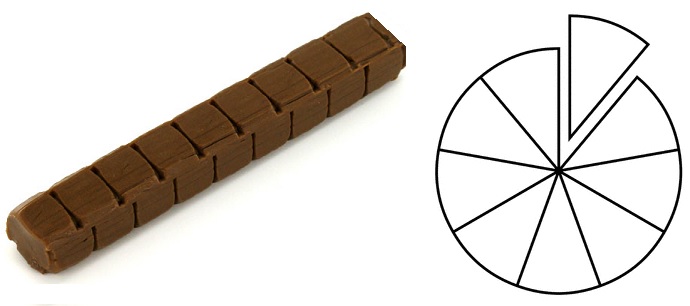
What the fuck is a tootsie roll?
The pie chart is counter intuitive? Anyone who has ever fought over pizza slices knows very well that 1/5 is larger than 1/6, even kids.
Here's a simple classroom script to teach kids about fractions:
1) Buy 2 pizzas, slice one in 8 pieces, the other in 12 pieces.
2) Take 20 students in the classroom and tell them to choose a piece from any of the pizzas.
3) Watch as war ensues
So one method is probably a small fraction better than another method of teaching fractions. This isn't how you enhance the next generation's education. This is how you make it look like you're doing something to help when you're actually just raising a fuss over the tiniest of things. This is the plastic banana slicer of education: an answer to a question nobody asked.
... and somebody read a school textbook.
Seriously. Textbooks have used multiple representations of fractions for years, one of which is linear, because the education research has indicated that different children learn better with different representations of fractions.
Well, at least we now know how long it takes for education research to trickle into the classroom: decades.
The comments on the site (as of this time) give some pretty good reasons why using slices of a circle aren't the best way to describe fractions. Most of the time it is easier for the mind to tell if two lengths are the same versus if two slices of a circle are the same. It is a much simpler calculation to determine length (line) then volume (pie piece).
There's 9 sections. What happens when you want to teach 1/4s, 1/2s, 16ths ?
That's why I think a bottle of Scotch is the new pie!
Now children, let me drink two shots, what fraction of the bottle did I just drink?
Now children, assume what's left is the whole and I drink another three shots, what fraction is left?
Now children, write a 1,000 word essay on why whiskey is the best math tutor whle I take a little snap.
The pre-segmented Tootsie Roll is actually a poor choice. A person who sees it already divided into seven chunks won't understand all those divisions have to move in order to divide it by eight.
John
I completely Agree... I've actually had a few public disagreements with Stephen Few (on his blog - Hi Stephen) about his love of bar charts.
He's absolutely right, technically, on the visual perception -- that it's easier to compare lengths to basically anything else (like pie slices), particularly shapes that vary in more than one dimension (is a 5x5 rectangle bigger than a 6x4? If you know the dimensions you can do the math, but if you look at the boxes it's not as easy).
BUT, where I disagree (and I seem to agree with parent AC) is that people get tired of bar charts. Kids, in particular, have amazingly short attention spans, and as any teacher knows, engaging a child in a learning experience is very important, and different students will learn different ways. Your example of buying pizzas for a class is a classic example (although war is not the standard goal). Cutting a long subway sandwich or tootsie roll may not have the same effect. In fact, it's possible that the measurements Stephen Few relies on to measure visual perception could change if we took the time early on not to cater only to what our students are already good at, but to exercise spatial considerations that could improve.
Pie charts have their place, if only to break up the monotony. Certainly we should teach kids ratios based on bars, lines, squares, and other things as well -- for the most part we already do -- but we should not say that any one way is the best, even if there's one measurement that "proves" it, at the expense of variety.
Math was taught and learned just fine for over 2000 years. Pretty damn arrogant to come along in the last 50 and think we know how to teach children math in a better manner than they've learned math all along. Pick your slogan, acronym, whatever. KISS (Keep It Simple Stupid), If it ain't broke, don't fix it... Nothing wrong with the way math has been taught all along. I have 4 kids that have all gone through Algebra in the last few years, and I had to go out and buy them Lego sets to learn Algebra. A true WTF moment for me. We didn't get Legos in school and still learned Algebra just fine. When they learned addition, subtraction, multiplication and division I'd help them with their homework only to hear "that's not how we do it" "our teacher taught us a different way" and we'd wind up taking 15 steps to solve a problem that should be done in 2 or 3. When people get paid to come up with "new and better" ways to do things, they have to come up with something or wind up losing that steady government paycheck. Doesn't matter that it's a worse solution than what's already in place, just that it's different.
This is just the latest episode in Stephen Few's war on pie charts. For anyone interested: http://www.perceptualedge.com/blog/?p=1492 http://www.perceptualedge.com/articles/08-21-07.pdf
Show them 1" on a ruler. Show them 1/4" increments. It's real easy to see 4 of those make up 1". Next show them 1/8" increments and 1/16" increment. They see pretty quickly how 16 can fit but the marks are smaller even though the number is bigger.
Now they've just learned how to read the crazy US Inch-standard system as well. Pretty handy for growing up in a slack-jawed yokel country who's politicians never let teachers adopt the metric system, but I digress...
Extra credit: show them a meter stick and listen to the gasp at how easy everything is because every little mark takes 10 units to get to the next larger unit of measure.
Join the Slashcott! Feb 10 thru Feb 17!
Uh, there *are* legit reasons for teaching the different classifications of fractions. For example, mixed fractions are the most intuitive representation of rational numbers. Improper fractions are the simplest way to write the number down, but not the most intuitive (for the given audience). Proper fractions are the remainder part of the mixed fraction, whereas the integers are taught in different lessons.
Math is hard, and teaching math is hard. The 'intuitive' or 'obvious' way to teach math isn't necessarily a good way.
I read TFA and all I got was this lousy cookie
However, there is little to no need for fraction in the real world
Let me guess, you find the the Big Mac button confusingly similar to the Quarter Pounder button.
Hint: One has 2/3rds of the number of buns of the other one. One bun, two buns, red bun, blue bun!
They need to use both.
I agree, some things like halving halves to make a quarter are easier to show in two dimensions.
And how do you visualize 1/3-1/5 or 1/3+1/5 with pies or tootsie rolls ? Either metaphor (pies or tootsie rolls) is fundamentally flawed in that it captures only 1 property of fractions (fraction of a whole) and that's it.
In UK schools they use Unifix blocks which are essentially the same as the "tootsie roll" examples. The way these would be used would be to make several columns of 15 blocks. One would be divided into three parts and the other into five. They could then easily illustrate adding 1/3 + 1/5 by adding one of the "three part division" to one of the "five part division". Counting would show that the answer was 8/15 and comparrison to the whole 15 parts would show that it is just over half.
This would also illustrate why you have to get the fractions to have the same denominator. Subtraction is a bit harder - they would have to take away the 3 15ths from the 5 15ths but you get the idea